HOA Called the Cops When I Said “I’m Not Under Your HOA”—They Didn’t Know I Owned the Entire Block
HOA Called the Cops When I Said “I’m Not Under Your HOA”—They Didn’t Know I Owned the Entire Block.
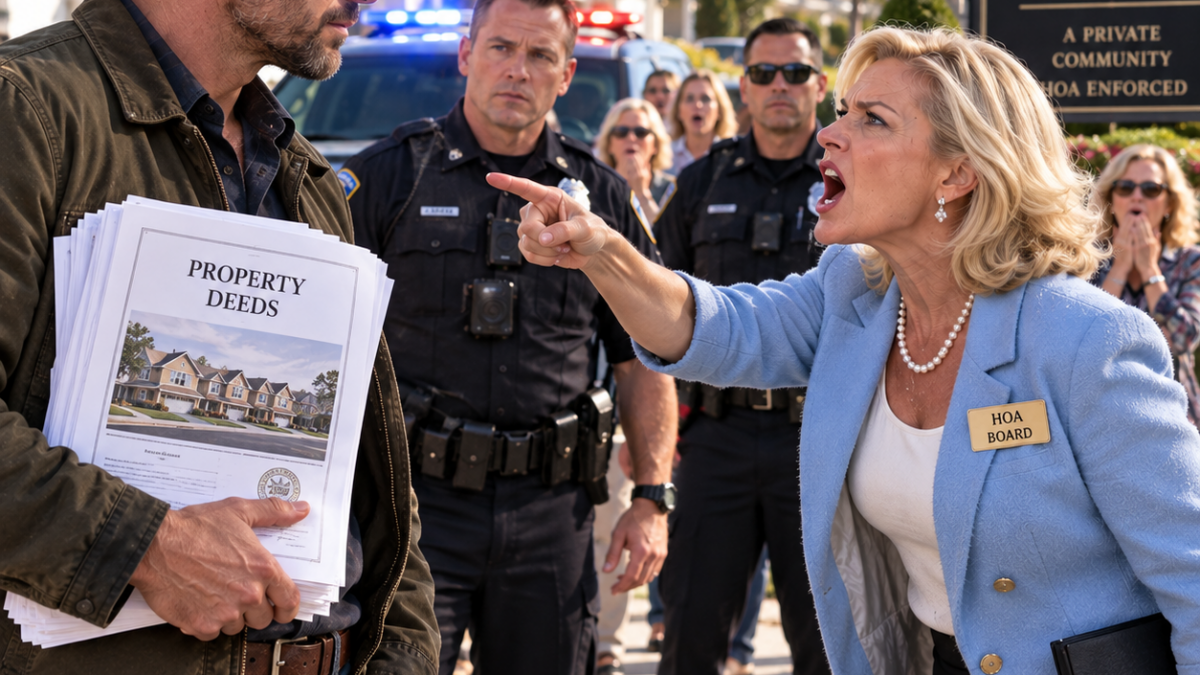
The HOA president called the police while I was installing a mailbox in my own front yard, pointed at me in front of half the street, and demanded the officer force me to obey community rules I had already discovered did not legally apply to a single house on my block.
She thought I was a new tenant who needed to be frightened into line, so when I calmly said, “I’m not under your HOA,” she laughed, called me a squatter, and demanded to know who the hell I thought I was.
Ten minutes later, the officer was holding a certified deed showing that I had just purchased all twelve homes on Willow Court—and the document that truly destroyed the HOA president was not my deed at all, but an annexation form sitting in her own files with four handwritten words beside her initials: HOLD. DO NOT RECORD.
My name is Nolan Reeves.
I was forty-one years old when I bought Willow Court.
All of it.
Twelve houses.
One cul-de-sac.
One short street behind Brookhaven Estates.
And, without knowing it at the time, six years of somebody else’s lies.
Before that, I spent fifteen years in commercial real estate.
Not selling suburban houses.
I bought distressed buildings, small retail centers, failed development parcels, warehouses nobody wanted, and occasionally pieces of property that looked worthless until you read the older documents.
That work taught me one lesson I trusted more than almost anything else:
Paper wins.
Not loud people.
Not expensive signs.
Not matching blazers.
Not somebody saying, “Everyone knows.”
Paper.
Deeds.
Recorded covenants.
Easements.
Assignments.
Closing statements.
County indexes.
PART2:
Documents are boring right up until the moment somebody realizes the thing they have been calling theirs never legally became theirs at all.
Willow Court started with a bankruptcy notice.
Halbrook Homes had once been one of the larger residential developers in our part of North Carolina.
During the good years, they built Brookhaven Estates.
Trimmed hedges.
Brick entrance monument.
Flags on porches.
Community pool.
Walking trails.
Clubhouse.
The sort of place where people talked about resale value before they talked about weather.
Then Halbrook overexpanded.
Interest rates moved.
Several projects stalled.
Debt piled up.
By the time creditors forced liquidation, the company’s portfolio was a mess.
Most investors looked at the auction package and moved on.
I didn’t.
PART3:
Messy portfolios are where mistakes hide.
One listing caught my eye.
WILLOW COURT RESIDENTIAL PORTFOLIO.
Twelve occupied single-family residences.
That by itself was not unusual.
What was unusual was the ownership.
I pulled the county records.
Lot one.
Halbrook Holdings LLC.
Lot two.
Halbrook Holdings LLC.
Three.
Same.
Four through twelve.
Same.
No individual homeowners.
No deeds transferring any of those houses to the families living there.
I called the receiver’s office.
“These are rentals?”
“Long-term occupancy agreements.”
“That isn’t what I asked.”
The woman sighed.
“Lease-to-own contracts.”
“Any closings?”
“Not according to the file.”
I sat back.
Twelve families had apparently been living on Willow Court under lease-purchase agreements that were supposed to convert into ownership later.
For one reason or another, those closings never happened.
The families maintained the homes.
Paid monthly amounts.
Some had probably lived there for years believing they were slowly moving toward ownership.
Legally, Halbrook still held every deed.
That made the portfolio interesting.
Then I checked Brookhaven.
The HOA declaration was recorded years before Willow Court had been completed.
It contained a legal description and a schedule of covered lots.
I read the schedule.
Then again.
Willow Court wasn’t there.
None of the twelve lots.
Maybe there had been an amendment.
I searched.
Nothing.
Annexation.
Nothing recorded.
Supplemental declaration.
Nothing.
That made no sense because the auction package contained HOA-related correspondence.
So I dug deeper.
Inside Halbrook’s old project files was an annexation document.
It looked complete.
It proposed adding Willow Court’s twelve lots to Brookhaven.
Signed by the developer.
Accepted internally by the HOA.
Notarized.
Everything except the one thing that mattered most.
No county recording information.
No instrument number.
No stamp.
No book and page.
Nothing.
It had been prepared.
Never recorded.
I called attorney Miriam Feld.
Miriam handled real-estate disputes for me whenever transactions stopped being boring.
She came to my office that afternoon.
I gave her the declaration.
Annexation form.
County search.
She read silently.
Then asked:
“You’re certain there isn’t a later recording under another entity?”
“I haven’t found one.”
“Don’t assume that means none exists.”
“I know.”
She spent another day checking.
Then called.
“You were right.”
“So Willow Court isn’t in Brookhaven?”
“Based on the records we’ve found, I would not say those lots are subject to the Brookhaven declaration.”
I leaned back.
“That’s lawyer language.”
“It means stop turning legal conclusions into T-shirt slogans.”
I laughed.
Then showed her something else.
County bankruptcy records contained expense schedules.
Willow Court residents had been paying Brookhaven HOA assessments.
Miriam stopped laughing.
“How long?”
“Looks like years.”
“Developer paying them?”
“No.”
“Residents.”
She stared at the numbers.
“If those lots were never properly subjected to the declaration, why was the association collecting assessments?”
“That’s the question.”
She closed the folder.
“Nolan, do not accuse anyone yet.”
“I wasn’t.”
“You have that face.”
“What face?”
“The one where you’ve already decided who the villain is.”
“I haven’t.”
“Good.”
“Keep it that way.”
She was right.
Maybe there was another agreement.
Maybe fees were voluntary.
Maybe the residents signed separate contracts.
Maybe somebody had simply made an administrative mistake six years earlier and everyone kept repeating it.
Facts first.
I bid on the portfolio.
Through Reeves Property Group.
There were other bidders, but not many.
Occupied lease-to-own houses in a bankrupt development come with complications.
Tenants.
Deferred maintenance.
Contracts.
Potential claims.
Title issues.
Nobody buying that package was getting twelve clean suburban flips.
The final bulk price was deeply discounted compared with the combined retail value of the homes.
I won.
Not for one hundred dollars.
Not for some magical auction loophole.
Real money.
Enough that I lost sleep between winning the bid and closing.
The receiver transferred all twelve deeds to Reeves Property Group subject to existing tenant rights.
I became landlord.
At least temporarily.
I did not announce myself.
That was deliberate.
Before deciding what to do with Willow Court, I wanted to understand the people already living there.
And I wanted to see how Brookhaven treated them when nobody important appeared to be watching.
The first person I met was Alma Reyes.
Seventy-four.
Widow.
Gray cardigan.
Gardening gloves.
I found her kneeling beside a row of marigolds.
I introduced myself only as Nolan Reeves, someone involved with the property transition.
Not false.
Not complete.
She invited me onto the porch for iced tea.
Her house was immaculate.
Not expensive.
Loved.
Photograph of her husband beside the television.
Grandchildren on the refrigerator.
A ceramic bird over the kitchen sink.
I asked how long she had lived there.
“Six years.”
“You like it?”
“I love the house.”
Pause.
“The HOA, not so much.”
“What happens with the HOA?”
She gave me a look.
Then disappeared inside.
Returned carrying a stack of paper thick enough to be a small textbook.
Violations.
Faded mailbox flag.
$125.
Decorative garden gnome.
$200.
Trash can left visible ninety minutes after collection window.
$400.
Flower-pot color.
$75.
One grass-height warning accompanied by a photograph taken from somewhere near her side window.
I frowned.
“They came onto your property?”
“They inspect.”
“Inside the fence?”
“Sometimes.”
“Did your lease authorize that?”
Alma looked confused.
“I don’t know.”
“Did you ever receive a copy of the Brookhaven declaration?”
“Welcome packet.”
“Recorded declaration?”
She shrugged.
“Mr. Hendrix always says if we don’t pay, they can put a lien on the house.”
Troy Hendrix.
Brookhaven property manager.
“How much are your regular HOA fees?”
She told me.
About $350 per month by then.
I nearly choked on my iced tea.
“For Willow Court?”
“Yes.”
“Everyone?”
“I suppose.”
“Why do you keep paying?”
Her hands trembled.
“I don’t want them to put me out.”
That sentence stayed with me.
“They can’t evict you.”
Alma looked down.
“They say fines can become liens.”
“Against whose property?”
“My house.”
Except it wasn’t legally her house yet.
Halbrook had never completed the lease-to-own closing.
The HOA was threatening a tenant with liens against property she did not own.
And if Willow Court was truly outside the declaration, the problem was even larger.
I walked the street.
Twelve houses.
I spoke to six families that day.
Seven more over the following week, counting spouses separately.
Same pattern.
Brookhaven fees.
Violation notices.
Threatening letters.
Unannounced inspections.
Fines.
One father named Marcus Lane showed me a letter from two years earlier.
He had missed a monthly assessment.
The notice threatened:
LIEN ENFORCEMENT AGAINST YOUR PROPERTY.
Marcus had three children.
At the time, his youngest had been in the hospital.
He paid the HOA instead of his car repair because he believed his home was at risk.
“The transmission survived another month.”
He laughed when he told me.
I did not.
I asked:
“Did Halbrook ever tell you these HOA payments were required under your lease?”
“I think so.”
“Think?”
“Troy collected them separately.”
That mattered.
I asked Miriam to review all twelve occupancy agreements.
None clearly subjected the tenants to Brookhaven HOA covenants independently of the property.
A few referred generally to neighborhood rules, but nothing we found created the legal structure Brookhaven had been representing.
Then I started calculating.
Twelve households.
Six years.
Fees rising over time.
Fines.
Processing charges.
Late fees.
The rough total crossed $450,000.
Miriam stared at my spreadsheet.
“This is not evidence of wrongdoing by itself.”
“I know.”
“But?”
“But we need the association’s records.”
Before filing anything, I hired a title examiner.
Paul Okafor.
Paul could spend eight hours reading county indexes and somehow emerge happier than when he started.
Two days later he called.
“Come here.”
His tone made me drive over immediately.
He had the Brookhaven historical file spread across his desk.
Original declaration.
Developer transfer.
Amendments.
Then the Willow Court annexation form.
He tapped the top.
“Prepared.”
“Yes.”
“Signed.”
“Yes.”
“Never recorded.”
“I know.”
Then he flipped it over.
Attached to the internal copy was an old yellow sticky note.
Four words:
HOLD. DO NOT RECORD.
Beneath them:
CW.
I stared.
“Who is CW?”
Paul raised one eyebrow.
“You tell me.”
Brookhaven HOA president:
Celeste Whitaker.
She had been on the board six years.
President for five.
Miriam came over.
Looked at the note.
Then at the form.
Then:
“Do we know she wrote this?”
“Not yet.”
“Do we know when?”
“Not precisely.”
“Do we know why?”
“No.”
She pointed at me.
“So we don’t say she deliberately prevented recording so she could collect money.”
“I didn’t say anything.”
“You were thinking loudly.”
Paul smiled.
Miriam ignored him.
“We need board minutes.”
“Management correspondence.”
“Bank records eventually.”
“But this note changes the questions.”
That night I sat at my kitchen table thinking about Alma.
Six years of fear.
Paying fines because she thought somebody could take away a house she did not even legally own.
Marcus delaying a car repair.
Families paying $350 a month.
Celeste’s initials potentially sitting beside an instruction not to record the document that would have given the HOA the authority it claimed.
Miriam wanted to file quickly.
I asked her to wait one week.
“For what?”
“I want to move into Willow Court.”
She stared.
“You own twelve houses.”
“One is vacant.”
“Yes.”
“I’ll use it.”
“Why?”
“I want to see what they do.”
“Nolan.”
“I won’t provoke anything.”
“You absolutely will provoke something simply by breathing near a rule you think is invalid.”
“I need to replace the mailboxes anyway.”
She closed her eyes.
“That sentence worries me.”
The first house at the mouth of Willow Court had become vacant during bankruptcy.
I moved enough furniture in to make it livable.
Bed.
Desk.
Coffee maker.
Two chairs.
Nothing fancy.
For the residents, I was simply the new man in number one.
I did not hide my name.
I did not announce the ownership structure.
The first morning, Alma brought banana bread.
Marcus introduced himself.
Kids rode bikes through the cul-de-sac.
Normal street.
The next morning a blue folder appeared jammed into my door handle.
WELCOME TO BROOKHAVEN.
Inside:
Architectural rules.
Fee schedule.
Community standards.
Violation policy.
Warning:
FAILURE TO COMPLY MAY RESULT IN FINES, COLLECTION ACTION AND LIEN ENFORCEMENT.
I stood on the porch drinking coffee.
Then folded the packet.
Set it aside.
Three days later I replaced my mailbox.
The existing boxes on Willow Court were in terrible condition.
Alma’s leaned.
Marcus’s had rust at the bottom.
Mine had a cracked post.
I ordered twelve simple black rural-style boxes with sturdy wood posts.
No decorative nonsense.
No violation traps.
I started with mine.
Saturday morning.
Sunny.
Halfway through tightening the final screw, Alma came outside.
“Looks nice.”
“Thanks.”
She glanced toward Brookhaven’s main road.
“They won’t like it.”
“Who?”
She laughed.
“You know.”
I kept working.
Ten minutes later, two women turned onto Willow Court.
Navy blazers.
Clipboards.
Celeste Whitaker walked first.
Blonde hair perfectly shaped.
Beside her:
Joyce Danner, board secretary.
Joyce looked uncomfortable before she even reached my lawn.
Behind them, a marked patrol vehicle rolled slowly into the cul-de-sac.
I stopped tightening the screw.
Not because I was scared.
Because I could not believe Celeste had called police over a mailbox before even speaking to me.
She stopped on the grass.
“Sir.”
“Yes?”
“This mailbox violates Section Nine of Brookhaven’s architectural standards.”
I looked at the mailbox.
Then at her.
“It’s black.”
“Only association-approved models are permitted.”
“Okay.”
“You’ll need to remove it immediately.”
“No.”
Her eyebrows lifted.
“And you’ll be assessed a four-hundred-dollar violation.”
“No, I won’t.”
Joyce shifted.
Celeste’s voice became colder.
“Excuse me?”
“I’m not under your HOA.”
People began appearing on porches.
Alma.
Marcus.
A couple across the street.
A teenager with his phone.
Celeste gave a short laugh.
“Everyone on Willow Court belongs to Brookhaven.”
“No.”
“That is how this development works.”
“I’ve read the declaration.”
Her smile changed.
Small detail.
But I saw it.
“You are a new tenant.”
“No.”
“Regardless, tenants do not get to modify exterior property without association approval.”
I set the screwdriver down.
“Still no.”
She turned toward the patrol car.
“Officer?”
Sergeant Lena Ortiz stepped out.
Gray streaks in dark hair.
Calm.
Professional.
Her hand rested near her duty belt but never touched her weapon.
She walked over.
“What seems to be the issue?”
Celeste spoke first.
“This individual is refusing to comply with community property restrictions and has altered association-controlled streetscape property.”
I almost admired the sentence.
Sergeant Ortiz looked at the mailbox.
“Sir, is this your residence?”
“Yes.”
“Did you install the mailbox?”
“Yes.”
Celeste interrupted.
“Without authorization.”
Ortiz held up a hand.
“Ma’am, let me ask.”
Then to me:
“Do you own the property?”
“Yes.”
Celeste laughed.
“He moved here two weeks ago.”
I said:
“Three days.”
She looked triumphant.
Ortiz asked:
“Do you have documentation?”
“Yes.”
I went to my porch.
Picked up the folder Miriam prepared because she knew me too well.
Returned.
Handed Ortiz the first page.
Certified deed.
She read.
Then looked at me.
“This is Reeves Property Group.”
“Yes.”
“Your company?”
“Yes.”
Next:
Portfolio schedule.
Lots 1 through 12.
Willow Court.
All transferred to Reeves Property Group through the court-approved bankruptcy sale.
Ortiz continued reading.
Celeste stepped closer.
“What is that?”
Ortiz did not answer immediately.
I handed over the Brookhaven declaration.
Covered-lot schedule highlighted.
No Willow Court.
Then certified county search showing no recorded Willow Court annexation.
Ortiz looked at Celeste.
“Ms. Whitaker?”
Celeste’s face stiffened.
“This is a clerical issue.”
“Maybe.”
Ortiz was careful.
Good.
She did not pretend to be a property judge.
She continued:
“But I don’t see anything here that allows me to treat this as criminal interference or force him to remove a mailbox.”
Celeste pointed toward me.
“He is disruptive.”
I laughed.
“I’m holding a screwdriver.”
“He is intentionally violating community standards.”
Ortiz said:
“That appears to be a civil property or covenant issue.”
Exactly.
Celeste’s voice rose.
“He does not belong here.”
I said nothing.
She pointed.
“Who the hell are you?”
That was the moment.
Not because I had rehearsed it.
I had imagined something clever.
In reality, simple sounded better.
“Nolan Reeves.”
“I know your name.”
“I own Reeves Property Group.”
Silence.
Then:
“My company bought Willow Court.”
Celeste stared.
I continued.
“All twelve houses.”
Somewhere behind her, Alma gasped.
Joyce’s folder slipped slightly.
Celeste shook her head.
“That’s impossible.”
I handed Ortiz the portfolio conveyance.
She looked.
Then said:
“Ms. Whitaker, these appear to be recorded deeds.”
Celeste said:
“The developer owned those houses subject to Brookhaven.”
I answered:
“Then show us the recorded document that subjected Willow Court to Brookhaven.”
Her jaw tightened.
“It exists.”
“Good.”
“Bring it.”
Joyce turned toward her.
“Celeste?”
“Not here.”
Those two words changed everything.
Not:
You’re wrong.
Not:
Here is the instrument.
Not:
County lost it.
Not here.
People on the street heard that.
I looked toward the neighbors.
Then said something I had not planned.
“Don’t stop paying anything because of what I say today.”
Miriam would have approved.
“Let the attorneys and records sort out what’s valid.”
“But keep every notice.”
“Every receipt.”
“Every check.”
Celeste snapped:
“You are not authorized to advise our members.”
I looked at her.
“They may not be your members.”
The cul-de-sac went silent again.
Joyce Danner had gone pale.
Sergeant Ortiz closed the folder.
“I’m not resolving HOA jurisdiction on the street.”
She handed it back.
“But I’m not ordering Mr. Reeves to remove property based on what I’ve seen.”
Celeste said:
“I called about disorderly conduct.”
Ortiz looked around.
Kids on bikes.
A mailbox.
Twelve neighbors.
No disorder.
Then:
“I don’t see that.”
That was enough.
No dramatic arrest.
No police officer declaring the HOA fraudulent.
Just a boundary.
Civil dispute.
No police enforcement.
Celeste turned to leave.
Then Alma spoke.
Quietly.
“What about my fines?”
Celeste stopped.
Alma stepped off her porch holding that thick stack of notices.
“You told me you’d put a lien on my house.”
Celeste said:
“Alma, this isn’t the place.”
“It’s my street.”
Marcus came out carrying his own envelope.
“You threatened me too.”
Other neighbors joined.
Celeste raised her clipboard.
“Please direct questions to management.”
Joyce suddenly said:
“Celeste.”
Celeste spun.
“Not now.”
Joyce opened her blue folder.
Her hands were shaking.
She pulled out a photocopy.
Then another sheet.
“I found this last month.”
Celeste stared.
Joyce held up the annexation form.
Attached:
The sticky note.
HOLD. DO NOT RECORD.
CW.
The air changed.
Celeste whispered:
“Joyce.”
Joyce had tears in her eyes.
“You told me the annexation was recorded before I joined the board.”
“This isn’t the place.”
“Was it?”
“Joyce.”
“Was it recorded?”
Celeste did not answer.
Sergeant Ortiz looked at the papers but did not take them.
She said calmly:
“If there are allegations involving financial collections or false documents, you’ll need counsel and potentially the appropriate investigative agency.”
Celeste’s face went red.
“This man staged this.”
I shook my head.
“You called the police.”
That shut her up for one second.
Then she walked away.
Fast.
Not running.
Almost.
The patrol car left after Ortiz gave me an incident number.
Before leaving she said:
“Mr. Reeves?”
“Yes?”
“Keep the documents.”
“I plan to.”
“You’d be surprised.”
“No.”
“I really wouldn’t.”
The street stayed outside for another hour.
Questions everywhere.
Are we in the HOA?
Do we keep paying?
Can they really lien us?
Who owns our homes?
What happens to our lease-purchase agreements?
That last question mattered most.
I raised my hands.
“Listen.”
“These are separate issues.”
“I bought the properties subject to whatever valid tenant rights you already have.”
“I am not evicting anybody.”
Alma started crying.
I continued.
“I need attorneys to review each lease.”
“Until then, don’t sign anything new from anyone without understanding it.”
Marcus asked:
“Are you raising rent?”
“No decision today.”
“Are you selling?”
“Eventually, maybe.”
“To who?”
I looked around the street.
“To you, if we can make it work.”
That spread faster than anything else I said.
Miriam arrived thirty minutes later.
She got out of her car.
Saw the crowd.
Saw Celeste was gone.
Saw the new mailbox.
Then looked at me.
“What did you do?”
“Installed a mailbox.”
She closed her eyes.
The next morning she filed for declaratory relief and accounting.
Not a magical “class action” that instantly solved everything.
First:
Determine whether Willow Court had ever been legally annexed.
Second:
Require Brookhaven to account for fees and fines collected from occupants of those parcels.
Third:
Preserve records.
Board minutes.
Bank statements.
Management communications.
Collection notices.
Anything involving Willow Court.
The twelve families obtained separate advice concerning their individual payments and lease rights.
Miriam coordinated with their lawyer once several residents retained one together.
That mattered.
I owned their houses.
I did not want to pretend that made me their attorney or their savior.
Power becomes dangerous quickly when somebody decides being helpful makes normal rules optional.
We had already seen enough of that.
Brookhaven’s initial response was predictable.
Administrative oversight.
Long-standing community understanding.
Residents received amenities.
Residents benefited from streets, landscaping and security.
Therefore assessments were equitable.
Miriam’s response was simple.
Equitable is not the same as authorized.
If Brookhaven had another contractual basis, produce it.
They produced newsletters.
Budgets.
Welcome packets.
Invoices.
Policies.
No recorded annexation.
Then discovery reached old board records.
The sticky note became important.
But we still needed authorship and context.
Joyce testified that she found it attached to the annexation original.
Former board members were interviewed.
One remembered a dispute six years earlier.
Halbrook had wanted Willow Court included in Brookhaven but did not want to surrender control of certain roads and maintenance obligations.
Negotiations stalled.
The annexation was prepared but held pending resolution.
Then Halbrook’s finances worsened.
Somebody never completed the recording.
Meanwhile residents moved in.
The management company began billing them.
Question:
Did Celeste know?
Emails answered that.
One old exchange from Troy Hendrix to Celeste:
WILLOW ANNEXATION STILL NOT RECORDED. DO WE PAUSE BILLING?
Celeste replied:
NO. RESIDENTS ALREADY OPERATING AS PART OF COMMUNITY. CONTINUE UNTIL LEGAL CLEANUP.
Another email months later:
COUNSEL NEEDS UPDATED DEVELOPER SIGNATURE BEFORE RECORDING.
Reply:
HOLD FOR NOW. DON’T CREATE AN ISSUE WITH HALBROOK.
CW.
Miriam read it twice.
Then looked at me.
“Now we can say she knew.”
That was the difference.
Suspicion first.
Evidence later.
The financial accounting began.
Fees.
Fines.
Late charges.
Violation-processing costs.
Some payments properly went into general Brookhaven operating accounts.
Landscaping.
Security.
Pool.
Management.
That complicated the case.
Because Willow Court families had sometimes used Brookhaven amenities.
Celeste’s lawyer argued they had received value.
Fine.
That might matter to damages.
It did not magically create covenant authority.
Then the forensic accountant found reserve transfers.
Nearly $190,000 connected to Willow Court collections had passed through accounts that required much harder explanation.
Vendor reimbursements.
“Executive community improvement advances.”
Transfers to an entity linked to Celeste.
One payment contributed to renovation work at her private pool.
Another to kitchen remodeling invoices.
A larger transfer eventually reached an account used toward a lake-house deposit.
Troy Hendrix was questioned.
At first:
Normal reimbursement.
Then:
Board-authorized spending.
Then, when asked for approvals:
“I followed Celeste’s instructions.”
That was when the dispute stopped being only about HOA jurisdiction.
Potential criminal conduct is not something I diagnose.
We gave the records to the proper people.
State investigators reviewed them.
County prosecutor reviewed them.
The board hired independent counsel.
Brookhaven residents learned what had happened gradually.
That mattered too.
I did not want to stand on Willow Court shouting:
Your HOA president stole your money.
We had seen suspicious transfers.
Investigators determined what crimes, if any, those records supported.
Celeste resigned before the civil hearing.
She did not escape the investigation.
Neither did Troy.
Brookhaven’s board held an emergency membership meeting.
I attended only because Willow Court ownership was on the agenda.
The clubhouse was packed.
People stood along walls.
Some angry at Celeste.
Some angry at me.
One man shouted:
“You bought twelve houses and blew up our association.”
I answered:
“Your declaration existed before I got here.”
That was all.
Joyce Danner sat at the front.
She had resigned as secretary temporarily while records were examined.
Then agreed to cooperate with independent counsel.
When public comment began, Alma Reyes walked to the microphone.
She brought her stack of violations.
Placed them on the table.
“I paid every one.”
The room quieted.
“I paid because I thought they could take my house.”
She looked toward me.
Then toward the board.
“Turns out it wasn’t even my house yet.”
Her voice shook.
“But you still scared me with losing it.”
Nobody laughed.
Marcus spoke next.
He told them about his child’s hospital stay.
About choosing the HOA assessment over transmission repair.
Then:
“I don’t care if you say we used the pool twice.”
“I paid because your letters threatened my home.”
That distinction mattered more than any spreadsheet.
Brookhaven homeowners began asking their own questions.
Why did dues pay a management company that kept billing unannexed lots?
Who authorized transfers?
Why had counsel not corrected the Willow Court issue?
Why did the board keep sending violations after learning the recording problem?
Celeste was not present.
Her lawyer was.
He took notes.
Months followed.
Real cases do not finish after one dramatic mailbox scene.
Documents.
Depositions.
Mediation.
Accounting.
Insurance carriers.
Board votes.
Tenant-law review.
Bankruptcy court clarification.
I spent more on attorneys than I had budgeted.
At one point, I wondered whether buying Willow Court had been the worst “opportunity” of my career.
Miriam said:
“That’s because you bought a lawsuit with twelve roofs attached.”
“Helpful.”
“You pay me for honesty.”
“I thought I paid you to win.”
“You pay me to keep you from doing stupid things while we try.”
Fair.
The court eventually ruled that the Brookhaven declaration, as recorded during the relevant period, did not subject the twelve Willow Court lots to HOA covenant authority.
The never-recorded annexation could not simply be treated as though the recording had happened.
Brookhaven could not rely on its architectural restrictions, lien provisions or mandatory-assessment framework against those parcels for the disputed period absent another valid basis.
The accounting and restitution issues continued separately.
Some categories were easier than others.
Violation fines tied exclusively to purported covenant authority?
Strong refund claims.
Certain administrative charges?
Same.
Regular assessments became more complicated because attorneys argued over benefits received and payments made under mistaken assumptions.
Settlement eventually resolved much of that.
The affected Willow Court households received substantial refunds and credits.
Interest on certain amounts.
Legal-fee contributions.
Written releases from claimed violations.
Most importantly:
No outstanding HOA lien claims.
The criminal side moved independently.
Investigators concluded enough evidence existed to charge Celeste with offenses related to misappropriated funds and false representations.
Troy cooperated.
Eventually accepted a plea arrangement and testified regarding payment instructions.
I attended only the hearings where I was needed.
Alma attended more than I did.
Front row.
Gray cardigan.
Hands folded.
She later told me:
“I wanted her to see the people on the other side of the spreadsheet.”
I understood.
Celeste eventually faced restitution obligations as part of the legal resolution.
I never celebrated the sentence.
By then I was more interested in Willow Court.
Because I had made a promise on mailbox day.
I told the families I would try to create a real path to ownership.
That became harder than saying it.
Some lease-to-own contracts credited portions of past payments toward purchase.
Others were poorly drafted.
Bankruptcy complicated obligations.
The receiver had transferred the portfolio subject to valid contract rights.
We had to determine what each tenant had already earned.
Miriam insisted on separate calculations.
“No blanket shortcut.”
“But I own everything.”
“Which is exactly why you don’t get to decide everybody’s rights by generosity.”
I frowned.
She continued:
“You can offer favorable deals.”
“You cannot erase contractual credits because you’re trying to be the hero.”
Point taken.
We hired independent closing counsel.
Reviewed every file.
Where residents had accumulated valid purchase credits, those credits stayed.
Where Halbrook had promised specific purchase terms enforceable against the successor, we honored them.
For the rest, Reeves Property Group offered purchase prices based largely on our allocated acquisition cost plus necessary transaction expenses—not full retail market value.
I made very little on those sales.
That was intentional.
But I also refused to create another hidden trap.
Each family got independent legal-review time.
No five-day deadline.
No “sign before Friday.”
No obligation to buy.
If they preferred renting temporarily, we created written leases.
If they wanted to leave, we worked out reasonable transitions.
Alma was the first closing.
She sat across from me at the title company wearing a blue dress.
Kept checking every page.
Good.
The closing attorney explained everything.
Then she signed.
At the end, the attorney slid the deed toward her.
Alma touched it.
Did not pick it up immediately.
“That’s mine?”
The attorney smiled.
“Once recording completes, yes.”
She looked at me.
“Actually mine?”
“Yes.”
She cried.
So did I.
Didn’t expect that.
She said:
“My husband was supposed to see this.”
I had no answer for that.
A week later the recorded deed arrived.
She framed a photocopy.
Kept the certified original somewhere safer.
I hope.
Marcus closed two months later.
His children helped paint the garage.
Other families followed.
Not every one.
Two chose to move.
One could not qualify immediately for financing, so we created a longer-term purchase path with outside counseling and no HOA pressure attached.
By the end of eighteen months, nine of the twelve households owned their homes.
One more closed the following year.
For the first time, Willow Court was actually a street of homeowners.
Not tenants being threatened with liens against somebody else’s deeds.
Then came the question:
Would Willow Court join Brookhaven now?
That surprised everyone.
Brookhaven’s new board approached respectfully.
Joyce Danner had returned after the investigation and was elected to help rebuild governance.
She came to a Willow Court meeting.
No blazer.
No clipboard.
Just a folder.
She said:
“We would like to discuss voluntary annexation.”
Marcus laughed.
Alma said:
“You’ve got nerve.”
Joyce smiled.
“Fair.”
Then she did something Celeste never had.
She explained.
Actual benefits.
Pool access.
Common-area maintenance.
Security patrol.
Events.
Costs.
Voting rights.
Assessment structure.
Architectural restrictions.
Then she said:
“You can say no.”
That changed the room.
Several residents wanted nothing to do with Brookhaven ever again.
Understandable.
Others used the pool.
Had friends there.
Liked the trails.
Wanted voting rights if they were going to participate.
I no longer owned most of the homes, so it was not my decision.
Good.
That was exactly how it should be.
Eventually, after months of discussion, some owners chose to join under a properly drafted and properly recorded annexation.
Others did not.
That created legal and practical details the lawyers handled.
No one pretended a colored map solved it.
Alma declined.
“I’m too old to have somebody measuring my garden gnome.”
Joyce laughed.
“So noted.”
Alma’s gnome became famous.
Small thing.
Red hat.
Green shirt.
The HOA had fined her two hundred dollars for it years earlier.
After her refund came, she bought five more.
Placed them in the garden like a tiny union meeting.
I asked:
“Isn’t this excessive?”
She answered:
“Freedom.”
Hard to argue.
My mailbox stayed too.
Simple black box.
Nothing special.
Except people kept photographing it.
Local news eventually picked up the story.
Their headline was dramatic.
MAN BUYS ENTIRE STREET, CHALLENGES HOA.
I hated it.
Made it sound like I bought Willow Court to wage war.
I didn’t.
I bought distressed real estate because that was my business.
I discovered the HOA problem afterward.
The title records did not become true because I arrived.
They had been true for six years.
I simply read them.
That distinction matters.
People like stories where one clever person arrives and defeats some giant machine.
Reality was messier.
Paul found the recording history.
Miriam kept me from saying stupid things.
Joyce produced internal records.
Willow Court families saved receipts.
A forensic accountant followed money.
Investigators did their jobs.
Sergeant Ortiz refused to let a civil property argument become police enforcement.
Brookhaven homeowners demanded accountability.
Even the bankruptcy receiver preserved enough records to reconstruct what Halbrook had promised.
Paper wins.
But only when people keep it.
The most difficult conversation I had happened with Joyce about a year later.
We sat outside Alma’s house during a block gathering.
She asked:
“Do you think I should have known?”
“Known what?”
“About the annexation.”
“You were secretary.”
“After it happened.”
“You found the sticky note eventually.”
“Not soon enough.”
I thought about it.
“Did Celeste tell you it was recorded?”
“Yes.”
“Did counsel treat Willow Court like it was inside?”
“Yes.”
“Did management bill them?”
“Yes.”
“Then why would you assume otherwise?”
She stared at the street.
“Because I should have read the declaration.”
I smiled.
“That’s fair.”
She laughed.
“You don’t have to agree that fast.”
“I’m not good at fake comfort.”
“So I’ve heard.”
Then she said:
“What scared me was how easy it was.”
“What?”
“Everybody believed everybody else had checked.”
That was exactly it.
Property manager assumed the board knew.
Secretary assumed president knew.
Residents assumed management knew.
Police were initially told rules existed.
Homeowners elsewhere assumed Willow Court paid because Willow Court belonged.
Six years of assumptions.
One unrecorded form.
That is how institutional mistakes become traditions.
And once money begins moving, people become reluctant to ask whether the original assumption was wrong.
That is why recording matters.
A recorded declaration gives notice.
A properly recorded annexation creates a public trail.
Future buyers can find it.
Lenders can find it.
Title companies can find it.
Residents can find it.
Without that, an internal folder is just an internal folder.
Celeste understood enough to know recording mattered.
Her emails proved it.
That was what made her conduct different from an innocent mistake.
She knew the cleanup had not happened.
She allowed billing to continue anyway.
Then the money became useful.
That was the tragedy.
Not a mailbox.
Not even a gnome.
Money.
Systems become dangerous when the people controlling them discover nobody is checking.
Brookhaven survived.
Important point.
The HOA did not collapse.
Nobody bulldozed the clubhouse.
Nobody lost houses because of the scandal.
The new board hired independent management.
Implemented dual approval for large transfers.
Published clearer financial reports.
Required counsel to verify covenant authority before lien action.
Created records-retention policies.
Boring reforms.
Excellent reforms.
People sometimes ask whether I hate HOAs.
No.
I hate sloppy authority.
An HOA can maintain shared property effectively.
A city can regulate roads.
A landlord can enforce leases.
A bank can protect collateral.
All legitimate.
But authority needs a source.
If you fine someone, show the covenant.
If you claim a lien right, show where it comes from.
If you say their lot joined an association, show the recorded annexation.
“That’s how we’ve always done it” is not a legal description.
Celeste’s greatest weapon had been certainty.
She stood on my lawn certain I had to obey.
Certain the police would make me.
Certain Willow Court belonged to Brookhaven.
Certain nobody would ask for the document.
When I said:
“I’m not under your HOA,”
she heard rebellion.
I meant something much simpler.
Show me.
She couldn’t.
Years later, Sergeant Ortiz came to a neighborhood fundraiser.
Recognized me.
Pointed toward the mailbox.
“Still illegal?”
I laughed.
“Apparently.”
She said:
“You know what I remember?”
“What?”
“Everybody expected me to pick a side.”
“Did you?”
“I picked leaving property law to people who get paid more to read it.”
“Wise.”
Then she added:
“You gave me a lot of paper.”
“I warned you it would take thirty seconds.”
“It took longer.”
“Sorry.”
“No, you’re not.”
She was right.
Reeves Property Group eventually sold the final Willow Court house.
I did keep one small property nearby as an office for a few years.
Then sold that too.
I had gone into the deal expecting profit.
I made less than I would have if I pushed every house to market value.
I was fine with that.
There are deals where maximum return is the right goal.
Willow Court stopped being one of them.
Not because I became charitable overnight.
Because there was already too much extracted from those families through confusion and fear.
I did not need to add myself to the line.
The last family to buy was the Chambers family.
Their financing took almost two years.
Medical debt.
Credit issues.
Nothing scandalous.
Just life.
When their deed recorded, the street held a party.
Not my idea.
Alma organized it.
Folding tables.
Hot dogs.
Macaroni salad.
Kids riding bicycles.
Every mailbox different by then.
Black.
White.
Brick posts.
One had flowers painted on it.
One looked terrible.
Nobody died.
At the center of the cul-de-sac, Alma placed her original garden gnome.
She tied a tiny paper sign around its neck.
FINE ME.
I almost fell over laughing.
“Alma.”
“What?”
“You’re seventy-six.”
“And?”
“Nothing.”
She pointed at me.
“Don’t start acting like an HOA.”
Fair warning.
Near sunset, I stood at the end of Willow Court.
Twelve houses.
Lights coming on.
Families talking.
Nothing about the street looked revolutionary.
That’s what I liked.
The biggest victories in property disputes are usually boring afterward.
People go home.
Pay mortgages.
Mow grass.
Replace mailboxes.
Plant ridiculous garden decorations.
No legal notice waiting on the door.
No one frightened by authority that never existed.
I thought about the morning Celeste called the police.
She believed the patrol car was power.
The clipboard was power.
Her title was power.
She was wrong.
Then I thought about my own reveal.
“I own this entire block.”
For a while, I liked that sentence too much.
It sounded powerful.
But ownership was not the most important thing I discovered either.
Because owning twelve deeds did not make me entitled to control twelve families.
Those families had leases.
Rights.
Histories.
Homes.
The fact that I bought the block did not mean I bought the people living on it.
That lesson mattered just as much as anything Brookhaven learned.
Power is legitimate only inside its boundaries.
HOA.
Landlord.
Police.
Property owner.
Anyone.
The moment you forget the boundary, a document eventually reminds you.
Celeste had an annexation form that could have been recorded.
Maybe Brookhaven could have lawfully added Willow Court six years earlier.
Maybe the residents would have accepted it.
Maybe fees would have been valid.
But somebody wrote:
HOLD. DO NOT RECORD.
Then continued acting as though those words did not matter.
They mattered.
More than the blue folders.
More than six years of violation notices.
More than the patrol car at my curb.
Four words in blue ink changed the history of an entire street.
That is why I still tell people the same thing I learned fifteen years before Brookhaven.
When property is involved, do not begin with the person shouting.
Begin with the paper.
Read the deed.
Read the declaration.
Read the amendments.
Read what was actually recorded.
Then read the little note somebody hoped no one would notice.
Because sometimes the truth is not hidden.
Sometimes it has been sitting in a filing drawer for six years, waiting for somebody patient enough to ask why the most important document in the folder never made it to the courthouse.
And sometimes the person who finally asks that question happens to be standing beside a brand-new mailbox while the HOA president is calling the cops on the man who owns the whole block.


