HOA Bulldozed the Hedge My Late Wife Spent 30 Years Growing—So I Built a 15-Foot Razor-Wire Wall They Couldn’t Touch
PART2:
Across the road, Dale Hutchins was already walking toward me.
Dale was sixty-four, a retired Marine, lean and hard in the way some men remain long after the uniform is gone.
He usually didn’t waste words.
That evening he looked like he had too many.
“Garrett.”
I kept staring at the destroyed boundary.
“What happened?”
He stopped beside me.
“I tried to stop them.”
I turned.
“Who?”
His jaw tightened.
“Tammy.”
That single name was enough.
Tammy Caldwell.
President of the Bridgewater Estates Homeowners Association.
Fifty-two.
Former luxury-home sales manager.
Current self-appointed ruler of all visible earth within approximately half a mile of her stone entrance monument.
Bridgewater had been built twelve years earlier on land west of mine.
Before that, it had been pasture.
Cedar.
Two stock tanks.
A collapsing pole barn.
And one old ranch road.
PART3:
The developer bought it from the Matheson family and turned it into eighty-six houses with limestone facades, black mailboxes, decorative gas lamps, and enough beige stucco to make a person appreciate barns.
My property was not part of Bridgewater.
That detail mattered.
I owned twenty-six acres.
My father bought the first fourteen in 1978.
I bought twelve more after I married Elaine.
We built our house there in 1989.
No HOA.
No deed restrictions beyond ordinary county rules.
Agricultural zoning on the rear acreage.
Residential homestead around the house.
The subdivision came later.
Much later.
That never stopped Tammy from treating my property as unfinished HOA business.
The first complaint came three years after Bridgewater opened.
My barn roof was “visually inconsistent with neighborhood character.”
I ignored it.
Then my tractor was “commercial equipment visible from premium residential lots.”
I ignored that too.
Then cattle fencing became “industrial wire.”
Then my gravel drive “generated dust.”
Then my old stock trailer was “unsightly.”
I eventually sent one certified letter.
It said:
I am not a member of Bridgewater Estates HOA. Please stop sending me violation notices.
For a while, they stopped.
Then Tammy became president.
Everything started again.
Tammy was the kind of person who never raised her voice until she was certain other people were watching.
Then she became theatrical.
She liked phrases such as:
“Community expectations.”
“Shared property values.”
“Visual stewardship.”
“Neighborhood integrity.”
Elaine used to call it decorative dictatorship.
She met Tammy only once.
That was enough.
Elaine died four years before the bulldozer.
Pancreatic cancer.
Ten months from diagnosis to funeral.
We had been married thirty-four years.
She was fifty-nine.
Some people tell you grief becomes easier.
I don’t know if that’s true.
It becomes familiar.
That’s different.
The first year without her, every room in the house felt like it was holding its breath.
I would turn toward the kitchen expecting her at the counter.
Walk into the bedroom and listen for drawers.
Wake before sunrise and reach across the mattress.
The trees were different.
They were alive.
That mattered.
We planted the first six in 1992 because prevailing wind hit the west side of the house hard.
Elaine found a nursery outside Austin selling small Leylands cheap.
They were barely taller than she was.
She planted three.
I planted three.
Mine leaned.
Hers didn’t.
For thirty years, we added trees.
One or two every spring.
Sometimes five.
Replacing weak ones.
Filling gaps.
By the time Bridgewater appeared, the hedge was already tall.
By the time Tammy appeared, it was a forest wall.
Elaine loved it.
She strung small white lights through the first twenty feet every Christmas.
Hummingbirds nested nearby.
Owls sat in the upper branches.
Our children, Seth and Morgan, built forts beneath them.
Elaine kept a folding chair in the shade.
After she got sick, she sat there most afternoons because chemotherapy made sunlight difficult.
Three weeks before she died, I wheeled her out beneath those trees.
She looked up.
Said:
“Don’t let anybody cut these ugly things down.”
I laughed.
“They aren’t ugly.”
“They’re absolutely ugly.”
“They’re ours.”
“That’s why I like them.”
Then she closed her eyes.
That was Elaine.
Love without performance.
So when Dale said Tammy’s name, something in me went cold.
“What did she do?”
Dale pointed toward the raw strip.
“She came about nine this morning.”
“Crew behind her.”
“Dozer.”
“Excavator.”
“Dump trailer.”
“I walked over.”
“She had paperwork.”
“What paperwork?”
“HOA vegetation-removal authorization.”
I stared at him.
“For my land?”
“She said the hedge crossed into the common fire corridor.”
“There is no common fire corridor.”
“I told her that.”
“What happened?”
“She said the board had legal confirmation.”
“Who operated the dozer?”
“Blue Canyon Earthworks.”
I knew them.
Legitimate local company.
Not cowboys.
“Did you tell them it was my property?”
“Three times.”
“Foreman said Tammy showed him a survey.”
“What survey?”
Dale reached into his back pocket.
Pulled out a folded photograph.
Phone printout.
“I took pictures.”
He handed it to me.
The plan showed my western boundary.
Or supposedly showed it.
A thick yellow shaded band labeled:
BRIDGEWATER WESTERN FIRE BUFFER — HOA MAINTENANCE AREA.
It extended thirty feet onto my side.
My house wasn’t drawn correctly.
My barn wasn’t located correctly.
The north corner pin wasn’t where it belonged.
I knew immediately.
“This is fake.”
Dale nodded.
“I figured.”
“County survey?”
“Didn’t say.”
“Engineer?”
“No stamp.”
“Recorder?”
“No.”
Then Dale looked down.
“Garrett.”
“What?”
“They got the bench too.”
I stopped.
“What bench?”
He knew exactly which one.
Elaine’s bench.
She had built it herself fifteen years earlier.
Cedar seat beneath the middle section of trees.
Not valuable.
Probably forty dollars in lumber when she made it.
She sanded the arms.
Carved our initials beneath the seat.
E + G.
Then got embarrassed because she thought it looked childish.
I loved it.
I walked toward where it had been.
Nothing.
Just tracks.
One broken arm stuck out from a pile of branches.
I picked it up.
Half the letter E remained underneath.
Something inside my chest broke open.
I didn’t cry.
Not yet.
I carried that piece to the porch.
Set it beside the door.
Then went back.
“What else?”
Dale exhaled.
“They crossed your fence line.”
“How far?”
“Enough to tear out the entire hedge.”
“Did they damage the irrigation?”
“Looks like it.”
“Cameras?”
“Your driveway camera caught the entrance.”
“My west camera?”
“Tammy covered it.”
I looked at him.
“What?”
“She put a trash bag over it.”
That was when grief turned into something cleaner.
Not rage.
Purpose.
I called Sheriff’s Office first.
Deputy Noah Ramirez arrived around seven.
He photographed everything.
Tire tracks.
Roots.
Broken irrigation.
Fence posts.
Camera.
Trash bag.
The operator had left one section of equipment track deep enough to show tread pattern.
No dispute about machinery.
No dispute about physical entry.
No dispute about damage.
Noah asked:
“Any permission?”
“No.”
“Contract?”
“No.”
“HOA membership?”
“No.”
“Easement?”
“No.”
“Survey?”
“I have one.”
I went inside.
My land records were in a fireproof cabinet.
Because unlike Tammy, I worked with fences for a living.
I knew better than to guess where boundaries were.
My last survey had been done five years earlier when I rebuilt the north fence.
Professional surveyor.
Stamped.
Recorded corners.
Pins located.
The cypress trunks had all been between eleven and seventeen feet inside my line.
Not near.
Not debatable.
Inside.
Noah studied it.
Then looked toward the destroyed hedge.
“These were nowhere near the boundary.”
“No.”
He wrote.
“Criminal mischief possible.”
“Civil damages definitely.”
“I’ll contact the contractor.”
“What about Tammy?”
“We’ll talk to her.”
“Don’t let her call this a landscaping mistake.”
Noah met my eyes.
“I don’t write opinions.”
“Good.”
“I write facts.”
I liked him.
The next morning, Blue Canyon’s owner arrived before nine.
His name was Rick Sutter.
Sixty.
Sunburned.
Dust permanently embedded in the skin of his hands.
He stepped out of his truck looking sick.
“Mr. Mercer?”
“Garrett.”
“I need to apologize.”
“Good start.”
He removed his hat.
“We were shown documents indicating HOA control of the strip.”
“Fake.”
“I know that now.”
“You knew yesterday?”
“No.”
“Dale told your foreman.”
“He called me.”
“And?”
“I was in San Angelo.”
“My foreman told me the woman had a survey, fire-management authorization, and property-maintenance agreement.”
“Did he verify?”
“No.”
“Then why keep going?”
Rick looked toward the bare ground.
“Because we made a bad call.”
Honest.
Painful.
Useful.
I respected it more than excuses.
He handed me copies of everything Tammy had given them.
Work order.
Survey-like drawing.
Board resolution.
Fire corridor memo.
One letter supposedly from the county.
I read it twice.
“This county letter is fake.”
“You sure?”
“The department doesn’t exist.”
“What?”
It said:
Williamson Regional Fire Vegetation Authority.
No such department.
We were in Burnet County.
Bridgewater sat partially near a municipal response area, but the wording was nonsense.
Rick swore.
“Who signed your contract?”
“Tammy Caldwell.”
“HOA?”
“Yes.”
“Insurance?”
He handed me certificate.
Good.
At least somebody planned ahead.
Then:
“She also signed a land-access certification.”
I looked.
HOA REPRESENTS THAT ALL AREAS IDENTIFIED ARE OWNED OR CONTROLLED BY BRIDGEWATER ESTATES HOA.
Tammy signed.
Personally.
Dated.
My pulse slowed.
Sometimes a lie gets easier once someone signs it.
“What did the job cost?”
“Twenty-seven thousand.”
“For my hedge?”
“And clearing brush along their south drainage.”
“How much was my section?”
“About eleven.”
“Paid?”
“Deposit.”
“From HOA?”
“Yes.”
“Would you testify?”
Rick looked at the damage.
“Yes.”
Good.
I called an attorney.
Not because I wanted revenge.
Because I knew exactly what grief does to judgment.
My lawyer was Rebecca Morse.
Forty-nine.
Property and construction law.
No patience for theatrics.
She came out Sunday afternoon.
Walked the entire strip.
Reviewed survey.
Contractor paperwork.
Police report.
Camera footage.
Dale’s photographs.
Then she asked:
“How much do you think those trees were worth?”
“No idea.”
“Replacement value?”
“Can’t replace thirty years.”
“I know.”
“Courts still like numbers.”
We hired a consulting arborist.
Her name was Dr. Lena Ortiz.
She measured stumps.
Estimated ages.
Species.
Privacy value.
Wind protection.
Landscape contribution.
Removal damage.
Root destruction.
Irrigation damage.
Soil compaction.
She was careful.
No exaggerated fantasy numbers.
She estimated the established hedge’s landscape replacement and loss value at well into six figures depending on methodology.
Then she said something that surprised me.
“You don’t want forty-seven thirty-foot replacements anyway.”
“Why?”
“Transplant survival.”
“Cost.”
“Disease risk.”
“Better to rebuild function differently.”
Function.
That word stayed.
Then Monday morning arrived.
I found an HOA envelope taped to my gate.
I thought it was an apology.
That was optimistic.
NOTICE OF NUISANCE CONDITION
According to Bridgewater Estates, my exposed western strip now contained:
Debris.
Root balls.
Irregular soil.
Broken irrigation tubing.
“Unsightly vegetation remnants.”
Fine:
$250 per day if not remediated within ten days.
I read it once.
Then started laughing.
Dale saw me from across the road.
“What?”
I handed him the notice.
He read.
Then looked at me.
“This can’t be real.”
“It is.”
“They bulldozed it.”
“Yes.”
“Then fined you for it.”
“Yes.”
“What are you going to do?”
That was when the idea arrived.
Not fully.
Just shape.
I looked at the bare four-hundred-foot strip.
Bridgewater houses now visible.
Their second-story balconies.
Pool decks.
Outdoor kitchens.
Tammy’s entire subdivision suddenly staring directly into my land.
For years, my hedge had protected both sides from each other.
Now it was gone.
“What does the notice demand?”
Dale asked.
I read:
“Removal of debris and restoration of appropriate boundary screening.”
He smiled slowly.
“No.”
I looked at him.
“What?”
“You’ve got that face.”
“What face?”
“The one Marines recognize right before somebody does something technically allowed.”
I called the county planning office.
Then agricultural extension.
Then zoning.
Then my surveyor.
Then a steel supplier.
Then a structural engineer I had worked with on ranch fencing.
His name was Jonah Pike.
No relation to Tammy.
He drove out Tuesday.
I pointed at the strip.
“I need a fence.”
“How much fence?”
“Four hundred feet.”
“How tall?”
He looked at me.
“Why are you smiling?”
“What’s the tallest legal agricultural security fence I can build under county rules on my parcel?”
Jonah stared.
“This is a loaded question.”
“Completely.”
He pulled up county code.
My western acreage retained agricultural classification.
Security fencing for livestock, equipment, and agricultural operations was treated differently from ordinary residential privacy fences.
Height limits were looser.
Certain materials were permitted where public access was restricted and setbacks met.
But there were safety requirements.
Signage.
Setbacks.
No hazardous projection into public right-of-way.
No obstruction of sight triangles.
No encroachment.
No utility interference.
I did not want something illegal.
That would be stupid.
I wanted something ugly enough that Tammy could see it from breakfast.
The final design was not a medieval death trap.
Despite what people later called it.
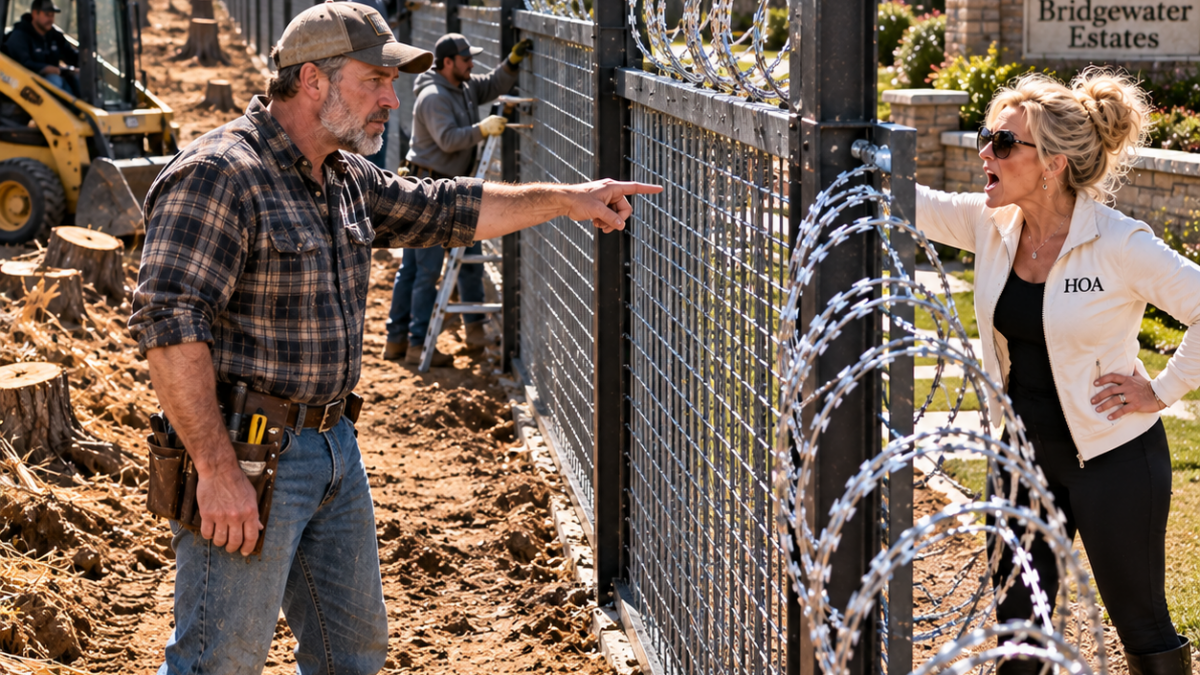
It was a fifteen-foot engineered livestock and equipment-security barrier built entirely on my agricultural parcel.
Steel posts.
Heavy welded-wire panels.
Opaque agricultural shade screening across the lower portion.
Above that, inward-oriented anti-climb security topping approved for non-public agricultural use.
People called it razor wire.
Technically, part of the security topping was concertina-style material.
But it sat high, inward, inaccessible from Bridgewater, behind a setback strip and secondary stock fence.
You could not touch it accidentally.
You could not reach it from their side.
It met county requirements.
That mattered.
Because the whole point was not to hurt anyone.
The whole point was to build something Tammy could not bulldoze while pretending she was confused about ownership.
Jonah stamped the structural drawings.
County reviewed.
Agricultural exemption applied to portions.
Security component received permit review.
Surveyor re-staked.
We placed the wall another three feet inside my property.
I surrendered land voluntarily just to eliminate argument.
Rebecca reviewed everything.
Twice.
Then we served Bridgewater a letter.
Not asking permission.
Notice.
A lawful agricultural security and privacy barrier will be installed entirely within the Mercer property. No Bridgewater HOA approval is required or requested. Any entry, interference, alteration, attachment, or removal attempt will be treated as trespass and referred to law enforcement.
Tammy called me thirteen minutes after delivery.
I answered.
“Garrett.”
“Tammy.”
“What are you building?”
“A fence.”
“You already had trees.”
“Not anymore.”
Silence.
“That area must comply with Bridgewater visual standards.”
“No.”
“It directly borders the community.”
“Yes.”
“Then exterior appearance affects our architectural environment.”
“Your architectural environment ends at my property line.”
“You cannot put industrial fencing beside million-dollar homes.”
“Watch me.”
She inhaled.
“Is this retaliation?”
“No.”
“It is clearly retaliation.”
“It is screening.”
She laughed.
“A fifteen-foot steel barrier is screening?”
“You told me to restore appropriate boundary screening.”
“That is not what we meant.”
“I know.”
That was the first satisfying moment.
Not the best.
Just first.
Construction started the following Monday.
My crew.
Dale helped for free.
Jonah inspected.
Survey stakes stayed visible.
I installed cameras first.
Several.
High.
Protected.
Battery backups.
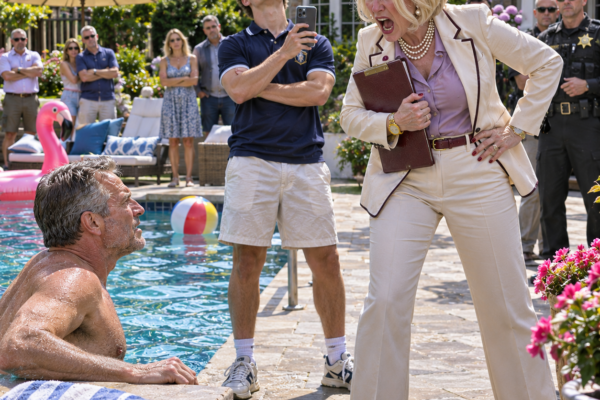
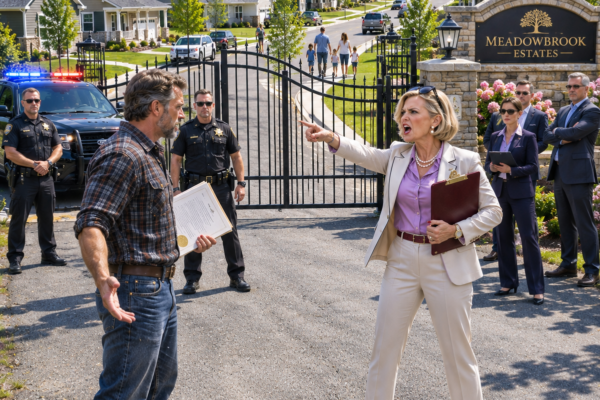
Tammy arrived at 8:12.
Of course.
White Mercedes SUV.
Sunglasses.
Two board members.
She got out and walked toward the line.
I held up one hand.
“Stop at the marker.”
She looked down.
Pink survey flag.
“This is absurd.”
“Marker’s real.”
“I’m talking about your structure.”
“So am I.”
She held papers.
“Bridgewater is issuing an immediate stop-work directive.”
I laughed.
“You have no jurisdiction.”
“Our counsel disagrees.”
“Then your counsel can call Rebecca.”
She waved toward the steel posts.
“This violates the six-foot community fence standard.”
“I’m not in your community.”
“It is adjacent.”
“Sun is adjacent too.”
“Good luck fining it.”
Dale turned away so she wouldn’t see him laugh.
Tammy’s voice rose.
“Garrett, be reasonable.”
That word.
After forty-seven trees.
After Elaine’s bench.
After the fine.
Reasonable.
“I was reasonable when I sent you my survey three years ago.”
“I was reasonable when you complained about my trailer.”
“I was reasonable when you called my barn unsightly.”
“I was reasonable when your crew destroyed my trees and I called the sheriff instead of doing something stupid.”
“You used all my reasonable.”
She froze.
Then said quietly:
“You think your grief gives you permission to terrorize a neighborhood?”
Everything stopped.
My crew heard.
Dale heard.
Board members heard.
I looked at Tammy.
“Do not talk about my wife.”
She crossed her arms.
“You’re the one turning landscaping into a memorial.”
“No.”
“You did that.”
Her face changed.
I continued.
“You took something ordinary.”
“You bulldozed it.”
“Then you made it evidence.”
She left.
By Friday, the posts were in.
Twenty-four-inch concrete footings where engineering required.
Braced.
Aligned.
Tall.
From Bridgewater, they looked enormous.
Because they were.
Monday, welded panels.
Wednesday, lower privacy screening.
Friday, security topping.
Signs on my side and at controlled access points:
PRIVATE AGRICULTURAL PROPERTY — NO TRESPASSING
SECURITY BARRIER — DO NOT CLIMB
Nothing threatening.
Nothing stupid.
Nothing aimed outward.
The final wall was ugly.
I mean spectacularly ugly.
Industrial.
Black steel.
Straight.
Severe.
Exactly the opposite of Elaine’s trees.
I hated it.
That surprised people.
Dale stood beside me after completion.
“Looks good.”
“No.”
“It looks legal.”
“Yes.”
“That’s different.”
Very different.
The hedge had been alive.
Soft.
Noisy in wind.
The wall didn’t move.
That first night I sat on the porch and stared.
Elaine would have hated it.
I knew that.
She would’ve walked outside, put both hands on her hips, and said:
“Garrett, what in God’s name have you built?”
Then she would have laughed.
Probably.
I hoped.
The next morning, Bridgewater sent another violation.
UNAUTHORIZED FENCE STRUCTURE
Fine:
$500 per day.
I forwarded it to Rebecca.
She sent back:
They are helping us.
“How?”
Every notice confirms they are intentionally asserting authority over property after being given proof they have none. Save all of them.
I saved all of them.
Then Tammy made her second catastrophic mistake.
She hired a fence-removal contractor.
Not Blue Canyon.
Different company.
They arrived at 7:30 on a Wednesday.
Mini excavator.
Cutting equipment.
Flatbed.
I was home.
Cameras rolling.
Before they touched anything, I walked out.
“Morning.”
Foreman said:
“You Garrett Mercer?”
“Yes.”
“We’re here to remove unapproved structure.”
“Who hired you?”
“Bridgewater HOA.”
“Do you have a property-access authorization signed by me?”
He looked confused.
“No.”
“Do you have a court order?”
“No.”
“County order?”
“No.”
“Then you’re trespassing if you cross that survey marker.”
I showed him.
He called someone.
Tammy arrived eight minutes later.
Furious.
“You are obstructing enforcement again.”
“No.”
“I’m preventing trespass.”
“The wall is illegal.”
“County inspected yesterday.”
“No, they didn’t.”
I smiled.
“Want the certificate?”
She stared.
I handed it over.
Final inspection.
Approved.
Agricultural security barrier compliant.
Tammy read it.
Then:
“This doesn’t override deed restrictions.”
“Show me mine.”
Silence.
“My property has no Bridgewater restrictions.”
“You are bound by the perimeter maintenance agreement.”
“What agreement?”
She pulled a copy.
I had never seen it.
Dated eleven years earlier.
Supposedly signed by me.
PERIMETER AESTHETIC MAINTENANCE CONSENT
Allowed Bridgewater HOA to maintain a thirty-foot strip along my western edge and “approve screening.”
My signature appeared at bottom.
One problem.
Eleven years earlier, I had been in Oklahoma for six weeks building storm-damage fencing after a tornado outbreak.
Another problem.
The document used my middle initial incorrectly.
Gareth M. Mercer.
My middle name is Allen.
Third problem.
The notary block contained a commission number.
Rebecca later checked it.
The commission belonged to someone whose license had expired fourteen years earlier.
I looked at Tammy.
“This is forged.”
Her face didn’t move.
“It came from association records.”
“I never signed it.”
“You may not remember.”
“I remember my own middle name.”
The contractor foreman lowered his clipboard.
I continued.
“Don’t touch the wall.”
He looked at Tammy.
“I need legal confirmation.”
Tammy said:
“You have it.”
“No.”
“You have a dispute.”
He packed up.
Smart man.
Tammy stayed.
“You think you’re clever.”
“No.”
“I think somebody forged my signature.”
She stepped closer.
“You’re accusing the HOA of a crime.”
“I’m describing paper.”
For the second time in my life, I watched someone realize documentation had stopped being decorative.
I called Noah Ramirez.
Then Rebecca.
The sheriff took the forged agreement.
A criminal report opened.
Now the original hedge removal paperwork was reviewed more closely.
Same notary.
Same fake commission number.
Same “perimeter maintenance agreement” referenced in Blue Canyon’s work order.
Someone had built the entire justification around a document I never signed.
That should have been enough scandal.
It wasn’t.
Because the notary belonged to Linda Caldwell.
Tammy’s mother-in-law.
Dead nine years.
The fake document was dated two years after her death.
When Rebecca told me, I sat down.
“Seriously?”
“Yes.”
“They used a dead woman as notary.”
“Yes.”
“Who does that?”
“Someone who assumes nobody checks.”
That sentence became the center of everything.
Nobody checks.
Bridgewater homeowners began checking.
Dale helped.
So did a woman named Priya Menon from Lot 44.
Former internal auditor.
Dangerous person to irritate with fake paperwork.
She requested HOA records.
Tammy delayed.
Then produced incomplete files.
Priya requested contractor invoices for:
Landscaping.
Fire mitigation.
Perimeter maintenance.
Legal expenses.
She found payments to Caldwell Community Services LLC.
Tammy’s brother owned it.
Landscaping invoices.
Consulting invoices.
Vegetation management.
Emergency compliance.
Over four years, more than $180,000.
Competitive bids?
None.
Conflict disclosure?
Not in minutes.
Then one invoice:
WESTERN PERIMETER VEGETATION REMOVAL — $31,800
Blue Canyon had charged $27,000 for the entire job.
The HOA paid Caldwell Community Services $31,800.
Then Blue Canyon received its deposit separately.
Double billing.
Priya called Rebecca.
Rebecca called the HOA’s insurance carrier.
The carrier hired counsel.
That was the beginning of the end.
The wall became famous.
People posted photos.
A local Facebook group called it:
THE FORT MERCER WALL.
Someone else called it:
GARRETT’S GRIEF FENCE.
I hated that one.
News station called.
I declined.
One reporter filmed from Bridgewater’s public street.
Headline:
PROPERTY DISPUTE TURNS INTO 15-FOOT SECURITY WALL
Tammy gave an interview.
Of course.
She said:
“The HOA has tried repeatedly to work with Mr. Mercer, but he has responded with increasingly hostile structures that undermine neighborhood safety and property values.”
I watched exactly fifteen seconds.
Turned it off.
Elaine used to say television is useful mostly for weather and baseball.
I should have listened.
Then the county got dragged in.
Bridgewater filed an official complaint seeking removal of my wall.
Alleged:
Unsafe height.
Hazardous wire.
Improper agricultural classification.
Visual nuisance.
Improper setback.
Fire access interference.
Code enforcement inspector named Marcus Lee came out.
Middle-aged.
Quiet.
Carried laser measure.
Tammy arrived before he finished parking.
Of course.
She launched into a presentation.
Marcus held up a hand.
“I need to inspect first.”
The most beautiful sentence a government employee can say.
He measured.
Reviewed site plan.
Survey.
Setback.
Wire orientation.
Secondary barrier.
Access gate.
Agricultural use.
Fire lane.
Nothing was left to guess.
Then he walked to the property line.
Looked at Bridgewater.
Looked at Tammy.
Asked:
“Where exactly does the HOA own property here?”
Tammy pointed vaguely.
“The western maintenance corridor.”
“Recorded?”
“Yes.”
“Instrument number?”
She hesitated.
“We have an agreement.”
She produced the forged document.
Marcus read.
Then looked at me.
“You dispute this?”
“Completely.”
“Sheriff report?”
I handed him the number.
He nodded.
Then asked Tammy:
“Do you have any recorded easement in county land records?”
“We have the maintenance consent.”
“That’s not what I asked.”
Silence.
“Any deed restriction on Mr. Mercer’s parcel?”
“No.”
“Any annexation into Bridgewater?”
“No.”
“Any county order giving you enforcement authority?”
“No.”
“Then the HOA does not appear to have jurisdiction over the structure.”
Tammy’s face hardened.
“But the razor wire.”
Marcus looked upward.
“Security topping is inward-oriented and outside accessible residential setback.”
“County-approved agricultural-security exception applies.”
“He has children next door.”
“The nearest residential yard is beyond his setback and your own subdivision fence line.”
“He built it to intimidate us.”
Marcus shrugged.
“Intent isn’t a building code.”
I nearly hugged the man.
I didn’t.
Professional boundaries.
The county closed the complaint.
Compliant.
No removal.
No modification required.
Tammy appealed.
Lost.
Then HOA legal counsel resigned.
That was interesting.
Firm wrote:
We are unable to continue representation due to conflicts concerning factual representations made to counsel.
Nobody needed a translation.
Priya found more.
The fake perimeter documents existed for three other neighboring properties.
Not just mine.
Two owners had accepted trimming and clearing because they believed Bridgewater possessed contractual rights.
One had paid $6,000 after the HOA threatened litigation over a barn.
None of them had signed the supposed agreements.
Same notary.
Same dead woman.
Now district attorney’s office became involved.
Tammy resigned as president before the board could remove her.
Vice president Mark Ellis tried to call it a “temporary leave.”
Homeowners did not appreciate that.
Special meeting.
Sixty-eight out of eighty-six homes represented.
Tammy attended with a lawyer.
No gavel.
New interim chair, Priya.
Appropriate.
First question:
“Did the board authorize removal of Garrett Mercer’s hedge?”
Mark said:
“We authorized western fire mitigation.”
“Did you verify ownership?”
“No.”
“Did you see a recorded easement?”
“We relied on the president.”
“Did you approve the forged maintenance agreement?”
“No.”
Tammy’s lawyer objected from the audience.
Priya looked at him.
“This is not a deposition.”
He stopped.
Then Blue Canyon’s Rick Sutter spoke.
He had been invited.
“We were provided a signed land-access certification.”
He held it up.
“Mrs. Caldwell signed it.”
The room turned.
Tammy’s lawyer whispered.
She said nothing.
Priya continued.
“Why was Caldwell Community Services paid $31,800 for a removal job Blue Canyon performed?”
Treasurer Angela Price looked physically ill.
“I approved payment based on invoice package.”
“Who submitted?”
“Tammy.”
“Did you know Caldwell Community Services belonged to her brother?”
“No.”
“Was it disclosed?”
“No.”
People started shouting.
Priya raised her voice.
“Please.”
“You will get answers faster if we can hear them.”
Auditors make excellent crowd control.
The board voted to appoint independent forensic review.
Insurance notified.
Records preserved.
Tammy removed from every committee.
Three weeks later, investigators searched the management office.
Not dramatic.
No SWAT.
Boxes.
Computer imaging.
Interviews.
Then they searched Caldwell Community Services.
Then Tammy’s home office.
The criminal allegations eventually included:
Forgery.
Fraudulent document use.
Theft.
Falsification of business records.
Conspiracy involving related-party billing.
The total was not millions.
It didn’t need to be.
The provable improper payments exceeded $240,000.
Some to Tammy’s brother.
Some through inflated contracts.
Some reimbursed as “emergency association expenses.”
Some legitimate work wrapped in false paperwork.
Tammy was charged.
Her brother too.
Treasurer Angela was not.
Investigators concluded she had been negligent but did not knowingly participate.
Mark wasn’t charged.
He resigned anyway.
Tammy eventually pleaded to reduced charges.
Restitution.
Probation plus a short custodial component.
Ban from serving in HOA fiduciary roles as part of settlement.
Her brother received a separate sentence and restitution order.
I never attended sentencing.
Rebecca did.
She told me afterward.
“You sure you don’t want details?”
“No.”
“Really?”
“Yes.”
“I thought you’d want closure.”
I looked toward the wall.
“Court doesn’t rebuild trees.”
She nodded.
“No.”
“It doesn’t.”
Civil settlement came later.
Blue Canyon’s insurer.
HOA carrier.
HOA direct contribution.
Tammy personal contribution.
Amount confidential.
Enough to repair land.
Enough to compensate substantial tree loss.
Enough to rebuild irrigation.
Enough for legal fees.
Not enough to bring Elaine’s hedge back.
Nothing was.
That was when I had to decide what to do with the wall.
Everyone assumed I would keep it forever.
Dale loved it.
Priya hated looking at it but respected the symbolism.
News people still occasionally drove by.
Some residents argued it lowered property values.
Maybe.
It definitely lowered the view.
Then one evening, almost two years after the bulldozer, I sat on the porch holding the broken arm from Elaine’s bench.
Still had it.
Half an E.
I looked at the wall.
Black steel.
Hard.
Motionless.
Then I heard Elaine in my head.
Not supernatural.
Memory.
Clear enough.
Garrett, what in God’s name have you built?
I laughed alone.
Then cried.
Finally.
Really cried.
Not dignified.
Not cinematic.
Old man on a porch with a broken board in his lap.
Thirty-six years of marriage.
Four years of grief.
Forty-seven trees.
All of it came loose.
I realized something I hadn’t wanted to admit.
The wall had done its job.
Not only legally.
Emotionally.
It gave my anger somewhere to go.
Straight lines.
Steel posts.
Honest measurements.
A problem that stayed where I put it.
But I didn’t want to spend the rest of my life looking at Tammy.
Even if Tammy had become a wall.
I called Lena Ortiz.
“What would you plant?”
She came out.
Walked the strip.
“Soil damaged.”
“Compaction.”
“Some root zones contaminated by construction debris.”
“But fixable.”
“What do you want?”
I looked at her.
“Something Elaine would’ve liked.”
“That doesn’t help.”
“She liked ugly trees.”
“Better.”
We designed a mixed native windbreak.
Live oak.
Eastern red cedar.
Yaupon holly.
Wax myrtle in lower areas.
A few replacement cypress, because history deserves stubbornness.
More resilient than one species.
Better wildlife value.
Less disease risk.
Layered heights.
Not a hedge.
A living boundary.
The wall stayed initially.
Behind it, we planted.
Bridgewater residents volunteered.
That surprised me.
Priya came with gloves.
Dale.
Rick Sutter from Blue Canyon.
Even Angela Price.
Children from the neighborhood planted smaller shrubs.
No press.
I insisted.
One boy asked:
“Is this where the scary trees were?”
I laughed.
“Cypress.”
“Were they scary?”
“No.”
“Why’d they cut them?”
Adults became quiet.
I said:
“Because people made a bad decision.”
He accepted that.
Children don’t need villains as much as adults think.
Three years later, the new trees had grown enough to soften the wall.
Five years, some above the lower screening.
Seven years, I started removing sections of steel.
Not all at once.
Hundred feet first.
Then another.
Security topping came down with professionals.
No drama.
No symbolic ceremony.
Dale complained.
“You’re taking Fort Mercer down.”
“Yep.”
“Historic.”
“No.”
“It is.”
“It’s ugly.”
“So was your first wife.”
He stared.
Then laughed so hard he had to sit on the tailgate.
Old friends earn dangerous privileges.
Eventually only sixty feet of the original wall remained around my equipment yard.
There it belonged.
Useful.
Not angry.
The rest became trees again.
Different trees.
No attempt to recreate Elaine’s exact hedge.
That would’ve felt fake.
We did rebuild her bench.
Mostly.
The broken arm became part of the new one.
I used cedar from another fallen tree.
Under the seat, I kept the damaged carving.
E + half of G.
Then added nothing.
No plaque.
No dates.
No explanation.
A bench doesn’t need paperwork unless Tammy is president.
Bridgewater changed too.
They amended bylaws.
No assertion of authority beyond recorded HOA property.
No contractor entry onto adjacent parcels without verified title or easement.
Related-party contracts disclosed.
Competitive bidding.
Two-signature payments.
Annual independent financial review.
Owners could inspect invoices online.
Boring.
Beautiful.
Priya became president for one year.
Refused a second.
Smart.
The next president was a retired school principal named Bob Chen who described his goal as:
“Make this so boring nobody puts us on the news.”
He succeeded.
Best president they ever had.
Years later, a new family moved into the house directly west of me.
Young couple.
Two girls.
Golden retriever.
They had no idea about Tammy.
First week, husband walked over.
“Mr. Mercer?”
“Garrett.”
“I’m Daniel.”
“Nice to meet you.”
He looked at trees.
“This property line yours?”
“Yep.”
“We’re thinking about replacing our fence.”
“Go ahead.”
“Do you know where the survey pin is?”
I showed him.
He thanked me.
Then pointed toward the sixty feet of remaining steel around my equipment yard.
“What’s that?”
“Long story.”
His wife called from across the fence.
“Is that razor wire?”
“Security topping.”
Daniel laughed.
“Why?”
I looked at the growing trees.
“Neighbor problem.”
He nodded like every homeowner understands those two words.
Then:
“Let us know if our dog bothers your cattle.”
“Will do.”
That’s how easy it can be.
Ask.
Listen.
Respect a line.
No bulldozers required.
My daughter Morgan visited one spring.
She walked the new windbreak.
She lives in Houston now.
Two kids.
Corporate attorney.
Elaine used to say Morgan became a lawyer because she enjoyed correcting people professionally.
Probably right.
Morgan touched one of the older replacement cypress.
“They’re getting tall.”
“Yep.”
“Not like Mom’s.”
“No.”
“She would’ve hated the wall.”
“I know.”
“She would’ve loved this.”
“I hope.”
Morgan looked toward the bench.
“You really kept the broken arm.”
“Yep.”
“Dad.”
“What?”
“You know Mom was going to replace that bench eventually.”
“No.”
“She told me.”
I stared.
“What?”
“Like a year before she got sick.”
“Said it was rotting.”
“She wanted one of those fancy teak benches.”
I looked at the rebuilt cedar bench.
Thirty seconds.
Then started laughing.
Morgan laughed too.
“What?”
“I almost started a war over a bench your mother wanted gone.”
“She would’ve enjoyed that.”
Probably.
That was the gift.
Grief freezes people.
Makes every object sacred because they touched it.
Elaine wasn’t sacred.
She was funny.
Impatient.
Bad at remembering anniversaries.
Excellent with plants.
Terrible at directions.
She hated my work boots by the door.
Loved crime novels.
Overcooked chicken.
Spent too much on garden centers.
She didn’t need me to preserve every branch she ever planted.
She needed me to keep living.
That realization took longer than rebuilding the property.
I wish I could say the wall was pure strategy.
It wasn’t.
Part of it was spite.
A lot, probably.
There’s no shame in admitting anger.
Only danger in pretending anger makes every idea wise.
The wall was wise because I checked first.
Survey.
Lawyer.
Engineer.
County.
Safety.
Setback.
I built something I had a legal right to build.
If I had thrown up dangerous wire on a residential boundary overnight without review, I would’ve become exactly what I accused Tammy of being.
Someone convinced that anger created authority.
It doesn’t.
That’s the deeper reason she lost.
Not because I outsmarted her with steel.
Because she believed wanting control was the same as having jurisdiction.
My land looked wrong to her.
So she treated appearance as permission.
My trees blocked views.
So she called them fire hazard.
My hedge occupied land she wanted aesthetically controlled.
So she invented a maintenance corridor.
My refusal irritated her.
So she found documents that said yes.
When documents didn’t exist, someone created them.
That’s how abuse of power grows.
Rarely from someone saying:
I know I have no right, but I don’t care.
More often:
Surely I must have a right because this outcome makes sense to me.
That sentence has destroyed a lot of fences.
And more than fences.
Dale died at seventy-four.
Cancer.
Fast.
Before he went, I brought him out to the bench.
He had become thinner.
Still sarcastic.
He looked at the windbreak.
“Your replacement trees are crooked.”
“Shut up.”
“Elaine’s were straighter.”
“Shut up.”
He looked toward the remaining steel section.
“You keeping that?”
“Equipment yard.”
“Good.”
He was quiet awhile.
Then:
“You know I really did try to stop them.”
“I know.”
“I should’ve parked my truck in front of the dozer.”
“No.”
“Would’ve worked.”
“Until you got flattened.”
“Marine Corps taught worse traffic control.”
I laughed.
Then he said:
“I’m sorry I couldn’t save them.”
That hurt.
I put a hand on his shoulder.
“They were trees, Dale.”
He looked at me.
“Not to you.”
“No.”
“But still trees.”
That distinction mattered.
People are more important than memorials.
Sometimes grief forgets.
I didn’t.
After Dale died, his wife gave me one of his old unit challenge coins.
I put it under Elaine’s bench.
Not attached.
Just hidden in a small sealed recess beneath the seat.
Elaine’s broken arm.
Dale’s coin.
No plaque.
Not everything needs to be visible to matter.
At seventy, I sold most of my fencing company to a younger partner.
Kept some consulting work.
I still built gates occasionally because retirement is boring if you’re good with your hands.
Bridgewater had grown quieter.
Trees taller.
My windbreak looked natural.
People driving Sawyer Creek Road wouldn’t know a bulldozer ever crossed it.
That’s good.
Scars don’t need permanent signage.
One autumn evening, I sat on Elaine’s bench with my grandson Caleb.
He was eleven.
Morgan’s youngest.
He pointed at the security wall around the equipment yard.
“Mom says you built a giant razor wall because a lady killed Grandma’s trees.”
“That’s not exactly how I’d say it.”
“Did she?”
“She bulldozed them.”
“Why?”
“Thought she had the right.”
“Did she?”
“No.”
“So you built the wall.”
“Yes.”
“To make her mad.”
I looked at him.
“Partly.”
He grinned.
“Cool.”
“No.”
“Why not?”
“Because making people mad is expensive.”
“How much did it cost?”
“Too much.”
“Was it worth it?”
I looked at the windbreak.
The bench.
House.
Bridgewater rooftops barely visible again.
“Temporarily.”
He frowned.
“What does that mean?”
“It solved the problem I had then.”
“What problem?”
“I needed people to stop crossing my line.”
“So you could’ve built a normal fence.”
“Probably.”
“Then why fifteen feet?”
Grandchildren are dangerous because they remove mythology.
I smiled.
“Because I was angry.”
He nodded.
“Okay.”
No judgment.
Children understand anger.
Then he asked:
“Would Grandma have liked it?”
“No.”
That made him laugh.
“Then why’d you do it?”
“Because sometimes you figure things out after you do them.”
He thought.
“Adults are weird.”
“Correct.”
We sat there while wind moved through the new trees.
That sound.
Soft.
Layered.
Not identical.
But close enough to something my body remembered.
Thirty years of Elaine’s hedge had been gone a long time by then.
I no longer dreamed about the bulldozer.
For years I did.
In the dream, I always arrived early.
Always stopped it.
Always stood between blade and first tree.
Dreams are generous like that.
Reality wasn’t.
I came home late.
Trees were gone.
Bench broken.
And I had to decide what happened next.
For a while, what happened next was steel.
Then lawyers.
Then court.
Then arrests.
Then money.
Then rebuilding.
Then trees again.
That order makes sense to me now.
Healing isn’t always noble at first.
Sometimes the first thing you build after loss is ugly.
You just shouldn’t mistake the ugly thing for the final thing.
The HOA notice that fined me for debris is still in my office.
Framed.
Beside my county compliance certificate for the wall.
Visitors read both.
Usually laugh.
My favorite line remains:
Owner shall restore appropriate boundary screening.
They asked.
I restored.
Technically.
Rebecca retired eventually.
At her retirement dinner, I gave her a small piece of black steel from the removed wall.
Mounted on oak.
Plaque:
NO HOA APPROVAL REQUIRED.
She laughed.
Then said:
“I still think you enjoyed that wall too much.”
“Probably.”
“You know what my favorite part was?”
“What?”
“They could’ve solved everything by apologizing before the fraud investigation.”
“That would’ve required stopping.”
“Exactly.”
People often imagine disasters come from one giant decision.
Sometimes.
More often, catastrophe is twenty small opportunities to stop.
Tammy could have stopped after the first complaint.
After seeing my survey.
After Dale confronted the crew.
After Blue Canyon questioned access.
After the police report.
After the forged agreement was challenged.
After the county inspection.
After residents requested invoices.
At every stage, truth offered an exit.
She kept walking past it.
That’s what fraud does.
It makes retreat feel more dangerous than continuing.
Until continuing becomes much worse.
Years after she left Bridgewater, Tammy wrote me a letter.
Unexpected.
No lawyer.
No request.
She said she had been attending a restorative accountability program.
Maybe court-related.
Maybe voluntary.
I didn’t investigate.
One paragraph stayed with me.
I saw your trees as an obstruction because they blocked the view from houses I felt responsible for. I did not let myself understand that they were living things someone had spent decades caring for, because if I had allowed myself to see that, I could not have ordered their removal as easily.
That was honest.
Then:
I told myself you were difficult because that was easier than admitting I was crossing a boundary I had no right to cross.
Also honest.
She apologized for Elaine’s bench.
Specifically.
Not “the incident.”
Not “what happened.”
The bench.
I appreciated that.
I replied once.
Thank you for naming what you did. Elaine would have preferred the trees. I prefer the truth.
That was it.
No friendship.
No reunion.
Some apologies close doors quietly.
Good enough.
Today, the west side of the property is green again.
Not the old hedge.
Better in some ways.
Messier.
More native.
Birds love it.
Deer too much.
The live oaks are broad.
Red cedar thick.
Yaupon fills gaps.
Three of the replacement cypress are already more than twenty feet tall.
One leans.
Mine.
Of course.
Elaine’s would be straight.
Every Christmas I still put lights through the first section.
Not forty-seven trees.
Just enough.
Morgan helps when she visits.
Caleb complains.
We make him do the ladder.
Tradition.
And when wind moves through the branches at night, I can sit on the porch, close my eyes, and hear something close to the old sound.
Not identical.
That matters.
People spend too much time trying to restore life exactly as it was.
You can’t.
You restore function.
Meaning.
Continuity.
You let the new thing become itself.
I learned that from fences.
From grief.
From trees.
And unfortunately, from Tammy Caldwell.
The story people repeat is simpler.
HOA bulldozed a widower’s thirty-year hedge.
He built a fifteen-foot razor-wire wall.
HOA couldn’t touch it.
President exposed.
Forged documents.
Financial fraud.
Justice.
Good headline.
But that’s not the part I remember most.
I remember coming home and seeing too much sky.
I remember the absence of wind in branches.
I remember picking up half of Elaine’s bench arm from a pile of shattered wood.
I remember understanding that somebody who had never met my wife had erased something she spent decades tending because it interfered with a view.
And I remember the choice that came after.
I could not put the trees back.
I could not bring Elaine back.
I could not make Tammy understand before she was ready.
What I could do was mark the line.
Clearly.
Legally.
Permanently enough that nobody could pretend again.
For a few years, that line was fifteen feet of black steel.
Ugly.
Unmissable.
Untouchable.
Then, once everyone finally learned where my land ended and theirs began, I no longer needed the wall to speak for me.
The trees could do it again.