HOA Built a 9-Foot Wall Over My Drainage Easement—Then the First Heavy Rain Tore Their Secret Open
PART3:
PHASE THREE SLOPE IMPROVEMENT PROJECT.
It explained that the HOA would construct a new retaining wall along the rear boundary of Phase Three to “improve erosion control, enhance community appearance, and protect downstream property values.”
No engineering drawing.
No permit number.
No survey.
No drainage plan.
Just:
WORK BEGINS FRIDAY.
Signed:
Renata Colby, HOA President.
I read it over breakfast.
Laura was pouring coffee.
“What?”
I handed it to her.
She read.
“So?”
“Rear boundary of Phase Three.”
“That’s behind us.”
“Exactly.”
She sat down.
“You think they mean our line?”
“I think somebody should show a map.”
Laura shrugged.
“Ask.”
That’s what I did.
Wednesday evening, Cedar Ridge held its monthly board meeting.
About thirty homeowners attended.
Renata sat at the front beside Douglas Pratt, the treasurer.
Douglas was sixty-two.
Quiet man.
Retired regional bank manager.
Usually knew every financial number down to the penny.
That night, he barely looked up.
When public comments opened, I stood.
“Question about the retaining wall.”
Renata smiled.
“Of course, Ron.”
“Where exactly is it going?”
“Along the Phase Three rear boundary.”
“Whose property?”
“Community common-area interface.”
That wasn’t an answer.
“Can we see the survey?”
Renata’s smile tightened.
“The project has been professionally reviewed.”
“That’s not what I asked.”
Several people turned.
I continued.
“Where are the engineering plans?”
Renata leaned back.
“It’s handled.”
“By whom?”
“Professionals.”
“Engineer name?”
She laughed lightly.
“Ron, not everything requires homeowner approval.”
“I didn’t ask for approval authority.”
I pointed toward the board table.
“I asked for the plan.”
Douglas looked at his papers.
Wouldn’t meet my eyes.
That bothered me.
Renata said:
“You’ll receive all appropriate project documentation when construction is complete.”
That bothered me more.
“When construction is complete?”
“Yes.”
“If the wall affects drainage, homeowners should see the design before you bury everything.”
A man near the back whispered:
“Here we go.”
I knew the tone.
Ron is complaining again.
I’d asked questions before.
Landscaping invoices.
A drainage ditch that hadn’t been cleaned.
Why clubhouse painting cost twice the estimate.
Nothing dramatic.
People sometimes interpret curiosity as hostility when they’d rather go home.
Renata folded her hands.
“Are you a structural engineer?”
“No.”
“Civil engineer?”
“No.”
“Licensed contractor?”
“No.”
“Then perhaps we should allow the people who are to do their jobs.”
A few people smiled.
I didn’t.
“My father was a foundation contractor.”
“Your father isn’t designing this wall.”
“No.”
“But he understood where the water goes.”
Renata sighed.
“Thank you, Ron.”
Meaning:
Sit down.
I did.
But I watched Douglas.
He still wouldn’t look at me.
The orange stakes appeared the next morning.
Seven of them.
Bright enough to see from the kitchen.
I walked outside with a tape measure.
The first stake sat near the northeast corner.
I measured from my known survey pin.
Fourteen inches inside my property.
Checked again.
Same.
Second stake.
Thirteen and three-quarter inches.
Third.
Fourteen.
The line continued across the back yard.
Inside my deeded boundary.
More importantly, directly through the drainage easement.
I photographed everything.
Then drove to the county GIS office online.
Confirmed parcel.
Confirmed easement.
No ambiguity.
Around nine, construction equipment arrived.
Mini excavator.
Skid steer.
Concrete forms.
Four workers.
Foreman.
Stocky man with a gray beard and sunburned neck.
Marty Zeller.
Zeller Outdoor Construction.
I walked over.
“Morning.”
He kept checking his clipboard.
“Morning.”
“Ron Tillman.”
“Okay.”
“I own this lot.”
That got his attention.
“HOA said everything’s approved.”
“Your stakes are on my property.”
Marty shrugged.
“Surveyor set them.”
“Which surveyor?”
“Ask the HOA.”
I showed him my phone.
County line.
Recorded survey.
“Fourteen inches.”
Marty glanced.
“Buddy, I’m pouring what they marked.”
“There’s a drainage easement here.”
“Not my problem.”
“It becomes your problem when you put nine feet of concrete over it.”
He looked at me.
“Wall’s eight.”
“Notice says nothing about height.”
“Eight to nine depending grade.”
“Permit?”
“HOA handles permits.”
“Engineering?”
“HOA.”
“Drainage?”
He pointed toward a pallet of pipe.
“Handled.”
I looked.
Four-inch perforated pipe.
At least they had something.
Maybe I was overreacting.
Then I asked:
“Can you wait until the boundary is verified?”
Marty laughed.
“Crew’s paid.”
“Concrete’s scheduled.”
“Take it up with your board.”
I called Renata.
Voicemail.
Emailed.
No answer.
Certified letter that afternoon.
I attached the deed.
Survey.
Easement.
Photos.
My letter was simple.
The proposed wall encroaches approximately fourteen inches onto my property and obstructs a recorded drainage easement.
Please suspend construction until boundary, permitting, engineering, and drainage issues are verified.
I sent a copy to Douglas.
Nothing.
Friday morning, work started.
At six.
By the time I left for work at seven-thirty, the excavation trench ran almost the full length behind our lot.
My job was facilities maintenance supervisor for a manufacturing plant forty minutes away.
I spent the entire morning checking my camera.
At noon, forms were going in.
At three, concrete trucks arrived.
At five-thirty, I pulled into my driveway and stopped.
The wall stood there.
Nine feet in the highest section.
Fresh gray concrete.
Nearly one hundred sixty feet long.
My father’s swale had disappeared.
Buried beneath excavation and compacted soil.
I got out.
Walked the base.
Something immediately felt wrong.
No drainage stone visible.
Walls that hold back soil need a way to relieve hydrostatic pressure.
You don’t need to be an engineer to understand that.
Water enters soil.
Soil traps water.
Pressure builds.
Proper retaining systems use gravel, perforated drainpipe, outlets, sometimes geogrid or tiebacks depending on design.
What I saw was heavy orange clay packed directly behind the wall.
Clay.
One of the worst soils you can use if you’re trying to let water escape.
I crouched near the bottom.
Small circular openings had been formed through the concrete.
Weep holes.
At least something.
I counted nine.
That was fewer than I’d expected.
But maybe there was an internal drain system.
I walked uphill.
Looked behind the wall where workers were backfilling.
No stone.
Just clay.
“Marty.”
He turned from the skid steer.
“Yeah?”
“Where’s your drainage aggregate?”
He looked annoyed.
“It’s fine.”
“That isn’t an answer.”
“Look, Ron—”
“You’re packing clay against concrete.”
“We’ve done walls before.”
“Where’s the pipe?”
“Behind it.”
“I don’t see it.”
“Already covered.”
“Outlet?”
“Other end.”
I walked to the other end.
Nothing.
“There’s no outlet.”
Marty threw up both hands.
“Call Renata.”
I did.
No answer.
Then I called the county.
Building department transferred me twice.
Eventually I got Linda Ashby.
County inspector.
Not related to anyone in Cedar Ridge as far as I knew.
I explained.
She asked:
“How tall?”
“About nine feet.”
Pause.
“Residential retaining structure?”
“HOA project.”
“Still nine feet?”
“Yes.”
“Address?”
I gave it.
Keyboard.
Then silence.
“Mr. Tillman?”
“Yes?”
“I don’t see a permit.”
I gripped the phone.
“Are you sure?”
“Searching parcel and subdivision project records.”
More typing.
“Nothing.”
“What requires a permit?”
“Anything over four feet measured from footing bottom to top usually requires structural review here, and HOA common-area work certainly needs site approval depending location.”
“What about engineering?”
“At that height, stamped design.”
“Drainage?”
“Also reviewed.”
I looked at the wall.
“When can you come?”
“Thursday.”
“That’s six days.”
“Four business days.”
“There’s weather coming.”
“I understand.”
“No, I mean a major storm.”
She paused.
“I’ll put you on cancellation priority.”
“Can you issue a stop order remotely?”
“Not without verifying conditions.”
I understood.
Didn’t like it.
“Take photographs.”
“I already am.”
“Especially any work still open.”
I photographed everything.
Then things got worse.
Monday afternoon, I came home early.
Zeller’s crew was finishing the wall.
A worker knelt beside the base with a bucket of mortar.
He was filling one of the weep holes.
I stopped.
“What are you doing?”
He looked up.
“Finishing.”
“You’re plugging the drain.”
He shrugged.
“Boss says close them.”
“Why?”
The worker looked toward Marty.
Marty was across the site.
“Madam President wants it clean.”
I thought I’d misheard.
“What?”
“She doesn’t like the holes.”
I walked toward Marty.
Fast.
“What are you doing?”
He sighed.
“Not again.”
“You’re sealing the weep holes.”
“Cosmetic finish.”
“They’re drains.”
“We have internal drainage.”
“Where does it discharge?”
He didn’t answer.
“Marty.”
He looked at me.
Then lowered his voice.
“Take it up with Renata.”
That sentence again.
I called her.
This time she answered.
“Ron.”
“You’re filling the weep holes.”
“We are completing the finish.”
“Those holes are there to relieve water pressure.”
“The engineer approved the final appearance.”
“Name.”
“What?”
“Engineer.”
Pause.
“Caleb Burke.”
“Company?”
“Burke Civil Engineering.”
“I want the plans.”
“Come to the office.”
I was there twenty minutes later.
Renata sat behind her desk.
Douglas wasn’t present.
She slid a drawing toward me.
Nine-foot retaining wall.
Dimensions.
Notes.
Seal in bottom right.
CALEB J. BURKE, P.E.
Stamped.
Signed.
At least apparently.
Renata leaned back.
“Satisfied?”
I didn’t answer.
I took a photograph.
Zoomed.
Something about the stamp bothered me.
Edges too sharp compared with the scanned drawing.
Signature looked slightly pixelated.
Like it had been dropped onto the page from somewhere else.
I said:
“I want a copy.”
“You have a photograph.”
“I want the official plan.”
“Our attorney advised against distributing proprietary engineering materials.”
“That’s nonsense.”
Renata smiled.
“Are we finished?”
“No.”
“You’re frightening homeowners over something you don’t understand.”
“I understand gravity.”
She rolled her eyes.
I left.
Burke Civil Engineering was easy to find.
I called.
Receptionist transferred me.
A man answered.
“Caleb Burke.”
“Mr. Burke, my name is Ron Tillman.”
I explained Cedar Ridge.
The wall.
Address.
Nine feet.
Long silence.
Then:
“How tall?”
“Nine.”
“Did you say Cedar Ridge?”
“Yes.”
“Phase Three rear boundary?”
“Yes.”
Another pause.
“I designed a wall there.”
Relief hit me.
Then he continued.
“Four feet.”
My relief disappeared.
“What?”
“Preliminary design.”
“When?”
“Six months ago.”
“What did it include?”
“Four-foot segmental retaining wall.”
“Drainage aggregate.”
“Perforated base drain.”
“Daylight outlets.”
“Existing swale preserved.”
I closed my eyes.
“This one’s concrete.”
Silence.
“Nine feet.”
Silence.
“Your stamp is on the drawing.”
Caleb’s voice changed.
“Send it to me.”
I emailed the photograph.
Thirty seconds.
Then:
“That’s my seal.”
I waited.
“But that’s not my drawing.”
My hands started shaking.
“Signature?”
“No.”
“What does that mean?”
“It means somebody used my seal.”
“Can a contractor do that?”
“Legally?”
“No.”
“Did you approve a nine-foot wall?”
“Absolutely not.”
“Did you approve blocking the drainage easement?”
“No.”
“Did you approve sealing the weep holes?”
“Good God, no.”
I looked toward the window.
Clouds gathering west.
“Can you come inspect it?”
“Friday morning.”
“Storm Thursday night.”
“What forecast?”
“Heaviest we’ve had in years.”
Caleb went quiet.
Then:
“Ron.”
“Yes?”
“Get people downslope warned.”
That sentence scared me more than anything Renata had said.
The house most directly below the wall belonged to Hazel Dunning.
Seventy-nine.
Widow.
She had lived there twenty-two years.
Her house sat roughly twelve feet lower in elevation than the wall base.
Maybe sixty yards downhill.
I knocked.
Hazel opened wearing gardening gloves.
“Ron.”
“Can we talk?”
We sat at her kitchen table.
I showed her photos.
Explained drainage.
Explained Caleb.
She listened.
Didn’t panic.
That’s something older people often do better than the rest of us.
When I finished, she asked:
“How bad?”
“I don’t know.”
“That’s not what your face says.”
I took a breath.
“If the wall holds, maybe nothing.”
“And if it doesn’t?”
“Water and soil could move downhill.”
“Toward me.”
“Yes.”
Hazel looked through her kitchen window.
Her basement windows faced the slope.
“What should I do?”
“Thursday night, stay with your daughter.”
She shook her head.
“My daughter lives two hours away.”
“Then stay with us.”
She smiled.
“Ron.”
“I’m serious.”
“So am I.”
“Hazel.”
“I’ve survived two husbands, breast cancer, and thirty-seven years teaching eighth-grade English.”
She pointed at me.
“I am not being chased out of my house by concrete.”
I couldn’t help smiling.
Then:
“Promise me you’ll keep your phone on.”
“I promise.”
I knocked on six more doors.
Some listened.
Some didn’t.
One man said:
“Renata said you’re trying to derail improvements because part of the wall crosses your lawn.”
Another said:
“If an engineer approved it, I’m sure it’s fine.”
I told him the engineer said he didn’t.
He looked uncomfortable.
“Maybe you misunderstood.”
That’s the dangerous thing about official-looking documents.
People trust paper long after the facts stop matching it.
Wednesday evening, Renata intercepted me on the sidewalk near the clubhouse.
Red blazer.
Arms crossed.
“I hear you’re going door to door.”
“Yes.”
“Stop.”
“No.”
“You’re creating panic.”
“I’m warning people.”
“About a properly engineered wall.”
“The engineer says it isn’t his design.”
That got her.
Half a second.
Then recovery.
“Caleb Burke has worked with our contractors for years.”
“I spoke to him.”
Her eyes narrowed.
“You contacted the HOA’s engineer directly?”
“Yes.”
“That was inappropriate.”
“His seal was on the plan.”
She stepped closer.
“You are becoming a liability to this community.”
I almost laughed.
“The wall is the liability.”
She pointed toward my house.
“That wall will outlast you.”
I looked her in the eyes.
“No.”
She smiled.
“That wall won’t last one good rain.”
Her smile remained.
Mine didn’t.
Thursday afternoon, I called Linda Ashby again.
“Still coming?”
Silence.
Then:
“I’m sorry.”
My stomach sank.
“Staff shortage.”
“When?”
“Early next week.”
“Linda, the storm starts tonight.”
“I know.”
“An engineer says his seal was forged.”
That changed her tone.
“What?”
I explained.
“Send me his statement.”
“He hasn’t written one yet.”
“Get one.”
“I will.”
She lowered her voice.
“If conditions become immediately dangerous, call emergency services.”
“Can you red-tag it today?”
“I can’t issue enforcement on hearsay without inspection.”
I knew she was right procedurally.
Didn’t make the weather care.
At home, Laura had already bought sandbags.
“Hazel?”
“Still refusing to leave.”
Laura sighed.
“Of course.”
We filled bags.
Twenty.
Then thirty.
Stacked them near the lower side of our yard and along the rear basement entry.
I mounted a camera on the fence.
Pointed directly toward the wall.
Continuous recording.
Battery backup.
Cloud upload.
Laura watched.
“Think it’ll actually fail?”
“I don’t know.”
“You do.”
I looked at her.
“I think somebody should’ve been able to answer that question before building it.”
Rain began at 9:53 p.m.
Steady first.
Then harder.
Weather alerts lit our phones.
Flash flood warning.
Severe thunderstorm.
Two to four inches expected.
At eleven, water was already pooling behind the wall.
I went outside with a raincoat and flashlight.
Laura followed to the deck.
“Ron.”
“I’ll stay up here.”
Water moved down from Phase Three.
But the swale was gone.
The wall intercepted the natural flow.
So water spread sideways.
Built up.
Soaked the clay.
The drainage system should have been working.
I walked the length.
Nothing from eight of the nine weep holes.
Of course.
They’d been sealed.
One at the far end remained partly open.
At 1:40 a.m., it began spitting muddy water.
Not flowing.
Spitting.
Pressure.
I stared.
Behind the wall, water level had risen several feet in places.
I called Renata.
Voicemail.
“Renata, this is Ron Tillman.”
“It’s 1:42 Thursday night.”
“The wall is holding water.”
“Your sealed drainage outlets aren’t functioning.”
“Call me immediately.”
Then the emergency HOA number.
Recording.
YOUR CALL IS IMPORTANT TO US.
I nearly threw the phone.
Laura stood beside me.
“Hazel?”
I called.
She answered on the fourth ring.
“Ron?”
“You awake?”
“I am now.”
“Put shoes on.”
“Why?”
“Just do it.”
“Is the wall—”
A sound rolled across the hill.
Deep.
Low.
Not thunder.
Concrete grinding under force.
Laura looked at me.
“What was that?”
Another sound.
Crack.
I turned toward the wall.
Flashlight beam moved across gray concrete.
A vertical fracture appeared near the center.
Hairline at first.
Then widening.
“Inside.”
I pushed Laura toward the house.
“Ron—”
“Call 911.”
I ran toward the back fence.
The wall groaned.
You could feel it.
Not hear.
Feel.
Through the ground.
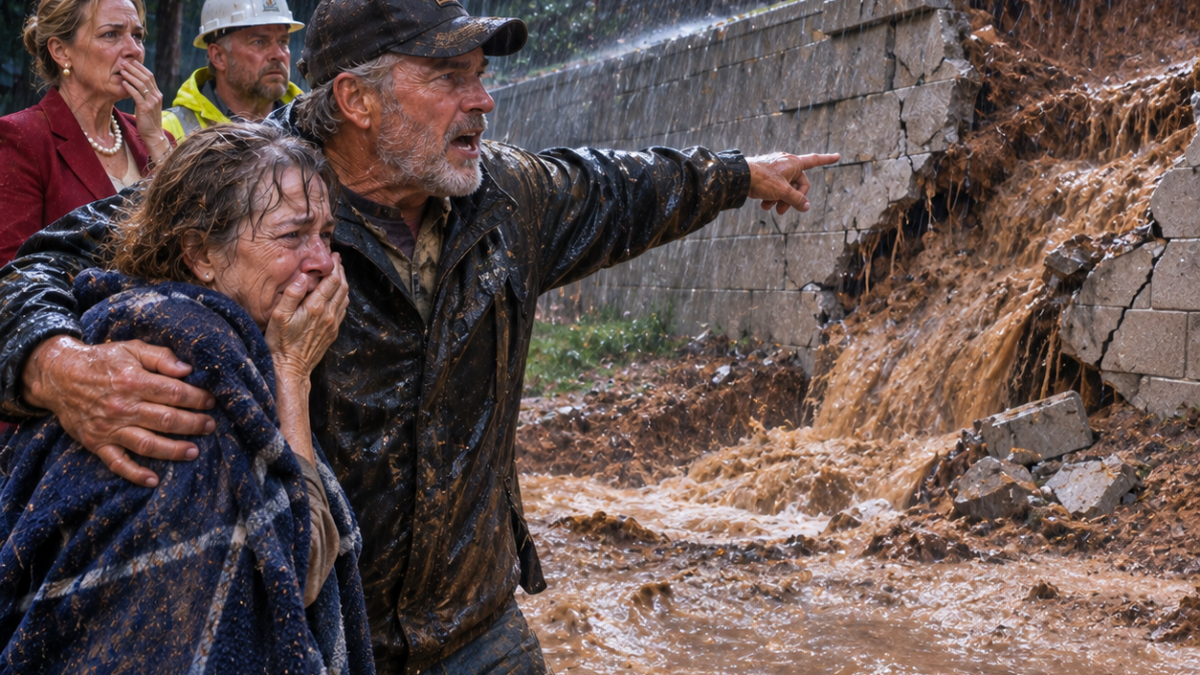
Then at 2:07 a.m., the center section bowed outward.
Slowly.
Like the entire hill had leaned against it.
The crack widened.
Water shot through.
Then the wall failed.
Not one explosion.
A sequence.
Snap.
Groan.
Roar.
A section nearly the length of a school bus tilted outward.
Concrete fractured.
Clay liquefied.
Thousands of gallons of trapped water burst through.
Mud.
Stone.
Construction debris.
Everything moved downhill.
Straight toward Hazel’s house.
I ran.
Later, people asked why.
I don’t remember deciding.
One second I was beside our fence.
The next I was crossing the lower yard.
Water hit my shins.
Then knees.
I climbed Hazel’s small fence rather than wasting time with the gate.
Mud pulled at my boots.
I reached her back door.
Pounded.
“Hazel!”
Nothing.
“HAZEL!”
Lights came on.
The mud wave reached the basement wall.
Brown water poured into the window wells.
Hazel opened the kitchen door wearing a nightgown and sneakers.
At least she’d listened to that part.
“What is happening?”
“We’re leaving.”
“My purse—”
“No.”
“Ron—”
“No.”
I took her arm.
Another surge hit.
Glass shattered below us.
Hazel froze.
“Basement?”
“Forget it.”
“I have photographs—”
“Forget them.”
Water came under the kitchen door.
I wrapped one arm around Hazel’s waist.
She protested.
“I can walk.”
“Not fast enough.”
I lifted.
She weighed maybe one hundred ten pounds.
We went through knee-deep water.
Mud.
Rain.
I nearly fell twice.
By the time we reached the slope toward my house, Sheriff’s deputies were coming down with flashlights.
One took Hazel.
Another grabbed my arm.
“You okay?”
“Yes.”
“You bleeding.”
I looked.
Cut on my forearm.
Didn’t matter.
We got Hazel onto our porch.
Laura wrapped her in a blanket.
Hazel was shaking now.
Shock arriving after stubbornness.
She grabbed my hand.
“My house?”
I looked downhill.
Water had reached the main floor threshold.
“Still standing.”
“Basement?”
I didn’t answer.
She understood.
Emergency crews blocked the street.
Fire department checked houses.
Nobody died.
That mattered more than anything else.
Hazel’s basement filled almost to the ceiling.
Two neighboring yards flooded.
One shed moved twenty feet.
My back yard lost most of the topsoil.
The wall?
Gone in the middle.
Two end sections standing like broken teeth.
At 4:30 a.m., rain eased.
I stood on our porch looking at the wreckage.
Laura came beside me.
“You warned them.”
I said nothing.
She took my hand.
“You warned them.”
“I should’ve gotten Hazel out earlier.”
“She wouldn’t go.”
“I should’ve called somebody.”
“You did.”
“More.”
“Ron.”
I looked at her.
Her voice softened.
“You cannot be responsible for everybody refusing to listen.”
I knew she was right.
Didn’t feel right.
At sunrise, Caleb Burke arrived.
Exactly as promised.
White pickup.
Rain boots.
Hard hat.
Clipboard.
He stood at the edge of the failed section.
Looked.
Didn’t speak for nearly a minute.
Then climbed carefully into the mud.
I followed.
He pointed.
“There’s no stone.”
“I know.”
“No filter fabric.”
“No.”
“Where’s the drain?”
We dug with a shovel.
Nothing.
Ten feet.
Nothing.
Twenty.
Nothing.
Caleb looked at me.
“They didn’t install it.”
He moved toward the broken concrete.
“Reinforcing?”
Pieces exposed.
Vertical rebar.
Sparse.
No proper tie-in system.
No reinforcement matching the drawing.
He crouched.
“This footing is undersized.”
I asked:
“How bad?”
He looked toward Hazel’s house.
“Bad enough that we’re lucky the failure happened progressively.”
“What do you mean?”
“If the entire center section had released at once…”
He didn’t finish.
Didn’t need to.
Caleb walked the wall.
Then stopped at the buried swale.
He pointed.
“There’s your easement.”
Water had cut through fresh mud, recreating part of the old drainage path almost perfectly.
“Nature remembered.”
I said:
“My father would like that.”
Caleb didn’t smile.
“This wall was never designed for this.”
“Your seal says otherwise.”
“Not my seal application.”
“Forged?”
He looked at me.
“Yes.”
That’s when Renata arrived.
Red blazer.
Wrong clothes for mud.
She walked toward us with both hands raised.
“What happened?”
I stared.
Caleb stared.
She looked at the collapsed wall.
“This can’t—”
I said:
“Look.”
She turned.
“Look what the rain did.”
Renata’s face hardened defensively.
“This was engineered.”
Caleb held out the photograph of the plan.
“No.”
She looked at him.
“You’re Caleb Burke?”
“Yes.”
Her face changed.
He continued.
“This is my seal.”
He pointed.
“But I did not apply it to this document.”
Renata looked toward me.
I said nothing.
Caleb continued.
“I designed a four-foot segmental wall with full drainage and preservation of the existing swale.”
He gestured toward the wreckage.
“This is a nine-foot cast concrete structure with inadequate reinforcement, no functioning drainage layer, and no approved basis in anything I submitted.”
Renata’s mouth opened.
“Zeller told me—”
A truck came up the hill.
Marty.
Perfect timing.
He climbed out.
Saw Caleb.
Saw Renata.
Saw deputies.
Saw the wall.
His face went gray.
Renata pointed.
“Marty, tell them.”
He stopped.
“Tell them what?”
“That you built according to approved plans.”
Marty stared at her.
“You serious?”
Renata’s face changed.
“Marty.”
He laughed once.
Angry.
“You told me to do it fast.”
“That is not—”
“You told me the board didn’t have money for the full spec.”
Neighbors were gathering.
Phones.
Hazel sat on our porch wrapped in Laura’s robe.
Marty continued.
“I told you it needed drainage.”
Renata stepped closer.
“Be very careful.”
“No.”
He pointed toward the wall.
“I’m done being careful.”
Then Douglas Pratt arrived.
He remained near his car.
Wouldn’t come closer.
Marty pointed at him.
“He paid me forty-eight thousand cash.”
Every neighbor stopped talking.
Douglas went pale.
Renata snapped:
“Marty.”
He shouted:
“You had two hundred twelve grand budgeted!”
There it was.
A number nobody on the street knew yet.
Marty was sweating despite the cold morning.
“You said build the wall for forty-eight.”
“You said you’d handle engineering.”
“You said you’d handle permits.”
“You told us skip the gravel.”
“You told us seal the holes because they looked ugly.”
Renata’s face had lost all color.
“I never said that.”
Marty laughed.
“I’ve got texts.”
That silenced her.
At 8:36, Linda Ashby finally arrived.
County truck.
Raincoat.
Red inspection tags.
She walked the site with Caleb.
Looked at the failed footing.
The filled weep holes.
The encroachment.
The buried swale.
Then she attached a bright red notice to the remaining wall section.
UNSAFE STRUCTURE — STOP WORK / NO ENTRY.
She turned to Renata.
“I need the permit file.”
Renata said:
“The HOA has it.”
Linda looked at her.
“My office does not.”
“There must be a clerical error.”
“There isn’t.”
Linda held out her hand.
“Engineering approvals.”
Renata didn’t move.
“Contract.”
Nothing.
“Payment documentation.”
Douglas looked toward the ground.
Linda turned to me.
“Mr. Tillman.”
“Yes?”
“Submit a formal request for the complete HOA financial ledger.”
“I already planned to.”
“Do it today.”
“Why?”
She looked at the wall.
“Because somebody paid for this.”
I sent the request before lunch.
Certified email.
Certified mail.
Hand delivery.
I wanted no arguments about receipt.
Two days later, Douglas Pratt came to my house.
Sunday evening.
He looked terrible.
No jacket.
No briefcase.
Hands shaking.
Laura opened the door.
“Douglas?”
“Is Ron here?”
I stepped into the hallway.
“What happened?”
He held up a thumb drive.
“Can we talk?”
We sat at the kitchen table.
Douglas didn’t touch the coffee Laura put in front of him.
He stared at the drive.
Then said:
“The reserve account had two hundred twelve thousand dollars allocated for slope stabilization.”
Same number Marty gave.
I waited.
“Engineering.”
“Drainage.”
“Wall construction.”
“Contingency.”
“What happened to it?”
Douglas closed his eyes.
“One hundred forty thousand was transferred.”
“To where?”
“Clubhouse improvement account.”
I stared.
“What improvements?”
He looked ashamed.
“The bar.”
I thought I’d misheard.
“What?”
“Renata wanted the clubhouse upgraded.”
I knew renovations were underway.
New flooring.
Private lounge area.
Stone bar.
Wine refrigerators.
Board-only meeting room.
Nobody had said where the money came from.
Douglas continued.
“She said the wall could be done cheaper.”
“How cheap?”
“Forty-eight thousand.”
“Marty.”
He nodded.
“What about the remaining twenty-four?”
“Consulting.”
“What consulting?”
He shook his head.
“I don’t know.”
“Douglas.”
“I don’t.”
“Who authorized transfer?”
He looked at me.
“Renata.”
“Board vote?”
Silence.
I understood.
“You signed.”
His face crumpled.
“Yes.”
“Why?”
“She said we’d reimburse it next year.”
“From what?”
“Special assessment if necessary.”
I leaned back.
Laura sat beside me.
Douglas pushed the thumb drive across.
“Everything’s there.”
“What?”
“Bank statements.”
“Emails.”
“Draft minutes.”
“Transfers.”
I looked at him.
“Why now?”
He glanced toward the back yard.
Through the window, Hazel’s ruined house was visible below.
“Because somebody almost died.”
That was the first honest thing I’d heard from him.
The emergency board meeting happened Tuesday.
The clubhouse was full.
Standing room only.
Renata sat at the front with an attorney.
Douglas wasn’t beside her.
He sat in the audience.
That mattered.
Renata opened with:
“The board deeply regrets the unfortunate weather-related failure of the Phase Three retaining structure.”
A man behind me muttered:
“Weather-related?”
She continued.
“Preliminary information suggests possible interference with drainage infrastructure during construction.”
I stood.
Her attorney looked at me.
Renata said:
“Ron, public comments will come later.”
“No.”
The room shifted.
“You’re not blaming me for this.”
“I did not name you.”
“You just said drainage was interfered with.”
“That possibility is being investigated.”
I walked toward the front carrying a document tube and laptop.
Her attorney stood.
“Mr. Tillman, please return to your seat.”
I ignored him.
Placed the 1987 blueprint on a table.
Unrolled it.
“Recorded drainage easement.”
Then my photographs.
“Orange stakes fourteen inches inside my property.”
Photo.
“Swale before construction.”
Photo.
“Swale buried.”
Photo.
“Weep holes open.”
Photo.
“Weep holes being filled with mortar.”
Then video.
Fence camera.
Time stamped.
Worker kneeling.
Mortar.
Hole after hole disappearing.
The room went silent.
Renata’s lawyer whispered to her.
I continued.
Then Caleb’s signed statement.
I DID NOT DESIGN, APPROVE, OR STAMP THE NINE-FOOT WALL CONSTRUCTED AT CEDAR RIDGE.
I placed the HOA engineering sheet beside it.
“Forged seal.”
People gasped.
Renata stood.
“That allegation has not been proven.”
“No.”
I looked at her.
“Not yet.”
Douglas stood from the audience.
Renata’s face changed.
He held up a printed ledger.
“I can prove the money.”
That meeting ended differently than Renata planned.
She adjourned after residents began demanding her resignation.
The next morning, my attorney Owen Prescott sent evidence packages to the county.
State engineering board.
Sheriff’s office.
HOA insurer.
County prosecutor.
Owen loved documentation almost as much as I did.
He told me:
“A bad wall is a civil problem.”
“A forged professional seal becomes something else.”
Investigators seized the HOA computer two days later.
The forged engineering document was traced to a PDF editing program installed on the board’s laptop.
Metadata showed the original four-foot Burke design had been opened.
Dimensions altered.
Wall height changed.
Notes removed.
Drainage details deleted.
Then Burke’s seal and signature were copied from another legitimate project.
The modified file was saved under Renata Colby’s user account.
When investigators asked her to explain the metadata, she reportedly stared at it for almost a minute.
Then said:
“I need an attorney.”
Marty Zeller cooperated immediately.
His phone contained texts.
Renata:
WE NEED THIS COMPLETED BEFORE COUNTY REVIEW.
Marty:
AT THAT HEIGHT I NEED NEW ENGINEERING.
Renata:
USE BURKE’S PLAN. ADJUST DIMENSIONS.
Marty:
DRAINAGE ADDER IS 27K.
Renata:
NO. SKIP THE STONE. EXISTING SOIL IS FINE.
Marty:
IT’S CLAY.
Renata:
THE WALL WILL HANDLE IT.
Then:
FILL THE VISIBLE HOLES WHEN DONE. THEY LOOK CHEAP.
Marty:
THOSE ARE WEEP HOLES.
Renata:
MAKE IT CLEAN.
That message was read aloud later in court.
Make it clean.
Three words.
Nearly cost Hazel Dunning her life.
The financial investigation expanded.
The clubhouse renovation had cost more than homeowners were told.
Private bar.
Custom cabinetry.
Leather furniture.
Wine refrigerator.
New boardroom.
Imported tile.
More than one hundred forty thousand dollars diverted from the slope project.
Douglas had approved transfers.
He cooperated.
Resigned.
Eventually entered a civil repayment agreement and avoided the more serious criminal charges after investigators concluded he hadn’t personally taken money.
That didn’t make him innocent.
He knew.
He signed.
He stayed quiet.
He would tell the neighborhood that himself months later.
Renata was removed by membership vote within thirty days.
Not close.
Ninety-three percent.
Marty lost several contracts and faced licensing penalties.
The state engineering board pursued the forged seal case.
County prosecutors brought fraud and forgery-related charges against Renata.
The HOA insurer initially tried calling the collapse an extreme-weather event.
Owen sent them the video of the weep holes being filled.
Their position changed quickly.
Hazel’s house was repaired.
New basement.
Foundation work.
Electrical.
Mold remediation.
Landscaping.
Temporary housing.
Everything.
The insurer paid.
The HOA paid deductibles and uncovered portions.
Hazel refused to move permanently.
Of course she did.
Her daughter tried.
Hazel told her:
“I survived the wall.”
“I’m not letting it steal my garden too.”
The new wall took three months to design.
This time there were plans.
Real ones.
Permit number.
County review.
Independent geotechnical engineer.
Caleb Burke himself reviewed the drainage.
Not because he had to.
Because his name had been used.
He came to our kitchen one afternoon.
Spread drawings over the table.
“This is what should have been built.”
The new system wasn’t simply a taller version of the original.
It stepped with the grade.
Reinforced.
Proper footing.
Drainage stone.
Filter fabric.
Perforated pipe.
Multiple outlets.
Open weep paths.
And most importantly:
My father’s swale was restored.
Exactly along the recorded easement.
I ran my finger down the line.
“You preserved it.”
Caleb looked at me.
“I’m not arguing with water.”
I smiled.
“My father used to say something similar.”
“What?”
“You don’t beat water.”
“You give it somewhere better to go.”
Caleb nodded.
“Smart man.”
The new wall sat completely outside my property line.
Not fourteen inches in.
Not one inch.
Survey pins protected during construction.
County inspector on site repeatedly.
I probably annoyed everybody.
I don’t care.
Sometimes annoying people is what prevents them from repeating expensive mistakes.
Our civil settlement came later.
One hundred forty-eight thousand dollars.
Encroachment.
Property damage.
Loss of use.
Legal expenses.
Emotional damages related to the flooding.
I wasn’t expecting that much.
Owen negotiated aggressively.
Laura and I talked.
Mortgage wasn’t large.
We didn’t need all the money.
Hazel’s insurance had covered her repairs, but she had other expenses.
Temporary living.
Destroyed furniture beyond certain policy limits.
Family photographs.
Things insurance always values in a way that feels insulting.
I gave her part.
She refused.
I insisted.
She refused again.
I told her my father would haunt both of us if she didn’t take it.
She finally accepted enough to restore her garden and replace furniture.
Then she made me promise not to tell anyone the amount.
So I won’t.
The first heavy rain after the rebuilt wall arrived six weeks later.
Not as violent as the storm that destroyed the old one.
Heavy enough.
Weather alert.
Two inches overnight.
At ten, I made coffee.
Laura laughed.
“Going to stand out there all night?”
“Possibly.”
“You’re insane.”
“Professionally interested.”
“That’s what insane people call it.”
Rain began.
I went to the back deck.
Flashlight.
New wall dark with water.
Behind it, drainage system worked.
One weep outlet began flowing.
Then another.
Then another.
Clear water.
Steady.
Not spraying.
Not muddy.
No pressure building.
The restored swale filled.
Water followed the same path it had followed when I was seventeen.
Around the oak.
Across the lower grass.
Toward the county drain.
Exactly where Dad had shaped it.
Laura came outside with a blanket around her shoulders.
“You happy?”
I watched.
“Yes.”
“About drainage?”
“Yes.”
“You’re becoming your father.”
“I’ve been accused of worse.”
Across the slope, Hazel’s porch light came on.
She stepped outside holding an umbrella.
She saw me.
Waved.
I waved back.
Water moved safely between us.
Nothing dramatic happened.
That was the victory.
No cracking.
No sirens.
No mud.
No rescue.
Just water going where it was supposed to go.
Sometimes good engineering looks like nothing happening.
Months later, Cedar Ridge elected a new board.
Douglas didn’t run.
Obviously.
The new president was a woman named Priya Shah.
Civil accountant.
Quiet.
Almost aggressively transparent.
At her first meeting, she put every major contract on a projector.
Budgets.
Bids.
Permits.
Bank balances.
Someone finally complained:
“Do we need this much detail?”
Priya looked at him.
“Yes.”
I laughed.
She looked at me.
“You especially don’t get to laugh.”
“Why?”
“You created half these disclosure rules.”
“Fair.”
The clubhouse bar remained.
Nobody wanted to spend more money ripping it out.
But the board-only lounge became a general resident room.
Hazel hosted a book club there.
I considered that appropriate.
The forged plan stayed evidence for years.
After the criminal case ended, I received a certified copy.
I keep it next to Dad’s 1987 blueprint.
Two documents.
Same piece of ground.
One respected how the hill worked.
One pretended concrete could change it.
That comparison tells the whole story.
Renata eventually pleaded guilty to charges tied to the forged engineering document and misuse of association funds.
People asked me whether I felt satisfaction.
Some.
Not from prison.
From the acknowledgment.
For weeks, she’d called me alarmist.
Troublemaker.
Unqualified.
She told neighbors I was scaring them.
She told me the wall would outlast me.
Then the rain came.
Water has no political allegiance.
No HOA membership.
No respect for titles.
It doesn’t care whether you’re president.
Treasurer.
Contractor.
Homeowner.
It follows gravity.
That’s what made the whole thing so maddening.
Nothing that happened was mysterious.
Water entered soil.
Drainage was blocked.
Pressure rose.
Wall was inadequate.
Wall failed.
No surprise.
Only consequences.
The lies were complicated.
Physics wasn’t.
Marty visited once after everything.
Not because we became friends.
We didn’t.
He wanted to apologize.
We stood near the new wall.
He stared at it.
“That’s how I wanted to build it.”
I looked at him.
“Then why didn’t you?”
He rubbed his jaw.
“Needed the contract.”
“Forty-eight thousand.”
“Yes.”
“You knew it was wrong.”
He looked at the ground.
“I knew it was cheap.”
“Not the same thing.”
“No.”
He swallowed.
“When they told us to fill the holes, I should’ve walked.”
“Yes.”
“I thought the worst thing that would happen was cracking.”
“Hazel almost drowned in her basement.”
“I know.”
He looked sick.
“I think about that.”
“Good.”
He looked at me.
That surprised him.
I continued.
“You should.”
“I thought you’d tell me to forgive myself.”
“No.”
“Maybe someday.”
“But first remember.”
Marty nodded.
“I do.”
He left.
Laura later said I was hard on him.
Maybe.
But forgiveness without memory becomes permission.
I didn’t hate Marty.
I also didn’t want him making the same decision on somebody else’s hill.
Douglas came by too.
He apologized.
His was harder to hear.
He had known the money was moved.
Not the forged seal, he said.
Not the exact construction shortcuts.
But enough.
“I could have stopped it.”
He sat at our kitchen table.
“Yes.”
I didn’t soften it.
“I kept telling myself I’d fix the account next year.”
“With homeowner money.”
“Yes.”
“Why?”
He stared at his hands.
“Renata made everything sound temporary.”
“Money comes back.”
“Contract gets corrected.”
“Permit catches up.”
“Board approves later.”
“Always later.”
He looked at me.
“I knew better.”
“Why didn’t you act?”
“Because admitting the first mistake would’ve exposed the second.”
That was honest.
He continued.
“Then the third.”
“Then the fourth.”
“And eventually I wasn’t protecting the HOA.”
“I was protecting the fact that I had stayed silent.”
That might have been the most useful thing anybody said during the entire scandal.
Wrongdoing compounds like debt.
Every time you hide one decision, the next lie becomes more expensive to admit.
Eventually people aren’t defending the original mistake.
They’re defending all the silence after it.
That was Renata.
That was Douglas.
That was Marty.
Different levels.
Same pattern.
I thought about myself too.
If I hadn’t kept Dad’s blueprint?
If I hadn’t measured the stakes?
If I had accepted Renata’s stamped plan?
If I had listened when people said:
You’re not an engineer.
Maybe Hazel’s house would’ve been empty when the wall failed.
Maybe not.
That’s what bothers me.
Expertise matters.
Of course it does.
Caleb knew more about retaining-wall design than I ever will.
Linda knew permitting.
Owen knew law.
But citizens don’t need a professional license to ask:
Where’s the permit?
Where’s the plan?
Whose signature is this?
Why are you blocking the drainage?
Those aren’t attacks.
They’re questions.
Real professionals usually welcome questions they can answer.
Fake confidence hates them.
I learned that with Renata.
Every time I asked for a document, she answered with status.
It’s handled.
Professionals approved it.
The board has authority.
Not everything needs your approval.
All true-sounding phrases.
None contained evidence.
The day after the rebuilt wall passed final inspection, Caleb handed me the signed package.
Permit.
Engineering.
Materials certification.
Drainage inspection.
Final approval.
Almost fifty pages.
I laughed.
He asked:
“What?”
“Renata said not everything needed my approval.”
Caleb smiled.
“She was right.”
I looked at him.
He held up the documents.
“But everything this size needs somebody’s.”
Fair.
Dad’s swale looks almost exactly like it did thirty years ago now.
Grass grew back.
Stone remains in the low sections.
During dry weather, kids would never notice it.
That’s ideal.
Every spring, I clean leaves out.
Laura says I treat it like a family heirloom.
Maybe I do.
One morning, a boy from Phase Three stopped at the fence while I was working.
Ten or eleven.
He pointed.
“Is that the ditch that broke the wall?”
I smiled.
“The ditch didn’t break anything.”
“My dad says the drainage broke it.”
“Your dad’s close.”
The boy looked confused.
I set down the rake.
“The water needed somewhere to go.”
“Okay.”
“The old wall blocked it.”
“So water broke it.”
“Pressure did.”
“Same thing.”
Fair.
He looked at the new wall.
“Will this one break?”
“Someday everything breaks.”
That concerned him.
I added:
“But not because the drains are blocked.”
He nodded.
Then asked:
“Why did they block them?”
I looked toward the clubhouse.
“Because somebody cared more about how the wall looked than how it worked.”
The boy thought about that.
“That’s dumb.”
“Very.”
He rode away.
Kids are good at summarizing engineering scandals.
The anniversary of the collapse came on a clear Saturday.
Hazel invited us to dinner.
Her basement had been completely rebuilt.
New family room.
Shelves.
A small desk.
On one wall hung framed photographs restored by a company her daughter found.
Some had been damaged in the mud.
Faces blurred at the edges.
Still there.
Hazel pointed toward one.
Her wedding.
“You saved that?”
“No.”
“The restoration company did.”
“But you saved me.”
I shook my head.
“Let’s not.”
She looked at me.
“Ron.”
“I got lucky.”
“No.”
“I got you out.”
“Yes.”
“That’s not—”
She interrupted.
“Do you know why old people thank people badly?”
I laughed.
“No.”
“Because younger people keep arguing.”
I stopped.
She took my hand.
“Thank you.”
I nodded.
“You’re welcome.”
Then she let go.
“Good.”
“Now eat.”
That was Hazel.
Renata’s old clubhouse office eventually became a storage room.
Nobody wanted it.
Too much history.
Priya asked whether I wanted the red blazer after evidence release.
She was joking.
I said I’d rather rebuild the wall myself.
The neighborhood changed in subtle ways.
People attended meetings.
Not everyone.
Enough.
Contract bids received questions.
Budgets got read.
When a new landscaping project came up, a resident asked:
“Permit required?”
The room laughed.
Then checked.
Good.
The biggest change wasn’t suspicion.
It was participation.
There’s a difference.
Suspicion says everyone is lying.
Participation says show me.
Healthy communities need the second.
Otherwise one polished voice eventually starts making decisions in rooms nobody else enters.
I never joined the board.
People asked.
Absolutely not.
I value my remaining sanity.
But Priya did put me on the infrastructure committee.
Laura laughed for a full minute when I told her.
“You’re officially Drainage Ron.”
“I quit.”
“No, you don’t.”
“I might.”
“You’ve already printed the meeting packet.”
She knew me too well.
The committee’s first project was replacing two old storm drains near the pool.
The engineer presented drawings.
Before I could speak, he pointed at me.
“Yes.”
“There are weep outlets.”
The room laughed.
I liked him immediately.
Years passed.
Cedar Ridge went back to boring.
That’s the best ending a neighborhood can have.
No investigations.
No reporters.
No sheriff’s cars.
No emergency meetings.
Grass complaints.
Pool schedules.
Arguments about Christmas lights.
Normal nonsense.
Hazel still lives below us.
She turned eighty-two last spring.
Still gardens.
Still refuses help until she needs it.
Douglas moved to Arizona near his daughter.
Marty’s company survived but under new ownership.
Caleb became our HOA’s preferred independent engineering reviewer, which I suspect annoyed him.
Linda still works county inspections.
Priya still publishes financial reports so detailed that nobody can accuse the board of hiding anything without first reading eighty pages.
And every time a heavy storm comes, I still wake up.
Not panicked.
Listening.
Rain on roof.
Then I walk to the back window.
Laura sometimes wakes.
“You checking?”
“Yes.”
“You know the new wall works.”
“Yes.”
“You going outside?”
“Probably.”
She groans.
“Take a coat.”
I stand on the deck.
Water comes through the outlets.
One.
Two.
Three.
Steady.
Clear.
Then down the swale.
Past the oaks.
Toward the drain.
No pressure.
No mystery.
Water doing what water has always done.
I think about Dad then.
He never used phrases like hydrostatic pressure.
He would’ve hated HOA meetings.
He would’ve disliked Renata immediately.
But he understood the land.
One summer when I was eighteen, I asked why he spent an entire Saturday cleaning a ditch nobody could see from the house.
He said:
“Because rain remembers where downhill is.”
I laughed at him.
He didn’t.
He added:
“You can forget.”
“Water won’t.”
Thirty-five years later, I watched an HOA bury that same route beneath nine feet of concrete.
They had permits they hadn’t actually obtained.
Plans an engineer hadn’t actually approved.
Money that had been redirected.
A contractor who knew better.
A treasurer afraid to admit what he’d signed.
A president who believed confidence could replace physics.
Then the rain remembered.
At 2:07 in the morning, everything they had hidden became visible at once.
The buried easement.
The missing drainage.
The bad reinforcement.
The forged design.
The diverted money.
The ignored warnings.
It all came out through one crack.
That’s why I don’t call the collapse an accident anymore.
The storm didn’t make the mistake.
The storm revealed it.
The mistake began weeks earlier.
Maybe months.
The first time somebody said:
We’ll fix the paperwork later.
The first time somebody moved money because nobody was watching.
The first time Marty accepted forty-eight thousand dollars to build something he knew should cost more.
The first time Douglas signed a transfer he knew the board hadn’t properly authorized.
The first time Renata copied an engineer’s seal and convinced herself results mattered more than rules.
By the time concrete cracked, failure had already happened.
The wall simply made it visible.
That’s true about more than construction.
Bad systems often look strongest right before pressure arrives.
Then something ordinary tests them.
Rain.
A question.
An audit.
A records request.
One homeowner who kept an old blueprint in his garage.
People sometimes tell me I won.
I don’t think of it that way.
Hazel lost a basement.
We lost part of our yard.
Homeowners lost money.
Trust disappeared overnight.
Nobody wins that.
But we did learn something.
A retaining wall isn’t strong because it looks solid.
It is strong because of the things you usually can’t see.
Footing.
Rebar.
Drainage stone.
Pipe.
Engineering.
Details buried behind the finished surface.
Trust works the same way.
Transparency.
Records.
Rules.
People willing to ask uncomfortable questions.
People willing to answer them.
Ignore those things and the structure may still look perfect.
For a while.
Then pressure comes.
It always does.
The final time I saw Renata was outside the courthouse.
She had just finished a hearing.
No red blazer.
Plain dark coat.
Her attorney beside her.
I was waiting for Owen.
She saw me.
Stopped.
For a second I thought she’d walk away.
Instead, she approached.
“Ron.”
“Renata.”
She looked older.
Not dramatically.
Just tired.
She glanced toward the courthouse steps.
“I never thought the wall would fail.”
I believed her.
That might surprise people.
I did.
She had been arrogant.
Dishonest.
Reckless.
But I didn’t think she built the wall hoping it would collapse.
I said:
“I know.”
She looked at me.
“You do?”
“Yes.”
“Then why do you look at me like that?”
“Because you didn’t need to think it would fail.”
She frowned.
“You needed to know whether it could.”
She looked away.
I continued.
“That’s what permits were for.”
“Engineering.”
“Drainage.”
“The stuff you skipped because you wanted it finished.”
She swallowed.
“I thought Marty knew what he was doing.”
“He told you.”
No answer.
“You told him to skip the stone.”
Still nothing.
“You told them to fill the holes.”
Her eyes filled.
“I didn’t understand what they did.”
“That was the problem.”
She looked at me.
Then said something I wasn’t expecting.
“I’m sorry about Hazel.”
I believed that too.
“Tell her.”
“I don’t think she’ll speak to me.”
“Maybe.”
“Tell her anyway.”
Renata nodded.
She walked away.
I don’t know whether she ever did.
I never asked Hazel.
Some things aren’t mine to manage.
The old failed-wall concrete was removed years ago.
I kept one small piece.
Laura complained.
“Why do we own a chunk of bad concrete?”
“Reminder.”
“We have photos.”
“Concrete’s better.”
“Men.”
She shook her head.
It sits beside Dad’s old blueprint tube in the garage.
Gray.
Ordinary.
Nothing about it looks dangerous.
That’s fitting.
The danger was never concrete alone.
It was everything people decided concrete would hide.
No gravel?
Hidden.
No drain?
Hidden.
Wrong design?
Hidden.
Forged seal?
Hidden.
Money moved?
Hidden.
Easement buried?
Hidden.
Until water arrived.
That’s why, during every storm, I still watch those weep holes.
Not because I’m afraid the new wall will fall.
Because I like seeing the truth work.
Clear water comes out.
Exactly where the plan says.
Exactly where the engineer intended.
Exactly where gravity demands.
Then it finds my father’s swale and moves quietly downhill.
Hazel’s lights stay on.
Her basement stays dry.
Our yard stays where it belongs.
Nothing makes the news.
Nobody calls 911.
Nobody gets carried through mud.
No attorney sends a letter.
No county inspector brings a red tag.
The system works.
And after everything that happened, I’ve learned to appreciate how beautiful boring can be.
Some mistakes cost money.
Some cost property.
Some nearly cost lives.
And some destroy trust so completely that rebuilding the concrete is the easy part.
But sooner or later, pressure reveals what was built correctly and what was only made to look solid.
Because lies can block paperwork.
They can seal holes.
They can bury easements under nine feet of concrete.
They can even borrow an engineer’s name.
But they can’t rewrite gravity.
And the truth, just like water, always finds a way out.


