HOA Bought My Neighbor’s Road to Box Me In at Christmas—Then I Bought the Land They Needed to Expand
PART2:
Thin Montana snow blowing sideways across the road.
My headlights caught a brand-new sign bolted beside the barrier.
PRIVATE ROAD
ELKRIDGE ESTATES
AUTHORIZED ACCESS ONLY
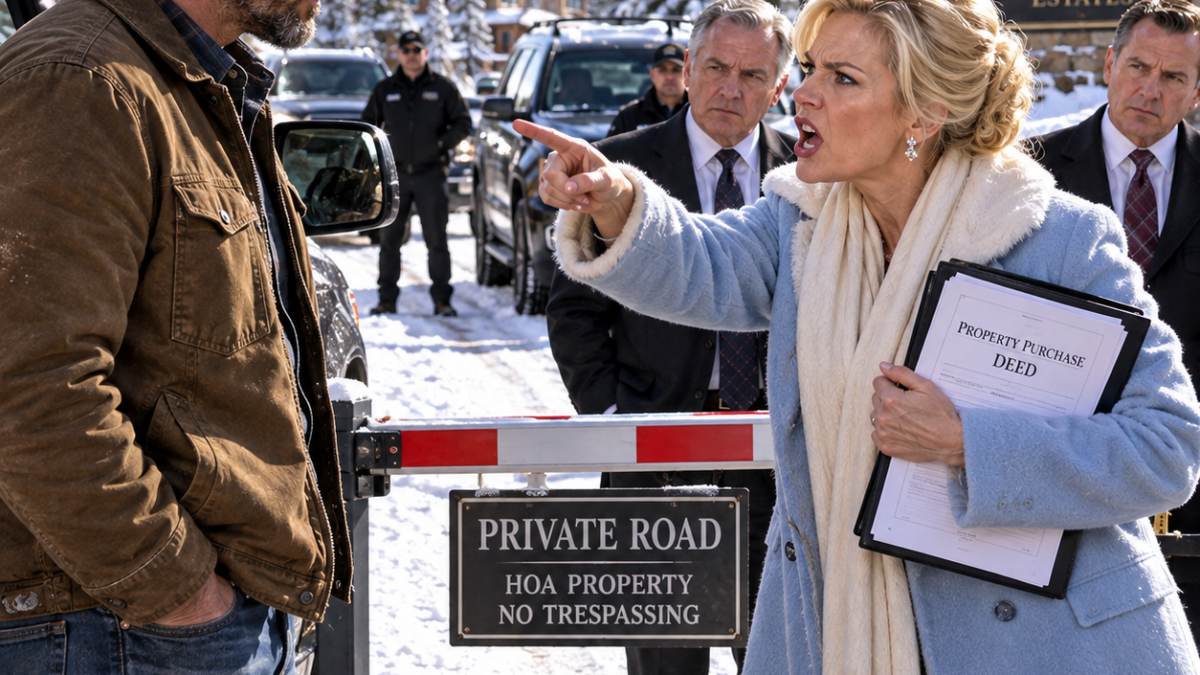
Vivian stood next to it wearing a light blue winter coat.
Platinum-blonde hair.
Leather gloves.
Perfect boots that had never touched manure.
Two Elkridge HOA board members sat inside SUVs parked behind her.
I stopped my truck.
Got out.
Left the engine running.
“Merry Christmas, Mr. Mercer.”
She said it like she was welcoming me to a hotel.
I looked at the barrier.
“Move it.”
Her smile remained.
“No.”
“My cattle are waiting.”
PART3:
“I understand.”
“That road leads to my house.”
“It also crosses property Elkridge purchased Friday.”
She held up a folder.
Recorded deed.
I walked closer but did not touch the barrier.
“From Earl?”
“Yes.”
Earl Pruitt owned acreage south of mine.
He was seventy-three.
Widower.
His daughter lived near Bozeman.
He had been talking about selling for months.
South Lane crossed part of his property before reaching Mercer Ranch.
For fifteen years, Earl and I had handled the road like neighbors.
I repaired ruts when my equipment caused them.
He kept culverts clear.
When snow got bad, whichever one of us had the larger machine plowed first.
No lawyers.
No board.
No access stickers.
No steel barrier.
Vivian handed me a notice.
“Elkridge acquired Mr. Pruitt’s road interest.”
I scanned it.
Then saw the second page.
ACCESS AGREEMENT.
Annual fee.
Maintenance surcharge.
Indemnity language.
Commercial-use restrictions.
Approval requirements for livestock transport.
Right of Elkridge to suspend access under certain circumstances.
I looked up.
“You expect me to sign this?”
“If you want continued access.”
“How much is the yearly fee?”
She told me.
I laughed.
She didn’t.
The amount was large enough to matter to a working ranch.
Not enough to bankrupt me.
That was not the point.
The agreement converted a right I had used for fifteen years into permission controlled by an HOA that had been trying to buy my land for three.
I folded the document.
“Where’s the instrument extinguishing Mercer Ranch’s existing access?”
Vivian’s smile thinned.
“Our attorneys reviewed the purchase.”
“That isn’t what I asked.”
She pointed to the deed.
“Elkridge owns the road interest.”
“Maybe.”
Her eyes hardened.
“There’s no maybe.”
I looked at the legal description again.
Something bothered me.
The parcel line stopped oddly.
Too neatly.
Like someone had copied only part of a much older description.
“Move the barrier tonight.”
“No.”
“Then let me through once.”
“No.”
“My feed schedule depends on me getting home.”
“You can sign.”
I looked at her.
“You bought something Friday.”
“Yes.”
“You put up a barrier Christmas Eve.”
“Yes.”
“And now you’re telling me the only way to reach my ranch is signing away rights before my lawyer has even reviewed what you purchased.”
She shrugged.
“You had years to cooperate with Elkridge.”
There it was.
Not road maintenance.
Not safety.
Cooperation.
Three years earlier, Vivian came to my kitchen with Phase Three plans.
Elkridge Estates had started small.
A private subdivision east of my ranch.
Then golf.
Clubhouse.
Luxury homes.
Landscaped roads.
Security gate.
The original development was legal, attractive, and popular.
People liked living there.
Nothing wrong with that.
But growth changed the board.
And Vivian believed the valley looked unfinished anywhere Elkridge did not control it.
She spread architectural drawings across my kitchen table.
Luxury homes along my eastern ridge.
Resort cabins near the creek.
Golf expansion across ground where I rotated cattle.
Service roads.
Utilities.
Trails.
She pointed.
“This section could become some of the highest-value property in the county.”
I answered:
“It’s already valuable.”
“For cattle?”
“Yes.”
She smiled like I had missed the joke.
“You could make considerably more selling.”
“I’m not selling.”
“Not even this portion?”
“No.”
“Why?”
“Because I like owning my ranch.”
She gathered the drawings slowly.
“I think eventually you’ll reconsider.”
Instead, I began receiving letters.
Dust complaints.
Fence appearance.
Equipment visibility.
Livestock odors.
All from an HOA my land did not belong to.
I kept every one.
My former career had taught me that nonsense becomes evidence if somebody repeats it long enough.
Now Vivian had bought Earl’s road interest.
I pulled my phone out.
Photographed the barrier.
The sign.
Her notice.
The county recording reference.
Then called Calder Wynn.
Calder was my attorney.
He had handled Mercer Ranch land work since I bought the property.
He answered on the third ring.
Christmas Eve.
“Gideon?”
“Sorry.”
“That usually means you’re about to ruin dinner.”
“Open the South Lane file.”
Silence.
“What happened?”
“Earl sold his interest to Elkridge.”
“All of it?”
“That’s what Vivian says.”
I read him the recording number.
He wrote it down.
“Do not sign anything.”
“Wasn’t planning to.”
“Do not move the barrier.”
“I was thinking about that.”
“Stop thinking about it.”
I looked at Vivian.
She was watching me from beside her SUV.
Calder continued.
“I need the deed.”
“And the older road instruments.”
“I want to know exactly what Earl owned and exactly what he conveyed.”
I looked at the groceries inside my truck.
Turkey.
Potatoes.
Coffee.
Bottle of bourbon I had bought myself because Christmas dinner with cattle and no guests still deserved decent bourbon.
“How long?”
“I don’t know.”
“Helpful.”
“Merry Christmas.”
He hung up.
Vivian walked over.
“Well?”
“My attorney is reviewing it.”
“Then I assume you’ll reconsider.”
“No.”
Her jaw tightened.
“You’re not driving through.”
I looked at the barrier again.
Then back at her.
“For tonight.”
She smiled.
“For as long as necessary.”
That confidence stayed with me.
I turned around.
For the first time in fifteen years, I could not drive home by the road I had always used.
Mercer Ranch had another route.
At least on paper.
An old logging grade exited near Miller Creek Road on the western side.
I had not driven the whole thing in years.
Fallen timber blocked sections.
One culvert worried me.
It had never needed to support regular cattle trailers or feed deliveries.
But it was something.
I drove to a surveyor named Wade Holloway.
Wade was supposed to be closing his workshop for Christmas.
Instead, I found him standing beside a plywood table with an old county map.
“You picked a bad day for a property dispute.”
“I didn’t choose it.”
“That’s what everybody says.”
I showed him Vivian’s notice.
Then the map.
He traced South Lane.
“This strip came out of an older ranch division.”
“I know.”
“Earl owned an interest.”
“Yes.”
“But this description stops short.”
“That bothered me.”
He nodded.
“Me too.”
“Meaning?”
“Meaning somebody needs to read the parent documents before claiming they bought the whole road.”
He did not tell me what I wanted to hear.
Good surveyors rarely do.
They tell you what can be measured.
Calder called an hour later.
“I have enough for a preliminary answer.”
I put him on speaker.
Wade leaned closer.
“Earl owned an undivided interest in part of the South Lane parcel.”
“Okay.”
“Elkridge bought that interest.”
“Okay.”
“But there is an older recorded reservation benefiting the ranch property.”
My chest loosened.
“So I still have access.”
“Likely yes.”
“Likely?”
“I am still checking later records.”
“But the purchase itself did not magically erase your recorded right.”
That was enough for Christmas Eve.
I called Vivian.
“I have a recorded access right.”
“Our purchase was reviewed.”
“Then your attorneys should review the older records.”
“Our position remains the same.”
“I need to get home.”
“Sign the agreement.”
“No.”
She hung up.
I slept on a cot in Wade’s workshop.
Christmas Eve.
Truck parked outside with groceries.
Mercer Ranch somewhere beyond the timber.
At sixty minutes after sunrise, Wade and I started clearing the western logging route.
Not building a new road.
Clearing an existing one.
Important difference.
Deadfall.
Branches.
Snow.
The old grade was still visible.
We reached the culvert.
Wade inspected it.
Then crawled down the bank.
“Pickup?”
“Probably.”
“Trailer?”
“No.”
“Feed truck?”
“Absolutely not.”
I drove across slowly.
The surface held.
A mile later, the old road connected with an internal ranch track.
For the first time in almost twenty-four hours, I reached my own house.
I checked cattle before coffee.
Water.
Feed.
Fences.
Everything fine.
Then I carried Christmas groceries inside.
The coffee tasted absurdly good.
I sat at the kitchen table alone.
Looked toward the eastern window.
Elkridge rooftops were visible through the trees.
Vivian thought she had boxed me in.
She had not.
But she had created a serious operational problem.
A ranch cannot survive on pickup access.
Livestock trucks.
Fuel deliveries.
Hay equipment.
Repair trailers.
Feed.
Heavy vehicles.
South Lane mattered.
Two days later, Douglas Fenn, an Elkridge board member, found Wade and me near the Miller Creek entrance.
He stopped.
“Where did you come from?”
“My ranch.”
“That isn’t Elkridge Road.”
“No.”
He called Vivian before leaving.
She arrived thirty minutes later.
Studied the western track.
“You’ve been excavating?”
“Clearing deadfall.”
Wade answered before I could.
“Existing road corridor.”
“We haven’t altered drainage.”
“And I’m not approving it for heavy trucks until the crossing is reinforced.”
Vivian looked at me.
“So this isn’t permanent.”
“It’s access.”
“For small vehicles.”
“For now.”
She smiled slightly.
“You still need South Lane.”
“Yes.”
That smile told me she believed she still had leverage.
She did.
My winter livestock shipment was scheduled in four days.
Heavy trailer.
Buyer had already extended the pickup once.
Calder contacted Elkridge’s lawyer.
Requested temporary passage.
Offered timing coordination.
Provided the older recorded access language.
Vivian refused.
Their position:
No commercial access without the new agreement.
I could have signed.
Paid.
Fought later.
Calder said that was an option.
But the agreement went beyond a temporary payment.
It rewrote the relationship.
I would be acknowledging their right to approve access I already believed Mercer Ranch possessed.
I said no.
County representative inspected the situation.
He looked at both documents.
Barrier.
Road.
Could not decide private property rights on the roadside.
Reasonable.
That required agreement or court.
Vivian stood beside her SUV after he left.
“Our agreement is still available.”
“My truck comes tomorrow.”
“Then you have a decision.”
I already had.
The carrier arrived the next morning.
Stopped at the barrier.
Driver called.
“I can’t take this trailer over your western road.”
“I know.”
“And I’m not driving through a locked gate.”
“I know.”
I called the buyer.
He had waited long enough.
By afternoon, the cancellation arrived.
A livestock contract I had spent years building was gone.
Not postponed.
Gone.
The cattle remained in my loading pens.
I forwarded the written cancellation to Calder.
“Put it in the file.”
He asked:
“What do you want to do?”
I looked east.
Toward Elkridge.
Then said:
“I want to stop depending on Vivian.”
That was the moment my strategy changed.
Until then, I had focused entirely on how to get into my ranch.
Now I began studying how Elkridge planned to get out of its existing boundaries.
I spread the Phase Three map across my kitchen table.
Vivian’s vision depended on land Elkridge did not own.
North:
Old hay property.
Northeast:
Retiring cattle operation.
East:
Undeveloped frontage.
Nearby:
Abandoned gravel pit.
Warehouse parcel.
And several corridors tied to the original ranch division.
I called Calder.
“Pull ownership on every parcel around Phase Three.”
Silence.
“You buying another access?”
“Maybe.”
“What else?”
“I want to know what they still need.”
That bothered him.
Good.
A lawyer who likes every idea immediately is not useful.
“Gideon.”
“Yes.”
“Do not start buying property just to hurt them.”
“I know.”
“Every purchase needs to make independent sense.”
“I know.”
“Willing sellers.”
“Yes.”
“Fair price.”
“Yes.”
“No threats.”
“Yes.”
He sighed.
“Fine.”
First property belonged to a widow named Margaret Ellis.
Northern hay ground.
I had bought hay from her for years.
Her husband died two winters earlier.
She was considering selling.
Elkridge had already approached her.
She showed me their letter.
Offer deadline.
Follow-up calls.
Revised deadline.
“They keep telling me the opportunity won’t stay open.”
“Have you signed anything?”
“No.”
“Option?”
“No.”
“Exclusive agreement?”
“No.”
I did not make an offer.
Instead:
“Have your lawyer review everything.”
She laughed.
“My lawyer retired.”
“I’ll give you names.”
“Not yours.”
“Better that way.”
She appreciated that.
Outside, I looked across her field toward Elkridge.
Vivian’s Phase Three map colored the property as though it already belonged to them.
Proposed homes.
Roads.
Utilities.
But Margaret’s deed still said Margaret Ellis.
That mattered.
A week later, she asked whether I would consider buying.
I said:
“Yes.”
“Why?”
“Hay.”
She stared.
“Only hay?”
“No.”
She smiled.
At least she appreciated honesty.
“It also connects to my ranch and gives me better northern access.”
“And Elkridge?”
“They want it.”
“Yes.”
“That affects value.”
She nodded.
I hired an independent appraiser.
Not my number.
Not Vivian’s.
Market value.
Development potential considered.
Agricultural value considered.
Margaret wanted the house protected after sale.
She was not ready to leave immediately.
We drafted an occupancy agreement.
First version made her uncomfortable.
She said:
“I don’t want to sell my place and spend the next three years wondering whether somebody can tell me to get out.”
Fair.
We revised it.
Clear term.
Access.
Maintenance responsibilities.
Utilities.
No ambiguity.
Closing delayed.
I accepted that.
Then she signed.
Copper Gate Land Company bought the property.
Copper Gate was mine.
An LLC left over from my real-estate years.
Nothing secret.
Nothing magical.
Just a separate entity for acquisitions.
The field remained hay ground.
Margaret remained in the farmhouse.
Next came a cattle parcel northeast of Elkridge.
Owner retiring.
Fair appraisal.
Negotiated sale.
Existing agricultural access preserved.
We bought it.
Grazing capacity improved.
It also happened to sit directly beside land Phase Three required.
Vivian came to my ranch.
“I hear you’ve been purchasing land.”
“Yes.”
“Why?”
“Expanding my operation.”
“Those parcels are part of coordinated development planning.”
“They have owners.”
“We’ve invested years.”
“Then you should have secured them before drawing houses on them.”
Her jaw tightened.
“You’re making this personal.”
I looked toward the loading pens.
Empty now.
Because my livestock contract had been canceled.
“I lost a buyer because you blocked South Lane.”
“Elkridge did not cancel your sale.”
I raised my voice.
“No.”
“You just held the road closed until my customer stopped waiting.”
She went quiet.
I regretted the volume.
Not the statement.
“I’m done discussing property here.”
“Have your attorney call Calder.”
She left.
I kept buying.
Not everything.
Only parcels with real use.
Abandoned gravel pit.
Ugly property.
But we needed storage.
Road base.
Material staging.
Bought after environmental review.
Old warehouse.
Roof needed work.
Building solid.
Road access good.
Perfect for equipment that had been sitting outside.
Bought.
Then came the highway frontage.
Narrow parcel.
Not glamorous.
But Phase Three’s proposed second entrance ran straight through it.
The owner had not given Elkridge an exclusive purchase right.
Calder contacted him.
He was willing to sell.
One condition:
Existing access benefiting an adjoining property had to remain.
I said:
“Of course.”
Calder looked at me.
“You could negotiate harder.”
“No.”
“Why?”
“Because I’m not doing what Vivian did.”
That became important.
Buying land does not make you king.
It gives you whatever rights the deed conveys.
Subject to whatever recorded rights already exist.
I wanted those honored.
Every one.
The frontage closing took weeks.
Then Copper Gate owned it.
By then, we had also discovered something else.
The original Mercer Ranch division contained an old irrigation and stock corridor running east.
Wade found it on historic surveys.
Calder traced title.
No clear release.
The corridor crossed land Elkridge planned to develop.
It did not give me ownership of those acres.
It did not automatically prevent construction.
It did mean Elkridge had to account for the recorded right rather than pretending it never existed.
I refused to send threatening notices to lenders before the review was complete.
Calder had suggested we could notify interested parties once we knew the legal status.
I asked:
“What happens if families already contracted to buy Phase Three houses panic?”
“They might.”
“Then we wait.”
“Until?”
“Until we know exactly what we’re saying.”
I had already lost money because somebody else moved faster than the documents justified.
I would not do the same thing.
Meanwhile, Vivian kept presenting Phase Three to residents.
I attended one clubhouse meeting as an adjoining landowner.
Large rendering.
Homes.
Club facilities.
Second entrance.
Green space.
Douglas Fenn told the room:
“Unfortunately, cooperation from surrounding agricultural owners has been difficult.”
Several people looked at me.
Vivian added:
“We’ve offered Mr. Mercer a reasonable access solution.”
I stood.
“The solution charges my ranch for access it already has a recorded right to use.”
“Our attorneys disagree.”
“Then let the court decide.”
“Private roads require responsible management.”
“So does respecting recorded property rights.”
Some homeowners nodded.
Others looked irritated.
I left.
No grand speech.
The barrier remained.
Weeks became months.
Copper Gate continued closing parcels.
Margaret’s northern field.
Cattle ground.
Gravel pit.
Warehouse.
Highway frontage.
Every purchase made sense separately.
Together, they changed the map.
One afternoon Vivian and Douglas found me on the northern property.
She looked over the field.
“Copper Gate owns this?”
“Yes.”
“Is that company connected to you?”
“I’ve worked with it on acquisitions.”
True.
Not complete.
She said:
“Elkridge may want to purchase part of this.”
“Submit an offer.”
“We already have engineering work based on this property.”
“That doesn’t create ownership.”
Douglas stepped forward.
“Are you buying everything around us just to block Phase Three?”
“No.”
“I’m buying land that benefits Mercer Ranch.”
“Convenient.”
“Very.”
Vivian studied me.
She knew something.
Not enough.
The final frontage deed recorded three days later.
Calder called.
“Now?”
“Yes.”
We arranged a formal meeting.
Elkridge clubhouse conference room.
Vivian.
Douglas.
Several board members.
Association attorney.
Calder.
Me.
I arrived carrying one folder and a rolled parcel map.
Vivian began.
“We’re prepared to revisit South Lane.”
Interesting.
For months:
Sign.
Pay.
No discussion.
Now:
Revisit.
“But,” she continued, “the board is concerned about recent acquisitions interfering with Phase Three.”
I placed the folder on the table.
“Then let’s establish what everyone actually owns.”
I unrolled the map.
Current county parcels.
Not Vivian’s colored development rendering.
Actual ownership.
I placed the first deed down.
“Northern hay property.”
Copper Gate.
Second.
“Cattle parcel.”
Copper Gate.
Third.
“Gravel property.”
Copper Gate.
Fourth.
“Warehouse.”
Copper Gate.
Douglas leaned forward.
I moved to the narrow strip beside the highway.
“And this is the proposed second entrance.”
Vivian reached toward the map.
I placed the frontage deed beside it.
Her eyes moved through the legal description.
Then toward the Phase Three drawing.
“That entrance is central to the plan.”
“I know.”
“We can negotiate.”
“Yes.”
“Then we need whoever controls Copper Gate here.”
I took out the LLC ownership record.
“You already have him.”
Silence.
I slid the paper across.
“Copper Gate is mine.”
Vivian looked at me.
Then at the map.
Douglas leaned closer.
Board members shifted in their chairs.
I did not smile.
That would have weakened the moment.
The point was not:
Got you.
The point was:
You assumed.
For years, Vivian had colored other people’s property into Elkridge’s future and behaved as if time would eventually convert the drawing into ownership.
Now the actual ownership map told a different story.
Elkridge still owned its subdivision.
Nobody had threatened a resident’s house.
Existing streets remained.
Clubhouse remained.
Golf course remained.
But its planned expansion touched critical land now belonging to someone who had no obligation to sell.
Vivian said:
“We can redesign.”
“Yes.”
“On land we control.”
“Exactly.”
Her eyes narrowed.
“You think you’ve boxed us in.”
“No.”
I pointed toward the existing subdivision.
“You’re not boxed in.”
“People can enter.”
“They can leave.”
“No barrier.”
“What changed is that you don’t automatically own your expansion.”
That distinction mattered.
I was not trying to trap three hundred families.
I was preventing their board from treating neighboring landowners as pieces on a map.
Calder then brought out Wade’s survey of the historic irrigation and stock corridor.
The association attorney studied it.
Calder explained:
“It’s a recorded right requiring consideration in any construction plan.”
“Not ownership.”
“Not necessarily a prohibition.”
“But it cannot responsibly be ignored.”
The lawyer nodded.
Then I returned to South Lane.
Placed the Christmas Eve notice on the table.
Beside Earl’s deed.
Beside the older road documents.
I said:
“Elkridge bought Earl’s interest.”
“Yes,” Vivian said.
“The Christmas notice says that purchase gave you authority to exclude me unless I paid.”
She followed the older description.
Saw where it stopped.
Then Calder placed the access reservation beside it.
The association attorney read.
Quietly.
Douglas began to speak.
Vivian raised a hand.
He stopped.
She looked at the documents for a long time.
Then said:
“We bought what Earl could sell.”
I waited.
“Not what Mercer Ranch already had.”
There it was.
No fireworks.
No screaming.
A sentence.
The exact sentence she could have said on Christmas Eve.
A board member looked toward her.
“We authorized the road purchase based on the understanding it gave the association full control.”
Vivian said:
“I understand.”
Another board member asked:
“Did counsel review the historical access before the barrier went up?”
The association attorney said:
“Our initial review focused on the acquired interest.”
Not great.
The room shifted.
The board chair pro tem finally said:
“Until legal and financial exposure is reviewed, all further Phase Three acquisitions will go through counsel.”
Vivian looked at him.
He continued.
“Vivian, you won’t conduct land negotiations individually.”
She did not argue.
That was the moment her power changed.
Not because I bought more acreage.
Not because Copper Gate sounded impressive.
Because the board could finally see the difference between what their money had actually bought and what Vivian told them it bought.
I said:
“My position is simple.”
“South Lane reopens under the recorded rights.”
“Annual fee withdrawn.”
“Commercial access recognized.”
“Maintenance agreement based on shared obligations.”
The association lawyer nodded.
“We can draft terms.”
“Good.”
Then Vivian asked:
“What do you want for the frontage?”
I looked at her.
“I haven’t decided whether I want to sell.”
That answer hurt her more than a high price.
Because for the first time, she had to wait for another landowner’s decision.
Settlement took several weeks.
The records showed Elkridge had spent more than $400,000 on the South Lane purchase, attorneys, engineering, and early Phase Three work.
Not all wasted.
They still owned what Earl legitimately sold.
They simply had not purchased exclusive control.
That distinction became expensive.
Residents demanded answers.
Why had a steel barrier gone up before old rights were fully analyzed?
Why had association money been spent on engineering over parcels Elkridge did not own?
Why were homeowners told Phase Three was nearly ready when multiple properties were still privately held?
I did not attend every meeting.
Not my HOA.
Not my circus.
But I heard about them.
Douglas took heat.
Vivian took more.
Then the road agreement was finished.
It recognized Mercer Ranch’s recorded access.
Eliminated the annual access fee.
Set maintenance contributions.
Created rules for coordinating repairs and temporary closures.
No party could block the other arbitrarily.
Everybody signed.
Recorded.
Only then did the barrier come down.
I stood beside my truck while a crew removed the steel arm.
No crowd.
No cheering.
The same county representative who had previously said he could not resolve private rights on the roadside stopped by afterward.
He looked at the recorded agreement.
Then the open road.
“Looks like you worked it out.”
“We documented it.”
“Same thing sometimes.”
I drove through South Lane.
Gravel under the tires.
Same turn.
Same fence.
Same ranch.
The livestock contract I had lost did not magically return.
That mattered.
Victory does not erase damage.
But the next truck had a lawful route.
And Wade was reinforcing the western culvert so I would never again depend on only one entrance.
The new properties began working too.
Margaret’s field produced hay.
Cattle parcel entered grazing rotation.
Gravel pit gave us material and storage.
Warehouse kept equipment out of winter weather.
Frontage remained undeveloped.
I had no plan to turn any of it into Mercer Estates.
Vivian once accused me of buying land purely to interfere.
Maybe anger helped me notice opportunities faster.
I won’t pretend otherwise.
But anger did not make the deals useful.
Good land did.
Good access did.
Independent appraisals did.
Willing sellers did.
Every owner had a lawyer.
Every recorded right remained intact.
That distinction became important to me.
I did not want to beat Vivian by becoming Vivian.
The original Phase Three plan was eventually reduced.
Some sections were redesigned.
Some postponed.
A few never happened.
Elkridge still grew.
Just on land it actually owned or acquired by agreement.
Funny how ordinary development becomes when everybody remembers the seller can say no.
The following Christmas Eve, I drove home with groceries again.
Same time of day.
Snow.
Coffee in the console.
South Lane open.
At the former barrier location stood a smaller sign.
SHARED PRIVATE ACCESS
AUTHORIZED USERS PER RECORDED AGREEMENT
Not dramatic.
Accurate.
Vivian waited beside the boundary.
Blue coat.
Of course.
She held a folder.
I stopped.
Got out.
“These are the updated maintenance schedules.”
She handed them over.
I checked.
“Thank you.”
Silence.
Then she looked toward the ranch.
“I hope the arrangement works.”
“So do I.”
She could have apologized.
She didn’t.
I could have humiliated her.
I didn’t.
We were not friends.
We were neighbors with documents.
Sometimes that is enough.
I drove on.
Behind me sat Elkridge.
Expensive houses.
Clubhouse lights.
Families preparing Christmas dinner.
None of them trapped.
None of them punished.
Around parts of the future expansion sat land Copper Gate had purchased.
My land.
Not because I had built a wall around the neighborhood.
Because Vivian had taught me the cost of letting somebody else control every road you may need tomorrow.
At the ranch I placed the updated schedule in the filing cabinet.
Beside it:
The original Christmas Eve notice.
I kept that too.
Annual access charge.
Threat.
Barrier language.
A piece of paper claiming I needed their permission to use a right that existed before Elkridge bought Earl’s interest.
Documents are useful even when they are wrong.
Sometimes they remind you what not to agree to.
I poured bourbon.
Sat beside the window.
Snow moved across the pasture.
A year earlier, I had spent Christmas Eve sleeping behind Wade Holloway’s workshop because an HOA president believed buying part of one road gave her control over my entire ranch.
Now South Lane was open.
Western road reinforced.
Ranch larger.
More independent.
And Phase Three had been forced to become what every development should have been from the beginning:
A proposal.
Not destiny.
People who heard the short version loved to say I “bought the land around the HOA and boxed them in.”
That is not exactly what happened.
I never blocked their roads.
Never stopped residents reaching homes.
Never bought a strip simply to lock a gate in their faces.
The frontage I purchased remained subject to neighboring access.
The historic corridor remained a right, not ownership.
Margaret kept living in her house because our agreement protected her.
The ranch road reopened because both ownership interests were finally acknowledged.
That difference matters.
If I had used my property the way Vivian tried to use hers, I would have learned nothing.
Owning land gives you power.
It also gives you limits.
Your deed ends somewhere.
Your rights meet other rights.
A road can have multiple legitimate interests.
A survey line may carry an easement.
A frontage parcel may be yours while someone else retains lawful access through it.
Real property is less like a castle than people think.
It’s layers.
Ownership.
Use.
Access.
Water.
Utilities.
Restrictions.
Recorded promises made by people who may have been dead fifty years before you arrived.
That was why Calder’s first advice on Christmas Eve mattered more than any clever purchase I made later.
Don’t sign.
Don’t touch the barrier.
Find out what they actually bought.
That one question saved me.
Not:
What does Vivian say she owns?
Not:
What does the map look like?
What did Earl actually have the legal ability to convey?
Once we answered that, everything changed.
Elkridge bought a legitimate interest.
That was true.
It did not buy mine.
Also true.
Two truths can exist on the same road.
Vivian’s mistake was needing one of them to disappear.
The same thing happened with Phase Three.
Elkridge had legitimate plans.
Engineers.
Investment.
Homeowners who wanted amenities.
None of that was wrong.
But the plan crossed property owned by other people.
Margaret.
The cattle rancher.
The frontage owner.
Me.
Those people did not become unreasonable simply because their land was useful to someone else’s project.
That lesson changed how I thought about the whole fight.
At first, I wanted the satisfaction of watching Vivian lose.
After the livestock sale disappeared, I was angry enough to imagine every unpleasant outcome available.
Blocked project.
Lost money.
Board revolt.
Humiliation.
Then I remembered something from my real-estate days.
The worst land deals happen when the buyer becomes emotionally committed to winning.
You stop asking whether the asset makes sense.
You start buying victory.
So every Copper Gate purchase had to answer one question:
Would I still buy this if Elkridge vanished tomorrow?
Margaret’s hay ground?
Yes.
Cattle property?
Yes.
Warehouse?
Yes.
Gravel pit?
At the right price, yes.
Frontage?
Access and long-term flexibility made it useful.
Good.
Only then did I sign.
That rule protected me from turning retaliation into bad business.
It also protected the sellers.
They did not need to become pieces in my feud.
Margaret reminded me of that more than once.
Years later, she still lived in the farmhouse.
One afternoon I stopped to repair a section of fence.
She brought coffee.
Said:
“You know, Elkridge offered more money eventually.”
I looked at her.
“Really?”
“After you made your offer.”
“Why didn’t you take it?”
She shrugged.
“They kept telling me what I needed to do.”
“You kept asking what I wanted.”
That stayed with me.
Control often announces itself as urgency.
Sign now.
Offer expires Friday.
Pay in seven days.
Move the barrier only if you agree.
People use deadlines because deadlines make questions feel expensive.
Vivian did that constantly.
Christmas Eve was the most obvious version.
She wanted the symbolic advantage.
Holiday.
Snow.
Groceries in my truck.
Animals waiting.
Sign now.
I almost admired the strategy.
But pressure does not change a deed.
Years after the dispute, Elkridge elected a different board.
Vivian had stepped down.
Not immediately after our meeting.
A few months later.
I heard she sold her house eventually.
Moved to Arizona.
We never spoke again.
Douglas stayed.
Surprisingly, he became easier to deal with.
Maybe because he had watched what assumptions cost.
New board president called me once.
“Mr. Mercer, we’re reviewing snowplow responsibilities.”
“Okay.”
“Our contractor says a section near the ranch gate needs additional work.”
“Send me the plan.”
“We thought you might object.”
“To snow removal?”
“To HOA equipment on the shared road.”
“If it’s within the agreement, why would I?”
Silence.
Then he laughed.
“Fair enough.”
That was progress.
Elkridge homeowners started buying hay from us again.
Some had children who wanted to see the ranch.
We held an open farm day one spring.
Vivian would have hated it.
Fifty suburban kids learned cows smell worse than cartoons suggest.
One boy asked:
“Did you really buy all the land around our neighborhood so nobody could leave?”
I laughed.
His mother looked horrified.
“Who told you that?”
“Dad.”
His father suddenly found the horizon fascinating.
I crouched.
“No.”
“People can leave.”
“See that road?”
“Yes.”
“That’s yours.”
“See that field?”
“Yes.”
“That’s mine.”
“Everybody just has to know where their stuff ends.”
The boy nodded.
Apparently property law is easier at eight.
I wish more adults understood it.
The western road became fully usable after Wade reinforced the culvert.
That gave Mercer Ranch something more valuable than revenge.
Redundancy.
Two routes.
If South Lane washed out, I could still move equipment west.
If winter blocked Miller Creek, South Lane remained.
I should have fixed that years earlier.
Vivian exposed a vulnerability I had ignored.
That part was on me.
Dependence is easy to overlook when relationships are friendly.
Earl and I got along for fifteen years.
So I never thought seriously about what happened if he sold.
The recorded access helped.
But operational dependence on one road was still foolish.
Afterward, I reviewed everything.
Water rights.
Utilities.
Fuel contracts.
Access.
Suppliers.
Not because I became paranoid.
Because resilience is boring until you need it.
Earl called me months after the settlement.
From his daughter’s place.
“Gideon.”
“Earl.”
“I heard about the road.”
“I figured.”
“You mad at me?”
That question hurt.
“No.”
“You sold what you owned.”
“I didn’t understand what Elkridge planned to do.”
“I know.”
“They offered good money.”
“I hope they did.”
Long pause.
“I thought your access stayed.”
“It did.”
“They told me their lawyers had everything handled.”
“I believe you.”
He breathed out.
“I’m sorry about Christmas.”
“It wasn’t you.”
Maybe that was generous.
Maybe accurate.
Earl had every right to sell his interest.
The problem started when Vivian treated his interest as if it erased mine.
Different thing.
I visited him once before he died.
We talked cattle.
Weather.
His grandson.
Not the road.
Some fights do not deserve the final word in every relationship.
Mercer Ranch grew to nearly five thousand acres after those acquisitions.
Not all contiguous.
That is Montana.
The land did better than I expected.
Hay production increased.
The warehouse saved maintenance costs.
Gravel pit became useful during road work.
I occasionally received offers from developers.
Including Elkridge.
I declined some.
Accepted none for years.
Then, much later, the county approached about a small strip near the highway for an emergency connector.
Public project.
Actual engineering.
Compensation.
Recorded easement.
No pretending.
We negotiated.
I agreed.
People were surprised.
“You fought Elkridge for years over roads.”
“No.”
“I fought over authority.”
That was always the point.
I was never against roads.
Never against homes.
Never against development.
I was against somebody treating negotiation as something only the other person was required to do.
There is a difference between:
We need this land.
And:
Therefore you must give it to us.
Between:
We bought an interest.
And:
Therefore your rights no longer exist.
Between:
This project benefits our community.
And:
Therefore every neighbor should pay the cost.
The county project showed how simple it could be when everybody started from the facts.
Survey.
Appraisal.
Impact.
Terms.
Agreement.
Recorded.
Done.
No blue coat at a barrier on Christmas Eve.
No lost cattle contract.
No lawyers arguing about what the seller had actually owned.
Just process.
Calder retired eventually.
At his retirement dinner, somebody asked which client had caused the most trouble.
He pointed at me.
I said:
“That’s defamatory.”
He replied:
“Truth is a defense.”
Then he told the South Lane story.
His version made him sound smarter.
Naturally.
After dinner, he handed me a small framed copy of the old access language.
Below it he had added:
READ THE OLDER DOCUMENT.
I hung it in the ranch office.
Wade saw it later.
“You needed that lesson?”
“Apparently.”
“You used to work acquisitions.”
“Exactly.”
“Then you should’ve known.”
“Thank you, Wade.”
“You’re welcome.”
Friends are valuable because they prevent your own legend from becoming too impressive.
The ranch changed with time.
I changed too.
Less cattle eventually.
More leased grazing.
Some conservation work near the creek.
Margaret moved to her daughter’s home when she was ready.
Not when a contract told her she had to.
Her farmhouse became housing for one of my managers.
The old warehouse got a new roof.
The gravel pit stopped looking abandoned.
And South Lane remained gravel.
I could have paved it.
Never did.
Something about the dust reminded me whose road it had been before everybody tried to make it symbolic.
One December, years after the dispute, I drove home late.
Snow.
Groceries.
Same angle of headlights.
For a second, approaching the old barrier location, my body remembered.
That strange tightening.
The thought:
What if I can’t get home?
Then the sign appeared.
Shared access.
Open road.
I slowed.
No Vivian.
No SUVs.
No lawyers.
Just tire tracks through snow.
I drove on.
At the ranch gate I stopped the truck.
Got out.
Listened.
Wind through pine.
Cattle farther down.
House lights.
Nothing dramatic.
That was what I had wanted the whole time.
Normal.
The ability to go home without negotiating my existence with somebody else’s board.
People think the best revenge is turning the tables.
Maybe.
But revenge keeps the other person at the center of your decisions.
What I wanted eventually was independence.
That is better.
Vivian bought Earl’s interest because she believed controlling one road would force me to choose between surrendering rights or leaving my ranch.
I responded by finding another road.
Strengthening it.
Reading every deed.
Buying land that made sense.
Preserving other people’s access.
And making sure that no future HOA president could draw a line over Mercer Ranch and assume the conversation was already finished.
Did those purchases complicate Elkridge’s Phase Three?
Absolutely.
Did I enjoy watching the board finally understand that?
I would be lying if I said no.
But enjoyment was not the legal right.
Ownership was.
Recorded rights were.
The sellers’ choices were.
That was the difference.
Vivian once told me:
“The valley has changed.”
She was right.
Valleys change.
Roads change.
Owners change.
Agriculture changes.
Neighborhoods grow.
But change does not suspend consent.
A person can need your land desperately and still not own it.
A board can spend hundreds of thousands designing something and still have no right to the ground beneath the drawing.
A developer can call a route essential and still need an easement.
And buying your neighbor’s interest in a road does not mean you bought the right to erase yours.
That Christmas Eve, Vivian stood beside a barrier and believed the transaction had already settled the question.
She had a deed.
She had lawyers.
She had a steel gate.
I had groceries getting cold in the truck.
For one night, that looked like power.
But land records are patient.
They do not care who is smiling at the roadside.
They do not care who has a nicer map.
They do not care whose project looks inevitable.
They only ask:
What was conveyed?
What was reserved?
What is recorded?
What belongs to whom?
Once we asked those questions, everything Vivian thought she controlled became negotiable again.
South Lane.
Phase Three.
The frontage.
The northern field.
The corridor.
That was the real reversal.
Not that I boxed Elkridge in.
I didn’t.
I simply bought enough land that they finally had to do with me what they should have done with every landowner from the beginning.
Ask.
Negotiate.
Listen to no.
And put the answer in writing.
The final Christmas Eve notice still sits in my filing cabinet.
I look at it occasionally.
At the top:
MERRY CHRISTMAS.
Below:
ACCESS CONDITIONED UPON EXECUTION OF AGREEMENT.
Then the annual fee.
Sometimes I think about signing it.
What would have happened?
Maybe easier week.
Livestock shipment completed.
No lost buyer.
No cold night at Wade’s shop.
No months of lawyers.
Maybe.
But the agreement would have converted an old recorded right into something controlled by people who had already shown me how they intended to use control.
The easier decision that night would have been the more expensive one later.
That is true about more than roads.
People often surrender permanent rights to avoid temporary discomfort.
They sign because Christmas is tomorrow.
Because the truck is waiting.
Because the deadline says Friday.
Because everybody is tired.
Vivian understood urgency.
What she did not understand was that I had spent years buying land for other people before I ever owned a ranch myself.
I knew one rule better than almost any other.
When someone is rushing you to sign a property document, slow down.
Read the older deed.
Read the exceptions.
Read the reservations.
Read the map they did not hand you.
And when somebody says they bought everything, ask the only question that matters:
Everything they wanted—
or everything the seller actually had the right to sell?
On Christmas Eve, that question got me locked out of my ranch for one night.
A year later, it got me home.
And by then, the association that tried to control the only road I depended on was looking at a completely different map.
Not because I drew over their land.
Because I finally stopped letting them draw over mine.



