He Wrote “She Came” 2,556 Times From His Prison Cell—Then He Walked Through the Gate and Saw the One-Eyed Cat Waiting.
PART3:
That distinction would later seem unbelievably stupid.
At 11:42 p.m., he walked into a convenience store outside Elk City.
The cashier was a thirty-four-year-old woman named Amanda Reed.
She had two children.
Caleb did not know that then.
He only saw her uniform.
The register.
The fluorescent lights.
And his own reflection in the glass refrigerator doors behind her.
“Open it,” he said.
His voice shook.
Amanda looked at the gun.
Then at him.
“Please.”
That one word followed him longer than the sentence did.
Please.
Not “don’t shoot.”
Not “take the money.”
Just please.
Caleb almost walked out.
Instead, he stayed.
Amanda opened the register.
Eighty-three dollars.
Caleb grabbed it.
Then ran.
Police arrested him three hours later at the apartment.
The money was still in his pocket.
The unloaded gun was on the kitchen table.
At sentencing, Amanda sat behind the prosecutor.
Caleb looked at her once.
Only once.
She looked tired.
Not angry.
Somehow that made it worse.
He stood when the judge asked whether he wanted to say anything.
Caleb turned toward her.
“I’m sorry.”
Amanda did not respond.
The judge sentenced him to twelve years.
That was the last time Caleb saw her for almost nine years.
At Red River, nobody cared about the eighty-three dollars.
Nobody cared why he had done it.
Prison reduced people to numbers efficiently.
Caleb became Mercer, C.
Then eventually just Mercer.
His cell was on the ground floor of the east wing.
Third window from the end.
The window was eighteen inches wide and reinforced.
Outside the glass sat a steel mesh screen.
Beyond that was a narrow strip of gravel, then the yard, then fencing, then the flat western Oklahoma landscape.
His cellmate for the first fourteen months was a man named Ellis Boone.
Boone was fifty-three, serving time for burglary, and had been incarcerated enough times to understand every invisible rule Caleb did not.
On Caleb’s first night, Boone pointed at the upper bunk.
“That’s yours.”
Caleb put his property bag down.
“Fine.”
“Don’t touch my coffee.”
“Fine.”
“Don’t ask me what I’m in for.”
“Wasn’t planning to.”
Boone looked at him for a long moment.
Then nodded.
“You might be all right.”
Caleb wasn’t.
Not then.
The first year broke him in ways he did not know how to describe.
It wasn’t constant violence.
That was what people on the outside imagined.
The harder part was sameness.
Doors.
Count.
Breakfast.
Work assignment.
Count.
Lunch.
Yard.
Count.
Dinner.
Count.
Lights out.
Repeat.
His kitchen assignment began at 4:45 every morning.
He washed trays.
Scraped pans.
Mopped floors.
The smell of institutional eggs stayed in his clothes no matter how often he washed them.
At night, he lay in his bunk listening to men snore, cough, argue, laugh, pray, cry quietly, or pretend not to cry at all.
The first six months, Nathan wrote every week.
The letters were awkward.
Weather.
Work.
Football.
Nothing about their mother.
Nothing about the robbery.
Nothing about the courtroom.
Still, Caleb saved every one.
Then Nathan got married.
Caleb learned about it afterward.
A photograph arrived three weeks later.
Nathan in a gray suit.
A woman named Rachel beside him.
Caleb stared at the picture for nearly an hour.
He wrote back.
You look happy. I’m glad.
He meant it.
Mostly.
Then Nathan’s letters became monthly.
Then every few months.
Then stopped.
Caleb continued writing.
Happy birthday.
Merry Christmas.
How’s Rachel?
Hope work is going well.
Sometimes he apologized.
Sometimes he didn’t know what else to say.
After the first year, none of the letters received answers.
One evening Boone found Caleb staring at an empty mail call envelope that belonged to another prisoner.
“You expecting something?”
Caleb shook his head.
“Then quit looking.”
“Helpful.”
Boone sat on the lower bunk.
“You know what happens in here if you spend your whole sentence waiting for outside people?”
“What?”
“You spend your sentence waiting.”
Caleb looked at him.
Boone shrugged.
“People out there keep moving. We don’t.”
Caleb hated him for saying it.
Mostly because he knew Boone was right.
In September 2015, roughly eighteen months after Caleb arrived, the mornings were still hot.
Oklahoma had not yet decided summer was over.
Caleb was no longer on early kitchen prep every day.
His schedule changed after he injured his wrist.
That was why he happened to be in his cell at six o’clock on a Tuesday morning.
He lay awake on his bunk staring at the ceiling.
A thin line of orange light had begun to enter through the window.
Then something moved across it.
A shadow.
Small.
Low.
Caleb turned his head.
There was a cat sitting outside his window.
He blinked.
The cat remained.
She was small.
Tortoiseshell.
Mostly black and brown with irregular patches of orange.
Her fur was dirty.
One ear had been clipped at the tip.
And her left eye was missing.
Not damaged.
Not swollen.
Gone.
The eyelid had healed closed over an old scar.
Her remaining eye was green.
And she was staring directly at him.
Caleb slowly sat up.
The cat didn’t move.
He swung his feet onto the floor.
Took two steps toward the window.
Still nothing.
“What are you doing here?”
The cat blinked once.
Caleb almost laughed.
“I’m talking to a cat.”
She stood.
For some reason, Caleb thought she was leaving.
Instead she approached the mesh.
He placed his palm against the glass.
The cat tilted her head.
Then pressed the side of her face against the outer screen.
Caleb froze.
There was reinforced glass between them.
Steel mesh.
Rules.
Concrete.
An entire correctional system.
But for a moment, all he saw was the tiny face pressed toward his hand.
At 6:24, she walked away.
Crossed the yard.
Slipped through a gap beneath the service gate.
And disappeared.
Caleb told nobody.
The next morning, she returned.
6:01.
Same path.
Same window.
Same gravel strip.
She sat.
Caleb stood near the glass.
“You again.”
She groomed one paw.
“Not much of a conversationalist.”
The cat ignored him.
At 6:23, she left.
The third morning, Caleb was waiting.
That was when Boone noticed.
“What are you doing?”
“Nothing.”
“You’ve been standing at that window ten minutes.”
Caleb moved aside.
Boone looked.
The cat was sitting below.
Boone stared at her.
Then at Caleb.
“That thing got one eye?”
“Looks like it.”
“You feeding it?”
“No.”
“Good.”
Boone climbed down from his bunk.
“Against the rules.”
Caleb glanced at him.
“You worried about rules now?”
“Prison changes a man.”
The next morning, Boone tossed Caleb half a piece of biscuit from breakfast.
Caleb caught it.
“What’s this?”
Boone lay back down.
“I’m not feeding the cat.”
Caleb looked at the biscuit.
Then at him.
“I understand.”
The sealant beneath the exterior screen had deteriorated near one corner.
There was just enough space to push something narrow through.
Caleb tore the biscuit into tiny pieces.
He used a folded piece of cardboard to work them beneath the gap.
The cat watched.
Then walked closer.
She sniffed.
Ate.
Caleb smiled.
It surprised him how strange smiling felt.
That evening, he bought a small notebook from commissary.
He did not know why.
The next morning, after the cat left, he opened it.
September 19, 2015.
Then wrote two words.
She came.
The day after that:
She came.
Then again.
She came.
Weeks passed.
The cat kept arriving.
Nearly every morning at six.
At first, Caleb assumed someone near the prison fed her.
Maybe she belonged to a farm.
Maybe she lived around one of the service buildings.
But staff members began noticing too.
Officer Frank Dwyer was one of them.
Dwyer had worked corrections for seventeen years.
He was broad-shouldered, gray at the temples, and famous among inmates for being impossible to charm.
He did not bend rules.
He did not shout often either.
He had learned that men paid more attention when he lowered his voice.
One morning he stopped outside Caleb’s cell.
“Mercer.”
Caleb looked up.
Dwyer pointed toward the window.
“You feeding that animal?”
Caleb hesitated.
“No, sir.”
Dwyer stared at him.
Caleb stared back.
Outside, the cat was eating a piece of turkey.
Dwyer slowly looked toward the window.
Then back at Caleb.
“That turkey walk through the wall by itself?”
Caleb said nothing.
Dwyer sighed.
“Facility rules prohibit feeding wildlife.”
“Yes, sir.”
“Animals can carry disease.”
“Yes, sir.”
“Could bring fleas.”
“Yes, sir.”
Dwyer glanced at the cat again.
She sat beneath the window cleaning her front paw.
“You understand me?”
“Yes.”
Dwyer continued walking.
Caleb watched him go.
The next morning, no officer came by at six.
Neither did one the morning after that.
Caleb understood.
Dwyer understood that Caleb understood.
Nothing more needed to be said.
He named the cat Patch.
Not because she had patches of orange fur.
Because of the missing eye.
It was a terrible name.
Boone told him so.
“Sounds like a pirate.”
“She looks like a pirate.”
“She’s female.”
“Female pirates existed.”
“You been reading too much.”
Caleb had been reading too much.
That was another change.
He started with westerns.
Then crime novels.
Then biographies.
Then history.
By his third year, he had read nearly everything on the east-wing library cart.
He read about the Dust Bowl because he could see the same kind of dry land from his window.
He read Steinbeck.
He read Hemingway.
He read Maya Angelou.
He read a book about trauma and hated it so much he read it twice.
He read a memoir by a former addict and thought about his mother.
He read a book on grief.
Then another.
For years, Caleb had blamed his mother for dying.
That was easier than admitting he missed her.
Patch came through all of it.
Summer.
Winter.
Storms.
Heat.
During July, the concrete yard could become brutally hot before breakfast.
Patch learned to walk along the narrow strip of shadow beside the building.
During winter, she tucked her paws beneath her body.
If rain came, she sat beneath a drain ledge.
She adjusted.
But she came.
Six o’clock.
Twenty minutes.
Sometimes twenty-five.
Then gone.
The routine became the most reliable thing in Caleb’s life.
Mail might not come.
Parole laws might change.
Cell assignments changed.
Officers changed.
Boone eventually transferred.
Food changed.
Work assignments changed.
Men arrived.
Men disappeared.
Patch came.
In 2017, Nathan returned one of Caleb’s letters unopened.
No message.
Just the envelope with a postal label.
Caleb stared at it during mail call.
Dwyer noticed.
“You good?”
Caleb folded the envelope.
“Yes.”
“You don’t look good.”
“I said I’m good.”
Dwyer nodded.
“All right.”
That night, Caleb did not sleep.
The next morning, Patch appeared at 5:58.
Caleb pressed his forehead against the glass.
“You’re early.”
She sat.
He whispered, “Everybody leaves.”
Patch blinked her remaining eye.
“Didn’t ask for commentary.”
She stayed until 6:31.
Longer than usual.
Caleb wrote:
She came.
In January 2018, Patch missed her first morning.
Caleb waited.
6:00.
Nothing.
6:05.
Nothing.
6:10.
Nothing.
At 6:30, he had to report to work.
He kept looking back at the window.
All day, something sat heavily in his chest.
“Mercer.”
His kitchen supervisor tapped the counter.
“You planning to wash that tray or marry it?”
Caleb realized he had been holding the same tray for nearly a minute.
“Sorry.”
That evening, he stood at the window until lights out.
No Patch.
He opened the notebook.
January 14, 2018.
For the first time, he wrote:
She didn’t come.
The sentence looked wrong.
The following morning, he woke at 4:45.
At six, no cat.
His chest tightened.
At 6:11, a shape appeared near the service gate.
Patch limped across the yard.
Caleb nearly shouted.
She moved slowly.
Her right rear leg barely touched the ground.
When she reached his window, she sat.
Caleb crouched.
“What happened?”
Patch looked up.
“Come on, girl.”
He pushed extra food through the gap.
She ate.
Dwyer stopped nearby.
He saw the limp.
His expression changed.
“She hurt?”
“Yes.”
“Can’t bring her inside.”
“I know.”
“We’re not veterinarians.”
“I know.”
Dwyer remained standing there.
Caleb looked at him.
“If she stops coming, I won’t know what happened.”
Dwyer sighed.
“I know.”
That afternoon, Dwyer spoke to a maintenance worker named Luis Ortega.
Luis lived seven miles away and volunteered occasionally with a local rescue group.
Nobody told Caleb that.
The following morning, Patch did not appear.
Neither did the next.
Caleb wrote:
She didn’t come.
She didn’t come.
On the third morning, just after six, Patch crossed the yard.
Her rear leg was wrapped in a small blue bandage.
Caleb stared.
Then looked down the corridor.
Dwyer was at the officer station.
Their eyes met.
Dwyer did not smile.
He only raised his coffee cup slightly.
Caleb turned back toward the window.
Patch ate breakfast.
“Looks good on you,” he whispered.
She came.
That notebook became sacred.
Caleb never called it a diary.
If anyone did, he corrected them.
“It’s a record.”
“A record of what?”
“Attendance.”
“Whose?”
“None of your business.”
By 2019, there were more than a thousand entries.
She came.
She came.
She came.
Occasionally:
She didn’t come.
Fourteen missed days in seven years.
Caleb remembered every one.
A storm.
Her injured leg.
Several unexplained absences.
A stretch of three days when temperatures dropped below ten degrees.
He worried more about those absences than he worried about himself.
During a counseling session, a therapist named Ms. Porter asked why.
“She’s a cat.”
“I’m aware.”
“You understand she probably visits other places.”
“Probably.”
“She may have several food sources.”
“Probably.”
“So why does her absence affect you this strongly?”
Caleb stared at the floor.
Ms. Porter waited.
He hated therapists who understood silence.
Finally, he said, “Because she doesn’t have to come.”
“What does that mean?”
“Nobody makes her.”
He looked toward the small office window.
“My brother used to write because I was his brother. My public defender came because it was his job. Guards come because they’re paid.”
“And the cat?”
“She doesn’t owe me anything.”
Ms. Porter nodded.
Caleb’s jaw tightened.
“She doesn’t know what I did.”
“Would it matter if she did?”
He almost laughed.
“She’s a cat.”
“I’m asking you.”
Caleb stopped.
Nobody had ever asked him that question.
Would Patch still come if she knew?
If she knew Amanda Reed had stood beneath fluorescent lights believing, for perhaps ten seconds, that she was about to die?
Would she still sit there?
Caleb rubbed his hands together.
“I don’t know.”
Ms. Porter said, “Maybe the real question is whether you believe you deserve anything that comes without punishment attached.”
Caleb looked at her.
“That sounds like therapist talk.”
“It is.”
“I hate therapist talk.”
“I know.”
He smiled despite himself.
Then the smile disappeared.
“I deserve to be here.”
Ms. Porter did not argue.
That mattered.
“You committed armed robbery,” she said.
“Yes.”
“You terrified someone.”
“Yes.”
“You have consequences.”
“Yes.”
“But serving consequences and believing you are permanently worthless are not the same thing.”
Caleb looked away.
That sentence stayed with him.
Months later, he asked for information about restorative justice programs.
There wasn’t much available.
But he wrote Amanda a letter.
Not expecting forgiveness.
He made that clear.
He began six different versions.
Destroyed all of them.
Finally, he wrote:
Ms. Reed,
You do not owe me a response.
You do not owe me forgiveness.
You do not owe me relief from what I did.
I have spent years wanting to explain that the gun wasn’t loaded and that I never intended to hurt you. I realize now that those explanations are mostly for me. You did not know the gun was unloaded. You believed you could die. I caused that fear.
I am sorry.
I stole $83, but what I really took was your safety for however long my actions affected you.
I cannot give those minutes back.
I am trying to become someone who would never make that choice again.
I understand if that means nothing to you.
Caleb Mercer.
He mailed it.
No answer came.
He continued his sentence.
Patch continued coming.
In the spring of 2020, the facility changed under pandemic restrictions.
Visits stopped.
Programs shut down.
Men became anxious.
Tempers rose.
Two housing units went into lockdown after fights.
Caleb’s brother had not visited anyway.
For him, lockdown changed less than it did for others.
Except Patch.
For several weeks, yard access was limited.
But his window remained.
At six each morning, she appeared.
Sometimes men from nearby cells tried to see her.
The one-eyed cat had become unofficially famous.
“Your girlfriend’s here, Mercer.”
“Shut up.”
“Tell her I said hi.”
“Get your own cat.”
One morning a young prisoner named DeShawn Walker asked Caleb, “How’d you train her?”
“I didn’t.”
“Bull.”
“She just showed up.”
“For seven years?”
“Not seven yet.”
“How long?”
“Almost five.”
DeShawn stared through the window.
Patch sat grooming herself.
“That’s weird.”
“Yes.”
“Good weird.”
Caleb nodded.
“Yeah.”
It was good weird.
Then, in late 2020, a new deputy warden arrived.
Her name was Melissa Brant.
She was not cruel.
But she was rigid.
She believed inconsistency created danger.
During an inspection of the east wing, she saw Patch beneath Caleb’s window.
“What is that animal doing inside the perimeter?”
No one answered.
She turned toward Dwyer.
“Officer?”
“Stray cat, ma’am.”
“I can see that.”
Brant looked at the food beneath the window.
“Is an inmate feeding it?”
Dwyer hesitated.
“Yes, ma’am.”
“Remove the food.”
Caleb stood inside his cell.
Brant looked at him.
“You understand facility policy?”
“Yes.”
“No contact with animals.”
“Yes.”
“No passing objects through windows.”
“Yes.”
“Then why are you violating it?”
Caleb looked at Patch.
“Because she’s hungry.”
Brant’s expression did not change.
“That is not your responsibility.”
“No, ma’am.”
“Stop feeding her.”
Caleb said nothing.
Brant stepped closer.
“That wasn’t a suggestion.”
“Yes, ma’am.”
For three days, Caleb did not feed Patch.
She still came.
She sat beneath his window.
Watched him.
Left.
On the fourth day, Caleb pushed a piece of chicken through the gap.
Brant had ordered maintenance to repair the opening.
By the following afternoon, sealant covered it.
Caleb stared at the closed gap.
Dwyer stopped behind him.
“Sorry.”
Caleb did not turn.
“It’s just a cat, right?”
Dwyer remained silent.
Caleb pressed his hand to the window.
Patch pushed her face against the mesh.
Glass between them.
Again.
Just like the first morning.
The feeding stopped.
But the visits did not.
That was when Caleb understood something.
He had assumed food brought her.
It didn’t.
Patch kept coming even when there was nothing to eat.
Every morning.
Six o’clock.
She sat.
Caleb sat on the other side.
Sometimes that was all they did.
The notebook continued.
She came.
She came.
She came.
A month later, Deputy Warden Brant ordered animal control contacted.
Caleb learned because another inmate overheard two officers discussing it.
That night, he did something he had not done once during six years inside.
He lost control.
He kicked his metal locker hard enough to dent the lower door.
Officer Dwyer arrived.
“What happened?”
Caleb paced.
“They’re going to kill her.”
“You don’t know that.”
“Animal control takes feral cats.”
“They may relocate her.”
“She’ll come back.”
“Caleb.”
It was the first time Dwyer had used his first name.
Caleb stopped.
“I can’t do anything.”
Dwyer looked at him.
“That what this is about?”
“What?”
“The cat?”
“Yes.”
Dwyer shook his head.
“No.”
Caleb became angry.
“What the hell else would it be about?”
“You’ve spent six years controlling everything you can control.”
Dwyer pointed around the cell.
“Your bunk. Your work. Your reading. Your behavior.”
His voice softened.
“And one thing shows up every morning that you can’t control.”
Caleb stared.
“Now somebody might take it.”
Dwyer nodded.
“You’re back to being powerless.”
Caleb looked at the floor.
Dwyer continued.
“You can be scared without breaking your locker.”
“I’m not scared.”
“Sure.”
Caleb laughed bitterly.
Dwyer glanced toward the window.
“She came before you fed her. She came after you stopped.”
Caleb’s eyes burned.
“What if they take her?”
“Then you survive it.”
“I don’t want to.”
“Neither do I.”
Caleb looked at him.
That surprised him.
Dwyer shrugged.
“She’s grown on people.”
Apparently she had.
Two days later, a local rescue organization arrived instead of animal control.
Luis Ortega had called them.
They trapped Patch humanely.
Caleb watched from his window.
She fought the cage violently.
His stomach turned.
Then she was carried away.
The next morning:
She didn’t come.
The day after:
She didn’t come.
The third morning:
She didn’t come.
Caleb barely ate.
On the fourth day, Dwyer handed him a folded photocopy.
“What is this?”
“Don’t make me regret it.”
It was a veterinary report.
Female tortoiseshell.
Approximately seven to nine years old.
Spayed.
Previous left-eye enucleation or traumatic loss.
Bloodwork acceptable.
Mild dental disease.
No microchip.
Released to managed outdoor colony.
Caleb read it twice.
“They’re letting her go?”
Dwyer nodded.
“Where?”
Dwyer looked toward the window.
“Ask your girlfriend tomorrow.”
At 6:07 the following morning, Patch appeared beneath the east-wing window.
Caleb put both hands against the glass.
“You ugly little thing.”
She meowed.
He had never heard her meow from that distance before.
Caleb laughed.
Then cried.
She came.
Deputy Warden Brant never mentioned the cat again.
Years later, Dwyer told Caleb that several officers had quietly argued for her release back to the area.
Not because rules changed.
Because people did.
In February 2021, Caleb received a letter.
The envelope had no return name he recognized.
He opened it carefully.
Ms. Reed.
Amanda.
He sat down.
The letter began:
Mr. Mercer,
I received your letter almost a year ago.
It took me this long to decide whether I wanted to answer.
Caleb stopped reading.
His hands shook.
He started again.
Amanda told him that for two years after the robbery, she could not work night shifts.
She had nightmares.
If someone entered the store wearing a hood, her heart raced.
She quit the convenience store six months later.
For years, she hated Caleb.
Then life continued.
Her children grew.
She remarried.
She became an assistant manager at a grocery store.
She did not forgive him immediately.
She wasn’t sure forgiveness happened in a single moment.
But she appreciated the letter.
Then came the line Caleb read more than any other.
I don’t need you to hate yourself for me.
Caleb lowered the page.
He covered his face.
For years, he had believed self-hatred was a form of repayment.
If he suffered enough internally, perhaps that proved he understood.
Amanda’s next words destroyed that logic.
If you are truly sorry, then become useful.
Do something good when you get out.
Don’t waste the years I spent being afraid by turning yourself into another damaged person.
Caleb cried until count.
That evening he opened the notebook.
He almost wrote about Amanda.
But he didn’t.
That notebook belonged to one thing.
She came.
In 2022, Caleb became eligible for a sentence reduction based on good behavior, educational credits, work performance, and changes in state correctional policies.
For the first time, release became real.
That frightened him more than prison had in years.
Outside meant decisions.
Rent.
Work.
Phones.
Transportation.
People who could ask what he had done.
People who could refuse him.
Inside, Caleb knew who he was.
Mercer.
East wing.
Third window.
Kitchen assignment.
Library aide.
Six o’clock.
Patch.
Outside, he had no idea.
Ms. Porter asked him about it.
“You’ve talked for years about wanting freedom.”
“Wanting something and being ready for it aren’t the same.”
“What scares you most?”
Caleb thought.
“That I’ll still be this person.”
“What person?”
“The guy who robbed Amanda.”
“You will always be the person who did that.”
Caleb stared at her.
“That’s encouraging.”
She smiled faintly.
“I didn’t say you have to remain only that person.”
He looked down.
“People outside don’t care about the difference.”
“Some won’t.”
“Jobs won’t.”
“Some won’t.”
“Housing won’t.”
“Some won’t.”
Caleb became irritated.
“You’re not helping.”
“I’m not going to promise you it’s easy.”
She leaned forward.
“But difficult is not the same as impossible.”
Caleb looked toward the office window.
“What about her?”
“Patch?”
He nodded.
“What happens when I leave?”
Ms. Porter smiled.
“You’re worried the cat will keep showing up at your old window.”
“Sounds stupid.”
“No.”
Caleb laughed bitterly.
“She doesn’t know my release date.”
“No.”
“She won’t know I’m gone.”
“No.”
“So she’ll sit there.”
“Maybe.”
That image haunted him.
Patch beneath an empty cell window.
Waiting.
Caleb hated it.
In May 2023, his release date became official.
July 11.
He counted fifty-two days.
Then fifty-one.
Every morning, he wrote:
She came.
Forty days.
Thirty.
Twenty.
The closer release came, the less Caleb slept.
He finally wrote Nathan one more letter.
This one was different.
Nate,
I get out July 11.
You don’t have to come.
I mean that.
I spent a long time angry that you stopped writing. I understand now that you were allowed to live your own life.
I’m sorry for the things I put on you before prison and after Mom died.
I don’t know what our relationship looks like when I get out.
If you don’t want one, I’ll respect it.
But I wanted you to know I’m leaving.
Caleb.
No response.
Seven days before release, Dwyer stopped at the cell.
“You packed?”
Caleb looked around.
There wasn’t much.
“Almost.”
“You got housing?”
“Transitional place in Weatherford.”
“Job?”
“Possible warehouse position.”
Dwyer nodded.
“You nervous?”
“No.”
“Liar.”
Caleb smiled.
Dwyer looked toward the window.
Patch was there.
Older now.
Her tortoiseshell coat had thinned around the shoulders.
Her remaining green eye had become slightly cloudy.
Her movements were slower.
But she came.
Dwyer said, “What are you going to do with her?”
“How am I supposed to do anything?”
“Could take her.”
Caleb stared.
“She’s feral.”
“She sits outside your window every day.”
“That doesn’t mean she’ll let me pick her up.”
“Maybe.”
Caleb looked outside.
Patch turned her face toward him.
“What if she belongs out there?”
Dwyer shrugged.
“What if she decides?”
On July 10, Caleb woke before five.
Last full morning.
He stood at the window.
At 5:59, Patch appeared beneath the service gate.
She crossed the yard.
Caleb watched every step.
When she reached his window, she sat.
He pressed his palm against the glass.
“Tomorrow I’m leaving.”
Patch stared.
“You understand that?”
Nothing.
“I won’t be here.”
She blinked.
Caleb swallowed.
“I don’t know if anybody ever told you, but you saved my life.”
The words embarrassed him.
Even alone.
He continued anyway.
“You didn’t fix it.”
Patch began cleaning her shoulder.
“Good talk.”
Caleb smiled.
“You just gave me something to wake up for.”
She stopped grooming.
Looked up.
“I wish I could explain.”
He kept his hand against the glass.
“I’m sorry I’m leaving.”
That surprised him.
He was apologizing for becoming free.
At 6:26, Patch stood.
She walked away.
Halfway across the yard, she stopped.
Looked back.
Then disappeared beneath the service gate.
Caleb opened the notebook.
July 10, 2023.
She came.
He closed it.
That evening, he barely slept.
At 5:30 the next morning, he dressed in civilian clothes issued through reentry.
Jeans.
Plain blue shirt.
Used sneakers.
He looked at himself in the steel mirror.
He barely recognized the man there.
Thirty-eight years old.
Gray near the temples.
Lines around his eyes.
Nine years older than the man who entered.
At six, Caleb stood at the window.
Nothing.
6:05.
Nothing.
6:10.
He smiled sadly.
Of all mornings.
Dwyer appeared.
“Time.”
Caleb kept looking outside.
“She didn’t come.”
Dwyer glanced at the empty gravel.
“Maybe she’s late.”
“They’re processing me.”
“I know.”
Caleb took the notebook.
Opened to the last page.
July 11, 2023.
He hesitated.
Then wrote:
She didn’t come.
He closed it.
Dwyer escorted him through east wing.
Men called out.
“Take care, Mercer.”
“Don’t come back.”
“Send us your cat.”
Caleb laughed.
At the final control door, Dwyer stopped him.
Corrections officers were not supposed to become friends with inmates.
Both men understood that.
Dwyer held out his hand anyway.
Caleb shook it.
“You did the work,” Dwyer said.
Caleb nodded.
“Thank you.”
“For what?”
Caleb looked toward the east wing.
“You know.”
Dwyer nodded.
“Go live.”
Release processing took more than an hour.
Fingerprints.
Paperwork.
Property.
Rules.
Parole instructions.
His belongings were placed in a transparent plastic bag.
Wallet.
Expired identification.
Letters.
His mother’s photograph.
The notebook.
That was it.
Nine years of a human life inside one clear bag.
At 7:30 a.m., a final gate buzzed.
Caleb stepped through.
No applause.
No family.
No brother.
No car waiting.
Just the Oklahoma morning.
He stood outside the fence.
For the first time in nine years, no officer told him where to walk.
The freedom was almost disorienting.
Then he heard something.
A small sound.
Not a meow.
Gravel shifting.
Caleb turned.
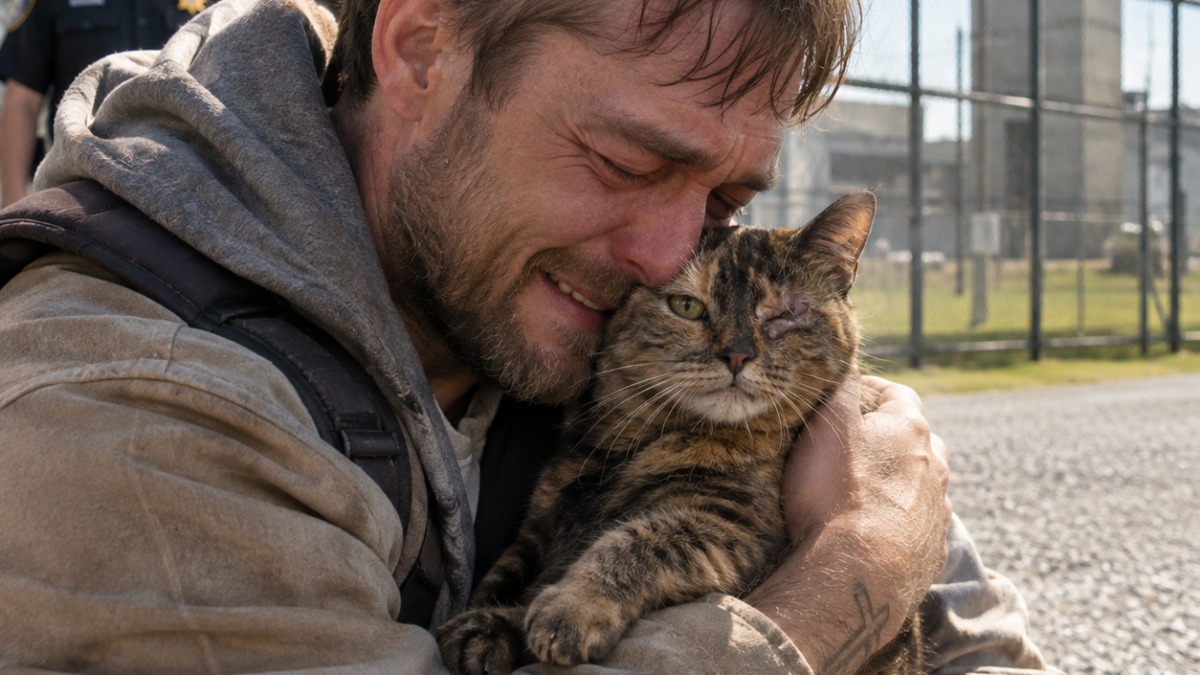
Under the shadow of a fence post sat a tortoiseshell cat.
One eye.
Clipped ear.
Cloudy green gaze.
Caleb stopped breathing.
“Patch?”
She stood.
Caleb dropped the plastic bag.
He crouched.
“No way.”
Patch walked toward him.
Slowly.
No glass.
No steel mesh.
No concrete wall.
Just six feet of open ground between them.
Caleb held out his hand.
Patch sniffed his fingers.
Then pressed her head directly into his palm.
The same palm he had placed against the glass thousands of mornings.
Only now he could feel her.
Warm fur.
Thin skull.
The vibration of a purr.
Caleb began crying.
Not quietly.
Not carefully.
Nine years of restraint collapsed beside that Oklahoma prison gate.
He lifted Patch.
For one second, her body stiffened.
Then she settled against his chest.
She weighed almost nothing.
“You knew.”
She purred.
“How the hell did you know?”
Behind the fence, Dwyer stood near the control point.
Caleb looked up.
Dwyer was smiling.
“You do this?”
Dwyer shook his head.
“Nope.”
“Did somebody move her?”
“Nope.”
Caleb looked at the cat.
“You were at the front gate.”
Dwyer shrugged.
“Smart cat.”
Caleb laughed through tears.
Then picked up his property bag.
The transitional housing van was supposed to meet him at the highway service road roughly a half mile away.
Caleb started walking.
Patch remained in his arms.
After perhaps a hundred yards, he lowered her.
“I’m not kidnapping you.”
She stood beside his shoe.
Caleb took another step.
Patch followed.
He stopped.
She stopped.
“All right.”
He walked.
She walked.
For seven years, they had existed on opposite sides of reinforced glass.
Now, for the first time, they moved in the same direction.
Caleb did not look back at the prison.
The van driver looked at Patch.
“You bringing a cat?”
“Apparently.”
“Program director know?”
“No.”
The driver sighed.
“Of course not.”
Caleb’s stomach dropped.
“Are animals forbidden?”
“At some placements.”
The transitional house in Weatherford was thirty miles away.
During the entire drive, Patch slept in Caleb’s lap.
He watched Oklahoma pass outside the window.
Gas stations.
Fields.
Farmhouses.
Cars moving freely.
Everything looked too bright.
Too fast.
At the house, counselor Denise Warren met him outside.
She looked at Caleb.
Then the cat.
Then Caleb again.
“No.”
Caleb’s heart fell.
“She followed me.”
“I’ve heard that one.”
“I’m serious.”
Denise crossed her arms.
Caleb held Patch closer.
“She’s been coming to my prison window for seven years.”
Denise stared at him.
The driver nodded.
“Facility staff confirmed it.”
Denise looked at Patch.
The cat looked back with one eye.
Denise sighed.
“Our policy allows animals with approval.”
Caleb waited.
“You’re responsible for food, litter, veterinary care, and damage.”
“Yes.”
“You don’t have a job yet.”
“I will.”
“If you can’t provide care—”
“I will.”
Denise studied him.
Then stepped aside.
“Welcome home.”
Caleb walked into a room with one bed, one dresser, a desk, and a window facing east.
Patch immediately jumped onto the windowsill.
She sat there.
Looking at the morning light.
Caleb stared at her.
For seven years, every window between them had been a barrier.
This one wasn’t.
He opened it slightly.
Patch sniffed the outside air.
She could leave.
She didn’t.
That afternoon, Caleb bought cat food with a small reentry stipend.
He also bought a litter box.
He had forty-six dollars left.
He laughed at the absurdity.
Nine years in prison.
Forty-six dollars.
And apparently a dependent.
When the housing counselor completed his intake paperwork, she asked, “Cat’s name?”
“Patch.”
He stopped.
The word suddenly felt wrong.
Denise waited.
Caleb looked toward the windowsill.
The cat was asleep.
“No.”
“What?”
“That’s not her name.”
“What is?”
Caleb thought about prison.
The notebook.
The glass.
The gate.
His own hand finally touching her fur.
“Finally.”
Denise smiled.
“Finally?”
“Yeah.”
“Strange name.”
Caleb looked at the cat.
“Fits her.”
That night, Caleb slept badly.
The room was too quiet.
No count.
No steel door.
No shouting down the hall.
At 3:12 a.m., he woke convinced he had missed an order.
Then remembered.
Free.
At 5:58, he woke again.
Finally was sitting on the windowsill.
The first light entered through the glass.
Caleb sat up.
She turned.
He reached for the notebook.
Opened to July 11.
She didn’t come.
He stared at the sentence.
Then crossed it out.
Below it, he wrote:
She was waiting.
The following morning, he began a new line.
She’s here.
Finding work was harder than Caleb expected.
The warehouse interview went well until the background check.
The supervisor became polite.
Too polite.
“We’ll call you.”
They never did.
A tire shop rejected him.
A landscaping company said they were fully staffed, even though a HELP WANTED sign remained outside for another month.
At a hardware store, the manager asked directly.
“Armed robbery?”
“Yes.”
“You use the gun?”
“It was unloaded.”
The manager leaned back.
“That isn’t what I asked.”
Caleb swallowed.
“I held it.”
“Then you used it.”
Caleb nodded.
The manager looked at him for a long time.
“No.”
Caleb left humiliated.
Outside, he sat on the curb.
For nine years he had imagined freedom as the moment gates opened.
Nobody told him there were gates without fences.
Housing applications.
Employment forms.
Background checks.
People’s eyes changing after one box was checked.
Have you ever been convicted of a felony?
Yes.
He wanted to quit.
That evening, Finally sat beside him on the bed.
Caleb rubbed her head.
“You could’ve picked somebody with a better résumé.”
She purred.
“Terrible judgment.”
A week later, Denise gave him a lead.
A warehouse manager named Earl Simmons had hired people from the transitional program before.
Caleb went.
Earl was sixty.
Heavyset.
Direct.
He read Caleb’s application.
“Robbed a store?”
“Yes.”
“Why?”
Caleb had learned not to make excuses.
“I was grieving, broke, angry, and stupid.”
Earl looked at him.
“Gun?”
“Unloaded.”
“Cash?”
“Eighty-three dollars.”
Earl raised an eyebrow.
“You went to prison nine years over eighty-three bucks?”
“I went to prison because I made a woman think she might die over eighty-three bucks.”
Earl leaned back.
That answer changed something.
“You show up late?”
“No.”
“You steal from me?”
“No.”
“You fight?”
“No.”
“You disappear?”
“No.”
Earl pushed a form across the desk.
“Start Monday.”
Caleb stared.
“That’s it?”
“No.”
Earl pointed at him.
“You screw up, you’re gone.”
Caleb nodded.
“Fair.”
He worked.
Every day.
Loading pallets.
Checking inventory.
Sweeping.
Unloading trucks.
He volunteered for overtime.
Not because he was trying to impress anyone.
Because work gave shape to freedom.
Finally waited in the window each evening.
Caleb eventually bought her a bed.
She ignored it.
She slept on the windowsill.
In August, he found a veterinarian.
The first exam cost more than he expected.
“Her remaining eye has some clouding,” the veterinarian said. “Likely age-related. She’s probably around twelve now.”
“Twelve?”
“Possibly older.”
Caleb touched her head.
“How long?”
The veterinarian smiled gently.
“No one can answer that.”
Caleb hated that answer.
He had already spent too much of his life losing people.
The vet checked Finally’s scar.
“Old injury.”
“Any idea how she lost the eye?”
“No.”
“She was already like that when I met her.”
“When was that?”
“Seven years ago.”
The vet looked surprised.
“You’ve had her seven years?”
“Not exactly.”
Caleb told the story.
By the end, the veterinarian had stopped typing.
“She came to a prison every day?”
“Yes.”
“To one window?”
“Yes.”
“And then waited when you were released?”
Caleb nodded.
The vet looked down at Finally.
“Well.”
“What?”
“I was going to say she’s lucky.”
Caleb scratched behind the cat’s ear.
“I think you’ve got that backward.”
In September, his phone rang.
Caleb had purchased a cheap prepaid phone.
Only a few people had the number.
Denise.
Work.
Parole officer.
Veterinarian.
He answered.
“Hello?”
Silence.
Then:
“Caleb?”
He knew the voice.
Even after nine years.
“Nate?”
Another pause.
“Yeah.”
Caleb sat on the bed.
Finally climbed beside him.
“How’d you get this number?”
“Your counselor called.”
“Denise?”
“She said you’d given permission for family contact.”
Months earlier.
He had forgotten.
Nathan breathed slowly.
“I got your letter.”
“The one before release?”
“Yeah.”
“That was a while ago.”
“I know.”
Caleb waited.
Nathan said, “I didn’t know what to say.”
“You’ve said that before.”
“I know.”
No anger.
Just history.
Nathan continued.
“I was mad at you.”
“You had a right.”
“I was mad at Mom too.”
Caleb closed his eyes.
There it was.
The thing neither brother had ever discussed.
Nathan’s voice cracked.
“She died and then you just… disappeared too.”
“I was in prison.”
“No.”
Nathan’s tone sharpened.
“You disappeared before that.”
Caleb said nothing.
“You stopped answering calls. You wouldn’t let me come over. I asked you to stay with us.”
“I know.”
“Then you robbed somebody.”
“I know.”
“I had just lost Mom.”
Nathan started crying.
“And then I had to explain to everybody that my brother went to prison for armed robbery.”
Caleb stared at the wall.
“I know.”
“No, you don’t.”
Caleb let that stand.
Nathan continued.
“I stopped writing because every letter made me feel guilty.”
“For what?”
“For having a life.”
Caleb swallowed.
“I never wanted that.”
“I know that now.”
Finally pressed against his thigh.
Nathan asked, “You really have a cat?”
Caleb laughed unexpectedly.
“What?”
“Your counselor mentioned a cat.”
Caleb looked down.
“That’s complicated.”
“Apparently not, if she lives with you.”
Caleb smiled.
“She found me in prison.”
Nathan was silent.
Then:
“That sentence raises several questions.”
For the first time in almost eight years, the brothers laughed together.
It was awkward.
But real.
They began speaking every Sunday.
At first, calls lasted ten minutes.
Then twenty.
Then an hour.
Nathan told him about Rachel.
About their son, Owen.
Caleb had a nephew.
Seven years old.
He had never met him.
In November, Nathan drove to Weatherford.
Caleb stood outside the transitional house waiting.
A blue pickup arrived.
Nathan stepped out.
He looked older.
Of course he did.
So did Caleb.
For several seconds, neither moved.
Then Nathan said, “You look terrible.”
Caleb laughed.
“You got fat.”
Nathan nodded.
“Marriage.”
Then both men cried.
They hugged in the parking lot.
Not because nine years disappeared.
They didn’t.
Because there was finally somewhere to begin.
Nathan met Finally.
“So this is the famous prison cat.”
“She has a name.”
Finally hissed at him.
Nathan raised both hands.
“I see prison changed her too.”
Caleb laughed.
Christmas came.
Then spring.
Caleb moved from transitional housing into a small apartment.
Pets allowed.
East-facing window.
That requirement mattered more to him than square footage.
Finally found the new windowsill immediately.
Every morning at six, she sat there.
Caleb kept writing.
She’s here.
One day Denise visited with paperwork.
She noticed the notebook.
“You still doing that?”
“Yes.”
“Every morning?”
“Yes.”
“What happens when she isn’t?”
Caleb looked at Finally.
She was sleeping in sunlight.
“I don’t know.”
Denise sat quietly.
Caleb understood what she meant.
Finally was old.
Older than anyone could say for certain.
He had spent years terrified of losing her before freedom.
Now he was free and terrified in a different way.
But this time he did not allow fear to become ownership.
He opened the window when the weather was nice.
Finally could leave.
Sometimes she stepped onto the fire escape.
Sometimes she sniffed the air.
She never went farther.
One evening, Caleb received another letter.
Amanda Reed.
He had written once after release.
He told her he had a job.
Housing.
A cat.
He thanked her for telling him to become useful.
Amanda’s response was short.
I’m glad you’re doing well.
My oldest daughter is starting college.
I’m proud of her.
I’m telling you that because for years I only existed in your story as the woman behind the register.
I want you to remember I had a life before what happened and I have a life after it.
Keep building yours.
Caleb read that line repeatedly.
I had a life before what happened and I have a life after it.
So did he.
That did not erase accountability.
It put it in proportion.
In July 2024, one year after release, Caleb drove back toward Red River Correctional Facility.
He had no intention of entering.
His parole conditions allowed the trip because Denise had helped arrange something through a reentry program.
Dwyer had retired.
They met at a diner twelve miles from the prison.
Dwyer walked in wearing jeans.
Caleb almost didn’t recognize him without a uniform.
“You look weird.”
Dwyer sat down.
“Good to see you too.”
Finally was in a carrier beside Caleb.
Dwyer looked down.
“She alive?”
Finally meowed angrily.
Dwyer smiled.
“Still mean.”
“She remembers you.”
“No, she doesn’t.”
“She definitely does.”
They drank coffee.
Caleb showed him the notebook.
Dwyer turned pages slowly.
She came.
She came.
She came.
Thousands of lines.
Then:
She was waiting.
After that:
She’s here.
Dwyer stopped.
“You know, we used to talk about her.”
“Who?”
“Officers.”
Caleb looked surprised.
“You thought you had some secret relationship with that cat?”
“I didn’t think anybody cared.”
Dwyer laughed.
“Mercer, she crossed the whole yard every morning like she was reporting for duty.”
He turned another page.
“Guys would radio if she was late.”
Caleb stared.
“You’re kidding.”
“No.”
“What would they say?”
Dwyer smiled.
“East-wing visitor hasn’t checked in.”
Caleb laughed.
Then covered his eyes.
“You’re serious.”
“Completely.”
Dwyer became quieter.
“One year, new staff wanted her trapped.”
“I remember.”
“A bunch of us objected.”
“Why?”
Dwyer looked at him.
“Because that cat did more for you than most of our programs.”
Caleb’s throat tightened.
Dwyer continued.
“You never got written up.”
“Once.”
“That locker?”
Caleb nodded.
“Doesn’t count.”
“I damaged state property.”
“It was already garbage.”
Caleb smiled.
Dwyer looked toward Finally.
“You started reading because you were sitting at that window.”
“How do you know?”
“You always had a book when she showed up.”
Caleb hadn’t noticed.
“You volunteered for extra shifts. Helped younger guys with GED work. Stayed out of fights.”
Dwyer shrugged.
“Maybe the cat had nothing to do with it.”
“She did.”
“I know.”
Finally began complaining inside the carrier.
Caleb opened the door.
She stepped onto his lap.
Then, astonishingly, climbed onto the booth seat beside Dwyer.
The retired officer looked down.
“Well, I’ll be damned.”
Caleb laughed.
“She remembers you.”
Dwyer touched her head.
For several minutes, the three of them sat together.
A former prisoner.
A retired corrections officer.
And a one-eyed cat who had ignored every category humans had assigned them.
Two years after Caleb’s release, Finally began slowing down.
More sleep.
Less jumping.
Her remaining eye clouded further.
The veterinarian diagnosed kidney disease.
Manageable.
Then less manageable.
Caleb gave her medication.
Special food.
Subcutaneous fluids.
Nathan visited more often.
Owen adored her.
The boy asked, “Did she really go to jail?”
“She visited.”
“Why?”
Caleb smiled.
“I don’t know.”
“Maybe she knew you were lonely.”
“Maybe.”
Owen looked serious.
“Were you bad?”
Children ask the questions adults avoid.
Caleb nodded.
“I did something bad.”
“Are you bad now?”
Nathan glanced toward Caleb.
Caleb thought carefully.
“I think people are more complicated than that.”
Owen frowned.
“That sounds like grown-up talk.”
“It is.”
“Did you hurt somebody?”
“I scared somebody badly.”
“Did you say sorry?”
“Yes.”
“Did she forgive you?”
“I don’t know completely.”
Owen considered that.
Then pet Finally.
“Cats don’t care.”
Caleb smiled.
“No.”
Owen scratched her head.
“Maybe that’s why people need cats.”
Nathan laughed.
Caleb almost did.
But the sentence stayed with him.
In the winter of 2026, Finally stopped eating.
Caleb knew.
The veterinarian knew.
Even Nathan knew when Caleb called.
“Want me to come?”
“Yes.”
Nathan arrived that afternoon.
Finally lay on the east-facing windowsill.
Sunlight touched her old tortoiseshell fur.
Caleb sat beside her.
For years, he had imagined the day she wouldn’t come.
He had never imagined being beside her when she could no longer go anywhere.
He rubbed the scar where her left eye had once been.
“You were ugly when I met you.”
Nathan smiled from across the room.
Finally opened her remaining eye.
Caleb laughed through tears.
“Still are.”
She purred weakly.
“I’m kidding.”
His voice broke.
“You’re perfect.”
Nathan looked away.
Caleb placed his palm against Finally’s cheek.
For thousands of mornings, glass had separated them.
Now nothing did.
“I don’t know why you picked my window.”
Finally breathed slowly.
“I don’t know where you went during the day.”
Another breath.
“I don’t know how you knew what gate to wait at.”
His tears fell into her fur.
“But I know you came.”
Finally’s paw rested against his wrist.
Caleb whispered, “Every damn morning.”
The veterinarian came to the apartment.
Caleb had asked for that.
He did not want Finally’s last moments beneath fluorescent lights.
She had spent too much of her life choosing windows and sunlight.
Caleb held her.
Nathan sat beside him.
At 6:18 p.m., Finally died with her head in Caleb’s hand.
He stayed there a long time.
Eventually Nathan asked, “You okay?”
Caleb looked toward the empty window.
“No.”
Nathan nodded.
“Okay.”
He did not tell Caleb it was only a cat.
He did not say she was in a better place.
He simply stayed.
That mattered.
The following morning, Caleb woke at 5:52.
Habit.
For several seconds, he forgot.
Then saw the empty windowsill.
He reached toward the notebook.
His hand stopped.
He opened to a blank page.
For seven years:
She came.
For three years after release:
She’s here.
Now what?
Caleb stared at the paper.
Finally, he wrote:
She stayed.
He closed the notebook.
Then cried until sunlight filled the room.
A month later, Caleb returned to the animal rescue group that had treated Finally years earlier.
Luis Ortega still volunteered there.
Older now.
More gray.
Caleb introduced himself.
Luis stared.
“East-wing cat guy?”
Caleb laughed.
“That’s me.”
Luis hugged him.
Caleb hadn’t expected that.
They talked.
Caleb told him Finally had died.
Luis looked genuinely heartbroken.
“She was tough.”
“You knew her?”
“Sure. She lived behind an old feed warehouse before she started going to the prison.”
Caleb became still.
“What?”
Luis nodded.
“She was part of a small feral colony.”
“Why did she leave?”
“Most of the colony disappeared over time. Cars. Coyotes. People moved.”
Caleb sat down.
“So she really had nowhere.”
“Pretty much.”
Caleb thought of all those mornings.
A man with nobody visiting him.
A cat with no colony.
Two abandoned creatures separated by glass.
Luis said, “Funny thing is, we tried relocating her once.”
“When?”
“After we treated that leg.”
Caleb remembered the blue bandage.
“We released her about three miles away where a barn owner fed cats.”
Caleb stared.
“She came back.”
“Within two days.”
“To the prison?”
“Yep.”
Luis laughed.
“That cat crossed God knows how much open country to get back there.”
Caleb felt tears fill his eyes.
He had always thought Finally came because the prison happened to be part of her territory.
No.
At least once, someone had taken her away.
And she returned.
To his window.
“Why?”
Luis shrugged.
“You’d have to ask her.”
Caleb smiled sadly.
“Too late.”
Luis nodded.
“Maybe not everything needs an explanation.”
That afternoon, Caleb drove to the old service road outside Red River.
He had received permission to stop outside the public boundary.
He stood near the front gate.
The same place Finally had waited.
Dwyer joined him.
Caleb carried a small metal plaque.
Nothing expensive.
He had paid for it himself.
The facility would not let him install it on prison property, so a nearby rescue group had arranged for it to be mounted at a small community animal shelter outside town.
Still, Caleb wanted to show Dwyer first.
The plaque read:
FINALLY
A ONE-EYED CAT WHO CROSSED THE YARD EVERY MORNING FOR SEVEN YEARS.
SHE REMINDED ONE MAN THAT BEING FORGOTTEN IS NOT THE SAME AS BEING UNWORTHY.
Dwyer read it.
Then cleared his throat.
“Little dramatic.”
Caleb smiled.
“Shut up.”
Dwyer handed it back.
“You still have the notebook?”
“Yeah.”
“What are you going to do with it?”
“Keep it.”
“Good.”
They stood near the fence.
Caleb looked toward east wing.
From outside, he could barely identify the third window from the end.
For nine years, that tiny rectangle had been his entire view of morning.
Now it looked impossibly small.
Dwyer asked, “You ever think about what would’ve happened if she hadn’t shown up?”
Caleb took his time answering.
“Yeah.”
“And?”
“I think I would’ve survived prison.”
Dwyer nodded.
Caleb continued.
“I’m not sure I would’ve learned how to live.”
The men stood quietly.
A truck moved along the distant highway.
Wind carried dust across the road.
Caleb looked at the gate.
For years he had thought freedom meant leaving that place behind.
He understood now that freedom was more complicated.
Freedom was accepting that he had harmed Amanda without believing harm was the only thing he would ever contribute to the world.
Freedom was calling his brother every Sunday even when some conversations were uncomfortable.
Freedom was showing up for work.
Paying rent.
Attending meetings.
Keeping promises.
Freedom was standing beside a window that could open and not being afraid of what might leave through it.
Six months after Finally died, Caleb became a volunteer with a local reentry program.
At first, he only helped unload donated furniture.
Then he began meeting men during their first week after release.
He never gave speeches.
He hated speeches.
He told them practical things.
Where to get identification.
Which employers actually hired people with records.
Which bus routes went where.
How to open a bank account.
How to respond when someone looked at their background check and suddenly changed tone.
One afternoon, a young man named Marcus sat across from him.
Marcus had served six years.
He had been out eleven days.
“I can’t do this.”
Caleb had heard those words before.
In his own head.
“What happened?”
“Three job rejections.”
“Okay.”
“My girlfriend doesn’t want me back.”
“Okay.”
“My daughter barely knows me.”
“Okay.”
Marcus became angry.
“Why do you keep saying okay?”
“Because those things are happening.”
“That’s not okay.”
“No.”
Caleb leaned forward.
“But we start with what’s true.”
Marcus stared.
Caleb continued.
“You got rejected three times.”
“Yes.”
“You’re still here.”
“Yes.”
“Apply four.”
Marcus laughed bitterly.
“That your wisdom?”
“No.”
Caleb smiled.
“My wisdom came from a one-eyed cat.”
Marcus stared.
“What?”
Caleb told him.
Not all at once.
Just enough.
About the window.
The six o’clock visits.
The notebook.
Finally waiting at the gate.
When Caleb finished, Marcus shook his head.
“That sounds made up.”
“I know.”
“What was the point?”
“There isn’t one.”
Marcus frowned.
Caleb continued.
“She didn’t give speeches. She didn’t fix my sentence. She didn’t get me a job.”
He tapped the table.
“She showed up.”
Marcus looked down.
Caleb said, “Sometimes that’s the first thing you do.”
“Show up?”
“Tomorrow.”
Marcus sighed.
Then nodded.
He came back the next day.
Years later, Caleb still kept Finally’s notebook on his nightstand.
The original one.
Its cover was bent.
Pages yellowed.
Ink fading.
Two thousand five hundred and fifty-six entries read:
She came.
Fourteen read:
She didn’t come.
Then one line had been crossed out.
She didn’t come.
Underneath:
She was waiting.
After release, pages read:
She’s here.
And on the morning after Finally died:
She stayed.
Caleb never added another entry.
There was nothing left to record.
The lesson had already been written thousands of times.
Nathan once asked if Caleb regretted those nine years.
It was Christmas.
Owen was asleep on the couch.
Rachel was cleaning dishes with Caleb.
Nathan stood near the kitchen window.
“Regret prison?”
Caleb asked.
“Everything.”
Caleb looked outside.
Snow had begun falling lightly.
Oklahoma rarely gave them much.
This was barely enough to cover the grass.
“I regret what I did to Amanda.”
“Obviously.”
“I regret what I did to you.”
Nathan nodded.
“I regret wasting the year after Mom died.”
Caleb paused.
“But prison?”
Nathan waited.
Caleb said, “I don’t believe suffering automatically makes people better.”
“No.”
“Some guys left worse.”
“I know.”
“I don’t think I needed prison to become good.”
“What do you think you needed?”
Caleb looked toward the empty east-facing windowsill.
“Something to come back.”
Nathan followed his gaze.
He understood.
A few months later, Amanda Reed contacted Caleb again.
She had heard through the victim notification system that he had begun doing reentry work.
She asked whether he would be willing to participate in a restorative justice panel.
Not privately with her.
Publicly.
Former offenders and victims speaking to people entering diversion and rehabilitation programs.
Caleb almost refused.
Then remembered her letter.
Become useful.
He agreed.
The first panel was held in a county community center.
Forty folding chairs.
Bad coffee.
Fluorescent lights.
Caleb hated fluorescent lights.
Amanda arrived ten minutes before it began.
He recognized her immediately.
Older.
Shorter hair.
Glasses.
He stood.
For several seconds, neither moved.
Caleb felt twenty-nine again.
Hood pulled up.
Gun in his hand.
Eighty-three dollars.
“Ms. Reed.”
“Amanda.”
He swallowed.
“Amanda.”
She looked at him.
“You look different.”
“So do you.”
She smiled faintly.
“That tends to happen in twelve years.”
There was silence.
Caleb said, “I’m sorry.”
Amanda nodded.
“I know.”
He did not ask whether she forgave him.
He had finally learned forgiveness was not a receipt to collect.
Amanda noticed the small tortoiseshell-cat pin on his jacket.
“What’s that?”
Caleb looked down.
He smiled.
“A long story.”
After the panel, Amanda listened.
All of it.
When Caleb finished, she shook her head.
“A prison cat.”
“Yep.”
“One eye.”
“Yep.”
“Seven years.”
“Yep.”
“And she waited at release?”
“Yep.”
Amanda laughed.
Then became thoughtful.
“You know what’s strange?”
“What?”
“That cat got to know you without knowing the worst thing you ever did.”
Caleb nodded.
Amanda continued.
“Maybe everyone deserves at least one relationship like that.”
Caleb looked at her.
“Maybe.”
She held out her hand.
Caleb stared.
Then shook it.
Amanda said, “What you did was terrible.”
“I know.”
“But I’m glad terrible wasn’t the last thing you did.”
Caleb’s throat tightened.
“Thank you.”
They never became friends.
They did not need to.
Some endings do not require closeness.
Only truth.
Only accountability.
Only enough peace for two people to leave the same room without carrying the same fear they brought into it years earlier.
That evening, Caleb returned home.
He placed his keys on the table.
The apartment was quiet.
Finally’s old bed still sat near the window even though she had rarely used it.
He had never been able to throw it away.
On the wall above it hung a framed photograph.
Dwyer had taken it during their diner meeting.
Caleb sitting in a booth.
Finally on the seat beside him.
One eye half closed.
Caleb laughing.
Beneath the photograph was a copy of the plaque.
She reminded one man that being forgotten is not the same as being unworthy.
Caleb stood there for a long time.
Then went to the nightstand.
Opened the notebook.
He flipped back to the first entry.
September 19, 2015.
She came.
He remembered the man who wrote those words.
Thirty years old.
Angry.
Ashamed.
Waiting for letters that never arrived.
Believing punishment and worthlessness were the same thing.
Outside his cell had been a one-eyed stray.
No home.
No owner.
No apparent reason to cross forty yards of exposed prison yard.
Yet she did.
Morning after morning.
Summer after summer.
Winter after winter.
Two thousand five hundred and fifty-six times.
Maybe animals do not understand redemption.
Maybe they do not understand convictions, sentences, guilt, parole, restitution, shame, forgiveness, or second chances.
Maybe that was precisely why Finally mattered.
She knew only presence.
She knew the third window from the end.
She knew a hand appeared behind the glass every morning.
She knew food sometimes came through a crack.
She knew a man sat quietly when she sat quietly.
And one day, after years of barriers between them, she somehow knew enough to wait at another gate.
Caleb closed the notebook.
The following morning, he woke shortly before six.
Old habit.
The sky outside his east-facing window was beginning to brighten.
For a moment, he could almost imagine a small shadow moving across the glass.
He smiled.
Then made coffee.
At 6:10 his phone rang.
Nathan.
“You awake?”
“Yeah.”
“Why?”
“You called me.”
“I mean before that.”
Caleb laughed.
“Habit.”
Nathan said, “Owen’s baseball game Saturday.”
“I know.”
“You coming?”
“Yes.”
“Good.”
A pause.
Then Nathan said, “You always answer now.”
Caleb became quiet.
“What?”
“The phone.”
Nathan laughed slightly.
“You answer.”
Caleb looked toward the windowsill.
“Yeah.”
“I guess I just noticed.”
Caleb smiled.
“I had a good teacher.”
“What?”
“Nothing.”
They talked for twenty minutes.
Afterward, Caleb dressed for work.
He picked up his keys.
Then paused beside the window.
The morning sun had begun to spread across the floor.
There had been a time when that light reached him through reinforced glass and steel mesh.
A time when he measured the world in eighteen inches.
A time when freedom was forty yards away.
A time when the only living thing that crossed that distance for him had four paws, one eye, and absolutely no idea that she was doing anything extraordinary.
People often asked Caleb why Finally came to his window.
He never found an answer.
Maybe the first morning had been chance.
Maybe she smelled food.
Maybe she liked the warmth near the building.
Maybe something about his stillness made her feel safe.
But chance could explain one morning.
Food could explain a few.
Routine could explain months.
Caleb never knew what explained seven years.
He stopped needing to know.
Some things become smaller when you force them into explanations.
What mattered was simple.
When nobody visited, she came.
When his brother stopped writing, she came.
When Caleb believed his worst decision had become his entire identity, she came.
When summer heated the prison yard until the concrete shimmered, she came.
When winter froze the drains, she came.
When storms covered the gravel with mud, she came.
When she was injured, she returned.
When people moved her miles away, she found her way back.
When Caleb stopped feeding her, she still came.
And on the one morning when freedom finally opened the gate, she did not sit beneath the third window from the end.
She waited where he was going.
For years, Caleb had believed Finally spent every morning trying to reach him.
He understood differently now.
She had already reached him.
The glass had never stopped that.
The fence had never stopped that.
The sentence had never stopped that.
And when they finally stood on the same side, she did not need to keep making the journey.
She had arrived.
So had he.


