He Humiliated the New Fighter Pilot and Made Her Serve Coffee—Then the General Ordered Them Into the Sky Together
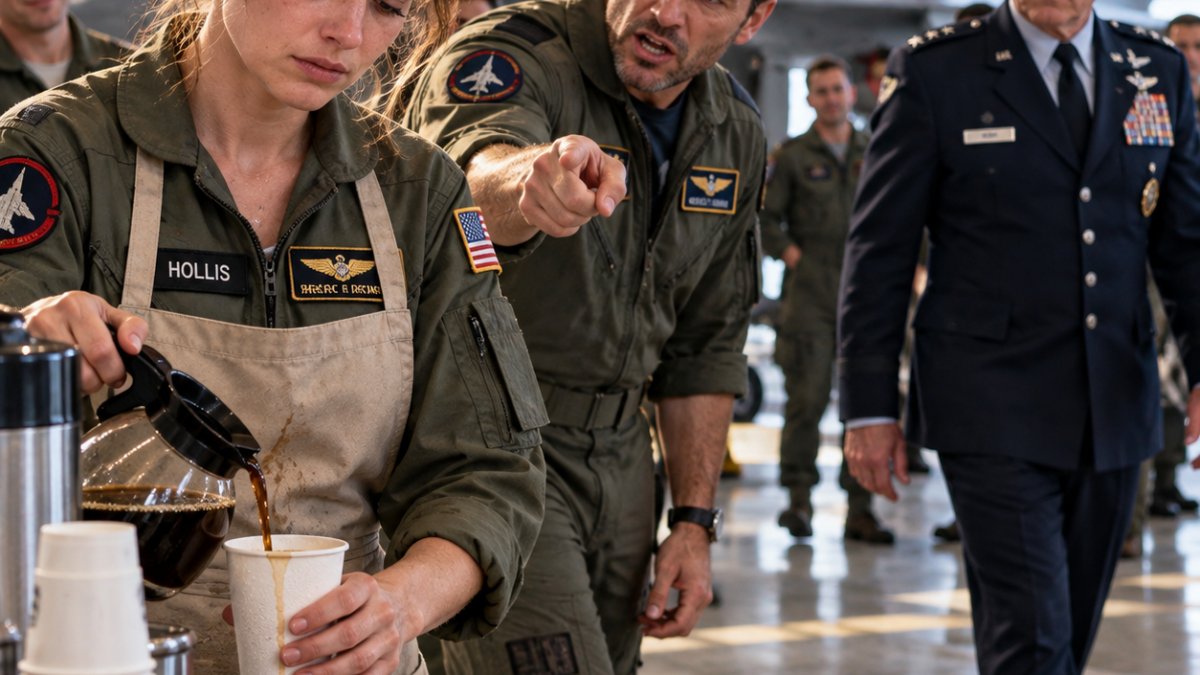
He Humiliated the New Fighter Pilot and Made Her Serve Coffee—Then the General Ordered Them Into the Sky Together.
The first thing Major Brett Calloway gave me after I reported to Talon Squadron was not an aircraft, a briefing packet, or a flight schedule—it was a coffee order, because he had already decided a female captain with four hundred hours had no business on his wing.
Two weeks later, with a four-star general standing in the squadron building, Calloway sent me into a thunderstorm as his wingman, ignored three weather warnings, lost his engine and most of his displays inside the clouds, and suddenly the “Nobody” he had mocked was the only pilot between him and a burning town below.
Then my own jet quit after I brought him home, and as I spiraled toward the runway with almost no fuel, the same men who had spent weeks telling me I had not earned my wings had to watch me land without a scratch—exactly the way my father had once taught me.
My name is Captain Kendra Hollis.
The day I reported to Talon Squadron, Major Brett Calloway told me the coffee station was in the back.
That was before he read my orders.
Or maybe he had already read them.
Sometimes cruelty is more efficient when it arrives prepared.
The squadron building sat on the edge of a fighter wing in the western United States, where the valley opened wide beneath a ridge line that caught afternoon thunderstorms like a net.
I arrived at 0645.
Flight bag.
Helmet case.
Orders.
Freshly pressed flight suit.
And my father’s silver wings pinned above my left pocket.
Not mine.
His.
Ray Hollis.
Colonel Ray Hollis had flown fighters for twenty-three years.
F-16s mostly.
Vipers.
Combat hours.
Test work.
Instructor time.
The kind of pilot maintainers trusted because he never blamed the jet before checking himself.
The kind of father who never once told his daughter flying was too dangerous.
He only said:
“If you’re going to do it, learn enough to come home.”
PART2:
He died from cancer three years before I finished advanced fighter training.
I wore his wings on the day I reported to Talon.
Not because I believed I had earned them.
Because he had.
I knew the difference.
Major Calloway did not care.
I stepped through the squadron operations room.
Pilots at tables.
Mission boards.
Weather display.
A lieutenant carrying binders.
Someone arguing with maintenance over a hydraulic write-up.
I approached the senior man near the whiteboard.
Tall.
Early forties.
Square jaw.
Dark hair.
Major’s oak leaves.
BRETT CALLOWAY stitched over one chest pocket.
“Talon?”
“Yes.”
I handed over my orders.
PART3:
“Captain Kendra Hollis.”
“Reporting as directed.”
He looked at me.
Then at the helmet case.
Then at the wings.
His expression changed.
“Coffee station’s in the back, miss.”
Several people went quiet.
I thought perhaps I had misunderstood.
“Sir?”
“Coffee.”
He pointed.
“Back wall.”
A lieutenant near him looked uncomfortable.
I stood still.
“Captain Kendra Hollis.”
“Reporting to Talon Squadron.”
Calloway took the paper.
Read it.
Then looked up.
“Wait.”
“You’re the new pilot?”
“Yes, sir.”
Someone behind him said:
“Finished first in her class.”
Calloway’s mouth turned.
“First in what?”
“Home economics?”
A few men laughed.
Not many.
That mattered.
I looked at him.
“Advanced fighter training, sir.”
“Forty pilots in the class.”
“Forty.”
“And you were one.”
“Yes.”
“Congratulations.”
Nothing in his voice suggested congratulations.
He set my orders on the desk.
“Here’s how this works, Hollis.”
“Up there, I only take people I would trust with my life.”
“Not some public-affairs poster child.”
The room went still.
I had heard versions of that sentence before.
Scholarship girl.
Diversity slot.
Recruiting poster.
Someone always needs an explanation for a woman finishing first that does not involve her being good.
I kept my voice level.
“Then fly one sortie with me, sir.”
“Decide after.”
His eyebrows lifted.
“I don’t fly with passengers.”
“I’m not one.”
His expression hardened.
Behind him, a young lieutenant whispered:
“Boss, she’ll need a call sign.”
Calloway looked at me.
Then smiled.
“Easy.”
“Nobody.”
Silence.
“Because nobody asked for her.”
That one got a few more laughs.
I looked around.
Men avoiding my eyes.
One lieutenant looked ashamed.
Calloway’s gaze dropped to the wings on my chest.
“And those aren’t regulation.”
I knew what he meant.
Not the position.
The fact they were old.
Silver worn smooth.
Different from my current issue wings.
“Sir, they belonged to my father.”
“Then he earned them.”
“You haven’t.”
For a second, grief and anger hit together.
Dangerous combination.
I swallowed both.
“Are we finished, Major?”
Something in my tone made the room colder.
Calloway picked up my orders.
“You’ll fly the simulator until I decide different.”
“Today, Nobody stays on the ground.”
I saluted.
“Yes, sir.”
Then walked away.
Nine hundred hours.
That was what my father had in one logbook I still kept at home.
Not his total.
Just one book.
I had four hundred.
Four hundred did not make me him.
I never claimed it did.
But I had earned every one.
That afternoon, I found a small maintenance alcove near Hangar 3.
Quiet.
Metal bench.
Tool cabinets.
An old crew chief was reading my aircraft assignment sheet.
Chief Master Sergeant Tom Brett.
Everyone called him Chief Brett.
Late fifties.
White hair at the edges.
Hands permanently stained with the kind of grime soap never fully removes after thirty years around aircraft.
He looked at my wings.
Then stopped.
“Where’d you get those?”
“My father.”
“Name?”
“Ray Hollis.”
Chief Brett’s face changed.
Not surprise.
Recognition.
He stepped closer.
“Ray Hollis?”
“Yes.”
“I buckled that man into a Viper for six years.”
I stared.
“You knew him?”
“Knew every complaint he had about oxygen regulators.”
“He complained about everything.”
“Not jets.”
“No.”
Chief smiled.
“No.”
“He never blamed the airplane until he ran out of himself to blame first.”
That sounded exactly like Dad.
Chief nodded toward my wings.
“Why do they smell like coffee?”
I looked down.
I had not realized they still did.
That morning, Calloway had dropped my father’s wings into his mug after telling me they weren’t regulation.
Not accidentally.
He picked them up from the table where I had removed them during paperwork.
Dropped them.
Black coffee.
Two sugars.
“Major Calloway.”
Chief Brett went very still.
“He did what?”
“Not important.”
“Yes, it is.”
“No.”
I wiped the wings with a towel.
“He can disrespect me.”
“He doesn’t get to turn Dad into an excuse.”
Chief studied me.
“Call sign?”
“Nobody.”
He laughed once.
Not cruelly.
“Good.”
I frowned.
“Good?”
“Nobody looks twice at a Nobody.”
Then he slid a maintenance card across the bench.
Tail 07.
Maintenance check flight.
Authorized.
His signature.
I stared.
“You want me to fly it?”
“Routine maintenance verification.”
“Flight controls.”
“Engine response.”
“Handling.”
“Within regs.”
“Calloway?”
“Sleeping, hopefully.”
“Chief.”
He looked at me.
“Your father lost an engine over this valley once.”
“I know.”
“No.”
His voice softened.
“You know the story.”
“I was here.”
I stopped.
Chief continued.
“He could have punched out.”
“The jet would have come down through this hangar.”
“My whole crew was inside.”
“He rode it past the buildings before he left it.”
“Saved every one of us.”
I had heard Dad say only:
“Had an engine problem once.”
That was him.
Chief tapped Tail 07’s paperwork.
“I am not giving you a free flight.”
“You screw this up, I own it.”
“You do it clean, you bring my jet back.”
“Understood.”
“0530.”
“Yes, Chief.”
“And Hollis?”
“Yes?”
“Your dad didn’t earn those wings by wearing them.”
“Neither will you.”
I nodded.
“Good.”
The next morning, I flew Tail 07.
No tricks.
No unauthorized maneuvers.
No showing off.
Maintenance check profile.
Climb.
Turns.
Control response.
Engine parameters.
Recovery.
But an airplane tells you what it thinks of you.
07 was beautiful.
Light on the controls.
Balanced.
Responsive.
The valley at dawn was dark blue beneath me.
Ridge line turning gold.
I could almost hear Dad.
Don’t fight her.
Tell her what you want.
Then let her fly.
Chief was waiting when I taxied back.
So was Calloway.
That ruined the moment.
He stood on the ramp with arms crossed.
Helmet under one arm.
Angry enough to distort the air around him.
“Who authorized this?”
Chief held up paperwork.
“I did.”
“Maintenance flight.”
“All legal.”
Calloway looked at me.
“Get out.”
I climbed down.
Saluted.
“Sir.”
“In my squadron, nobody touches a fighter unless I say so.”
Chief replied:
“That is not how maintenance authority works.”
Calloway turned.
“Stay out of this.”
Chief’s face changed.
Dangerous.
I interrupted.
“It was a signed maintenance flight, sir.”
“Within the profile.”
“All by the regs.”
Calloway looked at me.
“Around here, the regs are what I say they are.”
That was the first moment I truly lost respect for him.
Not because he disliked me.
A leader can dislike you.
Not because he underestimated me.
People make mistakes.
But a pilot who believes regulations are personal property is dangerous.
He stepped closer.
“From now on, you do morning weather.”
“And you keep the coffee coming.”
“That’s all the flying you get.”
He handed me his empty mug.
“Black.”
“Two sugars.”
“Nobody.”
I took it.
“Yes, sir.”
The squadron watched.
He thought humiliation would make me quit.
He did not know my father.
More importantly, he did not know me.
Every morning, I did weather.
Properly.
Not a joke.
Not punishment.
Weather kills fighter pilots.
Terrain and ego help.
I studied the valley.
Pressure.
Moisture.
Wind.
Ridge effects.
Every evening that month, thunderstorms formed along the western ridge.
Same pattern.
Heat built.
Moist air climbed.
Cells stacked fast.
Once the storm matured, the valley could seal in ten minutes.
I briefed it every morning.
“Storm development after 1800.”
“Rapid visibility deterioration.”
“Lightning risk.”
“Recommended recovery no later than 1740.”
Calloway called me Weather Girl.
The first time, I ignored it.
The second time, I documented it mentally.
The third time, Chief Brett heard.
He asked:
“You going to hit him?”
“No.”
“Good.”
“Paperwork’s worse.”
Chief grinned.
Calloway kept me in the simulator.
Hours.
Emergency procedures.
Engine failure.
Partial panel.
Electrical loss.
Weather penetration.
Hydraulic failures.
Flameout approaches.
He probably meant it as punishment.
It made me better.
One afternoon he walked into the simulator bay while I was practicing an engine-out recovery.
“You have four hundred hours.”
“Yes, sir.”
“Adorable.”
I looked at him.
“A logbook doesn’t make you a pilot.”
“No, sir.”
“Getting home does.”
That answer made him stop.
He stood behind me.
“Your father had rules for dead-stick work.”
I turned.
“You knew him?”
“Everybody knew Ray Hollis.”
Calloway pointed at the display.
“Rule one?”
“Speed keeps you alive.”
“Explain.”
“Your gut tells you to pull the nose up.”
“Stay airborne longer.”
“You do that without thrust, you bleed speed.”
“Then stall.”
“Then you fall.”
“So?”
“Nose down.”
“Protect energy.”
“Keep flying the airplane.”
He nodded.
“Rule two?”
“Altitude buys time.”
“Every thousand feet is thinking room.”
“And three?”
I looked at him.
“He never told me three.”
Calloway’s voice changed.
“Three.”
“You never leave your wingman.”
“Not even one you can’t stand.”
For the first time, there was no mockery.
Just pilot to pilot.
Then the door opened.
Moment gone.
Two weeks later, General Rebecca Kessler arrived.
Four stars.
Command pilot wings.
Thirty years in uniform.
She was inspecting the wing and selecting a demonstration team lead for the next year.
That made everyone nervous.
Especially Calloway.
Talon Squadron had been considered a favorite.
I had been scheduled for simulator standby.
Lieutenant Pruitt would take the flight slot.
At 0900, General Kessler entered operations.
Calloway stood straighter.
“General.”
“Major.”
She looked around.
“Colonel Mercer.”
Wing commander stepped beside her.
Kessler reviewed the pilot roster.
“Word is you’ve got a new captain.”
Calloway answered:
“Yes, ma’am.”
“Finished first in her class.”
“Yes, ma’am.”
“Where is she?”
Silence.
Then someone looked toward the back.
I was carrying coffee.
Of course.
I stopped.
General Kessler’s voice cut across the room.
“Captain.”
I turned.
“Ma’am.”
“Why is a fighter pilot carrying a coffee tray?”
“Sqaudron assignment, ma’am.”
Calloway stepped in.
“She’s still getting settled.”
Kessler looked at him.
“I didn’t ask whether she was settled.”
“No, ma’am.”
She looked at me.
“Current?”
“Yes, ma’am.”
“Sim hours?”
“Thirty-eight this month.”
“Aircraft time?”
“Maintenance verification sortie.”
“Only one?”
“Yes, ma’am.”
Kessler turned to Calloway.
“That is a creative way to use a fighter pilot.”
“She isn’t ready.”
“Then let’s find out.”
Calloway’s jaw tightened.
“Ma’am?”
“Two ships.”
“Today.”
“You lead.”
“She’s your wingman.”
The room stopped breathing.
Calloway said:
“General—”
“That was not a question.”
“Yes, ma’am.”
Kessler looked at me.
“Who has weather?”
“I do.”
“Brief it.”
I walked to board.
“Ridge convection expected around 1800.”
“System has accelerated.”
“Latest model suggests buildup may begin closer to 1730.”
“Recommendation: wheels down by 1740.”
Calloway said:
“We land when I say we land.”
I looked at him.
“Copy.”
General Kessler heard everything.
So did Colonel Mercer.
That mattered later.
Chief Brett found me on the ramp.
Tail 07.
My jet.
He slapped the intake.
“She’s tuned.”
“Bring her home.”
“Yes, Chief.”
He looked toward Calloway’s aircraft.
“And him.”
I smiled.
“Yes, Chief.”
We launched in the afternoon.
Calloway was Talon Lead.
I was Talon Two.
The valley looked clean at first.
Good visibility.
Clouds gathering along ridge.
Calloway was an excellent pilot.
That is important.
He was arrogant.
Unfair.
Sometimes cruel.
But not incompetent.
We ran the first profile.
Then second.
His handling was precise.
Mine stayed on him.
“Two, you with me?”
“With you, Lead.”
At 1715, the ridge darkened.
At 1722, lightning flickered inside the buildup.
I keyed radio.
“Lead, storm is twenty minutes early.”
“No factor.”
“Recommend terminate.”
“One more run.”
At 1727:
“Lead, that’s my second weather call.”
“Turn west now.”
“No.”
At 1730:
“Lead, third call.”
“Storm is closing the valley.”
“We go home now.”
Calloway answered:
“I’m not letting a cloud write my evaluation.”
I looked at the wall ahead.
Black.
“Lead—”
Lightning hit.
White.
Instant.
Violent.
Calloway’s aircraft disappeared into cloud.
His radio exploded with static.
Then:
“My displays are gone.”
“Everything’s dark.”
I snapped closer.
“Lead, talk to me.”
“RPM dropping.”
“Engine response—”
Pause.
Then words every fighter pilot understands immediately.
“Mayday.”
“Mayday.”
“Talon Lead.”
“Engine out.”
I moved off his right wing.
Close.
Dangerously close.
But close enough.
“Major.”
“Turn your head right.”
His aircraft emerged partly through cloud.
I could see him.
He could not see his instruments properly.
Electrical damage.
Engine failing.
Weather around us.
Terrain below.
Town beyond ridge.
Tower came on.
“Talon Lead, eject.”
General Kessler’s voice came into command net moments later.
“Tell him to punch out.”
I looked toward town.
Homes.
Highway.
Fuel.
A dead fighter is still forty thousand pounds of metal and fuel with nowhere polite to land.
I keyed:
“Negative immediate ejection.”
Tower answered:
“Talon Two?”
“If he ejects here, aircraft trajectory threatens populated area.”
Kessler came on.
“Captain Hollis, what do you have?”
“Lead in sight.”
“Engine out.”
“Partial electrical.”
“I can guide.”
Colonel Mercer said:
“Nobody brings a dead jet home blind.”
I heard General Kessler answer:
“Nobody’s on his wing.”
For the first time in my life, that call sign sounded useful.
“Major.”
No response.
“Major Calloway.”
“I’m here.”
His breathing was too fast.
“Listen only to me.”
“My body says I’m turning.”
“It’s lying.”
Spatial disorientation.
Cloud.
No reliable display.
Human inner ear becomes enemy.
“Forget your gut.”
“Watch my lights.”
“I can’t see enough.”
“Then you don’t have to fly the whole airplane.”
Pause.
“What?”
“Follow me.”
“Wings level.”
“I want to pull.”
“Don’t.”
“Speed keeps you alive.”
His breathing changed.
“Nose down two degrees.”
“Hold two hundred knots.”
“I don’t know if—”
“Trust my voice.”
“Nose down.”
“Two degrees.”
“Two hundred.”
He did it.
I watched his nose.
“Good.”
“Altitude buys time.”
“We’ve got nine thousand feet.”
“Call it four minutes.”
Calloway laughed once.
Terrified.
“That’s plenty?”
“More than Dad gave himself.”
Silence.
Then:
“Copy.”
Tower said:
“Talon Two, fuel state?”
I checked.
Bad.
“Bingo.”
“Return immediately.”
“Negative.”
“Talon Two—”
“I’m staying with Lead.”
Calloway heard.
“Hollis.”
“Yes?”
“Your wings.”
“What?”
“The ones I dropped in coffee.”
My jaw tightened.
“They were my father’s.”
“I know.”
“I’m sorry.”
“Save it for the ground.”
Pause.
“Yes, ma’am.”
I almost smiled.
“Left ten.”
He followed.
“Hold.”
“Speed.”
“Two hundred.”
“Good.”
Below us, fire crews cleared runway.
Emergency vehicles lined taxiways.
General Kessler had taken over tower coordination.
Chief Brett stood somewhere on the ground listening.
I know because later he told me he had both hands on the radio console.
We broke through the lowest cloud layer.
Runway ahead.
“Lead.”
“Twelve o’clock.”
“I see gray.”
“That’s runway environment.”
“Gear.”
He lowered it.
“Gear light dead.”
“I can’t tell.”
“I can.”
I moved low and right.
Dangerously close.
Checked.
“Three down.”
“You’re clean.”
“Sliding left.”
“Ease right.”
“Don’t chase.”
“Speed.”
“Hold.”
“I’m not going to make it.”
“Yes, you are.”
“Hollis—”
“Nose down.”
“Don’t bleed your speed.”
“Now flare.”
Calloway hit runway hard.
But straight.
“Brakes.”
No answer.
“Major.”
“Brakes!”
He stomped them.
Aircraft slowed.
Emergency crews rolled.
His voice cracked over radio.
“I’m on the ground.”
Again.
“I’m on the ground.”
Tower erupted.
“Talon Lead stopped.”
Then someone said:
“07 going around.”
I had no choice.
Calloway’s recovery had eaten the runway.
I climbed.
Fuel warning screamed.
Then engine coughed.
Once.
Twice.
Silence.
I knew before gauges confirmed it.
My engine was gone.
Chief Brett’s voice came over maintenance radio.
“Hollis?”
I breathed once.
“07 flameout.”
Someone on ground whispered:
“She’s got nothing left.”
Colonel Mercer:
“Nobody lands that.”
General Kessler answered:
“Exactly.”
I almost laughed.
Then Dad’s voice in my head.
Speed keeps you alive.
Altitude buys you time.
Don’t chase the runway.
I was too high.
Good.
Altitude was money.
I spiraled.
Tight.
Runway centered beneath.
Energy management.
No thrust.
No second chance.
“07, eject if unstable.”
“No.”
I heard Kessler.
“Captain.”
“I can make it.”
No argument.
Only:
“Then fly.”
That was leadership.
Not ego.
Not fear.
Trust.
I lowered gear.
Held two hundred knots.
Nose down.
Not too much.
Not too little.
The instinct to pull was enormous.
I ignored it.
Runway expanded.
Threshold.
Speed.
Energy.
Flare.
Touchdown.
Hard.
Clean.
No bounce.
I rolled out.
Engine silent.
For two seconds, nobody said anything.
Then Chief Brett screamed so loud the radio clipped.
“Not a scratch!”
I sat there breathing.
Hands shaking now that they were allowed.
Emergency trucks surrounded me.
I opened canopy.
Cold air hit my face.
Calloway’s aircraft sat farther down.
He climbed out.
Helmet under one arm.
Looked at me.
No swagger.
No contempt.
Just relief.
He walked across ramp.
“You were on fumes.”
I removed helmet.
“You were on nothing.”
He stopped.
“You could have left me.”
I looked at him.
“You taught me rule three.”
His face tightened.
“I was wrong about you.”
“Loud,” I said.
He blinked.
“What?”
“You were wrong about me loud.”
“In front of everybody.”
I looked toward squadron personnel gathering.
“Fix it the same way.”
He nodded.
No argument.
General Kessler approached.
Thirty years of command in her posture.
She looked at me.
“Captain Hollis.”
“Ma’am.”
“In thirty years in this uniform, I have never heard a pilot that steady on a radio.”
“Thank you, ma’am.”
She turned.
“Major Calloway.”
“Colonel Mercer.”
“My office.”
Calloway looked at me once.
Then followed.
The investigation was fast because everything was recorded.
Weather warnings.
My three calls.
Calloway’s decision.
General’s recall.
Engine failure.
My guidance.
His landing.
My flameout.
My landing.
No room for mythology.
No room for excuses.
Kessler asked Calloway:
“Your wingman warned you three times.”
“Yes, ma’am.”
“You continued.”
“Yes.”
“Why?”
He looked at floor.
“To prove a point.”
“What point?”
“That I was the better judgment in the cockpit.”
Kessler stared.
“And were you?”
“No, ma’am.”
“You’re relieved as Talon Lead effective immediately.”
Calloway nodded.
“Yes, ma’am.”
Colonel Mercer said:
“General, I was deferring to my flight lead’s judgment.”
Kessler turned.
“That is the problem, Colonel.”
“Where was yours?”
Silence.
Leadership consequences did not stop with one major.
That mattered.
The next morning, the entire squadron assembled.
Calloway walked to front.
No coffee.
No jokes.
He looked at me.
Then at everyone.
“Two weeks ago, I stood in this room and called Captain Hollis Nobody.”
Nobody moved.
“I questioned whether she belonged here.”
“I withheld flight time for reasons that had more to do with my pride than her performance.”
“I put her father’s wings in my coffee.”
Chief Brett’s jaw tightened.
Calloway continued.
“Yesterday, I ignored her weather warning three times.”
“I lost my engine in the clouds.”
“And Captain Hollis flew me home.”
He looked directly at me.
“I was wrong.”
No hedging.
No “if anyone was offended.”
Wrong.
“That landing belongs to her.”
“Both of them.”
Then he picked up his old squadron mug.
Black ceramic.
TALON LEAD painted on one side.
He set it in front of me.
“Whoever leads drinks out of this.”
I looked inside.
“Should I check it for wings?”
The room laughed.
Calloway did too.
Barely.
“I earned that.”
Then he faced me.
“Captain Hollis.”
“Yes, sir?”
“I’m reporting to instructor school.”
I stared.
“Why?”
“Turns out I have some learning to do before I teach anybody.”
That was the first apology I actually respected.
Not because he punished himself.
Because he changed direction.
He saluted.
“Permission to be dismissed, Captain.”
Technically, he still outranked me.
The gesture was symbolic.
I understood.
“Dismissed, Major.”
He turned.
Then I called:
“Major.”
He stopped.
“Watch your six.”
He smiled.
“I’ve got people for that now.”
General Kessler met me later.
Her office.
Colonel Mercer present.
Chief Brett too.
She slid two folders across the desk.
“I have two positions.”
“Demo team lead.”
“Or Talon Squadron operations lead.”
I stared.
“Ma’am.”
“You get one.”
“Which one do you recommend?”
“The one nobody wants.”
I almost laughed.
She pointed.
“Talon.”
“Yours.”
I looked at the folder.
“Ma’am, I have four hundred hours.”
“And two emergency landings yesterday that half this base could not have made.”
“That does not make me ready to lead a squadron.”
“No.”
“It means we start the process.”
“Temporary acting lead.”
“Mentorship.”
“Check rides.”
“Command review.”
“Not a fairy tale.”
I appreciated that.
She continued:
“You know what I care about?”
“What?”
“You warned your lead.”
“Repeatedly.”
“He ignored you.”
“You stayed.”
“Then when your engine quit, you flew your own airplane.”
“That is the job.”
She looked at my chest.
My father’s wings.
“Regulations require current insignia.”
“Yes, ma’am.”
“I have a new pair.”
She pushed a box toward me.
Fresh wings.
I looked.
Then touched my father’s.
“Respectfully…”
“These stay.”
Kessler smiled.
“Good answer.”
Chief Brett looked away.
Probably because his eyes were wet.
Later that week came the formal recognition.
Not the wild kind.
No medals invented overnight.
A commendation recommendation.
Safety review.
Emergency airmanship citation.
Training command acknowledgment.
My name entered properly.
No Nobody.
Except the squadron kept the call sign.
Not as insult.
It became something else.
Pilots do that.
We take words.
Break them.
Build them back stronger.
The first lieutenant assigned to me came to my desk the next morning.
Young.
Nervous.
“Ma’am.”
“Yes?”
“I’d like to fly as your wingman.”
“If you’ll have me.”
I looked at him.
“Can you stay on me?”
“I’ll figure it out.”
“No.”
He stiffened.
I pointed toward weather board.
“You don’t figure it out in the air.”
“You learn before.”
“Yes, ma’am.”
“Rule one?”
He had heard the story.
“Speed keeps you alive.”
“Rule two?”
“Altitude buys time.”
“Rule three?”
“You never leave your wingman.”
I nodded.
“Not even the one you can’t stand.”
He smiled.
“Yes, ma’am.”
I looked toward ridge.
“Storm builds at eighteen hundred.”
“We’re wheels down by seventeen-twenty.”
“Yes, ma’am.”
“Anybody argues?”
“No, ma’am.”
“Good.”
Months later, Major Calloway returned from instructor school for a temporary training visit.
Different man.
Not magically.
Still blunt.
Still competitive.
Still Calloway.
But he listened more.
That mattered.
He came into operations wearing instructor patch.
Stopped beside my desk.
“Major Hollis.”
By then, the promotion had come through.
I looked up.
“Major Calloway.”
“Requesting a ride.”
“With?”
“The best stick on this base.”
I leaned back.
“I don’t fly with passengers.”
He nodded.
“Fair.”
I let him stand there for a second.
Then:
“Wingmen, though.”
His eyebrows lifted.
“Go get your helmet.”
Chief Brett laughed from the hallway.
Someone shouted:
“Bring him home again!”
Calloway turned.
“Who’s out front?”
A young pilot answered before I could.
“Nobody is.”
The squadron laughed.
I picked up my helmet.
“No.”
I looked around the room.
At pilots.
Maintainers.
Weather board.
Talon mug.
My father’s old wings.
Then at Calloway.
“Talon Lead is.”
We walked toward the flight line.
The ridge was clear that morning.
Blue sky.
Good visibility.
But I still checked weather twice.
Because ego does not stop storms.
Rank does not stop storms.
Talent does not stop storms.
Weather does not care how badly you need to impress a general.
An airplane does not care about your reputation.
And the sky has no interest in who you thought belonged there.
My father taught me that.
Calloway almost learned it too late.
I learned something else.
You cannot control whether people underestimate you.
You can control what happens when the moment finally asks whether they were right.
I did not earn my place in Talon Squadron because a general walked in while I carried coffee.
I did not earn it because my father had been Ray Hollis.
I did not earn it because Calloway apologized.
I earned it in every simulator hour nobody saw.
Every weather brief people mocked.
Every checklist.
Every procedure.
Every time I kept my mouth shut when anger would have made me careless.
Every time I spoke when silence would have been dangerous.
And finally, in a thunderstorm over a valley my father had once crossed without an engine, when the man who called me Nobody could no longer see his instruments and had to decide whether my voice was worth trusting.
“Speed keeps you alive.”
“Nose down.”
“Hold two hundred.”
“Altitude buys you time.”
“Four minutes.”
“Plenty.”
“Stay with me.”
He did.
Then my own engine stopped.
And I learned rule three had never been only about the person flying beside you.
Sometimes your wingman is a voice from years ago.
A father.
A chief.
A lesson.
A mistake somebody finally admitted.
Something that stays with you when the cockpit gets quiet.
You never leave your wingman.
Not even the one you cannot stand.
Not even the one who hurt your pride.
And sometimes—not always, but sometimes—if you bring them home, they learn how to become someone worth flying beside.
That is how Nobody became Talon Lead.
Not because nobody believed in me.
Because when everything went dark, I knew exactly who I was.



