For 1,196 Days, Everyone Looked Away From a Shelter Cat’s Unusual Face—Then a 7-Year-Old Girl With Scars Stopped at Her Cage and Whispered Something No One Expected
PART3:
We took X-rays.
Blood work.
Dental films.
A full examination.
The veterinarian told us the deformity was congenital.
She had been born that way.
There were no untreated fractures.
No tumor.
No infection causing the asymmetry.
No evidence of current pain.
She could eat.
Drink.
Groom.
Breathe adequately.
Her left nostril made breathing noisy but not dangerous.
Surgery might improve appearance slightly, but it was not medically necessary and carried its own risks.
Our veterinarian looked at me after the examination.
“She’s healthy.”
I looked at Clover.
“That should make this easy.”
It did not.
For the first two weeks, nobody asked about her.
That was normal.
Animals needed time.
We listed her.
White female domestic shorthair.
Approx. one year.
Gentle.
Quiet.
Affectionate.
Good litter habits.
Enjoys being brushed.
Then we added the line:
Born with a facial difference that does not affect quality of life.
I thought honesty would help.
Maybe it did.
Not enough.
The first family came to meet her eleven days later.
Mother.
Father.
Two boys.
They entered the cat room excited.
Stopped at each enclosure.
Talked.
Laughed.
One boy pressed his fingers to the glass in front of a gray kitten.
Then they reached Cage 14B.
The mother’s smile changed.
The younger boy stared.
“What’s wrong with that one?”
I stepped closer.
“Nothing is wrong with her.”
The father looked embarrassed.
“She was born with a facial deformity.”
The boy moved closer.
His mother took his shoulder.
“Come on.”
Not mean.
Fast.
Too fast.
They adopted the gray kitten.
Clover watched them leave.
At the time, I told myself there would be another family.
There was.
Hundreds.
Then thousands.
And Clover kept waiting.
We named her Clover about three months after she arrived.
Technically, intake had listed her as White Female 317.
Shelters do that sometimes.
Numbers first.
Names later.
One of our night volunteers, a sixty-six-year-old retired librarian named June, hated it.
“She cannot spend her life being 317.”
“She won’t.”
“How do you know?”
“Because somebody will adopt her.”
June looked at me.
“You said that six weeks ago.”
I did not answer.
She stood in front of Cage 14B.
The cat sat near the back.
June held a treat through the bars.
“What about Clover?”
“Why Clover?”
“Luck.”
I almost laughed.
June did not.
“She’s waiting for hers to change.”
So Clover became Clover.
The name suited her in ways we did not understand yet.
At first, she still came forward whenever people entered the cat room.
That mattered.
She had no reason to distrust strangers.
She sat near the glass.
Watched.
If someone crouched, she moved closer.
If fingers touched the panel, Clover sometimes pressed her nose toward them.
The first few rejections did not change that.
Neither did the first ten.
Then I began noticing something.
She learned the pattern.
People came through the door.
They looked at other cats.
Stopped.
Smiled.
Talked.
Then reached her cage.
One look.
A pause.
Eyes away.
Move on.
Clover started sitting farther back.
Not hiding.
Not yet.
But no longer at the glass.
By six months, she usually stayed on her blanket until the room emptied.
By one year, she had learned something I wish no animal could learn.
Being unseen hurt less than being seen and rejected.
The staff noticed too.
June would sit beside her after closing.
“You don’t need them.”
Clover purred.
June scratched beneath the crooked jaw.
“I’m lying.”
Clover’s breathing whistled softly.
June sighed.
“You do.”
I kept records.
It was my job.
Admissions.
Vaccines.
Medical notes.
Behavior observations.
Adoption inquiries.
For reasons I still cannot explain, one night I opened Clover’s file and began counting.
In her first year, seven hundred eleven animals left our shelter through adoption, transfer, or foster placement.
Clover remained.
Second year.
Another six hundred eighty-three.
Still there.
Third year.
Seven hundred twenty.
Still there.
By the time she had spent three years and four months in Cage 14B, 2,214 animals had been adopted around her.
Two thousand two hundred fourteen.
Dogs who arrived after her.
Cats born after her.
Animals recovering from broken legs.
Blind animals.
Three-legged animals.
Cats with diabetes.
A deaf pit bull.
A terrier with only one eye.
A fifteen-year-old Chihuahua whose tongue hung permanently from one side of his mouth.
Every one of them eventually left with somebody.
Clover watched.
Fourteen people asked specifically about her during that entire period.
Fourteen.
I remember them because June wrote their names in the notebook she kept at reception.
Not judgment.
Hope.
She called it Clover’s Maybe List.
Fourteen maybes.
Six agreed to hold her.
All six returned her.
The first woman held Clover perhaps thirty seconds.
Clover began purring.
The woman’s face changed.
“She’s sweeter than I expected.”
I hated the sentence immediately.
Sweetness had nothing to do with facial symmetry.
But I said nothing.
The woman touched Clover’s back.
Then looked directly into her face.
“I just…”
She handed her back.
“I need to think.”
She never returned.
The second couple stayed seven minutes.
The husband liked Clover.
I could tell.
He scratched her chin.
She climbed halfway onto his chest.
His wife kept staring.
In the lobby I heard her whisper:
“I know it sounds terrible, but I don’t want everyone asking what happened to her.”
They adopted another cat a week later.
The third person was a college student.
He took photographs.
Asked about medical needs.
Seemed serious.
Then called his parents.
They paid his rent.
No cat.
The fourth was a woman who already owned two special-needs cats.
I thought:
This is it.
She held Clover.
Clover melted against her.
Then the woman started crying.
“I’m sorry.”
“What?”
“I lost one with jaw cancer.”
She shook her head.
“I know this isn’t cancer. I know.”
She wiped her eyes.
“But every time I look at her, I’m going to think about him.”
That one I understood.
Not every rejection was cruelty.
Sometimes people carried wounds we could not see.
The fifth family lasted four minutes.
Then came the man who held Clover for eleven.
I remember the exact time because June wrote it down.
Eleven minutes.
Longest anyone had ever held her.
He was forty-something.
Work boots.
Two daughters at home.
His wife had sent him to “look.”
He asked good questions.
Clover curled into his elbow.
He smiled.
“She is sweet.”
“Yes.”
“She always like this?”
“Pretty much.”
He scratched her head.
“She’s ugly as sin.”
June stiffened behind the desk.
I gave her a look.
Do not.
The man laughed.
Not maliciously.
“That sounded worse than I meant.”
I said:
“She doesn’t know what she looks like.”
He went quiet.
Then held her longer.
I began believing he might actually take her.
He walked around the room with Clover in his arms.
She purred.
At minute nine, she put one paw against his chest.
At minute eleven, he kissed the top of her head.
Then returned her to me.
“I can’t.”
My heart sank.
“Why?”
He looked genuinely ashamed.
“My kids are sensitive.”
“To what?”
He gestured vaguely toward Clover.
“This.”
I stared.
He lowered his voice.
“I just can’t take that face home.”
June stopped pretending not to listen.
The man continued:
“My youngest would have nightmares.”
Clover pushed her head beneath my hand.
I felt heat rise through me.
Twenty-two years in rescue teaches you not to insult potential adopters.
Mostly.
I said:
“She’s a cat.”
“I know.”
“She sleeps.”
“I know.”
“She plays with bottle caps.”
“I know.”
“She has never hurt anyone.”
“I understand.”
“Then what exactly is the nightmare?”
He looked at me.
I immediately regretted the sharpness.
Not because I was wrong.
Because shame rarely changes people usefully.
He left.
June waited until the door closed.
“Sensitive.”
“June.”
“I’m sensitive to idiots.”
“June.”
She sat beside Clover’s cage.
“We need better humans.”
Clover purred.
We did what shelters do when an animal waits too long.
We compensated.
Extra blankets.
More enrichment.
Longer play sessions.
Office time.
Treats.
Clover learned the building.
She knew where the food room was.
She knew which drawer held catnip.
She knew June carried freeze-dried chicken in her left pocket.
She knew I worked too late on Thursdays.
Sometimes I found Clover asleep on my paperwork after staff had gone home.
I began bringing her into my office during quiet hours.
She would climb onto the windowsill.
Watch birds.
Then sleep beside my keyboard.
There were moments when I almost told myself keeping her at the shelter was acceptable.
She was loved.
Fed.
Safe.
Warm.
The lie felt comforting.
But shelters are not homes.
Even good ones.
Lights switch on according to schedules.
Doors slam.
Dogs bark.
Staff changes.
Volunteers come and go.
Cleaning chemicals erase familiar smells.
Animals disappear.
New ones arrive.
No one belongs fully.
Not even Clover.
Especially Clover.
At night, every cat still slept behind a closed door.
Clover knew affection.
She did not know permanence.
There is a difference.
We posted about her online.
Several times.
Photos.
Videos.
One volunteer took beautiful pictures in sunlight.
We wrote:
Clover doesn’t know she looks different.
She only knows she wants a lap.
People reacted.
Thousands of hearts.
Comments.
“She’s beautiful.”
“I’d take her if I lived closer.”
“Someone please adopt this baby.”
Nobody came.
That phrase became something I learned to distrust.
Someone please.
Someone meant not me.
We had one application from three states away.
It fell apart over transportation.
Another from a person with nine cats and unresolved animal-control complaints.
Declined.
A third applicant wanted Clover because she looked “freaky” and would do well on social media.
Declined immediately.
That one made June so angry she spent an hour organizing towels violently.
“People.”
“What?”
“Nothing.”
“You’re folding like the towels insulted you.”
“Maybe they did.”
By Clover’s third year, the white fur around one side of her face had developed a permanent rust-colored stain near the narrowed nostril.
We cleaned it gently.
She tolerated everything.
Medication.
Nail trims.
Dental checks.
Nothing changed her temperament.
Gentle.
Patient.
Quiet.
She rarely meowed.
Mostly that little whistle.
And the purr.
Her purr was ridiculous.
Deep.
Loud.
Almost mechanical.
Because of the narrowed nostril, it carried a faint high note over the rumble.
June called it her broken accordion.
I hated the phrase.
Clover apparently didn’t.
One winter evening, the shelter furnace failed.
Not dangerously.
We had backup heaters.
But staff stayed late moving animals away from exterior walls.
At two in the morning, I sat in the cat room wearing my coat.
Clover was in my lap.
I remember looking down at her and thinking:
You may die here someday.
The thought terrified me.
Healthy animals become old.
Years pass.
A three-year wait can become five.
Seven.
Ten.
Would Clover become one of those animals staff members love until loving becomes an apology?
I touched her face.
The crooked side.
She leaned into my hand.
“I’m sorry.”
Her eye closed.
“For what?”
She purred.
I think people imagine shelter workers become numb.
We don’t.
We become organized.
Pain gets files.
Schedules.
Checklists.
Protocol.
You learn to cry while driving home because there are feeding rounds to finish first.
You learn to euthanize an animal compassionately and answer the phone five minutes later.
You learn to say:
“I’m sorry for your loss.”
Then:
“Yes, we open at ten.”
You function.
Clover was different because nothing catastrophic happened to her.
There was no emergency to solve.
No illness to treat.
No behavior crisis.
Only waiting.
Slow suffering is harder to point at.
She had food.
Warmth.
Care.
Was she unhappy?
Not constantly.
But by year three, she no longer approached families.
That told me enough.
When groups entered, she moved toward the back.
Sometimes she turned around completely.
June noticed first.
“She’s given up auditioning.”
I hated how accurate that sounded.
In February 2023, we discussed foster placement.
Long-term.
Maybe permanent if adoption never came.
The challenge was finding a quiet home without many animals because Clover had spent years adapting to shelter routine.
I made calls.
One foster agreed.
Then her landlord changed the pet policy.
Another had a sick parent move in.
A third became unavailable.
March arrived.
Clover’s file showed 1,190 days.
Then 1,191.
1,192.
I did not know why I had started counting daily.
Maybe because once numbers become painful, watching them grow feels like punishment you somehow deserve.
On Saturday, March 18, the shelter opened at ten.
It was cold but sunny.
Mud around the parking lot.
Spring almost beginning.
By noon, we had adopted one beagle puppy and two kittens.
Around one-thirty, a family entered.
Mother.
Father.
Little girl.
Seven years old.
I noticed the scars immediately.
Everyone did.
Pretending otherwise would be dishonest.
The right side of her face and neck carried thick burn scarring.
Not one small mark.
Extensive.
Contracted skin pulled slightly at the corner of her mouth.
Part of her right ear had been reconstructed.
The hair above and behind that ear grew unevenly, with one patch where it never returned.
The scars traveled from her jaw downward along her neck toward the collarbone.
She wore a lavender sweater.
Jeans.
Purple sneakers.
Her mother kept one hand near her shoulder but did not touch unless the girl reached first.
Her father carried a pet carrier.
I assumed they had already decided.
They hadn’t.
“We’re looking,” he said.
“Cat?”
The girl nodded.
I smiled.
“Take your time.”
She did.
Most children move quickly through shelters.
Excitement pulls them.
Kitten.
Next kitten.
Orange cat.
Fluffy cat.
This girl moved slowly.
At each enclosure, she crouched.
Placed her face near the glass.
Whispered something.
I could not hear.
At Cage 10, a tabby pawed the window.
She laughed.
At 11, an older calico stayed asleep.
The girl whispered anyway.
At 12, a black kitten climbed the door.
At 13, empty cage.
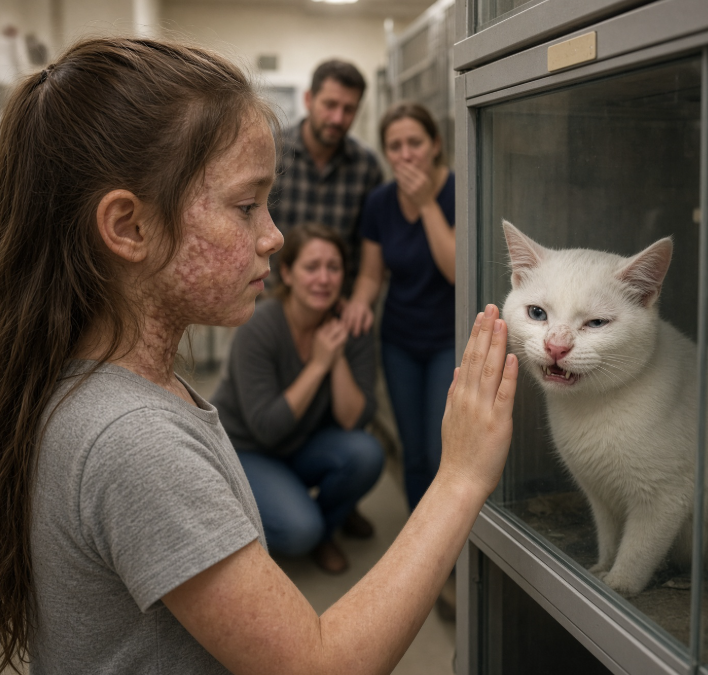
Then 14B.
Clover.
Usually, when families entered by then, Clover stayed at the rear.
That afternoon she was sitting against the glass.
I still do not know why.
Sunlight came through the high window.
Her white coat glowed.
Crooked face completely visible.
Lower teeth exposed.
Left eye low.
Nose off center.
No hiding.
The girl stopped.
Everything else in the room seemed to keep moving for another second.
Then quiet.
The girl stepped closer.
Clover watched.
No retreat.
The child lifted one hand.
Placed her palm flat against the glass.
Clover leaned forward.
Slowly.
Until the deformed side of her face touched the exact spot where the girl’s palm rested.
Glass between them.
Skin.
Fur.
Hand.
Face.
Neither moved.
I was standing twenty feet away.
Her mother noticed next.
She stopped speaking to her husband.
He followed her gaze.
June sat at reception.
I saw her stand.
Another family in the aisle became quiet.
The little girl looked at Clover.
Not with pity.
That matters.
No tilted head.
No “poor thing.”
Recognition.
The child turned toward her mother.
Her voice was completely ordinary.
“She looks like me, Mom.”
Six words.
Her mother collapsed to her knees.
Not fainting.
Her legs simply stopped.
The father caught her shoulder.
June covered her mouth with both hands.
I felt my throat close.
A man filling out dog-adoption paperwork at reception looked over, stared for a second, then walked outside.
Later, he told me he needed somewhere private to cry.
The little girl looked confused.
“Why are you crying?”
Her mother shook her head.
“I’m okay.”
“You’re crying.”
“I know.”
The girl looked back at Clover.
Then whispered:
“Don’t worry.”
Clover’s smaller eye blinked.
“People look away from me too.”
I could not move.
I had heard adults say cruel things around Clover.
Not always intentionally.
I had seen children stare.
I had watched parents redirect them.
But I had never imagined a child would stand there and explain rejection to the cat as if they were sharing a secret.
The girl continued:
“Sometimes kids ask what happened.”
Her mother made a quiet sound.
The girl did not notice.
“And sometimes they look a lot.”
Clover stayed against the glass.
The child touched one finger near Clover’s visible lower tooth.
“You’re not scary.”
That broke June.
She turned away.
I walked toward Cage 14B.
Slowly.
“Would you like to meet her?”
The girl looked up.
“Yes.”
Her mother wiped her face.
“Sweetheart…”
“I want to.”
The father crouched.
“Are you sure?”
The girl nodded.
I unlocked the enclosure.
The sound of the latch made Clover turn.
For three years, that door had opened for cleaning.
Medical care.
Volunteers.
Meet-and-greets that ended.
Clover stepped out cautiously.
Onto the concrete.
The little girl sat cross-legged.
I expected Clover to explore.
She didn’t.
She walked directly to the child.
Sniffed one purple sneaker.
Then climbed into her lap.
No hesitation.
The girl froze.
“Mom.”
“I see.”
Clover turned once.
Then pressed the side of her crooked face into the right side of the girl’s neck.
The scarred side.
Exactly there.
The child closed both arms around her.
Clover began purring.
That whistle threaded through the rumble.
The sound carried down the aisle.
June would later swear she heard it from reception more than forty feet away.
I believe her.
The girl laughed.
“She’s loud.”
I knelt beside them.
“She does that.”
Clover pushed harder against the burn scar.
The girl’s mother covered her mouth again.
For years, that mother later told me, her daughter slept with the right side of her face toward the wall.
Even alone.
Even with nobody looking.
She had undergone eleven surgeries.
Skin grafts.
Scar revisions.
Ear reconstruction.
Physical therapy.
Counseling.
Support groups.
Adults had spent years telling her:
You’re beautiful.
You’re strong.
Your scars don’t define you.
Children had not always been as kind.
Children stared because children are curious.
Some asked questions.
Some whispered.
One boy at school had called her melted.
Another child asked whether touching her scars would burn.
The girl stopped wanting school photographs.
She refused swimming because wet hair exposed the scarred side of her head.
When strangers stared at grocery stores, she moved to her mother’s other side.
She never said much.
That may have frightened her parents most.
Pain children name can be addressed.
Pain they normalize becomes part of posture.
Then Clover pressed a crooked mouth into that scar.
No hesitation.
No politeness.
No pretending the scar was not there.
Simply:
Here is where I want to be.
The girl stroked Clover’s back.
Then said something I will remember longer than my own name.
“You see?”
Her mother looked at her.
“She isn’t scary.”
Clover purred.
The girl continued:
“She’s just different.”
Nobody spoke.
Then she said:
“Different isn’t scary.”
Pause.
“It’s just lonely.”
Seven years old.
Seven.
I had spent twenty-two years in rescue trying to find language for what long-term shelter animals lose.
A seven-year-old found it in one sentence.
Different is not scary.
It is lonely.
The father sat down on the floor.
Right there.
Nice jeans.
Didn’t care.
Clover remained in the girl’s lap.
He touched the cat’s back.
Clover glanced at him.
No problem.
He looked toward his wife.
The question passed silently.
She nodded.
I almost interrupted.
Not because I wanted to stop them.
Because after more than three years of rejection, I no longer trusted hope.
“Take your time.”
The mother looked at me.
“We want her.”
My heart started pounding.
“You don’t have to decide today.”
The girl frowned at me.
“We decided.”
I smiled despite myself.
Her mother laughed through tears.
“Yes.”
The father asked:
“What do we need to know medically?”
That question saved me.
Not:
Will she get worse?
Can her face be fixed?
Will she frighten visitors?
Medical.
Practical.
We went through everything.
Congenital malformation.
No pain.
Narrowed nostril.
Slight respiratory noise.
Routine dental monitoring because of jaw alignment.
No special medication.
No surgery currently recommended.
Indoor home.
Regular veterinary care.
The father took notes.
The mother asked about food.
Litter.
Sleep.
Behavior around children.
June stood behind reception pretending to reorganize papers because she could not stop crying.
I told them Clover had lived with us 1,197 days.
The girl looked horrified.
“How many nights?”
“The same number.”
“She slept here?”
“Yes.”
“Alone?”
I hesitated.
“There were other cats.”
“That’s not what I asked.”
Her mother looked at me.
I told the truth.
“Yes.”
The girl’s arms tightened around Clover.
“She’s not doing that anymore.”
No one argued.
Adoption paperwork usually takes fifteen minutes.
That afternoon it took almost an hour because staff kept finding reasons to enter the office.
Someone needed a signature.
Someone needed to check a vaccine date already printed clearly.
Someone brought the carrier.
Someone else brought toys.
June disappeared into storage and returned with Clover’s favorite green blanket.
Then a bag of treats.
Then a stuffed mouse.
Then the ceramic dish Clover used during office time.
I finally looked at her.
“June.”
“What?”
“They own bowls.”
“She likes this one.”
“June.”
“Three years.”
I stopped.
“Fine.”
June packed half the shelter.
Clover sat in the little girl’s lap while paperwork was completed.
At one point, the girl’s father asked:
“Does she need to ride in the carrier?”
“Yes.”
The girl looked disappointed.
“Just in the car.”
“Can I sit beside her?”
“Absolutely.”
When it was time, I lifted Clover.
For years I had imagined this moment.
Thought I would feel only joy.
I didn’t.
There was fear.
What if they returned her?
Animals get returned.
Good families sometimes discover allergies.
Housing changes.
Behavior changes.
Life happens.
I had watched Clover survive rejection too many times to trust goodbye.
I placed her into the carrier.
She immediately turned toward the girl.
The girl pressed her scarred cheek against the carrier door.
Clover pushed her crooked face toward it.
I closed my eyes.
The mother touched my arm.
“She’s coming home.”
I nodded.
“I know.”
“You don’t believe me.”
That startled me.
I looked at her.
She understood.
“People have promised before?”
“Not exactly.”
She glanced toward Clover.
“People have changed their minds.”
“Yes.”
Her eyes filled.
“So have they with my daughter.”
I did not know what to say.
She whispered:
“We won’t.”
They left at 3:42 p.m.
I know because after the door closed, I looked at the clock.
Cage 14B remained empty.
Food dish gone.
Blanket gone.
Name card still attached.
CLOVER.
I stood there.
June came beside me.
Neither spoke.
Then she removed the card.
Her hands shook.
“One thousand one hundred ninety-seven.”
“Yes.”
June pressed the card to her chest.
“About damn time.”
I laughed.
Then cried.
That night, I stayed late.
Habit.
At closing, I walked through the cat room.
I stopped in front of 14B.
Empty cages usually make shelter workers happy.
Empty means adopted.
Transferred.
Fostered.
Moved forward.
Clover’s empty enclosure hurt strangely.
For three years, she had been part of the building.
Her whistle.
Her white paws through the bars.
Her heavy purr in my office.
I touched the glass.
“Stay gone.”
It sounds cruel unless you work rescue.
Stay gone is a blessing.
Do not come back.
Find your home and make us irrelevant.
At 9:17 that night, my phone buzzed.
Photo.
Clover on a purple bedspread.
The little girl beside her.
Their faces touching.
Message from the mother:
She ate dinner. Used the litter box. Now she has claimed the pillow.
I stared at it.
Then another photo arrived.
The girl asleep.
Right side of her face visible.
Clover curled against it.
Not wall-facing.
Not hiding.
I sat at my desk and cried so hard I eventually had to take my glasses off.
The next morning, June printed the photo.
Put it inside the staff room.
No caption.
Nobody needed one.
For the first two weeks, Clover’s mother—because I began thinking of her as Clover’s mother too—sent updates almost daily.
Day two:
Clover followed her daughter from room to room.
Day three:
Clover discovered the sunny kitchen window.
Day four:
The girl took Clover’s photograph to school.
That one worried me.
Children can be cruel.
The mother later explained what happened.
During morning sharing, the teacher let students talk about pets.
The girl held up a photograph.
“This is Clover.”
One child said:
“What’s wrong with her face?”
The room apparently went silent.
Her teacher prepared to intervene.
The girl answered first.
“Nothing.”
The child stared at the photo.
“But why does it look like that?”
“She was born that way.”
“Oh.”
Then:
“Can she eat?”
“Yes.”
“Does she scratch?”
“Not me.”
Another child said:
“She’s weird.”
The girl replied:
“So?”
That was it.
So?
One syllable.
Three years of shelter rejection answered by a seven-year-old.
So?
Clover is different.
So?
The girl’s scars are visible.
So?
Difference required explanation only when people insisted it did.
I began realizing the adoption had not only given Clover a home.
Clover was giving the girl something language had failed to provide.
Evidence.
Every adult in her life could say appearance did not determine worth.
Clover embodied it.
The cat did not need the child to be brave.
Beautiful.
Inspirational.
Strong.
Clover did not know the girl had scars.
Or maybe she knew only that the skin smelled different.
It did not matter.
She slept against that side anyway.
The girl began sleeping facing outward.
Her mother noticed the first week.
For years, bedtime had followed a pattern.
Kiss.
Lights out.
Girl rolled toward wall.
Right side hidden.
After Clover:
Girl faced room.
Clover on pillow.
Scarred cheek exposed.
At first the mother thought it was accidental.
Then every night.
One evening she asked:
“You’re sleeping this way now?”
The girl shrugged.
“Clover likes this side.”
Her mother went into the bathroom and cried where her daughter could not see.
I know because she told me six months later.
Not all changes were dramatic.
The girl still disliked photographs sometimes.
Still had difficult days.
Still asked her mother whether more surgery would make her look “regular.”
Clover did not magically remove childhood insecurity.
Animals are not medicine in fur coats.
Trauma does not disappear because a cat sleeps beside you.
But something shifted.
The girl began answering questions herself instead of hiding behind her parents.
At a grocery store, a toddler stared.
The toddler’s mother pulled him away and apologized.
The girl said:
“It’s okay.”
Then to the toddler:
“I got burned when I was little.”
The toddler asked:
“Did it hurt?”
“Yes.”
“Does it hurt now?”
“Sometimes.”
The toddler nodded.
Conversation finished.
Her mother stood frozen.
In the parking lot, she asked:
“Are you okay?”
The girl said:
“He just wanted to know.”
Before Clover, she would have moved behind her mother.
Now she recognized curiosity did not always equal rejection.
That was another gift.
Clover had taught her that being looked at was not automatically the same as being refused.
At the shelter, Clover changed us too.
After she left, Cage 14B stayed empty three days because I could not bring myself to place another animal there.
Ridiculous.
We had intake pressure.
Space mattered.
Finally June said:
“You know she doesn’t own the cage.”
“I know.”
“Then put somebody in it.”
A five-month-old orange kitten moved into 14B.
Adopted in two days.
I resented him slightly.
June laughed at me.
“He’s not responsible for beauty standards.”
“I know.”
“Then stop looking at him like he stole Clover’s inheritance.”
“I’m not.”
“You are.”
He left with a young couple.
Good for him.
Months passed.
Clover returned once.
For a visit.
The girl carried her through the front door in a carrier.
The entire shelter stopped.
I wish I were exaggerating.
June came out of the cat room.
Reception left the desk.
Two kennel attendants appeared.
Someone shouted:
“CLOVER!”
Clover’s eyes widened.
She knew the place.
Immediately.
I opened the carrier.
She stepped out.
Sniffed.
Looked toward the cat hallway.
Then climbed directly into the girl’s lap.
That was all the reassurance I needed.
She remembered the shelter.
She did not choose it.
The girl wore her hair pulled back that day.
Both sides of her face fully visible.
I noticed.
Her mother noticed me noticing.
Neither said anything.
The girl asked:
“Can Clover see her old room?”
We walked to 14B.
Occupied by a black cat named Pepper.
Clover looked through the glass.
Pepper hissed.
Clover stared.
The girl laughed.
“She doesn’t like Clover.”
“She doesn’t know her.”
“Clover used to live there?”
“Yes.”
“For three years?”
“Three years and four months.”
The girl looked at the enclosure.
It suddenly looked small to me.
It had always been the same size.
“Why did nobody take her?”
There it was.
The question adults had avoided.
I looked at her mother.
She did not rescue me.
Good.
I said:
“Some people had trouble seeing past her face.”
The girl’s expression changed.
Not sad.
Angry.
“That’s stupid.”
“Yes.”
Her mother raised an eyebrow.
I corrected:
“Not everyone understood her.”
The girl crossed her arms.
“That’s stupid too.”
I laughed.
“Fair.”
She crouched beside Clover.
“I understand.”
I know.
That was the whole miracle.
Not that they looked alike.
They did, in a strange emotional way more than a literal one.
One face asymmetrical from birth.
One face scarred by fire.
But resemblance alone was not the reason they connected.
Recognition was.
They both lived in a world where people sometimes made a decision before learning anything else.
Face first.
Person second.
Cat second.
The girl knew that experience.
Not every detail.
But enough.
Six months after the adoption, the mother asked whether she could speak with me privately.
We sat in my office.
Clover was not there.
Her daughter was at school.
The mother looked tired.
Not unhappy.
Emotional.
“What’s wrong?”
“Nothing.”
That answer from parents usually means something.
She took out her phone.
Showed me a photograph.
School picture.
Her daughter.
Facing camera.
Full face.
No turning.
No hair strategically covering the scarred side.
No cropped angle.
Just a seven-year-old girl smiling.
I looked at the mother.
“She chose this one.”
“What do you mean?”
“The photographer gave her options.”
Her mother began crying.
“She used to ask them to photograph the other side.”
I looked back at the picture.
“She said Clover doesn’t hide her face.”
I had no words.
The mother continued.
“My daughter has had eleven operations.”
I listened.
“Plastic surgeons.”
She counted on her fingers unconsciously.
“Occupational therapy. Physical therapy. Trauma counseling. Child psychologists. Burn camps. Support groups.”
Her voice shook.
“They all helped.”
“I’m sure.”
“They did.”
She looked at me.
“But none of them did in sixty seconds what Clover did on that shelter floor.”
I started to object.
“That isn’t fair to—”
“I know.”
She wiped her eyes.
“I’m not saying they failed.”
Then:
“They told her they understood.”
I waited.
“She needed someone who knew.”
The sentence stayed with me.
“Clover doesn’t understand burns.”
“No.”
“She doesn’t understand staring.”
I thought of three years in 14B.
“Maybe she understands that.”
The mother nodded.
“That’s what I mean.”
Her voice became quiet.
“They look at each other.”
Pause.
“And somehow both of them know.”
I looked toward the empty windowsill where Clover used to sleep in my office.
The mother continued:
“My daughter used to ask me if she was ugly.”
My chest tightened.
“What did you say?”
“What every mother says.”
She smiled sadly.
“You’re beautiful.”
“Because she is.”
“I know.”
“But when your mother says it…”
She looked down.
“You’re supposed to say that.”
I understood.
“Clover didn’t have to say anything.”
“No.”
“She just wanted her.”
“Yes.”
The mother wiped another tear.
“Exactly.”
That night, I thought about the first man who held Clover eleven minutes.
The one who said his daughters would have nightmares.
I wondered what he would think if he saw Clover now.
Not because I wanted revenge.
I wanted him to understand what fear had cost him.
He looked at a face and imagined a nightmare.
One little girl looked at the same face and found relief.
Same cat.
Same teeth.
Same eye.
Same crooked jaw.
Meaning came from the person looking.
That truth changed how I trained volunteers.
Before Clover, when children stared at animals with visible differences, some staff tried redirecting quickly.
“Let’s look at this kitten.”
We stopped doing that.
Instead:
“Do you have a question?”
Children asked.
“Why is his leg gone?”
“Why is her eye cloudy?”
“Why does that dog walk funny?”
We answered.
Because curiosity, when treated like shame, learns to become secrecy.
Secrecy becomes discomfort.
Discomfort becomes avoidance.
Better to say:
He had an injury.
She was born that way.
That dog is old.
No, it does not hurt.
Yes, you can pet him.
No, it is not contagious.
Children usually accepted differences faster than adults once given simple truth.
Clover taught us that too.
A year after her adoption, we received another cat with a facial difference.
Not as severe.
A healed jaw injury left his tongue hanging slightly out.
His name was Winston.
I felt fear immediately.
Not for his health.
For waiting.
We posted him.
Three days later, a family adopted him.
The mother said:
“Our daughter saw Clover’s story online.”
I stared.
“What?”
“She said if Clover found a home, Winston can too.”
I almost called Clover’s family immediately.
I waited until closing.
Sent a photo.
The girl replied from her mother’s phone:
TELL WINSTON HE LOOKS GOOD.
I printed that too.
June said our staff room was becoming a shrine.
She was right.
Clover aged.
Four.
Then five.
Her face never changed dramatically.
The jaw remained twisted.
Teeth visible.
Eye low.
Nose flattened.
Whistle.
Her family sent birthday photos.
Clover wearing a paper crown.
Clover inside a laundry basket.
Clover sitting on homework.
Clover asleep with one white paw across the girl’s burned cheek.
That photo destroyed me every time.
The girl changed more.
Hair longer.
Scar revisions.
Growth made some contractures tighten, requiring additional surgery.
Clover stayed beside her through recovery.
After one procedure, the girl came home with bandages along the right side of her neck.
Her parents expected Clover to avoid the unfamiliar smell.
Hospital.
Adhesive.
Medication.
Instead, Clover sat outside the bedroom until allowed inside.
Then curled on the left side.
Not the right.
Nobody taught her.
Maybe coincidence.
Maybe sensitivity.
Animals notice movement and scent better than we do.
When bandages came off, Clover returned to her usual place against the scarred side.
The mother sent me a message:
She knows where to be.
I answered:
She always has.
At age nine, the girl gave a school presentation about Clover.
Her mother sent me the written speech afterward.
It was only two pages.
Children are better editors than adults.
One line read:
Some people thought Clover’s face meant something bad about her, but it only meant her face was different.
Another:
When I saw her, I thought if she could look like that and still deserve a family, maybe I could look like me and still deserve everything too.
I had to stop reading.
That is the danger in rescue.
People think the hardest moment is loss.
Sometimes the hardest moment is understanding how close a life came to never intersecting another.
If that county worker had not found Clover.
If our shelter had transferred her.
If we had given up.
If the family visited one day later.
If the girl stopped at another cat first.
If Clover had hidden in the back that afternoon like she usually did.
Tiny variables.
Whole lives.
I do not believe everything happens for a reason.
Working animal rescue cures you of that quickly.
Some things happen because people are careless.
Cruel.
Poor.
Overwhelmed.
Unlucky.
Some animals suffer and no beautiful explanation arrives.
But sometimes, after enough meaningless pain, two beings meet in a way that gives meaning to what comes next.
That is different.
Clover did not spend 1,196 days unwanted so she could eventually heal a child.
I refuse that interpretation.
Those days were not necessary.
They were not good.
They were simply what happened.
But on day 1,197, something beautiful grew from them.
Pain did not become justified.
It became useful.
There is a difference.
Years later, June retired.
Her final day, Clover’s family visited.
By then, the girl was eleven.
Tall.
Confident.
Still scarred.
Of course.
Some surgical revisions softened areas, improved movement, reduced tightness.
But the marks remained.
Clover was older too.
White coat slightly thinner.
Still crooked.
Still whistling.
June sat on the floor.
Clover climbed into her lap.
June immediately cried.
“You remember me?”
Clover purred.
The girl said:
“She remembers everybody.”
June looked at her.
“You know who named her?”
“You?”
June smiled.
“Clover.”
“For luck.”
The girl looked down at the cat.
“Did it work?”
June laughed through tears.
“Took long enough.”
The girl became serious.
“She wasn’t unlucky before me.”
June looked surprised.
“What?”
“She had you.”
That silenced all of us.
The girl continued:
“And her other people.”
She pointed around the shelter.
“She just didn’t have a house.”
Children.
Always correcting adults where it matters.
We had spoken about Clover’s years as though nothing good happened until adoption.
That was not entirely true.
She had June.
Me.
Volunteers.
Warm blankets.
Treats.
Office windows.
Hands.
Not enough.
But not nothing.
The girl knew the difference.
At thirteen, she returned to volunteer.
Her parents agreed to one Saturday a month.
The first time she put on a shelter volunteer shirt, I nearly lost it.
She rolled her eyes.
“You cry a lot.”
“I do not.”
“My mom said you cried when we adopted Clover.”
“Your mother is unreliable.”
“She has pictures.”
“Traitor.”
She started with laundry.
Everyone starts with laundry.
Then dishes.
Cat enrichment.
Reading to shy animals.
She was especially good with children visiting the shelter.
When they asked about scars, she answered.
When they stared too long, she sometimes joked:
“You can ask. I know my face is interesting.”
Adults became mortified.
Children relaxed.
One Saturday, a six-year-old boy saw a three-legged cat.
He asked:
“Is he broken?”
The girl crouched.
“No.”
“But he’s missing a leg.”
“Missing isn’t the same as broken.”
I heard it from across the room.
Stopped moving.
Missing isn’t the same as broken.
I wrote it down later.
She had become fourteen by the time Clover began developing dental problems related to the malformed jaw.
One lower canine rubbed tissue.
Extraction.
The procedure went well.
Clover came home sleepy.
The girl stayed beside her.
That evening she sent me a photograph.
Clover’s mouth looked even more uneven with the tooth removed.
Caption:
SHE SAYS MODELING CAREER IS OVER.
I responded:
DEVASTATING.
The girl:
GOOD THING SHE HAS OTHER SKILLS.
What skills?
PURRING. SLEEPING. JUDGING.
Accurate.
Clover never became pretty in the conventional sense.
I need to say that because sometimes people rewrite stories about difference by pretending everyone was secretly beautiful according to the same standards that caused the problem.
Clover’s face remained startling.
People who met her for the first time still looked twice.
Some stared.
Children sometimes whispered.
Her jaw was still visibly deformed.
Her eye still sat low.
Her teeth still showed.
Her breathing still whistled.
The goal was never to transform her into something easier to look at.
The goal was for looking not to determine loving.
The same became true for the girl.
Her scars remained.
One ear remained different.
Hair did not regrow across part of her scalp.
More surgery might have changed some things cosmetically.
Her family let her decide as she grew older.
Sometimes she chose procedures for comfort or movement.
Sometimes she said no.
Her body.
Her choice.
Clover had taught that family something about difference without ever knowing it.
Not every visible irregularity needed correcting.
Not every face needed to become easier for strangers.
At sixteen, the girl wrote her college application essay about the day she met Clover.
Her mother sent me a copy only after receiving permission.
She did not write:
A disfigured cat taught me to love myself.
Too simple.
Instead, she wrote:
When I was little, adults kept telling me not to care when strangers looked at my scars, but the truth was I cared very much. Clover did not teach me to stop caring. She taught me that being seen and being rejected were not the same event.
I read that sentence three times.
Being seen and being rejected were not the same event.
That was the lesson.
Clover had hidden because she expected seeing to lead to rejection.
The girl had hidden the right side of her face for the same reason.
Then they saw each other.
And neither left.
That was all.
Seeing.
Staying.
Years after Clover’s adoption, a new volunteer once asked me which rescue story I considered the most extraordinary.
I said I did not rank them.
She pressed.
“You know what I mean.”
I did.
She had heard Clover’s story.
Everyone did eventually.
I looked around the shelter.
A dog recovering from heartworm slept in one room.
A kitten screamed because lunch was four minutes late.
An elderly cat sat behind me.
Every animal had a story.
Clover’s became visible because humans like symmetry in narratives even when we struggle with it in faces.
Different-looking cat.
Scarred child.
Recognition.
Home.
Perfect story structure.
Real life continued afterward.
That was where the meaning lived.
Clover threw up on the rug.
The girl had bad school days.
Veterinary bills happened.
Surgeries happened.
Teenage arguments happened.
Clover scratched a new sofa.
The mother texted:
YOUR MIRACLE CAT IS A CRIMINAL.
I replied:
NO RETURNS AFTER SEVEN YEARS.
Ordinary life.
That was success.
Not endless inspiration.
Belonging.
Clover stopped being a symbol when she crossed that family’s doorway.
She became their cat.
That is what every shelter animal deserves.
Not to remain a lesson forever.
Just a life.
One winter, the family sent a video.
Snow outside.
Fireplace on.
The girl was studying on the couch.
Clover slept on her chest.
The camera moved closer.
You could hear the purr.
Rumble.
Whistle.
Rumble.
Whistle.
The girl opened one eye.
“Mom.”
Her mother laughed behind the phone.
“Sorry.”
“Why are you filming?”
“Clover.”
“She’s literally asleep.”
“I know.”
“That’s creepy.”
Normal teenage annoyance.
I loved it.
The girl scratched Clover’s cheek unconsciously.
Scarred hand?
No.
Her hand had never been burned.
Only face and neck.
Ordinary hand.
The same hand that pressed against shelter glass years earlier.
Clover opened one eye.
Then pushed her face into the girl’s neck.
Right side.
Still.
Years later.
Still.
I sat alone in my office watching the video.
June had been right.
Luck turned.
But not because fortune suddenly arrived.
Because somebody finally recognized what everyone else had misunderstood.
Clover was not difficult to love.
She was difficult for some people to imagine loving before they tried.
Those are different things.
The girl did not need imagination.
She already knew.
I sometimes wonder about the fourteen people on Clover’s Maybe List.
Especially the six who held her.
Do they remember?
Maybe not.
For them, Clover was eleven minutes.
Four minutes.
A passing thought.
For Clover, each person was possibility.
That imbalance exists in shelters constantly.
A visitor spends thirty seconds deciding.
An animal may wait another year because of it.
I do not blame every person who did not choose Clover.
Adoption is personal.
People must choose animals appropriate for their homes.
Nobody owes every unwanted animal adoption.
But I do wish more people asked themselves one question before walking away:
What exactly am I afraid of?
Medical cost?
Behavior?
Housing restrictions?
Valid.
Or discomfort?
Embarrassment?
What strangers might say?
Those are different.
Clover exposed that difference.
So did the girl.
One summer afternoon, years after adoption, I attended a community fundraiser for the shelter.
The girl—seventeen then—spoke briefly.
Clover did not attend.
She hated crowds.
Wise cat.
The girl stood behind a microphone.
No attempt to hide her scars.
She told the story simply.
“I was seven.”
“My parents said I could choose a cat.”
“I found Clover.”
Then she smiled.
“Technically, she found me.”
People laughed.
She continued:
“When I was younger, I thought everybody who stared at my face was deciding something about me.”
The room became quiet.
“Sometimes they were.”
Honest.
“But sometimes they were just looking because humans look at what is unfamiliar.”
She paused.
“I learned that from having Clover.”
“She gets stared at everywhere.”
More laughter.
“She does not care.”
Then:
“I do care.”
No inspirational lie.
“I still care sometimes.”
Her mother cried at a table near the front.
“But caring doesn’t mean I have to hide.”
The girl looked toward me.
“And somebody looking away doesn’t mean I have to follow them.”
That line stayed.
Clover’s story had begun with people looking away.
The girl had learned not to chase their eyes.
Her worth did not move when attention did.
After the speech, a woman approached her.
Older.
Visible birthmark across half her face.
They spoke privately.
I stayed away.
Later, the girl told me the woman said she wished she had had a Clover when she was young.
The girl responded:
“You still can.”
The woman laughed.
Three months later, she adopted an eleven-year-old cat from us.
Not because the cat looked different.
Because she wanted an old one nobody else had asked about.
Stories ripple strangely.
Clover grew old.
White cats hide gray hair well.
But age showed elsewhere.
Slower jumping.
Longer sleep.
Weight loss.
Arthritis.
Her family added steps to the girl’s bed.
The girl left for college but returned often.
The first semester away was difficult.
For Clover too.
According to the mother, the cat slept on the girl’s pillow for two weeks after she moved into the dorm.
At Thanksgiving, the girl entered the house.
Clover heard her voice from another room.
Ran as fast as an arthritic old cat could run.
The reunion video reached me within ten minutes.
I watched it three times.
The girl lay on the floor.
Clover walked onto her chest.
Purring.
Whistling.
The girl cried.
“You remember me.”
Of course.
Some bonds do not require daily maintenance.
They simply recognize.
College brought new experiences.
Roommates.
Dating.
Photographs.
People meeting the girl without childhood context.
Some asked about scars respectfully.
Some did not.
One boyfriend apparently told her she was “brave to wear her hair up.”
She ended the relationship.
Her mother told me, laughing.
“What did she say?”
“She asked him why he thought existing with visible ears required bravery.”
I laughed too.
Clover raised that child well.
By Clover’s twelfth year—or approximately, because shelter age estimates are imperfect—kidney disease appeared.
Early.
Manageable.
Special diet.
Fluids later.
The family handled it.
The girl returned from college during one period when Clover stopped eating.
She slept beside her.
Old pattern reversed.
The child now watching the cat.
Clover improved.
For a while.
One spring, the girl visited the shelter alone.
Adult now.
Twenty.
She sat in my office.
Same window Clover used to occupy.
“She’s getting old.”
“I know.”
“I hate it.”
“I know.”
“What am I supposed to do?”
I looked at her.
There are questions rescue work never teaches you to answer elegantly.
“Love the cat you have now.”
She stared.
“That’s terrible advice.”
“Probably.”
“No, I mean…”
She wiped her eyes.
“I keep thinking about her dying.”
“That steals today.”
“I know.”
“Does knowing help?”
“No.”
“Then we agree.”
She laughed through tears.
I took her hand.
“When it becomes time to make decisions, you’ll know enough to ask good questions.”
“What if I choose wrong?”
“You probably won’t feel sure.”
“That’s not comforting.”
“No.”
I had learned from Clover that comfort and truth were not the same service.
The girl looked out the window.
“She saved me.”
I shook my head gently.
“She helped you.”
She looked offended.
“What’s the difference?”
“You saved yourself too.”
That mattered.
Animals can open doors.
People still have to walk through.
Clover had given her recognition.
The girl did the rest.
She grew.
Spoke.
Chose.
Stopped hiding.
Built identity.
Clover was part of it.
Not all of it.
The following year, Clover’s kidney disease advanced.
She stopped climbing even with steps.
Slept more.
Whistle louder because sleep relaxed her airway.
The girl moved home temporarily after graduation.
Nobody discussed whether that was partly for Clover.
Everyone knew.
One morning, Clover did not eat.
Fluids helped briefly.
Then not.
Their veterinarian explained.
Quality of life.
Pain.
Nausea.
Hydration.
Good days.
Bad.
The family called me.
I went to their house.
Not as shelter manager.
As someone who had loved Clover first.
She lay on the girl’s pillow.
Older.
Thin.
Face unchanged.
Still Clover.
The girl sat beside her.
Right cheek resting near the cat’s head.
I touched Clover.
Her eye opened.
That purr began.
Weak.
Whistling.
I laughed and cried at once.
“You still sound ridiculous.”
The girl smiled.
“She got louder.”
Clover leaned into my fingers.
I thought about the carrier on that first rainy morning.
Young cat.
No name.
No idea what humans would decide about her face.
Then 1,197 days.
Then this room.
Photographs.
Sunlight.
Homework.
Surgeries.
School.
College.
A whole life after waiting.
The girl whispered:
“I don’t want her to think I’m leaving her.”
I swallowed.
“She won’t.”
“How do you know?”
I looked at Clover.
“Because you stayed.”
That was enough.
Clover died at home several days later.
Her family chose home euthanasia.
The girl held her.
Mother beside her.
Father beside them.
Clover’s face pressed against the right side of the girl’s neck.
Same place.
Last place.
Her breathing slowed.
The whistle faded.
Stopped.
The mother later told me that was the hardest silence she had ever heard.
They buried Clover beneath a maple tree in the backyard where she used to watch birds through the screen.
The girl placed the green shelter blanket with her.
June’s blanket.
Still around after all those years.
When June heard, she drove two hours for the small memorial.
We stood together.
No speeches planned.
The girl said a few words.
“I used to think Clover and I loved each other because we looked alike.”
She looked down.
“But we didn’t.”
Pause.
“We loved each other because neither of us needed the other one to look different first.”
That was Clover’s story.
Not beauty.
Not ugliness.
Not pity.
Acceptance without prerequisites.
After Clover died, the girl continued volunteering at shelters near wherever she lived.
Eventually she became a pediatric occupational therapist working partly with burn-recovery patients.
When she told me, I laughed.
“What?”
“You spent years around therapists.”
“I know.”
“And now…”
“I know.”
“Did Clover choose that too?”
“No.”
She smiled.
“I did.”
Good answer.
Years later, I retired.
Twenty-nine years in animal rescue.
Thousands of animals.
Hundreds I remember clearly.
Dozens I still dream about.
Clover remains different.
Not because her story went viral.
It did, locally at least.
Not because a child said the perfect sentence.
Not because of the scars.
Clover changed how I understand being chosen.
For years, I thought adoption was about finding people capable of seeing beauty others missed.
I no longer think that.
That still centers beauty too much.
Clover did not need someone to decide she was beautiful despite her face.
She needed someone who understood her face was not the question.
Kind?
Yes.
Healthy?
Yes.
Safe?
Yes.
Affectionate?
Yes.
Could she live happily in the home?
Yes.
Then the jaw was simply a jaw.
The teeth were teeth.
The eye was an eye.
Difference without verdict.
The little girl knew this before the adults.
She looked at Clover and recognized herself.
But then she did something more important.
She did not pity herself in Clover.
She defended Clover.
“She isn’t scary.”
“She’s just different.”
And eventually, through defending Clover, she learned how to defend herself.
That is often easier.
We will say things for someone we love that we cannot yet say for ourselves.
Don’t call her ugly.
Don’t stare.
She deserves a home.
She is not broken.
Then one day we hear our own words.
Maybe they apply inward too.
Clover gave the girl someone else to protect until she learned she deserved the same protection.
That is how I understand it now.
I still have Clover’s original intake photograph.
White cat.
Crooked face.
Green shelter towel.
Eyes wide.
The image is not flattering.
Intake photos rarely are.
On the back I wrote:
Cage 14B.
1,197 days.
Chosen March 18, 2023.
Then years later, the girl added something underneath.
Not chosen.
Recognized.
She was right.
Clover had been loved by shelter staff.
Touched.
Fed.
Protected.
But on that Saturday afternoon, something different happened.
Someone looked at the feature everyone else treated as an obstacle and thought:
I know that feeling.
Not:
I can overlook it.
Not:
I’m kind enough to accept it.
I know.
Those two words may be the most powerful gift one lonely being can give another.
Not sympathy.
Recognition.
You are not the only one.
The world has looked at me strangely too.
I have learned to hide too.
I have wondered whether somebody could love me without looking away.
I know.
That was what Clover gave without language.
Her crooked mouth pressed into scarred skin.
Her body relaxed.
Her purr loud enough to fill the room.
I know.
I know.
I know.
And you are not alone anymore.


