Family Sold Grandpa’s Locked Tool Chest for $50—Then a Retired Marine Found His Iwo Jima Katana, Signed Surrender Papers, and a Forgotten War Hero’s Story Inside.
PART3
Rain expected tomorrow.
His body had become an unnecessarily accurate weather instrument.
He examined a Stanley plane.
1970s.
Too new.
A brace with cracked wood.
Repairable.
A tarnished Brunton-style compass.
Interesting but overpriced.
Then he saw the chest.
Half-hidden behind a stack of books.
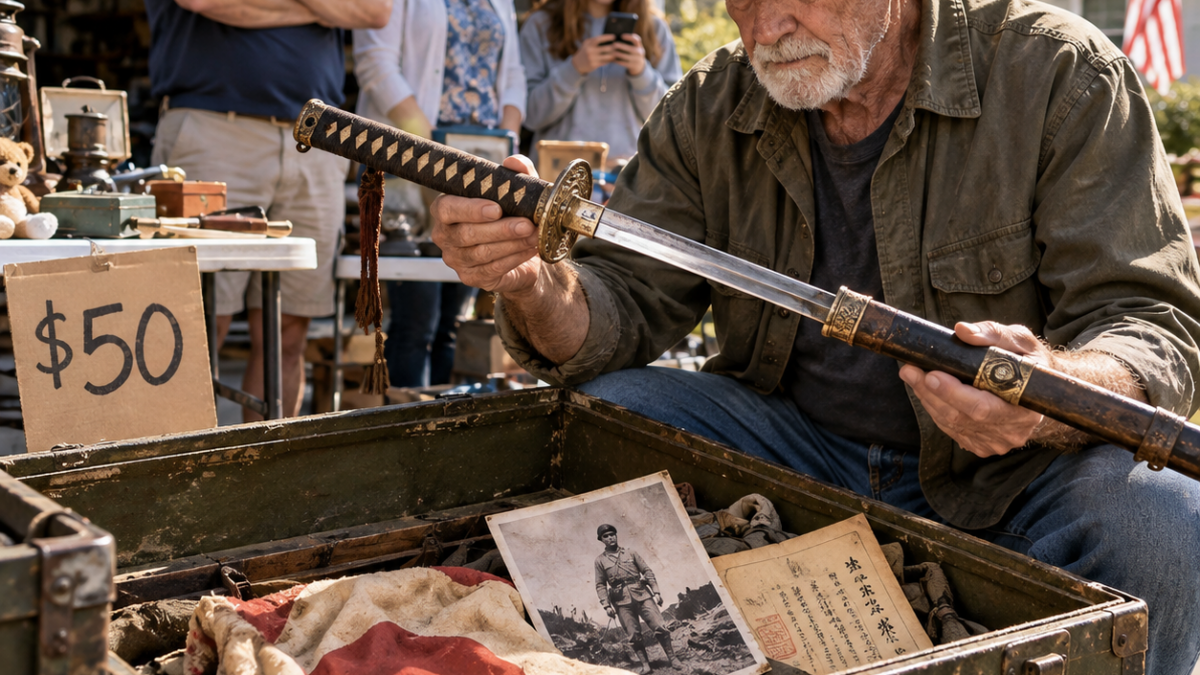
Olive drab under decades of grime.
Rectangular.
Steel-reinforced corners.
Heavy side handles.
Old brass padlock through the hasp.
The paint had oxidized nearly black in places.
A faint white stencil remained on the lid.
Tom crouched.
Ran one finger across it.
The man with the coffee noticed.
“That thing?”
Tom looked up.
“What’s the story?”
The man shrugged.
“Granddad’s.”
“Military?”
“Probably.”
Tom looked again.
“You don’t know?”
“He was a Marine.”
“What era?”
“World War Two.”
The answer came casually.
Like saying someone’s grandfather had once worked for the post office.
Tom stood.
“What was his name?”
“James Callaway.”
Tom repeated it silently.
“What’s inside?”
“No clue.”
“No key?”
The man shook his head.
“Old man kept it locked forever.”
His wife called from a table:
“Greg, tell him it’s as-is.”
Greg Callaway nodded.
“As-is.”
Tom tapped the padlock.
“You ever try opening it?”
“Why?”
That answer bothered him.
Tom said nothing.
Greg continued:
“Probably greasy tools.”
“Rags.”
“Old paperwork.”
“He had that thing in his shed my whole life.”
“We’re cleaning out Mom’s storage and everything from Granddad’s place.”
“He died this winter.”
Tom looked at him.
“Sorry.”
Greg shrugged slightly.
“Thanks.”
The teenage girl looked up long enough to ask:
“Dad, can I have money for Starbucks?”
Greg said:
“In a minute.”
Then turned back to Tom.
“Fifty bucks.”
“For the chest?”
“Everything in it.”
Tom studied him.
“As-is.”
“Yep.”
“No returns?”
Greg laughed.
“If you find gold bars, they’re yours.”
Tom didn’t laugh.
He reached into his pocket.
Two twenties.
One ten.
Greg took the cash.
No receipt.
Tom said:
“Give me something in writing.”
Greg frowned.
“For fifty bucks?”
“Old habit.”
Greg found a yard-sale pad.
Wrote:
1 military tool chest, locked, contents unknown — $50, sold as-is.
Signed:
Greg Callaway.
Tom folded it carefully.
Then he and Greg loaded the chest into his truck.
It was heavy.
Very heavy.
Greg grunted.
“Told you. Tools.”
Maybe.
Tom’s hands had told him something different.
The weight shifted as they tilted it.
Long object inside.
Solid.
Not loose wrenches.
Tom said nothing.
On the drive home, the chest rattled once each time he hit a bump.
He turned the radio off.
By the time he reached his gravel road, curiosity had become pressure.
He backed to the barn.
Used a dolly.
Dragged the chest inside.
Set it beneath the main work light.
Then did nothing for almost a minute.
Tom believed impatience broke more old things than rust did.
He inspected the hinges.
Original.
Hasp.
Old but sound.
Padlock probably added later.
The chest itself appeared World War II-era military issue, though not rare in that condition.
He photographed everything before touching it.
Lid.
Stencils.
Lock.
Sides.
Bottom.
Eleanor had taught him that.
She collected antiques.
“Photograph it before you make it better,” she always said.
“Otherwise nobody believes what you started with.”
Tom took a hacksaw from pegboard.
He could have used a grinder.
Didn’t.
Too much heat.
Too much chance of sparks near unknown contents.
The padlock took eleven minutes.
Tom worked patiently.
Steel singing softly beneath the blade.
Back.
Forward.
Back.
Forward.
Finally the shackle separated.
The old lock dropped into his palm.
Heavy.
He set it beside the chest.
Then rested both hands on the lid.
He did not know why he suddenly felt nervous.
Maybe because military objects carried echoes.
Not supernatural.
Human.
A uniform is cloth until you know who wore it.
A helmet is steel until you find the name scratched under the liner.
Then weight changes.
Tom opened the chest.
Hinges resisted.
Then lifted.
The smell came first.
Cosmoline.
Oil.
Dry cloth.
Old paper.
Metal.
Dust sealed away from sunlight.
Tom stood very still.
The top layer was exactly what Greg had predicted.
Rags.
Folded.
Dark with preserved oil.
But not carelessly stuffed.
Stacked.
Edges aligned.
Tom lifted the first.
Then another.
Third.
Underneath lay something wrapped in faded red silk.
Long.
Almost forty inches.
Tom’s heart changed rhythm.
“No.”
He knew the shape.
He did not touch it immediately.
He grabbed his phone.
Photographed.
Then carefully lifted the bundle with both hands.
The silk had once been brilliant crimson.
Now dark rust-red.
It crackled slightly with age.
Tom placed it on a padded section of bench.
Unwrapped one fold.
Then another.
A sword.
Japanese military mounts.
The scabbard olive-brown with field wear.
Metal fittings dulled.
Hilt wrapped in ray skin and cord beneath wartime fittings.
Type 98-style shin-gunto mounting, or close enough that Tom recognized the general pattern.
He whispered:
“Well, Jimmy.”
He had already started calling the dead man by his first name.
Tom knew enough to know what he didn’t know.
That distinction saves people from destroying history.
He did not clean it.
Did not polish.
Did not oil anything.
Did not remove the handle.
He drew the blade barely two inches.
Stopped.
Steel gleamed.
Not orange.
Not ruined.
A visible temper pattern moved along the edge.
Not proof by itself of age or hand-forging.
But enough to make Tom’s palms sweat.
This wasn’t a souvenir replica.
Whatever the blade’s exact origin, somebody had cared for it.
Tom returned it gently to the scabbard.
Then looked inside the chest.
Beneath where the sword had rested:
Manila envelope.
Dry.
Brittle.
Tied once with cotton string.
Tom changed gloves.
Eleanor had kept archival gloves in the shop for old photographs.
He used them now.
The envelope contained several items.
A folded document.
Japanese characters.
English translation.
Stamped military notations.
Date.
April 1945.
Iwo Jima.
Tom stopped breathing for a moment.
He read again.
Japanese officer:
Lieutenant Hideo Tanaka.
145th Infantry Regiment.
Receiving Marine:
Corporal James M. Callaway.
28th Marines.
5th Marine Division.
Tom read the name twice.
Callaway.
Same as the yard sale.
Paper-clipped behind it was a photograph.
Three and a half by five.
White border yellowed.
A young Marine stood on black volcanic ground beneath a huge Pacific sky.
Nineteen, maybe twenty.
Carbine slung.
Helmet pushed back.
Face burned thin by sun and exhaustion.
Behind him, farther up the slope, stood the summit terrain of Mount Suribachi.
On the back:
J. Callaway
Suribachi
March 1, 1945
Tom sat.
His knees suddenly needed permission.
He placed the photograph beneath the work light.
“Jesus Christ.”
He had purchased yard-sale mysteries before.
Rare hand tools.
Railroad locks.
Civil War-era buttons that turned out to be reproductions.
A surgeon’s kit missing half the instruments.
Once a letter from 1918 written by a soldier who died before reaching home.
Nothing like this.
He poured coffee.
It had gone cold.
Drank anyway.
Then Tom did something no collector dreaming of profit would have done.
He stopped opening things.
There were more papers in the chest.
Possibly photographs.
Maybe service records.
A wrapped object shaped like a medal case.
Tom left them exactly where they were.
Provenance mattered now.
Context mattered.
Once objects got separated, stories broke.
He took broad photographs.
Closed the chest without locking it.
Then called the first person he trusted.
Charles Avery.
Retired curator.
Had worked years with Marine Corps historical collections before moving back to Virginia.
Charles answered on the fourth ring.
“Tom.”
“Charlie.”
“You die?”
“Not yet.”
“Then why are you calling before noon?”
“I bought a tool chest.”
“You need professional help.”
“World War Two Marine.”
Silence.
“Go on.”
“Possible Japanese officer’s sword.”
Longer silence.
“Possible?”
“I haven’t taken it apart.”
“Good.”
“Document says Iwo Jima.”
Charles’s voice changed.
“What kind of document?”
“Surrender of arms.”
“Named?”
“Yes.”
“Marine named?”
“Yes.”
“Photograph?”
“Yes.”
“Tom.”
“Yeah.”
“Do not touch anything else.”
“I know.”
“Send pictures.”
Tom did.
Fifteen minutes later Charles called back.
His joking voice was gone.
“Where did you get this?”
“Yard sale.”
“You’re kidding.”
“Fifty dollars.”
Silence.
Then:
“You’re not kidding.”
“No.”
“Who sold it?”
“Grandson of the Marine.”
“Jesus.”
“That’s approximately what I said.”
Charles asked for details.
Tom gave them.
Then Charles said:
“I’m not authenticating from phone photographs.”
“I know.”
“But the sword mounts look period.”
“Document format is plausible.”
“And that photo…”
“What?”
“If that location and date are what they say…”
He trailed off.
Tom understood.
The flag raising on Mount Suribachi had happened February 23, 1945.
March 1 placed James Callaway on the mountain less than a week later.
Not as one of the famous flag raisers.
That wasn’t the point.
He had been there.
One Marine among thousands fighting across an island that would kill or wound more than twenty-six thousand Americans and devastate the Japanese defenders.
Charles said:
“Find his service record.”
“Already starting.”
Tom called a regional Marine historical association.
Then county records.
Then funeral home.
James Matthew Callaway.
Born 1925.
Died six months earlier.
Age ninety-seven in the corrected records, not ninety-two as someone had first remembered.
Tom wrote everything down.
Enlisted 1943.
5th Marine Division.
28th Marines.
Iwo Jima campaign.
Bronze Star Medal with Combat “V” documented in family obituary and later confirmed in records.
Wounded once.
Returned home.
Worked at a lumber mill for four decades.
Married Evelyn Callaway.
Four children.
Eleven grandchildren.
Never published memoir.
Rarely attended veterans events.
One local oral-history interview in 1995.
Tom found the archive Monday.
But before Monday came Sunday.
And Sunday brought Robert Stone.
Retired Major General.
Eighty-one.
Tall.
Back straight.
Silver hair cut as if regulations remained enforceable.
He had known Jimmy Callaway late in life through Marine veteran events.
Stone had given remarks at Callaway’s funeral.
Charles Avery called him after seeing Tom’s photographs.
Stone called Tom at 8:14 Saturday night.
“This is Robert Stone.”
Tom sat straighter despite being in his kitchen.
“General.”
“Don’t start that.”
“Habit.”
“You have Jimmy Callaway’s chest.”
“Yes.”
“Did his family sell it?”
“Yes.”
“Everything?”
“Written receipt says chest, locked, contents unknown, sold as-is.”
Stone was silent.
Then:
“Don’t sell anything.”
Tom’s jaw tightened.
“I wasn’t planning to.”
“Good.”
“General.”
“Bobby.”
“Bobby.”
Tom looked toward the barn.
“I think the family has no idea.”
“They don’t.”
“You sure?”
“I spoke to Jimmy’s eldest daughter after funeral.”
“She knew he had a sword somewhere.”
“Never saw it.”
“Jimmy wouldn’t discuss it.”
“Did she know about document?”
“No.”
“Photo?”
“No.”
Tom sighed.
Stone said:
“I’m coming tomorrow.”
“That’s a long drive.”
“I’ve made longer for less.”
He arrived at 9:45.
Ten minutes early.
Of course.
Tom met him outside.
They shook hands.
Stone carried a hard archival case, nitrile gloves, and the expression of a man arriving at a hospital.
Inside the workshop, Tom opened the chest.
Stone did not touch anything for almost two minutes.
Then he saw the photograph.
His face changed.
“That’s Jimmy.”
“You recognize him?”
“I knew him at ninety.”
Stone leaned closer.
“But yes.”
He picked up the photograph with gloved hands.
“Those eyes.”
Tom watched.
Stone whispered:
“You stubborn son of a bitch.”
“Why?”
“He told me once he’d been on Suribachi.”
“He never said when.”
“Never said who with.”
“He said, ‘I was a Marine on an island full of Marines. That’s enough.’”
Stone looked at Tom.
“That was Jimmy.”
They documented each item.
Carefully.
The chest contained more than the sword and surrender paper.
A Marine Corps pay record.
Two letters home that had never been mailed.
A small New Testament.
A field dressing packet.
A cloth map fragment.
Three Japanese military buttons.
Jimmy’s Bronze Star citation copy.
A Purple Heart medal in its case.
A photograph of four Marines, only one identified.
And a sealed envelope.
On front, Jimmy had written:
FOR WHEN SOMEBODY FINALLY ASKS ABOUT THE SWORD.
Tom and Stone looked at each other.
Neither opened it immediately.
Stone said:
“We need witnesses.”
Tom smiled slightly.
“Now you’re being dramatic.”
“No.”
“I’m being seventy years old around documents.”
They called Charles by video.
Recorded the opening.
Inside was six handwritten pages.
Jimmy’s handwriting had become shaky later in life.
First line:
I never considered this sword mine.
Stone stopped reading.
Tom waited.
Then Stone read aloud.
Jimmy described April 1945.
Combat on Iwo Jima had officially wound down, though isolated Japanese personnel remained in caves and tunnels.
His unit had been searching terrain after weeks of fighting.
Leadership had been shredded by casualties and reassignment.
In one cave complex, several Japanese soldiers emerged.
One officer.
Wounded.
Starving.
Still armed at first.
Jimmy wrote that the lieutenant removed his sword and presented it formally before surrender.
Jimmy had been the senior enlisted Marine immediately present when contact occurred.
Not the senior Marine on the island.
Not some cinematic battlefield commander.
Just a corporal standing in the wrong place at the right moment after too many men had already been killed.
The Japanese officer gave his name:
Hideo Tanaka.
The sword was inventoried, then eventually released to Jimmy as a permitted war trophy through processes common to that era.
Jimmy wrote:
He looked older than me. I found out later he was twenty-six.
I was nineteen.
At nineteen I thought twenty-six was old.
He bowed when he handed me the sword.
I did not know whether to bow back.
So I did.
Jimmy described the sword staying wrapped for most of his life.
He had taken it out only occasionally.
He believed the blade had belonged to Tanaka’s family before the war.
He had once tried to locate the Tanaka family in the 1960s but failed.
Then came the line that changed everything.
If anybody opens this after I am gone, do not sell it until you try again.
Tom looked at Stone.
Stone looked back.
The letter continued.
If Lieutenant Tanaka has children, I think they ought to be told it survived.
If they want it and it can legally and properly go back to them, hear them out.
If they don’t, put it somewhere people can learn what happened.
Do not make me into a hero for standing there.
The brave part was him walking out of that cave when surrender probably felt worse than dying.
Nobody spoke for a while.
Charles’s voice came tinny through the phone.
“Well.”
Tom said:
“Changes things.”
Stone nodded.
“It does.”
Tom looked at the sword.
It had gone from valuable object to responsibility.
That was different.
Better.
Sunday afternoon, Stone said:
“We need to go back.”
“To Greg?”
“Yes.”
Tom’s expression tightened.
“He sold it.”
“I know.”
“Legally.”
“Maybe.”
Stone looked at him.
“Do you want to win ownership or do you want to preserve Jimmy’s story?”
Tom didn’t answer immediately.
Because the question annoyed him.
Mostly because he knew the answer.
“Preserve it.”
“Then the family needs to know.”
Tom sighed.
“Fine.”
They packed everything carefully.
Not to surrender it immediately.
To explain.
Stone insisted on bringing only the sword, key documents, and photograph in the hard case.
The rest remained secured at Tom’s home.
When they reached Greenville, the yard sale was still active.
Reduced inventory.
Same blue tarp.
Greg sat in a folding chair drinking beer.
Ten in the morning.
Tom parked.
Greg recognized him.
Raised one hand.
“Hey.”
Then saw Stone.
Straightened.
Tom approached.
Greg said:
“Chest work out?”
“Yes.”
“Tools?”
Tom looked at him.
“Your grandfather ever talk about Iwo Jima?”
Greg’s face changed slightly.
“Some.”
“How much?”
“Not really.”
“He was there.”
“I know.”
Stone stepped forward.
“Greg Callaway?”
“Yes.”
“My name is Robert Stone.”
Recognition was slow.
Then sudden.
“You spoke at Grandpa’s funeral.”
“Yes.”
Greg stood.
His wife, Melissa, came from garage.
Their daughter finally put down her phone.
Stone said:
“Could we sit somewhere?”
Greg looked at the hard case.
“What happened?”
Stone said:
“We found something your grandfather wanted your family to know about.”
That was different from:
You sold his life for fifty dollars.
Tom was glad Stone had phrased it that way.
They sat at patio table.
Stone told them.
Not dramatically.
Jimmy.
28th Marines.
Iwo Jima.
Bronze Star.
Wound.
Suribachi.
Japanese officer.
Greg listened with his mouth slightly open.
Melissa covered her lips.
Their teenage daughter, Kayla, moved closer.
Then Stone opened the case.
He lifted the photograph first.
Not the sword.
That mattered.
Greg took it.
“My God.”
Stone said:
“Your grandfather.”
Greg ran one thumb near the edge without touching image surface.
“He looks like my son.”
Kayla whispered:
“He looks like Uncle Matt.”
Melissa sat.
Greg turned photograph over.
Read pencil.
“March first.”
Stone nodded.
“Less than a week after the flag raising.”
“He was there?”
“He was on Suribachi around that time.”
“We are still verifying exact unit movements and context.”
“But yes, the photograph appears consistent with his service.”
Greg stared.
“He never showed us.”
Stone said:
“Apparently he believed the famous story belonged to the men in the photograph everyone knows.”
“He saw himself as incidental.”
Then the sword.
Greg stopped breathing.
“You found that in the box?”
Tom said:
“Wrapped beneath rags.”
Greg looked at him.
“How much is it worth?”
Melissa turned sharply.
“Greg.”
“What?”
“I’m just asking.”
Stone answered carefully.
“That isn’t the important question.”
“I understand.”
“I’m asking because…”
Greg trailed off.
Tom knew exactly why.
Fifty dollars.
If the sword was worth thousands, Greg needed to understand how badly he had misjudged it.
Stone said:
“Depending on blade age, maker, condition, and documented provenance, a sword like this could be financially significant.”
“Tens of thousands.”
“Possibly more.”
“No responsible person would give a final value before specialist examination.”
Greg sat down hard.
“Jesus.”
Melissa whispered:
“We sold it for fifty dollars.”
Tom said:
“You sold a locked chest.”
Greg looked at him.
“Same thing.”
Tom could have enjoyed that moment.
He didn’t.
Because shame is entertaining only until you see it working on a real person.
Stone produced Jimmy’s letter.
He read the important parts.
Try to find Tanaka’s family.
Don’t sell it first.
Put it somewhere people can learn.
When he finished, Greg was crying.
Quietly.
Not theatrical.
He covered his eyes.
“I didn’t know.”
Stone said:
“I believe you.”
“I thought it was junk.”
Tom said nothing.
Greg looked at him.
“You must think I’m the worst grandson in the world.”
Tom considered.
“No.”
Greg laughed bitterly.
“Come on.”
“I think you made a fifty-dollar decision about something you didn’t understand.”
“That’s different.”
“How?”
“Because you can fix decisions.”
Greg looked at the sword.
“Can we buy it back?”
Tom did not answer immediately.
Legally, he possessed a written receipt.
But probate and estate ownership could complicate questions.
Greg himself might not have held sole title to his grandfather’s effects.
Other heirs existed.
Museum accession departments would care deeply about clean provenance.
Tom had already thought about it.
Stone said:
“That’s not the next step.”
“What is?”
“Call your mother.”
Greg stiffened.
“She’ll kill me.”
“Probably.”
Stone smiled faintly.
“Then call your aunts and uncles.”
“Everyone with inheritance rights.”
“We do this correctly.”
Greg looked at Tom.
“You’re willing?”
Tom nodded.
“I didn’t buy this to get rich.”
“Then why’d you buy it?”
“Because old military chest for fifty dollars was better odds than the lamp beside it.”
Kayla laughed unexpectedly.
Everyone looked at her.
“Sorry.”
Tom smiled.
“Don’t be.”
Greg’s mother, Susan Callaway, arrived an hour later.
Seventy-one.
She took one look at photograph and cried before anyone explained.
“Daddy.”
That one word changed room.
Not Corporal Callaway.
Not Bronze Star recipient.
Daddy.
She touched the edge of photograph.
“He never showed us this.”
Stone said:
“He left a letter.”
Susan read it alone.
Halfway through, she pressed paper to her chest.
When finished:
“He always did this.”
Tom asked:
“What?”
“Made himself smaller.”
She wiped eyes.
“My brothers thought he hated talking about the war.”
“I don’t think he hated talking about it.”
“I think he hated being praised for surviving.”
Stone nodded.
“That would fit the man I knew.”
Susan looked at sword.
“Is that the one?”
“You knew there was one?”
“Yes.”
“Sort of.”
“When I was little, I saw him oil something long on kitchen table.”
“Mom told me not to bother him.”
“Years later I asked.”
“He said, ‘It belongs to somebody’s boy.’”
Tom’s throat tightened.
Susan looked at him.
“You bought Daddy’s chest?”
“Yes, ma’am.”
“For fifty dollars.”
“Yes.”
She laughed through tears.
“He’d love that.”
Greg stared.
“Mom.”
“What?”
“Granddad would not love me selling it.”
“No.”
She looked at her son.
“He would not.”
Greg lowered his head.
Susan continued:
“But he’d love a Marine finding it.”
Tom said:
“Why?”
“He trusted Marines more than family with old things.”
“That sounds unhealthy.”
Susan smiled.
“That was Daddy.”
By evening, all four surviving Callaway children had joined by phone or in person.
Nobody fought over money.
At least not yet.
That surprised Tom.
One son, Richard, said:
“If it’s worth six figures, that could help Mom.”
Susan snapped:
“I don’t need sword money.”
Richard:
“I didn’t mean—”
“I know what you meant.”
Stone intervened.
“Before anybody discusses sale, Jimmy’s letter specifically asks that the Tanaka family be sought.”
Silence.
That shifted conversation.
Greg’s daughter Kayla asked:
“Can we actually find them?”
Tom looked at her.
“Maybe.”
“Seventy-seven years later?”
“People find harder things.”
She leaned forward.
“I can help.”
Greg said:
“You have school.”
“It’s summer.”
Tom liked her immediately.
The next six weeks became investigation.
Historical, not criminal.
And slow.
Charles Avery coordinated with archives.
A Japanese-American historian named Dr. Emi Sato joined voluntarily after hearing about the document.
She read Japanese handwriting more accurately than anyone in Tom’s circle.
Lieutenant Hideo Tanaka.
145th Infantry Regiment.
Born in Nagano Prefecture.
The surrender paper appeared genuine in form and age, though the exact context required archival corroboration.
The sword went to a qualified Japanese sword specialist.
Under controlled conditions, the handle was removed for inspection.
Tang.
Signature.
File marks.
Age.
The specialist called Tom.
“Your instinct was right.”
“Family blade?”
“Likely.”
“How old?”
“Blade appears older than wartime mounts.”
“Possibly late Edo period.”
Tom sat down.
“Signed?”
“Yes.”
“Need more study.”
“Do not start calling auction houses.”
“I wasn’t.”
“Good.”
The wartime military mount had carried an older traditionally forged blade.
Exactly the kind of family sword many Japanese officers brought into service.
The monetary estimate varied wildly.
Thirty thousand.
Sixty.
Potentially higher with attribution and complete provenance.
One dealer suggested the documented Iwo Jima surrender could push auction interest far beyond ordinary market value.
Tom hated that conversation.
Every dollar sounded like distance from Jimmy’s letter.
Kayla became the most committed researcher.
She created a spreadsheet.
Dates.
Units.
Japanese name variants.
Callaway records.
National Archives requests.
Japanese prefectural records.
She interviewed her grandmother.
Found boxes nobody had opened since Jimmy died.
One contained letters.
In a 1967 letter, Jimmy had written to an organization trying to locate Japanese veterans.
He named Hideo Tanaka.
No result.
Another attempt in 1985.
Again no result.
Kayla called Tom.
“He tried twice.”
“I know.”
“Why didn’t he tell anybody?”
“Maybe because failing privately hurts less.”
She was quiet.
“You say things like Grandpa.”
“I’ll take that as a compliment.”
Then Dr. Sato found something.
A Japanese veterans registry.
Hideo Tanaka had survived the war.
Repatriated in 1946.
Married.
Worked as a school administrator.
Died in 1989.
One daughter.
Keiko Tanaka Mori.
Likely alive.
Age eighty-three.
Living near Matsumoto.
Tom sat in his workshop holding phone.
“Are we sure?”
Dr. Sato said:
“No.”
“Not yet.”
“But dates, regiment, hometown, and family records align.”
“We need direct confirmation.”
Stone said:
“How?”
Dr. Sato:
“Carefully.”
A letter went to Japan.
Not:
We have your father’s valuable sword.
Instead:
Researchers in the United States have located wartime materials associated with Lieutenant Hideo Tanaka, 145th Infantry Regiment, believed surrendered on Iwo Jima in 1945.
We are attempting to verify identity and family history.
Weeks.
No response.
Then email.
From Keiko’s son.
Masato Mori.
His English was excellent.
He wrote:
My mother would like to speak.
Video call arranged.
Tom sat at Susan Callaway’s kitchen table.
Stone.
Greg.
Kayla.
Dr. Sato translating where necessary.
Screen connected.
An elderly Japanese woman appeared.
Small.
Silver hair.
Blue cardigan.
Her son beside her.
Dr. Sato introduced everyone.
Then showed the sword.
Keiko’s face changed before translation finished.
She leaned toward screen.
Asked something rapidly.
Dr. Sato listened.
Then:
“She wants to see the family crest on the fitting.”
The sword specialist had documented it.
Tom held up high-resolution photograph.
Keiko covered her mouth.
Started crying.
Nobody in Tennessee spoke.
Masato put an arm around his mother.
After several minutes, Keiko spoke.
Dr. Sato translated.
“She says her father returned without the sword.”
“He almost never discussed Iwo Jima.”
“But he told her once that he had given the family blade to an American Marine when he surrendered.”
“He believed he had dishonored his ancestors.”
Tom looked toward Jimmy’s letter.
Keiko continued.
“She remembers her grandmother grieving the sword.”
“Not because of money.”
“Because it had belonged to her grandfather.”
Then Masato spoke.
“My grandfather searched?”
Dr. Sato translated.
Keiko nodded.
After war, impossible.
Records destroyed.
Names unknown.
He remembered only:
A young American corporal.
Thin.
Dirty face.
Who bowed back.
Keiko smiled through tears.
“He always remembered that.”
Tom’s eyes filled.
Jimmy had remembered bowing too.
Two nineteen- and twenty-six-year-old men on black volcanic ground.
Enemies.
Neither understanding the other’s language fully.
Both remembering one bow for the rest of their lives.
Kayla whispered:
“Show her Grandpa.”
Tom held up Suribachi photograph.
Keiko stared.
Masato translated before Dr. Sato could.
“My mother asks if this is him.”
Susan said:
“Yes.”
“James.”
“Jimmy.”
Keiko repeated carefully:
“Jimmy.”
Then she bowed toward screen.
Susan began crying harder.
She bowed back.
No one planned it.
Maybe that was why it mattered.
The question of the sword became unavoidable.
Who should have it?
Legally, complicated.
Morally, more complicated.
Jimmy’s request had been:
If they want it and it can legally and properly go back to them, hear them out.
Tom expected Keiko to ask.
She didn’t.
She said through Dr. Sato:
“My father surrendered it.”
“He believed surrender transferred responsibility.”
“If Mr. Callaway protected it all his life, then his family has also become part of the sword’s story.”
Masato added:
“My mother does not want private sale.”
Susan said immediately:
“Neither do I.”
Greg looked down.
Nobody mentioned his first question about value.
Keiko proposed something unexpected.
Museum.
Not hidden in either family.
Displayed with both names.
Tanaka.
Callaway.
Not victory trophy.
Not shame.
Two young men.
War.
Surrender.
Survival.
Stone leaned back.
“That,” he said quietly, “is exactly right.”
The National Museum of the Marine Corps expressed interest but required extensive provenance and legal title documentation.
Good.
Museums should.
Tom’s fifty-dollar receipt was not enough by itself for an artifact of this significance.
Estate counsel became involved.
Jimmy’s will.
Distribution.
Ownership.
Whether Greg had authority to sell the chest.
He had been handling items with family permission, but some assets technically belonged to heirs jointly.
Tom could have argued bona fide purchase.
Maybe won.
Instead he signed an agreement.
He relinquished any claim to profit.
The Callaway heirs executed a clean deed confirming transfer of the artifacts for museum donation.
The Tanaka family provided a statement consenting to permanent public preservation of the sword and contributing their family history.
Tom retained exactly one item.
The cut padlock.
Greg insisted.
“You earned something.”
Tom laughed.
“I earned a broken lock?”
“Symbolic.”
“Cheap family.”
Greg smiled.
First time they could joke about it.
The museum team authenticated what they could.
Some details from family lore softened under scrutiny.
Jimmy had indeed served with 28th Marines, 5th Marine Division.
He had been on Iwo Jima.
His Bronze Star with Combat “V” was confirmed for actions during the campaign, though the exact family description about Hill 362B required careful wording because surviving records did not support every later embellishment.
The March 1 photograph was consistent with Suribachi terrain and period, but historians could not prove the exact photographer.
The surrender document’s date and signatures were genuine enough for experts to consider it extraordinary, though researchers described the event cautiously as a localized surrender and transfer of arms, not some formal island-wide surrender.
The sword was authenticated as a traditionally forged older blade fitted into wartime officer mounts.
Its maker attribution remained under specialist review.
That was fine.
Truth did not become smaller because adjectives got more careful.
Tom respected that.
At one planning meeting, a museum researcher said:
“We should avoid calling it the most significant private Iwo Jima artifact in America.”
Greg looked disappointed.
Tom said:
“Good.”
Everyone looked at him.
“Why?”
“Because we don’t need to sell tickets.”
Stone smiled.
The exhibit took nearly a year.
Not three months.
Paperwork.
Conservation.
Mount fabrication.
Translation.
Rights.
Climate-control planning.
Historical review.
Family approvals.
Then opening date.
Susan Callaway almost refused to attend.
“I don’t like crowds.”
Greg said:
“Mom.”
“Your grandfather hated crowds too.”
Kayla said:
“Grandma.”
Susan looked at her granddaughter.
Kayla had spent almost a year researching Jimmy.
She had written her college entrance essay about the chest.
Not about its value.
About silence between generations.
Susan sighed.
“Fine.”
Tom traveled to Virginia.
Stone met him.
Dress blues.
Tom wore suit.
Refused uniform.
“You have one,” Stone said.
“I also have a suit.”
“You’re impossible.”
“Rank privilege.”
“You retired gunny.”
“Still counts emotionally.”
The exhibit was smaller than Greg imagined.
Not grand hall.
Better.
Quiet gallery focused on individual experiences of Iwo Jima.
Sword inside climate-controlled case.
Not dramatically upright like weapon worship.
Resting horizontally.
Beside it:
Surrender document.
Jimmy’s photograph.
A photograph supplied by Keiko’s family:
Hideo Tanaka before deployment.
Twenty-five.
Formal uniform.
Serious eyes.
Between the two photographs was the central text.
TWO MEN, ONE SWORD
On the left:
Corporal James M. Callaway
United States Marine Corps
28th Marines, 5th Marine Division
On the right:
Lieutenant Hideo Tanaka
Imperial Japanese Army
145th Infantry Regiment
Below:
In April 1945, during the final period of operations on Iwo Jima, Lieutenant Tanaka surrendered his sword to Corporal Callaway. Callaway preserved the sword and associated documentation for the rest of his life. Decades later, after the materials were rediscovered, the Callaway and Tanaka families chose to preserve them together as evidence of war, surrender, memory, and reconciliation.
Tom read it three times.
No “hero.”
No “enemy.”
No auction value.
Good.
Then he noticed a quotation below.
Jimmy’s letter:
I never considered this sword mine.
And beneath it, Keiko Tanaka Mori:
My father remembered the young Marine who bowed back.
Tom had to look away.
Stone pretended not to notice.
Across the gallery, Greg stood with his wife.
Kayla beside him.
And Greg’s ten-year-old son, Matthew.
The boy wore a clip-on tie.
Same detail as original family story, except now it felt real because Tom watched the kid keep adjusting it crooked.
Susan Callaway stood closest to display.
She placed one hand on glass beneath her father’s photograph.
No touching artifacts.
Just glass.
“Hi, Daddy,” she whispered.
Greg heard.
His face collapsed.
He walked beside her.
“Mom.”
She looked at him.
“I’m sorry.”
“For what?”
He pointed at chest display.
Everything.
“I sold it.”
Susan studied her son.
Then:
“Yes.”
Greg winced.
She continued:
“And then you helped bring it back.”
He shook his head.
“Tom did.”
“Tom opened it.”
“Kayla researched it.”
“Dr. Sato found Tanaka family.”
“Bobby called museum.”
She touched Greg’s arm.
“You signed donation.”
“You could have fought.”
“You didn’t.”
Greg looked toward Tom.
“I almost sold Grandpa’s sword for fifty bucks.”
“No.”
Susan smiled sadly.
“You sold a box because you were cleaning a garage.”
“There’s a difference.”
“Tom told me that.”
Greg laughed through tears.
“Of course he did.”
Then Matthew asked:
“Dad?”
Greg wiped his face.
“Yeah?”
“Why didn’t Grandpa Jimmy tell anybody?”
The room quieted around them.
Greg looked at museum text.
Then at his son.
“I don’t know.”
Susan answered.
“I do.”
Everyone looked at her.
She said:
“Because your great-grandfather thought remembering the dead was more important than talking about himself.”
Matthew thought.
“Was he right?”
Susan took a long breath.
“Partly.”
Tom listened.
Susan continued:
“He was right to remember them.”
“He was wrong to think that meant we didn’t need to remember him too.”
Matthew looked at photograph.
Then:
“I want to know everything.”
Greg nodded.
“We’re working on that.”
Kayla said:
“I have two hundred pages.”
Matthew groaned.
Everyone laughed.
The Tanaka family could not travel.
Keiko’s health was fragile.
Instead, museum placed screen nearby for private family ceremony.
When Keiko appeared, Susan approached.
Two elderly daughters.
One American Marine’s daughter.
One Japanese officer’s daughter.
Neither had been alive on Iwo Jima.
Both had lived entire lives under shadows created there.
Dr. Sato translated.
Susan said:
“My father kept your father’s sword safe.”
Keiko nodded.
“My father remembered your father with gratitude.”
Susan’s eyes filled.
“Gratitude?”
Keiko spoke slowly.
Translation:
“He believed your father treated him as a defeated soldier, not an animal.”
“He expected humiliation.”
“He did not receive it.”
Tom looked down.
This was the part nobody could put a price on.
Keiko continued.
“My father carried shame after surrender.”
“For many years.”
“But he also carried memory of that bow.”
“It helped him understand he was still a human being.”
Susan covered her mouth.
Then:
“My father carried guilt for taking the sword.”
Dr. Sato translated.
Keiko smiled.
“Then perhaps they both carried unnecessary things.”
Stone had to turn away.
Even generals get overwhelmed.
After ceremony, museum curator handed Greg a copy of artifact accession paperwork.
No price.
No auction estimate.
Permanent collection.
Public trust.
Greg read donor list.
Callaway Family.
With acknowledgement of Tanaka Family.
And:
Thomas Hadley, finder and preservation advocate.
Tom frowned.
“I told them not to do that.”
Stone said:
“They ignored you.”
“Good institution.”
Kayla approached Tom.
“I have something.”
Envelope.
Inside was fifty dollars.
Two twenties.
One ten.
Tom stared.
“No.”
“Yes.”
“What is this?”
“Your purchase price.”
“Absolutely not.”
“Grandma says take it.”
Tom looked at Susan across room.
She nodded.
Tom walked over.
“You’re ruining my best yard-sale story.”
Susan said:
“You didn’t buy the chest.”
“Apparently I did.”
“You rescued it.”
“Don’t use that word.”
“Why?”
“Because objects aren’t puppies.”
Susan smiled.
“Take the money.”
“No.”
She crossed arms.
Tom recognized stubbornness inherited from Jimmy.
“Fine.”
He took the fifty.
Then handed it to Matthew.
“Buy books about your great-grandfather’s unit.”
The boy looked at Greg.
Greg nodded.
“Deal.”
Tom never learned what final insurance valuation museum assigned the sword.
He deliberately avoided asking.
Collectors contacted him anyway.
Somebody leaked enough details.
A dealer offered to broker a private sale if ownership situation ever changed.
Tom hung up.
Another claimed the blade could bring more than $100,000.
Maybe.
Maybe not.
Didn’t matter.
The strangest call came from a television producer.
“We’d like to recreate moment you opened the chest.”
“No.”
“We can fly you out.”
“No.”
“We think this could be huge.”
“It was huge without television.”
The producer didn’t know what to do with that.
Tom ended call.
Back home, the empty space on his workbench felt strange.
For months, chest had lived there.
Now museum had it too.
Not just sword.
Whole chest.
Rags.
Padlock? No.
Tom kept that.
Everything else together.
Because greasy rags were part of story.
How Jimmy had hidden history under ordinary cloth.
Tom placed the cut brass lock on a shelf.
Beside Eleanor’s favorite blue vase.
She would have loved the entire thing.
Or mocked him.
Probably both.
One night Tom poured bourbon.
Two fingers.
Same bottle brand as day he opened chest.
He sat in workshop.
Turned padlock in his palm.
Then said aloud:
“Well, Ellie.”
“Found a good one.”
The barn stayed quiet.
But quiet no longer felt entirely empty.
Months later Greg visited.
Alone.
Drove forty miles.
Brought something.
A wooden hand plane.
Old.
Worn.
“My grandfather’s.”
Tom looked.
“Don’t sell me another mystery box.”
Greg laughed.
“No.”
“This was his.”
“He used it at the lumber mill?”
“At home.”
“Mom says he built her crib with it.”
Tom examined blade.
Handle polished by decades of use.
“What do you want me to do?”
“Restore it.”
“Restore or erase?”
Greg frowned.
“Difference?”
Tom held up tool.
“These scratches are him.”
“This dent might be him.”
“Dark stain probably his hand oil.”
“If I make it look new, you lose some of that.”
Greg thought.
“Then don’t make it new.”
“Make it work.”
Tom smiled.
“That I can do.”
Greg stayed.
They drank coffee.
Talked.
Tom asked why family had known so little about Jimmy.
Greg answered honestly.
“We stopped asking.”
“When?”
“I don’t know.”
“When I was a kid, Grandpa was just Grandpa.”
“He smelled like sawdust.”
“Complained about television.”
“Cut apples with pocketknife.”
“He came to baseball games.”
“Then I got older.”
“Busy.”
“College.”
“Work.”
“Kids.”
“He got quieter.”
Greg looked at bench.
“I thought there’d always be time.”
Tom nodded.
That sentence belonged to almost every family.
Greg continued:
“When we cleaned out his shed, I wasn’t thinking about him.”
“I was thinking about square footage.”
“Mom needed storage cleared.”
“We had one weekend.”
“Everything became categories.”
Keep.
Sell.
Trash.
Tom said:
“That’s how houses get emptied.”
“Is that supposed to make me feel better?”
“No.”
Greg appreciated answer.
After coffee, Tom showed him how to flatten plane iron without destroying maker marks.
Greg tried.
Terrible at first.
Better later.
He came back another Saturday.
Then another.
By winter, Tom had accidentally acquired a friend young enough to be his son.
Greg started bringing Matthew.
Kayla when home from college.
Tom taught them tools.
Not because Jimmy had been Marine.
Because Jimmy had been carpenter too.
That mattered.
At one point Matthew asked:
“Was Great-Grandpa brave?”
Greg looked at Tom.
Tom said:
“Probably.”
Matthew frowned.
“Probably?”
“I wasn’t there.”
“But Bronze Star.”
“Medals document certain acts.”
“They don’t summarize a man.”
Matthew thought.
“So how do we know?”
Tom picked up Jimmy’s plane.
“He worked forty-one years.”
“Raised four kids.”
“Kept promises.”
“Preserved something another family cared about for seventy-seven years.”
“Your grandma says he never missed Christmas breakfast.”
Tom shrugged.
“Bravery has many witnesses.”
Matthew nodded as though storing sentence.
Greg smiled.
Later:
“You’re good with kids.”
“No.”
“You are.”
“I yell at them less because they’re not mine.”
A year after museum exhibit opened, Keiko Tanaka Mori died.
Her son Masato emailed Callaway family.
In her final months she had kept printed photograph of Jimmy beside photograph of her father.
That news moved Susan deeply.
She wrote back:
My father would have been honored.
Masato replied:
My mother believed both men finally came home from the island.
Tom printed that email.
Put it beside padlock.
Two years passed.
Tom turned eighty.
His knees worsened.
He stopped driving to distant yard sales.
Greg started taking him.
Their roles reversed.
At one estate sale Tom saw another military chest.
Greg said:
“No.”
“What?”
“Absolutely not.”
“We don’t know what’s in it.”
“That’s exactly why.”
Tom laughed so hard he had to hold truck.
They bought it for twenty dollars.
Contained plumbing fittings.
Greg stood triumphant.
“See?”
Tom held up brass valve.
“Rare.”
“It’s from Lowe’s.”
“Historically significant.”
“Get in truck.”
At museum, Jimmy and Hideo exhibit became a popular stop, not because sword was spectacular, though it was.
Because two photographs faced each other.
Young American.
Young Japanese officer.
Visitors stood between them.
School groups asked questions.
Why would officer surrender sword?
Why would Marine keep it?
Why did families not know?
Why are some war stories hidden?
Museum added oral-history station.
Susan recorded memories of her father.
Keiko’s son provided translated excerpts from Hideo’s postwar writings.
One said:
I believed surrender ended my honor.
An American corporal bowed.
I began to believe perhaps life after defeat was still life.
Jimmy’s letter said:
He looked ashamed to be alive.
I understood that look better after I came home.
Those two quotations became heart of exhibit.
Not blade.
Not money.
Not famous island.
Survival.
Tom visited one last time at eighty-two.
Walked with cane now.
Stone had died previous winter.
Charles Avery too ill to travel.
Tom stood alone in front of case.
A docent recognized him.
“Mr. Hadley?”
Tom sighed.
“Yes.”
“Would you like me to tell the group who you are?”
“No.”
She smiled.
“They’re middle-schoolers.”
“Especially no.”
Too late.
One boy overheard.
“Are you the guy who found it?”
Tom looked at twenty students.
Bright faces.
Field trip badges.
He considered escape.
Cane made it unlikely.
“Yes.”
A girl asked:
“Did you really pay fifty dollars?”
“Yes.”
“Did you know it was inside?”
“No.”
“Did you get rich?”
Tom smiled.
“No.”
“Why not?”
“Because it wasn’t mine to get rich from.”
The students quieted slightly.
Another boy pointed to sword.
“But you bought it.”
“I bought a chest.”
“So technically—”
“Never become a lawyer.”
Docent laughed.
Tom continued:
“Sometimes owning something and being responsible for something are different questions.”
The girl asked:
“What does that mean?”
Tom looked at display.
“It means I could’ve asked, ‘How much can I get?’”
“Instead we asked, ‘What should happen to it?’”
“Those questions lead to different places.”
The first boy asked:
“Which one’s right?”
Tom said:
“You’ll spend your whole life figuring that out.”
A teacher smiled.
Then a student asked:
“Was Mr. Callaway a hero?”
Tom looked at Jimmy’s photograph.
Nineteen.
Thin.
Alive.
“I think he’d hate that question.”
“Why?”
“Because men who survive something terrible often remember the people who didn’t.”
The student waited.
Tom said:
“But he did something worth remembering.”
“What?”
“He kept another man’s history safe even when nobody was watching.”
That satisfied Tom more than saying hero.
After group moved on, Tom sat on bench.
He thought about first time he saw chest behind paperback books.
Fifty dollars.
Greg barely looking up.
How easy it would have been for another buyer to purchase it.
Maybe tear sword from documents.
Sell blade.
Throw rags away.
Discard photograph because young Marine unidentified.
Auction surrender paper separately.
Within weeks, one story could have become four commodities.
Context destroyed.
History is fragile that way.
Not because paper burns easily.
Because meaning depends on keeping things together.
Person.
Object.
Document.
Memory.
Once separated, value changes.
Sometimes permanently.
Tom understood why Jimmy had kept everything locked.
Not because he was hiding treasure.
Because he had never figured out how to divide it.
Sword belonged to Tanaka.
But surrendered to Jimmy.
Photo belonged to Jimmy.
But represented dead friends.
Bronze Star belonged to Jimmy.
But he believed courage belonged to company.
War had given him objects he could physically carry and meanings he could not resolve.
So he put them together.
Locked the chest.
Lived his life.
Maybe not healthy.
Maybe human.
Greg eventually understood his grandfather differently too.
He stopped saying:
“He never talked about the war.”
Instead:
“We didn’t know how to ask.”
That was fairer.
Families often expect veterans to begin at beginning.
Tell me about war.
Impossible question.
Too large.
Jimmy might have answered smaller questions.
What did you eat?
Who was funniest?
Were you scared on boat?
What did Suribachi smell like?
What did Tanaka say?
Why did you bow?
What did you feel when you came home?
Nobody asked those.
Then time closed.
Kayla began interviewing older veterans in her community through college history project.
Not because all had hidden treasure.
Most did not.
That was the point.
One man talked forty minutes about repairing generators in Korea.
Another woman discussed nursing in Vietnam.
A retired Coast Guardsman told story about storm rescue.
No swords.
No six-figure artifacts.
Still history.
Kayla told Tom:
“I think I finally understood.”
“What?”
“The chest made us care because stuff inside was valuable.”
“Right.”
“But Grandpa was valuable before we opened it.”
Tom smiled.
“There you go.”
She looked embarrassed.
“Sounds obvious.”
“Most true things do afterward.”
At eighty-three, Tom had a mild stroke.
Recovered.
Slower speech.
Right hand weaker.
Greg visited rehabilitation center.
Brought something in cloth.
Tom recognized immediately.
Jimmy’s hand plane.
Restored.
Sharpened.
Not polished sterile.
Greg had done work himself.
Tom turned it over.
“You left dents.”
“You told me to.”
“Good.”
“I flattened sole.”
“Mostly.”
Tom examined.
“Mostly?”
“You’re still mean.”
“Rehabilitation requires purpose.”
Greg sat.
Then:
“Museum called.”
“What?”
“They’re expanding exhibit.”
“Why?”
“More material from Tanaka family.”
“They want include Grandpa’s plane.”
Tom looked surprised.
“Plane?”
“Yep.”
“Why?”
“Because curator says visitors should understand he was more than Marine.”
Tom became quiet.
That pleased him more than sword.
A tool Jimmy used for decades after war.
Object of building instead of fighting.
Tom said:
“Send it.”
Greg nodded.
“But after you die, can I sell it for fifty?”
Tom laughed until nurse came to check on him.
Another two years.
Tom Hadley died at eighty-five.
Peacefully.
Workshop closed for first time in decades.
His son handled estate.
Greg attended funeral with whole family.
Matthew now teenager.
Kayla history teacher.
On casket lay no sword.
No chest.
No war trophies.
Just Tom’s old Marine Corps cover and a small wooden-handled drawknife Eleanor had bought him at an estate sale forty years earlier.
After service, Greg visited barn one last time.
Tom’s son handed him a box.
Inside:
Cut brass padlock from Jimmy’s chest.
And note.
Greg —
This one actually belongs in your family now.
Don’t sell it for fifty dollars.
—Tom
Greg laughed and cried at same time.
He took lock home.
Mounted it in shadow box.
Underneath:
THE LOCK THAT KEPT A STORY WAITING.
Years later, Matthew inherited it.
By then museum exhibit had expanded.
Jimmy’s plane sat beside postwar photograph:
James Callaway at lumber mill.
Older.
Work shirt.
Smile.
Hideo Tanaka’s section included photograph as school administrator surrounded by students.
No uniforms.
That became my favorite version of their story.
Not Iwo Jima.
After.
Two men who survived.
One returned to Tennessee and made lumber into houses.
One returned to Japan and spent decades educating children.
War connected them once.
Life defined them afterward.
The sword remained between their photographs.
Not trophy.
Bridge.
When visitors asked what it was worth, docents answered carefully:
Financial value depends on specialist appraisal.
Historical value is inseparable from documented provenance.
Then they redirected to people.
That was exactly what Tom wanted.
Greg grew old enough that grandchildren began asking.
One granddaughter heard story and said:
“You seriously sold all that for fifty dollars?”
Greg sighed.
“Yes.”
“Grandpa.”
“I know.”
“That was dumb.”
“Thank you.”
“Were you sad?”
“Very.”
“Did Great-Great-Grandpa get mad from heaven?”
“Probably.”
She thought.
“Did Tom?”
“No.”
“He should have.”
Greg smiled.
“Tom understood something.”
“What?”
“People don’t know what they don’t know.”
She frowned.
“That sounds like excuse.”
“It can be.”
“Or it can be starting point.”
“What happened next matters.”
His granddaughter looked at padlock.
“So what happened next?”
Greg pointed toward museum photo on wall.
“We learned.”
That was answer.
Not punished.
Not ruined.
Not humiliated forever.
Learned.
The original yard-sale story could have ended differently.
Tom could have sold sword privately.
Greg could have sued.
Families could have fought.
Auction houses could have turned pain into bidding war.
Japanese family could have demanded return.
American family could have refused.
Everyone could have become uglier once money appeared.
Instead, a dead Marine’s letter forced them to slow down.
Try again.
Find them.
Hear them out.
That’s why Jimmy’s most valuable artifact was not the blade.
It was six pages of shaky handwriting.
Instructions from a man who spent seventy-seven years wrestling with one moment.
The sword made people look.
The letter told them how.
Jimmy Callaway never thought his story belonged to him.
He was right in one sense.
It also belonged to Hideo Tanaka.
To Susan.
To Greg.
To Kayla.
To Keiko.
To Masato.
To Tom.
To every young visitor who stood between two photographs and realized history contains people on both sides.
But Jimmy was wrong about something too.
Silence does not always honor the dead.
Sometimes silence simply leaves the living without enough pieces to understand them.
He could have told Susan.
Could have shown Greg.
Could have explained sword.
Maybe he wasn’t able.
Maybe the words cost too much.
That deserves compassion too.
Tom understood because he had his own locked places.
Vietnam.
Names.
Eleanor.
He was not better than Jimmy at speaking.
Just luckier in timing.
He opened someone else’s chest before anyone opened his.
The final display text added after Tom’s death contained a sentence from him.
Kayla had recorded it during one of their interviews.
She asked:
“What did you really buy for fifty dollars?”
Tom thought a long time.
Then answered:
“A chance to ask the questions they ran out of time to ask.”
That line now sits beneath photograph of rusted olive-drab chest.
Visitors often stop there longer than at sword.
Good.
Because in end, family did not lose history when Greg sold chest.
They came dangerously close.
Difference was an old retired Marine who noticed faded stencil, paid fifty dollars without haggling, and cared enough to open the lid slowly.
Inside was a Japanese officer’s katana.
A surrender document.
A photograph from Suribachi.
But those were only objects.
What Tom Hadley actually found was unfinished conversation between two families, two countries, and two young men who had once stood facing each other on the black sand of Iwo Jima.
One surrendered a sword.
One bowed back.
Both went home carrying things they never fully put down.
And seventy-seven years later, when their children and grandchildren finally learned the whole story, nobody cared anymore that the chest had sold for fifty dollars.
They cared that somebody had opened it before the story inside disappeared forever.




