Everyone Said I Was Too Much for Any Man—Then a Cowboy Saddled a Horse Just for Me and Said, “Sit Down and Let Me Show You.”
PART2:
“Me. I used to be the intimidating one.”
That was my father.
He never told me to make myself smaller.
Red Bluff handled that responsibility for him.
Papa owned the Calloway Feed Store on Main Street.
Thirty years behind the same counter.
Grain.
Salt.
Seed.
Tack.
Farm tools.
Chicken feed.
Lamp oil.
Coffee if somebody asked nicely.
Information if somebody asked badly.
In a town like ours, the feed store was part business and part confessional.
Farmers talked while waiting on grain.
Ranch hands complained about bosses.
Women slipped in for seed and somehow left knowing who had proposed to whom.
Papa knew everybody.
More importantly, he knew when not to repeat something.
That made people trust him.
I began helping when I was thirteen.
Sweeping first.
Then inventory.
Then accounts.
Papa was good with people.
Numbers were another matter.
Not disastrously bad.
Just optimistic.
There is a difference.
He would look at a column of figures and say:
“That seems about right.”
I would say:
“It is either right or it isn’t.”
“Numbers aren’t cattle, Maggie.”
“No. Cattle move.”
“That sounds like an argument against numbers.”
“It’s an argument against you doing them.”
At nineteen, I ordered a bookkeeping manual from Chicago.
It took six weeks to arrive.
The postmaster handed it over and asked whether I intended to become a banker.
“No.”
“Then why do you need that?”
“Because Papa’s accounts look like they were kept during an earthquake.”
He laughed.
Papa did not.
Not until I showed him what proper books revealed.
Three customers were two months behind.
One supplier had overcharged us for salt blocks.
A wagon delivery had been entered twice.
We recovered almost eighty dollars in errors.
Papa stared at my ledger.
Then at me.
“Well.”
“Well what?”
“You’re better at this.”
“Yes.”
He smiled.
“I raised an unpleasant woman.”
“You raised an accurate one.”
“Worse.”
By twenty-four, his hands began failing him.
Arthritis.
We did not call it that then.
We said his fingers were stiff.
Then stiffer.
Then some mornings he could no longer close them around a coffee cup until noon.
He hated it.
Men who build their identity around usefulness rarely surrender it gracefully.
I took over lifting first.
Then deliveries.
Then accounts completely.
Eventually the whole store.
Papa still came downstairs from the rooms above.
Sat near the stove.
Talked to customers.
Complained about my prices even though I set them using his margins.
But everybody knew who ran Calloway Feed.
Me.
That was when the comments changed.
Before, I had been too tall.
Now I was too capable.
That one was more interesting.
A man could forgive my height if he believed I needed him.
Competence complicated things.
I could lift fifty-pound grain sacks.
Could order freight.
Could read contracts.
Could tell whether a rancher was lying about the condition of his herd because feed purchases told stories men did not realize they were telling.
Could repair a simple harness.
Could ride well.
Could shoot adequately.
Could manage money.
Could say no.
Especially that last one.
At twenty-three, Grady Wilson proposed.
Grady owned eighty acres south of town.
Good soil.
Average cattle.
Better opinion of himself than either.
We had known each other since childhood.
He came into the store one afternoon carrying flowers.
That should have warned me.
Grady had never purchased flowers in his life.
“Maggie.”
“Grady.”
“I’ve been thinking.”
“That explains the flowers.”
He frowned.
Then took a breath.
“I think we make sense.”
That was the proposal.
Not:
I love you.
Not:
I cannot imagine my life without you.
We make sense.
I leaned against the counter.
“How?”
“Well…”
He had prepared this.
“Our properties are close.”
“Yes.”
“You understand farm accounts.”
“Yes.”
“You can work.”
There.
I almost smiled.
“Continue.”
“My mother says you’d be useful during harvest.”
Romance was alive and thriving in Red Bluff.
“And?”
“You’re not getting younger.”
I stared.
He realized the direction of the conversation too late.
“Maggie, I didn’t mean—”
“No.”
He blinked.
“You haven’t heard everything.”
“I heard enough.”
“I have a good farm.”
“Yes.”
“House.”
“Yes.”
“Then what’s the problem?”
I looked directly at him.
“You haven’t mentioned wanting me once.”
He frowned.
“I’m asking you to marry me.”
“You’re describing equipment.”
His face reddened.
“That’s unfair.”
“Is it?”
“I said you’re useful.”
“That may be the most romantic sentence I hear all year.”
“Maggie.”
“No, Grady.”
“You’ll regret waiting.”
“Maybe.”
“You think some better man is coming?”
“No.”
That confused him.
“Then why say no?”
Because being alone did not frighten me as much as being useful to a man who mistook usefulness for love.
I did not say all that.
I simply told him:
“Because I don’t want to marry you.”
Grady left with the flowers.
His mother stopped speaking to me for seven months.
Peace has a price.
The second proposal came when I was twenty-six.
A shopkeeper from Abilene named Walter Pryce.
He was in Red Bluff purchasing feed contracts for a relative.
Clean coat.
Polished boots.
Hands soft enough that I doubted he had lifted anything heavier than his own opinion recently.
He took me to supper twice.
He was not terrible.
That made what happened almost worse.
On the third evening, he walked me home.
Stopped beneath the lamp outside the store.
“Maggie.”
“Yes?”
“I imagine a woman like you must be lonely.”
I looked at him.
“A woman like me?”
He smiled.
My dislike began immediately.
“You’re… unusual.”
“Very romantic.”
“I mean your size.”
There it was.
He continued quickly.
“Not unattractive.”
Generous.
“Just difficult for some men.”
“And you?”
“I’m secure.”
Nothing tells you a man is insecure faster than him explaining his security.
Walter took my hand.
“I think I could handle you.”
I pulled my hand away.
“Handle me.”
“I mean—”
“No, I heard you.”
“Maggie.”
“Good night, Walter.”
He returned to Abilene the next morning.
By the following week, half of Red Bluff knew.
That was when “too much” became official.
I heard it at the bakery.
The livery.
Church picnic.
Behind me in line at the post office.
Sometimes people said it kindly.
That was the strange part.
“Maggie’s a fine woman. Just… a lot.”
“She needs a certain kind of man.”
“Maybe somebody taller.”
“Maybe somebody strong enough to keep her in line.”
That one usually earned a look.
Eventually they stopped saying it within reach.
I told myself I did not care.
Mostly, I didn’t.
But there is a difference between refusing to obey an insult and being untouched by it.
Late evenings were harder.
After I closed the store and Papa went upstairs.
Accounts balanced.
Street quiet.
Texas dark pressing against the windows.
I sometimes sat alone behind the counter and wondered whether the town was right for the wrong reasons.
Maybe I was not too much.
But maybe there truly was no man in Red Bluff who wanted exactly what I was.
Not tolerated.
Not managed.
Not “handled.”
Wanted.
There is a loneliness particular to being admired for competence but not invited into tenderness.
People trusted me with their money.
Their orders.
Their business.
Farmers asked my advice.
Women sent daughters to me for employment.
Men twice my age accepted my calculations.
But nobody looked at me as though strength made me more lovable rather than less manageable.
Eventually I stopped expecting it.
Then Cole Bridger walked through my door.
Wednesday.
October.
Eight in the morning.
I was lifting a grain sack onto the shelf behind the counter.
Fifty pounds.
Routine.
I heard the door.
“Morning.”
“Morning.”
I finished placing the sack before turning.
The first thing I noticed was not that he was handsome.
Though he was.
Unfortunately.
It was his hands.
Strong.
Work-marked.
Scar across one knuckle.
The hands of somebody who had spent years repairing things that could injure him.
He was about thirty-five.
Broad through shoulders.
Dark hair beneath a hat that had actually seen weather.
Amber-brown eyes.
Calm.
Not the false calm men perform when they want you to believe nothing frightens them.
The quieter kind.
His gaze went to me.
Then the sack.
Then back to my face.
No:
Let me get that.
No:
That’s too heavy for you.
No performance.
He simply said:
“I’m Cole Bridger.”
I wiped my hands on my apron.
“Congratulations.”
One eyebrow lifted.
“I’m the new foreman at McCreedy’s.”
“That’s more useful information.”
His mouth moved slightly.
Not quite smile.
“I need to establish the feed account.”
I opened the ledger.
“Bridger?”
“Yes.”
“Spell it.”
He did.
I wrote.
“Quantities?”
He listed them.
I calculated.
“Delivery weekly?”
“Every Thursday.”
“Previous account was current.”
“Yes.”
“I’ll extend same terms. Payment first of month.”
“Appreciated.”
I looked up.
He was looking at me.
Directly.
No nervousness.
No attempt to look shorter by leaning.
No attempt to look taller by straightening.
Just looking.
“You new to Texas?”
“Wyoming before this.”
“Cold.”
“Very.”
“Before Wyoming?”
“Colorado.”
“And before that?”
“Kansas.”
I closed ledger.
“Long way.”
“Twelve years.”
“Running?”
That surprised him.
Then he smiled.
“Maybe.”
“From what?”
“Moving.”
I liked that answer.
“You finally ready to stop?”
“I think so.”
“Red Bluff is a decent place.”
“So far.”
His eyes stayed on mine half a second longer than necessary.
Then he nodded.
“Miss Calloway.”
“Mr. Bridger.”
He left.
I thought about him once that morning.
Then perhaps three times.
Then enough that I became annoyed with myself.
The next day, he returned.
No wagon.
No ranch hand.
No reason.
I looked behind him.
“You forget something?”
“Probably.”
“What?”
He stood near counter.
“I don’t actually need anything.”
That made me smile despite myself.
“Bold business strategy.”
“I was in town.”
“Clearly.”
“And I thought I’d ask for recommendations.”
“What kind?”
“Food.”
“Mrs. Porto’s.”
“Barber?”
“Main Street.”
“Second Street?”
“Cheats.”
“Sheriff?”
“Competent.”
“Council?”
“Less so.”
He nodded solemnly.
“Livery?”
“Harmon brothers.”
“Honest?”
“Bill is.”
“And the other?”
“Will become honest once he learns you know horses.”
Cole leaned one forearm against the counter.
“Anything else I should avoid?”
“Anyone telling you Red Bluff is simple.”
“Why?”
“No town is.”
He considered.
Then:
“What about you?”
I looked up.
“What about me?”
“Should I avoid you?”
Direct.
So direct I nearly laughed.
“Most people in town would say yes.”
“Most people in town don’t know what they’re talking about.”
I stared.
“You’ve been here two days.”
“Long enough.”
That should have irritated me.
Instead, something warm moved beneath my ribs.
Dangerous.
I stepped back.
“What do you actually need, Mr. Bridger?”
He looked around.
Then chose the smallest grain bag we sold.
“I’ll take that.”
“You have three hundred pounds being delivered next week.”
“I know.”
“You don’t need this.”
“I know.”
“You’re terrible at excuses.”
“I’m new in town.”
“You’ll improve.”
“I hope.”
He paid.
Left.
I stood behind the counter holding the coins.
Then whispered:
“That man bought grain just to talk to me.”
Papa’s voice came from the back room.
“I know.”
I turned.
He sat near the stove smiling.
“How long were you listening?”
“Long enough.”
“Go upstairs.”
“This is my store.”
“My store now.”
“Cruel child.”
He stood carefully.
Then looked toward the door.
“Good shoulders.”
“Papa.”
“What?”
I threw a rag at him.
By the end of the second week, everybody noticed.
Cole visited too often.
Sometimes legitimate.
Often not.
Once he bought nails.
We did not sell nails.
I told him the general store was across the road.
He said:
“Right.”
Then stayed twenty minutes.
We talked about Wyoming winters.
Texas summers.
Horses.
Freight prices.
Bad coffee.
Nothing.
Everything.
He listened.
That was unfamiliar.
Men often waited for women to stop speaking so they could resume.
Cole asked follow-up questions.
If I said feed prices would rise because freight had changed, he asked why.
If I complained about the council, he asked what they had done.
When I answered, he did not smile indulgently.
He considered.
Sometimes disagreed.
I liked that even more.
He did not worship me.
He respected me.
Those things are not interchangeable.
A worshipped woman eventually becomes disappointing because humans cannot remain statues.
A respected woman is allowed to be wrong.
Cole told me once I had miscalculated projected hay need for McCreedy’s.
I nearly threw him out.
Then checked.
He was right.
I hated him for eleven minutes.
He seemed delighted.
“You’re enjoying this.”
“A little.”
“Leave.”
“Tomorrow?”
I pointed at door.
“Tomorrow.”
The town noticed.
By week three, whispers followed him.
I heard one conversation myself.
Two women near bolts of cloth in the general store.
“That Bridger man keeps going to Maggie’s.”
“Poor fellow.”
Poor fellow.
I almost laughed.
Then another:
“He doesn’t know yet.”
Know what?
That I read?
Worked?
Had shoulders?
Perhaps somebody would eventually warn him my favorite color too.
They did.
Bill Harmon handled it.
Cole later told me everything.
Bill was shoeing his horse.
Good man.
Kind.
But infected with Red Bluff’s concern.
“Maggie’s a good woman.”
Cole said Bill opened with that, which meant criticism would follow.
“But?”
“She’s a lot.”
Cole asked:
“What does that mean?”
“Opinions.”
“Everybody has opinions.”
“Not like Maggie.”
“She runs a business.”
“She’s taller than—”
“Bill.”
Cole stopped him.
“I appreciate the concern.”
“You know what you’re getting into?”
Cole apparently answered:
“I know what I’m hoping to get into.”
Bill nearly dropped the hoof.
“And what’s that?”
“A conversation with a woman who has something worth saying.”
When Cole told me weeks later, I did not know whether to kiss him or accuse him of showing off.
I did neither.
Yet.
The first real change came one Friday in November.
Six o’clock.
Dark early.
I was locking the store.
Cole rode up.
No feed order.
No saddle repair.
No invented grain emergency.
I stood with key in door.
“What do you need?”
He swung down.
“Nothing.”
“That’s new.”
“I thought we could walk.”
“Where?”
“River.”
I looked at him.
“Why?”
“Because I want to.”
Honesty.
No elaborate excuse.
I hung my apron.
“Give me a minute.”
We walked along the river.
Cottonwoods bare.
Water low.
Cold enough that our breath showed.
I wore my dark green wool coat.
Cole noticed.
“Good coat.”
“You came all the way from McCreedy’s to compliment outerwear?”
“No.”
“What else?”
“Still deciding.”
“Dangerous.”
“Yes.”
We talked.
Really talked.
I told him about Papa.
His hands.
The store.
Chicago bookkeeping manual.
He laughed when I told him I had learned because nobody local would teach me.
“Why is that funny?”
“Because it sounds exactly like you.”
“You’ve known me a month.”
“Enough.”
I asked about him.
Twelve years moving.
Kansas.
Colorado.
Wyoming.
Every few years, another ranch.
Another foreman.
Another bunkhouse.
“Why?”
“Work.”
“That isn’t why.”
He looked toward river.
“No.”
I waited.
“My mother died when I was twenty-one.”
“I’m sorry.”
“Father remarried.”
“Bad?”
“No.”
That surprised me.
“Then?”
“Nothing held me.”
Simple.
He worked somewhere until another place offered more responsibility.
Then left.
Never enough reason to refuse.
“McCreedy’s different?”
“I hope.”
“Why Red Bluff specifically?”
“They offered.”
“Three ranches probably offered.”
He smiled.
“Four.”
“Then?”
“Something felt right.”
“The land?”
“Maybe.”
He glanced at me.
“Hadn’t been here two days before I thought maybe it was something else.”
I stopped walking.
“You are not subtle.”
“No.”
“Do you practice these lines?”
“No.”
“That is either reassuring or frightening.”
We walked again.
Then I said the thing that had been sitting between us anyway.
“People have been telling you things.”
“Yes.”
“What?”
Cole did not pretend ignorance.
“That you’re too much.”
I stared at river.
“For any man?”
“Yes.”
“And?”
He took a moment.
“I’ve spent weeks talking to you.”
“That is not a defense.”
“It is for me.”
I looked over.
“I think people measured you against men who were not big enough for the measurement.”
I stopped.
Completely.
Cole stopped too.
Cold air.
Dark water.
Stars beginning.
“What did you say?”
He faced me.
“The problem isn’t that you’re too much.”
His voice was quiet.
“It’s that some men needed you to be less so they could feel like more.”
Nobody had ever said that to me.
Not Papa.
Not friends.
Certainly not men.
I had told myself versions.
Defenses.
Jokes.
But hearing another person say it without being asked felt different.
“You don’t know me that well.”
“I know you taught yourself bookkeeping because you needed the skill and nobody offered it.”
He stepped closer.
“I know you kept your father’s store open when his hands failed.”
Another step.
“I know you turned down two men you didn’t want instead of marrying out of fear.”
My throat tightened.
“I know you laugh only when something is funny.”
His mouth moved.
“And you laugh loudly.”
“There it is.”
“I like that part.”
I did not know what to do with my face.
Cole continued:
“I know you don’t ask permission to be competent.”
“And?”
“And I don’t want you to.”
Silence.
I looked directly at him.
“Cole.”
“Yes?”
“What exactly are you doing?”
He answered without hesitation.
“Telling you Red Bluff has been wrong about you.”
“That’s dangerous.”
“I’ve survived Wyoming.”
“And?”
“I’d like the chance to be right about you.”
I could hear river.
Wind.
My own breathing.
Then I said:
“All right.”
Just that.
All right.
His face changed.
Barely.
But I saw relief.
He held out his arm.
Not grabbing.
Offering.
I took it.
We walked back.
December came gray and cold.
Not northern cold.
Cole mocked Texas constantly.
“This isn’t winter.”
“Water freezes.”
“Barely.”
“People wear coats.”
“Decoratively.”
“You’re insufferable.”
“So I’ve been told.”
We spent evenings by stove.
Sometimes feed store.
Sometimes McCreedy foreman’s house with an older ranch couple nearby maintaining the fiction of respectable chaperoning.
The town watched.
Eventually the novelty weakened.
That almost disappointed me.
Then, one Saturday morning, Cole changed everything again.
Seven o’clock.
I opened store.
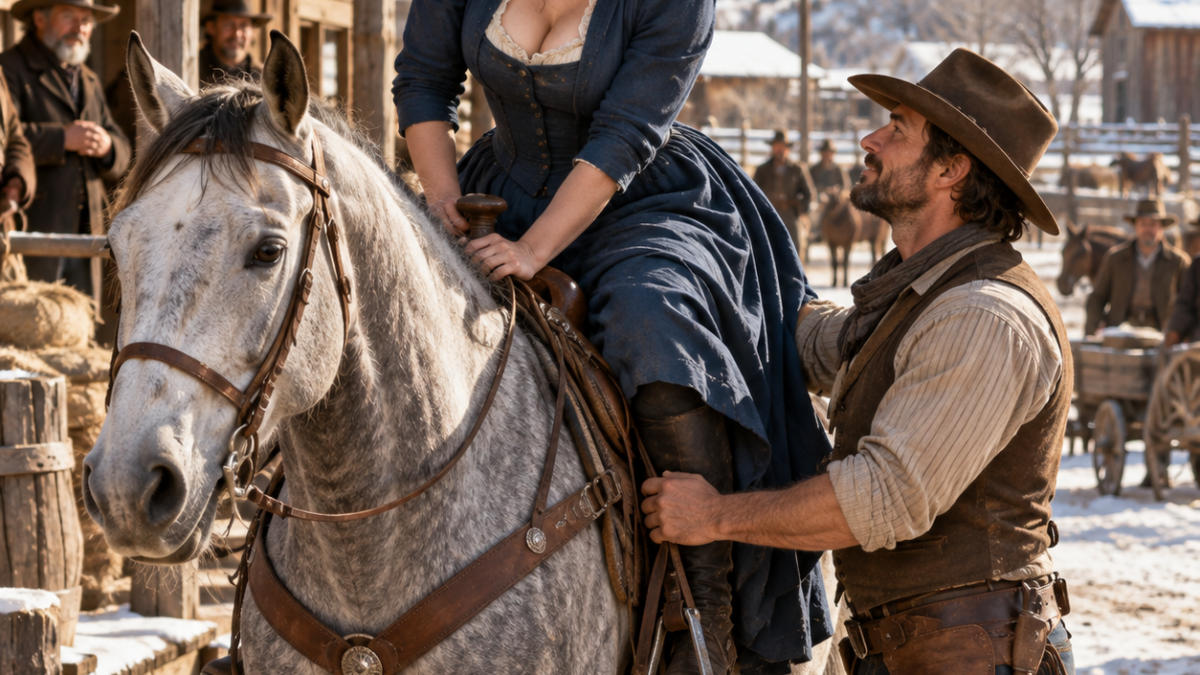
He stood outside with two horses.
His own bay.
And a large gray mare.
Beautiful.
Deep chest.
Strong back.
Sixteen hands.
I knew horses.
Immediately.
“What is this?”
“I want to show you north pasture.”
“Why?”
“Frost.”
I stared.
“Frost.”
“You’ll understand.”
Then I looked at mare again.
Cole noticed.
“Silver.”
“She’s McCreedy’s?”
“Yes.”
“Why bring her?”
“For you.”
Something inside me recoiled before I could stop it.
Three years earlier, I had gone to Harmon’s livery because Papa needed a delivery made beyond town.
My usual borrowed wagon was unavailable.
I asked for saddle horse.
One of the younger men—Bill’s cousin, not Bill—looked me up and down.
Then looked at the horses.
He laughed.
Not viciously.
That almost made it worse.
“Miss Calloway, I don’t think we’ve got one big enough.”
Four men heard.
One joked:
“Need a draft horse.”
Everybody laughed.
I smiled.
Because that is what women do when humiliation arrives dressed as humor.
I told them never mind.
Walked away.
I had not ridden since.
Not because I could not.
Because every saddle afterward reminded me of laughter.
Cole knew.
Of course Red Bluff told stories.
“You heard.”
“Yes.”
I looked at Silver.
“She is big.”
“Sixteen hands.”
“That’s more than enough.”
“I know.”
“You checked?”
“I checked her back.”
“Saddle?”
“Adjusted this morning.”
I stared.
He had thought about it.
Not to rescue me from my body.
To fit equipment to it.
Cole touched saddle horn.
“Just sit down.”
I looked at him.
“And let me show you.”
“Show me what?”
“That nothing was wrong with you.”
My throat tightened.
“The horse was wrong size.”
Simple.
Obvious.
Devastating.
I looked at Silver.
The mare looked back calmly.
No judgment.
No town.
No laughter.
Just an animal built for carrying weight.
I put one boot in stirrup.
Paused.
Cole said nothing.
That mattered.
I swung up.
Silver barely shifted.
Solid.
Balanced.
Correct.
I sat.
And something happened inside me that I had not expected.
Relief.
I had spent three years pretending I did not miss riding.
That was easier than admitting one humiliating afternoon had taken something from me.
Silver took one step.
Then another.
My body remembered immediately.
Hands.
Seat.
Balance.
I looked down at Cole.
He smiled.
Not triumph.
Not:
See what I did for you.
Just satisfaction.
“Well?”
I smiled so hard my cheeks hurt.
“She fits.”
“She does.”
He mounted his bay.
We rode north.
The pasture was worth seeing.
Frost coated grass.
Low winter sun turned every blade silver-gold.
Creek edges frozen.
Center moving dark between them.
The whole field looked transformed without becoming anything other than itself.
That felt important.
We stopped near fence.
“You were right.”
Cole nodded.
“I usually am about what’s worth seeing.”
“Arrogance is not attractive.”
“Fortunately, I’m only trying to attract one person.”
I looked at him.
“How’s that going?”
He turned his horse toward me.
“You tell me.”
I looked out at frost.
“Better than expected.”
“Low expectations?”
“When you entered store, I expected another man who would eventually decide I was too much.”
“Maggie.”
His voice changed.
I looked.
“I’ve been looking for someone who was enough for twelve years.”
My heart stopped.
Cole continued:
“Every place I worked, every town, every woman I met…”
He shook his head.
“Nothing wrong with any of them.”
“Then?”
“I never had reason to stay.”
I swallowed.
“And now?”
“You are the first person I have ever met who feels like enough.”
I looked away because tears embarrassed me.
He waited.
“Maggie.”
“Yes?”
“The town got it backwards.”
I laughed weakly.
“You’ve said.”
“I’m saying again.”
He dismounted.
I watched.
Then he stepped beside Silver.
Looked up at me.
“You are not too tall.”
“Convenient from down there.”
He smiled.
“Not too loud.”
“Questionable.”
“Not too capable.”
“Impossible.”
“Not too opinionated.”
“That one is simply false.”
He laughed.
Then:
“You are enough.”
Everything in me went quiet.
The thing I had felt missing during late nights in the feed store.
The thing I could sense but never name.
Not a husband.
Not rescue.
Not permission.
Someone who did not love me in spite of the space I occupied.
Someone who loved that I occupied it fully.
“Cole.”
“Yes?”
“Ask me.”
He froze.
“You sure?”
“Do not ruin this.”
He reached into coat.
I almost laughed.
“You brought a ring?”
“I was hoping.”
“That’s confidence.”
“Hope is not confidence.”
Fair.
He held it.
“Maggie Calloway.”
“Yes.”
“Will you marry me?”
“Yes.”
No speech.
No suspense.
I knew.
The way people know certain truths when they finally hear them spoken in the right voice.
Yes.
Cole exhaled like a man who had been holding his breath since Kansas.
“That’s it?”
“You wanted difficulty?”
“No.”
“Good.”
He put ring on my finger.
Then I looked down.
“Cole.”
“Yes?”
“I am still taller than you when I’m on this horse.”
He laughed.
“Hopeless woman.”
“Too much?”
His face became serious.
“Never.”
We married in February.
Simple.
That was mutual.
I had no interest in decorative misery.
Cole had no patience for elaborate ceremonies.
Between us, we achieved a wedding where the important thing happened and nearly everything unnecessary did not.
Red Bluff attended anyway.
Of course.
Mrs. Porto baked cake.
Bill Harmon stood near back.
Papa sat front row.
When I came down the aisle, I looked at him.
My father was crying openly.
No attempt to hide.
He had spent years hearing what people said about me.
Rarely argued publicly.
He knew I did not need defending.
But later he told me:
“I worried.”
“About what?”
“That eventually you would believe them.”
I looked at him.
“Did you?”
“Never.”
“Then why worry?”
“Because hearing something enough can make it sound like your own voice.”
That may have been the wisest thing Papa ever said.
Cole and I stood before the preacher.
He looked at me.
I looked at him.
No one asked me to obey.
I had reviewed the wording beforehand.
The preacher had objected.
I had persisted.
Cole stayed wisely silent.
Marriage began exactly as courtship had.
With clear terms.
I kept the feed store.
That also surprised people.
One woman asked:
“You’re still going to work?”
“Yes.”
“After marriage?”
“Yes.”
“Why?”
“Because I own it.”
She seemed dissatisfied.
Cole remained McCreedy foreman.
Eventually I handled portions of McCreedy accounts too because their bookkeeping offended me.
Competence expands into available space.
Cole claimed I was slowly conquering Texas using ledgers.
I did not deny it.
Silver became part of my life.
Every Saturday morning if weather allowed.
Cole and I rode.
Sometimes north pasture.
Sometimes river.
Sometimes nowhere.
The first few months, people stared when I rode through town.
Tall woman.
Large mare.
Then they stopped.
That is how social change often happens.
Not through public apology.
Through repetition.
Something shocking becomes familiar.
Familiar becomes ordinary.
Eventually nobody remembers why it was strange.
Red Bluff revised its opinion of me without admitting revision.
I stopped hearing “too much.”
Started hearing:
“Maggie’s exactly right for Cole.”
I disliked that almost as much.
I had always been exactly right.
Cole did not fix me.
He noticed.
Important difference.
One evening, I said so.
We had been married six months.
Sitting outside our small house near McCreedy ranch.
I still spent days at store.
Papa had retired fully by then.
Cole repaired a bridle.
I worked accounts.
I said:
“Something bothers me.”
He looked up.
“That list is long.”
“About people.”
“Also long.”
“They say I changed.”
Cole waited.
“That marriage softened me.”
His mouth tightened.
“Do you feel softer?”
“No.”
“You still threatened a supplier last Tuesday.”
“He deserved it.”
“Then seems evidence is weak.”
I smiled.
“But you know what they mean.”
“Yes.”
“They think you made me easier.”
Cole set bridle aside.
“Maggie.”
“What?”
“I didn’t marry you because I wanted easy.”
“I know.”
“Do you?”
“Yes.”
He studied me.
Then:
“You laugh more.”
I paused.
“That isn’t softer.”
“No.”
“You ride again.”
“Yes.”
“You leave store earlier sometimes.”
“Sometimes.”
“You let me carry sacks occasionally.”
“When you’re already standing there.”
“Generous.”
He smiled.
“You’re not less.”
Then his voice softened.
“You’re just not doing everything alone anymore.”
That sentence changed something in me.
Because for years, independence had become defense.
If I could do everything myself, nobody could use help to control me.
Cole never did.
If he lifted a sack, it was not because I could not.
If I handled accounts, it was not because he was incapable.
We divided work according to sense, not pride.
That was freedom too.
A year into marriage, Papa died.
Quietly.
Chair near stove.
He had been tired all week.
One afternoon, I went upstairs with soup.
Found him sleeping.
He was not.
Grief made me useless in a way I hated.
I could run store.
Plan funeral.
Settle estate.
Count inventory.
But at night, I could not stop crying.
Cole never said:
Be strong.
Thank God.
People told me that constantly.
“You’re strong, Maggie.”
As if strength were a debt.
As if capable women should grieve efficiently.
Cole sat beside me.
Sometimes held me.
Sometimes did nothing.
One night I said:
“I don’t know how to do this.”
He answered:
“You don’t have to know.”
“I have to open store tomorrow.”
“No.”
“Yes.”
“No.”
I stared.
“The store doesn’t disappear if you close one day.”
“Customers—”
“Can feed cattle ahead.”
“Cole.”
“You buried your father yesterday.”
I hated his logic because it was sound.
He continued:
“You are allowed to be too much grief too.”
I stared.
Then cried harder.
That was Cole.
He took the phrase the town used to diminish me and kept returning it as permission.
Too much laughter?
Good.
Too much opinion?
Good.
Too much grief?
Let it come.
Too much love?
He never complained.
Years passed.
We had two children.
A daughter first.
Eleanor.
Tall from birth, or so Cole claimed.
I warned him not to start.
A son three years later.
James.
Eleanor inherited my height and Cole’s quiet eyes.
By twelve, she was already taller than most girls.
One afternoon she came home angry.
“What happened?”
“Nothing.”
That meant something.
Cole was outside.
I sat her at kitchen table.
“Tell me.”
A boy at school had called her giant.
Another laughed.
Teacher told her to ignore it.
Eleanor stared at hands.
“Am I too big?”
The question reached backward through twenty years.
I wanted to say no immediately.
But I remembered how adults had answered me.
With reassurance that still accepted the premise.
No, you aren’t too tall.
As though if I were, it might be shameful.
So I asked:
“Too big for what?”
She frowned.
“What?”
“For chair?”
“No.”
“For house?”
“No.”
“For horse?”
“No.”
“Then?”
“For… people.”
I leaned closer.
“People do not come in correct sizes for other people’s comfort.”
She looked up.
“Some will think you are too much.”
“That’s bad.”
“No.”
“It means they have told you something useful about themselves.”
She thought.
Cole entered.
Caught last sentence.
“What happened?”
Eleanor told him.
He listened.
Then said:
“Want to ride Silver’s daughter?”
Our old mare was retired by then.
Her foal, Storm, nearly full-grown.
I looked at him.
“That is your solution?”
“Worked once.”
I laughed.
Eleanor did too.
That was enough.
We rode.
Years later Eleanor would say that afternoon mattered.
Not because horse solved cruelty.
Because nobody asked her to shrink before giving her a larger saddle.
That became family rule.
Right saddle.
Right chair.
Right work.
Right people.
Do not shrink person to fit wrong thing.
Change the thing.
Cole eventually bought into McCreedy operation.
Then later, after old Mr. McCreedy died and his sons wanted to sell, we purchased part of ranch.
Not alone.
Loans.
Years.
Risk.
My feed store secured some credit.
Cole nearly refused.
“You built that.”
“And?”
“I won’t risk your business.”
“Our business.”
“Maggie.”
I looked at him.
“Sit down.”
He stared.
“What?”
“And let me show you.”
He laughed so hard he had to sit.
I laid out accounts.
Projected cattle yields.
Feed costs.
Debt schedule.
Land value.
Risks.
Not romantic.
Marriage at fifteen years often looks like arithmetic.
After an hour, Cole leaned back.
“You planned all this.”
“For months.”
“Without telling me?”
“I wanted accurate numbers first.”
“You terrify me.”
“Good.”
We bought land.
Prospered slowly.
Not magically.
Drought came.
Prices crashed.
One winter killed calves.
Another year was excellent.
Life.
Eleanor married a schoolteacher from San Antonio.
Six feet two.
Everybody in Red Bluff considered this cosmically satisfying.
I did not care about his height.
I cared that when she spoke, he listened.
That was enough.
James never married.
He loved horses more reliably than people.
Fine.
Papa’s feed store expanded.
We added hardware.
Then seed.
Then a small office where I trained two young women in bookkeeping.
One was sixteen and told me her father said women did not need accounts.
I handed her Chicago manual.
Same title I ordered decades earlier.
“Learn anyway.”
She did.
Eventually she opened a business in Fort Worth.
Sent me a letter.
Mrs. Bridger,
You once told me competence is not something to hide just because it embarrasses somebody.
I never forgot.
I had said that?
Sounded like me.
I kept the letter.
Cole grew gray.
So did I.
He still stared.
At sixty, I caught him watching me from barn door while I argued with a supplier.
“What?”
“Admiring.”
“Still using that terrible line?”
“It worked once.”
“No, Silver worked.”
He smiled.
“You married me.”
“Temporary lapse.”
“Forty years?”
“Long lapse.”
Our marriage was not perfect.
We fought.
Sometimes badly.
I once threw a ledger at him.
Missed intentionally.
He claims otherwise.
He once left during an argument and rode three miles before realizing that was exactly the kind of silent withdrawal he had promised never to use.
He came back.
That mattered.
“I needed air.”
“You could say that.”
“I know.”
“Then say it.”
“I need air.”
“Go.”
“Now?”
“Yes.”
“I just came back.”
I almost laughed.
We learned.
That is all long love is in some ways.
Learning the same person repeatedly as time changes them.
Cole at thirty-five wanted somewhere to stop.
Cole at forty-five wanted land.
At fifty-five wanted children safe.
At sixty-five wanted knees that worked.
At seventy wanted mornings with me.
I changed too.
Maggie at twenty-eight believed needing anyone was danger.
At forty, I knew dependence could be chosen and negotiated.
At fifty, I learned accepting help was not surrender.
At sixty, I learned strength sometimes looked like admitting exhaustion before falling.
At seventy, I needed Cole to button the back of my dresses because my shoulder stiffened.
First time, I hated it.
He said:
“Too independent?”
I glared.
“Do not.”
He buttoned dress.
No triumph.
That was why I let him.
Silver lived until twenty-seven.
We buried her near north pasture.
I cried almost as much as when Papa died.
Cole did too.
“She was the right size,” I whispered.
He squeezed my hand.
“Yes.”
Afterward we stood beside grave.
I thought of that December morning.
Three years without riding.
Humiliation.
Then one man who did not tell me I should accept less.
He found the proper horse.
That was his gift.
Not changing me.
Adjusting the world where he could.
Cole died before I did.
Heart.
Seventy-six.
Morning.
He had complained of indigestion.
Then sat down.
Then gone.
Too fast.
Our children arrived that evening.
I sat beside his body before undertaker came.
His hands.
Older.
Still scarred.
The first thing I noticed when he entered the store.
I held them.
Said:
“You were enough.”
I don’t know why.
Maybe because that was what he gave me first.
Not beauty.
Not admiration.
Enough.
He had spent his life telling me the town’s measurement was wrong.
At end, that was what I wanted him to hear.
After funeral, people came.
Food.
Stories.
Red Bluff had changed enormously.
Railroads.
New buildings.
Old names gone.
Still a small town at heart.
One elderly woman, daughter of someone who knew me young, said:
“Mr. Bridger always knew how to handle you.”
I was eighty.
Grieving.
Not patient.
I looked at her.
“He never handled me.”
She blinked.
I continued:
“That was the entire point.”
She apologized.
I softened.
People repeat phrases without examining them.
I knew that better than most.
Cole never handled me.
Never tamed me.
Never made me less.
He simply met me at full size.
That is rarer than love songs admit.
I remained at ranch several years.
Then moved closer to Eleanor.
The feed store stayed in family hands.
Calloway on sign.
I insisted.
Not because marriage meant less.
Because I had existed before it.
Cole understood.
He never once asked me to change sign.
People later told our story as though a cowboy had finally found a way to “manage” the difficult Calloway woman.
Wrong.
Others told it as though Cole rescued me from spinsterhood.
Also wrong.
I was not waiting helplessly.
I had store.
Father.
Work.
Friends.
A life.
There was simply one room inside me no one had entered.
The room where I wanted to be seen without first being reduced.
Cole walked in because he did not bring measuring tape.
That is all.
When people called me too much, he did not say:
No, you aren’t.
He said:
Maybe they are not enough.
There is enormous difference.
One asks a woman to prove she is within acceptable limits.
The other questions limits themselves.
That changed me.
Not into a different woman.
Into a less defended one.
I laughed louder.
Not softer.
Loved more openly.
Accepted help occasionally.
Rode horses again.
Taught daughters.
Built businesses.
Argued.
Grieved.
Became old.
Nothing about me became less.
Life simply became large enough to fit me.
That is what love should do.
Not shrink.
Fit.
I still remember the first morning with Silver more clearly than wedding.
Cold.
Gray mare breathing mist.
Cole standing beside her.
I could feel every joke from livery three years earlier.
Every comment about my body.
Every suggestion that a woman should take up less room.
I looked at the mare.
Large.
Steady.
Built properly.
Cole did not say:
Don’t be afraid.
He knew I hated being told what I felt.
He did not say:
Trust me.
Trust is not commanded.
He simply said:
“Sit down and let me show you.”
Then let the horse prove it.
Nothing wrong with Maggie Calloway.
Wrong horse.
Wrong saddle.
Wrong men.
Wrong measurement.
That lesson lasted the rest of my life.
When Eleanor was thirty and worried she was “difficult” because she disagreed with her husband, I told her:
“Wrong saddle.”
She laughed.
“What?”
“Ask whether problem is really you.”
Sometimes it was.
Let’s be clear.
I was wrong plenty.
Strong women can be wrong.
That is equality too.
But never assume your size is problem simply because somebody built a smaller box.
That became my philosophy.
Not elegant.
Useful.
One granddaughter inherited my height.
At fourteen, six feet already.
She came to visit.
Stood beside me.
I was bent by then.
She said:
“Grandma, Mama says you were taller than everyone.”
“Almost.”
“Did you hate it?”
I thought.
“Sometimes.”
“Do you hate it now?”
“No.”
“Why?”
“Because I stopped asking the wrong people whether I fit.”
She looked confused.
Good.
Some lessons need living.
I took her to old tack room.
Cole’s saddle still there.
Silver’s bridle too.
I showed photograph.
Me on Silver.
Cole beside.
Granddaughter stared.
“You look happy.”
“I was.”
“Grandpa looks short.”
I laughed until I coughed.
“Yes.”
Then told her whole story.
At end she asked:
“Did Grandpa really say everyone else was too little?”
“Something like that.”
“That’s kind of rude.”
“Very.”
“I like him.”
“So did I.”
When I was nearing ninety, I went back to north pasture one final time.
Eleanor took me by wagon.
Winter again.
Frost.
Creek moving between ice.
Different fences.
Different cattle.
Same land.
We stopped where Cole proposed.
I could not mount horse anymore.
That hurt.
But memory rode for me.
I saw Silver.
Gray.
Steady.
Cole.
Thirty-five.
Amber eyes.
The man who had spent twelve years moving until he entered a feed store and found a reason to stop.
Eleanor asked:
“You okay?”
“Yes.”
“Cold?”
“Yes.”
“Want to go?”
“Not yet.”
We stayed.
Frost glittered.
I thought of Red Bluff’s original verdict.
Too much for any man.
How small it seemed after a lifetime.
Communities are often confident about futures they will never have to live.
I had.
They were wrong.
Not because I found a rare extraordinary man capable of enduring me.
I hate that interpretation.
Cole did not endure me.
He enjoyed me.
Difference.
He enjoyed my arguments.
Not every one.
Nobody is saint.
But enough.
He laughed when I laughed.
Asked what I thought.
Trusted my books.
Let me carry what I could.
Carried what I could not.
Let me do same for him.
He never needed me small to feel large.
That was his strength.
And I never needed him weak to prove mine.
That was ours.
If I could speak to the twenty-eight-year-old woman behind Calloway Feed counter one day before Cole entered, I would not tell her:
A man is coming.
That makes life sound like waiting for romance.
She wasn’t.
I would tell her:
Do not believe them.
Not even secretly.
Do not let repetition become your inner voice.
Do not mistake being difficult to dominate for being difficult to love.
Do not confuse being strong with being unworthy of gentleness.
And when a man finally appears who does not ask you to bend so he can stand straighter, pay attention.
Not because you need him.
Because recognition is rare.
Then Wednesday comes.
Eight o’clock.
Door opens.
Cowboy enters.
I lift grain sack.
He watches.
Does not interfere.
“Morning.”
“Morning.”
Everything begins quietly.
No thunder.
No music.
Ledger.
Feed quantities.
Payment terms.
Eyes meeting.
Then next day he returns for nothing.
Then again.
Then river.
Then truth.
Then Silver.
“Sit down and let me show you.”
A lifetime hiding inside one sentence.
Let me show you.
Not:
Let me change you.
Not:
Let me save you.
Not:
Let me make you smaller.
Let me show you.
Show you that the horse can fit.
The saddle can fit.
The life can fit.
The man can fit.
You do not have to cut pieces off yourself first.
That was Cole Bridger’s greatest gift to me.
And if Red Bluff learned anything from us, I hope it was this:
When a woman is called too much, the question should not always be how to make her less.
Sometimes the wiser question is whether the world around her has simply been asking her to fit into something too small.
I spent twenty-eight years being measured against rooms built for somebody else.
Then a cowboy brought me the right horse.
And for the first time, I understood.
I had never been too much.
I had simply been waiting for a life big enough to let me sit tall.


