**“Back Row, Sergeant. I Don’t Carry Passengers.” Thirty Soldiers Laughed—Then the Gray-Haired Master Sergeant Turned Around, Saw Her Face, and Said, “You Need to Check Her File.”**
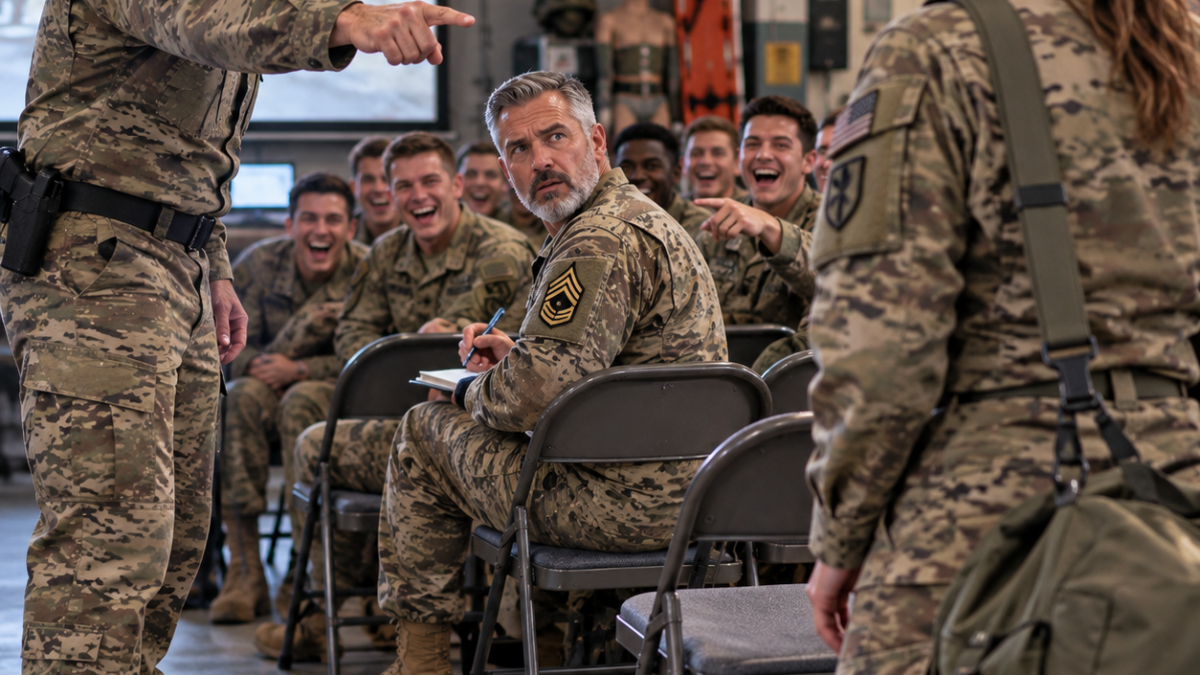
“Back Row, Sergeant. I Don’t Carry Passengers.” Thirty Soldiers Laughed—Then the Gray-Haired Master Sergeant Turned Around, Saw Her Face, and Said, “You Need to Check Her File.”
Sergeant First Class Cole Danner looked at my age, my current MOS, and the gray beginning at my temples, then sent me to the back wall in front of thirty soldiers because, as he put it, he didn’t “carry passengers.”
I planned to finish the course, collect my recertification, and never think about him again—until a gray-haired master sergeant in the front row turned around, saw my face, and went pale because fifteen years earlier he had known me under a very different job title.
By lunchtime, Danner would discover that the quiet forty-three-year-old truck driver he had called dead weight had once spent seven years hanging beneath medevac helicopters over Afghanistan—and the hardest truth exposed that day would not be what he had failed to see in me, but what I had spent twelve years refusing to see in myself.
Sergeant First Class Cole Danner read the roster like he was sorting equipment before a mission.
“Ramirez, twenty-two, combat engineer. Front row.”
A chair scraped across concrete.
“Patel, twenty-four, signal. Second row.”
Another chair moved.
“Reeves, nineteen, engineer. Front row. Good. Young legs.”
The converted maintenance bay at Fort Bliss smelled like motor oil, canvas, burnt coffee, and the fine West Texas dust that found its way beneath every closed door on post.
Thirty soldiers had gathered for combat lifesaver recertification during the sixth day of mobilization.
The room had three rows of folding chairs facing a slightly crooked projector screen.
Two orange rescue litters leaned against the far wall beside a training mannequin whose helmet had been repaired with silver duct tape.
A dented metal cart held the projector.
Someone had written CHECK YOUR SIX on the side with black marker.
I had been standing near the entrance for nearly ten minutes with my duffel hanging from one shoulder when Danner finally reached my name.
“Natalie Mercer.”
“Here, Sergeant.”
His eyes moved down the clipboard.
“Forty-three.”
I waited.
He looked at me, then back at the sheet.
“Eighty-eight Mike.”
“Correct.”
“Motor transport operator.”
“Yes.”
“National Guard.”
“Yes.”
Danner smiled.
That smile bothered me more than open contempt would have.
There was no hostility in it.
No cruelty he expected anyone to challenge.
Just the calm satisfaction of a man who believed he had correctly solved a simple problem.
He pointed toward the back wall.
“Back row, Sergeant Mercer. I don’t carry passengers.”
Thirty soldiers heard him.
Most laughed.
PART2:
Some because they thought it was funny.
Some because Danner was the instructor.
A few because relief is its own kind of laughter when someone else becomes the target.
My driver, Specialist Daniel Tran, was sitting in the front row.
He immediately looked over his shoulder at me.
His expression was halfway between apology and outrage.
Staff Sergeant Kesha Brooks, one of my squad leaders, twisted around from the third row.
I gave her the smallest shake of my head.
Leave it.
I picked up my bag.
Walked to the chair against the back wall.
Sat.
Danner made a note on his clipboard.
“Dead weight belongs in the back. Nothing personal. Battlefield math.”
A few people laughed again.
I placed my duffel between my boots and rested both hands flat on my knees.
Danner continued.
Names.
Ages.
Jobs.
Seats.
By the time the projector came on, the room had settled.
The laughter faded the way laughter usually does when the person being laughed at refuses to feed it.
For several minutes, I almost convinced myself it had been nothing.
Almost.
The problem was that Danner was good.
A bad instructor would have been easy to dismiss.
He wasn’t.
His voice carried cleanly.
His demonstrations were sharp.
He understood the lifesaving sequence.
He knew the material without staring at slides.
That made him more dangerous.
Competent people sometimes make the mistake of assuming competence in one area makes their instincts reliable everywhere.
Danner clicked to the first slide.
“Out there, you’re going to make decisions fast.”
He walked slowly in front of the screen.
“You don’t get biographies.”
He pointed at the class.
“You don’t get twenty minutes to understand somebody.”
“You see what’s in front of you.”
“You decide who can work.”
“You decide who needs work.”
“And you move.”
That was when the master sergeant in the front row turned around.
I had not paid much attention to him.
Broad shoulders.
Engineer patch.
Late thirties or early forties.
Gray beginning at both temples.
Notebook open across one knee.
Pen in his right hand.
He looked over his shoulder.
Saw me.
Stopped writing.
The pen froze halfway through a sentence.
Something happened to his face.
The muscles went still first.
Then the color seemed to drain from underneath his skin.
He turned farther until his entire body was angled toward me.
Danner snapped his fingers.
“Master Sergeant.”
The man did not move.
“Eyes front.”
Still nothing.
“Master Sergeant Holloway?”
The name meant nothing for perhaps half a second.
Then he spoke.
“Sergeant.”
His eyes remained on mine.
“You should check her file.”
Danner gave a short laugh.
“I read her file.”
He glanced toward me.
“She drives trucks.”
A few soldiers laughed again.
Less confidently.
Master Sergeant Marcus Holloway held my gaze for one more second.
Then turned around.
He placed his pen beside his notebook with extraordinary care.
Like it might explode if he dropped it.
My hands began shaking.
I pressed them harder against my knees.
Nobody else could have understood why his face frightened me.
Fifteen years had changed him.
Weight along the jaw.
Gray hair.
Lines around the eyes.
But memory does strange things with faces you once studied from eight inches away while they were bleeding beneath you.
It strips away age.
Pulls the old face through the new one until both exist at the same time.
Danner advanced the slide.
MASSIVE HEMORRHAGE.
Someone in row two yawned.
The class moved on.
For everyone else, nothing had happened.
For me, Fort Bliss vanished for half a second.
I saw vineyards.
Mud walls.
Brown mountains.
Rotor wash.
Blood.
I pressed my thumbnail into the side of my finger.
Hard enough to hurt.
Fort Bliss.
Texas.
Not Afghanistan.
Not Arghandab.
Not August.
At 0820, Tran dragged his chair into the back row beside me after asking Danner if he could sit with his platoon sergeant.
Danner allowed it.
Tran lowered his voice.
“That was messed up.”
“Take notes.”
“You want me to say something?”
“No.”
“He doesn’t know anything about you.”
I looked at him.
“Exactly.”
Tran frowned.
Then obeyed.
His handwriting looked like an EKG during cardiac arrest.
When he wrote MASSIVE HEMORRHAGE, he underlined it twice.
At 0840, Danner clicked to a photograph of a helicopter hovering over rough ground.
My throat tightened before I could stop it.
“Hoist casualty packaging,” he said. “Most of you won’t do this yourselves. But somebody may need to prepare a casualty for aircraft evacuation. Do it wrong and you make somebody else’s day much worse.”
I looked down at the concrete.
One oil stain curved across the floor in a long dark line.
My brain turned it into a river.
I knew which one.
Across the room, Holloway had stopped writing.
Every few minutes his head shifted slightly, like he was resisting the urge to look back.
Danner noticed.
“Master Sergeant Holloway.”
“I’m here.”
“Stay here.”
Holloway’s jaw tightened.
Danner continued explaining the litter straps.
Then he got one detail wrong.
Not catastrophically wrong.
Not enough to matter in a maintenance bay with a mannequin and a stopwatch.
But under a hovering helicopter, with dust filling your mouth and someone shooting from the far side of a mud wall, it could cost ten or eleven seconds.
I knew because once I had counted every one of them.
I said nothing.
That was what I did now.
I knew things.
I let other people teach them.
At 1000, Danner called a break.
Chairs scraped.
Coffee poured.
Phones appeared.
Tran stepped outside to call someone.
Brooks started toward me, saw my expression, and changed direction.
I stayed seated.
Holloway stood.
Ignored the coffee.
Walked down the wall.
Stopped beside me.
For several seconds, neither of us spoke.
Then he said quietly:
“Arghandab.”
My throat closed.
“August.”
“I know.”
His hand tightened around the back of the chair in front of me.
“I looked for you.”
Fifteen years disappeared.
August 18, 2009 began hot enough to make breathing feel expensive.
I was twenty-eight.
Staff sergeant.
68 Whiskey.
Flight medic.
Our medevac detachment had been operating from a forward site outside Kandahar.
By early afternoon, my uniform was soaked through.
At 1423 the call came.
Urgent surgical.
Engineer unit.
Blast injury.
Arghandab River Valley.
The valley from the air looked wrong for Afghanistan.
Green.
Vineyards.
Narrow fields.
Trees following water.
Then brown mountains beyond everything.
The mud walls dividing those fields turned the valley into a maze.
They also made landing difficult.
Chief Warrant Officer Evan Rourke brought our aircraft into a hover above a narrow opening while gunfire cracked somewhere west of the pickup.
“You get thirty seconds when your boots hit.”
His Georgia accent never changed.
Not when the aircraft shook.
Not when rounds cracked.
Not when people screamed.
“After thirty, I’m bringing you up with him or without him.”
“With him.”
The crew chief clipped me into the hoist.
Tapped my shoulder.
I swung my legs out.
There is a moment when you leave an aircraft and your body understands before your brain does that nothing is beneath you.
Then the cable took my weight.
Rotor wash is not wind.
It is pressure with dirt inside it.
It goes into your sleeves.
Your mouth.
Around your goggles.
Under your collar.
The noise is so complete you stop hearing it as sound.
It becomes something physical inside your bones.
I landed between rows of grapevines.
Four engineers were crouched beside a young soldier near a wall.
Tourniquet high on the thigh.
Blood still everywhere.
The injury sat higher than the tourniquet could fully control.
He was conscious.
Sunburned.
Terrified.
Staring directly at me.
His name tape read:
HOLLOWAY.
I dropped beside him.
“Medic.”
“I know.”
“You know your name?”
“Marcus.”
“Good.”
“What happened?”
“Bomb.”
“That is unhelpfully broad.”
He almost smiled.
I cut more fabric.
Found the wound.
The tourniquet had bought time.
Not enough.
I packed deep.
Hard.
There is no clean version of wound packing.
No graceful one.
No dramatic speech.
You put gauze where the blood is coming from.
Then more.
Then more.
You use pressure until your forearms shake.
Holloway yelled.
“I know.”
“Jesus!”
“I know.”
“That hurts!”
“That means you’re still available for complaints.”
One of his soldiers laughed despite everything.
I kept pressure.
“Stay with me.”
“I’m trying.”
“You’re doing fine.”
“I don’t feel fine.”
“Your standards are too high.”
He gave one laugh that turned into a groan.
The aircraft hovered overhead.
Our crew chief shouted through radio.
We moved Holloway onto litter.
I clipped him.
Clipped myself.
Kept pressure.
Then the cable lifted us.
The vineyard dropped beneath my boots.
We spun slowly.
Holloway stared upward.
He was losing blood.
Consciousness was becoming work.
Inside the aircraft, I knelt beside him.
The flight to Kandahar took nineteen minutes.
He talked through most of them because I made him.
“Tell me something.”
“About what?”
“Anything.”
“Where are you from?”
“Ohio.”
“Bad answer.”
“What?”
“I asked for something interesting.”
He smiled weakly.
“Where are you from?”
“Midland.”
“Texas?”
“Unfortunately.”
“What’s there?”
“Oil.”
“Dust.”
“People pretending Odessa is worse.”
He laughed.
Then winced.
I leaned harder into the wound as the helicopter banked.
“Tell me something else.”
“The sunsets are ugly.”
“That’s terrible.”
“You haven’t seen enough West Texas sunsets.”
He looked at me.
“I’m going to?”
I knew better than to promise.
Medical training teaches that quickly.
Never promise a casualty an outcome you do not control.
So I said:
“You’ll have to check for yourself.”
He stared.
“Deal.”
At Kandahar, the surgical team ran toward us before the aircraft had fully settled.
A nurse put her hands over mine.
“I have pressure.”
I did not let go.
“Sergeant.”
“I’ve got him.”
My fingers stayed where they were.
“Let go.”
I didn’t.
She looked directly at me.
“Let go.”
The third time, I did.
Holloway vanished through the hospital doors.
I stood in rotor wash with blood from wrist to elbow.
Rourke handed me a bottle of water.
I poured it over my arm.
The water ran pink.
Holloway lived.
I learned that two days later.
I never visited.
At the time, I told myself we were busy.
We were.
We flew four urgent missions that week.
But that wasn’t the real reason.
I had begun learning as little as possible about patients after they left the aircraft.
The dead accumulated faster than I could carry them.
Two months later, a letter appeared in my box.
The envelope read:
TO THE FEMALE FLIGHT MEDIC
DUSTOFF
ARGHANDAB
AUGUST 18
Someone had attached a yellow sticky note.
THIS YOU?
I recognized Holloway’s large slanted handwriting.
I never opened it.
I put the envelope into an old boot box.
It followed me home.
Moved between four houses.
Fifteen years.
Still sealed.
At Fort Bliss, Holloway stood beside my chair.
“I wrote for months.”
“I know.”
His head turned sharply.
“You know?”
“The emails reached an old account.”
“You never answered.”
“No.”
“I contacted the medevac association.”
“I described you to anybody who might know.”
“Brown hair.”
“Texas.”
“Woman.”
“Insulted sunsets.”
That almost made me smile.
“I asked them not to give my information out.”
His expression softened.
“I figured.”
Around us, soldiers moved through the break.
Nobody paid much attention yet.
Danner stood near the projector with coffee.
Holloway lowered his voice.
“I tell my soldiers about you.”
I looked up.
“What?”
“Every time some nineteen-year-old thinks fear means he doesn’t belong.”
“Every time somebody thinks they can’t finish another mile.”
“I tell them about the medic who kept pressure on my wound for nineteen minutes while she looked just as scared as I felt.”
“I wasn’t—”
“You were.”
I stopped.
He smiled.
“That’s why I remember.”
I looked at the training tourniquet on the table beside me.
Holloway followed my eyes.
Then:
“Why are you sitting back here?”
The answer came before I could protect it.
“It’s where I was put.”
Something changed in Marcus’s expression.
He straightened.
Walked back toward the front.
For one second I thought the conversation was over.
Then he folded his chair.
The metal legs snapped together.
Heads turned.
Holloway lifted the chair.
Walked down the aisle.
Passed the first row.
Second.
Third.
Reached the back.
Opened it beside mine.
Sat.
Danner looked up.
“Master Sergeant.”
Holloway opened his notebook.
“Sergeant?”
“Your seat is in front.”
“I’m good.”
“That’s the back row.”
“I know.”
Danner laughed as though he had missed the joke.
“Your knees need room.”
“They’re fine.”
I leaned toward Holloway.
“Don’t.”
He kept his eyes on the notebook.
“Don’t what?”
“Do this for me.”
“I’m not.”
“Then why?”
He wrote one line.
Then said:
“Correcting where I chose to sit.”
That sentence hurt because I understood it.
Danner had not truly put me in the back row that morning.
He had merely found me there.
The first time I moved myself backward happened six months after Arghandab.
Different mission.
Different province.
Night hoist.
Zabul.
The terrain was too uneven for a safe landing.
Dust hung over everything.
Sergeant Lena Ortiz clipped me into cable.
Chief Warrant Officer Silas Kerr held the aircraft above the ridge.
I had the casualty packaged.
We were halfway back inside when the world disappeared.
Brownout.
No horizon.
No ground reference.
The helicopter drifted.
A skid struck rock.
After that, I remember fragments.
Metal folding.
Ortiz screaming.
My body thrown sideways.
A violent strike across my back.
Then silence.
The aircraft lay on its side.
Stars were visible through what had become the upper doorway.
The casualty was still clipped to me.
My right wrist pointed in the wrong direction.
Ortiz crawled closer.
“Natalie.”
“Your arm.”
“Get his feet.”
“Your wrist is broken.”
“Lena.”
“Get his feet.”
We moved the casualty first.
Everybody survived.
Patient.
Pilots.
Crew.
Me.
That became the sentence people repeated afterward.
Everybody lived.
True sentences can still hide things.
I fractured a vertebra.
Broke the wrist in two places.
Surgery.
Plates.
Months of rehabilitation.
Six months grounded became twelve.
Then permanent.
The flight surgeon sat with me.
Careful.
Kind.
Honest.
“You can stay in the Army.”
“You can run.”
“Lift within profile.”
“Deploy.”
“But another hard landing could cause significant spinal injury.”
“If it fails during a mission, you become a second casualty.”
That decision was fair.
What happened afterward was more complicated.
Major Peter Halbrook called me into his office.
Medical profile on desk.
He was not cruel.
That mattered.
Cruel people are easy to reject.
He was practical.
Organized.
Career-minded.
“Staff Sergeant Mercer.”
“Yes, sir.”
“I can’t put a liability on an aircraft.”
The word entered me deeper than he could have known.
Liability.
“I understand.”
“We’ll move you to medical supply.”
“Yes, sir.”
“You’re still part of the mission.”
“Yes, sir.”
The supply cage was at the rear of the hangar.
Chain link.
Shelves.
Batteries.
Dressings.
Tourniquets.
Aid bags.
From my desk, I could watch crews run toward aircraft when the alert sounded.
Then watch them return hours later.
Dust.
Sweat.
Sometimes blood.
New flight medics walked past me on their way to training.
Nobody said:
That woman has performed more than two hundred operational hoists.
Ask her questions.
They asked for batteries.
Chest seals.
Gauze.
Forms.
I became the person who checked boxes and made people sign.
One afternoon I was counting training tourniquets.
I wrapped one around my arm without thinking.
Muscle memory.
When I reached for the windlass, my right hand shook.
Barely.
Most people would not have noticed.
I did.
I heard Halbrook.
Liability.
I put the tourniquet down.
Something inside me went down with it.
I stopped practicing.
When I later left active duty and joined the Guard, I changed jobs.
Transportation.
88 Mike.
Trucks were honest.
Mechanical.
Predictable.
Fuel loads.
Tire pressure.
Engine temperature.
Routes.
Convoy intervals.
I became good at it.
Very good.
I learned my soldiers.
Their spouses.
Their kids.
Who sent money home.
Who lied about sleep.
Who needed to be told to eat.
Who needed one quiet minute before a hard conversation.
I never mentioned flight medicine.
When somebody got hurt during training, I called the medic.
Held flashlights.
Stepped aside.
Nobody kept me behind that chain-link cage.
I stayed there.
Back at Fort Bliss, Holloway sat beside me.
Then one of his engineers stood.
Staff Sergeant Lonnie Price.
He folded his chair.
Carried it back.
Sat beside Holloway.
Danner paused.
Continued teaching.
Three minutes later, another engineer moved.
Then another.
By 1015 every soldier from Holloway’s section had relocated.
There wasn’t enough room along the wall.
A second improvised row formed.
Then Brooks stood.
She knew nothing about Afghanistan.
Nothing about the crash.
Nothing about the letter.
She only knew me.
Kesha folded her chair.
Walked back.
Sat.
I stared at her.
Her face said:
You can yell later.
Tran moved next.
Then the rest of my platoon.
Eleven soldiers carried their chairs away from the front.
I had not told them to.
I never would have.
But they chose.
Two signal specialists followed because they trusted somebody who had already moved.
Then Ramirez.
Then Reeves.
By eleven o’clock, three pristine rows sat empty near the projector.
Everybody else was crowded into four uneven rows along the back.
Some sat on the floor.
Danner finally lowered the remote.
“What exactly is going on?”
Nobody answered.
Thirty-person silence has weight.
He looked at Holloway.
Holloway wrote.
He looked at me.
I looked at my hands.
Brooks finally spoke.
“Check her file, Sergeant.”
Danner’s jaw tightened.
“All of it.”
I closed my eyes.
“Kesha.”
“You can be mad later.”
Danner checked his watch.
“Lunch.”
“Back at thirteen hundred.”
“Outdoor litter lane.”
People stood.
The room emptied slowly.
I stayed.
Old habit.
If I waited, I didn’t have to answer people in hallways.
Danner walked to the instructor tablet.
Typed.
I should have left.
Instead I watched.
His face changed.
Primary specialty:
88M.
Prior specialty:
68W.
Additional qualification:
Flight Medic.
Assignments.
Medevac.
Combat deployments.
Awards.
His mouth tightened.
Distinguished Flying Cross.
Air Medal with Valor.
Combat Medical Badge.
Then a line from an old evaluation.
211 OPERATIONAL HOISTS.
Danner scrolled up.
Then down.
Then up again.
Read it twice.
He leaned back.
Placed both hands flat on the table.
For one second, he looked exactly like I had that morning.
Still.
Careful.
Trying not to reveal what his body was doing.
I left.
At lunch, the story got worse because stories always get cleaner as they travel.
“She saved Holloway.”
“She flew medevac.”
“Afghanistan.”
“Hero.”
I wanted to correct everybody.
I had not saved Marcus alone.
His soldiers put on the first tourniquet.
Pilots held the hover.
Crew chief ran the cable.
Surgical team repaired what I only temporarily controlled.
Clean stories are usually less true.
At 1258, Danner came onto the outdoor litter lane.
Thirty soldiers stood under a white Texas sun.
The gravel reflected heat through our boots.
Command Sergeant Major Denise Carver stood near the building.
I had never met her.
Someone had called.
Danner carried the orange litter.
He stopped in front of me.
“Sergeant Mercer.”
“Sergeant.”
He held out the rolled litter.
“I teach hoist packaging from a slide.”
I waited.
“I’ve practiced it on this mannequin hundreds of times.”
Still I said nothing.
“I’ve never packaged a real casualty under a hovering aircraft.”
He extended the litter.
“Will you teach it?”
The question struck somewhere I had armored.
Part of me wanted to embarrass him.
He had embarrassed me.
He had spent the morning sorting human beings by age and usefulness.
His own system had collapsed publicly.
I could have made him feel small.
But revenge and repair are not the same thing.
“No.”
Several soldiers shifted.
Danner lowered his hands.
I said:
“I’m not a medic anymore.”
He did not argue.
“I drive trucks.”
“You were right about that.”
Danner looked at me.
“I was right about your current MOS.”
“That’s the one I have.”
He nodded.
Turned away.
Then Tran spoke.
“Sergeant Mercer.”
I looked.
“Please.”
He pointed to the litter.
“If something happens on a convoy overseas, he won’t be there.”
He nodded toward Danner.
“You will.”
“We will.”
“Daniel.”
“I don’t want to know this from a slide.”
My right hand started shaking.
I curled the fingers.
Tran saw.
So did I.
For twelve years, that tremor had been evidence in a private trial.
Liability.
Passenger.
Dead weight.
Then a new thought arrived.
Not courage.
Not revelation.
Annoyance.
So what?
My hand shook.
So what?
I held it out.
“Give me the litter.”
Danner walked back.
Placed it in my hands.
The gravel burned through my knees when I knelt.
My hand trembled until the moment I snapped the litter open.
Then the tremor disappeared inside the work.
“Tran.”
“Head.”
He moved.
“Brooks, hips.”
“Price, legs.”
Staff Sergeant Price stepped in.
“Nothing moves until the person controlling the head calls it.”
“If you remember nothing else, remember that.”
Tran placed his hands at the mannequin’s helmet.
“Ready.”
“On three.”
We rolled.
I slid the litter underneath.
Aligned.
Began the straps.
“Chest first.”
Danner watched.
“Not the feet?”
“That’s what your slide says.”
His face changed.
“It’s not dangerous,” I told him.
“It’s slower.”
“How much?”
“About eleven seconds if everything goes wrong.”
The class went still.
“Eleven seconds does not matter here.”
“Nobody is shooting.”
“The helicopter isn’t burning fuel above a grape field.”
“This mannequin won’t die if we restart.”
I tightened the chest strap.
“Real casualties don’t give resets.”
I attached the lifting harness.
My fingers followed a sequence they had not touched in years.
Tagline.
Anchor.
Check.
Tension.
Angle.
Danner crouched.
“Why there?”
“So the casualty doesn’t rotate toward the aircraft during ascent.”
I showed him.
“Attach opposite and you can still control it.”
“But then you’re fighting the geometry.”
Danner took a pen from behind his ear.
Wrote that down.
That mattered.
“Time?”
“Three forty-two.”
I stood.
My right hand trembled again.
This time everyone saw.
I did not hide it.
Carver’s eyes moved to my hand.
Then to Danner.
Then she walked away.
That frightened him more than shouting would have.
“Again.”
I thought he meant me.
He pointed at the class.
“Pair up.”
“Do it the way Sergeant Mercer showed you.”
For the next three hours, I taught.
Not because Danner ordered me.
Because once I started, I remembered what knowledge feels like when it has somewhere to go.
Ramirez rushed the straps.
I slowed him down.
“Fast and wrong is wrong faster.”
He grinned.
Then got it right.
Private Angela Rios understood the harness before two NCOs beside her.
Tran asked everything.
“What if he’s unconscious?”
“What if you can’t flatten the litter?”
“What if there are two casualties?”
“What if we don’t have this system?”
I answered.
Danner ran the stopwatch.
Sometimes he added something.
Sometimes I corrected him.
Once he corrected me.
That mattered too.
If the afternoon had turned into a ceremony about how secretly impressive I was, I would have hated every second.
Instead, it became training.
Danner was still good at his job.
I was rusty.
Thirty soldiers watched two experienced people stop protecting their pride long enough to make everybody better.
At 1630, Danner signed the day’s certification cards.
When mine reached him, he signed.
Paused.
Looked up.
“Tomorrow.”
“Yes, Sergeant.”
No apology.
I was relieved.
I didn’t want a public performance.
If he had learned something, I wanted to see it when nobody rewarded him.
Carver caught me outside.
“Sergeant Mercer.”
“Command Sergeant Major.”
“How long were you flight medic?”
“Seven years.”
“How long transportation?”
“Ten.”
She studied me.
“Why did my instructor know none of that?”
“Because he didn’t need to.”
One eyebrow rose.
“For the course,” I clarified. “He needed to teach combat lifesaver. He didn’t need my biography.”
“But the seating?”
“No.”
“Why?”
I looked back into the maintenance bay.
Empty chairs.
Front.
Back.
“Because triage tells you what somebody needs right now.”
“It doesn’t tell you what they’re worth.”
Carver nodded slowly.
“That sentence may end up in a briefing.”
“I’d rather my name didn’t.”
“That can be arranged.”
She glanced toward Danner.
“This is bigger than him.”
I waited.
“We’ve got instructors using humiliation like it’s pressure training.”
“Front rows for the fast people.”
“Public pushups for low scores.”
“Nicknames.”
“Most sounds harmless until somebody mistakes humiliation for instruction.”
“That’s not my call.”
“No.”
She looked back at the chairs.
“But his mistake gave me a useful problem.”
That night I sat on my bunk staring at my phone.
For almost fifteen minutes.
Then I called Mrs. Evelyn Park.
My seventy-six-year-old neighbor back in Midland.
“Natalie?”
“You overseas already?”
“Not yet.”
“You sound strange.”
“I need a favor.”
“That sounds worse.”
I told her where to look.
Hall closet.
Top shelf.
Brown boot box.
Masking tape.
KANDAHAR.
She found it.
“I have it.”
My mouth went dry.
“There should be an envelope.”
Paper rustled.
“Yes.”
“Take a picture of the front.”
A minute later it appeared.
TO THE FEMALE FLIGHT MEDIC.
My hand shook.
“Evelyn?”
“Yes?”
“Open it.”
Mrs. Park opened Marcus Holloway’s letter fifteen years after he mailed it.
Three pages.
Large handwriting.
Slanted.
Impatient.
I zoomed in.
To the flight medic,
I still don’t know your name.
I know you’re from Texas and you said Midland sunsets are ugly. I saw one from my hospital window in Germany three days after they flew me out. It was gray and orange and honestly pretty bad. I thought about you the whole time.
I stopped reading.
The barracks continued around me.
Laughter near the showers.
Boots crossing the floor.
A zipper opening.
I started again.
Marcus wrote about his mother crying when he called.
His younger brother pretending not to.
A surgeon telling him the wound packing had probably bought the time needed to reach surgery.
He wrote that someone told him the medic was a woman.
He found that funny because half his platoon had spent deployment arguing women could not handle “real Army work.”
Near the bottom:
I’m going to be a sergeant someday.
If I get soldiers of my own, I’m going to tell them about you.
They don’t need your name.
I just need you to know somebody will remember.
I sat until the screen dimmed.
For fifteen years, I had told myself I left that letter sealed because humility mattered.
That wasn’t humility.
It was punishment.
I had decided gratitude belonged to the woman I had been before the crash.
The medic.
The one whose hand did not shake.
Because I believed she was gone, I denied both of us the letter.
At 2140, I bought two terrible coffees from a vending machine.
Brooks somehow knew which barracks housed Holloway’s battalion.
Of course she did.
Marcus was sitting outside under a security light.
I handed him one cup.
“I opened it.”
He stared.
“When?”
“Forty minutes ago.”
He laughed.
A huge sudden laugh.
Then wiped his eyes.
“I’m sorry.”
“For what?”
“Not answering.”
“You were busy.”
“No.”
He waited.
“I didn’t think I deserved it.”
He frowned.
“I did my job.”
“Sometimes it worked.”
“Sometimes it didn’t.”
“The people it didn’t work on couldn’t write letters.”
“Reading yours felt unfair.”
Marcus stared at me.
“That makes absolutely no sense.”
“I know.”
“Do you?”
“About forty percent.”
He smiled.
Then I told him about the crash.
Halbrook.
The supply cage.
The shaking hand.
I had never told the entire sequence to anyone.
“When I saw my hand shake, I thought it proved he was right.”
“So I stopped doing anything that might prove him right again.”
Holloway turned his coffee cup slowly.
“You know what I tell soldiers about you?”
“You told me.”
“No.”
“That was the short version.”
I looked over.
“I tell them you were scared.”
I felt irritation before anything else.
“I was working.”
“You were terrified.”
“You were bleeding out.”
“I had eyes.”
I laughed.
He continued:
“Your face was scared.”
“Your hands weren’t.”
I looked at my right hand.
It was shaking slightly.
“I’ve been sitting in that back row for years.”
Marcus nodded.
“Danner didn’t put me there.”
“No.”
“He just pointed out the chair.”
“Pretty much.”
I took a drink.
The coffee was terrible.
Marcus leaned back.
“Well, you’ve been very committed to being dead weight.”
I laughed hard enough to hurt.
We stayed on that curb until almost 2300.
Then talked about ordinary things.
His wife.
My daughter.
His kids.
Truck maintenance.
Bad coffee.
Important conversations need somewhere ordinary to land.
The next morning, Danner’s classroom had changed.
No rows.
Thirty chairs formed a large uneven circle around the mannequin.
Danner stood near the projector.
“Sit wherever.”
Nobody moved at first.
Then Holloway sat.
Everyone followed.
For four hours, Danner taught without assigning a nickname.
Without reading anyone’s age.
Without sorting anybody by presumed usefulness.
A nineteen-year-old private answered one question wrong.
I watched Danner almost make a joke.
The reflex arrived.
Then he stopped.
“Walk me through how you got there.”
The private explained.
Danner found the misunderstanding.
Corrected it.
Nobody laughed.
That afternoon, Carver suspended subjective seating exercises across the training battalion pending curriculum review.
Danner’s embarrassment became paperwork.
Paperwork became policy.
The issue turned out to be bigger than one instructor.
There was a culture among some trainers that treated humiliation and stress as interchangeable.
Both could create effort.
Only one reliably created learning.
On day ten, Danner found me in the dining facility.
“Can I sit?”
I pointed.
We ate quietly.
Then he said:
“Triage has been my whole adult life.”
I waited.
“You look at somebody.”
“You decide fast.”
“Who can walk.”
“Who needs immediate help.”
“Who can wait.”
“Who probably won’t make it.”
“That’s the job.”
“I started thinking that made me good at reading people.”
He shook his head.
“Triage works on injuries.”
“Yes.”
“Not identities.”
I looked at him.
He gave a tired laugh.
“Took me seventeen years to figure that out.”
“No.”
He looked up.
“Took you one bad morning.”
That was enough.
We did not need forgiveness ceremony.
We left Fort Bliss before sunrise on day eleven.
Our company waited under floodlights.
Rucks.
Buses.
Jet fuel.
Diesel.
Cold desert air.
Danner found me at 0405.
He handed me folded notebook paper.
“Read it later.”
Then offered his hand.
I shook it.
He walked away.
On the flight, I unfolded the note.
Sergeant Mercer,
I seated thirty soldiers based on what I thought I understood in thirty seconds. I called that assessment.
It wasn’t.
I changed the class.
No assigned seats. No age jokes. No “dead weight.”
The hoist slide is corrected too.
I added a note saying the strap sequence came from an experienced flight medic who reminded me classrooms are not battlefields.
I left your name off.
You don’t have to write back.
—Danner
I read it twice.
Folded it.
Put it in my notebook.
We landed in Kuwait near the end of October.
Our world became diesel.
Sand.
Convoy briefs.
Maintenance forms.
Routes.
Tire pressure.
Truck inspections.
I loved the work.
Trucks did not care who I had been.
During my first week, I visited Captain Emily Shaw.
“I used to be a flight medic.”
“I know.”
I stared.
She shrugged.
“I read your file.”
I almost laughed.
“I want to recertify as a combat lifesaver instructor.”
“What do you need?”
“Training tourniquets.”
“Medical supplies.”
“A mannequin.”
“One hour twice a week.”
She wrote.
“We probably can’t get the mannequin.”
“We’ll use Tran.”
Tran objected strongly when informed.
His objections changed nothing.
We held our first class on the tailgate of Truck Eleven.
The truck leaked two pounds of pressure from the left rear tire every three days despite repeated maintenance tickets.
Soldiers sat on gravel.
I demonstrated a tourniquet.
The first time I put it around my arm, my hand shook.
Everybody saw.
Nobody cared.
That surprised me more than anything.
Brooks sat in front.
“Sergeant Mercer.”
“Yes?”
“Are we being tested?”
“Yes.”
“Prize money?”
“No.”
“I reject the legitimacy of this evaluation.”
“Ten pushups.”
“Abuse of positional authority.”
“Fifteen.”
She grinned.
Private Rios became fastest in the platoon.
Fourteen seconds.
The first time she did it clean, she jumped up and shouted.
“My mom is never going to believe this.”
“Do not tell your mother you’re excited about cutting off circulation.”
She called her mother that night.
By December, medical refreshers were routine.
Then a truck from another company rolled on a curve outside camp.
Nobody died.
But broken glass cut the driver’s forearm badly.
Our convoy arrived first.
Tran was out before my vehicle fully stopped.
I rounded the wreck expecting to take over.
He already had a tourniquet high on the arm.
Windlass tight.
Bleeding controlled.
He looked up.
Not like the kid from Danner’s class.
Like a soldier doing his job.
“Time it, Sergeant.”
“Placed at fourteen-oh-six.”
“Mark it.”
He did.
“Call nine-line.”
He grabbed the radio.
I stood behind him.
For a strange second, I remembered all the years after the crash when I had called for a medic and stepped away.
I told myself that was responsibility.
Sometimes it was.
Sometimes it was hiding.
This time I stayed close.
I did not take over.
I didn’t need to.
Training had done exactly what training is supposed to do.
Someone else’s hands were ready.
That evening, I walked beyond the motor pool.
The sunset was gray.
Orange.
Flat.
Honestly ugly.
I took a photo.
Sent it to Marcus, whose engineer battalion was farther north.
No caption.
He answered:
Ugly.
Then:
Beautiful.
I laughed.
Two weeks later, I finally wrote back to Danner.
I sat outside a maintenance tent with sand blowing across the paper.
I told him his old strap order probably would never have killed anyone.
Then:
But classrooms lie if we let them.
Everything is clean there.
Nobody is shooting.
Nobody is screaming.
You can repeat the drill.
Real life doesn’t repeat.
That is why humility matters more than looking certain.
I paused.
Then wrote the sentence I had needed fifteen years to understand.
You didn’t put me in the back row.
You only found me sitting there.
That does not excuse what you did.
It just means not all that weight belongs to you.
I signed it.
Underneath I added:
Passenger.
Then laughed and mailed it.
Danner replied in January.
Three words.
Circle still there.
I taped the note inside my green convoy notebook.
By then, Carver’s curriculum review had become permanent guidance.
Instructors could still create pressure.
Competition.
Time limits.
Stress.
But they could no longer publicly rank soldiers by age, body type, job, or assumed usefulness.
Danner remained an instructor.
I was glad.
Removing him would have made a cleaner story.
It would also have wasted what he learned.
People sometimes wanted me to call him a bully.
I never saw him that simply.
He had been careless with authority.
Carelessness matters because rank gives ordinary opinions unusual weight.
His mistake embarrassed him.
Then made him better.
That was enough.
My relationship with myself took longer.
The tremor never disappeared.
Some mornings, my right hand still shakes when I hold coffee.
Cold makes it worse.
So does exhaustion.
For years, I treated the movement like a confession.
Now it is simply a hand that shakes.
It also works.
Near the end of deployment, Captain Shaw asked me to run a combat lifesaver refresher for the entire company.
Almost eighty soldiers.
I stood in front holding a training tourniquet.
My wrist trembled.
Nobody laughed.
Maybe somebody stared.
I stopped checking.
I demonstrated.
Then handed the tourniquet to the nearest private.
“Your turn.”
That mattered more than demonstrating it perfectly.
Knowledge held too tightly becomes another kind of hiding.
Marcus and I stayed in touch after deployment.
Not every day.
We did not become inseparable friends because of one dramatic reunion.
Real life is rarely that neat.
Sometimes he sent photographs of bad sunsets.
Sometimes I sent worse ones.
Mrs. Park returned the original letter to my boot box.
Eventually I framed it.
Not my medals.
Not the flight photographs.
The letter.
It hangs in my hallway now.
My name is not on it.
That is part of why I like it.
TO THE FLIGHT MEDIC.
For fifteen years, I believed those words belonged to someone who had died without dying.
The woman who flew hoists.
The woman whose hands did not shake.
The woman before the crash.
I had divided my life into before and after as cleanly as Danner had divided the classroom into front and back.
Useful.
Liability.
Medic.
Driver.
Carrier.
Passenger.
It took a folding chair to show me how ridiculous that was.
A year after Fort Bliss, I attended a training conference in Texas.
Danner was teaching casualty movement.
I stood outside the classroom before he saw me.
Thirty chairs were arranged in a circle.
No front.
No back.
The mannequin lay in the middle.
Danner caught my eye.
He did not announce me.
Did not tell the room about Afghanistan.
Did not read my awards.
He pointed toward an empty chair.
“Room if you want it.”
I sat.
Halfway through, someone asked about hoist packaging.
Danner answered.
Then looked at me.
“Sergeant Mercer.”
“Anything you’d add?”
The old version of me would have said no.
Would have called it professionalism.
Humility.
Knowing my lane.
Sometimes all three were just better-sounding words for hiding.
I leaned forward.
“One thing.”
Thirty faces turned.
My right hand trembled where it rested on my knee.
I let it.
“When you learn casualty care, people will give you sequences.”
“Checklists.”
“Numbers.”
“Rules.”
“Learn them.”
“Practice until your hands can perform them while your brain is scared.”
Nobody moved.
“But don’t confuse being scared with being incapable.”
Danner looked down.
I continued.
“And don’t make that mistake about the person beside you either.”
After class, Danner and I carried equipment toward storage.
He had the mannequin.
I had one orange litter.
“You know,” he said, “that first morning, I really thought I was motivating people.”
“I know.”
“That somehow makes it worse.”
“It makes it common.”
He laughed quietly.
We reached the equipment cage.
He set the mannequin down.
“Did you ever forgive the officer who called you a liability?”
Major Halbrook.
I had spent years blaming him.
Then years blaming myself.
Eventually I realized the division was too simple.
“He made a bad choice of words.”
“I built a house inside them.”
Danner nodded.
“That’s not the same as forgiving him.”
“No.”
I looked toward the parking lot.
“It’s better.”
“How?”
“I don’t need anything from him anymore.”
That was true.
No apology.
No recognition.
No late explanation repairing twelve years.
Halbrook had moved through his career.
So had I.
The difference was that I was finally choosing mine again.
Before leaving Fort Bliss that afternoon, I walked into the old maintenance bay.
It had been renovated.
New lights.
Fresh paint.
Most of the oil stains gone.
I found the wall where the back row had once been.
There was nothing special about it.
Concrete.
For years, I had imagined the distance between front and back as enormous.
Aircraft door to supply cage.
Medic to truck driver.
Useful to useless.
Carrier to passenger.
In reality it had always been a few dozen feet.
The farther distance existed inside me.
I stood there.
Then pulled one folding chair away from the wall.
The metal legs scraped across the floor.
I carried it toward the middle of the room.
My right hand shook on the top rail.
I did not switch hands.
Did not hide it.
Carried the chair anyway.
That is what I wish somebody had told me when I was twenty-nine and counting tourniquets behind a chain-link cage.
Someone may decide you are finished before you are.
A commander.
A boss.
An instructor.
A spouse.
A parent.
Somebody with a clipboard who looks at your age, your job, your injury, your mistake, your silence—and thinks they understand the whole person.
What they say can hurt you.
It can cost years.
It can become a voice you carry long after the person who said it has forgotten.
But there is another danger.
Eventually, you may start doing their work for them.
You may move yourself to the back before anyone asks.
You may leave the letter sealed.
You may stop using the hand because it shakes.
You may call hiding discipline because discipline sounds better.
Marcus Holloway carried one chair across a classroom and sat beside me.
Then his soldiers moved.
Then mine.
Then people who knew nothing about me moved because someone they trusted had moved first.
By lunch, the front rows were empty.
I will always remember that sight.
But the most important chair was not Marcus’s.
Not Brooks’s.
Not Tran’s.
It was the one I finally learned to carry myself.
My hands still shake.
I carry it anyway.





