An 11-Year-Old Tabby Had 13 Minutes Left Before Euthanasia—Then a Stranger Who Drove 160 Miles Through the Night Walked In
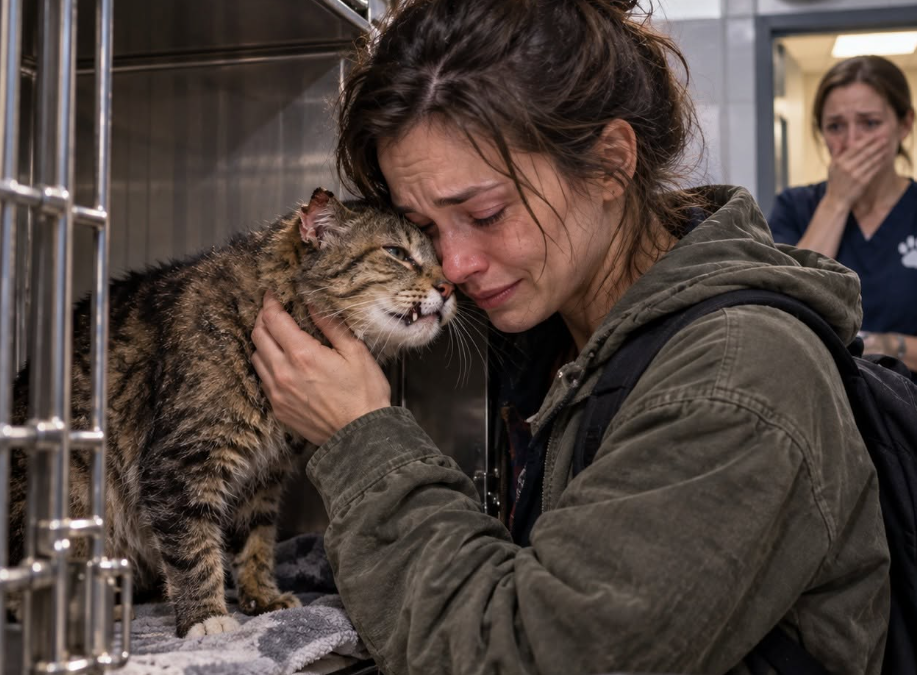
An 11-Year-Old Tabby Had 13 Minutes Left Before Euthanasia—Then a Stranger Who Drove 160 Miles Through the Night Walked In
They were going to euthanize the old brown tabby at exactly six in the morning, and by 5:47 he had already been moved into the back room where two cats scheduled before him were being sedated.
Then a woman wearing yesterday’s clothes and untied sneakers burst through the shelter doors after driving 160 miles through the night, looked through the steel bars at his torn ear, watery eyes, and scarred nose, and said only two words: “That one.”
Nobody understood why she was shaking so badly—because for fourteen days, almost everyone else had walked past cat number 4-2281 without stopping.
I worked mornings at the shelter then.
And I remember him.
Eleven years old.
Brown tabby.
Male.
No collar.
No microchip.
Torn left ear.
White scar across his nose.
Missing canine tooth.
Chronic respiratory problems that left his eyes watery and made him sneeze several times an hour.
He wasn’t aggressive.
He wasn’t feral.
He simply wasn’t the kind of cat people noticed.
The kittens reached through their cages.
The younger cats rolled onto their backs.
Some meowed whenever anyone entered the room.
4-2281 did none of that.
He sat at the back of his kennel with his face turned toward the wall.
People assumed he wanted to be left alone.
So they left him alone.
For fourteen days.
His first seventy-two hours were protected by the legal hold.
After that, he survived almost by accident.
Once because a rescue transport took six kittens and opened several cages.
Once because his paperwork ended up under the wrong stack.
Another morning, an emergency intake forced the euthanasia list to be postponed.
And once, Marcy—a technician who had discovered how completely he relaxed when someone finally picked him up—quietly moved his folder to the bottom of the pile.
Four times, death came close.
Four times, something interrupted it.
The fifth time, there was nowhere left to move his paperwork.
The shelter was full.
Every kennel.
Every isolation cage.
Temporary crates had been placed in rooms never meant to hold animals.
Nursing mothers.
Sick kittens.
Senior dogs surrendered after their owners died.
Puppies under quarantine.
There was nowhere left.
And ugly decisions had to be made by people who hated making them.
So his number went onto the morning list.
4-2281.
Six o’clock.
When I came in before dawn, his cage had already been moved to the euthanasia room.
He didn’t fight.
That almost made it worse.
He sat on the thin blanket with his front paws tucked beneath him.
His eyes were half closed.
Like he had become very good at expecting nothing.
At 5:42, Marcy checked the clock.
At 5:44, she stood outside his cage longer than she needed to.
At 5:45, someone asked if she was ready.
She didn’t answer.
Then, at 5:47, the front door slammed open.
A woman rushed inside.
Maybe mid-forties.
Hair pulled back badly.
Sweatshirt wrinkled.
Sneakers untied.
Eyes red from exhaustion.
“I’m here for the tabby,” she said.
The receptionist frowned.
PART2:
“Which tabby?”
“The old one.”
“We have several—”
“Torn left ear. Scar on his nose. Crooked mouth.”
That got everyone’s attention.
“How do you know him?”
She didn’t answer.
“Please.”
Her voice cracked.
“Where is he?”
Someone told her he had already been moved to the back.
She went white.
“What time?”
“Six.”
The woman looked at the clock.
5:48.
Twelve minutes.
We took her back.
When she reached the euthanasia room, she stopped so suddenly I almost walked into her.
There he was.
Curled against the rear wall of the steel cage.
Number 4-2281.
The cat nobody wanted.
The woman walked closer.
His eyes opened.
For the first time that morning, he lifted his head.
She put both hands over her mouth.
Then she whispered:
“Oh God.”
Marcy looked at her.
“Do you know this cat?”
The woman was already crying.
She lowered herself to the floor in front of his cage.
And the old tabby who had spent fourteen days staring at walls slowly stood up.
One step.
Then another.
Then he came all the way to the bars.
That was when the woman reached into her pocket, pulled out an old photograph, and showed us why she had driven 160 miles through the night for a cat everyone else thought had no one left…


