A Young Marine Laughed at My Call Sign and Grabbed My Flight Jacket—Then Every Commander in the Officers’ Club Stood Up.
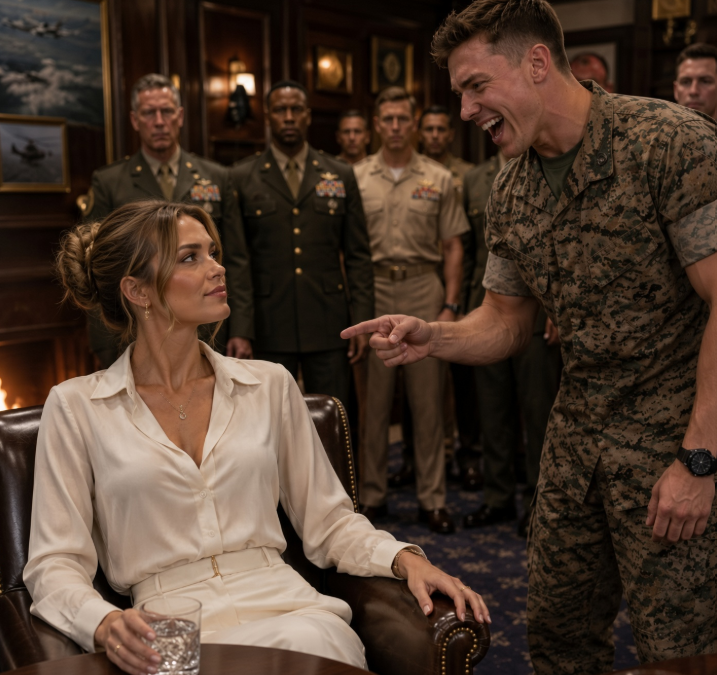
A Young Marine Laughed at My Call Sign and Grabbed My Flight Jacket—Then Every Commander in the Officers’ Club Stood Up.
A young Marine laughed at my call sign in a crowded officers’ club.
Thirty seconds later, a room full of commanders rose to their feet.
And the look on his face told me he finally understood that he had just mocked something far older, darker, and more expensive than the patch lying beneath his hand.
My name is Captain Amelia Brooks.
And this happened on a stormy night at Camp Lejeune.
Rain hammered the tall windows of the officers’ club hard enough to blur the security lights outside.
Wind rolled in from the Atlantic and pushed against the building in long, heavy bursts.
Inside, everything felt warm.
Polished wood.
Brass plaques.
Framed photographs.
Old squadron insignias.
Command portraits.
Memorial displays.
The kind of room where decades of military history had been cleaned, framed, and mounted carefully enough that younger service members could walk past it without understanding how much blood some of those photographs represented.
I sat alone beside the fireplace.
Glass of water in my right hand.
No uniform.
No ribbons.
No medals.
No rank insignia.
Just jeans, a white blouse, and an old black flight jacket hanging over the back of my chair.
I had been at Lejeune for three days.
Officially, meetings.
Unofficially, I was trying to make it through the week without being reminded of something I had spent six years learning how not to discuss.
The jacket was part of the problem.
I almost never wore it.
But that evening the storm had turned colder than expected, and habit had won.
Across the upper shoulder was an old patch.
Black background.
A silver number four.
A python coiled around it.
Underneath were three words.
**NO ONE LEFT BEHIND.**
Most people in the club knew better than to ask.
Some recognized it immediately.
PART2:
Others simply noticed that the older officers became quieter whenever their eyes landed on it.
Lance Corporal Tyler Bennett noticed none of that.
I heard him before I saw him.
“Hey, check this out.”
Young voice.
Too much confidence.
Too much audience.
I kept looking at the fire.
A few Marines stood behind me.
Someone whispered something.
Then Tyler laughed.
“Python Four?”
Pause.
“Seriously?”
His friends did not laugh as quickly as he expected.
That should have warned him.
It didn’t.
“Sounds like a video-game username.”
I took a drink of water.
Then felt someone touch the jacket.
My entire body went still.
Tyler lifted the collar.
“What’d you do?”
PART3:
He laughed again.
“Scare mice in supply?”
Silence.
Not gradual silence.
Instant silence.
The officers’ club simply stopped.
I could hear rain.
Firewood settling.
Ice shifting inside somebody’s glass.
Tyler either did not notice or misunderstood what the silence meant.
I slowly turned.
He was young.
Maybe twenty.
Twenty-one at most.
His hand still rested on my jacket.
His grin was beginning to look uncertain.
I looked at his hand.
Then his face.
“Take your hand off it.”
My voice was quiet.
Tyler smiled again because young men sometimes mistake calmness for weakness right up until the moment they understand what it actually means.
“Or what?”
I looked beyond him.
Retired Colonel Robert Maddox had stopped drinking at the bar.
Three majors near a poker table were staring.
A Navy commander along the far wall had straightened.
Colonel James Mercer was no longer speaking to the officer beside him.
Major General Richard Hayes had turned completely around in his chair.
Nobody looked amused.
Nobody was coming to Tyler’s rescue.
I returned my eyes to him.
“You have five seconds.”
He laughed.
“Seriously?”
“One.”
The Marine beside him shifted.
“Tyler…”
“Two.”
His smile weakened.
“Three.”
“Man, maybe just—”
Tyler yanked his hand away.
The jacket slipped from the chair.
Hit the floor.
The patch landed faceup.
Black python.
Silver four.
NO ONE LEFT BEHIND.
For one long second, nobody moved.
Then a chair scraped behind me.
Major General Richard Hayes stood.
Tyler stared.
Another chair moved.
Colonel Mercer rose.
Then the Navy commander.
Then another senior officer.
Then another.
One by one, men and women throughout that room stood.
Not ceremonially.
Not because anybody ordered them.
They simply stood.
Tyler turned slowly, watching a room full of people with more combat time than he had years in uniform come to their feet because of the jacket he had just dropped onto the floor.
His face emptied of color.
“What’s happening?”
Nobody answered.
He looked at me.
Then the patch.
“What is Python Four?”
The retired colonel at the bar finally spoke.
“Sit down, son.”
Tyler remained frozen.
Maddox’s eyes stayed on the patch.
“You don’t joke about names you haven’t earned the right to understand.”
Then something changed near the back wall.
A man rose from the shadows.
He was not wearing a uniform.
He did not need one.
Some men carry rank on their shoulders.
Others carry it in the way an entire room reorganizes itself when they stand.
His hair had gone almost completely white.
The scar along his jaw was still visible.
And the moment I saw him, six years disappeared.
Lieutenant General Marcus Vale.
The man who had been sitting in a command center thousands of miles away the night Python Four stopped being just another call sign.
Vale looked directly at me.
Then at the jacket.
And said two words.
“Python Four.”
Every remaining person in the club stood.
Tyler Bennett stopped breathing.
So did I.
Because I had not spoken to Marcus Vale in six years.
And I knew immediately that whatever had brought him into that room had nothing to do with coincidence.
Vale walked toward us slowly.
The club remained silent.
Rain struck the windows harder as the wind shifted.
I bent down.
Picked up my jacket myself.
Nobody offered to help.
They understood.
That jacket had been carried through fire.
It had covered blood.
It had belonged to men and women whose names still woke me in the dark.
It was mine to lift.
I brushed dust from the patch.
Draped the jacket over my arm.
Tyler swallowed.
“Ma’am…”
I raised a hand.
“Don’t.”
His mouth closed immediately.
Vale stopped beside him.
His eyes remained on me.
“Captain Brooks.”
“General.”
First time I had said that to him in six years.
Something crossed his face.
Regret.
Memory.
Maybe both.
Then he looked toward Tyler.
“What is your name, Marine?”
Tyler snapped rigid.
“Lance Corporal Tyler Bennett, sir.”
“Unit?”
“Second Combat Logistics Battalion, sir.”
Vale studied him.
“Do they no longer teach history in Second Combat Logistics Battalion?”
Tyler flushed.
“Yes, sir. I mean—no, sir. We do, sir.”
“You put your hand on that jacket.”
“Yes, sir.”
“You mocked the call sign.”
“Yes, sir.”
“You asked what Python Four did.”
Tyler looked physically ill.
“Yes, sir.”
Vale leaned slightly closer.
“Then you’ll listen.”
No one sat.
I could see faces from different periods of my life.
Some had been young captains during Afghanistan.
Some majors.
Some colonels.
Some had worked rescue coordination.
Some had received casualty notifications.
Some had attended funerals.
Some knew only part of the story.
Almost nobody knew all of it.
Vale drew breath.
I knew what came next.
The official version.
The sanitized version.
The one where dead people became numbers and bad decisions became “operational constraints.”
“No.”
Vale turned.
So did everyone else.
I met his eyes.
“If he wants to know Python Four…”
I looked at Tyler.
“…he hears it from me.”
Vale stood completely still.
Then nodded once.
“Your floor, Captain.”
My floor.
Almost funny.
After Night Glass, the military had given me plenty.
Medals.
Commendations.
A promotion I nearly refused.
Physical therapy.
Mandatory counseling.
Statements to investigators.
A dozen people explaining why the decisions made that night had been reasonable.
Nobody had given me ownership of the story.
That had taken six years.
I pointed toward Tyler.
“Sit.”
He obeyed immediately.
His friends sat beside him.
Pale.
Uncomfortable.
I looked around.
“Please.”
The senior officers slowly returned to their seats.
Vale remained standing.
Of course.
I placed my jacket across the back of my chair.
Then stood beside the fire.
“The call sign Python Four belonged to a casualty-evacuation flight element attached to a joint task force in Helmand Province.”
Tyler stared.
“Official mission was medical extraction.”
I took a drink.
“Unofficial mission was simpler.”
I looked at the patch.
“We went where the map was red and somebody was still alive.”
No one moved.
“There were four of us on the final flight.”
I began counting.
“Captain Daniel Cross.”
Pilot.
“Warrant Officer Luis Ortega.”
Co-pilot.
“Staff Sergeant Mina Park.”
Crew chief.
I paused.
“And me.”
Tyler glanced at the patch.
I knew what he was thinking.
“So you were Python Four?”
“Eventually.”
I walked closer to the fireplace.
“The name began during a training exercise.”
Years earlier.
Before Afghanistan.
Before Night Glass.
A Marine had become trapped inside a drainage tunnel after a vehicle rollover.
The access point was too narrow for normal extraction equipment.
I crawled inside.
Mud.
Water.
Almost no room to breathe.
Dragged him backward inch by inch.
Afterward, somebody said:
“Brooks moved through that pipe like a python.”
The nickname followed me.
Eventually it became a flight designation.
Then the team.
Then something else.
I stared into the fire.
“The mission started at 0217.”
The room changed at once.
People who have served in combat understand stories told in exact times.
0217.
Not “around two.”
Not “early morning.”
Because trauma keeps clocks.
“An observation post near Sangin had been hit.”
Pause.
“Not shelled.”
I looked at Tyler.
“Overrun.”
His posture changed.
“Marines.”
“Navy corpsmen.”
“Two interpreters.”
“An intelligence officer.”
“Multiple wounded.”
“The compound was collapsing.”
“Enemy fighters were pressing from three directions.”
“Weather had grounded most aviation.”
“And command believed the position might not survive until sunrise.”
Somewhere behind Tyler, a chair creaked.
“Python Four wasn’t first choice.”
Our aircraft had already been turned back from another mission because a sandstorm closed the route.
We were returning when the distress call came through.
Captain Daniel Cross heard it before dispatch finished relaying details.
I could still hear his voice.
Southern.
Calm.
Almost annoyingly calm.
**Python Four copies. Give us the grid.**
“They told him the risk was unacceptable.”
Cross asked:
“How many wounded?”
At least eleven critical.
Then:
“Give me the grid.”
Vale looked downward.
He remembered.
Of course he did.
He had been one of the people ordering us not to go.
“We flew low.”
Too low.
Visibility nearly zero.
Sand struck the aircraft like gravel.
Cross fought the controls.
Ortega read instruments as if his life depended on every number.
It did.
Mina Park worked the cabin.
Blood bags.
Tourniquets.
Litters.
Weapons.
Equipment.
I stayed near the ramp.
Watching the darkness.
Watching nothing.
Watching everything.
“When we reached the compound, there was no landing zone.”
Tyler frowned.
“No landing zone?”
“No.”
“Then how did you—”
“Captain Cross created one.”
I almost smiled.
It was exactly the kind of thing Daniel Cross did.
The courtyard barely fit the aircraft.
One wall partially collapsed.
Smoke.
Tracer fire.
Burning vehicles.
Cross threaded the helicopter between structures so closely that later photographs showed scrape marks along one side.
We touched down.
Everything exploded into movement.
Marines carried wounded brothers.
Some walking.
Some dragging men by plate carriers.
Some crawling because standing made them targets.
A Navy corpsman named Petty Officer Ellis had shrapnel through his side.
He continued treating other people.
“He refused to board.”
Tyler looked confused.
“Why?”
“His patients.”
I remembered Ellis’s face.
Gray.
Sweating.
Angry at me for trying to move him.
“He told me men were trapped in the east building.”
I said:
“We’re full.”
Ellis answered:
“Then come back.”
I stopped speaking.
Then come back.
Three words.
People imagine dramatic final statements.
Often it is something simple.
A request.
A name.
A promise.
Ellis died arguing with me.
We loaded the final litter.
Lifted.
Took fire.
Made the surgical site.
Unloaded.
Refueled with engines running.
Then command ordered us to stand down.
Cross answered over radio:
“Say again? You’re breaking up.”
Someone in the room gave a sad laugh.
The retired colonel muttered:
“Lying bastard.”
I almost smiled.
“He heard them perfectly.”
Tyler whispered:
“You went back.”
“Yes.”
Second approach.
Worse.
Compound burning.
Visibility poorer.
East building partially collapsed.
We landed.
Park and I went inside.
Six more survivors.
One man trapped beneath a structural beam.
Mina came in beside me.
Could not move it.
Ortega left the aircraft to help.
Together we lifted enough.
Pulled the Marine free.
Then the first RPG hit.
The sound still lived somewhere inside my bones.
Not an explosion the way movies make explosions sound.
A violent metallic concussion.
Pressure.
Light.
Something tearing apart.
The aircraft survived.
Barely.
Tail section damaged.
Hydraulics shredded.
Ortega wounded.
Fire spreading.
Cross kept the rotors turning.
Mina dragged Ortega back toward the aircraft.
I was still inside the east building.
Three people remained with me.
A nineteen-year-old Marine named Caleb Ross.
Another Marine unconscious.
And Farid.
One of the interpreters.
“Caleb couldn’t feel his legs.”
I looked at Tyler.
“He kept apologizing.”
Tyler’s eyes filled slightly.
“For what?”
“For being heavy.”
Nobody spoke.
“He thought he was slowing us down.”
My jaw tightened.
“People apologize for strange things when they think they’re dying.”
I carried the unconscious Marine first.
Ran back.
Caleb next.
Back again.
Farid last.
His hands were burned.
He had been pulling people from fire before we arrived.
Tyler asked:
“Under fire?”
I looked at him.
“No, Lance Corporal.”
Pause.
“Under fireworks.”
His face flushed.
Several older officers looked down.
I continued.
“By the time we got Farid to the aircraft, Cross knew we couldn’t lift everybody.”
Damage.
Weight.
Loss of power.
Wounded.
The math no pilot ever wants to calculate.
Command sent the order.
Destroy sensitive equipment.
Move survivors on foot toward an alternate extraction location.
Tyler stared.
“With litter patients?”
“That was the problem.”
Vale spoke quietly behind us.
“There were too many.”
His voice carried old guilt.
Cross made the decision.
The helicopter would attempt to lift with the most critical casualties.
Mina would go with him.
Ortega was wounded but conscious.
I would remain behind with the rest.
Tyler stared.
“You stayed?”
“I was ordered to.”
“That isn’t—”
He stopped.
“No.”
I nodded.
“It wasn’t fair.”
I looked around at the officers.
“Nothing about that night was.”
Before Cross lifted, Mina climbed down from the aircraft.
My uniform sleeve had burned open.
She took off the black flight jacket she had grabbed from our kit.
Pressed it into my hands.
“Can’t have Python Four freezing after all this.”
She smiled.
I remembered it perfectly.
Too perfectly.
Because Mina knew.
I think we both did.
Something about the aircraft sounded wrong.
The hydraulics.
Cross’s face.
Ortega bleeding beside him.
Maybe we simply understood the odds.
She climbed back aboard.
Cross lifted.
Barely.
Mina fired from the open door until dust swallowed the aircraft.
I watched it disappear.
They made three kilometers.
Then another RPG found them.
The helicopter crashed.
Daniel Cross died.
Luis Ortega died.
Mina Park died.
Four wounded Marines died.
Two survived.
Later, the report said Mina had thrown herself over them before impact.
Tyler lowered his head.
I continued.
“My group had nine.”
Three walking wounded.
Four litter patients.
Farid.
Me.
We moved.
Irrigation ditches.
Broken compounds.
Fields.
Walls.
Anywhere that gave us five seconds of concealment.
Enemy fighters hunted us.
Flashlights before dawn.
Rifles.
Radio calls.
We moved for six hours.
“How?” Tyler whispered.
I looked at him.
“I don’t know.”
And that was true.
Sometimes surviving people tell the story afterward as if every action followed a plan.
It didn’t.
My plan became:
Reach that wall.
Then:
Reach that ditch.
Then:
Get Caleb another hundred yards.
Then:
Stop the bleeding.
Then:
Move.
Then:
Move again.
The sun rose while we were still two kilometers from extraction.
Daylight made us visible.
I believed we were finished.
Then something came through my damaged radio.
Static.
Fragments.
Coordinates.
Voices.
Major Richard Hayes—now sitting fifteen feet from me with two stars on his shoulders—had been a battalion commander.
He kept aviation assets circling outside the weather.
Marcus Vale commanded the task force.
Most people believed Python Four was gone.
Vale did not.
He spoke from behind me.
“I heard you breathing.”
Everyone turned.
Vale was staring at me.
“Your radio was damaged.”
I remembered.
“We heard wind.”
“Static.”
“Breathing.”
He paused.
“Then you said two words.”
My throat tightened.
**Still moving.**
I had forgotten saying them.
Or tried to.
My thumb pressing a damaged transmit switch.
Blood all over my glove.
Caleb asking whether we were getting close.
Farid dragging one side of a litter despite burned hands.
Still moving.
It was not courage.
It was the closest thing I could manage to a lie everybody needed.
Vale’s people guided us from broken transmissions.
One fragment at a time.
New direction.
New ditch.
New landmark.
We kept moving.
But not everyone.
Corporal Henry Voss died on the route.
I carried him farther than I should have.
Everyone knew he was dead before I admitted it.
I finally put him down behind a stone wall.
Closed his eyes.
Continued.
Farid lasted almost to the extraction point.
Three hundred meters.
That close.
His breathing became wrong.
Then worse.
I tried stopping.
He grabbed my sleeve.
“No.”
“Farid—”
“No.”
His English weakened when pain became bad.
He kept asking about his daughter.
I had never met her.
He took something from around his neck.
Small cord.
Small patch.
Python Four.
I had given him one weeks earlier because he liked the design.
He pushed it into my hand.
“Tell her…”
He coughed.
Blood.
“Tell her I was brave.”
I promised.
Farid died before the extraction aircraft arrived.
I carried his patch for years.
The rescue team reached us at 0849.
By then I had two rounds stopped by my vest.
Shrapnel in my leg.
Burns down one arm.
Almost no memory of when I last slept.
The aircraft landed under fire.
They began loading survivors.
Command ordered immediate departure.
Then I saw movement.
Thirty meters east.
Drainage trench.
Someone shouted:
“Hostile!”
I knew it wasn’t.
I still don’t know how.
Movement.
Pattern.
Something.
Maybe instinct is simply experience moving faster than language.
I ran.
Somebody ordered me back.
I kept going.
Rounds struck the dirt.
I reached the trench.
Found a Marine.
Sergeant Evan Cole.
Barely conscious.
One leg badly wounded.
Blood everywhere.
I dragged him.
He was bigger than me.
Heavy gear.
Dead weight.
At some point I fell.
Got up.
Moved again.
The rescue aircraft began lifting power.
I screamed.
They waited.
I got Cole aboard.
Then climbed in after him.
Seven people survived that extraction.
Tyler noticed immediately.
“You saved him.”
“No.”
General Vale answered before I could.
“She did.”
I turned sharply.
“General.”
Vale stepped forward.
“No.”
His voice remained calm.
“They should understand.”
I hated the attention.
Vale looked at Tyler.
“Sergeant Evan Cole is alive today because Captain Brooks refused the final evacuation order.”
Tyler stood.
Too quickly.
Chair almost fell.
“Ma’am.”
His voice shook.
“I’m sorry.”
I looked at him.
He was no longer embarrassed because senior officers were watching.
He was ashamed.
Different.
“I didn’t know.”
“No.”
I nodded.
“You didn’t.”
He flinched.
Then I softened my voice.
“But ignorance isn’t permission.”
“Yes, ma’am.”
“You wear a uniform with history attached to it.”
I picked up the jacket.
“Some of that history is written in books.”
I tapped the patch.
“Some of it is carried by people who don’t talk about it.”
His eyes turned red.
“Some of it is sitting quietly in an officers’ club trying to drink water.”
“Yes, ma’am.”
I studied him.
He was young.
Stupid that night.
Not evil.
There is a difference.
“Apology accepted.”
His shoulders loosened a fraction.
“Lesson pending.”
Confusion.
“Ma’am?”
“Tomorrow.”
I looked at his friends.
“0500.”
All three went rigid.
“Base memorial walk.”
I pointed toward Tyler.
“Full pack.”
Then the others.
“All of you.”
One swallowed.
“Us too, ma’am?”
“You laughed quieter.”
Pause.
“That earns you nothing.”
“Yes, ma’am.”
A few people smiled.
The first release of tension all night.
“Every name connected to Python Four.”
I looked at Tyler.
“You learn them.”
“Yes, ma’am.”
“Cross.”
“Yes, ma’am.”
“Ortega.”
“Yes, ma’am.”
“Park.”
“Yes, ma’am.”
“Ellis.”
“Yes, ma’am.”
“Voss.”
“Yes, ma’am.”
“Farid.”
“Yes, ma’am.”
“And the people they carried.”
Tyler nodded.
“Yes, ma’am.”
The room slowly came alive again.
People sat.
Bartender moved.
Someone ordered whiskey.
Rain continued.
I thought the difficult part was over.
I was wrong.
Vale came beside me near the fireplace.
“You told more than usual.”
“I told enough.”
“No.”
I looked at him.
“You told what was declassified.”
The way he said it made my skin tighten.
“General.”
His eyes moved toward the Python Four patch.
“There is something you need to know.”
“Not tonight.”
“Yes.”
He looked toward me.
“Tonight.”
For six years, Marcus Vale had avoided being alone with me.
Memorial events.
Promotions.
Ceremonies.
He would appear.
Shake my hand.
Say something formal.
Disappear.
There had always been a conversation between us.
Neither of us wanted it.
Now he looked like a man who could no longer postpone it.
“What is this about?”
His answer was one word.
“Farid.”
Everything inside me stopped.
“What about him?”
Vale looked toward the rear exit.
“Walk.”
I should have refused.
Instead, I put on the flight jacket.
Followed him.
The covered porch behind the club opened toward wet grass and distant lights.
Rain blew sideways beyond the roof.
Wind smelled of salt, pine, and electricity.
Vale stood against the railing.
I did not bother waiting.
“You found his daughter.”
His jaw tightened.
“Yes.”
The word hit harder than any part of the story I had told inside.
Six years.
I had searched.
Written.
Asked.
Used every legitimate channel available.
Afghanistan collapsed into chaos.
Families moved.
Records disappeared.
Names changed.
Eventually I was told she could not be found.
“Her name?”
“Layla Rahmani.”
“Where?”
Vale did not answer fast enough.
I stared.
“You told me they couldn’t locate her.”
“I was instructed to tell you that.”
The rain suddenly seemed colder.
“By whom?”
Silence.
“General.”
He looked away.
That was when anger arrived.
Not hot.
Cold.
Precise.
“You knew.”
“I knew she had been located.”
“How long?”
“Not immediately after Night Glass.”
“That wasn’t my question.”
He took the hit.
“Years.”
I stepped away.
“Years.”
“Amelia—”
“I promised a dying man.”
“I know.”
“I promised him I would tell his daughter he was brave.”
“I know.”
“And people above me decided I wasn’t allowed to keep that promise?”
“It was more complicated.”
I laughed.
Nothing humorous in it.
“It always is when somebody wants you to accept a lie.”
Vale’s eyes hardened.
Then softened again.
“Farid was not only an interpreter.”
“I know he worked intelligence support.”
“No.”
He shook his head.
“You do not know.”
I turned fully toward him.
“I was there.”
“You were there for the part they allowed you to survive.”
The sentence struck like a hand across my face.
“Careful.”
He nodded once.
“Fair.”
Thunder rolled offshore.
Vale lowered his voice.
“Farid was carrying intelligence.”
“What kind?”
“Names.”
“Whose?”
“Routes.”
I stared.
“Proof that someone inside our contracted logistics chain was feeding movement information to insurgent groups.”
For a moment I forgot the rain.
“Contractors?”
“Yes.”
“Local?”
Vale said nothing.
My stomach tightened.
“American?”
Silence.
That was the answer.
“Who?”
“The original file disappeared after Night Glass.”
“Convenient.”
“Yes.”
“Cross died.”
“Yes.”
“Ortega.”
“Yes.”
“Mina.”
His eyes changed.
I noticed.
“Farid.”
Vale nodded.
“Marines.”
“Yes.”
“And the evidence disappears.”
“Yes.”
“Who buried it?”
Vale looked out into the darkness.
“I spent six years trying to prove that.”
The anger inside me shifted.
“You?”
“Yes.”
“Why didn’t you tell me?”
“Because after Night Glass you were already a target of internal review.”
“I know.”
“Not that kind.”
I stared.
“What kind?”
Vale chose his words carefully.
“Someone wanted the surviving members of Python Four disconnected from the intelligence Farid carried.”
“Surviving members.”
My chest tightened.
“I was the only one.”
Vale did not answer.
Not immediately.
I caught it.
“Marcus.”
First name.
His eyes moved back to me.
“What aren’t you saying?”
“Someone found new proof.”
“Who?”
“You already know.”
The answer came before he spoke it.
“Layla.”
He reached inside his coat.
Removed a sealed plastic envelope.
Inside was a photograph.
Young woman.
Approximately twenty.
Dark hair.
Serious expression.
Busy street market behind her.
Around her neck hung a cord.
Attached to it—
A black patch.
Silver four.
My knees almost weakened.
I took the photograph.
“She’s alive.”
“Yes.”
“Where?”
Vale hesitated.
“Unknown.”
“What does that mean?”
“As of forty-eight hours ago, we lost contact.”
My head came up.
“Forty-eight hours?”
“She contacted an old embassy channel.”
“From where?”
“We don’t know.”
“Why contact you?”
“She didn’t.”
I looked at the photograph.
“She used a phrase that moved through archived authentication protocols.”
“What phrase?”
Vale’s eyes stayed on mine.
“Your call sign.”
I stopped breathing.
“What did she say?”
He answered exactly.
“Tell Python Four my father’s promise was not buried.”
The rain hammered the porch roof.
Then:
“The connection terminated.”
I stared at Layla’s face.
Farid.
Bleeding against a wall.
Tell her I was brave.
“What promise?”
Vale said:
“We don’t know.”
I looked up.
“You’re lying again.”
“No.”
“You already lied for six years.”
“I withheld information.”
“Do not insult both of us with vocabulary.”
His jaw tightened.
Fair.
“Why tell me tonight?”
That question changed him.
He looked toward the windows.
Inside, officers were talking again.
Tyler and his friends sat quietly near the fireplace.
“Tonight was not random.”
I followed his gaze.
“What?”
“Bennett.”
My stomach tightened.
“What about him?”
“Someone sent him something before he came into the club.”
“What?”
“An anonymous message.”
“What kind?”
“Meme.”
I stared.
Vale almost looked embarrassed saying it.
“Old military call signs.”
“Python Four?”
“Included.”
My blood went cold.
“You’re telling me a twenty-year-old lance corporal mocked my patch because somebody put the idea in his head?”
“Yes.”
“He knew?”
“No.”
That mattered.
“Tyler was bait.”
Vale’s expression hardened.
“He was manipulated.”
“Into touching my jacket?”
“Into creating attention around the call sign.”
I stepped toward him.
“And you knew this before tonight?”
“I suspected.”
“That’s why you were inside.”
“Yes.”
“You were watching him.”
“And you.”
I laughed once.
“So after six years of avoiding me, you suddenly decide I deserve surveillance?”
“Protection.”
“Don’t.”
He stopped.
“Do not call it protection when nobody bothered telling me there was danger.”
He had no answer.
Good.
The rear door opened.
Major General Hayes stepped onto the porch.
He looked at Vale.
Then me.
His right hand hovered near his jacket.
Phone.
“What?”
Vale asked.
Hayes’s face told me before the words did.
“We received a secure message routed through base command.”
“Layla?”
“No.”
He removed the phone.
Held it toward us.
Eight words filled the display.
**PYTHON FOUR WAS NOT THE ONLY SURVIVOR.**
For a moment I heard nothing.
Not rain.
Not wind.
Nothing.
“That’s impossible.”
Neither man spoke.
“I was there.”
My voice sounded wrong.
“I saw the casualties.”
Vale remained still.
“Cross.”
“Yes.”
“Ortega.”
“Yes.”
“Park.”
Silence.
I stopped.
Memory opened.
Not gently.
The crash site had been burning.
Recovery had happened under combat conditions.
Remains.
Reports.
Identification.
Partial remains.
One member of our crew had not been visually identified the way the others had.
The report had relied heavily on location, equipment, biological fragments, assumption.
Mina Park.
I gripped the railing.
“No.”
Vale whispered:
“Amelia.”
“No.”
Hayes stared at the phone.
“There’s an attachment.”
My heart began hammering.
He opened it.
Video.
Dark.
Grainy.
Recent.
A woman sat beneath a hanging bulb.
Hair cut short.
Body thin.
One side of her face heavily scarred.
For a fraction of a second my brain refused recognition.
Then she looked toward the camera.
Those eyes.
I knew those eyes.
I had seen them in green aircraft light.
In sandstorms.
Across coffee cups.
Behind night-vision goggles.
Looking at me from the ramp before missions.
Mina.
I stopped breathing.
“Mina.”
Neither general spoke.
The woman in the video slowly raised one hand.
Between her fingers:
A patch.
Black python.
Silver number four.
My vision blurred.
Six years.
Six years of memorials.
Six years of hearing her name read among the dead.
Six years of remembering her handing me the flight jacket.
Can’t have Python Four freezing to death after all this.
Mina looked directly into the camera.
Her voice came through rough.
Damaged.
But unmistakable.
“Amelia.”
My knees nearly gave way.
“If you’re seeing this…”
She glanced somewhere beyond the camera.
Then back.
“…do not trust Vale.”
The video ended.
Black screen.
Nothing else.
I turned slowly.
Marcus Vale’s face had gone pale.
Not offended.
Not angry.
Afraid.
Inside the officers’ club, people were still moving.
Still talking.
Tyler Bennett stood beside one of the windows.
He could see us through the rain.
He had no idea what was happening.
No idea that thirty minutes earlier he had thought Python Four was a ridiculous nickname.
No idea his stupid joke had triggered a room full of commanders to stand.
No idea someone may have wanted exactly that reaction.
No idea the patch he dropped had just connected six years of graves, classified files, a missing interpreter’s daughter, and a woman the United States military had officially buried.
I looked down at the jacket.
The words seemed different now.
**NO ONE LEFT BEHIND.**
For six years, I believed they described what we had tried to do.
Now they felt like an accusation.
Cross was dead.
Ortega was dead.
Ellis.
Voss.
Farid.
Men I could not bring home.
But Mina Park—
Mina was alive.
Somewhere.
Scarred.
Hidden.
Warning me not to trust the general standing three feet away.
Hayes finally whispered:
“Captain?”
I looked at Vale.
He held my gaze.
“Amelia, there are things you still don’t know.”
I put the photograph of Layla inside my jacket.
Then took the phone from Hayes.
Replayed Mina’s video.
Again.
Her eyes.
Her hand.
The patch.
The warning.
**Do not trust Vale.**
I handed the phone back.
Then looked at the man who had commanded Operation Night Glass.
The man who had heard me breathing through static.
The man who had helped guide seven survivors to extraction.
The man who had allowed me to believe Mina Park had been dead for six years.
“General.”
Vale waited.
“You have thirty seconds.”
His face tightened.
“For what?”
“To tell me why my dead crew chief thinks you’re the enemy.”
Lightning flashed across the wet field.
For one instant, the entire porch turned white.
Vale opened his mouth.
Then stopped.
And that hesitation told me more than any answer could have.
Inside, Tyler Bennett was still watching us through the window.
I almost felt sorry for him.
He thought the worst mistake of his military career had been laughing at an old call sign.
It wasn’t.
His joke had opened a door.
Behind that door was Operation Night Glass.
Farid’s daughter.
A buried intelligence file.
An American logistics network somebody had compromised.
And a woman who should have been dead.
I looked once more at the patch over my heart.
Python Four.
For six years, I had thought the mission ended at 0849 when the extraction aircraft lifted us out.
I understood now how wrong I had been.
Python Four was not finished.
It had only been waiting.



