A Young Lieutenant Ordered Me to Salute Him in Front of 40 Soldiers—Then the Two-Star General Behind Him Went Pale and Said, “Son, You Have Five Seconds.”
A Young Lieutenant Ordered Me to Salute Him in Front of 40 Soldiers—Then the Two-Star General Behind Him Went Pale and Said, “Son, You Have Five Seconds.”
For three weeks, I let a brand-new lieutenant mistake my silence for weakness because I wanted him to learn the regulation, not fear the ribbon on my chest.
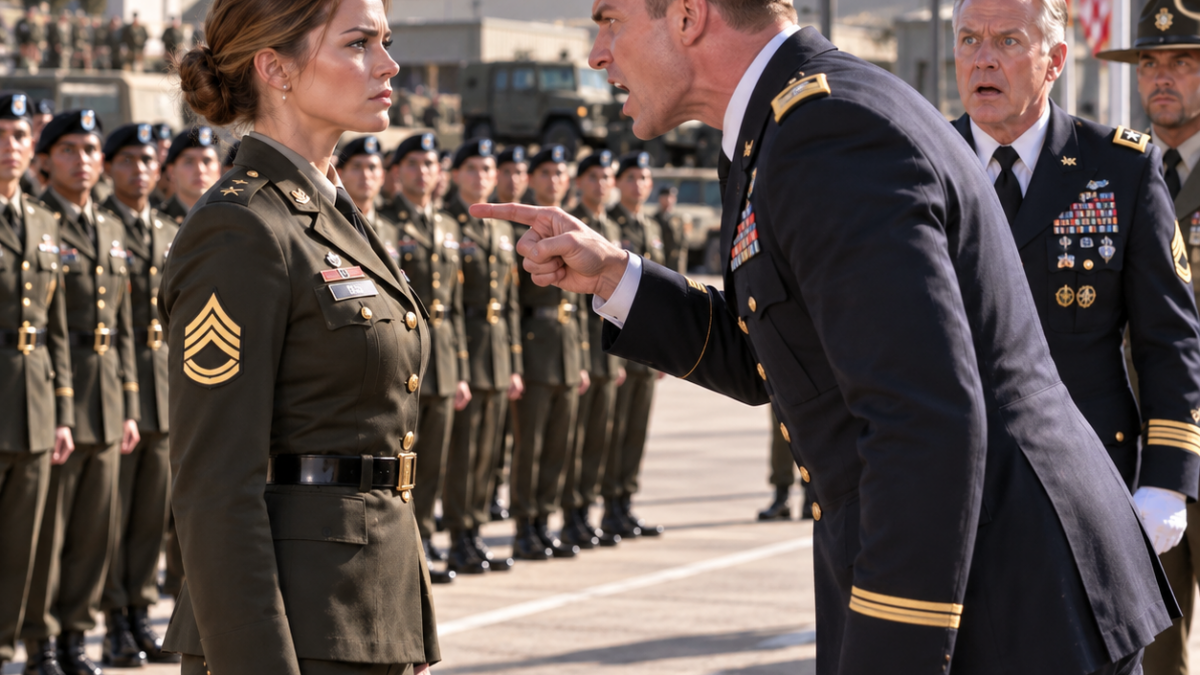
Then he ordered me to salute him in front of forty soldiers while I stood locked in formation, even though every person on that lawn knew I was not supposed to move.
I kept my arm at my side—until the headquarters doors opened, a two-star general saw my face, and the entire post learned why the quiet sergeant had been trying so hard not to be noticed.
At 4:45 on the first Tuesday of September, I stood barefoot in my apartment outside Fort Carson with a ruler in one hand and my ribbon rack in the other.
The room was dark except for the lamp over my ironing board. That little circle of white light made my Army Green Service Uniform look almost ceremonial before the ceremony had even begun. Outside the cracked window, Colorado still smelled like cold pavement, pine, and the first diesel trucks rolling toward post before sunrise.
I measured everything twice.
The distance above the pocket.
The alignment of the backing.
The straightness of every row.
A staff sergeant in Korea had taught me when I was nineteen that “looking straight” was not the same as “being straight,” and fourteen years later, I still heard his voice whenever I built a uniform.
I fastened the last ribbon at the top.
Then I stared at it.
Pale blue.
Thirteen white stars.
Quieter than almost everything beneath it, but heavier than all of them combined.
People called my discomfort modesty.
They were wrong.
Modesty is when you think praise is too much.
What I felt was closer to guilt with polished edges.
In the top drawer of my dresser sat a walnut box with a brass hinge. Inside that box was the medal that belonged to the ribbon, resting beneath a lid I almost never opened. The box was small enough to fit in both hands, but I had organized the entire drawer around avoiding it. Socks on one side. Brown undershirts on the other. Nothing ever placed on top.
I had not worn the medal itself in almost two years.
The ribbon was bad enough.
The medal had weight.
Real weight.
The kind that felt less like metal and more like names.
Sergeant Owen Barrett.
Specialist Noah Keller.
PART2:
I dressed, checked my gig line, tucked my hair, and left before sunrise.
I had arrived at Fort Carson only three weeks earlier after five years teaching combat medicine in San Antonio. The schoolhouse had suited me better than I ever admitted out loud. Students watched my hands instead of my chest. They cared about tourniquets, junctional wounds, airway positioning, casualty cards, pressure points, and whether they would pass their practical exam.
Most nineteen-year-olds were too busy panicking over simulated blood to study an instructor’s ribbon rack.
That anonymity had been a gift.
My assignment manager took it away that spring with one phone call.
“Rachel,” he said, “five years is long enough. You need soldiers again.”
So I came to Colorado as the new platoon sergeant for twenty-two medics.
First Sergeant Calvin Grady had read my personnel file before I arrived. On my first morning, he shut his office door, removed his reading glasses, and studied me the way senior NCOs study problems they are too experienced to poke without thinking.
Grady was forty-four, from East Texas, and moved like a man who had spent two decades learning that haste usually produced paperwork.
“Want me to tell the company?” he asked.
“No, First Sergeant.”
“The commander?”
“The commander needs to know what’s in my file. My platoon doesn’t.”
“They’ll see your rack.”
“Most soldiers see rank first.”
He looked at me as if he knew that answer was technically correct and emotionally dishonest.
Then he put his glasses back on and showed me my desk.
For three weeks, I managed to be mostly ordinary.
Mostly.
Then Second Lieutenant Evan Whitaker arrived.
He and I had reached Fort Carson during the same week. That was almost everything we had in common.
He was twenty-three, four months out of college, tall and sharp-featured, with a haircut so fresh it looked like he still heard his commissioning ceremony every time he passed a mirror. He carried himself with the rigid tension of a man terrified that everyone around him might discover he was new.
New officers are not always dangerous.
Some are humble.
PART3:
Some ask good questions.
Some understand early that rank gives responsibility before it gives wisdom.
Whitaker had not learned that yet.
I first met him over an ambulance dispatch form.
Six of my medics were preparing two field ambulances for range support when Whitaker walked through the motor pool, noticed the vehicles, and picked up our clipboard like a prosecutor discovering evidence.
He tapped the operator-license block with one finger.
“This is wrong.”
I looked at it.
It wasn’t.
“Sir,” I said, “that is the format this motor pool currently uses.”
His expression changed because my medics were listening.
“Standards start with NCOs, Sergeant.”
The sentence had the polished sound of something memorized in a classroom.
“Yes, sir.”
“Fix it.”
“Yes, sir.”
He walked away.
I did not alter the form because there was nothing to alter, and the ambulances dispatched exactly on schedule.
PFC Sofia Vega watched the entire exchange.
Vega was nineteen, from Albuquerque, with thick dark hair that fought every regulation hair net the Army issued and the irritatingly useful habit of thinking before she spoke. During a mass-casualty exercise the previous week, she had gone immediately to the worst casualty mannequin, applied the correct treatment, checked her work, and recorded the time without being prompted.
She was the kind of young medic I wanted beside me when simulations stopped being simulations.
“Sergeant?” she asked after Whitaker left.
“Yes, Vega.”
“Are we fixing the form?”
“No.”
“Because it isn’t wrong?”
“Correct.”
“But he told you to.”
“He told me based on incorrect information.”
“So we just ignore him?”
“No. We comply with the standard.”
She thought about that.
Then nodded.
Vega was going to be a problem in the best possible way.
Two days later, Whitaker found another issue.
My salute.
I encountered him in the battalion parking lot at six paces, saluted, and said, “Good afternoon, sir.”
He returned the salute, took another step, then stopped.
“That was slow, Sergeant.”
I lowered my hand.
“Sir?”
“Your salute. You saw me before six paces.”
I had rendered it exactly as required.
We both knew the argument was not really about distance.
“I’ll work on it, sir.”
That afternoon, he wrote a memorandum saying I had deliberately delayed my salute in a display of disrespect consistent with what he called “resistance to correction.”
Grady called me into his office at 1630 and placed his coffee mug directly on top of the memorandum.
He only did that with documents he disliked but was not permitted to burn.
“One sentence,” he said.
I knew the sentence.
Tell him what the ribbon means.
Tell him what happened before San Antonio.
Tell him to read the part of my record that would make his face change.
Instead, I said, “Then he stops for the wrong reason.”
Grady leaned back.
“Meaning?”
“He’s wrong about the dispatch form. He’s wrong about the salute. If he backs off because of what I’ve got on my chest, then he doesn’t learn that standards matter. He learns that special people get to correct him.”
“That’s a very principled explanation.”
“It happens to also be true.”
“And it saves you from being looked at.”
I said nothing.
Grady tapped the memorandum once.
“I’m not signing it. I’m not forwarding it. It stays here.”
“Thank you, First Sergeant.”
“Don’t thank me. I’m waiting.”
“For what?”
He put his glasses back on.
“To see what you do when hiding stops working.”
That night, I dreamed of Afghanistan for the first time in months.
I woke with my hands clenched so tightly my fingernails had left marks in my palms.
Two names were already moving through my head before I opened my eyes.
Sergeant Owen Barrett.
Specialist Noah Keller.
By Tuesday morning, I still had not said either name aloud.
At 0845, forty soldiers formed on the division lawn beneath a sky so clear the mountains looked close enough to touch.
Wet grass darkened our brown shoes. The flag rope struck the pole in the wind. Chairs for families and guests were stacked off to one side under tarps. The division band sat waiting near the walkway, instruments resting against knees, brass catching sunlight.
Lieutenant Whitaker stood at the front with a clipboard under his arm.
He looked prepared.
For the first twenty minutes, he was.
Then he announced he intended to inspect the formation.
He moved down the first rank, adjusted one soldier’s collar, corrected another’s alignment, reminded someone about hand placement, then entered the third rank and stopped directly in front of me.
His eyes flicked to my face.
Not my ribbons.
My face.
“Good morning, Sergeant.”
I remained at attention.
His jaw tightened.
“I said good morning.”
“Good morning, sir.”
He stepped closer.
“You salute officers first, Sergeant,” he said loudly enough for forty soldiers to hear. “Or did they skip that lesson at your schoolhouse?”
I stared straight ahead.
“Sir,” I said evenly, “I am in formation.”
That should have ended it.
The regulation was basic. Individual soldiers standing in formation do not independently salute an approaching officer. The person in charge renders honors for the formation when appropriate. Nearly everyone on that lawn knew it. Whitaker knew it too, or at least had learned it once.
For half a second, recognition crossed his face.
Then embarrassment replaced it.
That was when he made his mistake.
“Salute me, Sergeant.”
My arm stayed at my side.
His voice hardened.
“Now.”
Someone behind me inhaled sharply.
The specialist on my right stared straight ahead with such concentration a muscle jumped beside his eye. Around us, the formation became so still I could hear a drummer from the band stop tapping his sticks against his knee.
Whitaker shifted slightly, angling his body so the next words carried.
“Or I write you up in front of everyone here.”
I felt no dramatic surge of anger.
Mostly, I felt tired.
That is the thing people rarely understand about public humiliation. Rage is not always first. Sometimes exhaustion arrives before anything else because you realize you have been dragged into a lesson the other person does not yet know he is teaching.
I could obey and teach every junior soldier watching that confidence could override written standards.
I could turn my head slightly and tell him what the pale blue ribbon meant, and watch the confrontation evaporate before his next breath.
Neither option felt right.
So I stood still.
Whitaker mistook silence for defiance.
I meant it as a boundary.
At the far edge of my vision, the headquarters doors began to open.
Two people descended the steps.
One was a captain carrying a folder.
The other wore two silver stars.
Major General Nathaniel Mercer commanded the division.
I had not seen him since 2021.
Before that, I had known him as Colonel Mercer.
Before that, I had known him kneeling in Afghan dust with both hands wrapped around my shaking wrists.
He was thirty yards away when his pace slowed.
Then he stopped.
His aide took two more steps before noticing and stopped too.
Mercer looked first at Whitaker.
Then at the soldier Whitaker was confronting.
Recognition began somewhere deep in his face.
His complexion drained.
Not from fear.
From shock.
From the sudden arrival of a ghost wearing pressed greens and polished shoes on his division lawn.
Whitaker noticed none of it.
“Sergeant, this is your final—”
“Son.”
The voice came from behind him.
Whitaker froze.
General Mercer crossed the remaining distance slowly.
“You have about five seconds.”
Whitaker turned and saw the stars first.
Every young lieutenant sees stars first.
His spine straightened instantly.
“Good morning, sir. This NCO is refusing a direct order.”
“Turn around, Lieutenant.”
“Sir, I have the situation under control.”
“Turn around.”
Whitaker faced him.
Mercer barely looked at him.
He was staring over the lieutenant’s shoulder at me.
For a moment, I could tell he was not completely certain. Seven years had passed since Afghanistan, five since the White House. Back then, I had been Staff Sergeant Rachel Monroe with dust ground into every seam of my uniform and a face that looked older than twenty-six.
Now I was Sergeant First Class Monroe.
Pressed uniform.
Brown shoes.
Hair pinned neatly.
Trying desperately to be ordinary.
His eyes dropped to the top of my ribbon rack.
Pale blue.
Thirteen white stars.
His gaze returned to my face.
He knew.
Behind him, Captain Dana Reeves followed his line of sight. Her eyes moved rapidly across my ribbons, the efficient scan of an aide trained to notice details before her boss needed them explained. When she reached the top row, she went completely still.
A moment later, Command Sergeant Major Hector Alvarez came striding from the parking area. He was a broad man in his early fifties with gray at his temples and the purposeful walk of a senior NCO who had noticed his commanding general stop unexpectedly.
He was still ten yards away when he studied my rack.
Then he stopped too.
The atmosphere on the lawn changed.
Nobody knew why.
General Mercer finally spoke.
“Lieutenant Whitaker.”
“Sir.”
“What is the rule for rendering salutes while standing in formation?”
Whitaker opened his mouth.
Nothing came out.
Mercer supplied the answer quietly.
“Individual soldiers in ranks do not salute independently. The person in charge renders the appropriate salute for the formation.”
“Yes, sir.”
“Who is in charge here?”
“I am, sir.”
Mercer let the silence stretch.
“Then explain why you ordered a soldier to violate the standard you are responsible for enforcing.”
Whitaker’s ears reddened.
“I thought—”
“That,” Mercer said, “is the issue we are going to discuss later.”
“Yes, sir.”
“You threatened corrective action because she followed the rule.”
Whitaker’s chin lowered by a fraction.
“Yes, sir.”
Mercer finally looked directly at me.
“Sergeant First Class Monroe. Fall out.”
I stepped backward, turned, walked between the ranks, then positioned myself two paces from the general.
By custom and regulation, I expected to salute him.
I was already preparing to raise my hand.
He moved first.
A two-star general came to attention in front of his headquarters and raised his right hand to his brow.
He saluted me.
For one suspended second, I forgot the lawn, Whitaker, the soldiers, the band, the flag, and the whole staring world.
I saw an ammunition can.
I saw mountains harsher than Colorado’s.
I saw blood on my gloves.
I saw Colonel Mercer kneeling in dust, holding my wrists because I could not make them stop shaking.
Then training took over.
I returned the salute.
He held his hand there.
I held mine.
The only sound was the flag lanyard striking the pole.
When he lowered his hand, I lowered mine.
I heard Whitaker inhale.
From the corner of my eye, I saw his gaze snap toward the ribbon rack he had ignored for three weeks.
Pale blue.
Thirteen stars.
He knew the chart.
Every officer candidate was shown that chart.
I watched him remember what it meant.
His face turned white.
“It’s good to see you standing, Rachel,” Mercer said.
The use of my first name nearly broke something inside me.
“Good to be standing, sir.”
“How long have you been here?”
“Three weeks.”
“Three weeks?”
A hint of an old smile touched his face.
“And you didn’t come see me?”
“I figured you were busy, sir.”
His expression softened.
“You have my time.”
I looked past him toward the headquarters doors because meeting his eyes had suddenly become difficult.
“You’ve always had my time,” he added.
Then he turned toward Whitaker.
Every soldier on that lawn expected destruction.
So did I.
Instead, Mercer said, “Lieutenant, this is still your rehearsal.”
Whitaker blinked.
“Sir?”
“Finish it.”
“Yes, sir.”
“Sergeant Monroe, fall back in.”
I returned to third rank, second file.
The specialist beside me did not turn his head, but every muscle in his face screamed that he wanted to. General Mercer stepped to the walkway with Captain Reeves on one side and Command Sergeant Major Alvarez on the other.
None of them left.
Whitaker moved to the front.
“Formation,” he called, voice cracking slightly, “attention.”
We were already at attention.
Nobody corrected him.
He swallowed.
“Dress right, dress.”
Forty arms rose.
Forty heads turned.
And for the next forty minutes, Lieutenant Whitaker conducted the cleanest rehearsal I had seen in years.
When the sequence reached “Present arms,” he raised his hand from the front exactly as the regulation required. I watched the back of his head and waited for satisfaction.
It never came.
What I felt instead was hollow exhaustion.
Because the instant General Mercer saluted me, the thing I had spent five years trying not to become walked out of the drawer and onto the lawn.
By lunch, everyone at Fort Carson would know.
And the lieutenant was suddenly the least of my problems.
Rumors travel faster through an Army post than vehicles ever do.
By the time I returned to my company shortly after eleven, forty soldiers from six battalions had transformed the morning into legend. In one version, Whitaker had been relieved on the spot. In another, General Mercer had ordered him escorted away. Somebody even claimed the band had started playing after the salute.
None of that happened.
The truth was dramatic enough.
Three medics in the break room stood when I entered.
They did not snap to attention or call the room, but they rose with the awkward instinct people have when someone important walks in.
Staff Sergeant Miguel Ortiz, who had deployed four times and rarely reacted to anything, looked over his monitor at me for several seconds before giving one slow nod.
A private I barely knew held the door open with both hands.
I hated it immediately.
I had seen that look before.
After Washington.
At airports.
At conferences.
At restaurants.
Once in a grocery store when an elderly man noticed the ribbon on my uniform and cried before I could put down my basket.
Respect creates distance when people decide your worst day made you something other than human. They stop teasing you. They stop complaining in front of you. They stop inviting you to help move their couch on Saturday.
I had come to Colorado because I wanted to be a platoon sergeant.
In ninety seconds on a lawn, I had become a symbol again.
Sofia Vega was alone in the supply cage counting combat gauze when I found her.
She looked at me.
Then at her clipboard.
Then back at me with a red flush spreading across her cheeks.
“PFC Vega.”
“Sergeant.”
She swallowed.
“You told me you taught tourniquets.”
“I did.”
“That’s not what I mean.”
“I know.”
She placed the clipboard down.
What I saw in her face surprised me.
It was not awe.
It was hurt.
I had given her a technically truthful answer because I wanted her to stop asking questions. Now she understood that I had deliberately left out the one thing everyone else suddenly knew.
“Why didn’t you tell us?”
I looked at the shelves behind her.
Cardboard boxes labeled with lot numbers, expiration dates, and medical supply codes.
Everything categorized.
Everything where it belonged.
“I’ll tell you,” I said.
“When?”
“Not today.”
She nodded.
But the disappointment remained.
At my desk, I found a message from division public affairs. The command would be honored, it said, if I stood with the official party at Thursday’s awards ceremony instead of in formation. They also requested permission for a photograph with the award recipients afterward.
The message said I could decline.
Then it said it again.
Then a third time.
I placed my phone face down.
At 1400, Captain Reeves called and asked me to report to division headquarters at 1500.
First Sergeant Grady drove me over without unnecessary conversation. As we pulled into the parking lot, he nodded toward the white columns.
“Told you people would see the rack.”
“You did.”
“I’m not saying it because I enjoy being right.”
“You enjoy it a little.”
“A little.”
He parked but did not turn off the engine immediately.
“Whatever he asks,” Grady said, “you don’t owe anybody an instant answer.”
The second-floor hallway displayed framed photographs from the division’s history. Europe. Korea. Vietnam. Iraq. Afghanistan. Near the end were newer pictures containing more women, though still fewer than men.
Captain Reeves met me outside Mercer’s office.
“Sergeant Monroe,” she said, with the careful tone of someone who had spent the afternoon researching everything she could find about me.
Mercer stood at the window when I entered.
A single page sat in the middle of his desk.
Whitaker’s memorandum.
“First Sergeant Grady forwarded this,” Mercer said.
“He did?”
“With a note.”
I almost smiled.
“What did it say?”
“‘You probably need context.’”
That sounded exactly like Grady.
“Sit down, Rachel.”
Mercer did not sit behind his desk. He took the chair opposite mine, reducing the space between us the same way he had seven years earlier. His hair was completely gray now, the lines beside his eyes deeper, but he still had the unsettling habit of looking at me as if he could see both the soldier in front of him and the one he had found in Afghanistan.
“First question,” he said. “How are you?”
“I’m fine, sir.”
His eyebrow moved.
“I’m better than I was,” I corrected.
He accepted that.
“Second question.”
His hand settled on the memorandum.
“I can end this lieutenant’s week or seriously damage his career.”
I said nothing.
“He ordered a soldier in formation to violate a regulation. When she refused, he threatened punishment. He had already documented what he thought was disrespect after your parking-lot encounter. There is enough here for formal action.”
“Yes, sir.”
“I’m asking what you think should happen.”
I pictured Whitaker at the front of the formation, his voice cracking.
“Neither.”
Mercer leaned back.
“Neither?”
“Don’t destroy him.”
“He humiliated you publicly.”
“He was wrong publicly.”
“Repeatedly.”
“Yes.”
“Why protect him?”
“I’m not.”
I searched for the right words.
“He’s scared.”
Mercer studied me.
“Somebody taught him experienced NCOs are going to test him. He arrived waiting for an attack, so every correction looked like one. He picked me because I didn’t give him the reaction he expected, and then every interaction became proof of something he had already decided.”
“That is generous.”
“It is an assessment.”
“And the memorandum?”
“Wrong.”
“The order?”
“Wrong.”
“The threat?”
“Wrong.”
Mercer’s expression remained unreadable.
“What would you do?”
“Give him to me for an hour.”
“For what?”
“Training.”
A smile almost appeared, but he suppressed it.
“You want the lieutenant who tried to reprimand you assigned to remedial training with you?”
“Just an hour on the lawn.”
Mercer picked up the memorandum and pushed it across the table.
“Then it’s yours.”
I read Whitaker’s sentence about a “deliberate display of disrespect.”
The words felt smaller now than they had in Grady’s office.
I folded the page carefully in half, tore it along the crease, folded the pieces again, and tore them a second time.
Then I put the pieces in my pocket.
Mercer nodded once.
“Public affairs,” he said.
“No front row.”
“All right.”
“No photo.”
“All right.”
“I want to remain in formation Thursday.”
“Third rank, second file?”
“Yes, sir.”
He waited.
“But I’d like something else.”
“What?”
“Ten minutes during my platoon’s sergeant’s-time training next week.”
“For what?”
My mouth went dry.
For seven years, I had known exactly what words I refused to say.
“I want to tell them about August fourteenth.”
Mercer’s face softened.
“Not the citation,” I said. “The whole thing.”
He looked toward the window for a long time.
Finally, he said, “I’ve been waiting seven years for you to want that.”
My throat tightened.
“I didn’t know.”
“I never told you.”
“Why?”
“Because it wasn’t my decision.”
We both stood.
As I reached the door, Mercer said, “Rachel.”
I turned.
“Owen Barrett’s wife sends me a Christmas card every year.”
My hand tightened around my cover.
“She always asks if I’ve heard from you.”
I could not answer.
Mercer did not ask me to.
When I reached Grady’s truck, I handed him the shredded memorandum. He examined the pieces and dropped them into the cup holder beneath his coffee.
“So,” he said, “you finally decided what to do.”
“Apparently.”
“No.”
He started the engine.
“You finally decided who you wanted to be while doing it.”
At 1700, I returned to the division lawn.
Lieutenant Whitaker was already standing beside the flagpole, alone, holding his cover with both hands.
His eyes were red.
He saw me approaching and immediately came to attention. His right hand started upward, stopped halfway, then dropped awkwardly because neither of us was wearing headgear and we were not in formation.
I pretended not to notice.
“At ease, sir.”
He lowered his shoulders.
“I owe you an apology,” he said.
The words came too quickly, like he had rehearsed them until they no longer required breathing.
“What I did this morning was unprofessional. The memorandum was inappropriate. I was wrong about the dispatch form and the parking-lot salute. I was wrong today. I have already told my battalion executive officer I should be removed from the ceremony detail.”
“No.”
He blinked.
“Sergeant?”
“You’re finishing the ceremony.”
“I don’t think that is appropriate.”
“Why?”
“Because I failed publicly.”
“Then succeed publicly.”
He stared at me.
“The general said you asked for this hour.”
“I did.”
“Why?”
I looked across the empty lawn. The chairs for Thursday’s ceremony were stacked beneath tarps, and without forty soldiers standing there, the space seemed almost absurdly ordinary.
“Somebody gave me an hour when I was young and stupid.”
“You?”
“I have been young, sir.”
The corner of his mouth twitched despite himself.
We walked.
I made him explain the rules for saluting in formation, when honors were rendered, what happened when an officer approached a working detail, and when salutes were inappropriate indoors.
He knew almost every answer.
His problem had never been ignorance in the simple sense.
It had been fear layered over knowledge.
“You knew the formation rule this morning,” I said.
He stared toward the mountains.
“Yes.”
“Why did you push it?”
“Because everybody was watching.”
“Exactly.”
He winced.
“I thought if I backed down after you corrected me, I’d lose authority.”
“And what happened instead?”
“I lost it anyway.”
“No. You damaged it.”
“What’s the difference?”
“Authority comes back when people see you correct yourself. Trust comes back slower.”
He considered that.
Then his eyes dropped toward my ribbon rack.
“Can I ask?”
“You can.”
“Is it really…”
“Yes.”
He could not say the name.
I understood.
“Sir, there is not a law requiring you to salute me first.”
“I looked it up.”
“I assumed you would.”
“It’s a custom.”
“Yes.”
“It’s encouraged.”
“Yes.”
“But not required.”
“Correct.”
Whitaker pressed his lips together.
“Then this morning, when I demanded a salute…”
“You were demanding the exact thing that only means something when it’s freely given.”
His face tightened.
“That’s what the general was showing me.”
“No.”
He looked surprised.
“General Mercer wasn’t teaching you a lesson when he saluted me.”
“He wasn’t?”
“He wasn’t thinking about you.”
That landed harder.
“He knew me before today,” Whitaker said.
“Yes.”
“From where?”
I looked toward the headquarters building.
“Afghanistan.”
He waited.
I did not continue.
For once, he had enough judgment not to press.
Thursday morning, Whitaker ran the ceremony flawlessly.
I stood third rank, second file, exactly where I had during rehearsal. When the national anthem began, he called “Present arms,” and his hand rose crisply at the front while forty of us moved as one.
The families seated in folding chairs never knew anything had happened two days earlier.
That felt right.
Afterward, there was sheet cake in a reception area beside headquarters. A staff sergeant who had received an Army Commendation Medal walked over with his mother and introduced me only as “Sergeant Monroe from the medical company.”
His mother shook my hand and told me she loved the Army’s green uniforms because they reminded her of photographs of her father.
We discussed tailoring for almost five minutes.
She had no idea who I was.
It was the best conversation I had all week.
The following Tuesday, twenty-two medics sat in our classroom with the blinds half closed against the Colorado sunlight.
Dry-erase marker fumes mixed with burnt coffee from the hallway pot. Grady stood against the rear wall with his arms folded, pretending he had happened to wander in.
I walked to the whiteboard.
I wrote two names.
SERGEANT OWEN BARRETT.
SPECIALIST NOAH KELLER.
When I turned around, Sofia Vega was watching me.
Not my ribbons.
Me.
I rested the marker on the tray.
“The ribbon at the top of my rack isn’t really mine,” I said.
Nobody moved.
“It’s a receipt.”
Grady’s eyes lowered.
I took one breath.
“Those two men paid for it.”
The room became completely silent.
I told them about August 14, 2019.
Eastern Afghanistan.
A road cut between a river and steep ground.
Heat pressing down before noon.
Six vehicles moving toward a village meeting.
I told them about the first blast and the sudden firing from above. I did not describe bodies for drama, because the details that make people lean forward are usually the details that make people who lived through them unable to sleep.
I told them what medics needed to understand.
The front vehicles became trapped.
Soldiers were exposed between them.
I crossed the road.
Then again.
Then again.
Later, people counted four trips.
In my memory, there was only one endless crossing.
Owen Barrett was twenty-eight, from Kansas, married, and incapable of telling a short story.
Noah Keller was twenty-one and still called his mother every Sunday.
They were beside the same vehicle when I reached them.
Both were badly wounded.
Keller was worse.
I had already used most of my immediate medical supplies helping other casualties. Barrett had applied equipment to his own injury and was conscious enough to understand what I was seeing when I looked between him and Keller.
He began removing what was helping him.
“Don’t,” I told him.
“Take it, Doc.”
“No.”
“He needs it.”
“So do you.”
Barrett smiled at me.
That smile followed me longer than the gunfire.
“I’m fine.”
He wasn’t.
I used what Barrett gave me to help Keller.
I worked on Noah for eleven minutes.
He asked if his mother would be angry with him.
I told him no.
He asked if he was going to live.
I told him yes.
He didn’t.
While I focused on Keller, Owen Barrett deteriorated behind me.
He never called for me.
Not once.
By the time I realized, it was too late.
The classroom remained silent.
I had treated eleven soldiers that day.
Nine survived.
For years, everyone who read the official citation heard about the nine.
I heard the two.
When I stopped speaking, nobody applauded.
Thank God.
Ortiz raised his hand eventually.
“What town in Kansas was Sergeant Barrett from?”
I told him.
He wrote it down.
That nearly broke me.
Because I realized then that for seven years, I had believed refusing to talk about the medal somehow protected Owen and Noah from being reduced to supporting characters in my story.
Instead, I had almost erased them.
I had put the medal in a drawer.
And I had put their names there with it.
After everyone left, Sofia remained seated.
The two names still filled the whiteboard behind me.
“Sergeant?”
“Yeah?”
“Does it get lighter?”
I thought about giving her something comforting.
Then I decided she deserved something useful.
“No.”
Her expression fell.
“But you can get stronger.”
She looked at the names.
“How?”
“You let other people carry some of it.”
She nodded.
I left Owen’s and Noah’s names on the whiteboard overnight.
The next morning, someone had drawn a small medical insignia beneath them.
Nobody admitted doing it.
I didn’t ask.
That weekend, I opened the top dresser drawer.
For the first time in years, I removed the walnut box without immediately wanting to put it back.
I carried it into the living room.
And I placed it on the bookshelf.
The walnut box looked strangely ordinary there.
It sat between a coffee mug Sofia had given me as a joke and a paperback novel I had been pretending to read for three months. Morning sunlight reached that shelf for about an hour, and on Sunday I watched it touch the brass hinge and move slowly across the lid.
The medal still felt heavy.
I simply stopped pretending darkness made it lighter.
That evening, my phone rang from a Tennessee number.
“Monroe.”
“That’s how you answer civilian calls now?”
I knew the voice immediately.
“Caleb.”
Caleb Stroud had been one of the nine. I had carried him across the road during the first minutes of the attack, though my memory of it was mostly his arm locked around my shoulders and the sound of both of us breathing.
He left the Army years later and became a nurse in Knoxville.
“I heard you finally told it, Doc.”
I sat down.
“Who told you?”
“You know soldiers.”
“Unfortunately.”
He laughed.
“I heard you said Owen’s name.”
“And Noah’s.”
“Good.”
The word irritated me.
“Good?”
“Yeah.”
“That’s all you’ve got?”
“No. I’ve got seven years of things I’ve wanted to say, but if I say them all at once, you’ll hang up.”
I almost did anyway.
Instead, I looked at the open walnut box.
“Try one.”
Caleb became quiet.
“Owen knew what he was doing.”
My jaw tightened.
“We’re not doing this.”
“You asked for one.”
“He needed what he gave me.”
“I know.”
“I should’ve stopped him.”
“Maybe.”
The answer shocked me.
Everybody else always rushed to tell me I had done nothing wrong.
Caleb did not.
“Maybe?” I repeated.
“Yeah. Maybe you should’ve stopped him. Maybe you should’ve done ten different impossible things at once. Maybe you should’ve grown four hands and predicted the future.”
I closed my eyes.
“He made a choice too, Rachel.”
“I was the medic.”
“He was a sergeant.”
“That doesn’t—”
“He wasn’t furniture.”
The sentence cut straight through me.
Caleb continued.
“You spent seven years talking like Owen was just lying there while you decided everything. He wasn’t. He saw Noah. He saw you. He knew exactly what he was offering.”
“And he died.”
“Yes.”
“So did Noah.”
“Yes.”
The simplicity of the answers stripped away everything I normally argued with.
“My daughter is named Ellie,” Caleb said.
“I know.”
“After Owen?”
“Partly.”
He had never admitted it before.
“She knows who he was,” he said. “She knows Noah too. We talk about them.”
I stared at the medal.
“I didn’t.”
“No.”
“Why didn’t you tell me I should?”
“Would you have listened?”
“No.”
“That’s why.”
We sat silently on opposite sides of the country.
After several minutes, Caleb said, “You didn’t finally let yourself tell their story.”
“What did I do?”
“You finally let us into yours.”
Monday morning, I crossed the battalion parking lot at 0640.
The mountains were turning pink in the first sunlight when Lieutenant Whitaker approached from the opposite direction.
At six paces, he saluted first.
Crisp.
Deliberate.
I returned it.
“You don’t have to do that, sir.”
“I know.”
We dropped our hands.
“Then why?”
He met my eyes.
“That’s why.”
He walked on.
So did I.
The week might have ended there if the Army ever allowed anything to end cleanly.
Instead, on Wednesday afternoon, First Sergeant Grady appeared at my desk holding a printed email.
“You’ve become educational.”
“That sounds dangerous.”
“Brigade commander wants you at a professional-development session.”
“No.”
“You haven’t read it.”
“Still no.”
“Lieutenants and junior NCOs.”
I looked up.
Grady smiled.
“Thought that might change your answer.”
The session was scheduled for Friday and included officers from several battalions. The request did not mention my medal. It mentioned the rehearsal incident, professional authority, regulations, and leadership under pressure.
I read the email twice.
“Whitaker going?”
“Already volunteered.”
That surprised me.
Friday, I stood in a classroom full of people who knew some version of the lawn story.
Whitaker sat in the first row.
I expected embarrassment from him.
Instead, when the brigade commander introduced us, Whitaker raised his hand.
“Sir, can I start?”
The colonel looked amused.
“Go ahead.”
Whitaker stood.
“I was the lieutenant.”
Nobody needed clarification.
“I knew the regulation before the incident.”
The room changed.
“I want that clear,” he continued. “Sergeant Monroe didn’t embarrass me by knowing something I didn’t. I embarrassed myself because once I realized I was wrong, I was more concerned about appearing weak than correcting the error.”
A captain near the wall stopped writing.
Whitaker swallowed.
“I thought authority meant never backing down publicly. I was wrong about that too.”
Then he looked at me.
“I also thought her refusing to explain who she was meant she was challenging me.”
I held his gaze.
“It wasn’t her job to prove she deserved correct treatment.”
Nobody moved.
For once, I did not feel the urge to save him from silence.
He sat down.
The brigade commander turned toward me.
“Sergeant Monroe?”
I stood.
“Lieutenant Whitaker covered most of my class.”
A few people laughed.
Then I said, “Rank gives you authority over certain decisions. It doesn’t make incorrect information correct.”
The laughter disappeared.
“If the only people you are willing to listen to are people with impressive résumés, you are not disciplined. You are starstruck.”
Whitaker nodded once.
I continued.
“The standard has to protect the private who has nothing on her chest too.”
When the session ended, a young staff sergeant stopped me near the door.
“My platoon leader does something similar,” he said quietly.
“Similar how?”
“He takes corrections personally.”
“What do you do?”
“Usually nothing.”
“Why?”
“Because I don’t have your ribbon.”
There it was.
Exactly what I had feared.
I looked at him.
“You don’t need it.”
He gave an uncertain smile.
“No,” I said. “I’m serious.”
Then I realized the lesson on the lawn had never actually been about Whitaker.
It was about everyone who had watched me stand still.
Three weeks after the rehearsal, Lieutenant Whitaker knocked on the medical company’s door holding two coffees. He had apparently decided bringing coffee made an unexpected visit less threatening. One cup was black, which meant he had either asked someone or been spying on me.
“Sergeant Monroe?”
“Sir.”
“Can I borrow ten minutes?”
“You already used your hour.”
He smiled.
“I know.”
We sat outside behind the ambulance line, where the noise from the motor pool gave conversations some privacy. Hydraulic fluid and diesel hung in the cool air. Whitaker handed me the black coffee and kept the other.
“I got my platoon assignment.”
“Congratulations.”
“Maintenance platoon.”
“You’ll learn humility.”
“So I’ve been told.”
He looked down at his cup.
“I wanted to ask you something before I take over.”
“Ask.”
“How do you know when to push?”
I almost laughed.
“You chose me for that question?”
“That’s why I chose you.”
Fair enough.
I watched an ambulance reverse into a bay.
“You push when the standard or the soldier needs you to.”
“That’s broad.”
“Leadership is inconveniently broad.”
“What about respect?”
“What about it?”
“How do you know when someone is actually undermining you?”
“Sometimes they’re just disagreeing.”
“I know that now.”
“No, sir. You know it intellectually.”
He grimaced.
I continued.
“If somebody disagrees and they’re right, thank them. If they’re wrong, explain why. If they’re disrespectful, address the behavior without inventing a bigger crime.”
“What if everyone is watching?”
“Then they’re about to learn what kind of leader you are.”
He nodded slowly.
“I keep replaying that morning.”
“So do I.”
He looked surprised.
“You?”
“You weren’t the only person exposed on that lawn.”
His expression changed.
“I thought the salute was…”
“Vindication?”
“Yeah.”
“It wasn’t.”
“What was it?”
I searched for a word.
“History.”
Whitaker stayed quiet.
“The general knew me when I couldn’t open a water bottle because my hands were shaking. When he saluted, I wasn’t thinking about you.”
“That’s what you told me.”
“I was thinking about everybody who wasn’t standing there.”
He looked toward the vehicles.
“I’m sorry.”
“I know.”
“Do you forgive me?”
The question was so earnest I almost smiled.
“This isn’t a marriage, sir.”
He laughed once.
“You don’t need emotional absolution from me to become a better officer. You apologized. You corrected yourself. Now prove it with the next twenty soldiers who work for you.”
He considered that.
“That’s harsher.”
“It’s kinder.”
A few days later, I received a letter forwarded through division headquarters.
The return address was Kansas.
For almost an hour, I left it unopened on my desk.
Grady passed twice without comment.
Finally, I carried it into an empty conference room.
The handwriting belonged to Owen Barrett’s widow, Hannah.
She wrote that General Mercer had told her I was at Fort Carson and that I had recently spoken about Owen to my medics. She hoped contacting me was not unwelcome.
I stopped reading.
For years, I had imagined Owen’s family in ways that always ended with accusation.
Why did you take his equipment?
Why didn’t you notice?
Why did you survive?
I forced myself to continue.
Hannah wrote about Owen burning pancakes every Sunday, refusing to throw away shirts with holes, and singing badly in the car. She wrote that their son, Luke, remembered almost none of him directly because he had been too young when Owen deployed.
Then came the sentence I read six times.
Thank you for saying his name when it would have been easier not to.
I covered my mouth with my hand.
There was no accusation.
That almost hurt worse.
She wrote that she had read the official account many times but never believed the few paragraphs could contain the full truth. She knew Owen had been injured. She knew he had made decisions before he died.
She did not know what decision.
I sat alone for a long time.
Then I called General Mercer.
“Sir.”
“Rachel.”
“Did you tell Hannah Barrett what happened?”
“No.”
“Why not?”
“Because I didn’t see it.”
“You knew from reports.”
“Reports aren’t ownership.”
I looked at her letter.
“She doesn’t know.”
“No.”
“She deserves to.”
“Probably.”
“That’s not an answer.”
“It’s yours.”
I hated when he did that.
That night, I called Hannah.
The number rang twice.
“Hello?”
For a moment, I could not speak.
“This is Rachel Monroe.”
Silence.
Then a breath.
“Oh.”
“I got your letter.”
“I’m sorry if—”
“Please don’t apologize.”
Another silence.
“I need to tell you something about Owen.”
Her voice changed.
“Okay.”
I told her.
Not dramatically.
Not defensively.
I explained Noah’s condition, my lack of equipment, and Owen realizing what was happening. I told her I had ordered him not to remove what he was using.
I told her he did it anyway.
“He said, ‘Take mine, Doc. I’m fine.’”
Hannah made a sound that was half laugh, half sob.
“What?”
“That’s Owen.”
I closed my eyes.
“He wasn’t fine.”
“He never admitted when he wasn’t.”
“I took it.”
“I know.”
“I chose Noah.”
“Rachel.”
“I chose wrong.”
“No.”
“I lost them both.”
“You lost them both.”
The distinction stopped me.
“You didn’t kill them.”
I pressed my forehead against the wall.
“He never called for me.”
Hannah cried then.
Quietly.
“He wouldn’t.”
“I should have checked.”
“Probably.”
There it was again.
No absolution.
Just truth.
“But he made you believe Noah needed you more,” she said.
“Yes.”
“Then he got what he wanted.”
I could not answer.
“He spent his whole life doing that,” she whispered. “Making people look somewhere else when he was hurting.”
We stayed on the phone for almost an hour.
When we hung up, nothing was fixed.
Owen was still dead.
Noah was still dead.
I was still the person who had made the decision.
But for the first time, I was not the only person carrying my version of it.
The next morning, I opened the walnut box before leaving for work.
I touched the medal.
Not the ribbon.
The medal itself.
Then I closed the lid gently.
Not to hide it.
Just because I was going to work.
By October, Fort Carson had turned gold around the edges. Cottonwood leaves blew across parking lots, mornings sharpened, and soldiers began carrying jackets they refused to wear until the temperature became unreasonable.
My platoon settled into a rhythm that had nothing to do with generals or medals.
That mattered more than I can explain.
Sofia Vega continued asking better questions than people two ranks above her.
Ortiz failed an ambulance inspection because he had trusted somebody else’s checklist and endured my lecture without pretending otherwise.
Two privates broke up with the same woman three weeks apart and somehow turned it into a platoon-level crisis.
They started treating me like a person again.
Not completely.
But enough.
One afternoon, Sofia entered my office holding a tourniquet trainer.
“Sergeant?”
“What did you break?”
“Nothing.”
“Then why do you look guilty?”
“I volunteered you.”
“For?”
“The battalion medic competition.”
I stared at her.
She grinned.
“For coaching.”
“Vega.”
“You literally taught this stuff for five years.”
“I currently supervise people who teach themselves to read email.”
“So you’re qualified.”
I should have been annoyed.
Instead, I laughed.
The sound surprised both of us.
Later that week, General Mercer visited the medical company without public affairs, cameras, or an entourage. Grady called the room as required, and Mercer immediately put everyone at ease.
He walked through the treatment area, asked young medics what they were learning, and spent ten minutes letting Sofia explain a training scenario.
She never once mentioned my medal.
When he reached my office, he leaned against the doorframe.
“You look different.”
“I’m wearing the same uniform.”
“Not what I meant.”
“I know.”
His eyes went to the small photographs on my desk.
Hannah Barrett had emailed one after our call.
Owen stood beside a grill wearing an apron that said KISS THE COOK and holding a spatula like a weapon.
Noah’s family later sent a picture too, one of him at nineteen with sunglasses crooked across his face.
I had placed both photographs together.
Mercer noticed.
“You spoke to Hannah.”
“Yes.”
“How was it?”
“Terrible.”
He smiled slightly.
“And?”
“Necessary.”
“Those two often travel together.”
I folded my arms.
“You could have warned me.”
“Would you have called her if I had?”
“No.”
“Then I remain undefeated.”
“Don’t get arrogant, sir.”
He laughed.
Before leaving, he became serious.
“I’m retiring next year.”
That caught me off guard.
“Really?”
“Thirty-three years.”
“What will you do?”
“My wife has a list.”
“Smart woman.”
He looked toward the hallway where my medics were arguing about equipment.
“I wondered for a long time what happened to you after Texas.”
“You knew where I was.”
“On paper.”
I understood.
“I thought disappearing was respectful.”
“To whom?”
“Everybody.”
“And now?”
I looked at Owen and Noah.
“Now I think silence can become selfish if you keep calling it humility.”
Mercer nodded.
“That’s a hard lesson.”
“Took me seven years.”
“I’ve learned slower ones.”
At the door, he stopped.
“Rachel?”
“Sir?”
“That day in Afghanistan, I told you to say you kept nine.”
“I remember.”
“I was trying to keep you alive long enough to understand the sentence.”
My throat tightened.
“I understand it differently now.”
“How?”
“I kept nine.”
He waited.
“And I lost two.”
Mercer nodded.
“Both can be true.”
After he left, I sat alone for several minutes.
For years, I believed accepting the first sentence betrayed the second.
It didn’t.
Several weeks later, Lieutenant Whitaker invited me to observe one of his platoon’s maintenance formations.
I arrived expecting some awkward leadership experiment.
Instead, I found a normal formation.
That was the best possible outcome.
Whitaker gave instructions. One specialist corrected a date he had announced. He stopped, checked his notes, and said, “You’re right. Friday, not Thursday. Thank you.”
Then he continued.
Nobody gasped.
Nobody lost respect.
The formation did not collapse.
Afterward, he walked over.
“Did you see that?”
“The date?”
“I was wrong in public.”
“Congratulations.”
“Nobody mutinied.”
“Miracle.”
He smiled.
“I wanted you to see.”
“I did.”
For a second, I saw the young officer from the division lawn, face turning red because forty soldiers had witnessed him make a mistake. He was still young. Still inexperienced.
But fear no longer made every correction feel like an attack.
“Keep doing that,” I said.
“I will.”
We parted in the parking lot.
At six paces, he saluted first.
I returned it.
Neither of us mentioned why.
That winter, I attended a small gathering in Kansas.
No cameras.
No speeches.
Hannah Barrett invited several soldiers who had served with Owen, and Caleb drove in from Tennessee with his wife and daughter.
Ellie was eight.
She asked me if I really knew the man she was partly named after.
“I did.”
“Was he funny?”
“Annoyingly.”
She smiled.
Hannah brought out a box of old photographs after dinner. In one, Owen was twenty-two, wearing civilian clothes and holding a fish far smaller than the expression on his face suggested.
“That’s the guy,” Caleb said.
“The heroic fisherman,” I replied.
Hannah laughed so hard she had to set down her drink.
Something inside me shifted.
For seven years, Owen Barrett existed in my memory almost entirely beside an armored vehicle, pale and wounded, telling me he was fine.
That night, I saw him holding a ridiculous fish.
The dead deserve more than the moment they died.
When I returned to Colorado, the medal stayed on the bookshelf.
I still did not wear it casually.
I still disliked strangers approaching me because of it.
I still avoided certain interviews.
Healing did not transform me into someone who wanted attention.
It simply stopped requiring disappearance.
On a cold Monday morning, I entered the platoon area and found Sofia correcting a new private’s medical kit.
“Check it again,” she told him.
“I already checked it.”
“Knowing isn’t the same as checking.”
I stopped in the doorway.
Those were almost the exact words my first staff sergeant had told me at nineteen.
Sofia noticed me.
“What?”
“Nothing.”
“You’ve got a weird look.”
“Carry on, PFC.”
She narrowed her eyes suspiciously and turned back to the private.
I went to my office.
The pale blue ribbon was on my uniform where it belonged.
Owen’s photograph was on my desk.
Noah’s was beside it.
The walnut box would be waiting at home in the morning light.
None of those things canceled the others.
If someone asks me now what the medal means, I no longer tell them only that I taught tourniquets.
I tell them there were eleven.
I tell them nine came home.
I tell them Owen Barrett and Noah Keller did not.
I say their names.
And if someone confuses rank with correctness, volume with authority, or demanded obedience with earned respect, I remember that September morning on the division lawn.
I remember Lieutenant Whitaker standing too close, certain that my stillness was insubordination.
I remember the headquarters doors opening behind him.
I remember General Mercer recognizing me.
Most of all, I remember what happened before the general said a single word.
I did not salute when the regulation told me not to.
I did not announce the ribbon on my chest.
I did not use my history to crush a young officer who was already wrong.
I simply stood still.
For years, I thought standing still meant hiding.
Now I know the difference.
Sometimes standing still is the clearest way to refuse to be pushed backward.
And sometimes the truth does not need you to shout.
You keep your arm at your side.
You keep your eyes forward.
And you let the truth walk the last few steps on its own.



