A Woman Drove Past a Cat Sitting on a Suitcase Beside Route 3—Then She Opened the Bag and Found a Note That Changed Everything
PART3:
Most frightened cats near traffic disappear the instant a car door opens.
This one simply sat.
Diane stepped out carefully.
Traffic rushed past behind her.
The wind from a pickup truck moved the cat’s fur.
Still he stayed.
“Hey, sweetheart.”
His ears turned toward her voice.
Diane walked slowly.
Twenty feet.
Fifteen.
Ten.
“Are you waiting for somebody?”
The cat blinked.
She could see him better now.
He was large.
Probably fifteen pounds.
Short gray coat.
White patch beneath his chin.
Round yellow-green eyes.
Clean.
Not a feral cat.
Not even close.
His fur was smooth.
His weight looked good.
No obvious injuries.
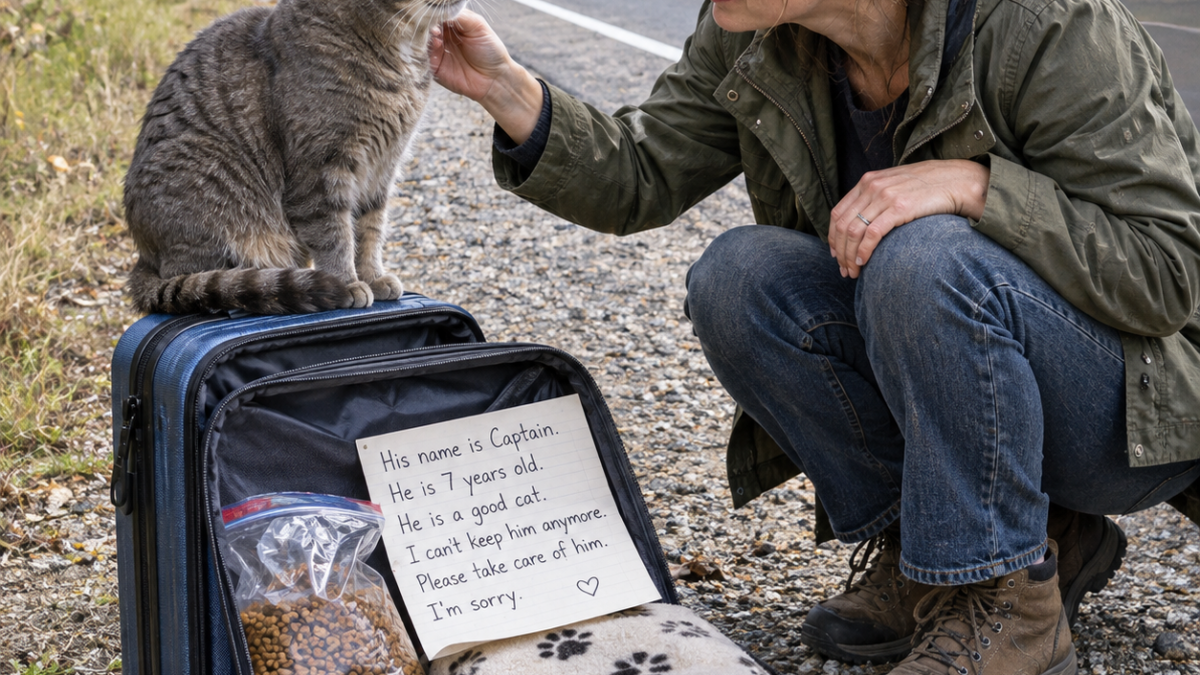
The suitcase beneath him was dusty but not old.
Blue fabric.
Black wheels.
Telescoping handle pushed down.
The kind of carry-on someone might take on a weekend flight.
Diane stopped a few feet away.
The cat stared at her.
“Can I touch you?”
She held out one hand.
He leaned forward.
Sniffed her fingertips.
Then pressed his cheek against them.
That was when Diane knew.
This cat knew people.
Trusted people.
Expected people.
And whoever his person was, they were not standing anywhere nearby.
Diane crouched.
“Okay.”
She stroked his head.
He purred almost immediately.
Not loudly.
A quiet vibration beneath her hand.
She glanced toward the trees.
“Hello?”
Nothing.
“Anybody?”
Cars continued passing.
No answer.
Diane stood and looked at the suitcase.
The cat remained on top.
She hesitated before touching it.
Opening someone else’s luggage felt wrong.
Then she looked at the highway.
Leaving it closed felt worse.
“Sorry, buddy.”
She reached for the zipper.
Captain finally moved.
He stepped off the suitcase and stood beside her leg.
Diane unzipped the top.
Inside was a bag of dry cat food.
Not a handful.
A mostly full bag.
Next to it sat a plastic water dish.
A small package of treats.
A folded gray blanket.
And a sheet of notebook paper.
The paper had been folded once.
Diane’s chest tightened before she even picked it up.
She opened it.
The handwriting was uneven.
Blue ink.
Five short lines.
His name is Captain.
He is 7 years old.
He is a good cat.
I can’t keep him anymore.
Please take care of him.
I’m sorry.
Diane read it once.
Then again.
Cars passed behind her.
A motorcycle.
A delivery truck.
A minivan.
The world kept moving.
Diane did not.
She looked at Captain.
He had returned to the suitcase.
He climbed onto it again.
Turned once.
Sat down.
As though that was where he had been told to stay.
Diane felt something inside her chest fold inward.
“Oh, sweetheart.”
Captain blinked.
She looked back at the note.
I’m sorry.
Those two words bothered her most.
Not because they excused anything.
They did not.
Leaving a domestic cat beside a highway was dangerous.
Terribly dangerous.
He could have run into traffic.
Been attacked.
Become dehydrated.
Disappeared into the woods.
But somebody had not simply thrown him away.
That was obvious too.
They had packed.
Food.
Bowl.
Blanket.
Treats.
His name.
His age.
Someone had spent seven years knowing this cat.
Maybe longer than some marriages.
They knew what food he ate.
Which blanket belonged to him.
They had folded it carefully.
Diane imagined the person packing that suitcase.
Opening drawers.
Finding his bowl.
Pouring food into the bag.
Writing the note.
Stopping.
Starting again.
Then carrying everything into a car.
Captain probably thought they were going somewhere together.
That thought nearly made Diane cry.
She pulled out her phone.
No service for a moment.
Then one bar.
She called animal control.
Voicemail.
Sunday.
She called the non-emergency sheriff’s number.
The dispatcher took her location and said somebody could check the area, but unless there was evidence of an active crime or owner nearby, the most important thing was getting the cat away from traffic.
“Can I take him?”
“If he’ll let you.”
Diane looked at Captain.
He was still sitting on his suitcase.
“Oh, I think he will.”
She opened the rear passenger door.
Then returned.
“Captain.”
His ears moved.
That was the first time she used his name.
He looked directly at her.
Diane swallowed.
“Come on.”
She picked him up.
He did not resist.
He simply relaxed against her chest.
Heavy.
Warm.
His paws rested against her shoulder.
Diane expected scratching.
Fear.
Some attempt to escape.
Instead Captain turned his head toward the road.
Looking.
Waiting.
Diane stood there longer than she needed to.
“Are you expecting them to come back?”
Captain watched traffic.
She hated the question as soon as she said it.
Finally she carried him to the car.
He settled onto the passenger seat.
Diane loaded the suitcase into the trunk.
When she closed it, Captain looked back through the rear window.
Diane climbed behind the wheel.
She did not start the engine immediately.
For several minutes, she watched every vehicle that passed.
Maybe someone would suddenly brake.
Turn around.
Run toward them.
Someone realizing they had made a terrible mistake.
Nobody did.
Captain sat beside her.
Diane touched his head.
“Okay.”
She started the car.
“We’re going home.”
For the first few miles, Captain stood with his front paws on the passenger door and looked through the window.
Diane kept thinking he might cry.
He never did.
That was somehow worse.
About ten minutes later, he turned around.
Walked across the seat.
Curled into a circle beside the gear console.
And went to sleep.
Diane glanced down at him at every stoplight.
“How are you sleeping?”
He kept sleeping.
Maybe exhaustion.
Maybe trust.
Maybe he had spent hours sitting on that suitcase before she passed.
She would never know.
Diane lived alone in a small brick house south of Fredericksburg.
She had not owned a cat in years.
Her last cat, Molly, had died at sixteen.
Diane had promised herself she would not get another one.
Not because she disliked cats.
Because losing Molly hurt more than she expected.
That promise lasted until Captain walked into her kitchen.
The moment Diane placed him on the floor, he began exploring.
Not frantically.
Room by room.
Kitchen first.
Living room.
Hallway.
Bedroom.
Then back to the kitchen.
He rubbed against Diane’s legs.
She poured water into the bowl from his suitcase.
Captain drank.
Then ate a little food.
Afterward, he sat in the middle of the kitchen and looked at her.
Diane laughed nervously.
“Well?”
Captain meowed.
One small sound.
“That’s all you have to say?”
Another meow.
Diane unfolded his blanket.
It was soft fleece.
Gray.
One corner worn thinner than the rest.
She placed it on the living room floor.
Captain saw it from across the room.
Walked directly to it.
Circulated three times.
Lay down.
Within minutes, he was asleep.
Diane stood above him.
Seven years.
That kept going through her mind.
Seven years.
Someone had watched this cat sleep on this blanket.
Someone had filled that bowl thousands of times.
Someone had probably taken pictures of him.
Called his name.
Complained about fur.
Moved him from chairs.
Maybe let him sleep on a bed.
Then something happened.
Diane wanted to be angry.
Part of her was.
But the suitcase made simple anger impossible.
People who want nothing to do with an animal do not usually pack a travel bag.
They dump.
They leave.
They drive away.
Whoever left Captain had prepared him.
Not safely.
Not responsibly.
But deliberately.
That bothered Diane all evening.
At eight, she called her sister.
“I found a cat.”
“You always find animals.”
“No.”
Diane looked toward Captain.
“This is different.”
She told her everything.
Her sister went silent when Diane read the note.
Finally:
“They packed him a suitcase?”
“Yes.”
“That’s…”
“I know.”
“Are you keeping him?”
“I just found him.”
“Diane.”
“I’m taking him to the vet tomorrow.”
“That wasn’t my question.”
Diane looked at Captain.
He had woken up.
His eyes followed her from the blanket.
“I don’t know.”
Her sister laughed softly.
“You know.”
That night Diane made a temporary bed for Captain in the spare room.
Food.
Water.
Litter box borrowed from a neighbor.
Blanket on the floor.
She left the door open.
At midnight, she checked.
Captain was on the blanket.
At two, she checked again.
Same place.
At four-thirty, Diane woke because something jumped onto her bed.
Captain.
He walked across the comforter.
Sniffed her face.
Then lay beside her legs.
But after ten minutes, he got back down.
Returned to the spare room.
Returned to the blanket.
In the morning, Diane found him there.
She began to understand.
That blanket was not just bedding.
It smelled like before.
Whatever before had been.
The veterinarian opened at eight.
Diane called at 8:02.
“We can squeeze you in at ten-thirty.”
She brought Captain.
And the note.
And, for reasons she could not explain, the suitcase.
The veterinary technician looked at the luggage.
“Traveling?”
Diane shook her head.
“Found him sitting on it.”
The technician stopped typing.
“What?”
By the time veterinarian Dr. Hannah Cole entered, half the clinic had heard.
Captain behaved beautifully.
He tolerated the exam.
Weight:
14.8 pounds.
Heart clear.
Lungs clear.
Teeth unusually clean for a seven-year-old cat.
Neutered.
Claws trimmed recently.
No fleas.
No obvious parasites.
Healthy coat.
Good muscle.
“Somebody cared for him,” Hannah said.
Diane nodded.
“That’s what’s bothering me.”
They scanned for a microchip.
Nothing.
Again.
Nothing.
Diane felt unexpectedly disappointed.
A chip could have provided a name.
Phone number.
Answer.
Maybe even a chance to confront whoever had left him.
Instead:
Nothing.
Hannah read the note.
Her expression changed.
“This is sad.”
“People online are going to tear this person apart.”
“Probably.”
“Should they?”
Hannah looked at Captain.
“Leaving him beside a highway was dangerous.”
“I know.”
“So yes, that decision was bad.”
She folded the note.
“But we don’t know the story around it.”
Diane looked at her.
Hannah continued.
“I’ve met people who surrendered animals because they were dying.”
“People entering nursing homes.”
“People losing housing.”
“People fleeing domestic violence.”
“People living in their cars.”
“People who loved the animal and still made a terrible choice.”
Diane looked at Captain.
“So what do I do?”
“Legally?”
“No.”
Hannah smiled faintly.
“Emotionally?”
“Yes.”
“I don’t think you have to decide what kind of person left him.”
Diane considered that.
“You can just decide what kind of life he gets now.”
That answer stayed with her.
The clinic filed a found-animal report.
Diane contacted the county shelter.
Local rescue groups.
Neighborhood pages.
Lost-pet groups.
She shared Captain’s description.
Where he had been found.
Approximate time.
But she did not immediately post the note.
She wanted to give someone a chance to call.
Nobody did.
Day one.
Nothing.
Day two.
Nothing.
Day three.
Captain settled into Diane’s house as if he had been preparing for it.
He discovered the window over the kitchen sink.
The sunny spot beside the sliding door.
The top of Diane’s sofa.
He hated the vacuum cleaner.
Loved chicken.
Ignored expensive cat toys.
Became obsessed with a cardboard box from a shoe delivery.
At night, though, he returned to the blanket.
Always.
Diane tried moving it once.
Only three feet.
Captain stood where it had been.
Looked at the empty floor.
Then looked at her.
Diane immediately put it back.
“Sorry.”
Captain stepped onto it.
Lay down.
“Message received.”
A week passed.
Then two.
The official stray hold period ended.
No claimant.
No microchip.
No matching lost report.
The shelter told Diane she could formally adopt him if she wanted.
She already knew the answer.
She signed the papers.
Name:
Captain.
She never considered changing it.
The name belonged to him.
Whatever else had changed, that did not need to.
About three weeks after finding him, Diane finally posted on Facebook.
One photograph showed Captain sitting on her couch.
He looked annoyed by the camera.
The second photograph was the handwritten note.
Diane wrote only:
Found on a suitcase on the side of Route 3 with a cat sitting on top of it.
She hit post.
Then went to make coffee.
An hour later, thirty shares.
By lunch, four hundred.
By evening, more than two thousand.
Within days, eleven thousand.
Messages arrived from Virginia.
Maryland.
North Carolina.
California.
Canada.
People wanted to adopt Captain.
Too late.
Others offered food.
Vet bills.
Beds.
Toys.
Diane declined most.
“He’s fine.”
Some comments were furious.
Monster.
Heartless.
I hope they get what they deserve.
How could anybody do this?
Others focused on the suitcase.
One woman wrote:
I hate what they did, but people who don’t care don’t pack a blanket.
Another:
This feels like somebody who had no good options and made a terrible one.
Another:
Maybe they were losing their home.
Maybe they were sick.
Maybe they thought leaving supplies would help.
Then came arguments.
People fought beneath a picture of a cat who was sleeping through all of it.
Diane stopped reading after a while.
She knew one fact.
Captain had been abandoned beside a highway.
Dangerous.
Wrong.
Everything else was speculation.
She refused to turn a person she had never met into a villain she could understand easily.
Because the suitcase would not let her.
Whenever Diane became angry, she looked inside it.
Food packed neatly.
Water dish.
Treats.
Blanket.
Note.
His name is Captain.
He is 7 years old.
He is a good cat.
That line.
He is a good cat.
Not difficult.
Not aggressive.
Not unwanted.
Good.
The person wanted the stranger who found him to know that.
Diane imagined them writing it.
Maybe crying.
Maybe not.
Maybe putting Captain on the suitcase and telling him to stay.
Maybe driving away quickly because they could not look back.
Maybe Captain sat exactly where they placed him because he trusted them to return.
That was the part Diane could not forgive easily.
The waiting.
For months afterward, Captain reacted strangely to cars.
If one stopped in front of Diane’s house, he ran to the window.
Delivery truck?
Window.
Neighbor?
Window.
Diane’s sister arriving?
Window.
He would watch until the person came inside or drove away.
Then return to what he had been doing.
One afternoon, a blue SUV stopped.
Captain became intensely alert.
He jumped from the sofa.
Ran to the glass door.
Tail high.
Body rigid.
The driver sat inside for several seconds.
Captain meowed.
Diane’s heart stopped.
The door opened.
A teenage boy stepped out carrying a package.
Wrong person.
Captain watched him leave.
Then slowly returned to his blanket.
Diane sat beside him.
“Do you remember their car?”
He closed his eyes.
“I wish you could tell me.”
He could not.
Winter arrived.
Captain gained half a pound.
His fur became thicker.
He developed a routine.
Breakfast at six.
Window inspection at seven.
Nap until eleven.
Follow Diane while she worked from home.
Demand food at four even though dinner was at five-thirty.
Sleep on blanket.
Occasionally scream at a closed bathroom door because apparently privacy violated his rights.
Diane laughed more.
Her house sounded different with another living thing in it.
She had not realized how quiet it had become after Molly died.
Captain filled space.
Not loudly.
Just enough.
His suitcase remained in the hall closet.
At first Diane considered throwing it away.
Then could not.
It felt like destroying evidence from a life Captain had lived before her.
So she kept it.
Blanket stayed out.
Bowl became his daily water bowl.
The original food was eventually eaten.
The note went into a clear protective sleeve.
Diane stored it inside the suitcase.
One year after finding Captain, Facebook reminded her of the post.
She almost ignored it.
Then opened the comments.
Thousands.
One new message waited in her private inbox.
No profile photograph.
Account only a few months old.
The message said:
Thank you for keeping him.
Diane stared.
Her pulse changed.
She clicked the account.
Nothing.
No posts.
No identifying information.
She replied:
Did you know Captain?
Three dots appeared.
Stopped.
Appeared again.
Then:
Yes.
Diane sat down.
Her hands began shaking.
Who are you?
No answer.
Five minutes.
Ten.
Then:
I can’t tell you.
Diane’s stomach tightened.
Are you the person who left him?
Long pause.
Finally:
Yes.
Diane stared at the screen.
Every question she had carried for a year arrived at once.
Why?
Why the highway?
Why not a shelter?
Why not call someone?
Why did you leave him sitting there?
Do you understand how dangerous it was?
Do you want him back?
Instead Diane typed:
Is Captain safe with me something you wanted to know?
The reply came quickly.
Yes.
Diane looked toward the living room.
Captain was asleep on his blanket.
She took a photograph.
Sent it.
Captain curled on his side.
White chest visible.
One paw over his face.
The response did not arrive for several minutes.
Then:
Thank you.
Diane typed:
Can you please tell me why?
This time she waited almost an hour.
The message that came was longer.
I lost my apartment.
I was living in my car.
Then my car was repossessed.
The shelter I was going to wouldn’t take pets and I had nowhere else.
I called two rescues and they were full.
I was supposed to report to a program that morning and they told me if I didn’t arrive I would lose my placement.
I didn’t know what to do.
I thought someone would stop for him because he wouldn’t leave the suitcase.
I know it was wrong.
I think about it every day.
I’m sorry.
Diane read the message three times.
Then another arrived.
Please don’t tell people who I am.
I’m doing better now.
I just needed to know he lived.
Diane’s anger did something unexpected.
It did not disappear.
She still hated the highway.
Still hated imagining Captain beside cars moving fifty-five miles an hour.
But suddenly the suitcase made sense.
A person without a home had packed everything their cat still owned.
Maybe the suitcase had once held that person’s clothes.
Maybe they emptied it for him.
Maybe there had been no surrender fee.
No transportation.
No time.
No safe choice left.
Only bad ones.
Diane typed:
He lived.
He’s healthy.
He’s loved.
He still sleeps on the blanket.
The reply came:
He always did.
Diane covered her mouth.
Captain lifted his head from the other room.
She started crying.
Another message:
Can you tell him I’m sorry?
That broke her.
Diane put the phone down.
Walked to Captain.
Sat on the floor.
He immediately rolled onto his side and pressed his head against her knee.
She stroked his face.
“Captain.”
He purred.
Diane cried harder.
“I found them.”
Captain blinked.
Or maybe they found us.
She told him the only thing she could.
“They’re sorry.”
He placed one paw on her leg.
Cats do not understand apologies the way people do.
Maybe that is mercy.
Diane never learned the person’s name.
She did not ask again.
They exchanged only a few more messages.
Captain had originally been adopted as a kitten from a friend’s barn.
He loved tuna.
Hated thunder.
His favorite sleeping place had always been the gray blanket.
The person had kept him through seven years of moves, jobs, breakups, and financial problems.
Then everything collapsed at once.
They said:
I thought leaving his things would make somebody understand he belonged to someone.
Diane replied:
It did.
The stranger answered:
I stood across the road in the trees for almost twenty minutes before I left.
That stunned Diane.
You watched him?
Yes.
I couldn’t move.
Then a car stopped farther down and I panicked and left because I knew if I went back I wouldn’t make myself go.
Diane asked the question she had avoided.
Do you want him back?
No answer for a long time.
Then:
Yes.
Another message immediately followed.
But I won’t ask.
He has a home.
I lost the right to make him start over again because I miss him.
Diane read that several times.
Then wrote:
I don’t know if rights are the word.
But I agree he shouldn’t be uprooted.
The reply:
I know.
Diane hesitated.
Would you like pictures sometimes?
Three dots.
Then:
Please.
So every few months, Diane sent one.
Captain asleep in sunlight.
Captain inside a cardboard box.
Captain wearing a ridiculous Christmas bow he immediately removed.
Captain sitting on the blue suitcase after Diane took it from the closet for a photograph.
That picture received one reply.
I remember that day.
Diane did not ask anything more.
Eventually the messages stopped.
Maybe the person wanted closure.
Maybe life changed.
Maybe seeing Captain became painful.
The account remained but never sent another note.
Diane respected that.
She never posted the conversation.
Not online.
Not even when people continued debating the original story.
She kept it private because pain does not become public property merely because a story goes viral.
When someone commented:
Only a monster could pack a cat’s bag and leave him.
Diane wanted to answer.
She didn’t.
When someone wrote:
There had to be a reason.
Diane wanted to say:
There was.
She didn’t.
The person had asked for privacy.
Captain did not need the internet deciding whether his former owner deserved forgiveness.
Years passed.
Captain turned eight.
Nine.
Ten.
He remained healthy.
Eventually developed mild arthritis.
Dr. Cole recommended joint supplements.
Diane bought stairs so he could reach the bed.
He refused them for three months.
Then one night she caught him using them.
“Interesting.”
Captain immediately jumped off as if denying everything.
At eleven, his face became slightly whiter around the muzzle.
At twelve, he slept more.
Still on the same blanket.
The fleece wore thin.
Diane repaired one torn corner by hand.
She considered replacing it.
Could not.
At thirteen, Captain developed kidney disease.
Early stage.
Manageable.
Prescription food.
Fluids later.
More veterinary appointments.
Diane joked:
“You were found with a food bag and now your food costs more than mine.”
Captain did not care.
At fourteen, he stopped jumping onto the suitcase.
Diane had started taking it out every year on the anniversary of his rescue.
Not as trauma.
Almost as a birthday ritual.
She would place it on the living room floor.
Captain would sniff it.
Sometimes sit beside it.
Once climbed on top and stayed there.
Diane took a photograph.
Same pose.
Older cat.
Same blue suitcase.
She looked at the image beside the original photograph from Route 3.
Seven years apart.
The first photo did not exist, technically.
Diane had been too focused on rescuing him to photograph the roadside.
But in her memory she could still see it exactly.
Gray cat.
Blue suitcase.
Traffic.
Waiting.
Now Captain sat in sunlight inside a warm house.
No traffic.
No waiting.
Just home.
At fifteen, his kidneys worsened.
Diane knew the signs.
Molly had taught her.
Weight loss.
Less appetite.
Longer sleep.
Good days.
Bad days.
One evening, Captain walked slowly into the spare room.
The gray blanket had been moved there because he preferred the quieter space.
He circled twice.
Lay down.
Diane sat beside him.
“Remember this?”
She touched the blanket.
Captain purred.
Very faint.
“I do.”
She stroked his head.
“I almost drove past you.”
Captain closed his eyes.
“A quarter mile.”
She laughed through tears.
“Can you imagine?”
He breathed slowly.
Diane thought about the person who had packed the suitcase.
Where were they now?
Did they still think of him?
Probably.
Did they imagine this moment?
Maybe.
Diane opened her phone.
The anonymous account still existed.
No messages in years.
She sent one.
Captain is fifteen now.
He’s had a very good life.
His kidneys are failing and I think we’re getting close.
I thought you should know.
For two days:
Nothing.
Then:
Thank you for telling me.
Diane stared at the screen.
Another message came.
Can I see him?
Not take him.
Just see him.
Diane’s heart began pounding.
She had never expected this.
She had never met this person.
Did she owe them that?
Did Captain?
Would it confuse him?
Stress him?
She called Dr. Cole.
Then her sister.
Then sat beside Captain for nearly an hour.
Finally she replied:
Yes.
Public place isn’t good for him now.
You can come here.
The person arrived three days later.
Diane watched from the window.
A woman stepped from an old sedan.
Mid-forties.
Thin.
Dark hair streaked with gray.
She stood beside the car for almost a minute before walking toward the house.
She carried nothing.
Diane opened the door.
Neither woman knew what to say.
Finally:
“Diane?”
“Yes.”
The woman nodded.
“I’m Laura.”
First name only.
Enough.
Diane stepped aside.
Laura entered.
Captain was sleeping on his blanket.
She saw him.
Stopped.
Her hands covered her mouth.
“Oh.”
Captain opened his eyes.
He looked toward the stranger.
For several seconds, nothing happened.
Diane held her breath.
Laura did not move closer.
“Hi, Captain.”
The cat’s ears lifted.
Laura started crying.
Captain raised his head.
Then slowly stood.
Fourteen seconds.
Diane knew because later she remembered counting.
Captain walked across the rug.
Not fast.
Arthritic.
Thin.
He stopped three feet from Laura.
Sniffed.
Laura crouched.
Did not reach.
Captain stepped closer.
Then pressed his forehead into her knee.
Laura made a sound Diane would remember for the rest of her life.
Not a sob.
Not exactly.
Something lower.
Something that came from eight years of missing an animal she believed she had forfeited.
“Oh, baby.”
Captain rubbed against her.
Laura put both hands around him.
Carefully.
Diane turned away.
She gave them privacy.
Laura stayed two hours.
Captain sat beside her most of the time.
Not frantic.
Not confused.
He seemed comfortable.
Maybe scent memory.
Maybe voice.
Maybe cats store old people somewhere we do not understand.
Laura told Diane the rest.
She had lost her job.
Then housing.
Had been living with a boyfriend who became violent.
She left.
Stayed in her car.
The car was repossessed.
A church program offered temporary housing but would not accept animals.
She tried friends.
Everyone had dogs, allergies, leases.
Called rescues.
Full.
A shelter told her owner surrenders required an appointment more than a week away.
She had less than a day.
“So I did the worst thing I’ve ever done.”
She looked at Captain.
“I convinced myself the suitcase would make someone stop.”
Diane said quietly:
“It did.”
“I know.”
Laura wiped her face.
“I drove back twice.”
Diane stared.
“What?”
“The first time I got halfway to Fredericksburg.”
“I turned around.”
“Captain was still there.”
“Why didn’t you take him?”
Laura cried.
“Because then I still had nowhere to go.”
She wiped her eyes.
“I put him back.”
Diane felt her heart twist.
“I drove away again.”
“The second time, there was a car on the shoulder.”
“Yours.”
Diane understood.
“You saw me?”
“From farther up the road.”
“I saw you put him in the car.”
Laura looked directly at her.
“I knew he was safe.”
For years, Diane had imagined whoever left Captain disappearing without looking back.
They had looked back.
Again.
Again.
It did not make the choice safe.
But it made it human.
Laura reached into her coat pocket.
Removed a photograph.
Captain as a kitten.
Tiny gray body.
Sleeping on the same blanket.
She handed it to Diane.
“You should have this.”
Diane looked.
“You keep it.”
“I have another copy.”
Then Laura smiled through tears.
“He used to sleep with one paw over his eyes.”
“He still does.”
“I know.”
They both laughed.
At the door, Laura knelt beside Captain one last time.
“I’m not taking you.”
Her voice broke.
“I just wanted you to know I didn’t forget.”
Captain rubbed against her hand.
Laura whispered:
“I’m sorry.”
Then she left.
Captain stood at the window watching her car disappear.
Diane feared he would search for her afterward.
He did not.
He walked back to the gray blanket.
Lay down.
And slept.
Maybe that was the answer.
Past and present did not have to compete.
Captain had loved someone before Diane.
He loved Diane now.
Both things could be true.
Three months later, Captain stopped eating.
Diane knew.
Dr. Cole came to the house.
No clinic.
No carrier.
No fluorescent room.
Captain lay on his blanket near the living-room window.
Sunlight on his back.
Diane sat beside him.
Before the veterinarian arrived, Diane sent Laura one final message.
Today.
Laura replied almost immediately.
Please tell him I love him.
Diane wrote:
I will.
When Dr. Cole arrived, Captain raised his head once.
Diane stroked his face.
Fifteen years old.
Eight years with her.
Seven before.
Two lives.
One cat.
She whispered:
“Laura loves you.”
Captain purred weakly.
“And I love you.”
His eyes closed.
“You were a good cat.”
Those were the words from the original note.
He is a good cat.
Diane had read them on a highway shoulder eight years earlier.
Now she said them back.
“You were such a good cat.”
Captain died with his head resting on the blanket somebody had packed for him years before.
Diane kept the blanket.
She kept the suitcase.
She kept the first note.
And now she kept Laura’s kitten photograph too.
For months she could not open the suitcase.
Then one Sunday afternoon, almost exactly eight years after she had first seen Captain beside Route 3, she sat on the living-room floor and opened it.
Inside:
The note.
The photograph.
His old water bowl.
Collar.
A small bag containing one of his favorite toy mice.
And the folded gray blanket.
Diane placed the original note beside Laura’s later photograph.
Seven-year-old Captain described in five handwritten lines.
Kitten Captain sleeping with one paw over his face.
A whole life existed between those two pieces of paper.
Another whole life came afterward.
Diane finally understood why the suitcase had stayed with her emotionally more than anything else.
It represented failure.
Yes.
Someone had failed Captain terribly that day.
But it also represented love that had run out of safe options.
Those things can exist together.
Human beings like stories where people are either cruel or kind.
Good or bad.
Abandoner or rescuer.
Captain’s life refused to fit that shape.
Laura loved him.
And left him.
Diane was a stranger.
And turned around.
One terrible decision almost killed him.
One ordinary decision saved him.
No dramatic rescue organization.
No television crew.
No heroic speech.
Just a woman driving down a highway who saw something strange, traveled another quarter mile, and decided she could not live comfortably with herself if she did not go back.
That turn gave Captain eight more years.
Eight birthdays.
Eight Christmases.
Thousands of meals.
Vet visits.
Cardboard boxes.
Sunlight.
One reunion.
A peaceful death.
A home.
People often ask Diane why she turned around.
She never has a profound answer.
“It looked wrong.”
That is all.
Something looked wrong.
So she checked.
Sometimes compassion is not a grand emotion.
Sometimes it is inconvenience.
Missing an exit.
Making a U-turn.
Getting dust on your shoes.
Opening somebody else’s suitcase because the animal sitting on top cannot explain why he is there.
Diane eventually posted one final photograph of Captain.
Years after the original viral post.
The picture showed him old and gray, asleep on the same blanket.
She did not tell Laura’s private story.
That belonged to Laura.
She wrote only:
Captain died peacefully at home today.
Eight years ago I found him sitting on a blue suitcase beside Route 3.
Inside was a note saying, “He is a good cat.”
They were right.
He was.
Thousands of comments appeared.
People remembered.
Some had followed Captain from the beginning.
Many asked again:
Did you ever learn who left him?
Diane did not answer.
She had promised privacy.
Instead, she closed Facebook.
Went to the hall closet.
Placed Captain’s suitcase on the floor.
And rested one hand on the handle.
For years she had thought the saddest part of Captain’s story was that somebody packed everything he might need except themselves.
Eventually she realized something else.
The suitcase had never contained everything Captain needed.
It could not.
Food runs out.
Water bowls sit empty.
Blankets hold scent but cannot provide touch.
Notes cannot come back.
Captain needed a person.
That Sunday afternoon, one person left.
A few minutes later, another person stopped.
Maybe that is why the story stayed with so many people.
Not because abandonment is rare.
Not because rescue is rare.
Because so much of life turns on moments nobody expects to matter.
Diane could have kept driving.
Most cars did.
Captain could have panicked and run.
He didn’t.
Laura could have left him with nothing.
She packed a bag.
None of those choices were perfect.
Some were terrible.
One was merciful.
Together they became the shape of Captain’s life.
Years later, Diane sometimes drives Route 3.
The shoulder where she found him looks exactly like every other shoulder.
Gravel.
Grass.
Guardrail.
Trees.
No marker.
Nobody passing would know that a gray cat once sat there on a blue suitcase waiting for someone who was not coming back.
Diane knows.
Every time she passes, she slows slightly.
Not much.
Just enough to look.
Because she learned something from Captain.
Sometimes the thing on the side of the road that everybody else passes is not waiting for everybody.
It only needs one person to turn around.



