A Woman Adopted a Cat Used as Bait in a Dog-Fighting Operation and Spent $14,000 Saving Her—When Someone Asked Why, Her Answer Silenced Everyone.
PART3:
Neighbors stood on porches pretending not to watch.
Lena climbed out of the passenger seat with a crate in one hand and a medical bag in the other. Beside her, Sam Bishop, one of the shelter’s strongest kennel techs, opened the back of the van and began unloading carriers.
Officer Delaney met them near the gate.
He was in his late thirties, tall, broad-shouldered, with blood on one sleeve that Lena immediately knew was not his. His face was calm in the way people get when they have no room left for visible emotion.
“The dogs are in the back building,” he said. “Animal control is handling transport. The cats are behind the shed.”
Lena looked past him.
She heard the dogs before she saw anything.
Not barking the way shelter dogs barked.
Not excited.
Not even aggressive.
These were fractured sounds. Hoarse. Exhausted. Confused. Dogs who had been trained to survive fear by becoming it. Dogs who were victims too, though the public often forgot that after headlines used words like fighting and vicious.
Officer Delaney led Lena and Sam around the side of the house.
The backyard was mud, chain, broken boards, and evidence markers.
A heavy smell hung in the air.
Blood.
Waste.
Rust.
Old fear.
Near the far fence, half-hidden behind a leaning shed, was a wire cage no larger than a laundry basket.
Sam stopped walking.
Lena did too.
For a moment, neither of them spoke.
There were four cats inside.
One was already gone, curled in a position no sleeping animal chooses.
Two were alive but badly injured, pressed against the back wire, eyes wide, bodies trembling.
The fourth lay on her side near the front.
A small gray tabby.
At first, Lena thought she was dead too.
Then one paw moved.
Barely.
Just enough.
“Oh, baby,” Lena whispered.
She knelt in the mud.
Officer Delaney looked away.
“I found them after we cleared the shed,” he said. “They were behind stacked tires. Cage was covered with a tarp.”
Sam’s jaw tightened.
“How long?”
“No idea.”
Lena opened the latch carefully.
The metal scraped.
The gray tabby did not react.
That scared Lena more than hissing would have.
She reached in with both hands, slow and gentle, and lifted the cat out.
The body in her hands weighed almost nothing.
The injuries were worse up close.
Her ears were torn, one nearly shredded at the outer edge. Puncture wounds marked her neck, back, and hind legs. Some were old and scabbed. Some were fresh. Her tail bent wrong in two places. Her fur was sticky with dried blood and dirt. One eye was swollen nearly shut. Her breathing came in shallow pulls, as if every inhale had to climb through pain.
She was not fighting.
She was not crying.
She had gone somewhere deep inside herself where touch could not reach.
Sam opened a towel.
Lena wrapped her.
The cat’s head lolled against her wrist.
“Is she bait?” Sam asked, though he already knew.
Officer Delaney’s face hardened.
“That’s what it looks like.”
Lena held the cat closer.
There were words people used because the real thing was too ugly.
Bait animal.
Training animal.
Throwaway.
Evidence.
But the truth was simpler.
Someone had taken a living creature, small enough to be helpless, and used her terror as entertainment for dogs humans had also destroyed in a different way.
Lena carried the cat to the van.
“We need to move now.”
The gray tabby was listed at intake as Cat 4, female, unknown age, emergency medical.
By the time she reached the shelter, her temperature had dropped. Her gums were pale. Her heart rate was weak and fast. She was dehydrated, in shock, and covered in wounds that needed cleaning before anyone could even understand the full map of damage.
Dr. Elaine Porter, the shelter’s emergency veterinarian, took one look and said, “Surgery prep.”
Lena followed them into treatment.
Dr. Porter glanced back.
“You don’t need to watch this.”
“Yes, I do.”
The veterinarian said nothing else.
They shaved areas of the tabby’s body carefully. They flushed wounds. They placed an IV catheter. They gave pain medication, antibiotics, fluids, oxygen. A technician warmed rice bags and tucked them beneath blankets. Another held the cat’s head steady while Dr. Porter examined her tail.
“Broken,” Dr. Porter said quietly. “At least two fractures.”
“Can you save it?” Lena asked.
“Not my first concern.”
The tabby’s right ear was worse than Lena had thought. Tissue had been torn and damaged, the edges uneven and inflamed. The left ear was more intact but scarred. Her back was dotted with punctures. Her hind leg had swelling around an older injury.
Dr. Porter listened to her lungs.
“She’s alive,” the veterinarian said. “That’s what I can say right now.”
“Prognosis?”
Dr. Porter’s face did not move.
“Unknown.”
That word appeared on the shelter’s first public update that afternoon.
URGENT MEDICAL FOSTER OR ADOPTER NEEDED.
The post showed no graphic photos at first, only the gray tabby wrapped in a towel, one eye open, the other swollen, her head resting on a veterinary technician’s gloved hand.
Found during Baton Rouge dog-fighting raid. Used as a bait animal. Critical condition. Prognosis unknown. Will require extensive medical treatment, possible multiple surgeries, and long-term recovery. We are asking for an experienced foster, adopter, or rescue partner willing to take on a difficult case. She deserves a chance.
The comments came quickly.
Poor baby.
People are monsters.
I wish I could.
Praying.
Please keep us updated.
Someone should pay.
Who did this?
Can I donate?
Lena read the comments from the treatment room floor, where she sat with her back against the wall during the first brief pause in chaos.
She hated the words I wish I could.
Not because they were cruel.
Because most of the time they were honest.
People did wish.
They wished suffering could be solved by sadness.
They wished somebody else had more space, more money, more time, more courage, more capacity.
But animals like Cat 4 did not survive on wishes.
They survived when someone crossed the distance between I wish and I will.
That night, thirty miles away in Denham Springs, Rhonda Broussard sat at her kitchen table with a stack of unpaid bills, a chipped mug of coffee gone cold, and her phone in her hand.
She was fifty-three years old, though exhaustion sometimes made her look older and laughter could still make her look thirty. She worked as an office manager for a plumbing company, kept receipts in labeled folders, clipped coupons even when she did not need to, and believed most emergencies could be survived if you had a working car, a full tank of gas, and the sense not to panic before you knew the facts.
Her husband, Dale, was watching a football replay in the living room with the volume low.
Their house was modest, clean, and lived in. A magnolia tree stood in the front yard. The hallway wall held framed photographs of nieces, nephews, dead parents, and two cats who had lived long lives and left holes too large for their size.
Rhonda had not planned to adopt again.
That was what she had told Dale after their old tortoiseshell, June Bug, died at nineteen.
“No more,” Rhonda had said through tears at the emergency vet.
Dale had nodded, though neither of them believed grief when it made vows.
Now Rhonda stared at the shelter post.
The gray tabby’s face filled the screen.
One open eye.
A towel wrapped beneath her chin.
A body so small inside all that damage.
Rhonda read the update once.
Then again.
Then a third time.
Dog-fighting raid.
Bait animal.
Critical.
Prognosis unknown.
Experienced foster or adopter needed.
Dale walked into the kitchen during halftime.
“You coming to bed soon?”
Rhonda did not answer.
He looked at the phone.
His face changed.
“Oh, Lord.”
Rhonda’s thumb rested near the picture.
“She’s in Baton Rouge.”
Dale leaned against the counter.
“Rhonda.”
“I know.”
“That looks bad.”
“I know.”
“Real bad.”
“I know that too.”
He crossed his arms.
“What are you thinking?”
She looked up at him.
There are marriages built on romance, and there are marriages built on recognition. Rhonda and Dale had both, but recognition had carried them farther. He knew her face when she had already made a decision and was waiting for the world to catch up.
Dale closed his eyes.
“Baby.”
“They’re asking for somebody experienced.”
“We’ve had house cats. That’s not the same as medical trauma.”
“I can learn.”
“She may not live.”
“Then she shouldn’t die alone in a cage after what happened to her.”
Dale rubbed one hand down his face.
“You don’t even know if they’ll let you take her.”
“I’ll drive there in the morning.”
He looked at the bills on the table.
“We’re not rich.”
“I know exactly how not rich we are.”
“This could cost thousands.”
Rhonda looked back at the picture.
The gray tabby’s eye seemed to meet hers through the glass of the phone.
“She didn’t choose the cage.”
“No.”
“She didn’t choose the dogs.”
“No.”
“She didn’t choose the pain.”
Dale said nothing.
Rhonda put the phone down.
“Somebody has to choose something different for her.”
Dale stood quietly for a moment.
Then he reached for his keys on the hook.
“What are you doing?” she asked.
“Putting gas in the car tonight.”
Rhonda’s eyes filled.
He shrugged.
“If you’re going to Baton Rouge first thing, I don’t want you stopping on empty.”
She stood and hugged him hard.
Dale kissed the top of her head.
“I’m not saying yes to fourteen cats,” he muttered.
“I didn’t ask for fourteen.”
“You always start with one.”
But his arms tightened around her.
At 8:12 the next morning, Rhonda walked into the Baton Rouge shelter wearing jeans, a faded LSU sweatshirt, and the expression of a woman who had not come to browse.
Lena was at the front desk.
Rhonda placed both hands on the counter.
“I’m here for the gray tabby from the raid.”
Lena looked up sharply.
Most people began with questions.
Is she friendly?
How old is she?
Is she good with dogs?
Will she be okay with children?
How much does she cost?
Rhonda began like she had already accepted the answer to every question.
Lena stood.
“You saw the post?”
“Yes.”
“She’s critical.”
“I know.”
“She’s going to need extensive care.”
“I know.”
“She may need multiple surgeries.”
Rhonda nodded.
“She may not survive.”
Rhonda swallowed.
“I know that too.”
Lena studied her.
“What’s your name?”
“Rhonda Broussard. Denham Springs.”
“Do you have other pets?”
“Not now. We lost our old girl last year.”
“Medical experience?”
“With animals? Pills, fluids once, wound care after dental surgery. Nothing like this. But I follow instructions.”
“You understand this is not a normal adoption.”
“I’m not here for normal.”
Lena’s throat tightened.
“Come with me.”
They walked through a side hallway into the medical area. Rhonda noticed everything. The smell of disinfectant. The rolling carts. The stacks of towels. The whiteboard with names and times. The tired faces of people trying to do too much with too little sleep.
Dr. Porter met them outside the treatment room.
“I’m going to be direct,” the veterinarian said.
“Please.”
“She survived the night. That is good. She is still critical. She has multiple puncture wounds, soft-tissue trauma, a broken tail, damage to the right ear, possible older fracture in the right hind leg, dehydration, infection risk, and signs of shock. She will need surgery, possibly several. First estimate is around four thousand dollars. That is only the beginning if complications develop.”
Rhonda listened without interrupting.
Dr. Porter continued.
“Emotionally, she may be shut down for a while. She may never become affectionate. She may hide. She may bite. She may have litter box problems. She may have fear responses we cannot predict.”
Rhonda nodded.
“Can I see her?”
Dr. Porter hesitated.
Then she opened the treatment room door.
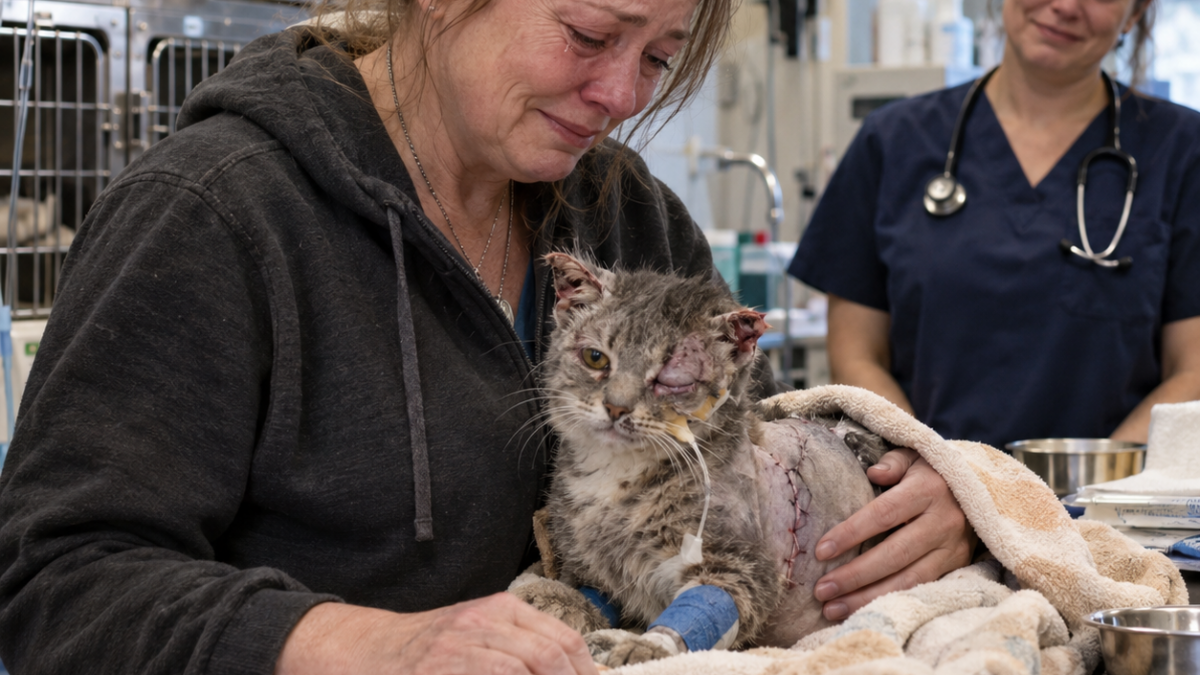
The gray tabby lay inside an oxygen kennel on layered blankets. Her body had been shaved in patches. Tubes ran from her small frame to bags and machines. One ear was bandaged. Her tail was loosely splinted. Her open eye moved when Rhonda stepped closer, but the cat did not lift her head.
Rhonda pressed one hand to her mouth.
She had expected terrible.
Terrible was not the same as seeing.
“Oh, sweetheart,” she whispered.
Lena stood beside her.
“We don’t know if she can go home today.”
“I’ll wait until she can.”
“There’s paperwork.”
“I’ll sign it.”
“There’s the estimate.”
“I’ll pay it.”
Lena’s eyes softened.
“You haven’t asked if she’s worth it.”
Rhonda looked at her then.
There was no drama in her face.
Only certainty.
“She’s alive. That answers the question.”
The first time Rhonda touched her, the cat did not move.
Dr. Porter opened the oxygen kennel just enough for Rhonda to slide two fingers inside. Rhonda touched the gray tabby between the eyes, gently, barely making contact.
The cat’s skin twitched.
Rhonda almost pulled back.
Then, with effort so slight that everyone in the room held still to witness it, the tabby leaned the weight of her forehead into Rhonda’s fingers.
Not far.
Not trust.
Not yet.
But something.
Rhonda began to cry silently.
Dr. Porter looked away to give her privacy.
Lena did not.
Some moments deserved witnesses.
“What’s her name?” Lena asked softly.
Rhonda kept her fingers against the cat’s forehead.
“She have one?”
“Not yet. Intake just says Cat 4.”
Rhonda looked at the wounds, the bandages, the broken tail, the ear, the little body that had been treated like a disposable object by people who would probably stand in court someday and claim they did not know what happened behind the shed.
Her jaw tightened.
“Jury,” she said.
Lena blinked.
“Jury?”
“Because somebody should have been held accountable for what happened to her.”
The treatment room went quiet.
Rhonda looked down at the cat.
“But until they are, she’ll have a name that remembers.”
Jury’s first surgery took place that afternoon.
Dr. Porter and a surgical specialist from an emergency clinic worked for three hours. They cleaned and debrided puncture wounds, placed drains, stabilized the tail, repaired damaged tissue around the ear, and removed fragments of infection already trying to take hold beneath the skin. Jury’s blood pressure dipped twice. Her temperature fell once. A technician warmed fluids and whispered encouragement as if the cat could understand every word.
Rhonda waited in the lobby.
Dale arrived after lunch with a bag of vending machine snacks, two coffees, and a face full of worry.
“You okay?”
“No.”
He sat beside her.
“Dumb question.”
She leaned against him.
A woman across the lobby glanced over.
“That the dog-fighting cat?” she asked.
Rhonda stiffened.
Dale answered before she could.
“Her name is Jury.”
The woman looked embarrassed.
“Oh. I just saw it online.”
Rhonda stared at the double doors leading to medical.
“She’s not a headline.”
“No, ma’am,” the woman said softly. “I’m sorry.”
The surgery cost $4,182.76.
Rhonda paid the deposit with a credit card she had worked hard to keep low.
When the receptionist read the total, she did it gently.
Rhonda signed.
Her hand shook only after she finished.
That night, Jury remained hospitalized.
The next night too.
On the third day, Dr. Porter called.
“She’s stable enough to leave medical care, but not stable enough for ordinary home care. If you take her, you’ll need to administer medication, monitor wounds, restrict movement, and bring her back immediately if anything changes.”
“I can do that.”
“She has drains.”
“I can learn.”
“She may not eat.”
“I’ll sit with her.”
“She may hide.”
“Then I’ll make hiding safe.”
There was a pause.
“You really mean that.”
“Yes.”
“All right. Come at three.”
Rhonda turned the guest room into a recovery room before she picked Jury up.
Dale removed the bed frame so the mattress sat low on the floor. Rhonda spread clean sheets, placed washable pads near the litter box, arranged water bowls, medication syringes, towels, and a notebook for tracking food, bathroom habits, and pain meds. She plugged in a small night-light shaped like a moon.
Dale stood in the doorway.
“Looks like an ICU in here.”
Rhonda adjusted a blanket.
“It is.”
“For a six-pound cat.”
She turned.
He raised both hands.
“I know. Jury.”
Her expression softened.
“I’m scared.”
Dale walked in and pulled her close.
“I know.”
“What if I can’t save her?”
“Then you’ll make sure she knows somebody tried.”
Jury came home in a blue carrier wrapped in a towel that smelled like the shelter.
When Rhonda opened the carrier in the guest room, Jury did not come out for forty-seven minutes.
Rhonda lay on the floor beside the carrier, one cheek against the rug.
“Take your time,” she whispered. “Nobody is reaching in.”
Jury’s one good eye watched her from the shadows.
Dale brought dinner to the hallway and found his wife lying flat outside the carrier.
“You want a sandwich down there?”
“Yes.”
He handed it to her.
She ate lying on the floor.
Jury blinked slowly.
That night, at 11:18, Jury stepped out.
Every movement looked painful. She walked low, tail splinted and bandaged, legs uncertain, body half-shaved, ears wrapped. She sniffed the water bowl. Ignored the food. Sniffed the litter box. Turned. Saw Rhonda still lying on the floor. Then, instead of hiding under the dresser like Rhonda expected, Jury walked three shaky steps toward her and stopped.
Rhonda held her breath.
Jury lowered herself onto the towel beside Rhonda’s hand.
Not touching.
Close enough.
Rhonda cried into the rug without making a sound.
The first month was measured in tiny victories and large bills.
Jury ate two teaspoons of food.
Victory.
Jury kept down antibiotics.
Victory.
Jury used the litter box.
Victory.
A drain came out.
Victory.
An incision looked angry.
Emergency visit.
Jury gained three ounces.
Victory.
Jury’s tail began to fail.
Disaster.
The tissue around the fractures would not heal properly. Nerve damage made the tail limp and painful. Infection threatened to move deeper. Dr. Porter referred Rhonda to a surgeon in Baton Rouge who spoke plainly while showing her X-rays.
“I recommend amputation,” he said.
Rhonda looked at the small bones lit white on the screen.
“Will she be okay without it?”
“Cats adapt very well.”
“Will it hurt less?”
“Yes.”
“Then do it.”
The surgery cost $2,936.
Rhonda put part of it on the credit card and part of it on a payment plan.
When Dale saw the paperwork, he sat down at the kitchen table and went quiet.
Rhonda stood across from him.
“Say it.”
He looked up.
“I’m not against saving her.”
“I know.”
“But we need to talk about money.”
“I know that too.”
“We have the truck insurance due next month. The AC is making that sound. Your car still has the loan.”
“I can pick up extra bookkeeping for Ronnie’s cousin.”
“You already work full-time.”
“I’ll do nights.”
“Rhonda.”
“What do you want me to do, Dale?”
He looked toward the hallway where Jury slept in the guest room.
“I want you not to break yourself trying to repair what evil people did.”
The words landed softly because he meant them with love.
Rhonda sat across from him.
“I know you’re scared.”
“I am.”
“So am I.”
“I don’t want to be the man who says stop.”
“You’re not.”
“I don’t want to be the man who lets us drown either.”
Rhonda reached across the table.
“We’ll make a plan.”
He took her hand.
“Together?”
“Together.”
That night, they spread bills across the table. They cut streaming services. Delayed a vacation they had talked about but never booked. Moved grocery spending to cash envelopes. Dale sold two fishing rods he barely used. Rhonda took on weekend invoicing for a small HVAC company.
Then the third surgery came.
Jury’s right ear, already damaged beyond simple healing, developed thick scar tissue and recurring inflammation. The surgeon reconstructed what could be saved and removed what could not. When the bandage came off weeks later, one ear stood mostly whole. The other was only partial, an uneven little curve that made Jury look permanently windblown.
Rhonda kissed the top of her head.
“You are still the prettiest girl in Louisiana.”
Jury, heavily medicated and unimpressed, drooled on her sweatshirt.
By then, people knew about Rhonda and Jury.
Not famous known.
Small-town known.
Shelter followers shared updates. Lena texted when donors asked how “the bait cat” was doing, though Rhonda kept correcting everyone.
“Her name is Jury.”
A local rescue page asked to run a fundraiser.
Rhonda said no.
“Are you sure?” Lena asked. “People want to help.”
“They can donate to the shelter.”
“But this is a lot.”
“I know.”
“You don’t have to carry it all yourself.”
Rhonda sat on the guest room floor while Jury slept against her thigh.
“I’m not too proud to need help,” she said. “That isn’t it.”
“Then what is it?”
Rhonda stroked Jury’s back, careful around the healing wounds.
“So much was taken from her without permission. Her safety. Her body. Her peace. I want at least one part of her story to be simple. I chose her. I pay for her. I bring her home.”
Lena was quiet for a moment.
“That’s love, Rhonda. Not logic.”
“I didn’t claim it was logic.”
The fourth surgery came because infection is patient.
A month after the ear reconstruction, Jury stopped eating. Her temperature rose. She hid under the low mattress and made no sound when Rhonda called. Rhonda knew before the thermometer confirmed it.
Emergency.
Internal infection.
Surgery.
Another estimate.
Another signature.
This time, Rhonda sat in her car outside the clinic afterward and screamed into both hands.
Not because she regretted it.
Because love did not cancel fear.
Dale drove from work and found her in the parking lot with the door open and the paperwork in her lap.
He crouched beside her.
“Hey.”
She laughed once, bitterly.
“Do not hey me. I am one bill away from selling plasma in the parking lot.”
He almost smiled, then saw her face and did not.
“We’ll figure it out.”
“I refinanced my car.”
Dale stared.
“What?”
“I called this morning before the appointment. Extended the loan. Lower monthly payment. Got cash out.”
“Rhonda.”
“I know.”
“You should have told me first.”
“I know.”
He stood and walked three steps away.
She let him.
The parking lot hummed with traffic from the road.
When Dale turned back, his face was hurt, not angry. Hurt was worse.
“We said together.”
Rhonda’s eyes filled.
“She was getting worse.”
“I understand that.”
“I panicked.”
“I understand that too.”
“I’m sorry.”
He looked toward the clinic.
“I’m not mad you helped her. I’m mad you got scared alone.”
That broke her.
She covered her face.
Dale came back and knelt in front of her.
“We’re in this together,” he said. “Even when it’s stupid expensive. Even when I’m scared. Even when you think I’ll say no.”
Rhonda nodded against his shoulder.
Inside the clinic, Jury survived the fourth surgery.
After that, healing came slowly.
Not like a miracle.
Like a stubborn negotiation.
One scar closing.
One meal finished.
One step without stumbling.
One night without fever.
One morning when Jury walked from the guest room into the hallway on her own and looked around the house as if she had finally decided it might belong to her.
Rhonda sat on the couch, afraid to move.
Jury limped into the living room.
Dale lowered the newspaper.
“Well, hello there.”
Jury paused.
Dale extended one finger.
She sniffed it.
Then, with the dignity of a queen inspecting poor furniture, she climbed awkwardly onto the couch, crossed Dale’s lap without permission, and settled on Rhonda’s chest.
Rhonda stopped breathing.
Jury pressed her face into the hollow of Rhonda’s neck.
Then she purred.
Not quietly.
Not delicately.
The sound vibrated through Rhonda’s ribs.
Dale’s eyes widened.
“Good Lord.”
Rhonda began to cry.
Dale folded the newspaper.
“That cat sounds like a lawn mower.”
Rhonda laughed through tears.
Jury purred louder.
After that, it became ritual.
Every night, once the house quieted, Jury climbed onto Rhonda’s chest. No tail. One half ear. Scars beneath fur. Slight limp. A body that carried a record of cruelty like a map.
She pressed her face against Rhonda’s neck.
Then she purred loud enough for Dale to hear from the recliner.
At first, Rhonda thought it was gratitude.
Then Dr. Porter corrected her gently.
“Maybe comfort. Maybe bonding. Maybe self-soothing. Maybe all of it.”
Rhonda nodded.
“I know.”
“But you’re going to call it gratitude anyway?”
“Every single time.”
Dr. Porter smiled.
“Fair enough.”
The legal case did not go the way people wanted.
That was the part nobody online understood.
They wanted arrests, mugshots, long sentences, dramatic courtroom justice. They wanted one villain dragged into light and named responsible for every wound. They wanted suffering to produce a clean consequence because otherwise the world felt unbearable.
Officer Delaney did everything he could.
He logged the cage.
Logged the location.
Logged the animals.
Logged the conditions.
Photographed chains, treadmills, syringes, bloodstained boards, homemade training equipment, veterinary supplies, cash, and records written in code.
Several men were arrested on charges connected to dog fighting.
But Jury’s specific injuries became harder to prosecute.
The property owner claimed he knew nothing about the cats.
One suspect said strays wandered onto the property.
Another claimed the cats were already injured.
The deceased cat could not testify.
The surviving two injured cats were transferred to a rescue and disappeared into medical foster records.
Jury’s body told the truth, but bodies do not speak in court without humans able to establish who did what, when, and with what intent beyond doubt.
Rhonda learned this from Officer Delaney in a hallway outside a preliminary hearing three months after the raid.
She had come holding a folder of veterinary records and a printed photo of Jury from the day after rescue.
Officer Delaney looked exhausted.
“They may get dog-fighting charges,” he said. “Possession of paraphernalia. Animal cruelty on some of the dogs. But tying an individual defendant directly to Jury is going to be difficult.”
Rhonda stared at him.
“She was in a cage behind the house.”
“I know.”
“She was torn apart.”
“I know.”
“She didn’t do that to herself.”
His jaw tightened.
“I know that too.”
“Then how can nobody be responsible?”
He looked down the hall toward the courtroom.
“Responsible and convictable are not always the same thing.”
Rhonda hated that sentence.
She hated it because he said it gently.
She hated it because he was not dismissing her.
She hated it because it was true in a system that cared more about proof than pain, and while proof mattered, pain did not disappear when proof failed.
A man in a gray suit walked past them.
One of the defendants.
He looked at Rhonda’s folder, then at her face.
Something like a smirk touched his mouth.
“Y’all making a lot out of some cats,” he muttered.
Rhonda stepped forward.
Officer Delaney put a hand out, not grabbing her, just reminding her where they were.
The man kept walking.
Rhonda’s whole body shook.
Officer Delaney said quietly, “Don’t give him anything he can use.”
“He used her,” Rhonda whispered.
“I know.”
“No. You saw it. You know. Everybody else gets to call it evidence. I have to carry it home.”
The officer’s face changed.
For the first time, the professional control cracked.
“I found that cage,” he said. “I carry it too.”
Rhonda looked at him.
He swallowed.
“I’m sorry.”
She nodded once.
Not forgiveness.
Recognition.
Inside the courtroom, the hearing was procedural, cold, and full of language that made bloodless shapes out of living things. Motions. Continuances. Evidentiary issues. Chain of custody. Probable cause. Separate counts. Dismissals without prejudice.
Rhonda sat through all of it.
When one charge related to the cats was dropped, she did not cry.
She wrote the date in her folder.
Then she wrote one word beside it.
Nothing.
That night, Jury climbed onto her chest as usual.
Rhonda lay stiff beneath her.
Dale turned off the television.
“Court bad?”
“Yes.”
“How bad?”
“Bad enough.”
Jury pressed her face against Rhonda’s neck and began to purr.
Rhonda stared at the ceiling.
“I named her Jury because somebody should have had to answer for her.”
Dale sat on the edge of the couch.
“Maybe the name still fits.”
“How?”
“Juries don’t only punish. Sometimes they witness.”
Rhonda looked at him.
He shrugged.
“I don’t know. Sounded better in my head.”
But the words stayed.
Sometimes justice did not arrive through court doors.
Sometimes it began with witness.
Eleven months after the adoption, Rhonda took two photos.
The first was not new. It was the intake photo Lena had sent her with permission. Jury on the treatment table, shaved, stitched, bandaged, one eye swollen, feeding tube in place, body nearly swallowed by medical pads.
The second was from that morning.
Jury on the couch cushion in a patch of warm sunlight.
Her scars healed.
Both eyes open.
One ear upright.
The other mostly gone.
No tail.
One paw stretched over the edge of the cushion.
Peaceful.
Not fixed.
Not erased.
Peaceful.
Rhonda posted them side by side.
She stared at the caption for almost an hour before typing.
Left photo: the day I got her. Right photo: today. $14,000. Four surgeries. One car refinance. I’d do it again tomorrow.
She did not expect it to go far.
It went everywhere.
By evening, thousands of people had shared it.
By the next morning, news outlets called.
Animal rescues reposted it.
Veterinarians commented on the quality of care.
Survivors of trauma wrote messages Rhonda could barely read without stopping to breathe.
I understand this cat.
Thank you for showing what healing can look like.
My rescue dog sleeps the same way.
Scars are not ugly.
Then came the other comments.
Fourteen thousand dollars for a cat? Ridiculous.
Could have fed people with that.
It’s just an animal.
You got played by vets.
This is why people are broke.
Rhonda tried not to read them.
Of course she read them.
One comment, posted by a man with sunglasses in his profile picture, said:
Lady spent car money on a half-eared cat that probably doesn’t even know her name.
Rhonda looked at Jury, who was sleeping with her face tucked into one paw.
Then she replied.
She does not need to know the price to be worth it.
That reply spread faster than the original post.
A local TV station requested an interview.
Rhonda said no twice.
The third time, Lena called.
“You don’t have to,” Lena said. “But people are asking about bait animals now. They’re asking what happens after raids. They’re asking how to help with medical cases. The shelter has received more medical donations in two days than in the last three months.”
Rhonda sat at her kitchen table.
Jury slept in the window.
Dale listened from the sink, drying a plate very slowly.
“I don’t want her treated like a spectacle,” Rhonda said.
“I know.”
“I don’t want to cry on camera.”
“You probably will.”
“That’s not helping.”
“I know.”
Lena softened her voice.
“You can set rules. No filming her if she hides. No graphic footage. No making her sound pathetic. No calling her broken.”
Rhonda looked at Jury.
“She isn’t broken.”
“Then tell them that.”
The interview took place in Rhonda’s living room.
Jury surprised everyone by walking into frame halfway through, limping slightly, then climbing onto Rhonda’s lap as if she had scheduled the moment herself.
The reporter, a young woman named Camille, lowered her voice.
“Is this okay?”
Rhonda nodded, one hand resting lightly on Jury’s back.
Camille asked about the costs.
Rhonda answered plainly.
“First surgery was a little over four thousand. Then the tail amputation. Then the ear. Then the infection. Medications, follow-ups, emergency visits. Around fourteen thousand total.”
“Did you ever think about stopping?”
Rhonda looked down.
Jury pressed her cheek against Rhonda’s wrist.
“I thought about money. I thought about fear. I thought about what would happen if we couldn’t keep up. But I never looked at her and thought she wasn’t worth trying for.”
Camille hesitated.
“A lot of people online are asking why someone would spend that much on a cat.”
Dale looked up from behind the camera crew.
Rhonda knew the question was coming.
Still, when it arrived, she felt every bill, every signature, every parking lot breakdown, every midnight medication alarm, every court hallway smirk, every person who had looked at Jury and seen only damage.
Her voice stayed calm.
“Because the people who hurt her spent nothing,” she said. “And I wanted the money to mean more than what they did.”
The room went silent.
The cameraman lowered the camera slightly, then lifted it again.
Camille’s eyes shone.
Rhonda continued.
“They spent nothing because cruelty is cheap. It costs nothing to throw a life away if you’ve already decided it doesn’t matter. But care costs something. Surgery costs. Time costs. Sleep costs. Marriage conversations cost. Fear costs. Hope costs. I wanted every dollar to say she was not disposable.”
Jury began to purr.
The microphone picked it up.
A deep, steady sound.
Camille smiled through tears.
“I think she agrees.”
The interview changed things.
Not everything.
Never everything.
But enough.
Donations poured into the shelter’s emergency medical fund. Lena created a special account for animals seized in cruelty cases who needed long-term care. Dr. Porter began speaking at community meetings about the hidden cost of animal fighting operations, not only to dogs, but to cats, rabbits, and other small animals used as bait.
Officer Delaney used Jury’s case in training.
Not the graphic photos.
The recovery photo.
He would stand in front of new officers and say, “This is why you check sheds, cages, buckets, barrels, crawl spaces, and tarps. Evidence can be alive. Victims can be silent. Do not stop at the obvious.”
The district attorney’s office did not suddenly fix itself.
The defendants did not receive the punishment Rhonda believed they deserved for Jury.
Some charges stuck.
Some did not.
One man served time on dog-fighting counts. Another took a plea involving animal cruelty and possession of fighting paraphernalia. Two charges related to the cats never made it to trial.
Rhonda attended what hearings she could.
She sat quietly.
She carried Jury’s before-and-after photo in a folder.
No outbursts.
No speeches.
No performance.
Once, outside the courthouse, the same man who had muttered about cats months earlier saw her again. He was not smirking this time. The interview had aired. People recognized Jury’s picture. Reporters were present.
He looked at Rhonda, then away.
Someone in the courthouse hallway whispered, “That’s the lady with the cat.”
Rhonda heard.
So did he.
It was not enough.
It was something.
Public shame is not justice, but sometimes it removes the hiding place cruelty counted on.
Jury continued to heal in ways no camera could fully capture.
She learned that the can opener meant food, not danger.
She learned that Dale’s boots in the hallway did not mean men shouting.
She learned that hands could approach slowly and stop when she tensed.
She learned that the vacuum was Satan but could be survived from beneath the bed.
She learned that windows held birds.
She learned that beds were soft.
She learned that Rhonda always came back from work.
That last lesson took longest.
For months, every time Rhonda left the house, Jury hid. When Rhonda returned, Jury would not come out immediately. She waited beneath the guest room chair, one eye visible, body low.
Rhonda never pulled her out.
She sat on the floor and talked.
“I went to work.”
“I came back.”
“I got groceries.”
“I came back.”
“I had a dentist appointment.”
“I came back.”
“I know you don’t believe me yet.”
“I’ll keep proving it.”
Eventually, Jury began meeting her at the hallway.
Not at the door.
That was too much.
But halfway.
Then closer.
Then one afternoon, Rhonda opened the front door and found Jury sitting three feet away, upright, one ear high, half ear tilted, no tail, eyes bright.
Rhonda dropped her purse.
“Well, look at you.”
Jury meowed once.
Dale called from the kitchen, “She’s been there twenty minutes.”
Rhonda knelt.
Jury walked to her and pressed her face against Rhonda’s chin.
Rhonda closed her eyes.
“I came back,” she whispered.
Jury purred.
The bills took longer to heal.
For two years, Rhonda and Dale lived carefully. No vacations. No new furniture. No impulse purchases. The refinanced car carried a payment long after it should have been gone. Dale joked that Jury owned the passenger-side door.
Rhonda’s sister, Elaine, did not understand.
At a family barbecue, after two glasses of wine and one too many comments from cousins about “the expensive cat,” Elaine followed Rhonda into the kitchen.
“You know people think you went overboard,” she said.
Rhonda placed a bowl of potato salad on the counter.
“People usually do.”
“Fourteen thousand dollars, Rhonda.”
“I can count.”
“You could have helped a child with that.”
Rhonda turned slowly.
“Did you help a child with yours?”
Elaine flushed.
“That’s not fair.”
“No. What’s not fair is people only remembering hungry children when they want to shame someone for saving an animal.”
“I’m just saying there are priorities.”
“There are always priorities. And every one of us chooses what pain we’re willing to look at.”
Elaine crossed her arms.
“You’re making me sound cruel.”
“I’m saying Jury was in front of me.”
“She’s a cat.”
“She’s a living creature who was tortured because humans decided her fear was useful.”
Elaine looked away.
Rhonda softened slightly.
“I’m not asking you to pay her bills. I’m not asking you to understand all of it. But don’t stand in my kitchen and weigh her life like meat.”
Elaine said nothing.
From the living room came Jury’s loud purr. Dale had apparently been chosen as temporary furniture.
Rhonda picked up the potato salad.
“Also, she likes you, so try not to embarrass yourself.”
Elaine laughed despite herself.
Months later, Elaine sent a check to the shelter medical fund.
The memo line read: For the ones in front of somebody.
Rhonda cried when Lena sent her a photo.
Jury became part of Rhonda and Dale’s marriage in the strange way rescued animals sometimes become family architecture.
Dale, who had once worried most about money, became Jury’s secret snack dealer. He denied this until Rhonda found the drawer of soft treats in his workshop.
“She has no tail and half an ear,” he said defensively. “Let her have chicken.”
“She is on a controlled diet.”
“She is on a survived dog-fighting diet.”
“That is not medically recognized.”
“It is in this house.”
Jury adored him, but differently.
Dale was daytime warmth. The recliner. Bits of chicken. A broad chest to walk across while he pretended to complain.
Rhonda was night.
Rhonda was the neck.
The safe place.
Every evening, Jury waited until Rhonda settled on the couch. Then she climbed up slowly, pressed her face into the same place beneath Rhonda’s jaw, and purred.
Sometimes Rhonda wondered what Jury remembered.
Did she dream of the cage?
Did she remember dogs?
Did she remember the cats found with her?
Did she know one had died inches away?
Did she remember wire beneath her paws, or only fear without shape?
Dr. Porter had once told Rhonda not to torture herself with unknowable questions.
“Animals live more honestly in the present than we do,” she said.
Rhonda believed that.
Mostly.
But sometimes, when Jury twitched in sleep and woke suddenly with claws out, Rhonda would place one hand nearby, not touching until invited.
“I’m here,” she would whisper. “That’s over.”
Jury would stare into the dark.
Then, slowly, return to Rhonda’s chest.
Healing did not erase the past.
It taught the body where to bring it when it hurt.
One year after the adoption, the shelter held a small event to launch the Jury Fund officially.
Rhonda hated the name at first.
“Don’t make her a logo,” she told Lena.
“We won’t.”
“I mean it.”
“I know.”
“No sad music video.”
“No sad music video.”
“No selling T-shirts with her wounded face.”
“Absolutely not.”
“No calling me an angel.”
Lena smiled.
“I would never insult you like that.”
The event was held in the shelter yard under a white tent. No gala. No champagne. Just folding chairs, rescue volunteers, police officers, veterinary staff, foster families, and a few survivors of cruelty cases now living safely in homes.
Jury did not attend.
Rhonda refused.
“She’s done enough public service by staying alive.”
Dale brought a framed photo instead. Not the hospital one. The sunlight couch one.
Officer Delaney spoke briefly.
He described the raid without graphic detail. He spoke about animal fighting as organized cruelty, about how dogs used in fighting are victims too, about the animals people do not think to look for behind houses and sheds.
Then he looked at Rhonda.
“Jury’s case changed how I search scenes,” he said. “She made me a better officer.”
Rhonda looked down.
Dr. Porter spoke next.
“Jury’s medical care was extensive,” she said. “But what saved her was not one surgery. It was continuity. Someone kept saying yes after the first emergency passed. That is where many cruelty survivors need us most. Not only at rescue. During the long, expensive, inconvenient afterward.”
Then Lena asked Rhonda if she wanted to say anything.
Rhonda had planned to decline.
Dale squeezed her hand.
She stood.
The crowd turned toward her.
She held the framed photo against her chest.
“I’m not good at speeches,” she said.
Nobody interrupted.
“I adopted Jury because I saw a shelter post at my kitchen table and could not make myself scroll past it. That’s the whole heroic story. I had coffee getting cold, bills sitting there, and a husband who knew from my face that his life was about to get more complicated.”
People laughed softly.
Dale raised one hand.
“True.”
Rhonda smiled, then looked at the photo.
“When I first saw her in person, I thought I was prepared because I had read the medical notes. I was not prepared. There is no being prepared for what cruelty does when it stops being a word and becomes a body in front of you.”
The yard quieted.
“I named her Jury because I wanted accountability. I wanted somebody to answer for every wound. The legal system gave us some consequences, but not enough. Not for her. Not for the cats in that cage. Not for the fear they lived through.”
Officer Delaney lowered his eyes.
Rhonda continued.
“For a while, that made me bitter. Then one night Dale told me juries also witness. That changed how I understood her name.”
She turned the framed photo outward.
“So here is what Jury witnesses now. She witnesses that cruelty is not the final author of a life. She witnesses that expensive does not mean impossible. She witnesses that scarred does not mean broken. She witnesses that if humans can create suffering, humans can also create repair.”
Lena wiped her face.
Rhonda’s voice shook.
“I don’t want anyone to hear this story and think they have to spend fourteen thousand dollars to prove they care. That is not the lesson. The lesson is to stop looking away from the suffering you actually have the ability to answer. Maybe you adopt. Maybe you foster. Maybe you drive transport. Maybe you donate five dollars. Maybe you report the house you’re afraid to report. Maybe you vote for stronger laws. Maybe you teach your children that animals are not objects. Maybe you simply refuse to call any life ‘just’ anything.”
She looked at the shelter building.
“Jury was never just a cat.”
No one clapped immediately.
That was how Rhonda knew they had heard her.
Then the applause came, not loud at first, but rising.
Dale stood.
Officer Delaney stood.
Dr. Porter.
Lena.
Volunteers.
Fosters.
People who had seen too much and still returned the next morning to see more.
The Jury Fund paid its first emergency bill six days later.
A pit bull rescued from a chain needed surgery to remove an embedded collar.
Then a kitten with a crushed pelvis.
Then a senior beagle with infected teeth.
Then a burned cat from a garage fire.
Rhonda received updates, though she did not ask for them often. She did not want to become the kind of person who needed gratitude as proof of goodness. Still, when Lena sent photos of animals helped by the fund, Rhonda saved every one.
She showed Jury sometimes.
“Look,” she would say. “Your expensive little self started something.”
Jury would sniff the phone and look away.
Fame did not interest her.
Warm laundry did.
Years passed.
Jury’s limp remained.
Her scars faded beneath winter fur and reappeared in summer when her coat thinned.
Her missing tail gave her balance a slight awkwardness that made every jump look like a small act of faith.
She never liked loud dogs, though a calm old hound belonging to Rhonda’s neighbor was eventually permitted to exist on the other side of the fence without insult.
She hated cages.
Carriers were difficult forever.
Rhonda learned to leave the carrier out all week before vet visits, lined with familiar blankets and treats. Even then, Jury shook on the drive.
But every time, after the appointment, Rhonda brought her home.
That became its own medicine.
The first time Jury returned from a routine checkup and did not hide afterward, Rhonda called Dale at work.
“She stayed in the kitchen.”
“Who?”
“Your mother. Who do you think?”
Dale laughed.
“Jury?”
“She went to the food bowl. She’s eating like nothing happened.”
“That’s good, right?”
Rhonda leaned against the counter.
“It means she knows vet trips end at home.”
Dale was quiet.
Then he said, “That’s real good.”
Jury lived in the present, but the present had been built carefully, day after day, out of proof.
Proof that hands could heal.
Proof that cars came back.
Proof that pain was treated.
Proof that food arrived.
Proof that voices stayed gentle.
Proof that the dark did not always contain danger.
Proof that her body, altered and scarred, was still welcome on every soft surface in the house.
Rhonda aged too.
Her hair silvered at the temples. Her knees complained when she sat too long on the floor. The car she had refinanced for Jury finally, mercifully, became fully paid off, and Dale taped a tiny picture of Jury to the final loan statement before filing it away.
Under the photo he wrote:
Paid in full. Worth every penny.
Rhonda framed it and put it in the laundry room.
Dale pretended to be embarrassed.
He was not.
The before-and-after photo remained online, resurfacing every few months whenever someone shared it again. Strangers continued to message Rhonda.
Some sent thanks.
Some sent pictures of their own scarred animals.
Some asked medical questions she was not qualified to answer.
Some still criticized the money.
Rhonda stopped arguing with most of them.
But once, years later, a message arrived from a woman in Mississippi.
My husband says we can’t afford surgery for the stray cat my daughter found. It’s $900. I thought that was crazy until I saw your post. I don’t know what to do.
Rhonda stared at the message for a long time.
Then she wrote back.
I can’t tell you what your family can afford. I won’t shame you either way. But ask yourself this: if you say no, is it because you truly cannot, or because someone taught you the life is not worth that much? Those are different answers.
The woman replied two days later.
We did the surgery. He’s home.
Attached was a photo of a black cat wearing a cone, looking furious and alive.
Rhonda showed Jury.
“See? You’re still expensive in other states.”
Jury yawned.
When Jury turned approximately nine, Dr. Porter found arthritis in her injured hind leg.
“Old trauma,” she said.
Rhonda stroked Jury’s head.
“What do we do?”
“Pain management. Joint supplements. Keep her weight controlled. Low steps for furniture.”
Dale built ramps.
Not one.
Four.
One for the couch.
One for the bed.
One for the window perch.
One for Rhonda’s reading chair, though Jury had never shown interest in that chair until the ramp appeared. Once it did, she claimed it immediately.
Dale stood with his hands on his hips.
“She’s using me.”
Rhonda nodded.
“Absolutely.”
Jury looked down from the chair with the calm authority of a retired queen.
As she aged, her nightly chest ritual changed.
She climbed more slowly.
Sometimes Rhonda lifted her.
The purr remained.
Still loud.
Still astonishing.
Dale said he could hear it through walls.
Rhonda said that was because Jury had been built with an industrial motor.
On difficult nights, when Jury’s leg ached or storms rolled over Denham Springs and thunder shook the windows, she pressed harder into Rhonda’s neck.
Rhonda would hold her and think about the wire cage.
Not because she wanted to.
Because love remembers what it protects against.
Jury did not know numbers.
She did not know $14,000.
She did not know four surgeries.
She did not know refinancing.
She did not know comments, interviews, court hearings, policy changes, fundraisers, or the way strangers had argued over the price of her survival.
She knew Rhonda’s heartbeat.
She knew Dale’s recliner.
She knew the sound of the treat drawer.
She knew sunlight.
She knew soft blankets warm from the dryer.
She knew that when pain returned, hands brought medicine.
She knew that every vet trip ended back home.
Maybe that was enough.
Maybe that was everything.
One autumn afternoon, Officer Delaney visited the house.
He had retired from police work earlier than expected after an injury unrelated to the raid. He now helped train animal control officers and first responders on cruelty scenes. He brought a folder under one arm and a small toy mouse for Jury.
Jury sniffed the mouse, accepted it, and immediately ignored him.
“That means she likes it,” Rhonda said.
“She has high standards.”
“She should.”
They sat at the kitchen table with coffee.
Officer Delaney looked older than the last time Rhonda had seen him, but lighter somehow.
“I wanted to show you something,” he said.
He opened the folder.
Inside were training materials from a statewide animal cruelty investigation seminar. One page included Jury’s recovery photo, used with Rhonda’s permission. Beneath it were the words:
Check every cage. Check every tarp. Check every victim.
Rhonda touched the page.
“She’s in training now?”
“She has been for a while.”
Rhonda smiled faintly.
“Don’t tell her. She’ll demand a salary.”
Officer Delaney laughed, then grew serious.
“We found two cats during a raid last month because an officer remembered Jury’s case. They were in a barrel behind a shed. Alive.”
Rhonda looked up.
“Alive?”
“Yes.”
“Bad?”
“Bad enough. But alive. Both in foster now.”
Rhonda pressed her fingers against her mouth.
Officer Delaney’s voice softened.
“I know the court case didn’t give you what you wanted.”
“No.”
“It didn’t give me what I wanted either.”
Jury limped into the kitchen then, toy mouse forgotten, and brushed against Rhonda’s ankle.
Officer Delaney looked down at her.
“But she gave us something to do with it.”
Rhonda picked Jury up carefully.
Jury allowed it for exactly seven seconds, then climbed onto the table like a rude centerpiece.
Officer Delaney smiled.
“She looks good.”
Rhonda stroked the half ear.
“She is good.”
He looked at Jury for a long moment.
“I’m sorry for what happened to you,” he said quietly.
Jury sniffed his coffee.
Rhonda moved the cup.
“She accepts your apology but not your beverage.”
For the first time since the raid, Officer Delaney laughed without sadness attached.
When Jury was old, truly old, Rhonda found herself counting differently.
Not bills anymore.
Not surgeries.
Not medication doses.
Days.
Good ones.
Difficult ones.
Days when Jury ate breakfast with enthusiasm.
Days when she slept more.
Days when her limp worsened.
Days when she still climbed onto Rhonda’s chest and purred like an engine refusing to quit.
Dr. Porter, who had become a friend by then, came to the house for checkups when travel became too stressful.
One evening, after examining Jury on the couch, she sat beside Rhonda and said the thing veterinarians hate saying and loving owners hate hearing.
“She’s tired.”
Rhonda nodded.
Her eyes did not leave Jury.
“How tired?”
Dr. Porter reached over and touched Rhonda’s hand.
“You’ll know soon.”
Dale stood by the window.
He wiped his eyes when he thought nobody saw.
Rhonda saw.
That night, Jury climbed onto Rhonda’s chest by herself.
Slowly.
With effort.
She pressed her face against Rhonda’s neck.
The purr came softer now.
Not weaker, exactly.
Smaller.
Rhonda held her with both hands.
“You don’t owe me staying,” she whispered.
Dale turned off the lamp.
The room darkened.
Rain tapped the window.
Jury’s purr vibrated once more against Rhonda’s throat.
The next morning, Jury did not eat.
By afternoon, she would not drink.
By evening, she looked at Rhonda with the same quiet trust she had offered years earlier in the oxygen kennel when she leaned her forehead into two fingers.
Rhonda called Dr. Porter.
Dale sat beside her on the floor while they waited.
Jury lay on Rhonda’s lap, wrapped in the soft yellow blanket from the couch.
“She cost more than my first truck,” Dale said, voice breaking.
Rhonda laughed through tears.
“She was better built.”
“No tail.”
“Custom model.”
“One ear missing.”
“Aerodynamic.”
Dale wiped his face.
“Stubborn.”
“Like me.”
He put one hand over Jury’s back.
“Like both of you.”
Dr. Porter arrived after sunset.
She moved gently, explaining each step though Rhonda already knew. Jury remained calm. She was not in a clinic. Not in a cage. Not under bright lights. Not surrounded by strangers.
She was home.
On Rhonda.
Where she had chosen to be every night.
Rhonda bent close.
“You were worth it,” she whispered. “Every penny. Every mile. Every argument. Every signature. Every scared minute. I would do it again tomorrow.”
Jury pressed her face against Rhonda’s neck.
The purr started.
Soft.
Uneven.
Still there.
She left the world with that sound in the room.
For a long time after, nobody moved.
Dale held Rhonda.
Dr. Porter cried openly.
The yellow blanket rose and fell no more.
Later, when the house became too quiet, Rhonda walked into the guest room where Jury had first hidden under the carrier shadow. The low mattress was gone. The pads were gone. The medication chart was gone. But on the shelf sat a small framed copy of the before-and-after photo.
Rhonda picked it up.
Left photo.
Right photo.
The wound.
The answer.
She did not post that night.
Or the next day.
For once, Jury belonged only to the people who had loved her in rooms without cameras.
A week later, Rhonda shared one final photo.
Not the injured one.
Not the famous couch one.
A new one.
Jury asleep on Rhonda’s chest, face tucked into her neck, half ear folded, scars hidden beneath soft gray fur, one paw resting over Rhonda’s heart.
The caption was simple.
Jury came home years ago with no tail, one broken body, and every reason not to trust another human being. She learned anyway. She slept on my chest every night and purred loud enough to fill the house. The people who hurt her spent nothing. Loving her cost us a lot. I still think we got the better deal.
The post spread again.
Not as outrage.
As tribute.
Thousands of people shared stories of animals they had saved, or failed to save, or wished they had been brave enough to help. Donations arrived at the Jury Fund in amounts as small as three dollars and as large as five thousand. One envelope contained only quarters and a note from a child.
For another cat who needs to come home.
Rhonda kept that note.
Years later, people still told Jury’s story.
Sometimes they got details wrong.
They said Rhonda spent $20,000.
She did not.
They said Jury had no ears.
She had one good ear and one partial.
They said Rhonda started a fundraiser.
She had not.
They said all the people responsible went to prison.
They did not.
The truth was harder.
A shelter in Baton Rouge got an urgent call from a police officer after a dog-fighting raid.
Behind the house, rescuers found cats in a wire cage.
One was dead.
Two were badly injured.
One gray tabby was barely alive.
A woman from Denham Springs saw the shelter’s post, drove there the next morning, read the medical records, saw the photographs, heard the estimate, and did not walk away.
The first surgery cost around four thousand dollars.
Then came another.
Then another.
Then another.
The tail could not be saved.
Part of one ear was lost.
An internal infection almost took her anyway.
The total reached about fourteen thousand dollars.
Rhonda refinanced her car.
She did not ask strangers to carry what she had chosen.
She named the cat Jury because accountability had failed, and somebody needed to remember the charge.
Jury survived.
She limped.
She scarred.
She purred.
She slept on the chest of the woman who brought her home and pressed her face into Rhonda’s neck as if that one safe place had answered every question her body still carried.
She did not know what she cost.
She knew what she was given.
A warm lap.
A soft couch.
A home without cages.
A woman who took her to the vet when she hurt and always brought her back.
A man who slipped her chicken and built ramps when her old injuries ached.
A name that said her suffering had been witnessed.
A life after the worst thing.
That was enough for Jury.
And for Rhonda, it had always been enough.
Because saving a life does not begin with knowing whether the ending will be easy.
It begins with looking at the life in front of you and refusing to calculate its worth by how badly someone else treated it.
Cruelty had been cheap.
Care was expensive.
Rhonda paid anyway.
And every night Jury purred against her heart, the money meant more than what they did.




