A Truck Driver Heard a Faint Clicking Inside an Abandoned Storage Unit—Then He Found a Cat That Had Survived 47 Days Licking Water From a Metal Wall.
PART3:
I had unlocked the door and was dragging a plastic storage tote toward my truck when I heard it.
Click.
I stopped.
Waited.
Nothing.
I lifted the tote again.
Click.
Click.
I set it down.
At first I thought it was metal contracting in the heat.
Storage buildings make noises.
They pop.
Tick.
Groan.
But this didn’t sound like metal.
It was softer.
Almost wet.
Then silence.
I walked toward the sound.
Two doors down from mine was Unit 66.
Its door was closed.
A thick padlock hung from the latch.
An old orange eviction notice had been taped to the center of the door.
Half of it had peeled loose.
The date caught my eye.
AUGUST 1, 2022.
I remember thinking whoever rented the unit had been gone a while.
Dust coated the bottom edge.
Cobwebs stretched between the latch and the door seam.
The padlock had begun collecting surface rust.
I leaned closer.
Nothing.
“Hello?”
I don’t know why I said that.
If a person had been inside, I suppose I expected an answer.
Instead:
Click.
Click.
Click.
Closer now.
My stomach tightened.
I crouched near the bottom of the door.
There was maybe a two-inch gap between the corrugated metal and the concrete slab.
Hot air moved through it.
It smelled stale.
Dust.
Cardboard.
And something sour.
“Hey.”
Click.
Then a faint dragging sound.
I got down on one knee.
“Is somebody in there?”
No voice.
I pulled out my phone and turned on the flashlight.
I aimed it through the opening.
All I could see was darkness and the edge of a cardboard box.
Then something pale moved.
Barely.
I dropped flat on my stomach.
“Hey.”
My voice changed.
That strange instinct humans have when we realize something living is in trouble.
“Come on, buddy.”
Click.
Click.
I moved the light.
For half a second, I saw white fur.
I shot upright.
“What the hell?”
I called the number on the sign near the entrance.
No answer.
Called again.
Voicemail.
I left a message.
“This is Cole Bennett, Unit 64. There is an animal locked inside Unit 66. I need somebody here right now.”
I waited thirty seconds.
Called again.
Nothing.
Then I dialed the emergency contact number printed in smaller lettering beneath it.
A man answered.
“Prairie View.”
“There is something alive locked in one of your units.”
Silence.
“What?”
“Unit sixty-six. Sounds like an animal.”
“Probably mice.”
“Not mice.”
“How do you know?”
“I can see fur.”
Another pause.
“What kind?”
“I don’t know. White. Maybe a cat.”
The man sighed.
Actually sighed.
As if I were calling to tell him a lightbulb had burned out.
“Tenant was evicted.”
“I can see that.”
“We can’t legally open units whenever somebody thinks they hear something.”
“There is an animal inside.”
“Could be something that crawled under the door.”
I stared at the two-inch gap.
“If it could crawl in, it could crawl out.”
He didn’t answer.
“How long until you can get here?”
“I’m in town.”
“How long?”
“Maybe forty-five minutes.”
I looked at the sun-baked metal door.
“You’ve got fifteen.”
“Excuse me?”
“If you’re not here in fifteen minutes, I’m calling the sheriff and cutting the lock myself.”
“You cut that lock and you’re liable for—”
I hung up.
He arrived twelve minutes later.
His name was Martin Keller.
Fifty-something.
Ball cap.
Khaki shorts.
A polo shirt embroidered with Prairie View’s logo.
He stepped from his SUV already irritated.
“You Cole?”
“Yes.”
“Show me.”
I took him to Unit 66.
He looked at the eviction notice.
“Yeah. That’s Paul Renshaw’s unit.”
“Who’s Paul?”
“Tenant.”
“Where is he?”
“No idea.”
Martin crouched.
He heard the clicking.
His expression changed.
“What is that?”
“I don’t know.”
We both got lower.
I shined my flashlight through the gap again.
This time I saw more.
White fur.
A narrow leg.
Something that looked impossibly thin.
Martin swore.
“Do you have bolt cutters?”
He looked at me.
“We’re supposed to document abandoned property first.”
I stared at him.
“Do you have bolt cutters?”
That time he didn’t argue.
He went to his SUV.
When he returned, he had a red pair almost three feet long.
The lock snapped on the second attempt.
Martin lifted the latch.
I grabbed the door handle.
The metal was hot enough to burn my palm.
Together we pulled.
The door rose three feet.
Heat rolled out.
Not warm air.
Heat.
A trapped wall of it.
I recoiled.
The smell hit next.
Urine.
Dust.
Rotting cardboard.
And the dry, terrible odor of something that had been alive too long without water.
I ducked under the door.
“Careful,” Martin said.
I ignored him.
The unit was ten feet by ten feet.
No windows.
No vents except small gaps where metal panels met.
Boxes were stacked on the left.
An old mattress leaned against the back.
Broken dining chairs.
Plastic bins.
A microwave.
Three garbage bags filled with clothes.
At first, I couldn’t find the cat.
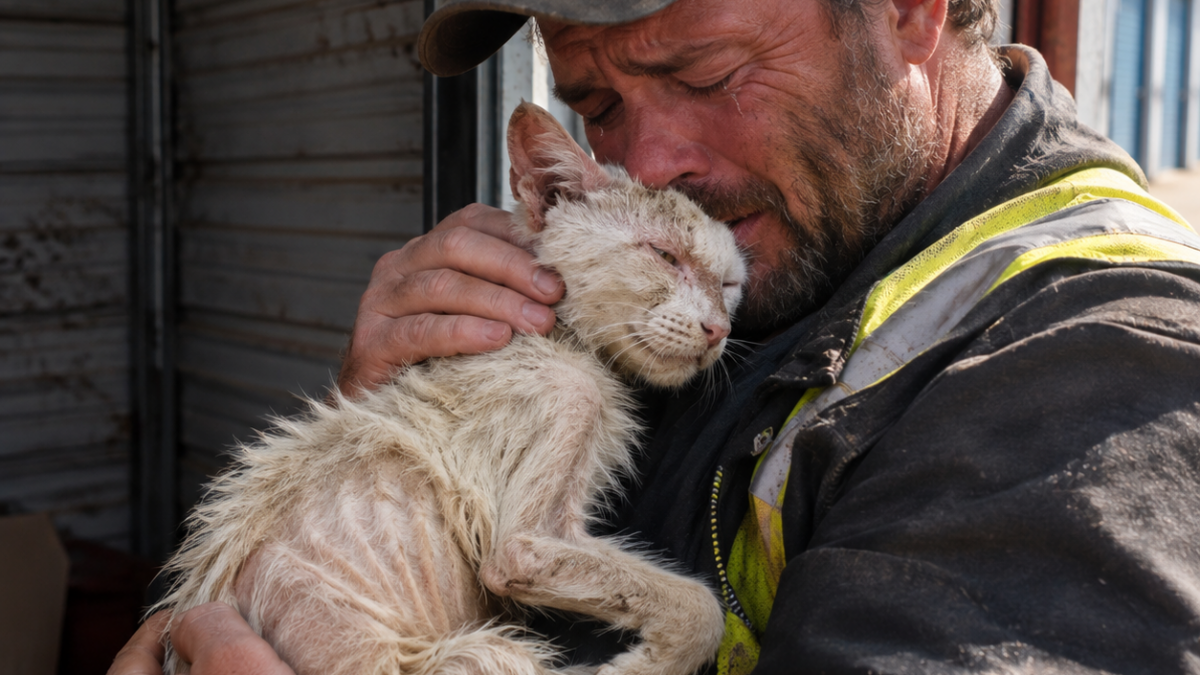
Then I saw him.
Far right corner.
On top of a flattened cardboard box.
White.
Or he had once been white.
Now his coat looked yellow-gray.
He was curled on his side.
Every bone visible.
His head rested on the cardboard.
His mouth opened.
Closed.
Opened.
Closed.
Click.
Click.
That was the sound.
His tongue moved weakly inside a mouth that was almost completely dry.
I stopped.
For years I had hauled freight through blizzards, tornado warnings, crashes, and heat waves.
I had seen things on highways I still don’t talk about.
But that cat made my knees feel weak.
“Oh, buddy.”
His eyes moved toward me.
Barely.
He couldn’t lift his head.
I crouched.
“Hey.”
His mouth opened again.
No sound.
Martin stood behind me.
“Jesus.”
I reached toward the cat.
Then stopped.
I didn’t know whether touching him would hurt.
His skin seemed stretched over bones.
“Call a vet.”
Martin pulled out his phone.
I took off my T-shirt.
I was wearing an undershirt beneath it.
I folded the shirt into a loose cradle and slid it beneath the cat.
He weighed almost nothing.
Later the veterinarian told me four-point-three pounds.
At that moment he felt lighter than my toolbox.
When I lifted him, his head rolled against my arm.
No resistance.
No fear.
He didn’t have enough strength left for either.
I carried him outside.
The sunlight seemed too bright for him.
His eyes closed.
Martin asked, “Water?”
“I don’t know.”
“Give him some.”
“Not yet.”
I had transported livestock feed before.
I’d heard enough about severely dehydrated animals to know that dumping water into them too quickly could cause problems.
I called the closest emergency veterinary clinic.
A woman answered.
I explained.
“Do not force water,” she said immediately.
“Bring him now.”
“How far?”
“Fourteen minutes.”
I made it in nine.
Martin followed in his SUV.
The cat lay wrapped in my shirt on the passenger seat.
At one red light, his mouth stopped clicking.
I panicked.
“Come on.”
I touched his ribs.
Movement.
Tiny.
“Come on, buddy. Stay with me.”
Green light.
I drove.
The veterinary hospital was called Sunflower Animal Emergency.
A technician was already waiting outside.
She opened my passenger door.
“Oh my God.”
Another technician brought a carrier stretcher.
They moved him carefully.
A veterinarian met us inside.
Dr. Hannah Reyes.
Early forties.
Dark hair pulled back.
Calm voice.
The kind of person whose calm makes everyone else realize how serious the situation is.
“How long was he trapped?”
I looked at Martin.
Martin swallowed.
“The eviction notice was August first.”
Dr. Reyes stopped.
“What date is today?”
“September seventeenth.”
She stared at us.
“Forty-seven days?”
Martin said quickly, “We don’t know that he was inside the whole time.”
Dr. Reyes looked at the cat.
Then back at him.
“Where else would he have gone?”
Martin had no answer.
They took the cat into treatment.
I stood in the lobby.
My hands were shaking.
Martin paced.
After five minutes he said, “I should go back.”
I looked at him.
“What?”
“I need to secure the unit.”
“You’re leaving?”
“What am I supposed to do here?”
I couldn’t believe him.
“There was a cat locked in one of your units for forty-seven days.”
“We don’t know that.”
“Stop saying that.”
Martin lowered his voice.
“You don’t know the circumstances.”
“I know the lock was rusting.”
“Cole.”
“I know the eviction notice was forty-seven days old.”
“The tenant abandoned the unit.”
“And the cat.”
“Maybe.”
“Maybe?”
People in the waiting room looked over.
Martin glanced around.
“This is not the place.”
“No. The place was your storage unit.”
He left.
I stayed.
An hour passed.
Then two.
Dr. Reyes finally came into the consultation room.
Her expression told me not to expect good news.
“He’s alive.”
I exhaled.
“But?”
“He is critically ill.”
She sat across from me.
“He’s severely emaciated. Severe dehydration. His kidneys are in acute distress. His liver values are abnormal. He’s anemic.”
“Can he make it?”
“I don’t know.”
“What do you need?”
She looked at me.
“Are you the owner?”
“No.”
“Facility owner?”
“No.”
“Do you know who owns him?”
“No.”
“Then technically we need authorization through animal control or whoever assumes financial responsibility.”
“I will.”
Dr. Reyes paused.
“What?”
“I’ll cover it.”
“You understand hospitalization may be expensive.”
“I said I’ll cover it.”
She studied me.
“Why?”
The question irritated me.
“Because he’s alive.”
She nodded once.
“All right.”
I called my sister to borrow money before I even knew the total.
Then I called my dispatcher and told him I wasn’t taking the run scheduled for Monday.
He said, “You sick?”
“No.”
“Family?”
“Sort of.”
I didn’t explain.
The first night, the cat received fluids slowly.
Very slowly.
Dr. Reyes was afraid aggressive rehydration could overwhelm his kidneys or heart.
They warmed him.
Monitored glucose.
Checked electrolytes.
Gave small amounts of nutrition.
He vomited the first feeding.
They stopped.
Tried again later.
He kept down less than a teaspoon.
I visited the next morning.
He looked worse.
That’s another thing people don’t understand about rescue.
Opening the door is not always the moment everything gets better.
Sometimes the body begins collapsing only after safety arrives.
Dr. Reyes explained it.
“He has been surviving in an extreme conservation state.”
“What does that mean?”
“His metabolism has slowed. His body has consumed fat reserves, then muscle. It has prioritized the brain, heart, and basic organ function.”
She looked through the glass of the oxygen kennel.
“He has essentially been dismantling himself to stay alive.”
I stared at him.
His head lay sideways.
“Forty-seven days.”
“I can’t prove he had no food whatsoever.”
“There wasn’t any.”
“You checked?”
“Nothing edible.”
“What about water?”
That question eventually took us back to the storage unit.
Animal control had become involved by then.
So had the sheriff’s department.
Not because locking a cat in a storage unit automatically became a criminal case.
They needed to establish ownership.
Intent.
Timeline.
What happened when Paul Renshaw was evicted.
Who knew the cat was inside.
And whether anybody had deliberately left him there.
An animal control investigator named Tessa Morgan met me at Prairie View.
Martin was there too.
He was suddenly very cooperative.
Probably because he had learned that television reporters had started calling.
One of the veterinary technicians had posted a vague message online about “a miracle cat rescued after weeks inside a storage unit.”
Wichita is not a small town, but stories travel quickly when animals are involved.
Martin unlocked Unit 66.
The smell remained.
Tessa put on gloves.
She photographed everything.
Boxes.
Mattress.
Old food packaging.
Litter.
There was a cat carrier near the back.
Blue plastic.
Door removed.
That mattered.
“Whoever put this stuff here owned a cat,” Tessa said.
Martin said nothing.
Near the carrier sat an empty cat food bag.
I felt anger rise.
“So he was left intentionally.”
Tessa held up one hand.
“Don’t jump ahead.”
“How else?”
“Evidence first.”
She searched.
No bowl with water.
No functioning container.
Nothing.
Then Dr. Reyes arrived.
She wanted to see the environment herself.
Within ten minutes she noticed the wall.
The north-facing wall.
“Look.”
At the bottom six inches of the metal panel were hundreds of faint marks.
Vertical.
Parallel.
Repeated.
I crouched.
At first they looked like scratches.
Then I noticed how low they were.
Four inches above the floor.
Maybe six at the highest.
Dr. Reyes touched the metal.
“What made these?”
Tessa photographed them.
I said, “Claws?”
Dr. Reyes shook her head.
“Wrong pattern.”
She ran her finger across the marks.
Then looked toward the concrete seam.
“There.”
A thin dark discoloration ran where metal met floor.
Tessa asked, “What?”
“Moisture line.”
The unit had been opened for hours now.
The wall was dry.
Dr. Reyes asked Martin, “Does this side get sun?”
“Morning maybe. Not much afternoon.”
“What are nighttime temperatures lately?”
“Sixties.”
“And daytime?”
“Nineties. August was over a hundred several times.”
Dr. Reyes nodded slowly.
I watched her thinking.
Then she said, “Condensation.”
We all looked at her.
“The interior gets extremely hot during the day. At night, cooler air and the shaded metal could create a small amount of surface moisture.”
Tessa crouched.
“Enough to drink?”
“Not normally.”
“For forty-seven days?”
Dr. Reyes looked at the scratches.
“He didn’t need normally.”
She pointed.
“These may not be claw marks.”
“What then?”
“Tongue abrasion.”
I stared at her.
“His tongue?”
“Repeated licking. Same spot. Night after night.”
The room seemed to shrink.
I looked at the wall.
Hundreds of tiny marks.
I imagined darkness.
Heat.
No food.
No water.
A cat lying on concrete waiting for the metal to cool.
Then licking.
Again.
Again.
Again.
I asked, “How much water could that possibly be?”
“Tablespoons.”
“That’s enough?”
“No.”
She looked toward me.
“It was enough not to die.”
That sentence followed me home.
It was enough not to die.
Not enough to be healthy.
Not enough to feel safe.
Not enough to stop suffering.
Only enough to make tomorrow possible.
The investigation became uglier over the next week.
Paul Renshaw was thirty-eight.
Divorced.
Had rented Unit 66 after losing his apartment.
He had used it to store furniture while staying with friends.
Records showed he had stopped paying in June.
Prairie View mailed notices.
Called him.
Sent emails.
On July 29, Martin visited the unit after another tenant complained about an odor.
He did not open it.
He taped an eviction notice to the door.
On August 1, the access code assigned to Paul was deactivated.
The unit was officially marked abandoned pending auction.
The problem was the cat.
His name, we eventually learned, had been Snow.
Paul had owned him since he was a kitten.
Photographs on social media showed a healthy white cat sleeping on couches, sitting on windowsills, and once wearing a red Christmas bow.
That hurt worse than if he’d always been neglected.
Somebody had loved him once.
At least enough to take pictures.
Tessa located Paul through his former employer.
At first he denied Snow had been in the unit.
Then investigators showed him the carrier.
The food bag.
Fur.
He changed his story.
He said Snow escaped while he was moving.
Then they showed him a text message.
It came from Paul’s ex-girlfriend.
July 28.
Did you get Snow out of storage yet?
His reply:
No. I’ll deal with it.
Another message.
July 30.
You can’t leave him there in this heat.
Paul replied:
There’s a gap under the door. He’s fine for now.
I read those words while sitting in Tessa’s office.
My hands went cold.
“He knew.”
“Yes.”
“He knew the cat was locked inside.”
“Yes.”
“Why didn’t he go back?”
Tessa looked tired.
“Paul says he lost his vehicle.”
“So?”
“He was staying twenty miles away.”
“Call somebody.”
“I know.”
“Uber.”
“I know.”
“Walk.”
“Cole.”
“For God’s sake, forty-seven days.”
Tessa let me be angry.
Then she said, “There’s more.”
Prairie View had called Paul on August 2.
Martin left a voicemail.
Your unit is in default. You need to remove any living animals immediately before access is permanently restricted.
Paul never responded.
I looked toward the window.
“So the facility knew too.”
“Possibly.”
“Not possibly.”
Tessa held up the report.
“The voicemail proves Martin raised the possibility of an animal.”
“Then why didn’t he open it?”
“That is what we’re asking.”
Martin’s explanation changed too.
First he said he had no reason to believe an animal was inside.
Then investigators obtained his voicemail.
He said he had smelled something and assumed a rodent or spoiled food.
Then why mention living animals?
“Standard language,” he said.
It wasn’t.
Former employees said no such standard language existed.
One woman named Teresa Mills, who had worked part-time for Prairie View until August, told investigators something worse.
On August 5, four days after the eviction notice went up, she heard scratching from Unit 66.
She told Martin.
“What did he say?” Tessa asked.
Teresa looked ashamed.
“He said the tenant had until auction day.”
“Did you tell him you thought there was an animal inside?”
“Yes.”
“What exactly did he say?”
Teresa swallowed.
“He said, ‘I’m not breaking a lock over a damn cat.’”
I had to leave the room.
I walked outside.
Stood beside my pickup.
Put both hands on the hood.
Forty-seven days.
Every hour of those forty-seven days changed after that statement.
Before, I could tell myself nobody knew.
A terrible accident.
A forgotten animal.
Miscommunication.
Negligence maybe.
But somebody had heard him.
Somebody knew.
Not every day.
Not everything.
But enough.
And still the door stayed closed.
I drove directly to the veterinary clinic.
Snow was still hospitalized.
He had survived nine days.
That itself amazed Dr. Reyes.
He was able to lift his head now.
Barely.
When I approached the kennel, his eyes opened.
Blue.
I hadn’t really noticed before.
“Hey, buddy.”
He watched me.
I opened the kennel under the technician’s supervision.
I put my hand inside.
Snow sniffed my finger.
Then rested his chin across my wrist.
That was all.
No purr.
No meow.
Just the weight of his head.
I sat there almost an hour.
A technician named Maya came in.
“You know he recognizes you.”
“You think?”
“He settles when you’re here.”
I smiled.
“Probably remembers I’m the idiot who opened the door.”
Maya looked through the kennel.
“You know what we’re calling him?”
“Snow?”
She shook her head.
“Latch.”
I laughed despite myself.
“Why?”
“Because Dr. Reyes kept saying, ‘the cat from the latched unit.’ It stuck.”
I looked at him.
“Latch.”
His ear twitched.
“That’s terrible.”
Maya smiled.
“It is.”
“Perfect.”
By the second week, Latch could sit upright for several seconds.
The first time he did, three technicians applauded.
He looked offended.
Dr. Reyes warned me not to celebrate too quickly.
Kidney values improved, then worsened.
His liver stabilized.
He developed diarrhea from refeeding.
He lost another two ounces.
Then gained one.
Then three.
His gums slowly changed from white to pink.
He began drinking from a shallow dish.
The first time I saw him drink, I had to leave.
I stood in the parking lot crying over a cat drinking water.
Forty-six-year-old truck driver.
Six foot two.
Two hundred pounds.
Crying because an animal could put his tongue into a bowl and take as much water as he wanted.
Nobody who saw me said anything.
Maybe they understood.
The criminal case moved forward.
Paul was charged under Kansas animal cruelty statutes for knowingly confining an animal without adequate food and water.
Martin faced separate charges and administrative penalties related to failure to act after being notified of an animal in distress, although his attorneys fought them aggressively.
Prairie View’s owner, a man named Gerald Price who lived in Arizona, tried to distance himself.
He said Martin was an independent property manager.
He blamed staff.
Staff blamed policy.
Policy documents suddenly appeared.
Then disappeared.
Reporters showed up.
People became very interested in responsibility once responsibility had a camera attached to it.
I hated all of them for a while.
Dr. Reyes told me anger was normal.
She was a veterinarian, not a therapist.
I told her that.
She said, “Animals teach you enough psychology whether you want it or not.”
One afternoon she asked if I planned to adopt Latch.
I stared at her.
“I drive a truck.”
“So?”
“Long distance.”
“So?”
“I can be gone five days.”
“So?”
“You’re the veterinarian.”
“And you’re avoiding the question.”
“I don’t know.”
She smiled.
“He already thinks you’re his person.”
“You can’t know that.”
“No.”
She glanced through the exam-room window.
“But he starts eating when you come in.”
I looked at Latch.
By then he weighed five-point-one pounds.
Still horrifyingly thin.
But alive.
“You’re manipulative.”
“I went to school for eight years.”
I started researching cat travel.
That is a sentence I never imagined saying.
Could cats ride in truck cabs?
Yes.
Some loved it.
Some hated it.
Could a kidney-disease cat travel?
Possibly, with veterinary supervision, stable routine, hydration, special food, and careful monitoring.
Could a middle-aged divorced truck driver who had never owned anything more demanding than a cactus become responsible for a medically complicated cat?
Unknown.
My sister Laura found the whole thing hilarious.
“You’re adopting him.”
“No.”
“You borrowed twelve hundred dollars from me for a cat.”
“I paid you back.”
“You canceled a run.”
“He was critical.”
“You visit every day.”
“Someone has to.”
“The clinic literally employs people for that.”
“Not the same.”
Laura smiled.
“There it is.”
“What?”
“Congratulations.”
“On what?”
“You have a cat.”
I hung up.
Latch came home with me on October 11.
Twenty-four days after I found him.
“Home” was a two-bedroom ranch outside Wichita that I had bought after my divorce.
It was tidy because I was rarely there.
No plants.
No clutter.
No children.
No pets.
The quiet had never bothered me before.
Latch arrived in a soft carrier with medications, prescription food, instructions, syringes for fluids, emergency numbers, and a follow-up appointment schedule longer than some trucking contracts.
I set the carrier in the living room.
Opened it.
Latch did not come out.
I waited.
Ten minutes.
Twenty.
An hour.
Finally, one white paw appeared.
Then his head.
He looked around.
The house must have seemed enormous after ten feet by ten feet.
He walked three steps.
Stopped.
Walked five more.
Stopped.
I sat on the floor.
“Take your time.”
Latch sniffed the rug.
The couch.
A table leg.
Then he walked toward the kitchen.
He found the water bowl.
And froze.
I watched him.
He lowered his head.
Drank.
Stopped.
Looked around.
Drank again.
For nearly two minutes.
Then he sat beside the bowl.
Just sat.
I don’t know what animals remember.
People like to assign human thoughts to them.
Maybe Latch did not understand storage units or eviction notices.
Maybe he had no concept of forty-seven days.
But for the first several weeks in my house, he always slept beside water.
Not beside me.
Not on the couch.
Not in the bed I’d bought.
Beside the water bowl.
Sometimes his paw touched it.
One night I moved it six feet into the kitchen because I kept nearly kicking it.
Latch woke me at 2:00 a.m.
Not meowing.
Clicking.
That sound.
Click.
Click.
Click.
I sat upright so fast I pulled something in my back.
He stood in the hallway opening and closing his mouth.
“Latch?”
I jumped out of bed.
He ran toward the place where the water bowl used to be.
Stopped.
Looked at the empty floor.
Then looked at me.
My chest cracked open.
“Oh, buddy.”
I carried him to the bowl.
He drank.
I never moved it again.
For months, I kept three bowls in the house.
Bedroom.
Kitchen.
Living room.
When we eventually traveled, I kept water within reach inside the truck.
Latch didn’t go on the road immediately.
My dispatcher gave me regional runs for several weeks.
Laura stayed at my house when I was gone overnight.
The first trip, Latch hid beneath the bed after I left.
The second, he waited beside the front door.
The third, Laura called me.
“You need to come home.”
“What happened?”
“He’s fine.”
“Then why?”
“He won’t eat.”
“He has to eat.”
“I know.”
“Try the chicken.”
“I did.”
“Warm it.”
“I did.”
“Put the kidney food underneath.”
“Cole.”
“What?”
“He’s sitting beside your boots.”
I went home early.
Latch ate ten minutes after I walked in.
Dr. Reyes was insufferably pleased.
“What were you saying about not being his person?”
“Don’t start.”
“I’m a medical professional.”
“You’re smug.”
“Also true.”
In December, after Latch reached seven pounds, we tried the truck.
Just sitting in it.
Engine off.
He sniffed everything.
Dashboard.
Sleeper bunk.
Passenger seat.
Cup holder.
Then found the case of bottled water stored behind my seat.
Of course.
The engine started.
Latch crouched.
I waited.
He did not panic.
We drove around the block.
Then five miles.
Then twenty.
By January, he went on his first overnight run to Oklahoma City.
I bought a harness.
He hated it.
I bought a small litter box that fit under the sleeper bunk.
He used it immediately.
I installed a secured water dispenser.
I bought a heated bed.
He ignored it and slept on my jacket.
Somewhere near El Reno, I realized I was talking to him.
“Fuel stop in forty miles.”
Latch looked out the passenger window.
“You don’t care.”
He blinked.
“I used to have normal conversations.”
He yawned.
“Rude.”
Truck stops loved him.
Especially once people heard his story.
I tried not to tell it too often.
Not because I was ashamed.
Because I didn’t want Latch to become only what happened to him.
He was not “the storage cat” inside my truck.
He was a cat.
He hated turkey but loved chicken.
He kicked litter aggressively enough to create environmental disasters.
He preferred sleeping on clean laundry.
He had an irrational hatred of one particular toll-booth speaker in Oklahoma.
He snored.
He stole the passenger seat.
He learned the sound of air brakes and stopped reacting.
He sat on the dashboard whenever we parked.
And he drank more water than any cat I had ever met.
The kidney damage never disappeared.
Dr. Reyes had warned me.
Some weeks were good.
Others weren’t.
Twice weekly, I gave him fluids beneath the skin.
The first time I tried, I nearly fainted.
Latch was calmer than I was.
“You’re okay,” I told him.
Dr. Reyes watched.
“He is.”
“I was talking to myself.”
“I know.”
By spring 2023, Latch weighed nine pounds.
His coat had turned white again.
Not bright white.
A little thin along his sides.
But clean.
Soft.
Alive.
That was enough.
The trial against Paul began in April.
I testified.
I did not want to.
But Tessa asked.
So did the prosecutor.
The courtroom was smaller than I expected.
Paul sat at the defense table wearing a gray suit.
He looked ordinary.
That bothered me.
I wanted someone who could leave a cat inside a storage unit to look obviously monstrous.
People rarely cooperate with that expectation.
He had short brown hair.
Wedding ring removed but pale line still visible.
A nervous habit of rubbing his thumb against his index finger.
When I took the stand, he would not look at me.
The prosecutor asked why I had been at Prairie View.
I explained.
“What first caught your attention?”
“A clicking sound.”
“Can you describe it?”
I swallowed.
“Like someone trying to swallow without spit.”
The courtroom became quiet.
“What did you discover?”
“A cat.”
“What condition was he in?”
I looked toward Paul.
“He couldn’t stand.”
“Could he vocalize?”
“No.”
“Could he lift his head?”
“No.”
“What happened after you removed him?”
“I drove him to Sunflower Animal Emergency.”
The prosecutor showed photographs.
Latch on the cardboard.
Latch at intake.
Ribs.
Sunken eyes.
Yellow coat.
I looked away.
Then came the photograph of the wall.
“What is this?”
“North wall of Unit 66.”
“What are those marks?”
“Dr. Reyes believed they were from him licking condensation.”
The prosecutor paused.
“Why would he lick a wall?”
I stared at Paul.
“Because somebody locked him somewhere without water.”
Defense objected.
Sustained.
The prosecutor rephrased.
“Why did you believe the moisture mattered?”
“It was the only water source we found.”
Paul finally looked at me.
I looked back.
I expected to feel rage.
I did.
But beneath it was something else.
Confusion.
How does a person reach a point where the suffering of a creature that trusted him becomes inconvenient enough to ignore?
The defense tried to argue Paul had intended to return.
Transportation problems.
Financial stress.
Housing instability.
Depression.
Alcohol misuse.
I believed some of it.
That’s the difficult part.
People can be struggling and still cause terrible harm.
One truth does not cancel the other.
Paul testified.
His attorney asked, “Did you intend for Snow to die?”
“No.”
“Did you love him?”
Paul’s face twisted.
“Yes.”
I felt sick.
“Why was he inside the unit?”
“I was staying with somebody who didn’t allow pets.”
“How long did you intend to leave him?”
“A couple days.”
“What happened?”
“My car died.”
“Then?”
“I lost my phone for a while.”
“Did you try to return?”
Paul stared down.
“No.”
“Why?”
“I don’t know.”
The prosecutor stood for cross-examination.
“Mr. Renshaw, your ex-girlfriend texted you on July 30 and told you the cat was in danger.”
“Yes.”
“You responded that he was fine because there was a gap under the door.”
“Yes.”
“You understood he was locked inside.”
“Yes.”
“You understood temperatures exceeded one hundred degrees.”
“Yes.”
“You understood there was no water source provided.”
Paul’s attorney objected.
The judge overruled.
Paul said, “There had been a bowl.”
“Was it full on July 30?”
“I don’t know.”
“Did you return to check?”
“No.”
“August first?”
“No.”
“August second?”
“No.”
“August fifth?”
“No.”
“August tenth?”
“No.”
The prosecutor continued through date after date.
It was brutal because it was simple.
August 15.
No.
August 20.
No.
September 1.
No.
September 10.
No.
September 17.
No.
Forty-seven days reduced to questions.
Each answer the same.
No.
Then the prosecutor asked, “What would have happened if Mr. Bennett had not rented Unit 64?”
Paul began crying.
“I don’t know.”
The prosecutor looked at him.
“I think you do.”
Paul eventually pleaded guilty before the case reached a final verdict.
The agreement included jail time, probation, fines, a prohibition on owning animals for several years, restitution for some veterinary expenses, and mandatory counseling.
People online said the punishment wasn’t enough.
Some wanted years.
Some wanted worse things I won’t repeat.
I understood the anger.
But hatred had already done enough.
Martin’s case ended differently.
Prosecutors could not prove he knew the cat remained alive throughout the entire period.
But the facility was cited for multiple code violations.
Its license and business practices were reviewed.
Gerald Price sold Prairie View within a year.
The new owners installed cameras, regular property inspections, emergency contact procedures, and a written rule requiring immediate investigation of any report of a trapped animal.
Martin was fired.
Teresa Mills, the former employee who had reported the scratching, cried when she called me after the hearing.
“I should’ve cut the lock.”
“You told him.”
“I could’ve done more.”
I knew that sentence.
I had said versions of it myself.
“What would you have risked?”
“My job.”
“Would you have lost it?”
“Maybe.”
I was quiet.
She whispered, “Forty-seven days.”
There was no comforting answer.
So I didn’t give one.
Sometimes regret deserves to remain uncomfortable.
Not forever as punishment.
Long enough to change what we do next.
Teresa later volunteered at Sunflower Animal Emergency.
She started one Saturday a month.
Then two.
She never told most people why.
Dr. Reyes knew.
So did I.
By summer, Latch had become something of a local celebrity.
I hated that phrase.
He did not.
Celebrity meant strangers brought him treats.
A radio station invited me for an interview.
I almost declined.
Then Tessa told me public attention had increased donations to animal rescue groups.
So I agreed.
The host asked predictable questions.
“How did you feel when you found him?”
“Bad.”
“Did you think he would survive?”
“No.”
“When did you decide to adopt him?”
“I apparently didn’t have a vote.”
The host laughed.
Then asked something better.
“What image stays with you?”
I knew immediately.
“Not him.”
The host seemed surprised.
“Not the cat?”
“The wall.”
“What about it?”
I described the scratches.
Hundreds.
Small.
Parallel.
Low to the ground.
The host went quiet.
“I went back once after the investigation ended,” I said.
“Why?”
“I needed to see it.”
“What did it look like?”
I thought for a moment.
“Like somebody had tried to write a message in a language no one understood.”
The studio became silent.
I continued.
“Every night that metal cooled enough for moisture to gather. Not much. Maybe tablespoons. Maybe less.”
I looked through the glass into the control room.
“Latch kept returning to the same spot.”
“Why?”
“Because it was there.”
The host waited.
I said, “That’s what people misunderstand about survival.”
“What?”
“Sometimes it isn’t brave.”
My throat tightened.
“It isn’t inspiring while it’s happening.”
I thought of Latch lying on cardboard.
“Sometimes survival is ugly and small.”
Nobody interrupted.
“It’s a mouth against a wall.”
A pause.
“A drop.”
Another.
“Then another.”
After the interview, a woman emailed the station.
Her name was Melissa.
She said she’d been sober eleven months.
She wrote:
When you talked about that cat going back to the same wall because it gave him just enough to make it through another night, I understood something about myself.
I thought surviving badly meant I was failing.
Maybe it just meant I was surviving.
I printed the email.
Kept it in my truck.
Not because I thought Latch was some symbol.
He was still a cat who knocked my sunglasses off the dashboard.
But sometimes what happens to one living thing helps another living thing explain itself.
I couldn’t dismiss that.
That fall marked one year since the rescue.
On September 17, 2023, I drove back to Prairie View.
It had new ownership by then.
New sign.
New cameras.
Fresh gravel.
I asked permission to enter Unit 66.
The new manager, a woman named Renee, knew the story.
She unlocked it.
Most of Paul’s belongings had been sold or discarded.
The unit was empty.
I stepped inside.
The metal door rolled down behind me halfway to block the afternoon sun.
The temperature changed instantly.
The room smelled like dust and steel.
I stood in the center.
Ten feet.
Ten feet.
That was all.
I took four steps from one wall to another.
Turned.
Four back.
For forty-seven days, this had been Latch’s world.
I crouched near the north wall.
The marks were still there.
Fainter.
But visible.
Hundreds of tiny scratches in the coating.
I ran one finger across them.
I had seen photographs.
That wasn’t the same.
I lowered myself onto the concrete.
Then lay on my side.
Exactly where Latch must have been.
The marks sat level with my face.
I imagined being too weak to stand.
Waiting all day for darkness.
Heat trapped inside the metal.
Then the temperature dropping.
The wall cooling.
A film of moisture forming.
Enough for a tongue.
One lick.
Another.
Another.
The thought was unbearable.
I stayed there a long time.
Renee eventually called from outside.
“You okay?”
“Yeah.”
I wasn’t.
I stood.
Before leaving, I photographed the wall one last time.
Later, I printed the photograph.
I almost hung it in my house.
Didn’t.
It felt wrong.
Latch didn’t need his worst place preserved where he slept.
Instead, I kept it inside a drawer.
I looked at it when I needed to remember something.
Not suffering.
Persistence.
There is a difference.
By late 2023, Latch traveled with me regularly.
Kansas.
Oklahoma.
Nebraska.
Colorado.
Missouri.
Arkansas.
He had a little bed in the sleeper cab.
Again, he rarely used it.
His favorite place was the passenger seat.
His second favorite was directly on whatever paperwork I needed.
At weigh stations, officers sometimes spotted him.
“That’s your co-driver?”
“He’s union.”
“Good worker?”
“Terrible.”
Latch blinked.
One officer in Nebraska said, “I know that cat.”
I sighed.
“Probably.”
“The storage cat.”
“His name is Latch.”
“Sorry.”
That mattered to me.
Maybe too much.
I did not want what happened to become his identity.
People do that with survivors.
They meet the tragedy before the person.
The cancer woman.
The veteran with PTSD.
The kid from the abusive home.
The addict.
The accident survivor.
The storage cat.
Survival can become another cage if everybody insists you live inside the story of what happened to you.
Latch wasn’t living there anymore.
He lived in my truck.
In my house.
On my clean shirts.
Under my blankets.
Beside three water bowls.
He had kidney disease.
He also had preferences.
Bad habits.
Routines.
A future.
That was the story I cared about.
In January 2024, his kidney numbers worsened.
I panicked.
Dr. Reyes didn’t.
“We expected fluctuations.”
“He’s drinking more.”
“That’s normal with chronic kidney disease.”
“He lost three ounces.”
“We adjust food.”
“What if it’s getting worse?”
“It will eventually.”
I hated her for saying it.
She knew.
“Don’t.”
“Cole.”
“He’s barely been alive a year.”
“He’s been alive almost six.”
“You know what I mean.”
“Yes.”
She took off her glasses.
“You rescued an animal with permanent organ damage.”
“I know.”
“You don’t get to love him only if I promise you unlimited time.”
I stared at the floor.
“That isn’t fair.”
“No.”
Her voice softened.
“Neither was the storage unit.”
I looked at Latch.
He sat on the exam table grooming one paw.
Dr. Reyes continued.
“You gave him time he wasn’t supposed to have.”
“No.”
She tilted her head.
“He took the condensation.”
I said it before I could stop myself.
“Excuse me?”
“He did the first forty-seven days.”
I scratched behind his ear.
“I just opened the door.”
Dr. Reyes smiled.
“Maybe that’s enough.”
That sentence stayed with me too.
Maybe opening the door is enough.
Not saving.
Not fixing everything.
Not undoing what happened.
Just opening the door when you find someone trapped.
Latch stabilized.
He gained the weight back.
By spring, he was nine-point-two pounds.
Dr. Reyes called him “handsome.”
I called him “expensive.”
He bit my finger.
Fair.
My life changed in quiet ways.
Before Latch, I volunteered for extra runs because I didn’t like being home.
I had been divorced eight years.
No kids.
My father was dead.
My mother lived in Arizona.
Laura had her family.
Driving gave me somewhere to be.
A reason not to notice how empty my house was.
Latch changed the math.
Now there was someone waiting.
Even when he traveled with me, home felt different because his things were there.
White fur on the couch.
Medication in the refrigerator.
Water bowls.
A scratching post he’d destroyed.
One ridiculous cat tree Laura bought him for Christmas.
I came home because home had become a place another creature recognized.
That may sound small.
Small things save lives too.
I learned that from a wall.
One night outside Amarillo, a storm forced me to stop early.
Rain slammed against the truck.
Lightning flashed across the flat horizon.
Latch was nervous.
He crawled into the sleeper.
I lay beside him.
Every time thunder hit, his body tensed.
“It’s okay.”
He pressed against me.
“You’re not trapped.”
Another boom.
I put my hand over him.
“Door opens.”
I don’t know whether he understood words.
But I said them anyway.
“The door opens now.”
His body slowly relaxed.
That became something I said often.
At home.
At the vet.
In the truck.
When he went into a carrier.
Door opens.
Maybe I was saying it for myself.
In August 2024, Prairie View’s new owner contacted me.
They were renovating several rows.
Unit 66 was being demolished.
She asked if I wanted anything before the wall panels were scrapped.
I knew immediately.
“The north wall.”
A pause.
“What?”
“The panel with the marks.”
“You want the whole wall?”
“One section.”
She thought I was crazy.
She wasn’t wrong.
A worker cut a square section approximately eighteen inches by eighteen inches from the lower panel.
I picked it up two days later.
It was heavier than expected.
Dull galvanized metal.
Hundreds of faint marks.
I put it in my garage.
For months, I did nothing with it.
Then a local animal welfare organization asked if I would speak at a fundraiser.
I refused.
They asked again.
I refused.
Dr. Reyes asked.
I agreed.
Manipulative woman.
The event raised money for emergency veterinary care for pets belonging to low-income owners.
I brought the wall section.
Not Latch.
He stayed home with Laura because crowds stressed him.
I placed the metal on a table.
People stared.
Some knew what it was.
Most didn’t.
When it was my turn, I told the story.
Then I held up the wall.
“This is what forty-seven days looks like.”
Nobody moved.
I showed the marks.
“He didn’t scratch trying to escape.”
I pointed lower.
“He licked.”
I explained condensation.
Heat.
Night cooling.
Tiny amounts of water.
Then I said something I had been thinking about for two years.
“We like survival stories after the survivor is safe.”
People listened.
“We turn them into inspiration because we know the ending.”
I looked at the wall.
“But while this was happening, there was nothing inspiring about it.”
My voice shook.
“There was a thirsty animal in the dark.”
I paused.
“That’s all.”
Nobody clapped.
Not yet.
“Don’t use his survival to make what happened seem less terrible.”
I looked around the room.
“The fact that he lived does not excuse the people who left him.”
Then I touched the metal.
“But don’t ignore what he did either.”
One night.
One drop.
One more morning.
“Sometimes that’s all survival is.”
When I finished, the room stood.
I hated that.
Latch would have hated it more.
He disliked applause.
The fundraiser raised almost sixty thousand dollars.
Part of it created an emergency boarding program for people facing eviction, hospitalization, domestic violence, or temporary homelessness.
The idea was simple.
Nobody should have to choose between losing housing and locking an animal somewhere unsafe.
They called the program Latch’s Door.
I objected.
They ignored me.
In its first year, Latch’s Door temporarily housed eighty-three animals.
Dogs.
Cats.
Rabbits.
One bearded dragon.
One extremely angry parrot named Earl.
One of the first people helped was a twenty-six-year-old woman named Jasmine whose landlord gave her seventy-two hours to leave after a plumbing collapse made her apartment uninhabitable.
She slept in her car.
Her two cats stayed with the program.
Three weeks later, Jasmine found housing.
When she picked them up, she cried.
She wrote me later.
I don’t know you, but someone told me the program exists because of your cat.
I was so close to giving mine away.
Thank you for opening a door you didn’t know I needed.
I printed that too.
My truck became full of letters.
People sent them through the rescue.
Survivors of addiction.
Eviction.
Illness.
Depression.
Abuse.
Prison.
Grief.
I didn’t answer most.
I didn’t know how.
What was I supposed to say?
Congratulations, my cat licked a wall and accidentally became motivational?
Instead, I read them.
Saved some.
And every night, I gave Latch his fluids.
By 2025, Dr. Reyes said his kidney disease had progressed to the next stage.
“He may have months.”
“Or?”
“Maybe longer.”
“How much longer?”
“You know I can’t answer that.”
“I hate that sentence.”
“I know.”
Latch was seven by then.
Maybe eight.
Nobody knew his exact birthday.
I chose September 17.
Not because it was the day he was born.
Because it was the day someone heard him.
Laura objected.
“You’re celebrating the day he almost died.”
“No.”
I put a tiny piece of cooked chicken on his plate.
“I’m celebrating the day he got another date.”
Latch ate the chicken.
That became his birthday.
Every September 17.
One year.
Two.
Three.
The third anniversary, we drove to the old storage site.
Not inside.
Just past it.
The buildings had been repainted.
New company name.
Unit 66 no longer existed.
Latch sat in the passenger seat.
I parked across the road.
He looked around.
No reaction.
Of course not.
For me, the place held forty-seven days.
For him?
Maybe smell.
Maybe sound.
Maybe nothing.
I was grateful.
“You don’t remember, do you?”
Latch began washing his paw.
“Good.”
I started the engine.
“We’ve got better places.”
We drove away.
I did not look back.
In February 2026, Latch stopped jumping onto the dashboard.
Then he stopped climbing onto the passenger seat without help.
I bought stairs.
He ignored them.
I lifted him.
He had lost weight again.
Eight pounds.
Then seven-point-six.
Dr. Reyes adjusted his medication.
Fluids increased.
He ate less.
But still traveled short routes.
Still drank.
Still slept beside me.
In May, I woke at 3:18 a.m. because of a sound.
Click.
Click.
Click.
My heart stopped.
“Latch?”
He was beside the bed.
Mouth opening.
Closing.
I turned on the light.
His water bowl was full.
He looked confused.
“Buddy?”
I carried him to the kitchen.
He didn’t drink.
I drove to the emergency clinic in sweatpants.
Dr. Reyes was not on duty.
Another veterinarian examined him.
His kidney values had crashed.
They hospitalized him.
I sat in the same waiting room where I had sat almost four years earlier.
Same walls.
Different chairs.
At 7:00 a.m., Dr. Reyes arrived early.
She found me.
“Cole.”
I knew.
“No.”
She sat beside me.
“No.”
“His kidneys are failing.”
“Fix it.”
“We can try another aggressive hospitalization.”
“Do it.”
She was quiet.
“Cole.”
“Do it.”
“We can.”
“Then why are you looking at me like that?”
“Because I need you to understand what we’re treating.”
“His kidneys.”
“No.”
Her eyes softened.
“We’d be treating your fear of losing him.”
I looked away.
“That’s not fair.”
“No.”
She always said that.
Never lied.
I hated her for it and loved her for it.
She continued.
“He’s nauseated. Weak. His blood pressure is falling.”
“What if he responds?”
“He could.”
“For how long?”
“Days. Maybe weeks.”
I covered my face.
Behind the treatment-room door, a dog barked.
Phones rang.
People walked.
The world continued doing what it does when yours stops.
Dr. Reyes said, “You opened the door for him once.”
I looked at her.
“Don’t.”
“You may need to open another one.”
I cried.
Not quietly.
Latch came home that afternoon.
Not because he was better.
Because I wanted his last night to happen somewhere without stainless steel.
I carried him into the house.
Set him beside the water bowl.
He sniffed it.
Drank once.
Then walked slowly to the living room.
He lay on my jacket.
Of course.
Laura came.
Tessa came.
Maya from the clinic came after her shift.
Dr. Reyes came the next morning.
Latch had not moved much.
Sunlight came through the window.
I sat on the floor.
He rested against my leg.
I had the metal wall section in the garage.
For some reason I thought about bringing it in.
I didn’t.
He did not need the wall.
I did.
I touched his head.
“You know, everybody thinks I saved you.”
Latch’s ear moved.
“Idiots.”
Laura laughed through tears.
I continued.
“You survived forty-seven days before I showed up.”
I scratched beneath his chin.
“All I did was hear you.”
His eyes closed.
I swallowed.
“I almost didn’t.”
That was the guilt I had never admitted.
I almost kept walking.
Almost loaded my equipment.
Almost drove home.
What if the clicking had been quieter?
What if music had been playing?
What if I had arrived an hour later when the heat made him stop?
Human lives are full of terrible small margins.
Two doors away.
One sound.
One decision to listen.
I pressed my forehead to his.
“I’m sorry it took so long.”
Dr. Reyes knelt beside us.
“You ready?”
“No.”
She waited.
Then I remembered Unit 66.
A door that stayed closed because everyone waited for someone else.
I would not make Latch wait for me now.
“Yes.”
She gave him a sedative.
His body relaxed.
For the first time in days, he looked completely comfortable.
I put one hand beneath his head.
Laura sat beside me.
Latch breathed slowly.
Dr. Reyes administered the final medication.
I whispered the words I had told him through every storm, every carrier ride, every veterinary appointment.
“Door opens.”
His chest rose.
Fell.
“Door opens now, buddy.”
Another breath.
Then none.
Latch died on June 4, 2026.
He had survived the storage unit by almost four years.
Four years the person who abandoned him had not intended to give him.
Four years of truck stops.
Chicken.
Snowstorms.
Water bowls.
Vet bills.
Clean laundry destroyed by cat hair.
Kidney food he pretended not to like until he realized there were no alternatives.
Four birthdays.
Thousands of miles.
Dozens of states.
A home.
A person.
I buried some of his ashes beneath a cottonwood behind my house.
The rest stayed in the truck.
Laura called that weird.
I told her to mind her business.
For weeks, I continued filling his water bowl.
Habit.
The first morning I realized what I had done, I stood in the kitchen holding the pitcher.
The bowl was already full.
No cat.
I sat on the floor.
Cried.
Then emptied it.
Not because I wanted to.
Because grief, like survival, happens in tiny actions.
Put the bowl away.
Wash the blanket.
Cancel the prescription delivery.
Remove the litter box.
One thing.
Then another.
People asked whether I would get another cat.
I said no.
Then six months later, Latch’s Door called.
A man had entered rehab unexpectedly.
His elderly orange cat needed temporary boarding.
No foster was available.
“Absolutely not,” I said.
The cat arrived that evening.
His name was Walter.
He was twelve.
Overweight.
Missing half an ear.
He hated trucks.
He slept beside the kitchen water bowl the first night.
I stared at him.
“You’re not staying.”
Walter yawned.
Six weeks later, his owner finished treatment and came to pick him up.
The man cried when Walter walked into his arms.
So did I.
Afterward, my house felt empty again.
But different.
Not hopeless.
Open.
A month later I started fostering.
Never more than one cat at a time.
Usually older ones.
Medical cases.
Animals people overlooked.
I did not adopt them.
At least that’s what I told Laura.
Then came a white kitten with kidney problems.
“Absolutely not,” I said.
Laura looked at me.
“You’re unbelievably stupid.”
The kitten climbed into my lap.
I named her Mercy.
Not because she replaced Latch.
Nothing could.
Replacement is another thing people misunderstand about love.
New love does not evict the old.
It moves in beside it.
The piece of metal from Unit 66 now hangs at the headquarters of Latch’s Door.
Behind glass.
I resisted that too.
Eventually, I agreed under one condition.
The plaque could not say miracle.
It could not say hero.
It could not say inspiring.
The final inscription reads:
FORTY-SEVEN NIGHTS.
WHEN THE WALL COOLED, A FEW DROPS OF WATER FORMED HERE.
A CAT RETURNED TO THIS SPOT AGAIN AND AGAIN UNTIL SOMEONE OPENED THE DOOR.
IF YOU HEAR SOMETHING, STOP.
IF YOU SEE SUFFERING, ACT.
DO NOT ASSUME SOMEONE ELSE WILL.
Sometimes I visit.
People stand in front of the wall.
They touch the glass.
Some cry.
I don’t.
Usually.
I know those marks too well now.
Hundreds of tiny vertical lines.
A language nobody understood until the door opened.
I think about Paul sometimes.
People ask if I forgave him.
That isn’t mine to do.
Latch was the one trapped.
I was just the man who found him.
Paul wrote me once from county jail.
The letter came through his attorney.
I almost threw it away.
Instead, I read it.
Cole,
I don’t expect you to respond.
I saw the story about the emergency boarding program.
I know saying I was going through a bad time sounds like an excuse.
It is.
Snow trusted me and I left him.
I kept telling myself I would go back tomorrow because admitting what I had already done was worse.
Every day I waited made it harder to go back.
Then enough days passed that I was afraid of what I would find.
So I kept not going.
I don’t know how to explain how a person becomes someone who does that.
I loved that cat once.
I know nobody believes me.
You don’t have to.
Thank you for giving him the life I should have.
I read it three times.
Then put it in the drawer beside the wall photograph.
I never answered.
Not every apology needs an audience.
Not every regret earns reconciliation.
But I believed one sentence.
Every day I waited made it harder to go back.
That is how many terrible things grow.
Not from one giant act of evil.
From avoidance.
Tomorrow.
Someone else.
Not my responsibility.
Probably fine.
I don’t want to know.
Forty-seven days can be built that way.
One tomorrow at a time.
That lesson changed me.
On the highway now, I stop.
Dog near an exit ramp?
I stop.
Animal carrier abandoned near a dumpster?
I stop.
Strange sound behind a building?
I stop.
Once it was just a raccoon.
Another time, somebody’s escaped chicken.
A few drivers make fun of me.
I don’t care.
I know what almost walking past feels like.
I will carry that for the rest of my life.
Sometimes on long runs, especially through western Kansas, the road gets so empty that it seems like the whole world has narrowed to headlights and asphalt.
I think about that metal box.
Ten feet by ten feet.
Darkness.
Heat.
A north-facing wall.
I imagine Latch during the first night.
Maybe he expected Paul to return.
Second night.
Third.
Maybe he cried then.
Maybe he scratched the door.
Maybe he spent hours near the gap beneath it.
We never knew.
By the final weeks, he had stopped wasting energy.
No claw marks near the door.
No destroyed boxes.
He simply lay near the wall.
Waited for night.
Waited for the metal to cool.
Then reached.
That’s the part I cannot forget.
He reached.
Even when standing became impossible.
Even when no one answered.
Even when every reasonable piece of evidence suggested nobody was coming.
He reached for the little thing that still existed.
A drop.
Then another.
Sometimes people hear that and say Latch refused to give up.
I don’t know if animals understand giving up.
Maybe he was thirsty.
Maybe instinct moved his tongue.
Maybe survival does not require philosophy.
I actually prefer that.
Because hope is often romanticized.
People imagine hope as confidence.
As believing everything will work out.
Latch had no reason to believe that door would open.
Hope, if we want to call it that, was not believing rescue was coming.
It was licking the wall anyway.
Years after I found him, Dr. Reyes and I had coffee.
She had kept one photograph from his case.
Latch three months after rescue.
White coat returning.
Nine pounds.
Sitting beside me in the clinic.
“You know,” she said, “I genuinely didn’t think he would make the first night.”
“You never told me.”
“You were already a wreck.”
“Professional.”
“I try.”
I asked her the question again.
“How did he survive?”
She smiled.
“You still want an answer?”
“Yes.”
“I don’t have one.”
“Metabolic shutdown?”
“Probably helped.”
“Condensation?”
“Absolutely.”
“Temperature drops?”
“Yes.”
“Anything else?”
She shrugged.
“Biology is messy.”
I looked at her.
“That’s your scientific explanation?”
“Sometimes.”
Then she became serious.
“You want survival to have a formula.”
“Would be nice.”
“It doesn’t.”
She stirred her coffee.
“Two animals in identical conditions can have different outcomes.”
“Why?”
“Genetics. Health. Stress response. Random physiology.”
She paused.
“Chance.”
I hated that word.
Dr. Reyes knew.
“Chance doesn’t make his survival less meaningful.”
“No.”
“It makes it less controllable.”
We sat quietly.
Then she asked, “Still driving?”
“Three days a week now.”
“Why cut back?”
“Latch’s Door hired me.”
She smiled.
“To do what?”
“Transport coordinator.”
Dr. Reyes laughed.
“You quit trucking for cats?”
“Half quit.”
“I need to tell the man who brought me a skeleton wrapped in his T-shirt four years ago.”
“Don’t.”
“He’ll never believe it.”
“He was an idiot.”
“He was.”
I smiled.
“Still is.”
By late 2026, Latch’s Door had expanded across three Kansas counties.
Not huge.
Not famous.
Just useful.
That mattered more.
We worked with shelters, hospitals, domestic violence organizations, reentry programs, and housing agencies.
When someone faced a crisis and had nowhere safe for an animal, we tried to make room.
Not forever.
Just until the next door opened.
A week.
A month.
Sometimes longer.
We had one rule printed above the dispatch desk.
NO ANIMAL GETS LEFT BEHIND BECAUSE A HUMAN LIFE FELL APART.
That rule came from Latch.
Not because his story was unique.
Because it wasn’t.
That is what scared me.
He was only the one I happened to hear.
There are thousands of locked doors.
Garages.
Cars.
Apartments.
Backyards.
Sheds.
Homes where elderly people are hospitalized suddenly.
Homes where people are evicted.
Homes where addiction takes over.
Homes where money disappears.
Homes where somebody means to come back tomorrow.
Most do.
Some don’t.
Programs like ours exist for the gap between love and ability.
Because sometimes people love their animals and still cannot care for them in a crisis.
Love is important.
It is not food.
It is not water.
It is not veterinary treatment.
It is not an open door.
Actions are.
That may be the hardest lesson in Latch’s story.
Paul said he loved Snow.
I believe he probably did once.
But when Snow needed food, water, and a person willing to return, love in Paul’s memory did nothing.
A few drops on a metal wall did more.
That does not mean love is meaningless.
It means love must become behavior.
Open the door.
Make the call.
Ask for help.
Tell somebody.
Stop the truck.
Listen twice.
One September afternoon, exactly four years after I heard the clicking, I drove past the old Prairie View site with Mercy asleep in the passenger seat.
She was almost a year old.
White fur.
Blue eyes.
Far too confident.
Nothing like Latch except the color.
I parked briefly.
The sky looked almost identical to the day I found him.
Huge.
Blue.
Hot.
Kansas fields stretching flat in every direction.
I thought about going inside.
Didn’t.
There was nothing I needed from Unit 66 anymore.
The wall was gone.
The lock was gone.
The eviction notice was gone.
Even the old gravel had been replaced.
Places change.
That’s good.
I touched the small urn mounted securely behind my sleeper cab.
A ridiculous thing, probably.
Then looked at Mercy.
“You would’ve hated him.”
She blinked.
“He would’ve hated you too.”
She yawned.
“Perfect.”
I started the engine.
As I pulled onto the road, a memory came back so clearly that for a second I could hear it.
Click.
Click.
Click.
I gripped the steering wheel.
Then the sound disappeared beneath the diesel engine.
For years, that noise had been the worst sound I knew.
Now I hear something else inside it.
Not suffering.
Not exactly.
A signal.
Weak.
Almost gone.
But still there.
Somebody is here.
Something is alive.
Please stop.
And somebody finally did.
People often ask why I named him Latch instead of keeping Snow.
The truth is I didn’t choose it carefully.
It happened.
But later I realized the name fit for a reason I never expected.
A latch is a small thing.
Not a wall.
Not a door.
Just the piece that keeps the door from opening.
For forty-seven days, one small piece of metal separated Latch from everything he needed.
Water.
Food.
Air.
Help.
The world.
Then another small thing changed everything.
A sound.
A man stopping.
A phone call.
Bolt cutters.
The door lifting.
That’s what I think about now.
Big suffering can be held in place by small failures.
And sometimes interrupted by small acts.
No one person can rescue everything.
I know that.
Truck drivers especially understand distance.
There is always another road.
Another town.
Another problem beyond the horizon.
But you do not have to rescue everything to rescue what is directly in front of you.
You can stop once.
Listen once.
Open one door.
Latch survived forty-seven days without anyone doing that.
He should never have needed to.
His survival was extraordinary.
The circumstances that required it were not.
That distinction matters.
I still have the notebook from his medical treatment.
Weight.
Four-point-three pounds.
Temperature.
Low.
Kidney values.
Critical.
Hydration.
Severe.
Prognosis.
Guarded.
Page after page.
Then slowly:
Five pounds.
Six.
Seven.
Eating independently.
Drinking.
Walking.
Discharged.
Stable.
Nine pounds.
Chronic kidney disease.
Good quality of life.
The final page contains a note Dr. Reyes wrote after he died.
June 4, 2026.
Latch passed peacefully at home with Cole.
Loved until the end.
I used to think the most important words were “passed peacefully.”
After everything he’d endured, peace mattered.
But now I think the last four matter more.
Loved until the end.
Because beginnings cannot always be repaired.
Somebody failed him.
Somebody left him.
Somebody else heard him too and chose not to act.
Forty-seven days were taken from him.
Nothing restores those days.
Justice doesn’t.
Adoption doesn’t.
Love doesn’t.
You cannot reach backward and put water in the empty bowl.
You cannot open yesterday’s door.
All you can do is decide what happens after it opens.
Latch got nearly four years.
I wish he’d had forty.
I wish he’d never known that storage unit.
I wish his kidneys had healed.
I wish the first person who heard him had acted.
I wish Paul had come back on day one.
There are a lot of wishes in rescue.
Eventually you have to live inside what actually happened.
Latch lived.
He traveled.
He became difficult.
He became loved.
He became old before his time.
He died safe.
The wall no longer held him.
And somewhere in an office in Wichita hangs the piece of metal that kept him alive just long enough for a truck driver two doors away to hear a sound he almost ignored.
Hundreds of marks.
Tiny.
Parallel.
No words.
No message.
But when I look at them now, I know exactly what they say.
Not “save me.”
Not “help.”
Not even “I’m still here.”
Something simpler.
Again.
Again.
Again.
One more lick.
One more drop.
One more night.
Again.
Until footsteps stopped outside.
Until a voice said, “Hey.”
Until bolt cutters snapped through rusted metal.
Until daylight entered that room.
Until hands lifted a four-pound body from cardboard.
Until water came in a bowl instead of on a wall.
Until a house became home.
Until highways replaced ten feet of concrete.
Until a cat who had spent forty-seven days with nowhere to go eventually traveled thousands of miles beside someone who never wanted him to be alone again.
That is how I remember Latch.
Not inside the storage unit.
Not starving.
Not clicking his dry mouth in the darkness.
I remember him on the passenger seat of my truck somewhere west of Salina, afternoon sunlight across his white coat, one paw hanging over the edge, a bowl of clean water secured two feet away.
Outside the windshield, Kansas stretched all the way to the horizon.
Nothing locked.
Nothing closed.
Just road.
And for the first time in his life, more places to go than he could ever possibly reach.


