A Tired Nurse Climbed Into the Wrong Car and Asked for a Ride Home—She Had No Idea the Driver Was Chicago’s Most Feared Mob Boss
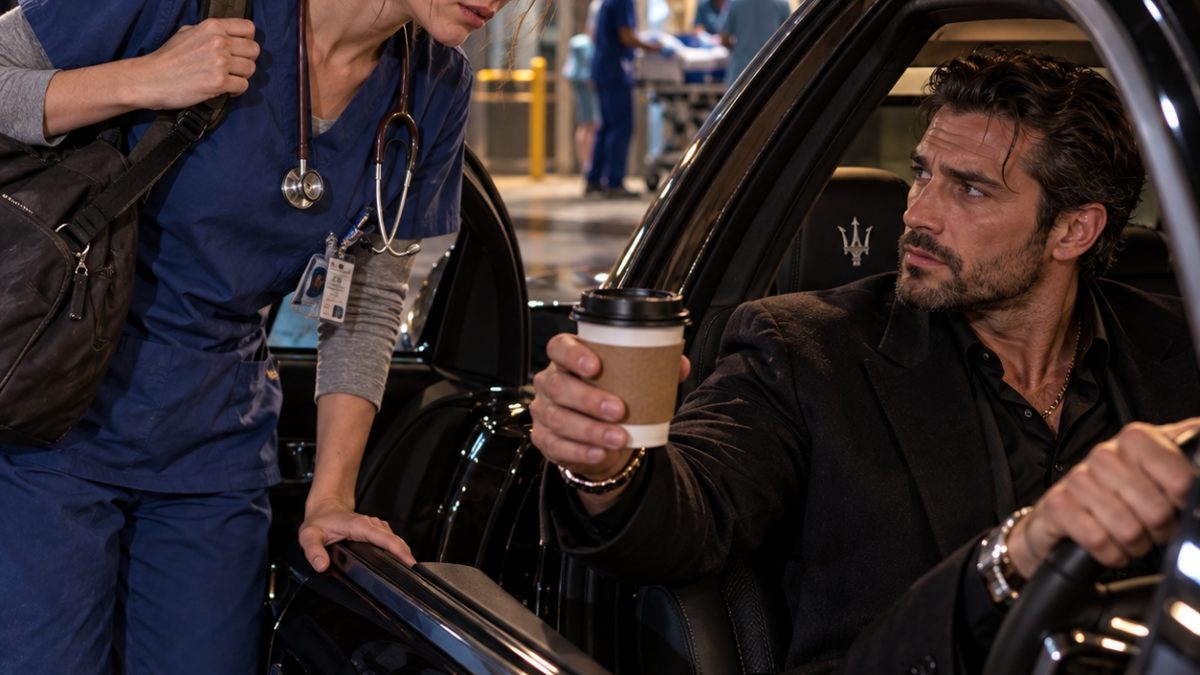
A Tired Nurse Climbed Into the Wrong Car and Asked for a Ride Home—She Had No Idea the Driver Was Chicago’s Most Feared Mob Boss.
I had been awake for twenty hours when I climbed into a black sedan outside St. Catherine’s Hospital, dropped my bag at my feet, closed my eyes, and whispered to the stranger behind the wheel, “Please. Just drive me home.”
I thought he was the rideshare driver I had ordered, so when the man quietly handed me an orange juice, told me coffee was not food, and refused to start the car until my hands stopped shaking, I was too exhausted to notice the two armed men standing fifty feet away staring at us like they had just witnessed a miracle.
Then my phone lit up with a text from another nurse—NINA, YOUR UBER IS STILL OUTSIDE—and the man beside me said his name was Luca Marchetti, a name half of Chicago knew well enough to cross the street when they heard it, while I sat frozen in the front passenger seat no one had been allowed to touch for six years.
My name is Nina Kowalski.
At the time, I was thirty-three years old, an emergency and trauma nurse at St. Catherine’s Medical Center in Chicago, daughter of a retired city-bus mechanic, owner of exactly four decent pairs of scrubs, and deeply convinced that caffeine qualified as a major food group.
It was 4:07 on a Thursday morning.
Technically Friday.
Hospital time makes days irrelevant.
If you have ever worked nights, you understand.
A shift starts on Wednesday.
Someone codes Thursday.
You leave Friday.
Your body believes it is still Tuesday.
I had picked up an extra eight hours because two nurses called out and because I was incapable of saying no when charge nurse Denise Parker looked at me with the expression she reserved for staffing disasters.
“Nina.”
“No.”
“I haven’t asked.”
“Your face asked.”
“Maria’s kid has the flu.”
“I’m already at twelve.”
“We need four.”
“Denise.”
“You love me.”
“I barely tolerate you.”
“Four hours.”
It became eight.
Because four hours later, a nineteen-car pileup on the Kennedy Expressway sent six patients to our emergency department.
Then at 1:12 a.m., the trauma phone rang.
Thirty-two-year-old male.
Gunshot wounds.
Two to the right flank.
PART2:
One graze across the upper arm.
Blood pressure collapsing.
Chicago police already en route because the shooting happened at a red light and whoever did it had apparently followed the victim for several blocks.
The patient arrived surrounded by men who did not look like family but behaved like soldiers.
Dark coats.
Hard faces.
No one shouting.
No one crying.
They simply positioned themselves outside Trauma Bay Seven and refused to leave.
Security called administration.
Administration called police.
Police arrived and suddenly everybody seemed to recognize everybody except me.
I was too busy keeping a man alive.
PART3:
His name was Tommy Russo.
Thirty.
Maybe thirty-one.
Dark hair.
Expensive shirt cut away in seconds.
Two bullets through the side.
One had torn through bowel.
The second had done worse.
Dr. Patel called for surgery.
Blood went up.
Pressure came down.
Then up.
Then down again.
Tommy regained consciousness once.
His hand found my wrist.
“Boss?”
“You’re in the hospital.”
“Luca?”
“I don’t know Luca.”
His fingers tightened.
“Tell him…”
“What?”
His eyes unfocused.
“Didn’t…”
Then he lost consciousness.
I shouted for anesthesia.
That was the last thing I thought about until nearly three hours later.
By 3:48, Tommy was upstairs.
Surgery.
Stable enough to move.
I entered the break room.
Opened the refrigerator.
Found nothing belonging to me.
Remembered I had brought no food.
Drank coffee.
Denise saw me.
“What did you eat?”
“Coffee.”
“Coffee is not food.”
“Tell my stomach.”
“You look terrible.”
“Thank you.”
“Go home.”
“I was planning to.”
“Do not drive.”
“I didn’t drive.”
“Good.”
I ordered a rideshare.
Black sedan.
Five minutes.
I changed out of my bloody scrub jacket.
Kept the rest.
Threw on a winter coat.
Walked through the employee exit.
Chicago at four in the morning has a strange honesty.
The city is not asleep.
Cities like Chicago are never asleep.
But they stop performing.
Traffic lights change for empty streets.
Snow along curbs turns gray.
Delivery trucks own downtown.
People who work while everybody else sleeps move through side entrances carrying coffee and keys.
A black sedan idled outside.
My app said black sedan.
I opened the rear door.
Locked.
I frowned.
Front passenger door opened.
That should have been my first clue.
I got in.
Dropped my backpack.
Closed my eyes.
“Avondale.”
Silence.
“Belmont.”
Still silence.
“Over the laundromat.”
I leaned my head back.
“Please.”
My voice sounded pathetic even to me.
“Just drive me home.”
The man beside me did not answer.
I heard movement.
Then:
“What did you eat today?”
I opened one eye.
The driver did not look like any rideshare driver I had ever met.
Maybe forty.
Forty-one.
Dark charcoal coat.
Black shirt.
No tie.
Hair beginning to gray at the temples.
Strong nose.
One scar near his left eyebrow.
Watch expensive enough that even I recognized quality.
His hands rested lightly on the steering wheel.
They were shaking.
Not dramatically.
Very slightly.
I noticed because nurses notice hands.
Hands tell the truth before faces do.
“Coffee,” I answered.
He looked at me.
“Coffee isn’t food.”
“You sound like my charge nurse.”
He opened the center console.
Pulled out a small bottle of orange juice.
Handed it over.
I stared.
“Do I look five?”
“You look hypoglycemic.”
“That’s very medical of you.”
“You’re shaking.”
“So are you.”
His hands stopped immediately.
Interesting.
He nodded toward the juice.
“Drink.”
“Are you always this bossy?”
“Yes.”
I was too tired to be intimidated.
I opened it.
Drank half.
“Finished?”
“No.”
“All of it.”
I drank the rest.
Then he checked his watch.
“You don’t drive for fifteen minutes.”
“I’m not driving.”
He looked at me.
I looked at him.
Neither spoke.
Then my phone buzzed.
Text from Denise.
WHERE ARE YOU?
I typed:
CAR.
Another message appeared.
YOUR DRIVER IS STILL OUTSIDE.
I stared.
Then slowly opened my rideshare app.
A blue marker sat half a block behind us.
Driver: Hassan.
Toyota Camry.
License plate ending 531.
I looked around the interior of the car.
Leather.
Custom dashboard.
No rideshare placard.
No phone mount.
No charger cables.
No tiny tree air freshener.
I looked at the man.
“This isn’t my ride.”
“No.”
My stomach dropped.
He said it calmly.
Almost kindly.
I reached for the door handle.
“Relax.”
“That’s usually something kidnappers say.”
For the first time, his mouth twitched.
“Fair.”
“Who are you?”
Before he answered, somebody knocked on his window.
I jumped.
A broad man stood outside.
Late forties.
Heavy coat.
Neck like concrete.
The driver lowered the window two inches.
“Boss.”
Boss.
Wonderful.
“Say the word,” the man outside said.
His eyes flicked toward me.
Suspicion.
Shock.
Something else.
The driver said:
“Easy, Gus.”
Gus stared at me.
Then at the seat.
“Boss…”
“I said easy.”
Gus stepped back.
I whispered:
“Why is he looking at me like I stole something?”
The driver stared through the windshield.
“Because nobody has sat in that seat in six years.”
I looked down at the passenger seat.
“You know whose car you just got into?”
“No.”
He turned toward me.
“Luca Marchetti.”
The name landed.
Hard.
Even I knew it.
Marchetti.
Construction.
Restaurants.
Private clubs.
Trucking.
Rumors.
Grand juries.
Federal investigations that produced headlines but rarely convictions.
My mother watched local news religiously.
I could hear her voice.
Nina, that man is connected.
Connected.
Chicago’s favorite polite word.
I stared at him.
“You’re Luca Marchetti.”
“So I’ve been told.”
I reached for the handle again.
He said:
“Your patient is still in surgery.”
I froze.
“Tommy?”
His face changed.
Barely.
“Yes.”
“You know him.”
“He’s family.”
That explained the men outside Trauma Seven.
His phone buzzed.
He looked at it.
OUT OF SURGERY. STABLE.
His shoulders dropped perhaps half an inch.
I noticed.
He noticed me noticing.
“Better?” I asked.
“Yes.”
“Good.”
Silence.
Then he started the engine.
“Where?”
“Excuse me?”
“You asked me to drive you home.”
“That was before I knew I had climbed into organized crime.”
That almost made him smile.
“My actual driver is back there.”
“You’d rather explain why you canceled after he waited?”
I looked behind.
The poor man was still parked.
I sighed.
“Avondale.”
“Street?”
“Belmont.”
“Over a laundromat.”
“I got that part.”
We drove.
Gus followed in another vehicle.
Of course.
I rested my head against the window.
“Why do you sit up front?”
He glanced over.
“I get carsick in the back.”
That made me laugh.
A real laugh.
At four fifteen in the morning.
I laughed so hard I had to cover my face.
“What?”
“Nothing.”
“You’re laughing at me.”
“Yes.”
“Why?”
“The terrifying Luca Marchetti gets carsick.”
“I have inner ears like everyone else.”
“Tragic.”
I closed my eyes.
The car was warm.
Orange juice helped.
Everything became heavy.
The next thing I knew, he was saying:
“Nina.”
I opened my eyes.
My building was outside.
I looked at the clock.
4:43.
We had been driving nearly thirty minutes.
My apartment was twelve minutes from the hospital at that hour.
I frowned.
“That’s four times past Lincoln Park Zoo.”
“Three.”
“You got lost?”
“No.”
“Then why?”
“You fell asleep.”
“So?”
“You looked like you needed twenty minutes.”
I stared at him.
“I drooled in your car?”
“No.”
“Are you lying?”
“Yes.”
I groaned.
“Sorry.”
He shrugged.
“It’s not my seat.”
That was a strange thing to say.
Before I could ask, Gus opened my door.
I climbed out.
Then turned back.
“Mr. Marchetti.”
“Luca.”
“No.”
His mouth twitched.
“Thank you.”
“You don’t owe me.”
“I got into your car.”
“You were tired.”
“I fell asleep.”
“You work in a hospital.”
“I probably drooled.”
“Extensively.”
I narrowed my eyes.
“Keep juice in this car.”
He looked confused.
“You’re going to need it again.”
“Why?”
“Because you don’t eat either.”
His face changed.
I had seen it.
Hands.
Shaking.
He looked away.
“Goodnight, Nurse Kowalski.”
I looked at the brightening sky.
“It’s morning.”
Then I went upstairs.
My mother was awake.
Of course.
We shared the apartment.
Temporary arrangement that had lasted six years.
Her name was Helena Kowalski.
Sixty-one.
Former school cafeteria manager.
Currently part-time cleaner at a legal office.
She was sitting at the kitchen table wearing a robe and reading mail.
“You’re late.”
“Trauma.”
“Eat.”
“Mom.”
She slid toast toward me.
I ate.
Then saw a red envelope beside her.
Loan reminder.
Friday auto-payment.
My father’s heart.
That was what I called it.
Six years earlier, Dad collapsed on a downtown train platform.
Heart attack.
Massive.
There was security footage.
I watched it once.
Thirty-two people walked around him before one woman stopped.
Thirty-two.
I counted.
The stranger called 911.
Dad survived.
Barely.
Triple bypass.
Rehabilitation.
Medication.
Insurance covered a lot.
Not enough.
He died two years later from another cardiac event.
The remaining medical debt became a second inheritance.
Mom and I paid every month.
Never missed.
Sometimes I took extra shifts.
Sometimes she cleaned offices at night.
“Kowalskis pay what they owe,” she always said.
That morning I pointed at the reminder.
“I can pick up another night.”
Mom looked at me.
“Nina.”
“What?”
“You’re thirty-three.”
“Excellent observation.”
“You worked twenty hours.”
“Today.”
“Yesterday.”
“Whatever.”
She folded the letter.
“We pay our way.”
“I know.”
Neither of us knew someone else would try to change that.
I slept five hours.
Returned to St. Catherine’s that evening.
Tommy Russo was still in surgical ICU.
Stable.
Critical.
And his people were still outside.
Four days passed.
They rotated.
Never left the corridor empty.
Nobody got inside alone with Tommy.
Not even hospital staff unless security knew.
It made our jobs miserable.
On day four, I pushed my crash cart toward his room and found two enormous men blocking the hallway.
“You.”
They looked at me.
“You’re standing in front of my crash cart.”
No movement.
“Out.”
One blinked.
“Ma’am?”
“This has epinephrine.”
“What?”
“If somebody dies because you blocked it, I’m listing both your names in the chart.”
They moved.
Someone laughed behind them.
I turned.
Luca.
No coat this time.
Dark sweater.
He looked less frightening.
Not harmless.
Different.
“You let them talk to you like that?” I asked.
One of the men said:
“He doesn’t listen to anybody, ma’am.”
Luca looked at me.
“He’s listening to you.”
“Then he’s trainable.”
One man snorted.
Luca ignored him.
“You eat today?”
“Breakfast.”
“Actual breakfast?”
“Yes.”
He looked suspicious.
“Eggs?”
“Toast.”
“That’s not breakfast.”
“Coffee isn’t either.”
“Fair.”
A food-service cart appeared.
Boxes.
Cannoli.
Cookies.
Fruit.
Coffee.
One of his men said:
“Professor brought pastries.”
I looked at Luca.
“Professor?”
He sighed.
“Don’t.”
An older man stepped from behind the cart.
Silver hair.
Round glasses.
Brown overcoat.
Warm smile.
“Cannoli for the nurses.”
I liked him immediately.
“Nobody brings nurses anything.”
“Then everyone is poorly raised.”
He extended his hand.
“Arthur Kane.”
“Nina Kowalski.”
His eyes sharpened.
“The nurse who got into Luca’s car.”
“Wrong car.”
“Of course.”
“I assume all of Chicago knows.”
“Only half.”
He laughed.
“I kept the books for Luca’s father.”
He glanced toward Luca.
“And now for him.”
Luca said:
“You make me sound like a corporation.”
Arthur smiled.
“You are less organized than a corporation.”
The men laughed.
Luca did too.
Arthur felt safe.
That would matter.
Two days later, he found me near the hospital elevators.
“Careful whose car you climb into, dear.”
I smiled.
“So I’ve learned.”
Then I saw Luca near the nurses’ station.
Standing still.
Watching me.
When I approached, he said:
“I’ve been standing here twenty minutes trying to figure out how people say this.”
“Say what?”
“Breakfast.”
I waited.
“With me.”
“Is that a complete sentence?”
“Usually I tell people where to be.”
“That explains why you’re struggling.”
He stared.
I almost smiled.
He tried again.
“Would you have breakfast with me?”
Bus stop visible through the lobby doors.
I pointed.
“Right there.”
“What?”
“I’ve had enough of your car for one week.”
He smiled.
“Tomorrow?”
“I work.”
“Friday?”
“Maybe.”
We ended up at a diner at 7:15 Friday morning.
No entourage inside.
Gus waited outside.
Luca ordered black coffee.
I ordered pancakes.
He watched.
“What?”
“You lecture people about food and order coffee.”
“I ate earlier.”
“Liar.”
His hands moved around the cup.
Steady now.
I asked:
“What happened to your hands that night?”
He went still.
“How did you know?”
“Faces lie.”
“Hands don’t.”
He looked toward the window.
“My father used to say that.”
“So did mine.”
“What did he do?”
“Fixed buses for the city for thirty years.”
I smiled.
“He could tell who was hungover, scared, getting divorced, or about to quit by looking at their hands.”
Luca looked down.
“Smart man.”
“He collapsed on a train platform.”
I had not planned to tell him.
But continued.
“Heart attack.”
“Thirty-two people walked around him.”
Luca looked at me.
“I counted on the security video.”
“Thirty-two.”
“One woman stopped.”
“She called 911.”
“He lived?”
“Two years.”
“Bypass first.”
“We’ve been paying for it since.”
His eyes changed.
Not pity.
Good.
I hate pity.
“That night,” I said, “you were scared for Tommy.”
“Yes.”
“And nobody would say it.”
“No.”
“Your hands did.”
He smiled slightly.
“That’s why you stayed in the car?”
“No.”
“Why?”
“Because I was too tired to move.”
He laughed.
Three days later, our medical loan disappeared.
I was checking my bank account before work.
Balance looked wrong.
The automatic payment was missing.
I called the lender.
“Loan number?”
I gave it.
The woman said:
“Paid in full.”
I stopped.
“What?”
“Balance settled yesterday.”
“By whom?”
“I can’t disclose—”
“Yes, you can.”
Thirty minutes later, I was standing outside Luca’s restaurant office.
Gus saw my face.
“Oh, no.”
“Where is he?”
“Nina.”
“Gus.”
He opened the door.
Luca looked up.
I threw a printed loan statement onto his desk.
“You paid off my loan.”
His face told me immediately.
“Yes.”
“How much?”
“Nina.”
“How much?”
“It doesn’t matter.”
“That was my father’s heart.”
He stopped.
“That was six years of my mother cleaning offices.”
“Six years of night shifts.”
“Six years of us refusing to let it beat us.”
“You don’t get to make that nothing.”
“I was trying to help.”
“You didn’t ask.”
He stood.
“I didn’t think—”
“Exactly.”
I pointed at him.
“Next time, you ask.”
Silence.
“I might even say yes.”
He stared.
Then:
“You’re sending it back.”
“Every dime.”
“That makes no sense.”
“To you.”
“It’s already paid.”
“I called the lender.”
“I can transfer repayment to your account.”
He looked offended.
“That defeats the point.”
“Yes.”
“That is the point.”
The money returned to him that afternoon.
Gus later told me Luca stared at the transfer for ten minutes.
“Who sends back that kind of money?” he asked.
I apparently did.
The next morning he waited beside my bus stop.
No car.
Just Luca.
“May I walk you to your bus?”
I looked around.
“You walked here?”
“Gus drove.”
“Of course.”
He smiled.
I let him.
A week later:
“May I send dinner to your floor?”
“You could just send it.”
“You said ask.”
I smiled.
“You may.”
Then:
“May I call on your break?”
“You have four minutes.”
“I’ll talk fast.”
Something changed in him.
Not softened.
Reoriented.
People who had spent years obeying him began watching in horror as Luca Marchetti learned the concept of asking permission.
Gus thought it was hysterical.
Arthur found it interesting.
I thought it was necessary.
Then I met Benny.
He was maybe nineteen.
Thin.
Cheap coat.
Three nights he stood across from my apartment.
At first I thought he was waiting for somebody.
Third night, I realized he was watching our building.
I crossed the street.
He tried to leave.
“Stop.”
He froze.
“Are you following me?”
“No, ma’am.”
“You’ve stood there three nights.”
Silence.
“You’re freezing.”
“I’m okay.”
“You have a fever.”
“No.”
I touched his forehead.
“101.”
“I’m working.”
“For who?”
No answer.
“Whoever is paying you is not paying enough.”
I brought him chicken soup.
Mom thought I had lost my mind.
“Strange boy watches our apartment and you feed him?”
“He’s sick.”
“So?”
“I’m a nurse.”
“That is not a legal defense for stupidity.”
Benny returned the thermos two days later.
Then I saw Luca standing beside my building.
Furious.
“You and I are going to talk about your little friend.”
“Front seat.”
He stopped.
“What?”
I pointed to his car.
“Front.”
Something crossed his face.
Fear.
Gus looked at him.
Luca opened the door.
I sat.
He got behind the wheel.
Did not start the engine.
I said:
“I didn’t know where else to go that first night.”
His hands tightened.
“Whose seat is this?”
I asked.
Silence.
Then:
“My daughter’s.”
Everything in me stilled.
“You have a daughter?”
“Sofia.”
“How old?”
“Twelve today.”
I looked at him.
“That night?”
“Her birthday.”
The shaking.
Of course.
He stared through the windshield.
“She was six the last time she sat here.”
“What happened?”
He swallowed.
“Someone shot at the car.”
My chest tightened.
“She was hit?”
“Shoulder.”
“Lived.”
“Yes.”
“I had every window replaced.”
He touched the dashboard.
“Kept the sticker she put under the glove compartment.”
I looked down.
Tiny faded unicorn.
“She wanted to ride up front for a year.”
He smiled sadly.
“Her mother hated it.”
“So did I.”
“But birthday.”
“So I let her.”
His voice became rough.
“Next morning I signed custody away.”
“What?”
“Not legally away.”
“Practically.”
“Her mother took her to Evanston.”
“Changed her last name.”
“Private school.”
“No connection to me.”
“Why?”
Luca looked at me.
“Arthur told me a man with a child is a man on a leash.”
Cold moved through me.
“He wasn’t wrong.”
He looked back toward the windshield.
“Everybody who comes near me becomes leverage.”
I understood the logic.
Hated it.
“You see her?”
“Every birthday.”
“Does she see you?”
“No.”
“What do you mean?”
“I park across from wherever she is.”
“School.”
“Game.”
“Dance recital.”
“Six years.”
“You sit in the car?”
“Yes.”
“And never get out?”
“No.”
I stared at him.
“You’re an idiot.”
He almost laughed.
“Probably.”
“Tell me about her.”
His face changed.
“She kicks with her left foot.”
“Soccer?”
“Yes.”
“Ties her laces twice around before the knot.”
“Why?”
“I don’t know.”
“Laughs with her entire body.”
“She still does this thing when she’s reading…”
His hands moved.
“You can see all that from across the street?”
“I pay attention.”
I looked at his shoes.
Double wrap around the ankle.
“You tie yours like that.”
He glanced down.
“She copied me.”
“Next birthday, get out of the car.”
His expression closed.
“I don’t know how.”
“Then I’ll sit right here until you figure it out.”
He looked at me.
That promise would become dangerous.
A few days later Arthur Kane was visiting Tommy’s floor.
He smiled at nurses.
Brought pastries.
Told me:
“I got here before surgery.”
“I signed Tommy’s forms myself.”
Something bothered me.
I did not know what.
That night, lying in bed, I realized.
4:40.
When Luca drove me home, Arthur’s car had entered the hospital lot as we left.
I remembered because Luca was watching the road.
I had looked out my window.
Black Mercedes.
Arthur inside.
Maybe nothing.
But hospitals make you obsessive about timelines.
I asked Tommy’s nurse.
Not about Tommy’s condition.
About paperwork.
She checked.
Emergency consent had been completed by Tommy himself before he lost capacity.
No Arthur.
I found Luca.
“Arthur lied.”
He looked up sharply.
“About what?”
“I cannot tell you anything about a patient’s private care.”
His expression hardened.
“Then don’t.”
“But I can tell you what I saw with my own eyes.”
He waited.
“You got the message that Tommy was out of surgery.”
“Yes.”
“We pulled out.”
“Yes.”
“Arthur’s car pulled in.”
Luca’s face changed.
“He said he arrived before Tommy went upstairs.”
“I know.”
“Maybe he left and returned.”
“Maybe.”
I met his eyes.
“But when Tommy wakes up, ask him who signed his forms.”
Luca said nothing.
Then:
“Arthur is the only person in my organization who knows where Sofia goes to school.”
That changed everything.
“Check.”
He stared.
“Checking costs you nothing.”
He made one call.
“Gus.”
Pause.
“Two cars to Ridgeview.”
“Now.”
Then another.
His daughter’s mother.
“It’s me.”
Long pause.
“I know.”
“Listen.”
“Don’t let Sofia walk home alone this week.”
Another pause.
“My people will be outside.”
“I’ll explain.”
He hung up.
For the first time, I saw Luca Marchetti frightened in a way juice could not fix.
The next morning, the loan was paid again.
I screamed at him over the phone.
“You did it again!”
“I didn’t.”
“I told you to ask!”
“Nina.”
“The loan says paid.”
“I did not pay it.”
I stopped.
“Who did?”
Silence.
Then:
“The Costas.”
Every person in Chicago knew the Costa name too.
Rival organization.
Old feud.
Bad blood.
I sat down.
“What?”
“They used one of their companies.”
My stomach turned.
Luca continued:
“And somebody sent me your loan record.”
“With a photograph.”
“What photograph?”
“Sofia’s school.”
I went cold.
“You think I gave them that?”
He did not answer quickly enough.
Anger erupted.
“You think I traded your daughter’s address for money?”
“You’re the only person I told.”
“I sent your money back.”
“I know.”
“Why would I keep theirs?”
“I don’t know.”
“You don’t get to be scared for her and become scared of me.”
“Nina—”
“No.”
I hung up.
Then I called the lender.
Ordered repayment immediately.
I did not care who sent it.
Not mine.
That night Benny appeared again.
No thermos.
No fever.
Scared.
“If Mr. Marchetti didn’t send me…”
He looked toward the street.
“Then who did?”
My stomach tightened.
“Who hired you?”
He swallowed.
“Professor.”
Arthur Kane.
Then Tommy woke up.
Properly.
The first person he asked for was Luca.
I was not there for the conversation.
But Luca told me later.
Tommy said the night before the shooting he stood outside Arthur’s office.
Arthur was speaking to Joe Costa.
A school.
Evanston.
Ridgeview.
Sofia.
Tommy heard too much.
Arthur saw him.
Said:
“The kid heard me.”
“Handle it.”
Next evening Tommy stopped at a red light.
Two bullets in the side.
The shooting had not been random.
Arthur had given the Costas Sofia’s location before I ever climbed into Luca’s car.
Before breakfast.
Before the loan.
He paid my medical debt later to create a visible connection between me and Costa money.
Arthur needed a traitor.
I was convenient.
A stranger.
A nurse Luca suddenly trusted.
A woman who sat in Sofia’s seat.
The front seat was the perfect symbol.
Arthur knew Luca’s people would hate what it meant.
Tommy said:
“I’m telling the police.”
Luca answered:
“Tell them everything.”
No revenge.
No disappearance.
No alley.
That surprised Tommy.
Probably surprised Luca too.
Arthur Kane expected old rules.
Luca decided to change them.
But first:
Sunday dinner.
The Marchetti family gathered every Sunday at one.
Not restaurant family.
Organization family.
Capos.
Old advisers.
Business partners.
Men who had known Luca since childhood.
Arthur carried enormous influence there.
Luca told me:
“You don’t have to come.”
“Are you asking?”
“Yes.”
I smiled despite being angry.
“Good.”
Then:
“I’m asking you to stand there when I tell them I was wrong.”
I looked at him.
“About me?”
“About everything.”
I agreed.
Gus picked me up.
I sat in the front.
He looked uncomfortable.
“What’s wrong?”
“Nothing.”
“You’re lying.”
He sighed.
“Boss’s people notice that seat.”
“So?”
“It meant Sofia.”
“I know.”
“And now?”
I looked out the window.
“I’m just sitting in a car, Gus.”
“Sure.”
Sunday dinner took place in a private dining room above an old Italian restaurant.
Twenty-three men.
Three women.
Family in every possible meaning.
I had never felt more out of place.
Arthur stood near the head of the table.
Calm.
Warm.
Professor.
Luca entered.
Room quieted.
He remained standing.
“For six years, I’ve hidden a daughter.”
Every face changed.
Arthur did not.
“Her name is Sofia.”
Luca continued.
“I told myself secrecy kept her safe.”
“Maybe it did.”
“Maybe it only gave one man too much power over me.”
Arthur’s eyes sharpened.
Nobody moved.
Arthur said:
“Luca told that nurse where the girl goes to school.”
There.
Fast.
Prepared.
“The Costas paid off her loan on Tuesday.”
Murmurs.
Arthur pointed toward me.
“She is the leak.”
“And I have a witness.”
Luca looked at him.
“Before anybody says anything.”
Silence.
“Thursday, I thought the same thing.”
I looked at him.
“I was wrong.”
Arthur smiled coldly.
“Over me?”
Luca said:
“Yes.”
Gasps.
Luca continued:
“Everybody in this city reads my face.”
“She was the only person who read my hands.”
Arthur laughed.
“You’re choosing sentiment over evidence.”
“No.”
I stepped forward.
I had both payment receipts.
Held them up.
“Paid in full.”
“Twice.”
“One payment from Luca.”
“One from someone connected to Costa.”
“I sent them both back.”
Arthur said:
“Easy to claim.”
I looked toward the door.
“Benny.”
A thin nineteen-year-old walked in carrying my thermos.
Arthur’s face changed.
Just slightly.
Benny looked terrified.
Luca said:
“Tell them what you saw.”
Benny swallowed.
“Mr. Kane told me nobody was gonna touch the girl.”
Arthur said:
“He’s sick.”
Benny continued.
“He had me drive him to Evanston.”
“To the school.”
“He gave me cash to take to Costa’s guy.”
Arthur stood.
“You little—”
Luca raised one hand.
Arthur stopped.
Benny continued.
“He told me to watch Nurse Kowalski.”
“And Sunday…”
His voice shook.
“He told me to say I saw her meeting Costas.”
“Did you?”
“No.”
“What did you see?”
Benny looked at me.
“She brought me soup.”
Someone at the table laughed once.
Nervously.
Benny said:
“She knew I was watching her.”
“She still brought soup.”
Arthur’s mask cracked.
“You expect these people to believe a sick kid?”
Luca said:
“You told me you signed Tommy’s surgical forms.”
Arthur froze.
“He signed them himself.”
Silence.
“You pulled into the hospital at four forty.”
Luca’s voice became cold.
“Why?”
Arthur said nothing.
“Were you checking whether Tommy could still talk?”
Nobody moved.
Then Luca placed his phone on the table.
Tommy’s recorded statement.
Made with police present.
Attorney present.
Tommy’s voice:
“The night before they shot me, I heard Arthur give Joe Costa the school.”
Arthur’s face drained.
“The kid heard me.”
“Handle it.”
Same phrase.
Tommy continued:
“He saw me at the door.”
“Next night they hit me at the light.”
The recording ended.
Arthur stepped backward.
Looked at the room.
“You don’t understand.”
Luca said:
“Then explain.”
Arthur’s voice sharpened.
“I kept this family alive after your father died.”
“True.”
“I built alliances.”
“Yes.”
“I kept your books.”
“Yes.”
“I taught you what your father didn’t live long enough to teach.”
“Yes.”
“And now you’re throwing that away over a nurse?”
“No.”
Luca’s voice remained quiet.
“I’m throwing you away because you gave another family my daughter’s school.”
Arthur stared.
“I did it because you became weak.”
The room tightened.
“Six years.”
“You hide.”
“You sit outside birthday parties.”
“You let a child become a chain around your throat.”
“I knew eventually the families would see it.”
“So you gave Sofia to the Costas?”
“I gave them information.”
“You nearly got Tommy killed.”
“I didn’t order that.”
“But you knew.”
Silence.
Arthur looked at me.
“This is what she did to you.”
Luca almost smiled.
“No.”
Then:
“This is what she didn’t do.”
Arthur frowned.
“She didn’t ask for money.”
“She sent it back.”
“She didn’t ask for protection.”
“She fed the boy watching her.”
“She didn’t ask for a place at this table.”
“I asked her to come.”
Luca’s expression hardened.
“You’ve spent years telling me a man with a child is a man on a leash.”
“You were wrong.”
“A man hiding his child from everyone he trusts is a man holding his own leash.”
Nobody spoke.
Arthur moved toward the door.
Two men shifted.
Luca raised his hand.
“No.”
They stopped.
Arthur turned.
“What?”
“You expect me to do what you’d do.”
Luca looked toward the stairwell.
“Police are downstairs.”
Arthur’s face changed completely.
“You called cops?”
“Tommy did.”
“He is the victim.”
“And you tried to kill him because he heard you.”
“I didn’t—”
“Tell them.”
Luca pointed downstairs.
“Tell them everything.”
Arthur stared at him.
“You’re destroying your father’s legacy.”
Luca answered:
“My father would have killed you.”
Pause.
“I’m trying very hard not to become him.”
That was the moment Luca changed.
Not because of me.
I hate stories where a woman appears and magically reforms a dangerous man through kindness.
People change because they decide something costs too much to continue.
I may have held up a mirror.
Tommy nearly dying did more.
Sofia did most.
Police arrested Arthur downstairs.
The investigation spread.
Costa connections.
Financial records.
Calls.
The shooting.
I did not ask for details I did not need.
Nurses learn that too.
Knowing everything can become another form of damage.
After everyone left, Luca and I stood alone beside the long dining table.
I was still angry.
He knew.
“I was wrong.”
“Yes.”
“I thought you sold Sofia’s school.”
“Yes.”
“I was terrified.”
“Yes.”
“I’m sorry.”
I looked at him.
“Better.”
“Better?”
“Specific apology.”
He almost smiled.
Then:
“I put you in her seat.”
“Yes.”
“And then I looked at you like you were Costa.”
I folded my arms.
“We’re both bad at this.”
“Bad at what?”
“Trust.”
That silenced him.
I continued.
“I am not something you park somewhere safe.”
“I know.”
“I have a job.”
“Yes.”
“A mother.”
“Yes.”
“And a loan with my name on it.”
“Technically, zero balance currently.”
I glared.
He raised both hands.
“Kidding.”
“Dangerous.”
He smiled.
“I’ll keep asking.”
“About what?”
“Everything.”
“You’re going to get sick of that.”
“Probably.”
Then he said:
“Will you come with me tomorrow?”
“Where?”
“Evanston.”
I knew.
“Sofia.”
“Yes.”
“Are you getting out of the car?”
His face changed.
“I don’t know.”
“Then I’ll sit in the front.”
He nodded.
The next morning, Luca called Sofia’s mother.
For six years, their communication had been limited.
Formal.
Security arrangements.
Money through intermediaries.
No emotional language.
This time he said:
“I want to see her.”
Silence.
I sat beside him.
Hands shaking.
Faces lie.
Hands don’t.
Finally he whispered:
“Okay.”
Hung up.
“She says Sofia has been asking about the black car.”
I smiled.
“What?”
“Every birthday since she was eight.”
He looked destroyed.
“She knew?”
“Children notice.”
We drove to Ridgeview Middle School.
No convoy visible.
Gus stayed two blocks away because Luca insisted.
I sat in the front.
He parked across from the soccer field.
Exactly where he had sat alone year after year.
Kids practiced.
I spotted Sofia before he pointed.
I did not need a photograph.
Dark hair.
Long legs.
Left-footed kick.
Laces wrapped twice.
She laughed at something a teammate said.
Whole body.
Exactly as Luca described.
“There.”
“I know.”
His hands trembled.
“You want this.”
“What?”
“Get out.”
“I can’t.”
“You can.”
“I haven’t spoken to her in six years.”
“Then don’t plan six years.”
He looked at me.
“What do I say?”
“Hello.”
“That seems insufficient.”
“Start small.”
He laughed nervously.
The great Luca Marchetti.
Terrified by a twelve-year-old girl.
Good.
He opened the door.
Then stopped.
Looked back.
“Will you come?”
“No.”
“Nina.”
“This part is yours.”
His face tightened.
I touched the seat.
“I said I’d sit right here while you figured it out.”
He nodded.
Closed the door.
Walked across the street.
Sofia saw him halfway.
Stopped moving.
Her teammates kept playing.
She stared.
Luca stopped too.
Twenty feet.
Ten.
Five.
I could not hear.
I watched.
He said something.
She folded her arms.
Definitely his daughter.
He said something else.
She began crying.
Then hit him.
Hard.
In the chest.
Once.
Twice.
Three times.
Luca let her.
Then she grabbed his coat.
He folded around her.
I looked away.
Some moments are not yours just because you helped someone reach them.
They talked forty-five minutes.
When Luca returned to the car, his eyes were red.
“She hates me.”
“No.”
“She said she hates me.”
“She is twelve.”
“That sounded extremely sincere.”
“She also hugged you.”
He nodded.
“She wants me at her game Saturday.”
I smiled.
“That’s not a question.”
He looked at me.
“She sounds like you.”
“Poor child.”
Sofia did not become part of Luca’s life overnight.
Six years do not disappear because somebody gets out of a car.
There were counselors.
Lawyers.
Her mother.
Boundaries.
Security.
Anger.
Questions.
Sofia wanted to know why he left.
He told her.
She said:
“That was stupid.”
He agreed.
She asked:
“Did you think I would rather have no dad than a dad somebody might hurt?”
He had no answer.
She cried.
He cried.
Good.
Healing should cost truth.
I met Sofia three months later.
She entered the hospital lobby carrying a soccer bag.
Looked at me.
Then at Luca.
“So you’re Nina.”
I stared at him.
“What have you said?”
“Nothing bad.”
Sofia said:
“He talks about you constantly.”
Luca looked offended.
“Not constantly.”
She ignored him.
“You sat in my seat.”
I froze.
Luca froze harder.
“Yes.”
She studied me.
Then:
“Dad said nobody did.”
“I did not know.”
“That’s okay.”
Pause.
“Do you like the seat?”
“I get carsick in the back.”
Sofia stared at Luca.
Then burst out laughing.
He closed his eyes.
“You told her?”
“Absolutely.”
That was how she accepted me.
Not fully.
Not immediately.
But enough.
Tommy recovered too.
Long rehabilitation.
Permanent nerve damage along his side.
He visited the ICU nurses six months later with enough food to feed the entire hospital.
I told him:
“This is excessive.”
He said:
“Luca told me nurses never get anything.”
“He stole that from Arthur.”
Tommy’s smile disappeared briefly.
Then:
“Still true.”
Arthur eventually faced conspiracy and financial charges related to the shooting and information he passed to the Costa organization.
The case took time.
No cinematic trial.
No instant justice.
Deals.
Evidence.
Attorneys.
Tommy testified.
Benny did too.
That terrified him.
Luca paid for Benny’s attorney.
Not his testimony.
Important distinction.
Then offered him a legitimate warehouse job.
Benny refused.
Good.
He entered an HVAC apprenticeship instead.
Kept my thermos for nearly a year.
When he finally returned it, there was a dent in the side.
“You owe me a thermos.”
“I know.”
“You’re paying.”
“Yes, ma’am.”
“Stop calling me ma’am.”
“Yes, ma’am.”
My mother’s reaction to Luca was exactly what you imagine.
“No.”
That was her first word.
“Mom.”
“No.”
“You haven’t met him.”
“I have television.”
“Television exaggerates.”
“Not enough.”
Luca arrived for dinner carrying flowers.
Mom stared at him.
“You’re shorter than I expected.”
He looked at me.
I shrugged.
“Family.”
He gave her flowers.
She said:
“I don’t accept bribes.”
“They’re carnations.”
“Cheap bribe.”
“I was told Polish mothers prefer practical men.”
“Who told you?”
“Nina.”
“I said no such thing.”
Mom smiled.
Barely.
Then she asked:
“What do you do?”
Luca paused.
I almost laughed.
“Construction.”
She narrowed her eyes.
“Of course.”
Dinner went better after that.
Mom eventually asked him why he paid our loan.
He answered truthfully.
“I thought money could solve something.”
She said:
“Money solves bills.”
“Yes.”
“Not permission.”
He looked at me.
“I’ve learned.”
Mom nodded.
“You may have dessert.”
High praise.
The loan remained ours.
We paid it.
Every last dollar.
Luca never touched it again.
The day the final payment cleared, Mom printed the confirmation.
Framed it.
My father’s heart.
Paid.
Not because we rejected help.
Because this one mattered to us.
Luca understood by then.
He sent dinner instead.
Asked first.
Years later, people would tell the story of how a tired nurse accidentally got into the car of a Chicago mob boss and changed his life.
I hate that version.
It makes me sound brave.
Makes Luca sound like a monster waiting for a good woman to fix him.
Neither is true.
I was exhausted.
He was terrified.
I opened the wrong car door.
That is all.
Everything after came from choices.
His.
Mine.
Tommy’s.
Benny’s.
Even Gus’s.
Arthur chose too.
For years.
That is what character is most of the time.
Not one dramatic moment.
Repeated small decisions until they become a life.
Luca gradually separated more of his legitimate businesses from people and structures that depended on violence.
Not overnight.
Not because love magically purified organized crime.
Because after Arthur used Sofia as leverage, Luca understood that the world he had inherited would eventually demand his daughter as payment.
He chose differently where he could.
Lawyers.
Accountants.
Clean books.
Businesses with actual payrolls and actual taxes.
He still remained Luca Marchetti.
People still lowered their voices when saying his name.
I never pretended otherwise.
But in our home, he was the man who forgot to eat.
The man who got carsick in back seats.
The man whose hands shook on his daughter’s birthday.
Sofia eventually spent alternate weekends with him.
Then more.
Her mother and Luca learned to communicate without lawyers copying every email.
That may have been the greatest miracle in the story.
Sofia never let him hide.
At fifteen she said:
“You can’t protect me by lying.”
Luca looked toward me.
I said:
“She’s yours.”
He sighed.
“Obviously.”
At sixteen she wanted to learn to drive.
Luca almost died.
I taught her.
In his car.
Front seat.
Of course.
First lesson, she adjusted mirrors.
Looked at me.
“This used to be my seat.”
“Yes.”
“Then yours.”
“Sometimes.”
She smiled.
“Ours?”
I looked toward Luca standing twenty feet away looking ill.
“Ours.”
Sofia passed her driver’s test first try.
Luca accused the examiner of recklessness.
She drove us home.
He sat in back.
For approximately four minutes.
Then:
“I’m going to throw up.”
Sofia screamed:
“Dad!”
I laughed so hard I cried.
Some people deserve ordinary problems after extraordinary ones.
Tommy married three years after the shooting.
Hospital physical therapist.
Naturally.
At the wedding, I sat beside Luca.
Arthur’s name never came up.
That was progress too.
You do not have to keep villains alive through constant remembrance.
Benny finished his apprenticeship.
Started his own company.
First service van had a thermos logo painted near the rear door.
He claimed coincidence.
Liar.
Mom retired.
Actually retired.
No more office cleaning.
She refused Luca’s money every time he offered anything.
Eventually he learned to ask:
“Helena, may I fix your broken refrigerator?”
She would say:
“Yes.”
Then:
“But I buy the parts.”
He would say:
“Fine.”
Then secretly install something better.
She would notice.
They would argue.
Family.
My work changed too.
I moved from trauma nights into clinical education eventually.
Not because I stopped loving emergency medicine.
Because twenty-hour shifts become less charming at forty.
I taught young nurses.
One lesson remained constant.
“Look at hands.”
They would laugh.
I told them:
“Faces perform.”
“Hands forget.”
You can see fear.
Pain.
Tremor.
Withdrawal.
Shock.
Hypoglycemia.
A new father pretending not to panic.
An elderly wife holding her husband’s coat.
A man everybody fears trying to hold an orange juice box steady because someone he loves is in surgery.
Hands tell you where to look.
Not always what the answer is.
But where to look.
Luca and I did not marry quickly.
Everyone expected us to.
We didn’t.
I had spent too much of my life paying my own debts to become somebody’s beautiful protected possession.
Luca had spent too much of his life confusing protection with distance.
We needed practice.
Asking.
Telling.
Not assuming.
One night three years after I got into his car, he said:
“May I ask you something?”
I laughed.
“You have become exhausting.”
“Is that a yes?”
“Yes.”
He took out a ring.
I stopped laughing.
“No restaurant?”
“No.”
“No men with guns?”
“Gus is downstairs.”
“Of course.”
“No violin?”
“No.”
“Good.”
He knelt.
“May I marry you?”
Not:
Will you.
May I.
Of course he did.
I cried.
“Yes.”
Then:
“But if you ever pay one of my bills without asking, divorce.”
“Understood.”
Sofia was maid of honor.
She threatened violence if anybody tried to argue.
My mother cried more than I did.
Gus stood beside Luca.
Tommy too.
Benny repaired an air conditioner the morning of the ceremony because apparently all roads lead back to practical skills.
No giant mafia wedding.
No politicians.
No newspaper photographs.
Small church.
Restaurant afterward.
Family.
At the reception, Sofia gave a toast.
She said:
“My dad spent six years thinking the best way to love somebody was from across the street.”
Luca looked down.
Then she looked at me.
“Nina got into his car because she was too tired to read a license plate.”
Everybody laughed.
“She taught him something I had been trying to teach him since I was six.”
Pause.
“If you love people, eventually you have to sit close enough for them to argue with you.”
That was Sofia.
After dinner, Luca and I left in the same black sedan.
Old by then.
He refused to replace it.
Too much history.
I opened the front door.
Stopped.
Sofia stood beside the car.
She raised an eyebrow.
“My seat.”
I said:
“I was here first tonight.”
“Technically, I was here first six years before you.”
Luca said:
“I’ll sit in back.”
Both of us looked at him.
He went pale.
“Fine.”
Sofia laughed.
“Go.”
I got in.
She closed the door.
Leaned through the window.
“Take care of my seat.”
“Ours,” I corrected.
She smiled.
“Ours.”
Years passed.
Chicago changed.
People changed.
The stories surrounding Luca grew quieter.
That was intentional.
Sofia went to Northwestern.
Then law school.
Which Luca considered karma for every attorney he had ever yelled at.
She specialized in juvenile advocacy.
At her graduation, she introduced me as her stepmother.
First time.
I cried in a bathroom for ten minutes.
Luca found me.
“You okay?”
“No.”
He handed me tissues.
“You’re smiling.”
“Shut up.”
He did.
Rare.
My mother died at seventy-nine.
Peacefully.
Luca held her hand on one side.
I held the other.
Before she lost consciousness, she looked at him.
“You eat today?”
He laughed through tears.
“Yes.”
“Real food?”
“Yes, Helena.”
“Good.”
Then to me:
“Your father would’ve liked him.”
I whispered:
“I know.”
Full circle.
The original black sedan lasted another seventeen years.
Then the transmission died.
Luca wanted to rebuild it.
Sofia and I staged an intervention.
He said:
“This car matters.”
I understood.
Of course I did.
We kept the passenger seat.
Yes.
Literally.
Had it restored.
Placed in Luca’s study.
Ridiculous.
Perfect.
The faded unicorn sticker stayed under the glove-box trim we mounted beside it.
Sometimes visitors asked.
“What’s special about that chair?”
Luca always answered:
“My daughter taught me to protect what mattered.”
Then he would look at me.
“And my wife taught me that protecting something isn’t the same as locking it away.”
I would say:
“I mostly taught you coffee isn’t food.”
Also true.
The strangest part of my story is that everyone assumes the wrong car was the accident that changed everything.
Maybe.
But I think the more important mistake happened later.
When Luca believed I had betrayed him.
Because that was where the old Luca would have made a decision based entirely on fear.
He almost did.
Then he stopped.
Asked.
Checked.
Listened.
Not perfectly.
Not quickly enough.
But enough.
That difference saved more than our relationship.
It exposed Arthur.
Protected Sofia.
Gave Tommy a chance to tell the truth.
And forced Luca to confront the rule he had built his life around:
A man with a child is a man on a leash.
Arthur believed love created weakness.
He was wrong.
Love creates vulnerability.
Those are not the same thing.
Vulnerability means somebody can hurt you.
Weakness means fear decides what you become.
Luca had spent six years letting fear decide.
He stayed across streets.
Behind glass.
Inside black cars.
Watching Sofia grow from a distance because distance felt like safety.
Then I climbed into that distance without permission.
Sat in the seat.
Fell asleep.
Drooled, according to a liar.
And suddenly the protected space had another person inside it.
Maybe that is why he kept driving past the zoo that morning.
He was not ready to take me home.
Not because of romance.
We barely knew each other.
Because for the first time in six years, someone was sleeping peacefully in a place he had preserved as a memorial to fear.
He needed a few more minutes.
I understand that now.
He never said it.
Faces lie.
Hands don’t.
His hands stopped shaking while I slept.
Mine did too.
The last time I worked a twenty-hour hospital shift was many years later during a winter emergency.
Snowstorm.
Staff stranded.
I stayed.
Old habits.
At 4:11 in the morning, I finally left.
A black SUV waited outside.
Not the old sedan.
That one was gone by then.
I opened the front passenger door.
Luca was driving.
Gray-haired.
Older.
Still dangerous-looking if you did not know him.
I dropped my bag.
Closed my eyes.
“Please.”
He smiled.
“Just drive me home?”
“Yes.”
“What did you eat today?”
I opened one eye.
“Coffee.”
He stared.
“After all these years?”
“Coffee has nutritional value.”
“It does not.”
He handed me orange juice.
I laughed.
“Still carrying this?”
“Emergency equipment.”
My phone buzzed.
Message from Sofia.
DAD SAYS YOU’RE COMING TO MY GAME SATURDAY.
NOT A QUESTION.
I showed him.
He smiled.
“She gets that from you.”
“No.”
“Definitely you.”
I drank the juice.
Then settled into the seat.
Luca started the car.
I said:
“You know, I could sit in the back now.”
He looked horrified.
“Why?”
“More room.”
“You get carsick.”
“I don’t.”
“I do.”
“That’s your problem.”
He smiled.
Then his hand rested on the center console.
Open.
Waiting.
I placed mine over it.
That was how we drove home.
No guards.
No hospital.
No secrets about daughters.
No men watching windows.
Just Chicago before sunrise.
Two tired people.
One old story.
And a front seat that had spent years belonging to grief before it finally learned how to belong to a family.
The first words I ever said to Luca Marchetti were:
“Please. Just drive me home.”
I thought I meant an apartment over a laundromat in Avondale.
I didn’t know then that home can become a person only after both of you stop trying to own, save, protect, pay for, or control each other.
Sometimes home is simply the person who asks instead of assuming.
The person who stays when you say no.
The person who believes your hands when your face is trying to be brave.
And sometimes, if you’re exhausted enough and very, very lucky, you find it by opening the wrong car door.



