A Supply Sergeant Threw My Duffel Into a Freezing Puddle and Called Me “Sweetheart”—Then He Grabbed My Arm and Demanded to See My Paperwork.
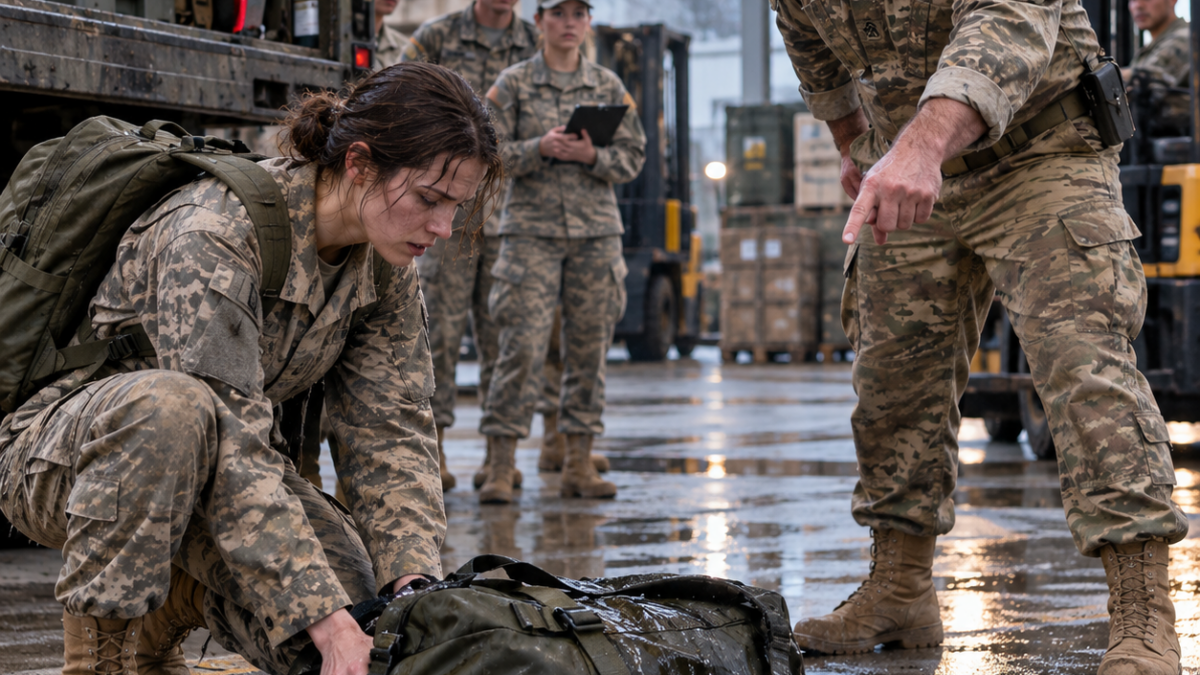
PART3:
I noticed that too.
I sat.
For the next forty minutes, I did exactly what he had ordered.
Nothing.
And because everybody believed I was nothing, the yard stopped performing.
That was why I had come without insignia.
Senior leaders see polished floors.
They see fresh placards.
They see safety chains clipped five minutes before the inspection party enters.
Broken equipment somehow disappears.
Missing documents become miraculously available.
Supervisors suddenly remember regulations they ignore every other day of the month.
But nobody prepares for a nameless woman sitting on a folding chair beside the loading dock.
So I watched.
I counted.
A priority pallet sat untouched for twenty-three minutes.
Three forklift operators took unnecessary detours because equipment blocked the emergency lane.
A clerk signed a receiving document without checking a temperature strip.
A soldier stepped over the same loose safety chain three separate times.
Nobody corrected anything.
And Sergeant First Class Dale Hargrove moved through all of it like a mayor inspecting a town he believed belonged to him.
At 7:23, two clerks froze beside a computer terminal.
One searched paperwork.
The other swore under his breath.
A high-priority aviation requisition showed a component on hand.
The shelf showed nothing.
Somewhere beyond that warehouse, an aircraft was grounded.
I waited.
Twenty seconds.
Then said:
“Aisle Nine. Bin Forty-One.”
Both clerks turned.
One stared at me.
“What?”
“That lot was cross-posted under returns eleven days ago.”
“How would you know?”
I nodded toward the pallet behind them.
“Same lot suffix.”
The clerk looked at the screen.
Then at me.
Then ran.
Less than two minutes later, he returned carrying the sealed aviation component.
The requisition cleared.
Nobody laughed.
A man stepped behind me.
“Where’d you learn supply?”
I turned.
Master Sergeant Elias Turner stood there.
Gray at the temples.
Broad shoulders.
Eyes that had seen too many young soldiers become old in a hurry.
“Same places you did,” I said.
His expression changed.
Not recognition.
Not yet.
Something closer to memory trying to open a locked door.
Then Hargrove came back.
“What’s going on?”
The clerk answered quickly.
“We found the aviation part.”
Hargrove looked at me.
Then at the computer.
His mouth tightened.
“Did Puddle decide she works here now?”
Puddle.
A few people smiled because they thought they were supposed to.
I said nothing.
He walked closer.
“You keep your hands off my operation.”
“I didn’t touch anything.”
“Then don’t talk either.”
“Understood.”
He walked away believing he had won.
Twenty minutes later, I found a food shipment whose cold-chain recorder had failed.
Before ten, I found hazardous material with the wrong classification.
By eleven, I found a serialized item sensitive enough that losing it should have triggered command attention.
It was sitting beneath torn packing material in an open returns bin.
No controlled ledger.
No cage.
No proper chain of custody.
I wrote the serial number inside my wrist.
And across the warehouse, Elias Turner kept watching me as if he had finally begun remembering a voice he had once heard through smoke.
By 8:30 that morning, Hargrove had given me another name.
“Puddle Clerk.”
He said it loudly enough for the break area to hear.
Then he repeated it every time somebody walked past.
Some soldiers laughed.
Some smiled because senior leaders were watching.
Some looked at the floor.
One young private never laughed.
Private First Class Mia Collins.
Small.
Serious.
Patrol cap sitting slightly too large on her head.
She carried a handheld scanner against her chest like she had been told losing it would end civilization.
Every time Hargrove made another joke at my expense, Mia’s mouth tightened.
She was too junior to challenge him comfortably.
But not yet experienced enough to pretend cruelty was funny.
I respected that.
I returned to the pallets Hargrove had assigned me.
Damaged packaging.
Loose equipment.
Expired components.
Tools without proper tags.
Returns mixed with serviceable stock.
Every shortcut in the section had eventually migrated there.
A pile of decisions people hoped somebody else would solve.
Around nine, Mia approached carrying two paper cups.
She set one beside me.
“Coffee.”
I looked up.
“For me?”
“You look like you need one.”
“That obvious?”
“Ma’am, everybody here needs one.”
She did not know my rank.
The “ma’am” was habit.
Respect before information.
That mattered.
“Thank you, Collins.”
She looked toward my duffel.
Someone had kicked it out of the puddle.
The fabric was still wet.
“You want me to move that somewhere dry?”
Before I could answer, she walked over.
Picked it up.
Leaned it against the wall.
Hargrove saw her.
“Collins!”
Every conversation near the dock stopped.
She turned.
“Yes, Sergeant?”
“Did I tell you to touch that bag?”
“No, Sergeant.”
“Then why are you touching things I didn’t tell you to touch?”
“It was wet.”
“I can see that.”
He walked toward her.
“Trying to impress our guest?”
“No, Sergeant.”
“Trying to make a statement?”
“No.”
“Then learn this now.”
He raised his voice.
“You do your assigned task. You do not rescue people from consequences they earned by showing up where they don’t belong.”
Mia’s jaw tightened.
Hargrove pointed toward my duffel.
“When I say something stays on the floor, it stays on the floor.”
“Yes, Sergeant.”
He sent her away on an inventory detail.
Punishment disguised as work.
I took one drink of the coffee she had brought me.
Burnt.
Over-extracted.
Probably brewed sometime during the previous presidential administration.
Best thing I drank all week.
That cup told me more about the brigade than Hargrove’s entire yard.
At 9:45, I saw the hazardous-material discrepancy.
A drum wore one classification.
Its manifest listed another.
Errors like that look administrative until incompatible material sits beside something it should never touch.
I pointed it out.
The clerk hesitated.
“Sergeant Hargrove said you’re not supposed to interfere.”
“I know.”
I turned the paperwork.
“Check it.”
Something in my voice made him obey.
Wrong classification.
He isolated the drum.
Called environmental support.
Corrected the placard.
When Hargrove learned what happened, he blamed the clerk for listening to me.
Not the mistake.
The clerk.
That interested me.
Weak leaders protect themselves.
Dangerous leaders protect ownership.
By late morning, I understood Hargrove’s real problem.
He did not think he managed an Army receiving yard.
He believed he possessed one.
Standards mattered only when they supported his authority.
Regulations existed only until they contradicted his instincts.
People who questioned him became disloyal.
People who obeyed him became “good soldiers,” even when what they obeyed was wrong.
Around ten, Turner approached again.
“You ever serve with the 414th?”
I continued replacing a damaged inventory tag.
“A long time ago.”
“Convoy security?”
“Among other things.”
His voice lowered.
“Northern route?”
My hand stopped.
“2012?”
Now I looked at him.
Six years earlier, smoke had turned daylight black.
Radios had become voices without faces.
Vehicles burned.
Metal screamed.
Men called distances through static.
There are some memories that age does not soften.
They simply become more organized.
I looked at Turner.
Really looked.
Then I heard his voice again.
Not from the warehouse.
From a road fourteen years behind us.
Truck Seven.
Disabled.
Smoke.
A soldier calling for guidance.
“You were Truck Seven,” I said.
His mouth opened.
Before he could answer, I shook my head.
Not here.
Not now.
Turner understood.
He had survived long enough to recognize an order delivered without words.
At eleven, Hargrove called me to the access-control desk.
He had the visitor log open.
“You don’t have a sponsor.”
“Apparently not.”
“No gaining section.”
“No.”
“No local orders.”
“Not in that system.”
He smiled.
At last, he had found something he understood.
A box he could put me into.
“Then you’re unauthorized personnel.”
The civilian guard beside him looked uncomfortable.
“She came in on the scheduled logistics transport.”
Hargrove barely glanced at him.
“Doesn’t matter if nobody claims her.”
He typed.
Unauthorized visitor.
Pending removal.
He turned the screen slightly as though he wanted me to admire his work.
“At shift change, you’re leaving my yard.”
I looked at the entry.
Then at him.
“I’d like last month’s serialized-item reconciliation.”
The smile disappeared.
“What?”
“The controlled-item count against the property book.”
His eyes moved toward the warehouse.
I gave him the report number.
Then the regulation paragraph.
“I’d also like Aisle Twelve secured until the discrepancy is reconciled.”
The civilian guard stopped pretending not to listen.
Hargrove stared.
“Who exactly are you supposed to be?”
“The person you’re removing at shift change.”
“You don’t get to request reports.”
“Then ignoring me should be easy.”
He slammed the visitor log shut.
“You’re done.”
I walked away.
Turner remained near the terminal.
Several minutes later, I looked back.
He was sitting at a computer.
Searching.
Then he stopped.
Read something.
Removed his glasses.
Rubbed both hands over his face.
And looked directly at me.
He had found the memorandum.
I knew it instantly.
The old convoy commendation.
My full name.
My service record.
Probably more.
There were now two people in the receiving yard who knew what Hargrove was doing.
One was me.
The other had once heard my voice lead his truck out of a kill zone.
Turner waited until Hargrove went outside.
Then followed him.
I could see them through the open loading door.
Turner spoke quietly.
Hargrove laughed.
That told me enough.
Turner returned alone.
“He won’t listen.”
“I didn’t expect him to.”
“I told him about the road.”
I looked up sharply.
“You shouldn’t have.”
“I didn’t use your name.”
“You didn’t have to.”
Turner lowered his voice.
“I knew the voice before I knew the face.”
Neither of us spoke for a moment.
“I spent years wondering who brought us out,” he said.
“You brought your crew out.”
“Because you came back.”
I looked at my hands.
Pale scars along one knuckle.
“Not everyone.”
Turner knew not to reassure me.
Some losses do not need comfort.
They need accuracy.
Specialist Evan Cole had been twenty-two years old.
Thin.
Loud laugh.
Cracked phone.
Traded dessert for hot sauce packets.
Called every senior NCO “boss.”
His vehicle had taken the worst angle of the attack.
I went back once.
Then again.
Then a third time.
Three vehicles came out.
Turner’s crew came out.
Evan did not.
Months later, somebody pinned a valor medal on me.
I remember staring at the metal.
Thinking one name weighed more.
Evan’s mother later wrote me a letter.
One sentence.
Thank you for going back for the others.
I carried it for fourteen years.
That road was part of the reason logistics mattered so much to me.
People who have never depended on supply under fire sometimes think warehouse errors are boring.
A misplaced part is paperwork.
Until an aircraft cannot launch.
A bad temperature recorder is paperwork.
Until soldiers become sick.
A serialized item left unsecured is paperwork.
Until it disappears and someone answers for it.
A broken pallet jack in a traffic lane is minor.
Until somebody gets hurt because everyone learned to step around it.
Details stop being small after you have watched small failures become life and death.
By noon, Hargrove had turned my removal into a performance.
He told soldiers to clear the apron before shift change.
He joked that “the puddle experiment” would soon be finished.
He ordered the gate guard to have an escort ready at 1500.
I kept working.
Tagged a broken pallet jack.
Cleared the dock-chain problem.
Stopped an outbound shipment carrying the wrong destination code.
Corrected controlled items.
Ordinary work.
That was the point.
People think leadership is speeches.
Medals.
Ceremonies.
Command photographs.
Most leadership is noticing what everyone else has accepted.
At lunch, Mia found me sitting on an empty pallet near the rear door.
She held half a sandwich.
“I’m fine.”
“You said that about the coffee.”
“I drank the coffee.”
“Exactly.”
I accepted the sandwich.
She sat at the opposite end.
“How long have you been here?” I asked.
“Three months.”
“You like supply?”
She thought.
“I like when it makes sense.”
“That is a good answer.”
“It doesn’t always make sense here.”
“No.”
She glanced toward the front.
“Sergeant Hargrove knows everything, though.”
No sarcasm.
She believed it because he had taught everyone around him to believe mistakes belonged to other people.
“What makes you think that?”
“He says when something goes wrong, it’s because somebody didn’t listen to him.”
I unwrapped the sandwich.
“That is not the same thing as knowing everything.”
She considered that.
Then looked at me.
“What rank are you?”
Her face immediately flushed.
“Sorry.”
“Today, rank isn’t important.”
She stared.
“That sounds like something somebody with rank would say.”
I laughed.
First time that day.
Mia smiled.
Then:
“Is he really throwing you out?”
“He’s planning to.”
“Can he?”
“We’ll see.”
She accepted that answer.
At 2:30, I returned to the front apron.
The duffel was dry except for a dark stain along the side.
Hargrove saw me touch it.
“Getting ready to leave?”
“If necessary.”
“Oh, it’s necessary.”
Turner stood twenty feet away.
I could see him debating whether to expose me.
I gave him one small shake of my head.
No.
Hargrove had created this day.
He could finish it.
2:58.
Gate guard stepped outside.
2:59.
Forklifts were still moving.
3:00.
Hargrove walked directly toward me.
Then put his hand around my upper arm.
Hard.
“Off my yard.”
Everything stopped.
Mia stepped from behind a pallet.
Turner moved immediately.
“Sergeant. Take your hand off her.”
Hargrove ignored him.
He looked directly into my face.
“You were logged unauthorized at eleven hundred. You’ve interfered with operations, accessed controlled areas, ignored guidance, and now you’re being removed.”
I looked at his hand.
Then at him.
“Your yard?”
He frowned.
“What?”
“You keep calling it your yard.”
“It is my receiving yard.”
“No.”
My voice stayed quiet.
“It isn’t.”
His grip shifted.
“You want to make this worse?”
“No.”
I smiled.
“I think you’ve already done enough.”
That unsettled him.
The yard had gone silent.
A truck idled at the gate.
Nobody spoke.
“Before you remove me,” I said, “pull my orders.”
“You don’t have orders.”
“I do.”
“I checked.”
“You checked the local receiving roster.”
“That’s where inbound personnel go.”
“Most inbound personnel.”
Uncertainty entered his face.
Small.
Cold.
I continued.
“Do it by the book, Sergeant. You’ve spent all day explaining the system to me.”
I held his gaze.
“Use it.”
Turner stopped ten feet away.
Mia beside him.
Hargrove finally released my arm.
“Fine. Bring whatever paperwork you think saves you.”
“Left cargo pocket.”
He stared.
“You want it?”
“I want you to take it out.”
I turned enough to expose the pocket.
“If I’m unauthorized, document the removal correctly.”
His face reddened.
“You’re unbelievable.”
“Possible.”
He reached into my cargo pocket.
Removed folded pages.
Government orders are ugly things.
Thin paper.
Boring fonts.
No drama.
Most life-changing sentences look administrative.
Hargrove unfolded the first page.
Read the header.
Then my name.
NAOMI R. MERCER.
His eyes dropped.
O-6.
Color left his face.
A whisper moved through the soldiers.
He read again.
I said:
“You wanted the yard to know who I was.”
Silence.
“Read it aloud.”
He looked toward Turner.
Turner had already come to attention.
That frightened Hargrove more than the paper.
His voice roughened.
“Colonel Naomi R. Mercer…”
The yard became still.
He found the assignment paragraph.
Stopped.
I waited.
Nine words.
That was all.
“Assigned as Commander, 92nd Sustainment Brigade, Fort Larkin.”
Silence.
Every sentence from the morning changed meaning at once.
Sweetheart.
Puddle.
We don’t need you.
Stay out of my operation.
His hand on my arm.
My wet duffel.
Turner snapped to full attention.
“Colonel Mercer!”
Then louder:
“Attention on the yard!”
The movement spread instantly.
Soldiers straightened.
Clerks emerged from stations.
Forklift operators stepped down.
Drivers turned.
Mia hit attention so fast she almost dropped her scanner.
Hargrove stood in front of me holding my orders.
His hands trembled.
Then a black staff vehicle drove through the gate.
Command Sergeant Major Lionel Price stepped out first.
Compact.
Fifty-one.
Quiet.
Then Colonel Marcus Vance, outgoing commander.
They had expected a formal reception.
Instead, they saw my stained duffel against the wall.
Hargrove three feet away.
Red marks above my elbow.
Price looked at Hargrove.
Then me.
His face became completely expressionless.
That was worse than anger.
“Ma’am.”
I returned his salute.
Vance followed.
“Colonel Mercer. Welcome to the Ninety-Second.”
His eyes moved toward Hargrove.
“I see you’ve toured Receiving.”
“Yes.”
“How thoroughly?”
“Thoroughly enough.”
Hargrove tried to speak.
Nothing happened.
I took the orders from his hand.
Then looked across the yard.
I could have humiliated him.
Easy.
A speech.
Public destruction.
Rank used like a hammer.
He had spent the entire day creating an audience for his cruelty.
I could have used the same audience against him.
Instead:
“At ease.”
A hundred people exhaled.
Hargrove remained rigid.
I faced him.
“Sergeant First Class Hargrove.”
“Ma’am.”
“Take one step back.”
He did.
“Stand fast.”
“Yes, ma’am.”
“We are not finished.”
“No, ma’am.”
Then I turned to Price.
“Secure Aisle Twelve. Suspend serialized returns movement pending full reconciliation.”
“Yes, ma’am.”
“Clear the fire lane.”
“Yes, ma’am.”
“Lock out damaged handling equipment.”
“Yes, ma’am.”
“Preserve ninety days of controlled-item inventories.”
Price’s eyes sharpened.
“Yes, ma’am.”
I turned to Vance.
“I need your office.”
“Of course.”
Then I looked toward Mia.
“And somebody remove Private Collins from whatever punishment detail Sergeant Hargrove assigned her.”
She froze.
“She has work to do.”
Price nodded.
“Yes, ma’am.”
As everyone moved, Hargrove stayed where I left him.
His face replayed the entire morning.
Only now did he understand the problem.
But I had no intention of making the problem merely personal.
The first meeting in Colonel Vance’s office lasted fifty-three minutes.
I know because I counted.
I described everything.
Blocked emergency access.
Improper storage.
Unsafe equipment.
Bad receiving practices.
Serialized-property failures.
Classification discrepancies.
Staged compliance.
Intimidation.
I did not begin with the duffel.
Vance noticed.
“The physical contact alone supports action.”
“I know.”
“And his treatment of you?”
“That tells me who Hargrove is.”
I looked toward the warehouse.
“The yard tells me who we’ve allowed the brigade to become.”
Price nodded slowly.
Vance leaned back.
“What do you recommend?”
“Formal investigation.”
“You can relieve him now.”
“I’m relieving him from direct control of Receiving.”
“That isn’t the same thing.”
“No.”
He studied me.
Then looked toward the window.
“I toured that warehouse twice last quarter.”
“I believe you.”
“It never looked like what you’re describing.”
“I believe that too.”
His jaw tightened.
“They cleaned it for me.”
“Yes.”
Price folded his arms.
“They performed an inspection instead of operating the system.”
“Exactly.”
Vance stared outside.
“I ate the performance.”
I said nothing.
Then:
“The investigation needs to look above Hargrove too.”
Vance looked back.
“If these practices became normal, somebody stopped checking.”
He nodded.
“That includes me.”
“Yes.”
I respected him more for saying it.
By five that evening, the process had begun.
Hargrove was removed from supervisory control.
Not stripped of rank.
Not marched away.
Not publicly degraded.
Accountability should not become entertainment simply because the person facing it once enjoyed humiliating others.
I found him outside the conference room.
“Ma’am.”
“Walk with me.”
We crossed the receiving yard.
The puddle had mostly dried.
Only a dark patch remained.
Hargrove saw it.
Then looked at me.
“I didn’t know who you were.”
I stopped.
There it was.
The wrong lesson.
“That,” I said, “is exactly the problem.”
He looked confused.
“You should not need to know someone is a colonel before deciding not to throw her property into water.”
“No, ma’am.”
“You should not need to know a private has witnesses before deciding not to humiliate her.”
“No, ma’am.”
“You should not need to recognize rank before following controlled-item procedures.”
“No, ma’am.”
I pointed toward Receiving.
“You keep telling me you didn’t know who I was.”
He looked down.
“I spent the entire morning watching who you were when you believed I was nobody.”
That reached him.
Not completely.
But somewhere.
“You will get due process,” I said. “Facts. Interviews. Records. Not rumors.”
“Yes, ma’am.”
“Until the investigation ends, you remain here under the same standards you demanded everybody else follow.”
He seemed surprised.
“You’re keeping me in the brigade?”
“For now.”
“I thought you’d want me gone.”
“I want the system fixed.”
He swallowed.
“And me?”
“That depends on whether you are capable of being corrected with it.”
He did not answer.
We resumed walking.
A forklift passed through the newly cleared fire lane.
“You keep your rank today.”
“Yes, ma’am.”
“Do not mistake that for mercy.”
His face changed.
“A discharge from this problem would be easier.”
He looked at me.
“You could leave angry. Tell yourself I destroyed you because of one bad morning. Never learn anything.”
“What do you want me to do?”
“The work.”
“All of it.”
I left him with Price.
Then found Mia.
She and Turner were counting controlled items.
When she saw my colonel insignia now visible on my uniform, her eyes widened as if she were discovering the truth again.
“Ma’am.”
“At ease, Collins.”
She relaxed approximately three percent.
I looked at the log.
“You preserved that returns bin.”
“Yes, ma’am.”
“Why?”
“You said something was wrong.”
“You didn’t know me.”
“No.”
“You didn’t know my rank.”
“No.”
“You had no reason to think helping me would benefit you.”
Mia looked confused.
“Then why?”
She answered:
“Because it was wrong.”
I looked at Turner.
He understood immediately.
“That answer will carry you farther in the Army than memorizing every regulation in this warehouse.”
Her expression brightened.
“Skill can be taught,” I continued. “Character usually arrives before the lesson.”
“Thank you, ma’am.”
I paused.
“And your coffee was terrible.”
She blinked.
Turner laughed.
Mia smiled.
“It’s government coffee, Colonel.”
“Fair.”
When she returned to work, Turner and I stepped between two storage rows.
He looked at me.
“Naomi Mercer.”
“Elias Turner.”
“I finally have the whole name.”
“So do I.”
He lowered his eyes.
“I’ve wanted to thank you for fourteen years.”
“You already did.”
“When?”
“You kept your crew alive.”
He looked up.
“That isn’t what I mean.”
“I know.”
“For coming back.”
“I came back because that was the job.”
“Most people wouldn’t have.”
“I don’t know what most people would do.”
Silence.
Then he said:
“Evan Cole.”
The name stopped me.
“I remembered him after we talked.”
“I never forgot.”
“I know.”
Turner hesitated.
Then said something I had never heard.
“He got two soldiers out before the truck burned.”
I stared.
“What?”
“You didn’t know?”
“No.”
“I thought you did.”
He took one breath.
“Evan pushed the gunner out the rear after impact.”
My hands began shaking.
“He helped the driver.”
I could not speak.
“They told me during evacuation.”
“Why did he stay?”
“Another soldier was trapped.”
For fourteen years, the story inside me had contained one subtraction.
One man I failed to save.
One vehicle I could not reach in time.
One name heavier than every medal.
Suddenly the arithmetic changed.
Not erased.
Never erased.
Changed.
Evan had not simply been waiting for rescue.
He had been rescuing someone else.
I turned away.
Turner let me.
And for the first time since arriving at Fort Larkin, I stopped counting.
The investigation took seven weeks.
Real accountability is slower than anger.
Records.
Transactions.
Security footage.
Training logs.
Equipment records.
Interviews.
People who had spent months learning when silence was safer finally began speaking.
The findings were ugly.
Useful too.
Hargrove was not a thief.
Not a criminal mastermind.
That almost made the problem more important.
He had done something ordinary.
He had created fear.
He publicly humiliated subordinates.
Normalized shortcuts.
Allowed controlled-item failures.
Turned disagreement into disobedience.
Taught soldiers that pleasing him mattered more than satisfying the standard.
Leaders above him missed it.
Some trusted him.
Some saw staged inspections.
Some read clean paperwork and never looked at the floor.
Colonel Vance signed the final handoff.
“I wish I’d seen it.”
“You saw what they prepared for you.”
“That isn’t enough.”
“No.”
He held out his hand.
“Make it better.”
“That’s the plan.”
Hargrove received formal administrative action.
He permanently lost his former supervisory position.
His advancement changed.
His record changed.
He remained in service.
At first, he was angry.
I could see it.
Then Price put him on the corrective inventory team.
No prestige.
No authority theater.
Serial numbers.
Old transactions.
Pallets.
Labels.
The tedious work that had always existed beneath the power he enjoyed.
One afternoon, I saw him standing beside Mia.
She showed him a scanner discrepancy.
Six weeks earlier, he would have interrupted.
This time, he listened.
That did not erase anything.
Change is not forgiveness.
It is evidence.
Mia grew more confident.
Turner put her into additional training.
She performed near the top.
I approved a competitive development course.
She came to thank me.
“Thank Master Sergeant Turner.”
“He said you approved it.”
“I approve many things.”
“You recommended me.”
“That sounds classified.”
She grinned.
“You’re terrible at pretending you don’t know things.”
“Dangerous accusation.”
The receiving yard changed slowly.
We stopped announcing most senior-leader visits.
I walked warehouses without entourages.
So did Price.
Supervisors hated it briefly.
Then they realized we were not hunting mistakes.
We were hunting dishonesty about mistakes.
I created one simple rule.
If a soldier identifies something unsafe, inefficient, or false, that soldier will not be punished for exposing it.
The first month, reports increased.
Seventeen problems.
Then thirty-one.
Some people panicked.
I didn’t.
When a system becomes safer to tell the truth, the number of visible problems rises before it falls.
Third month:
Twelve.
Better.
My favorite report came from a specialist who wrote:
THIS SHELF MAKES NO SENSE.
She was right.
The storage layout had survived three years because every new soldier assumed somebody smarter designed it.
Nobody had.
We fixed it in one afternoon.
Hargrove was on that team.
One evening, he appeared at my office.
“Ma’am?”
“Come in.”
He stood.
Did not sit.
“I owe you an apology.”
“You’ve apologized.”
“Not correctly.”
I waited.
“I kept saying I didn’t know who you were.”
“Yes.”
“That was me trying to make what I did smaller.”
Now I paid attention.
“If you’d actually been a new clerk…”
He paused.
“What I did would’ve been worse.”
There.
Finally.
“I treated you badly because I thought there was no consequence.”
Honest.
Ugly.
Useful.
“I’m not asking you to forgive me.”
“Good.”
“I only wanted you to know I understand it now.”
“Good.”
He looked almost disappointed by the short answer.
So I added:
“Understanding is the first useful thing you’ve done with that morning.”
He nodded.
“You don’t need my forgiveness, Sergeant.”
His eyes came up.
“You need the people around you to stop expecting the old version of you.”
“That may take a while.”
“It should.”
He left.
I did not feel victorious.
I felt relieved.
Because the consequence had finally reached the part of him that mattered.
Not rank.
Not pride.
Understanding.
Three months after my arrival, the warehouse looked boring.
Excellent.
Fire lanes remained clear without inspection threats.
Serialized equipment stayed locked.
Priority requisitions moved correctly.
People questioned numbers.
New soldiers were not punished for doing their jobs.
I kept walking the floor.
Sometimes new personnel did not recognize me.
Those were still my favorite encounters.
One morning, a young private stopped me outside a restricted cage.
He had not seen the insignia beneath my cold-weather jacket.
“Ma’am, I need to verify your authorization.”
The sergeant beside him went pale.
I handed the private my credentials.
He checked them.
Then looked at me.
Eyes enormous.
“Colonel—”
“You did exactly what you were supposed to do.”
Relief.
I pointed toward his sergeant.
“Do not punish him for checking me.”
“I wasn’t going to, ma’am.”
“Good.”
The story spread through the brigade before lunch.
So had the story of my first day.
Unfortunately.
People embellished.
In one version, Hargrove threw my duffel into a drainage ditch.
Another said I spent two days undercover.
Someone claimed I found fifty missing weapons.
Mia told me there was now a version where I personally drove the supply truck.
“I like that one.”
“I don’t.”
“More cinematic.”
“I was in the passenger seat.”
“Exactly.”
By then, she was Specialist Collins.
Promoted.
Same serious expression.
Same moral instincts.
Hargrove attended the ceremony.
He stood near the back.
Afterward Mia saw him.
Walked over.
They spoke.
He offered his hand.
She hesitated.
Then shook it.
I never asked what was said.
Not every reconciliation belongs to a commander.
Mine with the old convoy took longer.
Turner and I eventually sat down with the records.
Maps.
After-action reports.
Old transmissions.
Pieces he knew.
Pieces I knew.
Together, they formed something closer to truth.
Evan had helped two soldiers escape.
Stayed beside another.
The final radio call I remembered mostly as static had carried words Turner later heard more clearly.
“Get them out first.”
Evan said that.
I closed my eyes.
For fourteen years, I imagined his last moments as abandonment.
They weren’t.
He made the same decision I had.
Go back.
Get someone else out.
Turner said:
“You couldn’t save everybody.”
“I know.”
“You say that like a regulation.”
“I’ve practiced.”
“Do you believe it?”
I looked at the convoy map.
“More than I used to.”
That was enough.
I wrote to Evan’s mother again.
I almost didn’t.
Opening old grief can be selfish.
But she deserved the truth.
I told her I had learned more about her son’s final actions.
That he helped two soldiers escape.
That he stayed to help another.
Her reply came twelve days later.
Longer than the first.
She wrote that Evan had always been the child who went back.
Forgotten backpacks.
Lost dogs.
Friends who missed buses.
Then one line:
Maybe none of you left that road alone.
I read it three times.
Turner carried my voice.
I carried Evan’s name.
Evan’s mother carried my letter.
Fourteen years later, those pieces met in a warehouse because an arrogant sergeant threw my duffel into a puddle.
Life can be cruelly strange.
The humiliation did not become acceptable because something good came from it.
Pain does not earn retroactive permission just because healing eventually follows.
But pain does not own everything that happens afterward either.
At six months, Price brought my readiness dashboard.
Inventory accuracy up.
Shipping delays down.
Safety discrepancies down.
Urgent requisition time nearly cut in half.
“You happy?”
“No.”
He laughed.
“Of course.”
“I’m satisfied.”
“That is colonel for happy.”
“Don’t spread that.”
He sat.
“You planning another undercover stunt?”
“No.”
“Good.”
“I was considering civilian clothes.”
His face died.
I let him suffer three seconds.
“Joking.”
“That wasn’t funny.”
“A little.”
“This brigade has enough stories.”
No brigade ever does.
Every unit holds more stories than leaders hear.
The important question is whether you hear them before they become investigations.
A year after my first morning at Fort Larkin, rain fell before dawn.
Shallow puddles covered the receiving apron.
I stood beneath the warehouse roof and watched water drip from steel.
The scene looked almost exactly the same.
It felt completely different.
Mia was already working.
Turner had moved into a brigade-level job and complained constantly that paperwork was killing him.
Price said this proved the Army still had humor.
Hargrove remained.
Not where he had been.
Not who he had been either.
His career never returned to its old trajectory.
He completed retraining.
Formal counseling.
Corrective duty.
Rebuilt some trust.
Not all.
That morning, I saw him helping a new private with a mislabeled pallet.
The private looked nervous.
Hargrove pointed at the paperwork.
“Don’t sign because I tell you it’s correct.”
She checked.
“Destination code is wrong, Sergeant.”
“Good catch.”
No humiliation.
No audience.
No anger.
“Fix it before it moves.”
I remained out of sight for a moment.
Then continued walking.
He noticed me.
“Morning, ma’am.”
“Sergeant.”
I glanced at the pallet.
“Problem?”
“Wrong destination.”
“Who caught it?”
He nodded toward the private.
“She did.”
“Good.”
The private looked terrified.
I smiled.
“Keep catching them.”
“Yes, ma’am.”
Then I walked away.
It was not proof Hargrove became a perfect man.
There are no perfect men.
It was evidence he changed behavior when nobody important was supposed to be watching.
That mattered.
Forgiveness remained separate.
I never forgot him throwing my duffel.
Never forgot Mia standing there while he publicly humiliated her.
Never forgot the red marks on my arm.
Never forgot the pleasure on his face when he thought he had power over a person nobody would defend.
I did not hate him.
I also did not owe him a version of history where none of that mattered.
Growth and consequence can coexist.
So can peace and distance.
Later that morning, an aviation requisition came across my desk.
Priority.
Red border.
Different aircraft.
Different part.
Location:
Aisle Nine.
I smiled.
Mia saw.
“What?”
“Nothing.”
“You’re smiling at paperwork.”
“No.”
“You are.”
“Specialist Collins.”
“Yes, ma’am?”
“Go do Army things.”
She grinned.
“Yes, ma’am.”
The component cleared in six minutes.
Nobody celebrated.
Perfect.
Somewhere outside Fort Larkin, an aircraft would fly because a warehouse worked correctly.
The crew would never know the names of the soldiers who made it happen.
That was logistics.
Success often looked like absence.
No delay.
No shortage.
No accident.
No 2:00 a.m. phone call asking where a critical item had disappeared.
Invisible victories.
I opened the bottom drawer of my desk.
My original orders were there.
Same pages.
Soft creases.
I unfolded them.
Assigned as Commander, 92nd Sustainment Brigade, Fort Larkin.
Nine words.
Those words had silenced an entire receiving yard.
But they were never the important part.
The important part came before anybody knew them.
Mia picking a stranger’s bag off wet concrete.
Turner recognizing a voice before he recognized rank.
A clerk checking a broken temperature recorder because someone in a folding chair said something was wrong.
A junior soldier preserving evidence because wrong was wrong before punishment existed.
Those were the things I carried.
Behind the orders was Evan’s mother’s letter.
Maybe none of you left that road alone.
I folded everything back.
That afternoon, we held quarterly recognition.
Mia received an award for process improvements her team developed.
Turner stood beside Price pretending not to look proud.
Hargrove stood in formation with everyone else.
Afterward, Mia came over.
“Ma’am?”
“Yes?”
“Can I ask you something?”
“You usually do.”
She looked at the receiving apron.
“If Hargrove hadn’t thrown your bag in the puddle, when were you going to tell us who you were?”
“Noon.”
Her eyes widened.
“He bought himself three extra hours?”
“Approximately.”
She laughed.
Then became serious.
“Were you angry?”
“Yes.”
“You didn’t look angry.”
“I had practice.”
“Why didn’t you stop him?”
I looked across the yard.
Because that question mattered.
“I needed to know whether he behaved that way once…”
I paused.
“…or whether the system had learned to make room for it.”
“And?”
“The system had made room.”
Mia nodded.
“So you changed the system.”
“We changed it.”
She liked that answer.
Before leaving, she glanced toward the patch of concrete where my bag had landed a year earlier.
“I almost picked it up right away.”
“I know.”
“I was scared.”
“I know.”
“I waited.”
“You still picked it up.”
She smiled.
Then walked away.
Evening light came through the clouds.
Container walls turned pale gold.
My command would eventually end.
Every command does.
Another colonel would take the colors.
Another generation of soldiers would arrive.
New problems would replace old ones.
I no longer believed leadership meant fixing everything forever.
You cannot.
You fix what is in front of you.
You teach people how to recognize the next problem.
And if you are fortunate, you leave the organization a little less willing to lie to itself than when you found it.
Before leaving that evening, I lifted my old duffel from beside the desk.
The puddle stain was still visible.
I had thought about replacing the bag.
Never did.
Some objects matter because of what they carry.
Others matter because of what they remind you not to become.
I carried it toward the parking lot myself.
No aide.
No driver.
No ceremony.
At the edge of the receiving apron, Hargrove was locking a storage cage.
He saw the bag.
His eyes dropped to the stain.
For one second, both of us were back on that first morning.
He said:
“I can carry that, ma’am.”
No audience.
No performance.
I looked at him.
A year earlier, he threw it away because he believed carrying another person’s burden was beneath him.
Now he was offering.
I shook my head.
“No.”
He nodded.
“Yes, ma’am.”
I adjusted the strap.
Walked toward my vehicle.
I did not forgive him.
I did not need revenge either.
He had been forced to live inside the truth of what he had done.
I had moved beyond the puddle where he had tried to leave me.
Behind me, Receiving continued working.
Fire lane clear.
Controlled cage locked.
Placards matched.
Junior soldiers questioned bad numbers.
Nobody laughed when somebody pointed out a mistake.
And somewhere beyond the installation, an aircraft lifted into the evening sky carrying a component our warehouse had delivered when it was needed.
I listened to the distant rotors.
Then thought about Evan.
Turner.
Mia.
That road fourteen years behind me.
Some things do not disappear because you survive them.
You simply learn how to carry them without letting them decide where you are going.
I placed my duffel in the back seat.
It did not feel heavy anymore.
Then I drove away from the depot I had entered as a nobody, leaving behind a brigade that had finally learned the lesson Dale Hargrove missed before sunrise on my first day.
You never know who matters by looking at rank.
So you treat everyone like they do.
Because they do.



