A Shelter Planned to Euthanize a Gray Tabby Who Wouldn’t Stop Crying—Then One Staff Member Opened Her File and Discovered Who She Had Lost the Day She Arrived.
PART3:
Known footsteps.
Known bowls.
Then suddenly, a carrier.
A car.
A front desk.
Hands.
Paperwork.
A metal kennel.
Fluorescent lights.
Dogs barking in another room.
Strange cats above, below, beside.
Disinfectant in the air.
No familiar voice.
No familiar floor.
No explanation.
Of course they cry.
Of course they hide.
Of course they refuse food and flatten themselves under towels and look at us like we have become part of whatever disaster brought them there.
The first night, the cry made sense.
The second night, it still made sense.
By the third, people started talking.
Not cruelly.
That matters.
No one stood in front of her kennel and said she deserved anything bad.
No one wanted to hurt her.
Most of the people I worked with cared too much, not too little.
But shelters force caring people to speak in practical language because practical language is the only kind that fits on the board.
Kennel count.
Hold date.
Medical status.
Behavior notes.
Adoption potential.
Space.
Always space.
Space is the invisible hand around every shelter worker’s throat.
That week, space was tighter than usual.
Kitten season had come early.
Every cage was full.
Three nursing mothers were in foster, two bottle-baby litters were in the office, a ringworm case had closed one room, and the dog wing had already doubled up every compatible kennel.
On paper, we were full.
In reality, full had happened three days earlier.
Everything after that was math and mercy fighting in the hallway.
The gray tabby’s card said:
Adult female. Gray tabby. Approx. 5 years. Owner surrender. Fearful. Vocalizing. Not eating consistently.
By day four, someone had added:
Not adjusting.
Those two words landed like a stone.
Not adjusting.
I hated them because they were true in the smallest possible way and false in the way that mattered.
She was not eating well.
She was not approaching.
She was crying constantly.
She was not showing well to adopters.
All true.
But the phrase made it sound like failure.
Like the problem lived inside her.
Like she had been offered a reasonable situation and had declined to behave appropriately.
As if anyone would adjust beautifully to being locked in a metal box after losing everything.
I worked evening intake, which meant I saw the shelter after the public left.
The building changed then.
During visiting hours, shelters perform hope.
Voices become brighter.
Volunteers straighten blankets.
Staff introduce animals with optimism that sometimes hurts to hold.
“He’s a little shy at first.”
“She warms up with treats.”
“He just needs the right home.”
After closing, the performance ends.
The animals are still there.
The hard decisions are still there.
The calls that did not get returned.
The fosters who said no.
The adoption that fell through.
The cat who stopped eating.
The dog whose kennel card got a red note.
The gray tabby’s cry.
That fourth night, I stayed late.
Not because anyone asked me to.
Because I could not make myself leave while she was still making that sound.
The shelter got quieter after everyone else went home, except for the barking from the back runs and that one soft cry from her kennel.
I sat at the intake desk and pulled her file.
I was not looking for anything specific.
I think I just wanted one good reason to hate the system less.
The file was thin.
Too thin for a life.
Surrender form.
Medical intake.
Vaccination record.
Behavior notes.
No long history.
No favorite toy.
No explanation of what made her purr.
No note saying whether she liked windows, warm laundry, cardboard boxes, or the sound of rain.
Shelter files are full of what can be measured.
They rarely contain what was loved.
I read the surrender form first.
The handwriting was rushed.
Two cats surrendered from the same address.
Same estimated age.
Same intake day.
My eyes stopped.
Two cats.
I flipped back.
The second cat had a separate file number.
Sibling, the note said.
I opened the second file.
Male gray tabby. Approx. 5 years. Same household. Severe upper respiratory distress on intake. Emergency care initiated. Respiratory collapse. Deceased less than twenty-four hours after arrival.
I sat there staring at that line.
Less than twenty-four hours.
Then I looked over at her.
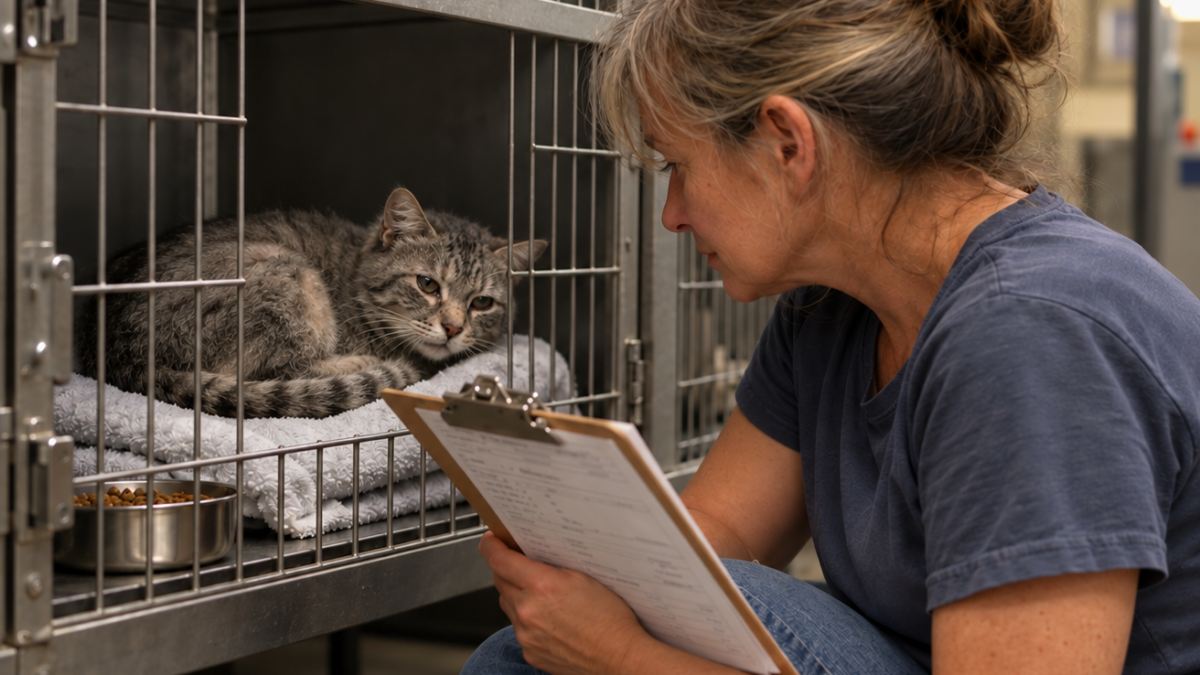
The gray tabby was curled in the back of the kennel, face turned toward the side wall, crying softly into the metal corner.
All at once, she did not seem strange anymore.
She did not seem “damaged.”
She did not seem “unadoptable.”
She did not seem like a behavior case.
She seemed like what she was.
A living creature whose whole world had been taken away in one day.
And then we had locked her in a metal box under fluorescent lights and wondered why she would not act normal.
She was mourning.
I do not know why that word had not been written anywhere.
Maybe because grief does not fit neatly into intake software.
Maybe because shelters are full of grief, and if we named it every time, none of us would finish a shift.
Maybe because animals are still expected to make human decisions easier by suffering quietly.
But once I saw it, I could not unsee it.
Her cry was not random.
It was not attention-seeking.
It was not defiance.
It was a call.
A small, repeated call to someone who was never coming back.
I printed the sibling’s record and placed it beside hers.
Then I sat on the floor in front of her kennel.
“Hey,” I said softly.
She cried.
“I’m sorry.”
She cried again.
“I didn’t know.”
That sounded stupid, but it was true.
I had not known.
And because I had not known, I had been hearing her wrong.
That is the thing about pain.
If you do not understand where it comes from, it can sound like inconvenience.
The next morning, I asked for more time.
Not because I was sure.
I was not.
Shelters teach you not to trust hope too quickly.
Hope can make promises space cannot keep.
But I walked into the manager’s office with the two files and placed them on the desk.
Marlene looked up from the schedule.
She was our shelter director.
Not cruel.
Not warm.
Just the kind of woman who had learned how to keep a place alive by making hard decisions before coffee.
Her hair was always pinned back too tightly. Her glasses always sat low on her nose. Her desk was covered in sticky notes, intake lists, invoices, and donated candy nobody liked but everyone ate during bad days.
“I know she’s on the morning review,” I said.
Marlene did not pretend not to know which cat I meant.
“She is.”
“She came in with a sibling.”
“I saw that.”
“The sibling died.”
Marlene was quiet.
“She’s not just shut down,” I said. “She’s grieving.”
Marlene leaned back.
“Erin.”
“I know.”
“We have six cats waiting for cages.”
“I know.”
“She has barely eaten.”
“I know.”
“She cries constantly.”
“I know.”
“And if I give every grieving animal more time because grief is understandable, I still don’t have another room.”
There it was.
Not cruelty.
Arithmetic.
That was what made it worse.
Cruelty would have been easier to hate.
Arithmetic sits there like a fact and dares you to argue with it.
“I’m asking for three days,” I said.
Marlene looked at me.
“Three?”
“I’ll sit with her after my shift. I’ll track food. I’ll write notes. I’ll try to get video if she improves.”
“And if she doesn’t?”
The question hit exactly where she meant it to.
“If she doesn’t,” I said, “then at least we’ll know we didn’t mistake mourning for failure.”
Marlene looked down at the files again.
The office was quiet except for the copier humming behind us and a dog barking somewhere in the back.
Finally, she wrote something on the review sheet.
“Three days.”
My breath came out too fast.
“Thank you.”
She pointed the pen at me.
“Do not make me regret this.”
“I won’t.”
“You might. Not on purpose. But you might.”
“I know.”
She sighed.
“Go clean room three.”
That was shelter mercy.
No music.
No hug.
No inspiring speech.
Just three more days and a room that still needed cleaning.
I started sitting with the gray tabby every day after my shift.
I did not force her out.
I did not reach in and grab her.
I did not try to make her grief photogenic.
I simply sat on the floor beside her kennel and talked.
Mostly nonsense.
What traffic had been like.
What I was making for dinner.
How my apartment felt too quiet since my divorce.
How sometimes I left the television on just to hear another voice in the room.
How my neighbor upstairs walked like he was punishing the floor.
How I once burned soup so badly the pot had to be thrown away.
How rain always made the shelter smell more like wet towels than usual.
At first, she did not look at me.
She cried facing the corner.
Every few seconds.
A small sound.
A wound with rhythm.
I brought a spoon with warmed wet food on it.
She ignored it.
I left it in the kennel and sat there anyway.
The first night, nothing changed.
The second night, nothing changed until I stood to leave.
Then her crying stopped.
Just for a moment.
I looked back.
She was watching me.
Not hopefully.
Not affectionately.
Just watching.
“Goodnight,” I said.
She cried again before I reached the door.
On the third day, she licked a little food off the spoon.
Not much.
A tiny amount.
Barely enough to matter medically.
Enough to matter emotionally.
I wrote it on her chart.
Accepted small amount of food from spoon while staff present.
Then, underneath, in smaller handwriting:
Trying.
On the fifth day, she drank water while I was still sitting there.
On the seventh, she stepped out of the back corner and came to the front of the kennel when she heard my shoes.
That was the first time I cried over her.
Not because she was fixed.
Because she was not.
She was just trying.
There is a kind of bravery people overlook because it does not look dramatic.
It does not roar.
It does not stand tall.
Sometimes bravery is a grieving cat taking three steps forward in a shelter kennel because the voice outside has not left yet.
By then, I had given her a name.
May.
The shelter had entered her as Gray Tabby Female because no name came with her surrender. I called her May because that was the month my mother died, years earlier, and because the word sounded like possibility without promising too much.
May.
Maybe.
Maybe she would eat.
Maybe she would trust.
Maybe somebody would see her.
A week later, a woman came in just before closing.
Maybe late sixties.
Maybe early seventies.
No makeup.
Sensible shoes.
Soft denim jacket.
The kind of person who did not waste words because life had already taught her which ones mattered.
She walked through the cat room slowly.
Most visitors move too fast.
They scan.
They judge.
They wait for a performance.
A paw through bars.
A chirp.
A roll.
A kitten climbing the cage.
This woman did not scan.
She looked.
There is a difference.
She passed the younger cats.
Passed the playful ones reaching through the bars.
Passed the fluffy orange kitten everyone had been asking about all day.
Then she stopped in front of May.
May was sitting still, watching her.
Not crying.
Not reaching.
Just watching.
The woman stood there for a long moment.
Then she looked at me and asked, “What happened to this one?”
That question told me almost everything I needed to know.
Not “What’s wrong with her?”
Not “Why is she acting like that?”
Not “Is she friendly?”
What happened?
I told her the truth.
Not the short version people use when they want to move things along.
The real version.
That May had come in with her sibling.
That the sibling died less than twenty-four hours after arrival.
That May cried for days.
That she was only now starting to eat, starting to trust, starting to come back to herself.
The woman listened without interrupting.
When I finished, she stood quietly in front of the kennel.
Then she said, “I buried my husband in January.”
I did not say anything.
Some sentences do not want a response.
She nodded toward May.
“I know that look.”
My throat tightened so fast it hurt.
I opened the kennel door.
May did not bolt.
She stepped out slowly.
Every person in that room seemed to disappear except the two of them.
The woman lowered her hand.
She did not reach over May’s head.
She did not grab.
She offered her fingers at nose level, patient and still.
May sniffed them.
Then she leaned her face into the woman’s palm like she had been waiting for that exact touch.
The woman smiled, but it was the kind of smile that comes with tears.
“I don’t need easy,” she said. “I need honest.”
Her name was Ruth Adler.
She filled out the adoption application at the front desk in careful handwriting.
Widowed.
Retired librarian.
Quiet home.
No other pets.
Experience with adult cats.
Willing to allow adjustment time.
In the section that asked why she wanted to adopt this animal, she wrote:
Because grief should not have to be charming to be worthy of company.
I made a copy of that line before the file went upstairs.
I probably was not supposed to.
I did it anyway.
May went home that evening in a borrowed carrier with a blue towel inside. Ruth carried her like something fragile, but not broken. That mattered. People often treat grieving animals like cracked glass. Ruth treated her like a tired soul who deserved steadiness.
Before they left, I crouched near the carrier.
May looked out at me.
Her eyes were still tired.
But the crying had stopped.
“Be good,” I whispered.
Then I corrected myself.
“No. Just be okay.”
Ruth heard me.
“She does not have to be good,” she said. “She can be sad.”
And then they were gone.
For three weeks, I heard nothing.
That is normal.
Adopters get busy.
Cats hide.
Life moves.
But I thought about May every night.
I thought about the way she had cried.
I thought about the file line I almost missed.
Sibling deceased.
I thought about how close we had come to calling grief unadoptable.
Then, three weeks later, Ruth sent a picture.
The gray tabby was asleep on a faded sofa under a crocheted blanket, one paw stretched out in the sun like she had finally made peace with being warm again.
No crying.
No fear.
Just sleep.
Under the photo, Ruth wrote only one sentence.
She follows me from room to room, but only when I’m sad.
I stared at that message for a long time.
Not because it was sweet.
Because it felt true in a way that made my chest ache.
People like to talk about animals as if they are simple.
Hungry.
Tired.
Scared.
Friendly.
Mean.
Easy labels.
Easy boxes.
But I had spent enough nights in that building to know how often we use simple words because the real ones ask too much of us.
Grieving asks too much.
It asks time.
It asks patience.
It asks people to stand near pain they cannot immediately solve.
And most people, even good people, do not like that.
I printed the picture and tucked it inside the front cover of May’s file.
I thought maybe I needed to keep it there for myself.
Proof.
Proof that what looked hopeless for one week could look completely different three weeks later.
Proof that “difficult” is sometimes just a living thing telling the truth in a way no one wants to hear.
After May, I started doing something I probably should have done sooner.
I began reading more files.
Not just the medical notes.
Not just the intake codes.
The little lines people barely notice.
Owner deceased.
Brought in with littermate.
Found after eviction.
Surrendered after divorce.
Housemate dog died two days ago.
Transferred from home of elderly owner entering long-term care.
I started seeing it everywhere.
Not in every case.
But enough.
Enough to make me sick.
There was a hound mix who would not leave the back of his run after being brought in from a house where his owner had died alone.
There was an older calico who batted at anyone wearing boots because the last person who wore boots around her had carried her out of a home she never got to see again.
There was a rabbit who stopped eating after her bonded mate died in transport.
And every single time, somewhere in the notes or the hallway talk, somebody would say the same kind of thing.
“She’s not adjusting.”
“He’s deteriorating.”
“This one isn’t adoptable in this condition.”
I know how that sounds.
Like I am blaming shelter workers.
I am not.
Not the way people on the outside like to do it.
They love to point fingers from behind a phone screen, like the whole thing is just a matter of bad hearts and bad choices.
It is not.
Most of us were exhausted.
Most of us cared too much, not too little.
Most of us had simply learned to speak in practical words because practical words are easier to survive than honest ones.
Honest ones stay with you when you try to sleep.
Practical ones let you finish your shift.
Still, once I saw it, I could not unsee it.
And that made me dangerous in a small, ordinary kind of way.
Not dramatic.
Not heroic.
Just the kind of dangerous that starts asking questions people do not have time for.
A few nights later, I was closing kennels with Dana, one of the techs who had been there longer than I had.
Dana was good at the work.
Fast hands.
Clear eyes.
No nonsense.
The kind of person who could bottle-feed newborn kittens while answering the phone and still remember which dog needed medication at six.
She saw me standing there rereading a cat card and said, “You’re doing that thing again.”
“What thing?”
“The thing where you look like you’re about to try to save the whole building with a clipboard.”
I laughed a little.
Then I said, “Do you ever think we call grief behavior because behavior sounds easier to treat?”
She kept stacking metal bowls.
“Sometimes grief is behavior.”
“That’s not what I mean.”
“I know what you mean.”
She set the bowls down harder than she meant to.
Then she leaned against the counter and looked at me with the tired face of somebody who had cried over too many things in private.
“You want the truth?”
“Yes.”
“We do that because grief doesn’t fit on the board.”
I did not say anything.
She kept going.
“We have kennels, meds, hours, volunteers, bite notes, intake counts, adoption appointments, and three people calling out sick. ‘This cat is in mourning’ sounds humane. It also doesn’t solve where I put the next six animals at eight o’clock.”
There it was again.
Not cruelty.
Arithmetic.
I said, “That still doesn’t make the animal wrong.”
Dana rubbed her forehead.
“I didn’t say it did.”
“Then why do we act like it does?”
She looked straight at me.
“Because in a full shelter, being understandable and being savable are not always the same thing.”
That sentence stayed with me for weeks.
Because it was true.
And because I hated how true it was.
The picture on my desk kept staring back at me.
May asleep in sunlight.
Body loose.
Face soft.
One small life transformed not by magic, not by medicine, not by some perfect fairy-tale rescuer.
Just by time.
A chair near a window.
A woman who understood what silence sounds like after somebody is gone.
I started making little handwritten notes for the kennels.
Not official ones.
Nothing that messed with medical charts.
Just index cards clipped to the fronts in my own messy printing.
Go slow. Start with your voice.
Lost bonded companion. Not aggressive. Just scared.
Prefers company before touch.
Best with patient adopter.
Still learning the room is safe.
A few people rolled their eyes.
A few people ignored them.
But a funny thing happened.
Visitors slowed down.
Not all of them.
A lot still wanted the easy ones.
The tiny ones.
The playful ones.
The instant-gratification animals who climbed into laps on cue and made everyone feel chosen.
But some people stopped.
Some people read.
Some people asked better questions.
There was a college kid with acne scars and a backpack who spent forty minutes sitting beside an older black cat no one ever noticed.
There was a middle-aged man in work boots who adopted a dog with a note that said:
Startles at loud voices but melts for soft ones.
There was a mother who explained grief to her daughter in front of a kennel instead of calling the cat weird.
It was not a revolution.
It was not even a system.
But it was something.
Then one Saturday afternoon, it blew up.
Not the shelter.
The story.
Ruth came by with a thank-you card and another picture.
This time, May was on a windowsill beside a ceramic mug and a little plant that looked half-dead but stubborn.
On the back, Ruth had written:
Her name is May now. She sits in my husband’s chair at four-thirty every day, then comes to find me. I think we are helping each other remember how to stay.
I had to go into the supply closet after I read that.
Not because I am some giant softhearted saint.
Because sometimes there are sentences that crack you open faster than grief itself.
I asked Ruth if I could share the story.
No last names.
No identifying details.
No shelter name.
Just the truth of it.
She said yes.
Then she looked at me and said something I still think about.
“Tell it carefully. People are meaner than they used to be when they’re protected by a screen.”
She was right.
I posted the story that night after my shift.
I left out the things that did not belong to me.
Kept the important part.
Cat came in with sibling.
Sibling died.
Cat cried for days.
People thought she was failing.
An older widow saw her and recognized grief.
Now the cat slept in a patch of sun and followed sadness from room to room like a little gray nurse.
I ended the post with one line.
Some animals are not difficult. They are just mourning in public, and we punish that faster than we admit.
I expected maybe a few shares.
A few rescue people.
Some friends from high school.
A couple of comments from the usual crowd who always react to anything involving animals.
By the next morning, my phone looked like it was having a seizure.
Hundreds of notifications.
Then thousands.
People shared it everywhere.
And the comments split almost immediately into two camps.
That is putting it politely.
One side said the same thing over and over in different words.
How dare shelters even think about euthanizing a grieving animal.
How broken is society if a cat can lose everything and still get judged for not performing happiness fast enough.
Why do humans abandon animals and then act shocked when those animals stop trusting us.
The other side said something else.
They said people on the internet love to cry over one cat while ignoring the reality that shelters are drowning.
They said workers are underfunded, overfilled, underpaid, and forced to make terrible calls with impossible numbers.
They said sadness does not create kennels, donations, foster homes, or staff hours.
They were right too.
That was the worst part.
Everybody wanted a villain.
But the villain was not one person.
It was the whole comfortable lie that compassion can run on empty forever.
It cannot.
And once those comments started rolling in, people got mean.
Not toward me at first.
Toward each other.
Toward shelter workers.
Toward adopters.
Toward anyone who had ever surrendered an animal for any reason.
I spent that lunch break sitting in my car, scrolling through strangers tearing each other apart over a cat sleeping on a couch.
One woman wrote that anyone who surrenders an animal should never be allowed to own one again.
A man replied that his mother had to surrender her dog when she went into hospice and he hoped life punished people like her less than people like the commenter.
Another person said shelters were killing factories with nice logos.
Someone else said rescue culture had become so judgmental that struggling families were too ashamed to ask for help until it was too late.
I kept reading because I could not stop.
That is the ugly thing about comment sections.
Sometimes they are a sewer.
Sometimes they are a confession booth.
Sometimes they tell the truth in the exact wrong tone.
By that night, I had one clear thought.
The comments were nasty.
But the story had hit something real.
Because underneath all the yelling was a question nobody wants to sit with.
When did we become so uncomfortable with pain that we started calling it failure if it lasted longer than a weekend?
Not just in animals.
In people too.
Especially in people.
An old cat cries for a week and gets labeled shut down.
A widow does not “bounce back” fast enough and people start talking about moving her, fixing her, distracting her, medicating her, managing her.
A man falls apart after divorce and everyone tells him to hit the gym, get back out there, stay positive, do not dwell.
A child gets quiet after loss and adults start using words like adjustment issue instead of heartbreak.
Maybe that was why the story spread.
Maybe it was never really only about the cat.
Marlene called me into the office the next day.
My stomach dropped so fast I thought I might throw up.
She had my post open on her screen.
I sat down and waited.
She said, “You didn’t name the shelter.”
“No.”
“You didn’t name the adopter.”
“No.”
“You didn’t share intake records.”
“No.”
She nodded once.
Then she said, “You made my front desk cry.”
I did not know what to do with that.
So I said nothing.
She turned the monitor toward me.
The post had been shared tens of thousands of times.
There were donation offers.
Volunteer offers.
Messages from people asking whether we had more “grief cases.”
That phrase made me flinch a little.
But I knew what they meant.
Marlene tapped the desk with one nail.
“I have a problem.”
I thought she meant me.
Then she said, “I have thirty-two messages from people who think this post proves we’re monsters, and forty-seven messages from people who suddenly want to foster adult cats. I don’t know whether to yell at you or thank you.”
“Both is fair.”
A tiny smile tugged at one corner of her mouth.
Then it disappeared.
“You understand the danger here, right?”
I nodded.
“That people want stories simpler than the truth.”
“Yes.”
“And the truth is we still have no room.”
“Yes.”
“And if you make this place look like a tragedy mill, I lose the public.”
“I know.”
She studied me for a second.
Then she said something I did not expect.
“What do you want us to do differently?”
That question scared me more than getting in trouble would have.
Because now I had to answer.
And answers are heavy when lives attach themselves to them.
So I told her the smallest, most practical version of what I wanted.
Not miracles.
Not speeches.
Not a giant policy overhaul.
Just a flag in the intake system for animals arriving after a bonded loss, owner death, or major home disruption.
A short holding note when possible.
Better kennel language.
A few foster outreach posts focused on adult animals in grief instead of only babies and easy cases.
Basic staff guidance that shutdown is not always the same as unsocialized or unsafe.
Marlene listened.
Then she folded her hands.
“You understand all of that still depends on space.”
“I know.”
“And staff.”
“I know.”
“And adopters willing to take animals who won’t perform joy on command.”
“I know.”
She leaned back.
“Then I’ll try it for thirty days.”
I think that was the moment I realized change rarely arrives looking noble.
Sometimes it arrives looking tired and mildly irritated and willing to test one spreadsheet column.
I would have taken a parade.
Instead, I got a pilot program.
Which, in shelter work, is honestly closer to a miracle than most people know.
We started small.
A yellow dot on kennel cards for loss-related intake history.
A short note for visitors.
Nothing melodramatic.
Nothing exploitative.
Just enough truth to slow people down.
Recently lost companion. Needs calm.
Owner hospitalization. Shy but responsive.
Household disruption. Start with quiet presence.
I braced myself for backlash.
And we got some.
One volunteer said we were “humanizing them too much.”
A donor wrote a message saying grief was “a stretch” and animals live in the moment.
A guy in the lobby laughed and told his son, “It’s a cat, not your therapist.”
I wish I could say I ignored that.
I did not.
It sat in my head all day.
Because that is part of the problem too.
People only respect animal emotion when it entertains them.
A dog wagging at the door?
Heartwarming.
A cat choosing one person and sleeping on their feet?
Beautiful.
An old pet waiting by a dead owner’s chair for weeks?
Suddenly everybody wants to tell you you are projecting.
As if love is believable in animals only when it makes us feel special.
As if loss becomes ridiculous the second it becomes inconvenient.
But we also got something else.
People started asking slower questions.
Not “Which one is easiest?”
Not “Which one is best with kids and won’t scratch furniture and doesn’t shed and won’t cry at night and comes pre-healed from whatever the last human did to it?”
Slower questions.
“What happened to this one?”
“How long has he been here?”
“What helps her feel safe?”
“Do you think he misses somebody?”
Those are dangerous questions too.
But in a better way.
A dangerous question cracks open a person’s schedule.
It makes them imagine a relationship instead of a product.
That is what adoption should be.
Not shopping.
Not emotional vending.
A relationship.
Complicated.
Uneven.
Alive.
About ten days into the pilot, an older orange cat came in from an apartment cleanout after his owner died.
He was huge in that droopy, middle-aged way some neutered males get.
Not fat exactly.
Just built like a retired plumber.
His name on the paperwork was Leonard.
He had dental issues, cloudy eyes, and the kind of flattened expression that makes people pass right by because he did not look cute enough to save.
The maintenance guy who helped bring him in said the cat had been found under the owner’s bed.
Would not come out for anyone but sat there staring at the bedroom door for hours.
The note on his card read:
Owner deceased. Slow to trust. Gentle handling only.
Three months earlier, that might have turned into a short stay and a bad ending.
This time, a woman in scrubs read the note, sat on the floor, and stayed there for half an hour.
She adopted Leonard two days later.
At the desk, she said, “I work night shift at a care home. Half my job is sitting with people nobody visits. I know this face.”
That nearly undid me.
Again.
There should be a limit to how many times a week something can nearly undo a person.
Shelter work does not believe in limits.
Then a man in his thirties came in with his daughter and stood in front of a terrier mix whose card said:
Recently lost canine housemate. Anxious when alone. Loves gentle routines.
The little girl looked up at her dad and said, “So he’s sad, not bad?”
Her father put a hand over his mouth for a second before answering.
“Yes,” he said quietly. “Looks like that.”
I turned away and pretended to reorganize leashes.
Because sometimes hope embarrasses you when it shows up in public.
The post kept spreading.
The comments kept fighting.
Reporters started emailing.
I ignored most of them.
I was not interested in turning one grieving cat into content for people who confuse tears with understanding.
But the messages from ordinary people kept coming.
A truck driver who said he slept with his dog’s collar under his pillow for two months after the dog died and had never admitted that out loud before.
A woman who said she almost returned the cat she adopted because it hid for twelve days, and now the cat slept on her chest every night.
A son who wrote that after his father died, the family dog lay by the garage door every evening for six weeks.
He ended the message with:
I wish someone had explained to me back then that grief can look repetitive and small.
That line hit me hard.
Repetitive and small.
Yes.
That was exactly it.
Not dramatic.
Not cinematic.
A sound every few seconds.
A chair waited beside.
A bowl untouched.
Paws by a door.
A body listening for a person who is never coming back.
That is grief in a lot of homes.
People think pain has to be big to be real.
Most of the time it is not.
Most of the time it is repetitive and small and relentless enough to wear grooves into a day.
And once I started saying that out loud, people responded like I had named something they had been carrying without language.
Which made other people angry.
That is how you know a story landed somewhere true.
Truth rarely arrives politely.
One night, about three weeks after the post, I got into an argument in the break room with a volunteer named Chris.
Not a screaming match.
Nothing dramatic.
Just one of those quiet American arguments where both people are tired and trying not to sound like they care too much.
Chris said, “I think you’re making people sentimental.”
“I think I’m making them pay attention.”
He opened a vending-machine coffee.
“No. You’re making them think every animal just needs more time.”
“That’s not what I said.”
“It’s what they hear.”
I leaned against the fridge.
“What do you hear?”
He looked tired enough to fold in half.
“I hear that the public loves a redemption story because it lets them ignore the intake line.”
That shut me up for a second.
Because again, he was not wrong.
He kept going.
“They’ll cry over one cat on their phone. Then they’ll keep not spaying, keep backyard breeding, keep moving without pet plans, keep giving animals as gifts, keep treating living things like they’re furniture with feelings.”
He took a sip of coffee and stared at the floor.
“And then they’ll blame shelters for being full.”
I let that sit between us.
Then I said, “So what do you want me to do, not tell the story?”
He shrugged.
“No. Tell it. Just don’t let people leave the story feeling innocent.”
That was the sharpest thing anyone said to me that month.
And I knew immediately he was right.
Because the easiest version of May’s story was this:
Sad cat.
Kind widow.
Happy ending.
Humanity restored.
People love that version.
It asks almost nothing from them.
The harder version is this:
May almost died not because nobody cared, but because too many people cared inside a system built on shortage.
Ruth could save one life because she had room in her home and room in her grief.
But for every person like her, there are ten people who want an animal only if it arrives cheerful, convenient, young, healthy, and grateful on schedule.
And for every sweet story that goes viral, there are dozens of animals whose pain never becomes shareable enough to save them.
That is the truth people do not post on throw pillows.
A month after May went home, Ruth came back again.
This time she brought May with her in a carrier for a quick check-in and some donated towels.
I was working the desk when I heard her voice.
May had changed.
Not into a different cat.
Into herself.
That is the only way I know how to explain it.
She was still quiet.
Still watchful.
But her body was not clenched anymore.
When I opened the carrier, she blinked at me, stepped forward, and pushed her head once against my wrist like we were two people who had both survived the same storm.
Ruth said, “She sleeps by my knees now.”
I smiled.
Then she added, “Only on the bad nights.”
We stood there a second in that strange soft silence grief creates when it recognizes itself.
Then she surprised me.
She said, “I read some of the comments.”
I winced.
“Don’t do that.”
She laughed, and it was the first full laugh I had heard from her.
“Too late.”
Then she got serious.
“Some people were angry that a cat like her ever got close to the list.”
“She did get close.”
“I know.”
She rested one hand on the carrier.
“But some of them were angry because they don’t know what it costs to keep saying yes.”
That was exactly it.
The public loves the word rescue.
It sounds noble and clean and brave.
What it often means in real life is fluorescent lighting, bleach in the air, payroll panic, volunteer shortages, too many bowls to wash, too many forms, not enough homes, and people trying to choose who gets one more week without becoming numb enough to break.
Ruth said, “You can’t shame your way into mercy.”
“No.”
“But you also can’t tell yourself hard things are normal just because they happen every day.”
“No.”
She smiled a little.
“Then maybe the trick is to stay tender without getting stupid.”
I laughed so suddenly I scared myself.
“Is that your professional opinion?”
“It’s my widow opinion.”
That might have been my favorite thing anybody said all year.
Stay tender without getting stupid.
That was it.
That was the line.
Not blind sentiment.
Not cold efficiency.
Tenderness with eyes open.
Compassion that understands math and still argues for more time when time matters.
A few days later, I rewrote the way I told the story online.
Not the original post.
A follow-up.
I said May had found a home.
I said some of the comments had praised shelter workers and some had condemned them, and reality was meaner and less satisfying than either side wanted.
Then I wrote this:
A full shelter is not proof that people do not care. Sometimes it is proof that caring alone cannot carry what a community keeps dropping.
That line spread too.
And that one made people furious.
Good.
Some truths should.
Because I am tired of the whole national habit of calling individual kindness enough.
It is not enough.
It matters.
It saves lives.
It changes afternoons and kitchens and couches and lonely winters.
But it is not enough.
Not when people keep treating pets like flexible commitments.
Not when “I had no choice” gets used for everything from inconvenience to boredom.
Not when older animals are ignored because they do not look marketable.
Not when grieving animals are expected to audition for survival with perfect behavior under strip lights forty-eight hours after their world ends.
And yes, I know that sentence makes people defensive.
It should.
People get offended fastest when a story gets too near their own decisions.
Another thing changed after May’s story.
More older people started coming in.
I do not know if the post reached them directly or if someone showed it to them.
But they came.
Widows.
Retired couples.
Men living alone after thirty years of marriage.
Women with careful hair and orthopedic shoes and folded lists in their purses.
They did not come asking for kittens.
They came asking for company that understood quiet.
That changed something in me too.
Because I realized how often adoption ads are written for young energy and instant charm.
As if every home wants chaos and comedy.
As if there are not millions of people living in quiet houses, eating one-person dinners, turning on televisions just to hear another voice.
The older adopters read the notes.
They did not flinch from words like shy or slow or still adjusting.
Sometimes I think that is because age teaches you what early pain looks like.
You stop expecting instant sparkle from anything real.
A man named Ellis adopted a twelve-year-old cat with kidney disease and exactly three teeth.
When I apologized for how long it might take her to settle, he said, “Ma’am, I’m seventy-six. We can get acquainted at a dignified speed.”
I laughed so hard I had to step away from the desk.
Then there was a woman who chose a beagle mix everyone kept overlooking because he did not bark, did not perform, did not rush the gate.
She read his card twice and asked, “Has he always been quiet?”
I told her he had been surrendered after his owner went into assisted living.
She nodded like I had just answered a question she already knew.
“Then let him be quiet,” she said. “Lord knows I’ve earned the right myself.”
It was not just May.
It became a pattern.
And patterns matter.
Patterns are how you stop writing off miracles as exceptions.
The hardest day in all of this came in late fall.
A bonded pair of senior cats came in after their owner died.
One died the first night from untreated illness.
The other stopped eating.
Just stopped.
Not angry.
Not wild.
Not dramatic.
Just done.
We tried all the tricks.
Warm food.
Quiet room.
Different bowls.
Different litter.
Time with staff.
Soft talking.
Reduced light.
Foster outreach.
Vet check.
Nothing moved.
On day four, I sat on the floor beside that kennel and felt the old helpless rage rising again.
Not at the cat.
At the fact that no matter how much truth you learn, some pain still outruns your ability to answer it.
I talked to him anyway.
About traffic.
About dinner.
About how unfair it is to be the one left behind.
About how cruel it feels that the body keeps waking up even when the life inside it wants the old life back.
He blinked at me once.
That was all.
A foster took him home the next morning.
Not because he was fixed.
Because she had seen my post months earlier and had signed up specifically for “the sad ones.”
That is what she called them.
Not unkindly.
Just plainly.
She texted me six days later.
He ate on the couch tonight while I watched old game shows. No miracles. Just tuna and time.
I cried right there at the sink.
Again.
Apparently, I was going to spend the rest of my career crying in ugly corners over small acts of patience.
There are worse fates.
By winter, the yellow-dot system had become normal enough that new staff thought it had always been there.
That felt important.
Real change is not when people clap.
It is when a better practice becomes boring.
When it becomes part of the furniture.
When somebody new does the kinder thing without knowing it used to be optional.
That is how culture changes.
Not all at once.
Not online.
Not because everybody agrees.
It changes because enough people repeat one better choice until it stops looking radical.
May’s holiday card arrived in December.
No glitter.
Thank God.
Just a plain card with a printed photo inside.
May was on the back of the sofa this time, looking out a frost-lined window.
Underneath, Ruth had written:
She still cries sometimes in her sleep. So do I. Then we both wake up, and neither of us is alone anymore.
I had to put the card down.
Because there it was.
The whole thing.
Not cure.
Not closure.
Not some fake inspirational line about love erasing pain.
Just this:
Neither of us is alone anymore.
Maybe that is the best any of us can do.
Maybe that is what saving a life usually looks like.
Not removing sorrow.
Sharing the room with it until it loosens its grip.
People online still ask me sometimes what happened to the crying cat.
They want the ending.
They always want the ending.
I tell them she got a home.
I tell them she found a woman who recognized grief when she saw it.
I tell them they sleep near each other now.
That usually satisfies them.
But it is not the whole answer.
The whole answer is harder.
The whole answer is that May changed me more than I changed her.
Because after her, I stopped trusting every label that gets slapped onto pain just because pain is inconvenient.
After her, I started asking one extra question before deciding what a behavior meant.
After her, I stopped believing that fast improvement is the same thing as healing.
After her, I looked at people a little differently too.
The angry ones.
The shut-down ones.
The ones who keep telling the same story in circles because their mind has not found a way around the missing piece yet.
The ones who seem too much in public.
Maybe some of them are just grieving in plain sight.
Maybe some of them are making a small repetitive sound the rest of us have decided not to hear.
So yes, the story of the crying cat went viral.
Yes, people fought in the comments.
Yes, strangers turned one shelter case into a referendum on morality, rescue, money, responsibility, and what kind of country we have become.
Maybe that part was inevitable.
Because if you want to know what people really worship, watch what they demand be convenient.
Right now, convenience wins too often.
Convenient grief.
Convenient love.
Convenient pets.
Convenient compassion that costs nothing and asks for no schedule change, no patience, no discomfort, no sacrifice.
But living things are not convenient.
Not if they are real.
Not if they have loved.
Not if they have lost.
And I think that is the part people need to argue about more, not less.
Not whether one cat deserved time.
She did.
That is easy.
The harder question is why we built a culture where time has become such a luxury that even obvious heartbreak has to prove its worth.
Until then, I keep the first picture in her file.
Gray tabby.
Sunlit paw.
Body finally uncurled.
A reminder.
Some animals are not broken.
Some people are not either.
Some are simply carrying a loss too heavy to hide, and the world punishes whatever it can see.
If this story unsettles you, good.
It unsettles me too.
It should.
Because a grieving cat should not have to get lucky to be understood.
And neither should anyone else.


