A Rookie Nurse Stepped Between a Gun and a Police K9—Then She Whispered the Command Only Her Dead Brother Had Ever Used
PART2:
Nobody stands around feeling heroic.
You do the next necessary thing.
Then the next.
Then the next.
If fear wants a turn, it can wait until the patient is upstairs.
I grabbed trauma shears.
Saline.
Extra pressure dressings.
Outside, sirens grew louder.
Rain flashed beneath the ambulance-bay lights.
The automatic doors opened.
Two paramedics came running.
Blood-slick gurney between them.
On it lay a Chicago police officer.
Uniform cut open.
Ballistic vest partly removed.
Skin pale enough to look gray beneath fluorescent lights.
Blood covered his chest, abdomen, and one leg.
One paramedic had both hands pressed against a wound near the groin.
The monitor screamed numbers that were moving in the wrong direction.
“David O’Connor, thirty-seven!” the paramedic shouted. “Two penetrating injuries, possible third graze. Lower chest and abdomen. Suspected femoral involvement. Lost consciousness twice. Pressure dropping.”
Dr. Aerys moved toward the stretcher.
“Second IV?”
The paramedic did not answer.
He looked down.
We all followed his eyes.
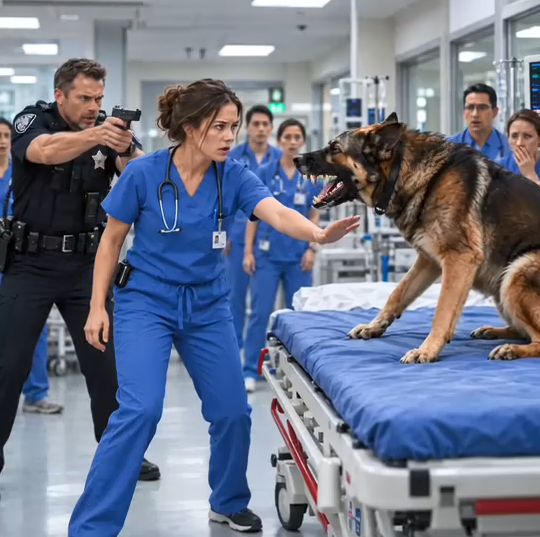
That was when I saw the dog.
Massive sable German Shepherd.
Crouched across Officer O’Connor’s legs.
Blood covered his front paws.
His chest.
Part of his muzzle.
His ears were pinned back.
His lips pulled away from white teeth.
His claws dug into the gurney pad like he intended to anchor himself there until somebody killed him.
A growl rolled through the trauma bay.
Low.
Deep.
I felt it in my chest.
Nobody moved for half a heartbeat.
Half a heartbeat is a very long time when somebody is bleeding to death.
“We couldn’t get him off,” the paramedic said.
Dr. Aerys stared at him.
“You brought a police dog into my trauma bay?”
“He wouldn’t leave the officer.”
“Where’s his handler?”
The paramedic pointed at the dying man.
Right.
Of course.
“He let us load O’Connor,” the medic continued. “But every time we tried to touch him after that, the dog went for us.”
Another medic held up a torn jacket sleeve.
“We called CPD K9.”
“How long?”
“Maybe twenty minutes.”
Dr. Aerys looked at the monitor.
“We don’t have twenty minutes.”
The dog growled again.
I watched him.
Everybody saw teeth.
I saw something else.
His eyes.
Wild.
Yes.
But focused.
Every time Officer O’Connor moved, the dog looked down.
Every time somebody reached toward O’Connor, the dog moved between the hand and the wound.
He wasn’t trying to escape.
Wasn’t attacking people randomly.
Wasn’t charging the room.
He was guarding.
That distinction would matter later.
In that moment, it did not matter enough.
His handler was dying.
Dr. Aerys took one slow step.
“Easy.”
The German Shepherd’s head snapped toward him.
Another step.
The dog lunged.
Jaws closed around Aerys’s sleeve.
Fabric ripped.
The surgeon stumbled backward into an instrument cart.
Metal crashed across the floor.
The dog released immediately.
He did not pursue.
He returned to O’Connor.
That should have told us everything.
It told us nothing useful fast enough.
“Everybody back!” Sarah shouted.
We moved.
The stretcher sat in the middle of Trauma One like an island.
Blood.
Metal.
A dying cop.
A dog who believed every person trying to save his handler was another attacker.
Officer O’Connor’s heart rate climbed.
His blood pressure fell.
Aerys looked at Sarah.
“Security.”
Already coming.
Three hospital security officers rushed through the doors.
Greg Sullivan came first.
Night supervisor.
Big man.
Former corrections officer.
Usually calm.
Usually the guy who brought us coffee at three in the morning when the cafeteria closed and the vending machine stole our money.
That night his hands were not calm.
He carried the hospital’s animal-control tranquilizer launcher.
He looked at the dog.
“Oh, hell.”
Dr. Aerys pointed.
“We need him moved.”
Greg studied the distance.
“How fast do you need access?”
“Now.”
“I can dart him.”
“How long?”
“Depends.”
“Greg.”
“Five minutes maybe.”
Aerys stared.
“He may not have two.”
Greg looked at the monitor.
Then at the dog.
“With this much adrenaline, sedation could be slower.”
“Higher dose?”
“Could compromise respiration.”
“What if you miss?”
Nobody needed that answered.
A dart in the wrong place could hit the officer.
O’Connor groaned.
The German Shepherd immediately looked down.
Nosed his chest.
Then turned back toward us.
Something happened inside me.
Tiny.
A tug.
Familiarity.
I did not understand it yet.
Greg lowered the tranquilizer launcher.
His hand moved toward his holster.
Click.
The retention snap opened.
My body went cold.
Sarah saw.
“Greg.”
He looked miserable.
“If the dog doesn’t move, the officer dies.”
Nobody argued.
Because he was right.
And because sometimes being right does not make a decision less horrific.
Greg drew.
The dog saw the gun.
His body lowered.
Teeth appeared.
He was ready.
That was the only word.
Ready.
Ready to die over the man beneath him.
Greg raised the weapon.
“No!”
My voice.
I did not decide to step forward.
My clipboard hit the floor.
I pushed past a resident.
Past Sarah.
Between Greg’s gun and the gurney.
He immediately angled the muzzle upward.
“What the hell are you doing?”
Sarah grabbed at my arm.
“Henderson!”
“Wait.”
“Khloe, move!”
“Wait!”
Dr. Aerys shouted:
“We don’t have time!”
I looked at the dog.
And the trauma light moved across the right side of his face.
That was when I saw the scar.
Jagged.
Pale.
Running diagonally from beside the nose toward his cheek.
The room disappeared.
I was twenty-two again.
Our apartment kitchen.
Matthew leaning against the counter in uniform.
A younger German Shepherd sitting beside him with fresh stitches across his muzzle.
“What happened?”
Matthew had smiled.
“You should see the fence.”
“Matthew!”
“Suspect ran through a vacant lot.”
“And Bruno?”
“Apparently forgot barbed wire exists.”
The dog had sneezed.
Matthew scratched his chest.
“Still caught the guy.”
Back in Trauma One, my knees almost gave out.
Same scar.
Same amber eyes.
Older.
Harder.
But him.
“Bruno.”
I barely made sound.
The dog’s ear moved.
Sarah looked at me.
“What?”
I stepped another inch.
Greg said:
“Don’t.”
I whispered:
“Bruno.”
This time Sarah heard.
Her face changed.
She knew my brother’s story.
Everybody who worked closely with me eventually did.
Not all of it.
Enough.
“Matthew’s dog?”
I nodded.
Greg stared.
“That doesn’t mean he knows you.”
“I know.”
“He could kill you.”
“I know.”
Dr. Aerys said:
“Henderson.”
His voice was different now.
Not angry.
Desperate.
I turned.
He looked at O’Connor.
“Ten seconds.”
That was all he could give me.
Ten seconds stolen from a dying man.
I nodded.
Then I faced Bruno.
Two years earlier, I had not been a nurse.
I had a marketing degree.
Three decent blazers.
A pile of job applications.
And an older brother who had spent most of his adult life raising me after our parents died.
Mom died when I was thirteen.
Cancer.
Dad died three years later.
Heart attack.
Matthew was nine years older.
He could have left.
Nobody would have blamed him.
Instead he came home.
Finished police academy.
Learned to cook badly.
Signed school forms.
Attended parent meetings while being obviously too young to be anyone’s father.
Ruined white clothes by washing them with red towels.
Thought frozen pizza became healthy if he added peppers.
Threatened to “run a background check” on the first boy who took me to homecoming.
Mostly joking.
I think.
Matthew became brother, parent, emergency contact, mechanic, and the person I called when the sink made a noise.
Bruno entered our lives when I was nineteen.
Two-year-old German Shepherd.
Working line.
Serious animal.
Suspicious of everybody.
Obsessed with Matthew almost immediately.
At first Bruno tolerated me.
Then I learned his routines.
Food release.
Door signals.
How Matthew clicked his tongue when visitors were safe.
The word that meant the backyard was clear.
And one phrase Matthew used at home that had nothing to do with official CPD K9 training.
“Code Four.”
Police language.
Situation under control.
No additional assistance required.
But Matthew used it differently.
After a long shift, Bruno would sit at the apartment window.
Watching.
Still working.
Matthew would take off his duty belt.
Drop his keys.
Scratch the dog’s neck.
“Code Four, buddy.”
And Bruno would leave the window.
Drink.
Eat.
Sleep.
Become a dog again.
I once asked why he needed that.
Matthew said:
“Because he spends twelve hours thinking every doorway might hide somebody who wants to hurt me.”
“He needs to know when the watch ends.”
I had thought it was sweet.
Then Matthew died.
Warehouse raid.
November.
Narcotics team entered with bad intelligence.
Suspects were better armed than expected.
Confused lines of fire.
Matthew took a round high in the thigh.
Femoral artery.
Scene too dangerous for medics to enter immediately.
Bruno stayed beside him.
A bullet grazed the dog’s ribs.
He stayed.
By the time backup reached Matthew, he had lost too much blood.
Captain James Donovan told me in a hospital family room.
He held Matthew’s police hat with both hands.
I remember almost nothing else.
Your brother served with honor.
Your brother saved lives.
Your brother died in the line of duty.
Those sentences were true.
They also felt insulting.
Matthew was more than duty.
He packed my lunch.
He left sticky notes on the refrigerator.
BUY MILK OR WE BECOME A WATER HOUSE.
He overcooked steak.
Snored.
Called every movie made after 2005 “too long.”
He was thirty-three years of person before somebody turned him into one sentence about sacrifice.
Bruno survived.
They had to remove him from Matthew’s body.
He underwent surgery.
Then behavioral rehabilitation.
I visited twice.
The second visit destroyed me.
When I entered the kennel room, Bruno looked behind me.
Then toward the door.
Back at me.
Door again.
Waiting.
Looking for Matthew.
He whined.
That was the last time I went.
I told myself I was letting professionals handle him.
Truth?
I was a coward.
I smelled like Matthew’s apartment.
His laundry detergent.
His kitchen.
His family.
And every time I arrived without Matthew, Bruno searched for the person I could not bring back.
So I disappeared from the dog’s life.
Months later, the department assigned Bruno to another K9 officer.
David O’Connor.
I ignored the announcement.
Captain Donovan called me.
I let voicemail take it.
The CPD newsletter arrived with Bruno’s photograph on the front.
I threw it away unopened.
I told myself I was glad he had moved forward.
Then refused to witness any proof.
Meanwhile, I blew up my own life.
Six months after Matthew died, I sat on my bathroom floor wearing his old sweatshirt.
I had a marketing interview that afternoon.
I couldn’t stand.
Could not imagine walking into an office to sell products while one sentence screamed inside my head.
Matthew died because blood left his body faster than anybody could stop it.
By evening I canceled the interview.
Three weeks later I applied to an accelerated nursing program.
Everybody called it brave.
Meaningful.
A tribute.
It wasn’t.
Not at first.
It was panic with tuition.
I could not save my brother.
So I tried to become the kind of person who might save somebody else’s.
Now I stood in Trauma Bay One.
Another warehouse.
Another wounded officer.
Another floor covered in blood.
And Matthew’s dog was standing between us and another man who might die.
History had not repeated.
It had cornered me.
I took one step toward Bruno.
He lunged.
His teeth snapped inches from my face.
Behind me people gasped.
Every muscle in my body screamed to move backward.
I didn’t.
Not because I was brave.
I was terrified enough that something inside me became strangely quiet.
I lowered myself carefully.
Knees on tile.
Hands visible.
Small.
No sudden movement.
“Everybody stop talking.”
I didn’t know whether they would listen.
They did.
The bay went quiet.
Monitor.
Rain.
O’Connor’s ragged breathing.
Bruno’s breathing.
Mine.
I reached beneath my scrub collar.
Silver chain.
Matthew’s badge.
I had worn it every nursing shift.
Technically against policy.
Sarah had seen it a hundred times and somehow never noticed.
Charge nurses possess selective blindness.
I pulled it free.
Held it in my palm.
Bruno growled.
I extended my hand.
Not close enough to force anything.
He snapped once.
Stopped.
His nose moved.
Maybe he smelled metal.
Skin.
Home.
Maybe nothing mystical happened.
Dogs understand scent better than we ever will.
Matthew and I shared a home.
Detergent.
Furniture.
Soap.
Food.
Bruno had slept beside my bed.
Sat on our couch when Matthew pretended he wasn’t allowed.
Stolen bacon from my plate.
Two years is a long time.
Maybe scent lasts in memory differently.
Maybe recognition was not one thing.
Bruno’s growl changed.
Less certain.
One ear lifted.
“Hey, buddy.”
His eyes stayed on mine.
I remembered him waiting outside my bedroom after I came home crying from a terrible date.
His nose under the kitchen table.
His ridiculous excitement over cheese.
Matthew saying:
Code Four.
I held up the badge.
“Bruno.”
He looked at it.
Then me.
My voice nearly disappeared.
“Code Four, buddy.”
His body went rigid.
Nobody moved.
I swallowed.
“Matthew says your watch is over.”
That sentence broke me before I finished it.
“I’ve got him now.”
Bruno stared.
“Stand down.”
The aggression did not disappear like somebody flipped a switch.
It collapsed.
Like exhaustion.
His front legs bent.
He dropped to the gurney.
A sound came from him.
High.
Broken.
Nothing like the growl.
He slid down from Officer O’Connor’s legs.
Low to the floor.
Crawled toward me.
Then shoved his head into my lap so hard I nearly fell backward.
My arms closed around him.
“Go!”
The trauma bay exploded.
Aerys was on the gurney instantly.
Nurses.
Residents.
Blood.
Lines.
Scissors.
Pressure.
“Femoral!”
“Pressure’s forty-eight!”
“Rapid transfuser!”
“Call vascular!”
“Get OR ready!”
Bruno jerked at the noise.
I held him.
“Stay.”
His entire body shook.
“It’s okay.”
Another blood unit went up.
Chest tube.
Second line.
Someone cut the rest of O’Connor’s uniform away.
The gurney disappeared beneath people trying to keep him alive.
Bruno whined.
He tried to rise.
I put my face against his neck.
“Code Four.”
He trembled.
“I’ve got him.”
The doors eventually closed behind Officer David O’Connor as the trauma team rushed him toward surgery.
And suddenly the bay was quiet again.
I remained on the floor.
Blood everywhere.
Bruno pressed against me.
Matthew’s badge in my hand.
Then I cried.
Not graceful tears.
Not one cinematic drop.
I sobbed.
Two years of nursing school.
Clinical rotations.
Night shifts.
Grief counseling.
Trying to become competent enough that helplessness could never touch me again.
Gone.
Bruno licked my cheek.
I buried my face in his fur.
“You remember.”
My voice broke.
“You remember him.”
A pair of shoes appeared beside us.
Expensive.
Administrator Richard Wallace.
Of course.
Tie perfect.
Expression furious.
The word LIABILITY might as well have been written across his forehead.
“What happened?”
Nobody answered quickly enough.
He saw Bruno.
“That animal needs to leave the hospital immediately.”
Bruno’s ears lifted.
I looked up.
“Lower your voice.”
Wallace stared at me.
“Nurse Henderson, that dog attacked a physician.”
“He grabbed his sleeve.”
“He is dangerous.”
A voice behind Wallace said:
“He is a police officer.”
Captain James Donovan.
Older now.
More gray.
Same eyes.
Wallace turned.
“He is a dog.”
“He is a certified CPD K9 who just came in attached to a critically wounded handler.”
“This is an emergency department.”
“Yes.”
“Not a kennel.”
“Then give us somewhere safe until K9 personnel and veterinary support arrive.”
Wallace pointed at me.
“She needs to return to duty.”
“No.”
Sarah.
Everybody looked.
“She’s off the floor.”
Wallace laughed.
“You do not make administrative decisions concerning—”
“Critical incident.”
Sarah cut him off.
“I am charge nurse.”
“I am relieving her.”
“You can complain tomorrow.”
Wallace opened his mouth.
Sarah gave him a look that had frightened residents, surgeons, administrators, and at least one cardiologist.
Wallace left.
Muttering.
Donovan crouched beside me.
His eyes found the badge.
“You still wear that.”
“Yes.”
He looked at Bruno.
“He remembered you.”
I shook my head.
“He remembered Matthew.”
Donovan’s jaw tightened.
“Maybe both.”
I was not ready to hear that.
“What happened to David?”
“Railyard pursuit.”
My stomach tightened.
“Suspect ran into an old freight warehouse.”
Of course.
“Ambush.”
“O’Connor took multiple rounds.”
Bruno pressed closer.
Donovan continued.
“Bruno dragged him behind a support column by the vest.”
I looked at the dog.
“Dragged him?”
“Far enough to get him out of direct fire.”
“Then held position until backup.”
Another warehouse.
Another handler bleeding beside him.
No wonder the dog had arrived prepared to fight the world.
For four hours, I stayed with Bruno inside a family consultation room.
Sarah brought towels.
Water.
Food.
Bruno ignored the food.
I cleaned O’Connor’s blood from his coat.
Paws first.
Chest.
Neck.
Muzzle.
The scar beneath my fingers.
He let me.
When I reached the collar, I found the tag.
BRUNO.
CPD K9.
DAVID O’CONNOR.
The name hurt.
And then I hated myself for being hurt.
David’s name had not erased Matthew.
But apparently some part of me still believed love worked like a replacement tag.
One person removed.
Another installed.
I had never met David.
Yet I resented him for surviving long enough to put his name beside Bruno’s.
That realization shamed me.
My phone buzzed.
1:15 A.M.
Still in surgery.
Splenic injury.
Femoral repair underway.
Massive transfusion.
At 2:30:
Unstable.
Still operating.
Bruno watched the door.
I remembered waiting for Matthew.
Different hospital.
Same chairs.
Same coffee nobody drank.
Same terrible language.
We’re doing everything we can.
Then the doctor who came out and made “everything” sound small.
At 3:45, O’Connor was still alive.
I put my hand into Bruno’s fur.
“Hold on.”
He looked at me.
“We hold on.”
At 5:12, the consultation-room door opened.
Dr. Aerys entered.
Surgical cap gone.
Face exhausted.
Scrubs stained.
For one second, his expression became the face of the doctor who had told me Matthew was dead.
I stopped breathing.
Then Aerys gave the smallest smile.
“He’s stable.”
I stared.
“He’s alive?”
“Yes.”
My legs stopped working.
I crouched beside Bruno.
His tail touched the floor.
Once.
Again.
Aerys pointed at me.
“If you hadn’t gotten that dog away from him, O’Connor dies in the trauma bay.”
I looked up.
“You saved his life.”
“No.”
“Yes.”
Normally I would have fought him.
Listed paramedics.
Surgeons.
Blood bank.
Nurses.
Chance.
Anybody except myself.
But exhaustion had removed the energy required to refuse every kind word.
So I just said:
“We all did.”
Three days later David O’Connor was awake enough for visitors.
Barely.
He looked like somebody had assembled him from tubing.
Bruised.
Pale.
Staples.
Lines.
Oxygen.
Bruno was not supposed to enter ICU.
There were rules.
Many.
Sarah took an unusually long coffee break.
Aerys became deeply interested in a chart.
Donovan stood at the nurses’ station looking prepared to arrest hospital administration if necessary.
I opened the glass door.
David turned.
His eyes found Bruno.
Everything in his face changed.
“Brun.”
Barely sound.
Bruno surged forward.
Then slowed when he reached the bed.
That broke me.
This dog who had been willing to attack an entire trauma team understood immediately that David was fragile.
Front paws carefully against the mattress edge.
Head against David’s shoulder.
David wrapped one arm around him.
Then a wounded police officer and a police dog cried together.
There is no prettier way to say it.
I stepped back.
Some moments shrink if you stare too hard.
Eventually David looked at me.
“You.”
I smiled.
“Apparently.”
“Donovan told me.”
“That man has no hobbies.”
“He said you stepped between Bruno and a gun.”
“Bruno was afraid.”
David looked toward my chest.
Matthew’s badge.
I touched it instinctively.
His eyes widened slightly.
“You’re Henderson’s sister.”
I froze.
“You knew Matthew?”
David gave a weak laugh.
“Knew him?”
His eyes closed briefly.
“He trained me.”
I couldn’t speak.
“First year out of academy.”
David smiled.
“Your brother taught me how not to become the kind of cop who needed everybody to know he was a cop.”
That sounded so much like Matthew that air left my lungs.
David continued.
“First week, I almost arrested a homeless guy for sleeping in a doorway.”
“What did Matthew do?”
“Made me buy him coffee and breakfast.”
I laughed through tears.
“Yeah.”
“That’s him.”
“After Matthew died…”
David stopped.
His hand moved through Bruno’s fur.
“I applied to K9.”
“Why?”
“Because of him.”
I looked at Bruno.
David said:
“The department was considering retiring Bruno.”
“He wouldn’t work.”
“Wouldn’t bond.”
“Some guys thought he had too much baggage.”
“I started visiting.”
“How long?”
“Months.”
“You?”
“Every day I could.”
“He hated me.”
That almost made me smile.
“What did you do?”
“Sat outside his kennel.”
“Nothing else?”
“Read reports.”
“Drank coffee.”
“Complained about him.”
“Sometimes brought food.”
“Didn’t touch him.”
“One day he walked over and lay by the gate.”
David looked at Bruno.
“That afternoon I asked Donovan for him.”
My vision blurred.
For two years I had imagined a stranger taking Matthew’s dog.
Using him.
Replacing Matthew.
What actually happened was an officer Matthew had trained spent months sitting outside a kennel because he refused to let Matthew’s partner disappear into retirement unwanted.
“You didn’t take him.”
David frowned.
“What?”
“Nothing.”
I moved closer.
He continued.
“Your brother saved me before Bruno ever did.”
“Not from bullets.”
“From becoming somebody I wouldn’t have liked.”
His eyes filled.
“When he died, I couldn’t do anything for him.”
“So I thought maybe I could do something for the dog.”
I looked at Bruno.
He had placed his head carefully against David’s arm.
David whispered:
“I promised him I would never act like Matthew hadn’t existed.”
That was when I cried again.
Quiet this time.
He looked at me.
“Your brother saved my life.”
“More than once.”
“Now you did too.”
I shook my head.
David ignored it.
“How does somebody repay that family?”
I put my hand over his.
“You already did.”
“How?”
I looked at Bruno.
“You stayed with him.”
My voice broke.
“When I couldn’t.”
David understood immediately.
No judgment.
He nodded.
“Then maybe now you can.”
That was the beginning.
Not of romance.
People always ask that when I tell this story.
No.
David became something harder to name.
Friend.
Connection.
A piece of Matthew’s life I had never known.
And Bruno became the bridge.
David’s recovery was ugly.
Real recovery usually is.
Movies show montages.
Actual recovery smells like antiseptic.
Medication.
Sweat.
Catheter tubing.
Frustration.
It is celebrating four steps down a hallway.
Then watching the same person cry because they cannot stand from a toilet without help.
David hated his cane.
Sarah threatened to cover it in glitter.
He believed her.
Bruno hated physical therapy.
First session, David took four assisted steps.
Bruno whined like someone was murdering him.
David glared.
“Don’t start.”
The dog tilted his head.
“I dragged you out of mud once.”
Bruno sneezed.
Even the therapist laughed.
Laughter changes hospitals.
It reminds everybody that the person inside the gown existed before the diagnosis.
David improved.
Bruno did not completely.
The warehouse shooting damaged something in him.
Metal crashes caused shaking.
Gunfire during retraining left him unable to settle.
Industrial buildings became impossible.
His veterinarian recommended retirement.
David fought it.
“I need him.”
Captain Donovan corrected him.
“You love him.”
David stared.
“Same thing.”
“No.”
Donovan leaned closer.
“If you need that dog to keep risking himself so you can feel like a street cop, that isn’t love.”
David went silent.
Bruno retired two months later.
Officially.
David adopted him.
There was a small ceremony in Chicago Memorial’s courtyard because apparently Sarah had decided every emotionally damaged person in her radius would receive closure whether they requested it or not.
Bruno wore a plain black collar.
No working harness.
No badge.
David stood with his cane.
Donovan nearby.
Greg came off security shift.
Aerys pretended he had accidentally wandered outside.
Sarah brought coffee.
David knelt carefully.
Looked at Bruno.
“You’re retired.”
Bruno stared.
“No suspects.”
Nothing.
“No warehouses.”
One ear moved.
“No biting surgeons.”
Aerys said:
“Especially that.”
People laughed.
Then David looked at me.
“Your turn.”
I knew what he meant.
My fingers went toward Matthew’s badge.
For two years, I had carried those numbers against my skin as if grief needed identification.
I knelt.
Bruno walked toward me.
Gray beginning at his muzzle.
Old scar beneath my thumb.
Amber eyes quieter.
I whispered:
“Code Four.”
His ears moved.
“Your watch is over.”
He pressed his forehead against mine.
And this time when I cried, it wasn’t because Matthew had died.
Not exactly.
It was because I finally understood that he had existed beyond the night he died.
In Bruno.
In David.
In Donovan’s stories.
In me.
Loss had convinced me absence meant erasure.
It didn’t.
A year passed.
I stopped being the rookie nurse everyone watched.
Sarah once told me:
“You’re becoming annoyingly competent.”
Coming from Sarah, that was essentially a military decoration.
The trauma phone still made my stomach tighten.
But not every ring became Matthew.
Sometimes it was simply work.
Sometimes somebody lived.
Sometimes somebody didn’t.
That lesson was harder.
Nursing did not give me authority over death.
It gave me something useful to do beside it.
Different.
Important.
Greg carried Trauma Bay One too.
Months later, David brought Bruno to the hospital for a follow-up.
Greg saw them.
David looked at him.
“You the guy who almost shot my dog?”
Greg went white.
David let the silence sit.
Then smiled slightly.
“Relax.”
Greg exhaled.
“I’m sorry.”
David nodded.
“I know.”
Greg looked at Bruno.
Then me.
“Can I?”
He crouched but stopped several feet away.
Bruno watched.
I said quietly:
“Code Four.”
Bruno stepped forward.
Greg placed one hand against his neck.
His eyes filled.
“I had the sights on him.”
“I know.”
“I still see it sometimes.”
Everybody carries a version of a moment where their hand almost became something they could not forgive.
I said:
“But you didn’t fire.”
“Because you stepped in.”
“No.”
I shook my head.
“I stepped in.”
“You still had to decide to stop.”
That mattered.
Hero stories simplify courage into one person.
Real emergencies rarely work that way.
One person may move first.
Everybody else still chooses what happens next.
Greg stopped.
Sarah backed me.
Aerys gave me ten seconds he did not have.
Paramedics kept O’Connor alive long enough to arrive.
Blood-bank staff moved units.
Surgeons repaired him.
Bruno listened.
David survived.
No one person owns the whole ending.
Even Wallace changed.
Slightly.
Which may have been the greatest medical miracle achieved at Chicago Memorial.
He approved a formal protocol for working dogs arriving with injured handlers.
Direct K9-unit contact.
Designated controlled room.
Veterinary response.
Security procedures.
Handler separation plans.
No improvising with weapons unless immediate danger left no alternative.
Sarah framed the first page.
Across the top, in marker, she wrote:
BRUNO’S LAW.
Wallace hated it.
It stayed behind the nurses’ station for six months.
David never returned to full street patrol.
That hurt him.
Everybody called him lucky because he survived.
Survivors learn quickly that “lucky” can feel like a demand.
Be grateful.
Don’t mourn what changed.
You lived.
What more do you want?
David wanted his legs to work the way they used to.
Wanted his old unit.
His old reflexes.
His old body.
He couldn’t have them.
Eventually CPD moved him into K9 training and handler mentorship.
At first he thought it was pity.
Then he discovered he was good at it.
He taught new handlers something Matthew had taught him.
“The dog does not exist for your ego.”
One recruit asked:
“What does that mean?”
David said:
“If you need a dog to make you look tough, get another job.”
When he told me, I laughed.
“Matthew?”
“Almost word for word.”
I started asking about my brother after that.
Really asking.
For two years, I had only wanted to know how he died.
That had been my mistake.
Death had swallowed Matthew’s biography.
So I reclaimed the rest.
Donovan told me academy stories.
David told me patrol stories.
Older officers told embarrassing stories.
There were many.
Apparently Matthew once chased a burglary suspect over a fence and ripped the back of his uniform pants wide open.
He completed the arrest with his jacket tied around his waist.
Bruno stole half a hot dog from a six-year-old during a street festival.
Matthew was so embarrassed he bought the family dinner.
At one Christmas party, Matthew performed karaoke.
Badly enough that Donovan claimed it constituted misconduct.
I had never heard any of it.
My brother had lived thirty-three years.
I had allowed one warehouse night to swallow all thirty-three.
That wasn’t fair to him.
So Matthew became a person again.
Not Officer Matthew Henderson, End of Watch.
Matthew.
Brother who snored.
Terrible cook.
Cop.
Friend.
Dog handler.
Idiot.
The man who raised me.
Healing turned out not to be forgetting.
It was expansion.
Making the story large enough that the death no longer occupied every page.
Two years after Trauma Bay One, David invited me to his backyard for Bruno’s retirement anniversary.
The dog lay beneath a maple tree.
Gray now.
Hips stiff.
He lifted his head when I arrived.
Tail thumped.
Did not bother standing.
David laughed.
“He has executive privileges.”
“He’s lazy.”
“He’s earned lazy.”
I sat beside Bruno.
His head settled on my leg.
I rubbed the scar.
David brought lemonade.
For a while we said nothing.
Then he said:
“I used to be jealous of Matthew.”
I looked up.
“What?”
“With Bruno.”
He stared toward the yard.
“First year.”
“I knew that dog loved me.”
“But sometimes he’d look at doors.”
“Like he expected somebody else.”
My throat tightened.
David continued.
“I wanted to be enough.”
“Then I realized how stupid that was.”
“Why?”
“Because loving me didn’t require forgetting him.”
I looked down at Bruno.
The sentence went through me.
Not because it was about the dog.
Not only.
For years I had treated happiness after Matthew like betrayal.
Laughing too hard.
Dating.
Career success.
Planning a future.
Every good thing felt as though I was leaving him behind.
Bruno had loved Matthew.
Then David.
Not by dividing loyalty.
By enlarging it.
Maybe humans could too.
Several months later, I took Matthew’s badge off my everyday chain.
That terrified me.
I placed it inside a shadow box.
His photograph.
Badge 4429.
A smaller picture of young Bruno.
Below it:
CODE FOUR.
I still wore the badge sometimes.
Memorials.
Important days.
Just not every shift.
Nothing happened.
Matthew did not disappear because metal left my skin.
Memory remained.
Love remained.
I remained.
Bruno aged.
Arthritis worsened.
Kidneys started failing.
Walks became shorter.
David called me one September afternoon.
“Can you come?”
The tone told me.
I drove over after shift.
Bruno lay beneath the maple tree.
Late-afternoon sun across his sable coat.
Face almost completely gray.
David sat beside him.
The veterinarian was coming.
I stopped.
“No.”
David nodded.
“He hasn’t eaten since yesterday.”
I sat down.
Bruno opened one amber eye.
Tail touched grass once.
“Hey, buddy.”
His nose reached toward my hand.
Weak.
I pressed my forehead against him.
For a long time, none of us spoke.
Then David said:
“You should tell him.”
I shook my head.
“I can’t.”
“You can.”
“That command means work is over.”
His voice broke.
“I know.”
When the veterinarian arrived, David held Bruno’s head.
I kept one hand on his shoulder.
Bruno looked between us.
Two people connected to two handlers.
Two lives.
One dog carrying history neither of us could hold alone.
I whispered:
“Code Four, Bruno.”
His ear moved.
“Your watch is over.”
My voice failed.
I tried again.
“You found Matthew.”
“Then David found you.”
“And somehow…”
I swallowed.
“You found me again too.”
David cried quietly.
“You don’t have to guard anybody anymore.”
Bruno exhaled.
“Go rest.”
The veterinarian gave the medication.
His eyes softened.
His head became heavier in David’s hands.
I bent close.
“Matthew’s got you.”
It was irrational.
I didn’t care.
“And we’ve got David.”
Bruno’s last breath left without struggle.
No warehouse.
No blood.
No gun.
No shouting.
Grass.
Sun.
Hands that loved him.
Code Four.
I thought losing Bruno would destroy me the way losing Matthew had.
It didn’t.
It hurt.
Deeply.
But I had finally learned pain was not the same as destruction.
That was Bruno’s last lesson.
David kept most of the ashes.
I kept some.
We placed a small portion near Matthew’s grave marker.
Donovan came.
Sarah too.
Greg stood behind us.
Aerys couldn’t attend but sent flowers.
The card said:
HE STILL OWES ME A SCRUB TOP.
David laughed and cried at the same time.
A few years later, Chicago Memorial partnered formally with CPD for emergency-response training involving working dogs.
I taught part of it.
First class:
Nurses.
Security.
Paramedics.
K9 handlers.
Residents.
I did not show footage from Trauma Bay One.
Didn’t show myself standing between Greg and Bruno.
Hero footage makes dangerous teachers.
Instead I put one sentence on the screen.
BEHAVIOR IS INFORMATION.
Then a photograph of Bruno.
Old.
Gray.
Sleeping beneath David’s maple tree.
I told them:
“The night Bruno entered our emergency department, people called him vicious.”
“He wasn’t.”
“He was terrified.”
Then I added:
“A terrified trained dog can absolutely be dangerous.”
“Understanding fear does not mean ignoring risk.”
“It means understanding what the behavior is trying to accomplish so trained people can respond safely.”
A resident asked:
“What should we do if it happens again?”
I answered:
“Do not do what I did.”
People laughed.
I didn’t.
“I stepped between a firearm and an agitated police dog.”
“I had a personal history with that dog.”
“I possessed information nobody else had.”
“It still could have ended badly.”
“We build protocols so the next nurse does not need luck, familiarity, or a private family cue.”
That mattered to me.
I refused to let the story become:
Young nurse fearlessly saves dangerous K9.
I wasn’t fearless.
I was terrified.
And “Code Four” was not a magic word.
If another person had walked toward another frightened German Shepherd and repeated it, nothing good might have happened.
The phrase mattered because of everything behind it.
Matthew.
Apartment.
Nightly routine.
Food bowl.
Home.
Safety.
The moment when work ended.
That was the real lesson.
Sometimes a familiar voice linked to safety can reach through panic farther than force.
But there is no universal password for trauma.
People misunderstand that too.
You cannot always say the right sentence and make fear disappear.
Sometimes all you can do is build enough safety, repeatedly, that the body eventually believes the danger ended.
Years passed.
I became charge nurse.
Sarah retired.
Pretended she wasn’t crying during the party.
Before she left, she pointed toward the red trauma phone.
“Your problem now.”
“I hate you.”
She hugged me.
“You’re ready.”
My first night as charge, the phone rang.
For half a second:
Matthew.
Warehouse.
Bruno.
Blood.
Then:
Present.
I picked up.
“Trauma.”
That was it.
Work.
Not memory.
Progress can be very small.
David remained one of my closest friends.
Not replacement brother.
Nobody needed replacing.
Eventually he married a physical therapist named Rachel.
I stood on his side at the wedding.
Donovan leaned over during the reception.
“Matthew would’ve approved.”
I smiled.
“He’d complain about the DJ.”
“Absolutely.”
David and Rachel later adopted a retired K9 named Atlas.
First time I met Atlas, he stole a napkin from my hand.
I looked at David.
“This one lacks Bruno’s professionalism.”
“Retirement standards have declined.”
The empty spaces in our lives stopped feeling like holes waiting to be filled.
They became spaces around which new things could grow.
It took me almost a decade to understand that.
Sometimes people recognized my name.
An article about Trauma Bay One had circulated.
The headline usually sounded something like:
ROOKIE NURSE WHISPERS SECRET COMMAND TO ATTACK K9.
I hated it.
Secret command.
As if Bruno had been a machine waiting for the correct password.
He wasn’t.
He remembered a relationship.
That phrase worked because Matthew had filled it with meaning thousands of ordinary times.
Code Four.
Dinner.
Couch.
Sleep.
Off duty.
Safe.
The watch is over.
Eventually I realized I had needed the same command.
I had been standing watch over Matthew’s death for years.
Reliving it.
Reconstructing it.
Punishing myself with it.
I became a nurse partly because I thought competence could travel backward through time.
If I learned enough about trauma care, maybe some part of me could prove I would have saved him.
Medically, I knew that was irrational.
Emotionally?
Different story.
One evening after shift, years after Bruno died, I drove to the cemetery.
Autumn.
Leaves across wet grass.
I sat near Matthew’s stone.
No badge around my neck.
Just his little sister.
“I’m okay.”
The words felt wrong.
For maybe one second.
Then peaceful.
“I miss you.”
Wind moved through trees.
“I still get angry.”
Nothing.
“Sometimes I still think if I’d become a nurse earlier…”
I stopped.
That sentence had built too much of my life.
If.
If I’d known.
If I’d been there.
If the medics reached him faster.
If.
No.
Matthew died because an armed man shot him in a warehouse.
Not because his little sister studied marketing.
Not because I lacked medical training.
Not because I failed.
I had known that intellectually for years.
Knowing something in the body takes longer.
“I couldn’t save you.”
Tears came.
“But that wasn’t my job.”
That sentence hurt more.
“You were my brother.”
“I was your sister.”
“That was enough.”
I touched the grass.
“And Bruno knew.”
I laughed softly.
“He was always smarter than me.”
When I stood, I looked at Matthew’s name.
“Code Four.”
Not goodbye.
Permission.
I drove home.
After that, when young nurses asked why I became an ER nurse, I stopped giving the polished answer.
“My brother died.”
“That pushed me here.”
Then I added:
“But grief can get you through a door.”
“It can’t decide whether you stay.”
They would ask:
“What made you stay?”
And I always thought about Trauma Bay One.
Sarah protecting her staff.
Aerys fighting for David.
Greg lowering his gun.
Donovan remembering Matthew.
Paramedics refusing to leave a wounded cop.
Blood donors whose names David would never know.
Bruno pressing his head into my lap.
“I learned I loved the work.”
That was true.
Not because I could save everyone.
I couldn’t.
Not because every story ended like David’s.
They didn’t.
I stayed because emergency medicine is filled with moments where frightened people hand strangers the worst minutes of their lives and say without words:
Help me hold this.
Sometimes we can fix something.
Sometimes we can only stand there while it hurts.
Both matter.
Matthew had understood that about police work.
Bruno understood it in his own way.
It took me longer.
On the twentieth anniversary of Matthew’s death, David met me at the cemetery.
Gray in his hair.
Gray in mine.
I objected to the comparison.
He brought a photograph.
Bruno.
Young.
Standing beside Matthew’s cruiser.
Matthew kneeling with one arm across him.
Uniform wrinkled.
Slightly annoyed expression.
Alive.
I had never seen it.
“Where did you find this?”
“Donovan.”
I touched the photograph.
Matthew looked so ordinary.
That was what hurt.
Not heroic.
Not ceremonial.
Human.
“Thank you.”
We sat.
After a while David asked:
“Do you ever think about the hospital night?”
“Yes.”
“Do you think you saved me?”
I smiled.
“You waited twenty years to ask that?”
“Maybe.”
I thought.
“No.”
He raised an eyebrow.
“You remain terrible at compliments.”
“I helped.”
“Bruno helped.”
“Greg helped by stopping.”
“Paramedics got you there.”
“Aerys and the surgeons repaired you.”
“Blood donors kept oxygen moving through your body.”
“Nurses kept you alive afterward.”
“Physical therapists rebuilt what they could.”
“You did months of work.”
I looked at him.
“No one person gets the whole survival story.”
David smiled.
“Matthew would’ve liked that.”
“He would’ve said it was too long.”
“True.”
We laughed.
Then David looked at the grave.
“He’d be proud of you.”
For years that sentence would have made me cry.
That day, I smiled.
“I think so.”
No guilt.
No argument.
Just:
I think so.
That evening, I placed the new photograph beside Matthew’s badge.
Then added another picture.
David in his hospital bed.
Bruno’s head against his chest.
Not because David replaced Matthew.
Because the story continued.
That was what I didn’t understand at twenty-two.
Death ends a life.
It does not end every relationship that life created.
Matthew trained David.
Matthew trained Bruno.
Matthew raised me.
Then Matthew died.
David carried forward things Matthew taught him.
Bruno carried memory.
I carried love, guilt, and grief into nursing.
Years later all three paths collided beneath fluorescent lights.
And this time—
the handler lived.
The dog lived.
And I lived differently afterward.
Nothing undid Matthew’s death.
Eventually I stopped needing anything to.
That was peace.
The version people remember is simpler.
A cop arrives bleeding to death.
His K9 guards him.
Security prepares to shoot.
A rookie nurse recognizes the dog.
She whispers a secret command.
The dog collapses.
Officer survives.
Good story.
Incomplete.
The real story started years earlier when a police dog lay beside one dead handler and could not understand why he would not stand up.
It continued when another officer spent months sitting outside a kennel until Bruno trusted him.
When I changed careers because helplessness terrified me.
When David chose Matthew’s dog because Matthew had once chosen him.
When Bruno dragged David behind cover.
When paramedics transported both of them because separating them was impossible.
When Greg reached for a weapon because he believed there was no other way.
When Aerys gave me ten seconds that his patient did not have.
When an old household phrase reached an animal trapped inside the worst memory of his life.
When surgeons worked until dawn.
When David opened his eyes.
When Bruno retired.
When I finally understood grief was not proof of loyalty.
That was the story.
The last memory I have of Bruno alive is still my favorite.
Not Trauma One.
Not the ICU.
Not retirement.
David’s backyard.
September sun.
Old dog beneath a maple tree.
I sat beside him.
He did not bother getting up.
Tail hit the grass once.
I rested my palm against his shoulder.
“Hey, buddy.”
One amber eye opened.
I smiled.
“Code Four.”
Tail again.
Nothing dramatic.
No crying.
No collapse.
No blood.
The phrase meant something gentler by then.
Safe.
Home.
Finished.
Loved.
Bruno closed his eye.
Exhaled.
Slept in the sun.
For two years after Matthew died, I thought Code Four belonged to my brother and his dog.
Then I thought it belonged to the night David survived.
Eventually I understood it belonged to anyone who had spent too long standing guard over something already gone.
Sometimes courage is holding a line.
Sometimes courage is believing someone when they tell you the danger has passed.
Sometimes loyalty is staying.
Sometimes loyalty is allowing yourself to leave.
Sometimes love is fighting.
And sometimes love sounds like permission to stop.
That night in Trauma Bay One, everyone thought I whispered a command that made a dangerous police dog surrender.
They were wrong.
Bruno did not surrender.
He remembered.
Matthew.
Our apartment.
The scar.
The kitchen.
Bacon.
The couch.
The moment a duty belt hit the table and a familiar voice told him he no longer had to protect everybody.
Code Four.
And when Bruno dropped his scarred head into my lap while doctors carried another handler toward surgery, he wasn’t the only one hearing it.
Some part of me was still sitting outside that warehouse two years earlier.
Still waiting for Matthew.
Still believing that if I stayed vigilant enough, useful enough, competent enough, I could change an ending that had already happened.
Bruno understood before I did.
The watch can end without love ending.
Someone can be gone without everything they gave you disappearing too.
Years later, when I became the nurse answering the red trauma phone and some frightened rookie looked at me with the same panic I once carried, I always gave them the same first instruction.
“Look at me.”
They would.
“Breathe.”
They did.
Then I would say:
“We’ve got this.”
I never meant:
The patient will live.
Emergency medicine cured me of promises like that.
I meant:
You do not have to hold this alone.
The same thing Matthew gave me when I was thirteen.
The same thing David gave Bruno by sitting outside that kennel.
The same thing Bruno gave me on the bloody floor of Trauma Bay One.
The same thing I whispered into his fur while another police officer disappeared through operating-room doors.
Code Four.
I’ve got him.
Your watch is over.
You can stand down now.
You’re safe.



