A Rich Restaurant Owner Ordered a Navy SEAL’s German Shepherd Out—Then the Dog Interrupted His Medical Episode in Front of Everyone and Proved Exactly Why He Was There.
PART2:
A stranger standing too close behind me while I tried to pay for coffee.
My doctors had names for what happened.
I had treatment.
A plan.
Medication when appropriate.
Therapy.
Grounding routines.
People who knew what to do if an episode became severe.
And Atlas.
Atlas was not a former military dog.
That distinction mattered to me.
He had not jumped from aircraft.
He had not hunted explosives.
He had not served beside me overseas.
He was trained later, specifically for the life I was living now.
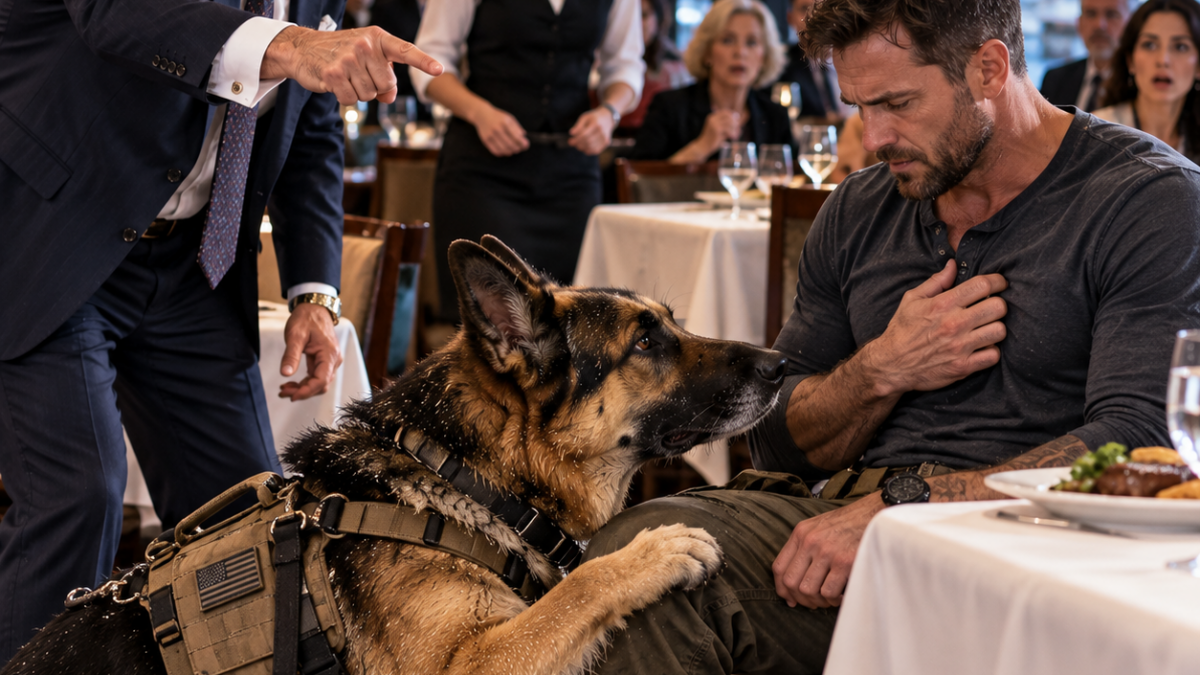
A German Shepherd.
Large.
Almost one hundred pounds.
Dark saddle over a tan coat.
Calm brown eyes.
One white hair patch beneath his chin that seemed to expand every year.
He had been trained to respond to behaviors I sometimes displayed before or during an episode of disorientation.
He did not diagnose me.
He did not read my thoughts.
He noticed patterns.
My right hand rubbing the seam of my jacket.
My gaze becoming fixed.
My breathing shortening.
My awareness narrowing until everything outside one point seemed far away.
When Atlas saw that pattern, he performed a tactile interruption.
Usually his muzzle against my knee.
Sometimes against my hand.
Persistent enough to pull my attention toward something real and immediate.
Then I followed the routine my clinicians had practiced with me.
Name where I was.
Identify objects I could see.
Put both feet on the ground.
Breathe.
Ask for help if necessary.
Simple.
Concrete.
Useful.
Atlas was not my courage.
He was not my cure.
He was a tool with a heartbeat.
A partner trained to help me use the skills I already had.
That evening, we went to Voss Harbor House because my sister Julia had chosen it for her upcoming anniversary dinner.
I wanted to try the restaurant first.
That sounds ridiculous until you have lived long enough with a condition that can turn one unfamiliar room into a question.
Is the seating crowded?
Is there an easy exit?
Is the noise level manageable?
Will somebody make an issue out of the dog?
I had learned to check.
Not because I was afraid of dinner.
Because planning gave me more freedom than pretending I needed none.
We arrived ten minutes early.
The restaurant sat directly on the waterfront.
Floor-to-ceiling windows.
Polished wood.
Brass fixtures.
White tablecloths.
A bar lined with bottles lit from beneath.
The kind of place where the host says your name as though confirming a reservation at a private club.
Atlas walked beside my left leg.
No pulling.
No sniffing tables.
No greeting strangers.
The host looked at him.
Then me.
“Reservation?”
“Cross.”
“For one?”
“One human.”
I smiled.
“Atlas works.”
The host gave an uncertain laugh.
Then found reservation.
I asked for quieter table if possible.
A woman approached from dining room.
Mid-forties.
Dark hair pinned back.
Black jacket.
Name tag:
ELENA BROOKS — GENERAL MANAGER.
“Mr. Cross?”
“Yes.”
“I’m Elena.”
“We can put you near the harbor windows.”
“There’s a little more space beside the booth.”
“That’d be perfect.”
She glanced at Atlas.
“Does he need anything?”
“Just floor.”
She smiled.
“We have plenty.”
That should have been entire story.
Atlas slid beneath the table.
Turned once.
Lay down.
His leash remained loose.
His head rested beside my shoe.
A waiter brought water.
Atlas ignored it.
A piece of bread fell from neighboring table.
Atlas ignored that too.
I looked through glass toward harbor.
Ferries.
Working boats.
Dock lights.
Rain beginning lightly on windows.
For several minutes, I thought:
This is going well.
Then Richard Voss walked over.
I knew who he was before anyone told me.
Some people carry ownership differently from management.
Elena moved through room watching what needed attention.
Richard moved through room watching who noticed him.
Late fifties.
Expensive navy blazer.
Open collar.
Silver watch.
Perfect haircut.
He paused three tables away.
Looked directly at Atlas.
His face changed.
Then he walked toward us.
“Get that German Shepherd out of my restaurant.”
Loud enough for six tables.
Conversation stopped.
A server carrying water glasses froze.
I looked up.
“Excuse me?”
Richard pointed.
“That dog.”
“He needs to go.”
Atlas did exactly what he was trained to do.
Nothing.
He remained under table.
Head down.
Richard looked irritated by that too.
“He’s my service dog.”
“I don’t care what you call him.”
“I own this restaurant.”
I felt my fingers tighten against edge of table.
Not episode yet.
Just anger.
Important difference.
I kept voice level.
“He’s trained to assist me with a disability.”
“He’s under control.”
“He’s not blocking aisle.”
Richard glanced toward diners as though seeking jury.
“He’s a hundred-pound Shepherd.”
“Close.”
“You expect me to take your word for it?”
I had been through this before.
Not often.
Enough.
“You may ask whether he is required because of a disability and what work he is trained to perform.”
“I’m happy to answer.”
Richard’s mouth tightened.
“I’m not holding a hearing.”
“Dog goes.”
“Or you both go.”
Under table, Atlas lifted his head.
My right thumb had begun rubbing seam of my jacket.
Tiny movement.
I barely noticed.
Atlas did.
His muzzle touched my knee.
Gentle.
Once.
Richard did not see.
I did.
I stopped rubbing.
Placed both feet flat.
Focused on window.
Harbor crane.
Blue drinking glass.
Brass lamp.
Early signs settled.
Elena appeared.
“Richard.”
He turned.
“Can I speak with you privately?”
“There is nothing private.”
She looked at me.
Then Atlas.
“Sir, is your dog required because of a disability?”
“Yes.”
“What work has he been trained to perform?”
“He interrupts episodes of disorientation with a tactile cue and helps me initiate a grounding routine I’ve practiced with my clinicians.”
Elena nodded.
“Thank you.”
Then turned to Richard.
“He’s answered what we need.”
“Atlas is controlled.”
“He is not disturbing anyone.”
Richard looked at her as though employee had just contradicted him at shareholder meeting.
“He is a German Shepherd.”
“Yes.”
“People are afraid of dogs.”
“Then we can address seating concerns.”
“That doesn’t mean we exclude a controlled service animal.”
Richard leaned closer.
His voice dropped slightly.
Still audible.
“If he’s so determined to drag an animal everywhere, he can go somewhere that welcomes dogs.”
That sentence hurt more than first.
Not because of insult.
Because it revealed what he thought.
This was preference.
Lifestyle.
Some man insisting on bringing dog because he could not bear leaving pet at home.
I looked directly at him.
“I would like to keep my reservation.”
“Then come back without him.”
Elena’s expression hardened.
“I can’t support that instruction.”
Richard looked at host.
“Cancel his table.”
Host froze.
Elena reached toward reservation tablet.
“Do not cancel it.”
Richard stared.
For a few seconds, entire dining room seemed smaller.
He finally said:
“We’ll discuss this after service.”
Then walked toward private dining area.
I should have felt victorious.
I didn’t.
My hands were trembling.
Atlas nudged knee again.
I followed routine.
Window.
Glass.
Lamp.
Feet.
Breath.
Elena waited until I looked at her.
“I’m sorry.”
“You didn’t do it.”
“I’m responsible for room.”
“You’re responsible for what you can control.”
She looked toward Richard.
“That is becoming complicated.”
I almost smiled.
She offered quieter booth closer to harbor window.
More space beneath table.
Fewer people passing.
I accepted.
Not because I wanted special treatment.
Because I needed dinner to stop being argument.
The waiter brought menu.
I ordered fish.
Coffee.
Then stared at plate longer than I ate.
Across room, Richard talked to guests near host stand.
One couple looked toward me.
He gestured once toward booth.
I felt every glance.
That is one of the strangest things about being challenged publicly over disability.
You can know intellectually that you did nothing wrong and still begin wondering whether every person around you wants explanation.
Was he really a SEAL?
What’s wrong with him?
Does he actually need dog?
He looks fine.
Why a German Shepherd?
Couldn’t he use smaller breed?
Is that legal?
Does the dog bite?
People did not have to say questions.
I could feel them.
Atlas slept.
That helped.
At service station, a young host named Colin leaned toward Elena.
“He told me last week to turn away all animals tonight.”
Elena looked at him.
“What do you mean all?”
“For foundation reception.”
“He said no animals.”
“Including service dogs.”
“Did he write that?”
Colin hesitated.
“Checklist.”
They opened staff tablet.
There it was.
NO ANIMALS, INCLUDING SERVICE ANIMALS, IN DINING OR EVENT AREAS.
REFER EXCEPTIONS TO OWNER.
Approved that morning.
Richard Voss.
That changed situation.
A spontaneous angry comment can be corrected.
A written instruction becomes repeatable.
The next service dog team could arrive after Elena’s shift.
Host could follow order.
Guest could be turned away.
No argument.
No witness.
No manager willing to risk job.
Elena photographed screen for internal record.
“Do not send this around.”
“Don’t delete it.”
Colin nodded.
Richard came back.
“Why is he still here?”
Elena said:
“Because he’s eating.”
“I told you—”
“I heard you.”
“You are undermining me.”
“No.”
“I’m preventing a bad instruction from becoming staff practice.”
Richard’s face reddened.
“You think one customer is worth tonight’s foundation reception?”
Elena replied:
“I think accessible event is what they booked.”
Then she returned to work.
I knew none of that yet.
I only knew my coffee tasted burnt.
I had eaten four bites.
Atlas remained under table.
A woman at neighboring table stood and walked over holding phone.
“Are you really Navy SEAL?”
I looked at camera lens.
“Please don’t film me.”
Her face fell.
“Oh.”
“My husband heard what happened.”
“He said you should tell that owner who he’s dealing with.”
I looked at Atlas.
Then her.
“This isn’t about who I used to be.”
She lowered phone.
“I’m sorry.”
“It’s okay.”
She returned.
Not malicious.
Just curious.
That was part people misunderstand.
Most humiliations are not built from villains.
They are built from accumulation.
One person shouting.
Another staring.
Another filming.
Another asking.
Another whispering.
You become event.
I had spent years in environments where attention was expected.
Briefings.
Operations.
Training.
Command.
Dinner was different.
I wanted fish.
That was all.
Twenty minutes before foundation reception, Richard called Elena into service hallway.
“You undermined me in front of customers.”
“I refused to remove controlled service animal.”
“My name is on restaurant.”
“And your name is on written instruction excluding service animals.”
Richard held hand out.
“Keys.”
Elena stared.
“What?”
“Your manager keys.”
“If you can’t enforce standards I set, I need someone who will.”
Elena had managed restaurants thirteen years.
Built schedules.
Covered sick calls.
Remembered regulars.
Handled broken refrigeration at midnight.
Flooded dish pit.
Staff fights.
Health inspections.
Wedding receptions.
Funerals.
Holiday disasters.
Now she could lose job because she refused to tell me to leave.
She placed keys on counter.
“I will finish shift if you want me to.”
“But I will not remove him.”
Richard pocketed keys.
“We’ll discuss employment after event.”
When she came back to my table, she looked paler.
“You okay?” I asked.
“Yes.”
“No.”
She gave tired smile.
“I’m working.”
“Did he threaten your job?”
Silence answered.
I looked toward Richard.
“I don’t want you fired because of me.”
“You didn’t write policy.”
“He did.”
“That doesn’t pay your mortgage.”
“No.”
She looked at me.
“But if I enforce something I know is wrong because I’m afraid of losing work, then I’m teaching every host watching me that fear outranks judgment.”
That shut me up.
Minutes later, foundation coordinator called asking about accessibility.
Two guests using mobility aids.
One guest accompanied by service dog.
Elena looked at written instruction.
Then Richard.
Then answered.
“Yes, service dogs are welcome.”
Pause.
“I also need to disclose there is conflicting direction from owner tonight.”
“I have refused to enforce it.”
She stuck to facts.
No medical details about me.
No gossip.
No accusation beyond what she knew.
The call reached foundation chair.
Patrice Monroe.
Retired port administrator.
Sixties.
Quiet.
The kind of person who lowered voice when others raised theirs.
She arrived before event.
Asked Richard one question.
“Will this restaurant admit a guest accompanied by a trained service dog?”
Richard smiled.
“Of course, if there is genuine need.”
Patrice asked:
“Who decides whether need is genuine?”
“Our management.”
Elena placed checklist on host stand.
Patrice read.
Richard reached toward it.
Too late.
“You wrote no service animals.”
“That’s an appearance guideline.”
“It wasn’t literal.”
Patrice looked at him.
“Your manager says you ordered a guest out over a service dog.”
“I offered to comp his meal.”
“A free meal does not replace access.”
Reception guests were already arriving.
Foundation could not magically relocate event.
Patrice did not pretend it could.
Instead she said:
“We need clear answer before our guests enter.”
“If you exclude service animal teams, we will document that refusal and address it under our contract.”
Richard had expected donor event to make him important.
Now person paying for private room was asking why he had created an unnecessary problem.
He looked around.
Then said:
“I’ll allow them tonight.”
Patrice answered:
“Not as favor.”
“Same service everyone else gets.”
Richard’s jaw tightened.
“Yes.”
Elena entered clarification into staff system.
Original instruction remained.
New instruction beneath.
Timestamped.
That mattered.
People love clean stories where bully gets humiliated instantly.
Reality is more useful when record stays.
I did not see most of that.
I saw staff rearranging table to make more room for mobility aid.
I saw another guest enter with small service dog and be seated without scene.
That was enough.
I finished coffee.
Asked bill.
I wanted out.
Not because Richard had won.
Because nervous system was tired.
Elena met me near entrance.
“Front lobby will be crowded now.”
“There’s a terrace exit.”
“Short outdoor passage to parking lot.”
“Would you prefer that?”
“Yes.”
“Want someone to walk with you?”
“No.”
“We’re okay.”
She opened terrace door.
Atlas rose.
Came to heel.
We stepped outside.
Cool air.
Salt.
Rain.
Diesel.
Harbor.
Better.
A catering worker rolled banquet cart through delivery doorway ahead.
I stopped to let him pass.
Atlas waited.
Then one wheel caught threshold.
The cart tipped.
A stack of metal trays hit concrete.
Hard.
Fast.
Violent metallic crash.
My body reacted before thought.
Everything inside me locked.
I knew where I was.
Then I didn’t.
The harbor disappeared while still being in front of me.
Sound stretched.
My right hand found jacket seam.
Rubbed once.
Twice.
Then froze.
I could see ramp.
Could not step.
Could hear people.
Could not separate words.
My breathing became shallow.
Atlas moved.
Muzzle against thigh.
Once.
I did not respond.
Again.
Harder.
A practiced interruption.
Nothing mystical.
Nothing heroic.
A dog performing a task.
Elena heard trays.
Came through door.
Saw me.
Did not grab.
Did not shout my name.
“Daniel.”
No response.
“It’s Elena.”
“We’re outside restaurant.”
“You don’t have to move.”
She asked worker to clear cart.
Atlas pressed muzzle again.
Persistent.
My eyes dropped.
Dog.
Atlas.
That name reached.
I found collar with hand.
One breath.
“Elena.”
“I’m here.”
“Atlas.”
Dog stayed close.
I looked around.
Needed objects.
“Rail.”
My voice thin.
“Good.”
Elena said.
“Sign.”
Illuminated restaurant sign.
“Water.”
Harbor lights.
My feet existed again.
Concrete beneath shoes.
Wind on face.
I took another breath.
Atlas stopped nudging once he had my attention.
Stayed against leg.
That was trained work.
Interruption.
Contact.
Then wait.
Elena brought chair.
“Would you like to sit?”
I nodded.
“Do you want me to call emergency services?”
“Not yet.”
“I have plan.”
“Call my sister.”
“If I don’t improve, yes.”
She gave me space.
Worker gathered trays.
Metal stopped moving.
Harbor sounds came back.
A gull.
Engine.
Wind.
Voices.
Richard stepped outside.
He was ready to complain about blocked passage.
Then saw me in chair.
Pale.
One hand on Atlas.
He stopped.
“What happened?”
Elena said:
“The noise triggered disorientation.”
“Atlas performed the task Daniel told us about.”
Richard looked at dog.
Then me.
Something in his face changed.
Not dramatic horror.
Understanding arriving late.
“Is he all right?”
“I’m recovering.”
Richard took step closer.
Elena raised hand.
“Give him space.”
He stopped.
I looked at him.
“You asked what Atlas does.”
Richard said nothing.
“That was it.”
His eyes moved to dog.
“I didn’t realize.”
I was tired.
More tired than angry now.
“You didn’t have to watch it happen.”
I said.
“I told you.”
Silence.
“You decided that wasn’t enough.”
That landed harder than anything I could have shouted.
Richard looked away.
Patrice appeared in terrace doorway.
She assessed.
“Does he want medical help?”
Elena said:
“He has asked for few minutes and sister call.”
Patrice nodded.
Did not approach.
Then looked at Richard.
“Are the service-animal instructions settled?”
Richard hesitated.
“Yes.”
“Just tonight?”
He shook head.
“No.”
“Not just tonight.”
Elena called Julia.
Only shared what I authorized.
My sister arrived twenty minutes later wearing rain jacket and expression she always wears when she knows I tried to do too much alone.
“You could have called earlier.”
“I thought I had it handled.”
“You usually do.”
“That is not same as always needing to.”
She crouched toward Atlas.
Paused.
Looked at me.
I nodded.
Then she scratched his shoulder briefly.
Atlas immediately returned attention to me.
When I was ready, I stood.
Julia took car keys.
We walked through front lobby.
Not side passage.
Not as statement.
Front path was wider and crowd had thinned.
Elena handed me card.
Her direct work number.
Brief written record of incident.
“We preserved staff observations and policy record.”
“If you choose to make complaint, restaurant will have documentation.”
I looked at card.
“You don’t have to risk job for me.”
“I didn’t do this only for you.”
She said.
“I did it because next person shouldn’t need manager willing to gamble paycheck.”
Richard stood nearby.
He did not stage apology.
No microphone.
No handshake demanded.
He waited.
When I looked toward him, he said:
“I was wrong to order your dog out.”
“I’m sorry.”
I studied him.
Then:
“Thank you for saying it.”
Nothing else.
Apology does not create instant forgiveness.
Nor should it.
Next morning, consequences began.
Foundation completed reception.
Then Patrice sent formal letter requiring written clarification before future bookings.
Restaurant attorney reviewed checklist.
Original instruction remained there.
No animals, including service animals.
Hard to call misunderstanding.
Elena requested meeting.
She arrived ready to resign.
Richard started with:
“Foundation embarrassed me.”
Elena replied:
“No.”
“The rule embarrassed restaurant.”
“Foundation found out because guest was being excluded.”
Attorney asked for factual timeline.
No speeches.
No insults.
Just:
Reservation.
Owner demand.
Service animal questions.
Manager response.
Written checklist.
Foundation contact.
Terrace episode.
Attorney explained restaurant needed consistent policy.
Staff training.
Process for dealing with actual disruptive behavior.
Controlled service animals not automatically excluded because size or breed.
Richard tried:
“I meant pets.”
Attorney pointed to page.
Including service animals.
Richard went quiet.
Finally asked Elena:
“What do you want?”
“Written correction.”
“Host training.”
“Authority to seat service dog teams without asking owner whether dog matches atmosphere.”
“And if I say no?”
“Then you need another manager.”
Richard looked through office glass.
Dining room.
Staff.
People who actually ran business.
“Write policy.”
“Have counsel review.”
“And keep your keys.”
Elena did.
I did not rely on private policy promise alone.
With help from disability-rights advocate, I filed factual complaint through appropriate civil-rights process.
No dramatic lawsuit announcement.
No demand Richard arrested.
No social-media campaign.
I submitted what happened.
Elena preserved observations.
Reservation records.
Written instruction.
Another diner gave independent account.
Process took time.
Restaurant responded.
Policy changed.
Training completed.
Written guidance adopted.
Richard sent me letter.
No excuses.
Acknowledged exclusion order was wrong.
Corrective commitments followed.
Voluntary resolution.
People online later turned story into:
NAVY SEAL DESTROYS RICH RESTAURANT OWNER AFTER SERVICE DOG SAVES HIM.
That is not what happened.
Atlas did not save me from Richard.
He performed trained task.
Richard did not need to witness episode to owe me ordinary access.
My Navy career did not make my rights stronger.
Elena did not stand up because I was SEAL.
The dog did not prove my disability was real.
That matters.
If the story becomes:
“Owner didn’t believe man until dog demonstrated disability,”
then lesson is wrong.
I should not have needed demonstration.
I told him what Atlas did.
That should have been enough.
Six weeks later Elena called.
“I’m not asking you to come back for photo.”
I laughed.
“Good opening.”
“I wanted to tell you procedures are in place.”
“We had another service dog team yesterday.”
“Host seated them normally.”
“No question beyond what was appropriate.”
“No phone call to owner.”
“No scene.”
I looked across living room.
Atlas asleep near window.
One ear twitching in dream.
“Good.”
Elena hesitated.
“And thank you.”
“For?”
“Giving us chance to correct it.”
“No.”
I said.
“You took the chance.”
After call, I clipped Atlas’s leash.
We walked harbor.
Passed restaurant.
I slowed.
Did not enter.
Not ready.
Maybe someday.
Maybe never.
Healing does not need symbolic return to scene.
We continued to public bench facing channel.
Atlas settled beneath feet.
Ferry crossed.
Wake spread.
I thought about the dinner.
About Richard shouting.
Atlas ignoring bread.
People filming.
Elena handing over keys.
Trays crashing.
Muzzle against thigh.
Rail.
Sign.
Water.
The moment world returned.
I rubbed Atlas’s chest.
“You did exactly what you were supposed to do.”
He looked up.
Then head rested against my knee.
That evening Julia called.
“How’d walk go?”
“Fine.”
“You went past restaurant?”
“Yes.”
“Go in?”
“No.”
“You going to?”
“Why do you care?”
“Because you’re dramatic.”
“I’m not.”
“You were Navy SEAL.”
“That is occupation, not personality.”
She laughed.
“You literally said that like movie character.”
Family exists to puncture self-image.
Months passed.
My sister held anniversary dinner somewhere else.
Not protest.
She liked another restaurant better.
Atlas came.
Nobody cared.
That was ideal.
Server asked appropriate questions.
Seated us.
Dog slept.
Food arrived.
No one learned biography.
No one saw episode.
Nobody applauded.
Best dinner I had in years.
Ordinary.
That word became important.
People think accessibility means extraordinary accommodation.
Often it means being allowed ordinary life without spectacle.
Eat.
Shop.
Travel.
Sit.
Attend wedding.
Walk into bank.
Take train.
Do things other people do without explaining body or mind to strangers unless necessary.
Atlas made some of that possible.
He also made some of it visible.
German Shepherd is not subtle.
Children stared.
Adults stared more discreetly.
People asked to pet him.
Some asked what happened to me.
I learned scripts.
“He’s working.”
“No petting right now.”
“Yes, he’s service dog.”
“No, I don’t discuss medical history.”
Most people accepted.
Some took offense.
That used to bother me.
Less now.
Boundaries feel rude to people used to access.
That does not make boundary wrong.
Atlas aged.
At seven, gray muzzle.
At nine, slower getting up.
At ten, arthritis beginning.
Service work adjusted.
Shorter outings.
More rest.
Eventually trainer helped transition some tasks and we began planning his retirement.
That word hit unexpectedly.
Retirement.
Mine had not felt easy.
Why should his?
He had structured life too.
Cues.
Work.
Check-ins.
Routine.
When vest came off for longer periods, he still watched me.
My hand moved to jacket seam.
His head lifted.
Training lived.
Even when not officially working.
I had to learn not to depend on him alone.
Clinicians had said that from beginning.
Atlas was one part of plan.
Not plan.
So while he aged, I strengthened other supports.
Julia.
Grounding without tactile cue.
Phone reminders.
Different seating choices.
Knowing when to leave.
Knowing when staying was worth it.
Those skills mattered.
Service dog had given me room to practice life.
Not replacement for life.
Richard contacted me once after policy change.
Not directly.
Letter.
He wrote that his initial concern had been restaurant atmosphere and guest comfort.
Then admitted he let those concerns become blanket judgment.
He said seeing Atlas perform task changed his understanding, but training made him realize something more uncomfortable:
He should not have required that understanding first.
That sentence impressed me.
Not because elegant.
Because true.
We often demand visible proof before compassion.
If wheelchair, understandable.
If cast, obvious.
If blood, urgency.
But many disabilities are not visible until crisis.
Nobody should have to become visibly unwell to earn credibility.
Richard finally understood.
I wrote back two lines.
Thank you for changing policy.
Please keep training staff.
That was all.
Elena stayed.
Eventually became operating partner.
Richard remained owner.
I heard he stopped micromanaging some things.
Good.
People can change without disappearing from story.
Internet prefers villain removed.
Business closed.
Mansion lost.
Public humiliation.
Reality sometimes gives better ending:
Man wrong.
Man corrected.
Systems improved.
Future guests treated better.
That was enough.
Two years after incident, I went back.
Not planned.
Rainy afternoon.
Julia and I had been near harbor.
She said:
“Coffee?”
I looked at restaurant.
Atlas, older, beside me.
I realized fear was not exactly about place.
It was about being watched again.
Questioned.
Turned into event.
Julia said:
“We can go somewhere else.”
I almost agreed.
Then Atlas touched my leg.
Not task.
Just proximity.
I smiled.
“Let’s try.”
We entered.
New host.
Young man.
“Two?”
“Yes.”
He glanced at Atlas.
“Any seating preference?”
“Quiet if possible.”
“Window booth has space.”
That was it.
No manager summoned.
No owner.
No debate.
Atlas settled under table.
Julia sat across.
I looked around.
Nobody stared long.
A child pointed.
Mother whispered something.
Child stopped.
Coffee came.
Richard appeared from back.
Saw me.
Paused.
I felt body tighten.
He did not approach immediately.
Good.
He spoke quietly to Elena.
She looked toward me.
I nodded slightly.
Richard came over alone.
“Daniel.”
“Richard.”
“I won’t keep you.”
“Okay.”
“Glad to see you.”
I did not know whether I was.
So I said:
“Thank you.”
He looked under table.
Atlas’s gray muzzle visible beside shoe.
“How’s he doing?”
“Getting old.”
Richard nodded.
“Me too.”
That made me laugh unexpectedly.
He smiled.
Then walked away.
No apology sequel.
No redemption speech.
Perfect.
Julia watched him leave.
“That was disappointingly mature.”
“I know.”
“Would’ve preferred wine thrown.”
“You watch too much television.”
“Runs in family.”
We drank coffee.
When we left, I noticed framed policy near host station.
Not service-dog poster.
General accessibility statement.
Small.
Professional.
No story about me.
Thank God.
Nothing more humiliating than becoming inspirational plaque while still alive.
Outside, rain stopped.
Atlas walked slowly.
I matched pace.
That became habit.
At beginning of our partnership, he matched mine.
Now I matched his.
Funny reversal.
People praised service dogs for loyalty.
They rarely mention obligation handler owes them.
Rest.
Veterinary care.
Respect.
Not turning them into machines.
Not forcing work past comfort.
Atlas gave me independence.
I owed him retirement before body demanded it.
At eleven, he stopped full public-access work.
That was hard.
First dinner without him, my hand rubbed jacket seam twice.
I noticed.
Stopped.
Feet down.
Window.
Menu.
Silverware.
Breath.
I managed.
Not perfectly.
Enough.
Atlas had helped teach nervous system that I could.
At home he became pet.
Finally.
No vest.
No working rules.
He stole socks.
Barked at mail carrier.
Slept sideways across hallway.
Ignored commands selectively because apparently retirement included unionization.
I loved him more for it.
One evening, Richard’s restaurant sent holiday card.
Signed by staff.
Elena had written:
Another year, three service dog teams this week, no drama.
I put card on fridge.
That may be biggest victory in entire story.
No drama.
Accessibility working so normally nobody needs heroic intervention.
When Atlas died, years later, Julia sat with us.
He was old.
Body tired.
I had made harder decisions in uniform.
None felt like that one.
He lay with head across my boot.
Same place it had rested beneath restaurant table.
I rubbed white fur beneath chin.
“You did your job.”
Then corrected myself.
“No.”
“You did more than your job.”
Julia cried.
I did too.
For once I did not stop.
After he was gone, apartment felt wrong.
Too quiet.
No nails on floor.
No heavy sigh near doorway.
No muzzle against knee.
For months my hand would move to jacket seam and part of me expected contact.
It never came.
So I used what we had practiced.
Feet.
Room.
Objects.
Breath.
Call Julia.
Ask help.
Atlas was gone.
Training remained.
That is what good assistance should do.
Expand life.
Not become only reason life functions.
Eventually I partnered with another service dog.
Different breed.
Different temperament.
Name was Mira.
Smaller.
Faster.
Less dignified.
Atlas had looked like security detail.
Mira looked like someone stole sandwich five minutes ago.
She worked just as well.
First time we entered restaurant together, host seated us.
No issue.
At one point man nearby asked:
“Is she really service dog?”
Before I answered, his wife nudged him.
“Leave man alone.”
I smiled.
Progress comes from unexpected places.
Years later, people still tell me:
“That owner must have felt stupid when dog proved it.”
Maybe.
But that is not part I remember.
I remember Elena putting keys on counter.
Because she knew rules were wrong before anything dramatic happened.
I remember Colin preserving checklist.
Patrice refusing to call access a favor.
Julia taking my keys.
Atlas touching my leg.
Richard stopping when Elena said give him space.
Systems are people making decisions in sequence.
One bad choice can spread.
So can one good choice.
Owner says dog leaves.
Manager says no.
Host preserves record.
Foundation asks question.
Attorney writes policy.
Staff gets training.
Next guest sits without conflict.
That is how culture changes.
Not always speeches.
Often procedure.
I think about line I told Richard on terrace.
“You asked what Atlas does.”
“That was it.”
People quote that.
It sounds satisfying.
It was.
But sentence after mattered more.
“I told you.”
Because I had.
Before crash.
Before episode.
Before visible proof.
I answered.
He simply decided my words were not enough.
That is heart of story.
Not dog’s skill.
Credibility.
Who gets believed about their own needs?
Whose explanation is enough?
Who must perform pain before someone stops questioning?
I had been SEAL.
It did not protect me from that.
Nor should title have been necessary.
I could have told Richard who I had been.
Ranks.
Deployments.
Awards.
People often respect service history.
Maybe he would have backed down.
But then what?
Next guest is accountant.
Teacher.
College student.
Retired mechanic.
Someone with no biography that impresses owner.
Do they deserve less?
No.
That is why I never played Navy card.
My past was irrelevant to whether Atlas could sit under table.
Elena understood.
Patrice understood.
Eventually Richard did.
The night of incident, I thought success meant finishing dinner.
Later I thought it meant policy change.
Years later I understood success differently.
Success was next service dog team arriving and host treating them like customers.
No manager summoned.
No crowd staring.
No proof demanded beyond what rules allowed.
No dog forced to demonstrate task.
Nothing happening.
Ordinary.
That is often what people with disabilities are asking for.
Not admiration.
Not special status.
Not heroic stories.
Room.
Access.
Dignity.
Chance to eat fish before it gets cold.
I still walk harbor sometimes.
The restaurant remains.
Elena eventually bought into business.
Richard stepped back.
The bench where Atlas and I sat is still there.
When ferry crosses, I remember his head on knee.
He was not strongest animal in world.
He was not magical.
He was trained.
Consistent.
Patient.
That was enough.
I spent first half of life around people who valued extraordinary performance.
Speed.
Precision.
Endurance.
Courage under pressure.
Atlas taught me another kind of competence.
Notice.
Interrupt.
Stay.
Three simple actions.
He noticed when I was slipping.
Interrupted pattern.
Stayed until I returned.
Maybe that is why losing him hurt so much.
Those were things I had not been good at doing for myself.
Now I am.
Better, anyway.
And whenever someone asks what Atlas was trained to do, I no longer give shortest answer.
Not just:
He interrupted episodes.
I say:
He gave me enough of a pause to use my own tools.
That distinction matters.
He did not drag me back to present.
He opened door.
I walked through.
The rich man at restaurant eventually saw that with his own eyes.
He saw a hundred-pound German Shepherd do nothing dramatic.
No barking.
No attacking.
No rescuing me from collapsing building.
He touched my leg.
Again.
Again.
Waited.
And because he had been trained to recognize the moment I was losing connection with room, he helped me find rail, sign, water.
That was all.
And it was everything.
Years later, if I could change one part of that night, I would not make Richard kinder sooner.
I would not erase argument.
I would not erase episode.
I would change one thing.
I would make sure nobody in that dining room ever believed Atlas had to prove himself.
Because the task he performed outside did not create our right to be inside.
It only revealed what Richard had refused to believe when I told him quietly the first time.
Atlas belonged beside me.
Not because I had once been Navy SEAL.
Not because the room watched him help me.
Not because owner eventually apologized.
He belonged because he was trained for a disability-related task, remained under control, and was part of how I moved through ordinary life.
Everything after that was simply other people learning what should never have required a demonstration.





