A Rancher’s Black Stallion Suddenly Refused Every Command and Guarded the Barn Door—Then He Heard a Woman’s Voice Coming From Inside.
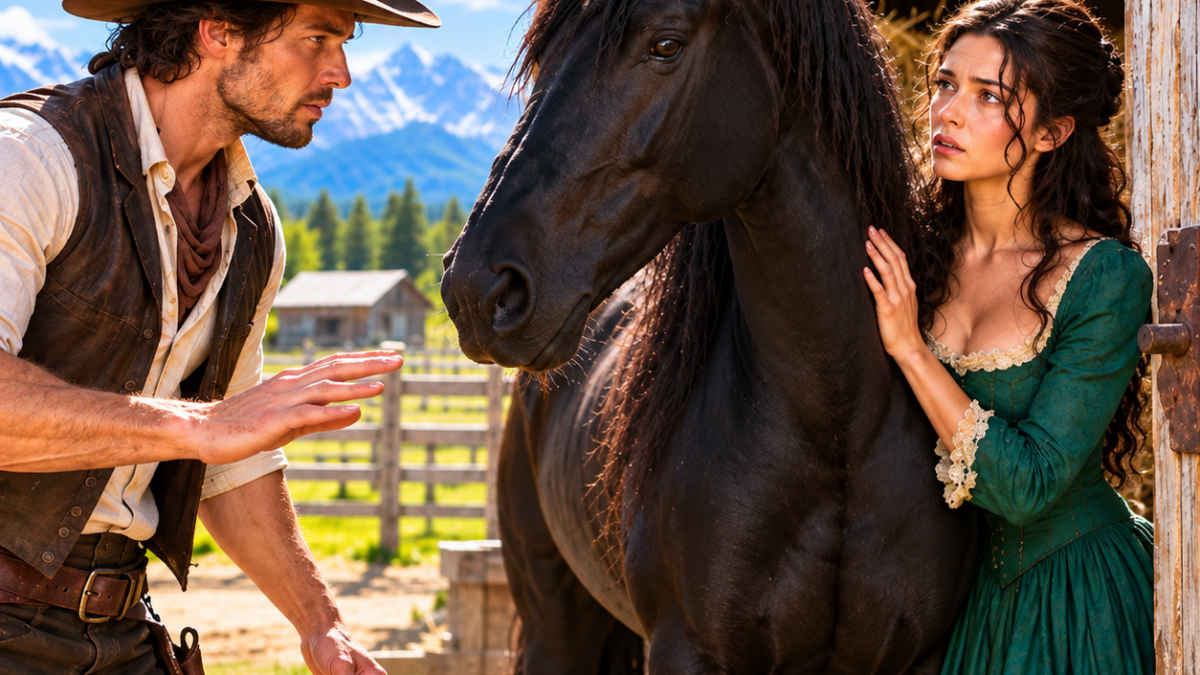
PART3:
“Question is what he means.”
Travis rested one hand near the rifle leaning against the fence post.
Midnight watched the movement.
His ears flattened harder.
Travis paused.
That was another thing.
Midnight was not afraid of the rifle.
He was warning Travis not to bring it closer.
Travis had known men less clear in their intentions than that horse.
He moved slowly, taking the rifle anyway but holding it loose in one hand, barrel down. Then he circled wide toward the side of the barn, keeping twenty feet between himself and Midnight.
The stallion turned his head, tracking every step.
“Easy,” Travis said, though he was not sure whether he was speaking to the horse or himself.
He reached the side wall, where a gap between warped boards gave a narrow view into the shadowed interior. Morning light cut through the barn in thin gold stripes. Dust hung in the air. The stalls were quiet.
Then Travis heard it.
A woman’s voice.
Low.
Steady.
Coming from somewhere near the back stalls.
“Easy now,” she said. “Nobody’s going to hurt either of us.”
Travis stopped moving.
Midnight, still guarding the doorway, did not shift an inch.
For a moment, Travis forgot the rifle in his hand.
A woman.
Inside his barn.
Talking to his horse.
He motioned for Caleb and Hrix to stay back.
Then he moved toward the rear entrance.
The side door creaked when he opened it.
Midnight snorted from the front, loud and sharp.
The woman inside did not scream.
That told Travis something.
Most frightened people make noise when surprised.
This woman went silent.
Travis stepped into the barn with the rifle lowered.
The smell of hay, leather, horses, and damp wood met him. The stalls stretched in two rows, shadows thick along the back wall.
He saw the shovel first.
It lay near the third stall, handle splintered, blade stained with dirt and something darker.
Then he saw the snake.
A rattlesnake, dead in the straw, body twisted near the stall door.
Then he saw her.
She sat near the back stalls with her knees drawn close, one hand resting against Midnight’s spare saddle blanket. A small carpet bag sat beside her. Her dress was dusty at the hem. Her dark hair had come loose from its pins. Her boots were worn, and one stocking showed through a tear near the ankle.
She was young.
Not a girl.
A woman.
Twenty-four maybe.
Tired in the way people are tired after they have kept themselves standing by pride alone.
When she saw Travis, her hand tightened around the edge of the blanket, but she did not reach for the shovel.
Midnight’s head appeared in the barn doorway behind Travis.
The stallion made one low, warning sound.
The woman looked past Travis to the horse.
“It’s all right,” she said softly. “He found me.”
Travis stared at her.
Midnight stepped one hoof into the barn.
Not toward Travis.
Toward her.
That was the part Travis could not make sense of.
For four years, Midnight had tolerated two people in the world.
Travis.
And, on generous days, Hrix.
The horse barely let Caleb brush his flank. He flattened his ears at strangers. He had once chased a traveling salesman straight over the water trough for stepping too close with a shiny buckle and too much confidence.
Yet now he stood between a strange woman and the doorway like she was something entrusted to his keeping.
Travis lowered the rifle completely and rested it against a post.
“You’re trespassing,” he said.
The accusation came out less certain than he intended.
“I know,” the woman said.
She did not move.
“I had nowhere else to go last night. I meant to be gone before anyone woke.”
Midnight walked to her and nudged her shoulder.
Not hard.
Not demanding.
Almost gentle.
Travis stared.
“He lets me handle him,” he said slowly.
The woman looked at the horse, then back at Travis.
“So I gathered.”
“The others, he barely tolerates. I’ve never once seen him take to a stranger like that.”
“Animals generally know who means them harm.”
“And who doesn’t?”
Her mouth softened, but it was not quite a smile.
“That too.”
Travis looked again at the dead rattlesnake.
“You kill that?”
She followed his gaze.
“It was near his stall door. He was kicking at the boards when I came in. I thought he’d hurt himself.”
“With a rattler at your feet, you went closer?”
“I didn’t see it at first.”
“And once you did?”
She glanced at the shovel.
“It seemed poor manners to leave it where it might bite him.”
Behind Travis, Hrix muttered from the doorway, “Well, I like her.”
Travis shot him a look.
Hrix lifted both hands and backed away.
The woman looked as though she might laugh, but exhaustion took the strength from her before the sound came out.
Travis noticed then how pale she was.
How tightly she held herself.
How her feet were blistered through the worn leather.
How her dress, though dusty, had once been good quality.
Not a drifter.
Not exactly.
Not a thief.
Not exactly.
A woman with a carpet bag, tired feet, and nowhere safe enough to sleep except a stranger’s barn.
“What’s your name?” Travis asked.
For the first time, she hesitated.
That told him more than the answer.
“Celia Sutton.”
“From where?”
“Ohio.”
“That’s a long walk.”
“I didn’t walk all of it.”
“Train?”
“Partly.”
“Stage?”
“Partly.”
“Wagon?”
“For a time.”
“For a time?”
“The wagon broke an axle six miles short of town. The driver refused to continue after dark. I left my trunk strapped there and took what I could carry.”
“You walked six miles in the dark?”
“I intended to.”
“You didn’t make it.”
“No.”
Her voice remained steady, but Travis could hear how much effort the steadiness cost.
Outside, the morning wind moved through the grass.
Inside, Midnight lowered his head until his breath warmed Celia’s sleeve.
She touched his muzzle with two fingers.
The stallion closed his eyes.
Travis felt something shift uncomfortably inside his chest.
Not affection.
Not yet.
Recognition, maybe.
He knew what it meant when an animal chose someone.
He knew better than to dismiss it.
“You hungry?” he asked.
Celia looked up sharply, as if she had expected suspicion, not breakfast.
“I can leave.”
“That wasn’t what I asked.”
“I don’t want trouble.”
“You already have trouble. Question is whether breakfast makes it worse.”
This time, the smile almost arrived.
“I haven’t eaten since yesterday afternoon.”
Travis turned toward the doorway.
“Hrix.”
“Already on it,” the older hand said.
“You don’t know what I was going to ask.”
“Breakfast,” Hrix called back. “Coffee. Something that ain’t judgment. I’m a man of instincts.”
Caleb snorted from outside.
Celia looked down, but Travis saw the corner of her mouth move.
He picked up the rifle and set it higher against the wall, away from her, then crouched near the dead snake.
“Rattler was close enough to strike him if he’d kicked lower,” he said.
“He seemed to know it.”
“He usually knows more than men give him credit for.”
“So do most horses.”
Travis looked over his shoulder.
“You know horses?”
“I grew up helping my father manage a modest string back home.”
“Riding?”
“Riding. Grooming. Foaling. Breaking, though my father called it gentling when he wanted to sound kinder than he was.”
Travis studied her.
“What brought you this far from Ohio, Miss Sutton?”
She held his gaze.
“A wedding I had no intention of attending.”
It was not an answer most women gave a strange man while sitting in his barn.
But then, nothing about that morning had kept to ordinary rules.
Travis stood.
“Yours?”
“Yes.”
“To someone you chose?”
“No.”
Midnight shifted beside her.
The horse’s ears tilted toward Travis as if weighing his reaction.
Travis kept his voice even.
“Your father arranged it?”
“He considered it arranged. I considered it an argument he refused to hear.”
“And the man?”
“Twice my age. Large cattle holdings. That appeared to be his chief qualification.”
“Not a small one, to some men.”
“No. But I was expected to marry the man, not his cattle.”
That time, Travis did laugh.
Short.
Surprised.
Celia looked startled by it, then less guarded for half a breath.
It changed her face.
Not into beauty, though she had that too in a tired, storm-battered way.
Into herself.
Travis saw it and looked away because something about witnessing it felt too private.
“You can wash up at the pump,” he said. “Breakfast is at the house. After that, I’ll send one of the hands into town about your trunk.”
“I can pay.”
“I didn’t ask.”
“I will still pay.”
He looked back at her.
“I expect you will.”
That seemed to satisfy her more than charity would have.
She tried to stand.
Her knees failed the first time.
Travis stepped forward instinctively.
Midnight pinned his ears.
Travis stopped.
Celia placed one hand on the stall wall and rose on her own.
“I’m all right,” she said.
Travis believed she had said that many times in her life when it had not been true.
He moved aside and let her pass.
Midnight followed her out of the barn like a sworn guard.
Hrix stood in the yard holding a tin cup of coffee and watching the whole scene with open fascination.
“Well,” he said, “that’s new.”
“Mind your own work,” Travis said.
“Am minding it. My work is mostly witnessing foolish men figure things out late.”
Travis ignored him.
Celia accepted the coffee with both hands.
The first sip nearly made her cry.
She turned her face slightly away so no one would see.
Travis saw anyway.
He did not mention it.
That was the first kindness he gave her.
Not food.
Not shelter.
Silence.
The house at Harlo Ranch was simple but well kept.
A main room with a stove, a table, two chairs, one long bench, shelves of tin plates, a rifle above the mantel, and a narrow hallway leading toward the sleeping rooms. It was not a place decorated by a woman’s hand. Nothing hung where it did not serve a purpose. Nothing softened a corner unless it had been placed there by accident.
Celia noticed that immediately.
Travis noticed her noticing.
“My mother died when I was young,” he said, surprising himself by explaining. “My father and I kept the house practical.”
“It is a good house.”
“It is a plain house.”
“Plain and good often overlap.”
He did not know what to say to that.
Hrix served breakfast as if he had appointed himself host. Biscuits. Salt pork. Beans warmed from last night. Coffee strong enough to stand a spoon in.
Celia ate carefully at first.
Then hunger won.
No one commented.
Caleb came in once, saw Midnight standing outside the kitchen window staring through it, and said, “Boss, your horse is haunting us.”
“He’s watching her.”
“He knows she’s not in trouble.”
“He doesn’t know that.”
“I’m not certain he believes you do.”
Hrix chuckled into his coffee.
Celia looked embarrassed.
Travis said nothing because Caleb was probably right.
After breakfast, she told the rest of it.
Not all of it.
Enough.
Her father, Amos Sutton, had raised horses and pride in nearly equal measure on a farm outside Cleveland. Her mother had died when Celia was sixteen, leaving behind a sewing kit, three dresses carefully folded, and a daughter old enough to work but not old enough to be heard.
For years, Celia had helped with the horses.
She knew feed schedules.
Foaling signs.
Laminitis.
Rain rot.
The difference between fear and stubbornness.
The value of standing still.
Then her father’s finances tightened.
A neighboring landholder named Elias Pritchard made an offer.
Not directly for Celia.
Men like that rarely spoke so plainly.
First came business.
Then shared prospects.
Then visits.
Then comments about what a fine steadying influence Celia would make in a larger house.
Then one evening, over supper, her father told her the matter was decided.
She would marry Elias in June.
Celia argued.
Her father dismissed it.
She argued again.
He called it nerves.
She refused outright.
He called it disobedience.
After two months of being told her life was a transaction that had already been settled, Celia gathered the savings she had hidden from small sewing work and stable jobs, packed what she could, and left before dawn.
“I did not leave dramatically,” she said, fingers wrapped around her coffee cup. “No note full of accusations. No scene. I simply understood that if my father would not hear no at his own table, he would not hear it at the church door either.”
Travis listened.
He had known stubborn fathers.
He had been raised by one.
But his father’s stubbornness had been tied to decency, not ownership. Hard lessons. Hard expectations. But never the belief that a daughter was a debt to be settled.
“You came all this way alone?” he asked.
“Not alone every mile. But alone enough.”
“And where were you headed?”
“Anywhere my father was not arranging.”
It should have sounded foolish.
It did not.
Travis looked through the window.
Midnight stood in the yard, black coat shining in the morning light, still watching the house.
“I could use help in the stables,” Travis said.
Celia’s cup stilled halfway to the table.
“Pardon?”
“Difficult horses mostly. Fair wage. Same as I’d pay any hand. Six dollars a week, and the small room off the tack room is yours for as long as the work lasts.”
She stared at him.
“You do not know a thing about me beyond one morning.”
“I know you handled a rattlesnake alone in the dark. I know my most stubborn horse trusts you more than he has trusted anyone in four years. I know you did not take anything from my barn except shelter.”
“That seems a thin reference.”
“It’s thicker than some I’ve hired on.”
Hrix, from the stove, said, “True.”
Travis looked at him.
Hrix became suddenly fascinated by the biscuits.
Celia set her cup down.
“I accept,” she said slowly. “On one condition.”
Travis braced himself.
“It stays exactly that. Honest work. Nothing more assumed.”
He met her eyes.
“I wasn’t offering anything more.”
She nodded.
“I believe you.”
Travis did not know why those three words settled in him the way they did.
Maybe because she did not say them lightly.
Maybe because Midnight, outside the window, finally lowered his head and began grazing.
The room off the tack room was small but clean.
It had a narrow cot, a washstand, one shelf, and a square window looking toward the paddock. It had once belonged to a married hand whose wife had decided ranch life was too lonely and had taken a stage east after one winter. Since then, the room had stored spare blankets and harness leather.
Travis had Caleb clear it while Celia rested on the porch with her injured feet soaking in warm water.
He sent Hrix into town to ask about the broken wagon and trunk.
He told himself these were practical acts.
A worker needed a place.
A worker needed belongings.
A worker with blistered feet could not be much use in the stable.
All practical.
By late afternoon, Celia insisted on seeing the horses.
Travis considered telling her to rest.
Then remembered the way she had spoken about not needing another man’s opinion on her choices before even knowing him.
So he only said, “Walk slow.”
She looked at him.
“That was almost an order.”
“Advice, then.”
“Better.”
Midnight met her at the stable door.
Travis had never seen anything like it.
The stallion stepped forward, lowered his head, and breathed into her hair. Celia lifted one hand to his neck, fingers sliding along the black coat as if they had known each other years instead of hours.
“He was frightened last night,” she said.
“Of the snake?”
“At first. But after, I think he feared I would leave before morning.”
Travis almost smiled.
“You give yourself considerable importance in his mind.”
“No. He gave it to me. I simply noticed.”
That was the thing about Celia Sutton.
She noticed.
Not in the way nervous people watch for danger, though Travis suspected she did that too.
She noticed the small truth of living things.
The horse that flinched only when a strap came from the left.
The mare that refused grain because her back tooth hurt.
The colt that kicked not from meanness but from confusion.
The hired hand who joked more when worried.
The rancher who pretended his kindness was practicality.
Within a week, the stable changed around her.
Not dramatically.
No sweeping transformation.
Just small corrections.
A gentler hand with Rusty, the gelding who had become wary of saddling after a bad fall the previous winter.
A different feed mixture for Bluebell, who left oats in the corner of her trough.
A loose hinge fixed because the sound made one young mare startle.
Midnight took to waiting at the stable door each morning until Celia appeared.
Hrix observed this with great delight.
“Horse is courtin’ her before you are,” he told Travis one morning.
Travis nearly dropped the curry comb.
“I am not courting anybody.”
“Didn’t say you were doing it well.”
“Hrix.”
“Just observing the livestock has taken a considerable interest.”
“The livestock is a stallion.”
“Still ahead of you.”
Travis walked away.
Hrix’s grin followed him the rest of the afternoon.
A week after Celia’s arrival, word came that her trunk had finally been recovered from the broken wagon and was waiting at the depot in town.
Travis hitched the wagon himself without being asked.
“You needn’t trouble yourself,” Celia said, though she climbed up beside him anyway.
“Told you I don’t offer anything I don’t mean.”
“You meant the room and the wage.”
“Meant this too.”
The ride into town was mostly quiet.
Dakota Territory stretched around them in late spring color—grass bending under wind, sky vast enough to humble any human plan, distant hills softened by blue haze. Celia sat with gloved hands folded in her lap, back straight despite the wagon ruts.
Travis watched the team.
Mostly.
Once, he caught her looking at the land with an expression he did not know how to read.
“Too empty?” he asked.
“No.”
“Too far?”
“From Ohio?”
“From whatever you left.”
She took a long breath.
“No. That is the first comfort of it.”
At the depot, the clerk produced the trunk after making them wait long enough to prove his importance. Travis lifted it into the wagon bed before Celia could object.
“There’s not much in it,” she said on the ride back. “A few dresses. My mother’s sewing kit. A photograph I could not bear to leave behind.”
“Didn’t ask what was in it.”
“No.”
“Only that it belonged to you. And you had a right to have it back.”
Celia said nothing after that.
But she kept one hand resting lightly on the trunk lid the rest of the way home, as though reassuring herself it was truly there.
That evening, Travis found her in the tack-room doorway, looking at the photograph from the trunk.
He did not mean to intrude.
He was about to step away when she said, “My mother.”
He stopped.
In the photograph, a woman stood beside a young horse, one hand on its neck, her face calm and direct.
“She looks like you,” Travis said.
“She was braver.”
“That so?”
“She stayed.”
“Staying is not always bravery.”
Celia looked at him.
“Leaving is not always cowardice.”
“No,” he said. “It isn’t.”
Something passed between them then.
Not romance.
Not yet.
Understanding, perhaps.
Two people standing near different wounds and recognizing the shape.
Travis had been engaged once, in his early twenties, to a woman named Clara Bell. She had been pretty, lively, and very certain that she loved him until she understood what loving him meant.
Ranch life.
Distance.
Weather.
Hard seasons.
No town dances whenever she pleased.
No guarantee that money would behave.
No husband who could set down chores simply because she wanted company.
She left three months before the wedding, choosing a banker from Bismarck who owned clean cuffs and worked indoors.
Travis did not blame her anymore.
That was what he told people.
It was mostly true.
But after Clara, he rebuilt his days around things he could control.
Dawn chores.
Breakfast.
Fence lines.
Herd counts.
Training schedules.
Supply ledgers.
Supper.
Sleep.
He did not leave much room for surprise.
Then Celia Sutton appeared in his barn with a carpet bag, a dead rattlesnake, and his most difficult horse guarding her like treasure.
After that, surprise seemed to have moved into the tack room and taken wages.
Not every day was gentle.
Work rarely is.
Rusty tested Celia’s patience for three weeks. The gelding accepted the saddle blanket but flinched each time the girth strap moved under him. Some days he improved. Some days fear dragged him backward.
“He may never be what he was before,” Celia admitted one afternoon, watching Rusty tremble under her hand. “Some of them carry fear too deep to talk out entirely.”
“Didn’t ask for promises,” Travis said. “Only honest effort. Which he’s plainly getting.”
She looked at him then, and something warm moved behind her eyes.
Another day, Travis forgot himself.
A young colt proved stubborn with a buyer expected the following morning. Travis stood at the fence rail, deadline pressing on his patience.
“Press him harder,” he said.
Celia did not look at him at first.
The colt circled, ears flicking.
Travis continued, “Buyer’s coming tomorrow. Can’t have him still testing you by then.”
“I’ll manage my own methods. Thank you.”
Her tone cut sharper than he expected.
The words landed like a gate closing.
Travis fell silent.
The colt settled within the hour, responding to the patience Travis had nearly interrupted.
That evening, he found Celia washing dust from her hands at the pump.
“I owe you an apology,” he said.
She turned off the pump.
“Yes.”
That took him back half a step.
She waited.
He deserved that.
“My father taught me better than that. A horse pressed too hard learns fear, not trust. I let a buyer’s deadline make me forget my own best lesson.”
Celia wiped her hands slowly.
“I’ve been helping with difficult horses since I was a girl, Travis. I don’t need a rancher’s opinion on patience, however well-intentioned, however anxious the timing made you.”
“Fair enough.”
“I do not mind advice.”
“No?”
“I mind being handled.”
He nodded.
“I’ll remember.”
“I believe you will.”
It was not forgiveness exactly.
It was better.
It was trust that an apology meant change.
He made sure it did.
By the fourth week, Celia had become part of the rhythm of the ranch in a way that startled him when he noticed it.
Coffee before sunrise.
Stable doors opened.
Midnight greeting her.
Hrix making remarks that were only half as foolish as they sounded.
Caleb trying to impress her with rope tricks and failing spectacularly.
Celia laughing softly when she thought no one was listening.
Travis asking her thoughts on horses whose problems he already understood, simply because he wanted to hear her answer.
“You’ve asked my thoughts on that gelding three times this week,” she observed once.
“Wanted a second opinion.”
“That’s a generous description of simply wanting the company.”
He had no honest argument against it.
So he gave none.
That seemed to please her.
It was Celia who noticed one evening that Travis had worked clean through supper hour chasing a fence break in the north pasture. When he returned past dark, tired and irritated, he found a plate warming on the stove.
Beans.
Cornbread.
Salt pork.
Coffee still hot.
Celia sat at the table mending a torn glove.
“Didn’t have to do that,” he said.
“Neither did you ride six miles for my trunk.”
“That was different.”
“Was it?”
He looked at the plate.
Then at her.
Something in him, long guarded and carefully scheduled, moved again.
“Seems only fair someone looks after you occasionally too,” she said.
He sat down before his face could give away too much.
Outside, Midnight made a low sound from the paddock.
Hrix, from the doorway, said, “Horse agrees.”
Travis threw a dish towel at him.
Celia laughed.
For the first time in years, the house did not feel plain to Travis.
It felt occupied.
Six weeks after Celia arrived, a man came riding through the front gate on a gray afternoon.
The sky had hung low all morning, clouds swollen with rain that would not fall. Travis was in the yard repairing a loose wagon board when Midnight, grazing near the paddock fence, lifted his head.
The change was immediate.
The stallion went still.
Then his ears pinned.
His body shifted between the yard and the stable door.
Travis set down the hammer.
The rider dismounted at the gate without waiting for invitation.
He was a narrow man in a dark coat too fine for the trail, with a trimmed mustache and the expression of someone who believed other people’s land was only an inconvenience if he had business on it.
“Name’s Peyton,” he called. “I’m looking for Celia Sutton.”
Travis did not move toward him.
“What business?”
“Her father hired me to bring her home.”
Midnight stamped once hard.
The stranger’s horse shied sideways, reins pulling sharp through Peyton’s hand.
Travis watched him correct the animal too roughly.
Midnight snorted.
“Horse seems to have an opinion about your visit,” Travis said.
“Horses don’t generally concern me.”
“That may be why they dislike you.”
Peyton’s eyes narrowed.
From the stable doorway, Celia stood very still.
Travis saw her before Peyton did.
Her face had gone pale, but not weak.
Never weak.
She stepped out before Travis could answer for her.
“I’m Celia Sutton,” she said.
Peyton turned.
His eyes traveled over her work dress, her dusty boots, her rolled sleeves, the stable behind her.
Disapproval sharpened his mouth.
“Miss Sutton. Your father is concerned for your welfare.”
“My father is concerned about cattle holdings.”
“I was instructed to escort you home.”
“I am not returning to Ohio.”
“That is not my understanding.”
“Then your understanding traveled farther than its usefulness.”
Hrix, from somewhere behind Travis, muttered, “Lord.”
Celia continued, voice steady.
“I am not returning to Ohio, nor to a marriage I never agreed to want. Tell my father I have found honest work and a life I am choosing for myself.”
Peyton glanced at Travis.
“You keeping her here?”
The yard went quiet.
Even Caleb stopped moving.
Travis felt the old instinct rise in him.
To step forward.
To answer.
To shield.
Midnight shifted, ready.
But Celia had not asked to be spoken for.
So Travis stayed where he was.
Celia noticed.
He saw the flicker in her face.
Gratitude.
Or something close.
“No one is keeping me here,” she said. “That is rather the point.”
Peyton considered this, then looked again at Midnight.
The stallion’s head was low.
His eyes were hard.
Peyton was foolish, but not entirely stupid.
“I’ll deliver your message,” he said.
“Do.”
He mounted.
His horse turned too quickly under the rein, eager to leave.
At the gate, Peyton looked back once.
Not at Travis.
At Celia.
“You may find your father less patient when he receives it.”
Celia lifted her chin.
“He taught me patience with horses. He forgot I might learn it elsewhere too.”
Peyton rode off.
Dust rose behind him until the road took him from sight.
Only then did Celia’s shoulders loosen.
Travis waited until the yard settled.
“That took real nerve,” he said.
“I had considerable practice fleeing before I found something worth staying for instead.”
The words hung between them.
Celia seemed to hear them only after saying them.
Her cheeks colored slightly.
“Before you read anything further into that,” Travis said carefully, “I want you to know your work here doesn’t depend on any answer beyond the one you already gave Peyton. Wage stands. Room stands. Whatever you decide about anything else.”
She looked at him.
“Why tell me that now?”
“Because I mean to ask you something in a few days’ time. And I’d rather you wait knowing you have nothing to lose either way.”
The rain finally began then.
Soft at first.
Then steady.
Celia did not step under shelter.
Neither did Travis.
Midnight moved close enough to stand between them and the open road.
Celia touched the horse’s neck.
“You are a careful man, Travis Harlo.”
“I try to be.”
“Careful men can still ask frightening questions.”
“I know.”
“Then I’ll try to be brave enough to hear it.”
He did not ask that day.
He wanted to.
The wanting surprised him with its force.
But love, if that was what this had become, could not be another door closing around her.
So he waited.
Celia thought on it over the next several days.
She watched Travis work horses.
Watched him correct himself when impatience rose.
Watched how he asked her opinion on matters he once would have decided alone.
Watched how he never once suggested that her father’s claim outweighed her own voice.
That, more than any tenderness, moved something deep in her.
She had known men who called control protection.
Men who called obedience respect.
Men who called a woman difficult when she did not mistake a cage for shelter.
Travis did none of that.
He made mistakes.
He admitted them.
He wanted.
But he did not demand.
One evening, she found him mending a fence that did not need mending.
The sun had gone low behind the pasture. The sky was amber at the edge and purple above. Midnight grazed nearby, occasionally lifting his head to check on them as if supervising a matter of great importance.
Celia stood beside Travis without speaking.
After a while, he set down the pliers.
“Fence bothering you?” she asked.
“No.”
“Then why have you tied the same stretch of wire three different ways?”
He looked at his hands.
“Gives them something to do.”
“While your thoughts make a nuisance of themselves?”
“Something like that.”
She watched the horizon.
“I wasn’t running toward anything when I left Ohio,” she said. “Only away from something.”
Travis waited.
“I find lately that has changed.”
His heart struck once, hard.
“Toward what?”
She looked at him.
“I believe you already know the answer.”
He swallowed.
“Celia—”
“Though I’ll admit I’d like to hear you ask the actual question properly. When you’re ready.”
He almost laughed.
Not because it was funny.
Because he had spent a decade arranging his life to avoid exactly this kind of moment, only to find that when it came, it wore dusty boots and had straw on her sleeve.
Two evenings later, he asked.
On the porch.
The same porch where he had once admitted how carefully he had built his life around not being surprised.
Midnight stood in the near paddock, ears turned toward them.
Hrix and Caleb had vanished with the exaggerated subtlety of men who wanted to overhear and knew better than to be caught.
Travis had rehearsed the words all afternoon while mending another fence that required no attention whatsoever.
Every version abandoned him the moment Celia sat down beside him.
The evening air smelled of grass and rain-soaked earth.
“I have something to ask you,” he said.
“About the horses?”
“No.”
She folded her hands in her lap.
He took a breath.
“Celia Sutton, will you marry me?”
Her shoulders loosened as if she had been holding herself steady against joy.
Then she smiled.
Not almost.
Fully.
“You finally found a question you hadn’t asked me three times already.”
“Seemed a poor time to start repeating myself.”
“So is that a yes?”
“Yes,” Celia said.
She reached for his hand without quite seeming to decide to.
In the paddock, Midnight let out a low, satisfied sound, as though the matter had been properly settled to his approval.
Hrix shouted from somewhere near the water trough, “About time!”
Caleb added, “Told you the horse knew first!”
Travis closed his eyes.
Celia laughed until she cried.
That same week, she wrote to her father herself.
Not asking permission.
Not apologizing.
Informing.
She told him where she was.
Told him she had found honest work.
Told him she would marry Travis Harlo in the autumn.
Told him plainly that she loved him as a father but would not surrender her life to his bargains.
At the end, she wrote:
If you wish to know me going forward, it must be as a daughter with judgment of her own, not as property misplaced.
She sealed the letter with steady hands.
Her father’s reply came a month later.
Celia carried it to the stable before opening it.
Travis stayed nearby but did not ask to read.
Midnight stood with his head over the stall door, breathing softly.
Celia unfolded the paper.
The letter was shorter than she expected.
Celia,
I taught you to trust your own judgment with horses, then refused to trust it with your own life.
I was wrong to arrange what I arranged.
If you will permit it, I would like to see you married, even if I have no right left to walk you there myself.
Your father,
Amos Sutton
Celia read it twice.
Then a third time.
She did not cry immediately.
Sometimes forgiveness, or the possibility of it, takes longer to reach the body than anger does.
Travis waited.
Finally, she folded the letter.
“I will allow him a seat.”
“Nothing more?”
“Nothing more promised.”
“That seems fair.”
“It is more than he earned.”
“Yes.”
“And less than he asked.”
“Yes.”
She looked toward the open stable door.
“Honesty was all I ever wanted from him.”
Travis stepped closer but did not touch her until she leaned first.
When she did, he put one arm around her shoulders.
Midnight lowered his head and pressed his muzzle gently against her sleeve.
“You see?” she whispered to the horse. “He can learn.”
Travis was not sure whether she meant her father or himself.
Maybe both.
They married that autumn.
Not in a grand church.
Not with polished floors or chandeliers or a guest list built for appearances.
They married outside the Harlo house, under a sky so clear the whole territory seemed to be watching.
Hrix wore a clean shirt and complained about it.
Caleb nearly dropped the rings.
Marlowe, the neighboring rancher, brought two pies and a bottle he claimed was suitable for celebration and medicinal purposes.
Celia’s father stood at the back of the small gathering in a dark suit that looked uncomfortable from three states away.
He did not walk her.
He did not give her.
She walked herself across the yard, steady and sure, with Midnight standing at the paddock fence, black mane braided with a blue ribbon Ruth from town had insisted upon.
When the minister asked who came willingly into this marriage, Celia answered before he finished the question.
“I do.”
Several people laughed softly.
Travis nearly did too.
When they kissed, Midnight let out a ringing call loud enough to startle two guests and make Hrix slap his knee.
“Well,” Hrix said, “horse approves.”
Afterward, Amos Sutton approached his daughter.
He removed his hat.
For a moment, he looked older than Celia remembered.
Or maybe she was finally seeing him without fear in the way.
“You look like your mother,” he said.
“I know.”
“She would have liked him.”
Celia glanced toward Travis, who was being congratulated by Caleb with enough force to nearly crack a rib.
“Yes,” she said. “I think she would have.”
Amos swallowed.
“I am sorry.”
The words were plain.
No defense.
No explanation.
No mention of cattle holdings.
Celia nodded.
“Thank you.”
It was not everything.
But it was something honest.
For that day, it was enough.
Two years into the marriage, their son Samuel was born.
He came into the world during a storm, quiet at first, then furious. Travis had never known fear like those hours. Not cattle storms. Not broken bones. Not blizzards. Not the morning Midnight blocked the barn.
Nothing compared to waiting outside a bedroom door while the woman who had rearranged his whole life fought to bring another life into it.
When the baby finally cried, Travis sat down hard in the hallway.
Hrix found him there.
“You faint?”
“No.”
“Look like you considered it.”
“Mind your own work.”
“Am minding it. This is the best work on the ranch today.”
Celia brought Samuel to the stable when he was three weeks old, tucked in a basket lined with blankets.
Midnight approached slowly.
Travis held his breath.
Celia did not.
The stallion lowered his head and breathed over the sleeping infant. Samuel’s tiny fist opened and closed.
Midnight stood still.
Then, with the same solemn certainty he had shown the first morning he guarded Celia, the horse placed himself between the basket and the open stable door.
“He’s guarding your son same as he once guarded you,” Travis said.
“Seems to be a habit of his,” Celia replied, “deciding who’s worth protecting before anyone properly asks.”
Three years later, Ruth was born.
She was not quiet.
From the beginning, Ruth Harlo announced herself to the world as if she had important corrections to make. She cried louder than Samuel, laughed earlier, crawled faster, and by age four had informed Hrix that he was brushing the pony wrong.
“She gets that from you,” Travis told Celia.
“My good judgment?”
“Your confidence.”
“Then she is fortunate.”
Samuel began riding at five, making his first circuit of the paddock while Travis walked beside him with one hand resting lightly on the saddle.
Midnight watched from the fence, older now but still powerful, ears pricked as if evaluating the boy’s seat.
“He disapproves,” Celia said.
“He disapproves of everyone.”
“He approves of me.”
“You are the exception by which he judges the rest of us.”
When Ruth reached five, she began lessons on a gentle pony and declared before the first ride was finished that she intended to ride beside Samuel by summer’s end.
Samuel, eight by then, leaned on the fence and said, “You have to learn not to bounce first.”
Ruth glared at him.
“I bounce with purpose.”
Hrix nearly choked laughing.
By then, Midnight had settled into a steadier, more patient version of himself. Still strong enough to work when needed, but calm enough to stand for hours while small hands braided ribbons into his mane.
He never lost the particular devotion he had shown Celia that first morning.
Every day, he greeted her at the stable door.
At first, alone.
Then with Samuel at her side.
Then Ruth.
Then both children arguing over who loved him better while Midnight endured them with the grave patience of a king receiving noisy subjects.
Some evenings, after the children had worn themselves out and fallen asleep in the hayloft after a long day with the horses, Celia would stand quietly in the stable doorway.
The same doorway Midnight had blocked.
The same doorway Travis had entered with a rifle in his hand and suspicion in his chest.
The same barn she had once entered as a frightened stranger with a carpet bag and nowhere else to go.
She would look at the stalls.
The horses.
The tack.
Her husband checking a latch.
Her children asleep above.
Midnight keeping watch nearby.
And something in her chest would settle.
Not because life had become easy.
Ranch life was never easy.
Fences broke.
Winters came hard.
Money thinned.
Children took fevers.
Horses went lame.
Storms tore roofs.
Arguments happened.
Apologies followed.
The past did not disappear simply because love arrived.
But she had chosen this.
That made all the difference.
One night, Travis came to stand beside her in the doorway.
“What are you thinking?” he asked.
“That first night, I was afraid you would find me.”
He looked into the barn.
“I remember.”
“Now I listen for your footsteps coming home.”
He turned toward her.
“Considerable distance between those two things.”
“The best kind of distance.”
She leaned into him.
Above them, Samuel shifted in his sleep.
Ruth murmured something bossy even in dreams.
Midnight stood in the golden hay light, old ears turned toward the door, still guarding what he had chosen years before.
Travis Harlo had spent a decade protecting himself from surprise.
Then his horse refused to obey.
A woman’s voice came from inside the barn.
A life he had scheduled down to chores and fence lines opened like a door he had not known he was waiting at.
Celia Sutton had run from a future chosen for her by someone else.
She had crossed miles with blistered feet and a carpet bag, seeking only enough shelter to survive one night.
Instead, she found a black stallion who recognized her before any person did.
A rancher who lowered his rifle.
A room that came with wages instead of assumptions.
A love that did not ask her to trade freedom for safety.
And years later, whenever she watched Midnight standing guard over her children, she understood something she had not known that first morning in the straw.
Sometimes the life you choose begins in the place where you meant only to hide.
Sometimes love does not arrive announcing what it will become.
Sometimes it simply blocks the doorway, refuses to move, and waits until someone finally listens.
Midnight had known before all of them.
The woman in the barn was not danger.
She was home finding its way in.


