A Pool Cleaner Looked Into an Empty Backyard Pool and Saw a Motionless Cat Below—Then the Hundreds of Bloody Scratches Covering the Walls Revealed How Long He Had Been Fighting
PART3:
Ten days before that Tuesday, Brent had called the company office to say their pool was being drained for resurfacing work while they were in the Bahamas for two weeks. My instructions were simple: stop by twice before the contractors started, inspect the equipment, remove debris from the empty basin, and make sure nothing interfered with the work crew’s arrival.
I had already visited once.
The pool had been empty then.
Empty pools always make me uneasy.
A full pool is alive in a way, even if no one is swimming. Light moves through it. Water softens the space. Sound changes around it. But an empty pool looks like a concrete mouth dug into the earth, a deep, smooth pit with nowhere forgiving to land and no easy way out if you end up at the bottom.
The Harper pool was nearly seven feet deep at the far end.
No ladder had been installed yet on that side because the rails had been removed before resurfacing. The steps were in the shallow end, but the drop from the deck was still steep, the walls smooth, the slope awkward. A person could climb out if they knew where the steps were and could reach them. A small animal could not.
The contractors had left yellow caution tape near one side, but no temporary fencing over the opening, no escape ramp, no cover, nothing that would help an animal trapped inside.
I had noticed it on the first visit.
I had even mentioned it to the property manager.
“Empty basin should be secured,” I said.
He shrugged over the phone.
“Homeowners didn’t approve extra safety setup. Workers are coming next week.”
“What about animals?”
“It’s a private yard. Gate stays closed.”
That was supposed to be the end of it.
People love saying “private property” as if birds, cats, raccoons, wind, rain, and gravity have all agreed to respect the deed.
On that Tuesday, I parked beside the curb, unlocked the side gate with the code the company had given me, and pushed it open.
The backyard was silent.
Too silent.
No pool pump hum because the system had been shut down. No water movement. No kids. No dog. No television from inside. Just heat sitting on the patio stones and the dry rustle of palm fronds over the privacy wall.
I carried my small equipment bag in one hand and a leaf net in the other. My plan was to check the main drain cover, inspect the skimmer lines, clear a few leaves from the bottom, and move on. I had seven more pools after that and one client who complained if I arrived after two.
I walked across the patio toward the deep end.
Then I looked down.
At first, my brain refused to understand what I was seeing.
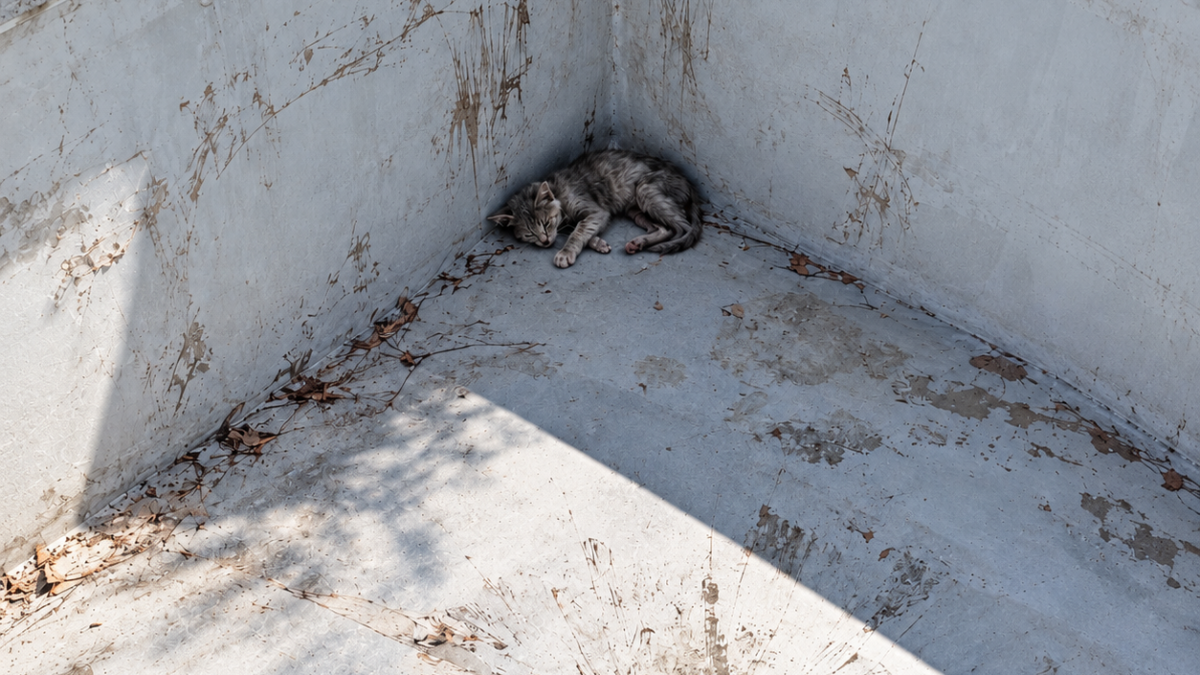
The bottom of the pool was pale gray concrete, stained in places from years of water exposure and now drying unevenly in the heat. A few dead leaves had collected near the drain. A plastic water bottle lay in the shallow slope. In the far deep-end corner, where the wall of the house cast a narrow triangle of shade for part of the afternoon, something small and gray was curled against the wall.
A towel, I thought.
Then I saw the ear.
A cat.
There was a cat at the bottom of the empty pool.
He was lying so still that my first thought was that he was dead.
I set my equipment bag down slowly.
“Hey,” I called, though I do not know why. “Hey, buddy?”
Nothing.
The cat did not lift his head.
I moved along the edge, looking for the safest way down. That was when I saw the walls.
The claw marks covered everything.
Not a few scratches near one corner.
Hundreds.
Maybe more.
Long, frantic, vertical streaks carved into the dusty residue along the pool walls. Some marks started low and rose several feet before fading. Others crossed sideways where he must have slipped. Near the corners, the scratches overlapped so densely that the wall looked sanded raw.
Every wall.
Every angle.
Every possible escape.
The deep end was worst. The marks climbed nearly three feet in some places, higher than I would have believed a starving cat could reach. At first, the scratches were deep and sharp, gouged into dirt and old plaster dust. Then, higher up, they became lighter, broken, desperate.
I had seen enough injured animals to understand what that meant.
At the beginning, he had claws.
Then he didn’t.
A heat deeper than the Florida sun went through me. Anger, fear, something like shame even though I had not put him there.
I took a photo from the edge, not because I wanted to remember, but because something in me already knew I would need proof.
The gray cat in the corner.
The scraped walls around him.
The empty concrete pit.
And then, when I zoomed in near the drain, I saw the detail that made my stomach twist.
A tiny puddle of rainwater remained in the low point around the drain cover.
Barely anything.
Maybe a few mouthfuls.
The rain had fallen three or four days earlier. The rest of the pool floor was dry except for faint mineral rings and dust. Around that little puddle, the concrete was oddly clean. No debris. No grit. No film.
The cat had licked every drop he could reach.
That puddle had probably kept him alive.
Without it, the heat would have finished what the pool had started.
I looked back at the shaded corner.
The cat had chosen the only two things left to him.
A little shade.
A little water.
Then he had stopped climbing.
He had simply waited.
I moved fast then.
There was an access ladder left by the repair crew at the shallow end, a temporary aluminum thing hooked over the coping. I climbed down, boots hitting the dry pool floor with a hollow slap that echoed off the walls.
The sound made the cat move.
Barely.
His head lifted maybe an inch.
His eyes opened.
Not fully.
Just enough for me to see he was alive.
“Okay,” I whispered. “Okay, I’ve got you.”
He tried to pull himself tighter into the corner, but his body barely obeyed. He was a small gray cat, short-haired, dusty, so thin his hips and shoulders looked too sharp beneath his skin. His fur had the dull, separated look of dehydration. His ears were sunburned at the edges. His nose was red and cracked.
When I got closer, I saw his paws.
All four were bad, but the front ones were destroyed.
The pads were raw and bloody, swollen in places, split in others. His claws were worn down almost completely. Some were cracked. Some looked gone. Dried blood darkened the fur around his toes. Dust and tiny grains of pool plaster clung to the wounds.
I crouched a few feet away and took off my sunglasses because animals read eyes better than people think.
“Hey, little man,” I said softly. “You tried hard, didn’t you?”
He stared at me.
His breathing was shallow, uneven.
For one second, I was terrified he would die before I touched him.
I took the towel from my equipment bag, the one I used for my hands after chemical checks. It smelled faintly of chlorine and sunblock. Not ideal, but better than bare arms. I moved slowly, wrapped it around him, and slid one hand beneath his chest.
He weighed almost nothing.
That was the part that hit me hardest at first.
Not the blood.
Not the scratches.
The weight.
He felt like lifting a bundle of paper.
A living creature should not be that light.
He did not fight. He made one weak sound, not quite a meow, not quite a breath, and pressed his face into the towel as if even resistance cost too much.
I climbed out with him held against my chest.
The pool walls rose around me like proof of what he had survived. At the top, I sat on the coping for a second, breathing hard, the cat wrapped in my arms, both of us covered in dust from the empty basin.
I had a water bowl in the truck for rinsing small tools. I washed it twice, filled it from a bottled water jug, and set it near him in the shade.
He smelled the water before his head fully lifted.
Then he drank.
And drank.
And drank.
I had to stop him twice because animals that dehydrated can make themselves sick drinking too fast. He looked at me like I had betrayed him each time I pulled the bowl away for a few seconds.
“I know,” I said. “I’m sorry. Slow.”
He drank for several minutes in small intervals, his whole body trembling.
Then I called the emergency vet.
Then my office.
Then, because I knew the Harpers and I knew what would happen if they returned to find anything out of place, I called the property manager and left a message stating exactly what I had found.
Not emotional.
Not accusing.
Just facts.
Found live cat trapped in drained pool. Severe dehydration and paw injuries. Transporting to emergency veterinary care. Documented pool wall scratches and condition. Visit incomplete due to animal emergency.
Then I carried the cat to my truck, placed him on the passenger seat inside the towel, and turned the air conditioning all the way up.
He did not look back at the house.
I did.
And for reasons I did not yet understand, the security camera above the patio door seemed suddenly important.
The emergency clinic smelled like antiseptic, wet fur, and coffee that had been reheated too many times. I carried the cat in through the side entrance because the receptionist saw us from the window and waved me past the front forms.
A veterinary technician named Maya took one look at him and called to the back.
“Dr. Patel, I need you now.”
They placed him on an exam table and began working quickly. Temperature. Heart rate. Hydration check. Pain assessment. Fluids. Cooling. Blood sugar. Paw cleaning. Sunscreen burns on ears and nose. Weight.
I stood against the wall with my hat in my hands, leaving dusty fingerprints on the brim.
Dr. Anika Patel was in her forties, small, sharp-eyed, and calm in the way doctors become when they know panic is contagious. She examined him with gentle speed.
“You found him in a pool?”
“Empty pool,” I said. “Deep end. No way out.”
“How long?”
“I don’t know. Clients drained it maybe ten days ago. They’re out of town.”
She looked at the paw pads.
“Not ten days.”
“Thank God.”
“But not one day either.”
She checked his gums again.
“I’d estimate four to five days trapped, based on dehydration, paw trauma, sun exposure, and muscle weakness. Could be slightly less, could be slightly more.”
Four to five days.
Ninety-six to one hundred twenty hours.
In a concrete pit.
In July heat.
Climbing until his claws failed.
Drinking rainwater from the drain.
Waiting.
I leaned harder against the wall.
“Is he going to make it?”
Dr. Patel did not answer immediately.
That scared me.
“He has a chance,” she said. “His internal injuries seem limited so far. That is good. He is severely dehydrated, exhausted, underweight, and his paws are badly damaged. Some claws may regrow. Others may not. His pads will take weeks to heal. His ears and nose are sunburned. We need blood work before I say more.”
The cat lifted his head slightly at the sound of my voice.
Maya noticed.
“He know you?”
“No,” I said. “I just found him.”
The tech smiled sadly.
“Sometimes that’s enough.”
They asked if I was the owner.
“No.”
Was I surrendering him?
“He isn’t mine to surrender.”
Could I authorize emergency treatment?
That question sat heavily in the air.
Legally, stray animals were complicated. Payment was complicated. Responsibility was complicated. The cat was dying, and the world still wanted a signature.
I gave mine.
I had no noble speech prepared. No savings account marked for emergency cat rescue. I had rent due, truck repairs I had been putting off, and a daughter starting community college in the fall.
But I had carried him out of the pool.
I had seen the walls.
Some choices become yours because you are the one who looked down.
“Do what he needs,” I said.
The receptionist gave me the estimate ten minutes later.
I did not read the total twice because if I did, I might have had to sit down.
I handed her my credit card.
She looked at me, then at the card, then back at me.
“You sure?”
“No,” I said. “Run it anyway.”
They kept him.
I went back to the Harper house the next morning because I still had a job and because I could not stop thinking about the pool.
The backyard looked exactly the same.
That felt wrong.
The sun was out. The palms moved lazily. The patio furniture sat arranged under the pergola. A pair of sunglasses someone had forgotten still lay on a side table. The house stood silent and expensive, untouched by what had happened in its own backyard.
I walked to the edge of the empty pool and stopped.
Without the cat in the corner, the basin looked larger.
Crueler.
The scratches were everywhere.
In daylight, they seemed even worse. Some still had faint traces of blood. Near the deep-end corner where he had finally collapsed, the concrete showed a dusty outline of his body. The little puddle around the drain had shrunk since yesterday. By afternoon, it would be gone.
If I had arrived one day later, he would have been gone too.
I climbed down slowly.
The hollow echo of my boots made my skin crawl.
I photographed every wall.
Every corner.
The drain.
The shaded area.
The temporary ladder on the far end.
The absence of any animal escape ramp.
Then I stood in the middle of the deep end and turned in a full circle.
For four or five days, that cat had seen nothing but these walls.
Sky overhead.
Concrete around him.
No food.
Almost no water.
No one answering.
I had cleaned thousands of pools.
That was the first time an empty one looked back at me.
My phone rang while I was still standing at the bottom.
The screen showed the property manager, Dennis Wahl.
I answered.
“Ethan, what the hell is this message I got about a cat?”
“Exactly what I said. Cat trapped in the drained pool. I took him to emergency care.”
A pause.
“Is it alive?”
“Yes.”
Dennis exhaled, irritated rather than relieved.
“Okay. Well, you need to finish the inspection. Contractors are scheduled Thursday.”
“I’m here now.”
“Good. Also, Mrs. Harper saw you on the camera carrying something out yesterday. She’s asking why you removed property from the premises.”
I looked up at the camera mounted beneath the patio roof.
“Property?”
“That’s her word, not mine.”
“It was a dying cat.”
“She says it might be a neighborhood stray that got into the yard. She doesn’t want liability attached to her house.”
“There’s liability attached to an unsecured drained pool.”
Dennis sighed.
“Don’t start with that.”
“I mentioned it last week.”
“And I told you the owners didn’t approve additional safety measures.”
“And now an animal nearly died.”
“Ethan, listen. I know you care, but don’t make this bigger than it is.”
I stared at the claw marks.
Bigger than it is.
The phrase hit me so hard I almost laughed.
“Dennis, I’m standing inside a concrete hole covered in blood and scratches.”
“It’s unfortunate.”
“No. Unfortunate is rain on a barbecue. This was preventable.”
His voice cooled.
“Just finish the job and send the report.”
The line went dead.
I should have done exactly that.
Finished the job.
Sent the report.
Stayed in my lane.
Service workers are trained by money to stay in our lane. You can know a thing is wrong, but if the person doing wrong signs the checks, suddenly everyone around you becomes very interested in tone, procedure, and not jumping to conclusions.
I had a mortgage once.
Then divorce took the house.
I had a business partner once.
Then cancer took him.
Now I had a route, a truck, a reputation for showing up on time, and enough debt to keep me careful.
Careful men do not accuse wealthy clients of negligence.
Careful men do not risk contracts.
Careful men do not take photos of blood on pool walls.
But I had already taken them.
And the cat had already looked at me from the bottom.
So I climbed out, finished the equipment check, wrote the most detailed inspection report of my life, and emailed a copy not only to my office and Dennis but to myself.
Then I drove to the clinic.
Maya met me in the lobby.
“He made it through the night.”
I had not realized how tightly I was holding myself until the words loosened something in my chest.
“Can I see him?”
“Briefly.”
They had set him up in a padded kennel with soft towels and cooling support. His paws were bandaged. A fluid line ran into one foreleg. His ears had ointment along the burned edges. His eyes were more open than yesterday, still weak but aware.
Maya opened the kennel door.
“He’s not ready to be handled much, but you can talk to him.”
I crouched.
“Hey, pool guy,” I said.
The cat looked at me.
Maya raised an eyebrow.
“Pool guy?”
“I don’t know his name.”
“We’ve been calling him Deep End.”
I looked at the cat.
He blinked slowly.
“Dark humor at a veterinary clinic?”
“You have no idea.”
Deep End.
It should have sounded wrong.
But somehow, it fit.
Not because that pool defined him, but because he had been found at the bottom of something and survived it.
I stayed ten minutes.
Before leaving, I asked Maya, “Any microchip?”
“No.”
“Any missing cat reports?”
“We’re checking. Gray male, young adult, not neutered. No collar. Hard to know if he’s owned, lost, dumped, feral, stray.”
“He didn’t act feral.”
“No. He acted exhausted.”
That was fair.
On my way out, Dr. Patel stopped me.
“Mr. Cole?”
“Ethan.”
“Ethan. I need to ask something uncomfortable.”
“Okay.”
“Are you willing to let us use your photos if animal control needs documentation?”
“Yes.”
“Good. Because this may become a neglect case depending on circumstances.”
“Against who?”
“That depends on how he entered the pool, how long the property owner knew, whether reasonable precautions were ignored, and whether there are other facts we do not know yet.”
Other facts.
There were.
I just did not know them yet.
They started surfacing that afternoon.
I was skimming a pool behind a rental property when my phone buzzed with a number I did not recognize. I almost ignored it. Then I saw the voicemail transcription beginning with: This is Mrs. Alvarez next door to the Harper house.
I called back immediately.
The woman who answered sounded elderly but sharp.
“You’re the pool man?”
“Yes, ma’am. Ethan Cole.”
“You found a gray cat yesterday?”
I stopped walking.
“Yes.”
“Is he alive?”
“Yes.”
She made a sound that was half sob, half prayer.
“Thank God.”
I set the skimmer pole down.
“Do you know him?”
“I think so. His name is Oliver. He isn’t mine exactly. He belongs to no one exactly. But I’ve fed him every morning for almost two years.”
My grip tightened on the phone.
“Gray male? Short hair? Maybe five, six pounds now, but should be heavier?”
“He has a little white patch under his chin,” she said. “Like he spilled milk.”
I closed my eyes.
“Yes.”
Mrs. Alvarez began crying softly.
“I knew something happened.”
She explained that Oliver had appeared in the neighborhood two years earlier, a lean gray cat with cautious eyes and a habit of sleeping beneath her hibiscus bushes. She had tried to bring him inside, but he panicked at closed doors. So she fed him on her back patio, gave him a weatherproof shelter, and slowly earned the right to sit within a few feet of him.
“He wasn’t wild,” she said. “Just careful.”
“When did you last see him?”
“Five days ago. Morning. He ate breakfast, then walked along the wall toward the Harper property like he sometimes did.”
“He went into their yard?”
“Not usually. Along the wall. There are lizards there. He liked to watch them.”
“Did you tell anyone he was missing?”
“I called the HOA office. I asked if any workers had seen a gray cat. They told me outdoor cats wander.”
Her voice hardened.
“I am seventy-three years old, Mr. Cole. I know cats wander. Oliver did not miss breakfast.”
A familiar anger moved through me.
“Did you contact the Harpers?”
“I tried. They’re away. I left a message through the HOA portal. No response.”
“Do you have proof you fed him?”
“Proof?”
“Photos, videos, anything showing him?”
“I have dozens of photos. My granddaughter says I take more pictures of that cat than of people.”
“Mrs. Alvarez, would you be willing to speak with animal control?”
“Yes.”
She did not hesitate.
Then she said, quieter, “Did he suffer very much?”
I looked at the pool net lying in bright sun beside me.
“Yes,” I said, because she deserved the truth. “But he’s alive.”
Mrs. Alvarez was silent for a moment.
“I would like to see him when the veterinarian allows it.”
“I think he’d like that.”
I did not know if that was true.
I wanted it to be.
The HOA became involved by evening.
Not because of compassion.
Because Mrs. Alvarez posted one photo in the neighborhood group.
It showed Oliver—Deep End to the clinic, Oliver to her—sitting beneath her hibiscus bush two weeks before the incident, gray fur sleek, green eyes alert, the tiny white patch under his chin clear as a thumbprint.
Her caption was simple.
This is Oliver. He has eaten breakfast on my patio every morning for almost two years. He disappeared five days ago. Yesterday he was found dying at the bottom of a drained, unsecured swimming pool in our neighborhood. If anyone saw him between Thursday and Tuesday, please contact me or Animal Control.
Within an hour, the comments were chaos.
Some people were horrified.
Some asked which house.
Some shared prayers.
Some argued cats should not be outdoors.
Some demanded the post be removed because it “created neighborhood conflict.”
Then Kendra Harper commented from her vacation account.
We are very sorry if a stray entered our property while we were away. However, we are not responsible for random animals trespassing in our private pool area. Our yard is gated and secure. Please direct concerns to the appropriate wildlife services instead of making accusations.
It was the kind of response rich people write when they want to sound reasonable while warning everyone to shut up.
Mrs. Alvarez replied only once.
Oliver is not wildlife. He is a living creature who suffered for days in your pool.
Kendra did not respond publicly again.
But two hours later, my boss called.
His name was Ray Donnelly, owner of Clear Blue Pool Service. He was a decent man most days, but decent men with payrolls can become very nervous when wealthy clients get angry.
“Ethan,” he said, “I just got off the phone with Mrs. Harper.”
“I bet that was pleasant.”
“She’s threatening to cancel all four properties.”
“She has four pools with us?”
“Two rentals, her house, her mother’s condo. So yes.”
I sat in my truck outside a gas station, watching heat shimmer above the hood.
“What does she want?”
“She says you removed an animal from her property without authorization, took photos, shared information, and implied negligence.”
“I didn’t share anything publicly.”
“Did you send photos to anyone?”
“The vet. Animal control if needed. Documentation.”
Ray sighed.
“I’m not saying you did wrong.”
“Then what are you saying?”
“I’m saying we need to be careful.”
There was that word again.
Careful.
“Ray, the cat was dying.”
“I know.”
“The pool was empty, deep, and unsecured.”
“I know.”
“I warned Dennis last week.”
A pause.
“You have that in writing?”
“No. Phone call.”
He exhaled.
“Of course.”
“Ray.”
“I’m on your side as a person. As a business owner, I have to manage risk.”
“Risk to who?”
“To us. To you. To the company.”
“The risk already happened to the cat.”
He was quiet long enough that I knew the words landed.
Finally, he said, “Animal control called me too. I told them you’d cooperate.”
“Good.”
“Kendra wants you removed from her route.”
“I figured.”
“I’m going to reassign the properties for now.”
It should not have hurt.
It did.
Not because I loved cleaning the Harper pool. I hated that place.
It hurt because I knew what it meant.
A wealthy woman could let a living thing suffer in her backyard, then make one phone call, and the man who rescued it became the inconvenience.
“All right,” I said.
Ray’s voice softened.
“Ethan, I’m trying to keep this from getting worse.”
I looked through the windshield at a crow picking at a crushed fast-food cup near the curb.
“Maybe it needs to get worse.”
He did not answer.
Animal Control Officer Denise Warren met me at the Harper house the next morning.
Denise was not what people imagined when they pictured animal control. She was not careless, not bored, not looking to do the minimum. She was in her fifties, sun-browned, blunt, and carried herself like a woman who had learned that animals often had better manners than the humans arguing over them.
She stood at the edge of the empty pool and said, “Jesus.”
Then she looked at me.
“You took these photos?”
“Yes.”
“Before removing him?”
“One from the edge. I got him out after that.”
“Good.”
She photographed the walls, the drain, the shaded corner, the ladder, the gate, the patio camera, and the absence of any escape device. She measured wall height and depth. She asked me to walk her through exactly where I entered, where I stood, where the cat was lying, where the water was.
I did.
Then she asked, “You reported concerns before?”
“To Dennis Wahl, property manager. Last week. Told him an empty basin should be secured. He said owners didn’t approve additional safety setup.”
“Phone call?”
“Yes.”
“Any record of the call?”
“My phone log.”
“That helps. Any text after?”
“No.”
She wrote that down.
Then Mrs. Alvarez appeared at the top of the adjoining side path, gripping a cane with one hand and the fence with the other.
“I have something,” she said.
Denise looked up.
“Mrs. Alvarez?”
“Yes.”
She held out a small tablet.
“My granddaughter showed me how to save the camera clips.”
Mrs. Alvarez’s house had a backyard camera pointed toward her patio feeding station. It also captured the top of the wall shared with the Harper property.
The footage showed Oliver on Thursday morning.
He ate from Mrs. Alvarez’s bowl at 7:12 a.m.
At 7:26, he walked along the base of the wall, jumped onto a low planter, then climbed to the top of the wall. He paused, tail flicking, looking down into the Harper yard.
Then he disappeared over the other side.
Mrs. Alvarez’s camera did not show the pool.
But it proved when he entered.
Five days before I found him.
Denise watched the clip twice.
“Can you send me that?”
“I already did,” Mrs. Alvarez said. “To the email you gave me.”
Denise smiled faintly.
“Good.”
Mrs. Alvarez looked down into the pool. Her face changed when she saw the scratches.
“Oh, Oliver.”
I looked away.
Some grief feels private even when it happens in front of you.
Then a voice snapped from the patio speaker.
“What are you people doing on my property?”
Kendra Harper’s voice came through the security system sharp and metallic.
Denise looked toward the camera.
“Animal Control investigation, ma’am.”
“You do not have permission to be there.”
“I have authorization through the property manager and probable cause related to an animal cruelty complaint.”
“This is absurd. A stray cat fell into our pool. That is not cruelty.”
Denise’s expression did not change.
“Mrs. Harper, did you receive notice from your property manager that the drained pool was unsecured?”
A pause.
The speaker crackled.
“I’m not discussing legal matters through a patio camera.”
“That’s fine. I’ll contact you formally.”
Kendra’s voice sharpened.
“And I want that pool man off my property immediately. He had no right to remove anything or take photos.”
Mrs. Alvarez gripped her cane harder.
I felt my face heat.
Denise looked directly into the camera.
“Mrs. Harper, the pool man removed a dying animal from a hazardous enclosure. Had he not done so, this investigation would likely involve a deceased cat.”
Silence.
Then Kendra said, “We will be speaking to our attorney.”
The speaker clicked off.
Denise looked at me.
“Fun client.”
“You have no idea.”
The final piece came from the Harper security footage.
Not willingly.
Kendra refused to provide it at first.
Her attorney sent a letter arguing that private residential surveillance was not subject to disclosure absent a warrant and that the homeowners bore no responsibility for an animal entering a secured yard.
Denise went through the county attorney.
The footage was preserved.
Then obtained.
And what it showed changed everything.
Oliver fell into the empty pool Thursday morning at 7:31.
Not jumped.
Fell.
The camera angle from the patio captured the far edge. He walked along the coping near the deep end, likely following shade or a lizard. A leaf blower left behind by contractors sat near the edge with its cord looped poorly. Oliver stepped over it, startled when the cord shifted, slipped on dust near the rim, and dropped into the empty basin.
He landed badly.
For almost a minute, he did not move.
Then he stood.
He began trying to climb.
The footage was motion-activated, so it did not record continuously. Instead, it captured fragments over five days.
Oliver clawing at the deep-end wall.
Oliver moving along the perimeter.
Oliver trying the corner.
Oliver collapsing in the shade.
Oliver returning to the tiny puddle after rain.
Oliver climbing less each day.
Oliver lying still longer.
But that was not all.
On Friday afternoon, roughly thirty-two hours after Oliver fell in, a man entered the Harper backyard.
Not me.
Not a contractor.
Brent Harper’s brother, Luke.
That fact emerged because the Harpers had given him access while they were away. Luke was thirty-eight, lived two neighborhoods over, and had been asked to check the mail and bring in a package.
The footage showed him stepping onto the patio with a beer in one hand and his phone in the other.
He walked past the pool.
Stopped.
Looked down.
Oliver was alive and moving then.
Luke leaned over the edge.
He watched for nineteen seconds.
Then he laughed.
The camera had audio.
Not perfect, but enough.
“Well, that’s your own fault,” he said.
Then he took out his phone.
He filmed the cat.
He sent the video to someone.
Later, phone records would show it went to Brent Harper.
The reply from Brent, recovered through the investigation after lawyers got involved, read:
Not my problem. Strays get in all the time. Don’t touch anything. Pool guys coming next week.
Luke replied with a laughing emoji.
Then he left.
He did not call animal control.
Did not lower a chair.
Did not place water.
Did not contact Mrs. Alvarez.
Did not tell anyone who cared.
He saw a living animal trapped in a concrete pit and decided suffering was funny enough to record but not serious enough to interrupt his day.
When Denise told me, I was standing outside the clinic after visiting Oliver.
Deep End.
Oliver.
The cat had two names now, one from where he was found and one from where he had once been loved.
I listened to Denise’s voice on the phone and felt something in me go very still.
“He saw him?”
“Yes.”
“And left him?”
“Yes.”
“For four more days?”
“Until you found him.”
I looked through the clinic window.
Maya was changing Oliver’s bandages. He was stronger now, though still thin. Mrs. Alvarez sat nearby in a chair, one hand pressed over her heart as if she needed to keep it from breaking open.
“What happens now?” I asked.
“Charges are being reviewed. Against Luke Harper for failure to provide aid and animal cruelty under the county statute. Possible citation or charge against the homeowners depending on the hazard and prior notice. Civil issues separate.”
“Will it stick?”
Denise sighed.
“I’m going to do everything I can.”
That was not a yes.
It was better than nothing.
The video leaked.
Not from me.
Not from Denise.
Not from the clinic.
My guess was someone in the Harper circle sent it to someone else, because cruelty likes an audience until the audience changes.
The clip appeared first in the neighborhood group, then vanished, then reappeared on a local community page.
Luke Harper leaning over the empty pool.
The gray cat at the bottom, still trying to climb.
Luke laughing.
“That’s your own fault.”
Then leaving.
The internet did what it does.
Sometimes cruelly.
Sometimes carelessly.
This time, I could not bring myself to feel bad for him.
The Harpers’ careful statement came next.
We are deeply saddened by the situation involving a stray animal that entered our property while we were out of the country. We were unaware of the severity of the matter and are cooperating with authorities. Any suggestion that we intentionally caused harm is false and defamatory.
Then someone posted Brent’s text.
Not my problem.
Strays get in all the time.
Don’t touch anything.
The dealership reviews started dropping within hours.
Brent went from angry to invisible. Kendra deleted her comments. Luke claimed he thought the cat could get out on its own. Nobody believed him because the video showed the walls and the depth clearly enough.
The local news called me.
I refused at first.
Then I spoke because Mrs. Alvarez asked me to.
“People need to know what he did to survive,” she said. “Not what they did to explain it away.”
So I stood in front of Marlowe Veterinary Surgical Center with a microphone near my face and tried not to look as uncomfortable as I felt.
The reporter asked, “What went through your mind when you looked into the pool?”
I thought of the hollow concrete basin.
The scratches.
The little puddle.
The gray body in the corner.
“I thought I was too late,” I said.
“And when you realized he was alive?”
I swallowed.
“I thought somebody had been waiting for anyone to look down.”
The clip ran that night.
They showed blurred footage of the pool walls, photos of Oliver before and after, Mrs. Alvarez holding a framed picture of him from better days, Dr. Patel explaining dehydration and paw trauma, Denise Warren urging pool owners to secure drained basins.
They did not show the worst of the wounds.
I was grateful.
People do not need gore to understand suffering. Sometimes a scratched wall is enough.
Donations poured into the clinic for Oliver’s care.
More than enough to cover what I had put on my card. The receptionist called me about refunding the emergency deposit.
I told her to apply it to the next animal who came in without someone to pay.
She said, “Are you sure?”
This time, I was.
Oliver spent eleven days at the clinic.
Mrs. Alvarez visited every afternoon.
At first, he was too weak to respond much. Then, little by little, he began lifting his head when he heard her voice.
“Mi cielo,” she would whisper through the kennel door. “You scared me.”
The first time he pushed his face into her fingers, she cried so hard Maya had to bring tissues.
I visited too, though I tried not to crowd him. He was not my cat. Not really. I was just the man who looked into the pool.
Still, whenever I came in, he opened his eyes.
Maya noticed.
“Your pool guy is here,” she would tell him.
Oliver’s ears twitched at my voice.
One afternoon, Dr. Patel found me standing outside his kennel.
“He’ll need foster placement while his paws heal.”
“I thought Mrs. Alvarez—”
“She wants him. But she has stairs everywhere, and she’s worried she can’t manage bandage changes alone. We’re arranging help.”
I nodded.
Dr. Patel studied me.
“You’re attached.”
“No.”
She smiled.
“You answered too fast.”
“He has Mrs. Alvarez.”
“He also has you.”
I did not know what to do with that.
People think rescue is a clean exchange. You save the animal, the animal goes where it belongs, and you return to your life feeling good. Sometimes that happens. Other times, the animal leaves a mark shaped exactly like the moment you found him.
Oliver had left claw marks on concrete.
Somehow, he had left them in me too.
The case resolved slowly.
Luke Harper accepted a plea that included animal cruelty, fines, probation, community service with no animal contact, and mandatory restitution to the emergency care fund. Many people thought it was too light. I did too, some days. But he stood in court while the video played, while Mrs. Alvarez cried, while Denise read the timeline of Oliver’s suffering from the motion-activated clips.
He did not laugh then.
Brent and Kendra Harper were cited for maintaining an unsecured hazardous drained pool after prior notice and were required by the HOA and county to install temporary safety barriers and an animal escape ramp for any future draining. The HOA, embarrassed into action, passed a rule requiring covers, barriers, or ramps for drained pools left unattended more than twenty-four hours.
That rule mattered more than the fine.
Fines are anger translated into numbers wealthy people can absorb.
Rules prevent the next body at the bottom.
The Harpers sold the house six months later.
At least, that is what Mrs. Alvarez told me with great satisfaction.
“I hope the new owners are cat people,” she said.
“They’d better be, living next to you.”
She laughed for the first time since I had met her.
Oliver went home to Mrs. Alvarez after three weeks in foster care.
Not outdoors.
Never again.
She converted her sunroom for him. Low bed. Soft rugs. Ramps. Scratching pads he could use gently as his claws regrew. A fountain because he became obsessed with water after the pool, though Dr. Patel warned that trauma could create strange habits.
Some claws came back crooked.
Some did not return at all.
His paw pads healed slowly, thickened and rough in places. His ears carried small scars from the sunburn. His nose remained slightly pinker than before.
He gained weight.
He learned the sunroom windows.
He watched lizards from behind glass and no longer had to risk walls for them.
The first time I visited him there, he sat on a cushion beside Mrs. Alvarez’s chair and stared at me like he was deciding whether I belonged indoors.
“Hey, Deep End,” I said.
Mrs. Alvarez frowned.
“His name is Oliver.”
“I know.”
Oliver blinked slowly.
I crouched, holding out one hand.
He did not come to me.
That was okay.
After a while, he stood, walked carefully across the rug, and sniffed my fingers. Then he pressed his forehead once against my knuckle.
Just once.
Then he returned to Mrs. Alvarez.
I looked away because my eyes had done something embarrassing.
Mrs. Alvarez pretended not to notice.
“You saved his life,” she said.
I shook my head.
“He saved it before I got there.”
She looked at me.
“What do you mean?”
I thought of the water around the drain.
The shade.
The claw marks.
The waiting.
“He found what he needed until someone came.”
Mrs. Alvarez reached down and touched Oliver’s back.
“Then both things are true.”
Maybe they were.
Months passed.
My route changed.
The Harper house disappeared from my schedule. I did not miss it. Ray apologized in his own awkward way by giving me better clients and fewer impossible time windows. He also added a company policy: if any technician found an unsecured drained pool, they were required to document it and notify the office immediately in writing. Service could be paused if the hazard was not corrected.
“Your cat made us update procedures,” Ray said.
“He’s not my cat.”
Ray smiled.
“Sure.”
I kept cleaning pools.
Fifteen to twenty a day.
Check chemicals.
Clean filters.
Remove leaves.
Move on.
But I looked differently after that.
Into corners.
Under covers.
Behind equipment.
At empty basins.
Especially at empty basins.
I started carrying a small animal ramp in my truck. It was meant for wildlife that fell into pools. Light plastic, ridged, easy to hook over an edge. I bought it myself. Then another tech saw it and bought one too. Then Ray ordered them for every truck after a raccoon got trapped in a drained spa and was able to climb out because of one.
Small changes.
That is how decency survives systems built for speed.
One morning, about a year later, I stopped by Mrs. Alvarez’s house to check a small above-ground fountain pump she had asked me about. It was not part of my job, but I did it anyway.
Oliver sat in the sunroom window.
Healthy now.
Still cautious.
Still gray.
Still carrying faint scars on his ears and paws.
Mrs. Alvarez opened the door before I knocked.
“He knew you were coming.”
“He did not.”
“He sat there ten minutes ago.”
“He likes the window.”
“He knows.”
I did not argue with her. You do not win arguments with women like Mrs. Alvarez. You only waste time.
After I fixed the pump, she invited me inside for coffee. Oliver stayed by the window at first, then eventually moved to the rug near my chair.
Not touching.
Near.
That felt like something.
Mrs. Alvarez placed a small framed photograph on the table.
It was the picture I had taken from the pool edge.
The one showing Oliver curled in the corner, the scratched walls around him, the little puddle near the drain.
I had not known she had a copy.
“Why do you keep that?” I asked.
She looked at it for a long moment.
“Because sometimes people only want the after picture.”
I said nothing.
“They want him healthy in the window. They want the happy ending. I want that too. But I do not want to forget what he endured before help came.”
The photo was hard to look at.
But she was right.
Happy endings can become another kind of erasure if we let them smooth over the pain that made them necessary.
Oliver walked closer then.
He sniffed the leg of my work pants, perhaps smelling chlorine, summer, and the old memory of concrete. Then he did something he had never done before.
He climbed into my lap.
Not gracefully.
Not fully.
He placed his front paws on my thigh first, tested the balance, then stepped up and settled with surprising weight.
I froze.
Mrs. Alvarez covered her mouth.
Oliver circled once and lay down.
His paws, scarred and imperfect, rested against my knee.
For a moment, I could not breathe.
I had lifted him from a pool when he weighed almost nothing. Now he was warm and solid and alive across my lap, purring so softly I felt it before I heard it.
Mrs. Alvarez whispered, “He remembers.”
I looked down at him.
Maybe he did.
Maybe he didn’t.
Maybe animals do not remember stories the way we do. Maybe he did not think of the pool as a narrative with danger, rescue, villains, and justice. Maybe he only knew my smell, my voice, the fact that my hands had once lifted him out of heat and concrete.
Maybe that was enough.
I sat there until my coffee went cold.
I still clean pools.
I still open gates and test water and skim leaves and check filters. I still get sunburned on the back of my neck when I forget sunscreen. I still deal with clients who think service work makes a person invisible.
But I do not feel invisible in the same way anymore.
Not after Oliver.
Because I know now that looking is not small.
Looking can be the difference between life and death.
Looking can turn a routine stop into a rescue.
Looking can expose the kind of cruelty that hides behind gates, cameras, statements, and money.
Looking can make a scratched wall speak.
Sometimes I think about those four or five days.
I try not to, but I do.
The sun crossing overhead.
The concrete heating.
The empty house.
The sound of his claws on plaster.
The rain falling just enough to leave a little water in the drain.
The afternoon shade moving slowly along the wall.
The moment he stopped climbing.
The waiting.
That is the part that stays with me.
Not the rescue itself.
Not the news story.
Not Luke Harper’s face in court.
The waiting.
A small gray cat at the bottom of a rich family’s empty pool, surrounded by proof that he had tried everything, waiting for someone to look down and decide he mattered.
I have looked into thousands of pools.
Blue ones.
Green ones.
Empty ones.
Overflowing ones.
Pools behind mansions, rentals, duplexes, and little houses where kids press their faces to the window because they want to know if they can swim yet.
Most of them reflect the sky.
That one reflected something else.
It reflected what happens when suffering is hidden in plain sight and everyone assumes someone else will handle it.
It reflected the danger of being too busy, too careful, too afraid of inconvenience to stop.
It reflected the truth that cruelty is not always a hand raised in violence.
Sometimes cruelty is a man laughing over a wall.
A text saying not my problem.
A pool left open because safety costs extra.
A voice through a speaker worrying more about liability than life.
But kindness can be simple too.
A woman noticing a missing breakfast.
A technician taking a photo.
A vet opening a clinic door.
An animal control officer refusing to be intimidated.
A neighbor saying his name again and again until the world remembered he had one.
Oliver survived because of all those things.
But first, he survived because he did not stop trying until trying was no longer possible.
Then he waited.
And on a Tuesday morning when I was already behind schedule, I opened a gate, walked across a patio, and looked down.
That was all.
That was everything.
An empty pool stared back at me.
And this time, I did not look away.


