A Paralyzed Cat Dragged Himself Nearly Six Miles Down a Lonely Highway—Then a Sheriff’s Deputy Discovered He Was Following the Car That Took His Kittens
PART3:
He stepped carefully from his patrol vehicle, one hand raised toward traffic. Heather stood near her front bumper, crying openly now, phone still clutched in one hand.
“He won’t stop,” she said. “I tried talking to him. He won’t stop.”
Mason saw the cat then.
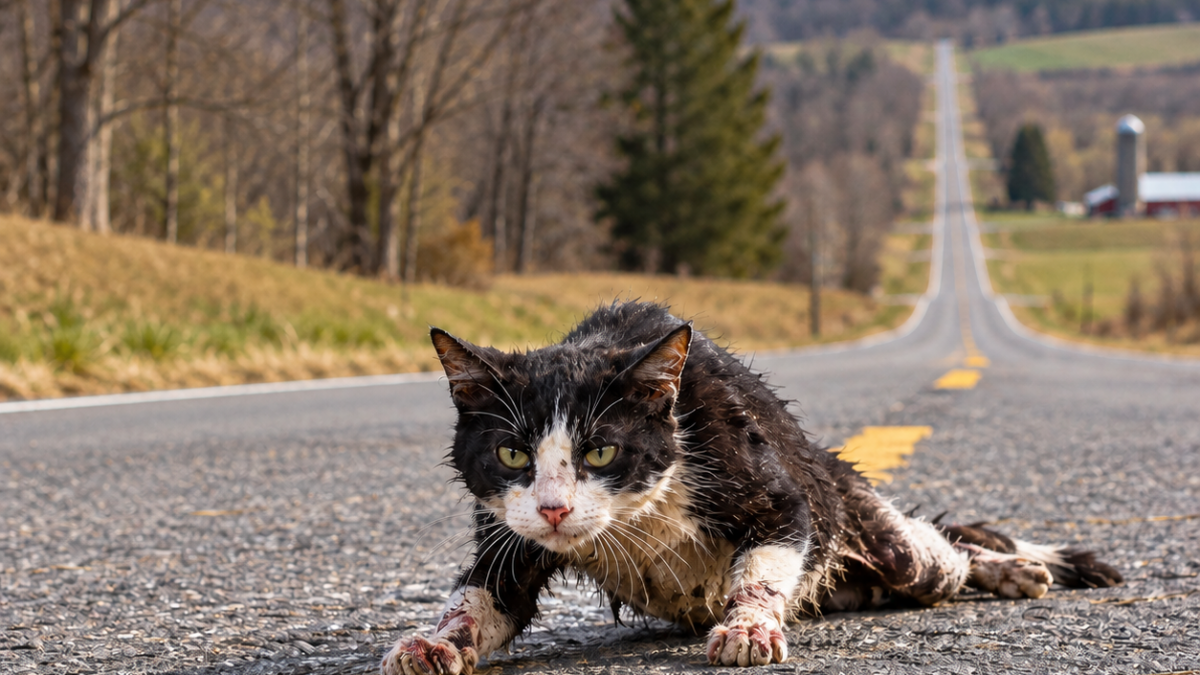
Large male.
Black-and-white tuxedo.
Unneutered.
Filthy.
Dragging the back half of his body like weight tied to him.
His front paws moved with a rhythm that looked less like movement than labor. Reach. Grip. Pull. Breathe. Reach. Grip. Pull. Breathe.
The cat’s head stayed low, but his eyes stayed forward.
South.
Mason had handled injured animals before. Most tried to hide. Some fought. Some froze in shock.
This cat was traveling.
Mason called for animal control, then looked at the road and knew waiting might kill him. The cat was too close to the passing lane. One frightened movement, one gust from a speeding truck, one driver checking a phone, and it would be over.
He went back to the cruiser, pulled out a thick blanket and a pair of gloves, then waited for a gap in traffic. Heather stood behind him, whispering, “Please, please, please,” like a prayer she had not planned to say out loud.
Mason crossed the lane quickly, boots crunching over gravel and broken glass near the median.
The cat heard him.
One ear twitched.
The body did not turn.
Mason crouched several feet away.
“Easy, partner,” he said softly. “I’m not here to hurt you.”
The cat pulled forward again.
The sound of his body scraping over the pavement made Mason’s jaw tighten.
Up close, the damage was worse.
The front claws were worn down to the quick. Pink flesh showed where keratin should have been. Some nails bled fresh. The paw pads were shredded, not simply irritated but torn open, ragged layers of skin hanging away from raw tissue. Tiny stones were embedded in the wounds.
The cat’s chest had been rubbed nearly bald. The skin beneath was wet, red, and bloody. His belly had long abrasions that looked as if someone had dragged him across sandpaper for hours.
But what made Mason feel sick was not only the injury.
It was the trail.
Small red marks dotted the road behind the cat.
Regular.
Steady.
A line.
Mason looked back over his shoulder.
Blood.
Not a puddle.
Not one spot from an accident.
A trail.
The cat had been doing this for a long time.
“Buddy,” Mason murmured, “what are you trying to get to?”
The cat’s front legs trembled. He lowered his head as if the effort had finally become too much. Mason moved then, not fast enough to startle, but decisively. He laid the blanket over the cat’s body and scooped him carefully beneath the chest and hips.
The cat reacted with one sharp hiss, more exhaustion than threat. His front paws pushed weakly against Mason’s sleeve, claws too damaged to grip. For half a second, his eyes fixed south again, and Mason felt the animal’s body strain in that direction.
Even in his arms, ruined and bleeding, he was trying to keep going.
“I know,” Mason said, though he did not know anything yet. “I know.”
Heather covered her mouth as Mason carried him back across the road.
“Is he going to live?”
Mason did not answer immediately.
The cat weighed almost nothing for his size. His bones pressed through his skin. His back legs hung limp over Mason’s forearm, swinging slightly with each step.
“We’re going to give him a chance,” Mason said.
That was as much truth as he had.
County Animal Control was forty minutes out. The nearest emergency veterinary clinic was thirty-two minutes away if Mason drove fast. He made the decision in the space of one breath.
“I’m taking him in myself.”
Heather nodded quickly.
“I’ll follow.”
“You don’t have to.”
“Yes, I do.”
Mason did not argue. Some witnesses needed to see the ending of the first part, even if they could not handle the rest.
He placed the cat gently on the passenger-side floorboard, wrapped in the blanket. The cat did not try to escape. He only lifted his head once, looking through the windshield toward the highway as Mason turned the cruiser around.
When Mason pulled away, the cat’s eyes stayed open.
Still facing south.
The clinic was called Marlowe Veterinary Surgical Center, though most locals simply called it Dr. Ellis’s place because Dr. Karen Ellis had built it from a converted ranch office twenty-three years earlier and refused to retire despite threatening to do so every winter.
The night staff was thin when Mason arrived. One veterinarian, one surgical assistant, one receptionist, and one kennel tech cleaning the back. Mason carried the cat through the doors still wrapped in the patrol blanket.
The receptionist looked up, saw blood on the blanket, and stood.
“Emergency,” Mason said.
The surgical assistant came around the corner before anyone called her.
Her name was Natalie Brooks. Thirty-four years old. Dark hair pulled into a messy bun. Blue scrubs. Tired eyes that still sharpened instantly when she saw an animal in crisis.
“What happened?”
“Found him in the median on Route 17,” Mason said. “Paralyzed rear legs. Drag wounds. Severe paw trauma. Unknown time exposed.”
Natalie moved fast.
“Room two.”
Dr. Ellis was already washing her hands by the time Mason laid the cat on the exam table.
Heather arrived seconds later and stopped just inside the doorway, pale and breathing hard.
“Is that the driver who called?” Natalie asked.
Mason nodded.
“She can stay if she doesn’t interfere,” Dr. Ellis said.
Heather folded her arms tightly across her stomach and stayed near the wall.
The blanket opened.
For one second, the exam room went quiet.
Veterinary staff see suffering. They see wounds and fear and neglect. They learn to move through shock because animals cannot wait for humans to process their emotions.
But the cat on that table was something else.
Dr. Ellis leaned closer, her mouth flattening.
“Male. Adult. No collar. No microchip visible yet. Severe abrasions. Neurologic deficit rear limbs.”
Natalie placed a hand gently on the cat’s shoulder.
“Hey, sweetheart.”
The cat’s eyes shifted to her.
Amber-green.
Clear despite the pain.
Natalie would later say that was when she knew he was not ready to die. His body was wrecked, but his eyes were still working like they had orders.
Dr. Ellis checked his gums.
“Dehydrated. Shocky. Start fluids. Pain control. Broad-spectrum antibiotics. Warm him slowly. Mason, where exactly was he found?”
“Mile marker 68. Median. Moving south.”
“Moving?”
Mason nodded.
“Dragging himself.”
Dr. Ellis looked down at the front paws.
Natalie had already begun cleaning one gently with saline. Her expression changed as dirt and blood loosened.
“These pads are shredded,” she said.
Heather made a sound and turned toward the wall.
Dr. Ellis examined the rear limbs. She pinched lightly between the toes. No response. Checked tail tone. Nothing. Palpated the spine with practiced care.
The cat’s head lifted once, but he did not scream.
Dr. Ellis looked at Mason.
“This isn’t acute road trauma.”
“You sure?”
“I’ll need imaging to confirm, but yes. If he’d been struck today, I’d expect different soft-tissue trauma. This paralysis is older.”
Mason felt the first shape of anger then.
Not hot.
Cold.
Older.
“Older how?”
“Hard to say without radiographs. But not hours.”
Natalie glanced up.
“How long has he been crawling?”
Mason thought of the blood marks stretching behind the cat.
“Long enough.”
They worked on him for over an hour before X-rays were taken.
The clinic gave him pain medicine, fluids, antibiotics, and warmth. Natalie cleaned what she could from the paw wounds while murmuring to him in a voice so soft Mason had to look away.
There is a kind of tenderness that makes anger harder to hold safely.
When the X-ray appeared on the screen, Dr. Ellis stood with her arms crossed, staring.
Natalie stood beside her.
Mason waited behind them.
Heather sat in the hallway with a paper cup of water she had not touched.
“There,” Dr. Ellis said.
Mason looked, though bones on radiographs had never made much sense to him.
Dr. Ellis pointed.
“T13 compression fracture. Significant spinal trauma. Not fresh. See the early calcification? Three weeks old at least. Maybe four.”
Mason’s jaw tightened.
“So he was already paralyzed.”
“Yes.”
“When he ended up on that road?”
“Yes.”
Dr. Ellis did not soften it.
She had learned that truth spoken gently could still be direct.
“This cat was not hit by a car today. He has been paralyzed for weeks. Someone either kept him that way without proper treatment or found him that way and failed to get help. The wounds on his front paws and chest are from dragging himself over a long distance after the paralysis.”
Natalie looked through the glass toward the treatment table where the cat lay sedated but breathing.
“How far?”
Mason thought of the road.
“I’m going back to find out.”
Dr. Ellis turned to him.
“Tonight?”
Mason nodded.
“If there’s a trail, weather could take it by morning.”
Heather stood when Mason came out.
“Is he alive?”
“Yes.”
“Is he—”
“He’s hurt badly,” Mason said. “But he’s alive.”
Heather pressed one hand to her mouth.
Mason hesitated, then asked, “You remember exactly where you first saw him?”
“Yes.”
“Can you show me?”
She nodded before he finished.
They drove back to Route 17 in the fading light, Heather following Mason’s cruiser with her headlights trembling slightly over the pavement. The sun dropped low behind the fields, painting the road in copper and shadow. Traffic thinned.
Mason parked near the place where he had picked up the cat.
Then he began walking north.
Opposite the direction the cat had been traveling.
Heather walked several feet behind him, arms wrapped around herself.
At first, the blood was easy to follow.
Small marks, darkening as they dried.
A smear where the cat’s chest had dragged harder.
Then another.
Then a faint double scratch where his front claws had caught.
Mason photographed each section with a ruler from his evidence kit, though he knew animal cruelty cases did not always get the same urgency as crimes against people. He had seen too many of them dismissed as sad but not worth the resources.
Still, evidence was evidence.
And this cat had left six miles of it.
After the first mile, Heather stopped talking.
After the second, she stopped crying.
By the third, she had gone pale with the kind of quiet horror that no longer needs to express itself.
Mason walked with his flashlight angled low. The trail wandered slightly but stayed along the road’s edge or median, always southbound. Sometimes it moved into gravel and became harder to see. Sometimes it returned to asphalt, where the blood and drag marks appeared again.
At mile four, Mason found a small patch of black-and-white fur stuck to rough pavement.
At mile five, he found a smear where the cat must have rested or collapsed.
Then the trail continued.
Heather whispered, “He got up again.”
Mason said nothing.
At just under six miles, the trail led them to the rest area.
It was an old pull-off used by truckers, travelers, and locals who wanted a place to stretch before the highway narrowed through farm country. One camera faced the main building. Two trash cans stood near the parking lot. A picnic table leaned slightly near the grass.
Mason followed the final faint marks to a strip of flattened grass near the edge of the parking area.
There, the blood trail became confused, scattered, mixed with footprints and tire marks.
Behind a trash can, he found the torn plastic bag.
Dry cat food remnants inside.
A small cheap plastic dish.
Heather stood several yards away, unable to come closer.
Mason photographed everything.
Then he crouched near the flattened grass.
Someone had placed an animal there.
Or dropped him.
Or set him down and walked away.
Mason imagined the cat lying in the grass, unable to use half his body, watching a car door close.
He imagined the engine turning over.
He imagined the vehicle pulling away.
Then he imagined the cat dragging himself toward the sound.
“Deputy?” Heather said quietly.
Mason looked up.
“What kind of person does this?”
Mason had heard variations of that question his entire career. After child neglect calls. After domestic assaults. After frauds targeting elderly people. After animals left in cages without water.
He had never found a satisfying answer.
So he gave the only one that mattered now.
“The kind we find.”
The rest area camera was old, fixed, grainy, and aimed badly.
But it worked.
The manager of the state maintenance office was irritated at being called after hours until Mason explained why. Then he became quiet and drove out personally with a key to the small locked utility room where the footage was stored.
They pulled the video from two nights earlier.
Mason watched it three times.
11:04 p.m.
A dark sedan entered the lot.
No front plate visible from the camera angle.
Passenger side door opened.
A figure stepped out.
Hood up.
Face turned away.
The person carried something low and awkward.
Not a box.
Not a bag.
An animal.
The figure walked toward the grassy strip near the median, bent down, and placed the shape in the grass.
The shape moved slightly.
The person returned to the car.
The sedan exited south.
Mason paused the footage and leaned closer.
The rear plate appeared briefly as the car turned.
Only part of it was visible.
Three characters, maybe four.
A county registration sticker.
A dent near the trunk.
A small oval decal on the left side of the rear window.
Not enough for an easy identification.
Enough to start.
Mason copied the footage and sent stills to dispatch, then to the state database liaison. He filed the evidence before midnight, though he knew the case would be competing with a dozen more urgent human disasters by morning.
When he returned to Marlowe Veterinary Surgical Center, Natalie was sitting beside the cat’s kennel.
The clinic lights were dim. The cat was awake now, wrapped in clean towels, IV line secured, front paws bandaged heavily. He watched the room through the kennel door.
Natalie looked up when Mason entered.
“You found where he started?”
“Yes.”
“How far?”
“Just under six miles.”
Natalie closed her eyes.
For a moment, she said nothing.
Then she asked, “Did they leave him food?”
Mason thought of the torn bag.
“Yes.”
She gave a bitter little laugh.
Not amusement.
Disbelief.
“Like that makes it better.”
“No.”
“What kind of food?”
“Dry.”
She looked at the cat’s mouth, his exhausted eyes, his body that could not reach safety.
“He probably couldn’t even get to it after they left.”
Mason leaned against the wall.
“He followed the car.”
Natalie looked at him.
“What?”
“The trail goes south. Same direction the vehicle left.”
She turned back to the kennel.
The cat stared at her through the bars.
Natalie whispered, “Why?”
Mason had no answer.
Neither did Dr. Ellis.
When Mason told her, she only made a note in the file: animal traveled southbound from suspected abandonment site; reason unknown.
Reason unknown.
Those words would bother Natalie for days.
In veterinary work, sometimes the facts were brutal but simple. An animal was hit by a car. An animal was poisoned. An animal fell. An animal was neglected. You treated what you could and accepted what you could not know.
But this cat’s direction felt like a sentence missing its final word.
Southbound.
That was what Mason began calling him while writing the report.
The cat from the southbound trail.
The southbound cat.
Southbound.
The name stuck before anyone voted on it.
By the second day, even Dr. Ellis used it.
“Southbound’s temperature is stable.”
“Southbound took water.”
“Southbound tolerated bandage change.”
“Southbound tried to bite me, which I consider progress.”
Natalie laughed the first time Dr. Ellis said it. Then she cried in the supply room five minutes later, because progress should not have to look like a half-dead cat trying to defend the little dignity he had left.
Southbound’s back legs could not be saved.
That truth came in stages, though Dr. Ellis suspected it from the beginning.
The spinal injury had left them paralyzed long enough that circulation, muscle tone, and tissue condition had deteriorated severely. There were wounds from dragging. Infection risk was high. The limbs were dead weight, causing pain and further injury.
Dr. Ellis explained it to Mason first because he was the reporting deputy and because no owner had been identified.
“He can live,” she said. “But not with those legs.”
Mason looked through the observation window.
Southbound lay on his side, head lifted just enough to watch Natalie moving nearby.
“What kind of life?”
Dr. Ellis did not answer quickly.
That made Mason respect her more.
“A hard one at first,” she said. “Then maybe a good one. Cats adapt better than people expect. He has strong front limbs, despite the injuries. If the paw pads heal and we manage pain, he could use a cart. He’d need the right home. Someone patient. Someone not sentimental in the wrong way.”
“What’s the wrong way?”
“Feeling sorry for him instead of learning what he can still do.”
Mason nodded slowly.
“And the surgery?”
“Major. Risky because he’s weak. But if we don’t amputate, infection and complications may kill him.”
Mason looked down at his hands.
He had carried Southbound off the road, but that did not give him ownership of the decision. It only gave him responsibility for making sure the decision was not ignored.
“What do you need?”
“Authorization from animal control. A cruelty case file. Funding approval if we can get it. If not, we’ll figure it out.”
“Figure it out how?”
Dr. Ellis’s mouth tightened.
“The way we always do when someone else’s cruelty drops an impossible bill on our table.”
Mason left the clinic and spent the afternoon making calls.
Animal control.
Sheriff.
County prosecutor’s office.
State agriculture enforcement, because abandonment and cruelty statutes often overlapped in frustrating ways.
Some people cared immediately.
Some sounded tired.
Some asked whether the cat was “just a stray.”
Mason’s answer grew colder each time.
“No. He is evidence of a crime.”
On the fourth day, Southbound underwent surgery.
Natalie helped prep him.
She had assisted in hundreds of procedures. Spays. Neuters. Tumor removals. Fracture repairs. Emergency foreign-body surgeries. Amputations after accidents. She knew how to focus on instruments, vitals, timing, sterile fields.
But shaving the ruined limbs of a cat who had dragged them for six miles felt different.
Southbound was sedated, eyes closed, body finally still. His front paws were wrapped. His chest wounds had been cleaned and dressed. His breathing moved evenly through the anesthesia circuit.
Natalie placed one hand briefly on his head before scrubbing in.
“I know,” she whispered. “It’s not fair.”
Dr. Ellis heard her but said nothing.
The surgery lasted hours.
Both rear limbs were removed. Damaged tissue cleaned. Wounds closed. Pain managed. Antibiotics adjusted. Southbound’s blood pressure dipped once and made everyone in the room stop breathing until it stabilized.
When it was over, Natalie stood beside the recovery area and watched him wake.
He came back slowly.
Disoriented.
Heavy.
Less of his body present than before.
At first, he tried to move and could not understand the new balance. His front legs pushed weakly. His head lifted. His body shifted.
Natalie opened the kennel and gently steadied him.
“Easy,” she said. “You’re still here.”
Southbound’s eye fixed on her face.
There was no trust in it yet.
Only awareness.
That was enough.
“You’re still here,” she repeated.
For the next two weeks, Southbound healed by inches.
Inches were something he understood.
He accepted food grudgingly at first, then with more interest. He tolerated bandage changes with increasing irritation, which Dr. Ellis called a sign of returning personality. His front paw wounds slowly began to close. The raw skin on his chest and abdomen formed fragile new layers.
Natalie came in early and left late.
She told herself it was because the clinic was understaffed.
That was partly true.
She also told herself Southbound needed careful monitoring.
That was fully true.
But the deeper truth was that she could not stop thinking about what he had done.
At night, when she went home to her small rental house behind the laundromat, she heard it in her head.
Pull.
Drag.
Pull.
Drag.
Her own house was quiet. Too quiet sometimes. She had divorced two years earlier from a man who thought compassion was admirable as long as it did not interfere with dinner plans, savings accounts, or his comfort. He had never been cruel in ways that left bruises. He had simply treated every soft part of her like a flaw that needed correction.
“You can’t save everything, Nat.”
He used to say that when she cried after hard cases.
“You bring all that sadness home like it’s your job to suffer over every broken animal.”
She had believed him for a while.
Then she stopped.
The divorce papers came six months after she found him yelling at their elderly dog for having an accident near the back door. The dog had kidney disease. Her husband had known that. He was not ignorant. He was inconvenienced.
Natalie left with the dog, two suitcases, and the quiet certainty that some people revealed themselves not in emergencies, but in how they treated the helpless when no one important was watching.
Her dog had died the following winter.
Since then, the house had stayed empty.
She had told herself she was not ready.
Then Southbound arrived.
One evening, after closing, Natalie sat beside his kennel while rain tapped lightly against the clinic windows. Southbound rested with his front paws tucked under him, bandages clean, body thin but no longer collapsing into itself.
“You were following somebody,” she said quietly.
His ear twitched.
“Not the people who left you. I don’t believe that. Not really.”
Southbound stared at her.
Natalie leaned back against the cabinet.
“Unless you did. Animals do that too, don’t they? Love the ones who hurt them. Humans aren’t much smarter.”
The cat blinked once.
She smiled sadly.
“You don’t care about my divorce.”
He closed his eye.
“Fair.”
Three weeks after the rescue, the car was found.
Not through brilliant detective work.
Not through a dramatic chase.
Through a traffic stop for an expired registration and a broken brake light.
Deputy Mason was not the one who made the stop. It happened two towns south, late on a Thursday afternoon, when Officer Luis Romero pulled over a dark sedan with a dent near the trunk and an oval decal in the rear window.
The partial plate matched Mason’s alert.
Romero called it in.
Mason was off duty, halfway through heating soup in his microwave, when dispatch contacted him.
“They’ve got your sedan.”
Mason turned off the microwave and grabbed his keys.
“Occupants?”
“Adult male driver. Adult female passenger. Two children in the back.”
Mason stopped.
“Any animals?”
A pause.
“Officer reports a metal crate on the rear seat. Four kittens inside.”
For a moment, Mason did not move.
Then the anger that had been waiting in him for three weeks stood up fully.
“I’m on my way.”
By the time he arrived, the sedan sat on the shoulder beside Romero’s patrol car. The driver was a man in his late thirties named Colin Whitaker, thick-necked, red-faced, wearing a sweatshirt with a construction company logo. The passenger was his wife, Marcy Whitaker, thin and tense, with dyed blonde hair pulled into a tight ponytail. Two children, a boy around eleven and a girl perhaps eight, sat silently in the back.
And on the back seat beside them was a metal crate.
Inside were four kittens.
Black-and-white.
Tuxedo patterned.
Thin.
Dirty.
Alive.
Mason approached the crate slowly.
All four kittens stared back.
One had a white stripe up the nose that split slightly left above the bridge.
Mason felt the world narrow.
“What are those?” he asked.
Colin Whitaker crossed his arms.
“Cats.”
“I can see that.”
“Then why ask?”
Mason looked at him.
“Because I’m wondering why you’re driving around with four underweight kittens in a crate on your back seat.”
Marcy spoke quickly.
“We were taking them to a friend.”
“What friend?”
She looked at Colin.
Colin said, “A farm.”
Mason almost laughed.
Not because it was funny.
Because it was always a farm.
Every animal dumped, neglected, traded, or vanished seemed to be headed to some imaginary farm where responsibility dissolved into open fields.
Romero opened the sedan’s rear passenger door. The smell of urine and fear came out with the warm air.
The little girl in the back seat looked at Mason and whispered, “They’re hungry.”
Marcy turned sharply.
“Kaylee.”
The child flinched.
Mason saw it.
So did Romero.
Mason crouched slightly, keeping his voice gentle.
“Hey, Kaylee. How long have the kittens been in the car?”
Colin snapped, “Don’t talk to my kid.”
Mason stood slowly.
“Then answer the question.”
“They’re ours,” Colin said. “We can do what we want with our animals.”
There it was.
Not guilt.
Ownership.
The old ugly belief that having power over a living thing meant having permission to treat it however you pleased.
Mason kept his voice calm.
“Do you own a black-and-white adult male cat?”
“No.”
Marcy looked down.
Mason saw that too.
“Did you own one?”
Colin’s jaw worked.
“We had a cat that got hurt. It ran off.”
“Ran off where?”
“I don’t know. It was weeks ago.”
“From a rest area?”
Marcy’s face changed.
Colin stared at Mason.
“I don’t know what you’re talking about.”
Mason pulled out a still image from the surveillance footage. Grainy. Dark. A person stepping out of the passenger side at the rest area.
He held it up.
“Want to try again?”
Marcy began crying.
Colin did not comfort her.
He got angry.
“That cat was useless,” he said.
The words landed so hard even the wind seemed to stop.
Mason heard Romero inhale.
The two children in the back seat went very still.
Colin pointed toward the crate.
“We had mouths to feed already. The thing couldn’t walk. It pissed everywhere. Dragging itself around. My wife was hysterical about it. Kids crying. What was I supposed to do? Spend thousands on a cat?”
Marcy whispered, “Colin, stop.”
But he was exposing himself now, carried forward by the arrogance of a man who believed cruelty became reasonable if he explained the inconvenience clearly enough.
“I left food,” he said. “I didn’t just toss it in a ditch. I left food and water.”
Mason’s voice dropped.
“He couldn’t reach it.”
Colin blinked.
“What?”
“He was paralyzed. You left dry food behind a trash can and put him in the grass. He dragged himself six miles after your car.”
Marcy sobbed once, sharp and involuntary.
The little boy in the back began crying silently.
Colin’s face reddened.
“That’s impossible.”
“No,” Mason said. “It’s documented.”
“He should’ve stayed where we put him.”
Mason stepped closer.
Every officer learns the discipline of not reacting physically to words. Still, some sentences test the training.
“He should have stayed where you put him?” Mason repeated.
Colin realized too late how it sounded.
“I mean—he was an animal.”
Mason looked toward the kittens.
“And those?”
Colin’s mouth opened, then closed.
Kaylee whispered again from the back seat, so softly Mason almost missed it.
“He was their dad.”
Marcy turned around.
“Kaylee, don’t.”
But the little girl had started crying harder now.
“Mom said he was following us,” she said. “At the rest stop. She said don’t look.”
Mason’s gaze moved to Marcy.
Marcy covered her face.
Colin slammed one hand on the roof of the sedan.
“Enough!”
That was when Romero ordered him to step back.
The traffic stop became an animal seizure.
Then an investigation.
Then charges.
The four kittens were removed from the vehicle and transported to Dr. Ellis’s clinic. They were underweight, dehydrated, flea-infested, and terrified, but alive. The mother cat was not in the car. The Whitakers claimed she had “disappeared” days earlier. No one ever found her.
When Natalie saw the kittens, she knew before anyone said anything.
It was the markings.
All four black-and-white, each with the same strange asymmetrical blaze splitting left above the nose. Not identical in every hair, but close enough to make the room feel haunted.
Dr. Ellis examined them one by one.
Natalie stood beside the table, glancing through the hallway toward the recovery ward where Southbound was resting.
Mason watched her face.
“You think—”
“They’re his,” she said.
Dr. Ellis did not look up from the kitten she was examining.
“No DNA test,” she said. “We can’t prove legally through pattern alone.”
Natalie swallowed.
“I know.”
Dr. Ellis finally looked at Mason.
“But I’ve been doing this twenty-three years. I’ve never seen this exact marking repeated across an entire litter unless the male was directly responsible.”
One kitten, the smallest, hissed weakly at Natalie when she tried to clean his face.
She smiled through tears.
“Yeah,” she whispered. “You’re his.”
They did not bring the kittens to Southbound.
Not right away.
He was still healing. They were too young, too stressed, medically vulnerable. No one knew what recognition would mean to a cat, or whether it would help or hurt. People often want emotional reunions because people need them. Animals do not always benefit from human ideas of closure.
Still, Natalie carried one of the kitten blankets into Southbound’s ward that night.
Not to force anything.
Only because she could not help herself.
Southbound was awake in his padded enclosure. His new body was still difficult for him. Without the dead weight of his back legs, he balanced differently. He shifted often, frustrated by limits he did not understand.
Natalie placed the folded blanket several feet away.
His head lifted.
For the first time since his surgery, Southbound made a sound that was not pain, irritation, or warning.
A low, broken chirp.
Natalie froze.
He pulled himself forward.
Not far.
Not fast.
His front paws were still healing.
But he moved toward the blanket.
He lowered his nose to it and inhaled.
Once.
Twice.
Then he pressed his face into it and stayed there.
Natalie sat on the floor outside the enclosure and cried quietly into her sleeve.
Dr. Ellis found her ten minutes later.
“You know you’re getting attached.”
Natalie laughed through tears.
“I passed attached somewhere around the second bandage change.”
“He’s going to need a specific home.”
“I know.”
“A hard home.”
“I know.”
“Someone who can handle mobility equipment, wound care, possible urinary issues, pain management, long-term costs, behavioral trauma.”
Natalie wiped her face.
“I know.”
Dr. Ellis leaned against the doorframe.
“Do you?”
Natalie looked at Southbound, his face still pressed into the kitten blanket.
“No,” she admitted. “Probably not.”
“That’s the first intelligent answer you’ve given.”
Natalie laughed again, and this time it almost sounded like herself.
The cruelty case became public before the prosecutor was ready.
Someone at the traffic stop filmed part of Colin Whitaker yelling that he had done nothing wrong because “it was just a cat.” The clip spread locally, then farther. By the next morning, people knew about the paralyzed tuxedo cat who had crawled six miles after the family who abandoned him.
The public anger came fast.
Sometimes public anger is messy and careless.
This time, it brought pressure.
The sheriff’s department received calls. The prosecutor received emails. The clinic received donations, supplies, and messages from strangers who wanted updates on Southbound and the kittens.
Dr. Ellis hated the attention.
Then she saw the cart donation offer.
A company specializing in mobility devices for disabled animals had seen Southbound’s radiographs and case summary on a professional veterinary forum. They wanted to build him a custom rolling cart at no cost.
Natalie read the email three times.
Then she ran to Dr. Ellis’s office.
“He got wheels.”
Dr. Ellis looked over her glasses.
“He got what?”
“Wheels.”
The fitting process took time.
Measurements.
Adjustments.
Strength assessment.
Healing milestones.
Southbound needed his front paws recovered enough to bear weight comfortably. His chest wounds needed protection. His core needed to adapt. His patience, never abundant, needed negotiation.
The first time they placed him in the cart, he froze.
His ears went flat.
His eyes widened.
Natalie crouched in front of him with a treat.
“Okay,” she said softly. “I know. This is weird.”
Southbound glared at her.
“Very weird. I agree.”
He refused to move.
The kennel tech, Jordan, watched from the doorway.
“Maybe he hates it.”
“He’s allowed to hate it for five minutes.”
At minute six, Southbound took one step with his front paws.
The cart rolled behind him.
He stopped immediately and looked back as if betrayed by physics.
Natalie smiled.
“Yeah. It follows you.”
He took another step.
Roll.
Another.
Roll.
Then three.
Then five.
Then, suddenly, he seemed to understand.
His front legs pulled.
The cart carried what his body no longer could.
He crossed the therapy room in a crooked but determined line.
Jordan whispered, “Oh man.”
Natalie pressed both hands to her mouth.
Southbound reached the far wall, turned badly, bumped the baseboard, hissed at it, and kept going.
By the end of the week, he could cross the room.
By the second week, he could navigate the hallway.
By the third, he had learned that if he got enough momentum, he could terrorize the clinic receptionist by rolling silently under the front desk and appearing beside her ankle like a ghost with whiskers.
“He’s a menace,” the receptionist said.
Natalie looked proud.
“He’s healing.”
“He stole my muffin.”
“Emotionally, that’s progress.”
The kittens went into foster care.
All four survived.
Their names changed several times because every foster family had opinions. For the clinic records, they were called Clover, Dash, Millie, and Bishop. Clover was the smallest and loudest. Dash climbed everything. Millie slept inside shoes. Bishop had the same fixed, serious stare as Southbound.
Mason visited once while they were at the clinic for vaccines.
He stood in the exam room watching four tiny tuxedo bodies tumble over one another on a towel.
“Hard to believe they were in that car.”
Natalie nodded.
“One of them hissed at Dr. Ellis this morning.”
“Good.”
“That was my reaction.”
Mason reached one finger toward Bishop. The kitten sniffed it, then bit him with complete confidence.
Mason smiled.
“Definitely his.”
The legal case did not end as dramatically as people wanted.
Real justice rarely does.
Colin and Marcy Whitaker were charged under animal cruelty and abandonment statutes. Colin tried to frame the situation as financial hardship. He claimed he had intended to take the paralyzed cat “somewhere he might be found.” He claimed the food proved he had not meant harm. He claimed the cat’s injuries from the road were unforeseeable.
The prosecutor showed the surveillance footage.
The medical report.
The X-rays showing an older fracture.
Photographs of the paw pads, claws, chest abrasions, blood trail, torn bag, plastic dish, flattened grass.
Then Mason testified.
He described finding Southbound still moving.
He described following the blood trail back six miles.
He described the kittens in the car.
Heather testified too.
Her voice shook, but she did not stop.
“He wasn’t wandering,” she said. “He was trying. I’ve never seen anything try that hard.”
Dr. Ellis testified with clinical precision.
She refused melodrama.
That made her words worse.
She explained the old compression fracture. The untreated paralysis. The condition of the paws. The time required for the wounds. The fact that the cat had been paralyzed before abandonment. The suffering involved.
Colin stared at the table during most of it.
Marcy cried.
When Natalie entered the courtroom to provide supporting documentation about post-operative care, Colin’s attorney tried to suggest that people were exaggerating because the case had become emotional online.
Natalie looked at him evenly.
“Have you seen his paws?”
The attorney paused.
“In photographs, yes.”
“No,” Natalie said. “Have you held them while gravel came out of the tissue? Have you changed bandages while he shook from pain but still tried to keep his head up? Have you listened to the sound his cart makes because someone left him with no other way to move?”
The judge told her to answer only the question asked.
Natalie apologized.
But the room had heard her.
The Whitakers were convicted of animal abandonment and cruelty. The sentence included fines, probation, mandatory restitution for veterinary costs, community service, and a long-term prohibition from owning animals. Many people wanted jail. Some were furious when that did not happen.
Mason understood the frustration.
Natalie did too.
But on the day the order came through banning them from owning animals, she walked back to Southbound’s recovery room and told him anyway.
“You won’t be their property again.”
Southbound was in his cart by then, stationed near the window where afternoon sun came through. He looked at her, unimpressed.
“I know,” she said. “You wanted tuna.”
The kittens were all adopted by summer.
Good homes.
Carefully screened.
Clover went to a retired librarian who sent monthly photos. Dash went to a family with older children and a cat tree tall enough to satisfy his ambitions. Millie went to a nurse who worked nights and wanted a companion who did not mind odd hours. Bishop went to Heather Nolan, the driver who had first stopped on the highway.
Heather cried when she signed the papers.
“I couldn’t save his father from the road,” she said.
Natalie placed Bishop’s carrier on the counter.
“You called for help. That saved him.”
Heather shook her head.
“It doesn’t feel like enough.”
“Sometimes enough starts small.”
Heather looked through the carrier door. Bishop stared back with Southbound’s serious eyes.
“I’ll make sure he has a good life.”
“I believe you.”
Southbound never saw the kittens again.
That was a decision, not an accident.
Natalie asked Dr. Ellis about it more than once.
“Would it help him?”
Dr. Ellis’s answer stayed the same.
“We don’t know. He is healing. They are safe. Reintroducing them may distress him, may mean nothing, or may create stress none of them need. Humans want symbolic closure. Animals need stability.”
Natalie hated that answer because it was probably right.
So instead, she kept one clean towel from the kittens’ last visit.
Just one.
She let Southbound smell it before it was washed.
He pressed his face into it for a long time.
Then he rolled away toward the window.
Natalie watched him go.
“That’s it?” she whispered.
Southbound stopped near the sunbeam and began washing one front paw.
Maybe that was it.
Maybe that was all he needed.
Maybe she was the one who wanted more.
The day Natalie adopted him did not feel like a decision.
That was how she explained it later.
“It wasn’t like I woke up and decided to adopt a cat with no back legs,” she told Mason. “I just realized I was already planning my house around him.”
Mason had stopped by the clinic with paperwork and a bag of donated cat food from someone at the sheriff’s department.
He leaned against the reception counter.
“How much planning?”
Natalie counted on her fingers.
“Ramps. Low litter setup. Washable floor mats. Cart storage. Medication station. Window perch modified so he can roll onto it. No stairs. Soft bedding. Wider pathway between kitchen and living room.”
Mason stared at her.
“So a normal amount.”
“Exactly.”
Dr. Ellis walked by without looking up.
“She filed the adoption paperwork yesterday.”
Natalie turned.
“You weren’t supposed to announce it like that.”
“You were taking too long.”
Mason smiled.
“What does Southbound think?”
At that moment, Southbound rolled out from the hallway, turned too sharply, hit the base of the counter with one wheel, hissed at it, corrected himself, and continued toward Natalie.
Mason watched.
“He seems emotionally prepared.”
Natalie crouched.
Southbound rolled straight to her and stopped with his front paws on her shoe.
That was the closest he came to signing.
He went home on a Friday evening.
Natalie’s house had never felt so ready or so inadequate.
She had cleaned obsessively. Rearranged furniture. Removed rugs that might catch his wheels. Set up food and water stations. Placed a low bed near the living room window. Built a ramp to the back porch even though Dr. Ellis told her he should not go outside unsupervised, which Natalie already knew, thank you.
Southbound entered in his cart, paused just inside the door, and looked around.
Natalie held her breath.
He rolled forward.
Pull.
Roll.
Pull.
Roll.
The sound filled the house.
Not loud.
Not smooth.
A rhythm.
Front paws on wood floor.
Small wheels following.
Pull, roll.
Pull, roll.
He inspected the living room first. Then the kitchen. He found the food station within forty seconds, which Natalie respected. He ignored the expensive orthopedic bed and settled under a cheap wooden chair beside the window.
“Of course,” she said.
That night, Natalie barely slept.
Southbound did.
Not deeply at first. He woke at every sound. Once, a truck passed outside and he lifted his head sharply, body tensing as if preparing to move south again. Natalie turned on the lamp.
“You’re home,” she said.
The word felt too big.
Too soon.
But Southbound lowered his head.
At 3:12 a.m., Natalie woke to the sound of wheels.
Pull.
Roll.
Pull.
Roll.
She sat up.
Southbound moved through the hallway in the dark, his cart making a soft, steady rhythm against the floor. He reached her bedroom doorway and stopped.
“You okay?”
He stared at her.
Then he rolled inside, crossed the room, and stopped beside the bed.
He could not jump.
Natalie had placed a low padded platform beside the bed for that reason. Southbound sniffed it, ignored it, and stared at her again.
“Oh,” she said.
She got up, unclipped him from the cart, supported his body carefully, and lifted him onto the bed.
He settled near her feet, stiff at first, then slowly softened into the blanket.
Natalie lay awake for a long time listening to him breathe.
She had told herself she was giving him a home.
In the darkness, with Southbound’s scarred body warm against the blanket, she understood he had brought life back into hers too.
The public eventually moved on.
It always does.
New stories came. New outrage. New heartbreak. New miracles. Southbound became, for many people, a post they had shared once and remembered vaguely when they saw a tuxedo cat.
But for the people who knew him, his life did not become a symbol.
It became ordinary.
Beautifully, stubbornly ordinary.
He woke Natalie before her alarm by rolling into the bedroom door if she dared sleep too late.
He hated one specific blue towel for reasons no one understood.
He loved tuna but only if served in a shallow white dish.
He learned to reverse his cart after getting stuck under the kitchen table twice.
He developed an ongoing feud with the mail slot.
He liked Mason, tolerated Dr. Ellis, adored Heather when she visited with Bishop’s photos, and treated Natalie as if she were both staff and furniture.
His scars changed but did not vanish.
The front paw pads healed thick and dark, almost black, roughened permanently from the road. The skin on his chest and belly closed into a wide, pale, hairless scar that stretched from sternum to lower abdomen. If Natalie ran her fingers lightly over it, she could feel texture in the scar tissue.
Road texture.
That was what Dr. Ellis called it once, quietly.
Natalie hated the phrase.
Then she accepted it.
Because it was true.
Southbound carried the road on his body.
Not as tragedy alone.
As evidence.
As history.
As proof of what he had survived.
The cart company sent a second set of wheels as he grew stronger. The new ones were smoother, lighter. Southbound hated them for two days, then realized he could move faster and immediately used that speed to ambush Natalie’s ankles from around corners.
“You are a menace,” she told him.
He blinked.
“An expensive menace.”
He yawned.
At night, sometimes, Natalie would close her eyes and hear his movement from the kitchen to the living room.
Pull.
Roll.
Pull.
Roll.
She understood why she had told people it sounded like a heartbeat.
It did.
Not a soft heart.
Not a sentimental one.
A hard-working heart.
A heart that had every reason to stop and did not.
Months after the adoption, Mason came by with a folder.
Natalie met him on the porch. Southbound sat in his cart beside her, watching a beetle cross the walkway with intense suspicion.
“What’s that?” she asked.
“Final case documents.”
“I thought everything was done.”
“It is.” Mason handed her a copy. “I thought you might want it.”
Natalie opened the folder.
Photographs.
Reports.
Court order.
Medical summary.
The abandonment footage stills.
The traffic stop inventory.
The animal ownership ban.
She stopped at one photograph of the rest area grass.
The flattened patch.
The place where Southbound had been left.
Her throat tightened.
Mason leaned on the porch railing.
“I went back there yesterday.”
Natalie looked up.
“Why?”
“Don’t know. Case is closed. Guess I wanted to see it without evidence markers.”
“And?”
“It’s just grass.”
Southbound’s ears shifted.
Mason looked at him.
“Hard to believe something that big started in a place that ordinary.”
Natalie closed the folder.
“Cruelty usually looks ordinary until someone refuses to ignore it.”
Mason nodded.
They stood quietly.
Then he said, “I keep thinking about the kids.”
“The Whitaker kids?”
“Yeah.”
Natalie looked toward the road.
“How are they?”
“With relatives for a while. Child services got involved after the traffic stop. Not just because of the animals. Other things came out.”
Natalie closed her eyes briefly.
Of course other things came out.
Cruelty rarely stays in one lane.
“Kaylee asked about him,” Mason said.
Natalie looked at him.
“The little girl?”
“She wanted to know if the dad cat lived.”
Natalie swallowed.
“What did you say?”
“I said yes. I said he had wheels now.”
A small smile moved across Natalie’s face despite the sadness.
“What did she say?”
“She cried. Then she asked if he hated her.”
Southbound watched the beetle disappear beneath the step.
Natalie whispered, “Oh.”
“I told her I didn’t think animals hate children for being trapped in adults’ choices.”
Natalie looked at him.
“That was a good answer.”
“I hope so.”
Southbound rolled forward suddenly, placing one paw near Mason’s boot.
Mason glanced down.
“Is that approval?”
“No,” Natalie said. “He wants you to move. You’re blocking the beetle.”
Mason stepped aside.
Southbound continued his investigation.
Life went on.
That phrase can sound dismissive, but sometimes it is the deepest mercy.
Life went on, and Southbound remained in it.
The kittens grew.
Heather sent photos of Bishop perched on windowsills, sleeping in laundry baskets, sitting in the sink with the solemn dignity of a judge. Clover became round and bossy. Dash required an upgraded cat tree. Millie slept in shoes until she became too large and then slept on shoes, refusing to accept reality.
Natalie printed every photo.
She kept them in a small album she never showed Southbound because she knew that was for her, not him.
On the first anniversary of his rescue, Dr. Ellis closed the clinic early for an hour. Not for a party, exactly. Southbound would have hated a party. But Heather came. Mason came. Jordan and the receptionist brought tuna treats. Dr. Ellis pretended the whole thing was ridiculous and then spent twenty minutes adjusting a tiny blue bandana around Southbound’s neck.
He hated the bandana.
Everyone took photos anyway.
Heather stood beside Natalie near the therapy room door.
“I still see him sometimes,” Heather said.
Natalie looked at her.
“On the road?”
Heather nodded.
“When I drive that stretch. Not physically. But I see him. I slow down every time.”
“Me too,” Mason said from behind them.
Natalie turned.
He shrugged.
“I patrol it. I know the exact spot.”
Dr. Ellis, overhearing, said, “Maybe that’s not a bad thing.”
“What?”
“Remembering where someone was almost missed.”
The room went quiet.
Southbound, unimpressed by emotional reflection, rolled directly over the edge of a paper plate and dragged it halfway across the floor.
The receptionist sighed.
“There goes the cake.”
“He can’t eat cake,” Dr. Ellis said.
“He doesn’t know that.”
Southbound continued pulling the plate.
Pull.
Roll.
Pull.
Roll.
Everyone laughed.
And for once, the laughter did not feel like it was covering pain.
It felt like something growing beside it.
In the second year, Southbound became stronger.
Not healed in the way people sometimes demand.
Not restored.
Restoration was not the point.
He became himself.
A cat with wheels.
A cat with scars.
A cat who had once dragged himself down a highway and now liked sunbeams, tuna, cardboard boxes, and knocking pens off Natalie’s desk.
He learned the house’s rhythms.
Morning coffee.
Breakfast.
Medication.
Cart time.
Rest time.
Porch time.
Window time.
Bedtime.
If Natalie cried, which she still did sometimes, he did not comfort her in a dramatic way. He did not climb onto her chest or lick her tears. He simply rolled into the room, positioned himself where she had to see him, and stared until she acknowledged him.
“You’re not subtle,” she would say.
He never was.
Maybe that was what she needed.
Something that did not disappear into politeness.
Something that insisted on being seen.
One evening, Natalie’s ex-husband saw a local news follow-up online and sent her a text.
That cat story is yours? Figures. You always did need something broken to fix.
Natalie stared at the message for a long time.
Old words have a way of finding old bruises.
Southbound was under the table, chewing on the edge of an envelope he had stolen from her bag.
Natalie looked at him.
Broken.
The word felt suddenly obscene.
Not because Southbound’s body was whole. It was not. Not because he did not need care. He did.
But broken was what careless people called things they did not want to understand.
Broken was what Colin Whitaker had seen.
Useless.
Inconvenient.
Disposable.
Natalie deleted the message.
Then she sat on the floor.
Southbound rolled halfway out from under the table, envelope still in his mouth.
“You’re not broken,” she told him.
He chewed.
“I’m not either.”
He tore the envelope.
“Okay, one of us is destructive.”
He blinked slowly.
She laughed.
That was the last message from her ex-husband she ever answered by feeling small.
Years later, people would still ask Natalie why Southbound followed the car.
She never claimed certainty.
“He may have followed the sound,” she would say. “Or the scent. Or the direction of movement. Or maybe he was disoriented and chose the road because it was open.”
Sometimes people looked disappointed by that answer. They wanted her to say love. They wanted a clean explanation. They wanted the father cat knowingly pursuing his stolen kittens with human-like understanding.
Natalie understood that.
She wanted it too, sometimes.
But she had learned to respect mystery.
What mattered was not whether Southbound understood every detail the way people told it later.
What mattered was what he did.
Fields lay on both sides of the road.
Ditches.
Woods.
Softer ground.
Places to hide.
Instead, he chose the direction the car had gone.
He chose the hard road.
He chose movement.
He chose to follow.
And somewhere miles ahead, in a metal crate on a back seat, his kittens were still alive.
That was enough.
One crisp fall morning almost three years after the rescue, Natalie drove Southbound to a community event at the county fairgrounds. She had refused several invitations before, worried crowds would stress him, but this one was different. It was a fundraiser for a small animal emergency care fund created after his case, designed to help cover treatment for animals seized in cruelty investigations before ownership and payment were legally sorted out.
Dr. Ellis called it the Southbound Fund.
Natalie resisted the name.
Southbound did not care, which everyone took as permission.
At the fairgrounds, he sat in his cart beside Natalie’s booth while children approached carefully and adults tried not to cry in front of him. A large printed sign explained the fund, not with graphic photos, but with a simple sentence:
Sometimes survival begins before help arrives.
Mason came in uniform.
Heather came with her family and a framed photo of Bishop.
Dr. Ellis came despite claiming she hated events.
Even Kaylee Whitaker came.
Natalie recognized her immediately, though she had grown taller. She was with a social worker and an aunt. Her hair was shorter. She looked nervous enough to run.
Natalie saw Mason notice her too.
Kaylee stood at the edge of the booth for several minutes, staring at Southbound.
Natalie approached slowly.
“Hi.”
Kaylee swallowed.
“Hi.”
“You’re Kaylee.”
The girl nodded.
Southbound looked at her from his cart.
Kaylee’s eyes filled.
“I’m sorry,” she whispered.
Natalie’s chest tightened.
“You were a child.”
“I saw him in the grass.”
Natalie did not speak.
Kaylee wiped her face quickly, embarrassed.
“I didn’t know he followed. I didn’t know until Deputy Reed told us.”
Southbound shifted his weight, wheels clicking softly.
Kaylee looked at him like she expected judgment.
Natalie crouched slightly.
“Do you want to say hello?”
Kaylee shook her head quickly.
Then stopped.
Then whispered, “Can I?”
Natalie looked at Southbound.
He was calm.
“Hold out your hand low. Let him decide.”
Kaylee knelt on the grass.
Her hand trembled.
Southbound watched her for several seconds.
Then he rolled forward one short pull.
Then another.
He sniffed her fingers.
Kaylee began crying silently.
“I tried to feed the kittens,” she whispered. “When they let me.”
Natalie closed her eyes briefly.
Southbound pressed his nose once against the girl’s knuckles.
Then he turned and rolled back toward Natalie, apparently satisfied that the interaction had concluded.
Kaylee covered her mouth.
“He doesn’t hate me?”
Natalie answered carefully.
“No. He doesn’t.”
The girl cried harder.
Mason stood several yards away, eyes down.
Later, Natalie asked him, “Did we do the right thing?”
“Letting her meet him?”
“Yes.”
Mason watched Kaylee leave with her aunt.
“I don’t know,” he said honestly. “But I think maybe she needed to see he lived.”
Natalie looked at Southbound.
“And maybe he needed nothing from it at all.”
“That’s allowed too.”
She smiled faintly.
“Yes. It is.”
The Southbound Fund raised enough that day to cover emergency care for three animals in its first month.
Then six.
Then more.
A dog with a broken jaw.
A burned kitten.
Two neglected horses.
A senior cat found locked in an abandoned apartment.
Not every story ended happily.
But more of them had a chance to begin because one cat had forced a county to look at what abandonment really meant.
Not an animal quietly disappearing.
Not a problem solving itself.
A body on the road.
A blood trail.
A cost.
A witness.
A choice.
Southbound grew older.
His shoulders became powerful from years of pulling his cart. His face grayed around the muzzle. His one white stripe remained slightly crooked to the left, echoed in photographs of four grown kittens living in four different homes.
He slowed eventually.
The cart became harder some days.
Natalie adjusted.
Less time in wheels.
More soft bedding.
Pain management.
Warm compresses.
Short porch trips.
Sunbeams moved across the floor, and she moved his bed to meet them.
He never lost the rhythm entirely.
Even near the end, when he crossed a room, it came back.
Pull.
Roll.
Pull.
Roll.
A heartbeat.
One night, Mason came over with takeout because Natalie had missed dinner after a difficult shift. They sat on the living room floor because Southbound had claimed the couch blanket and neither of them felt like arguing with him.
Mason had become more than the deputy who carried the cat off the road.
He had become a friend first.
Then something gentler.
Something neither he nor Natalie rushed to name because both understood that important things deserved patience.
Southbound slept near their feet.
Mason looked at him and said, “Do you ever wonder what would’ve happened if Heather hadn’t stopped?”
Natalie did not answer right away.
Outside, rain tapped softly against the windows.
“Someone else might have.”
“Maybe.”
“Or maybe not.”
Mason nodded.
Natalie looked at the scarred cat.
“That’s the part that scares me. How much depends on one person deciding something matters enough to stop.”
Mason leaned back against the chair.
“She did.”
“You did too.”
“So did you.”
Southbound opened one eye as if irritated by the sentimental tone.
Natalie smiled.
“Yes, you too.”
He closed his eye again.
When Southbound finally died, it was not on a road.
Not in a cage.
Not on a surgical table.
It was years later, in Natalie’s house, on a thick blanket in a patch of winter sunlight, with her hand resting on the scarred place between his shoulders.
Dr. Ellis came to the house.
Mason was there.
Heather came later, with a photo of Bishop to leave beside him for a while, though Natalie knew Southbound did not need it. Maybe she did.
Southbound was tired.
Old pain had become harder to manage. His appetite had faded. His good hours had grown smaller. Natalie knew the signs. Knowing did not make it easier.
She lay beside him on the floor before Dr. Ellis began.
“You don’t have to go anywhere now,” she whispered.
His ear moved faintly.
“You followed far enough.”
Mason stood near the doorway, crying silently.
Dr. Ellis worked with the same steady tenderness she had given him from the beginning.
Southbound’s breathing slowed.
Natalie kept her hand on him.
The final breath was quiet.
No scrape.
No struggle.
No road.
Only stillness.
Afterward, Natalie pressed her face into his fur and wept until there was nothing dignified left in her.
Mason sat beside her on the floor.
Dr. Ellis wiped her own eyes and did not pretend otherwise.
The house felt impossibly silent without the sound of wheels.
For weeks, Natalie heard phantom movement.
Pull.
Roll.
Pull.
Roll.
She would turn, expecting him in the doorway, annoyed at something, demanding tuna, judging her life choices.
Grief is strange that way.
It keeps the rhythm after the body is gone.
The Southbound Fund continued.
His cart was cleaned and placed in the clinic lobby, not as decoration, but as testimony. Beside it was a small plaque:
He could not walk.
He could not run.
But he kept moving.
People donated under it.
Children asked about him.
Adults stood quietly longer than they expected.
Sometimes Natalie found small toy cars left near the wheels. Sometimes cat treats. Once, a little girl left a drawing of a black-and-white cat with angel wings and wheels, which Dr. Ellis called anatomically confusing but emotionally accurate.
Mason kept one copy of the original case file in his desk until he retired.
Heather still slowed near mile marker 68.
Bishop lived to be a large, serious cat who disliked strangers and slept every night on Heather’s youngest son’s backpack.
Clover, Dash, and Millie sent updates through their families for years.
Kaylee grew up and volunteered at an animal shelter in another county. When she turned eighteen, she wrote Natalie a letter.
I used to think stopping cruelty meant being brave in a big way. Now I think sometimes it starts with telling the truth, even if your voice shakes. I’m sorry I didn’t have that voice sooner. I’m trying to have it now.
Natalie kept the letter in the same drawer as Southbound’s adoption papers.
Years after the road had healed over, after rain and traffic erased the blood, after the rest area camera was replaced and the sedan was scrapped, after the court fines were paid and the social media outrage had long since moved on, the story remained with the people who had touched it.
Not because it was sad.
Though it was.
Not because it was cruel.
Though it was that too.
But because at the center of it was a decision no one could fully explain.
A paralyzed cat left in the grass.
A car driving south.
Four kittens in a crate.
A road too hard for any wounded body.
Fields and woods on either side.
And one direction chosen anyway.
Maybe he followed scent.
Maybe sound.
Maybe instinct.
Maybe memory.
Maybe something older and simpler than any word people could put around it.
All anyone knew was what he did.
He dragged himself nearly six miles.
Two front paws shredded.
No working back legs.
Chest and belly torn open by asphalt.
Inch by inch.
Toward what had been taken from him.
That did not make him human.
It did not make him a myth.
It made him exactly what he was.
A father.
An animal.
A survivor.
A body full of pain that kept moving because something ahead mattered more than stopping.
And maybe that is why people could not forget him.
Because everyone, at some point, understands the road.
Not his road.
Not that kind of suffering.
But the feeling of being left behind by something you loved.
The feeling of moving toward what others say is impossible.
The feeling of having no strength for the whole distance, only enough for the next inch.
Southbound never knew his story became larger than him.
He never knew strangers donated in his name.
He never knew his kittens survived.
He never knew a little girl named Kaylee grew up trying to become braver than the house that raised her.
He never knew a surgical assistant who thought she was only preparing him for an operation built her life around his rhythm.
He never knew Deputy Mason Reed looked differently at every call after him, asking not only what happened here, but who kept going before anyone cared.
He knew tuna.
Sunlight.
A white dish.
Natalie’s voice.
The wheels beneath him.
The house that answered when he moved.
Maybe that was enough.
Maybe, after everything, enough was not a dramatic reunion or perfect justice or the undoing of pain.
Maybe enough was a soft place where the road finally ended.
A place where no one drove away.
A place where the sound behind him was not a car disappearing south, but a woman in the next room calling his name.
“Southbound.”
And for once, he did not have to follow.
He was already home.


