A Navy SEAL Came Back for His Injured K9—Then the Vet Said, “He Wants You. That Doesn’t Mean He’s Ready to Go Home.”
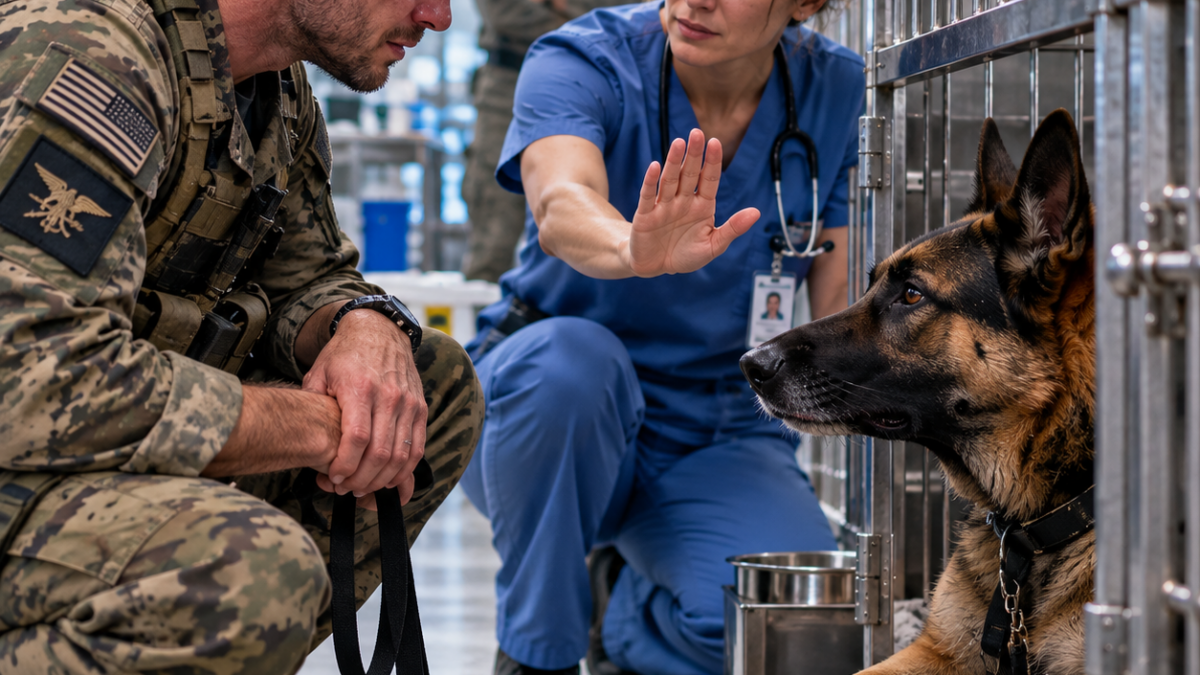
PART2:
He had rearranged travel around the appointment.
Closed out his temporary obligations.
Borrowed a vehicle suitable for transporting Rex.
Bought a ramp because someone at the facility had mentioned jumping restrictions.
Moved furniture in his quarters.
Put down non-slip runners.
He had done what military people do when uncertainty makes them uncomfortable.
He planned around it until it looked like certainty.
Dr. Emily Hart met him before he reached the recovery ward.
She was forty-three, compact, dark hair pulled behind her head, no wasted movement.
Jack had spoken with her by phone four times.
She was calm.
Direct.
Never said more than the medicine supported.
Jack respected her.
He also disliked her immediately that morning because she was standing between him and Rex.
“Commander Mercer.”
“Jack.”
She nodded.
“Jack.”
“How is he?”
“He’s doing well.”
Relief moved through him.
“Good.”
He looked past her.
“Then when can I take him?”
Emily’s expression didn’t change.
“Not today.”
Jack thought he had misheard.
There was a metallic sound behind the recovery-room door.
A collar tag touching enclosure.
Jack knew it.
He moved toward the sound.
“Rex.”
Inside, claws hit floor.
The tag moved again.
Fast.
Jack looked through observation window.
Belgian Malinois.
Six years old.
Dark mask.
Mahogany coat.
Lean.
Sharp.
Rex stood immediately.
His ears came forward.
Tail hit side of enclosure.
Once.
Twice.
Then faster.
He pressed toward the door as far as the recovery lead allowed.
Jack felt something in his chest loosen for the first time in three weeks.
“Look at him.”
Emily stood beside him.
“He wants to go.”
“He wants to be with you.”
Jack looked at her.
“Those aren’t the same thing.”
He hated the sentence instantly.
Mostly because he suspected it was true.
The technician opened controlled access.
Jack entered.
Rex almost launched.
Jack dropped into a crouch and caught him gently around shoulders before he could put too much force through front legs.
“Easy.”
Rex pushed into his chest.
Sniffed his arms.
His jacket.
His neck.
Then the pocket.
The leash.
Jack laughed despite himself.
“You remember that?”
Rex nosed harder.
“You think we’re leaving?”
Tail.
Jack looked at Emily through the doorway.
“Tell me this dog isn’t ready.”
Emily said:
“I will.”
That ended the smile.
She waited until the reunion settled.
Then:
“Let’s walk him.”
The lane was designed for rehabilitation.
Non-slip flooring.
Distance markers.
Cameras.
Minimal distraction.
One technician handled Rex first.
Jack stood along wall.
Rex took the first six steps cleanly.
Jack folded his arms.
Ten steps.
Fine.
Turn.
Fine.
Halfway back, something changed.
Small.
Most people would not have seen it.
Jack did.
Rex’s stride shortened on the left front.
Not a limp exactly.
Then another step.
On the turn, Rex shifted more weight to the opposite side.
Emily said:
“There.”
Jack didn’t answer.
The technician slowed Rex.
He corrected briefly.
Then shortened again.
Jack’s jaw tightened.
“He’s tired.”
“Yes.”
“He’s been in rehabilitation.”
“Yes.”
“He’ll build that back.”
“Probably.”
Jack turned.
“Probably?”
Emily gestured toward dog.
“Come here.”
They watched Rex settle.
When Jack stepped closer, Rex immediately came up again.
Weight forward.
Energy.
Ready.
The lameness almost disappeared.
Emily said:
“This is exactly the problem.”
Jack frowned.
“He looks better.”
“No.”
“He looks more motivated.”
She pointed.
“Watch the injured side.”
Rex leaned toward Jack, tail moving, eyes locked.
Emily continued:
“Adrenaline.”
“Engagement.”
“Excitement.”
“Those can make an animal push past discomfort.”
Jack knew that.
Every handler knew that.
A driven working dog could perform through injury because the task mattered more than pain.
What had made Rex excellent in the field could make him terrible at protecting his own healing body.
Emily said:
“If I discharge him because he wants to leave with you, you may bring him straight back with a worse injury.”
Jack stared at Rex.
The leash in his pocket suddenly felt heavier.
“What exactly are we dealing with?”
“Stable small fracture in the paw with surrounding soft-tissue trauma.”
“No displacement.”
“No surgery indicated.”
“That’s good.”
“It is.”
“Then what’s stopping discharge?”
“Function.”
She crouched beside Rex but did not touch the injured limb yet.
“Bone image can look encouraging before the entire limb is ready for unrestricted use.”
“Tendons.”
“Soft tissue.”
“Compensation patterns.”
“Conditioning.”
“He has to tolerate more than a straight hallway.”
Jack said:
“He doesn’t need unrestricted activity at home.”
Emily looked at him.
“Are you going to treat him like a patient?”
“Yes.”
“Or like Rex?”
Jack didn’t answer.
That was the question.
Rex had spent years being rewarded for one trait above nearly everything else.
Go.
Search.
Climb.
Hold.
Stay engaged.
Move through fatigue.
Finish the task.
Jack had been the person who gave those cues.
Now Jack’s presence itself was a cue.
Rex saw him and expected work.
Emily stood.
“You came for the dog you remember.”
Jack’s expression hardened.
“I came for my partner.”
“I know.”
“The question is whether you can take care of the patient he is.”
That one landed deeper.
Jack looked through the glass as the technician settled Rex again.
The dog’s injured paw stretched slightly forward.
He licked once at fur above it.
Stopped.
Jack slipped his hand into jacket.
Touched folded leash.
Did not take it out.
Then his phone vibrated.
He ignored it.
It vibrated again.
Unit operations officer.
Jack already knew why.
His SEAL element was beginning another deployment preparation cycle.
Workup started the following Monday.
Jack had helped build the training calendar before Rex was injured.
Commander Daniel Price needed confirmation.
Jack would either return to his leadership position or command would begin moving somebody else fully into it.
He looked at Rex.
Then at phone.
Emily noticed.
“Take it.”
“No.”
“This isn’t changing in five minutes.”
Jack stepped outside.
Called back.
Price answered:
“Mercer.”
“Sir.”
“You at the facility?”
“Yes.”
“How is he?”
“Healing.”
Pause.
“But?”
“Not cleared.”
“Understood.”
“We still need to meet.”
Jack looked through the observation glass.
“When?”
“1400.”
“I’ll be there.”
He hung up.
Rex was watching him.
That was the first time Jack understood the day was no longer about taking a dog home.
It was about what happened if he couldn’t.
Three weeks earlier, Rex had been injured during a security-support assignment at a coastal military installation damaged by severe weather.
The story sounded more dramatic when other people told it.
People heard “Navy SEAL” and “K9” and imagined gunfire.
There had been none.
No enemy.
No heroic charge.
No explosion.
Just storm damage.
Metal.
Bad footing.
One wrong step.
Jack’s element had been supporting movement through a restricted operational area while engineers and safety personnel assessed sections of the installation.
Rex was assigned through the military working dog program for a specific search function under handler control.
He wasn’t leading anybody.
Working dogs don’t make operational decisions.
Handlers do.
Rex worked where Jack directed.
They were moving between designated areas when a damaged section of metal grating shifted under debris.
Rex planted his left front paw.
The material moved.
The dog recoiled instantly.
Three-legged for half a step.
Then tried to continue.
That was Rex.
Jack stopped him.
“Down.”
Rex looked forward.
“Down.”
He complied but hated it.
Jack checked paw carefully.
No open wound.
Tender.
Weight-bearing inconsistent.
Rex attempted to rise.
Jack stopped him.
The dog gave that intense Malinois stare that always seemed to say:
You cannot possibly mean we’re done.
Jack had seen him work through cuts.
Heat.
Fatigue.
A bruised pad.
Nothing major.
But he knew enough not to guess.
Veterinary support came.
Assessment.
Imaging.
Stable fracture.
Soft-tissue injury.
Protected movement.
Rehabilitation.
Jack stayed until Rex was sedated for imaging.
Then returned to his team.
Some people later asked him how he could leave.
They didn’t understand.
Rex was under competent medical care.
Jack had people relying on him too.
Loyalty is not always staying in the room.
Sometimes it’s trusting the people whose job begins where yours ends.
For three weeks, Jack did that.
Updates arrived.
Rex ate.
Rex rested.
Rex tolerated passive movement.
Rex began controlled walking.
Every update became promise in Jack’s head.
When I get back, we leave.
Nobody at the clinic made that promise.
Jack did.
To himself.
At 1400, he sat across from Commander Daniel Price.
Price was fifty.
Quiet.
One of those officers who could make a room pay attention without changing volume.
He had worked with Jack long enough not to begin with speeches about duty.
“How’s Rex?”
“Improving.”
“Discharge?”
“No.”
“How long?”
“Unknown.”
Price nodded.
Then slid a folder aside.
“We need you back with the team next week.”
Jack knew.
“The workup starts Monday.”
“I know.”
“Vale can cover portions temporarily.”
“Marcus can lead it.”
“He can.”
That didn’t make Jack feel better.
Lieutenant Marcus Vale was excellent.
That was the problem.
If he had been incompetent, Jack could tell himself the team needed him uniquely.
It didn’t.
Good units are built specifically so they do not collapse when one person leaves.
Price folded his hands.
“What are you asking?”
Jack looked at the table.
“I need time here.”
“How much?”
“I don’t know.”
Price leaned back.
“That part is hard to put on orders.”
“I know.”
“Is Rex medically dependent on your presence?”
Jack hesitated.
“I don’t know.”
“Then find out.”
Price wasn’t cruel.
That made it harder.
“Talk to medical team.”
“Talk to the working dog program coordinator.”
“Rex is government-owned working dog.”
“You don’t personally decide disposition.”
“I know.”
“Your guilt isn’t a medical plan.”
Jack looked up.
Price held his gaze.
“I didn’t say you were guilty.”
“You didn’t need to.”
Price was right.
Jack had been gone when Rex began rehab.
Some irrational part of him felt that absence like betrayal.
The dog had been injured while partnered with him.
Then Jack left.
Professional care did not quiet that feeling.
Price continued:
“If staying helps the dog and we can support temporary local assignment, we’ll review it.”
“If staying just makes you feel better while qualified staff are doing same job, that’s different.”
Jack nodded once.
Price said:
“Bring me facts.”
Jack returned next morning without the leash.
Emily noticed.
“Learning.”
“Don’t enjoy this.”
“I enjoy very little before coffee.”
The rehabilitation session began with a prescribed short walk.
This time Jack was allowed to handle.
A technician demonstrated exactly.
Slow pace.
Straight line.
Turn radius.
Stop point.
No extra distance.
Rex came to Jack.
Eyes bright.
Jack took rehabilitation lead.
Not his old black leash.
That bothered him more than it should.
“Easy.”
Rex walked.
Clean steps.
Jack felt relief.
Turn.
Still good.
Back.
Good.
Near end, Rex looked up as if expecting more.
Jack’s hand automatically moved toward reward pouch.
Emily said:
“Stop there.”
He did.
Rex waited.
Jack almost continued.
The dog looked great.
That was the trap.
“What if he can do another lap?”
Emily said:
“What does another lap tell you?”
“That he can tolerate more.”
“No.”
“It tells you he can perform more right now.”
“The medical question is what the limb looks like afterward and tomorrow.”
Jack stared.
“So we stop while he’s good.”
“Yes.”
“That feels backward.”
“Recovery often does.”
Rex settled beside him.
Confused.
Jack crouched.
“That’s it.”
Rex stared as though Jack had violated contract.
Jack smiled faintly.
“I know.”
That became the first new skill.
Stopping before Rex wanted to.
Jack had spent years learning when to push.
Now he had to learn when not to.
Over the next several days, he began seeing what Emily had seen.
The tiny shortening of stride after fatigue.
The subtle head movement used to unload painful forelimb.
The fractionally wider turn.
The way Rex stood slightly more on his right side after longer session.
And the dangerous part:
when Jack appeared, half those signs disappeared temporarily.
Rex wanted to perform for him.
The better their bond, the easier it was for Jack to overestimate recovery.
One week later, swelling increased slightly after a prescribed progression.
Jack walked into treatment area expecting another step forward.
Instead Emily had revised schedule.
Activity reduced.
Progression postponed.
Jack stared.
“He was better yesterday.”
“He was.”
“Did we reinjure it?”
“Current assessment doesn’t suggest new structural damage.”
“Then why move backward?”
“We aren’t moving backward.”
“It says reduced activity.”
“That’s not failure.”
“It is less than yesterday.”
Emily looked at him.
“Recovery isn’t a straight line.”
Jack hated that phrase.
It sounded like something printed on wall in physical therapy clinic.
The reason such phrases become clichés is because reality keeps making them true.
That evening, Jack called Marcus Vale.
Vale answered:
“Jack.”
“Got a minute?”
“Yeah.”
Jack told him temporary assignment might happen.
Vale was quiet.
Then:
“Price says I may take full workup.”
“Yes.”
“I’d rather hear it from you.”
“You deserve that.”
“How’s Rex?”
“Improving.”
“But slow.”
“Yeah.”
Vale paused.
“You going to stay?”
“I don’t know.”
Another pause.
Then:
“Don’t do it because you feel guilty.”
Jack looked through glass at Rex sleeping.
“What?”
“You heard me.”
“I didn’t say—”
“Come on.”
Vale had served with him too long.
“You’re acting like he got hurt because you left him.”
“He got hurt while he was with me.”
“Exactly.”
“And then I went back to unit.”
“Because medical people were caring for him.”
“I know.”
“Do you?”
Jack clenched jaw.
Vale continued:
“If staying actually helps him, stay.”
“If not, don’t turn your guilt into his treatment plan.”
Jack said nothing.
Vale softened.
“I’m not telling you to come back.”
“I’m telling you make decision for right reason.”
Jack ended call twenty minutes later.
That sentence stayed.
Two days after, Emily asked him into consultation room.
Rex’s examination was encouraging.
The fracture remained stable.
Weight bearing improved.
Range of motion good.
Soft-tissue response acceptable.
Jack said:
“So we’re close.”
Emily sat.
“To leaving inpatient care?”
“Potentially.”
“To operational duty?”
She paused.
“I can’t tell you that.”
Jack leaned back.
“You mean he won’t return?”
“I mean I can’t tell you.”
“There’s a difference.”
“Then what are we waiting to see?”
“Whether he can tolerate increasing physical demand without persistent pain, lameness, or compensatory injury.”
“He’s walking.”
“Operational work isn’t walking.”
“He needs sprinting.”
“Acceleration.”
“Deceleration.”
“Sharp turns.”
“Uneven ground.”
“Jumping.”
“Sustained work.”
“Load on paw under adrenaline.”
“You know that better than I do.”
Jack did.
She continued:
“He may return.”
“He may return with limitations.”
“He may be retired.”
“We evaluate dog in front of us.”
“Not dog you hope he’ll become next month.”
Jack looked down.
He had imagined recovery as pause.
Then everything resumes.
Same team.
Same handler.
Same work.
Emily was telling him injury might not be a comma.
It might be a period.
Or a different sentence.
Jack asked the question he had been avoiding.
“Would me staying here change his medical outcome?”
Emily thought before answering.
He appreciated that.
“The care continues either way.”
“Qualified staff can rehabilitate him.”
Jack felt something drop.
Then:
“But you’re his established handler.”
“He responds strongly to you.”
“That can help with a controlled transition outside inpatient care if you’re capable of following restrictions.”
“So I matter.”
“Yes.”
“Not because you’re indispensable.”
That stung.
Emily continued:
“Because consistency can help.”
“Those aren’t same.”
Jack almost laughed.
“You enjoy these sentences.”
“No.”
“I’ve just seen people hurt animals trying to prove love.”
He looked up.
She wasn’t accusing.
She was warning.
“Rex doesn’t need you to be a hero.”
“What does he need?”
“Reliable.”
That one followed him out of room.
Reliable.
Not heroic.
Jack had built an adult identity around being useful under pressure.
There was comfort in pressure.
Missions simplify life.
Task.
Role.
Standard.
Decision.
Action.
Rehabilitation was the opposite.
Slow.
Ambiguous.
Repetitive.
No applause for stopping at the correct marker.
No visible victory for not taking extra lap.
No medal for noticing a two-centimeter change in gait.
But Rex needed exactly that.
Jack met with military working dog program coordinator.
Emily joined.
The rules became clearer.
Rex remained government property.
Jack did not simply “take his dog home.”
Any transition required approval.
Veterinary recommendation.
Suitable environment.
Written restrictions.
Follow-up.
If Jack returned to deployment preparation, Rex could remain at facility under professional care.
That was legitimate.
If command placed Jack locally, he might assist rehabilitation and later supervise approved convalescence.
Also legitimate.
Neither guaranteed Rex stayed with Jack permanently.
Neither guaranteed return to duty.
The coordinator said:
“If he doesn’t regain operational function, retirement disposition would be separate process.”
Jack asked:
“Could I adopt him?”
“Potentially.”
“Not automatically.”
Jack nodded.
That uncertainty hurt.
But it was honest.
He requested another meeting with Price.
This time he carried medical paperwork.
Not leash.
Price read.
“What do you want?”
Jack answered clearly.
“Temporary shore-based assignment through next medical review.”
“If authorized, I support Rex’s transition and rehab.”
“Vale takes workup.”
“I prepare full handover.”
“I remain available for local duties.”
Price asked:
“You understand your deployment-cycle position may not wait?”
“Yes.”
“If Rex returns to duty, he may be assigned according to program needs.”
“I know.”
“If he doesn’t—”
Jack looked at paper.
“I still want his next decision to be right.”
Price studied him.
Then:
“Good.”
Jack frowned.
“Good?”
“That’s first thing you’ve said this week that isn’t about what you need.”
Command review took days.
No dramatic confrontation.
No admiral pounding desk.
The military is often far less cinematic than people imagine.
Staffing.
Requirements.
Medical recommendation.
Availability.
Risk.
Commander discretion.
Eventually:
Approved.
Temporary local assignment.
Review date.
Vale would lead next workup.
Jack would not deploy with team on that cycle.
He signed.
Felt no victory.
He had gained time with Rex.
He had also stepped away from people he loved.
Both were true.
He called Vale.
They went over responsibilities line by line.
Training calendar.
Personnel.
Open issues.
Expected decisions.
Vale listened.
At end:
“You built a good team.”
Jack said nothing.
Vale continued:
“Let us do our jobs.”
Jack exhaled.
“Copy.”
“And Jack?”
“Yeah?”
“Don’t call every six hours.”
“I wasn’t going to.”
“Sure.”
Jack almost smiled.
The next phase of Rex’s rehabilitation was not about returning to duty.
It was about something Jack hadn’t considered difficult.
Being calm with him.
Outside.
Rex knew Jack as work.
Jack’s clothing.
Vehicle.
Gear.
Movement.
Tone.
All predicted action.
If recovery moved to less controlled environment, that association could become threat to healing.
Emily approved a short exterior courtyard session.
Jack wore jeans.
Plain shirt.
No tactical vest.
No training bag.
No familiar working equipment.
Rex stepped outside.
Head lifted.
Nose working.
A vehicle door slammed beyond fence.
His ears snapped.
His pace increased.
Leash tightened.
For one fraction of second, old partnership returned.
Jack felt it in his own body too.
Ready.
Move.
Follow.
He almost let Rex accelerate.
Instead:
“Easy.”
Slowed his own pace.
Rex checked back.
Jack rewarded calm.
They continued.
First circuit perfect.
Second, Rex became animated near gate.
Jack stopped at marker.
Rex stared.
Ready.
Jack waited.
No third circuit.
Back inside.
Emily examined paw.
Next morning:
No increased swelling.
Small milestone.
Jack found himself oddly proud.
Not because Rex had gone farther.
Because Jack had stopped him while he still wanted more.
That was when he understood his temporary assignment.
He had not traded a deployment for standing beside kennel.
He had accepted responsibility for making sure his presence did not make Rex reckless.
The next challenge was home.
Or what Jack called home.
A small government-leased house near installation.
He had already prepared it.
Non-slip rugs.
Ramp.
Rest area.
Water.
Crate.
But first supervised environmental visit exposed problem.
Rex recognized Jack’s vehicle.
Immediately accelerated.
Recognized old gear bag in utility room.
Became intensely alert.
The bag wasn’t even open.
Didn’t matter.
Work scent.
Work association.
Rex began scanning doors.
Jack corrected pace.
Emily watched.
“This is why we test environment.”
“I can manage him.”
“That’s not point.”
“I’ll keep him leashed.”
“Also not point.”
Jack frowned.
She gestured toward Rex.
“Home needs to reduce demand.”
“Not make you spend every second suppressing it.”
Jack looked at old gear.
He had imagined those objects comforting.
To Rex they were an invitation.
So he changed everything.
Work equipment moved to locked storage elsewhere.
Vehicle access restricted except necessary transport.
No ball throwing.
No bite-work equipment.
No familiar harness except approved rehab one.
Non-slip mats at every turning point.
Baby gates even though Rex could clear them easily under other circumstances.
A quiet area beside Jack’s chair.
Loading ramp secured.
Food station positioned to avoid sharp turns.
The details humbled him.
He had planned operations involving aircraft, people, timelines, contingencies.
Now success depended on preventing one dog from deciding a hallway meant sprint.
Next visit went better.
Rex entered.
Sniffed mat.
Found water.
Looked toward utility room.
No gear.
Jack gave calm settle.
Rex lay beside chair.
Nothing happened.
For twelve minutes.
Emily wrote notes.
Jack asked:
“That’s it?”
“That’s excellent.”
“We sat.”
“Yes.”
“No swelling?”
“We’ll check.”
He looked down at Rex.
Working dog accustomed to doing.
Now task was not doing.
Maybe Jack too.
Meanwhile Vale’s team progressed.
Authorized updates came.
Training milestones.
Qualification events.
Team photographs.
One evening Jack saw a routine image.
Everyone seated around briefing table.
Vale in position Jack usually occupied.
The absence hit unexpectedly.
Not jealousy.
Grief, almost.
Life going on without him.
He had chosen it.
Choice doesn’t remove cost.
Rex slept on other side of glass.
Jack turned phone face down.
Then opened rehabilitation notes.
Controlled walk tolerated.
No new swelling.
Repeat same workload tomorrow.
Not advance.
He understood why now.
Consistency before progression.
One morning he noticed Rex’s gait change before the technician did.
Tiny head dip.
Short stride on turn.
Jack stopped.
“Something’s off.”
The technician watched.
Emily came.
Assessment.
No acute reinjury evident.
But progression paused.
Jack felt old panic.
They had been close to transition.
“What happened?”
“Maybe fatigue.”
“Maybe normal variability.”
“Maybe compensation.”
“We reassess.”
“Could this end discharge?”
“Potentially.”
Jack looked at Rex.
The dog leaned into him.
Unaware of schedules.
Orders.
Deployment cycles.
Discharge dates.
Just present.
Jack rested hand on shoulder.
“We’re not rushing.”
He said it.
And this time believed it.
The next few days were deliberately boring.
Same activity.
Same distance.
Same checks.
Gait returned.
No swelling.
No protective behavior.
Trend mattered more than one impressive performance.
At final transition meeting, Emily spoke plainly.
“Rex meets criteria to leave inpatient care into authorized supervised convalescence.”
Jack didn’t smile yet.
“Restrictions?”
“Still substantial.”
“Return to duty?”
“Undetermined.”
He nodded.
“What happens if he never gets there?”
“Then veterinary team and working dog program determine retirement or alternate disposition.”
“And me?”
“Your job is today’s plan.”
“Not his entire future.”
Jack almost laughed.
“You have a slogan for everything.”
“No.”
“You keep asking questions ten steps ahead.”
Fair.
Command confirmed arrangement.
Jack signed.
The morning he finally came to take Rex out of inpatient care, he brought black leash.
Same one.
Folded.
Emily saw it.
“Sentimental?”
“Government issue.”
“Sure.”
Rex heard his voice.
Stood.
Ears forward.
Tail.
That same energy.
On first day Jack would have taken it as proof.
Look at him.
He’s ready.
Now he saw it for what it was.
Love.
Expectation.
Drive.
None of those are x-rays.
Emily completed exam.
Reviewed every restriction.
“No running.”
“No jumping.”
“No operational training.”
“Prescribed walks only.”
“No stairs if avoidable.”
“Use ramp.”
“Watch for swelling.”
“Shortening stride.”
“Toe-touching.”
“Guarding.”
“Licking paw excessively.”
“If anything changes, call.”
Jack listened.
No interrupting.
No negotiating.
Then he clipped black leash to approved harness.
Rex moved toward door too quickly.
Jack stopped.
“Easy.”
Rex looked back.
Jack slowed.
Dog matched.
They walked.
Not dramatic.
No staff lined hallway.
No applause.
One technician waved.
Willis from front desk said:
“Good luck.”
That was it.
The exit was maybe seventy feet.
It took longer than necessary.
Jack no longer measured success by speed.
Outside, Rex lifted his nose into sunlight.
Vehicle waited.
Ramp secured.
Before injury, he would have launched into rear compartment.
Jack walked him to ramp.
One step.
Pause.
Another.
Rex wanted faster.
Jack kept slow.
At top, Rex turned carefully.
Settled.
Jack secured him.
Closed door.
Then stood with one hand on vehicle.
Somewhere else, his SEAL team was preparing for work he would not join.
Rex was with him.
But not as working partner.
Neither half of life looked the way Jack expected.
And strangely, for first time, that did not feel like failure.
At the approved recovery house, Rex entered on leash.
Walked over mat.
Sniffed water.
Checked doors.
No work gear.
No ballistic vest.
No training bag.
No sound meaning mission.
Jack sat.
Rex stood for moment.
Then lowered beside chair.
Injured paw stretched forward.
Relaxed.
Jack’s phone buzzed.
Message from Vale.
FIRST MAJOR WORKUP BLOCK COMPLETE. TEAM GOOD.
Jack stared.
Typed:
Congratulations. Tell them I said well done.
He meant it.
Set phone down.
Rex rested chin on Jack’s boot.
Jack did not reach for leash.
Two days later they returned rehab.
Then again.
Weeks passed.
Progress came in inches.
Walk duration increased.
Controlled inclines.
Different surfaces.
Balance work.
Gradual strength.
Then a setback.
Then stable.
Then progress.
Jack learned language of canine rehabilitation better than he ever expected.
He learned pain signs Malinois can hide.
He learned restlessness isn’t always readiness.
He learned muscle loss happens quickly.
He learned front-limb injuries alter entire body.
He learned to film Rex walking from side and front so clinicians could compare.
He learned patience is not passive.
It is active restraint.
Some mornings Rex looked so good Jack wanted to test him.
One short sprint.
Just see.
He didn’t.
Some evenings the dog brought an old tug toy Jack had forgotten in closet.
He stood holding it, eyes bright.
Jack’s chest hurt.
“No.”
Rex pushed toy against knee.
“No.”
Again.
Jack took toy.
Put it away.
Rex stared at him as if betrayed.
Jack sat on floor.
“I know.”
That was harder than giving danger command had ever been.
Because Rex didn’t understand why the person who had spent years asking for everything now asked for less.
Jack couldn’t explain:
I am protecting you from the part of yourself I helped build.
So he stayed consistent.
Months after injury, the first return-to-work evaluation began.
Not full duty.
Controlled assessment.
Veterinary team.
Program staff.
Jack.
Different handler observing.
Straight-line movement.
Turns.
Controlled acceleration.
Environmental engagement.
Rex looked fantastic initially.
Jack’s heart lifted.
Then after repeated turns, subtle shortening returned.
Emily saw it.
So did Jack.
Evaluation stopped.
No argument.
In parking lot Jack sat in truck without starting engine.
Emily tapped window.
He lowered.
“What?”
“You okay?”
“No.”
She nodded.
“Fair.”
“He’s not coming back.”
“I didn’t say that.”
“You didn’t need to.”
Emily leaned on door.
“Maybe he will.”
“Maybe he won’t.”
“That is still answer.”
Jack looked away.
“I kept thinking if I did everything right…”
She finished:
“Then you’d earn old Rex back?”
He said nothing.
Emily continued:
“Rehabilitation isn’t transaction.”
“You don’t follow instructions and receive previous life as reward.”
Jack’s jaw tightened.
“I know.”
“Do you?”
He looked at her.
She wasn’t trying to hurt him.
“Not yet.”
“That’s okay.”
Later that week, Price called.
Temporary local assignment review approaching.
Team nearing deployment certification.
Jack could request return to operational slot later, but his previous leadership position was now Vale’s for cycle.
There would be other roles.
Other cycles.
Nothing guaranteed.
Price asked:
“Regrets?”
Jack looked at Rex sleeping.
“Yes.”
Price waited.
“Doesn’t mean decision wrong.”
“No.”
Jack said:
“I miss team.”
“I know.”
“I miss working him.”
“I know.”
“I hate that Vale’s doing my job well.”
Price laughed.
“There it is.”
“But I’m glad he is.”
“That’s leadership.”
Jack shook head.
“No.”
“That’s being replaced efficiently.”
“Same thing sometimes.”
Rex’s second evaluation came six weeks later.
Better.
Strength improved.
No obvious lameness in straight movement.
Then high-speed change of direction.
Small hitch.
Again.
Repeated.
Still there.
The program made decision Jack knew was coming.
Rex would not return to full operational duty.
Medical retirement recommended.
Jack heard words in a consultation room with Emily and program coordinator.
He looked at Rex through window.
The dog stood alert.
Ready.
Of course.
Jack asked:
“Can he live normally?”
Emily answered:
“With some limitations.”
“Probably yes.”
“Can he run?”
“Recreationally after conditioning, likely within reason.”
“Jump?”
“We prefer minimizing repetitive high-impact.”
“Work?”
“Not operational demands he was trained for.”
Jack nodded.
The coordinator said:
“You may apply for adoption as primary former handler.”
Jack looked up.
“Apply?”
“Still process.”
Home review already strong.
Command endorsement.
Medical plan.
Legal transfer after retirement.
Jack almost smiled.
“What happens if denied?”
“We don’t anticipate that based on current assessment.”
“That’s closest thing to certainty anyone’s given me in months.”
Emily said:
“Don’t get used to it.”
Rex officially retired six weeks later.
There was no giant ceremony.
Jack didn’t want one.
Small.
Program staff.
A few handlers.
Price came.
Vale came back between training blocks.
Rex wore clean collar and simple harness.
No working vest.
Someone read service summary.
Detection work.
Deployments.
Injury.
Retirement.
Then legal adoption transfer.
Jack signed.
For first time, Rex became his dog.
Not assigned.
Not paired.
His.
Jack stood holding papers.
Vale said:
“How’s it feel?”
Jack looked at Rex.
“Expensive.”
Emily laughed.
“You have no idea.”
Vale crouched but waited for Rex to approach.
Good handler manners.
Rex sniffed.
Accepted.
Jack said:
“He’s going to hate retirement.”
Price answered:
“So will you.”
That proved true.
Jack eventually returned to operational duties.
Not immediately.
Different cycle.
Different position.
The team had changed.
People moved.
Vale had grown into leadership.
Jack had to learn not to reclaim what no longer belonged to him simply because it once had.
That lesson felt familiar.
He remained close to Rex.
But Rex no longer went to work.
At first, departures were awful.
Jack put on gear.
Rex stood.
Ears forward.
Paced to door.
Jack said:
“Stay.”
Rex stared.
The first morning Jack left for training without him, the dog whined once.
Jack almost canceled.
He didn’t.
A neighbor and approved caregiver stayed.
Rex eventually learned new routine.
Jack gear no longer meant both of them.
That transition hurt.
But dogs adapt when people stop confusing grief with fairness.
Jack stopped leaving working equipment where Rex slept.
Created different departure ritual.
Rex got food puzzle when Jack geared up.
Walk at different time.
No emotional goodbyes.
Within months, Rex barely lifted head when Jack picked up helmet.
That hurt too.
Jack laughed at himself.
He had wanted dog not distressed.
Then felt insulted when dog wasn’t.
Human beings are exhausting.
Retirement gave Rex other things.
Swimming under controlled conditions.
Long scent walks.
Sun on porch.
Puzzle searches around yard.
No impact work.
No tactical environments.
Sometimes Jack hid coffee tin with odor target purely as game.
Rex searched at walk.
Found.
Sat.
Jack rewarded.
No mission.
No danger.
Just brain getting to be itself.
One evening Price visited.
Rex was lying upside down on rug.
Completely undignified.
Price stared.
“This is terrifying military asset?”
“Classified.”
Rex sneezed.
Price sat.
“You coming back next cycle?”
Jack nodded.
“If there’s place.”
“There is.”
“Not Vale’s.”
“No.”
Jack smiled.
“Good.”
Price looked at him.
“You mean that?”
“Yes.”
He did.
Vale had earned role.
Jack would take different responsibility.
Partnership isn’t ownership.
That lesson again.
A year after injury, Emily came for dinner.
Jack suspected she mostly came to inspect Rex.
She denied.
Rex walked to her.
Leaned.
She checked paw reflexively.
Jack said:
“Off duty.”
“So are you.”
“Never stopped you.”
She smiled.
They watched Rex trot across yard.
No limp at normal speed.
Jack said:
“He looks perfect.”
Emily didn’t correct immediately.
Then:
“He looks comfortable.”
Jack nodded.
Better word.
He had stopped needing “perfect.”
Another year passed.
Rex turned eight.
Gray began at muzzle.
Jack was away for several months.
Rex stayed with a former handler family approved in advance.
Jack hated leaving.
But not like before.
The dog had safe life not dependent on Jack occupying every hour.
That was healthy.
On return, Rex heard truck.
Lost mind.
Ran to fence.
Jack’s first instinct was panic about paw.
Then remembered.
He was medically retired, conditioned, stable.
He opened gate.
Rex hit him like furry missile.
Jack laughed into dog’s neck.
“Okay.”
“Okay.”
“Some things don’t change.”
But plenty had.
Rex no longer expected working vest.
Jack no longer checked gait every thirty seconds.
They had moved from handler and asset to something simpler.
Companions.
People often asked Jack whether giving up that deployment cycle had been worth it.
He disliked question.
Worth implies trade can be balanced.
One deployment versus one dog.
One career opportunity versus months of recovery.
Life doesn’t account that neatly.
The team performed well without him.
Rex healed enough for good retirement.
Jack’s career continued, altered but not destroyed.
Would Rex have recovered medically without Jack staying?
Probably.
Emily had been honest about that from beginning.
Qualified professionals could have treated him.
So was Jack’s decision unnecessary?
No.
Because it wasn’t only about changing bone healing.
It was about supervising transition.
Learning Rex’s limitations.
Changing their relationship.
And, though Jack admitted it reluctantly, changing himself.
Before injury, he believed loyalty meant:
I go where you go.
You go where I go.
We work until mission ends.
After injury, loyalty became:
I will not ask you to prove anything.
That was harder.
Rex aged.
At ten, arthritis developed in injured limb.
Manageable.
Medication.
Weight control.
Swimming.
Shorter walks.
At eleven, Jack retired from active operational work too.
Not because Rex.
Time.
Body.
Enough years.
He moved to a small place outside Virginia Beach.
Fenced yard.
Trees.
No stairs for Rex except two shallow porch steps.
The black leash hung beside door.
Same one.
Jack still used it.
By then clasp had been replaced a third time.
One morning, a young neighbor saw them walking.
Boy maybe nine.
Asked:
“Is that a police dog?”
“Military.”
“Did he bite bad guys?”
Jack smiled.
“His main job was finding dangerous things before people got hurt.”
“Is he a hero?”
Jack looked at Rex sniffing grass for embarrassing amount of time.
“Yes.”
Boy asked:
“What does he do now?”
Jack said:
“This.”
Rex peed on mailbox post.
The boy laughed.
Jack did too.
Heroism becomes funny when it lives long enough.
At twelve, Rex’s injured paw started bothering him more.
Jack recognized it before vet did.
Shortened stride.
Turn compensation.
Exactly what Emily showed him years earlier.
He stopped walk immediately.
Old instinct.
No pushing.
No let’s see if it improves.
The lesson stayed.
Veterinarian adjusted care.
Rex remained comfortable.
At thirteen, his world got smaller.
Around block became half-block.
Then driveway.
Then yard.
Jack did not mourn each reduction as defeat.
He had learned that from first rehab.
Stop while he still wants more.
One evening Jack took black leash from hook.
Rex stood slowly.
Tail.
They walked to end of driveway.
Rex looked down road.
Once, that look meant:
What’s next?
Jack used to answer with movement.
Now he crouched.
“That’s enough.”
Rex leaned into him.
They turned home.
The dog died the following winter.
Not dramatically.
Old body.
Cancer discovered late.
Fast decline.
Jack called Emily.
They had remained friends.
She flew out.
When she entered, Rex lifted head.
Tail moved.
She sat beside him.
“You still don’t know when to quit.”
Jack said:
“He learned from me.”
Emily looked.
“No.”
“You learned from him.”
Fair.
The final decision came on a morning when Rex stopped enjoying food and could no longer rise without distress.
Jack knew.
Still asked veterinarian every question twice.
Pain options.
Another day.
What if.
Maybe.
The vet answered gently.
Jack sat on floor.
Rex’s head against thigh.
Black leash beside them.
Not attached.
No reason.
Jack rubbed ears.
“You don’t have to do anything.”
Rex breathed.
“You hear me?”
“No search.”
“No work.”
“No rehab.”
“No next task.”
His voice broke.
“You’re done.”
Emily sat across.
Jack had spent years believing good partner meant always ready when next mission came.
Now there wasn’t one.
He whispered:
“Good boy.”
The veterinarian gave medication.
Rex relaxed.
Jack kept his hand on shoulder.
The same shoulder he’d held in rehabilitation facility thirteen years? no—years earlier, when dog had been six.
Rex’s breathing slowed.
Then stopped.
Jack stayed.
Nobody rushed him.
Afterward he folded black leash.
Twice.
Put it into jacket pocket.
Same as first day.
Emily watched.
“You keeping it?”
“Yes.”
“Of course.”
Months later Jack visited old rehabilitation facility for working-dog veteran event.
He hated events.
Price convinced him.
Emily gave a lecture to handlers.
Jack stood in back.
One slide showed video of working dog moving cleanly for first few steps, then shortening stride after fatigue.
Emily paused.
“Drive is not health.”
Jack looked down.
That sentence would have made him angry once.
Now it seemed obvious.
She continued:
“Your dog wanting to continue does not relieve you of responsibility to stop.”
“Sometimes the handler’s hardest job is ending the session before the dog asks.”
Jack left before Q&A.
Outside, a young handler caught him.
“Commander Mercer?”
“Jack.”
“Sir, I heard about Rex.”
Jack waited.
The handler had a Malinois in vehicle.
Young.
Intense.
The man said:
“My dog got hurt last month.”
“Minor shoulder.”
“Vet says rest.”
“He looks fine.”
Jack smiled faintly.
“That’s dangerous sentence.”
The young handler laughed nervously.
“I just hate holding him back.”
“I know.”
“How did you know when Rex was ready?”
Jack looked toward building.
“I didn’t.”
“What?”
“I spent months wanting somebody to tell me.”
“No one could.”
“So what’d you do?”
“Followed plan.”
“Watched dog.”
“Stopped when medical team said stop.”
“Accepted uncertainty.”
The young man looked disappointed.
No secret trick.
Jack added:
“And don’t confuse how badly he wants something with whether it’s good for him.”
The handler nodded.
Jack started away.
Then stopped.
“One more thing.”
“Yes, sir?”
“When he gets frustrated because you’re asking less from him, don’t take it personally.”
“He trusts you enough to give everything.”
“Your job is deciding when everything is too much.”
Jack walked to parking lot.
The black leash was in his truck now.
He kept it in glove compartment for years.
Not because he couldn’t let go.
Because it reminded him of the day he arrived thinking love meant taking Rex home.
Emily Hart had stopped him in hallway.
He’s doing well.
Then when can I take him?
Not today.
At the time Jack thought she was denying reunion.
She wasn’t.
She was protecting it.
If she had let emotion make decision, Jack might have walked Rex out too early.
The dog would have pushed.
Jack might have let him.
The paw might have worsened.
Maybe not.
Nobody can know.
But that uncertainty is exactly why medicine exists.
To keep hope from becoming evidence.
Jack understood that eventually.
He also understood something harder.
There are different ways to come back for someone.
Sometimes you arrive with leash expecting to rescue them.
Sometimes you sit beside them while professionals do work.
Sometimes you step away from your team.
Sometimes you trust team without you.
Sometimes you change house.
Remove gear.
Use ramp.
Repeat boring walk.
Accept setback.
Stop early.
And sometimes, after years of working side by side, the last act of loyalty is asking nothing at all.
People liked telling Jack’s story as sacrifice.
The Navy SEAL who gave up deployment for his injured K9.
He always corrected that.
“I didn’t give up career.”
“I missed one cycle.”
“The team kept working.”
“Rex had medical care whether I stayed or not.”
That version was less dramatic.
It was also more honorable to everybody involved.
Vale deserved credit.
Price.
Emily.
Technicians.
Working dog program.
The people who carried responsibility while Jack learned what his new role was.
Rex’s recovery was not one man’s devotion.
It was a system working correctly.
Jack’s choice mattered.
But it wasn’t magic.
The real change happened in one person.
Jack.
Before the injury, he measured partnership by readiness.
Could Rex move?
Search?
Work?
Respond?
Continue?
Afterward, he learned another measure.
Could Rex rest?
Could Jack let him?
Could both of them exist without the next assignment proving their worth?
That question followed Jack into retirement too.
For months after leaving service, he woke early with nowhere to report.
No schedule.
No team waiting.
No Rex pacing by door.
The silence was brutal.
Then one morning, he caught himself.
He was doing exactly what he’d once done to Rex.
Interpreting stillness as failure.
Assuming if he wasn’t moving toward next task, something was wrong.
He laughed alone in kitchen.
“Okay, buddy.”
Rex had taught him after all.
The right decision can be to finish while you still want more.
Jack started volunteering with working-dog transition programs.
Not training dogs operationally.
Helping handlers understand retirement.
He was blunt.
Some disliked him.
Good.
He told them:
“Your dog doesn’t owe you one more year because you’re not ready to lose job you did together.”
He told commanders:
“Don’t treat handler grief like operational weakness.”
He told families:
“A retired working dog may not become normal pet overnight.”
And he told everybody:
“Listen to veterinarian.”
Emily enjoyed that one.
She once texted:
I want this statement notarized.
Jack replied:
Delete my number.
She didn’t.
Years after Rex died, Jack found the leash while cleaning truck.
Black nylon.
Soft.
Clasp scratched.
He sat on garage floor holding it.
For a long time.
He remembered first morning.
Rex behind glass.
Bright.
Ready.
Tail against enclosure.
Look at him.
He wants to go.
Emily’s answer.
He wants to be with you. Those aren’t the same thing.
At sixty, Jack finally understood that sentence far beyond veterinary medicine.
Wanting somebody does not mean you own their future.
Loving somebody does not give you right to demand old version back.
Loyalty does not mean forcing recovery to follow your schedule.
Sometimes love is recognizing that the person—or dog—you came back for has changed.
Then changing with them.
Jack hung the leash above his workbench.
Not memorial exactly.
Reminder.
Below it he later placed a small metal tag.
REX.
Nothing else.
No rank.
No deployment list.
No heroic inscription.
He had already lived those things.
Jack preferred one memory.
A quiet room.
A healed-enough dog lying beside his chair.
No vest on wall.
No gear by door.
No mission coming.
Rex’s injured paw stretched forward on a rubber mat.
Jack’s phone buzzing with news that the team had completed its first major milestone without him.
For the first time, Jack had been able to look at both things and feel no need to change either.
The team was where it needed to be.
Rex was where he needed to be.
Jack was learning the same.
Years earlier, he’d walked into rehabilitation facility with a leash and one question:
When can I take him home?
By the time they finally walked out together, the veterinarian had taught him a better question.
What does he need from me now?
That question saved Jack from turning love into pressure.
It changed how Rex recovered.
It changed how Jack led.
It changed how he retired.
And it taught a Navy SEAL who had spent most of his adult life preparing for the next mission that sometimes the most loyal thing you can do for your partner is look at the road ahead, feel him pulling toward it—
and say:
“Not yet.”
Then years later:
“That’s enough.”
And finally:
“You don’t have to work anymore.”
Rex closed his eyes each time as if the answer had always been simpler than Jack made it.
Stay.
Heal.
Rest.
Home was never the place at the end of the leash.
Home was the moment Jack stopped asking Rex to be the dog he used to be and chose, instead, to care for the dog standing in front of him.





