A Mysterious Woman Rode Into a Cowboy’s Life Saying, “Your Mother Asked Me to Find You”—Then She Unwrapped a Small Parcel That Left Him Questioning Six Years of Silence
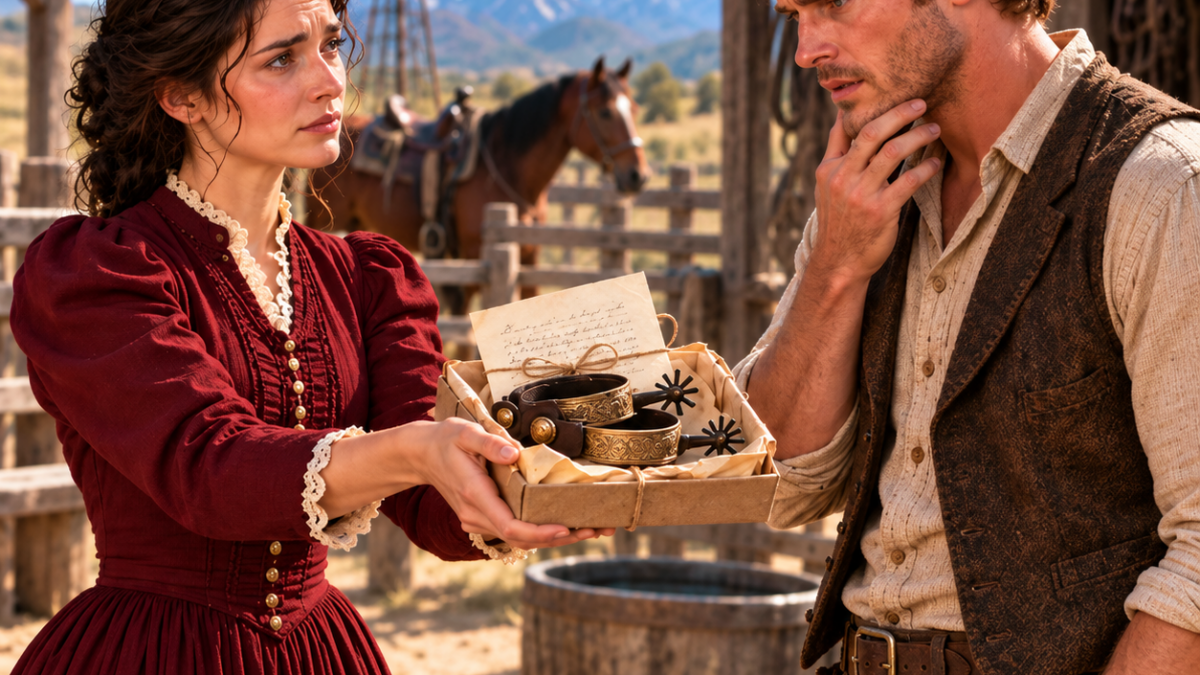
PART3:
“My name is Lila Bennett.”
Graham nodded once.
He had never heard it.
She adjusted the parcel.
Then said:
“Your mother asked me to find you.”
The word mother reached his hands before it reached the rest of him.
His fingers stopped moving.
Six years.
No letters.
No visits.
No messages sent through cattlemen.
No Christmas word.
No apology.
No accusation.
Nothing.
Graham’s expression did not change.
But inside him, something old lifted its head.
“My mother.”
“Yes.”
Lila watched him carefully.
“She’s not well.”
Graham’s jaw tightened.
Lila inhaled.
Then, because there was no kind arrangement for what she had traveled all this way to say:
“She died three weeks ago.”
The world continued.
That was the part Graham would remember.
A wagon rolled through the ranch gate.
Its wheels struck hard-packed earth.
Somebody near the bunkhouse shouted about a loose latch.
A horse blew air through its nose.
Leather creaked.
Wind moved dust beneath the fence.
Ordinary sounds.
Ordinary afternoon.
And somewhere in the middle of all of it, Graham’s mother became a woman who had been dead for twenty-one days.
“Died.”
He repeated the word.
Lila lowered her eyes.
“I’m sorry.”
Graham said nothing.
“I would’ve chosen different ground if I’d had the choosing of it.”
That almost irritated him.
Almost.
Mostly because she sounded as if she meant it.
He looked at the parcel.
“What’s that?”
Lila hesitated.
Then began unwrapping the cloth.
Inside lay two things.
A folded letter.
And a pair of riding spurs.
The leather straps had gone stiff with age.
But the metal had been carefully kept from rust.
Graham stared.
Something about the spurs felt familiar without being remembered.
He reached for the letter first.
Not the spurs.
“These aren’t mine.”
“No.”
“Never were.”
“I know.”
He looked at her.
“They were bought for you.”
Graham’s fingers tightened around the letter.
“By who?”
“Your mother.”
He stared at the spurs again.
“For what?”
Lila shook her head.
“That much she never told me directly.”
Graham’s mouth hardened.
“You came all the way from Colorado carrying something you don’t understand?”
“I came because I promised.”
“To her?”
“Yes.”
“And what exactly did she make you promise?”
Lila met his eyes.
“To put the letter in your hand.”
“That all?”
“That was the promise.”
“And the spurs?”
“My choice.”
That answer made Graham study her more closely.
She was frightened.
Not of him exactly.
Of the moment.
But she was standing her ground.
Silas Boone emerged from the tack shed.
Sixty-one.
Gray beard.
Bent slightly in the shoulders after more years on horseback than most men survived.
He stopped far enough away not to intrude.
Graham looked at the letter.
The handwriting on the outside had not changed.
Graham.
His mother’s hand.
Strong.
Angular.
Practical.
Even seeing it made anger rise faster than grief.
He opened the letter in the tack room.
Alone.
Sat on an overturned feed bucket because after the first paragraph, his legs became unreliable.
Graham,
If you are reading this, I ran out of days before I ran out of pride, which is exactly the kind of thing your father would have said about me, and he would not have been wrong.
I am not going to spend this letter explaining six years.
I don’t believe I could do it honestly in the time I have left to write it, and you have never once needed me to explain a thing you could see plainly with your own eyes.
The house is still standing.
It is still yours to walk away from, sell, or never think of again as long as you live.
I am not asking you to come back.
I am not asking you to forgive me from this kind of distance, because I don’t believe either one means much unless you’ve stood in that kitchen first and seen it for yourself.
If you want to know what stayed the same in this house and what didn’t, go look.
Miss Bennett can tell you the rest of it.
Or she can tell you nothing at all.
That will be her own choice to make, not an instruction left behind by me.
I have given this family enough instructions to last a lifetime.
Your mother.
Graham read it twice.
He did not cry.
He was too angry.
The anger surprised him.
Not because it existed.
Because it had survived six years so perfectly.
Even dead, Matilda Calder had left him a choice.
Come.
Don’t come.
Forgive.
Don’t forgive.
Sell.
Stay.
Walk away.
You decide.
Now.
After a lifetime of deciding for him.
Graham folded the letter.
Then unfolded it.
Read the line again.
I have given this family enough instructions to last a lifetime.
His throat tightened.
The old woman had known.
At least enough to make the sentence.
But knowing was not apologizing.
Understanding was not repairing.
And dead people had an unfair advantage.
They got the last word without having to hear the answer.
Graham walked outside.
Lila stood near the corral.
The parcel cloth now folded over one arm.
Spurs still inside.
Graham stopped.
“Why didn’t she just say it?”
Lila looked at him.
“What?”
“Whatever she wanted.”
His voice sharpened.
“Why send a stranger across two territories carrying half a riddle?”
“I don’t know.”
“You lived with her.”
“Yes.”
“For how long?”
“Almost three years.”
“Then you knew her better than I did.”
“No.”
Graham stared.
Lila continued:
“I knew her later.”
“That sounds like the same thing.”
“It isn’t.”
She folded the cloth tighter.
“I knew the woman she was after you left.”
Graham’s jaw tightened.
“That version have better manners?”
“No.”
Something about the immediate answer nearly disarmed him.
Lila continued:
“She could be difficult.”
“That is a gentle word.”
“She corrected how I folded towels.”
Graham looked at her.
“Twice.”
“That sounds like her.”
“She once stopped speaking to Mrs. Bellamy for twenty-six days.”
“Over what?”
“She never told me.”
Graham almost smiled.
Lila saw it.
Did not acknowledge it.
“She was stubborn.”
“Yes.”
“Controlling sometimes.”
His expression hardened again.
“Yes.”
“Capable of kindness.”
Graham looked away.
“There it is.”
“What?”
“The part where you explain that difficult people are secretly good.”
“I didn’t say good.”
Lila’s voice stayed even.
“And I didn’t come here to make her easier for you to forgive.”
That got his attention.
“Then why are you here?”
“Because she asked.”
“You said the promise was only the letter.”
“It was.”
“So why still standing here?”
Lila was silent for a moment.
“Because I think you have questions.”
“And you think you have answers?”
“No.”
She looked at him directly.
“I have memories.”
Graham breathed slowly.
“That’s different.”
“Yes.”
He looked toward Silas.
The old foreman immediately pretended to inspect a saddle.
Graham knew him too well.
“Give me tonight.”
Lila nodded.
“I planned to leave for the south road in the morning.”
“You have somewhere to stay?”
“The boarding house in town.”
Graham reached into his pocket.
She shook her head.
“I can pay.”
“I wasn’t offering money.”
“Good.”
Graham almost smiled.
“Silas?”
The foreman looked over.
“Yeah?”
“Can somebody take Miss Bennett into town?”
Silas nodded.
Lila picked up her case.
Graham stopped her.
“The spurs.”
She held the bundle toward him.
He did not take them.
“Keep them tonight.”
Lila frowned slightly.
“Why?”
“Because I don’t know what they are yet.”
She seemed to understand.
“All right.”
The next morning, Graham saddled before daylight.
Silas found him tightening a cinch.
“You leaving?”
“South.”
Silas nodded.
“Colorado?”
“Maybe.”
“You want me to ask why?”
“No.”
“Good.”
Graham paused.
Then:
“Do you remember the letter?”
Silas went still.
Six years disappeared from the space between them.
“Yes.”
“You ever wonder?”
“Every damn year.”
Graham looked at him.
Silas leaned on the corral.
“When your mother wrote saying family circumstances changed, I believed her.”
“I know.”
“I should’ve written you direct.”
“You did.”
“After I filled the spot.”
“Yes.”
Silas looked down.
“I’ve regretted that.”
“You did nothing wrong.”
Silas frowned.
“That easy?”
“No.”
Graham tightened the strap.
“But it wasn’t your choice to steal.”
Silas nodded slowly.
“You going home?”
Graham hated the word.
“I’m going to look.”
“That’s different.”
“Yes.”
Lila had already arranged to travel south.
Their roads matched for most of the journey.
So they rode together.
At first, mostly silence.
That surprised Graham.
He expected someone who had traveled hundreds of miles carrying a dead woman’s request to feel entitled to conversation.
Lila did not.
She rode a chestnut mare named Rose.
Sat well enough.
Not ranch-trained.
But competent.
She carried only one case.
The spurs remained wrapped inside.
By the second day, Graham asked:
“How did you meet her?”
“Your mother?”
“Yes.”
“I arrived in Juniper Bend expecting a teaching position.”
“And?”
“It belonged to someone else.”
Graham looked over.
“They hired another teacher?”
“The trustee’s letter was delayed.”
Lila smiled without humor.
“I came west believing there was a room and job waiting.”
“There wasn’t.”
“No.”
“What did you do?”
“Panicked privately.”
“That useful?”
“No.”
Graham almost smiled.
“I had enough money for perhaps two weeks at an inn.”
“Then my mother found you.”
“Your mother overheard me asking the clerk about work.”
“That sounds like her.”
“She told me she had a spare room.”
“For money?”
“At first she said nothing.”
Graham laughed once.
“That means there was money.”
“Yes.”
Lila smiled.
“I insisted.”
“And?”
“She charged me less than any reasonable landlord.”
“That also sounds like her.”
“I did chores.”
“She criticized them.”
“Relentlessly.”
They rode several yards in silence.
Then Graham said:
“Why stay?”
“I found work eventually.”
“That wasn’t my question.”
Lila looked toward the road.
“She stopped being my landlady.”
Graham waited.
“I stopped being a boarder.”
“What were you?”
Lila considered.
“I’m still deciding what to call it.”
Graham looked away.
The answer bothered him more than if she had said friend.
Because whatever relationship grew between the two women had not needed him.
His mother had lived.
That realization became more real with every mile.
Graham had imagined Matilda frozen in the same kitchen where he left her.
Not consciously.
But somewhere inside, yes.
A mother preserved by guilt.
A house holding its breath.
Maybe that was vanity.
Maybe anger needed the person who hurt you to remain unchanged so the story stayed clean.
Lila ruined that story.
She talked about Matilda growing tomatoes badly.
Replacing the porch step.
Taking in two orphaned kittens one winter and pretending for months they were temporary.
Arguing with the pastor about roof repairs.
Refusing to wear spectacles even after she began holding newspapers at arm’s length.
A whole life.
Graham hated the relief he felt.
“She wasn’t waiting for me.”
Lila looked at him.
“No.”
“That should bother me.”
“Does it?”
“No.”
They rode farther.
“I think I’m glad.”
Lila nodded.
“I thought you might be.”
He looked at her sharply.
“Don’t do that.”
“What?”
“Decide what I might feel.”
She held his gaze.
Then:
“You’re right.”
That immediate correction hit him harder than an argument.
His mother would have defended her assumption.
Explained why it was reasonable.
Lila simply accepted the boundary.
Graham looked ahead.
“Thank you.”
The house stood outside Juniper Bend beneath cottonwoods and low Colorado foothills.
Smaller than he remembered.
That offended him.
Childhood homes should not shrink.
He dismounted.
Stood at the gate.
The porch step had been repaired with newer wood.
Curtains changed.
Fence line adjusted.
Garden dead for autumn but clearly used.
A dark wool coat hung inside the entry.
Lila’s.
She noticed him looking.
“She kept living.”
Graham said nothing.
“If that helps.”
“It does.”
He breathed.
“I don’t like that it does.”
“You don’t have to like everything that helps.”
He looked at her.
“That something she said?”
“No.”
“Good.”
Inside, the kitchen smelled like dust, old wood, dried herbs, and something else.
Home.
He hated that word too.
The old tin cup sat above the washstand.
Bent handle.
Graham froze.
“That’s mine.”
“I know.”
“You used it?”
“No.”
“She?”
“No.”
“Why is it there?”
Lila shrugged.
“Habit.”
Graham stared.
He had dropped it at thirteen while running through the kitchen.
Bent the handle.
Matilda told him she would throw it away.
Never did.
Six years absent.
Still there.
He turned.
“Means nothing.”
Lila did not argue.
“Okay.”
That irritated him.
“You agree?”
“I agree it may mean nothing to you.”
He looked at her.
She began removing her gloves.
Graham almost smiled.
Living in the house did not turn Lila into Matilda’s defender.
That became the reason he trusted her.
That evening she fried potatoes.
Graham watched from the doorway.
“You cut them too small.”
Lila glanced up.
“Your mother said smaller.”
He stiffened.
“What?”
“She taught me.”
“Why?”
“Said you wouldn’t eat them if the pieces were large.”
Graham stared.
“I was eight.”
“She remembered.”
“That doesn’t mean anything.”
“I didn’t say it did.”
He left the kitchen.
Came back five minutes later.
The potatoes were still small.
He ate every one.
The next few days became an excavation.
Not of property.
Of contradiction.
Graham found no hidden apology.
No diary explaining everything.
No confession tucked into a Bible.
Instead, he found ordinary things.
A repaired saddle blanket he recognized from childhood.
His father’s shaving mug.
A box of tax receipts.
Seed orders.
A faded ribbon his younger sister had worn before dying of fever at six.
His mother had kept that too.
Then came the birthdays.
Lila prepared supper one evening.
Beef.
Onions cooked pale.
Not browned.
Graham sat.
Did not touch it.
“How do you know?”
“Your mother.”
“She told you?”
“Showed me.”
“When?”
“First year.”
“Why?”
Lila hesitated.
Graham already knew.
“She made this?”
“Every year.”
His fingers tightened on the fork.
“Every birthday?”
“Yes.”
“While I was gone.”
“Yes.”
“For who?”
“Herself, I suppose.”
“That’s ridiculous.”
“Probably.”
He looked at her.
Lila continued:
“She’d cook it.”
“Eat it?”
“Some.”
“What happened to the rest?”
“Usually gave it to neighbors the next day.”
Graham pushed the plate away.
“She could remember onions.”
Lila waited.
“She could remember how I liked potatoes.”
Nothing.
“She could keep a stupid cup.”
Lila did not speak.
“And still decide my life belonged to her.”
“Yes.”
Graham looked up sharply.
Lila’s expression remained steady.
“Yes.”
Not but.
Not because.
Not she loved you.
Just yes.
That made grief possible in a way forgiveness had not been.
He pulled the plate back.
Ate.
The spurs came out three nights later.
Lila placed them on the kitchen table.
“You asked what they were for.”
Graham stared.
“You know now?”
“I know more.”
He picked up one strap.
Leather stiff.
Metal polished.
“She bought them the week before you were supposed to leave for Silas Boone.”
Graham went still.
Lila continued.
“She planned to give them to you the morning you left.”
His thumb moved over the buckle.
“Then she wrote the letter.”
“Yes.”
“And kept these.”
“Yes.”
“For six years.”
“Yes.”
“Why?”
“I never asked.”
“You lived with her three years.”
“I learned there were questions she would answer only badly.”
Graham looked at the spurs.
A father might have bought them for a son going into his first real ranch job.
His own father had been dead less than a year when Silas offered him the position.
Graham had wanted that job more than he had ever admitted.
Not for money.
Not mainly.
Because it would have been the first thing in his life chosen without Matilda’s approval.
He told Lila about it on the porch the following evening.
“I had a bedroll packed.”
She listened.
“New gloves.”
Nothing.
“Saved money.”
Wind moved through cottonwood branches.
“I kept thinking when I arrived there, nobody would know me as her son.”
Lila looked at him.
“I wanted to be somebody before I belonged to anybody.”
His throat tightened.
“And she took it.”
“Yes.”
“She thought she was saving me.”
“Yes.”
“My father had just died.”
“Yes.”
“She thought I’d go reckless.”
“Yes.”
Graham looked over.
“You’re supposed to disagree eventually.”
“No.”
He laughed bitterly.
Lila continued:
“She had reasons.”
“There.”
“Reasons aren’t rights.”
Graham stopped.
Lila’s voice stayed calm.
“She may have been terrified of losing you.”
“She was.”
“She may have believed you were grieving badly.”
“I was.”
“She may even have been correct that the season with Silas was dangerous.”
“It was.”
“She still had no right to answer for you.”
Graham looked at her.
For six years, everyone who heard the story eventually softened Matilda’s actions.
She was grieving.
She was scared.
She loved you.
She meant well.
All possibly true.
All irrelevant to the central wound.
Lila was the first person to let both truths remain whole.
“She loved me.”
“Yes.”
“She wronged me.”
“Yes.”
No cancellation.
No moral balancing.
Graham stared toward the dark fields.
“Thank you.”
Lila nodded.
A few days later, she told him something else.
Not because Matilda asked.
Because Graham asked.
“Did she know?”
They sat near the stove.
Lila looked up from mending.
“Know what?”
“That she was wrong.”
Lila’s needle stopped.
Graham continued.
“Not sorry.”
He swallowed.
“I don’t need a dead woman’s apology. I just need to know whether she ever understood what she did.”
Lila took time before answering.
“Once.”
Graham’s chest tightened.
“What happened?”
“She was writing.”
“To me?”
“I think so.”
“Think?”
“I didn’t see the page.”
Lila set down the fabric.
“She stopped.”
“And?”
“She said…”
Lila looked directly at him.
“She said she had no business telling another man what her son would or would not do.”
Graham did not move.
“She said that?”
“Yes.”
“Exactly?”
“Yes.”
Lila continued:
“She said the answer had been yours to give.”
The room blurred slightly.
Graham blinked.
“Then why didn’t she tell me?”
“I don’t know.”
“You lived right here.”
“I don’t know.”
“She knew where I was.”
Lila’s expression changed.
Graham noticed.
“What?”
“She heard something once.”
“What?”
“A cattle buyer came through.”
Graham stared.
“He mentioned an outfit near Rawlins.”
“When?”
“Two years ago.”
Graham stood.
“She knew.”
“Approximately.”
“She could have written.”
“Yes.”
“She didn’t.”
“No.”
Anger returned.
Clean.
Hot.
Then Lila said:
“You knew where she was too.”
Graham stopped.
“What?”
“You told me on the road.”
He looked away.
The cattle buyer.
Sage Hollow.
Widow Calder still living near Juniper Bend.
He had heard.
Done nothing.
“That’s different.”
“Yes.”
Lila’s answer surprised him.
She continued:
“She created the first wrong.”
Graham looked at her.
“She had the greater responsibility to repair it.”
Silence.
“But you asked whether she could have written.”
Lila’s voice softened.
“She could.”
“So could you.”
Graham sat slowly.
He wanted to be angry at Lila.
Couldn’t.
Because she had not equated their failures.
She had only refused to erase his.
Months after hearing his mother was alive, another man had offered to carry a message south.
Graham had answered no before the man finished asking.
He remembered it perfectly.
His mother had wronged him.
Entirely true.
He had also protected his anger long after protection became habit.
Also true.
Not equal.
But real.
They sorted Matilda’s desk two days later.
Receipts.
Seed orders.
Lamp oil purchases.
Church pledges.
Old letters.
Near the bottom, an envelope stuck beneath a ledger.
Graham pulled.
The paper tore slightly.
He lifted the book.
Removed the envelope.
His name.
His mother’s handwriting.
Dear Graham,
Then nothing.
Blank page.
Graham stared.
The fold was worn.
Soft.
Opened and closed repeatedly.
Lila touched the edge.
“She handled this often.”
Graham’s jaw tightened.
“She could write to Silas.”
Lila said nothing.
“One letter.”
He laughed without humor.
“One damned letter to a stranger was enough to change my whole life.”
Still silence.
“But she couldn’t finish a sentence to me.”
His hand shook.
He set the page down harder than intended.
“Dear Graham.”
He stared at the words.
“That’s all?”
“Yes.”
“Six years?”
Lila did not answer.
Graham stood.
Walked outside.
The porch boards creaked.
Sun low.
Fields gold.
He carried the unfinished letter.
Sat.
For an hour.
No revelation arrived.
No heavenly explanation.
No forgiveness.
Only a blank page.
Eventually, Graham realized something about silence.
It could mean pride.
Fear.
Cowardice.
Love.
Shame.
Or nothing.
A blank page refused to tell him which.
And perhaps that was appropriate.
His mother’s greatest failure had been assuming she knew what his future should be.
Graham would not make the same mistake by pretending he knew everything inside her silence.
The next morning, he wrote to Silas Boone.
Silas,
You did nothing wrong taking my mother’s word six years ago.
I’m writing so you’ll know at last it was never truly an answer from me.
Hope the outfit’s running well.
Graham Calder.
He folded it.
For the first time, the story existed somewhere in his handwriting.
That mattered.
Not because Silas needed it.
Because Graham did.
A week passed.
Then Lila packed.
Graham found her in the spare room folding dresses into her case.
“You’re leaving?”
“I was always leaving.”
“I thought…”
He stopped.
Lila looked at him.
“What?”
“Nothing.”
“That isn’t true.”
Graham leaned against the doorframe.
“Where?”
“Glenwood.”
“The teaching position?”
“Possibly.”
“You have it?”
“No.”
“Then why go?”
Lila’s eyebrows lifted.
Graham immediately heard himself.
Why go?
As if she required permission.
He corrected.
“Sorry.”
Lila waited.
“That sounded like…”
“Your mother?”
“Yes.”
Lila smiled faintly.
“Good catch.”
Graham almost laughed.
She closed the case.
“My promise ended at the corral.”
“I know.”
“I stayed because I chose to.”
“I know.”
“And I can leave because I choose to.”
“Yes.”
She lifted the case.
Graham stepped aside.
Did not reach for it.
That mattered.
She carried her own luggage to the door.
Graham followed.
Outside, afternoon light lay across the fence.
Lila reached the gate.
He stopped behind her.
“Lila.”
She turned.
“You don’t have to leave today.”
She watched him.
“I know.”
“I don’t mean because of the house.”
Nothing.
“Or my mother.”
Nothing.
“Or what you did.”
He swallowed.
“If Glenwood is where you want to go, go.”
Her eyes narrowed slightly.
“But?”
“But if you’re only leaving because there’s no reason to stay…”
He took a breath.
“I’d like you to know there is one.”
Lila went very still.
Graham continued:
“I would like you to stay.”
Not forever.
He did not say that.
Not because he was afraid.
Because forever offered too early can become another form of pressure.
“For a while.”
Lila looked toward the road.
Then back.
“Why?”
Graham smiled faintly.
“You really make a man say everything.”
“Yes.”
“I like talking to you.”
“That sounded painful.”
“It was.”
She smiled.
“I like when you’re in the kitchen.”
Lila’s smile faded into something softer.
“I like that you don’t tell me what my mother meant.”
Wind moved one loose strand of her hair.
“I like that when you know you crossed a line, you step back instead of explaining why the line shouldn’t have been there.”
Lila looked down.
Graham continued:
“And I think the house feels less like hers when you’re in it.”
“Is that good?”
“Yes.”
He paused.
“It feels like someplace still alive.”
Lila’s eyes filled slightly.
She looked toward the road again.
“The Glenwood road will still be there next week.”
Graham smiled.
“Yes.”
“For a little while, then.”
“That’s all I’m asking.”
She opened the gate.
Then turned back toward the house.
Nothing else happened.
No kiss.
No embrace.
No dramatic promise.
That was right.
Graham had spent six years grieving a decision someone else made for him.
The last thing he wanted was to rush another person toward one.
Lila stayed.
One week became three.
Three became winter.
She accepted substitute teaching in Juniper Bend twice a week.
Mending paid the rest.
Graham repaired part of the barn.
Sold a few unused tools.
Reviewed the property accounts.
Not because the house needed saving.
It didn’t.
Matilda had left modest debts but enough livestock and land to cover them.
The larger question was ownership.
The will left everything to Graham.
House.
Pasture.
Animals.
Savings.
He hated that.
“It feels like payment,” he told Lila.
“For what?”
“Six years.”
“Then sell it.”
He looked at her.
“That easy?”
“No.”
“But you said—”
“I said you could.”
Lila continued kneading bread.
“You keep waiting for property to tell you what your mother meant.”
Graham frowned.
“It can’t.”
He sat.
“What would you do?”
Lila looked at him.
“Do you want my answer?”
“Yes.”
“Keep it until you know why you’re selling.”
He considered.
“That’s irritatingly sensible.”
“I learned from Matilda.”
He gave her a look.
She laughed.
By January, Graham received a letter from Silas.
Short.
Graham,
I knew.
Not then.
Later.
Not the details, but enough.
You were too proud to write and I was too old to chase a grown man across Wyoming.
There is still work here if you ever want it.
Not the old job.
That belongs to another time.
Something new.
Boone.
Graham read it twice.
Lila watched.
“Good letter?”
“Yes.”
“You’re going?”
“I don’t know.”
She nodded.
The lack of pressure mattered.
A week later, Graham rode north for three days to inspect a horse herd being sold near Glenwood.
Lila remained at the house.
When he returned, she was at the kitchen table grading children’s writing exercises.
He entered.
Lila looked up.
“You’re back.”
The words were ordinary.
The feeling was not.
Graham removed his coat.
“Disappointed?”
“Deeply.”
He smiled.
That evening, they ate together.
Potatoes.
Cut small.
Graham looked at the plate.
“You know you don’t have to keep doing that.”
“Doing what?”
“Cutting them like my mother.”
Lila put down her fork.
“I cut them that way because you eat them.”
Graham stared.
A small distinction.
Huge difference.
His mother remembered what he wanted.
But too often believed remembering gave her the right to choose for him.
Lila remembered and left the choice intact.
Something opened inside him.
“Lila.”
“Yes?”
“Would you stay if I asked longer than a week?”
She smiled.
“Are you asking?”
“Yes.”
“How long?”
“I don’t know.”
“Excellent planning.”
“I’m trying something new.”
She laughed.
Then:
“Yes.”
By spring, Juniper Bend had noticed.
Small towns noticed everything.
People assumed marriage long before Graham and Lila discussed it.
Mrs. Bellamy cornered Lila outside church.
“You’ll make him a fine wife.”
Lila answered:
“He hasn’t asked.”
Mrs. Bellamy was scandalized.
Graham heard.
Later:
“Thank you.”
“For embarrassing you?”
“For not answering for me.”
Lila looked at him.
“You’re very sensitive about that.”
“Wonder why.”
She smiled.
Their first kiss happened after an argument.
That felt appropriate.
Graham had accepted Silas’s offer to return north temporarily to help with a difficult horse contract.
Six weeks.
Good pay.
Work he wanted.
He told Lila.
Her face changed.
He noticed.
“What?”
“Nothing.”
“Lila.”
“I’m thinking.”
“About?”
“How much I dislike this.”
Graham stiffened.
She continued:
“And how little that has to do with whether you should go.”
He stared.
“You don’t want me to?”
“No.”
“But?”
“But it’s your choice.”
The words nearly broke him.
Not because they were dramatic.
Because he had waited half his life to hear love spoken without ownership attached.
“I want to go.”
“I know.”
“I also don’t want to leave you.”
“That’s inconvenient.”
“Yes.”
Lila smiled sadly.
“Go do the work.”
Graham stepped closer.
“You’re sure?”
“No.”
He laughed.
She touched his coat.
“I’m afraid you’ll like Wyoming more.”
“I might.”
“That was the wrong answer.”
He smiled.
“I’m afraid too.”
“Of what?”
“Coming back and finding Glenwood took you.”
Lila laughed.
“Then we’re both ridiculous.”
“Yes.”
He kissed her.
Softly.
Nothing like stories.
No thunder.
No horse stamping dramatically.
Just two adults deciding something at the same time.
Graham went north.
Six weeks.
Wrote every Sunday.
Sometimes twice.
Lila wrote back.
Not because they had to.
Because they could.
That distinction never stopped mattering.
When he returned, she met him at the gate.
Graham dismounted.
Neither said anything for several seconds.
Then Lila:
“You’re late.”
“Horse threw a shoe.”
“Likely excuse.”
“You missed me.”
“Possibly.”
He kissed her.
She let him.
That autumn, Graham proposed.
Not with his mother’s ring.
Matilda’s ring belonged to Matilda’s marriage.
He bought a simple gold band in Glenwood.
They sat on the porch where the unfinished letter had first made Graham confront everything unsaid.
He did not kneel.
Lila disliked theatrical gestures.
“Would you marry me?”
She looked at him.
“Why?”
Graham frowned.
“That is an alarming response.”
“I want the answer.”
He thought.
“Because I love you.”
“Good start.”
“Because you make terrible coffee.”
“I do not.”
“Because you tell me when I’m wrong.”
“Frequently.”
“Because I trust you.”
Lila’s smile softened.
“And?”
Graham looked toward the road.
“Because when you want something from me, you ask.”
Her eyes filled.
“And when I say no?”
“You remain irritating.”
She laughed through tears.
Graham continued:
“I don’t want a wife who agrees with me.”
“Good.”
“I want you.”
Lila looked at the ring.
Then at him.
“Yes.”
He smiled.
She held up one finger.
“With conditions.”
“Of course.”
“No deciding where I teach.”
“Agreed.”
“No buying land in my name without telling me.”
“Agreed.”
“No speaking for me because you think you know what I mean.”
Graham swallowed.
“Agreed.”
“And if I fold towels wrong…”
“Matilda would haunt you.”
Lila laughed.
They married in May.
Small ceremony.
Silas came from Wyoming.
He stood beside Graham.
Before the wedding, Silas handed him a narrow wooden box.
Inside were the spurs.
Graham stared.
“I thought you had those.”
“Lila sent them.”
Graham looked across the churchyard.
She stood with two schoolchildren arranging flowers.
“Why?”
Silas shrugged.
“Ask your wife.”
“Not wife yet.”
“Five minutes.”
Graham touched the spurs.
He had still never worn them.
During the ceremony, they remained in the box.
Afterward, Lila explained.
“I didn’t want them hidden in a drawer anymore.”
“You want me to wear them?”
“Only if you choose.”
Of course.
Years later, Graham did.
Not for ranch work.
For their son’s first long ride.
His name was Thomas.
Their daughter came two years later.
Matilda.
Graham had not suggested the name.
Lila did.
He initially said no.
Then spent a week thinking.
Then changed his mind.
Not because grief had become sentimental.
Because people were allowed to be more than the worst thing they did.
His mother had loved him.
Badly sometimes.
Correctly sometimes.
Completely, perhaps.
But love itself did not excuse control.
Graham taught his children that lesson without telling them he was teaching it.
When Thomas wanted to apprentice with a blacksmith at sixteen, Graham hated the idea.
The work was dangerous.
The man drank.
Graham said:
“I don’t like it.”
Thomas stiffened.
Then Graham continued:
“But it’s your decision.”
The boy stared.
“You’re letting me?”
“No.”
Graham almost smiled.
“I’m acknowledging I don’t own the choice.”
Thomas chose another blacksmith.
Better man.
Longer travel.
Graham helped him pack.
That night, Lila found Graham in the barn holding the old spurs.
“You okay?”
“No.”
“He’ll come back.”
“Maybe.”
Lila leaned beside him.
“You’re allowed to tell him you’re afraid.”
Graham nodded.
“I did.”
“And?”
“He said he knows.”
“That’s enough.”
Graham looked at the spurs.
“My mother was afraid.”
“Yes.”
“She loved me.”
“Yes.”
“And still…”
“Yes.”
Lila took his hand.
Both truths.
Always.
When their daughter Matilda turned nineteen, she received an offer to teach in Denver.
Graham hated that even more.
Lila enjoyed his suffering.
“You’re getting what you deserve.”
“Cruel woman.”
“You married me voluntarily.”
“Questionable judgment.”
Young Matilda stood in the kitchen.
“Papa?”
“Yes?”
“Should I go?”
Every old instinct in Graham rose.
No.
Stay.
Denver is far.
Teaching positions fail.
Cities are dangerous.
You don’t know anyone.
He could construct ten good reasons.
Maybe twenty.
Instead, he asked:
“Do you want to?”
“Yes.”
“Then that’s where the answer starts.”
She went.
Graham watched the stagecoach disappear.
Then went into the barn and cursed quietly.
Lila found him.
“You did well.”
“I hate doing well.”
“I know.”
Years passed.
The house changed.
New curtains.
New porch.
Tin cup remained.
Not as shrine.
Simply because no one bothered moving it.
The unfinished letter stayed in Graham’s desk.
Not framed.
Not displayed.
Sometimes he opened it.
Dear Graham.
Nothing else.
For many years, he believed the blankness represented everything his mother failed to say.
Later, it came to mean something else.
Words had failed.
Choices remained.
Graham could decide what he did after them.
That was more powerful.
When Silas died, Graham traveled north for the funeral.
Afterward, he rode alone to Morrow Creek.
The ranch had changed owners.
Young hands worked the corrals.
Nobody knew him.
Graham stood near the same fence where Lila had found him decades earlier.
He could see it perfectly.
Her dusty dress.
Parcel.
The letter.
Spurs.
Your mother asked me to find you.
He had thought that day brought death into his life.
Actually, it brought choice back.
His mother’s last act, imperfectly and too late, had finally done the thing she failed to do when he was twenty-seven.
She gave him information.
Then left the decision alone.
Come home if you want.
Don’t if you don’t.
Ask Lila.
Or don’t.
Forgive.
Or not.
Maybe that was the closest Matilda could come to apology.
Graham never decided.
He no longer needed to.
On his seventieth birthday, Lila cooked beef and onions.
Pale.
Not browned.
He laughed when the plate arrived.
“You still do this.”
“Yes.”
“Why?”
“Because you like it.”
Their children were visiting.
Grandchildren too.
The house was loud.
A little boy ran through the kitchen carrying Graham’s bent tin cup.
Graham shouted:
“Careful!”
The child stopped.
Everyone looked.
Graham stared at the cup.
Then laughed.
Lila watched him.
Later, after everyone slept, they sat on the porch.
“You scared him,” she said.
“I know.”
“Over a cup.”
“I know.”
“Sound like someone?”
Graham gave her a look.
“Don’t.”
She smiled.
Graham’s expression softened.
“I understand her more now.”
Lila waited.
“Not enough to excuse her.”
“I know.”
“I understand being afraid for a child.”
“Yes.”
“And thinking fear gives you wisdom.”
Lila nodded.
Graham looked toward the dark road.
“The dangerous part is when you stop noticing where fear ends and control begins.”
Lila squeezed his hand.
“You noticed.”
“Because she taught me what happens when you don’t.”
They sat quietly.
After a while, Graham said:
“Do you think she knew I’d come home?”
“No.”
He looked at her.
“You answered quickly.”
“You hate people deciding what dead women meant.”
He laughed.
“Fair.”
Lila continued:
“I think she hoped.”
“That’s different.”
“Yes.”
He looked toward the house.
“I’m glad I came.”
“So am I.”
“I’m glad you stayed.”
Lila smiled.
“You asked.”
The word still mattered after forty years.
Asked.
Not told.
Not arranged.
Not decided.
Asked.
When Lila died, Graham was seventy-nine.
He sat beside her bed.
Held her hand.
Their daughter was there.
Thomas too.
Lila had been sick for several months.
She remained herself until the final week.
On the last evening she woke and looked at Graham.
“You kept the spurs?”
“Yes.”
“Still ugly.”
“They’re beautiful.”
“They’re excessive.”
“My mother bought them.”
“That explains it.”
Graham laughed softly.
Then cried.
Lila touched his hand weakly.
“Don’t make me nicer after I’m dead.”
He looked at her.
“What?”
“You’ll be tempted.”
“Never.”
“I was difficult.”
“Frequently.”
“Good.”
She closed her eyes.
“Tell them that.”
“I will.”
“Tell them I loved you.”
“I will.”
“And Graham…”
“Yes?”
“I chose to stay.”
His throat broke.
“I know.”
Those were her last clear words.
Not love.
Choice.
It fit.
After her funeral, Graham returned to the kitchen.
The house felt enormous.
He opened the desk.
The unfinished letter.
Dear Graham.
Still blank.
Beside it lay his mother’s old spurs.
Graham placed Lila’s final teaching notebook beside them.
Three objects.
One woman who loved him but took away his choice.
One woman who loved him and guarded it.
One life built between those lessons.
His granddaughter found him there.
“Grandpa?”
He looked up.
“You okay?”
“No.”
She came closer.
“Want me to stay?”
Graham smiled.
“If you want.”
She sat.
They said nothing.
Silence could mean many things.
That day, it meant company.
Graham lived four more years.
Before he died, he gave the spurs to Thomas.
His son looked surprised.
“These were Grandma Matilda’s?”
“She bought them.”
“For you?”
“Yes.”
“Did you ever forgive her?”
Graham thought.
People had asked versions of that question for decades.
He finally had an answer.
“Some days.”
Thomas smiled faintly.
“Some days?”
“Forgiveness isn’t always a door.”
Graham looked toward the old kitchen.
“Sometimes it’s weather.”
“What does that mean?”
“Means some days I understood her.”
He touched the spurs.
“Some days I was angry.”
His son listened.
“Some days I missed her so badly I couldn’t remember which one mattered.”
Thomas nodded.
“And now?”
Graham breathed.
“Now I think she loved me.”
“That enough?”
“No.”
Thomas looked at him.
“No?”
“Love doesn’t make every choice right.”
Graham smiled.
“But it makes the story true.”
He handed him the spurs.
“Keep them.”
“Why?”
“So somebody remembers that.”
When Graham died, the family found one final letter in his desk.
Finished.
That mattered.
It was addressed to his children.
Thomas and Matilda,
There is a letter in this desk your grandmother never finished.
Do not judge her only by it.
There are also spurs she bought for a journey she later prevented me from taking.
Do not judge her only by those either.
Your grandmother loved me.
Your grandmother wronged me.
Both are true.
The temptation in grief is to simplify people after they can no longer argue with us.
Resist it.
Do not make me better than I was.
Do not make your mother better than she was.
Tell the truth.
Your mother taught me that staying means more when leaving remains possible.
My mother taught me that love becomes dangerous when it stops asking.
I learned from both.
When your children leave, let them.
When they return, do not punish them for taking time.
When they disagree with you, listen before fear decides they are wrong.
And if you have something important to say, say it while someone is still alive to answer.
Your father.
Thomas read it at the kitchen table.
His sister cried.
Their children listened.
Above the washstand sat an old tin cup with a bent handle.
Nobody moved it.
Not because Graham had ordered them not to.
He hadn’t.
They left it because they chose to.
And perhaps that was the final difference between memory and obligation.
One keeps something because love asks nothing.
The other keeps it because fear says you must.
Graham Calder spent much of his life learning that distinction.
The lesson began on a Wyoming fence line when a stranger walked toward him carrying two things.
A letter.
And a pair of spurs.
He thought she had brought proof that his mother had died.
What Lila Bennett actually brought him was evidence that Matilda had been far more complicated than the villain Graham needed her to be and far more flawed than the saint grief might eventually have made her.
The spurs did not erase the stolen job.
The birthday dinners did not erase six silent years.
The unfinished letter did not become an apology simply because death made it precious.
And Matilda remembering exactly how her son liked his onions did not give her the right to decide where that son should spend his life.
But neither could Graham honestly say she had stopped loving him.
That was the painful truth.
A person can love you correctly in a hundred small ways and still get you terribly wrong in the one place where your freedom matters most.
Graham’s peace did not come from pretending the wrong had never happened.
It came from refusing to let that wrong become the only truth left.
And Lila was the first person who helped him do that.
Not by defending Matilda.
Not by asking him to forgive.
Not by telling him that a mother always knows best.
Lila did something far rarer.
She told him what she knew.
Admitted what she didn’t.
And left the meaning in his hands.
Exactly where it belonged.
Years earlier, Matilda Calder had purchased a beautiful pair of spurs for the son she expected to watch ride away.
Then fear overcame her.
She took his decision.
Wrote another man.
Stopped the journey.
Six years later, with death approaching, she finally understood enough to do one thing differently.
She sent a woman to find Graham.
But this time, she did not tell him what to do.
She gave him the letter.
The house.
The truth she could manage.
And a road.
Graham chose whether to follow it.
He chose to return.
He chose to ask questions.
He chose not to forgive too quickly.
He chose to admit his own silence.
He chose Lila.
And when Lila reached the gate preparing to leave, Graham did not order her to stay.
He did not tell her what was best.
He did not explain why her future should include him.
He simply said:
“If nothing is pulling you anywhere just yet, you’re welcome to stay.”
The rest was hers.
She chose.
That was why, for all the things Matilda Calder had taught him badly, Graham eventually became grateful for one lesson.
No matter how deeply you love someone, their life is not yours to answer for.
You can warn them.
You can fear for them.
You can hope.
You can ask.
But if you truly love them, somewhere along the way you have to open your hand.
And let them choose.


