A Millionaire Evacuation Contractor Told a Navy SEAL to Abandon His German Shepherd—Then the Missing Bus Exposed Why He Wanted Them Gone
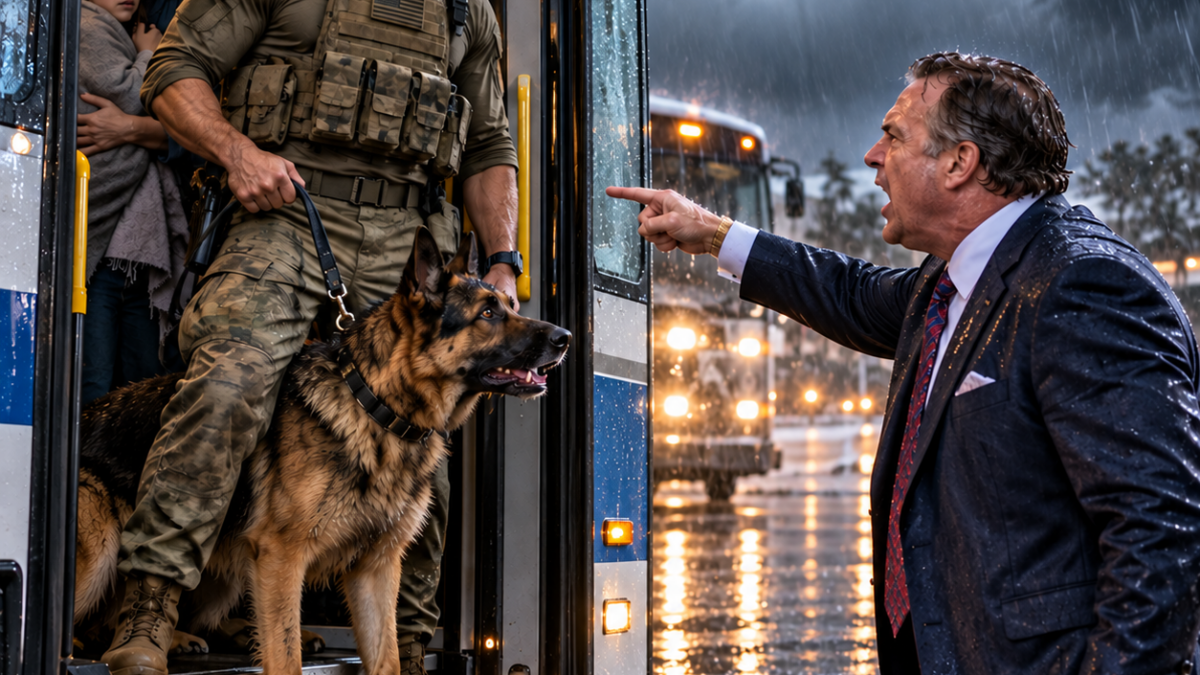
A Millionaire Evacuation Contractor Told a Navy SEAL to Abandon His German Shepherd—Then the Missing Bus Exposed Why He Wanted Them Gone.
At the last evacuation bus, wealthy contractor Graham Voss pointed at retired Navy SEAL Nathan Cole’s German Shepherd and ordered him to leave the dog behind—even though the “animal transport” Graham promised did not exist anywhere in the terminal.
Nathan refused to surrender Bruno to a stranger without a driver, crate, destination, or manifest, and within twenty minutes the county coordinator discovered something far bigger than one missing dog van: Graham’s company had also claimed forty-two evacuation seats on a bus that had been broken down at its depot since the night before.
By the time floodwater closed the southern road, the man who had accused a Navy SEAL of delaying an evacuation was standing in front of the same frightened families admitting that Nathan had never refused to leave—the contractor had been trying to make people disappear from the passenger count because some of the buses he had been paid to provide were never coming.
“Leave the dog or get out of the line.”
Graham Voss said it loudly.
That mattered.
He did not lean toward Nathan Cole and speak quietly.
He did not pull him aside.
He did not ask for a minute to clarify policy.
He planted himself beside the open door of the final scheduled evacuation coach, lifted one hand toward Bruno, and made certain everyone standing beneath the rain-soaked terminal awning could hear.
“Leave the dog,” he repeated, “or get out of the line.”
Rain drove sideways across the parking lot behind him.
A sheriff’s SUV crawled past the fence with amber lights turning through the gray morning.
Its loudspeaker announced that the lower waterfront roads would begin closing within the hour.
The bus engine idled.
Diesel exhaust hung in wet air.
People were scared.
That was exactly why Graham’s voice carried so well.
Nathan stood three feet from him with a numbered boarding card in his left hand and Bruno’s leash in his right.
He was forty-three years old.
Former Navy SEAL.
Civilian marine-maintenance instructor now.
Bad left knee.
Gray beginning along his beard.
And unlike what half the people in that line would later say online, Nathan did not reach for a weapon, flash military credentials, threaten Graham, or tell anyone he had special rights.
He simply said:
“He rides with me.”
Graham gave him the smile of a man who had spent years turning other people’s emergencies into invoices.
“No animals in the passenger cabin.”
“Then where is the animal transport?”
PART2:
Graham pointed toward the far end of the lot.
“Our staff will handle him.”
Nathan looked.
There was no animal vehicle.
No transport van.
No kennels.
No uniformed animal handler.
No visible crate.
No separate loading team.
No vehicle number.
Nothing.
A young Voss Coastal Transit employee stepped closer and reached toward Bruno’s leash.
Nathan’s voice changed.
Not louder.
Lower.
“Don’t touch him.”
The employee stopped.
Bruno moved one step closer to Nathan’s left knee.
Seven-year-old German Shepherd.
Black saddle.
Tan legs.
Broad head.
Ordinary brown harness.
No service-dog patch.
No fake vest.
No tactical gear.
He was retired.
And Nathan knew exactly what that meant.
Bruno had spent years as a military working dog, but military history did not magically turn him into a service animal under civilian access rules.
He did not perform a disability-related trained task for Nathan.
Nathan had never claimed otherwise.
He had followed county evacuation instructions.
At registration he had told staff:
“I have a dog.”
The clerk had stamped his boarding card:
ANIMAL ACCOMPANYING — TRANSPORT TO BE CONFIRMED.
That was the promise.
Not that Bruno could sit in the passenger cabin.
Not that Nathan could ignore safety rules.
Only that the county would coordinate a suitable transport arrangement.
Now Graham was trying to take the leash without telling Nathan who was driving, where Bruno was going, or who would receive him.
Nathan held up the card.
“If you want to make an example out of me, at least tell everyone where he’s going.”
Graham extended his hand.
“Give me your boarding card.”
“No.”
“Then you’re refusing evacuation.”
Nathan looked behind him.
An elderly woman holding a grocery bag.
A man carrying an insulated medication case.
A mother with two children wearing yellow rain ponchos.
Three dockworkers.
A grocery-store cashier Nathan recognized from town.
These people had already waited in storm conditions for hours.
He had no intention of turning the boarding lane into a showdown.
“No,” Nathan said.
“I’m asking you to show me where you’re taking my dog.”
A phone rose somewhere behind the line.
Recording.
Graham noticed.
So did Nathan.
He wished it hadn’t.
Public conflict changes people.
Some perform harder.
Some retreat.
Graham performed.
“We are evacuating hundreds of people,” he said. “I am not delaying this coach because one man refuses to follow procedure.”
Nathan almost answered.
Then another voice came from behind Graham.
“Which procedure?”
A woman in a yellow county emergency-management rain shell approached.
Maria Torres.
Forty-eight.
Hair pulled tight beneath hood.
Plastic-covered clipboard under one arm.
Radio clipped high on her vest.
County Emergency Management Coordinator for the terminal.
She had been moving between buses since before sunrise.
She looked at Nathan.
Then Graham.
“What’s the problem?”
Graham answered first.
“This gentleman refuses the animal policy and is holding departure.”
Nathan handed Maria his boarding card.
“I registered Bruno at intake.”
She read the stamp.
Nathan continued.
“Mr. Voss says there’s a separate animal vehicle.”
“I asked which one.”
“No one can identify it.”
Maria looked at Graham.
“Which vehicle?”
“It’s part of the overflow arrangement.”
“Vehicle number?”
Graham turned toward his dispatcher.
“Find out.”
Maria didn’t argue.
She stepped away from the bus door.
“Keep loading approved passengers.”
The driver nodded.
The line began moving around Nathan.
That one decision mattered.
Nathan was no longer blocking the evacuation.
Nobody needed to choose between a dog dispute and getting elderly people onto a bus.
Maria pointed toward a covered section beside the building.
“Mr. Cole, move Bruno over there while I verify.”
Nathan nodded.
“Thank you.”
Graham looked irritated.
Not because Maria had insulted him.
She hadn’t.
Because she had removed the audience from his ultimatum.
Nathan walked Bruno beneath the awning.
The dog shook rain from his coat.
Nathan unfolded a blue towel from his backpack.
Same towel he kept near the kitchen door at home.
Bruno knew it.
He stood still while Nathan dried his paws.
Then drank from a collapsible bowl.
“Down.”
Bruno lowered onto the towel.
His ears remained forward.
Watching buses.
Watching Nathan.
Watching everything.
Nathan rubbed behind one ear.
“Good.”
The storm had started before dawn.
Not a hurricane.
Not yet.
A powerful coastal system pushing surge into low streets and dumping rain faster than older drainage could handle.
Forecasts had shifted overnight.
County officials ordered mandatory evacuation for several low-lying waterfront zones because even moderate flooding could isolate neighborhoods once bridges and connectors closed.
The county had buses.
Not enough.
Years earlier it had signed an emergency transportation agreement with Voss Coastal Transit.
Graham’s company owned coaches, shuttles, drivers, dispatch staff, and a maintenance depot outside the flood zone.
During emergencies the county controlled evacuation priorities, shelter destinations, and incident command.
Voss Coastal supplied vehicles and operational dispatch.
Graham had influence.
A lot.
He did not have command authority.
That distinction was about to become important.
Graham Voss was fifty-six.
Founder and majority owner of Voss Coastal Transit.
He had started with two airport vans twenty-eight years earlier.
Now he owned regional charter buses, executive coaches, shuttle contracts, school activity buses, and municipal emergency agreements.
He lived in a waterfront house worth several million dollars.
Sponsored hospital galas.
Sat on the Chamber of Commerce board.
His name appeared on a youth athletic complex.
He liked telling reporters he had built everything from nothing.
That part was mostly true.
What people disagreed about was what building success had taught him.
His employees called him decisive.
Competitors called him ruthless.
Nathan, after ten minutes, thought Graham was a man who had become so accustomed to being obeyed that he had stopped noticing when certainty outran facts.
Nathan had met officers like that.
Not many.
The good ones learned.
The dangerous ones treated confident language as a substitute for verified information.
During his years in Naval Special Warfare, Nathan had learned the opposite.
A status board is not a vehicle.
A radio call is not a person.
A plan is not a resource.
“Available” means somebody has put eyes on it, knows where it is, and can tell you who is responsible.
Anything else is hope wearing a label.
That habit had saved people overseas.
It was why he would not release Bruno’s leash to a stranger because Graham pointed toward an empty parking lot.
Nathan was not Bruno’s original military handler.
That was another detail people later got wrong.
Bruno had served through a military working-dog program and had crossed paths with Nathan repeatedly during joint base-security training and several temporary assignments.
Nathan learned the dog over years.
The way Bruno’s left ear tilted when he heard something unfamiliar.
The difference between his alert posture and prey excitement.
The small huff he made before settling.
After Bruno retired from military service, Nathan went through the approved adoption process.
Paperwork.
Home evaluation.
Veterinary transition.
Liability acknowledgment.
No dramatic “hero gets his war dog” handoff.
Just a retired working dog becoming a civilian dog in the home of someone he already trusted.
Nathan’s life had become quieter too.
He taught marine systems maintenance at a technical institute.
Diesel engines.
Pumps.
Hydraulics.
Emergency repairs.
He still woke before sunrise.
Still checked doors twice.
Still automatically noted exits.
But he no longer spent his days where mistakes arrived with gunfire.
Bruno slept beside Nathan’s chair.
Waited by the kitchen door for his blue towel after rain.
Pushed a rubber ring across the porch when he wanted to play.
When Nathan’s old knee tightened, Bruno sometimes rested his head against it.
Not trained medical assistance.
Just familiarity.
They knew each other.
That was why Nathan had no intention of handing Bruno to someone who couldn’t answer the simplest question.
Where is he going?
Five minutes passed.
Then ten.
The last scheduled coach continued loading.
Maria moved between dispatch and boarding table.
Nathan watched without interfering.
The elderly woman from line sat beneath awning nearby.
She was sixty-eight.
Evelyn Price.
Nathan learned her name when she dropped the paper where she’d written her shelter address.
He picked it up.
“Here.”
“Thank you.”
Her fingers shook.
“My husband is already inland.”
“You’ll get there.”
“I hate buses.”
Nathan smiled.
“Then today is inconvenient.”
She laughed once.
Bruno looked at her.
Evelyn looked down.
“Does he bite?”
Nathan answered honestly.
“He can.”
Her eyes widened.
“He’s also trained and under control.”
“Can I pet him?”
“Not today.”
“Fair enough.”
She appreciated the answer.
A man named Malcolm Reed sat beside her.
Dock electrician.
Fifty-one.
Carrying medication in a hard insulated case.
Nathan didn’t know it yet, but Malcolm would matter later.
Twenty minutes after Maria started checking, a dispatcher approached.
“The animal van is on another assignment.”
Maria asked:
“Which assignment?”
The dispatcher looked at Graham.
Graham said:
“It’ll come after next transfer.”
Maria lifted radio.
“Transport desk, confirm animal-capable vehicle assigned to Terminal Four.”
Static.
Then:
“Negative.”
Maria looked at Graham.
“Repeat?”
The voice:
“No animal vehicle currently assigned to Terminal Four.”
Graham said:
“That’s wrong.”
Maria kept radio up.
“Any animal vehicle scheduled to this site this morning?”
Pause.
“Negative.”
The people closest heard.
So did the phone recording.
Maria lowered radio.
Then looked at Nathan’s card.
She wrote something across it.
Nathan asked:
“What’s that?”
“Your status remains active.”
“You are not being marked refusal.”
Graham stepped forward.
“We have bridge closures coming and you’re negotiating with one person over a dog.”
Maria’s answer was short.
“I’m correcting an unfilled transport commitment.”
Then to the driver:
“Continue boarding.”
No drama.
No shouting.
Competence rarely looks cinematic in real time.
The bus filled.
Then another problem surfaced.
Driver Denise Keller walked over holding her seating sheet.
“Maria.”
“What?”
“We have capacity issue.”
Graham turned.
“What issue?”
Denise pointed.
“Accessibility restraint at row three failed inspection.”
“I reported before we pulled in.”
“That took four usable seats out.”
Maria studied manifest.
“Then these numbers don’t work.”
Graham reached.
“Let me see.”
She kept sheet.
“Departure list shows forty-six assigned.”
“Usable passenger positions?”
“Forty-two before failed restraint.”
“Now thirty-eight.”
Graham said:
“The numbers include supplemental vehicle.”
Maria looked up.
“Which one?”
“The shuttle.”
“Vehicle number?”
“Dispatch is sorting it.”
Nathan heard that phrase again.
Sorting it.
He looked toward large whiteboard above loading lane.
Three scheduled vehicles had been listed for the departure group.
Two were physically present.
The third line read:
DEPARTED 0810.
Nathan had been at terminal before eight.
He had watched that lane continuously except registration.
He had not seen a third bus depart.
Maybe it used another lane.
Maybe he’d missed it.
He did not assume.
That was another habit.
Observation is not conclusion.
He walked toward Maria when she finished with driver.
“Can I ask one question?”
She nodded.
“Does the county count capacity when contractor promises vehicle, or when dispatch verifies it?”
Maria looked at him.
“Verified resource.”
Nathan pointed toward board.
“I’ve been here since before eight.”
“I saw these two vehicles.”
“I didn’t see the third one marked departed.”
“That doesn’t mean it didn’t leave somewhere else.”
“But if you have more names assigned than physical seats, I’d verify it.”
Graham stepped close.
“You have no idea how this contract operates.”
Nathan looked at him.
“That’s probably true.”
Graham seemed surprised.
Nathan continued.
“I know which buses I saw.”
“This is none of your business.”
Nathan looked toward Evelyn.
Then Malcolm.
Then the families still waiting.
“The people in line are my business while I’m standing beside them.”
Maria raised one hand.
“Enough.”
Not at Nathan.
At both.
She keyed radio.
“County transportation, I need live fleet reconciliation for Terminal Four.”
A minute later the answer came.
One coach listed on Graham’s sheet did not appear on current county driver roster.
Maria requested maintenance supervisor at Voss Coastal.
Graham objected.
“We don’t need to call maintenance during an active evacuation.”
Maria ignored him.
The call connected.
“Voss maintenance.”
“This is Maria Torres, county emergency management.”
“I need status on Coach 317.”
Pause.
“Three-seventeen?”
“Yes.”
“It’s at depot.”
Graham’s face changed.
Not dramatically.
Just enough.
Maria asked:
“Operational?”
“No, ma’am.”
“Transmission.”
“Came in yesterday evening.”
“Has it moved today?”
“No.”
Maria stared at Graham.
The maintenance supervisor continued:
“It’s up on rear stands.”
“Couldn’t move if you wanted.”
Silence.
Rain hammered awning.
The board behind them still said:
DEPARTED 0810.
Maria turned to dispatcher.
“Freeze that entry.”
“Do not count those seats.”
Graham said:
“It’s a coding error.”
Maria answered:
“Maybe.”
“Until reconciled, those seats do not exist.”
Nathan looked at Bruno.
The dog problem and bus problem were not separate.
Not entirely.
Graham had been insisting there was no room to accommodate complications.
Dog.
Animal transfer.
Extra waiting.
One man slowing line.
But his company had promised forty-two seats on a vehicle that had never left the depot.
There were now eleven adults without confirmed capacity.
Including Nathan.
Maria requested updated priorities.
Limited mobility first.
Essential medication.
Families with young children.
Nathan said:
“Put me in last group.”
Maria looked.
“You sure?”
“Yes.”
“You and Bruno remain active evacuation.”
“I understand.”
“I’m not asking you to stay.”
“I know.”
“I’m offering the seat to someone who needs it more if you can verify another route for us.”
Maria nodded.
That was workable.
Evelyn’s accessible position became available on departing coach.
She hesitated at door.
Looked back.
“Are you coming?”
Nathan smiled.
“Not this one.”
“My husband…”
“Is waiting.”
“Go.”
She looked at Bruno.
“Take care of your dog.”
Nathan answered:
“That’s the plan.”
Evelyn boarded.
The door closed.
The bus left by northern route.
Graham watched it go with jaw tight.
His company had submitted capacity it could not currently provide.
Nathan didn’t yet know why.
Mechanical problem could happen to anyone.
Storms complicate everything.
Maybe someone failed to update board.
Maybe dispatch had simply made bad mistake.
But Graham’s behavior began to make different sense.
If passenger demand exceeded real capacity, one way to reduce discrepancy was to reduce passengers.
One dog owner marked “refused evacuation.”
Maybe others labeled no-shows.
People directed elsewhere.
Numbers become cleaner.
That was theory.
Nathan did not say it.
Not yet.
He had spent too much of his life watching bad assumptions become bad decisions.
Maria requested contingency vehicles.
County public-works vans.
An inland shelter partner with animal transport capability.
But she did not announce anything until actual drivers confirmed.
Nathan respected that.
“We have possible eighteen-seat county van,” she said later.
“Possible?”
“Yes.”
“Meaning?”
“They are locating driver.”
“Good.”
Graham muttered:
“This is absurd.”
Maria turned.
“What is?”
“We have available resources.”
“Name them.”
He didn’t.
That ended conversation.
County staff moved Nathan and Bruno into a small interior waiting room approved for temporary animal holding.
Solid floor.
Closing door.
Secured access.
Quiet compared with terminal.
Bruno’s hind legs were stiff from standing on wet concrete.
Nathan noticed the extra second before he lay down.
Seven wasn’t ancient for German Shepherd.
But he had years behind him.
Working miles.
Vehicle jumps.
Concrete.
Training.
He was retired for a reason.
Nathan dried his feet again.
Spread blue towel.
Bruno settled.
Nathan sat beside.
For first time all morning, he heard dog breathe more clearly than buses.
The liaison arrived.
“County van confirmed.”
“Eighteen seats.”
“Can Bruno ride?”
“No approved loose-animal space.”
“Then fill it with people.”
She blinked.
“You’re okay with that?”
“Why wouldn’t I be?”
Somebody had decided Nathan was fighting to make Bruno ride wherever he wanted.
He wasn’t.
He wanted a safe, documented plan.
Those are different things.
Malcolm appeared at doorway.
Medication case under arm.
“Sorry.”
Nathan looked.
“What happened?”
“Driver said this can’t block aisle.”
“That makes sense.”
“He said luggage goes below.”
“Medication?”
“Insulin and two other things I need accessible.”
Nathan almost gave advice.
Stopped himself.
He didn’t know vehicle policy.
“Ask Maria.”
Malcolm looked frustrated.
“She’s busy.”
“Still ask.”
Nathan walked with him.
Maria checked.
Driver clarified approved secured compartment inside passenger area where medication could remain accessible without blocking aisle.
Problem solved.
No improvisation.
No untracked luggage.
Nathan looked back toward Bruno.
A metal gate slammed somewhere.
Dog’s ears snapped up.
He rose.
Nathan returned.
“Down.”
Bruno obeyed.
His breathing slowed.
Another hour.
One proposed animal transport came from rescue volunteer.
Maria verified it before assignment.
Large crate latch damaged.
She declined.
Nathan said:
“Thank you.”
The volunteer looked offended.
“It’s only one latch.”
Maria answered:
“One latch is what keeps dog in crate during emergency braking.”
That was the kind of sentence Nathan appreciated.
The second option came from inland shelter partner.
This time county dispatch verified:
Driver.
Vehicle ID.
Secured large crate.
Ventilation.
Receiving staff.
Destination.
Route.
Estimated arrival.
Real plan.
Not here yet.
But real.
Rain intensified.
Southern connector began taking water.
County transportation officer announced likely closure within forty-five minutes.
Maria laid Nathan’s options out.
“You can take passenger van now.”
“Bruno stays here under county supervision until animal vehicle arrives.”
“Or you can stay with closing team while site remains safe.”
“If safety officer orders terminal closure before animal van arrives, we move to contingency.”
Nathan looked at dog.
Bruno lay with one paw over blue towel.
The image of Graham’s employee reaching for leash returned.
Nathan asked:
“How long?”
“Estimated forty minutes.”
“Site safe?”
“For now.”
“I’ll stay.”
Maria nodded.
“If that changes—”
“You tell me.”
“I won’t gamble with your staff.”
“That I can work with.”
Graham overheard.
“All this for one dog.”
Nathan looked toward buses leaving.
“No.”
“The buses keep leaving.”
“People who need seats are moving.”
“This is about one promise you made and couldn’t verify.”
For once, Graham had nothing immediate.
Nathan thought conflict might be over.
It wasn’t.
The most important thing Bruno did that day was not bark.
Not detect explosives.
Not attack anyone.
Not perform some movie-version military-dog miracle.
He stayed.
The inside loading passage had become primary route after wind damaged exterior canopy.
Staff moved the remaining passengers through in small groups.
Nathan had Bruno on down-stay on blue towel while he helped an older man recover a boarding card dropped beneath bench.
A luggage trolley rattled in corridor.
Bruno’s ears fixed.
His head rose.
Nathan heard scraping next.
Low.
Repeated.
He turned.
Trolley rear wheel had jammed at raised threshold.
The staff member pushing could not see around stacked bags.
At opposite end, an evacuee using walker approached with two people behind.
The passage had narrowed.
If cart shoved through, bags could topple.
Walker user could be struck or forced aside.
Bruno shifted.
Stayed down.
Nathan repeated softly:
“Stay.”
Dog held.
That mattered.
Nathan didn’t have to wrestle an excited animal.
He could look at route.
“Stop the cart.”
Staff member froze.
“Clear the doorway.”
“There’s someone coming through.”
Maria heard and came over.
They moved luggage.
Paused next group.
Walker user passed.
Less than a minute.
No one fell.
No injury.
No drama.
Maria looked at Bruno.
“He noticed before you.”
Nathan nodded.
“And stayed put.”
“That’s what his training gives us.”
She raised eyebrow.
“The noticing?”
“The control.”
“Dog doesn’t make decisions for us.”
“He gives me room to make them.”
That was how Nathan understood working animals.
Not magical heroes.
Partners whose training creates options.
Afterward he checked Bruno’s paws.
Gave water.
Room had warmed.
Nathan asked liaison:
“Confirm the incoming crate is ventilated and large enough for him to turn.”
She smiled.
“Already in notes.”
“Good.”
The dog had helped keep a human route safe.
Now humans owed same care to his route.
A woman approached.
The one who had recorded Graham.
“I have video.”
Nathan nodded.
“I know.”
“Do you want it?”
“Give it to Maria if county requests.”
“I was going to post.”
Nathan looked past her at tired people.
“Please don’t put everyone here online.”
“They didn’t agree to be part of this.”
She lowered phone.
“You don’t want people to see what he did?”
“I want county to have it.”
“That’s different.”
The humiliation had happened publicly.
Nathan didn’t need to turn an emergency into content.
Truth could exist without making every scared person background character.
Graham was now inside operations office.
County transportation officer had arrived.
They compared:
Vehicle maintenance record.
Submitted capacity.
Driver roster.
Dispatch timestamps.
Departure board.
The missing forty-two-seat coach.
Nathan was not part of meeting.
He had no contractual authority.
Did not pretend he did.
Later Maria explained enough.
Coach 317 had been out of service since previous evening.
Yet full capacity had remained in contractor submission.
Worse, dispatch board showed it as departed.
Graham called coding error.
Maybe part of it was.
But county asked harder question.
Why had people been told they were refusing evacuation when promised animal transport had never existed?
Why had unverified vehicles been counted?
Why were numbers treated as real before physical verification?
Eventually Graham admitted his office submitted full expected fleet before maintenance availability was reconciled.
That could reduce his company’s payment.
Might trigger review.
Nathan began to see motive more clearly.
Not cartoon conspiracy.
Not Graham secretly trying to kill evacuees.
Something more ordinary and therefore more believable.
A contractor had promised more capacity than it could deliver.
Storm made shortage visible.
Graham wanted departures to stay clean.
A man with a dog was inconvenient.
If Nathan could be labeled refusal, one problem disappeared from count.
Maybe Graham did not sit in office planning fraud.
Maybe he had spent a career rewarding employees for making numbers work until numbers mattered more than people behind them.
Intent would be for county to determine.
Nathan cared about outcome.
Maria came back into waiting area.
Graham followed.
Seven adults remained plus Nathan and Bruno under separate plan.
Maria stood where everyone could hear.
“For clarity.”
Conversation stopped.
“Mr. Cole did not refuse evacuation.”
Graham looked away.
“He registered an accompanying animal according to county instructions.”
“He requested verification before surrendering custody.”
“That was reasonable.”
The woman with phone held it low.
Maria continued:
“The county has corrected the passenger manifest.”
“A vehicle previously listed as available was not available.”
“That discrepancy is documented and will be reviewed.”
“No one here is being marked voluntarily left behind because an animal transfer could not be verified.”
Silence.
Then Graham said:
“I was wrong.”
People turned.
He looked at Nathan.
“The animal van was not here.”
“I should not have said it was.”
“And I should not have said you were refusing evacuation.”
Nathan could have humiliated him.
Could have asked him to repeat louder.
Could have mentioned forty-two missing seats.
Could have made wealthy contractor stand in rain while everyone watched.
Instead Nathan looked toward remaining passengers.
“Then help Maria finish count.”
Graham blinked.
Nathan said:
“That’s what matters.”
For first time all morning, list matched actual people.
Nobody cheered.
That’s not how real corrections usually feel.
A driver opened door.
People moved.
Southern road closed that afternoon.
The longer inland route remained open.
Last verified passenger van arrived.
Malcolm boarded with medication secured appropriately.
Seven adults became zero.
Nathan remained with Bruno and closing staff.
Maria checked animal van location every fifteen minutes.
Graham stayed near operations desk.
He had lost his commanding posture.
Maybe because county officer was now watching.
Maybe because facts were.
At one point he approached Nathan.
Bruno was standing beside him.
Graham did not reach.
“He really did stay down through all that?”
“Yes.”
“He’s trained.”
“For years.”
Graham looked at dog.
“I thought military dog would be more…”
“Aggressive?”
“Intense.”
“He is intense.”
Bruno yawned.
Graham almost smiled.
Nathan said:
“Training isn’t making dog dangerous.”
“It’s making him controllable.”
Graham nodded.
Then:
“I shouldn’t have reached for the leash.”
“You didn’t.”
“My employee.”
“You told him.”
“Yes.”
Nathan waited.
Graham said:
“I was trying to keep line moving.”
“I know.”
“That doesn’t excuse it.”
“No.”
The honesty surprised Nathan.
Maybe public consequences had reached him.
Maybe fear of contract review.
Motives don’t have to be pure for truth to improve behavior.
At 3:41 p.m., animal vehicle arrived.
White shelter-partner van.
Driver Rosa Medina.
Fifty-something.
Calm.
Printed manifest.
Maria verified plate.
Driver credentials.
Receiving station contact.
Cargo area.
Proper secured crates.
Nathan walked around vehicle himself.
Not because he distrusted Rosa.
Because checking was now the whole point.
Crate large enough.
Ventilation.
Floor intact.
Latch functional.
Anchor secure.
He put blue towel inside.
Bruno approached.
Metal door rattled next compartment.
Dog stopped.
Looked at Nathan.
Nathan did not pull.
“Easy.”
Asked Rosa to hold adjacent door still.
Let Bruno sniff.
Then familiar loading cue.
“Load.”
Bruno stepped in.
Turned.
Lay down.
Enough room.
Nathan secured door.
Rosa watched.
Maria checked identification.
Receiving contact acknowledged.
Everything had a name.
A number.
A destination.
A person.
Exactly what Graham’s first “our staff will handle him” had lacked.
Nathan rested fingers on crate for second.
“You’re okay.”
Bruno watched.
No whining.
No lunging.
Crate training.
Trust.
Maria said:
“You can ride with county closing vehicle.”
“Animal van cargo area isn’t approved for passenger.”
Nathan hated separation.
He did.
But safe arrangement mattered more than proving togetherness.
He asked:
“Same route?”
“Yes.”
“Destinations?”
“Less than mile apart.”
“Receiving supervisor?”
Maria gave name.
Nathan repeated it.
Then stepped away.
Rosa checked restraint once more.
Van left.
Nathan followed it with eyes until rain swallowed taillights.
Maria stood beside him.
“Hard?”
“Yes.”
“You could’ve demanded to stay together.”
Nathan shook head.
“I wanted to.”
“That wasn’t safest option.”
Maria studied him.
“You know, this morning everybody assumed argument was man refuses to leave dog.”
“It was never that.”
“What was it?”
Nathan looked toward empty loading lane.
“Don’t ask people to trust what you refuse to verify.”
The terminal closed behind them.
County staff checked bathrooms.
Waiting rooms.
Storage areas.
No one left.
They locked gate.
Nathan rode in closing vehicle.
The storm pushed branches across road.
Water stood along shoulders.
They used inland route.
At reception center Nathan went straight to animal intake.
Rosa was there.
Bruno resting.
Water bowl clipped inside crate.
Shelter worker checked Nathan’s identification.
Signed release.
Nathan opened crate.
“Okay.”
Bruno stood.
Stretched.
Stepped out.
One look around crowded room.
Then moved to Nathan’s left side.
Same position.
Always.
Nathan knelt.
Pressed hand into thick fur.
“You did good.”
Bruno leaned against him.
Only for second.
Then looked toward doorway.
Where next?
Working dogs keep asking that even when retired.
Nathan smiled.
“No idea, buddy.”
Later that evening he found Evelyn.
Her husband beside her.
Holding both hands around coffee.
She smiled when she saw Bruno.
“You made it.”
“So did you.”
“My husband said I worried him for nothing.”
Her husband said:
“She worried me plenty.”
Malcolm was there too.
Medication case beside cot.
Dry.
Accessible.
Safe.
Nathan filled Bruno’s bowl.
Spread blue towel next to his own cot.
Removed wet collar.
The shelter was loud.
Folding beds.
Crying child.
Phones.
Announcements.
People discussing flooded streets.
Bruno circled once.
Nathan pointed.
“Down.”
Dog lay.
Rested chin over Nathan’s boot.
That morning a stranger had told Nathan to leave him behind.
Now the leash still rested in Nathan’s hand.
Not because Nathan had forced Bruno into a passenger bus.
Not because Navy SEAL demanded exception.
Not because retired war dog had magical authority.
Because eventually the system did what it had promised.
A real vehicle.
Real crate.
Real driver.
Real manifest.
Real receiving staff.
And enough honesty to admit when first plan never existed.
The storm caused less damage than feared.
Some homes flooded.
Roads closed for two days.
Most evacuees returned within forty-eight hours.
Nathan’s street took water but house stayed dry.
Bruno inspected every room on return.
Then found rubber ring.
Dropped it on Nathan’s foot.
Nathan laughed.
“Of course.”
Life resumed.
But county review did not disappear.
Emergency transportation contract was audited.
Voss Coastal’s submitted fleet capacity compared with actual availability.
Several discrepancies surfaced.
Not dozens of phantom buses.
Nothing that dramatic.
But enough.
Vehicles listed before final maintenance clearance.
Status updates made from expected availability instead of verified driver confirmation.
Inadequate procedures for pet transport coordination.
Weak communication between contractor dispatch and county incident command.
And an incentive structure that paid partially based on committed capacity.
That last part mattered.
Graham had not invented a bus out of thin air solely to remove Nathan.
But his company’s system rewarded optimism.
Optimism became reporting.
Reporting became official board.
Then crisis exposed gap.
County withheld payment associated with unverified service.
Required corrective action.
New contract terms demanded real-time vehicle verification before capacity counted.
Driver identity.
Vehicle number.
Maintenance release.
GPS location.
No “expected” bus listed as available.
Animal transport plans required documented coordination before evacuees were told to surrender custody.
Maria led rewrite.
Nathan did not.
He was invited to review public comments.
He wrote one paragraph.
A plan should identify the real resource, the responsible person, the destination, and the transfer point. If those cannot be named, the plan is not complete.
That sentence made final procedure.
Graham kept his company.
People online wanted scandal to end with prison.
Bankruptcy.
Handcuffs.
Life rarely obliges.
County did not find evidence Graham intentionally endangered evacuees for profit in criminal sense.
It found contract and management failures.
He paid financial consequences.
Lost part of emergency contract for a year.
Had to undergo external compliance review.
His reputation took hit.
And for first time since he had built Voss Coastal, another executive became responsible for emergency operations.
Graham hated that.
Nathan knew because Graham told him later.
Six months after storm, Nathan was teaching diesel-hydraulic systems when receptionist called.
“Someone named Graham Voss is here.”
Nathan almost laughed.
“Why?”
“He says to apologize.”
“Tell him apology doesn’t require appointment.”
Receptionist lowered voice.
“He brought coffee.”
Nathan sighed.
“Send him in.”
Graham looked different without raincoat and clipboard.
Still expensive clothes.
Still polished.
But quieter.
He put two coffees down.
“I owe you one.”
“You already apologized.”
“In front of terminal.”
“Counts.”
Graham shook head.
“That was operational.”
Nathan almost smiled.
“Apologies have categories now?”
“I’ve had six months of lawyers and consultants.”
“Everything has categories.”
Fair.
Graham sat.
“I kept thinking about what you asked me.”
“What?”
“Where is the vehicle?”
Nathan waited.
Graham continued.
“I was so used to dispatch telling me things were arranged that I stopped asking whether arranged meant physically assigned.”
“That sounds like management problem.”
“It was.”
“Was?”
“We changed it.”
“Good.”
Graham rubbed cup lid.
“I also thought you were using dog to force exception.”
“I wasn’t.”
“I know now.”
“You could have known then.”
“Yes.”
That landed.
Graham continued:
“I saw old guy with German Shepherd, military posture, and I thought this was going to become one of those arguments where someone claims rules don’t apply to him.”
Nathan nodded.
“Reasonable concern.”
Graham looked surprised.
Nathan said:
“People do that.”
“I’ve seen fake service dogs too.”
“But you skipped verification both directions.”
“What do you mean?”
“You assumed I wanted exception.”
“And you assumed your animal vehicle existed.”
Graham laughed once.
“That’s unpleasantly accurate.”
Nathan drank coffee.
Graham said:
“I watched video later.”
“Which?”
“The woman at terminal.”
“I asked her not to post evacuees.”
“She gave copy to county.”
“Good.”
“She caught me telling you you’re refusing.”
“Yes.”
“I hate watching it.”
“You should.”
Graham looked at him.
Nathan continued:
“Not because you look bad.”
“Because everybody else was scared and you turned uncertainty into accusation.”
Graham nodded.
Then:
“I’m trying not to do that anymore.”
Nathan didn’t forgive him theatrically.
Didn’t need to.
He said:
“Good.”
They finished coffee.
Before leaving Graham asked about Bruno.
Nathan pointed through classroom window toward truck.
German Shepherd asleep in back under shade screen.
“He’s retired.”
“He looks bored.”
“He’s excellent at boredom.”
Graham smiled.
“Can I pet him?”
Nathan thought.
“Not today.”
Graham laughed.
“Fair enough.”
That should have been ending.
But Nathan kept thinking about evacuation long after.
Not because Graham.
Because of trust.
People in emergencies are asked to do extraordinary things quickly.
Leave homes.
Board unfamiliar buses.
Hand over medication.
Separate from pets.
Trust drivers.
Trust shelters.
Trust government.
Trust contractors.
Most of that trust is necessary.
No system can function if every person independently verifies every bolt.
But trust has structure.
You should be able to answer basic questions.
Who?
Where?
How?
When?
If answer is only:
Don’t worry, somebody has it—
that is not trust.
That is surrender.
Nathan had spent military career learning controlled trust.
You trust your teammate because role is known.
You trust aircraft because someone inspected it.
You trust extraction because coordinates are confirmed.
You trust intelligence provisionally.
Then update.
You don’t confuse trust with blindness.
That morning Graham asked Nathan to do exactly that.
Hand over leash.
Trust us.
Nathan couldn’t.
Bruno deserved better.
The other passengers did too.
Especially because the same unverified culture hiding dog van was hiding forty-two bus seats.
That connection stayed with Maria.
She and Nathan became friends.
Not close friends.
Emergency-management friends.
Which meant occasional texts during storm season.
Maria once sent photo of new county checklist.
ANIMAL TRANSFER VERIFICATION:
Vehicle ID.
Driver.
Crate capacity.
Destination.
Receiver.
Owner notification.
She wrote:
Look familiar?
Nathan replied:
Needs coffee field.
She wrote:
Denied.
Another year, hurricane threatened coast.
Evacuation terminal activated again.
Voss Coastal provided some vehicles under revised oversight.
Graham was not running boarding lane.
A younger operations manager named Tessa Reed was.
Maria texted Nathan:
Everything verified. Don’t come inspect us.
Nathan answered:
Wasn’t planning to.
She sent:
Liar.
Bruno was eight by then.
Slower.
Some arthritis.
Nathan did not evacuate in that storm because his zone wasn’t called.
They sat on porch as rain came.
Nathan watched dog sleep.
Thought about blue towel.
Empty parking lot.
The employee reaching for leash.
If Nathan had surrendered Bruno that morning, maybe nothing terrible would have happened.
Graham’s staff might have improvised something.
Dog might have been held safely.
Maybe van eventually arrived.
People sometimes told Nathan:
“You knew they were lying.”
No.
He didn’t.
He knew they couldn’t verify.
That’s enough distinction.
You don’t need to prove bad intent before refusing unsafe transfer.
You only need uncertainty that matters.
The same applied to buses.
Nathan didn’t know coach 317 was broken when he questioned board.
He knew what he observed didn’t match display.
So he asked.
That is mature skepticism.
Not paranoia.
Not assuming everybody corrupt.
Asking for mismatch to be checked.
Nathan taught that lesson to maintenance students.
One day a pump pressure gauge read normal while actual output dropped.
Student said:
“Gauge says fine.”
Nathan asked:
“Does water agree?”
The student looked confused.
Nathan smiled.
“Instrument is report.”
“Flow is reality.”
“Verify both.”
Same lesson.
Different system.
Bruno aged.
At ten, hind legs stiffened more.
Veterinarian prescribed anti-inflammatory medication.
Nathan added rugs.
Shorter walks.
No unnecessary jumping into truck.
The dog hated ramp at first.
Nathan stood there.
“Load.”
Bruno stared.
“Ramp.”
Bruno attempted side jump.
Nathan blocked.
“No.”
The retired military dog looked deeply offended.
Eventually used ramp.
Nathan laughed.
“You survived deployments and evacuation contractors, but aluminum ramp is where we draw line?”
Bruno sneezed.
At eleven, hearing softened.
At twelve, he mostly slept.
Still alert to Nathan’s keys.
Still followed him kitchen.
Still pressed head against old knee.
One autumn afternoon Graham Voss appeared again.
This time at Nathan’s house.
Called first.
He carried no contract.
No coffee.
A cardboard box.
“What’s that?”
“Dog biscuits.”
Nathan stared.
“Why?”
“My granddaughter picked them.”
Nathan looked toward Graham’s truck.
A seven-year-old girl waved from passenger seat.
Nathan waved back.
Bruno came slowly to porch.
Graham stayed at bottom step.
Did not approach.
“Can she meet him?”
Nathan assessed Bruno.
Old.
Calm.
No stress.
“From here.”
Nathan brought Bruno on leash.
Girl approached only when told.
Nathan showed where to stand.
No grabbing.
No hugging.
She tossed biscuit.
Bruno sniffed.
Ate.
Girl smiled.
“Was he in Navy SEALs?”
Nathan smiled.
“No.”
“He was military working dog.”
“Mr. Cole was SEAL.”
Graham added.
Girl stared at Nathan.
“Did he save you?”
Nathan looked down at Bruno.
People love that question.
He could say yes.
It would sound good.
Instead:
“We worked around each other before he retired.”
“After retirement, I adopted him.”
“He’s helped me plenty.”
Girl frowned.
“But did he save your life?”
Nathan thought.
“Not the way movies mean.”
Then:
“He trusted me when I asked him to.”
“That mattered.”
She seemed satisfied.
Children often accept nuance better than adults.
Graham watched.
After she went back truck, he said:
“I used to tell that story differently.”
“What story?”
“Evacuation.”
“How?”
“Guy with dog held up my bus.”
Nathan raised eyebrow.
Graham nodded.
“Then county embarrassed me.”
“Then?”
“Now I say I had system that told me resources existed when they didn’t.”
“And a man made me prove one.”
Nathan smiled.
“Better.”
“Less flattering.”
“Usually sign.”
Graham laughed.
Bruno lay on porch.
The two men watched him.
No need for more.
Bruno died at thirteen.
Cancer.
Fast.
Nathan had expected arthritis to be end.
Life doesn’t honor predictions.
One month he was eating.
Next he wasn’t.
Tests.
Tumor.
Limited options.
Nathan chose comfort.
He stayed home.
Blue towel beside Bruno’s bed.
The same one from terminal.
Threadbare now.
One morning Bruno couldn’t stand without pain.
Nathan knew.
Veterinarian came.
Nathan sat floor.
Bruno’s head on his boot.
Exactly like shelter night years earlier.
He held leash in one hand.
Not attached.
Just there.
“You did good.”
Bruno’s eyes moved.
Nathan rubbed behind ear.
“No one’s taking your leash.”
His voice broke.
“You can go.”
Veterinarian gave medication.
Bruno relaxed.
The storm story came back suddenly.
Graham telling him leave dog.
Nathan telling stranger don’t touch him.
All the verification.
All the insistence.
Who has him?
Where is he going?
Who receives him?
At the end none of those questions mattered.
Nathan knew exactly where Bruno was.
With him.
Safe.
Loved.
No missing manifest.
No unknown handler.
No empty parking lot.
Nathan held him until breathing stopped.
Maria sent flowers.
Graham did too.
Card:
Thank you for making me learn what “verified” means.
Nathan kept it.
Months later county dedicated a small emergency-animal staging area at inland reception center.
Not to Bruno specifically.
Nathan refused naming.
“This should be system, not memorial.”
But Maria placed small framed photo in staff office anyway.
Bruno lying on blue towel during evacuation.
Under it:
A PLAN ISN’T A RESOURCE UNTIL YOU CAN POINT TO IT.
Nathan pretended not to approve.
He did.
People still told story online wrong.
Rich man told Navy SEAL to leave German Shepherd behind.
Then war dog exposed corruption.
That title got clicks.
Reality was better.
Bruno didn’t expose corruption.
He stayed on a towel.
Nathan asked questions.
Maria verified.
A driver reported broken restraint.
A maintenance supervisor answered phone.
Records didn’t match.
County corrected.
People boarded.
Dog transported safely.
No punches.
No special forces intimidation.
No dramatic arrest.
Just professionals separating facts from assumptions before storm erased time to fix mistakes.
That was real competence.
Nathan preferred it.
Because if lesson depended on being Navy SEAL, most people couldn’t use it.
But anyone can ask:
Who is responsible?
What vehicle?
What destination?
What evidence?
What happens if plan fails?
Those questions belong everywhere.
Hospitals.
Flights.
Schools.
Construction.
Evacuations.
And sometimes dog transport.
Nathan had not won because he was tougher than Graham.
He won nothing, really.
He and Bruno reached a shelter.
So did Evelyn.
So did Malcolm.
That was objective.
Everything else was noise.
Years later, Nathan still had the boarding card.
ANIMAL ACCOMPANYING — TRANSPORT TO BE CONFIRMED.
Maria had written beneath:
NOT A REFUSAL — PENDING VERIFIED TRANSPORT.
He kept it beside Bruno’s adoption papers.
Why?
Because one word can change responsibility.
“Refusal” would have said Nathan chose to stay.
“Pending” told truth.
The system had not yet kept its promise.
Words matter when institutions write history.
So do manifests.
So do dogs who stay where they’re told while humans figure out what they should have confirmed hours earlier.
On that storm morning, Graham Voss tried to make Nathan choose between evacuation and Bruno.
Nathan rejected the choice because it was based on something Graham could not prove existed.
He did not demand the dog ride beside him.
He did not claim special privilege.
He simply refused to hand a living animal to nobody.
That insistence forced one vehicle to be checked.
Then another.
Then an entire passenger count.
And in the end, the biggest problem at Terminal Four was never a retired German Shepherd occupying space.
It was forty-two seats that existed only on paper.
Bruno was real.
The missing bus wasn’t.
Nathan had spent most of his adult life learning the difference.
That day, it mattered more than rank, money, reputation, or who spoke loudest beside the door.
When the last evacuees reached the inland shelter, Bruno lay down across Nathan’s boot.
Outside, the storm kept moving.
Inside, every person from their final group had a confirmed place.
Every name matched.
Every vehicle that had been counted had actually arrived.
And the dog Graham wanted left behind was exactly where the manifest said he would be.
Together with the man who had refused to let anyone turn an unverified promise into a goodbye.





