A Marine Asked a Homeless Old Man His MOS as a Joke—Then “0317” and the Callsign “Reaper Storm” Made His Sergeant Drop His Coffee
A Marine Asked a Homeless Old Man His MOS as a Joke—Then “0317” and the Callsign “Reaper Storm” Made His Sergeant Drop His Coffee
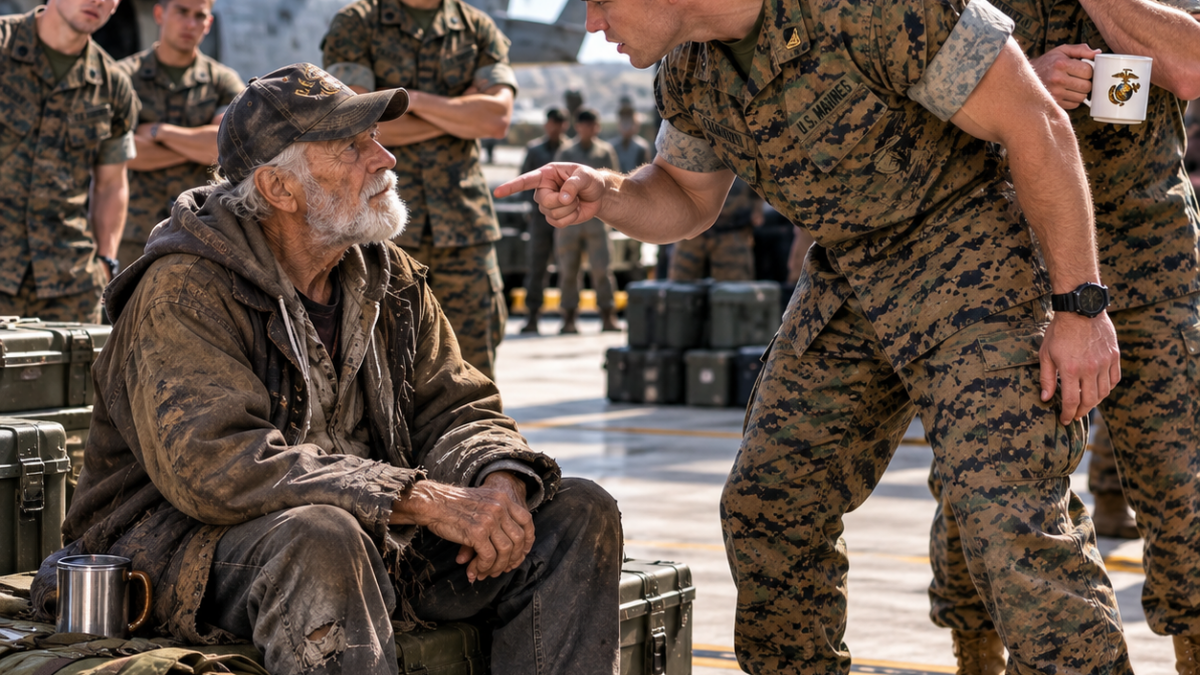
The young Marines thought the gray-bearded man sleeping beneath the overpass beside Miramar was just another homeless drifter until one of them jokingly asked what his MOS had been and the old man quietly answered, “8541 back then—Scout Sniper.”
They were still trying to decide whether he was telling the truth when someone asked if he had ever carried a call sign, and the words “Reaper Storm” made Staff Sergeant Daniel Torres drop his coffee onto the concrete.
Because Torres had heard that name only once before—from his father, a Vietnam Marine who swore that a sniper called Reaper Storm had kept his platoon alive for three days at Khe Sanh and then disappeared before anyone could properly thank him.
The rock hit the concrete six inches from the old man’s boot.
He opened one eye.
That was all.
No flinch.
No curse.
No sudden jump.
Just one pale blue eye opening beneath the brim of a faded green cap.
The boy who had thrown it was seventeen.
His name was Derek Palmer, though the old man didn’t know that.
Didn’t care either.
Derek stood with four friends beneath the freeway overpass less than half a mile from the outer fence line of Marine Corps Air Station Miramar.
They had come down there because bored teenage boys have an instinct for places adults don’t want them to go.
Concrete pillars.
Graffiti.
Dry weeds.
Discarded bottles.
The distant howl of aircraft.
And the old man.
They had seen him before.
Everybody around that section of town had.
He appeared and disappeared so regularly that local workers had started calling him Ghost.
Nobody knew his actual name.
He never held a cardboard sign.
Never asked passing drivers for money.
Never approached restaurants.
Never wandered through neighborhoods looking for cans.
He slept beneath the eastern span with his back against concrete and his face toward the base.
Always facing east.
Always in the same general place.
His belongings fit inside one weathered canvas bag.
His clothes were worn but clean.
Gray beard trimmed short.
PART2:
Boots old enough that the leather had gone almost white around the creases.
And despite everything else about him, the boots were always laced correctly.
Tight.
Even.
Tucked.
A habit.
Derek had noticed that before.
He simply hadn’t understood why it bothered him.
The boys had thrown bottle caps near the old man before.
Once a crushed soda can.
Ghost never reacted.
That made Derek want a reaction more.
Cruelty is sometimes less complicated than adults want it to be.
No tragic childhood.
No deep ideological hatred.
Sometimes somebody is simply young, bored, surrounded by friends, and desperate to make them laugh.
Derek picked up another rock.
This one larger.
His friend Luis said:
“Come on, man.”
Derek grinned.
“What?”
“Leave him.”
“He doesn’t care.”
The old man sat up.
Slowly.
The motion changed everything.
One second he looked asleep.
Next second he was upright, one knee raised, both hands visible, shoulders square.
Not afraid.
Not confused.
Watching.
Derek stopped smiling.
The old man studied the five teenagers exactly the way someone might study traffic before crossing a road.
Not angry.
Assessment.
Distance.
Hands.
Numbers.
Exits.
Derek could not have explained why he knew that.
He only knew he suddenly did not want to throw the rock.
Then one of his friends laughed nervously.
Derek’s pride came back.
He raised his arm.
A voice behind them said:
“Drop it.”
The rock fell.
Not because the command was loud.
Because of how it was said.
Four Marines were walking from a nearby aviation-support facility toward the parking area outside the secured perimeter.
Flight suits.
Coffee cups.
One carried a helmet bag.
The Marine in front was Staff Sergeant Daniel Torres.
Thirty-six.
Aviation maintenance chief.
Broad shoulders.
Close-cut black hair.
Expression normally described by his junior Marines as “you are already in trouble and just don’t know the paperwork number yet.”
Torres approached.
“What are you doing?”
Derek shrugged.
“Nothing.”
“You were about to throw a rock at him.”
“We were messing around.”
“With him?”
Derek looked toward the old man.
“He’s just some homeless guy.”
Torres stopped.
That sentence changed his face.
Not much.
Enough.
“Just?”
Derek realized too late.
Torres pointed toward the sidewalk.
“Go.”
“Sir, I—”
“I’m not your sir.”
He stepped closer.
“But if I see you throwing things at him again, you’re going to explain it to somebody wearing a badge while your parents listen.”
Derek’s friends were already retreating.
Derek looked at the old man once more.
Ghost was standing now.
Canvas bag in one hand.
Slight limp.
Watching.
Derek turned and followed his friends.
Torres waited until all five were gone.
Then faced the old man.
“You all right?”
The old man nodded.
“Fine.”
Voice rough.
Quiet.
Torres noticed something immediately.
The man’s posture.
Not parade-ground perfect.
Age had changed too much for that.
But balanced.
Weight distributed.
Hands relaxed.
He was not standing like a civilian who had just been threatened.
He stood like somebody who had spent a large portion of life learning not to waste movement.
Lance Corporal Noah Ramirez noticed something else.
“Staff Sergeant.”
Torres glanced over.
Ramirez subtly touched his own forearm.
The old man’s sleeve had shifted.
Ink.
Very old ink.
On the left forearm:
An eagle, globe, and anchor.
Not the modern crisp tattoo-shop style.
Blue-green.
Faded into skin.
Beneath it, a scroll nearly unreadable.
On the other arm, partly covered by scar tissue, another image.
Skull.
Bush hat.
Lightning marks behind it.
Torres looked back at the old man.
“Marine?”
The old man was silent.
Torres corrected himself.
“Marine.”
That earned the faintest smile.
“Long time ago.”
Torres straightened unconsciously.
“What era?”
“Old one.”
Ramirez grinned.
He was twenty-two.
Young enough to ask questions before deciding whether they were wise.
“What was your MOS?”
Torres looked at him.
Ramirez shrugged.
“What?”
There was a teasing edge.
Not malicious.
The way young Marines sometimes tested men wearing old military symbols.
The old man looked at Ramirez.
Then at Torres.
“8541.”
Ramirez’s smile disappeared.
The older corporal beside him frowned.
The old man continued:
“Back then.”
Pause.
“What you boys would call scout sniper.”
Nobody laughed.
Ramirez glanced at the scarred forearm again.
“You were a sniper?”
The old man picked up his canvas bag.
“Sometimes.”
Torres’s attention sharpened.
“Unit?”
The old man hesitated.
“First Recon for a while.”
Torres blinked.
“Vietnam?”
“Yeah.”
“What year?”
“Sixty-seven through seventy.”
Torres felt something move in his stomach.
Not recognition yet.
More like the feeling before recognition.
Something aligning.
He had grown up in a house where Vietnam entered conversations indirectly.
His father, Michael Torres, had been there.
Second Battalion, Twenty-Sixth Marines.
Khe Sanh.
Hill fights.
Long patrols.
Mortars.
Names spoken once a year.
His father had rarely described combat directly.
But sometimes after midnight, usually when Daniel was a teenager and Michael had consumed two beers too many, stories came out.
Not heroic stories.
Fragments.
A flooded fighting hole.
A kid from Iowa who could sing every verse of “House of the Rising Sun.”
A corpsman who carried extra socks for everyone.
And one story Daniel had always assumed was partly myth.
A sniper.
Not one of Michael’s platoon.
Recon.
Appeared when things were bad.
His father had called him by a name.
Two words.
Daniel could almost hear them.
But not yet.
Ramirez asked:
“Did you guys even use call signs back then?”
The old man’s eyes moved toward him.
Ramirez smiled.
Again:
Young.
Curious.
Half joking.
“Come on, Gunny. You had a cool nickname?”
The old man’s expression changed.
Torres caught it.
“Ramirez.”
The lance corporal stopped.
“Leave it.”
The old man said:
“It’s all right.”
Then he looked past them.
Toward the fence.
Toward the aircraft beyond it.
One F/A-18 rolled somewhere in the distance.
Its engines rose.
The old man’s face became very still.
Ramirez asked:
“So?”
A long silence.
Then the old man said:
“Reaper Storm.”
Torres dropped his coffee.
The paper cup struck concrete.
Brown liquid splashed his boot.
Nobody moved.
Ramirez looked at him.
“Staff Sergeant?”
Torres stared at the old man.
No.
Impossible.
“Say that again.”
The old man looked back.
“I’d rather not.”
Torres stepped closer.
“What did you say?”
The old man’s shoulders changed slightly.
Defensive now.
Not fear.
Withdrawal.
“I said it once.”
Torres felt his pulse in his throat.
“My father told me that name.”
The old man’s eyes narrowed.
“Your father?”
“Michael Torres.”
Silence.
“Second Battalion, Twenty-Sixth Marines.”
The old man’s face emptied.
Torres added:
“Khe Sanh.”
Then something broke through the old man’s expression.
Recognition.
Not dramatic.
A tiny inhale.
“Little Mike?”
Torres stopped breathing.
Nobody had called his father that in Daniel’s entire life.
The old man looked at him more closely.
“Your father had a scar here.”
He touched beneath his left jaw.
“Mortar fragment.”
Torres whispered:
“Yes.”
“He hated peaches.”
Torres stared.
The old man continued.
“Would trade canned peaches for cigarettes even though he barely smoked.”
Daniel’s eyes burned.
“Yes.”
The old man looked toward the ground.
“He made it home.”
It wasn’t a question exactly.
Torres nodded.
“Thirty-six years.”
“Family?”
“Mom. Me. My sister.”
The old man closed his eyes.
“Good.”
His voice cracked.
“Good.”
Ramirez and the other Marines stood perfectly still.
Torres swallowed.
“My father told me about you.”
The old man looked almost embarrassed.
“He told stories.”
“My father didn’t tell many.”
“That sounds like Mike.”
“He said a recon sniper kept their position alive for three days.”
The old man shook his head.
“Your father liked making stories bigger.”
“He said you stayed forward when everybody else pulled back.”
“That’s not exactly—”
“He said you kept NVA observers and officers from moving onto a ridge overlooking their position.”
The old man’s jaw tightened.
Torres continued:
“He said nobody knew where you slept.”
“Daniel.”
The use of his first name stopped him.
The old man had read the name tape.
Still felt personal.
“Don’t.”
Torres lowered his voice.
“Why?”
“Because your father survived because a lot of Marines did their jobs.”
Nobody spoke.
“Not one man.”
Torres looked at him.
“My father said exactly the opposite.”
That almost made him smile.
“He would.”
Torres stepped closer.
“What is your name?”
The old man hesitated.
“Thomas.”
“Thomas what?”
“Walker.”
Daniel Torres knew the name.
Not from his father.
From somewhere else.
A framed citation?
A book?
An old Marine journal?
He couldn’t place it.
But Ramirez reacted.
“Thomas Walker?”
The old man looked at him.
“Pretty common name.”
Ramirez was already taking out his phone.
Torres said:
“Put it away.”
“Yes, Staff Sergeant.”
Immediately.
Thomas adjusted the strap on his bag.
“I should go.”
Torres looked around.
“Where?”
Thomas shrugged.
“Where I go.”
“You sleep here?”
No answer.
“Mr. Walker.”
“Tom.”
“Tom.”
Torres forced himself to slow down.
“You served with my father.”
“Long time ago.”
“And you’re living under an overpass.”
Thomas’s eyes hardened slightly.
“Those two facts don’t obligate you to fix me.”
Torres heard the warning.
“I wasn’t—”
“Yes, you were.”
Silence.
Thomas looked toward the four Marines.
“You boys did a good thing with those kids.”
He nodded.
“Thank you.”
Then he started walking.
Limp more pronounced now.
Torres watched him.
“Tom.”
The old man stopped.
“My father died eight years ago.”
Thomas did not turn.
“Heart?”
“Cancer.”
Long pause.
“He talk much at the end?”
Torres understood the real question.
“About Vietnam?”
Thomas nodded.
“Some.”
“About the men?”
“Yes.”
Thomas slowly turned.
“Did he ever mention Carlson?”
“I think so.”
“Doc Bennett?”
“Yes.”
“Salazar?”
“My father had a photograph labeled Sal.”
Thomas breathed.
All those dead names still alive somewhere.
Then Torres said:
“He talked about Reaper Storm too.”
Thomas looked almost tired.
“Wish he hadn’t.”
“Why?”
“Because that wasn’t a man.”
“What?”
“It was a story.”
He tapped his chest.
“This is a man.”
Then he walked away.
Torres returned to the hangar forty minutes late.
Nobody said anything.
His master sergeant saw his face and asked:
“Problem?”
Daniel said:
“I think I just met a ghost.”
Word spread anyway.
It started with Ramirez.
Not maliciously.
He told another lance corporal:
“Staff Sergeant met some Vietnam sniper under the overpass.”
That Marine told a sergeant.
By lunch somebody had searched public veteran archives.
Thomas Edward Walker.
Marine Corps.
Born 1947.
Enlisted 1966.
Vietnam.
Reconnaissance.
Sniper training.
Purple Heart.
Bronze Star with combat distinguishing device.
Additional commendations.
Records incomplete in public databases.
No photo recent enough to compare.
The nickname “Reaper Storm” produced almost nothing official.
But old veteran forums contained fragments.
Reaper.
Storm Walker.
A recon shooter attached temporarily to multiple units.
One account from a retired Marine referred to:
Tom “Storm” Walker, the quiet bastard who showed up when everything went bad.
Another post, fifteen years old:
If you were near Khe Sanh in ’68 and heard people talk about Reaper, they meant Walker. Don’t believe the kill-count garbage. He’d hate that. What mattered was he could stay out forever and always seemed to know where trouble was coming from.
That sounded more like the man under the overpass.
Daniel did not like what happened next.
Marines became curious.
Not cruel.
But curiosity can still turn a person into an exhibit.
By evening, three young Marines drove past looking for Thomas.
He wasn’t there.
Next morning:
Gone.
Canvas bag.
Blanket.
Everything.
Torres felt sick.
“You scared him off,” he told Ramirez.
“I didn’t mean—”
“I know.”
“Staff Sergeant, I just told—”
“I know.”
Daniel rubbed his face.
“That’s the problem.”
Thomas returned three nights later.
Not to the same spot.
A hundred yards farther east.
Daniel found him because he had begun driving the frontage road after shift.
He parked.
Approached alone.
No uniform blouse.
Just undershirt and utility trousers.
Thomas saw him coming.
“You’re persistent.”
“My father said the same about you.”
“He used worse language.”
“I know.”
Daniel stopped several feet away.
“Can I sit?”
Thomas looked at concrete.
“Free country.”
Daniel sat.
For a while neither spoke.
Jets moved beyond fence.
Night operations.
The low vibration passed through the overpass.
Thomas visibly relaxed when he heard it.
Daniel noticed.
“You like the aircraft?”
Thomas looked toward lights.
“Routine.”
“What?”
“Sounds happen when they’re supposed to.”
Daniel waited.
Thomas continued:
“Engines spool.”
“Aircraft move.”
“People know where they’re going.”
He tapped concrete beside him.
“Out here, I know what tomorrow sounds like.”
Daniel understood more than Thomas wanted him to.
“You ever use the VA?”
Thomas laughed once.
“Of course.”
“Benefits?”
“Some.”
“Housing?”
“Had it.”
“What happened?”
Thomas didn’t answer.
Daniel said:
“You don’t owe me that.”
“Correct.”
Silence again.
Then Thomas surprised him.
“My wife died.”
Daniel turned.
“You were married?”
“Twenty-nine years.”
The internet would later claim Thomas never married.
The internet liked legends cleaner than humans.
“Her name was Helen.”
“What happened?”
“Ovarian cancer.”
“I’m sorry.”
Thomas nodded.
“House got quiet.”
He rubbed his hands.
“I didn’t handle quiet well.”
“You have kids?”
“No.”
“Family?”
“Sister in Iowa.”
“You talk?”
“Christmas.”
Daniel almost asked why only Christmas.
Stopped himself.
Thomas noticed.
“Learning.”
“What?”
“Not asking every question.”
Daniel smiled.
“My father said Marines can be trained.”
“Slowly.”
Another jet screamed into the night.
Thomas closed his eyes.
Daniel said:
“You stay near Miramar because of that?”
“Partly.”
“What else?”
Thomas gestured toward base.
“Marines.”
“You miss it?”
“No.”
Immediate.
Then:
“Yes.”
More honest.
Daniel nodded.
Thomas looked at him.
“You expecting me to tell you combat was the best time of my life?”
“No.”
“Good.”
“It wasn’t.”
Pause.
“It was the clearest.”
Daniel understood that distinction.
Mission.
Task.
Brother.
Direction.
Then return home to a world requiring decisions no operations order explained.
Thomas said:
“Your dad understood that.”
“He struggled?”
“Everybody did.”
“My father never talked about struggling.”
“Your father was a liar.”
Daniel laughed.
Thomas smiled.
“There.”
“What?”
“You got Mike’s laugh.”
That nearly broke him.
Daniel looked away.
Thomas said:
“He used to laugh when mortars landed too close.”
“My mother would’ve killed him.”
“Probably why he married her.”
They sat another hour.
Before leaving, Daniel wrote his number on paper.
Thomas looked at it.
“I don’t need saving.”
“It’s not a rescue number.”
“What is it?”
“A Marine’s number.”
Thomas stared.
Daniel put it beside his canvas bag.
“Use it if you want.”
“Why?”
“Because my father would kick my ass if I didn’t.”
Thomas smiled.
“That I believe.”
Weeks passed.
Daniel visited without schedule.
Sometimes Thomas was there.
Sometimes gone.
He never brought a group.
Never brought a camera.
Sometimes coffee.
Thomas disliked expensive coffee.
Preferred gas-station black.
Once Daniel brought a sandwich.
Thomas said:
“I have food.”
“Then don’t eat it.”
Thomas ate it.
Their conversations came in pieces.
Daniel learned Thomas had enlisted at nineteen.
Not because of patriotism.
His father had thrown him out.
The Marines were hiring.
He discovered he was good at being uncomfortable.
Good at staying still.
Good at noticing.
Recon noticed too.
Sniper school followed.
The MOS number was complicated.
Back then, classification and specialty designations did not map neatly onto modern terminology.
Thomas described himself simply:
“Rifleman who got specialized.”
Daniel asked about Reaper Storm once.
Thomas refused.
Second time, months later, he explained.
“Storm was mine.”
“Reaper?”
“Somebody else added it.”
“Who?”
“Don’t know.”
“Enemy?”
“Maybe Marines.”
He hated the nickname.
“Why?”
“Names like that turn killing into personality.”
Daniel said nothing.
Thomas continued:
“I was good at a job.”
“That’s all.”
“People like making that into something supernatural.”
“Were the stories about Khe Sanh true?”
“Parts.”
“Did you save my father’s platoon?”
“No.”
Daniel frowned.
Thomas pointed toward him.
“Your father saved his platoon.”
“His corpsman saved people.”
“Machine gunners did.”
“Mortar crews did.”
“Supply people got ammunition there.”
“Some idiot pilot brought resupply into weather that should’ve closed the sky.”
He leaned back.
“I had a rifle.”
“That doesn’t make me the story.”
Daniel remembered his father saying nearly the same thing about himself.
That was when he began to believe everything.
Not the mythology.
The man.
One Saturday Daniel brought an old photograph.
He had driven to his mother’s house and searched boxes.
Vietnam.
Seven Marines standing beside sandbags.
His father, Michael, twenty-one.
Thin.
Grinning.
At far edge:
A tall young Marine in a boonie hat.
Face turned partly away.
Daniel held it out.
Thomas took the photo.
His hands began shaking.
Not much.
Enough.
“That’s Carlson.”
He touched one face.
“Salazar.”
Another.
“Doc.”
Then Michael.
“Little Mike.”
He stopped at himself.
“Jesus.”
Daniel smiled.
“You were skinny.”
“So were you.”
“I’m not in that picture.”
“Exactly.”
Thomas stared.
“I haven’t seen this.”
“My father kept it.”
On back, in Michael’s handwriting:
KHE SANH. SOME OF THE MEN WHO GOT ME HOME.
Thomas looked away.
Daniel pretended not to notice his eyes.
Thomas gave photo back.
“Keep it.”
“I made a copy.”
“Daniel.”
“My father kept it for fifty years.”
He placed it in Thomas’s hands.
“Your turn.”
Thomas accepted.
That night, he slept with the photograph inside his jacket.
The teenage boys returned once.
Derek came alone.
Thomas was sitting beneath overpass.
The boy stopped twenty feet away.
Thomas looked up.
Derek held a grocery bag.
“I brought you something.”
Thomas looked at the bag.
“Why?”
Derek swallowed.
“My mom found out.”
Thomas almost smiled.
“She make you?”
“Kind of.”
“Then take it home.”
Derek’s face fell.
Thomas watched him.
“Why’d you throw the rock?”
Derek shrugged.
“Friends.”
“That’s not why.”
Derek looked embarrassed.
“I wanted them to think I wasn’t scared.”
“Of me?”
“No.”
“Of what?”
Derek had no answer.
Thomas did.
“Being small.”
The boy looked up.
Thomas tapped the concrete.
“Sit.”
Derek sat.
Not close.
Thomas said:
“You know something about groups?”
“What?”
“They’ll lend you courage.”
“Okay.”
“Then charge interest.”
Derek frowned.
Thomas smiled.
“You’ll understand later.”
Derek pushed the grocery bag closer.
Thomas looked inside.
Jerky.
Water.
Socks.
Apples.
Thomas took the socks.
“Keep the rest.”
“Why socks?”
“Always useful.”
Derek laughed.
“Okay.”
Before leaving, the boy asked:
“Were you really a sniper?”
Thomas sighed.
“Who told you?”
“People.”
“People talk too much.”
“Did you kill a lot of people?”
There it was.
Always.
Thomas looked at Derek until the boy became uncomfortable.
Then:
“Enough that I stopped counting the question as interesting.”
Derek’s face changed.
Thomas continued:
“You want to know something worth knowing?”
“Yeah.”
“Most men who come back from war remember the people they couldn’t help more clearly than the people they hurt.”
Derek swallowed.
“I’m sorry about the rock.”
Thomas nodded.
“Don’t throw another.”
“I won’t.”
“Good.”
That was forgiveness.
No speech required.
By winter, Daniel knew something was wrong physically.
Thomas lost weight.
His limp worsened.
Sometimes he pressed a hand to his abdomen.
“Doctor.”
“No.”
“Tom.”
“No.”
“You’re being stupid.”
“Probably.”
Daniel brought a VA outreach worker named Karen Lee.
Thomas walked away before they reached him.
Daniel chased him.
“Will you stop?”
“No.”
“You’re seventy-six.”
“Seventy-seven.”
“Even worse.”
Thomas stopped.
“Don’t ambush me.”
Daniel knew immediately he had crossed a line.
“Okay.”
“I mean it.”
“Okay.”
“You bring people here without asking again, we’re done.”
Daniel nodded.
“Understood.”
Karen waited by car.
Daniel apologized.
Thomas said:
“Good.”
Then added:
“Give me her card.”
Progress.
He called two weeks later.
Medical appointment.
Daniel drove.
Thomas complained the entire way.
Hospital found colon cancer.
Advanced.
Treatable options existed.
Thomas listened.
Asked clear questions.
Declined aggressive surgery.
Accepted palliative treatment and symptom management.
Daniel hated it.
“You could fight.”
Thomas looked at him.
“Don’t use that word with me.”
Daniel stopped.
“Cancer isn’t a man.”
“There’s no courage test.”
“There’s no mission failure.”
He tapped the medical folder.
“I get to choose what I spend what’s left on.”
Daniel nodded.
Hard.
But nodded.
Thomas accepted temporary veteran housing near the base.
Not because anyone publicly celebrated Reaper Storm.
Because Karen found a program allowing him privacy and minimal supervision.
Small studio.
Bed.
Shower.
Window facing west.
He spent first night awake.
Second too.
Third he called Daniel.
“I hate it.”
“Why?”
“Too quiet.”
Daniel brought a white-noise machine.
Thomas hated that more.
Then Ramirez had an idea.
He found recordings of flight-line ambience.
Thomas called it ridiculous.
Used it every night.
Word about him had spread inside unit despite everyone’s attempts to contain it.
A captain asked to meet him.
Thomas said no.
A gunnery sergeant who had read about Vietnam recon asked.
No.
Base historian.
No.
Public affairs.
Absolutely not.
One young corporal wrote a letter instead.
Thomas read it.
The Marine thanked him not for combat stories but for remaining near the base because seeing an older veteran outside reminded him how much military service could cost after uniforms came off.
Thomas read it twice.
Then wrote back:
Don’t make me into a warning either. Live well. Ask for help before pride makes the decision for you.
Daniel saw that answer.
“You should follow your own advice.”
Thomas gave him the finger.
Marine to the end.
Spring came.
Thomas weakened.
Daniel’s father had been gone nine years now.
His mother, Elena, asked to meet Thomas.
He resisted.
Then agreed.
She was seventy-eight.
Walked into the small apartment.
Thomas stood from chair.
Nearly fell trying.
Elena crossed room.
“Sit down, you idiot.”
Thomas froze.
Then laughed.
“My Mike married correctly.”
Elena hugged him.
Hard.
Thomas cried.
No attempt to hide it.
She had brought another box.
Michael’s letters from Vietnam.
Thomas’s name appeared seventeen times.
Not Reaper.
Tom.
Walker.
That crazy recon kid.
The sniper.
The bastard who found us cigarettes.
One letter:
Walker says I will make it home because I complain too much for God to want me early.
Thomas laughed.
Then cried again.
Elena held his hand.
“My husband never forgot you.”
Thomas whispered:
“I didn’t do enough.”
She slapped the back of his hand.
Not hard.
“Don’t insult my husband.”
Thomas stared.
“He said you did.”
Thomas could not answer.
Elena continued:
“You don’t get to tell a dead man his gratitude was mistaken.”
Daniel turned away.
Even Staff Sergeant Torres occasionally knew when his mother outranked everybody.
Thomas finally nodded.
“Yes, ma’am.”
Elena smiled.
“Good Marine.”
The legend of Reaper Storm became smaller after that.
Better.
To Daniel, Thomas was no longer the mysterious sniper from childhood stories.
He was the man who hated broccoli.
Who cheated at cribbage and denied it.
Who knew every aircraft sound but pretended not to.
Who kept six pairs of identical socks because Derek still brought them once a month.
Who woke from nightmares.
Who occasionally went three days without answering anyone.
Who remembered the birthdays of men dead before Daniel was born.
Who refused to let anyone call him hero in his apartment.
One day Ramirez visited.
He had been the Marine who asked the MOS question.
He carried two coffees.
Thomas looked suspicious.
“What do you want?”
“Advice.”
“Terrible idea.”
Ramirez sat.
“I reenlisted.”
“Condolences.”
“I’m serious.”
“So am I.”
Ramirez smiled.
Then:
“Why did you stay in so long?”
Thomas thought.
“I didn’t.”
“What?”
“I left after twelve.”
Ramirez had assumed retirement.
Most people did.
“What happened?”
“Got tired.”
“That’s it?”
“No.”
Thomas looked at his scarred hands.
“I started liking parts of myself I shouldn’t have.”
Ramirez did not understand.
Thomas continued:
“Being useful in war can become intoxicating.”
“People listen.”
“You’re needed.”
“Your senses sharpen.”
“Your decisions matter immediately.”
He looked toward window.
“Then you come home and nobody needs that version of you.”
Ramirez listened.
“So what do you do?”
“I didn’t know.”
“Still don’t.”
“That’s not inspiring.”
Thomas smiled.
“Truth usually isn’t.”
Ramirez asked:
“Do you regret serving?”
Thomas answered immediately.
“No.”
Then:
“Yes.”
Ramirez looked confused.
Thomas shrugged.
“Both can be true.”
That was another lesson the young Marine carried for years.
By early summer, cancer moved faster.
Hospice came.
Thomas wanted no ceremony.
No press.
No base commander procession.
Daniel honored it.
Mostly.
One evening Thomas called.
First time he initiated without logistics.
“Daniel.”
“Yeah?”
“Come tomorrow.”
“What time?”
“Early.”
Daniel understood.
He arrived at 5:20 a.m.
Ramirez came.
Karen Lee.
Elena Torres.
Derek, now eighteen, had somehow become part of strange little family.
Thomas lay near window.
Too weak to stand.
Flight operations beginning in distance.
He listened.
Daniel sat beside him.
Thomas whispered:
“Your dad would laugh.”
“At what?”
“You.”
“Why?”
“Staff Sergeant.”
Daniel smiled.
“He’d probably say I got lucky.”
“He’d be right.”
Thomas reached toward small table.
Canvas bag.
Daniel handed it.
Inside were few things.
Photograph.
Notebook.
Old EGA.
A folded envelope.
And one weathered patch.
No dramatic skull.
Just an old hand-sewn rectangle.
R. STORM.
Daniel looked.
“That was you?”
Thomas nodded.
“Recon boys shortened everything.”
“What do I do with it?”
“Whatever.”
“Museum?”
“No.”
“Family?”
Thomas looked at Elena.
Then Daniel.
“Give it to someone who understands it’s cloth.”
Daniel nodded.
Thomas closed his eyes.
Then opened again.
“Daniel.”
“I’m here.”
“Your father made it home.”
“Yes.”
“I needed to know that.”
Daniel’s throat closed.
“He made it home.”
“Good life?”
“Good life.”
“Loved my mom.”
Elena squeezed Thomas’s hand.
“Three grandchildren.”
Thomas smiled.
“Good.”
Daniel leaned closer.
“My father lived long enough to meet all of them.”
Thomas breathed out.
Something seemed to leave him.
Not life.
Burden.
“Good.”
His last hours were quiet.
No perfect sunrise timing.
No final salute.
No cinematic speech.
Around 7:40, a jet passed overhead.
Thomas opened his eyes.
Listened.
Daniel said:
“Hornet.”
Thomas whispered:
“Wrong.”
Ramirez laughed through tears.
“F-35.”
Thomas smiled faintly.
“Kids.”
That was almost his last word.
At 8:16 a.m., Thomas Walker died with Daniel Torres holding one hand and Elena holding the other.
Derek stood at foot of bed crying.
Ramirez did not hide his tears.
Karen closed Thomas’s eyes.
For several minutes, nobody spoke.
Then Elena said:
“Well.”
Everyone looked.
“He was difficult.”
Daniel laughed.
So did Ramirez.
Even Derek.
It was exactly the kind of goodbye Thomas would have tolerated.
His service record took months to reconstruct properly.
Not because it had been magically classified.
Because records from that era were incomplete, scattered, sometimes incorrect, and full of administrative gaps.
The truth was impressive without mythology.
Reconnaissance.
Scout-sniper duties.
Multiple combat operations.
Bronze Star with valor device.
Purple Heart with additional awards for subsequent wounds.
Navy Commendation with combat distinguishing device.
Other campaign and unit decorations.
No impossible secret kill count.
No mystical bounty verified by Pentagon files.
The name Reaper Storm appeared in letters, oral histories, and unofficial recollections.
A field legend.
That was enough.
Daniel refused media requests that turned Thomas into a supernatural assassin.
One producer wanted to call the segment:
AMERICA’S DEADLIEST FORGOTTEN SNIPER.
Daniel hung up.
At the memorial, he spoke instead about what Thomas had actually taught him.
The chapel was full.
Not because a viral post had spread.
Because Marines tell Marines.
Veterans came.
Some knew Thomas personally.
Some only knew stories.
A few had served with men Thomas had helped.
Derek sat in back with his mother.
He wore a collared shirt.
No rocks.
Ramirez stood beside him.
Daniel approached podium.
He unfolded paper.
Then folded it again.
Didn’t use it.
“My father told me about Thomas Walker when I was a boy.”
He looked over room.
“He told me about a Marine who appeared when things were bad.”
“A man who could read terrain.”
“A man who stayed calm.”
“A man people trusted.”
Daniel paused.
“For most of my life, I thought that story was about combat.”
He looked toward Thomas’s photograph.
“It wasn’t.”
“It was about what one human being becomes in another person’s memory.”
Silence.
“My father remembered Thomas as the man who helped him survive.”
“I met Thomas living under an overpass.”
“That difference bothered me.”
“It made me angry.”
“I wanted to fix it.”
Daniel shook his head.
“Thomas hated that.”
A few people laughed.
“He taught me something I should’ve known.”
“A person does not stop belonging to himself because you discover something impressive about his past.”
“He did not become more deserving of dignity when I learned his MOS.”
“He did not become more human when I learned his nickname.”
“He was already those things while teenagers threw rocks at him.”
Daniel’s voice tightened.
“And while Marines walked past him.”
Ramirez lowered his head.
Daniel continued:
“Thomas was proud of serving.”
“He was also wounded by it.”
“He loved Marines.”
“He also needed distance from them.”
“He wanted help sometimes.”
“He rejected it other times.”
“He was brave.”
“He was stubborn.”
“He could be generous.”
“He could be impossible.”
“He was not a legend.”
Pause.
“He was a man.”
That was the line people remembered.
After the service, Elena handed Daniel the old patch.
R. STORM.
“What do we do?”
Daniel looked at it.
Thomas’s instruction:
Give it to someone who understands it’s cloth.
Daniel gave it to Derek.
The boy stared.
“I can’t take this.”
“Yes, you can.”
“Why me?”
Daniel looked at him.
“Because you met him before you knew who he was.”
Derek went pale.
“That’s exactly why I shouldn’t.”
“No.”
Daniel put patch in his hand.
“That’s exactly why you should.”
Derek looked down.
Daniel said:
“You threw a rock at a homeless man.”
“Yes.”
“You apologized to Thomas.”
“Yes.”
“He forgave you.”
Derek nodded.
“So keep this.”
“Not as a trophy.”
“As a reminder.”
“Of what?”
Daniel answered:
“That respect comes before biography.”
Derek cried again.
Years later, that patch stayed in a frame above his desk.
Derek became an EMT.
Not because Thomas told him to.
Thomas never did.
But the afternoon under the overpass had changed the direction of something.
His first week as an EMT, Derek responded to a call involving an intoxicated homeless veteran yelling near a bus station.
Police had already arrived.
The man smelled terrible.
Swore constantly.
Refused to sit.
Another responder muttered:
“Another one.”
Derek heard Thomas.
Respect comes before biography.
He approached slowly.
“Sir.”
The man snapped:
“Don’t call me sir.”
“All right.”
“What do you want me to call you?”
The man stared.
Then:
“Ray.”
“Okay, Ray.”
Ten minutes later Ray allowed blood pressure check.
Twenty minutes later he agreed to hospital.
No legend reveal.
No medals.
No secret history.
Just a sick man receiving care.
Derek understood then that Thomas’s story would have been weaker if every homeless veteran turned out to be Reaper Storm.
Dignity cannot depend on surprise.
Daniel Torres remained in the Marine Corps another nine years.
Eventually became a master sergeant.
Young Marines occasionally heard the story.
Versions spread.
Some said Thomas had five Silver Stars.
Wrong.
Some said his Navy Cross was classified.
Wrong.
Some said an enemy general put a million-dollar bounty on him.
Probably nonsense.
Daniel corrected what he could.
One afternoon a lance corporal asked:
“Master Sergeant, doesn’t correcting it make the story less cool?”
Daniel looked at him.
“No.”
“Why?”
“Because if you need lies to respect the man, you missed the point.”
The lance corporal nodded.
Daniel pointed toward an elderly civilian janitor cleaning the passageway.
“You know his name?”
“No, Master Sergeant.”
“Go learn it.”
The Marine looked confused.
“Why?”
“Practice.”
Years passed.
Miramar changed.
Aircraft changed.
Buildings changed.
The overpass remained.
The city periodically cleared encampments.
Outreach teams worked the area.
Nobody renamed a road after Thomas.
Daniel thought Thomas would have hated it anyway.
Instead, a veterans nonprofit working near the base created a small outreach fund.
No heroic name.
No sniper silhouette.
Just:
THE WALKER FUND.
Transportation.
Temporary lodging.
Document replacement.
Medical appointment rides.
Small practical things.
Karen Lee suggested the motto.
Daniel approved.
NO ONE BECOMES INVISIBLE.
That would have embarrassed Thomas too.
But less.
Elena died at eighty-six.
At her funeral Daniel found the photograph of Michael and Thomas displayed beside family pictures.
This time he noticed something written faintly in a corner.
His father had added it years after Vietnam.
TOM WALKER — THE QUIET ONE.
Daniel smiled.
Of all descriptions:
Not Reaper.
Not Storm.
Not sniper.
The quiet one.
That fit.
Ramirez eventually became a staff sergeant.
His Marines learned quickly not to mock strangers.
Not because he lectured constantly.
Because when somebody made a cheap joke about an old veteran, Ramirez would ask:
“What was his MOS?”
Then when the Marine shrugged:
“No idea.”
Ramirez answered:
“Exactly.”
That usually ended it.
On the twentieth anniversary of Michael Torres’s death, Daniel visited his father’s grave.
He brought Thomas’s photograph.
Sat.
Talked aloud.
Felt stupid.
Kept talking.
“Found your guy, Dad.”
Wind moved through cemetery trees.
“He was a pain in the ass.”
Daniel laughed.
“You would’ve loved him.”
Then:
“He wanted to know if you had a good life.”
Daniel looked at the headstone.
“I told him yes.”
His voice broke.
“Hope I wasn’t wrong.”
He stayed until sunset.
Before leaving he placed no patch.
No medal.
Just one small stone.
Because monuments are mostly for the living.
The final thing Thomas left Daniel was the canvas bag.
Inside, beneath clothes and medical papers, Daniel eventually found a small notebook.
Not combat logs.
Names.
Dozens of them.
Some crossed out.
Some with dates.
Michael Torres.
Carlson.
Bennett.
Salazar.
Helen Walker.
Karen Lee.
Daniel Torres.
Noah Ramirez.
Derek Palmer.
Beside several names, one or two words.
Michael Torres — got home.
Helen — stayed.
Daniel — asks too many questions.
Ramirez — good kid.
Derek — learning.
At bottom of last page:
Still here.
Daniel stared for a long time.
He had spent years thinking Thomas stayed beside Miramar because the aircraft made him remember war.
That was only partly true.
Thomas had stayed because the sounds proved life was continuing.
New Marines.
New jets.
New missions.
Young men making mistakes.
Learning.
Growing old.
The world kept moving after his friends stopped.
Maybe he needed to hear that.
The hangar story became part of Daniel’s family too.
His daughter Sofia was sixteen when she finally asked:
“Dad, what did Grandpa actually say about Reaper Storm?”
Daniel thought back.
Michael at kitchen table.
Older.
A beer.
Eyes somewhere far away.
“He said there was a Marine you wanted nearby when things got bad.”
“That all?”
“No.”
“What else?”
Daniel smiled.
“He said he was weird.”
Sofia laughed.
“What kind of weird?”
“Quiet.”
“That isn’t weird.”
“In our family it is.”
She rolled her eyes.
Then:
“Did Grandpa know he was homeless?”
“No.”
“Would that have upset him?”
“Yes.”
“Why?”
“Because Grandpa would’ve thought Thomas deserved better.”
Sofia considered.
“Did Thomas think he deserved better?”
Daniel paused.
“That was more complicated.”
“Why?”
“Because deserving help and being ready to accept help are different things.”
She nodded slowly.
That answer stayed with her.
Thomas’s story never stopped changing the people around him.
Not because he was Reaper Storm.
Because eventually everyone realized that name was the least important part.
It had frozen the Marines beneath the overpass because they suddenly believed they were standing beside history.
What they learned afterward was harder.
They had already been standing beside a human being before they knew the history.
The old clothes did not erase his service.
The service did not erase his suffering.
The medals did not make homelessness noble.
Homelessness did not make him worthless.
The sniper stories did not explain every scar.
And helping him did not entitle anyone to rewrite his life into a clean patriotic ending.
Thomas Walker remained complicated until the end.
That was honest.
Daniel eventually retired from the Marines.
At his ceremony, Ramirez attended.
Karen.
Derek.
Sofia.
Daniel wore his blues.
After speeches, somebody asked which Marine had influenced him most.
Everyone expected his father.
Daniel answered:
“Two.”
“My father.”
“And a homeless old man who told a lance corporal his MOS.”
People smiled.
Daniel continued:
“The first taught me what service looks like.”
“The second taught me what service does not entitle you to.”
Silence.
“It does not entitle you to worship.”
“It does not make you better than civilians.”
“It does not guarantee you a good life.”
“It does not erase mistakes.”
“And it should never be required before another human being earns your basic respect.”
After ceremony, Ramirez found him.
“You got soft.”
Daniel smiled.
“Old.”
“Same thing.”
They walked outside.
Jets overhead.
Daniel stopped.
Listened.
“Thomas would’ve liked that.”
Ramirez looked up.
“F-35?”
Daniel nodded.
“Still sounds wrong.”
“You sound like him.”
“Watch yourself.”
Years later, Daniel returned to the overpass one last time.
City had cleaned the area.
Fresh paint.
Fence repaired.
No bedding.
No canvas bag.
Traffic still thundered overhead.
He stood where Thomas used to sit.
The concrete was warm from afternoon sun.
A group of teenagers passed on bicycles.
One looked at him.
Kept going.
Daniel smiled.
Maybe that was enough.
He thought about the first day.
Derek holding a rock.
Ramirez grinning.
Thomas’s sleeve sliding up.
The question:
What was your MOS?
Thomas answering:
Then the other question.
Call sign?
Reaper Storm.
Daniel’s coffee hitting concrete.
The whole world rearranging itself in a second.
For years, Daniel had thought that was the moment everything changed.
Eventually he understood it wasn’t.
The important moment happened earlier.
Before the MOS.
Before Reaper Storm.
Before Vietnam.
Before Michael Torres.
The important moment was when four Marines saw teenagers throwing rocks at an old homeless man and stepped in.
At that point they did not know whether Thomas had ever worn a uniform.
They did not know whether he’d been brave.
They did not know whether he’d saved anyone.
They only knew somebody vulnerable was being treated cruelly.
That should have been enough.
Everything else was history.
And history, Thomas would have said, was just what people added afterward because they were uncomfortable admitting that basic decency should never have required a legend.




