A Hiker Found a Starving Cat Nine Miles Deep in the Wilderness—Then He Saw the Three Kittens Hidden in a Hole She Dug With Her Own Paws.
PART3:
Nothing human within miles except old survey markers and the trail under my boots.
I checked my watch.
12:18 p.m.
If I wasted too much time, I wouldn’t finish the section.
I almost kept going.
That fact still bothers me.
People like to imagine that when something important happens, you feel it immediately.
Music swells.
Instinct speaks.
You know.
I didn’t know.
I was sweaty, tired, irritated, and thinking about mileage.
I picked up the cutter.
Then the cat cried again.
Longer.
Rough.
Desperate.
I put the machine down.
“All right.”
I stepped off the trail.
The sound came from a thick stand of mountain laurel about thirty feet downhill.
Getting through it was miserable.
Branches caught my pack.
Briars grabbed my pants.
At one point I nearly turned back because I couldn’t tell whether I’d heard the sound correctly.
Then something brown moved near a fallen hemlock.
I froze.
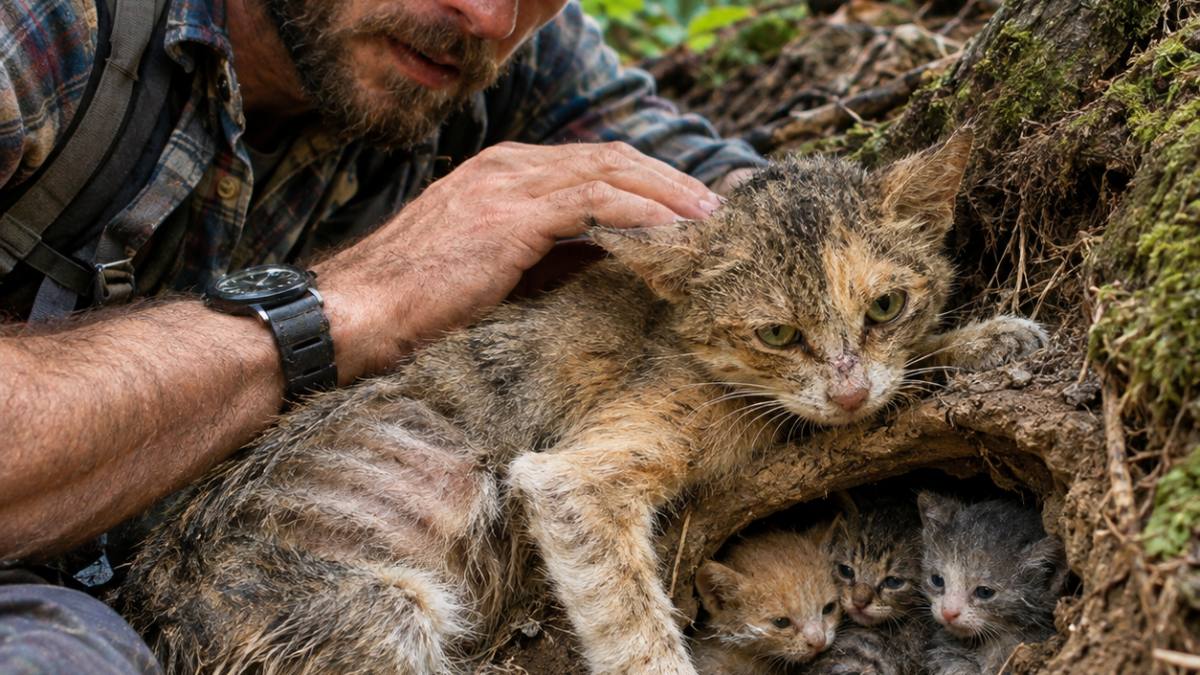
A cat sat beside the trunk.
Small tabby.
Brown and black stripes.
White under the chin.
She was looking directly at me.
My first reaction was relief.
Alive.
My second was horror.
She was so thin that her hips made two sharp points beneath her coat.
Her spine rose visibly along her back.
Her fur was dull and tangled with burrs.
One ear had a torn edge.
Her eyes looked enormous because everything else had disappeared.
I crouched slowly.
“Hey, sweetheart.”
She didn’t run.
That was wrong.
A feral cat that deep in the woods should have vanished the second she saw me.
Even a lost domestic cat would usually retreat from a stranger.
This one stayed.
Her body was tense.
Ears low.
Eyes fixed on me.
But she didn’t move.
I took one step.
She opened her mouth.
A raspy warning came out.
Not strong enough to be a proper hiss.
I stopped.
“Okay.”
She stared.
I took off my pack.
Set it down.
Then I noticed the ground beneath her.
At first, I thought she was sitting over a depression.
Then something moved.
A tiny gray-brown head appeared between her front legs.
I actually said:
“No way.”
The cat lowered her chest.
The little head disappeared.
I leaned sideways.
There was an opening in the soil.
Maybe eight inches deep.
Narrow.
Dug between two exposed roots of the hemlock.
Inside were kittens.
Three.
All pressed together.
Their eyes were open.
Their ears upright.
Maybe four weeks old.
One tabby.
One black.
One tortoiseshell.
They stared at me from underneath their mother’s body.
I sat down hard on the forest floor.
For a few seconds, I forgot about the trail.
The mileage.
The heat.
Everything.
“Jesus.”
The mother cat kept herself over the hole.
Her belly practically sealed the entrance.
I moved slightly.
So did she.
Not away.
Across.
Blocking me.
That was when I understood.
She wasn’t too weak to leave.
She was refusing.
Because leaving would expose them.
I backed up a foot.
Her ears rose slightly.
“Okay.”
I kept my hands visible.
“I’m not taking them.”
Obviously, she didn’t understand English.
But I talked anyway.
People do that around frightened animals because sometimes the voice is really for ourselves.
I took out my water bottle.
Poured some into a collapsible bowl.
Placed it several feet away.
The cat looked at it.
Then at me.
She didn’t move.
I opened my lunch.
Turkey sandwich.
Not ideal for a starving cat.
Better than nothing in an emergency, maybe, but I was afraid she’d eat too fast or react badly.
I had a pouch of tuna in my pack because I liked it on crackers.
I opened it.
The smell reached her.
Her head turned.
That was the first time she looked away from me.
I placed a small amount beside the water.
Backed up.
She didn’t move.
Five minutes.
Ten.
Then one kitten squeaked from the hole.
The mother looked down.
Licked its head.
I noticed her abdomen.
She was nursing.
That realization hit harder than seeing the bones.
This cat was producing milk.
Out here.
On almost nothing.
I knew enough about animals to understand what that meant.
Everything she ate was being divided four ways.
Maybe more accurately, she was eating for them first and surviving on whatever was left.
I pulled out my phone.
No service.
Of course.
Nine miles from the trailhead.
Another two from reliable reception.
I had a satellite emergency beacon, but this wasn’t a human life-threatening emergency.
At least not yet.
I needed to decide what to do.
I couldn’t simply leave them.
I also couldn’t easily carry four cats nine miles.
I had no carrier.
No box.
Only my pack, jacket, water, tools, and first-aid kit.
I studied the nest.
That’s when I noticed the scratches.
The soil wasn’t naturally shaped.
Claw marks covered the edges.
Small channels had been dug around the higher side, shallow grooves directing water away from the hole.
Leaves lined the bottom.
Not random leaves.
Shredded.
Pulled together.
A nest.
She had built it.
I looked at her paws.
The pads were raw.
One had cracked.
Soil packed beneath the claws.
I whispered:
“You did all this?”
She blinked.
I walked around the fallen tree carefully.
There were tiny bones nearby.
Voles, maybe.
Feathers.
Part of a beetle shell.
She had been hunting.
Enough to stay alive.
Not enough to stay healthy.
I saw disturbed soil near the opposite side of the trunk.
Scratches on bark.
A clump of gray fur caught on a splinter.
Not hers.
Could have been raccoon.
Fox.
Something had come near.
And she had fought.
I looked back at her.
“You are unbelievable.”
She didn’t care.
One kitten pushed forward.
The mother immediately turned.
Used her nose to shove it back.
Then covered the opening again.
I took another look at my watch.
12:51.
There was no way I was finishing trail work.
I started planning.
My fleece jacket was rolled in the pack.
I laid it open.
I had two bandanas.
Paracord.
A rain shell.
If I could create a sling, maybe I could carry them against my chest.
The problem was getting the mother to trust me.
I slid the tuna slightly closer.
Then the water.
Backed away.
Eventually, hunger won.
She rose.
The moment she moved, I saw just how bad she was.
Her legs shook.
Her stomach hung loose beneath an almost skeletal frame.
When she took three steps toward the food, her back legs nearly folded.
I clenched my jaw.
She ate.
Fast.
Too fast.
I moved the remaining tuna away.
She growled.
Weakly.
“I know.”
I gave her a little more.
Then waited.
Water.
More food.
Tiny amounts.
She kept looking back at the hole.
Every few seconds.
The kittens stayed quiet.
After maybe twenty minutes, I moved closer.
The mother stiffened.
I held my hand low.
She smelled my fingers.
Then something unexpected happened.
She leaned forward.
Barely.
Her forehead touched one knuckle.
Just once.
Domestic.
That was the word that entered my mind.
Not feral.
Not born out there.
Somebody had touched this cat before.
Somebody had fed her from bowls.
Somebody had probably let her sleep on furniture.
And somehow she was nine miles inside a wilderness area.
I felt anger before I had any proof.
“You belonged to somebody.”
She blinked slowly.
I touched her cheek.
She allowed it.
Then I saw the shoulder.
A swollen area beneath the fur.
Warm.
Painful.
Possible abscess.
I took my hand away.
“Okay.”
I spread the fleece jacket beside the nest.
Then gently reached toward the first kitten.
The mother reacted immediately.
Her paw came up.
Not claws.
Warning.
I stopped.
“I’m taking you too.”
She watched.
I slid my hand beneath her chest.
For ten seconds, she resisted.
Not much physically.
She couldn’t.
But her whole body hardened.
She tried to turn toward the kittens.
I whispered:
“Together.”
I wrapped the jacket around her first.
Then reached for the babies.
One.
Two.
Three.
I tucked them against her belly.
The second the last kitten touched her, her body changed.
She curled.
Wrapped herself around them.
And then she started purring.
I felt it through the fleece.
Not loud.
Steady.
A vibration against my forearm.
I sat there stunned.
She had no idea where I was taking her.
She had no reason to trust me.
Yet the babies were against her.
That was enough.
I built the sling.
Fleece around the cats.
Rain shell around the outside.
Paracord supporting the weight but not touching them directly.
The bundle sat against my chest.
I could still access the mother.
Still check breathing.
Still make sure the kittens weren’t compressed.
My tools had to stay.
I hid them near the trail.
Marked coordinates.
I’d retrieve them later.
Then I started walking.
The first two miles were uphill.
People hear “nine miles” and imagine a long walk.
Nine mountain miles carrying living animals are different.
Loose rock.
Roots.
Switchbacks.
Creek crossings.
Sections where one wrong step means sliding twenty feet.
I held the cats with my left arm.
Walking stick in the right.
My pack felt twice its normal weight.
The mother stayed almost completely still.
Every so often, I looked down.
Her eyes would be open.
Watching trees move above us.
Then she’d lower her head.
The kittens nursed.
I could feel them moving through the jacket.
At mile two, I stopped.
Gave the mother water from my hand.
She drank.
At mile three, I checked the shoulder again.
Still swollen.
At mile four, she vomited.
Not much.
I panicked.
Probably too much food too quickly.
Maybe stress.
I cleaned the fleece.
Gave no more food.
Only tiny amounts of water.
“You are not dying on me now.”
She blinked.
I kept moving.
Around mile five, thunder started far away.
Summer storm.
Of course.
I looked at the sky through the canopy.
Darkening.
“Perfect.”
The trail descended sharply.
Rain made rocks slick.
I shortened my stride.
Held the bundle tighter.
The mother purred again.
I laughed.
“You have terrible timing.”
She kept purring.
Maybe pain.
Maybe comfort.
Maybe the kittens.
I don’t know.
But for the next several miles, I felt it against my chest.
At mile six, my left shoulder started cramping.
Mile seven, my knees hurt.
Mile eight, the rain began.
Not a downpour.
Steady.
Enough to turn soil slick.
I pulled my poncho over the bundle.
The mother looked up at me.
I said:
“One more.”
I had walked that trail hundreds of times.
Never had the final mile felt so long.
Then I saw the trailhead sign.
My truck beyond it.
I nearly cried.
There was one car in the lot.
A couple loading backpacks.
The woman saw the bundle against my chest.
“Are you okay?”
“Cats.”
She frowned.
“What?”
“Four cats.”
The man walked over.
“You found cats out there?”
“Nine miles in.”
They stared at me.
I said:
“I need a vet.”
The woman already had her phone out.
She called the closest emergency clinic while I reached my truck.
The clinic was forty-two minutes away.
I made it in thirty-one.
Not smart.
But true.
I called ahead using speakerphone.
“Adult female cat, severely emaciated. Three kittens, maybe four weeks. Possible dehydration, infected shoulder, damaged paws.”
The receptionist asked:
“Where did you find them?”
I said:
“In the woods.”
“What road?”
“No road.”
Silence.
“Sorry?”
“Nine miles from the nearest trailhead.”
Another pause.
“We’ll be ready.”
The veterinarian who met me was Dr. Claire Bennett.
She had silver streaks in dark hair and the unnerving calm of someone who had seen everything.
She took one look at the mother.
Then at me.
“How long did you carry her?”
“Three hours.”
Claire pointed.
“Sit down before you fall down.”
“I’m fine.”
“You are visibly shaking.”
“I’m fine.”
A technician named Mara took the bundle.
The mother immediately tensed.
I said:
“Keep the kittens with her.”
Claire nodded.
“We will.”
I sat.
For the first time since noon, my arms were empty.
They felt wrong.
The mother cat weighed three pounds, eleven ounces.
Claire weighed her twice.
“Expected?”
I asked.
“Seven and a half. Maybe eight.”
She examined the paws.
“Badly worn.”
“From digging?”
“Could be. Travel too.”
The shoulder abscess required drainage.
She was severely dehydrated.
Malnourished.
Anemic.
Her mammary glands were inflamed.
Claire looked at me.
“She’s been nursing under extreme nutritional stress.”
“I figured.”
“Her body is using muscle.”
I knew what that meant.
“Can she survive?”
Claire didn’t answer immediately.
I hated that.
“The kittens?”
“Better shape than she is.”
“Because she fed them.”
“Very likely.”
All three weighed slightly less than ideal but were hydrated enough to be stable.
No major infections.
No serious injuries.
A miracle wasn’t the right word.
Work was.
Their mother had done the work.
Claire examined the dirt beneath her claws.
Some was packed deeply.
“We’ll need to sedate her lightly to clean these properly.”
“Why?”
“Infection risk.”
She pointed toward cracked pads.
“She has been digging a lot.”
I told Claire about the nest.
The drainage grooves.
The leaves.
The hunting remains.
The gray fur.
Claire listened carefully.
Then said:
“Take me back tomorrow.”
I stared at her.
“What?”
“If the weather allows.”
“Why?”
“I want to see the site.”
That surprised me.
“Why?”
“Because if we understand what she was doing out there, we can estimate how long she’d been maintaining those kittens.”
She looked toward the treatment room.
“And frankly, I want to see it.”
We returned two days later with a wildlife officer.
The rain had softened the nest edges.
Still, everything was visible.
Claire crouched.
Measured.
Eight and a half inches deep.
Protected by roots.
Downslope opening.
Drainage cuts.
Leaf bedding.
She found additional prey remains.
A vole jaw.
Two bird feathers.
Insect shells.
Then the scratched bark.
Gray fur.
The wildlife officer inspected it.
“Could be raccoon.”
“Fox?” I asked.
“Possible. Hard to know.”
Claire photographed the soil disturbance.
Then pointed at a section near the nest entrance.
“See this?”
I didn’t.
She showed me.
Small claw marks.
Deeper than the digging scratches.
“She may have braced here.”
“Against something?”
“Maybe.”
The officer shrugged.
“We can’t reconstruct a fight from dirt.”
Claire nodded.
“No.”
Then she looked around.
“Still.”
The forest suddenly felt different to me.
I imagined the cat there at night.
Owls calling.
Coyotes moving through the understory.
Rain.
Cold.
Thunder.
Three kittens crying in a hole.
Her leaving them long enough to hunt.
Then returning.
Again.
Again.
Again.
I asked:
“How long?”
Claire said:
“Kittens are around four weeks.”
“So four weeks?”
“Possibly.”
“Out here the whole time?”
“We can’t prove that.”
“But?”
She looked at the nest.
“But she was established here.”
Back at the clinic, she found something else.
A microchip.
I was standing in the exam room when the scanner beeped.
Claire froze.
“What?”
She scanned again.
Beep.
“She’s chipped.”
My stomach tightened.
“So she has an owner.”
“Had, maybe.”
Claire entered the number.
Old registry.
Inactive.
No current contact.
The chip had been implanted at a veterinary practice that closed six years earlier.
Claire requested archived records.
Three days later, we got a partial match.
Female tabby.
Name: Rosie.
Estimated birth year: 2019.
Owner address: Knoxville, Tennessee.
More than a hundred miles away.
I stared at the screen.
“That’s impossible.”
Claire said:
“Not necessarily.”
“She walked from Knoxville?”
“I doubt it.”
The phone number was disconnected.
The registered owner had moved.
Property records showed the address sold in 2021.
We searched public listings.
Social media.
Nothing definitive.
Then Claire found something strange in the old vet notes.
“Spayed.”
I looked at her.
“What?”
“The record says she was spayed.”
“She has three kittens.”
“Maybe incomplete procedure.”
“That happens?”
“Rarely. Or the record could be wrong.”
She examined the abdomen later.
There was a scar.
Small.
Old.
Potential spay scar.
Ultrasound suggested reproductive tissue remained.
Possibly an incomplete ovariohysterectomy.
That explained how a supposedly spayed cat became pregnant.
It didn’t explain the wilderness.
I couldn’t stop thinking about that.
Somebody had owned her.
Somebody had chipped her.
Somebody had taken her to a vet.
Her name had once been Rosie.
Then somewhere between Knoxville and that remote stretch of forest, she disappeared from human life.
Lost?
Transported?
Abandoned?
Escaped from a vehicle?
We didn’t know.
I wanted an answer.
Maybe because answers give anger somewhere to land.
Claire was more cautious.
“You can’t assume abandonment.”
“How does a house cat end up nine miles inside an unmarked trail system?”
“She could’ve been lost closer to a road months ago and traveled.”
“Pregnant?”
“Possible.”
“Through bear country?”
“Possible.”
“With damaged paws?”
“Afterward.”
I stared at her.
“You don’t think someone dumped her.”
“I think we don’t know.”
I hated that.
We posted a found-animal notice without revealing exact location.
No valid claimant appeared.
One woman said the cat was hers but couldn’t identify markings correctly.
Another said Rosie looked like a cat she’d lost in 2018.
Wrong age.
A man emailed claiming he’d seen someone release cats near a forest service road that spring.
No proof.
Nothing.
Meanwhile, Rosie recovered.
Except I stopped calling her Rosie.
Not because I wanted to erase her past.
Because every time I looked at her, I thought about the distance.
Nine miles.
That’s what separated her from the nearest trailhead.
Nine miles carrying her babies in every decision.
Nine miles between dying unseen and being found.
I started calling her Nine.
At first, Claire objected.
“She has a name.”
“An old name.”
“Rosie.”
“From a registration nobody updated.”
Claire crossed her arms.
“And you think Nine is better?”
“Yes.”
“Terrible name.”
“Memorable.”
“Sounds like a science experiment.”
Nine looked at me from her cage.
I said:
“Do you like it?”
She blinked.
“See?”
Claire rolled her eyes.
The kittens needed names too.
Mara named them Laurel, Hemlock, and Ridge.
I objected to Ridge.
Nobody listened.
By day three, Nine was eating controlled meals.
Small portions.
Frequent.
She hated the schedule.
She screamed at us for food.
That was wonderful.
A cat demanding something is stronger than a cat too weak to ask.
Her shoulder abscess drained well.
Antibiotics worked.
Paw pads were bandaged.
The first time we removed the wraps for cleaning, she tried pulling her feet away.
Claire smiled.
“Good.”
I asked:
“Good?”
“She has enough energy to complain.”
The kittens began eating soft food.
Nine still nursed them.
Less.
But whenever they slept, she arranged herself around them exactly as I’d found her.
Body over bodies.
Protective.
I visited every day.
That wasn’t planned.
The first day, I told myself I was checking on them.
Second day, returning borrowed blankets.
Third day, bringing a photo of the nest.
Fourth day, no excuse.
Claire saw me walk in.
“You know visiting hours aren’t technically a thing here.”
“I was nearby.”
“You live forty minutes away.”
“Nearby is relative.”
She smiled.
Nine heard my voice.
Her head lifted.
Then she stood.
That was the first time she came to the cage door for me.
I froze.
Mara opened it.
Nine stepped forward.
Her bandaged paw touched my wrist.
Then she rubbed her face against my hand.
Something inside my chest moved.
I whispered:
“Hey.”
She purred.
Same vibration.
The trail.
My jacket.
Nine miles.
Claire watched.
“Well.”
I looked at her.
“What?”
“Nothing.”
“Say it.”
“She knows you.”
I hated how much I liked hearing that.
I had not planned to adopt a cat.
My apartment technically allowed pets.
That wasn’t the issue.
The issue was me.
After my divorce, I had built a life based on not needing anyone.
That sounds healthier than it was.
My marriage ended because I was gone too much.
According to Megan.
She wasn’t entirely wrong.
I worked as a civil engineer Monday through Friday.
Weekends, I hiked.
Trail crews.
Backcountry volunteer projects.
Search-and-rescue support.
Anything that put miles between me and home.
Megan once said:
“You know every trail in three states better than you know me.”
I told her that wasn’t fair.
She replied:
“Name my new supervisor.”
I couldn’t.
I knew the elevation of Mount Mitchell.
Couldn’t remember the name of the person she talked about almost every evening.
That argument stayed with me.
We didn’t divorce because I hiked.
We divorced because I used distance to avoid intimacy.
My father did the same thing with work.
I apparently found mountains.
After Megan left, I hiked more.
Silence doesn’t ask questions.
Trees don’t accuse you of being emotionally unavailable.
A trail never asks whether you love it enough.
Then Nine appeared.
A creature who had spent weeks doing the exact opposite of me.
She could have left.
Survival would’ve been easier without kittens.
She could’ve hunted farther.
Moved closer to water.
Found a barn.
Followed scent toward humans.
Instead, she stayed.
She restricted her own world to a hole between two roots because three small lives depended on her returning.
That bothered me in a way I couldn’t explain.
Maybe because I knew I wouldn’t have been capable of that kind of staying when my marriage needed it.
Claire noticed.
Not all of that.
Enough.
One afternoon, while Nine slept, she asked:
“Why do you hike alone?”
“I don’t always.”
“Mostly.”
“Peace.”
“That sounds suspicious.”
“Why?”
“People say ‘peace’ when they mean ‘nobody can bother me.'”
I looked at her.
“Are all veterinarians this judgmental?”
“Only the excellent ones.”
I laughed.
Then she asked:
“Divorced?”
I stared.
“No ring.”
“Neither do lots of people.”
“You have the energy.”
“What energy?”
“The ‘I used to have a person and now I own very good outdoor gear’ energy.”
I laughed so hard Nine woke up.
“That’s offensive.”
“Accurate?”
“Unfortunately.”
Claire smiled.
Then became serious.
“You don’t have to adopt her because you found her.”
I immediately said:
“I know.”
Too quickly.
Claire noticed.
“Good.”
I looked at Nine.
“Who’s adopting the kittens?”
“Applications already.”
“All three?”
“Probably.”
“Together?”
“Not necessary at their age. Pairs preferred where possible.”
I nodded.
“And Nine?”
Claire didn’t answer.
“What?”
“Adult cats move slower.”
My chest tightened.
“She’s not old.”
“No.”
“She’s friendly.”
“Yes.”
“She’s famous locally now.”
“That helps.”
I stared at her.
Claire said:
“Daniel.”
“No.”
“I didn’t say anything.”
“I’m not adopting a cat.”
“Okay.”
“I travel.”
“Okay.”
“I hike.”
“Okay.”
“I don’t want litter in my apartment.”
“Very reasonable.”
“I am serious.”
“So am I.”
Nine woke.
Looked at me.
Then limped to the front of the enclosure.
Claire opened the door.
Nine climbed directly into my lap.
I looked down.
Claire said nothing.
“Don’t.”
“I didn’t.”
“You are thinking loudly.”
“Veterinary skill.”
Nine curled against my stomach.
Purring.
I sighed.
“This proves nothing.”
“Absolutely.”
Six days after rescue, Nine was discharged into foster care.
Mine.
Temporary.
I made Claire write temporary three times on the paperwork.
She did.
Then drew a smiley face beside the third one.
The kittens came too.
My quiet apartment became a disaster within twelve hours.
Laurel discovered curtains.
Hemlock slept in my hiking boots.
Ridge peed in a laundry basket despite having three clean litter boxes.
Nine inspected every room before settling.
She checked closets.
Behind furniture.
Under the bed.
Windows.
Doors.
Every exit.
Then she chose the hallway.
Not the couch.
Not the bed.
The hallway where she could see both bedroom and living room.
Guard position.
That was my interpretation.
Maybe it was simply cooler.
But every night, the kittens slept in a padded box beside my bed.
Nine lay between them and the door.
The first thunderstorm was bad.
Rain hit the windows.
Nine woke instantly.
She stood over the kittens.
Tail low.
Eyes huge.
I sat on the floor.
“You’re inside.”
She paced.
The kittens barely cared.
Nine checked the bedroom door.
Then returned to them.
I touched her side.
She flinched.
I removed my hand.
“Okay.”
No forcing.
I sat nearby for almost an hour.
Eventually, she lay down.
Not relaxed.
But down.
Rain continued.
Nothing attacked.
No hole flooded.
No need to dig drainage trenches.
No predator came.
The kittens slept.
Nine watched.
That became our first lesson in safety.
Not telling her.
Showing her.
Storm after storm.
Night after night.
Food bowl full.
Water clean.
Door locked.
Babies present.
No danger.
Her body took months to believe what her mind could learn faster.
By week three, she gained nearly a pound.
Her shoulder healed.
The paw pads started toughening normally.
The kittens became chaos.
Laurel was adopted first.
A couple with another young cat.
They came to meet her.
Nine watched from across the room.
When the woman lifted Laurel, Nine stood.
I felt guilty immediately.
The adopter noticed.
“Should we not?”
Claire was there for the home visit because apparently my apartment had become an unofficial satellite clinic.
She said:
“Let Nine approach.”
The woman sat.
Laurel played with her shoelace.
Nine walked over.
Sniffed the woman.
Then Laurel.
Then the carrier.
She looked at me.
I know that’s anthropomorphic.
I don’t care.
It felt like she asked:
Safe?
I crouched.
“It’s okay.”
Nine touched noses with Laurel.
Then walked away.
Laurel left.
That night, Nine searched.
Under the couch.
Behind curtains.
Closets.
She returned to the kittens.
Counted, maybe.
Two.
I felt horrible.
I sat beside her.
“She has a home.”
Nine stared.
“Better than a hole.”
She walked into my lap.
That helped me more than her.
Hemlock and Ridge left together the following week.
Brothers.
Adopted by a family with two kids.
That goodbye was worse.
Nine followed the carrier to the door.
When it closed, she meowed.
Not the weak forest sound.
Full voice.
Once.
Then again.
I almost canceled the adoption.
Claire stopped me.
“Don’t confuse pain with wrong.”
I looked at her.
“She misses them.”
“Probably.”
“Then why separate them?”
“Because motherhood isn’t permanent dependence.”
I hated how sensible that sounded.
Claire continued.
“Those kittens have good homes.”
Nine sat near the door.
“She kept them alive to reach this point.”
I swallowed.
“Doesn’t make it easier.”
“No.”
That night, Nine slept in the empty kitten box.
I moved it beside my bed.
She stayed there until morning.
The next day, she followed me into the kitchen.
Then the living room.
For the first time, she wasn’t positioning herself around kittens.
She didn’t know what to do.
Neither did I.
We figured it out.
Nine learned the couch.
That took three days.
Then she learned my bed.
That took one.
She discovered tuna came from cupboards.
Sunlight moved across the living-room rug every afternoon.
The red blanket belonged to her.
My keyboard was warmer than necessary.
My alarm clock was an enemy.
She started waiting by the door when I came home from work.
I started coming home earlier.
That detail mattered more than I wanted to admit.
Before Nine, if coworkers invited me for drinks, I’d go.
If I felt restless, I’d drive to a trail after work.
If my apartment felt empty, I’d avoid it.
Now at 5:15, I thought:
Nine needs dinner.
Technically, an automatic feeder could solve that.
I bought one.
Never used it.
I liked being needed.
That realization scared me.
So I did what I usually did when scared.
I planned a long hike.
Twenty-two miles.
Overnight.
I arranged for Mara to check Nine.
Packed gear.
Friday morning, Nine watched the backpack.
She knew.
Animals recognize rituals.
I loaded it.
She sat beside the door.
“One night.”
She stared.
“You’re being dramatic.”
Nothing.
I left.
At mile seven, I realized I was thinking about her.
Mile twelve, I checked my phone for Mara’s update.
Photo.
Nine on my couch.
Caption:
She hates me.
I laughed.
At camp, I sat alone beside a small stove.
Forest all around.
Normally that was exactly what I wanted.
That night, it felt different.
Too quiet.
I returned early the next morning.
Nine met me at the door.
She meowed.
Then head-butted my shin hard enough to hurt.
I dropped my pack.
Picked her up.
She allowed it for exactly eight seconds.
Then demanded release.
I laughed.
“I missed you too.”
That weekend I filled out the adoption form.
No announcement.
No drama.
I emailed Claire.
Subject:
Fine.
Body:
You win.
She replied:
Nine wins.
I officially adopted her in October.
The mystery of her past never fully resolved.
We eventually found the original owner.
Not because of the microchip registry.
Because Claire’s office contacted former staff from the closed veterinary clinic.
One technician remembered Rosie.
She remembered the family name.
A county search located the owner’s daughter in Kentucky.
Her name was Alyssa.
Claire called me before contacting her.
“You don’t have to be involved.”
“I want to know.”
“Daniel.”
“I want to know how Nine ended up there.”
Claire hesitated.
“Don’t assume you’ll like the answer.”
“I don’t need to like it.”
Alyssa returned the call.
She was twenty-eight.
She cried when Claire said Rosie was alive.
That surprised me.
Then the story came out.
Rosie had belonged to Alyssa’s mother, Marianne.
Marianne died unexpectedly in late 2021.
Stroke.
Alyssa lived out of state.
Her mother’s house was sold.
Rosie was temporarily taken by Marianne’s boyfriend, Curtis.
According to Alyssa, Curtis disliked cats.
He promised to rehome her.
Alyssa assumed he had.
Then life moved.
Funeral.
Estate.
Work.
Her own pregnancy.
She never followed up.
Claire asked Curtis.
He denied abandoning Rosie.
Claimed she “ran away” from his property.
His property was forty miles from where I found her.
Forty miles.
Not nine.
Could she have traveled?
Maybe.
Had he dumped her closer to the wilderness?
Possible.
No proof.
He became defensive.
Then stopped answering calls.
That was all we got.
Alyssa asked to meet Nine.
I didn’t know how I felt.
This woman hadn’t checked for nearly two years.
Then again, grief creates blind spots.
I knew that.
We arranged a meeting at Claire’s clinic.
Alyssa walked in carrying an old photograph.
Rosie—Nine—sitting on an elderly woman’s lap.
Healthy.
Round.
Red collar.
Nine was looking at the camera.
The woman held her like she’d done it a thousand times.
Alyssa cried before Nine entered.
Then Mara carried her in.
Nine saw Alyssa.
Stopped.
Alyssa whispered:
“Rosie.”
Nine’s ears moved.
That was all.
Alyssa knelt.
Didn’t grab her.
Good.
Nine approached slowly.
Sniffed.
Then walked away.
Alyssa covered her face.
I felt strangely protective.
Not angry exactly.
Something harder.
She said:
“My mother loved her.”
I believed that.
Alyssa showed me photos.
Rosie on a windowsill.
Rosie under a Christmas tree.
Rosie sleeping beside Marianne.
One image showed her wearing a ridiculous pink bow.
I laughed.
Alyssa smiled through tears.
“She hated that.”
I looked at Nine.
“Understandably.”
Then Alyssa said:
“I should’ve checked.”
No excuses.
That mattered.
“I thought Curtis found her a home.”
I didn’t answer.
“I was pregnant. Mom died. We were selling everything.”
Her voice shook.
“But I should’ve checked.”
I looked at Nine.
She was washing one paw.
Alyssa continued.
“If he’d told me she ran away, I would’ve come.”
Maybe.
We’ll never know.
She asked:
“Can I take her?”
My entire body went cold.
Alyssa saw my face immediately.
“No. Sorry. I don’t mean take her.”
She wiped her eyes.
“I mean—God, that sounded awful.”
I relaxed slightly.
“I mean, she’s yours.”
She looked at Nine.
“Clearly.”
Then at me.
“I just wanted to know if I had any right to ask.”
I said:
“No.”
Harsh.
True.
Alyssa nodded.
“Okay.”
Claire gave me a look.
I ignored it.
Then Nine walked back toward Alyssa.
She sniffed her hand.
Alyssa froze.
Nine rubbed once against her fingers.
Then returned to me.
That broke something in Alyssa.
She cried silently.
I didn’t know what to do.
So I sat beside her.
We looked at the cat between us.
Finally, Alyssa said:
“Mom would be glad she made it.”
I nodded.
“I think so.”
She gave me the photograph.
The one of Nine on Marianne’s lap.
“I want you to have this.”
I took it.
“Are you sure?”
“Yeah.”
She touched the image.
“That’s who she was before.”
I looked at Nine.
Then at the photo.
“Thank you.”
I framed it.
It sits on my bookshelf now.
Not because I call Nine Rosie.
I don’t.
But because surviving something terrible doesn’t erase the life before it.
She was loved once.
Then failed.
Then lost.
Then a mother.
Then found.
All of those things are true.
The county wildlife officer later estimated that Nine had probably entered the remote area from an old service road several miles away.
There are seasonal logging tracks not shown on public maps.
Someone could have driven partway in.
Or Nine could have wandered.
Again:
No proof.
I had to learn to live without the villain.
That’s harder than people think.
If someone deliberately dumped her, I wanted to hate them.
If Curtis lied, I wanted consequences.
But wanting certainty doesn’t create evidence.
Claire told me:
“Justice and explanation aren’t always available.”
I said:
“That’s depressing.”
“Medicine is full of unfinished stories.”
“So is hiking.”
“Exactly.”
The better ending was Nine herself.
By winter, she weighed seven pounds.
Not eight.
She stayed naturally small.
Her coat became glossy.
The torn ear remained.
So did a thin scar on her shoulder.
The paw pads healed.
She hated having her feet touched forever.
Understandable.
She stopped sleeping near doors.
That took five months.
One evening, I noticed.
She was asleep in the center of my bed.
Not facing the entrance.
Back exposed.
Completely relaxed.
I stood there watching.
Safety is sometimes visible only when fear finally stops doing its job.
I didn’t wake her.
The next spring, I took Nine back near the trailhead.
Not nine miles in.
That would have been ridiculous.
Just the edge of the woods.
Harness.
Carrier.
Controlled.
Claire called me insane.
Nine hated the car more than the forest.
When I opened the carrier near a quiet picnic area, she sniffed the air.
Her body went still.
Birds.
Leaves.
Wind.
For several minutes, she didn’t move.
Then she stepped onto the grass.
I kept the leash loose.
She sniffed.
Walked ten feet.
Stopped.
A squirrel moved in a tree.
Nine crouched instinctively.
I laughed.
“Absolutely not.”
She looked offended.
We stayed fifteen minutes.
Then she voluntarily returned to the carrier.
That surprised me.
I drove home.
She slept the whole way.
I never took her deep into the wilderness again.
Some places don’t need revisiting to prove you’ve survived them.
The kittens grew.
Their families sent photos.
Laurel became enormous.
Hemlock remained sleek.
Ridge developed a habit of sleeping in bathroom sinks.
Every birthday month, I received updates.
I showed Nine.
She did not care.
Or pretended not to.
Still, I saved every photo.
The first anniversary of finding her, I hiked the route again.
This time, alone.
Same month.
Same humidity.
Same laurel.
I found the fallen hemlock.
The hole had mostly collapsed.
Leaves filled it.
One drainage groove remained faintly visible.
I sat beside it.
For a long time.
The forest had erased almost everything.
That’s what forests do.
They don’t preserve stories for us.
Rain falls.
Leaves rot.
Roots shift.
Animals move through.
Eventually, the earth looks ordinary again.
I found one small indentation beneath a root.
Probably nothing.
I touched it anyway.
I thought about Nine lying there.
Three kittens beneath her.
Predators outside.
Hunger.
Rain.
No idea anyone was coming.
That last part is what stayed with me.
People call her brave.
Maybe she was.
But bravery usually implies understanding risk.
Did Nine think in those terms?
Probably not.
She had kittens.
They needed her.
So she stayed.
She hunted.
Returned.
Dug.
Nursed.
Protected.
Repeated.
Love, when stripped of language, can look a lot like routine.
Show up.
Feed.
Guard.
Return.
Again.
Again.
Again.
I finally understood why her story hit me so hard.
My marriage hadn’t failed because I was cruel.
Megan never said I was.
It failed because I kept assuming love was something you felt rather than something you repeatedly returned to.
I loved her.
I also worked late.
Hiked weekends.
Forgot conversations.
Avoided conflict.
Stayed physically absent whenever emotional presence became difficult.
Nine had taught me a painful definition of commitment.
Return.
Even when hungry.
Return.
Even when tired.
Return.
Even when danger is nearby.
Return because something you love is waiting.
I called Megan after that hike.
We had spoken occasionally since the divorce.
Birthdays.
Tax documents.
A mutual friend’s wedding.
Nothing deep.
She answered.
“Daniel?”
“Hey.”
“Everything okay?”
“Yeah.”
Pause.
“Nine okay?”
She knew about the cat.
Everyone did.
“She’s good.”
“Then why are you calling?”
Fair.
I sat beside the hemlock.
“I wanted to apologize.”
Silence.
“For what?”
“For making you explain the same thing a hundred times.”
Another silence.
“I don’t need anything from you.”
“Daniel—”
“I know.”
I looked at the old nest.
“I think I finally understand what you meant when you said I always left.”
Megan exhaled.
“That’s a strange sentence from a man who lived in the same house.”
“I know.”
We spoke for twenty minutes.
No reconciliation.
No dramatic second chance.
That wasn’t the point.
She was engaged.
Happy.
I was glad.
Painfully.
Genuinely.
Before hanging up, she said:
“I’m glad you found the cat.”
I looked toward the trees.
“I think she found me.”
Megan laughed.
“That sounds like something you’d make fun of other people for saying.”
“Probably.”
“You’re improving.”
“Slowly.”
After that, my life changed in small ways.
Not magical ones.
I still hiked.
Still volunteered.
Still loved remote places.
But I stopped using them as disappearance.
I joined a regular trail crew instead of always working alone.
Made friends.
Accepted invitations.
Started dating again eventually.
Claire, annoyingly, predicted that too.
Not dating her.
Though several people assumed that story.
No.
Claire was married to a very patient high-school history teacher named Ben, who found my crush-like admiration for his wife hilarious.
I did become friends with both.
Nine liked Ben more than me.
I resented it.
The woman I eventually dated was named Emily.
She was a landscape architect.
On our third date, she asked:
“What’s with the cat named Nine?”
That question took forty-five minutes to answer.
On our sixth date, Nine sat in her lap.
I told Emily:
“That’s basically a background check.”
“Did I pass?”
“Apparently.”
Nine fell asleep.
Emily smiled.
“Good.”
Two years after the rescue, Emily moved in.
Nine protested by sitting inside an empty moving box and refusing to leave.
Three months later, she slept between us.
The irony was not lost on me.
I had spent years building walls around my life.
Then a cat who once lived in a hole taught me to make room.
The rescue story kept circulating online.
Every few months, somebody reposted it.
Sometimes accurately.
Sometimes not.
One version claimed I fought a bear while carrying the cats.
I did not.
Another claimed Nine killed a fox.
No evidence.
One said the kittens had been born underground during a hurricane.
Also false.
Claire hated those versions.
“Why isn’t the truth enough?”
I agreed.
The truth was enough.
A starving mother cat was found nine miles into a wilderness.
She had built a protected nest.
She had dug drainage channels.
She hunted small prey.
She nursed three kittens despite severe malnutrition.
She had signs consistent with defending the site.
Her paws were damaged from weeks of travel and digging.
All three kittens survived.
That is enough.
You don’t need a bear fight.
You don’t need supernatural intelligence.
You don’t need to invent cruelty.
Reality already did the work.
The only part people consistently underestimated was the walk out.
Three hours.
Nine miles.
Nine against my chest.
Kittens nursing.
Rain starting.
Every bone in her body visible through fleece.
And that purr.
I still remember it physically.
Not as sound.
As vibration.
Against my sternum.
Mile after mile.
Sometimes people ask why she purred.
I don’t know.
Cats purr for many reasons.
Comfort.
Stress.
Self-soothing.
Social contact.
Pain.
Maybe because her kittens were warm against her.
Maybe because she was exhausted.
Maybe because she associated human touch with safety from her earlier life.
Maybe all of it.
What matters to me is what I felt.
A creature with almost nothing left still producing that vibration while I carried her toward a future she couldn’t understand.
When Nine turned eight, the old shoulder injury developed arthritis.
Nothing severe.
She moved slower in cold weather.
Claire prescribed medication as needed.
The first time I saw Nine hesitate before jumping onto the couch, my stomach dropped.
Emily noticed.
“She’s aging.”
“I know.”
“You look offended.”
“I am.”
“By biology?”
“Yes.”
Nine solved the problem by demanding a small step stool.
Technically, Emily bought it.
Nine immediately understood.
Smart cat.
The old nest photograph hangs beside my front door.
Not the kittens.
The hole.
People ask why.
Because that’s the part I don’t want to forget.
Not survival after rescue.
Survival before rescue.
A hole eight inches deep.
Three kittens.
One mother.
Claw marks.
Leaves.
Drainage grooves.
That hole was architecture.
Not impressive by human standards.
No lumber.
No nails.
No roof.
But functionally perfect.
Low profile.
Hidden.
Dry.
Covered by her body.
Built by an animal under enormous nutritional stress.
I once asked Claire whether Nine consciously planned all of that.
She said:
“Don’t underestimate instinct.”
I asked:
“That’s not an answer.”
“It is.”
“Did she know she was designing drainage?”
“Probably not the way an engineer does.”
“I’m an engineer.”
“I know. That’s why this annoys you.”
She smiled.
“Animals solve problems without writing reports about them.”
I looked at the photo.
“So she just kept modifying what worked.”
“Exactly.”
That made sense to me.
Engineering without blueprints.
Motherhood without instructions.
Survival without certainty.
When Nine was ten, I finally retired the fleece jacket.
Yes.
I had kept it.
Washed.
Patched.
Stored in a box.
The fabric had one permanent stain near the zipper.
I used it for winter hikes for years.
Then one day, a seam ripped.
Emily said:
“Throw it away.”
I looked at her.
She immediately corrected herself.
“Never mind.”
We framed a small piece of it instead.
Ridiculous.
I know.
Nine didn’t care.
But people keep relics because memory needs objects sometimes.
A hospital bracelet.
A wedding ring.
A child’s shoe.
A torn fleece.
Things that say:
This happened.
You were there.
You carried something important.
Years later, I still volunteer on trails.
Younger volunteers sometimes know the story before meeting me.
One nineteen-year-old kid asked:
“Are you the cat guy?”
I said:
“Unfortunately.”
He looked disappointed.
“You don’t like the story?”
“I love the cat.”
“Same thing.”
“No.”
I handed him a saw.
“Start on that fallen maple.”
At lunch, he asked:
“What did it feel like when you saw the kittens?”
I thought about lying.
Saying I knew I had to save them.
Saying I felt destiny.
Instead:
“I felt stupid.”
He laughed.
“Why?”
“Because I almost kept walking.”
He stopped.
“Seriously?”
“Yeah.”
“After hearing her?”
“I was behind schedule.”
He stared at me.
I said:
“That’s the lesson nobody puts in the inspirational posts.”
“What?”
“Important things don’t always announce themselves as important.”
I looked down the trail.
“Sometimes they sound like a weak noise off in the brush when you’re busy.”
He was quiet.
Then asked:
“What if you had walked past?”
I looked at him.
“I don’t spend much time with that question.”
I used to.
I don’t anymore.
Because there’s no useful ending there.
I stopped.
I went into the brush.
I found her.
That’s the timeline we got.
Nine is older now.
She spends more time sleeping.
She still doesn’t like rain.
If thunder starts, she checks rooms.
Not panicked anymore.
Just alert.
Sometimes she lies near the front door for a few minutes, old habit returning.
Then she remembers.
Bed.
Couch.
Emily.
Me.
Safety.
She comes back.
Every year on August 14, I make the same hike.
Not because that’s exactly the day I found her.
Close enough.
I stop at the old hemlock.
The tree has decayed further.
The nest is gone now.
Completely.
No hole.
No drainage lines.
No evidence.
The forest reclaimed everything.
Last year, I brought Emily.
She stood where the nest had been.
“So this is it?”
“Yeah.”
She looked around.
“God.”
“What?”
“It’s really far.”
I laughed.
“You believed me?”
“I knew nine miles as a number.”
She looked toward the endless trees.
“This is different.”
Exactly.
Nine miles sounds measurable.
Standing there, it feels impossible.
No house smoke.
No highway noise.
No roofs through trees.
Nothing.
Emily crouched.
“How did she do it?”
I answered the only honest way.
“I don’t know.”
We stood.
Then Emily said:
“She didn’t need to know how.”
I looked at her.
She continued:
“She just kept doing the next thing.”
That was better than anything I’d ever said.
Hunt.
Return.
Dig.
Feed.
Cover.
Defend.
Again.
The next thing.
That’s how Nine survived.
Maybe that’s how most of us do.
The kittens are adults now.
Laurel lives with a schoolteacher.
Hemlock and Ridge still live together.
I get Christmas cards.
One year, all three families brought them to the clinic parking lot for a reunion.
Bad idea.
They didn’t recognize one another in any meaningful, cinematic way.
There was hissing.
Laurel hid behind a carrier.
Ridge tried stealing treats.
Nine looked irritated by everyone.
Claire laughed until she cried.
I said:
“This ruins the story.”
She replied:
“No. It improves it.”
She was right.
Life after rescue isn’t always sentimental.
It’s ordinary.
That’s the gift.
The kittens got to become annoying house cats.
They knocked things over.
Scratched furniture.
Gained weight.
Went to annual exams.
Had dental cleanings.
Complained in carriers.
That is success.
Nine’s great accomplishment wasn’t keeping them dependent forever.
It was keeping them alive long enough to no longer need her.
Once, at a fundraising event for the trail association, someone asked me to speak.
I hate speeches.
I agreed anyway.
There were about a hundred people.
Volunteers.
Rangers.
Hikers.
Donors.
They wanted “the Nine story.”
I told the facts.
Then I said something I had never said publicly before.
“I used to think the important part was that I carried her nine miles.”
People nodded.
“That’s what everyone mentions.”
I looked at the photograph projected behind me.
Nine in the clinic.
Thin.
Three kittens beside her.
“But I was strong, hydrated, fed, wearing boots, carrying gear, and I knew where the trail ended.”
The room became still.
“Nine didn’t.”
I paused.
“She had been carrying those kittens for weeks in a different way.”
“Every hunting trip.”
“Every drop of milk.”
“Every handful of soil scratched from the nest.”
“Every night she lay over that hole instead of finding a safer place for herself.”
“Every time she returned.”
I looked around.
“My nine miles took three hours.”
“Hers took weeks.”
That was the first time the comparison felt clear.
People call me the rescuer.
Technically, yes.
I carried them out.
Got them medical care.
Signed adoption paperwork.
But long before I arrived, Nine had already performed the hard rescue.
She had taken three helpless lives that should have died in that forest and dragged them day by day toward the moment when someone might finally find them.
She built the time I needed to arrive.
That’s what mothers do sometimes.
They don’t create certainty.
They create one more day.
One more feeding.
One more night.
One more chance.
Nine never knew whether help was nine miles away or ninety.
She had no idea whether a trail worker would hear her.
She wasn’t waiting for me.
That’s important.
She wasn’t heroic because rescue was coming.
She was heroic because, as far as she knew, it wasn’t.
And still she stayed.
Today, Nine sleeps on a blue blanket near the living-room window.
The old scar on her shoulder is almost hidden.
Her paws are soft now.
No packed soil.
No bleeding pads.
No need to dig unless she decides a houseplant has offended her.
She still has the torn ear.
I love it.
It belongs to the version of her I found.
Every morning, she waits beside my coffee machine.
Breakfast.
Then window.
Then sun.
On rainy days, couch.
On cold days, my lap.
Sometimes Emily says:
“You realize she has no memory of being a wilderness legend.”
“Probably.”
“She thinks she’s always deserved this.”
I look at Nine.
“I hope so.”
Because that’s the ending I prefer.
Not gratitude.
Animals don’t owe us gratitude for treating them well.
Nine doesn’t owe me anything because I carried her.
The kittens don’t owe her for surviving.
Love isn’t a debt ledger.
She gave because they needed.
I carried because she needed.
Claire treated her because that was the work in front of her.
The adopters opened their homes.
One action handing life to the next.
That’s all.
People love asking whether I believe Nine knew she was sacrificing herself.
I don’t.
Not in the human way.
I don’t think she sat beside the hemlock calculating calories and deciding motherhood required martyrdom.
She followed needs.
Hunger.
Crying.
Threat.
Rain.
Warmth.
Presence.
Her body did what bodies do.
Her instincts did what instincts do.
And somehow, the result looked like devotion.
Maybe devotion often works that way.
Not grand decisions.
Small repetitions.
You return.
You feed.
You shield.
You stay.
When I think about the forest now, I don’t picture bears or ridgelines first.
I picture one patch of laurel.
A fallen hemlock.
A skinny tabby staring at me as if I were the danger.
And three faces inside the earth.
I remember the moment she refused to move.
At first, I thought weakness held her there.
I was wrong.
Love did.
Not poetic love.
Not human romance.
Something older.
More physical.
More stubborn.
Her body over the entrance.
Her scent between predators and kittens.
Her bones thinning while they grew.
Her paws breaking soil so rain wouldn’t reach them.
Her mouth carrying prey back through the woods.
Her wounded shoulder facing outward.
Everything about her positioned between danger and those babies.
And when I finally lifted her, she fought for ten seconds.
Only ten.
Then the kittens touched her belly.
She curled around them.
And purred.
That vibration stayed against my chest for nine miles.
Sometimes, on difficult hikes, I can almost feel it again.
People say I saved Nine.
Maybe.
But when I look at the life I have now, I think that sentence is incomplete.
Nine taught me that staying can be harder than leaving.
That protection sometimes looks like returning to the same place when every instinct in your exhausted body must be telling you to save yourself.
That being needed isn’t a trap if you choose to answer.
That the world can change because you heard one faint sound and decided, for once, not to keep walking.
Most of all, she taught me something I should have understood long before I found her.
Love isn’t always loud.
Sometimes it is almost impossible to hear.
Sometimes it is a weak rasp thirty feet off a trail.
Sometimes it is hidden underneath a starving body.
Sometimes it is three tiny kittens sleeping in a hole scratched out between roots.
And sometimes the only reason you ever find it is because, when you could have walked past, you stop.


