A Grieving Widow Went to a Shelter Just to “Look”—Then She Saw Two 9-Year-Old Brothers Clinging to Each Other and Asked One Question That Changed All Three of Their Lives.
PART3:
I told him he had nothing to apologize for.
That was true.
It also did not help either of us.
After the funeral, people were kind.
They brought casseroles and soup and banana bread wrapped in foil. They sent flowers with cards that said things like “Thinking of you” and “He was a good man.” They hugged me in the church hall and told me to call anytime. My mailbox filled with sympathy cards. My porch filled with food. My phone buzzed constantly.
I believe people meant it.
I do.
But grief has a second funeral nobody attends.
The first one is for the person you lost.
The second one happens quietly, weeks later, when everyone else returns to normal and you realize normal did not wait for you.
The casseroles stopped.
The cards slowed.
The phone grew quieter.
People went back to work, to errands, to grandchildren, to appointments, to dinner plans, to lives that still had forward motion.
And I stayed behind in a house that suddenly felt too large for one woman.
My daughter Megan called every evening.
At first, she kept it light.
“Did you eat today, Mom?”
“Yes.”
“What did you eat?”
“Food.”
“That is not an answer.”
“It is technically an answer.”
She would sigh, the way daughters sigh when they think their mothers are being difficult on purpose.
“Did you go outside?”
“To get the mail.”
“That does not count.”
“It counted enough when your father wanted me to bring in the electric bill.”
Sometimes I could make her laugh.
Sometimes I heard the fear beneath her voice anyway.
Megan was thirty-two, married to a good man named Josh, with a ten-year-old son, Caleb, and a life that ran on school schedules, soccer practice, grocery pickups, and the kind of middle-aged exhaustion that starts earlier than anybody expects.
She had my eyes and Paul’s mouth.
That stubborn set of the lips when she thought she was right.
I loved that mouth on him.
It could drive me crazy on her.
One evening, a month after the funeral, Megan got quiet after asking if I had eaten.
“Mom?”
“Yes?”
“I’m worried about you.”
“I know.”
“No. I mean really worried.”
“I’m fine.”
She breathed out, slow and sad.
“You’re not fine.”
“I am as fine as someone can be.”
“That’s not the same thing.”
I looked across the living room.
Paul’s recliner sat angled toward the television, exactly where it had always been. His folded blanket rested across one arm. His crossword puzzle book was still on the side table. The pencil he had been using the week before his last hospital admission lay inside the crease of the page.
The puzzle was unfinished.
I had not touched it.
“You sound like you’re fading,” Megan said.
That stayed with me.
Fading.
I did not answer for a while.
Then I said, “I’m still here.”
“I know,” she whispered. “That’s why I’m calling.”
A few days later, she asked if I would go with her to the rescue shelter.
“Just to look,” she said.
“No.”
“Mom.”
“No, Megan.”
“You don’t have to adopt anything.”
“I know that. That’s why I’m not going.”
She tried again two days later.
I said no again.
The third time, I almost got angry.
“I am not looking for a replacement,” I told her.
“I didn’t say you were.”
“You think if you put something furry in this house, I’ll stop noticing your father is gone.”
She went silent.
That was when I knew I had hurt her.
“I’m sorry,” I said.
“I don’t think that,” she said, but her voice was tight.
I rubbed my forehead.
“I’m not trying to be cruel.”
“I know.”
“I just don’t want joy assigned to me like homework.”
That made her cry.
Not loudly.
Just enough that I heard her breathing change.
“I’m not trying to assign you joy,” she said. “I just don’t want the house to swallow you.”
A week later, I went.
Not because I wanted a cat.
Not because I was ready.
Not because Megan talked me into hope.
I went because I had started talking out loud to the television and answering myself, and one morning I stood in the kitchen holding two coffee mugs instead of one.
I had taken Paul’s mug down from the cabinet without thinking.
His blue one.
The one with the chipped handle.
I stood there staring at it for so long the coffee maker beeped twice.
Then I put the mug back and sat at the table until the coffee went cold.
That afternoon, when Megan called, I said, “Fine.”
“What?”
“I’ll go to the shelter with you.”
She did not cheer.
I appreciated that.
“Tomorrow?”
“Tomorrow.”
The shelter sat on the edge of town in a plain tan building with a cracked parking lot and a row of tired flower pots out front. The sign near the entrance had been sun-faded almost to white. Inside, it smelled like bleach, newspaper, litter, and warm animal fur.
Dogs barked somewhere in the back.
Cats blinked from metal cages along the left wall.
Most were young.
Pretty little things.
Bright eyes.
Clean coats.
The kind of cats people point to first.
A calico kitten batted at a feather toy through the bars. Two black kittens climbed over each other in a hammock. A sleek young Siamese mix watched us like royalty tolerating peasants.
Megan moved slowly beside me.
She did not push.
I knew she was trying.
Then I saw them.
Bottom kennel.
Near the corner.
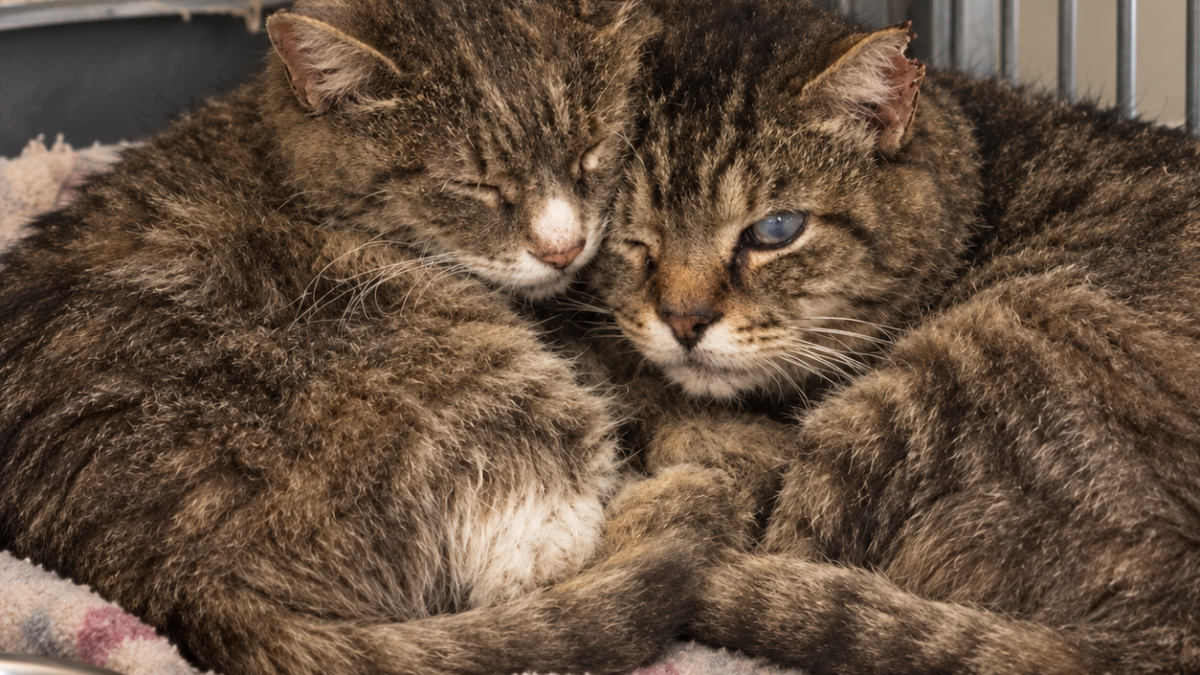
Two gray tabby brothers curled so tightly together they almost looked like one animal.
Not sleeping exactly.
Holding on.
One had a white patch under his chin and a broad old-man face with tired green eyes. The other had one cloudy eye, a ragged ear, and the cautious posture of a creature who had learned to let someone else test the world first.
A volunteer noticed me staring.
“Those two are bonded,” she said softly. “Theo and Frankie.”
I repeated the names in my head.
Theo.
Frankie.
“They came in together?” I asked.
“Yes.”
“How long have they been here?”
The volunteer hesitated.
“Too long.”
There are answers people give when the real answer is complicated and sad.
Too long was one of them.
She told us they had belonged to an older man who got very sick and went into long-term care. He never came back home. His family could not keep the cats. Since the brothers were nine years old and needed to stay together, people kept passing them by.
“Nine isn’t ancient,” Megan said, maybe because she heard the sadness rising in my throat.
“No,” the volunteer said. “But people come in wanting kittens. Or young adults. Or just one cat. Bonded seniors are harder.”
I kept looking at them.
The volunteer opened the cage door a few inches.
The white-chinned brother lifted his head and looked at me.
Theo.
The other one, Frankie, leaned harder into him without opening his good eye, as if he knew exactly where safety was and had no intention of losing contact with it.
I don’t know why that was the moment.
Maybe because grief recognizes grief.
Maybe because love does too.
All I know is that I looked at those two old cats pressed together on a faded fleece blanket, and I saw Paul reaching for my hand in a hospital bed. I saw the way we moved through the house those last few months, slower than before, always checking where the other one was. I saw how a life built side by side becomes less about romance and more about knowing the exact sound of someone’s slippers in the hallway.
And then, before I could stop myself, I asked a question I am still ashamed of.
“What if someone only takes one?”
The volunteer looked at me.
Then she looked at them.
“We try not to let that happen,” she said softly.
Right then, Theo lowered his head and began licking Frankie between the ears.
Slow, careful licks.
Not playful.
Not cute.
Familiar.
Like something he had done a thousand times before.
Like, I’m still here.
Like, you’re not alone.
Like, I’ve got you.
I turned my face away because I was already crying.
Megan touched my arm.
“Mom?”
I swallowed.
“Get the paperwork.”
Her eyes widened.
“For both?”
I looked back at those cats.
“I know what it feels like to lose the one you’ve built your life around,” I said. “I’m not doing that to them.”
The ride home was the first drive in months that did not feel empty.
I could hear them shifting in their carriers in the back seat.
Small sounds.
Living sounds.
I had not realized how starved I was for them.
When we got home, they came out slowly, stiff and cautious, like two old men checking into a motel they were not sure about.
They sniffed the hallway.
The living room rug.
The legs of the kitchen chairs.
The corner by the pantry.
Theo was braver. Frankie stayed a few steps behind him, his cloudy eye catching the afternoon light.
Then Theo stopped beside Paul’s recliner.
He looked up at it for a long time.
Then he settled underneath.
That about finished me.
Frankie watched him from the edge of the rug.
Theo gave one soft chirp.
Frankie went to him.
The two of them curled beneath my dead husband’s chair as if they had found the one place in the house where waiting still made sense.
I sat on the couch and cried into my hands.
Megan sat beside me.
For once, she did not say anything.
The first night, I woke to a soft scratching at my bedroom door.
At first, still half-asleep, I thought it was Paul.
That was one of grief’s cruelest tricks.
For just one breath, before memory returned, I thought my husband was on the other side of the door.
Then I heard it again.
Scratch.
Scratch.
I got up, opened the door, and found Theo and Frankie sitting side by side in the hallway, looking up at me like they had a question.
I laughed so suddenly it turned into crying.
Then the crying turned back into laughing.
“Well,” I whispered, wiping my face with the sleeve of my nightgown, “come on then.”
They came in.
Theo walked around the bed once and jumped up with surprising confidence.
Frankie tried to follow, misjudged the height, slid backward, and looked deeply offended.
I lifted him.
He gave one quiet grunt as if to say he had intended that all along.
Theo settled near my knees.
Frankie walked to Paul’s side of the bed.
Not the middle.
Not my side.
His side.
He circled twice and lowered himself into the dip in the mattress that still held the shape of a man who had slept there for thirty years.
I stood beside the bed, one hand over my mouth.
“You too, huh?” I whispered.
Frankie closed his eyes.
After that, the house changed.
Not in some movie kind of way.
Grief did not disappear.
I still missed Paul in a hundred small places every single day. In the bathroom, where his razor no longer buzzed in the morning. At the grocery store, where I kept almost reaching for his favorite cereal. At night, when I turned over and found too much mattress.
But now there was breakfast to put out in the morning.
Fur on the couch.
A water bowl to refill.
A litter box to scoop.
A warm weight in my lap by afternoon.
Two old cats waiting at the door when I came back from getting the mail, as if I mattered to somebody again.
Theo was loud.
Not young-cat loud. Not playful. More like a retired foreman who had opinions about operational delays.
If breakfast was late, he stood in the kitchen and yelled.
If I forgot to open the curtains, he yelled.
If Frankie was asleep in a spot Theo wanted, he yelled at me, apparently believing I controlled seating assignments.
Frankie was quieter.
He had one cloudy eye and one ragged ear, and he moved through the world like every room needed paperwork before approval. But once he trusted a place, he trusted it deeply. He took over the old blue blanket on my side of the couch. He liked having his chin scratched but pretended not to. He followed Theo everywhere and acted shocked whenever Theo did something foolish, which was often.
They found my husband’s places faster than I did.
That sounds strange, but it is true.
They found the warm patch of morning light in the dining room.
They found the loose board near the laundry room that made a tiny click when you stepped on it.
They found the exact corner of the living room rug where Paul used to stand every night before checking the mailbox.
They found his recliner.
Theo slept underneath it every afternoon.
Not on the cushion.
Not on the arm.
Underneath.
Like that space meant something.
Frankie preferred Paul’s side of the bed.
He would climb up there at night, circle twice, and settle his old bones into that familiar hollow.
The first time I saw him sleeping there, I had to sit on the edge of the mattress because my knees went soft.
When you have loved someone for thirty years, their absence leaves a shape.
Not a poetic shape.
A real one.
In the mattress.
In the closet.
In the bathroom drawer.
In the way the towels hang.
In the coffee cups you keep reaching past because his favorite one is still sitting there and your hand remembers before your brain does.
Theo and Frankie found those shapes.
Every last one.
And what broke me was not that they reminded me of Paul.
It was that they moved through the house like they understood something everyone else kept trying to rush me past.
Love does not leave cleanly.
It lingers.
In fabric.
In routine.
In air.
In the worn places where two lives rubbed against each other for a very long time.
Megan called every evening like before.
Now she could hear something different in my voice.
“You sound better,” she told me one Tuesday.
I was standing at the sink rinsing out two little food bowls while Theo yelled at my ankles like I had personally delayed dinner for political reasons.
“I’m still sad,” I said.
“I didn’t say happy,” she answered. “I said better.”
I looked down at Theo.
Frankie sat by the pantry door pretending not to care, which meant he cared very much.
“Yeah,” I said. “Maybe I am.”
Megan sounded relieved enough to cry.
That should have warned me.
Relief can become control so quickly that you barely notice the moment it changes.
At first, it came as small suggestions.
“Mom, I can come by Saturday and help you tidy up a little.”
“Mom, maybe we can sort some of Dad’s clothes when you’re ready.”
“Mom, have you thought about clearing out the garage before summer?”
Nothing unreasonable.
Nothing cruel.
Nothing that would make a stranger point a finger and say, There. That is the problem.
That is what makes family hurt so much.
Most of the time, nobody thinks they are being cruel.
They think they are being practical.
They think they are helping.
They think love and management are the same thing.
I kept giving the same answer.
“Not yet.”
And Megan kept answering the same way.
“Okay.”
But her okay got tighter every time.
I could hear it.
The way you hear a drawer sticking before it jams completely.
The house kept changing anyway.
Not because I redecorated.
Not because I was healing in some dramatic movie way.
Because now there were tiny ordinary interruptions everywhere.
Theo batted bottle caps under the stove.
Frankie dragged one of my slippers halfway down the hall and then sat beside it like he had completed an important job.
They both developed the habit of waiting by the front window around five-thirty every evening.
Paul had come home around that time for years.
When I noticed them sitting there together, staring at the driveway as the light changed, something cold moved through me.
I had never taught them that.
Nobody had.
But there they sat.
Two old cats keeping an appointment with a man they had never met.
The first time I saw it, I cried hard enough that I had to sit down right there on the floor.
Not because it was spooky.
Not because I thought Paul was somehow coming back through the front door.
Because it felt like the house itself still remembered him.
And those cats had put their paws right on the memory.
A week later, Megan came over with a casserole in one hand and the look on her face that meant she had decided something without telling me first.
She kissed my cheek.
Theo sniffed her shoe.
Frankie watched from under the side table like she might be there to inspect him.
Megan looked around the living room and smiled.
“Wow,” she said. “It really does feel different in here.”
“It smells like tuna half the time,” I said.
She laughed.
“I mean it, Mom. It feels alive.”
I almost said, Then let it stay alive the way it is.
But I didn’t.
I wish I had.
Instead, I asked if she wanted coffee.
She said yes.
We sat at the kitchen table while Theo cleaned one paw with deep concentration, pretending he had no interest in our conversation. Megan wrapped both hands around her mug.
Then she said, very carefully, “You know, this might be a good time.”
My stomach sank.
“A good time for what?”
“To start making some changes while you’re feeling stronger.”
There it was.
So soft you could almost mistake it for kindness.
I set my mug down.
“Megan.”
“Hear me out.”
I did not want to.
But I did.
Because that is what mothers do, even when their grown children are about to say something that lands like a boot on the chest.
She started talking about the house.
How big it was.
How much work it would need long-term.
How I did not use half the rooms anymore.
How the stairs worried her.
How winters got harder every year.
How there were nice smaller places closer to her neighborhood, where I would have people nearby and less to manage.
I looked at her while she spoke.
Really looked.
My daughter had my eyes but not my patience.
Paul’s stubborn mouth.
The little line between her eyebrows that appeared whenever she was anxious.
She was anxious now.
That much was obvious.
What hurt was that her anxiety had dressed itself up like a plan.
“This is still my home,” I said.
“I know that.”
“Then why are you talking about it like it’s already too much for me?”
She reached for my hand.
I pulled mine back before she could take it.
That changed the room immediately.
The cats felt it too.
Frankie disappeared.
Theo stopped licking his chest and looked from one of us to the other.
“I’m not saying now,” Megan said quickly. “I’m saying eventually. We should at least think about it.”
I heard myself laugh, but there was no humor in it.
“Your father hasn’t even been gone a year.”
She went quiet.
Then she said the thing people say when they have run out of gentle language.
“That’s exactly why.”
I stared at her.
She pressed on because once people believe they are being practical, they start trusting that feeling more than your pain.
“You can’t freeze your life here, Mom.”
Freeze.
As if grief were me being dramatic in bad weather.
As if staying in the house where I had built an entire adult life was the same thing as refusing to clean out a pantry.
I stood and carried both coffee mugs to the sink even though mine was still half full.
That ended the conversation, at least on the surface.
Megan knew it.
She rinsed the casserole dish in silence before leaving.
At the front door, she bent down to say goodbye to Theo.
He backed away from her.
I hated that I noticed.
I hated even more that it mattered.
The next month was full of tiny good things.
That is why what happened after hurt so badly.
I started sleeping a little better.
Not every night.
But enough that I no longer woke at three in the morning and sat in the dark listening to the house like it might confess something.
Theo discovered the joy of warm laundry and once nearly rode a towel into the dryer.
Frankie learned that if he tapped my shin with one paw while I was reading, I would eventually give up and let him climb into my lap.
I began opening curtains again.
Then windows.
Then the back door on mild afternoons.
The first time I laughed without guilt came because Theo got his head stuck in the handle of a paper grocery bag and marched around the kitchen like an outraged little sheriff.
I laughed so hard I had to lean against the counter.
Then, right behind that laugh, came the old feeling.
The sharp one.
The one that says, You are not supposed to do that without him.
I stood there with tears in my eyes and one ridiculous cat in a paper bag and realized something awful.
Grief can make you feel disloyal for surviving.
Nobody tells you that part enough.
They tell you grief comes in waves.
They tell you to be gentle with yourself.
They tell you your husband would want you to smile again.
All of that may be true.
But nobody tells you what it feels like the first time joy slips into the room and your heart reacts as if you have committed a small betrayal.
The cats did not care.
They wanted dinner at six.
They wanted brushed fur on Sunday mornings.
They wanted the window opened two inches, not one, not three.
They wanted life.
Steady, boring, necessary life.
And because of that, I kept participating in it.
Then came the Thursday that split everything open.
I had an eye appointment in the next town.
Nothing major.
Just the regular sort of getting-older appointment where they shine lights in places you did not know could be examined and then send you out blurry, annoyed, and wearing disposable sunglasses that make you look like an escaped laboratory patient.
Megan insisted on driving me.
“You shouldn’t be behind the wheel after they dilate your eyes,” she said.
She was right.
So I said yes.
That, I have learned, is how a lot of trouble starts.
With someone being technically right.
The appointment took longer than expected.
Afterward, Megan suggested lunch.
I said no at first because I wanted to get home to the cats.
She smiled that patient smile adult children get when they think their parent is becoming a little too attached to an animal.
“Mom,” she said. “They’re fine for one extra hour.”
I should have listened to the small flare of irritation in my chest.
I did not.
We went to lunch at a quiet place near the clinic.
Soup for me.
A sandwich for her.
We talked about nothing important.
Caleb’s soccer game.
A neighbor’s tree that had finally been taken down after leaning dangerously for two years.
The weather turning.
Normal things.
Halfway through my soup, I even thought maybe I had been too hard on her.
Maybe she was just scared.
Maybe I was too.
That is the thing about love.
It keeps giving everybody the benefit of the doubt long after the warning signs have shown up.
When we pulled into my driveway, I knew something was wrong before I got out of the car.
The front curtains were open wider than I had left them.
My husband’s old wool coat was gone from the hall tree by the door.
I stood there with my purse hanging from my shoulder and felt the blood drain from my face.
“Megan.”
She came in behind me, holding my arm because of my blurry vision.
“Surprise,” she said.
That word nearly made me sick.
“I had a little time while you were in the appointment, so I came back and got started.”
Got started.
People say those words like they are harmless.
What they often mean is, I made decisions about your life while you were not here to stop me.
The living room smelled like lemon cleaner.
Not faintly.
Strongly.
Strong enough to wipe out the warm dusty scent the room usually held in the afternoons.
The folded blanket Paul kept on the recliner was gone.
The stack of crossword books from the side table was gone.
The little ceramic dish where he tossed loose change was gone.
So were his reading glasses.
Even though the frame had been bent for years.
Even though he had not worn that pair in ages.
I looked around like somebody had broken into the house and stolen only memory.
“Megan,” I said again, but this time it came out thin.
“I just packed a few things,” she said too quickly. “Nothing big. Only the things that were making the room feel…”
She stopped.
She was smart enough not to finish that sentence.
Like a grave.
Like a shrine.
Like death sitting in the chair.
Pick your poison.
I did not need her to say it.
I could hear it anyway.
Theo appeared in the doorway.
Then he froze.
He looked toward the recliner.
Then toward the hall.
Then back at the recliner again.
Frankie came out from under the sofa, sniffed the air once, and let out the strangest sound I had ever heard from him.
Not a meow.
Not really.
A broken little cry.
He went straight to the hall closet and scratched at the door.
That sound went through me like a knife.
I opened the closet.
Inside, stacked on the floor, were three donation bags and two boxes.
One of the bags was open just enough for me to see Paul’s slippers.
One box held his winter scarf, two flannel shirts, his old shaving mug, and the blanket from the chair.
Folded.
Neat.
Like none of it had ever belonged to a living man.
Theo shoved his whole face into that box.
Frankie climbed in right after him.
Then the two of them did what broke me clean in half.
They started digging.
Not playing.
Not being naughty.
Searching.
They burrowed through that box with frantic little movements, pressing their faces into the flannel, the blanket, the slippers.
Theo dragged one slipper halfway out with both front paws like he was trying to rescue it.
Frankie shoved his nose into the blanket and stayed there.
I sat down right on the hallway floor and started sobbing so hard I could not catch my breath.
Megan knelt beside me immediately.
“Mom, please. Please don’t do this.”
That sentence.
I still think about it.
Please don’t do this.
As if grief were a performance I had chosen.
As if I were making a scene instead of having my husband packed into donation bags while two old cats searched for the scent that had made this house feel safe.
I turned and looked at her with tears and mucus and zero dignity left.
“You did this while I was gone?”
“I was helping.”
“Helping who?”
“You.”
“No,” I said. “You were helping yourself.”
That slapped her harder than if I had yelled.
Her whole face changed.
“What is that supposed to mean?”
“It means you didn’t ask me what I was ready for. You walked into my house and started erasing your father because it made you uncomfortable.”
“I did not erase him.”
“You bagged up his clothes, Megan.”
“He is not his clothes.”
“No,” I said, voice shaking. “But this is still the house he lived in. These are still the things his hands touched. And I am still the woman who slept beside him for thirty years. You don’t get to decide when that becomes clutter.”
For a second, neither of us moved.
Theo was still inside the box.
Frankie had dragged the edge of the blanket across the closet floor and laid down on it with his head pressed flat, like he could keep something from disappearing by staying on top of it.
Megan looked at them.
Then at me.
Then back at the box.
And instead of softening, she got angry.
Maybe because guilt can only sit in a body for so long before it reaches for armor.
“This isn’t healthy,” she said.
There it was again.
That word people use when they want grief to behave nicely and fit a timetable.
Healthy.
I stood too fast and had to brace myself on the wall.
“What exactly would look healthy to you?” I asked. “Tell me. A smaller apartment? Beige walls? One chair? No memories older than six months?”
“That is not fair.”
“No. What’s not fair is being treated like a problem to solve because I loved my husband enough for this house to still show it.”
She started crying then.
Real crying.
Not dramatic.
Not manipulative.
Just overwhelmed.
“I watched Dad die too,” she said. “Do you think I don’t see him everywhere? Do you think walking in here doesn’t hit me in the throat every single time?”
That stopped me.
Because there it was.
The part underneath her control.
Fear.
Pain.
A daughter who had lost her father and thought if she could just clean the room, maybe the ache would stop ambushing her.
I knew that feeling.
I did.
But knowing it did not make what she had done hurt less.
“I’m sorry you hurt when you come here,” I said quietly. “I really am. But this is still my house to hurt in.”
She covered her mouth with one hand.
The same way she used to when she was little and trying not to cry in public.
For one awful second, I saw my daughter at seven years old with a skinned knee.
Then I saw the grown woman in front of me who had crossed a line because she was scared of losing me too.
Maybe that is why I did not scream.
Maybe that is why I did not tell her to get out.
I just said, “Put it back.”
She looked at the bags.
At the boxes.
At the chair.
At me.
Then, very slowly, she nodded.
We spent the next hour putting everything back where she had found it.
Not perfectly.
Not symbolically.
Practically.
The blanket back on the recliner.
The glasses back on the table.
The shaving mug back on the bathroom shelf.
The slippers beside the bed.
The coat on the hall tree.
While we worked, the house grew quieter and quieter.
Not dead quiet.
Listening quiet.
Theo followed the blanket.
Frankie followed the coat.
At one point, Megan stood holding one of Paul’s flannel shirts and pressed it to her face so suddenly it made me turn away.
I gave her that privacy.
Some crying belongs to the person doing it.
That night, after she left, neither cat would eat much dinner.
Theo took three bites and walked away.
Frankie licked the gravy and sat staring toward the hall closet.
I barely slept.
At two in the morning, I found both cats curled together on Paul’s folded robe at the foot of the bed.
I did not remember taking the robe out of the box.
Apparently I had.
Apparently my hands knew what the rest of me needed.
The next morning, Frankie threw up clear liquid on the kitchen mat and refused breakfast.
Now, I know some people would say I was reaching.
That it was a coincidence.
That cats throw up.
That old cats get finicky.
Maybe so.
But when you live closely with animals, you learn the difference between ordinary and wrong.
This was wrong.
By noon, Frankie still had not eaten.
By one, he was loafed in a corner with his eyes half shut, and Theo kept going over to him, touching noses, then looking at me like he expected me to fix whatever this was.
So I called the veterinarian and got him in that afternoon.
Megan texted while I was putting Frankie into the carrier.
I’m sorry.
Then another message.
I really thought I was helping.
Then another.
How is Frankie?
I stared at the screen for a long time before answering.
Taking him in now.
That was all I had in me.
At the clinic, the veterinarian examined Frankie gently, ran some tests, and asked if anything had changed at home.
I hesitated.
Then I told the truth.
“A lot of familiar things got moved around yesterday,” I said. “Then moved back.”
She nodded in that way people do when they have seen more than they can fully explain.
“For older cats, especially bonded ones, routine matters a great deal,” she said. “The world already feels less predictable when they age. Sudden change can hit them hard.”
I felt so vindicated I almost hated it.
Not because I wanted to be right.
Because I did not want this to have been hard on him at all.
He received medicine, fluids, and instructions for bland food and careful watching.
Nothing catastrophic.
Thank God.
Just an old cat reminding all of us that stability is not a luxury when you are fragile.
It is mercy.
On the drive home, Frankie made one tiny sound from the carrier.
Theo, who had stayed home, met us at the door and immediately pressed his face against Frankie’s through the grate.
I stood in the hallway holding that carrier and thought, This is what people keep missing.
Older lives are not less valuable because they come with more care.
They are not less worthy because they move slower.
They are not disposable just because they are inconvenient to somebody else’s timetable.
And maybe that thought was not only about cats.
Maybe it was not even mostly about cats.
Megan came over that evening without calling first.
I almost did not answer.
But I did.
Because I was tired of pain making every room smaller.
She stood on the porch with no makeup on, hair in a messy knot, and one of her father’s flannel shirts in her hands.
The same one she had held earlier.
“I found this in my car,” she said. “I must have carried it out without realizing.”
I took the shirt.
Neither of us moved.
Then she said, “Can I come in?”
I stepped aside.
We sat in the living room with Frankie asleep in his carrier beside the recliner and Theo posted beside it like a bodyguard.
Megan looked older that night.
Not in her face exactly.
In her posture.
Like she had been carrying something too heavy and was finally letting her arms admit it.
“I need you to understand something,” she said.
I did not answer.
She kept going.
“When Dad got sick, every time I came over here, I felt like I was bracing for bad news before I even opened the door. Then after he died, I kept walking in and expecting… I don’t know. To feel him. To hear him. To see his stuff and not lose my breath.”
I listened.
Because grief deserves witnesses, even when it shows up inside the person who hurt you.
“I would leave here and sit in my car and cry,” she said. “Then I’d think about you staying in this house alone with all of it, and it scared me. The cats helped. You sounded alive again. So I thought maybe if I could clear out some of the hardest things, maybe it would help both of us breathe.”
I nodded slowly.
“I believe that,” I said.
She started crying.
“But?”
“But help that arrives without asking can feel a lot like being erased.”
That landed.
I saw it land.
I went on before I lost my nerve.
“I need you to hear me, Megan. I am lonely. I am grieving. I am older than I was. None of that means I stop being the person in charge of my own life.”
She wiped at her face.
“I know.”
“No,” I said. “I don’t think you do. I think you’re terrified I’ll disappear if you don’t get ahead of it. I think you look at me and see a problem coming. A widow in a big house. A mother who cries in hallways over slippers. And maybe sometimes that does scare you. But scared is not the same as right.”
She looked down at her hands.
For a long time, all we could hear was Frankie breathing and Theo washing one shoulder with loud, determined licks.
Then Megan said, very softly, “I don’t want to manage you. I just don’t know how to lose another parent.”
That one got me.
Because there it was.
The true sentence.
The ugly honest one underneath all the practical talk.
Not real estate.
Not clutter.
Not square footage.
Fear.
I reached over and took her hand.
Her fingers were freezing.
“You are not losing me,” I said.
She gave a sad little laugh.
“You say that like you get to decide.”
“No,” I said. “I say it like you don’t get to start burying me before I’m gone.”
She broke then.
Fully.
And because she is my daughter, I moved closer and held her while she cried, even though I still hurt.
That is motherhood too.
Holding the child who just broke your heart because you can see the broken place in hers.
We sat that way for a long time.
Theo eventually climbed into Megan’s lap as if he had appointed himself minister of reconciliation.
She laughed through tears and called him a traitor.
Frankie, still sleepy from the vet visit, opened one cloudy eye and closed it again.
In the days after that, things changed.
Not magically.
Not neatly.
But honestly.
Megan stopped trying to decide my future out loud.
I stopped pretending I was not angry.
Both of those things helped.
We made rules.
No more “helping” in my house without asking first.
No bags.
No boxes.
No surprise sorting.
No practical ambushes disguised as errands.
If we touched Paul’s things, we touched them together.
And only when I said yes.
A week later, I did say yes.
Not to a whole room.
Not to his closet.
Not to the garage.
Just one drawer in the bathroom.
His old razors.
Expired medicine.
A tube of ointment with the cap glued shut.
Two receipts from a hardware store.
A pack of cough drops so old they had become one solid brick.
We did that one drawer together.
When I got tired, we stopped.
That mattered more than the drawer.
Stopping when I said stop.
Respect looks small from the outside.
Sometimes it is just a hand not reaching where it used to.
Life settled again.
Theo resumed his supervision of every meal.
Frankie got his appetite back and started yelling at me in the kitchen with surprising force for such an old soul.
The front-window waiting ritual continued at five-thirty.
I started sitting with them when they did it.
Three bodies facing the driveway.
Not because I thought Paul would come walking up it.
Because love had lived here, and there was something holy in not pretending otherwise.
One Sunday afternoon, I finally opened the door to the little back room Paul had used as an office.
I had not been in there since the week after the funeral.
Not really.
I had opened it.
Looked in.
Closed it again.
That does not count.
Theo had been pawing at that door for days.
Frankie sat beside him like moral support.
So I opened it.
The room smelled stale and paper-dry.
Paul’s desk was still cluttered with pens, envelopes, and a legal pad with three lines of half-finished writing on it.
A sweater hung over the chair.
There was a coffee ring on one corner of the desk that I used to nag him about.
I stood in the doorway and thought, I cannot do this.
Then Theo walked right past me.
Frankie followed.
Theo jumped into the desk chair.
Frankie went straight to the sweater and kneaded it once with his old paws before settling down.
Just like that, my feet moved.
I went in.
I sat in the chair opposite the desk.
I put my hand over the coffee ring like I was covering a wound.
And I cried in a way I had not let myself cry yet.
Not funeral crying.
Not hallway crying.
Not startled-by-memory crying.
The deep ugly kind.
The kind with sound in it.
The kind that leaves your face hot and your body empty afterward.
Theo stepped onto the desk and bumped his head against my wrist.
Frankie stayed on the sweater.
Between them, they held that room open until I could sit in it without drowning.
That is what those cats did to my empty house.
They did not decorate it.
They did not fix it.
They walked straight into the places I had nailed shut and made them livable again.
One room at a time.
One routine at a time.
One ordinary evening at a time.
The conflict with Megan did not vanish after one tearful conversation.
Real life is not that efficient.
Three weeks later, she called and asked whether I had thought more about the stairs.
I said, “Megan.”
She stopped.
Then she said, “Sorry. That was me managing.”
“Yes.”
“Can I ask it a different way?”
“Yes.”
“Would you be willing to let Josh install a second railing? Not because you’re incapable. Because it would make me breathe easier.”
That was different.
Do you hear the difference?
One version said, I have decided your life is too big for you.
The other said, I am scared and would like to help in one specific way, with your permission.
I said yes.
Josh came that Saturday.
He was gentle in the way good sons-in-law learn to be around grief. He did not mention moving. He did not mention downsizing. He brought his tools, measured twice, installed the railing, and complimented Theo on his supervisory skills.
Theo sat on the landing and watched every screw go in.
Frankie hid until Josh left.
Later, I ran my hand along the new railing and felt something loosen in me.
Maybe accepting help did not have to mean surrendering authority.
Maybe there was a way for my daughter to love me without taking over.
Maybe there was a way for me to need people without becoming a project.
That winter, we made slow progress.
Megan and I sorted one box every other Sunday.
One.
Never more unless I asked.
Some days, we got through the whole box.
Some days, we opened it, saw what was inside, and closed it again.
Once, the box contained Paul’s old work badges, a broken tape measure, three birthday cards from Caleb, and a pair of gloves I thought I had lost.
I held the gloves for so long Megan finally said, “Do you want to stop?”
I nodded.
She closed the box.
No argument.
No sigh.
No tight okay.
Just respect.
I loved her for that.
In February, one year after Paul died, I hosted dinner.
That may not sound like a major act.
It was.
For months, I had avoided having too many people in the house. Visitors shifted the air. They asked where things were. They avoided saying Paul’s name or said it too carefully. They looked at the recliner and then looked away.
But on the anniversary weekend, I invited Megan, Josh, and Caleb.
I made Paul’s favorite pot roast because grief had made me brave or reckless, and sometimes those are the same thing.
Halfway through dinner, Caleb looked toward the living room and asked, “Grandma, why does Theo sleep under Grandpa’s chair?”
The adults went still.
Children ask questions grief-trained adults avoid.
I put down my fork.
“I think he likes it there.”
“Because it smells like Grandpa?”
Megan closed her eyes.
Josh looked at his plate.
I said, “Maybe.”
Caleb nodded.
“Frankie sleeps on his side of the bed too, right?”
“Yes.”
“Maybe they’re keeping his spots warm.”
My throat tightened.
Megan began to cry silently.
Caleb looked alarmed.
“Did I say something bad?”
“No, honey,” Megan said, reaching for his hand. “You said something true.”
After dinner, Megan helped me wash dishes.
For a while, we worked side by side in quiet.
Then she said, “I used to think if we moved the things, the missing would shrink.”
I rinsed a plate.
“And now?”
She looked toward the living room, where Caleb sat on the floor watching Theo ignore a toy mouse.
“Now I think the missing just moves somewhere else.”
I handed her the plate.
“Yes.”
“I’m sorry I tried to move yours without asking.”
“I know.”
She dried the plate carefully.
“I’m sorry I made you feel like I wanted Dad gone.”
I turned off the faucet.
That apology went deeper.
“I know you didn’t,” I said.
“I didn’t. But I understand why it felt that way.”
I nodded.
“For what it’s worth, sometimes I wanted the reminders gone too.”
She looked surprised.
“Oh, honey,” I said. “Of course I did. I still do sometimes. There are days I hate that chair.”
“Really?”
“Yes. There are days I want to throw every coffee mug against the wall. There are days I want the house to stop telling me he lived here because it also keeps telling me he died.”
Her eyes filled again.
“But those days pass,” I said. “And when they do, I’m glad I didn’t let the worst hour make a permanent decision.”
She leaned against the counter.
“That makes sense.”
“It only took me a year and two elderly cats to learn it.”
We laughed.
Not loudly.
Enough.
That spring, the shelter called.
At first, I panicked.
When you adopt senior animals, a call from the shelter months later can make your heart jump into your throat. But it was the volunteer who had introduced us to Theo and Frankie.
Her name was Rachel.
She said, “I hope this isn’t strange, but would you be willing to send us an update on the boys? People ask about bonded seniors, and sometimes it helps to have a happy story.”
A happy story.
I looked at Theo, who was asleep belly-up on the rug like a retired king.
Frankie sat in the window watching a squirrel with deep moral concern.
“Yes,” I said. “I can do that.”
Megan helped me write it.
We did not make it glossy.
No perfect ending.
No “they saved me and everything is fine.”
We wrote the truth.
That I adopted two older bonded cats after losing my husband.
That they brought life back into a quiet house.
That they also made me confront grief I had been avoiding.
That senior animals come with needs, but so do all forms of love.
That being passed over does not mean being empty.
Rachel posted it with a photo of Theo under Paul’s recliner and Frankie on the blue blanket.
The post received more attention than I expected.
People commented about their own older pets.
Their widowed parents.
Their siblings trying to rush grief.
Their cats who slept on deceased spouses’ clothing.
Their fear of adopting older animals because goodbye might come too soon.
One comment stayed with me.
A woman wrote:
I never adopted seniors because I was afraid of losing them. This made me realize they are already losing time waiting for someone less afraid than me.
A week later, Rachel messaged.
That woman adopted an eleven-year-old calico.
Then another bonded pair went home.
Then a twelve-year-old black cat.
Not because of me alone.
That would be too grand.
But maybe because of Theo and Frankie.
Because two old cats under a dead man’s chair made strangers look longer.
I printed the shelter post and tucked it into a folder.
Not because I needed applause.
Because I wanted proof that love can keep moving outward even when you think it has ended in one house.
Theo began slowing down first.
He still yelled at me, but he did it sitting down more often.
The vet said his hips were stiff.
We added joint supplements.
Then a low step by the couch.
Then a second water bowl upstairs.
Frankie took medicine for his thyroid.
He hated it.
I learned to hide the pill inside soft food.
He learned to eat around it.
This became our war.
He won more often than I would like to admit.
Megan drove us to vet appointments when needed, but she no longer took over. She asked, “Do you want me to come in?” instead of assuming. Sometimes I said yes. Sometimes I said no. Both answers were accepted.
The first time she waited in the car because I said I could handle it, she looked nervous.
When I returned, she said, “Was it okay?”
“Yes.”
“Good.”
Then, after a pause, “I hated that.”
“I know.”
“But I’m proud of me.”
I laughed.
“So am I.”
Two years after Paul’s death, I donated some of his clothes.
Not all.
Some.
Megan and I did it together.
Theo and Frankie supervised from the hallway.
We kept the wool coat.
The robe.
Three flannel shirts.
The blue mug.
The crossword book.
The old shaving mug.
Things that still hurt, but gently now.
The rest went to a veterans’ outreach center Paul had supported. A man there told me the coats and shirts would be used by people who needed them.
That helped.
Not because it erased anything.
Because it let some of Paul’s ordinary warmth leave the house without feeling thrown away.
When we got home, Frankie sniffed the remaining flannel shirts, approved the inventory, and went back to sleep.
Megan said, “I think he’s the real executor.”
I said, “Absolutely.”
The house changed slowly after that.
Not emptied.
Changed.
I moved Paul’s recliner six inches to the left so I could open the window more easily.
That may sound like nothing.
It was not nothing.
For two years, I had treated that chair like moving it might disturb the dead.
Theo inspected the new position and spent an entire afternoon refusing to sleep under it.
By evening, he gave in.
I took that as permission.
I turned Paul’s office into a reading room, but I kept his desk.
I cleared the papers, except the legal pad with the three unfinished lines. That stayed in the drawer.
Megan and I painted the walls a warm cream.
Not beige.
I refused beige on principle.
Frankie slept on the drop cloth while we worked and somehow got paint on one whisker.
For the first time in years, I bought a new lamp.
I felt guilty for exactly twenty minutes.
Then Theo knocked the receipt behind the bookshelf, and guilt had to wait while I found the yardstick.
Life has a way of insisting on itself.
That is both cruel and merciful.
Caleb grew taller.
Megan softened.
I became older and more myself at the same time.
People assume grief shrinks you.
Sometimes it strips away the parts of you that were performing strength for other people.
I stopped saying yes when I meant no.
I stopped apologizing for needing time.
I stopped pretending the cats were “just company.”
They were family.
Not replacements.
Not children.
Not symbols.
Family.
Theo and Frankie reached twelve.
Then thirteen.
Every birthday felt borrowed and blessed.
The shelter sent them a card one year.
It read: Still together. Still loved.
I cried for twenty minutes.
Then Theo tried to eat the envelope.
Frankie was the first to leave us.
It was a cold morning in January.
He had been declining for weeks. Kidney disease, the vet said. Manageable for a while, then less manageable, then not manageable at all. I had learned by then that love sometimes means counting good days and being honest when the count changes.
The night before, Frankie climbed onto Paul’s side of the bed, circled twice, and settled into the old hollow in the mattress.
Theo lay beside him.
I slept very little.
At dawn, Frankie lifted his head and looked at me with his cloudy eye and his clear one.
I knew.
The vet came to the house.
Megan came too.
She did not ask what needed sorting, fixing, or planning.
She simply sat beside me.
Theo pressed against Frankie until the sedative made Frankie’s body relax. Then, just before the final injection, Theo leaned forward and licked the top of his brother’s head.
Slow.
Careful.
Familiar.
Like something he had done a thousand times before.
Like, I’m still here.
Like, you’re not alone.
Like, I’ve got you.
Frankie left the world on Paul’s side of the bed, with my hand on his back and his brother’s breath against his ear.
Afterward, Theo searched.
Not the frantic way he might have when younger.
Not wildly.
He was old.
He knew something.
Still, he checked the bedroom.
The hall.
The living room.
The underside of the recliner.
The window.
Then he returned to the bed and lay in Frankie’s spot.
Megan stood in the doorway crying.
“I understand now,” she whispered.
I looked at her.
“The boxes?”
She nodded.
“I understood before, but not like this.”
I reached for her hand.
“I wish you didn’t have to.”
“Me too.”
Theo lived eight more months.
Quiet months.
Tender months.
He yelled less.
Slept more.
Sat in the window at five-thirty alone.
I sat with him every evening.
Two bodies facing the driveway.
Then one September afternoon, he stopped eating.
By then, I knew the language of endings better than I wanted to.
The vet came again.
Megan came again.
This time, Theo lay under Paul’s recliner.
Where he had first settled when he entered my house.
Where he had spent hundreds of afternoons.
Where he had kept company with a man he never met and a grief he somehow understood.
I lay on the floor beside him, my old knees protesting, one hand on his side.
“You did good,” I whispered. “You both did so good.”
Megan sat nearby, one hand over her mouth.
Theo’s last sound was not a yell.
It was a little breath that almost became a purr.
Then he was gone.
The house became quiet again.
But not the same quiet.
That is important.
When Paul died, the silence felt like abandonment.
After Theo and Frankie, the silence had texture.
They had changed the rooms.
They had left fur in places I would be finding until the end of my natural life. They had scratched the corner of the couch. They had worn paths into routine. They had made me laugh in months when laughter felt impossible. They had forced Megan and me to tell the truth. They had searched for what love had touched and laid down in it until I became brave enough to do the same.
A week after Theo died, Megan came over with flowers.
Not lilies.
She knew better by then.
Simple yellow daisies in a mason jar.
She set them on the kitchen table.
The house felt enormous.
For a while, we said nothing.
Then she asked, “Do you want me to help you put away their things?”
I looked at the food bowls.
The low steps.
The blanket under the recliner.
The cat bed by the window.
My chest tightened.
Megan quickly said, “Only if you want. Only when you want. Or never.”
I looked at her.
Really looked.
My daughter had learned.
So had I.
“Not yet,” I said.
She nodded.
“Okay.”
This time, okay meant okay.
Months passed.
I left the bowls down longer than some people would understand.
I washed the blankets but kept them folded in the reading room.
I donated unopened food to the shelter.
I kept Theo’s ridiculous paper bag, flattened and tucked into the folder with the shelter post.
I kept Frankie’s blue blanket on Paul’s side of the bed for a long time.
Then one morning, I woke up and moved it to the chair by the window.
No ceremony.
No sobbing.
Just movement.
That is how healing often comes.
Not as a grand sunrise.
As the ability to move one blanket without feeling like you have betrayed the dead.
Megan and I are better now.
Not perfect.
Mothers and daughters rarely are.
But better.
She asks before she helps.
I answer honestly.
Sometimes I let her help.
Sometimes I say no.
Sometimes we open one drawer.
Sometimes we close it again.
Sometimes we sit in Paul’s reading room and drink coffee while Caleb, now a teenager with feet too large for his body, tells us about school in sentences that contain no useful details.
The house is still mine.
That matters.
Not because I will live here forever.
Maybe I will.
Maybe I won’t.
One day, the stairs may become too much. One day, I may choose a smaller place. One day, I may hand Megan the keys and say, “Now.”
But it will be my now.
Not fear’s.
Not convenience’s.
Not grief’s.
Mine.
People may still say Megan was right.
Some may say she only tried to help.
Some may say keeping Paul’s things around was unhealthy.
Some may say older people should downsize sooner, grief should not sit in furniture forever, cats are not children, and a house is just a house.
They are allowed to think that.
But here is what I know.
A house is not just a house when it is the place where your whole adult life happened.
A chair is not just a chair when it held the man you loved through his strong years and his weakest ones.
A robe is not just a robe when two old cats curl up in it because some part of the home still lives there.
And a widow is not a storage problem.
She is not a project.
She is not a waiting room for assisted living.
She is a person learning how to survive the second half of a sentence she never wanted spoken out loud.
As for Theo and Frankie, they were older than most adopters wanted.
They needed soft food.
They needed medicine.
They needed patience.
They were not cheap.
They were not convenient.
They shed on everything I owned.
They woke me too early.
They yelled about dinner as if I had never fed them in my life.
And I would choose them again in a heartbeat.
Because old souls know things.
They know how to stay.
They know how to make a home out of what remains.
They know being passed over does not mean being empty.
Most of all, they taught me something I wish more people understood.
We are too quick to make old lives smaller.
Old pets.
Old people.
Old homes.
Old grief.
Anything that moves slower than the world wants gets treated like a burden waiting for efficiency.
But slower is not worthless.
Worn is not finished.
And love that lingers is not clutter.
So no, I did not rescue two old cats nobody wanted.
Not really.
I opened the door, yes.
I signed the papers.
I bought the food, paid the bills, gave the medicine, cleaned the bowls, and lifted them when their old bones needed help.
But what they gave back was bigger.
They stood in the wreckage of my quiet and refused to let it stay dead.
They made my daughter and me tell the truth.
They made us fight the right fight.
They made me defend the shape of my own life.
And in a house that had gone too still after loss, two unwanted old cats did the holiest thing I have seen in a long time.
They searched for what love had touched.
Then they laid down in it.
And they taught me I was allowed to do the same.


