He Called the Healer Dangerous and Ordered Her Away—By Midnight, the Proud Doctor Was Begging Her to Save the Child
PART2:
Sarah had been twenty-four, newly married, fevered after childbirth, and trusting. That was the word that haunted him most. Trusting. She never questioned him. Not once. Her husband fetched water when Theodore requested it. Her mother held the baby. Theodore did everything in the order he had been taught.
Clean cloths.
Cooling compresses.
Careful monitoring.
Tinctures in measured amounts.
Notes every hour.
He did not miss a step.
Sarah died anyway.
No one blamed him.
That made it worse.
Her husband clasped his hand and thanked him for trying.
The midwife said some things were in God’s hands.
The town said the fever had been too strong.
His senior physician told him, “You did what was correct.”
Theodore accepted none of it.
Correct had not kept Sarah breathing.
Correct had not returned a mother to her child.
Correct had not stopped her husband from standing in the doorway with the face of a man whose future had been hollowed out in a single morning.
After Sarah Pruitt, Theodore stopped trusting anything that could not be written down.
He became careful until carefulness hardened.
He became disciplined until discipline resembled suspicion.
He became the sort of doctor who distrusted improvisation, especially when it came from women with baskets, jars, dried leaves, and reputations built outside lecture halls.
That was how he first thought of Rose Quinn.
Not as a woman.
Not even as a practitioner.
As a danger.
He had heard her name within his first week in Benton’s Crossing.
A widow with no husband’s name attached to her respectability, though some said she had never been married at all.
A healer who lived four miles outside town where the road curved toward cedar country.
A woman people fetched at night when children coughed too hard, when births stretched long, when stomach illnesses swept through cabins, when pain needed easing and the doctor was too far, too costly, too proud, or simply not yet summoned.
She made teas.
Poultices.
Tinctures.
Infusions.
Steam remedies.
Herbs hanging from rafters.
Roots in jars.
Knowledge passed from her grandmother, who had learned from settlers, Indigenous women, midwives, and her own hands.
To Theodore, before he met her, she was everything medicine needed to outgrow.
Not because all her remedies were useless. He was not fool enough to believe plants held no effect. Some did. Willow bark eased pain. Foxglove affected the heart. Opium came from a flower. Medicine itself owed much to roots, bark, mold, mineral, and accident.
But the lack of system offended him.
The lack of measurement.
The confidence without instruments.
The trust people gave her in private, then denied in daylight.
He had seen too many patients lose precious hours to hope wrapped in old wives’ language.
He decided before ever speaking to Rose Quinn that she was exactly the sort of amateur his training had warned him about.
That decision nearly killed Faith Hart.
The fever began on a Tuesday in June.
Faith was seven years old, though she reminded everyone she was closer to eight than six, which she considered an important legal distinction.
She belonged to Franklin and Martha Hart, who owned the largest farm in the county. Franklin grew wheat, kept cattle, loaned money more generously than some and less generously than he believed, and sat in the front pew at church because his father had paid for half the bell. Martha was quieter, smaller, and possessed of the kind of inner steel people mistook for softness until life tested it.
Faith was their only living child.
Three babies had been buried before her.
That fact lived in the Hart house even when no one mentioned it. It lived in Martha’s habit of touching Faith’s hair whenever the girl passed close. It lived in Franklin’s insistence that Faith never ride alone, never climb too high, never stand near the well without someone watching, never walk to the creek after rain, never go into the barn loft if the ladder was damp.
Faith, naturally, did all those things whenever opportunity allowed.
She had her father’s stubbornness and her mother’s endurance.
She also had the particular frankness of children who have been loved fearfully.
On Tuesday morning, she refused breakfast.
By noon, she was flushed.
By evening, she had a fever.
Martha sat beside the bed and told herself children ran fevers all the time. She placed a cool cloth on Faith’s forehead. Faith complained that the cloth was too cold, then too warm, then smelled like soap, then asked for it back the moment Martha removed it.
Franklin sent a rider for Dr. Cross on Wednesday morning.
Theodore arrived within the hour.
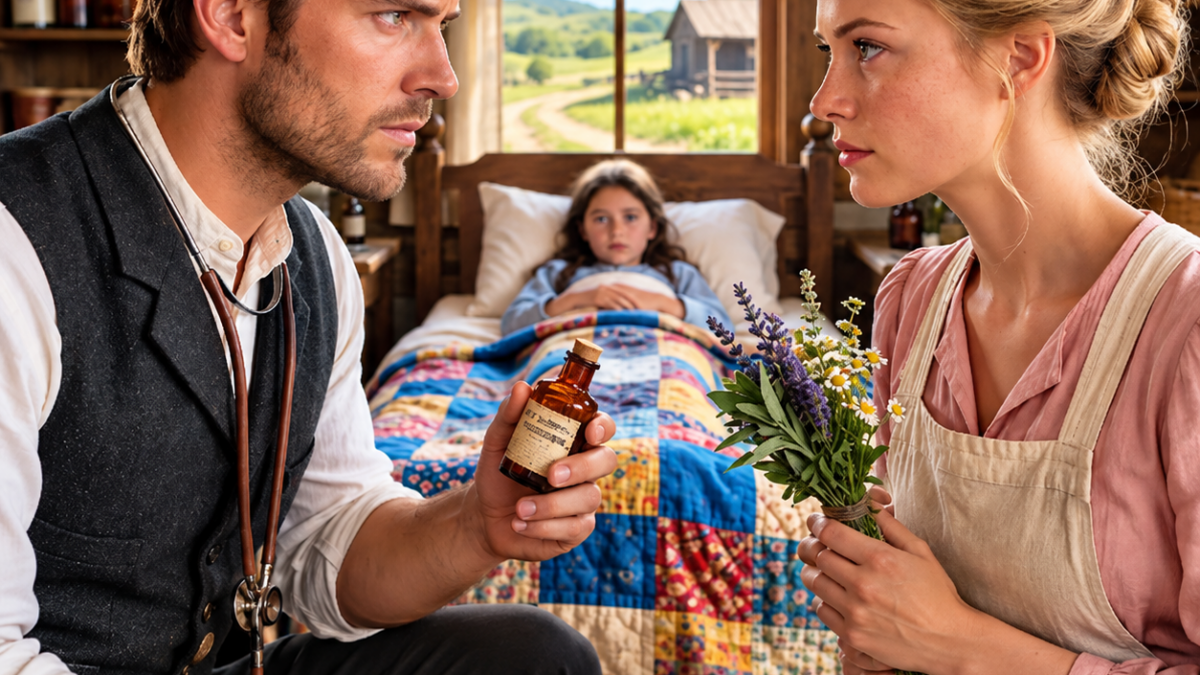
He tied his horse outside, entered the Hart house with his bag in hand, washed carefully, and examined Faith with the practiced calm of a man who knew parents watched the physician’s face more closely than they listened to his words.
Pulse rapid.
Skin hot.
Throat reddened.
No severe cough.
No stiffness of the neck.
Some stomach discomfort.
No delirium yet.
Common seasonal fever, he decided.
Unpleasant.
Frightening to parents.
Most likely recoverable.
He prescribed rest, fluids, cooling compresses, and a tincture to ease discomfort and encourage sleep. He warned Martha to keep Faith hydrated and Franklin to stop standing in the doorway as if fear itself could supervise recovery.
Franklin did not appreciate the remark.
Martha did.
By Wednesday evening, Faith’s fever had not broken.
Theodore returned.
The room smelled of sweat, damp cloth, kerosene, and worry.
Faith lay twisted in the sheets, cheeks flushed crimson, hair stuck to her temples. She muttered once, reaching toward something no one else could see.
Martha looked at Theodore’s face.
“What is it?”
“Fever can rise before it turns,” he said.
It was true.
It was not enough.
He examined Faith again.
That was when he saw the rash.
Faint at first.
A mottled pattern beginning near her collarbone, spreading in uneven patches across the upper chest.
He lifted the lamp closer.
The rash was not like measles.
Not like scarlet fever.
Not quite like anything he could confidently place.
He felt irritation rise in him, directed not at the child, but at the symptom for refusing to arrange itself into a known category.
He wrote in his ledger:
June 15. Evening. Fever persists. Rash at collarbone, irregular, not raised. Monitor closely. Increase fluids. Continue tincture.
“What does that mean?” Franklin asked.
Theodore closed the ledger.
“It means I will return in the morning if not before.”
“If not before?”
“It means I want to be sent for if her breathing worsens, if she cannot be roused, or if the rash spreads rapidly.”
Martha went pale.
Faith stirred.
“Mama?”
Martha sat beside her instantly.
“I’m here.”
Theodore stepped into the hall.
Franklin followed him.
“You said it was common.”
“I said it appeared common.”
“That sounds like a correction.”
“It is.”
Franklin’s face tightened.
“You are supposed to know.”
Theodore turned.
The words struck the place inside him where Sarah Pruitt still lived.
“I am supposed to observe honestly,” he said. “Would you prefer I pretend certainty where I do not have it?”
Franklin looked toward the sick room.
“No.”
“Then send for me if she worsens.”
He stepped onto the porch.
The evening air carried the smell of damp grass and horses.
At the gate stood a woman in a dark traveling dress, a shawl around her shoulders, and a leather satchel hanging from one hand.
She had walked there.
He could tell by the dust on her hem.
She was not young, though neither was she old. Perhaps thirty-two. Perhaps older. It was hard to tell. Her face was strong rather than pretty in the usual way, with dark hair pinned carelessly and eyes that seemed to have finished assessing him before he began assessing her.
Theodore knew who she was before she spoke.
Rose Quinn.
Franklin saw her and frowned.
“Who called you?”
“No one,” Rose said. “Mrs. Bell passed my place near noon. Said the Hart girl had taken fever.”
Theodore descended one step.
“Your concern is noted, Miss Quinn. It is not needed.”
Rose looked past him toward the open sick room window.
“I did not ask whether it was needed.”
“This child is under medical care.”
“I assumed as much when I saw your horse.”
Theodore stopped at the bottom step.
“Then there is no reason for you to come farther.”
Rose’s gaze moved to him.
There was no fear in it.
That irritated him more than defiance would have.
“I have no wish to interfere.”
“Good.”
“But I would like to ask one question.”
“No.”
Franklin shifted uncomfortably.
Theodore heard Martha moving inside the sick room. The window stood open to catch whatever breeze the evening might offer. Voices on the porch would carry.
Theodore should have lowered his voice.
Instead, pride lifted it.
“Stay away from her,” he said plainly. “This child needs medicine, not superstition.”
The words entered the house before he could retrieve them.
Martha appeared at the sick room window.
Franklin looked down.
Rose did not move.
The only sign that the insult had landed was a slight stillness around her mouth.
Then she looked past Theodore again, through the window, to the small bed where Faith lay fevered beneath a damp cloth.
“That rash on her collarbone,” Rose said. “Has it begun spreading downward yet, or only across?”
Theodore went very still.
Franklin’s head snapped toward him.
Martha gripped the windowsill.
Theodore had not mentioned the rash to anyone outside that room.
Rose continued, her voice level.
“I saw it from the gate when Mrs. Hart lifted the lamp. It has a broken pattern to it. Not like heat rash. Not like measles either.”
Theodore felt heat rise under his collar.
“You are observing through a window at dusk.”
“Yes.”
“That is not diagnosis.”
“No,” she said. “It is observation. I find most useful things begin there.”
Franklin looked between them.
“What does she mean?”
Theodore did not answer.
Rose adjusted her satchel on her arm.
“I have seen a fever with that pattern once before.”
Theodore’s eyes narrowed.
“Where?”
“Years ago, north of here. Three children in one household, then two farmhands. Not the same in every detail. Patterns rarely are. But close enough to make me ask questions.”
“What questions?”
“Water, first.”
Theodore almost laughed.
“Water?”
“Yes.”
“Every fever in the territory is not caused by water.”
“I didn’t say every fever.”
“You said enough.”
“I asked enough.”
Theodore stepped closer.
“I studied under physicians who have treated fevers you could not begin to understand.”
Rose met his gaze.
“I don’t doubt it.”
The answer disarmed him for half a breath.
She did not sound offended.
That made the insult he had given her feel larger.
“I have also seen this particular pattern before,” she said. “In a family who waited too long to consider more than one opinion. I came because worry brought me here, not vanity. You may send me away. But if that rash spreads downward and the child’s breathing worsens before midnight, ask where the household draws its water.”
Theodore’s jaw hardened.
“I am aware of contaminated water risks.”
“Then we agree on something.”
“I did not ask for your instruction.”
“No,” Rose said quietly. “You asked me to stay away. I will.”
She looked toward the window, where Martha stood with eyes wide and frightened.
“I hope she improves, Mrs. Hart.”
Martha whispered, “Thank you.”
Rose turned and walked back down the road.
She did not look over her shoulder.
That, somehow, angered Theodore more than if she had.
Franklin spoke first.
“What did she mean about the water?”
“Speculation.”
“Is she right?”
“I do not know.”
Theodore hated saying it.
Franklin heard it anyway.
Inside the room, Faith moaned.
The night began badly and worsened.
By nine o’clock, the fever climbed higher.
By ten, the rash had spread downward over Faith’s chest in blotched, uneven patches.
By ten-thirty, her breathing changed.
Theodore sat beside the bed with his sleeves rolled, counting respirations by the second hand of his watch. Martha stood behind him, lips moving in silent prayer. Franklin paced the hall until Theodore told him either to sit or leave because the floorboards were making the child restless.
Franklin sat.
Faith’s lips cracked.
Her pulse raced beneath Theodore’s fingers.
He adjusted fluids.
He cooled her skin.
He administered what his training offered and waited for the response that did not come.
At eleven-fifteen, Faith began struggling for breath.
Not dramatically at first.
Just a slight catch.
A resistance.
As if the air had thickened inside her.
Theodore leaned closer.
“Faith?”
Her eyes fluttered but did not open.
Martha made a small sound.
Theodore examined her again.
Rash spreading.
Fever unbroken.
Breathing shallow.
No improvement.
He wrote nothing in the ledger now.
There are moments when documentation becomes cowardice.
He thought of Sarah Pruitt.
He thought of the blue coverlet.
He thought of correct steps taken correctly.
Then he thought of Rose Quinn standing at the gate with dust on her hem, asking the question he had not asked yet because he had been too busy being offended by the source.
Water.
At eleven-forty, Faith’s breathing worsened again.
Franklin Hart, who had spent most of his life believing money could summon solutions, fell apart quietly.
He gripped the back of a chair until his knuckles whitened.
“Doctor,” he said. “Tell me what to do.”
That sentence undid Theodore.
Not because he had no answer.
Because he had several and trusted none completely.
He looked at the child.
Then at Martha.
Then at the open window beyond which the road ran dark toward Rose Quinn’s place.
His pride gave one final, pathetic protest.
She could be wrong.
She was probably wrong.
You will look a fool.
You will lose standing.
People will say the doctor needed the healer.
Faith gasped.
Theodore stood.
“I am going to fetch Miss Quinn.”
Franklin stared.
“You sent her away.”
“Yes.”
“Then why—”
“Because I was wrong to do so.”
Martha covered her mouth.
Theodore closed his bag.
“Keep the cloths cool. Give her water only boiled from this moment on.”
Franklin blinked.
“Boiled?”
“Yes.”
“You think Rose—”
“I think your daughter does not have the luxury of my pride.”
He was out the door before Franklin could answer.
The road to Rose Quinn’s cabin ran four miles through dark fields, cedar stands, and low places where fog collected like water. Theodore rode hard, his horse breathing steam beneath him. Branches scraped his coat. Mud splashed his boots. Once, his horse stumbled near a washout, and Theodore nearly went over the animal’s neck.
He cursed, righted himself, and kept going.
By the time Rose’s cabin came into view, a single lamp already burned in the front window.
Theodore dismounted before the horse fully stopped.
He had not reached the porch when the door opened.
Rose stood there dressed for travel, satchel in hand.
As if she had expected him.
That stung too.
“I need your help,” Theodore said.
The words cost him more than any diagnosis ever had.
Rose searched his face.
Not smugly.
Not triumphantly.
That was worse.
If she had been smug, he could have hidden behind resentment.
Instead, she looked only concerned.
“The rash?”
“Downward. Fever rising. Breathing labored.”
“Water?”
“I have not yet checked.”
“Then we check.”
“I don’t fully understand what I’m looking at.”
“Neither do I entirely,” Rose said, stepping onto the porch and pulling the door shut behind her. “I have a suspicion, not certainty.”
“I will take suspicion over pride.”
She looked at him sharply.
He deserved that.
Then she moved past him toward his horse.
“You can apologize later if the child survives.”
“If?”
Rose faced him.
“I don’t make promises to comfort adults while children fight for breath.”
Theodore nodded.
“Fair.”
“I’ll need my own horse. Yours is near blown already.”
Of course she noticed.
Within five minutes, they were riding back together under a moonless sky.
For the first mile, neither spoke.
Theodore’s shame rode beside him like a third horse.
Finally, Rose said, “Tell me exactly what you saw.”
He did.
All of it.
Pulse.
Fever.
Throat.
Rash.
Breathing.
Treatment.
Dosage.
Times.
He expected her to interrupt, to contradict, to wave away his methods with the same contempt he had shown hers.
She did not.
She listened with frightening attention.
When he finished, she asked three questions he had not anticipated and two he should have.
“Any stomach cramping?”
“Yes.”
“Any others ill in the house?”
“No.”
“Farmhands?”
“Not mentioned.”
“Where is the well?”
“North side, near the wash shed, I believe.”
“Livestock?”
“Cattle trough beyond it.”
“How near?”
“I do not know.”
“Then we will know by morning.”
He glanced at her.
“You truly suspect contaminated water?”
“I suspect something wrong near the water. I don’t know if it is the whole answer.”
“That distinction matters to you?”
“It should matter to anyone who means to help.”
Theodore absorbed that in silence.
They reached the Hart house just past midnight.
Martha met them at the door.
She looked at Rose first.
There was no shame in it.
Only desperate hope.
Rose removed her gloves.
“I need hot water. Boiled. Clean cloths. A lamp with good oil. And someone to show me the well at first light.”
Franklin appeared behind his wife.
His face tightened when he saw Rose step inside.
Theodore saw the hesitation.
Before Franklin could speak, Theodore said, “Miss Quinn is here at my request.”
Rose glanced at him.
So did Franklin.
The sentence mattered.
More than Theodore had understood until he said it.
It placed responsibility where it belonged.
With him.
Rose washed her hands thoroughly, then entered the sick room.
Faith lay twisted in sweat-damp sheets, her small chest rising and falling too fast. Rose stopped just inside the doorway.
Theodore watched her take in the room.
Not mystical.
Not theatrical.
Methodical.
Window open.
Blankets.
Water basin.
Lamp smoke.
Cup on bedside table.
Mother’s chair.
Child’s skin.
Breath.
Rash.
Hands.
Mouth.
She approached the bed and sat beside it.
“Faith,” she said softly.
The girl did not respond.
Rose lifted the edge of Faith’s nightdress enough to see the rash. She did not touch at first, only looked. Then she pressed the back of her fingers lightly to Faith’s skin.
Theodore had expected muttering.
Prayers.
Confidence.
Instead, Rose frowned.
“She is very hot.”
“Yes.”
“You said fluids?”
“As much as she can take.”
“What water?”
Martha answered.
“From the well.”
“Boiled?”
“Not before he said so.”
Rose looked at Theodore.
Not accusing.
Still, he felt it.
“I did not suspect it early enough,” he said.
“No one suspects everything early enough.”
The words could have comforted him.
They did not.
Rose opened her satchel.
Inside were linen packets, small corked bottles, folded paper, dried leaves tied with string, a spoon wrapped in cloth, a mortar small enough for travel, and a notebook more worn than Theodore’s ledger.
He noticed the notebook.
“You keep records?”
Rose did not look up.
“Of course.”
“Of what?”
“What helped. What harmed. What did neither. Who lived. Who didn’t. Weather. Wells. Food. Births. Fevers. Mistakes.”
He stared at her.
She measured dried leaves into the mortar.
“What?” she asked.
“Nothing.”
“You look surprised for a man who values records.”
“I am.”
“Then I suggest you be surprised after we help the child.”
He almost smiled.
Almost.
Rose prepared something bitter-smelling in a cup of boiled water and let it steep while Theodore monitored Faith’s pulse. She did not call it a cure. She did not claim certainty. She asked Theodore what he had already given so she would not unknowingly compound harm. That, more than anything, began shifting something in him.
Dangerous amateurs did not ask about interactions.
Frauds did not admit uncertainty.
Fools did not keep records of failure.
Rose cooled the preparation and offered it a spoonful at a time when Faith surfaced enough to swallow. Theodore supported the child’s head. Martha watched like a woman whose whole soul had narrowed to the distance between spoon and mouth.
Some of the liquid dribbled down Faith’s chin.
Some went in.
Rose wiped her gently.
“No more for now.”
“That little?” Franklin asked.
“That little stayed down,” Rose replied. “I prefer what stays.”
Through the rest of the night, they worked.
Not smoothly at first.
Theodore reached for a cloth just as Rose did.
Rose told him the lamp smoked too much.
He told her the child needed less blanket.
She told him she knew that and had moved the blanket because Martha was trembling and needed something useful to do.
He looked and saw Martha indeed steadier with the task in hand.
Rose watched Faith’s face.
Theodore watched the watch.
Rose listened for changes in breath.
Theodore counted them.
At one point, near three in the morning, Franklin whispered, “Is she dying?”
Theodore opened his mouth.
No honest sentence came quickly enough.
Rose answered.
“She is fighting.”
“That is not what I asked.”
“It is the only answer I have that is true.”
Franklin turned away.
Theodore looked at Rose then.
Something complicated moved in his chest.
Not admiration exactly.
Not yet.
Recognition.
At dawn, the fever had not broken.
But Faith was no worse.
Sometimes holding steady is the only victory available, though people rarely recognize it when exhausted hope wants drama.
Rose stood.
“The well.”
Theodore stood too.
“You have not slept.”
“Neither have you.”
“That is not an argument.”
“Then don’t make it one.”
Franklin led them outside.
Morning came pale and damp over the Hart farm. Mist clung low to the fields. Chickens scratched near the wash shed. A hired man watched from the barn, hat in hand, already aware something was wrong enough to make the doctor and healer walk side by side.
The well stood north of the house, stone-lined, with a wooden cover.
At first glance, nothing seemed obviously foul.
Rose crouched.
Theodore stood beside her.
She looked at the ground, not the water.
That surprised him.
She touched the soil near the stones. Followed a shallow slope with her eyes. Walked toward the trough beyond the wash shed.
The cattle trough sat too near.
Theodore saw that now.
Behind it, in a low dip half-hidden by weeds, stagnant runoff had gathered. A cracked drainage channel, likely dug years earlier and neglected, angled toward the well after heavy rain.
Rose pointed.
“How long has that been there?”
Franklin frowned.
“What?”
“That trough drainage.”
Franklin looked annoyed, then uncertain.
“I don’t know.”
Theodore crouched by the wet ground.
The smell reached him.
Sour.
Wrong.
Rose’s mouth tightened.
“Has anything died near here?”
“No.”
She looked at him.
Franklin’s face changed.
“A calf,” he admitted. “Three weeks back. But it was dragged away.”
“From where?”
He pointed toward the trough.
Theodore closed his eyes.
Rose said nothing.
That silence condemned more effectively than speech.
“I didn’t think—” Franklin began.
“No,” Martha said from behind them.
They turned.
She had followed without anyone noticing, a shawl wrapped around her shoulders.
Her face was white with fury.
“You didn’t think because thinking about such things is my work until it becomes your consequence.”
Franklin looked wounded.
“Martha—”
“Our daughter drinks from that well.”
“We all drink from it.”
“And yet when I said the water tasted foul after the last rain, you told me the pump needed priming.”
Franklin fell silent.
Theodore looked at Rose.
“Can this cause her symptoms?”
“It can cause illness. Whether it caused all of this, I will not swear.”
“But it is wrong.”
“Yes.”
“And dangerous.”
“Yes.”
Theodore turned to Franklin.
“No one in this household drinks unboiled water again until that well is cleaned, tested as far as we can manage, and the runoff redirected.”
Franklin nodded too quickly.
“Of course.”
Martha’s eyes flashed.
“Not of course. Do it.”
He looked at her.
For the first time since Theodore had known him, Franklin Hart seemed smaller than his own house.
“I will,” he said.
Rose rose from her crouch.
“Send riders to every family using low wells after the rain. Ask about fevers. Stomach illness. Rashes.”
Theodore nodded.
“I’ll do it.”
Franklin said, “You think others—”
“I think if there is danger in one well, we should not wait until children prove it by falling ill.”
Rose looked at Theodore.
“Agreed?”
Theodore met her gaze.
“Agreed.”
That was the first time they stood on the same side of a question without needing injury or insult to put them there.
The days that followed were slow, uncertain, and humbling.
Faith did not recover like a storybook child sitting up at sunrise, smiling prettily, while adults wept in gratitude.
She suffered.
The fever held through the first day after Rose arrived.
Her breathing remained too fast.
The rash darkened before it faded.
She woke confused, cried for water, then cried because water tasted boiled.
Rose adjusted her preparation twice, watching carefully for any sign it harmed more than helped. Theodore altered his schedule, reduced one tincture, increased fluids, and kept notes beside Rose’s.
Their notebooks lay open on the same small table.
His neat.
Hers slanted and crowded.
Both useful.
That unsettled him in a way he did not have time to examine.
On the second evening, Rose sat back in her chair, face gray with exhaustion.
“I don’t know that this is working.”
Theodore looked at Faith.
Her breathing was still rough, but not worse.
“Neither do I.”
Rose rubbed both hands over her face.
“That comforts me less than you may hope.”
“But she is no worse.”
“Some days that is only postponement.”
“Some days it is the only honest victory available.”
Rose looked at him.
“You say that as if you learned it the hard way.”
He did not answer.
Faith stirred.
Her eyes fluttered open.
For a moment, the room froze.
Martha leaned close.
“Faith?”
The girl’s gaze moved, unfocused, from her mother to Theodore to Rose.
“You’re both still here,” she murmured.
Theodore felt something in him give way.
Rose touched the child’s hair.
“We’re not going anywhere.”
Faith’s cracked lips twitched.
“You argue a lot.”
Martha made a sound that was half sob, half laugh.
“We do,” Theodore admitted.
Faith closed her eyes again.
The tiny ghost of a smile remained on her face for one breath.
Neither Theodore nor Rose mentioned how much that small observation steadied them through the rest of the night.
On the third morning, Faith’s fever began to break.
Not dramatically.
Not all at once.
By degrees.
Half a point.
A cooler forehead.
A deeper breath.
A longer sleep.
A request for water.
A complaint that the room smelled bad.
“That,” Rose said, eyes closing briefly in relief, “may be the finest insult I have ever heard.”
By the fifth day, Faith sat up in bed and ate broth, then demanded bread with butter, then complained that everyone was staring at her as if she had performed a circus act.
Franklin cried behind his hand.
Martha did not bother hiding her tears.
Theodore recorded the improvement in his ledger with a hand that shook slightly.
Rose watched from the window.
Faith looked at her.
“Miss Quinn?”
“Yes?”
“Did you save me?”
Rose came to the bedside.
“No.”
Faith frowned.
“Dr. Cross?”
“No,” Theodore said.
Faith looked annoyed.
“Then who did?”
Rose smiled.
“You fought very hard.”
Theodore added, “Your mother boiled enough water to supply an army.”
Martha laughed through tears.
Rose said, “Your father finally listened about the well.”
Franklin looked embarrassed.
“And Dr. Cross and I argued at you until the fever gave up from irritation,” Rose finished.
Faith considered that.
“That sounds right.”
By the end of the week, the worst had passed.
A second farm reported stomach illness, though milder.
Two children near the creek had rashes but recovered quickly after their families boiled water and changed sources.
The Hart well was cleaned, the trough moved, the drainage corrected.
No one could prove with scientific certainty that the well had caused Faith’s illness entirely.
But no one with sense denied something had been dangerously wrong.
Theodore did not enjoy uncertainty.
He enjoyed it less when uncertainty saved face for men who wanted conclusions simple enough to flatter them.
Franklin wanted to say the fever had simply passed.
Martha would not let him.
At the first Sunday church gathering after Faith sat up, Franklin stood outside beside the wagon while neighbors offered relief, gossip, and self-important advice.
Mrs. Bell said, “I hear Miss Quinn was called in.”
The way she said it made Rose’s name sound like an unfortunate ingredient.
Franklin hesitated.
Martha looked at him.
It was not a large look.
It did not need to be.
Franklin cleared his throat.
“Miss Quinn saw what the rest of us missed.”
Theodore, standing nearby, turned.
Mrs. Bell blinked.
“Oh.”
Franklin continued, visibly uncomfortable.
“And Dr. Cross had the sense to bring her back.”
Theodore almost corrected him.
The timeline was less generous.
Then he decided the public version could wait for a more private honesty. What mattered was that Rose was not being hidden.
But Rose herself was not there.
She rarely attended church.
Some said she preferred solitude.
Some said she knew when a room would tolerate her only until prayers ended.
Theodore found her that afternoon in her garden, kneeling among plants with a basket at her side.
She did not look surprised to see him.
“You walk quietly for a man in city boots,” she said.
“I came to return your notebook.”
She stood.
“You read it?”
“I did not intend to.”
“That is not a no.”
He held it out.
“It fell open.”
“That is also not a no.”
“I read one page.”
“Only one?”
He felt heat rise in his face.
“Three.”
Rose took the notebook.
“And?”
“And I owe you an apology.”
She tucked the notebook into her satchel.
“For reading it?”
“For much more than that.”
Rose waited.
Theodore had rehearsed on the walk over. The words had seemed orderly then. Now, in front of her, with sunlight on the herb beds and dirt on her sleeves, order fled.
“I dismissed you before I knew you,” he said. “I called your work superstition because it did not arrive in the form I respected. That was not rigor. It was arrogance.”
Rose’s expression did not change.
He continued.
“I have spent years telling myself that certainty protects patients. It does not. Honesty does. You were honest about what you knew and did not know. I was certain where I should have been curious.”
Something softened in her eyes, though not enough to rescue him from finishing.
“I am sorry for insulting you at the Hart house. I am sorry for sending you away. I am sorry that my pride cost Faith hours she may have needed.”
Rose was quiet long enough that he began to fear she might simply thank him and close the door.
Instead, she said, “Apology accepted.”
The relief was immediate and undeserved.
“Thank you.”
“Don’t look so grateful yet. I haven’t finished.”
He straightened.
She stepped closer.
“I accept your apology because it is sincere. But I do not want to become one more private exception to your public rule.”
He frowned.
“What does that mean?”
“It means men like Franklin Hart will call me when desperate and forget my name when comfortable. Women like Mrs. Bell will ask me for cough remedies in winter and look through me at the mercantile in spring. I know how to be useful in secret. I have spent years doing it.”
Theodore said nothing.
“You came here privately to apologize. Good. But if all that changes is your private opinion of me, then nothing important changes.”
He deserved that too.
“What would you have me do?”
Rose smiled without humor.
“That is the first honest question you have asked me when no child was fevered.”
He accepted the blow.
“I mean it.”
“Then when my knowledge helps, say so where others can hear. When you disagree, disagree honestly, not contemptuously. When someone calls me a witch under their breath after asking me for tea the week before, do not pretend you heard nothing because politeness feels easier.”
Theodore nodded.
“That is fair.”
“No,” Rose said. “It is overdue.”
A week later, the opportunity came sooner than expected.
The mercantile stood at the center of town, stocked with flour, salt, lamp oil, coffee, calico, nails, thread, sugar, buttons, and rumors in roughly equal measure.
Theodore entered to purchase quinine and paper.
Rose stood at the counter buying vinegar and twine.
Mrs. Bell, the same neighbor who had carried word of Faith’s fever, stood near the fabric bolts with another woman. Theodore saw her glance at Rose, then away, as if the healer were a household tool mistakenly set in public view.
Rose paid quietly.
She turned to leave.
Mrs. Bell murmured, “Funny how some people become respectable once the doctor requires them.”
The words were soft.
Soft enough to deny.
Loud enough to wound.
Rose’s face remained calm.
Theodore set down his package.
“Mrs. Bell.”
The store went quiet.
Mrs. Bell turned.
“Yes, Doctor?”
The title was deliberate.
So was his answer.
“Miss Quinn saw a pattern in Faith Hart’s illness that I missed. She asked a better question than I did. The child is alive in part because Miss Quinn walked four miles when no one invited her and because, after wasting precious time, I finally had the sense to seek her help.”
Mrs. Bell flushed.
“I meant no offense.”
“You did,” Theodore said. “But you may repair it.”
The shopkeeper suddenly found great interest in arranging nails.
Rose looked at Theodore with an expression he could not read.
Mrs. Bell swallowed.
“Miss Quinn,” she said stiffly, “I am glad you were able to help the Hart girl.”
Rose nodded.
“So am I.”
Outside, Rose rounded on Theodore.
“You needn’t make theater of me.”
“It was not theater.”
“You humiliated her.”
“She attempted the same with you.”
“I have endured worse.”
“That is not an argument for allowing more.”
Rose stared at him.
He held her gaze.
Finally, she looked away, but not before he saw the glimmer of something like unwilling amusement.
“You are very difficult when corrected,” she said.
“So I have been told.”
“By whom?”
“Recently? You.”
She almost smiled.
That was the beginning.
Not of romance.
Not yet.
Of respect with roots.
Theodore began greeting Rose openly whenever they crossed paths. He did not overdo it after the mercantile incident, though the temptation existed. He did not want to turn decency into performance. He simply treated her in daylight the way the county already treated her in private necessity.
People noticed.
Of course they did.
Benton’s Crossing had fewer than six hundred residents and enough idle speculation to supply three cities.
The doctor and the healer were seen speaking outside the post office.
The doctor and the healer both attended to the Miller baby’s cough.
The doctor and the healer disagreed for fifteen minutes outside a barn about whether a farmhand’s headaches came from poor lamplight, weak eyes, or his habit of sleeping too little and drinking too much coffee.
The doctor and the healer were seen laughing.
That last report did the most damage.
Respect might be explained.
Laughter suggested danger.
Rose heard the gossip too.
She pretended not to.
Theodore did not pretend well.
One evening, after they had both been called to examine an elderly man with chest tightness, Theodore walked Rose home because rain threatened and because he had begun inventing reasons to continue conversations.
The patient, Mr. Adler, had been instructed by Theodore to rest and reduce exertion, and by Rose to stop arguing with his daughters because anger did his heart no favors.
“I am unconvinced irritation can be measured medically,” Theodore said as they walked.
“Then you have never watched a stubborn man turn purple during an argument about firewood.”
“I have, but correlation is not causation.”
“Men say that when they wish to continue behaving badly without admitting consequence.”
Theodore looked at her.
“You have built an entire philosophy from observation.”
“So have you. You simply use Latin when doing it.”
He laughed.
The sound surprised him.
It had been years since laughter escaped before he could judge whether it was appropriate.
Rose noticed.
She noticed too much.
“You do that as if laughter is an instrument you forgot how to use.”
The road narrowed between cedars.
Theodore looked ahead.
“I lost a patient once.”
Rose’s steps slowed.
“Only once?”
He gave her a sad half-smile.
“No. But one I carry differently.”
They walked on.
He told her about Sarah Pruitt.
Not all at once.
The story came in pieces, pulled by the rhythm of their steps and the rain beginning softly in the branches.
He told her about the fever after birth.
The training he followed.
The husband who trusted him.
The room.
The light.
The child left motherless.
He did not realize how long it had been since he had said Sarah’s name aloud until he spoke it and felt the old guilt stir like an animal disturbed from sleep.
“I did everything correctly,” he said.
Rose’s voice was gentle.
“And she died.”
“Yes.”
“You made correctness your penance.”
The accuracy of it angered him for one irrational second.
Then it freed him.
“I thought method was humility,” he said. “Perhaps it became fear dressed as certainty.”
Rose stopped walking.
Rain dotted her shawl.
“My grandmother raised me,” she said. “Most of what I know began with her. She had hands that could find fever in a wrist before anyone else saw it in the face. She brought babies into the world, eased pain, set bones well enough when no doctor could come. People came to her at all hours.”
“What happened?”
Rose looked down the road toward her cabin.
“She died of an illness I tried to treat.”
Theodore said nothing.
“I gave her everything she had taught me. Everything I knew. I changed preparations. Prayed. Bargained. Slept in a chair beside her for six nights.”
Rose’s jaw tightened.
“She died before dawn on the seventh.”
“I am sorry.”
“For years I wondered whether that meant the knowledge failed. Or I failed. Or she had taught me wrong. Eventually I understood something I still dislike.”
“What?”
“Sometimes illness is larger than any single tradition.”
Theodore absorbed that.
Rain fell harder.
Neither moved.
Finally, Rose said, “You are not the only one who made certainty out of grief.”
He looked at her then.
For the first time, the space between them held something more dangerous than argument.
Understanding.
They reached her porch wet and quiet.
Theodore meant to say good night.
Instead, he said, “May I call on you tomorrow?”
Rose’s mouth curved.
“For professional reasons?”
He hesitated.
Then, because he had learned something from Faith’s sickroom, he chose honesty.
“I am running out of those.”
Rose looked at him for a long moment.
“Then come for coffee.”
He nodded.
“I take mine plain.”
“I remember. Like a man rationing joy.”
“That was one observation.”
“A correct one.”
He smiled.
“Tomorrow, then.”
“Tomorrow.”
Their courtship, if that was what the county insisted on calling it, was mostly argument with coffee.
Theodore brought medical journals.
Rose read them with fierce concentration and challenged anything that smelled of assumption.
Rose showed him her drying room, where herbs hung from rafters in careful bundles and jars lined shelves according to use, strength, season, and risk. He learned quickly that asking, “How do you know the dosage?” in the wrong tone would earn him a glare sharp enough to trim bark.
“Experience is not absence of method,” she told him once.
“No,” he admitted. “But method should survive explanation.”
“Then ask as if you want to understand, not as if you are waiting to catch me.”
He did.
She explained.
Not everything she used impressed him. Some remedies, by her own admission, comforted more than cured. Some eased symptoms. Some had uncertain value but low risk. Some she avoided because she had seen harm. She kept records of failures. Theodore respected that more than she knew.
He taught her to use his microscope.
The first time she saw pond water magnified, she went utterly still.
“There is a whole world inside a drop.”
“Yes.”
“And men see this and remain arrogant?”
Theodore coughed.
“Some do.”
She bent closer.
“Remarkable.”
Faith Hart recovered fully and became insufferably proud of having nearly died in a medically interesting way.
She visited Rose often, usually with excuses thin enough to embarrass a less confident child.
A scraped knee.
A headache.
A question about a plant.
A message from her mother.
A sudden need to inform Rose that Theodore had been seen smiling near the livery.
One afternoon, Faith arrived at Rose’s cabin with dirt on her skirt and blood on one knee from falling off a fence she had absolutely been told not to climb.
Theodore was already there, arguing with Rose about whether a neighbor’s persistent headaches required spectacles or less reading by poor lamplight.
“You’re here again,” Faith observed, entirely too pleased with herself.
“Professional visit,” Theodore said.
“That’s what you said last week.”
“It was a different professional matter last week.”
Faith looked between them with the frank patience of a child who had decided adults were being slow.
“Are you courting Miss Quinn, Dr. Cross?”
Rose nearly dropped the bandage she had been unwinding.
Theodore, to his credit, did not flinch, though visible effort was required.
“I am considering it,” he said. “Properly and slowly, so as not to make a mess of it.”
Faith frowned.
“That seems a very doctor way of answering.”
Rose pressed her lips together.
Faith held out her knee.
“You should do it faster. Adults die.”
Silence fell.
Rose’s hands stilled.
Theodore looked at Faith more closely.
Her face remained matter-of-fact, but something shadowed her eyes. Children who have been very ill learn mortality before adults want them to.
Rose cleaned the scrape gently.
“You are not wrong,” Theodore said at last.
Faith nodded, satisfied she had improved the situation.
“I know.”
After she left, Theodore and Rose stood on the porch watching her skip carefully down the road.
“She is too young to understand that,” Rose said.
“She understands because she nearly died while adults argued over water.”
Rose looked at him.
“We were not only arguing.”
“No. But from her bed, it likely sounded that way.”
“Do you regret calling me?”
“I regret not calling you sooner.”
The answer came easily now.
Rose heard that too.
Autumn came in gold and smoke.
Theodore asked properly in October, on the same porch where he had once told Rose to stay away.
He arrived with no flowers because the garden had better taste than he did, no ring because the jeweler in Olympia was delayed by weather, and no speech because every version he rehearsed sounded like a lecture.
Rose opened the door and saw his face.
“Oh,” she said.
He frowned.
“Oh?”
“You look like a man about to propose or confess to murder.”
“That is an alarming range.”
“Am I wrong?”
“No.”
“Which is it?”
He removed his hat.
“Rose Quinn, I am not offering to rescue you from anything.”
Her expression changed.
That, at least, was the right beginning.
“You have built something valuable on your own,” he continued. “You have knowledge I respect, work I have come to trust, and a life that does not require my approval to be worthy.”
She stepped onto the porch.
He swallowed.
“I am asking whether you would have me as a husband. Not quietly. Not conveniently. Not as a man who calls for you at midnight and fails to stand beside you by noon. I am asking to spend the rest of my career and life standing beside you in daylight, even when we disagree, which I expect will be often.”
Rose looked toward the garden.
For once, Theodore could not read her.
“I have spent a long while being useful to people who would rather not be seen needing me,” she said finally.
“I know.”
“I do not want to become a doctor’s hidden indulgence.”
“You would not.”
“I do not want to be corrected in public and thanked in private.”
“You would not.”
“I do not want your respect only when illness frightens you.”
“You have it when I am not frightened too.”
She looked back at him.
“That may be the most romantic thing you have ever said.”
“I feared as much.”
She smiled.
A real one.
“I would like to try being needed openly, for once.”
His heart struck hard.
“Yes?”
“Yes, Theodore.”
He let out a breath he had not realized he was holding.
Then she added, “But I reserve the right to disagree with you in front of patients when necessary.”
“I expected nothing less.”
“And you will stop pretending coffee must be consumed as if rationed by a military quartermaster.”
“That may require time.”
“I am marrying a work in progress, then.”
“As am I.”
She laughed and stepped into his arms.
The county talked for months.
Some approved.
Some disapproved.
Some pretended they had always respected Rose.
Those were Theodore’s least favorite.
Mrs. Bell sent a pie with a note containing three spelling errors and one strained apology.
Franklin Hart offered them use of his largest barn for the wedding supper.
Martha told him not to make every decent gesture enormous just because guilt made him uncomfortable.
They married that winter in a small ceremony with snow along the fence rails and Faith Hart in attendance, fully recovered and nearly bursting with the importance of having predicted the marriage.
When the minister asked if anyone had objection, Faith turned around and glared at the guests preemptively.
No one dared.
Married life surprised them.
Not because it was easy.
Because it was ordinary.
Theodore moved into Rose’s cabin at her insistence that she had better shelves. He brought books, instruments, ledgers, and three chairs too uncomfortable for human use. Rose allowed one chair in the examination room and banished the others to storage.
Herbs dried across the kitchen.
Medical journals crowded the table.
Arguments continued.
Now they occurred over breakfast, supper, laundry, patients, weather, dosage, cleanliness, shoes left near doors, and Theodore’s persistent belief that a proper filing system could improve any household.
Rose read his journals in the evening, marking passages with slips of paper.
“You are becoming very physician-like,” he told her once.
“Someone in this house must keep up with you before you grow prideful from lack of competition.”
He looked over his spectacles.
“You consider yourself competition?”
“I consider myself necessary opposition.”
“That sounds exhausting.”
“For whom?”
He laughed.
Their first serious case as husband and wife came in spring.
A fever, milder than Faith’s but frightening to the parents. The family lived near enough that both doctor and healer arrived almost at the same time, by prior arrangement rather than emergency humiliation.
Theodore dismounted.
“Water first,” he said before Rose had fully stepped down.
“Already thought of it,” she replied. “I’ll check the well. You check the child.”
They worked the case in under an hour.
No quarrel.
No drama.
No professional display.
Rose found nothing wrong with the well.
Theodore found early signs of an ordinary fever.
They prescribed fluids, rest, careful observation, and one of Rose’s mild preparations for comfort, which Theodore admitted might help and certainly would not harm.
The family grandmother watched them pack their bags with open curiosity.
“You two argue considerably less than the whole county predicted,” she said.
Rose tied her satchel.
“We save our arguing for matters that deserve it.”
Theodore loaded his horse.
“Or for coffee.”
Rose pointed at him without turning.
“That is not settled.”
The grandmother smiled.
By the end of that year, people had adjusted.
Not completely.
People rarely surrender prejudice in one dramatic gesture. They misplace it gradually, then act as if they never held it.
Rose was still called first in secret by some families and greeted stiffly by the same people in town. But fewer looked through her. More said her name. More acknowledged when she helped.
Theodore corrected them when they didn’t.
Not always with public speeches.
Sometimes with a simple sentence.
“Miss Quinn’s records may help here.”
“My wife has seen this pattern before.”
“Ask Rose. She knows more than I do about that.”
At first, each admission cost him a small internal wince.
Then it became habit.
Then it became truth spoken easily.
Rose noticed.
She said little.
But one evening, after a long day attending a difficult birth that ended well after frightening them both, she leaned against the kitchen counter and said, “You said my name before yours today.”
Theodore looked up from washing his hands.
“What?”
“To the father. You said, ‘Rose saw the trouble early.’ Not ‘we.’ Not ‘I.’”
“You did see it early.”
“Yes.”
He waited.
She looked away.
“Thank you.”
He dried his hands slowly.
“You never need to thank me for telling the truth.”
Rose’s mouth softened.
“No. But I remember when truth required midnight and a dying child before you could reach it.”
He accepted that.
“So do I.”
Two years into their marriage, in early spring of 1890, Rose told him he would soon need to learn several things beyond herbs and journals.
It took him a moment to understand.
When he did, he set down the mortar and pestle he had been holding with considerably less care than the instrument deserved.
“You’re certain?”
“Reasonably,” Rose said, smiling despite herself. “Though I welcome a second medical opinion if the physician in the house has one to offer.”
He crossed the kitchen as if approaching a sacred patient.
Rose laughed.
“Theodore, I am not made of blown glass.”
“No,” he said. “You are considerably more terrifying.”
He examined her with careful tenderness, though his hands shook slightly.
“I believe congratulations are in order,” he said at last. “For both of us.”
Rose watched his face.
“Are you frightened?”
“Yes.”
“Good.”
“Good?”
“Only fools enter parenthood entirely confident.”
“I have delivered children.”
“You have not fathered one.”
“That distinction has become suddenly enormous.”
She took his hand and placed it over her still-flat belly.
“We will argue our way through it.”
“That poor child.”
“She will be formidable.”
Faith, now nine and insisting to anyone who listened that she would soon be ten, was delighted.
She declared herself honorary sister, future instructor, emergency adviser, and chief naming consultant.
“You will be none of those without permission,” Rose told her.
Faith considered that.
“I will be available.”
“That is safer.”
She visited often that spring, helping fold small blankets and asking deeply intrusive questions Theodore refused to answer.
One afternoon, she sat with Rose in the garden, smoothing a small quilt across her knees.
“I remember being sick in that bed,” Faith said.
Rose looked up.
“You do?”
“Not much. Mostly heat. And Mama crying when she thought I slept. And you and Dr. Cross arguing.”
“We were trying not to argue.”
“You failed.”
Rose laughed.
Faith pulled at a loose thread.
“I remember waking once and thinking you both looked tired enough to die too.”
“We were rather tired.”
“But you stayed.”
Rose’s hands stilled.
“Yes.”
Faith nodded, as if confirming something important.
“When the baby comes, I want to teach her the garden.”
“That may have to wait a few years.”
“I can start with simple things.”
“Naming leaves to an infant?”
“Babies hear.”
“They do.”
“I’ll start with chamomile.”
Rose smiled.
“You would make a fine teacher.”
Faith returned the following week with a small jar of dried chamomile she had gathered and prepared under Martha’s supervision.
“For the nursery,” she announced.
Theodore examined the jar.
“It is labeled.”
“Of course it is. I am not reckless.”
Rose coughed into her hand.
The baby came on a clear night in September.
Theodore, despite every birth he had attended with professional calm, discovered that the medical knowledge of a physician becomes nearly useless when the woman laboring behind the door is his wife.
He paced the hallway for three hours.
The midwife, Mrs. Alder, finally opened the door and glared at him.
“If you wear a trench in that floor, Dr. Cross, you will repair it yourself.”
“How is she?”
“Doing the work men spend centuries describing badly.”
“May I—”
“No.”
The door closed.
He resumed pacing more quietly.
When he was finally called in, Rose looked exhausted, furious, radiant, and deeply amused by his face.
The baby lay in her arms, small and red and impossibly alive.
“A girl,” Rose said.
Theodore approached as if the floor might give way beneath him.
Mrs. Alder placed the child in his arms.
His hands, which had stitched wounds, set bones, held dying pulses, and steadied instruments through crisis, trembled.
“She’s very small,” he whispered.
“She is a newborn,” Rose said. “They tend that way.”
“She has your chin.”
“She has your frown.”
“I do not frown.”
The baby wrinkled her face in unmistakable disapproval.
Rose laughed weakly.
“I believe she disagrees.”
They named her June.
Not for the month itself, Theodore later told anyone rude enough to ask, but for the June night when a rash on a frightened child’s collarbone taught a doctor the difference between certainty and wisdom.
June Cross grew up between dried herbs and medical journals.
By two, she slept through arguments better than any child in the county.
By three, she toddled from her mother’s garden to her father’s examination room with the easy confidence of someone who considered both equally hers.
By four, she pulled more weeds than herbs but presented each plant to Rose with grave seriousness.
“This one helps fevers,” she informed a worried patient’s mother once, holding up something green and entirely wrong.
Rose examined it.
“That one helps the compost.”
June nodded.
“I knew it helped something.”
By six, she began asking Theodore questions after patient visits.
“Why did you listen to his chest twice?”
“Because the first time I heard something unclear.”
“Why didn’t you say that?”
“To whom?”
“Him.”
Theodore paused.
“I suppose I did not want to worry him.”
“Was he less worried not knowing?”
The question struck with Rose-like accuracy.
From the kitchen, Rose laughed.
Theodore looked toward her.
“You coached her.”
“I did not.”
June frowned.
“I can ask my own questions.”
“Yes,” Theodore said gravely. “You certainly can.”
Faith, sixteen by then and nearly grown, still came most Sundays.
She kept her promise.
She taught June the garden.
The two knelt together in dirt while Faith identified plants and June repeated the names with the solemn authority of a child certain she had always known everything worth knowing.
“That’s chamomile,” Faith said, guiding June’s small hand to the right leaves. “Same plant I brought your mother before you were born.”
“I know,” June said. “You tell me every time.”
“Because it’s worth telling every time.”
Rose watched them from the porch one afternoon, Theodore beside her.
Faith’s hair shone dark in the sun.
June’s small fingers mangled a cutting.
Rose said, “She lived.”
Theodore followed her gaze.
“Yes.”
“I think about that sometimes.”
“So do I.”
“If you had not come back for me—”
“I know.”
“If I had not come at all—”
“I know.”
“If Martha had not insisted on boiling water—”
“I know.”
“If Franklin had hidden the trough—”
“I know.”
“If the fever had simply been stronger—”
Theodore reached for her hand.
“I know.”
Rose leaned against the porch post.
“Life turns on so many hinges.”
“It does.”
“And we spend most of our time praising the door.”
He smiled.
“That sounds like something you should write down.”
“You write it. You enjoy ledgers more.”
He squeezed her hand.
In later years, people told the story differently.
Stories change shape as communities retell them, smoothing discomfort into legend.
Some said Dr. Cross had always respected Rose Quinn.
He had not.
Some said Rose had known immediately what was wrong and saved Faith single-handedly.
She had not.
Some said the well was definitely poisoned, or cursed, or full of rot, or contaminated beyond doubt.
No one knew with that certainty.
Some said Theodore fell in love with Rose the moment she challenged him on the porch.
He absolutely did not.
He was furious.
Then ashamed.
Then curious.
Then respectful.
Then entertained.
Then undone.
Love, in their case, did not strike like lightning.
It worked more like water.
Patient.
Persistent.
Finding cracks pride had left.
The truth was less tidy and far better.
A proud doctor dismissed a healer because her knowledge did not wear the clothing he recognized.
A healer asked an honest question anyway.
A child worsened.
A father panicked.
A mother endured.
A doctor rode through darkness and admitted he did not know enough.
A healer came.
Together, they did what neither could fully have done alone.
That was the story Theodore told whenever young physicians visited Benton’s Crossing and made the mistake of sounding too certain too soon.
By then, his hair had silvered at the temples.
Rose’s hands had grown more lined from weather and work.
June, tall and sharp-eyed, had begun reading medical texts with alarming speed and correcting both parents when either became imprecise.
Young doctors came west full of theory and impatience.
Theodore recognized himself in the worst of them.
One, a man named Dr. Edwin Vale, arrived from Boston with new instruments, new opinions, and a visible horror at the idea that local healers were consulted for anything beyond tea.
At supper, he said, “I suppose one must tolerate folk practices where access is limited.”
Rose looked at Theodore over her cup.
June stopped chewing.
Theodore set down his fork.
“That depends.”
Dr. Vale smiled.
“On what?”
“On whether one prefers tolerating useful knowledge or killing patients with one’s own vanity.”
The young man blinked.
Rose sipped her coffee.
June grinned into her napkin.
Theodore leaned back.
“I once told my wife to stay away from a sick child.”
Dr. Vale looked mortified.
Before the evening ended, Theodore told him the whole story.
Not the flattering version.
The true one.
At the end, Dr. Vale said quietly, “That must have been humbling.”
“No,” Rose said. “Humbling is when a lesson improves you. At the time, it was merely embarrassing.”
June laughed so hard she choked on bread.
Theodore looked at his wife.
“You remain merciless.”
“I remain accurate.”
He smiled.
“Both.”
Years later, when Faith Hart married, she asked Theodore and Rose to stand with her family.
At the reception, Franklin Hart, older and softer now, raised a glass.
“I owe my daughter’s life to many people,” he said. “To Dr. Cross. To Mrs. Cross. To my wife, who was right about the water before any of us admitted it. And to my daughter, who was stubborn enough to remain with us while the adults caught up.”
Faith laughed.
Martha cried.
Theodore looked at Rose.
Rose’s eyes shone.
After supper, Faith pulled them aside.
“I remember more now,” she said.
Rose touched her arm.
“Do you?”
“Bits. The lamp. Mama’s hand. You two arguing. Dr. Cross saying he didn’t know.”
Theodore looked down.
Faith smiled gently.
“That was when I felt safest.”
He looked up.
“When I said I didn’t know?”
“Yes. Because after that, everyone stopped pretending.”
Theodore carried that sentence for the rest of his life.
Everyone stopped pretending.
It was, he came to believe, one of the finest definitions of good medicine he had ever heard.
Years passed.
Benton’s Crossing grew.
The territory changed.
Rail lines advanced.
New doctors arrived.
New medicines too.
Some better.
Some merely newer.
Rose kept learning.
So did Theodore.
June eventually left for formal medical training despite several men suggesting the field was unsuitable for women. She responded to one by asking whether disease had ever shown preference for male incompetence. Theodore was proud enough that Rose told him he looked insufferable.
June wrote home often.
Her letters contained anatomy notes, complaints about professors, praise for laboratory work, and requests for Rose’s records on fever patterns.
In one letter, she wrote:
I find myself mistrusting any teacher who cannot say “I don’t know” without choking on it.
Theodore read that sentence aloud three times.
Rose said, “She is ours.”
“Yes,” he said.
“She will be trouble.”
“Yes.”
“Good.”
Near the end of Theodore’s career, a fever struck a logging camp north of town.
Several men fell ill.
One died before help arrived.
The camp sent for the doctor and, by name, for Rose.
That detail mattered to Theodore.
Not Doctor Cross and whoever else.
Not the healer if she’s available.
Both.
By name.
He was older then, slower mounting his horse, but his mind remained sharp. Rose rode beside him, gray threaded through her hair, satchel worn nearly smooth at the handle.
At the camp, they worked among rough men frightened into obedience.
Theodore organized isolation, boiling of water, cleaning of bedding, careful dosing, and observation.
Rose identified a likely source of contamination near the creek, prepared what comfort she could, and noticed early when one man worsened before Theodore did.
He did not resent it.
He adjusted.
They lost one more patient.
Saved seven.
On the ride home, exhausted and aching, Theodore said, “I still hate losing them.”
Rose looked ahead.
“I should hope so.”
“Does it ever become easier?”
“No.”
He nodded.
After a while, she said, “But it becomes less lonely when you stop needing to be the only answer.”
He looked at her.
The road ahead curved through cedar shadow into late light.
“No,” he said softly. “It does not become easier. But it becomes less lonely.”
She reached across the space between their horses.
He took her hand.
In old age, Theodore sometimes sat on the porch where it had all begun and watched Rose move through the garden.
The same porch, though repaired twice.
The same road, though wider now.
The same hills.
Different world.
He would think of the man he had been that June evening in 1887, standing stiff-backed between a sick child and the woman who had come to help.
He had thought himself the guardian at the door.
In truth, he had been one more obstacle.
That knowledge no longer humiliated him the way it once had.
It instructed him.
Pride remembered correctly can become useful.
Not as shame.
As warning.
Rose would catch him watching and say, “Are you composing another moral lesson in your head?”
“Possibly.”
“Make me sound younger.”
“I value accuracy.”
“Then make me sound correct.”
“That will require no embellishment.”
She would pretend not to smile.
One evening, long after Faith had children of her own and June had returned west as a physician with her mother’s eyes and her father’s ledgers, Rose found Theodore reading his oldest medical notebook.
The page lay open to June 1887.
Faith Hart.
Rash.
Fever.
Water?
He had added a note years later beneath the original entry.
Sent Rose away. Error.
Rose sat beside him.
“You still keep that?”
“Yes.”
“To punish yourself?”
“No.”
“Then why?”
He closed the ledger.
“To remember the cost of being certain too early.”
Rose leaned back.
“That is a worthy thing to remember.”
He looked at her.
“I never thanked you properly.”
“For what?”
“For coming back with me.”
“You asked.”
“After I insulted you.”
“Yes.”
“After I wasted time.”
“Yes.”
“After I made clear I did not respect you.”
Rose was quiet.
Then she said, “I did not come for you.”
“I know.”
“I came for Faith.”
“I know.”
She took his hand.
“But I stayed, eventually, for you.”
He bowed his head over their joined hands.
There were no words large enough.
So he did not use any.
That, too, was something Rose had taught him.
Not every important thing improves by being explained.
When Rose died, many years later, the town filled the church beyond capacity.
Women came who had once crossed the street to avoid greeting her.
Men came who had once called her only after dark.
Families came with grown children she had helped bring into the world, soothe through fever, or keep alive long enough for other help to arrive.
June spoke.
Faith spoke too, gray now at her temples, voice steady.
“When I was seven,” Faith said, “I nearly died because adults thought knowledge had to come from the right place before it could be trusted. Rose Quinn Cross asked one question and changed the course of my life. She did not demand credit. She demanded attention. There is a difference.”
Theodore sat in the front pew.
Old.
Still.
Hands folded over a cane.
When Faith returned to her seat, she touched his shoulder.
He covered her hand with his.
After the service, June found him on the porch of the church, looking toward the road.
“Father?”
He did not turn.
“I told her to stay away.”
June stood beside him.
“I know.”
“She never let me forget it.”
“Good.”
He smiled faintly.
“You are very much her daughter.”
“And yours.”
“That is not always a compliment.”
“It is today.”
He looked at her then.
June’s face held Rose’s steadiness and his own stubbornness, softened by something better than either had possessed at the beginning.
“She stood beside me in daylight,” he said.
June took his arm.
“You stood beside her too.”
“Not soon enough.”
“No,” June said. “But then for the rest of her life.”
He closed his eyes.
That was the mercy.
Not that he had been right.
Not that he had avoided harm.
Not that apology erased the first insult.
The mercy was that he had learned soon enough to spend the rest of his life differently.
In the years after, Theodore continued teaching younger physicians whenever they passed through Benton’s Crossing.
His advice became famous in a small way.
Not because it was clever.
Because it had been paid for.
He would say:
“Record carefully. Observe honestly. Measure what you can. Admit what you cannot. Distrust anyone who is never uncertain, especially yourself. And when someone without your credentials sees something you missed, do not waste the patient’s time protecting your pride.”
If asked where he learned that, he would point to the road beyond town.
“From a woman I once told to stay away.”
The story outlived them both.
Not perfectly.
Stories never do.
But the heart of it remained.
A doctor stood on a porch and mistook humility for weakness.
A healer stood below him and mistook his insult for something less important than a child’s life.
A fever rose.
A rash spread.
A well was questioned.
A horse carried a proud man through darkness.
A door opened before he knocked.
And by midnight, the man who had said “stay away from her” stood before the woman he had dismissed and said the only words that could save more than one life that night.
“I need your help.”
That was where the healing truly began.
Not in the herbs alone.
Not in the medical ledger alone.
Not in the boiled water, the cooling cloths, the careful monitoring, or the bitter preparation spooned between a child’s cracked lips.
It began when certainty finally made room for honesty.
It began when pride dismounted at Rose Quinn’s porch and admitted it had ridden the wrong direction.
It began when two people stopped asking whose knowledge deserved to win and began asking what a suffering child needed next.
That is what Faith Hart survived long enough to teach them.
That is what Rose Quinn already knew.
And that is what Dr. Theodore Cross spent the rest of his life remembering.
The best medicine is not always found in one tradition, one book, one satchel, one school, one title, or one pair of hands.
Sometimes it is found in the courage to look again.
Sometimes in the humility to ask the question


