A Father Woke at 3 A.M. to Find a Tattooed Biker Performing CPR on His 19-Year-Old Daughter—Then the Stranger Revealed Why She Had Been Calling Him Every Night for Six Months.
PART3:
“Your daughter overdosed. I’ve been doing CPR for four minutes. She has a pulse, but she is not breathing on her own. Call 911 right now.”
My brain refused the words.
Overdosed.
My daughter.
No.
Emily did not overdose.
Emily did not even drink.
Emily was a straight-A student at community college. She worked part-time at the library. She went to church with us on Sundays. She still texted her mother when she got to work. She still kept birthday cards in a shoebox under her bed. She still called me Daddy when she wanted something.
“What the hell are you doing in my house?” I shouted. “Who are you?”
“Your daughter called me.”
“That’s impossible.”
“She has been calling me every night for six months.”
“What?”
“I’m her sponsor. Now call 911 or she dies.”
Sponsor.
The word landed in my head and found nothing to connect to.
Sponsor?
My daughter was not an addict.
My daughter was not in recovery.
My daughter was not one of those people.
That was the shameful phrase that rose in me before I could stop it.
Those people.
As if addiction lived in another town, another family, another kind of house.
As if it could not enter through a prescription bottle after oral surgery.
As if it could not hide behind good grades and clean clothes and a daughter who smiled when her mother asked if she was okay.
“CALL 911!” the biker roared.
The force of his voice broke whatever denial had frozen me.
I dropped the bat.
It hit the tile and spun once.
My hands shook so badly I almost dropped my phone before I dialed. I screamed our address into the receiver. I said my daughter was not breathing. I said there was a man doing CPR. I said pills. I said bathroom. I said please.
The dispatcher’s voice became the only calm thing in the world.
“Sir, help is on the way. Stay on the line.”
The biker never stopped.
“One. Two. Three. Four.”
My wife appeared behind me.
She screamed.
A sound I had never heard from her before and hope never to hear again.
“Emily! Oh God, Emily!”
“Ma’am,” the biker said, still pressing on our daughter’s chest, “stay calm. Paramedics are coming.”
“Who is this man?” she sobbed. “Why is he touching her? What happened?”
“Your daughter overdosed,” he said. “She’s been fighting this for months.”
“What demon?” my wife cried. “What are you talking about?”
Emily suddenly gasped.
Her body jerked.
For one impossible second, I thought she was waking up.
Then she convulsed.
The biker moved instantly, rolling her onto her side as she vomited. He supported her head and held her hair back with a gentleness that did not match his size, his tattoos, or my terror.
“That’s it, sweetheart,” he said. “Get it out. You’re okay. You’re not alone. Breathe for me. Come on, Emily. Breathe.”
My wife fell to her knees in the doorway.
I stood there holding the phone, useless.
The dispatcher kept asking questions.
Was she breathing?
Was she conscious?
Were there opioids involved?
Had anyone given naloxone?
The biker answered faster than I could.
“Pulse present. Respirations shallow. Possible opioid overdose. Empty pill bottles. I started compressions when she wasn’t breathing. She just vomited. Airway clear now. Paramedics need to hurry.”
He sounded like someone who had done this before.
That terrified me almost as much as everything else.
Seven minutes later, the house filled with uniforms, radios, boots, stretcher wheels, medical bags, and bright lights.
The paramedics moved fast.
One asked, “You the one who did CPR?”
The biker nodded.
“Found her unresponsive. Estimate she’d been down maybe two minutes before I got here. Started compressions. Eight minutes total, give or take. She had a pulse but wasn’t breathing effectively.”
“You gave rescue breaths?”
“Yes.”
“Any naloxone?”
“No kit on me. I got here with nothing.”
The paramedic looked at him once, then at Emily.
“You saved her life. Another few minutes and we’d be having a different conversation.”
Different conversation.
That phrase passed through the bathroom and lodged somewhere inside my ribs.
My wife rode in the ambulance.
She climbed in barefoot, still wearing her nightgown under my coat, one hand holding Emily’s limp fingers until a paramedic gently moved her aside.
I should have gone with them.
Every part of me should have gone.
But the ambulance doors closed before my body moved, and then there was silence.
Not real silence.
The siren wailed as they pulled away.
Neighbors’ porch lights had come on.
Someone’s dog barked.
The dispatcher had disconnected after confirming help had arrived.
But inside the house, silence collapsed around the bathroom.
The biker sat on the edge of the tub.
This massive, terrifying man who had caught my bat with one hand and brought my daughter back from the edge of death was sitting in my bathroom with his head in his hands.
Sobbing.
His shoulders shook.
Not loudly.
Not dramatically.
Like someone trying to keep grief contained and failing.
I stood in the doorway, still barefoot, still in pajama pants, looking at the bloodless imprint of Emily’s body on the bath mat, the towels thrown everywhere, the pill bottles on the floor.
My voice came out hoarse.
“Who are you?”
The man wiped his face with both hands.
“My name is Thomas Walker.”
“How do you know my daughter?”
He looked at the tile for a long moment before answering.
“I’m a recovering addict. Twenty-three years clean. I sponsor people in the program. Emily has been my sponsee for six months.”
“That’s impossible.”
The sentence came out automatically.
Weakly.
Like my mind was still defending a version of reality that had already been destroyed.
Thomas looked up.
His eyes were red.
“No, sir. It’s not.”
“My daughter is not—”
I stopped because the bathroom floor itself contradicted me.
The empty bottles.
The ambulance.
The blue lips I would see in my nightmares for the rest of my life.
Thomas’s voice was quiet.
“Prescription pills.”
I sat down slowly on the closed toilet lid because my legs no longer trusted me.
“What?”
“It started after her wisdom teeth surgery last year. The doctor prescribed oxycodone. She took it because she was in pain. Then she liked how quiet it made everything feel. Then she needed more. By the time she realized she had a problem, she was buying pills off the street.”
“No.”
It was the only word I had.
“No.”
“I know.”
“You don’t know.”
“I do.”
“No. I would have known.”
Thomas did not argue immediately.
He let the sentence sit there between us until it became as hollow as it was.
Then he said, “Addicts are the best liars in the world, sir. Not because they’re bad people. Because the shame is so overwhelming they’ll do anything to keep the secret alive.”
My hands shook.
I put them between my knees and pressed them together.
“She goes to school.”
“I know.”
“She works at the library.”
“I know.”
“She goes to church.”
“I know.”
“She’s nineteen.”
Thomas’s face tightened.
“So was I when I first used.”
I stared at him.
He looked older than he probably was. Late fifties, maybe sixty. A gray beard, deep lines around his eyes, the thick wrists and scarred hands of a man who had lived hard and survived harder.
“Emily found me at a meeting six months ago,” he said. “She came in late. Sat in the back. Hoodie pulled over her face. Didn’t say a word the whole meeting. Afterward, she waited until almost everyone left and asked if I sponsored women.”
I blinked.
“Sponsors can be men?”
“Not usually. Not ideally. I told her to talk to one of the women in the group. She said she was afraid to talk to anyone who looked like her mother.”
That sentence cut.
Thomas continued.
“She said she’d been using almost a year. Said she wanted to stop and couldn’t. Said she had tried to taper herself off, tried to pray it away, tried to hate herself clean. Nothing worked. She was terrified someone would find out.”
My throat closed.
“She should have told us.”
“Yes.”
He looked at me carefully.
“But she believed she couldn’t.”
“Why?”
“She thought you would disown her.”
The word hit harder than if he had struck me.
“Disown her?”
“She said you and your wife were perfect.”
I almost laughed.
Not because it was funny.
Because it was so painfully wrong.
Perfect.
If Emily had seen the fights her mother and I had in whispers behind closed doors. If she had known how many nights I lay awake worrying about money, health, work, mortgage, her future, our marriage, my own father’s temper living inside me like something I had to keep caged.
Perfect.
“She said she couldn’t be the broken daughter,” Thomas said. “The addict daughter. The disappointment.”
I covered my face.
The past year rearranged itself violently in my mind.
Emily coming home tired.
Emily losing weight.
Emily sleeping through dinner.
Emily saying she had already eaten.
Emily dropping old friends.
Emily snapping at her mother, then apologizing too quickly.
Emily’s grades slipping slightly, then recovering.
Emily saying school was stressful.
Work was stressful.
Life was stressful.
We believed her because we wanted to.
Because stress was easier to face than addiction.
Because straight-A girls who shelved books at the library and sat beside their mothers in church did not buy pills from strangers.
Except they did.
Mine did.
Thomas leaned back against the bathtub.
“She called me every night.”
I looked up.
“What?”
“Every night. Sometimes midnight. Sometimes 2 a.m. Sometimes 4. Whenever cravings got bad. Sometimes ten minutes. Sometimes three hours. I’d talk her through it. Make her drink water. Make her tell me where she was. Make her put the pills in the toilet if she had any. Sometimes she did. Sometimes she lied. Sometimes she called back later and told me the truth.”
“Every night?”
“For six months.”
I thought of Emily’s closed bedroom door.
The faint sound of her voice through the wall.
I had assumed she was talking to friends.
A boy, maybe.
Or watching videos.
Or studying.
My little girl had been calling a stranger because she could not call her own father.
The realization broke something in me.
I started crying.
Not controlled tears.
Not adult tears.
The kind that come from a place beneath language.
Thomas looked away, giving me the dignity of not being watched while I fell apart.
“What happened tonight?” I asked finally.
His hands tightened.
“Tonight was different.”
“How?”
“She called around 2 a.m. She wasn’t asking for help with cravings. She wasn’t pacing. She wasn’t fighting. She was calm.”
I knew before he said the rest.
“She was saying goodbye.”
My stomach turned.
“Thanking me for everything. Saying she was tired. Saying she didn’t think she could keep disappointing everyone. Saying she loved her parents and hoped someday you’d understand she didn’t mean to hurt you.”
I gripped the edge of the toilet seat.
Thomas’s voice broke.
“I’ve been doing this twenty years. I know what a goodbye call sounds like.”
He wiped his eyes.
“I asked where she was. She wouldn’t tell me at first. I kept her talking. Asked stupid questions. Asked if she could see the moon. Asked if her room had that blue lamp she told me about. She finally said she was home. Then I heard bottles. I got on my bike and broke every speed limit between my house and yours.”
“How did you know where we live?”
“She told me months ago. Not because she wanted me here. I make all my sponsees give me an emergency address. Most of them hate me for it. I’m okay with that.”
“Our door was locked.”
“No. Front door was unlocked. Maybe she unlocked it. Maybe you forgot. I don’t know. I came in yelling her name. Found her in here.”
He looked at the floor.
“She had taken everything she had.”
I closed my eyes.
The bathroom seemed to tilt.
“I’m sorry I came into your house,” Thomas said. “I’m sorry your first sight of me was like that. But I wasn’t going to let her die. Not after everything she fought through.”
I looked at this man.
This biker.
This stranger.
This person I had tried to hit with a bat while he saved my daughter’s life.
“You saved her.”
His answer was immediate.
“No.”
“Thomas—”
“She saved her own life. Even when she was trying to end it, part of her reached out. That part is still alive. That’s the part that will get her through.”
I did not know what to do with that.
So I asked the question that had been burning through me since he said six months.
“Why?”
He looked at me.
“Why what?”
“Why do this? Why answer the phone every night? Why drive across town at three in the morning for a girl you barely know?”
Thomas reached into the inside pocket of his leather vest and pulled out a wallet.
He opened it carefully, with the reverence of a man opening a prayer book.
Inside was a photograph.
A young woman, maybe twenty-five.
Dark hair.
Wide smile.
Thomas’s eyes.
“My daughter,” he said.
His voice changed when he said daughter.
“Rebecca.”
I stared at the picture.
“She died of an overdose fifteen years ago. Motel room off Route 9. Alone. She’d been using for years, and I didn’t know how bad it was. Or maybe I did and didn’t want to know. Depends on how honest I’m being.”
He swallowed.
“She was too ashamed to call me. Thought I’d given up on her. Thought she was unlovable. I found out from a police officer at my door.”
“I’m sorry.”
Thomas looked at the picture for another moment before closing the wallet.
“I couldn’t save Rebecca. But I can answer the phone when someone else’s daughter calls.”
There are moments when you meet someone and understand that the life you see on the surface is only the thinnest layer of them.
Leather vest.
Tattoos.
Motorcycle boots.
Gray beard.
A man people might cross the street to avoid.
And underneath all of it, a father who lost his child and had spent fifteen years turning that pain into a lifeline for strangers.
I stood slowly.
The bathroom looked different now.
Not less awful.
Just different.
It was no longer the room where a biker invaded my home.
It was the room where my daughter had called for help and help came.
“You need to get to the hospital,” Thomas said.
I nodded.
Then stopped at the door.
“Come with me.”
He looked surprised.
“No. This is family time.”
“You are family time.”
His eyes reddened again.
He shook his head.
“Not yet. She needs you first.”
“I don’t know what to say to her.”
“Yes, you do.”
“No, I don’t.”
Thomas stood.
He was taller than me by several inches, broader by far, but in that moment he looked exhausted.
“Say what you wish Rebecca heard from me before it was too late.”
I could not answer.
He picked up the pill bottles from the floor one by one and placed them in a plastic bag from under the sink.
“Take these. Hospital may need to know.”
I nodded.
“And sir?”
I looked back.
“Do not make her first sober memory after this be shame.”
At the hospital, Emily was stable.
That was the first word they gave us.
Stable.
I had never loved a word more in my life.
She was pale, hooked up to monitors, an IV in her arm, oxygen tubing beneath her nose. Her hair was still damp near the ends from where Thomas had held it back. My wife sat beside the bed, clutching Emily’s hand with both of hers, her face swollen from crying.
Emily’s eyes opened when I walked in.
The moment she saw me, tears slid into her hairline.
“Daddy,” she whispered.
I had not heard that voice since childhood.
Not the word.
She still used that sometimes.
The voice.
Small.
Terrified.
“I’m so sorry,” she said. “I didn’t want you to find out like this.”
I moved to the bed.
For one horrible second, all my old instincts rose up.
Questions.
Anger.
How could you?
Where did you get them?
How long?
Why didn’t you tell us?
Do you know what you’ve done to your mother?
That is what fear sounds like when it dresses itself as authority.
I heard Thomas’s voice.
Do not make her first sober memory after this be shame.
I took Emily’s hand.
It was cold.
“Emily. Look at me.”
She squeezed her eyes shut.
“Please don’t.”
“Look at me.”
Slowly, she did.
Her eyes were full of so much shame I almost had to look away.
“I love you,” I said.
She started crying harder.
“I love you exactly as you are. I love you with your addiction. I love you on your worst day just as much as your best day. You are my daughter. Nothing will ever change that.”
Her face crumpled.
She made a sound that broke my heart in a new place.
“I was so scared you’d hate me.”
“I could never hate you.”
My wife stood and leaned over the bed, wrapping both arms around Emily carefully, mindful of the IV lines.
“I hate that you were suffering alone,” I said. “I hate that you thought you had to hide. I hate this disease. But never you.”
Emily sobbed into my wife’s shoulder.
For a while, that was all we did.
The three of us held onto each other around wires and monitors and the awful knowledge of how close we had come to becoming two parents planning a funeral.
Eventually, Emily whispered, “Thomas.”
I looked at her.
“Is he okay?”
“Thomas is okay.”
“I called him.”
“I know.”
“I don’t know why. I was going to…” Her voice failed.
My wife stroked her hair.
“You reached out.”
“I didn’t think he’d come.”
“He did.”
“He always answers,” Emily whispered. “Even when I call and don’t say anything. Even when I’m high. Even when I lie. He just waits me out.”
I pulled the chair close and sat beside her.
“Why didn’t you come to us?”
Emily turned her face toward the pillow.
“Because you’re perfect.”
My wife let out a choked laugh that became a sob.
“No, baby.”
“Yes. Both of you. You do everything right. You go to church. You pay bills. You love each other. You love me. I didn’t want to be the broken daughter. The addict daughter. The one who ruined everything.”
“You didn’t ruin anything,” my wife said.
“I lied to you for a year.”
“You were sick for a year.”
“I stole money from Mom’s purse.”
My wife closed her eyes.
“We’ll talk about that later.”
“I used in this house.”
“We’ll talk about that later too.”
“I almost died.”
My voice broke.
“We are talking about that now by being grateful you didn’t.”
Emily cried silently.
My wife touched her cheek.
“Nobody is perfect. You’ve been fighting a disease alone because you thought love had conditions. That is not weakness. That is loneliness. We are done letting you be lonely.”
“Thomas said addiction is a disease.”
“Thomas is right.”
“He said recovery isn’t punishment.”
“He’s right about that too.”
“He says I have to be honest or I’ll die.”
I looked at my daughter.
The little girl who once brought me dandelions in a plastic cup.
The teenager who rolled her eyes when I sang in the car.
The nineteen-year-old whose secrets almost buried her.
“Then we’ll learn how to hear the truth,” I said. “Even when it scares us.”
Emily spent two weeks in the hospital.
Detox.
Medical monitoring.
Psychiatric evaluation.
Counseling.
Safety planning.
Words I had never wanted attached to my child became part of our daily vocabulary.
At first, I hated them.
Then I realized words were tools.
Disease.
Relapse.
Trigger.
Craving.
Withdrawal.
Recovery.
Sponsor.
Treatment.
Words did not make the thing worse.
Silence had made it worse.
We visited every day.
My wife brought clean clothes, lotion, soft socks, Emily’s favorite blanket. I brought books she didn’t read and coffee I forgot to drink. We sat beside her bed and told her we loved her so often it began to sound less like reassurance and more like rebuilding.
The first time Thomas came, Emily was sitting up in bed with her hair braided loosely over one shoulder.
He paused at the doorway.
Still enormous.
Still leather-vested.
Still the kind of man hospital security watched a little too carefully until the nurses learned his name.
Emily saw him and burst into tears.
“Thomas.”
He crossed the room in three steps.
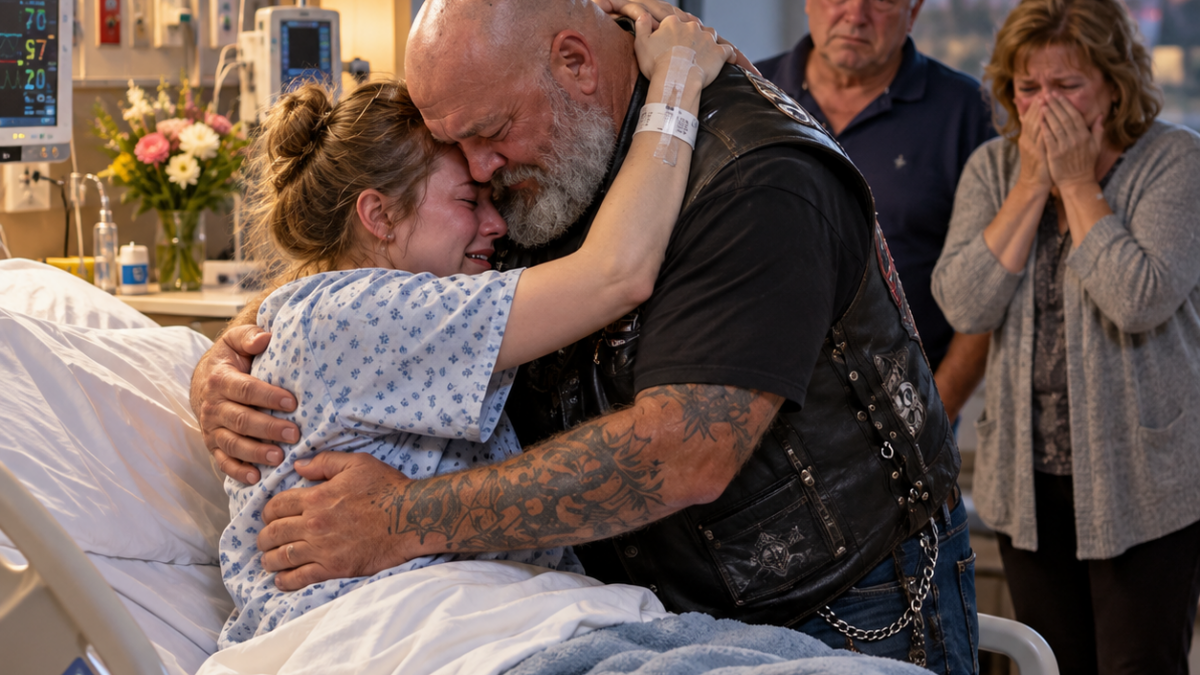
She threw her arms around him.
He held her gently, like someone holding a cracked bowl full of water.
“Thank you for not giving up on me,” she whispered.
“Always,” he said. “That’s what sponsors do.”
Then he looked over her shoulder at me.
“That’s what family does.”
I nodded because I could not speak.
Thomas stayed for twenty minutes.
He did not give speeches.
He did not tell Emily she had scared everyone, though she had.
He did not say she had disappointed him, though she feared it.
He sat beside the bed and asked if she had eaten.
Asked if she had been honest with the doctor.
Asked if she had told them about the street pills.
When she hesitated, he raised one eyebrow.
She sighed.
“Fine. I told them some of it.”
“Emily.”
“All of it. I told them all of it.”
“Good.”
“You’re annoying.”
“Still alive to be annoyed.”
She almost smiled.
After he left, I followed him into the hallway.
“Thomas.”
He turned.
“I don’t know how to do this.”
“No parent does at first.”
“I keep wanting to ask why.”
“That’s normal.”
“But it feels like the wrong question.”
“It usually is.”
“What’s the right one?”
He leaned against the wall, tired.
“What do you need today?”
I repeated it silently.
“What do you need today?”
“Not what did you do. Not how could you. Not what were you thinking. Those questions have their place eventually. But early recovery is fragile. Shame will try to kill her faster than the pills did.”
I swallowed.
“I’m angry.”
“You should be.”
“At her.”
“That’s honest.”
“I hate that.”
“Loving someone with addiction doesn’t make you a saint. You’re going to be angry. Scared. Suspicious. Grieving the daughter you thought you had. Then guilty for grieving because she’s alive. Get help for that.”
“I’m not the one who needs treatment.”
Thomas’s expression hardened—not cruelly, but firmly.
“That’s where you’re wrong.”
I looked away.
He softened.
“Families need recovery too.”
It turned out he was right.
I hated how often that happened.
Emily went from the hospital to a residential treatment center ninety days away from home.
The day we dropped her off, she cried so hard she could barely unbuckle her seatbelt.
“I don’t want to go.”
My wife sat in the back seat with her.
“I know.”
“What if I fail?”
“Then we keep going.”
“What if you get tired of me?”
“We won’t.”
“You don’t know that.”
I turned around from the driver’s seat.
“I know I woke up to you not breathing, and I would still rather walk through every hard day with you than one easy day without you.”
She covered her face.
The treatment center was not beautiful.
I had expected something softer, maybe because the brochures used words like healing and supportive environment. In reality, it was a low brick building with secure doors, group rooms, medical offices, and people smoking near a fence despite signs telling them not to.
Emily looked terrified.
Thomas met us there.
He had ridden three hours on his motorcycle to stand in the parking lot.
Emily stared at him.
“You came?”
“Did you think I wouldn’t?”
“I didn’t ask.”
“You didn’t have to.”
He handed her a small notebook.
“Write the truth in that. Even the ugly stuff. Especially the ugly stuff.”
She held it like something precious.
“What if I don’t want to know the truth?”
“Then write that too.”
Residential treatment was the hardest three months of our lives.
Emily did not transform in a montage.
There was no straight upward climb.
There were angry phone calls.
Tearful ones.
Silent ones.
One call where she accused us of abandoning her there.
Another where she admitted she had been dreaming about using.
One where she asked me to describe the bathroom floor because she couldn’t remember it and thought maybe remembering would keep her from doing it again.
I told her the truth carefully.
Not as punishment.
As witness.
“You were on the tile,” I said. “Thomas was doing compressions. Your mother was screaming. I called 911. You vomited. The paramedics came.”
She cried quietly.
“I don’t remember.”
“I know.”
“Was I blue?”
I closed my eyes.
“Yes.”
“I’m sorry.”
“I know.”
“Do you hate when I say that?”
“Sometimes.”
“Why?”
“Because sorry sounds too small and too heavy at the same time.”
She breathed into the phone.
“What should I say?”
“Say you’re still here.”
There was a pause.
“I’m still here.”
“That’s enough today.”
My wife and I started attending family support meetings.
The first night, I sat in a folding chair in a church basement and silently judged everyone in the room for ten minutes.
Then a father across the circle said, “I found my son unconscious in his car, and my first thought after he survived was that I was angry he had embarrassed us.”
He began crying.
Not because he still believed it.
Because he had believed it for three seconds and hated himself for it.
Something in me unclenched.
The room was full of people who loved someone and did not know how to survive loving them.
Mothers.
Fathers.
Husbands.
Wives.
Sisters.
Adult children.
They spoke a language I was ashamed to understand.
Boundaries.
Enabling.
Relapse plans.
Trust rebuilding.
Loving without controlling.
Hope without denial.
I learned that wanting to search Emily’s room every day came from fear, not wisdom.
I learned that trust returns slowly, and pretending otherwise helps no one.
I learned that addiction thrives in secrecy but recovery needs privacy too.
I learned that my daughter was responsible for her recovery, but we were responsible for becoming people she could tell the truth to.
That distinction saved us.
Emily came home after ninety days.
She was thinner, clearer-eyed, and terrified.
We had removed every old prescription from the house. Locked medications. Changed routines. Found outpatient treatment. Set up counseling. Agreed on boundaries. Agreed on what would happen if she relapsed. Agreed that fear would not be allowed to run the house, even though it kept applying for the job.
The first night back, she stood in the hallway outside the bathroom.
The bathroom.
She could not go in.
I saw her from the kitchen.
She stood frozen, one hand on the doorframe.
“Em?”
“I can’t.”
I walked toward her slowly.
“You don’t have to.”
“I need to brush my teeth.”
“There’s another bathroom.”
“I can’t avoid it forever.”
“No. But forever doesn’t start tonight.”
She laughed once through tears.
We used the downstairs bathroom for a month.
Then one evening, I heard water running upstairs.
I found her standing at the sink, brushing her teeth, crying silently.
I leaned against the hallway wall.
She saw me in the mirror.
“I’m okay.”
“I know.”
“Don’t come in.”
“I won’t.”
She brushed her teeth.
Spit.
Rinsed.
Turned off the water.
Then she walked out and collapsed against me.
I held her in the hallway while she shook.
Recovery was made of moments like that.
Not dramatic victories.
A bathroom entered.
A pill bottle avoided.
A craving spoken aloud.
A lie corrected.
A meeting attended when she did not want to go.
A phone call made before the danger became unmanageable.
Every night, Emily still called Thomas.
At first because she needed to.
Later because she wanted to.
Sometimes I heard her laugh from her room.
Sometimes I heard silence.
Sometimes she came downstairs afterward red-eyed but steadier.
I learned not to ask every time.
That was hard.
Fatherhood had always felt like asking.
Where are you going?
Who will be there?
What time will you be home?
Did you eat?
Did you study?
Are you okay?
Recovery taught me that love sometimes asks fewer questions so the truth has room to approach on its own.
Thomas came to dinner for the first time six months after the overdose.
He arrived on a Harley loud enough to rattle the windows.
Our neighbor across the street opened her curtains.
My wife had spent all afternoon cooking too much food.
Emily changed shirts three times and pretended she did not care.
Thomas parked in the driveway, removed his helmet, and stood beside the motorcycle looking suddenly unsure.
For a man who had entered our house at 3 a.m. and fought death on our bathroom floor, he looked strangely nervous about ringing the doorbell.
I opened the door before he could knock.
“Thomas.”
“Sir.”
“Mark,” I said.
He nodded.
“Mark.”
My wife came behind me.
Then Emily appeared and hugged him before anyone could say anything else.
He hugged her back with one arm, awkwardly at first, then fully.
During dinner, we learned pieces of his life.
He owned a motorcycle repair shop.
He had been sober twenty-three years.
His wife, Linda, had almost left him during his addiction but stayed after he entered recovery. Their daughter Rebecca had inherited too much pain from both of them, he said. Addiction had taken her fast, then slowly, then all at once.
He did not say that dramatically.
He said it like someone reciting weather that destroyed a town.
Linda came the next month.
She was small, sharp-eyed, and kinder than she wanted people to notice.
She hugged Emily for a long time.
Then she hugged my wife.
Neither of them said much.
They did not need to.
After dinner, Thomas and I sat on the porch.
Two fathers.
One who had lost his daughter to addiction.
One who almost had.
The summer air smelled like cut grass and charcoal from someone’s grill down the street.
Emily and Linda were laughing in the kitchen.
My wife was pretending not to cry while washing dishes.
“I still see it,” I said.
Thomas looked at me.
“The bathroom.”
He nodded.
“You will.”
“How long?”
“Depends.”
“On what?”
“Whether you let yourself remember the part after.”
I frowned.
“What part?”
“She breathed.”
I looked through the window at Emily.
Alive.
Laughing.
“She breathed,” Thomas repeated. “Don’t let the blue lips be the only picture your brain keeps.”
I swallowed.
“You sound like you’ve said that to yourself before.”
“Every day for fifteen years.”
We sat in silence.
Then I said, “Thank you.”
He sighed.
“Mark—”
“I know. Thank Emily. She made the call.”
“She did.”
“But you answered.”
Thomas looked out at the street.
“I’ll always answer if I can.”
“Why?”
He rubbed his hands together.
“Because nobody recovers alone. We like to say people have to save themselves, and that’s true in one way. But nobody climbs out of hell without hands reaching down. Meetings. Sponsors. Family. Doctors. Other addicts. Strangers sometimes. It takes a net.”
I nodded slowly.
“She has a net now.”
“She does.”
“I wish she’d had one sooner.”
Thomas turned toward me.
“She did.”
I looked at him.
“She had you. She just didn’t know the net would hold.”
That sentence stayed with me.
Two years have passed since that night.
Emily is clean.
I say that carefully now.
Not cured.
Not fixed.
Clean today.
Alive today.
Honest today.
In recovery today.
Those words are stronger than forever because they are real.
She finished her degree.
She works at a recovery center now, answering phones for people who sound the way she once sounded at two in the morning. Sometimes she speaks at schools about addiction, shame, and asking for help before silence turns deadly.
The first time I heard her speak, I sat in the back row beside my wife and cried before Emily even reached the microphone.
She stood in front of two hundred high school students and said:
“My name is Emily, and I’m a person in recovery from opioid addiction. I was the girl nobody suspected. Good grades. Part-time job. Church on Sundays. Loving parents. And I almost died because I believed needing help made me unworthy of love.”
The room went completely still.
She continued.
“The bravest thing I ever did was not getting clean. It was making one phone call when part of me still wanted to live.”
Thomas sat three rows ahead of me.
He wiped his eyes with a bandana.
Emily looked toward him and smiled.
Afterward, a girl in a school hoodie approached Emily near the stage. I could not hear what she said, but I saw Emily’s face soften. She took out a card and wrote something down.
Probably a number.
Probably a meeting.
Probably a lifeline.
The net widening.
Last Thanksgiving, we hosted dinner.
Thomas and Linda came.
Emily brought her boyfriend, Aaron, who knows her whole story and does not treat it like a fragile object or a scandal. He treats it like part of the map that brought her here.
Before dessert, Emily stood with a glass of sparkling cider.
“I want to say something.”
Everyone quieted.
She looked at my wife first.
Then me.
Then Thomas.
“I’m grateful for parents who loved me even when I couldn’t love myself. I’m grateful they learned recovery with me instead of making me earn my way back into the family.”
My wife covered her mouth.
Emily turned to Thomas.
“And I’m grateful for a scary-looking biker who answered his phone at two in the morning and refused to let me die.”
Thomas looked down.
His shoulders shook once.
Emily walked over and kissed his cheek.
“You’re stuck with us now,” she said.
He laughed through tears.
“Worse things have happened.”
After dinner, Thomas and I sat on the porch again.
Same two chairs.
Same fathers.
Different air.
Inside, Emily was teaching Linda how to use some app on her phone. My wife and Aaron were boxing leftovers. The house smelled like turkey, cinnamon, coffee, and the kind of peace that does not come from everything being easy.
It comes from telling the truth and staying.
“I think about swinging that bat at you,” I said.
Thomas chuckled.
“You had decent form.”
“I almost hit the man saving my daughter’s life.”
“You were scared.”
“I judged you the second I saw you.”
“Most people do.”
“I’m sorry.”
He looked at me.
“Mark, I broke into your house and was kneeling over your daughter at three in the morning. A little judgment was reasonable.”
I laughed.
Then grew serious.
“People see the vest. The tattoos. The bike. They think they know.”
“People like simple stories.”
“You’re not simple.”
“Neither is your daughter.”
We sat quietly.
Then Thomas said, “Rebecca would have liked Emily.”
I looked over.
He rarely said his daughter’s name without pain passing through his face.
“I think Emily would have liked her too.”
“She was funny. Mean funny. Could cut a man in half with one sentence.”
I smiled.
“She sounds like Linda.”
“She was exactly like Linda.”
His voice softened.
“For a long time, helping other people’s kids felt like punishment. Like God saying, Here, save strangers since you failed your own.”
“You didn’t fail her.”
He looked at me sadly.
“I know that some days.”
I understood.
There are truths the mind accepts before the heart does.
“Now?” I asked.
“Now it feels like Rebecca is still making me useful.”
I did not know what to say.
So I said nothing.
That is another thing I learned from recovery.
Not every silence needs rescue.
I think about that first night often.
The bat in my hands.
The blue lips.
The counting.
The empty bottles.
Thomas yelling at me to call 911.
My wife screaming Emily’s name.
The paramedic saying another few minutes.
Another few minutes.
That phrase is a canyon.
On one side, my daughter gives Thanksgiving toasts.
On the other, we bury her.
The difference was a phone call.
A sponsor who answered.
An unlocked door.
A stranger on a motorcycle breaking every speed limit because he knew what goodbye sounded like.
I used to believe heroes would be easy to recognize.
Uniforms.
Badges.
White coats.
Medals.
Clean hands.
Clear roles.
I know better now.
Sometimes a hero has a gray beard, a leather vest, old tattoos, and grief folded into his wallet.
Sometimes he looks like the kind of man you warn your children about.
Sometimes he is the man your child calls because he is the only one who knows how to listen without flinching.
Sometimes he enters your house without permission because permission would have taken too long.
Sometimes he catches your baseball bat with one hand and keeps your daughter’s heart moving with the other.
The night Emily overdosed was the worst night of my life.
It was also the night I learned my daughter was braver than I knew.
Because even in the darkest moment, some part of her reached for help.
And help came.
Not gently.
Not neatly.
Not in the form I expected.
Help came on a motorcycle.
Help came wearing leather.
Help came with a father’s grief and a sponsor’s phone that stayed on all night.
People still cross the street when they see Thomas sometimes.
Women clutch purses.
Men stare too long at his vest.
Parents pull children closer.
They do not know.
They do not know that he answered the phone every night for six months while my daughter whispered through cravings she was too ashamed to name.
They do not know that he talked her through shaking hands, panic, withdrawal, lies, relapse urges, and the awful quiet after midnight when shame gets loudest.
They do not know that he lost Rebecca and still chose to love other people’s children through the disease that took her.
They do not know that he saved my daughter before he ever stepped into our bathroom.
CPR was just the part I saw.
The rescue had been happening every night.
For six months.
While I slept down the hall.
I will carry that guilt for the rest of my life.
But I will not let it become useless.
I answer differently now when Emily calls.
I listen longer.
I judge slower.
I say I love you more often, even when the conversation is ordinary.
Especially when it is ordinary.
Because ordinary is where people decide whether love is safe.
Emily still has bad days.
Of course she does.
Sometimes she calls from her car and says, “I’m having thoughts.”
The first time she said that, I almost panicked.
Now I breathe.
“Thank you for telling me.”
“I hate this.”
“I know.”
“I’m tired.”
“I know.”
“I’m not going to use.”
“I’m glad you called before it got bigger.”
Sometimes she calls Thomas first.
Sometimes my wife.
Sometimes her therapist.
Sometimes all of us.
That is recovery.
Not never falling.
Building enough hands around you that a stumble does not become a grave.
Two weeks ago, Emily brought home a small framed photograph.
At first, I thought it was of her and Aaron.
Then she handed it to me.
It was a picture from Thanksgiving.
Emily in the middle.
My wife on one side.
Thomas on the other.
His arm around her shoulders.
Her head leaned against him.
Both smiling.
On the back, she had written:
For Dad.
The man who saved me by loving me after he knew.
And the man who saved me by answering before you did.
I needed both.
I keep it on my desk now.
Not because it is easy to look at.
Because it tells the truth.
I did not save Emily alone.
Thomas did not save Emily alone.
Emily did not save herself alone.
We are all alive because someone answered.
That is the story I tell when people ask about Thomas.
Sometimes they ask because they see him at our house and wonder why a biker is hugging my daughter in the driveway.
Sometimes they ask because Emily mentions her sponsor and they imagine some clinical arrangement instead of a second family.
Sometimes they ask because they still believe addiction belongs to other people.
I tell them:
My daughter called him when she was dying.
He came.
That is all.
And also everything.
At night, before I go to bed, I still check the hallway sometimes.
Old fear has habits.
I glance toward the bathroom door.
Sometimes I see it as it was.
Tile.
Pills.
Blue lips.
Thomas counting.
But more often now, I see something else.
Emily standing there months later, brushing her teeth through tears because she was ready to reclaim the room.
Emily laughing on the stairs.
Emily leaving for work at the recovery center with coffee in one hand and hope she earned the hard way in the other.
I see survival.
Not clean.
Not simple.
Not guaranteed.
But real.
And when my phone rings late, I answer.
Always.
Because Thomas taught me something I should have known before.
When someone calls from the edge, the words do not have to be perfect.
You do not have to be a professional.
You do not have to fix a whole life in one conversation.
You answer.
You keep them talking.
You remind them they are not alone.
You show up if you have to.
Heroes do not always look like heroes.
Sometimes they wear leather and ride motorcycles.
Sometimes they have criminal records and twenty-three years clean.
Sometimes they cry on the edge of your bathtub after saving your child.
Sometimes they are fathers who could not save their own daughters, so they spend the rest of their lives making sure someone else’s daughter hears a voice on the other end of the line.
I used to think gratitude was a feeling.
Now I think it is a responsibility.
I owe Thomas more than thank you.
I owe him the kind of life where my daughter never again believes the truth will cost her our love.
I owe Emily the kind of father who can hear the words addiction, relapse, craving, shame, and still see his child first.
I owe Rebecca, though I never met her, the honor of understanding that her father’s grief became a bridge my daughter crossed back to life.
And I owe that terrible night a promise:
That I will never mistake appearance for character again.
That I will never call addiction a moral failure when I have seen it nearly kill the best person I know.
That I will never let shame be louder in my house than love.
My daughter is alive.
She is alive because she fought.
Because she called.
Because Thomas answered.
Because the door was unlocked.
Because a biker broke into our house at 3 a.m. and gave us back the future we almost lost.
Every Thanksgiving now, before we eat, Emily says the same thing.
“Phones on?”
Thomas pats his vest pocket.
Mine sits beside my plate.
My wife’s is near the gravy.
Linda rolls her eyes and says, “This family is very dramatic.”
Emily smiles.
Then she lifts her glass.
“To answered calls.”
We all lift ours.
“To answered calls.”
And every time, I think of a young woman named Rebecca who did not get one.
I think of Thomas riding through the dark.
I think of my daughter’s voice on the phone, somewhere between goodbye and help.
I think of the hand that reached.
The hand that answered.
The hand that held her here.
And I thank God, with everything in me, that when my daughter called from the edge of the world, someone picked up.




