A Cop Laughed at My Navy SEAL ID, Threw It in the Trash, and Handcuffed Me in the Park—Then Three Black Suburbans Came Flying Into the Circle.
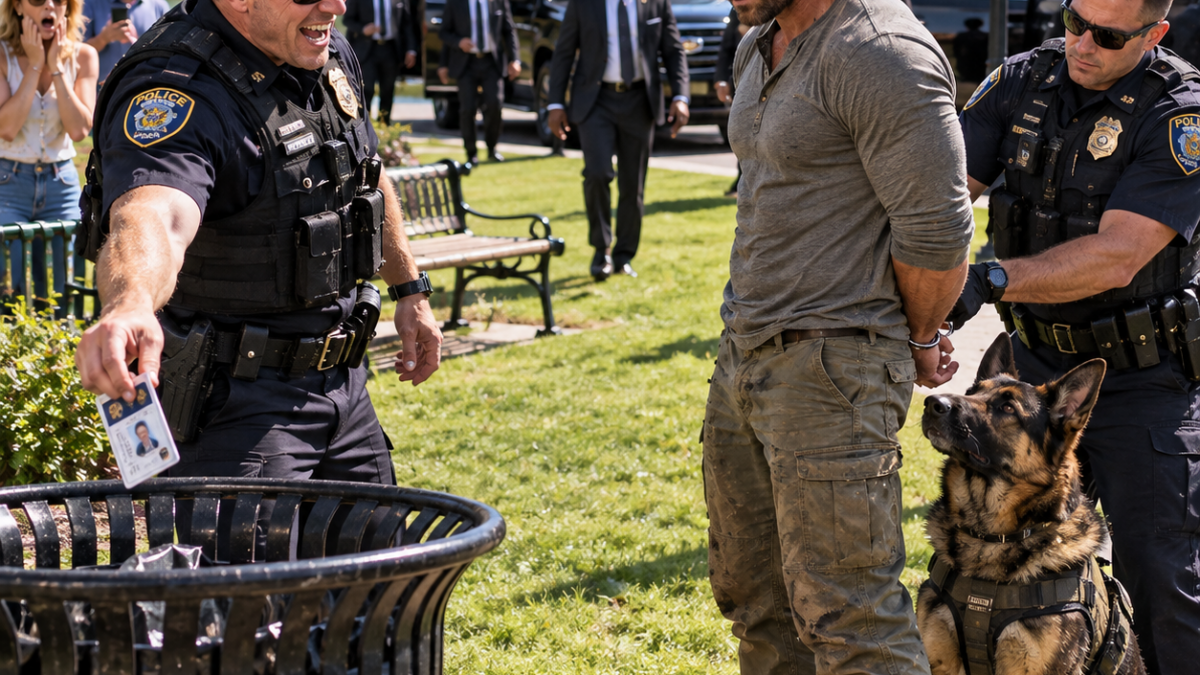
A Cop Laughed at My Navy SEAL ID, Threw It in the Trash, and Handcuffed Me in the Park—Then Three Black Suburbans Came Flying Into the Circle.
The officer never saw the three black SUVs coming because he was too busy laughing at the ID card he had already decided was fake.
He dropped twelve years of my service into a public trash can, called me a trespasser, and put handcuffs on me in the middle of the most manicured park in Savannah.
But the moment my retired military K9 lowered his head and waited for my command, everyone in Harborview Commons was about to learn the difference between suspicion and procedure.
My name is Adrien Walker.
I was thirty-eight years old the afternoon Officer Greer threw my Department of Defense identification card in the trash like it was an expired grocery coupon.
I had been on leave for exactly two days.
Ten days total.
That was all I had asked for after fourteen straight months of operations, briefings, flights, debriefings, training rotations, evaluations, and the kind of silence that follows you home after missions nobody outside a cleared room is allowed to hear about.
Ten days.
No alarm at 0430.
No wheels-up time.
No encrypted updates buzzing at my hip.
No team room.
No gear check.
No map spread across a table under fluorescent lights.
Just ten days to drive south, visit my younger brother Philip in Savannah, sit on his porch, drink something cold, and remember what it felt like to be a human being without a mission attached to my name.
Kodiak came with me.
He always did.
Kodiak was a retired military working dog, a ninety-one-pound German Shepherd with a coat the color of a storm cloud fading into black, tan points above his eyes, and a left shoulder that carried old shrapnel damage like a quiet weather report.
He had served two overseas deployments with me before the injury ended his active service.
The doctors called it healed.
Technically, they were right.
The scar had closed.
The limp had mostly faded.
But anyone who has served beside a dog like Kodiak understands that healing is not always the same thing as being done with what happened.
He still noticed helicopters before I did.
He still looked toward doorways in restaurants.
He still slept with his back against something solid.
And when my breathing changed in the middle of the night, he would lift his head from the floor and watch me until I came back from wherever memory had dragged me.
We had earned each other.
That is the cleanest way I know how to say it.
I had gone through the paperwork to bring him home after retirement, and that paperwork had been more complicated than half the missions we had ever run together.
Forms.
Evaluations.
Signatures.
Approvals.
Medical releases.
Transfer documentation.
Handler records.
Adoption authority.
Veterinary clearance.
People say, “He’s your dog now,” like that sentence is simple.
It was not simple.
It was earned by every mile we had walked together, every room he had entered before me, every time he had trusted my hand on his harness and I had trusted his nose more than my own eyes.
So when Officer Greer tossed my ID in the trash and reached for his cuffs, Kodiak knew before anyone else did that the air had changed.
He felt it through me.
That was what he did.
He felt the shift beneath the skin.
I had driven seven hours from Virginia Beach that morning to visit Philip.
Philip was an attorney, which meant he was always either late, nearly late, or explaining why being late was someone else’s fault.
He had married three years earlier and moved into Harborview Reserve, one of those new developments where every blade of grass looked supervised and the HOA newsletter used phrases like property harmony and community standards as if they were constitutional principles.
The houses were large.
The fences were decorative.
The people waved in a way that made you wonder whether they were greeting you or checking if you belonged.
I parked my truck outside the community gate because Philip had warned me the visitor spaces inside were narrow and policed by neighbors with too much free time.
The guard at the booth checked my name against the list.
“Adrien Walker?”
“That’s me.”
“Visiting Philip Seaton?”
“Yes.”
He glanced at Kodiak in the back seat.
“Nice dog.”
“He is.”
The guard waved us through.
No problem.
No concern.
No dramatic music.
Philip had texted earlier.
Running late. Deposition went long. Keys under the mat. Let yourself in or walk Kodiak around the commons. It’s nice this time of day.
Kodiak had been in the truck for seven hours.
So had I.
We chose the walk.
Harborview Commons sat in the center of the development, a long green rectangle framed by oak trees, iron fencing, flower beds, stone benches, and a fountain too clean to have ever met a child with muddy shoes.
The park was quiet when we entered.
Cut grass.
Fresh mulch.
A faint smell of barbecue from some hidden patio.
The kind of place designed to look peaceful, as long as everyone inside the frame matched the brochure.
Kodiak walked at heel.
Not because I needed him to.
PART2:
Because that was how we moved.
My left side was his place.
His shoulder lined up with my knee.
His leash stayed loose.
His eyes moved constantly, but his body remained calm.
We had been in the park maybe twelve minutes when I noticed the shift.
I did not hear the calls.
I did not see who dialed first.
But I recognized the pattern.
A woman walking a small Cavalier King Charles Spaniel stopped on the far path and stared too long.
A man on a bench folded his newspaper without reading the rest of the page.
A woman on a porch across the street lifted her phone and pointed toward us with one rigid finger.
Kodiak saw all of them.
So did I.
There are moments when a place rejects you before anyone says a word.
I had felt it before.
Different countries.
Different languages.
Different uniforms.
Different stakes.
The mechanics were the same.
PART3:
People decide first.
Then they search for reasons.
I kept walking.
“Heel,” I said quietly.
Kodiak healed.
Three minutes later, the cruiser came around the corner.
Lights on.
No siren.
Polite spectacle.
Officer Greer stepped out.
Early thirties.
Clean uniform.
Polished boots.
Pressed shirt.
The kind of posture that said he had decided how this would go before he closed his car door.
He looked at me.
Then at Kodiak.
Then toward my truck parked outside the gate.
Apparently, that detail mattered to him.
“Afternoon,” he said.
Not warm.
Not neutral.
A warning dressed as a greeting.
“Afternoon,” I replied.
“You live here?”
“No. Visiting my brother, Philip Seaton. Fourteen Harborview Lane. I signed in at the gate.”
Greer glanced toward the gate.
Then back at me.
“You got ID?”
“I do.”
I moved slowly.
Clearly.
Right hand visible.
No sudden motion toward my pocket.
That habit never leaves you.
When a man with a gun asks you for identification, you make sure he never has to guess what your hands are doing.
I pulled out my wallet, opened it, removed my military ID, and extended it toward him.
Greer took it.
He looked at it for a long moment.
Then came the laugh.
Sharp.
Ugly.
Loud enough to carry across the open grass.
“A Navy SEAL,” he said.
He said it like a punchline.
“Sure you are, buddy.”
I did not blink.
I did not shift my weight.
There is a kind of stillness people mistake for fear if they have never seen discipline up close.
That stillness is not emptiness.
It is containment.
Greer held the card at arm’s length like he was examining a magic trick.
He flipped it over.
Looked at the front again.
Shook his head.
“You know what I see when I look at this?”
I waited.
“I see a pretty good print job on a fake ID.”
He said it casually.
The way a man comments on traffic.
“We get guys like you running this every so often. Walk into a nice neighborhood, flash some kind of military card, hope people feel bad about calling it in. Solid play.”
“Call it in,” I said. “The number is on the back. DOD can verify in two minutes.”
“I’m not running down your fake card on dispatch.”
“That would be verification.”
“That would waste everybody’s time.”
He turned.
Walked three steps to the nearest trash can, a heavy green metal container near the edge of the path.
Then he held my ID over the opening.
For half a second, the whole park seemed to hold its breath.
He opened his fingers.
The card dropped.
It hit the metal bottom with a hollow sound.
Some moments exist in two dimensions at once.
In one dimension, it was a laminated plastic card inside a park trash can.
In the other, it was twelve years of service.
Two combat zones.
Missions I could not discuss with anyone outside a secure facility.
Faces I remembered.
Names I carried.
Brothers who came home.
Brothers who did not.
And six months of paperwork to bring home the dog sitting beside me.
Both dimensions were equally real.
Kodiak made a sound.
Not a bark.
Not a growl.
A low thing that started in his chest and did not quite make it out.
He felt the shift in me before any human in the park did.
“Steady,” I said.
Flat.
Quiet.
Kodiak went still.
Greer turned back around.
“You’re going to need to come with me.”
“On what basis?”
“Trespassing.”
“This park is for Harborview residents and their guests.”
“I am a guest. I signed in at the gate.”
“The gate doesn’t grant access to community spaces. That’s HOA policy.”
“Then call my brother.”
“I’m not calling anybody.”
“You should.”
He reached toward his duty belt.
“I’m going to ask you to turn around and put your hands behind your back.”
“You’re making a mistake.”
I did not say it loudly.
There was no heat in it.
It was the same tone I would use to tell someone they had left their lights on.
Greer’s jaw tightened.
“Turn around.”
I turned around.
I put my hands behind my back.
I kept my breathing slow.
The cuffs closed on my right wrist first.
Then the left.
Cold metal.
Too tight, but not dangerously so.
Greer pulled them snug anyway.
Kodiak stood.
He did not advance.
His shoulder blades rose.
His head dropped two inches.
His lips pulled back just enough.
The sound he made was not loud.
It was the kind of sound that goes straight through you and lands somewhere at the base of the brain, older than language.
Greer’s confidence cracked.
“Call off that dog right now.”
His voice jumped.
“Kodiak,” I said. “Down. Stay.”
Kodiak lowered himself to the grass.
Chin on paws.
Eyes fixed on Greer.
He did not look away for a single second.
Greer exhaled something that tried to sound like composure.
He stepped back.
Reached for his radio.
Prepared to call for transport.
The woman in the white linen blouse watched from her porch.
Her name was Patrice Holloway.
I learned that later.
She had lived in Harborview Reserve for four years and served on the aesthetic committee for two. She had made the first call. Then the second. Then, apparently, she had texted half the neighborhood that a suspicious man with a large dog was wandering the commons.
She watched me standing handcuffed near the trash can and felt something she probably would have called relief.
Maybe justice.
Maybe safety.
But what she felt looked a lot like satisfaction.
Greer lifted his radio.
He never finished the sentence.
The sound came from the far end of Harborview Drive.
Engines.
Three of them.
Heavy.
Fast.
Not reckless.
Purposeful.
Three black Chevy Suburbans came into view with federal plates, moving in tight formation at a speed that did not care about decorative median strips.
The engines were loud enough to vibrate the water in the fountain.
The vehicles split slightly as they entered the circle, then realigned and stopped along the curb twenty feet from where Greer stood.
Doors opened.
The man who stepped out of the middle vehicle was Deputy Director Charles Wynn.
Fifty-four years old.
Southeast Regional Counterterrorism Task Force out of Jacksonville.
A man who had spent thirty years in rooms where decisions were made and had never once needed to raise his voice to make those decisions land.
He wore a dark jacket over a white shirt.
No visible panic.
No wasted movement.
Three more men in tactical dress stepped out from the flanking vehicles.
They stopped.
Took in the scene.
Me.
The cuffs.
Kodiak on the grass.
Greer.
The green trash can.
Wynn’s expression did not change exactly.
But something behind his eyes went very flat and very cold.
He walked toward us.
He did not acknowledge Greer first.
“Adrien,” he said.
“Sir.”
“Are you hurt?”
“No, sir.”
Wynn looked at Kodiak.
Kodiak remained flat on the grass, chin on paws, eyes locked on Officer Greer.
Then Wynn looked at the trash can.
Then at Greer.
“I’m going to need you to get those cuffs off him.”
Greer had not moved.
He stood with his radio at his side while the architecture of his entire afternoon came apart around him.
He looked at the federal plates.
The vehicles.
The men in tactical dress.
The handcuffs.
The trash can.
“I was responding to a call,” Greer started.
“Key,” Wynn said.
One word.
Greer reached for his belt.
He unclipped the handcuff key and walked behind me.
The cuffs came off.
I brought my arms forward and rolled each wrist once.
“Thank you,” I said to Greer.
Not sarcastically.
Wynn did not say thank you.
He looked at the trash can.
Then back at Greer.
“That was a federal military identification document.”
Greer swallowed.
“I thought it was fraudulent.”
“You thought.”
The two words sat there.
“You had a number on the back of that card,” Wynn continued. “You had two minutes and a radio. You chose not to use either.”
Greer said nothing.
Wynn’s voice stayed level.
“Instead, you arrested an active-duty SEAL on leave and threw his federal credentials into a public garbage can in front of a residential neighborhood.”
Another pause.
“That is what happened today.”
Greer had no answer.
Wynn turned to one of the men from the vehicles.
“Get the card.”
The man walked to the trash can, reached inside without comment, found my ID near the bottom, wiped it clean on his jacket sleeve, and brought it back.
He handed it to me.
I looked at it once.
Then slid it back into my wallet.
Patrice Holloway had stepped off her porch during all of this.
She stood at the edge of the grass, still clutching her phone.
The satisfaction she had felt six minutes earlier had been replaced by something considerably less comfortable.
Wynn noticed her.
He did not address her yet.
He turned back to Greer.
“Your department has a direct liaison with the task force. There is protocol in place for exactly this kind of identification situation. You were not trained to recognize every federal credential. That is a gap we can address.”
He stepped closer.
“But you were trained to verify before you act.”
Greer’s eyes shifted downward.
“You chose not to.”
That sentence stood by itself.
Quiet.
Heavy.
Final.
“Your department will hear from us this afternoon.”
Greer’s posture had been eroding for the past three minutes.
Now it was gone entirely.
He stood with his hands at his sides and his eyes somewhere near the ground.
“Officer,” I said.
He looked up.
I held his gaze.
Not angry.
Not friendly.
Just there.
“I understand why you made the call you made.”
He seemed surprised.
“I looked wrong to you,” I said. “I didn’t fit what you expected to find here. That’s a human thing. I’ve made those calls too.”
Greer said nothing.
“But there is a reason we train past the first instinct. The first instinct is a guess. The second step is verification.”
I paused.
“One is bias. The other is procedure.”
The park was silent.
“You stopped at the guess.”
His jaw worked once.
No words came out.
“You pulled a weapon on a trained military dog who was sitting still,” I said. “Not because he was advancing. Because you were afraid and you needed to feel like you were in control.”
I looked at Kodiak.
He had not moved.
“I understand that too. Fear does that.”
Greer followed my gaze.
“He was never going to move unless I told him to. But you didn’t know that because you hadn’t asked. You hadn’t done anything except react.”
Patrice cleared her throat.
“I was the one who called.”
Her voice was careful now.
Measured.
Positioned to seem reasonable.
“I had concerns about an unfamiliar individual in a community space.”
Wynn looked at her.
“That’s not unreasonable,” she added quickly.
“No,” Wynn said. “Concern is not unreasonable.”
Patrice relaxed by half an inch.
Then Wynn continued.
“But you watched an officer throw a federal ID in the trash and handcuff a man in your park. You stood on your porch and felt good about it.”
He tilted his head slightly.
“You might want to spend some time thinking about what specifically felt good and why.”
Patrice opened her mouth.
Closed it.
No one rescued her from the silence.
Wynn turned back to me.
“Cars are ready when you are. We can drop you at your brother’s before the briefing.”
I bent down and placed one hand on Kodiak’s neck.
“Up.”
The dog stood immediately.
He shook himself once and moved to my left side.
His shoulder came exactly to my knee.
We fell into step together without any visible cue.
The way two things move when they have moved together long enough that coordination stops being conscious.
I walked toward the Suburbans.
I passed Greer without stopping.
I did not say anything else.
I did not need to.
The education had already happened.
Whether he chose to learn from it was a separate question, and it was no longer mine to answer.
The tactical officers returned to their vehicles.
Doors closed.
The three Suburbans pulled out of the common circle in the same tight formation they had arrived in.
They turned at the far end of the street and disappeared beneath the oak trees.
The park went quiet.
Greer stood alone on the grass with his radio in one hand, boots still shined, shirt still pressed, everything looking exactly the same from the outside.
He looked at the green trash can.
I do not know everything he thought in that moment.
But later, I learned some of it.
He thought about the card he had held in his hand for thirty seconds before deciding what it was worth.
He thought about the number on the back he had chosen not to dial.
He thought about a dog lying flat on the grass, chin on paws, patient, disciplined, waiting for a command from the man he trusted.
He thought about how Kodiak had never moved.
He thought, for the first time in a long time, that maybe his instincts were not the same as truth.
Inside the SUV, Wynn sat beside me.
Kodiak stretched across the floorboard, his head resting on my boot.
Wynn looked down at him.
“He stayed.”
“Yes, sir.”
“Good dog.”
“The best.”
For a minute, neither of us spoke.
Then Wynn said, “You handled that better than most men would have.”
“I was handcuffed in front of a fountain.”
“You know what I mean.”
I looked out the tinted window as Harborview’s perfect homes slipped past.
“I almost didn’t.”
Wynn turned his head slightly.
I continued.
“When he dropped the ID, I felt Kodiak shift. He felt me shift first. If I had raised my voice, if I had stepped forward, if I had given him anything to interpret as danger…”
I looked down at the dog.
“He would have obeyed.”
Wynn nodded.
“Which is why you didn’t.”
“Which is why I didn’t.”
That was the part people in the park did not understand.
Control is not the absence of anger.
Control is choosing what anger is allowed to touch.
At Philip’s house, my brother opened the door before we reached the porch.
He had clearly received seven versions of the story already, all of them incomplete and at least two probably absurd.
He looked at me.
Then at Wynn.
Then at Kodiak.
Then back at me.
“Do I want to know?”
“No.”
“Are you hurt?”
“No.”
“Is Kodiak hurt?”
“No.”
“Then I need a drink.”
“Same.”
Philip stepped aside.
Kodiak entered first, sniffed once, approved the living room, and immediately found the coolest patch of floor near the couch.
I sat down.
For the first time since the park, my body realized it did not have to remain braced.
That is always when the shaking tries to come.
Not during.
After.
My wrists were red where the cuffs had been.
Philip noticed.
His face changed.
“That officer put hands on you?”
“He cuffed me.”
“He cuffed you?”
“Yes.”
“After you gave him ID?”
“He threw it away.”
Philip stared.
Then he turned toward the kitchen.
“I’m opening the expensive beer.”
“You have expensive beer?”
“I have emergency beer.”
Wynn almost smiled.
“I’ll give you both a few minutes. Then we need to talk about why I was already on my way.”
That sentence cut through the room.
I looked at him.
“You were already on your way?”
Wynn nodded.
“Your check-in flagged.”
Philip looked confused.
“My guard booth?”
“Not exactly.”
I leaned forward.
Wynn sat across from me.
“We had a briefing scheduled in Savannah tomorrow morning. You were already on my route. When your leave location registered near Harborview, I planned to swing by and confirm timing in person.”
Philip blinked.
“You people just swing by in three black SUVs?”
Wynn looked at him.
“No.”
Philip nodded slowly.
“Great. That clears that up.”
Wynn turned back to me.
“Then your phone pinged with an emergency motion spike and no follow-up response. Your watch flagged elevated heart rate. Kodiak’s tracker showed abrupt stillness inside a non-federal residential zone.”
Philip looked at me.
“Kodiak has a tracker?”
“Kodiak has several things.”
Wynn continued.
“We were already close. Then dispatch traffic mentioned a possible fraudulent military ID, a large dog, and a detained male matching your description.”
I exhaled.
“So you came.”
“Yes.”
Philip looked between us.
“Can someone explain why my brother’s visit apparently requires a counterterrorism convoy?”
Wynn did not smile that time.
“Your brother is attached to an ongoing regional matter. He is not under investigation. He is a protected operational asset until tomorrow’s briefing concludes.”
Philip froze.
I closed my eyes.
“Sir.”
Wynn looked at me.
“Your brother is an attorney. He understands confidentiality.”
Philip raised one hand.
“I understand when someone says I do not want details.”
“Good,” Wynn said.
Then he looked at me.
“But today’s incident now creates a problem.”
“For me?”
“No. For everyone who failed to verify who you were.”
The briefing happened the next morning in a secure federal building that looked intentionally forgettable from the outside.
No sign.
No decorative flag arrangement.
No big glass front.
Just concrete, cameras, and the kind of doors that made people lower their voices before entering.
Officer Greer was not there.
His department was.
A captain named Elise Ramsey attended, along with two internal affairs officers, a city attorney, and a man from risk management who looked like his entire morning had been ruined by liability.
Deputy Director Wynn began with video.
Body camera.
Patrice’s cell phone.
Gatehouse records.
Security camera footage from Harborview Commons.
Dispatch audio.
The room watched Greer take my ID.
Laugh.
Refuse to verify.
Walk to the trash can.
Drop it.
Cuff me.
Reach for his radio.
Then freeze as the Suburbans arrived.
Nobody spoke for a long time.
Captain Ramsey looked exhausted.
Finally, she said, “There is no excuse for that.”
Wynn nodded.
“No. There is not.”
The city attorney cleared his throat.
“We need to determine whether Officer Greer acted under color of law based on a mistaken but good-faith belief—”
Wynn turned his head slowly.
The attorney stopped talking.
Captain Ramsey said, “He had the number on the card.”
“Yes,” Wynn said.
“He chose not to verify.”
“Yes.”
“He escalated based on assumption.”
“Yes.”
Internal affairs wrote that down.
Then Captain Ramsey looked at me.
“Commander Walker, I owe you an apology on behalf of the department.”
I did not answer immediately.
Apologies are strange things.
Sometimes they heal.
Sometimes they are sandbags placed quickly before a flood.
“I appreciate that,” I said.
Her face told me she understood the difference.
“We will investigate this fully.”
“I hope so.”
“We will also be reviewing officer training on military credentials, federal identification, service animals, and response procedures in private communities.”
Wynn added, “And bias.”
The word sat in the room.
Captain Ramsey nodded.
“And bias.”
The risk management man looked pained.
Good.
Pain can be useful when it points toward reform.
By that afternoon, Harborview Reserve was in a state of quiet panic.
Philip, who had lived there long enough to understand its rhythms, explained it to me from his porch.
“Nobody here minds drama as long as it happens at a safe distance.”
Kodiak lay near my boots.
Philip handed me coffee.
“They like rules,” he continued. “Rules make them feel protected. But they do not like being examined by the rules.”
Across the street, two women paused mid-walk when they saw me.
One pretended to check her phone.
The other whispered something.
I did not care.
Not exactly.
But I noticed.
You always notice.
By evening, a statement appeared from the Harborview Reserve HOA.
It was careful.
Too careful.
The Board of Harborview Reserve is aware of an unfortunate misunderstanding involving a visitor in Harborview Commons. We are cooperating with all relevant authorities and remain committed to ensuring community spaces remain safe, welcoming, and aligned with resident expectations.
Philip read it aloud, then made a sound of disgust.
“Unfortunate misunderstanding.”
I looked at Kodiak.
“He understood perfectly.”
The next day, Patrice Holloway posted on the neighborhood message board.
I never intended harm. As a resident and committee member, I acted out of concern for community safety. Recent events have been mischaracterized, and I hope everyone remembers that residents have the right to report suspicious activity.
That post lasted thirty-eight minutes before someone uploaded the video of Wynn speaking to her on the grass.
Concern is not unreasonable. But you watched an officer throw a federal ID in the trash and handcuff a man in your park. And you stood on your porch and felt good about it.
The replies changed after that.
Slowly at first.
Then all at once.
One resident wrote:
I was there. I didn’t speak up. I should have.
Another:
We need to ask why “visitor with dog” became “suspicious person” so fast.
Another:
My brother is active-duty. If this happened to him, I’d be furious.
Then a retired judge who lived near the fountain posted one sentence that changed the tone of the whole neighborhood:
The question is not whether residents may call police. The question is whether our community culture has taught people to confuse unfamiliar with dangerous.
Philip printed that one.
He taped it to his refrigerator.
“Good sentence,” he said.
“Lawyer sentence.”
“Best kind.”
“Worst kind.”
He ignored me.
Three days later, Officer Greer requested a meeting.
Not through the department.
Through Captain Ramsey.
Neutral location.
Witness present.
No media.
No HOA.
I almost said no.
Part of me wanted the system to do what systems do.
Investigate.
Report.
Discipline.
Move on.
But another part of me kept seeing Greer looking at the trash can after we left.
A man does not become better because consequences hit him.
He becomes better if he is willing to look at what consequences revealed.
So I agreed.
We met in a plain conference room at the police department.
Captain Ramsey sat near the wall.
Wynn attended by video.
Kodiak lay under the table, head on my boot.
Officer Greer entered wearing civilian clothes.
No polished boots.
No pressed authority.
Just a man who looked as if sleep had not been generous.
He stood across from me.
For several seconds, he did not speak.
Then he said, “Commander Walker, I was wrong.”
I waited.
He swallowed.
“I could say I was responding to a call. I could say the neighborhood was tense. I could say the dog made me nervous. I could say I thought the ID looked different from ones I’d seen before.”
He looked at me.
“All of that may be true. None of it excuses what I did.”
Kodiak shifted under the table.
Greer glanced down.
Then back up.
“I threw away your ID because I had already decided who you were before I verified anything.”
That was the first honest sentence he had spoken to me.
“I humiliated you because I thought control would make me look competent.”
Captain Ramsey looked down at her notes.
Greer continued.
“And when your dog obeyed you better than I obeyed my training, I realized something I should have realized sooner.”
“What?”
“That discipline doesn’t always look like a uniform.”
I said nothing.
He reached into his pocket slowly.
Placed something on the table.
A written apology.
Not printed.
Handwritten.
“I know this doesn’t fix anything,” he said.
“It doesn’t.”
He nodded.
“I know.”
“But it matters that you know it doesn’t.”
His eyes lifted.
That surprised him.
I continued.
“Most people apologize because they want the damage to disappear.”
“I don’t.”
“Good.”
He looked at Kodiak.
“I thought he was going to attack me.”
“He was waiting for me.”
“I know that now.”
“You should have known it then.”
“Yes.”
Silence.
“What happens to you?” I asked.
“Administrative leave pending findings. Likely suspension. Mandatory retraining if I keep the job.”
“If?”
He nodded.
“I don’t know if I should.”
That was not a question I could answer for him.
So I didn’t.
Before he left, Greer looked at Kodiak.
“May I say something to him?”
“No.”
He accepted that immediately.
Good.
Some boundaries exist because they were earned too late.
The fallout at Harborview lasted longer.
Patrice resigned from the aesthetic committee after residents demanded an open meeting. The HOA changed its visitor complaint procedures. Gatehouse logs had to be checked before police calls were categorized as trespassing. Security staff were required to confirm guest status before escalating. The board added a written policy stating that “unfamiliar” could not be used as a substitute for suspicious behavior.
Philip called it the Adrien Rule.
I told him not to.
He did anyway.
A month later, Captain Ramsey sent me the department’s final summary.
Greer had received a suspension, formal reprimand, mandatory retraining, and removal from private-community liaison assignments. More importantly, the department updated its policy on military credential verification and service animal encounters.
Wynn called it “a useful correction.”
Philip called it “bare minimum with paperwork.”
Kodiak did not care.
Kodiak cared about shade, bacon, my left side, and whether Philip’s couch could fit a ninety-one-pound shepherd who believed personal space was negotiable.
On my last evening in Savannah, I took Kodiak back to Harborview Commons.
Philip thought it was a terrible idea.
Wynn called it unnecessary.
Captain Ramsey said it was my choice.
So I went.
Not for Patrice.
Not for Greer.
Not for the HOA.
For me.
The park looked exactly the same.
Green grass.
Iron fencing.
Stone fountain.
Oak trees moving softly in the humid air.
A little boy was throwing a tennis ball near the far path while his mother watched from a bench.
An elderly man read a newspaper where the other man had sat days earlier.
A woman walked a spaniel past the fountain.
She glanced at me.
Then at Kodiak.
Then she nodded once.
Small.
Awkward.
But human.
Kodiak walked at heel.
Loose leash.
Shoulder at my knee.
We stopped near the trash can.
For a second, I looked at it.
A green metal container.
Nothing more.
Nothing less.
Objects are strange that way.
One day they are ordinary.
The next, they hold a memory you did not ask for.
Kodiak sat.
I rested one hand on his head.
“You did good,” I said.
His ears moved.
“You did exactly what I asked.”
He leaned against my leg.
There is a kind of pride that does its work quietly, without asking to be seen.
It does not arrive with black vehicles or federal plates.
It does not announce itself.
It wears worn cargo pants and a gray Henley.
It signs in at the guest booth.
It tells a dog to stay.
And the dog stays.
Even when the gun comes out.
Even when the cuffs go on.
Even when the man beside him has every reason to be angry.
Because something deeper than instinct has been built over years of doing the right thing in places where the wrong thing would have been easier.
That kind of pride does not need applause.
It just needs to be recognized when it is standing in front of you.
A week later, I was back in Virginia.
Kodiak slept by the back door.
My leave ended.
The world resumed its old shape.
But sometimes, in the quiet hours before dawn, I thought about Harborview Commons.
Not the cuffs.
Not the SUVs.
Not even the ID hitting the bottom of the trash can.
I thought about the moment before Greer dropped it.
That narrow second where a choice still existed.
He could have turned the card over.
Read the number.
Called dispatch.
Verified.
He could have taken the second step.
Instead, he trusted the first instinct.
The first instinct is a guess.
The second step is verification.
One is bias.
The other is procedure.
That is the lesson people like to pretend only applies to police officers, judges, soldiers, committees, boards, strangers on porches.
It does not.
It applies to all of us.
The hardest lesson any person ever learns is the one that requires them to admit they looked at a human being and saw a verdict.
Officer Greer drove back to his station that afternoon with that lesson sitting in the passenger seat.
Patrice Holloway walked back into her perfect house with that lesson following her through the door.
Harborview Reserve printed new policies because that lesson had finally reached their boardroom.
And I drove to my brother’s house, sat on his couch, drank a cold beer, and let Kodiak lie across my feet, heavy and warm and completely at ease.
For a few hours, neither of us had to be useful.
Neither of us had to be ready.
Neither of us had to prove we belonged.
Sometimes that is the whole point of coming home.
Not to be saluted.
Not to be thanked.
Not to have strangers understand everything you carried into the park with you.
Just to stand on quiet grass with your dog at your side and know that the card in your wallet is not the only thing proving who you are.
Your life already did that.
Your discipline did that.
Your restraint did that.
And when the world mistook you for a threat, the dog who knew you best waited for your voice before deciding what came next.
That was the part Officer Greer never saw coming.
Not the SUVs.
Not Deputy Director Wynn.
Not the federal plates or the tactical team or the phone calls that followed.
The thing he never saw coming was Kodiak staying down.
Because power is not always what moves.
Sometimes power is what could move, but doesn’t.
Sometimes the strongest command in the park is not shouted.
It is one quiet word from a handcuffed man to a loyal dog.
“Stay.”
And the dog stays.