A Cat Cried Beneath a Dumpster for Hours With a Broken Pelvis—Then a Rare Complication Left Him Unable to Stand, Until Vets Refused to Give Up.
PART3:
Instead she sat in an alley talking softly to a cat she could barely see.
“My name’s Maya.”
No response.
“I know you don’t care.”
The eyes remained fixed on her.
“You picked a terrible place to nap.”
Another tiny cry.
Maya swallowed.
“All right. Bad joke.”
She took off her sweater and folded it beside her.
The cat blinked slowly.
“That’s something.”
Twenty-three minutes later a battered white rescue van pulled into the alley.
Two women stepped out.
The first was Elena Brooks, a veterinary technician who volunteered with the rescue on weekends.
The second was Tasha Miller, the organization’s field coordinator.
Maya stood.
“He’s under there.”
Elena crouched and looked.
“Oh.”
That single word scared Maya.
“What?”
“He’s hurt.”
“How bad?”
“We won’t know until we get him out.”
Tasha retrieved a carrier, thick towel, and a low rolling board.
The dumpster was too heavy to move safely by hand.
They found the store manager.
He brought a pallet jack and two employees.
Everyone worked slowly.
The dumpster shifted six inches.
The cat tried to crawl.
Again came that terrible cry.
Elena immediately said:
“Stop.”
Everybody froze.
She slid onto her stomach and reached under with the towel.
“Hey, little man.”
The cat hissed.
It was weak.
Elena almost smiled.
“There you go.”
“Be mad at me.”
“Mad is good.”
She moved closer.
When her fingers touched his shoulder, the cat snapped at her.
Missed.
Then collapsed.
Elena’s smile vanished.
She wrapped him gently in the towel and supported his hindquarters as Tasha slid the board beneath him.
When they finally pulled him into daylight, Maya covered her mouth.
He was younger than she had expected.
Maybe nine months.
Maybe a year.
Thin under all the dirt.
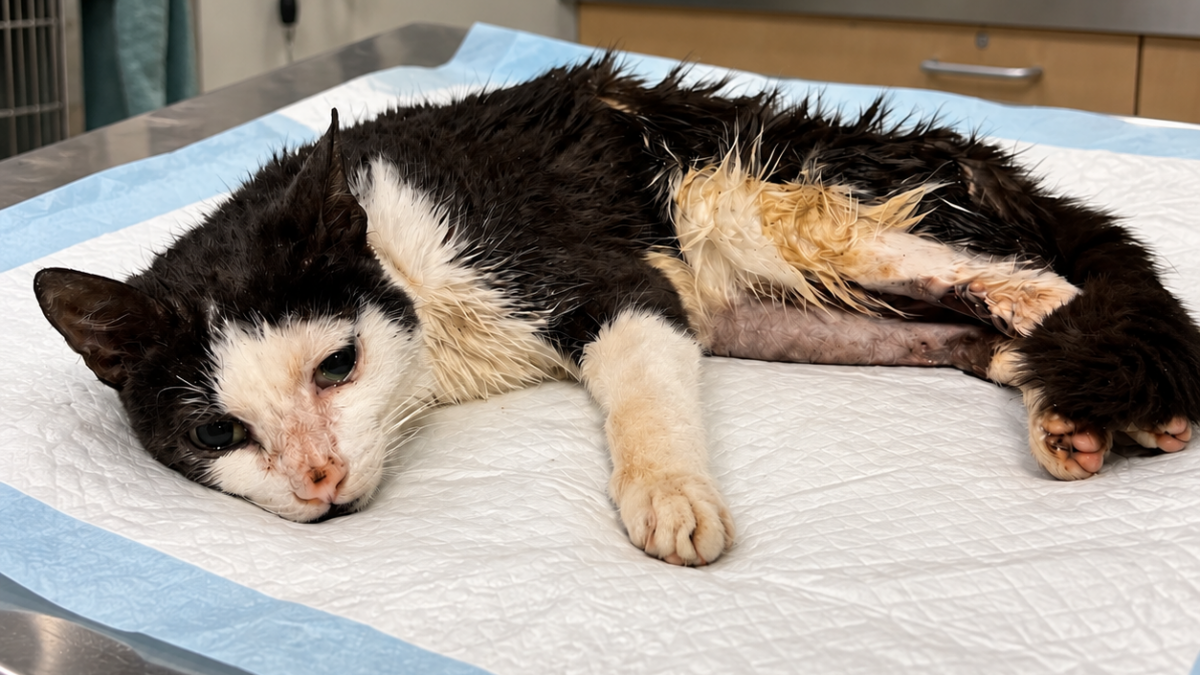
Gray tabby markings across his back.
White paws.
A white stripe down his nose.
His back legs lay strangely behind him.
Elena whispered:
“Pelvic injury.”
Maya said:
“Car?”
“Could be.”
The cat’s eyes moved from face to face.
Terrified.
Elena rested one hand against his cheek.
“You’re okay.”
The cat cried.
“No.”
Her voice softened.
“You’re not okay.”
“But we’re going to try.”
They placed him inside the carrier with rolled towels supporting his body.
Maya stood beside the van.
“Can I come?”
Tasha looked surprised.
“You don’t have to.”
“I know.”
That was exactly why she went.
At the emergency veterinary hospital, the front desk staff moved quickly once they saw the carrier.
A technician carried him through swinging doors.
Maya remained in the waiting room with Elena.
Tasha returned to rescue calls.
For the first time since hearing the cry, Maya had nothing to do.
That was worse.
She sat.
Stood.
Sat again.
Twenty minutes later a veterinarian entered.
Dr. Rachel Levin.
Early forties.
Hair tied back.
Tired eyes.
“You brought in the gray tabby?”
Maya stood.
“I found him.”
Elena said:
“He’s ours.”
Dr. Levin nodded.
“We took radiographs.”
Her expression answered before her words did.
“His pelvis is fractured.”
Maya swallowed.
“How badly?”
“Multiple places.”
She held up the images on a tablet.
Maya understood almost none of it.
Dr. Levin pointed.
“The good news is his spine appears intact.”
“And I’m not seeing obvious injury to the major organs.”
“The bad news…”
She touched another area.
“This is significant displacement.”
“He’s in severe pain.”
Elena asked:
“Surgical?”
“I think so.”
“Can he urinate?”
“Small amount.”
“We’re monitoring.”
Maya looked through the small window in the treatment-room door.
Firn lay inside a kennel.
IV line.
Blanket.
Eyes half closed.
“Does he have a name?”
Dr. Levin asked.
Elena shook her head.
“No chip.”
“No collar.”
Maya looked at him.
Outside the hospital windows, rain had begun to fall.
Cold drops against glass.
Earlier, beneath the dumpster, his fur had been streaked with something that looked almost like frost-colored dust.
She said:
“Firn.”
Elena glanced at her.
“What?”
“Firn.”
“Like old snow?”
Maya nodded.
“My dad used to hike.”
“He called compacted mountain snow firn.”
Elena looked at the cat.
“Firn.”
Dr. Levin smiled faintly.
“I’ve heard worse.”
Maya sat near his kennel until nearly midnight.
When she finally stood to leave, Firn opened one eye.
Maya touched the glass.
“I’m coming back.”
He had no reason to believe her.
People had probably walked past him for hours.
Maybe longer.
Someone might have seen him before Maya.
Maybe they assumed somebody else would stop.
Maybe they never heard him.
Maybe he had learned already that humans were unpredictable things.
Maya went home.
Her daughter Lily met her at the door.
“You’re five hours late.”
“I texted.”
“You said cat emergency.”
“It was.”
Lily stared.
“Did you bring a cat home?”
“No.”
Her disappointment was immediate.
“Mom.”
“He’s at the hospital.”
That changed everything.
“What happened?”
Maya told her.
Not all the details.
Enough.
Lily listened silently.
Then:
“Is he going to die?”
“I don’t know.”
Children dislike that answer.
Adults do too.
The next morning Firn underwent additional scans.
The surgeon, Dr. Anthony Reed, recommended repair.
Without intervention, the displaced pelvis could heal badly, compromise movement, and potentially affect basic bodily functions.
Surgery carried risk.
Everything did.
Pine County Animal Rescue posted a fundraiser.
INJURED CAT FOUND BENEATH DUMPSTER.
Within hours strangers started donating.
Five dollars.
Ten.
Twenty.
One person gave three hundred anonymously.
A retired woman wrote:
For the cat nobody heard at first.
The rescue approved surgery.
Maya cried in her car after receiving the message.
She had no idea why she was crying.
She barely knew Firn.
Maybe that was the reason.
Love is easier to explain when you have years behind it.
Harder when it arrives after twenty-three minutes in an alley.
The operation lasted almost three hours.
Dr. Reed stabilized the damaged area and repaired what could be repaired.
When he called afterward, he sounded cautiously optimistic.
“He did well.”
Maya sat at her kitchen table with Lily listening on speaker.
“Can he walk?”
Lily asked immediately.
Dr. Reed laughed softly.
“Not tonight.”
“But someday?”
“We hope.”
Hope.
That word became the center of Firn’s life.
Not certainty.
Hope.
For the first two days after surgery, he barely moved.
Pain medication kept him comfortable.
He ate little.
The staff hand-fed him small amounts of soft food from a spoon.
He hated everyone equally.
That pleased Elena.
“A cat who complains has plans.”
Maya visited every afternoon after work.
Lily came on Saturday.
She stood outside Firn’s kennel.
He stared at her.
She stared back.
“Hi.”
Firn blinked.
“I’m Lily.”
Another blink.
“My mom named you.”
No reaction.
“It could’ve been worse.”
Maya frowned.
“Excuse me?”
“You almost named our hamster Kevin.”
“Kevin was a good name.”
“For a hamster?”
“Especially for a hamster.”
Firn’s nose twitched.
Lily whispered:
“I think he agrees with me.”
Recovery started in millimeters.
Firn ate half a tablespoon more.
He shifted his own front paws.
He tolerated gentle touch without flattening his ears.
He used the litter area with assistance.
A technician heard him purr once.
Everyone argued over whether it counted.
Then, ten days after surgery, he pushed his chest upright.
The clinic celebrated like he had won a championship.
Elena sent Maya a video.
Firn sitting.
Crooked.
Annoyed.
Alive.
Maya replayed it seventeen times.
At two weeks, his stitches looked good.
At three weeks, he began controlled physical therapy.
His back legs were weak.
That was expected.
He had spent too much time immobilized.
Therapist Samantha Cho supported his abdomen with a soft sling while encouraging small steps.
“Come on.”
Firn glared.
Samantha placed a small dish of chicken puree two feet away.
His ears lifted.
“Ah.”
She smiled.
“Motivation.”
Firn moved one front paw.
Then another.
His hind legs followed poorly.
But they followed.
Maya was there.
“So that’s walking?”
Samantha nodded.
“Ugly walking.”
“I love ugly walking.”
“So do I.”
For several days, everything improved.
Firn became stronger.
His appetite returned.
He began grooming.
He gained a few ounces.
The rescue started discussing foster care.
Maya knew what everyone was thinking.
She knew what Lily was thinking.
She also knew she was thinking it.
Maybe Firn could come home.
Not officially.
Just foster.
That is what Maya told herself.
Then Firn stopped standing.
It happened on a Tuesday morning.
Samantha entered for therapy.
Firn tried to rise.
His front legs stiffened.
His back legs folded.
He fell sideways.
She assumed fatigue.
Tried later.
Same result.
By afternoon, he seemed painful in multiple joints.
Not only the repaired pelvis.
Wrists.
Hocks.
Shoulders.
His temperature was mildly elevated.
Appetite decreased.
Dr. Levin ordered bloodwork.
Then more bloodwork.
By evening, Firn could barely hold himself upright.
Maya arrived and found him lying flat.
“What happened?”
Nobody knew.
Those are frightening words in medicine.
Especially after progress.
Dr. Levin explained carefully.
“We don’t think the surgical repair failed.”
“Imaging looks stable.”
“Then why can’t he stand?”
“We’re trying to find out.”
Firn raised his head when he heard Maya.
He gave one hoarse cry.
It sounded almost identical to the sound beneath the dumpster.
Maya sat on the floor.
“No.”
She opened the kennel and touched his cheek.
“We are not going back there.”
Dr. Levin stayed late.
So did Elena.
Tests for infection.
Inflammatory markers.
Repeat radiographs.
Ultrasound.
Consultation with internal medicine.
The first answers were unsatisfying.
No obvious new fracture.
No surgical infection.
No spinal lesion explaining everything.
But Firn’s joints appeared inflamed.
By the next morning his stiffness had worsened.
Elena attempted to help him stand.
He cried.
She stopped immediately.
“Sorry.”
Firn lowered his head.
Elena turned away.
Veterinary staff learn strange emotional skills.
They can discuss blood values while terrified.
They can joke while exhausted.
They can eat lunch beside a chart describing something awful.
Then one small animal looks defeated and everything gets through.
Dr. Levin found Elena in the supply room.
“You okay?”
“No.”
“Me neither.”
“What if we fixed one thing and something else ruins him?”
Dr. Levin leaned against cabinet.
“That’s not how we think.”
“I know.”
“How do we think?”
Elena sighed.
“Next question.”
“Exactly.”
Next question.
That became the new rule.
Why were multiple joints inflamed?
Was it immune-mediated?
Reactive arthritis?
Infectious disease?
Something triggered by trauma?
Medication reaction?
A separate condition revealed under stress?
Samples were taken.
Specialist Dr. Priya Shah reviewed the case.
She came in Thursday.
Firn lay in his kennel staring at everybody with growing suspicion.
Dr. Shah examined him slowly.
Touched joints.
Checked reflexes.
Reviewed surgery.
Asked about symptoms.
“When did appetite change?”
“Tuesday.”
“Fever?”
“Low grade.”
“Any skin lesions?”
“No.”
“Joint fluid?”
“Pending.”
“FIV?”
“Negative.”
“FeLV?”
“Negative.”
She frowned at chart.
Then:
“This may be inflammatory polyarthritis.”
Maya repeated:
“Polyarthritis.”
“Multiple inflamed joints.”
“Why?”
“That is the question.”
“Can it be treated?”
“Sometimes very well.”
Sometimes.
Again, no certainty.
They waited for lab results.
Firn declined another day.
He could eat if bowl was brought close.
He could lift his head.
But standing had become impossible.
Lily came after school.
She sat beside him and read aloud from a book.
Maya listened from doorway.
Lily never said:
You’re going to be okay.
Maya was proud of that.
Instead she said:
“You don’t have to do anything today.”
Then:
“Just stay.”
Firn closed his eyes while she read.
That night Maya told Elena:
“I hate this.”
“Yeah.”
“It felt like we already saved him.”
Elena nodded.
“That’s the dangerous part.”
“What?”
“Thinking rescue is one moment.”
Maya looked toward Firn.
Elena continued:
“Sometimes rescue is the moment somebody stops.”
“Sometimes it’s surgery.”
“Sometimes it’s twenty small decisions for six weeks.”
“And sometimes?”
Elena’s voice softened.
“Sometimes we do everything and lose.”
Maya’s throat tightened.
“We’re not losing him.”
Elena looked at her.
“I hope not.”
The joint-fluid results returned.
Inflammatory cells.
No bacteria detected.
Additional infectious tests were negative.
Combined with clinical findings, Dr. Shah believed Firn was suffering from an immune-mediated inflammatory arthritis, possibly triggered during the severe stress of trauma and recovery.
Rare.
Treatable.
But treatment required suppressing the inflammation without exposing him unnecessarily to other risks.
Dr. Levin called Maya.
“We have a direction.”
Not an answer.
A direction.
Treatment began.
Anti-inflammatory and immune-modulating medication under close monitoring.
Pain management adjusted.
Hydration.
Nutrition.
Physical therapy paused.
Nobody expected instant results.
Firn had his own schedule.
First twenty-four hours:
Almost nothing.
Second day:
Temperature normalized.
Third:
He ate voluntarily.
Fourth:
Elena entered his kennel and found him sitting.
Not standing.
Sitting.
She yelled:
“Rachel!”
Dr. Levin ran in assuming emergency.
Then saw Firn.
“You scared me to death.”
Elena pointed.
“Look.”
Firn stared at both of them.
Then deliberately turned his head away.
Dr. Levin laughed.
“Attitude’s back.”
Maya arrived twenty minutes later because Elena had called her with no explanation beyond:
Come if you can.
She found Firn sitting.
Tears came instantly.
“That’s not fair.”
Elena smiled.
“What?”
“You could’ve warned me.”
“Would you have driven slower?”
“No.”
“Exactly.”
Day five:
Firn placed weight briefly on one front paw.
Day six:
He stood for two seconds.
Fell.
Looked furious.
Samantha whispered:
“That’s my boy.”
They did not push.
One attempt.
Rest.
Later another.
Then Firn stood for four seconds.
Eight.
Twelve.
His body seemed to be remembering itself.
By the second week of treatment he could cross half his kennel.
Unsteady.
Wide-legged.
But moving.
His repaired pelvis continued healing.
Inflammation decreased.
Appetite exploded.
Firn discovered that recovery apparently required six meals daily.
He screamed if breakfast was three minutes late.
Everyone found this wonderful.
“You were dying quietly two weeks ago.”
Elena placed food down.
“Now you have opinions.”
Firn buried his face in the bowl.
Maya began taking videos.
Not for social media at first.
For herself.
Firn standing.
Firn grooming.
Firn batting at a toy.
Firn trying to climb a folded blanket he absolutely did not need to climb.
One afternoon she showed Lily.
Lily watched.
Then:
“He’s going to live with us.”
Maya tried:
“He’s still rescue property.”
“Mom.”
“He needs medical clearance.”
“Mom.”
“We have to see how he does.”
“Mom.”
“What?”
“You bought a cat tree yesterday.”
Maya looked away.
“It was on sale.”
“We don’t own a cat.”
“It was very on sale.”
Lily smiled.
“Okay.”
Four weeks after the arthritis crisis, Samantha brought Firn into the small rehabilitation room.
No sling.
Soft mats.
Low obstacles.
Maya and Lily watched.
Firn stepped out of carrier.
Paused.
Looked around.
He walked.
Not perfectly.
A slight unevenness remained in his rear gait.
But walked.
Across mat.
Toward Samantha.
Past her.
Straight toward a feather toy.
She flicked it once.
Firn’s eyes widened.
Something changed in his face.
Predator.
Samantha moved toy.
Firn crouched.
Maya whispered:
“No way.”
The toy darted.
Firn ran.
Three steps.
Maybe four.
Not elegant.
Not fast.
But running.
Lily screamed.
“HE RAN!”
Firn startled and stopped.
Everyone laughed and cried at once.
Lily covered her mouth.
“Sorry.”
Firn stared.
Samantha moved toy again.
He ran after it.
This time farther.
Maya sat down on floor because her legs suddenly stopped working.
She remembered the dumpster.
Those eyes in darkness.
The scream when he tried to move.
His back legs lying uselessly behind him.
Then the hospital.
Surgery.
First sit.
Collapse.
Arthritis.
The awful Tuesday when he could not stand.
And now this ridiculous little gray cat was chasing feathers across a rubber mat like life had never once tried to break him.
Dr. Levin appeared in doorway.
Nobody had called her.
She had heard Lily.
“What happened?”
Elena pointed.
“Do it again.”
Samantha flicked feather.
Firn sprinted six feet.
Dr. Levin put both hands over her face.
“Oh, come on.”
Elena laughed.
“You’re crying.”
“I have allergies.”
“In November?”
“Extremely seasonal.”
Firn pounced.
Missed toy.
Rolled sideways.
Immediately stood.
Everyone froze for half a second.
Then relaxed.
He shook himself.
Returned to toy.
Strong.
That word finally belonged to him.
Not safe yet.
Not finished.
Strong.
The rescue officially moved him into foster care with Maya the following week.
The paperwork said:
TEMPORARY MEDICAL FOSTER.
Lily took photograph.
“Why are you taking a picture?”
Maya asked.
“For when we laugh at this later.”
Firn entered their house at 3:17 on a Saturday.
He remained in one quiet room initially.
Low litter box.
No stairs.
Medication schedule taped to wall.
Blankets.
Food.
Water.
And the suspiciously premature cat tree, which was moved out because Samantha said climbing was still restricted.
Lily protested.
“Why did we buy it?”
Maya said:
“Because your mother lacks impulse control.”
Firn hid behind an armchair for forty minutes.
Then came out.
Sniffed Lily.
Sniffed Maya.
Walked to food bowl.
Ate.
Then returned behind chair.
Excellent first day.
At night Maya set up a bed on floor.
Lily appeared with sleeping bag.
“What are you doing?”
“Helping.”
“You have a bed.”
“So do you.”
“I’m an adult.”
“Debatable.”
Maya sighed.
They slept there together.
Around two in morning Maya woke.
Something touched her arm.
Firn.
Standing beside mattress.
He stared at her.
Then stepped onto blanket.
Circled.
Lay against her ribs.
Maya did not move.
Lily, awake in sleeping bag, whispered:
“He picked you.”
Maya whispered back:
“Go to sleep.”
“You’re crying.”
“No.”
“You are.”
“Sleep.”
Firn began to purr.
The sound vibrated against Maya.
Not loud.
Steady.
She remembered the first sound she had heard from him.
A cry beneath metal.
Now this.
Months passed.
Firn continued treatment.
Medication slowly adjusted under veterinary supervision.
Joint inflammation remained controlled.
Pelvis healed.
Muscle returned.
His weight climbed.
Nine pounds.
Then ten.
His coat became glossy.
The folded ear remained.
So did a slight hitch in his gait when tired.
Maya loved both.
His personality expanded with health.
He stole chicken.
Attacked shoelaces.
Slept on clean laundry.
Refused expensive cat beds.
Preferred cardboard boxes.
Developed a passionate hatred of the vacuum.
Learned that Lily’s alarm clock meant breakfast soon.
Started waking her ninety seconds before it rang.
“Why me?”
Lily complained.
Maya answered:
“He respects my authority.”
Firn jumped onto Maya’s chest at 5:42 the next morning.
Authority ended.
At six-month follow-up, Dr. Levin examined him.
“Weight looks great.”
Firn tried to bite stethoscope.
“Temperament also great.”
Maya smiled.
“Joints?”
“Good.”
“Pelvis?”
“Healed.”
“Future?”
Dr. Levin sat.
“He may have arthritis earlier than another cat.”
“We monitor.”
“He may always move a little differently.”
“That’s fine.”
“And inflammatory disease can recur.”
Maya’s smile faded slightly.
“But right now?”
Dr. Levin looked at Firn.
Firn was attempting to pull a cotton ball out of open drawer.
“Right now he’s being an extremely normal nuisance.”
Maya laughed.
Best diagnosis she’d heard.
The adoption became official that afternoon.
Lily signed witness line even though nobody required her to.
The rescue took family photo.
Maya.
Lily.
Firn.
Firn looking away.
Perfect.
Elena brought the original carrier.
The one from dumpster rescue.
“We were going to replace it.”
Maya stared.
“Is that his?”
“Yep.”
A faint stain remained on towel beneath where he had first lain.
Maya touched plastic door.
“Keep it.”
“No.”
Elena smiled.
“Take it.”
“Why?”
“So you remember.”
Maya looked at her.
“I don’t think I’m going to forget.”
“Not him.”
Elena tapped carrier.
“The beginning.”
They kept it in garage.
Years later Maya still couldn’t explain why.
Firn became local rescue page favorite.
People who had donated followed updates.
The rescue posted:
FIRN RAN TODAY.
Hundreds of reactions.
One donor wrote:
I gave $10 when he was under the dumpster. Best $10 I ever spent.
Another:
Tell him strangers love him.
Maya read comments to Firn.
He licked his paw.
Unimpressed.
His story encouraged donations to other animals.
That mattered.
Firn’s recovery was dramatic.
Most rescue work was not.
Sometimes success looked like antibiotics.
A spay.
A warm room.
An old cat spending final months without pain.
A frightened dog learning a leash.
The rescue refused to turn Firn into proof that every case ended happily.
Dr. Levin said it best during fundraiser event.
“Hope isn’t pretending everything works out.”
She stood near projected photograph of Firn beneath dumpster.
“Hope is doing the next useful thing before you know the ending.”
Maya wrote that down.
She needed it later.
Because two years after Firn’s adoption, his arthritis flared.
Not as severe.
But enough to frighten everyone.
He became stiff.
Less playful.
Maya saw it immediately.
Old panic returned.
Dumpster.
Hospital.
Unable to stand.
She called Dr. Levin.
Treatment adjusted.
Firn improved within days.
Maya realized trauma leaves memory in rescuers too.
Firn had moved on faster than she had.
Cats are sometimes wiser that way.
They do not build stories around pain.
Pain hurts.
Then food appears.
Then sun warms floor.
Then a moth flies past.
Life continues.
Firn became five.
Then six.
Slightly rounder.
Significantly more opinionated.
Lily became teenager.
Then left for college.
The night before she left, she sat on living-room floor with Firn.
“You better take care of Mom.”
Firn washed himself.
“I’m serious.”
He yawned.
“Rude.”
Maya watched from hallway.
Lily whispered:
“You know you were my first rescue.”
Maya almost corrected her.
Firn was not Lily’s rescue.
Then she understood.
Maybe he was.
Lily had been twelve.
Old enough to understand suffering.
Young enough to believe saving meant fixing.
Firn taught her that care could take weeks.
Setbacks.
Medication.
Fear.
Patience.
That love sometimes meant sitting beside someone who could not stand and not demanding they get up for you.
Lily eventually studied veterinary nursing.
Maya blamed Firn.
Lily blamed Maya.
Firn accepted no responsibility.
At eight years old, Firn still ran.
Not far.
Not beautifully.
But every evening around seven, he had what Maya called his “idiot five minutes.”
He raced from living room to hallway.
Skidded on rug.
Turned.
Ran back.
Sometimes jumped onto couch.
Sometimes missed.
Never embarrassed.
One winter night Maya sat on sofa while snow fell outside.
Firn curled beside her.
His fur had silver around face now.
She scrolled old photographs.
There it was.
First picture.
Under dumpster.
Only eyes visible.
Then carrier.
Hospital.
Bandage.
Sitting.
Unable to stand.
Rehabilitation.
First run.
Lily at twelve.
Adoption photo.
Years passing.
Maya realized something.
The most important photograph was not the dramatic one.
Not dumpster.
Not first run.
It was ordinary photograph from previous week.
Firn asleep in patch of sunlight.
Nothing happening.
No emergency.
No triumph.
Just a cat sleeping safely in his own home.
That was the ending rescue stories deserved.
Ordinary.
Because ordinary was what Firn had almost lost.
He had not needed to become inspirational.
He had needed to become comfortable.
Fed.
Annoying.
Loved.
Safe enough to sleep without listening for danger.
Maya sometimes wondered how long he had cried beneath that dumpster before she heard him.
An hour?
Three?
All morning?
Nobody knew.
She stopped torturing herself with question eventually.
The part she knew was enough.
She heard.
She stopped.
That sounds small.
It was small.
One woman.
One sound.
One phone call.
A few minutes.
Then another person arrived.
Then another.
A technician.
Surgeon.
Donors.
Specialist.
Therapist.
Foster home.
Medication.
Food bowls.
Quiet nights.
No one person saved Firn alone.
That was another thing stories often get wrong.
Rescue looks heroic from distance.
Up close it is usually a chain.
Somebody hears.
Somebody calls.
Somebody drives.
Somebody examines.
Somebody pays ten dollars.
Somebody cleans a kennel.
Somebody stays late.
Somebody looks at strange symptoms and asks one more question.
Somebody refuses to give up when first explanation stops making sense.
Then one day a cat runs.
People call it a miracle.
Maybe.
Maya preferred another word.
Accumulation.
Hundreds of small acts accumulating until life became possible again.
The rescue kept one photograph of Firn on office wall.
Not glamorous.
He was mid-run.
Back legs slightly crooked.
Eyes enormous.
Mouth open.
Elena had written underneath:
HE WAS WORTH HEARING.
New volunteers asked about him.
Elena told story.
Never exaggerated.
Never said he would certainly have died if Maya had not stopped.
They could not know.
Never said surgery guaranteed recovery.
It didn’t.
Never said the rare arthritis disappeared forever.
It required monitoring.
Never said love cured him.
Medicine mattered.
Expertise mattered.
Money mattered.
Time mattered.
But love mattered too.
Love kept people asking the next question.
When Firn turned ten, Lily came home with veterinary hospital badge clipped to scrubs.
Maya stared.
“You realize this is your fault.”
“My fault?”
“You brought me to visit him.”
“You insisted.”
“I was twelve.”
“Exactly.”
Firn walked into kitchen.
Older now.
Still gray.
Still white feet.
Still crooked ear.
Lily crouched.
“Hi, dumpster goblin.”
He walked directly past her.
Maya laughed.
“He missed you.”
“Clearly.”
Lily opened treat bag.
Firn turned instantly.
“Fraud.”
She sat on floor.
Firn ate.
Then climbed slowly into her lap.
Lily stroked his back.
“You know something?”
Maya waited.
“I remember the first time I saw him.”
“At hospital?”
“Yeah.”
“He looked so small.”
Maya nodded.
“I thought saving him meant he’d get better.”
“He did.”
“No.”
Lily looked down at Firn.
“I mean I thought those were the same thing.”
“What changed?”
“He got worse.”
“The arthritis.”
“Yeah.”
“And everyone kept helping anyway.”
Maya understood.
Lily continued:
“That’s when I learned care isn’t a bargain.”
“You don’t care for something because you’re guaranteed the ending you want.”
“You care because it needs you now.”
Firn purred.
Maya felt tears.
“Stop becoming wise.”
Lily smiled.
“Your genes.”
“Impossible.”
Firn lived longer than anyone expected the day he was pulled from beneath dumpster.
Not because broken pelvis made lifespan prediction possible.
Because everyone had looked at that screaming little body and feared he might not survive the night.
Every birthday felt stolen.
In a good way.
At twelve, his arthritis became more noticeable.
He took medication.
Had ramps.
A heated bed.
No more jumping from counters.
Mostly.
He occasionally attempted things he shouldn’t.
Maya would say:
“Sir.”
Firn ignored.
At thirteen, he slept more.
Still demanded breakfast.
Still chased string when mood struck.
Still sat beside front door when Lily visited.
One autumn afternoon, Maya carried the old rescue carrier out of garage.
Dusty.
She cleaned it.
Firn watched from hallway.
She opened door.
He backed away.
“Oh, you remember this?”
Probably not.
Maybe smell.
Maybe shape.
Maybe Maya projected memory onto him.
She sat beside carrier.
“You know what?”
Firn blinked.
“You hated this thing.”
He walked closer.
Sniffed.
Then stepped inside.
Turned around.
Lay down.
Maya laughed.
“Well.”
That was Firn.
Turn terror into bed if given enough years.
She took photo.
Sent Lily.
Look who’s sleeping in original carrier.
Lily replied:
Full-circle king.
Then:
I’m crying at work. I hate you.
Maya smiled.
Firn slept.
There would eventually be an ending.
There always is.
But that was not the point of his story.
The point was not that he lived forever.
He didn’t.
The point was that he got the middle.
Years of it.
Meals.
Windows.
Sun.
Vaccinations he hated.
Nail trims he hated more.
Christmas wrapping paper.
Lily graduating.
Rainstorms from safe side of glass.
Birds outside.
Maya’s lap.
A thousand ordinary mornings.
That was what somebody had saved beneath the dumpster.
Not merely a pulse.
A future.
The day Maya first heard Firn, she nearly kept walking.
That haunted her less with time.
Because everybody nearly walks past something.
A sound.
A person.
A frightened animal.
A small problem that belongs to somebody else.
The moral was not that good people always stop.
Good people are distracted.
Late.
Tired.
Human.
The important thing was what happened next.
Maya heard the cry again.
She turned around.
That was all.
Turn around.
Look.
Listen.
Call somebody.
Stay.
Simple decisions.
Sometimes life changes at exactly that scale.
Years later Pine County Animal Rescue renovated its intake room.
On wall they painted a sentence.
No dramatic paw prints.
No halo.
Just:
SOMEONE HAS TO BE THE PERSON WHO STOPS.
Beneath it was a photograph.
Not Firn injured.
Not Firn in surgery.
Not Firn unable to stand.
The photograph showed him running.
Four paws off ground.
Slightly crooked.
Completely alive.
And whenever Maya saw it, she remembered the sound beneath the dumpster.
That weak little cry asking a world that had already hurt him whether anyone was still listening.
Someone was.
And because someone listened, a cat who once could not move without screaming eventually learned how to run toward the people who loved him.




