A Burned Cat Spent 1,556 Days in Cage Seven Watching Everyone Choose Someone Else—Then a Silent 9-Year-Old Girl With Scars of Her Own Stopped
PART3:
A woman in a red cardigan covered her mouth and stepped back as if his burns were contagious. A man who had filled out an application for a “special cat” looked at me and asked whether we had anything “less damaged.” A college couple told me they wanted to make a difference, then lasted less than five minutes in the visitation room before the young woman began crying and said, “I’m sorry, I just don’t think I can wake up and see that every day.”
That.
Not him.
That.
Another family came in with a little boy who pointed at Quasi and laughed.
“What’s wrong with his face?”
His mother hushed him, but not quickly enough. His father gave one of those embarrassed smiles people use when they don’t actually disagree with cruelty, they just wish it had been quieter.
I asked them to leave.
Afterward, I went back to Cage Seven. Quasi stood when he saw me, his stiff scarred skin pulling around his shoulders. I opened the door and sat cross-legged on the floor. He climbed into my lap like nothing had happened.
“I’m sorry, buddy,” I whispered.
He purred.
That made it worse.
People think animals don’t understand rejection because they don’t understand words. I learned a long time ago that rejection has a language older than speech. It is the hesitation before a hand touches. The sharp breath when someone sees. The body turning away. The footsteps moving to another cage.
Quasi knew waiting.
Our shelter did not euthanize healthy animals simply because they had been waiting too long. I made that rule my first year as director, and I had defended it through budget meetings, overcrowding, county inspections, and angry donors who wanted shelters to be “practical.” So Quasi was safe.
But safety and belonging are not the same thing.
Safety is a clean cage, food in a bowl, medicine on schedule, heat in winter, fans in summer, a name on a chart.
Belonging is someone noticing the way you like your blanket folded. Someone knowing you hate the blue toy mouse but adore the green one. Someone saving the last bite of turkey because you have trained them to believe you are starving. Someone waking in the night and reaching for you without thinking.
Quasi had safety.
For 1,556 days, he did not have belonging.
During those years, the shelter changed around him. Puppies arrived and left. Kittens grew into cats and were adopted. Senior dogs went home with widowers. A blind beagle named Marcy got adopted by a retired mailman who said he wanted a companion who also knew what it meant to lose direction. A three-legged terrier named Skip was with us only twelve days before a family fell in love with him.
Through all of it, Quasi stayed in Cage Seven.
We made his space comfortable. Denise, our volunteer coordinator, found a ceramic dish shallow enough that his exposed gums did not scrape painfully when he ate. Dr. Merrick designed a care routine for his scars. Caleb built him a wooden shelf low enough for his stiff body to climb. I put his cage near the window but not directly in the sun, because heat could irritate the scar tissue where fur no longer protected him.
Still, every adoption day felt like a small wound.
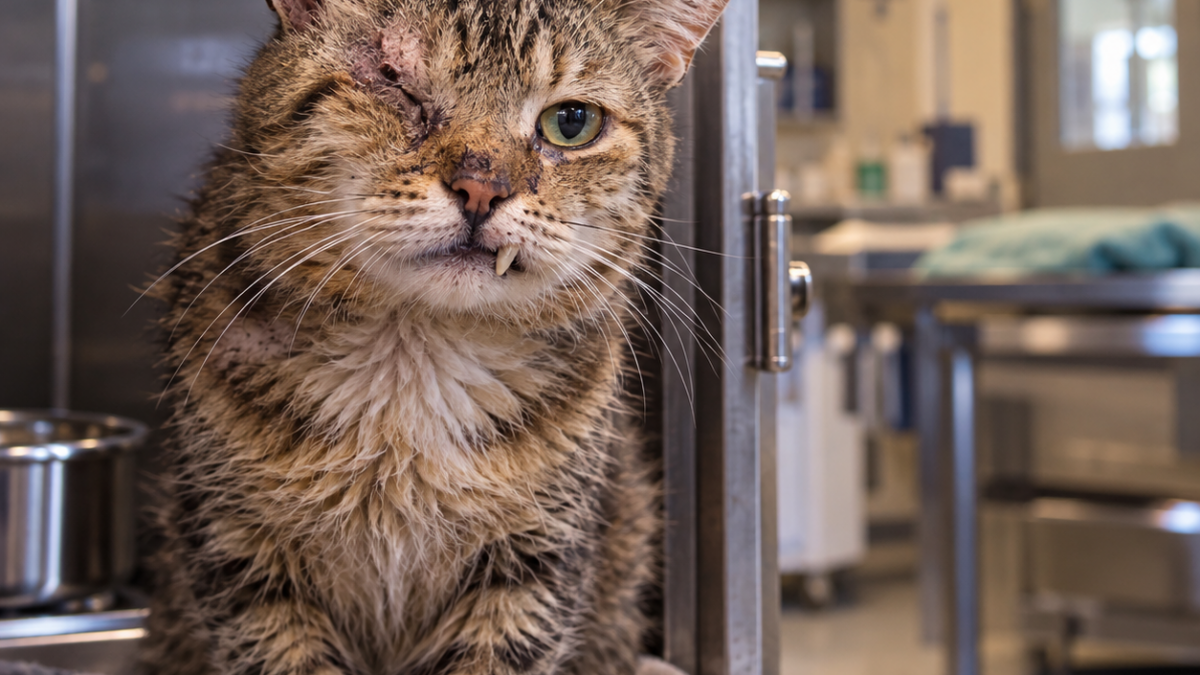
He would come forward when people entered the cat room. Not desperately. Not like the kittens who flung themselves against bars and screamed for attention. Quasi had learned patience the way unwanted animals do. He sat quietly at the front, one cloudy amber eye watching.
Sometimes a visitor would pause.
I would feel hope rise in me despite myself.
Then the visitor’s expression would change.
Pity.
Discomfort.
Fear.
And then they would move on.
By the fourth year, even some of our volunteers stopped saying, “Maybe today.” Hope becomes heavy when you have to carry it too long.
But Quasi still came forward every morning.
That was the thing about him.
He never stopped offering himself to the world that kept refusing him.
The spring everything changed came after a hard winter and a county funding fight that nearly broke me.
Cedar County was growing. New subdivisions had begun eating up the old farmland outside town. With them came people who liked the idea of rescue animals as long as the shelter did not smell, did not look sad, and did not require them to think too much about suffering. The county commission wanted numbers. Intake numbers. Adoption numbers. Cost-per-animal numbers. Average length-of-stay numbers.
Quasi became a number.
One afternoon, during a meeting in the back room, Patricia Voss tapped her manicured finger against a spreadsheet and said, “This is exactly what I mean.”
Patricia was on our advisory board, though I had fought her appointment. She owned Voss Realty, chaired the downtown beautification committee, and had a talent for making cruelty sound like responsibility. She wore cream-colored suits to an animal shelter and never left without checking the soles of her shoes.
She turned the spreadsheet toward me.
“One thousand five hundred fifty-six days,” she said. “For one cat.”
I folded my hands on the table.
“He has special needs.”
“He has no prospects.”
“You don’t know that.”
“Mara.” She said my name with the patient disappointment of someone explaining math to a child. “A shelter is not a sanctuary. We cannot keep every unadoptable animal forever because it makes us feel noble.”
Dr. Merrick, sitting beside me, stiffened.
“Quasi is healthy,” he said.
Patricia smiled without warmth. “Healthy is not the same as adoptable.”
I looked at her then, really looked at her, and felt an old anger rise from the floor of my chest.
“You’re right,” I said. “But neither of those words means disposable.”
The room went quiet.
Patricia leaned back.
“Nobody said disposable.”
“You implied it.”
“I implied we need to make hard choices.”
“No,” I said. “You implied he is taking up space that belongs to someone easier to love.”
Her face tightened. “That is emotional language.”
“It’s an emotional business.”
“It is a public service.”
“It is both.”
The county liaison cleared his throat and suggested we table the discussion until summer. That was what bureaucrats called mercy when they lacked the courage to make a decision in front of witnesses.
But Patricia was not finished.
Two weeks later, she launched what she called the “Bright Faces Adoption Initiative.” The idea was to photograph our most adoptable animals and promote them online with cheerful captions and pastel graphics. I had no objection to that part. Publicity helped. Good photos saved lives.
Then she sent me the draft.
Quasi was not included.
Neither was Morris, the elderly black cat with thyroid disease. Neither was Rocket, a three-legged gray cat who hid whenever strangers entered. Neither was Penny, a shy tortoiseshell who needed time before letting anyone touch her.
Only the pretty ones. The young ones. The uncomplicated ones.
At the bottom of Patricia’s email, she had written, We should consider relocating less marketable animals off the public adoption floor during campaign week so visitors have a more uplifting experience.
Less marketable.
I printed the email, walked into the supply closet, shut the door, and said a word my mother would have slapped me for using.
Denise found me there five minutes later.
“Are you hiding or planning a felony?”
“Both.”
She read the email and made the same face she made when cleaning a litter box after a sick tomcat.
“She wants to hide Quasi?”
“She wants to hide anything that reminds people rescue isn’t a catalog.”
Denise leaned against a shelf of paper towels.
“What are you going to do?”
“Something that won’t get me fired.”
“That narrows it down?”
“Barely.”
In the end, I did what I had done for nineteen years. I kept the doors open. I kept the animals visible. I kept Cage Seven where it had always been.
And on one warm afternoon in April, a woman walked in with her daughter.
The mother looked like exhaustion had been living in her bones for so long it had started paying rent. She was maybe late thirties, with brown hair pulled into a loose knot and a cardigan too warm for the weather. She held her purse with both hands, the way people do when they need something to grip.
The girl stood half a step behind her.
She wore long sleeves even though the day was hot. A medical compression garment showed at her neck and wrists. The right side of her face carried heavy burn scars from her jaw to her temple. Part of her ear had been reconstructed, and a smooth patch along her scalp showed where hair would not grow back. She had dark blond hair clipped carefully away from the scarred side, not to hide it exactly, but not to draw attention either.
Her eyes were the first thing I noticed.
Not because they were pretty, though they were.
Because they were guarded.
Some children come into shelters wide open. Their excitement runs ahead of them. They press their faces to cages, ask every animal’s name, beg for puppies before their parents have finished signing in.
This child entered as if every room might hurt her.
Her mother approached the front desk.
“We’re looking for a cat,” she said softly.
The girl said nothing.
“Do you have anything specific in mind?” I asked.
Her mother glanced down at her daughter.
“Quiet, maybe. Gentle.”
The girl looked at the floor.
I had learned not to force cheerfulness on wounded people. It feels like asking them to perform gratitude before they know whether they are safe.
So I nodded.
“We can look around.”
I showed them the kitten room first because that was what people expected. The kittens were in rare form that afternoon, tumbling over each other like drunk popcorn. One climbed the bars upside down. Another attacked its own tail with personal outrage. A little black-and-white kitten sneezed so hard she fell over.
Most children would have melted.
The girl watched politely, then stepped back.
Her mother tried to smile.
“They’re cute.”
The girl nodded once.
We moved on.
A tabby rolled onto his back and stretched. A calico reached through the bars, paw opening and closing. A young orange cat chirped at her with a bright little trill. The girl kept walking.
Her mother’s expression began to shift into something I recognized too well.
Hope trying not to show itself being disappointed.
We passed Morris. We passed Penny. We passed Rocket, who vanished under his blanket as soon as he heard footsteps.
Then we reached Cage Seven.
The girl stopped so suddenly her mother nearly bumped into her.
I held my breath.
Quasi was sitting at the front of his cage, his one good eye fixed on her. He had been sleeping when we entered the room, but now he was upright, scarred body still, head slightly tilted.
The girl stepped closer.
She did not flinch.
She did not cover her mouth.
She did not glance away and then pretend she hadn’t.
She studied every scar on his face with a stillness I had never seen in another visitor. Her eyes moved over the missing ear, the closed eye, the exposed teeth, the patches of bare scar tissue. Not greedily. Not with horror. With recognition so deep it seemed to empty the room of sound.
Then she slowly lifted one hand and placed her fingers against the bars.
Quasi stood.
He walked straight toward her.
And when he turned the scarred side of his face toward her hand, something inside me broke open.
The girl’s fingers trembled, but she did not pull them away. Instead, she crouched until her face was level with his and let him press harder into her palm.
Her mother covered her mouth.
I saw tears gather in her eyes, though I did not yet understand why.
The girl leaned closer.
Quasi closed his one eye.
For months, I would later learn, that child had barely spoken to anyone outside her family. But standing there with Quasi, she looked as if she had found words she had been saving for a very long time.
She turned toward her mother, took one breath, and opened her mouth.
“He looks like me.”
Her voice was so soft that for half a second I thought I had imagined it.
Her mother didn’t.
The woman’s knees seemed to weaken. She reached for the metal frame of the enclosure, steadied herself, and stared at her daughter.
The girl kept one hand between the bars.
Quasi kept his face pressed against it.
Then she looked up at her mother again.
“Can we take him home?”
Her mother made a sound that wasn’t quite a laugh and wasn’t quite a sob. She covered her mouth with both hands.
I had seen hundreds of adoptions in nineteen years. I had seen children scream with excitement over puppies. I had watched old men cry when a frightened dog finally crawled into their laps. I had watched people drive three states to adopt animals they had seen online.
But I had never seen anything like the expression on that woman’s face.
It wasn’t happiness alone.
It was relief.
The kind that arrives after you have spent so long trying to save somebody you love that you have forgotten what hope feels like.
She crouched beside her daughter.
“You want him?”
The girl nodded.
“Are you sure?”
Another nod.
Then she looked at me.
Not at the floor.
Not at her mother.
At me.
Directly.
“Can I hold him?”
Those were the first words she had spoken to me.
I swallowed hard.
“Absolutely.”
I unlocked Quasi’s enclosure.
Normally, when strangers entered his space, he waited. He never rushed anymore. He had spent too many years watching hands reach toward other cages.
But this time, when I opened the door, he stepped forward immediately.
The girl sat on the floor.
Her mother began to say, “Honey, be careful—”
Then stopped.
Quasi climbed into the girl’s lap.
Just like that.
No hesitation.
No fear.
He circled once, awkwardly because of his shortened tail and the stiffness in his scarred skin, then settled against the right side of her body.
The scarred side.
The girl froze.
I thought perhaps the weight surprised her.
Then I saw tears rolling down the left side of her face.
She didn’t wipe them away. She lowered her head until her cheek almost touched his.
Quasi began to purr.
It was not a delicate sound. Years of injury had left his breathing slightly rough, and his purr had a low, uneven vibration to it, like a tiny engine that had survived a wreck and still insisted on running.
The girl smiled.
It was the first smile I had seen from her.
Her mother turned away.
I pretended to be busy with the latch because I knew she needed a moment. Then I heard her whisper, “Oh, thank God.”
I looked at her.
She was crying openly now.
“I’m sorry,” she said.
“You don’t need to apologize.”
“You don’t understand.”
So she told me.
Her daughter’s name was Sophie Lane. She had been seven when the fire happened. A space heater in an older rental house had malfunctioned in the middle of the night. The official report called it electrical. That word sounded so clean for something that had filled a child’s room with heat and smoke.
Sophie had been trapped in her bedroom.
Her father had died when she was a baby, so it had just been Sophie and her mother, Claire, in the house. Claire had tried to get through the hallway but collapsed from smoke. A neighbor broke a window and dragged her out. Firefighters reached Sophie minutes later.
Minutes.
That was all.
But minutes can take almost everything.
The flames and heat caused third-degree burns over a large part of Sophie’s body, especially along her right side. There had been surgeries. Eleven already. More scheduled. Skin grafts. Compression garments. Physical therapy. Nightmares. Months when sleeping meant waking up screaming. Months when showering hurt. Months when getting dressed hurt. Months when strangers stared.
Claire’s voice shook as she spoke, but she did not look away from her daughter.
“The doctors knew what to do with the burns,” she whispered. “I didn’t know what to do when she stopped believing she belonged anywhere.”
I glanced toward Sophie.
She was running two fingers gently over the smooth scar where Quasi’s ear should have been. He leaned into her.
“When she first went back around other children,” Claire said, “they asked questions. At first she tried answering.”
She took a shaky breath.
“Then one boy called her a monster.”
My stomach tightened.
“She stopped talking to the other kids after that. Not gradually. Almost completely. Seven months. She speaks to me, her doctors, her therapist sometimes. But outside the family…”
Claire looked at me.
“You just heard more from her in ten minutes than most people have heard in months.”
I didn’t know what to say.
There are moments when saying something comforting feels smaller than simply standing beside someone.
So I stood there.
Sophie looked up.
“Mom?”
“Yes, baby?”
“Does he hurt?”
Claire glanced at me.
I answered carefully.
“Sometimes his scars get dry and uncomfortable. His gums need special care because part of his lip is missing. But right now he isn’t in pain.”
Sophie looked down at him.
“Does he know he looks different?”
That question went through me.
I sat on the floor a few feet from her.
“I don’t know what Quasi thinks when he sees himself,” I said. “But I know what he thinks when someone is kind to him.”
“What?”
“That he wants to stay close.”
She considered this.
Then she whispered to the cat, “Me too.”
Claire cried again.
I nearly did.
Actually, that is not true.
I did.
I excused myself under the pretense of getting the adoption paperwork. I made it halfway down the hall before my vision blurred.
Denise was behind the front desk, sorting medication logs.
She looked up.
“What happened?”
I shook my head.
“Nothing.”
“You’re crying.”
“For once, nothing happened.”
She stared at me.
I laughed through tears.
“Get Quasi’s file.”
Denise froze.
“What?”
“Get his adoption file.”
Her hand flew to her chest.
“No.”
“Yes.”
“No way.”
I nodded.
Denise started crying.
Within five minutes, three employees knew. Within ten, everyone did. We tried to behave professionally.
We failed miserably.
Caleb went into the supply room because he didn’t want the family to see him crying. Our receptionist, June, suddenly became very interested in organizing pens. Dr. Merrick happened to be there that afternoon and came out pretending he needed to review “home-care instructions,” though his eyes were red before he even entered the room.
He had treated Quasi for years.
He sat across from Sophie and explained the scar cream, the eye drops, and the cleaning Quasi sometimes needed around his exposed gums.
Sophie listened with more concentration than most adults.
“How often?” she asked.
“His gums?”
She nodded.
“Usually a thorough cleaning once a month, but you’ll want to check them regularly.”
“I can do that.”
Claire touched her shoulder.
“We can do that.”
Sophie shook her head.
“I want to.”
Dr. Merrick smiled.
“All right. Then I’ll teach you.”
For the next twenty minutes, he showed her exactly how to hold Quasi’s head gently, how to inspect the tissue, how to recognize irritation. She asked about his eye. His skin. His food. Whether sunlight bothered him. Whether cold weather made his scars hurt.
Nobody had ever asked us so many questions about Quasi.
People had always wanted to know what happened to him.
This girl wanted to know how to care for what remained.
There is a difference.
A very big one.
Claire filled out the adoption paperwork at the front desk. When she reached the section asking why they had chosen this particular animal, she stared at the blank line for a long time.
Then she wrote three words.
He chose her.
I saw it later.
I kept a photocopy.
I still have it.
When everything was finished, I went to retrieve the carrier we normally provided for cat adoptions.
Sophie shook her head.
“I want to carry him.”
Claire hesitated.
“It’s safer in the carrier, sweetheart.”
Sophie tightened her arms around Quasi.
“Please.”
We compromised. The carrier went with them for the car ride. But Sophie carried Quasi from the adoption room to the parking lot herself.
His scarred side rested against her scarred side. His missing ear was beside her reconstructed one. The place where his fur never grew back touched the compression garment beneath her sleeve.
Halfway to the car, she stopped.
“What is his real name?”
I smiled.
“Quasi.”
“Why?”
I hesitated.
The truth was uncomfortable.
“At the beginning,” I said slowly, “one of our volunteers thought the name fit because of an old story. A character who looked different but had a good heart.”
Sophie studied him.
“You can change it,” I added quickly. “Lots of adopted pets get new names.”
“No.”
“No?”
“He knows it.”
“He probably does.”
“Then it’s his.”
She scratched gently under his chin.
“And I like him how he is.”
Claire closed her eyes.
Sometimes children say things adults spend years trying to understand.
Sophie climbed into the back seat. Claire placed the carrier beside her and opened its door. Quasi walked in, turned around, and immediately walked back out.
He climbed into Sophie’s lap.
We all laughed.
Even Sophie.
Especially Sophie.
Claire finally persuaded him into the carrier by placing Sophie’s sweater inside. Before closing the door, Sophie put her fingers through the ventilation holes.
Quasi pressed his cheek against them.
Exactly as he had through the cage bars.
Only now the cage was going somewhere.
I stood in the parking lot until their car disappeared.
Then I went back inside.
Cage Seven was empty.
For years, I had imagined that sight. I thought it would make me happy.
Instead, I stood in front of it and cried so hard Denise had to hand me tissues.
His blanket was still there. So was the shallow ceramic dish he liked. A few orange hairs clung to the fabric.
Not many.
Quasi had never had many to leave behind.
Denise stood beside me.
“You okay?”
“Yeah.”
I looked into the empty cage.
“I just wish it hadn’t taken four years.”
She touched my shoulder.
“At least he doesn’t know how long four years is.”
I looked at her.
“I think animals know waiting.”
She didn’t answer.
That evening, after we closed, I checked the shelter records.
One thousand five hundred fifty-six days.
That was how long Quasi had lived with us.
Four years.
Three months.
And a few days.
I scrolled through his adoption history.
Fourteen inquiries.
Fourteen.
I remembered almost every one.
The woman who gasped. The man who asked if we had anything less damaged. The college couple who said they wanted a special-needs animal but decided Quasi would be too emotionally heavy. The family who let their little boy point and laugh until we asked them to leave. And that couple who stayed four minutes.
I closed the file.
For the first time, their rejection did not feel like the ending of Quasi’s story.
It felt like the road that had led him to Sophie.
The next morning, my phone rang before seven.
It was Claire.
Immediately, my heart jumped. Adoption calls that early are rarely casual.
“Is he okay?”
She laughed.
“He’s fine.”
I exhaled.
“He slept with her.”
I smiled.
“Already?”
“He cried outside her bedroom until she opened the door.”
“That sounds like Quasi.”
“No,” Claire said. “You don’t understand.”
Her voice changed.
“She slept.”
I waited.
“She slept through the night.”
The words came out slowly, as if she was afraid saying them too loudly might break them.
“As in… all night?” I asked.
“All night.”
Claire began crying.
“So did I.”
She explained that Sophie had struggled with nightmares since the fire. Some nights she woke once. Some nights five or six times. Occasionally she refused to fall asleep at all because closing her eyes made her feel as though she were back in the smoke.
But that night, Quasi had climbed onto the bed and settled beside her right shoulder.
When Sophie shifted, he shifted.
When she woke once around midnight, she found his face against her cheek. She put her hand on his chest. Felt him breathing. And went back to sleep.
“I know one night doesn’t mean everything is fixed,” Claire said.
“No.”
“But I haven’t seen her wake up rested in eighteen months.”
I leaned against the desk.
“What did she say this morning?”
There was a pause.
“She said Quasi keeps the fire dreams away.”
That became the beginning.
Not a miracle.
I want to be clear about that.
Love does not erase trauma. A cat cannot undo burns. A good night cannot erase eighteen months of fear. There were still surgeries. Still therapy. Still scar care. Still school. Still people who stared too long. Still days when Sophie did not want to leave the house.
But Quasi gave her something none of us had been able to give her.
Evidence.
Living, breathing evidence that a body could be terribly changed and still be worthy of tenderness.
Six days after the adoption, Claire sent me a photograph.
Sophie sat cross-legged on her bed doing homework. Quasi lay across the open workbook, his one eye closed, his ruined face resting directly on a multiplication worksheet.
The message beneath the photo said, Apparently he does not support mathematics.
I laughed so loudly Denise came out of the supply room to see what happened.
A week later came another photograph. Quasi in the bathroom sink. Sophie beside him brushing her teeth.
Then another. Quasi wrapped in a blanket with only his scarred face sticking out. Sophie had apparently informed Claire that “he gets cold where his fur forgot to grow.”
I showed that one to Dr. Merrick.
He pretended something had gotten in his eye.
Three weeks after the adoption, Claire visited the shelter alone. I barely recognized her.
Not physically. Her face looked the same.
But the exhaustion had loosened its grip on her.
She brought cookies for the staff. I took her into my office, and for the first time since we met, she sat down without looking like she might bolt at any second.
“How are they?” I asked.
She smiled.
“I don’t know how to explain it without making it sound dramatic.”
“Try me.”
“My daughter talks to the cat all day.”
“That sounds good.”
“No. I mean all day.”
She laughed, then wiped under one eye.
“She tells him things she won’t tell me. Things she won’t tell her therapist.”
My smile faded slightly.
“What kinds of things?”
“The fire. School. The surgeries.”
Claire looked down at her hands.
“She told him she hates it when people say she’s brave.”
I understood.
Adults say brave when they don’t know what else to say to a hurt child.
“What did you do?”
“Nothing. I sat outside the room and listened.”
Her eyes filled.
“She told him, ‘I don’t want to be brave. I just want to be normal.’”
I nodded.
“And then?”
“Quasi sneezed.”
I laughed.
“She told him, ‘Yeah. Me too.’”
We sat quietly.
Then Claire said, “Her therapist thinks this is helping her externalize some of what she’s been holding in.”
“That sounds promising.”
“It is.”
She looked through my office window toward the adoption floor.
“But there’s something else.”
I waited.
“She wants to come back here.”
“To visit?”
“To volunteer.”
I blinked.
“She’s nine.”
“I know.”
“We don’t normally allow volunteers that young except with a parent.”
“I’ll be with her.”
“What does she want to do?”
Claire smiled.
“Sit with the cats nobody visits.”
I had to look away.
We arranged it.
Saturday mornings. One hour. Mother and daughter together.
The first Saturday, Sophie arrived carrying a small backpack and wearing the same long sleeves. Quasi stayed home.
“He gets mad in the car,” she explained.
That was the most she had ever said to Denise.
Denise nodded gravely.
“Very reasonable.”
Sophie smiled.
We had three cats that week who were struggling with adoption. Morris, the elderly black cat. Penny, the shy tortoiseshell. And Rocket, a three-legged gray cat who had the unfortunate habit of hiding whenever anyone entered the room.
Sophie started with Morris.
She sat inside his enclosure and read him a book. She did not pet him until he approached first.
Forty minutes later, Morris was asleep against her leg.
A family adopted him the following week.
Was it because of her?
Probably not directly.
But when they asked why Morris seemed so comfortable with people, I told them about the girl who sat and read to him.
They liked that.
The next Saturday, Sophie chose Penny. Then Rocket. She never selected the cutest animal. Never the youngest. Never the easiest.
She always asked the same question.
“Who has been here longest?”
We began calling her our Waiting Room Specialist.
She hated the name.
So, naturally, Denise used it constantly.
Within six weeks of adopting Quasi, something else happened.
Sophie spoke to one of our adult visitors.
Not because she was forced. Not because Claire prompted her.
A woman was standing in front of Rocket’s enclosure. Sophie was nearby folding towels. The woman pointed toward Rocket’s missing hind leg.
“Does that bother him?”
Sophie looked at Rocket.
Then at the woman.
“No.”
The woman glanced at Sophie’s scars and then quickly looked away.
The old pattern.
I saw it.
Sophie saw it too.
For a second, her shoulders tightened.
I expected her to retreat.
Instead, she walked over.
“He runs faster than some of the cats with four legs,” she said.
“Really?”
“Yeah.”
Rocket chose that moment to shoot across the enclosure and climb a shelf with dramatic proof.
The woman laughed.
Sophie laughed too.
They talked for almost two minutes.
Claire stood behind the reception desk with one hand pressed to her chest.
I pretended not to notice her crying.
After they left, Sophie went right back to folding towels.
No celebration.
No announcement.
But on Monday, Claire called.
“Her therapist timed it,” she said.
“Timed what?”
“She spoke to a stranger for one minute and forty-eight seconds.”
I smiled.
“Rocket deserves a commission.”
“He probably does.”
By summer, Sophie was speaking more often.
Not constantly.
Not easily.
But more.
Then came a setback.
There always does.
Claire warned me about it before they arrived one Saturday. Another surgery had been scheduled. The doctors needed to release contracted scar tissue along the side of Sophie’s face and neck. The procedure was necessary. Sophie understood that.
She still hated it.
She had started waking at night again. She barely spoke. And for the first time since adopting him, she pushed Quasi away when he climbed onto her bed.
“I don’t know why,” Claire said quietly over the phone. “She’s angry at everybody.”
“She’s allowed.”
“I know.”
“She’s even allowed to be angry at him.”
Claire smiled sadly.
“Try telling him that.”
When they arrived, Sophie walked past me without saying hello. She went straight to the quiet room, where we kept the cats who needed less noise.
I found her sitting beside a senior cat named Pearl.
I sat on the floor several feet away.
We stayed silent for a long time.
Finally, Sophie said, “They have to cut me again.”
My chest tightened.
I kept my voice steady.
“I heard.”
“I don’t want them to.”
“I know.”
“Mom says it’ll help.”
“She probably believes that.”
“She says I’ll feel better later.”
“Maybe you will.”
Sophie looked at me sharply.
“You sound like her.”
“That’s unfortunate.”
The corner of her mouth twitched.
Then disappeared.
She looked down.
“I hate later.”
I thought about Quasi.
Four years of later.
“I think later can be pretty rude,” I said.
She glanced at me.
“It makes you wait for everything.”
“Exactly.”
She stroked Pearl’s back. The old cat allowed it, which was a rare endorsement.
Then Sophie’s fingers stopped.
“Do you think Quasi remembers when he got burned?”
I answered carefully.
“I don’t know.”
“Do you think he dreams about it?”
“I don’t know that either.”
“He moves sometimes when he sleeps.”
“Cats dream.”
“What if he remembers?”
“Then he wakes up somewhere safe.”
Her eyes lifted to mine.
I went on.
“He wakes up in your house. On your bed. Next to you.”
She stared at me for several seconds.
Then whispered, “I don’t always feel safe.”
“I know.”
“Even at home.”
“I know.”
“Is that stupid?”
“No.”
“Everybody keeps telling me the fire is over.”
I nodded.
“Your body learned something terrifying. Sometimes bodies take longer to believe what our brains already know.”
She was quiet.
Then she said, “Quasi’s body looks like the fire isn’t over.”
I felt that sentence settle into the room.
“What does Quasi act like?” I asked.
She thought.
“Like he owns my pillow.”
I smiled.
“Anything else?”
“Like breakfast should happen whenever he wants.”
“Very true.”
“And he screams if Mom closes the bathroom door.”
“I didn’t know that.”
“He screams a lot.”
“So his body carries what happened,” I said. “But his life isn’t only what happened.”
She looked toward the window.
“No.”
“Neither is yours.”
She didn’t answer.
I didn’t push.
That evening, Claire texted me a photograph.
Quasi was under the blankets. Only his head showed. Beside him was Sophie’s hand.
The message read, She let him back on the bed.
The surgery took place two weeks later.
I heard afterward that when the nurses wheeled Sophie toward the operating room, she carried a photograph of Quasi. Not a pretty photograph. She had chosen one that showed all of him clearly.
Missing eye.
Missing ears.
Exposed teeth.
Scars.
She told the nurse, “He had worse.”
I’m not sure that was medically accurate.
It didn’t matter.
When Sophie woke from anesthesia, the first thing she asked was whether Quasi had eaten breakfast.
Claire laughed so hard she cried.
The recovery was difficult.
Pain always sounds abstract when doctors discuss it in advance.
Then you live through it.
There were days Sophie refused to look in the mirror because swelling temporarily changed her face again. Days she asked why every improvement required hurting first. Days Claire called me from the hospital parking garage because she could not cry in front of her daughter anymore and needed somewhere to fall apart.
I listened.
That became part of our friendship.
Not advice.
Mostly listening.
Three days after Sophie returned home, Quasi did something extraordinary.
Or ordinary.
Sometimes there is no difference.
He crawled onto her chest while she was lying on the couch. Claire worried he would hurt her incision and tried to move him.
Sophie stopped her.
“He knows.”
Quasi settled lower. He placed his damaged face beside hers.
Sophie closed her eyes.
And slept for almost three hours.
Claire sent no photograph that time. She told me later she had considered taking one, then decided against it.
“Some moments belong to the people inside them,” she said.
I understood.
By September, Sophie was preparing to return to school.
That frightened her more than surgery.
At the shelter, she could control where she stood. At home, she was protected. School meant hallways. Whispers. Questions. Children trying not to stare. Children not trying at all.
Claire asked whether she wanted to transfer.
Sophie said no.
“I want my school.”
“Then we’ll make a plan.”
The therapist helped. Teachers were informed. The counselor agreed to give Sophie somewhere quiet to go if she felt overwhelmed.
Still, the night before the first day, Sophie called me.
Not Claire.
Me.
I was cleaning the intake room when my phone rang.
“Hello?”
Nothing.
Then:
“It’s me.”
I knew immediately.
“Hey.”
“Can you talk?”
“Of course.”
“I don’t want to go tomorrow.”
“You don’t have to convince me that school is terrible.”
“That’s not funny.”
“A little funny?”
“No.”
“Okay.”
Silence.
Then she said, “What if they look at me?”
“They probably will.”
I heard her breathing change.
I quickly added, “Not because there’s something wrong with you.”
“Then why?”
“Because people notice things they aren’t used to seeing.”
“I hate it.”
“I know.”
“What am I supposed to say?”
“You don’t owe everyone an explanation.”
“My therapist says that.”
“Your therapist sounds smart.”
“She is.”
“What do you want to say?”
“I don’t know.”
“Then don’t decide tonight.”
More silence.
Quasi meowed loudly in the background.
I smiled.
“Is that my former resident?”
“He’s sitting on my backpack.”
“Maybe he doesn’t want you to go either.”
“He wants my sandwich.”
“That sounds more realistic.”
She laughed.
Then her voice softened.
“What did you say when people called Quasi ugly?”
I stopped wiping the counter.
“I usually told them they didn’t know him.”
“What if somebody calls me ugly?”
That question hurt more than I let her hear.
I leaned against the sink.
“You want to know what I think you should say?”
“Yes.”
“Whatever makes you feel safe.”
“That’s not an answer.”
“It’s the best one I’ve got.”
She groaned.
Adults are very annoying when we refuse to give children movie dialogue.
Then I said, “But if you want the truth, anyone who decides who you are by looking at your scars has told you more about themselves than they’ve told you about you.”
She was quiet.
“Can I tell them about Quasi?”
“Absolutely.”
“Can I show his picture?”
“You better choose a good one.”
“He doesn’t have bad ones.”
I smiled.
“Exactly.”
The next afternoon, Claire called.
“She made it.”
“All day?”
“All day.”
“How?”
Claire laughed.
“With the cat.”
“What?”
“She brought photographs.”
Apparently, the first child who asked about her scars did so awkwardly. Not cruelly. Just bluntly.
“What happened to your face?”
Sophie froze. Every prepared answer disappeared.
Then she remembered Quasi.
She took out her phone.
“This is my cat.”
The child stared at the photo.
“What happened to him?”
“He got burned.”
“Whoa.”
“He survived.”
“Does he bite?”
“No.”
“Can he see?”
“With one eye.”
“Does he sleep with you?”
“Every night.”
The conversation moved.
Just like that.
Not away from the scars.
Through them.
Toward something she loved.
By lunchtime, two other children had seen Quasi’s picture. By the end of the week, half the class knew about him.
And something changed.
When children asked about her burns, Sophie did not always shut down. Sometimes she answered. Sometimes she said, “I don’t want to talk about it.” Sometimes she showed them Quasi.
The boy who had called her a monster the previous year was still there.
His name was Mason Reed.
That worried Claire more than anything.
The confrontation happened on a Thursday.
I learned about it that afternoon.
Mason saw Sophie in the hallway. He stared. Sophie kept walking. Then he said her name.
She stopped.
Her friend beside her stopped too.
Mason looked down.
“I’m sorry.”
That was all.
No dramatic speech.
No teacher forcing him.
No public humiliation.
Just two words.
Sophie stood there for several seconds.
Then said, “Okay.”
And walked away.
Claire asked later if she forgave him.
Sophie shrugged.
“I don’t know yet.”
I loved that answer.
Children are often pressured to forgive quickly because adults are uncomfortable with unresolved pain.
But forgiveness isn’t a receipt you hand someone because they finally apologized.
She was allowed time.
She was learning that too.
Weeks passed. School became routine.
Not easy.
Routine.
There is a difference.
Routine meant Sophie could have a bad Tuesday without believing her whole life was collapsing. It meant she could come home angry about homework instead of devastated by a stranger’s stare. It meant Claire could ask, “How was school?” and occasionally hear the universal child response:
“Fine.”
Claire told me the first time that happened, she went into the laundry room and laughed until she cried.
“I waited two years to be annoyed by the word fine,” she said.
Meanwhile, Quasi became thoroughly spoiled.
Four years in a shelter had apparently convinced him he was owed interest. He refused to drink from a normal bowl after discovering the kitchen faucet. He learned that Claire’s mother would share turkey. He slept only on the right side of Sophie’s bed. He sat outside the bathroom and screamed if the door closed. He knocked pens off desks. He developed an irrational hatred of one particular blue sock.
He also gained nearly two pounds.
Dr. Merrick put him on a diet.
Sophie protested.
“He survived being set on fire.”
Dr. Merrick nodded.
“He did.”
“He lived in a cage for four years.”
“Yes.”
“And now you’re taking away snacks?”
“Correct.”
She stared at him.
“That’s cruel.”
He stared back.
“He is overweight.”
Quasi screamed from the carrier.
Sophie pointed.
“Even he disagrees.”
I laughed so hard I had to leave the room.
The diet lasted.
Mostly.
I suspect Claire’s mother sabotaged it.
That winter, the air turned unusually dry. Quasi’s scar tissue began cracking in several places. His skin required ointment morning and night.
The first time Claire tried to do it, he escaped under the bed.
Sophie crawled after him.
Ten minutes later, she emerged holding Quasi like a baby.
“Give it to me.”
Claire handed her the ointment.
Sophie sat on the rug.
“Come on, buddy.”
She warmed a small amount between her fingers, then gently worked it into the tight skin along his neck. Quasi closed his eye. He purred.
Claire filmed about fifteen seconds and showed me later.
The remarkable part wasn’t Quasi.
It was Sophie’s hands.
They were steady.
Scarred, yes. Some areas were still covered by compression material.
But steady.
She touched his damaged skin without fear. Without pity. Without treating him as fragile.
She simply cared for him.
When she finished, she wiped her fingers and said, “There.”
Quasi immediately licked the ointment.
“No!”
He tried again.
“Quasi!”
He trotted away.
Claire laughed behind the camera.
Sophie chased him.
It was ridiculous.
Ordinary.
Beautiful.
Around Christmas, the shelter received a package.
Inside were twenty small fleece blankets. A note was taped to the top.
For the cats who are still waiting.
No name.
But I recognized the handwriting.
I called Claire.
“You didn’t have to do this.”
“She saved her allowance.”
“All of it?”
“Almost.”
“Why?”
Claire was quiet.
“Because she remembers what you told her.”
“What did I tell her?”
“That Quasi waited 1,556 days.”
My throat tightened.
“She asked how many nights that was.”
“The same number.”
“I know. She didn’t.”
Claire laughed softly.
“When I told her, she sat there for a long time. Then she said nobody should have that many lonely nights.”
We put a blanket in every cat enclosure.
One went into Cage Seven.
A new resident occupied it now, a twelve-year-old white cat named Pearl whose owner had died. Pearl had kidney disease and an unpleasant habit of slapping anyone who touched her feet. She had been overlooked for three months.
When Sophie came in after Christmas, she went straight to Pearl.
“Is she mean?”
Denise said, “Only if you have hands.”
Sophie nodded seriously.
“Fair.”
She sat outside the cage for half an hour. Pearl eventually came forward. Sophie didn’t reach in. She just talked.
About Quasi.
School.
Her upcoming surgery.
A science project.
Eventually, Pearl lay down beside the bars.
Three weeks later, an elderly woman adopted her.
Sophie began keeping a notebook. She wrote the names of long-term animals in it. Date they arrived. Things they liked. Things they feared. Which treats worked. Which toys. Where they liked being scratched.
When one was adopted, she drew a small house beside the name.
I saw the notebook only once.
Pages of little houses.
Some names had waited months for one.
Some only weeks.
Beside Quasi’s name, she had drawn the largest house.
Underneath it she wrote:
1,556 days.
Never again.
That spring, Patricia Voss returned to my office with a photographer and a proposal.
I knew she was coming because she had emailed me three times that week using phrases like “brand refresh” and “donor-facing transformation,” which meant she was about to ask us to do something expensive, useless, or cruel.
She stepped into my office wearing a pale green blazer and carrying a folder embossed with the Voss Realty logo.
Behind her stood a young photographer I recognized from the local paper.
“Mara,” Patricia said brightly. “I have wonderful news.”
My stomach sank.
“That sounds dangerous.”
She ignored that.
“I’ve spoken with Channel 6 in Knoxville. They’re interested in doing a human-interest segment.”
“About what?”
“About the shelter.”
I waited.
“And Quasi.”
My spine stiffened.
Patricia smiled.
“And the little girl.”
I did not return the smile.
“No.”
She blinked.
“You haven’t even heard the concept.”
“I heard enough.”
“It would be tasteful.”
“No.”
“It would help fundraising tremendously.”
“No.”
She set the folder on my desk.
“Mara, don’t be shortsighted. This is exactly the kind of story people respond to. A scarred child, a scarred cat, healing together. It’s powerful.”
“It’s their life.”
“It’s inspirational.”
“It’s private.”
“She volunteers here.”
“She is ten.”
“Her mother can consent.”
“And if her mother says no?”
Patricia’s smile thinned.
“Then I hope you’ll explain to her how much good this could do.”
I stood.
“I will explain that she owes us nothing.”
The photographer shifted uncomfortably by the door.
Patricia lowered her voice.
“You are letting your emotions interfere with the shelter’s interests.”
“I am protecting a child.”
“You are protecting your pride.”
That landed differently.
Not because it was true, but because Patricia believed it was. She thought my refusal came from stubbornness, not principle. She could not imagine leaving money on the table for the dignity of someone who had none to spare.
“She has a story people need to hear,” Patricia said.
“If Sophie ever wants to tell it, she can.”
“She may not understand the opportunity.”
“She understands being stared at.”
Patricia’s mouth tightened.
“That’s unfair.”
“No,” I said. “What’s unfair is teaching a child that because she survived something terrible, adults are entitled to package her pain.”
The room went still.
The photographer looked at the floor.
Patricia gathered her folder.
“This shelter needs donors.”
“I know.”
“You can’t run on sentiment forever.”
“I don’t.”
“You run on county money and private contributions.”
“And trust,” I said. “We run on trust. People bring us the most vulnerable creatures in this county because they believe we will not exploit them. That includes the human ones.”
She left without another word.
I thought the matter was over.
I was wrong.
Two weeks later, during our spring open house, Patricia arrived with two board members, a videographer, and the same fixed smile she wore at charity luncheons.
The open house had been Sophie’s idea, though she did not want credit. She had made index cards for the long-term animals, each one written in her careful handwriting.
Please ask what I love before you decide what I look like.
Sometimes the animal hiding in the back is waiting for somebody patient.
Old is not the same as finished.
Scars mean something happened. They do not tell you everything that happens next.
That last one was taped beside Samson, a black one-eyed cat who had lost his eye to glaucoma.
Sophie was refilling water bowls when Patricia swept in.
“Oh, there she is,” Patricia said, loud enough for half the lobby to hear.
Sophie looked up.
Claire, who had been stacking donated towels, froze.
Patricia crossed the room with theatrical warmth.
“You must be Sophie.”
Sophie glanced at her mother.
Claire moved closer.
“I’m Patricia Voss,” Patricia said. “I help support the shelter.”
That was a generous description.
Sophie nodded politely.
Patricia turned toward the videographer.
“This is the young lady I told you about.”
My body went cold.
“Patricia,” I said.
She ignored me.
“Sophie, would you mind standing near Quasi’s old cage? We’re filming some promotional material today.”
Claire stepped between them.
“No.”
Patricia blinked as though the word itself was rude.
“It would only take a minute.”
“I said no.”
A few visitors turned.
The videographer lowered his camera slightly but did not turn it off.
Patricia’s smile hardened.
“I’m sure you want to help the animals.”
Sophie’s face changed.
It was subtle. Most people would not have seen it. But I knew what fear looked like on that child. Her shoulders drew inward. Her hand lifted halfway toward the scarred side of her face before she caught herself.
Claire saw it too.
“My daughter is already helping,” she said.
Patricia gave a soft laugh.
“Of course. But sometimes helping requires courage.”
That did it.
I walked across the lobby.
“Turn the camera off.”
The videographer looked at Patricia.
“Now,” I said.
He turned it off.
Patricia’s face flushed.
“Mara, you are making a scene.”
“No. You brought a camera into a shelter and tried to corner a child after being told no.”
Gasps moved through the lobby.
Patricia leaned toward me.
“Careful.”
I heard the warning.
So did Claire.
So did Denise, who had appeared behind the desk with the expression of a woman mentally choosing which object would make the best weapon.
Sophie stood very still.
Then, quietly, she said, “I don’t want to be your sad story.”
The whole lobby went silent.
Patricia looked at her, truly looked at her for the first time that day, and somehow still learned nothing.
“Sophie, sweetheart, that is not what this is.”
“Don’t call me that.”
Claire reached for her daughter’s hand.
Patricia’s mouth opened.
Before she could speak, Mason Reed’s mother walked in with her son.
I recognized them because Claire had pointed them out once at a school event. Mason had grown taller since the hallway apology. He stood beside his mother looking awkward and uncomfortable, holding a bag of donated cat food.
Sophie saw him.
For a second, I thought the day might become too much.
But Mason looked from Sophie to Patricia to the camera, and something in his face shifted.
He stepped forward.
“She said no,” he said.
Patricia stared at him.
He swallowed.
“She shouldn’t have to say it twice.”
His mother put a hand on his shoulder, stunned but proud.
Sophie looked at Mason.
Not forgiving everything.
Not erasing the past.
But seeing something new.
Patricia gave a brittle laugh.
“This is absurd. I came here to help.”
“No,” Sophie said.
Her voice was still soft, but it carried.
“You came here to use us.”
Nobody moved.
Then Samson, the one-eyed black cat, reached through the bars behind Patricia and swatted the sleeve of her cream blazer with one determined paw.
Denise made a sound that was definitely not professional.
A child giggled.
Then another.
Patricia yanked her arm away and looked at the smear of wet paw print on her sleeve as if Samson had committed treason.
That should have been the end of it.
But cruelty hates being embarrassed.
Three days later, Patricia called an emergency advisory board meeting and accused me of mismanagement, insubordination, and creating “a hostile environment for donors.” She claimed I had humiliated her publicly and jeopardized critical funding. She also claimed our refusal to cooperate with media opportunities proved that I was “emotionally overattached” to certain animals and incapable of making strategic decisions.
It was a polished attack.
Prepared.
Documented.
She brought charts. Photos. Adoption statistics. Length-of-stay reports. She emphasized Quasi’s 1,556 days as proof that my policies had wasted resources. She argued that animals with severe disfigurements or chronic conditions should be transferred to sanctuaries, placed in permanent foster, or “humanely evaluated” if placement was unlikely.
Humanely evaluated.
I had been in rescue long enough to know every pretty phrase people use when they do not want to say kill.
The board listened.
Some looked uncomfortable.
Some looked persuaded.
When it was my turn, I stood with shaking hands and a folder of my own.
Not because I was afraid of Patricia.
Because I was angry enough to cry, and I hated crying in front of people who mistook tears for weakness.
“I have managed Cedar County Animal Haven for nineteen years,” I said. “In that time, our live-release rate has improved, our volunteer base has tripled, and our adoption return rate remains one of the lowest in the region. But I am not here to defend myself with numbers, because Patricia has already proved something important with hers.”
Patricia sat back, ready to enjoy herself.
I opened my folder.
“She has proved that Quasi waited 1,556 days.”
I placed his record on the table.
“She has proved that he was overlooked fourteen times.”
I placed the inquiry sheet beside it.
“She has proved that our system struggles to place animals who do not photograph easily, who require care, who make people uncomfortable, who force visitors to confront the fact that love is not always convenient.”
I looked around the room.
“What she has not proved is that their lives are worth less.”
Patricia’s expression cooled.
I continued.
“Quasi was not a failure. He was a responsibility. The fact that it took 1,556 days for the right person to find him does not mean we waited too long. It means we were here when she arrived.”
One board member, Mr. Hale, shifted in his chair.
I placed Sophie’s index cards on the table.
“These were written by the child Patricia tried to film without consent.”
Patricia opened her mouth.
The chairwoman lifted a hand.
“Let her finish.”
I read the card aloud.
“Scars mean something happened. They do not tell you everything that happens next.”
My voice almost broke.
I steadied it.
“That sentence got Samson adopted on Saturday.”
Mr. Hale looked up.
“The one-eyed cat?”
“Yes.”
I opened another file.
“Walter, hit by a car, rear leg amputated, thirty-three days to adoption after Sophie rewrote his description. Pearl, senior kidney cat, adopted after Sophie spent weeks socializing her. Morris, elderly black cat, adopted after she worked with him. Rocket, three-legged cat, adopted after visitors began asking about him because Sophie told them he could outrun the four-legged cats.”
Patricia sighed.
“These are anecdotes.”
“These are lives.”
“They don’t solve structural issues.”
“No,” I said. “But hiding them doesn’t either.”
The room went quiet.
Then Dr. Merrick, who had been silent until then, stood.
“As the shelter veterinarian, I want the record to show that Quasi was never suffering in our care. He had medical needs, but he was stable, social, responsive, and capable of a good quality of life. Ending or concealing an animal’s life because the public finds their appearance difficult would not be humane. It would be cosmetic.”
That word landed hard.
Cosmetic.
Patricia’s jaw tightened.
The vote did not happen that day.
Instead, the board ordered an internal review of Patricia’s media proposal and donor activities. She had overplayed her hand. In trying to remove me, she had forced people to examine methods they had been politely ignoring for years.
The investigation took six weeks.
It uncovered things I had not known.
Patricia had promised donors naming rights to renovations the board had never approved. She had used shelter photographs in fundraising materials for her private realty foundation without authorization. She had edited images to remove disabled animals from campaign shots. She had referred in emails to Quasi, Samson, Rocket, and others as “negative visual inventory.”
Negative visual inventory.
When the chairwoman read that phrase aloud at the next meeting, nobody looked at Patricia.
They looked at the table.
Shame does that sometimes.
Patricia resigned before they could vote to remove her.
She posted a statement online about “creative differences” and “a toxic nonprofit environment.” Some people believed her. People with money and nice hair are often granted the benefit of the doubt longer than they deserve.
But the shelter changed anyway.
The board approved a new policy requiring consent before any person, especially a child, could be used in promotional material. They created a fund specifically for long-term and special-needs animals. They invited Sophie, with Claire’s permission, to help design adoption cards for animals who needed visitors to look a little longer.
Sophie did not attend the board meeting.
She had no interest in Patricia’s downfall.
That was one of the things I admired most about her.
She cared about the animals.
Not revenge.
Justice, when it finally came, was quieter than a dramatic speech. It looked like a policy rewritten. A camera turned off. A donor fund redirected. A child learning that no was a complete sentence even when adults tried to make it expensive.
Months passed.
Sophie turned ten.
For her birthday, she did not ask for a party at a trampoline park or a pile of presents. She asked friends to bring cat food to the shelter.
There were seven children at first. Then nine. Then twelve because apparently word spread. I worried the attention would overwhelm her.
It didn’t.
The children carried bags of food through the lobby. One boy brought a ridiculous feather toy nearly as tall as he was. A girl brought three cans of tuna even though we had specifically said not to. Someone made a card that said HAPPY BIRTHDAY CAT LADY.
Sophie taped it to the wall.
I watched her talking.
Actually talking.
To children.
Some knew about the fire. Some did not. Nobody seemed to care much. They cared about cake. And kittens. And whether they were allowed to name a newly arrived orange cat Cheeto.
We did not allow it.
They called him Cheeto anyway.
At one point, I looked across the room at Claire.
She was watching too.
Our eyes met.
Neither of us said anything.
We didn’t need to.
Seven months of silence.
Now we couldn’t get twelve children to stop talking.
That evening, after everyone left, Sophie helped sweep the floor.
“I’m ten now.”
“So I heard.”
“That means I’m older.”
“That’s generally how birthdays work.”
She gave me a look.
“I can do more stuff.”
“Oh no.”
“At the shelter.”
“There it is.”
“I can clean cages.”
“With your mom.”
“I can feed.”
“With your mom.”
“I can do adoptions.”
“No.”
“Why?”
“Because you are ten.”
“You just said I’m older.”
“Not that much older.”
She folded her arms.
Then I saw something that nearly broke me.
She was pouting.
A completely ordinary ten-year-old pout.
No fear. No self-consciousness. No hand raised to cover the right side of her face.
Just irritation because an adult had denied her something.
I smiled.
“What?” she demanded.
“Nothing.”
“You’re being weird.”
“Probably.”
The next phase came slowly.
Sophie began to use mirrors again.
Claire told me months later.
At first, only with Quasi.
She would pick him up and stand in front of the bathroom mirror.
Scar beside scar.
Her face.
His.
She had spent months avoiding reflections after the fire. Mirrors told her what had been taken.
With Quasi there, the mirror seemed to say something different.
One morning, Claire found them standing together. Sophie held Quasi beside her face. She looked at his reflection.
Then hers.
“We’re the same,” she told him.
Quasi yawned.
Claire laughed.
Sophie laughed too.
Later she corrected herself.
“Not exactly the same.”
“Good,” Claire said. “Because if you start knocking glasses off counters, we’re going to have problems.”
“He does that because he’s curious.”
“He does that because he’s a jerk.”
“Mom!”
“Lovable jerk.”
“That’s better.”
At his next veterinary visit, we noticed cloudiness developing in Quasi’s remaining eye.
A cataract.
Not severe yet.
But there.
The news frightened Sophie. His one functioning eye had always seemed sacred. He had already lost so much.
When Dr. Merrick explained that Quasi might eventually lose more vision as he aged, Sophie became very quiet.
“Will he go blind?”
“Possibly someday. Not necessarily soon.”
“Can you fix it?”
“There may be options depending on how it progresses. Right now we monitor him.”
She looked at Quasi.
He was attempting to eat the paper covering the examination table.
“How will he know where I am?”
Claire touched her shoulder.
Dr. Merrick smiled.
“Cats use more than vision. Smell. Hearing. Memory.”
“He doesn’t have ears.”
“He has ear canals. He can still hear.”
Sophie touched one of the small scarred folds where an ear had once been.
“What if everything gets worse?”
There it was.
Not just Quasi.
Everything.
Her surgeries. Her scars. Her future. The fear that once something terrible happens, life becomes an endless series of losses.
Dr. Merrick answered first.
“Then we handle what gets worse when it gets worse.”
“That sounds scary.”
“It can be.”
“And if he can’t see?”
“Then you help him.”
She looked at him.
“Like he helped me?”
Dr. Merrick paused.
“Yes.”
Sophie nodded.
“Okay.”
Not brave.
Not fearless.
Okay.
That night, she rearranged her bedroom. Not dramatically. She moved a wastebasket away from the path between the bed and the door. She stopped leaving shoes in the middle of the floor. She told Claire they needed to keep Quasi’s food in one place so he could find it if his vision worsened.
Claire called me laughing.
“He can still see perfectly well.”
“I know.”
“She has created an accessibility plan for a cat who just chased a moth across the kitchen.”
“That sounds like her.”
“She labeled his food drawer.”
“Of course she did.”
There was something profound beneath the humor.
The child who had once felt helpless inside her own changed body had become someone capable of adapting the world for another changed body.
That mattered.
Quasi’s cataract progressed slowly. His gums required regular cleaning. His scars still cracked in dry air.
None of that made Sophie love him less.
If anything, care became part of their language.
Every morning before school, she checked his skin. Every month, she helped with his mouth. When he resisted, she bribed him with a tiny piece of chicken. When he got too heavy, she accused Dr. Merrick of starving him. When his eye watered, she wiped it. When she had procedures, he slept beside her.
They took turns being the one who needed tending.
I sometimes wonder whether that is the best definition of family I have ever seen.
The person who tends to you today may need you tomorrow.
Neither debt cancels the other.
Two years after Quasi’s adoption, we held another open house at the shelter.
Nothing fancy. Discounted adoption fees. Coffee. Cookies. A local pet store donated supplies. The board’s new long-term animal fund paid for fresh signage and a photographer who had been given very clear instructions: no people photographed without consent, no animal hidden because of age, disability, or scars.
Sophie, now older and far more confident, asked if she could make something for the wall.
I expected drawings.
Instead, she arrived carrying fourteen index cards.
Each card had one sentence.
She taped them beside photographs of animals waiting for homes.
Please ask what I love before you decide what I look like.
Sometimes the animal hiding in the back is waiting for somebody patient.
Old is not the same as finished.
Scars mean something happened. They do not tell you everything that happens next.
I stopped at that one.
Sophie noticed.
“That one’s Quasi’s.”
“I figured.”
There were cards about shy dogs. Three-legged animals. Senior cats. Animals requiring medication.
No pity.
No inspirational clichés.
Just invitations to look longer.
A couple entered around noon. They were in their fifties and told me they wanted a calm cat.
I showed them several.
Then we reached Samson.
Samson still had one eye, a black coat, and the serious expression of a retired judge. The wife stopped. Her husband hesitated.
I knew the hesitation.
I had seen it fourteen times with Quasi.
Then the woman noticed the card beside Samson’s enclosure.
Scars mean something happened. They do not tell you everything that happens next.
She read it twice.
“Who wrote that?”
I pointed across the room.
Sophie was refilling water bowls.
“She did.”
The woman looked at Sophie.
Then at Samson.
She asked to meet him.
Forty minutes later, Samson went home.
Sophie drew another house in her notebook.
That afternoon, while we cleaned up, I told her.
“You know what you did?”
“What?”
“You got Samson adopted.”
“No.”
“You helped.”
“He got himself adopted.”
I smiled.
“That sounds familiar.”
She looked at me.
“What?”
“Nothing.”
Three months later, another injured cat arrived.
Not burned.
Hit by a car.
One rear leg had to be amputated. Part of his jaw had been repaired with surgery. He was young and frightened and determined to wedge himself under anything soft.
When Sophie first saw him, she went completely still.
I expected her to approach.
She didn’t.
“What’s wrong?” I asked.
She looked at me.
“People are going to walk past him.”
Some would.
We both knew it.
“Maybe.”
“That’s not fair.”
“No.”
Her face hardened.
“Why do people do that?”
“Sometimes they’re scared of medical needs. Sometimes they want a pet that fits an idea they already have. Sometimes looking at an injured animal makes them think about things they don’t want to think about.”
“That’s stupid.”
“Sometimes.”
She looked through the glass. The cat hid beneath a blanket.
“What if nobody takes him?”
“We keep looking.”
“For four years?”
“If that’s what it takes.”
Her jaw tightened.
“No.”
I raised an eyebrow.
“No?”
“He’s not waiting four years.”
And for the first time, I heard something in her voice I had not heard before.
Not sadness.
Determination.
The good kind of anger.
The kind that does not need to hurt someone in order to change something.
She went home and made a plan.
With Claire’s help, Sophie wrote descriptions for our long-term animals. Not descriptions about what was wrong with them.
Descriptions about who they were.
Sammy: professional blanket thief, suspicious of vacuum cleaners, enjoys tuna and sitting on paperwork.
Martha: fourteen years old, believes human laps are furniture provided exclusively for her.
Duke: missing one leg, still convinced squirrels are personally insulting him.
The injured cat became Walter: recovering gentleman, terrible table manners, excellent listener.
We posted the descriptions at the shelter.
Visitors laughed.
They lingered.
They asked questions.
Walter went home after thirty-three days.
Sophie crossed his name from the waiting list.
One afternoon I asked her, “How does it feel?”
“What?”
“Thirty-three days instead of 1,556.”
She smiled.
“Better.”
That was her revenge on every person who had once looked at Quasi and turned away.
Not humiliation.
Not punishment.
Not cruelty returned for cruelty.
She simply learned to make people look again.
Years in animal rescue taught me that second looks save lives.
Sometimes human ones too.
Claire once told me she feared the fire would divide Sophie’s life into two permanent pieces.
Before.
After.
Before she had smooth skin.
After she had scars.
Before she trusted people.
After she feared them.
Before she was a child.
After she became “the burned girl.”
But Quasi complicated that story.
Because there was another before and after now.
Before Quasi.
After Quasi.
Before him, scars represented what fire had stolen.
After him, scars could also mean survival.
Before him, difference meant isolation.
After him, difference became recognition.
Before him, people looking at her face felt like judgment.
After him, sometimes a person looking was just a person looking.
She still had bad days.
This matters.
I do not want to turn her life into a sentimental story where one animal erased everything difficult.
He didn’t.
There were surgeries she hated. There were photographs she refused to take. There were summers when heat made compression garments unbearable. There were strangers who stared. There were cruel comments. There were nights she cried. There were times she asked why the fire happened to her.
No cat can answer that.
Neither can I.
But on those nights, Quasi stayed.
That was what he had always been good at.
Staying.
He stayed in a storm drain long enough to be found. He stayed alive through injuries no animal should have survived. He stayed gentle. He stayed at the front of his cage while people chose prettier cats. He stayed for 1,556 days.
And when the person he had apparently been waiting for finally arrived, he stayed beside her too.
Several years after the adoption, I visited their home for the first time.
I had been invited before. Scheduling never worked. Finally, on a Sunday afternoon, I drove out with a bag of prescription food, a folder of shelter photos, and a ridiculous green toy mouse I had found in the back of a cabinet.
Their house was ordinary.
That surprised me.
I don’t know why.
Some stories grow so large in your mind that you expect the setting to match.
But healing usually happens in ordinary places.
A driveway with chalk drawings. A kitchen with dishes drying beside the sink. A backpack dropped near the stairs. A half-dead houseplant on the windowsill. A grocery list held to the refrigerator with a magnet shaped like a taco.
Sophie opened the door.
She had grown taller. Her hair had grown around the scarred area of her scalp, though one section would never grow completely. Her face had changed too.
Not because the scars disappeared.
They hadn’t.
She had simply grown into herself around them.
“Hi,” she said.
“Hi.”
“You’re late.”
“By two minutes.”
“Quasi’s been waiting.”
“Quasi doesn’t own a watch.”
“He knows.”
“Of course he does.”
The cat was asleep upstairs on the right side of her bed, exactly where Claire said he always slept.
When he heard my voice, his head lifted.
His remaining eye was cloudier now. He stared. Then sniffed.
I sat beside him.
“Remember me?”
He walked forward.
Slowly.
Older.
Stiffer.
He pressed the scarred side of his face into my palm.
I had to look away.
Sophie noticed.
“You’re crying.”
“No.”
“You are.”
“Dust.”
“There’s no dust.”
“You’ve become very argumentative.”
“I learned from Mom.”
Claire shouted from downstairs, “I heard that.”
Sophie grinned.
Quasi climbed awkwardly into my lap. He was heavier than when I last held him. His skin felt warm.
Familiar.
“You did pretty well,” I whispered.
Sophie sat beside me.
“What?”
“I was talking to him.”
“I know.”
“What did you think I said?”
“I don’t know.”
She touched Quasi’s paw.
I looked at her.
“How are you doing?”
The question came out before I could stop it. Adults had probably asked her that a thousand times.
She thought about it anyway.
“Good.”
“Good?”
“Yeah.”
No speech.
No profound insight.
Just good.
Downstairs, we ate lunch. Sophie complained about school. Claire complained about Sophie leaving cups in her room. Sophie accused Claire of stealing French fries. Claire denied it. Quasi sat under the table waiting for evidence.
At one point, Sophie’s sleeve slid back. Scars ran along her forearm.
I saw them.
Then I realized I had not really noticed them.
Not the way I once did.
She was telling a story about a science teacher. Her hands moved while she talked. The scars were simply part of the hands.
That realization embarrassed me.
Because I had always considered myself someone who saw beyond Quasi’s injuries. But maybe I had still been dividing him into two categories.
The damaged parts.
And the real cat beneath them.
Sophie had understood something better.
There was no beneath.
Quasi was not a beautiful cat despite his scars.
He was Quasi.
Scars included.
Sophie was not herself despite what happened to her.
She was herself.
History included.
After lunch, she showed me something in her room.
The notebook.
The one with the little houses.
It was thicker now. She had added pages. Dozens of names. Maybe hundreds.
Beside each adopted animal was a house. Some pages were full of them.
I found Quasi near the beginning.
QUASI.
1,556 DAYS.
Underneath, in older childish handwriting:
NEVER AGAIN.
She had crossed out those words.
Beneath them, in newer handwriting, she had written:
KEEP LOOKING.
I pointed.
“You changed it.”
She nodded.
“Why?”
“Because sometimes animals still wait a long time.”
“That’s true.”
“I can’t make never again happen.”
“No.”
“But I can keep looking for their person.”
I smiled.
“That sounds harder.”
“It is.”
“And better.”
“Yeah.”
She turned the page. There were blank lines waiting for new names.
Quasi walked over and sat on the notebook.
Sophie sighed.
“You’re literally sitting on your own story.”
He began washing one paw.
She pushed gently.
He refused to move.
I laughed.
Some things never change.
Before I left, Claire pulled me aside near the front door.
“There’s something I never told you.”
Sophie was upstairs with Quasi.
“What?”
“The day we came to the shelter…”
Claire looked toward the stairs.
“It almost didn’t happen.”
“What do you mean?”
“She refused to get in the car.”
I listened.
“The therapist suggested an animal. I showed her pictures online for weeks. Puppies. Kittens. Every cute thing I could find.”
“She wasn’t interested?”
“Not at all.”
Claire smiled sadly.
“That morning, I told her we were going anyway. She cried. Told me she didn’t want an animal staring at her.”
My chest tightened.
“Why?”
“Because everybody stared.”
Of course.
“She said she didn’t want anything watching her sleep. She didn’t want anything looking at her when she forgot to hide.”
I thought of Quasi on the right side of her bed.
“We sat in the driveway for almost forty minutes,” Claire said.
“What changed her mind?”
“I don’t know.”
She shook her head.
“She finally got in.”
We both looked upstairs.
“So if she’d refused…”
“I know.”
Quasi might have spent another day in Cage Seven.
Then another.
Maybe another year.
Sophie might have found another animal.
Maybe one she loved.
Maybe healing would have come by some different road.
We never know the alternate lives we nearly lived.
That may be why ordinary decisions frighten me now.
Turn left.
Walk inside.
Open one more door.
Look at one more cage.
Stay four minutes longer.
Sometimes the entire future is waiting behind something you almost skipped.
I hugged Claire before leaving.
At the car, Sophie called after me.
“Wait.”
She ran outside. Quasi was not with her.
“He hates the porch,” she explained.
“Reasonable.”
She handed me a folded piece of paper.
“What’s this?”
“Open it later.”
I waited until I returned to the shelter.
Denise was working. I sat in my office and unfolded it.
It was a drawing.
Not sophisticated.
Not meant to be.
A girl and a cat were standing beside each other. The girl’s right side was marked with pink lines. The cat had one eye.
Above them, Sophie had written:
SOMEONE WILL STAY.
I kept that too.
It hangs near my desk.
Years have passed since the day Quasi left Cage Seven, but people still ask me which adoption I remember most.
I never have to think.
Not because his injuries were the worst.
Not because Sophie’s story was the saddest.
I remember it because it changed the way I understand being seen.
For years, everyone who stopped at Quasi’s cage saw the same physical facts.
Missing ears.
Missing eye.
Exposed teeth.
Scarred skin.
Those things were real.
The problem was not that people noticed them.
The problem was that many decided those facts were the entire animal.
Then a nine-year-old girl arrived.
She noticed every scar too.
Maybe more clearly than anyone.
But the scars told her a different story.
Not ruined.
Survived.
Not frightening.
Familiar.
Not unlovable.
Understood.
And Quasi looked at her the same way.
He did not know she had been bullied. He did not know she avoided mirrors. He did not know about eleven surgeries. He did not know four more might be coming. He did not know she had barely spoken to another child for months.
He knew her hand was warm.
He knew she touched him gently.
He knew when he pressed the side of his face most people avoided against her palm, she did not pull away.
That was enough.
Maybe that is what she needed most.
Not someone telling her she was beautiful.
Not someone telling her scars did not matter.
Not someone insisting she be brave.
Just another living creature saying, in the only language he had:
I’m not looking away.
Quasi grew older. His cataract worsened. His joints stiffened. He required more care.
Sophie grew older too. More procedures. More school years. More people. More mirrors.
Their bodies kept changing.
Their bond did not.
Every night, Quasi still chose the right side of her bed. His scarred face near her scarred face. When the dry winter air cracked his skin, she applied ointment. When surgery left her sore and frightened, he stayed beside her. When his vision dimmed, she kept the room predictable. When she woke from bad dreams, she reached for him.
Two survivors.
Neither fixing the other.
Neither needing to.
Just staying.
One evening, Claire sent me a final photograph.
Not for the shelter.
Not for social media.
Just for me.
Sophie was lying on her side. Quasi lay facing her. Their foreheads almost touched. His one cloudy eye was open. Hers were closed. Her hand rested against his chest.
No dramatic caption.
No explanation.
Claire wrote only:
Still together.
I stared at that photograph for a long time.
Then I looked across my office at the drawing taped beside my desk.
SOMEONE WILL STAY.
Four years earlier, Cage Seven held an animal people struggled to look at. A little girl later entered our shelter carrying scars people struggled not to stare at. The world had taught both of them, in different ways, that visible damage made others uncomfortable.
Then they met.
And neither looked away.
That was the victory.
Not that Quasi became beautiful to people who had rejected him. Not that Sophie somehow conquered every insecurity. Not that scars vanished.
They never did.
The victory was that neither of them had to disappear in order to be loved.
Quasi had spent 1,556 days waiting while people chose someone else. Fourteen visitors had paused. Nobody stayed.
Then one child who understood what fire could take placed her hand against his cage.
He pressed his ruined cheek into her fingers.
And instead of seeing a monster, she saw somebody like herself.
And for the first time in years, when she saw herself reflected in another living thing, she did not turn away.
Neither did he.
Sometimes the most satisfying answer to every person who made you feel broken is not revenge.
It is building a life so full of love that their cruelty no longer gets to write the ending.
And somewhere tonight, on the right side of a girl’s bed, an old scarred cat is sleeping beside the person who finally chose him.
Scar against scar.
Breath beside breath.
No cage between them.
No one walking away.



