A Blind Veteran Asked for a Gentle Guide Dog—Then the Center’s Most Dangerous Retired Police K9 Walked Up, Pressed His Head to the Veteran’s Shoulder, and Refused to Leave.
A Blind Veteran Asked for a Gentle Guide Dog—Then the Center’s Most Dangerous Retired Police K9 Walked Up, Pressed His Head to the Veteran’s Shoulder, and Refused to Leave.
I walked into the rehabilitation center looking for a calm guide dog that could help a blind Army veteran cross streets, find doors, and rebuild the independence an explosion had taken from me three years earlier.
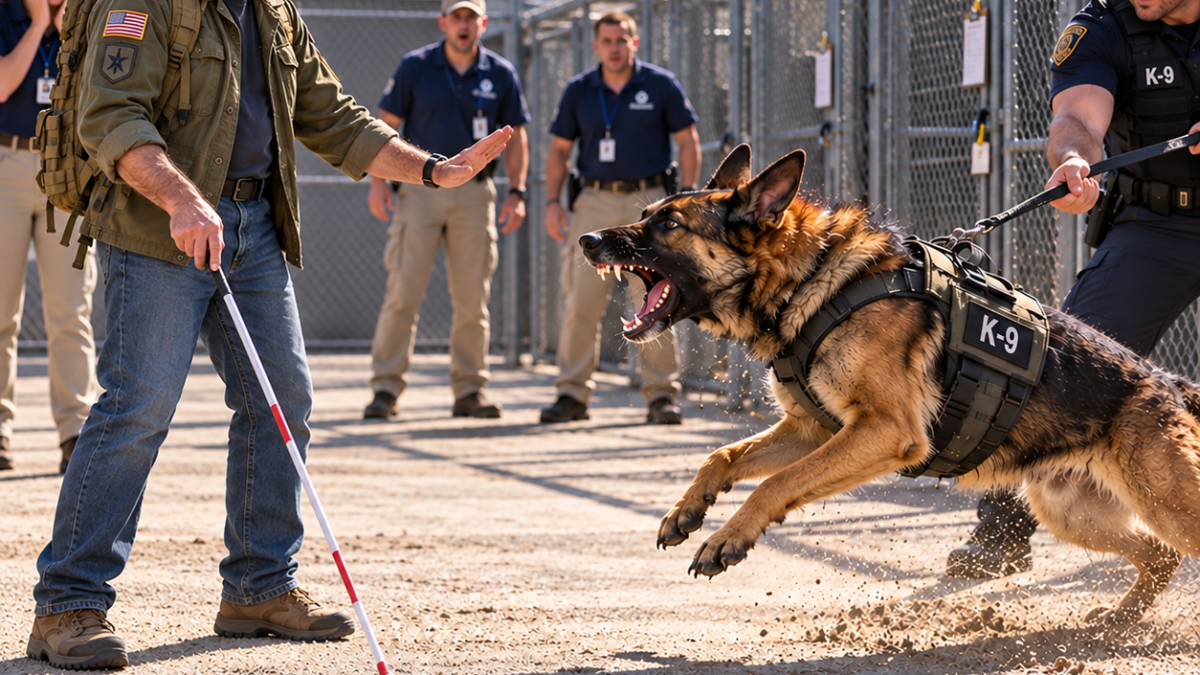
Instead, I stopped outside an isolation kennel holding Thor, a retired police German Shepherd who had injured two handlers after his partner died and whose file carried the words UNSUITABLE FOR ADOPTION in red.
Then Thor heard the tap of my white cane, stopped growling for the first time anyone could remember, and pressed his scarred muzzle against the bars as if he had finally found somebody who understood what it meant to survive an explosion and wake up in a different world.
My name is Ethan Walker.
I was thirty-nine years old the morning I met Thor.
For the previous three years, people had described me with the same word before they described almost anything else about me.
Blind.
Blind veteran.
Blind former Army sergeant.
Blind man.
Blind client.
Blind passenger.
Blind patient.
It was technically accurate.
I had no useful vision left.
But when one word appears often enough in front of your name, people eventually begin treating it like your entire biography.
Before the blindness, I had been Staff Sergeant Ethan Walker.
Eleven years Army.
Two deployments.
Infantry first.
Then reconnaissance.
I was the person younger soldiers came to when things stopped making sense.
I could read a terrain map in darkness.
Could tell the difference between distant outgoing artillery and incoming fire before some men realized there had been a sound.
I could enter an unfamiliar building and know where the exits were without consciously counting them.
Then one afternoon in Afghanistan, an explosive detonated beneath the lead vehicle in our convoy.
I remember light.
Not darkness.
Everyone assumes blindness arrived like a curtain.
Mine arrived as white.
A flash so violent that for several seconds I could see nothing except brightness.
Then pressure.
Heat.
Metal.
Someone screaming my name.
I woke in Germany three days later.
My eyes were wrapped.
My left cheek was stitched.
Three bones in my right hand were fractured.
PART2:
A surgeon stood beside my bed and explained retinal damage, optic nerve trauma, and words I understood individually but could not assemble into a future.
I asked:
“When can I see again?”
He became very quiet.
That was the moment I knew.
People imagine losing sight means learning to live without vision.
That is only the beginning.
You learn how much of your identity was built around being the person who noticed things first.
You learn how humiliating it feels when somebody grabs your elbow without asking.
You learn that strangers raise their voices when talking to you as if your ears disappeared with your eyes.
You learn doors can become arguments.
Stairs can become negotiations.
Grocery stores can become military operations.
You learn how often sighted people say things like “over there.”
Most of all, I learned that independence can disappear long before capability does.
My mother wanted me to live with her in Ohio.
My sister wanted me in North Carolina.
The VA wanted me in training.
Everybody wanted something because everybody was afraid.
I was afraid too.
I just preferred anger.
Anger sounded stronger.
PART3:
For three years I lived alone in a small house outside Richmond, Virginia.
I learned my routes.
Counted steps.
Used a cane.
Cooked.
Did laundry.
Took buses.
Worked part-time helping a veterans nonprofit evaluate emergency housing programs.
Technically, I was independent.
Emotionally, I had made my world about six blocks wide.
My mobility instructor knew.
Her name was Sandra Ruiz.
She had spent twenty years teaching people like me the difference between being able to move and actually living.
One afternoon, after I canceled a trip for the third time, she asked:
“Have you considered a dog?”
“No.”
“That was fast.”
“I have a cane.”
“A dog is different.”
“I don’t need different.”
“You’ve been walking the same six routes for eleven months.”
“They work.”
“So does a prison hallway.”
I disliked Sandra.
Which usually meant she was telling the truth.
She arranged an evaluation at Blue Ridge Working Dog Rehabilitation Center.
The facility did two things.
It helped transition retired police and military dogs.
And it worked with an accredited service-dog organization that occasionally assessed suitable dogs for veterans with mobility or psychiatric needs.
I was told clearly that a former police dog was rarely appropriate for guide work.
Different training.
Different drives.
Different histories.
I wasn’t going there to pick some heroic ex-K9.
I wanted boring.
Calm.
Predictable.
A Labrador, maybe.
Something that would not care about explosions, sirens, uniforms, or everything I was trying not to remember.
The morning I arrived, my cane tapped along polished concrete before anyone spoke.
Tap.
Sweep.
Tap.
Sweep.
My world had become sound and texture.
HVAC above me.
Hard walls on both sides.
Kennel disinfectant.
Wet fur.
Coffee somewhere to my right.
A printer.
Woman approaching in low heels.
“Mr. Walker?”
“Ethan.”
She stopped at a respectful distance.
“Ethan. I’m Karen Morales.”
Her voice was warm without being patronizing.
I liked her immediately.
“Placement coordinator.”
“Thank you for coming.”
“Thank Sandra.”
Karen laughed.
“She warned me you might say that.”
“That feels like a privacy violation.”
“She said you’d say that too.”
Maybe I disliked Sandra less than I thought.
Karen explained the process as we walked.
Several dogs had passed initial temperament screening.
Two Labradors.
One Golden Retriever mix.
A younger German Shepherd who had washed out of a mobility program because he was too environmentally distracted but might still work with an experienced handler.
“We’re not choosing today,” Karen said.
“Good.”
“We’re seeing how you respond to the dogs and how they respond to you.”
“I thought dogs didn’t fill out surveys.”
“Some are more honest than clients.”
We turned down another hallway.
The barking grew louder.
Different dogs.
Different sounds.
Excited.
Demanding.
Anxious.
High-pitched kennel frustration.
I had gotten good at listening to animals after blindness.
Not because blindness gave me supernatural hearing.
That’s another myth.
I simply paid attention.
When one source of information disappears, you learn not to waste the others.
I heard a dog throwing himself against a gate somewhere ahead.
Steel rattled.
Deep barking.
Then a growl low enough that I felt it through the rubber tip of my cane.
Karen stopped.
“Different direction.”
I turned my head.
Another impact.
“What is that?”
“Nothing you need to worry about.”
“That isn’t what I asked.”
She hesitated.
“His name is Thor.”
Another growl.
“What happened to him?”
“Ethan.”
“What happened?”
Karen exhaled.
“He’s a retired police K9.”
“What breed?”
“German Shepherd.”
“Age?”
“Nine.”
“Why isolation?”
Silence.
Then:
“He’s not part of the adoption program.”
“That still isn’t an answer.”
Karen lowered her voice.
“Thor worked with Officer Daniel Reeves for four years.”
“Tracking.”
“Narcotics.”
Explosive detection.”
“Apprehension.”
“One of the department’s best dogs.”
“And?”
“Daniel died during a warehouse raid last year.”
That explained the silence in her voice.
“What happened to Thor?”
“He survived.”
“That’s not what I asked.”
Karen was quiet for a second.
“When officers tried to remove him from Daniel’s body, Thor attacked them.”
Not surprising.
“Afterward?”
“He changed.”
“How?”
“He became difficult to handle.”
“Territorial.”
“Defensive.”
“He injured two staff members.”
“Nearly broke one handler’s arm during an evaluation.”
“Does he attack without warning?”
Karen paused.
“His file says unpredictable.”
I heard another growl.
Not frantic.
Rhythmic.
Pacing.
“What does your behaviorist say?”
“You ask very specific questions.”
“I spent a long time around working animals overseas.”
“Dogs?”
“Some.”
Another clang.
Karen said:
“Dr. Patel believes grief and trauma are involved.”
“But?”
“But grief does not make teeth less dangerous.”
Fair.
“What happens to him?”
“He has permanent sanctuary authorization here.”
“So they’re not euthanizing him.”
“The director has refused so far.”
“So far?”
“Insurance is asking questions.”
There it was.
Risk.
Records.
Liability.
Words that can decide a living thing’s future without ever entering the same room.
Karen touched my forearm lightly.
“Let’s keep going.”
I followed.
Three steps.
Four.
My cane touched a change in floor texture.
Then Thor stopped barking.
Completely.
I stopped too.
The sudden absence was louder than the noise.
Karen whispered:
“That’s strange.”
“What?”
“He’s standing at the gate.”
“How do you know?”
“I can see him.”
I waited.
Breathing.
Heavy.
Close.
I tapped my cane once.
Thor inhaled sharply.
The sound was distinct.
Not growling.
Scenting.
Then a whine.
Soft.
Broken.
Karen said:
“He hasn’t done that.”
“What?”
“That sound.”
I moved one step closer.
Karen caught my sleeve.
“Please don’t.”
“I’m not touching him.”
“He has gone through reinforced panels.”
“I heard.”
Thor’s claws clicked once.
Closer.
I could feel his breathing now.
Maybe four feet away behind steel.
I rested both hands on top of cane.
Didn’t face him directly.
Didn’t call him.
Didn’t reach.
Just stood.
The hallway filled with people.
I heard shoes.
Radios.
One man whispering:
“Get him back.”
Another:
“Thor.”
The dog did not react to them.
Only my cane.
Tap.
His breathing slowed.
I heard his nose against metal.
“Is he at the bars?”
Karen whispered:
“Yes.”
“What does he look like?”
She took a second.
“Confused.”
That interested me more than calm.
“Tail?”
“Low.”
“Ears?”
“Forward.”
“Teeth?”
“No.”
“Body?”
“Still tense.”
I nodded.
“He isn’t relaxed.”
“No.”
“He’s deciding.”
A male voice behind us said:
“Mr. Walker, I need you to step away.”
Older.
Authority.
“Who are you?”
“Martin Halverson.”
“Facility director.”
“Nice to meet you.”
“This is not a meet-and-greet.”
I smiled slightly.
“Apparently not.”
His shoes stopped beside Karen.
“Thor has a serious aggression history.”
“I heard.”
“You are here for service-dog evaluation.”
“Yes.”
“This animal is neither available nor appropriate.”
“Understood.”
“Then please step away.”
I did.
Immediately.
That surprised him.
I wasn’t trying to prove anything.
You don’t build trust by turning boundaries into theater.
The instant I moved, Thor whined again.
Then the kennel shook.
Once.
Karen inhaled.
Halverson said:
“Get him settled.”
Handlers moved.
Thor barked.
I continued walking with Karen.
But the sound followed me down the corridor.
Not rage.
Not exactly.
Something closer to panic.
We met the service dogs.
They were wonderful.
A yellow Lab named Cooper rested his chin on my knee.
A black Lab named Millie placed one paw on my shoe.
A Golden mix called Jasper retrieved my dropped glove before anyone asked him.
I liked them all.
None felt wrong.
But I kept listening toward the isolation wing.
Karen knew.
At lunch she asked:
“You’re thinking about Thor.”
“Yes.”
“You cannot use Thor as a guide dog.”
“I know.”
“He has no public-access reliability.”
“I know.”
“He’s trained for apprehension.”
“I know.”
“He has bite history.”
“Karen.”
She stopped.
“I know.”
“Then why?”
I ran my thumb across cane handle.
“Because everybody keeps telling me what he did.”
“Nobody has told me what happened before he did it.”
Karen went quiet.
The next morning, she called.
Not because Thor was suddenly available.
Because Dr. Maya Patel wanted to meet me.
She was veterinary behaviorist consulting on Thor’s case.
Forty-six.
Calm voice.
No dramatic conclusions.
I liked her.
She asked me to describe what I had heard.
Not what I believed.
That distinction mattered.
“Pacing before we approached.”
“Yes.”
“Barrier striking.”
“Yes.”
“Low growling.”
“Yes.”
“Then when my cane tapped, he stopped.”
“What next?”
“Inhale.”
“Then whining.”
“Then quiet.”
“Did you interpret that as recognition?”
“No.”
She sounded surprised.
“Why not?”
“He’d never met me.”
“Good.”
“What do you think it was?”
“I don’t know.”
“Maybe novelty.”
“Maybe cane sound resembled something.”
“Maybe my posture.”
“Maybe smell.”
“Maybe everyone else in that hall smelled nervous and I was too tired.”
She laughed.
“Excellent.”
“What?”
“You’re not romanticizing.”
“I don’t need another miracle story.”
Dr. Patel explained Thor’s history.
Daniel Reeves had been killed in an explosion during a warehouse operation.
Thor survived minor blast trauma.
When he regained orientation, Daniel was on ground.
Thor guarded him.
Officers attempted removal.
Thor bit one sleeve, then another officer’s forearm when they dragged him by collar.
Not ideal.
Understandable.
Back at department, Thor was rotated through three handlers in four months.
Every new handler tried to establish control.
Obedience corrections.
Forced kennel transfers.
Muzzle conditioning too quickly.
One incident happened when someone cornered him to remove Daniel’s old leather lead.
Another when a staff member grabbed his collar while he slept.
“Those are the attacks?”
“Two documented bites.”
“What did file call them?”
“Unprovoked aggression in one.”
I let out a breath.
“Was he asleep?”
“Yes.”
“That’s a provocation.”
“It doesn’t make bite acceptable.”
“No.”
“It makes it not random.”
Dr. Patel said:
“Exactly.”
“Why isolation?”
“He began guarding his kennel after repeated restraint.”
“Staff got afraid.”
“Then he sensed fear.”
“Cycle.”
“Yes.”
“Can he be rehabilitated?”
She paused.
“Maybe.”
“Can he safely live in a normal home?”
“I don’t know.”
“Could he ever be guide dog?”
“No.”
The answer was immediate.
Good.
“Not what he was trained for.”
“His protection history alone makes formal guide placement extremely unlikely.”
“Then why did you call me?”
“Because yesterday was first voluntary affiliative behavior we’ve seen from him in months.”
I sat back.
“You want to use me.”
“I want to understand what happened.”
Fair.
She continued:
“You would not enter his kennel.”
“You would not handle him.”
“We would work through barrier.”
“If Thor escalates, session ends.”
“No heroics.”
“Agreed.”
For the next week, I visited every afternoon.
I sat outside Thor’s isolation kennel.
Ten feet away first.
No commands.
No food.
No touching.
I talked.
Not about him.
About weather.
Traffic.
Bad coffee.
The Braves.
Things nobody cared about.
Thor paced.
Then stopped.
Sometimes he growled when handlers passed.
He never growled at my voice.
On day three, I placed cane flat on floor.
Thor lay down.
On day four, he slept.
That shocked staff more than anything.
Karen whispered:
“He never sleeps when visitors are here.”
“Maybe I’m boring.”
“Extremely.”
On day five, Dr. Patel asked if I would sit inside a double-gated assessment room while Thor was brought into opposite side on a long line.
No contact.
Handler retained line.
Exit open behind me.
I agreed.
Halverson did not.
“This is unnecessary.”
Dr. Patel responded:
“So is permanent isolation if we haven’t fully assessed alternatives.”
“He has attacked staff.”
“Which is why there are three safety layers.”
Halverson looked at me.
“And you accept risk?”
“I understand there is risk.”
“You cannot see his body language.”
“No.”
“That is significant.”
“Yes.”
I wasn’t offended.
It was true.
“So why do you believe this is reasonable?”
“I don’t.”
He paused.
I continued.
“I believe Dr. Patel believes it is reasonably controlled.”
“Different thing.”
Halverson stared.
Then nodded once.
At least we understood each other.
Assessment room smelled like rubber mat and disinfectant.
I sat in chair.
Hands on thighs.
Thor entered.
I knew because the room changed.
Nails.
Breathing.
Harness hardware.
Handler said:
“Easy.”
Thor growled once.
Not at me.
At leash pressure.
Dr. Patel:
“Give him slack.”
The line softened.
Growling stopped.
I turned face slightly away.
Thor circled.
Sniffed.
My boots.
Cane.
The old field jacket I wore when weather cooled.
He stopped there.
His nose pressed near sleeve.
He inhaled again and again.
Karen later told me his body started trembling.
I felt his breath against my hand.
I did not reach.
He moved closer.
Shoulder touched my knee.
Then his head settled against my thigh.
The room went silent.
I swallowed.
“Hey, Thor.”
His ears flicked.
I slowly lowered my hand.
Waited until he pushed upward.
Then touched side of neck.
He exhaled.
A sound almost like exhaustion.
Not surrender.
Not miracle.
A dog allowing contact.
That was enough.
Behind glass someone whispered:
“Oh my God.”
Dr. Patel immediately said:
“Don’t turn this into something it isn’t.”
I smiled.
I liked her even more.
Sessions continued.
Thor trusted me faster than he trusted anyone else.
That created a new problem.
He started guarding me.
If Karen approached too quickly, his body stiffened.
When a handler reached toward my shoulder, Thor stepped between us.
No bite.
But clear.
Dr. Patel ended session.
“This is not success.”
I nodded.
“I know.”
“He cannot replace Daniel with you and begin protecting you from world.”
“I know.”
“If this goes further, goal is not exclusive bond.”
“What is it?”
“Safety around relationship.”
That sentence stayed with me.
Safety around relationship.
Maybe humans needed that too.
We began transfer work.
Thor learned Karen could approach me.
First at fifteen feet.
Then ten.
Then five.
If he stayed relaxed, session ended.
No punishment.
No forced proximity.
I learned cues too.
His breathing changed before tension.
Nails stopped clicking.
Harness stopped moving.
Silence became information.
My blindness was not advantage.
But it made me listen closely.
Thor learned my cane.
My pace.
My voice.
I learned his exhale when he settled.
The tiny tongue click before he drank.
The way one rear paw scraped slightly because of an old injury.
Three weeks after first visit, I knew when Thor entered room without anyone telling me.
Karen said:
“You two are ridiculous.”
Dr. Patel corrected:
“They’re predictable.”
That was better.
Then the fire happened.
It was a Thursday afternoon.
Electrical fault in Wing C.
Later investigators determined an aging ventilation motor overheated near insulation above ceiling.
At first, nobody knew it was serious.
Alarm sounded.
Red strobes.
People moving.
Dogs barking.
A facility full of stressed animals became chaos in seconds.
Karen came into assessment room.
“We’re evacuating.”
I stood.
“Thor?”
“Handler has him.”
Then someone shouted from corridor:
“Isolation gate jammed!”
Everything changed.
Smoke entered ventilation system.
Thor was still in secured wing.
Two staff members tried to reach him.
Fire door had automatically closed.
Electronic kennel release failed with power interruption.
Karen grabbed my arm.
“Outside.”
“Where’s Thor?”
“Ethan.”
“Where?”
“Wing C.”
I pulled away.
“I’m not leaving.”
“Yes, you are.”
“Karen—”
“Firefighters are coming.”
Behind alarm, beneath barking, I heard Thor.
Three sharp barks.
Pause.
Three more.
He had never barked like that around me.
“That’s him.”
Karen said:
“I know.”
Smoke smell reached us.
A staff member ran past coughing.
“Secondary corridor clear!”
Another shouted:
“Fire team two minutes!”
Two minutes can be forever in smoke.
I moved toward Thor’s sound.
Karen blocked me.
“You cannot go in there.”
“Then somebody else go.”
“They’re trying.”
Thor barked again.
Closer than I expected.
The fire wasn’t between us yet.
The security door was.
A maintenance worker shouted:
“Manual latch from inside corridor!”
I heard metal.
Someone tried.
Cursed.
Heat was building.
I’m not proud of what I did next.
It wasn’t brave.
It was emotional.
I slipped around Karen when another employee grabbed extinguisher and entered the smoke-filled connector corridor.
She shouted my name.
I followed wall.
Cane sweeping.
Sprinklers came on.
Water struck tile.
Visibility meant nothing to me anyway.
But smoke meant everything.
I kept low because the staff member ahead told me to.
This wasn’t combat.
It wasn’t a rescue operation I was qualified for.
I was a blind man making a terrible decision because a dog I cared about was trapped.
That distinction matters.
“Thor!”
Bark.
I moved toward sound.
The maintenance worker found kennel control.
“Door’s warped!”
Thor hit gate from inside.
Metal shook.
I reached wall.
Found frame.
Worker shouted:
“Back!”
He pulled emergency release.
Nothing.
Again.
Thor struck gate.
Latch shifted.
“Again!”
The worker pulled.
Thor hit it.
The damaged latch gave.
Door opened.
Thor came out so fast he knocked me backward.
I hit floor.
His nose was everywhere.
Face.
Chest.
Hands.
Whining.
Alive.
I grabbed harness.
“Easy.”
Something crashed behind us.
Maintenance worker yelled:
“Move!”
I stood.
My cane was gone.
Thor pressed along left leg.
Karen’s voice somewhere beyond smoke:
“Ethan!”
I couldn’t tell direction.
Thor could.
He pulled once.
Stopped.
I put hand on harness.
Not trained guide handle.
Just strap.
“Find Karen.”
I don’t know whether he understood words.
He understood urgency.
Thor moved.
Slow enough that I could follow.
His body blocked me from a fallen chair.
He shifted around debris.
When I stumbled, he braced against leg.
The maintenance worker stayed behind us, hand on my shoulder.
That’s part later news stories often omitted.
Thor did not single-handedly carry a blind veteran through an inferno.
We moved together.
Dog.
Maintenance worker.
Me.
Firefighters met us near main corridor.
Fresh air hit.
Then outside.
I dropped to knees.
Coughed until ribs hurt.
Thor pressed against me.
A paramedic approached.
Thor stiffened.
I felt it immediately.
“Thor.”
His breathing stopped.
“She’s helping.”
Paramedic waited.
Good.
I placed her hand on my shoulder.
Thor sniffed.
Stayed.
That moment mattered almost as much as escape.
He let someone help me.
Not Daniel.
Not me alone.
Someone else.
Safety around relationship.
Karen reached us.
She was crying and angry.
“You idiot.”
“Fair.”
“You absolute idiot.”
“Still fair.”
She crouched.
Thor watched.
Then allowed her to touch my arm.
Karen started laughing through tears.
“You know what’s stupid?”
“What?”
“This is the best behavioral progress he’s ever made.”
I coughed.
“Please don’t put that in report.”
She did.
Thor had mild smoke exposure.
So did I.
Both spent several hours at different hospitals—me human, him veterinary emergency.
I hated separation.
So did he.
But Dr. Patel insisted.
“Your attachment cannot become dependency.”
I knew she was right.
When I visited two days later, Thor heard my cane in hallway.
One bark.
Then silence.
When kennel opened into controlled yard, he walked over.
Pressed forehead into my chest.
That was all.
No dramatic leap.
No miracle.
Just recognition.
Director Halverson came out.
I expected argument.
Instead he said:
“You should not have gone into that wing.”
“I know.”
“I mean it.”
“I know.”
“You could have died.”
“Yes.”
“So could staff member who followed you.”
“Yes.”
I had no defense.
He sat beside me.
After a while:
“Thor guided you out.”
“With help.”
“I know.”
He was silent.
Then:
“I’ve been reading his original incident reports.”
I turned toward him.
“And?”
“They’re incomplete.”
“How?”
“After Reeves died, first bite report says Thor attacked without warning.”
“Dr. Patel told me.”
“It doesn’t mention they used a catch pole to pull him off Daniel’s jacket.”
My jaw tightened.
“Second says handler injured during routine kennel transfer.”
“What actually happened?”
“They cornered him after he refused to leave blanket carrying Daniel’s scent.”
“Still dangerous.”
“Yes.”
Halverson surprised me.
“Dangerous doesn’t mean evil.”
“No.”
“And understandable doesn’t mean safe.”
“No.”
He exhaled.
“But permanent isolation may have been making him worse.”
That was the closest thing to apology he needed to give.
“What happens now?”
“Now?”
“Thor.”
“We reassess.”
“Not adopt?”
“Not yet.”
“Good.”
He sounded surprised.
“You agree?”
“I don’t want a fantasy.”
Halverson laughed once.
“Neither do I.”
Thor’s case reopened formally.
Not because he saved me from fire.
That mattered emotionally.
But one dramatic event does not erase bite history.
Dr. Patel assembled months of records.
Police department.
Veterinary files.
Training logs.
Video.
Staff statements.
Daniel Reeves’s widow, Rachel, agreed to speak.
She came carrying Thor’s old leather collar.
The moment he smelled it, he lay down.
Rachel cried.
I sat beside her but didn’t speak.
Eventually she said:
“Daniel loved that dog more than most people.”
“I believe it.”
“He slept beside Thor after bad calls.”
She laughed softly.
“Thor was supposed to protect Daniel.”
“Most nights Daniel said it was other way around.”
She touched collar.
“After Daniel died, everyone wanted Thor to get back to work.”
“They kept saying routine would help.”
“Maybe they were right for some dogs.”
“Not him.”
I asked:
“What was Daniel like?”
Rachel smiled.
“Annoying.”
Good answer.
“Patient?”
“With dogs.”
“Humans?”
“Not remotely.”
She told me Thor’s history.
Found abandoned as adolescent.
Police department selected him after rescue assessment because of strong search drive.
Daniel trained him.
Not through dominance.
Through repetition.
Games.
Trust.
Thor learned to work explosions, gunfire, crowds.
But warehouse blast that killed Daniel was different.
It wasn’t noise.
It was loss.
Dr. Patel concluded Thor’s aggression was strongly contextual.
Resource guarding around Daniel-associated objects.
Defensive responses to forced restraint.
Sleep startle.
Barrier frustration.
Protective attachment.
None made him safe automatically.
But none supported label “randomly aggressive.”
We built a plan.
I had to undergo evaluation too.
Home assessment.
Emergency backup handler.
Trainer visits.
Mobility specialist.
I laughed when Karen said:
“Thor isn’t only one with file.”
“What does mine say?”
“Stubborn.”
“That is medical diagnosis?”
“In your case.”
For six weeks, I visited.
Then supervised day trips.
Thor wore basket muzzle initially in public training.
He hated it.
Learned it predicted walks and chicken.
Eventually accepted.
He learned Karen could take leash from me.
Then Dr. Patel.
Then trainer named Miguel Santos.
Huge step.
He learned paramedics could approach if I was seated.
He learned somebody touching my cane wasn’t stealing it.
He learned a person standing close to me wasn’t threat.
I learned something harder.
Not every protective act was love.
Sometimes it was anxiety.
People romanticized Thor standing between me and others.
Dr. Patel didn’t.
“A dog deciding who can approach you is not service behavior.”
“It is risk.”
So we changed it.
When someone approached, Thor moved to my right side.
Sit.
Check me.
Then release.
Choice became command.
Anxiety became task.
That was how training helped him.
Not by erasing instinct.
By giving it a safer shape.
Three months after fire, Thor came home with me for a thirty-day foster trial.
The first night, he paced.
So did I.
He checked front door seventeen times.
I counted because I couldn’t sleep.
At two in morning I said:
“You know, you’re not very relaxing.”
He sighed.
Lay beside bed.
At 3:15, I woke from nightmare.
Explosion.
White light.
I sat up gasping.
Thor stood instantly.
Did not climb on me.
Did not bark.
He pressed shoulder against mattress.
Waited.
I put hand down.
Found fur.
Present.
Virginia.
Bedroom.
Thor.
Not Afghanistan.
My breathing slowed.
In morning, he followed me to kitchen.
I dropped spoon accidentally.
Thor flinched.
I froze.
Then we both stood there.
Two damaged nervous systems considering a spoon.
I laughed.
Thor sneezed.
I gave him chicken.
That became our life.
Not miraculous.
Routine.
Trainer three times a week.
Mobility instructor twice.
Thor was never certified as a traditional guide dog.
People asked constantly.
No.
His police background, protection training, age, and history made that inappropriate.
Instead he became something more specific.
An assistance companion trained around my established cane skills.
He learned to locate familiar doors.
Find empty chair.
Retrieve dropped cane.
Lead me toward Karen or another known person on command.
Interrupt panic.
Brace with body when I became disoriented.
At home he could guide me to back door during alarms.
In controlled environments, he learned obstacle indication.
But Sandra made one rule nonnegotiable.
“You keep using cane.”
“Why?”
“Because if Thor gets sick tomorrow, you still need your world.”
I hated it.
She was right.
Thor didn’t replace independence.
He expanded it.
That distinction mattered.
My world grew.
Six blocks became ten.
Then bus downtown.
Then farmers market.
First time crowd pressed around us, Thor became tense.
So did I.
We left.
Next week returned for ten minutes.
Then twenty.
Healing isn’t conquering.
It’s repetition without catastrophe.
Thor learned children weren’t threats.
Mostly.
He disliked toddlers running directly at his face.
Reasonable.
We kept distance.
He learned bicycles.
Elevators.
Coffee shops.
Fire sirens were hardest.
The first time an engine screamed past us, Thor dropped low.
I did too.
Different reasons.
We sat on sidewalk together.
No shame.
A woman asked if we needed help.
I said:
“Give us thirty seconds.”
She did.
Thirty seconds later, we stood.
Went home.
That was success.
Six months after fire, police department invited Thor back.
Not as operational dog.
Retirement recognition.
I almost declined.
Rachel asked me to go.
So we went.
Thor heard police radios.
Stiffened.
Then relaxed.
Old handlers lined up.
Some he tolerated.
Some he avoided.
Nobody forced.
Chief spoke about Daniel Reeves.
Four years service.
Lives found.
Suspects apprehended.
Explosives located.
Then he talked about year after Daniel.
He surprised me.
“We failed Thor for a while.”
The room became quiet.
“We saw behavior and forgot history.”
“We treated grief as disobedience.”
“We treated defensive responses as character.”
“We were responsible for public safety.”
“That responsibility was real.”
“But safety does not require us to stop asking why.”
I liked him for saying that.
Then he called Thor forward.
I rested hand against dog’s back.
Chief attached retirement medallion to collar.
Thor immediately shook.
Metal jingled.
Everybody laughed.
Rachel cried.
Then chief said:
“Thor saved one more life after retirement.”
I started to object.
He held hand.
“And I don’t only mean fire.”
That shut me up.
Later reporters asked the question I came to hate.
“Did you rescue Thor, or did Thor rescue you?”
People love symmetry.
I answered:
“Neither.”
Reporter looked disappointed.
“We helped each other.”
Less viral.
More true.
Thor didn’t cure blindness.
Didn’t cure PTSD.
Didn’t make grief disappear.
I didn’t cure his aggression.
Didn’t erase Daniel.
Didn’t turn him into a different dog.
We learned each other’s limits.
That’s less cinematic.
More valuable.
A year after adoption, I traveled alone for first time since injury.
Not truly alone.
Thor.
Cane.
Train to Washington.
Sandra made me plan routes.
Karen called twice.
I ignored second.
Union Station nearly overwhelmed both of us.
Announcements.
Rolling luggage.
Children.
Food smells.
Sirens outside.
Thor stopped.
I felt leash tension.
I said:
“Find wall.”
He moved.
We stood near wall.
Breathed.
Then continued.
Nobody applauded.
No one knew.
That was one of proudest days of my life.
Thor aged.
Gray muzzle.
Arthritis.
He retired from assistance tasks gradually.
By eleven, he no longer worked long routes.
I used cane more.
That was why Sandra insisted.
He became ordinary dog.
Which might have been greatest gift.
He slept in sun.
Stole socks.
Hated vacuum.
Loved peanut butter.
Barked at delivery trucks.
Wanted exact corner of couch.
Rachel visited every few months.
Thor always knew her.
Daniel remained part of him.
I never competed with dead man.
Another mistake people make with grief.
You don’t replace.
You add.
Thor’s loyalty to Daniel did not reduce what we had.
My memories of soldiers I lost did not make me incapable of new relationships.
Love isn’t room with one chair.
Years after fire, Karen asked:
“Do you remember first day?”
“I remember you trying to keep me away from him.”
“You’re welcome.”
“For what?”
“Excellent judgment.”
“You called him impossible.”
“I said dangerous.”
“Same thing.”
“No.”
She became serious.
“No, Ethan.”
“They aren’t same.”
I waited.
“Dangerous is a condition that requires responsibility.”
“Impossible is a conclusion.”
Fair.
Halverson retired.
Before he left, he gave me copy of Thor’s original red-tag file.
UNSUITABLE FOR ADOPTION.
Across it he had written:
REVISED AFTER FULL BEHAVIORAL REVIEW.
I asked:
“Why give this to me?”
He said:
“Because labels should be amendable.”
I kept it.
Not framed.
In drawer.
Thor died at twelve and a half.
Cancer.
Hemangiosarcoma.
Fast.
One week he was slower.
Next ultrasound.
Then decision.
I knew what prolonged fear looked like.
I wasn’t making him suffer because I couldn’t tolerate goodbye.
Rachel came.
Karen.
Dr. Patel.
Miguel.
Small group.
At home.
Thor lay beside my chair.
I had Daniel’s old leather collar in hand.
Rachel had given it to me years earlier.
I held it near Thor.
He sniffed.
Tail moved once.
“Daniel’s here too,” I said.
Maybe dogs don’t understand that sentence.
Maybe we say things for ourselves.
I touched his scarred head.
“You did enough.”
He exhaled.
I laughed through tears.
“Actually, you did too much.”
My cane rested beside chair.
The same tapping sound that stopped him first day.
I picked it up.
Tapped floor once.
Thor’s ear moved.
Once more.
He opened eyes.
I knelt.
Found his muzzle.
He pressed into palm.
Exactly as he had pressed against bars years earlier.
“Good boy.”
Medication made him sleepy.
Rachel held collar.
I held Thor.
Dr. Patel stayed with us.
His breathing slowed.
Then stopped.
The room became unbelievably quiet.
For first time in years, I hated silence.
Afterward I walked outside alone.
Cane.
No Thor.
Karen started toward me.
Sandra, who had come late, stopped her.
“Let him.”
She understood.
I walked to mailbox.
Back.
Maybe sixty yards.
Small.
Necessary.
That night, I left Thor’s bed where it was.
For months.
Eventually moved it.
Not because I was over him.
Because floor needed cleaning.
Grief and housekeeping coexist.
Life is rude like that.
People still tell Thor’s story occasionally.
“The dangerous police dog who chose a blind veteran.”
I understand why.
It’s a good headline.
But they usually get important part wrong.
Thor did not become gentle because he met me.
He was capable of gentleness all along.
The staff had simply stopped seeing situations where it could appear.
And I wasn’t brave because I entered a kennel.
Frankly, that first close session was carefully controlled and still probably more risk than most people should ever take.
I had professionals.
Barriers.
Behaviorist.
A plan.
What mattered was not that I ignored warnings.
It was that we replaced vague labels with specific questions.
When does he react?
What happened before?
What does his body do?
What was taken from him?
What does he protect?
What helps him recover?
Those questions changed Thor’s future.
They changed mine too.
When I lost my sight, I became “blind veteran.”
People stopped asking what else I was.
Thor became “dangerous dog.”
People stopped asking what else he was.
Maybe that is why I understood him.
Not mystical pain recognition.
Not souls speaking.
Labels had narrowed both of our worlds.
The work was widening them again.
One afternoon before Thor died, a little boy at park asked:
“Is he your seeing-eye dog?”
I said:
“No.”
The boy sounded confused.
“Then what does he do?”
I thought about it.
Thor lay beside my bench.
Old.
Gray.
Sleeping.
“He reminds me I can still go places.”
The boy accepted that.
Children sometimes handle truth better.
Thor never gave me sight back.
He gave me reasons not to wait for it.
That’s different.
After he died, I kept traveling.
That mattered.
I took train again.
Went to Colorado to visit sister.
Spoke at police K9 conference with Dr. Patel.
I hated stages.
Did it anyway.
Our presentation wasn’t titled Healing Through Love.
Thank God.
It was:
CONTEXTUAL AGGRESSION, HANDLER LOSS, AND POST-RETIREMENT TRANSITION IN WORKING DOGS.
Boring.
Perfect.
We showed anonymized timeline.
Handler death.
Forced separation.
Multiple transfers.
Defensive bites.
Barrier escalation.
Affiliative response under low-pressure exposure.
Gradual transfer of trust.
Structured placement.
No magic.
Just behavior, history, patience, safety.
At end, an officer asked:
“Would you adopt a dog like Thor again?”
I said:
“No.”
The room laughed.
I waited.
“Not casually.”
They quieted.
“Thor required resources.”
“Professionals.”
“Time.”
“Backup handling.”
“Management.”
“Most homes couldn’t safely provide that.”
“Love was not enough.”
“Love made me willing to do work.”
“The work made placement possible.”
Dr. Patel smiled.
That was answer she wanted.
Another officer asked:
“Then what should we learn?”
I held cane.
“Don’t confuse difficult with disposable.”
That’s it.
Thor was dangerous in certain circumstances.
Pretending otherwise would have been disrespectful to people he hurt.
He was also grieving.
Trainable.
Affectionate.
Capable of new bonds.
Capable of recovery.
Those truths can coexist.
Humans love simple categories because complexity requires responsibility.
Good dog.
Bad dog.
Hero.
Monster.
Disabled.
Capable.
Broken.
Recovered.
Thor and I lived in between.
Most people do.
I still pass Blue Ridge occasionally.
Karen is director now.
She tells new staff about “the cane incident.”
I tell her to stop.
She doesn’t.
The isolation wing was rebuilt after fire.
Better sprinklers.
Manual releases accessible from both sides.
Smoke barriers improved.
Emergency animal evacuation protocols changed.
That matters more to me than plaque.
They put one up anyway.
For Thor.
It reads:
THOR
K9 UNIT 7
PARTNER • SURVIVOR • TEACHER
No “hero.”
I requested that.
Hero is what he did sometimes.
Survivor is what he had to keep doing.
Teacher is what remained.
I visit plaque once a year.
Tap cane twice against floor.
For myself.
Not because I think Thor hears.
I’m not that sentimental.
Maybe a little.
First tap reminds me of man who walked into building wanting easiest dog available.
Second reminds me of dog who had every reason to distrust footsteps coming toward cage.
Neither of us got easy.
We got honest.
That’s better.
The day I met Thor, Karen told me they had calm, trained dogs ready for pairing.
She was right.
Those dogs deserved homes.
Many found them.
I could have gone home with Labrador eventually and probably lived good life.
Maybe safer one.
Instead, I stopped outside kennel because something in Thor’s growl sounded familiar.
Not because grief is magical language.
Because pain has patterns.
Guarding.
Withdrawal.
Anger.
Hypervigilance.
The belief that if you never relax, maybe nothing else will be taken.
I knew that pattern.
I lived it.
Thor heard cane.
I heard dog.
Both paused.
That was all at first.
One pause.
Then another.
A head near bars.
A hand kept still.
A relationship built so slowly that people looking for miracle would have been bored.
Then fire came.
We survived.
Then real work began.
Months of learning that closeness did not require guarding.
That help did not equal threat.
That independence didn’t mean isolation.
That losing one person didn’t forbid trusting another.
Thor learned those things.
So did I.
When people ask what shocked everyone that first day, they expect me to say the dangerous dog suddenly became gentle.
That’s not what happened.
Thor didn’t become anything.
For a few seconds, he stopped performing the behavior everyone expected from him.
He listened.
He sniffed.
He decided not to attack.
Then he whined.
That tiny sound changed the room because it reminded everyone behind those steel bars was not a monster.
There was a dog.
A grieving one.
A dangerous one.
A frightened one.
A good one.
All at once.
And on other side stood not a blind veteran looking for salvation.
Just a man holding a white cane.
Listening back.



