A Barefoot Boy Asked If He Could Heal My Paralyzed Legs—Then His Touch Made Me Stand and the Watch in His Hand Revealed My Family’s Darkest Secret.
PART3;
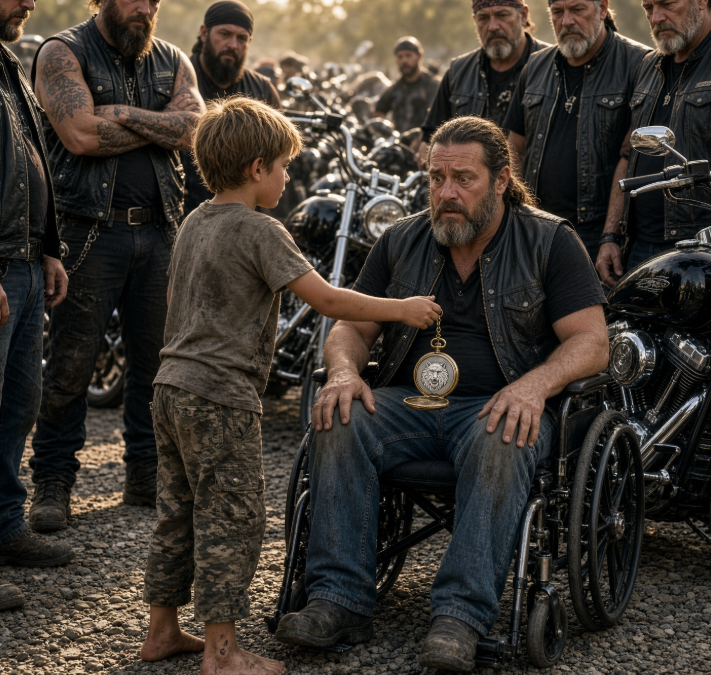
“If you make me walk,” I said, playing along because sometimes cruelty comes disguised as amusement, “I’ll give you a million dollars.”
The men laughed then.
Not loud enough to be vicious.
Loud enough to remind the boy he was surrounded by grown men who thought his miracle was a joke.
He did not laugh.
He only stepped closer.
Mack stiffened.
“Jack.”
I should have stopped it there.
I should have asked where his parents were.
I should have gotten him food, water, shoes, a blanket.
But something in his face held me still.
“Trust me,” he whispered.
Before anyone could stop him, he placed both bruised hands over my knees.
I expected nothing.
Maybe a child’s warm palms.
Maybe an awkward silence.
Maybe the bitterness that always came when someone reminded me, even accidentally, that my legs were still attached but no longer mine.
Instead, heat exploded through them.
Not warmth.
Not pressure.
Heat.
It tore through the dead places like fire poured through old wires. My hands clamped around the wheelchair arms. My breath vanished. The world narrowed to one impossible sensation rushing upward from my knees into my thighs, burning through muscles that had slept for two years, slamming into the broken place in my spine with such force that a sound ripped out of me before I knew I had made it.
The laughter stopped.
Someone dropped a bottle.
The boy’s hands trembled, but he did not pull away.
My right foot moved.
Just once.
A small shift inside my boot.
Nothing dramatic.
Nothing holy with light pouring from the clouds.
Just the toe of my boot moving half an inch in gravel.
But fifty hardened bikers saw it.
And every man there went silent.
I stared at my boot.
My heart slammed so hard I thought it might break a rib.
I tried again.
The foot moved.
Then the left.
A sharp breath came from somewhere behind me.
Mack whispered, “Jesus Christ.”
“What did you do to me?” I said.
The boy stepped back, still clutching the pocket watch.
I gripped the wheelchair and pushed.
At first, my body did not believe in itself.
My arms shook. My shoulders locked. My legs trembled beneath me like new beams taking weight in an old house. Pain came next, hard and bright, but pain meant sensation, and sensation meant something I had stopped asking heaven for.
I rose inch by inch.
The chair creaked beneath my shifting weight.
Men backed away, not from fear but from awe.
My knees wobbled.
My spine burned.
Then my hands left the chair.
For the first time in two years, I stood beside my Harley.
No one cheered.
Not at first.
Some miracles are too large for noise.
Mack covered his mouth with one hand. Big Ray, who had once stitched his own arm closed after a knife fight, had tears standing in his eyes. A prospect named Tyler crossed himself. I heard somebody say my name like a prayer.
I took one step.
Almost fell.
Mack lunged forward, but I waved him off.
Another step.
Then another.
Three steps away from the wheelchair.
Three steps toward the motorcycle I thought I would never ride again.
The sound that finally rose from the Iron Wolves was not cheering. It was something deeper, rougher, a roar that came from men who had seen death, prison, betrayal, and loss, but had never seen their president stand up from a chair every doctor said would hold him for life.
But I was not looking at them anymore.
I was looking at the object in the boy’s hand.
The pocket watch had fallen open.
Inside the gold cover, beneath the cracked glass, was an engraving.
A silver wolf crest.
Not just any wolf.
My wolf.
Our wolf.
The original Iron Wolves crest, designed before the club became a club, back when my father and three men met in a mechanic’s garage with more pride than money. I knew every line of it. The snarling mouth. The slanted eye. The jagged scar over the muzzle that my father insisted symbolized loyalty surviving violence.
Only two pocket watches bearing that exact crest had ever existed.
My father commissioned them when the Iron Wolves were founded.
One had passed to me after his death and now sat locked in my safe beneath the clubhouse office.
The other had disappeared twenty years ago with my younger sister, Mara.
My legs nearly gave out.
Mack grabbed my arm this time, and I let him.
“Where did you get that?” I asked.
The boy’s calm expression finally cracked.
For the first time since he walked through the rally, he looked like a child.
Scared.
Exhausted.
Alone.
He looked down at the watch, then at the wolves on our vests, then at the tattoo showing through the open collar of my shirt.
“My mother gave it to me,” he whispered. “She said if I ever found the man with the same wolf on his chest, I should tell him she’s still alive.”
The world went cold around me.
The fire barrels.
The lights.
The music.
The engines.
All of it seemed to fall away.
“What’s your mother’s name?” I asked, though I already knew what answer would split me open.
His fingers tightened around the watch.
“Mara,” he said. “Mara Vale Mercer.”
The name hit me harder than the miracle.
I did not fall because Mack held me upright.
For twenty years, my family had carried Mara like a wound that refused to close.
She had vanished at nineteen.
Not run away, my father said.
Taken.
Maybe dead.
Maybe trafficked.
Maybe murdered by enemies who hated the Iron Wolves. My father had spent years pretending to search while becoming quieter and harder with every passing month. He warned me never to trust cops, never to trust outsiders, never to let Mara’s name be used by anyone trying to weaken the club.
When he died, he left behind money, property, enemies, and one instruction written in his final letter to me.
Protect the club. Do not dig up old graves.
I thought he meant the past was painful.
I never imagined he meant it was buried alive.
The boy swayed where he stood.
I caught him before he hit the gravel.
The movement happened without thought. One second he was upright. The next, his eyes rolled back and his knees folded. I stepped forward, legs screaming, and grabbed him beneath the arms.
For one wild second, the entire club froze again—not because the boy collapsed, but because I had moved fast enough to catch him.
Then everything erupted.
“Get water!”
“Move back!”
“Call Doc!”
“Give him air!”
I lowered the boy carefully to the ground. His head lolled against my arm. He weighed almost nothing.
“What’s your name?” I asked.
His eyes fluttered.
“Eli.”
“Eli what?”
“Eli Mercer,” he whispered.
A sound moved through the Wolves, low and dangerous.
I looked up.
Every man there understood what that name meant.
If this boy was Mara’s son, he was blood.
Mine.
The club’s.
And somebody had sent him to us barefoot, bruised, starving, and terrified.
Mack crouched beside me.
“Jack, we need to get him inside.”
I nodded.
My legs trembled violently now. Whatever miracle Eli had given me had not made me strong. It had made me possible. There was a difference. Mack saw it and slid one arm under mine before pride could refuse help.
“I’ve got you,” he said quietly.
“I’m standing.”
“You’re shaking.”
“I’m standing.”
“Then stand while letting me help you.”
I almost smiled.
Almost.
We carried Eli into the clubhouse office, away from the rally and the stunned faces. Rosa, who ran the kitchen and had patched up more Wolves than most emergency rooms, arrived with blankets, water, and a look sharp enough to cut through panic.
She checked Eli’s pulse, his pupils, the bruises on his hands, the cuts on his feet.
“Who did this to him?” she asked.
No one answered.
That made the room colder.
Eli woke twenty minutes later on the leather couch in my office, wrapped in one of my old club hoodies, sipping water from a straw. He flinched when the door opened until he saw it was only Rosa with soup.
I sat in my wheelchair across from him.
Not because I could not stand.
Because my legs were done pretending they had returned from the dead without consequences.
The pain was deep now, muscular, electric, alive. I welcomed every bit of it and hated it at the same time.
Mack stood behind me near the wall. Ray, my vice president, guarded the door. Dana Whitlock, a county child welfare supervisor who had arrived after one of the Wolves called her directly, sat near the desk with a notebook in her lap.
Dana was not easily intimidated. She was Black, mid-forties, hair cut short, eyes steady behind square glasses, wearing slacks and a gray blazer that looked wildly out of place in a biker clubhouse. She had walked through fifty armed bikers as if entering a school board meeting.
When she saw Eli, her professional face cracked for half a second.
Then it returned.
“Eli,” she said gently, “my name is Dana. I help make sure kids are safe. Nobody here is going to hurt you.”
Eli looked at me, not her.
“I told you what she said.”
“I know,” I said.
“I found you.”
“You did.”
His small shoulders loosened a little, as if completing the mission mattered more than his own body.
I leaned forward.
“Where is Mara?”
He looked down at the pocket watch in his lap.
“She told me not to say until you believed me.”
“I believe you.”
He studied my face.
Children who have been lied to learn to inspect belief carefully.
“She said belief is easy when people want miracles. Hard when they have to give up lies.”
Dana glanced at me.
Mack muttered, “Sounds like Mara.”
It did.
That was the first thing that nearly broke me.
My sister had been stubborn, sharp-tongued, impossible to intimidate. At nineteen, she could reduce grown men to silence with one eyebrow. She had hated club politics, hated my father’s temper, hated how everyone treated the Mercers like royalty and prisoners at the same time.
She used to tell me, “Jack, this family doesn’t keep secrets. It keeps weapons.”
I thought that was teenage drama.
Now her son sat in my office holding a missing family watch and repeating sentences only she would craft.
Eli reached into the pocket of the hoodie and pulled out a folded photograph sealed in a plastic sandwich bag.
His hands shook as he gave it to me.
The photograph was old, creased, worn soft at the corners.
Three people stood outside a pale stone building.
My father, William Mercer, younger and broader, one arm around a woman I did not know at first because memory had made her face softer than any photograph could.
My mother.
Margaret Mercer.
Beside her stood a man with dark hair and a careful smile.
Thomas Vale.
The club treasurer who had supposedly stolen from the Iron Wolves and vanished before I was old enough to ask questions properly.
On the back, Mara had written in black ink.
Jack, come alone if you can. Come with someone you trust if you cannot. But come before she loses the courage to tell us why our father lied.
Beneath that was an address.
Bell’s Ridge.
Saint Agnes.
My fingers tightened on the photograph.
My mother had died when I was ten.
At least, that was what my father always told me.
I remembered lavender lotion. A wool blanket during thunderstorms. Her humming in the kitchen. A hospital bed. Flowers. Men from the club standing in a line outside a church. My father holding my hand so tightly my fingers hurt.
But I did not remember a grave.
The realization moved through me slowly, like poison entering water.
Dana read my face.
“What is Saint Agnes?”
I could barely answer.
“I don’t know.”
She took out her phone and searched public records.
“Saint Agnes Residential Care Facility,” she said after a moment. “Closed in 2011. It served women with long-term illnesses and neurological conditions.”
“My mother was never there.”
The certainty sounded strange even to me.
I had been a child.
Children believe what they are told because survival depends on it.
Eli watched me.
“My mother said Evelyn lives in the house behind the chapel.”
“Who’s Evelyn?”
“Evelyn Hart. She said Evelyn knows why your mother went away.”
My mouth went dry.
“What exactly did Mara say about my mother?”
Eli frowned in concentration.
Not guessing.
Remembering.
“She said your mother was part of the secret,” he said. “But she didn’t say she was bad.”
The distinction mattered more than it should have.
Mack shifted behind me.
“We’re going.”
Dana immediately said, “Not without planning.”
I looked at her.
“My sister may be alive.”
“And you stood for the first time in two years less than an hour ago. This child is injured. We don’t know who hurt him. We don’t know whether the address is safe.”
“I’m going.”
“Yes,” she said. “With me. With Mack driving. With Eli staying here under supervision until we know more.”
Eli sat up.
“No. My mother told me not to let him go alone.”
I looked at him.
“You found me. You did your part.”
He reached into the hoodie again and pulled out another folded paper.
This one had only three lines.
He may doubt everything else. He will not doubt the boy. If he tries to leave you behind, remind him that I know him better than he knows himself. And do not let him go alone.
Despite everything, a weak laugh escaped me.
“That sounds like her.”
Eli’s eyes searched my face.
“Are you angry?”
“At your mother?”
“At me.”
The question hurt because it was so direct.
“No,” I said. “I’m angry at myself.”
“For what?”
“For believing the easiest version of the story.”
He seemed to accept that.
But Dana did not bend.
In the end, we compromised in the way adults often do when a child has already carried more than any adult should have allowed. Eli would stay at the clubhouse with Rosa, Ray, and Dana’s colleague, a woman named Lenora who arrived within the hour. Two prospects would guard the building. No visitors. No drinking. No rally nonsense.
Before we left, Eli grabbed my hand.
His palm was too warm.
Or mine was too cold.
“Will you come back?”
“Yes.”
“You promise?”
I had spent my life treating promises as things men made before they understood the cost of keeping them.
But this one did not feel difficult.
“I promise.”
We left just after nine.
Mack drove his black pickup. Dana sat beside him with county documents on her lap. I sat in the back, legs stretched carefully across the bench, the pocket watch in my hand and the photograph on my knee.
The highway out of Nashville opened beneath a cloudless sky.
No one spoke for the first half hour.
My body ached in places that had not ached in years. My thighs spasmed. My calves twitched. My spine felt like someone had threaded burning wire through it. Every sensation was a miracle and a punishment.
I welcomed them all.
Dana finally said, “Did your father ever mention Saint Agnes?”
“No.”
“Did Mara?”
“She knew more than I did.”
“That doesn’t answer the question.”
I looked out the window.
“She probably knew enough to make him nervous.”
Mack’s hands tightened on the wheel.
“You really think William lied about your mother?”
“I don’t know what I think.”
“That’s a first.”
“I’m trying something new.”
Dana glanced back at me.
“You don’t have to solve your entire past tonight.”
“I’m not trying to solve it.”
“What are you trying to do?”
“Find my sister.”
The answer silenced us.
Bell’s Ridge was smaller than I remembered, a town folded around a courthouse square with brick storefronts, old trees, and flags hanging from lampposts. At night, it looked like the kind of place where secrets could survive for generations because everyone knew enough to stop asking.
Saint Agnes stood beyond town at the edge of a wooded rise.
The building was larger than I expected. Pale stone walls weather-stained. Several windows boarded over. A narrow chapel behind it, partly hidden by weeds. One house sat beyond the chapel, white siding, green shutters, porch light glowing.
Mack parked beside the chapel.
Dana stayed near the truck.
“I’m notifying the sheriff’s office we’re here,” she said. “Quietly.”
Mack frowned.
“You think we need that?”
“I think secrets this old usually have caretakers.”
She was right.
I hated that she was right.
I stepped out of the truck.
My legs held.
Barely.
Mack came around.
“You want me beside you?”
I looked at the little house behind the chapel.
Mara had told me to come with someone I trusted if I could not come alone.
“I want you beside me.”
We walked up the path.
The night smelled of damp earth and pine. Wind moved behind the chapel with a low restless sound. Each step required concentration. Heel. Weight. Balance. Pain. Again.
By the time we reached the porch, sweat had gathered at the back of my neck.
I knocked.
No answer.
I knocked again.
A woman’s voice called from inside.
“Who is it?”
“My name is Jack Mercer.”
The silence that followed seemed to reach through the door.
Then locks turned.
The woman who opened it was perhaps in her late seventies. Silver hair braided over one shoulder. Blue cardigan. White blouse. One hand on a polished wooden cane.
Her eyes went immediately to the watch in my hand.
Then to my face.
“Oh,” she whispered.
I knew that expression.
It was the look people gave when they saw someone who belonged to a memory they had kept alive too long.
“Are you Evelyn Hart?”
“Yes.”
“Did you know my sister?”
Her fingers tightened around the cane.
“I knew Mara.”
“Where is she?”
Evelyn looked past me toward the dark road.
“She came here three days ago. She left before dawn the following morning.”
“Where did she go?”
“I don’t know.”
The answer came too quickly.
“You gave her this photograph.”
“Yes.”
“You told her about my mother.”
Her gaze settled on me again.
“She told you.”
“She left a message.”
“Then she believed you were ready.”
“Ready for what?”
Evelyn opened the door wider.
“You should come inside.”
Mack moved slightly closer.
Evelyn noticed.
“Your friend may come too. I am not asking either of you to trust me. I am asking you to listen.”
The sitting room was warm from a gas fireplace and crowded with framed photographs. Women stood outside Saint Agnes over the decades. Nurses. Residents. Families. Some smiled stiffly. Some looked away from the camera like they already knew being recorded could be dangerous.
Evelyn locked the door behind us.
Not hurriedly.
Habitually.
I saw the same caution in the way Mara wrote her notes.
“Why did my father say my mother died here?” I asked.
Evelyn crossed to a cabinet and removed a small wooden box.
“Your mother’s name was Margaret Vale before she married William Mercer.”
For one breath, the name meant nothing.
Then the room tilted.
“Vale?” Mack said.
“Thomas Vale’s family?” I asked.
Evelyn nodded.
My hand found the back of a chair.
Thomas Vale.
My father’s old friend.
The club treasurer accused of stealing from us before disappearing.
The man in the photograph.
“My mother was his sister?”
“His younger sister.”
I tried to force that into the shape of my childhood.
My father had married the sister of the man he later accused of betrayal.
“Why hide it?”
“Because Thomas did not steal from the Iron Wolves,” Evelyn said. “He discovered someone else had been using club accounts to move money through shell companies. He was going to expose them.”
“Who?”
Evelyn lowered her eyes.
“Your father.”
The words should have exploded.
Instead, they landed with a dull, devastating weight.
Mack swore under his breath.
“That doesn’t make sense,” I said. “My father built the club.”
“He built the public version of it.”
“What does that mean?”
Evelyn placed the box on the table but did not open it.
“Thomas found financial records showing William had been helping a private security firm move money through club-owned businesses. The firm claimed it was legitimate consulting work. Thomas believed some contracts were connected to people who wanted information about witnesses and families under protection.”
I stared at her.
“That sounds like a conspiracy.”
“It sounds like one because your father made certain no one could prove it.”
“My father wasn’t involved in anything like that.”
“I didn’t say he began it.”
“Then what are you saying?”
“That he was afraid,” she said. “Afraid of losing the club. Afraid of being exposed. Afraid of what would happen to his family if the men behind those contracts learned Thomas had spoken.”
She opened the box.
Inside were letters tied with faded blue ribbon, a black-and-white photograph, and a medical file bearing my mother’s name.
My pulse began to pound.
“Your mother learned the truth after Thomas disappeared,” Evelyn said. “She came to Saint Agnes because she was afraid someone was following her. She was not ill when she arrived. She was exhausted, frightened, and pregnant.”
I could not breathe.
Mack looked at me.
“Pregnant with whom?” I asked.
Evelyn’s eyes filled with sorrow.
“With Mara.”
The room lost all sound.
Mara had been my sister.
That I knew.
But my mother had been alive when Mara was born.
She had not died when I was ten.
She had not even died when Mara disappeared.
“What happened to her?”
Evelyn touched the medical file.
“Your father found her here. He told her he would take you away from her if she refused to cooperate. He told her Thomas had left town and that no one would believe her accusations. Margaret agreed to return home, but only after he promised Mara would be protected.”
“Protected from what?”
Evelyn looked toward the dark window.
“From the person who had been watching your family since Thomas vanished.”
A floorboard creaked in the hallway.
Mack turned.
Evelyn went still.
I heard it again.
Soft.
Deliberate.
Followed by the faint scrape of something against the outside wall.
“Is someone here?” I asked.
Evelyn’s face had gone pale.
She reached into the box and pulled out another photograph. On the back, beneath an older image of Thomas Vale standing beside my father, someone had written a name.
Not Mara’s.
Not my mother’s.
A name I had heard only once before, spoken by my father during the final argument we ever had.
Silas Crowne.
Evelyn held the photograph toward me.
“Your father did not abandon Thomas,” she said. “Thomas came back.”
Outside, a vehicle door closed.
Evelyn leaned closer, her voice barely audible.
“And the man who brought him back is the reason Mara is missing now.”
The porch exploded inward.
Not literally.
No fire, no cinematic blast.
Just a boot against old wood, a lock splintering, and the sudden violent arrival of men who had done this kind of work before.
Mack moved first.
He shoved me sideways behind the heavy armchair as the door crashed open. Evelyn cried out and dropped her cane. Two men entered in dark jackets, faces partly covered, weapons low but ready. They expected an old woman. Maybe Mara. Maybe documents.
They did not expect Mack Delaney.
Mack hit the first man like a truck leaving a tunnel.
The man slammed into the wall, framed photographs shattering around him. The second raised his weapon, but I grabbed the fireplace poker and swung from the floor with everything my waking nerves could give me. The iron connected with his knee. He went down hard, cursing.
Pain tore through my legs as I pushed upright.
Not graceful.
Not strong.
But upright.
The man on the floor stared at me for half a second too long, as if a cripple standing was not in his plan.
That was his mistake.
Mack finished him.
Dana’s voice shouted from outside.
“Sheriff’s office is en route! Drop the weapon!”
More movement outside.
Tires on gravel.
Men shouting.
A gunshot cracked through the night, then another, from somewhere near the chapel.
Evelyn reached for the wooden box with shaking hands.
“The letters,” she said. “Don’t let them take the letters.”
I grabbed the box.
Mack dragged one attacker away from the door and kicked the weapon beneath the couch.
“Jack, move!”
We went out the back.
Evelyn knew the house better than anyone. She pressed a hidden latch behind a bookcase and opened a narrow rear exit into a covered walkway leading toward the chapel. Dana appeared there, phone in one hand, pistol in the other.
I stared at the gun.
She gave me a sharp look.
“County supervisors do home visits in rural Tennessee. You think I carry a clipboard and prayers?”
Mack barked a laugh despite everything.
We moved toward the chapel as headlights cut through the trees. A black SUV blocked the drive. Another vehicle sat near the old Saint Agnes building.
Evelyn stopped.
“That car,” she whispered.
“What?”
“That’s his.”
“Silas?”
She nodded.
The name moved through me like old smoke.
Silas Crowne had been a private security contractor with government friends, my father once said. A man who smiled like a preacher and cleaned up problems like a butcher. I was seventeen when I overheard his name during a fight between my father and Mara.
“He owns you,” Mara had shouted.
My father had slapped her.
I had stepped between them.
It was the only time I ever came close to hitting my father.
He told me later Mara was emotional, dramatic, poisoned by lies from people who wanted to destroy our family.
I believed him because sons often choose fathers over truth when the truth asks too much.
A tall figure stepped from the black SUV.
Even in the dark, I knew him.
Not from memory.
From the way every other man shifted when he appeared.
Power has a posture.
Silas Crowne wore a dark overcoat and no mask. His hair was white now, his face lined, but he moved with calm possession, as if the night itself belonged to him.
“Evelyn,” he called. “You should have let old ghosts stay quiet.”
Mack raised his gun.
Silas smiled.
“Careful. There are deputies on the way. You really want them finding biker guns at a closed care facility after shots were fired?”
Dana stepped forward.
“They’re also going to find armed men who forced entry into a residence.”
Silas looked at her, then at me.
“Jack Mercer,” he said. “You look more like your mother than your father.”
My hand tightened around the box.
“Where is Mara?”
Silas sighed, almost sadly.
“That woman has caused more trouble than she was ever worth.”
I took a step toward him.
My legs nearly buckled.
Mack caught my elbow.
Silas noticed.
“So the boy did find you.”
The world narrowed.
“You know Eli?”
“I know what he can do.” Silas’s smile thinned. “Your sister should have kept him hidden better.”
Dana’s voice went cold.
“You’re admitting knowledge of a missing child’s mother and a child who arrived injured?”
He glanced at her.
“I’m admitting nothing. I’m simply observing that extraordinary children attract dangerous attention.”
A siren wailed in the distance.
Silas heard it too.
His expression changed, not fear, exactly.
Calculation.
“This is not over,” he said.
“It is for two of your men inside,” Mack replied.
Silas looked at me one last time.
“Ask Evelyn what your mother traded for your life. Ask her why Mara ran. Ask her why Thomas begged your father for death.”
Then he got into the SUV.
His men withdrew fast, too fast for the approaching deputies to catch them cleanly. By the time the first cruiser skidded into the drive, the black SUV was already gone down the back road.
The deputies found enough to make reports.
Broken door.
Weapons.
Two injured men in the sitting room, both refusing to talk.
Evelyn’s statement.
Dana’s call log.
Our presence.
The box of documents.
But Silas Crowne vanished into the night like a man who had practiced disappearing for decades.
We returned to the clubhouse near dawn.
My legs gave out halfway through the door.
This time, I did not resist the wheelchair.
Eli was asleep in the upstairs room, curled beneath a blanket with the pocket watch clutched in one hand. Rosa sat nearby reading a paperback she had not turned a page of in hours.
When she saw me, she stood.
“Well?”
I looked at the sleeping boy.
“We found the beginning.”
Her face softened.
“That bad?”
“Worse.”
I slept for two hours and woke to sunlight cutting across my office floor, my body aching as if every nerve had been dug up and reburied incorrectly.
Mack sat in the chair across from me, reading one of the letters from Evelyn’s box.
His face was gray.
“What?” I asked.
He handed it to me.
The letter was from Thomas Vale to my mother.
Margaret, if William tells you I betrayed the club, do not believe him. If he tells you I ran, do not believe him. I found the accounts. I found Crowne’s payments. I found the names. William says he can control it, but men like Crowne are never controlled. If anything happens to me, take Jack and leave. Do not let our family become collateral.
I read it twice.
Then again.
The handwriting blurred.
For my entire life, Thomas Vale had been a cautionary tale.
Greed.
Betrayal.
The man who stole from the Wolves.
The reason my father trusted almost no one.
Now he was a man who had tried to warn my mother.
A man my father buried under a lie.
Dana arrived with coffee and bad news.
“The men from Evelyn’s house lawyered up before sunrise. Local sheriff knows one as private security. No direct tie to Silas yet.”
“There will be,” I said.
“Maybe. But maybe not fast enough.”
Mack leaned back.
“What about Mara?”
Dana looked at Eli’s closed door.
“I think Eli is the key.”
“No,” I said immediately.
“I don’t mean use him. I mean listen to him. Mara sent him because she knew you would believe him. She also knew whoever is chasing her might follow.”
“She sent her injured son into a biker rally alone.”
Dana’s expression hardened.
“She sent her son to the only man she thought could protect him.”
That shut me up.
Eli woke an hour later.
He ate pancakes like someone who had forgotten food could be warm. Rosa fussed over him until he smiled for the first time since I met him.
It changed his whole face.
After breakfast, I asked if he could tell us everything.
He sat on the office couch, feet wrapped in bandages, hoodie sleeves hanging over his hands.
“My mother said not to tell anyone until I found you.”
“You found me.”
He nodded.
“We lived in a house near the river. Not big. Green door. She worked nights sometimes. We moved a lot. She said moving kept the bad men guessing.”
“Did she say who they were?”
“Mr. Crowne.”
The room went still.
Eli looked down.
“He came once. I hid in the closet like she taught me. He told her the debt wasn’t paid.”
“What debt?”
“I don’t know.”
“What did Mara say?”
“She said my grandfather made the debt, not her.”
My father.
Even dead, still collecting interest in blood.
Eli continued.
“Mr. Crowne said blood debts pass down.”
Mack muttered something violent.
Dana wrote quickly.
“Then what happened?”
“Mom started looking for old papers. She said Evelyn knew where the first lie was. Then she took me there. Evelyn cried when she saw her. Mom gave me the watch and the notes. She said if she didn’t come back by morning, I had to find the wolf.”
“You walked from Bell’s Ridge?”
He shook his head.
“She put me on a bus. A woman helped me near the station. Then a man tried to take the watch.”
His voice got smaller.
“I ran.”
My hands curled.
“That how your hands got bruised?”
He nodded.
“And your feet?”
“I lost my shoes.”
Dana’s pen stopped moving.
She looked like she wanted to kill someone quietly.
“What can you do, Eli?” I asked gently.
He looked at my legs.
“I don’t always know.”
“Did Mara know?”
“She said I was born different because of Saint Agnes.”
Evelyn, who had come back with us for protection, was sitting near the window. Her face tightened.
“What does that mean?” I asked her.
She folded both hands over her cane.
“Saint Agnes was not only a care facility. Not always. In the late years, before it closed, Crowne funded private research through shell charities. Neurological work. Regenerative therapies. Pain studies. Most of it was legal enough on paper. Some was not.”
Dana’s face darkened.
“On residents?”
“On vulnerable women,” Evelyn said. “Women no one listened to. Women whose families had signed broad consent forms. Margaret discovered it after Mara was born.”
I felt sick.
“Was Mara part of it?”
“No. But your mother believed exposure during pregnancy may have changed something. Mara was healthy, but there were unusual neurological markers. Later, when Eli was born, the ability appeared stronger.”
Eli stared at his hands as if they belonged to someone else.
“I don’t like when people call it ability.”
“What do you call it?” I asked.
He shrugged.
“It hurts.”
I understood then.
Not fully.
But enough.
The miracle he gave me had cost him.
I remembered his collapse in my arms.
“How many people has Crowne made you heal?”
Eli’s face closed.
Dana leaned forward.
“Eli.”
“Three,” he whispered. “Maybe four. Mom stopped him after the last one.”
“What happened?”
“One man woke up. One didn’t. One screamed so loud I still hear it sometimes.”
Rosa crossed herself.
I wanted to burn the world down.
Instead, I kept my voice low.
“You will never do that for him again.”
Eli looked at me.
“You promise?”
“Yes.”
This time, the promise felt costly.
This time, I made it anyway.
The investigation became two investigations, then five.
Dana filed emergency protection for Eli. The county opened a child endangerment case connected to Mara’s disappearance. Evelyn turned over Saint Agnes records. Mack and I began digging through Iron Wolves archives my father had kept locked for decades.
And the club reacted exactly the way men react when their founding myth starts bleeding.
Some stood with me immediately.
Mack. Ray. Rosa. Big Ray. Most of the old guard who had loved Mara when she was a mouthy teenager stealing cigarettes from their jackets and calling them emotionally constipated dinosaurs.
Others did not.
There were men who worshiped my father more than they respected me. Men who had built their identities around William Mercer’s version of loyalty. Men who did not want to hear that the founder had moved dirty money, lied about Thomas Vale, faked parts of my mother’s death story, and left his own daughter running from a monster he once fed.
The confrontation happened three nights later in the main hall.
Every patched member present.
No music.
No beer.
Just men in leather standing beneath the Iron Wolves banner while I sat at the head table with my father’s letters, Thomas Vale’s records, Evelyn’s testimony, and a truth heavy enough to crack the room.
I told them everything.
Not all at once.
Clearly.
Chronologically.
Thomas had found shell accounts.
William had worked with Silas Crowne.
Margaret had discovered enough to run.
Mara had been born under protection and raised inside lies.
Crowne had pursued the family debt for decades.
Eli had been used.
My father had not built a clean kingdom.
He had built a house with blood in the foundation.
When I finished, silence held.
Then Cole Harlan stood.
Cole was sixty, broad, white-bearded, one of my father’s original recruits. He had never liked that I modernized club businesses, cut ties with certain old associates, and refused to let the Iron Wolves become hired muscle for anyone’s private wars.
He looked at me with disgust.
“You bring a county woman, an old nurse, and some magic kid into our house, and now we’re supposed to spit on William Mercer’s grave?”
Mack stepped forward.
I raised my hand.
Not from the wheelchair.
Standing.
Slowly.
Painfully.
But standing.
The room changed.
Cole’s mouth tightened.
I walked to the center of the hall one careful step at a time.
“You don’t have to spit on his grave,” I said. “But you will stop kneeling at it.”
A murmur moved through the room.
Cole pointed at the documents.
“Paper can be forged.”
“Yes.”
“Old women lie.”
“Yes.”
“Kids get coached.”
“Yes.”
He sneered.
“Then what do you really have?”
I opened my shirt.
The wolf tattoo covered my chest.
Beneath it, still faint but visible, was a childhood scar from a surgery I barely remembered.
“My mother wrote about this scar in a letter to Thomas,” I said. “A letter my father kept hidden because it proved she was alive after the date he claimed she died. She described the surgery. The doctor. The thunderstorm that night. She wrote that I cried until Mara stopped crying in her bassinet, as if my baby sister was already tired of my dramatics.”
A few men smiled despite themselves.
Then I held up the pocket watch.
“One watch stayed with my father. One watch went with Mara. Eli carried it back. If you want to call all of that coincidence because the truth makes you uncomfortable, take off the wolf.”
Cole’s eyes flashed.
“You don’t decide who wears it.”
“Yes,” I said. “I do.”
The room went still.
“My father taught us loyalty. Fine. Then be loyal to what the club was supposed to be, not what one frightened man let it become. Be loyal to brothers who don’t sell families to private contractors. Be loyal to children who walk barefoot into our rally asking for help. Be loyal to the truth even when it humiliates us.”
Cole looked around, expecting support.
He found less than he wanted.
Ray stood first.
“I’m with Jack.”
Mack followed.
Then Big Ray.
Then others.
One by one.
Not all.
But enough.
Cole removed his cut slowly and threw it on the floor.
“You’ll bury this club.”
I looked down at the leather.
“No,” I said. “I’m digging it up.”
He left with seven men.
Let him.
A rotten branch breaking is not a tree dying.
It is a tree surviving.
Mara was found because Eli remembered a song.
That sounds too soft for how violent the search became, but it is true.
He sat in my office four days after the split, listening as Evelyn described old Saint Agnes satellite buildings, county storage sites, properties Crowne-linked companies had purchased and sold over the years. Nothing clicked.
Then Rosa came in humming while carrying lunch.
Eli froze.
“What is it?” Dana asked.
“My mom sang that.”
Rosa looked surprised.
“It’s an old hymn.”
“Not the words. The tune.”
Evelyn’s face changed.
“Saint Agnes chapel bell.”
“What?” I asked.
“The chapel had a music box in the nursery. Same melody. It was moved when the facility closed.”
“Moved where?”
Evelyn closed her eyes, remembering.
“To the south annex. The children’s wing.”
“Saint Agnes had a children’s wing?”
“Unofficially,” she said.
Mack was already reaching for keys.
The south annex stood nine miles from Bell’s Ridge, hidden behind trees at the end of an old service road. Public records listed it as storage owned by a dissolved medical charity. Recent utility activity suggested otherwise.
We did not go alone.
Not this time.
Dana had sheriff’s deputies. A state investigator. A warrant tied to Evelyn’s records, Eli’s statement, and the armed assault at the chapel house. The Iron Wolves did not storm the building like outlaws in some revenge fantasy.
We blocked roads.
We watched exits.
We let the law enter first.
That was harder for some of my men than violence would have been.
I stood beside Mack near the tree line, leaning on a cane now because pride is useful only until it becomes stupidity.
When the deputies brought Mara out, I did not recognize her at first.
She was thirty-nine now. Thin. Dark hair cut roughly at her shoulders. Bruise along one cheek. Hands zip-tied in front before a deputy cut them loose. She walked like someone who had been awake too long but refused to collapse because collapse would give her enemies satisfaction.
Then she saw me.
Her face changed.
Not into joy.
Not at first.
Into disbelief so raw it looked like pain.
“Jack?”
I moved toward her.
Too fast.
My leg buckled.
Mack grabbed me, but I shoved him off because some moments require falling if that is what it costs.
Mara ran the last few steps and caught me as I caught her.
We both nearly went down.
She smelled like dust, sweat, fear, and my childhood.
For a moment, I was twenty-seven again, standing in the rain while my father told me she was gone. For a moment, I was ten, holding my mother’s hand too tightly outside a church. For a moment, I was every age at once, all of them lied to.
Mara held my face in both hands.
“You’re standing.”
“You sent a miracle.”
“I sent my son.”
“He’s safe.”
That broke her.
Her mouth trembled once, and then she folded into me, shaking so hard I could barely hold her up.
“He’s safe?” she whispered.
“Yes.”
“Crowne didn’t get him?”
“No.”
She cried then.
Not pretty.
Not quiet.
Like someone whose body had been waiting days to believe her child was alive.
Silas Crowne was not in the annex.
Cowards rarely wait in rooms where consequences arrive.
But records were.
Drives.
Ledgers.
Medical consent forms.
Payments routed through companies tied to the old Saint Agnes research program.
Documents connecting William Mercer, Thomas Vale, Silas Crowne, and private security contracts reaching back decades.
Most importantly, there were recent records showing Crowne had located Mara months earlier after she accessed a closed archive under her mother’s maiden name. He had wanted Eli. He had wanted whatever regenerative gift the boy carried. He had wanted to own what he could not understand.
Mara had run.
She went to Evelyn.
Then sent Eli to me.
And followed a false lead to the annex because she thought she could trade herself for evidence.
That part made me furious.
She looked at me in the ambulance and said, “Don’t start. You would have done the same.”
“Yes,” I said. “And you would have called me an idiot.”
“I still might.”
I laughed.
Then cried.
Then laughed again because grief and joy sometimes come out wearing the same face.
Crowne was arrested three weeks later at a private airfield outside Memphis.
Not by bikers.
Not by vengeance.
By federal agents acting on records Thomas Vale had died trying to expose and Mara had nearly died bringing back into the light.
He tried to trade names.
He tried to claim age, illness, misunderstanding, classified work, national security, anything powerful men say when they discover the law can still reach their collars.
Some charges stuck.
Some did not.
That is the frustrating truth.
Justice is not a movie where every villain confesses under lightning.
But enough stuck.
Financial crimes.
Conspiracy.
Kidnapping.
Child endangerment.
Obstruction.
Illegal human subject research tied to the Saint Agnes shell programs.
He died in custody two years later, appealing everything and admitting nothing.
I did not visit him.
Neither did Mara.
Neither did Eli.
My father was already dead, which meant he escaped a courtroom.
He did not escape us.
The Iron Wolves removed his portrait from the main hall.
Not burned.
Not spat on.
Stored.
History does not heal when destroyed. It heals when finally labeled correctly.
Beneath the empty space where his portrait had hung, we placed three framed documents.
Thomas Vale’s first warning letter.
Margaret Mercer’s letter proving she had lived beyond the lie.
And a copy of the court order recognizing Mara Mercer and Eli Mercer as protected victims of the Crowne investigation.
Some men left the club over it.
Better empty chairs than rotten loyalty.
Mara stayed at the clubhouse for almost a month.
At first, Eli would not let her out of his sight. He slept on a cot beside her bed. If she went to the bathroom, he waited outside the door. If she stepped onto the porch, he followed.
She let him.
Dana said trauma needed patience.
Rosa said the same thing but with more soup.
Mara and I did not know how to be siblings at first.
Twenty years is not a gap you close with one hug.
We argued.
About her running.
About me believing Dad.
About her not finding me sooner.
About me not looking harder.
That last fight nearly broke us.
It happened in the garage beside my Harley.
I had been practicing walking every day. Physical therapists came to the clubhouse because apparently when a miracle restarts nerves, the muscles still demand normal human misery. Eli’s gift had opened a door. I still had to walk through it one painful repetition at a time.
Mara found me gripping the parallel bars Mack had installed.
“You’re overdoing it,” she said.
“You sound like everyone.”
“Maybe everyone’s right.”
I laughed bitterly.
“You vanish for twenty years and come back bossy.”
Her face changed.
“I didn’t vanish.”
“I know.”
“Do you?”
I stopped.
Mara’s voice sharpened.
“I was nineteen, Jack. Dad had men watching me. Crowne had men watching all of us. Mom was gone. Thomas was gone. You were being groomed to inherit a lie, and every time I tried to tell you, you defended him.”
The words hit because they were true.
“I was young.”
“So was I.”
Silence.
She stepped closer.
“I sent letters.”
“What?”
“To you. Three. Maybe four. Evelyn helped with the first. I don’t know if Dad intercepted them or Crowne did. But I wrote.”
My throat tightened.
“I never got them.”
“I know that now.”
“I would have come.”
“Would you?”
The question hurt more than accusation.
Because at nineteen, twenty, twenty-one, would I have betrayed my father for a sister he had taught me to see as unstable?
I wanted to say yes.
The pause answered for me.
Mara nodded, tears in her eyes.
“That’s what I thought.”
I sat hard on the bench.
“I’m sorry.”
She wiped her face angrily.
“I don’t want sorry.”
“What do you want?”
“I want my brother back without pretending he never failed me.”
That sentence stayed between us a long time.
Finally, I said, “I don’t know how to be that.”
Mara sat beside me.
“Me neither.”
So we started there.
Not healed.
Not clean.
Not easy.
There.
Eli struggled with his gift.
That was what he called it only when adults forced language around it. Most days he called it the heat, or the hurt, or nothing at all.
We found specialists who did not want to exploit him. That took longer than it should have. Dana helped. So did federal victim advocates. Evelyn, before her health declined, gave testimony about Saint Agnes that helped doctors understand the possible origin without turning Eli into a specimen.
The rule became simple.
No one touched Eli for healing.
No demonstrations.
No tests without consent.
No cameras.
No club mythology.
The Iron Wolves were especially forbidden from treating him like some holy mascot, which they absolutely would have done if Mara had not threatened to personally break fingers.
Eli healed small things sometimes by accident.
A burn on Rosa’s hand.
A sprained wrist when Mack fell off a ladder and lied about it.
A stray dog’s infected paw, though the dog liked Eli more than any person after that and refused to leave, so we gained a clubhouse dog named Biscuit.
Every time Eli used the heat, he slept for hours.
Every time, Mara watched with fear.
I did too.
One evening, he found me in the garage staring at my Harley.
“You’re afraid to ride,” he said.
I looked at him.
He was sitting cross-legged on a workbench, shoes on now, feet healed, hair falling into his eyes. He looked more like a boy than when I first met him. That alone felt like victory.
“I’m cautious.”
“That means afraid but older.”
I laughed.
“You get that from your mother?”
“Yes.”
I ran my hand over the handlebars.
“I don’t know if my legs will hold.”
“You can use a sidecar.”
“I would rather be shot.”
He giggled.
I looked at him.
“You know, when you healed me, I thought walking was the miracle.”
“It wasn’t?”
“No.”
“What was?”
I looked toward the clubhouse, where Mara and Rosa were arguing about whether Eli needed another serving of dinner, where Mack was pretending not to feed Biscuit under the table, where the Iron Wolves had become something bruised but cleaner than before.
“The miracle was you walking in,” I said.
Eli considered that.
“I was scared.”
“I know.”
“But I did it.”
“Yes,” I said. “You did.”
The first time I rode again, nobody made it dramatic.
That was a lie.
Everyone made it dramatic.
They tried not to. But by noon, half the club had found excuses to be outside. Mack checked the bike three times. Ray stood with his arms crossed pretending he was just there for safety. Mara leaned against the garage door, crying before anything even happened. Eli sat on the porch beside Rosa and Biscuit, vibrating with excitement.
I wore a brace under my jeans.
I used a cane to reach the Harley.
My legs shook when I swung one over.
For a moment, fear closed its hand around my throat.
Not fear of falling.
Fear of wanting too much.
The engine turned over with a roar that traveled through my bones.
I closed my eyes.
Two years of silence ended.
I did not ride far.
Down the long drive.
Around the field.
Back.
Mack followed in the truck like an anxious mother hen with a pistol. Everyone cheered when I returned, and this time I let them.
Mara hugged me after I dismounted.
“You looked terrible,” she said.
“I looked majestic.”
“You looked like a man trying not to throw up.”
“Majestically.”
She laughed into my shoulder.
That sound alone was worth every painful mile ahead.
A year after Eli walked into the rally, we held another gathering outside Nashville.
Not invitation-only this time.
A fundraiser.
For missing kids, exploited children, and families trapped inside systems built by powerful men who believed no one would ever look behind the curtain. Dana helped design the foundation. Mara named it The Watchlight Fund, after the pocket watch that brought Eli home and the light he followed to find me.
We did not put Eli on stage.
We did not tell the miracle part.
That belonged to him.
But Mara spoke.
She stood in front of bikers, social workers, deputies, nurses, foster families, and survivors. Her hands shook at first. Then her voice steadied.
“My son found my brother because I believed blood might still mean something,” she said. “But what saved us was not blood alone. It was a child who kept walking while afraid. It was a man willing to question the father he worshiped. It was a social worker who refused to be intimidated. It was an old woman who kept letters when everyone told her silence was safer. It was a motorcycle club brave enough to admit its founder had lied.”
She looked back at me.
“And it was the truth. Late, painful, humiliating truth. But truth all the same.”
Eli stood beside me in the crowd, holding my hand though he would deny it later.
Mack leaned close and whispered, “You crying?”
“No.”
“You are.”
“Shut up.”
He smiled.
“Majestically.”
I elbowed him.
Years will pass before all of this settles.
Maybe it never fully will.
My mother’s grave turned out to be empty.
A symbolic burial staged by my father after Margaret disappeared from our lives permanently. Evelyn believed Margaret died years later under another name, in a safe house arranged by Thomas’s remaining allies. We found records but no body. No final letter. No clean ending.
Some wounds do not give you closure.
They give you direction.
Mara and I visit Saint Agnes once a year now. Not because it is holy ground. Because it is honest ground. We stand behind the chapel where Evelyn lived out her final months, where she told me the first truth that cracked my father’s lie open.
Evelyn died peacefully six months after Crowne’s arrest.
Before she passed, she gave Mara the blue ribbon that had tied my mother’s letters.
“Your mother was not weak,” she told us. “She was cornered. There is a difference.”
I think about that often.
Weakness and being cornered.
Loyalty and obedience.
Family and possession.
Truth and destruction.
My father taught me that men are measured by what they protect.
He was right.
He just lied about what he protected.
He protected his name.
His club.
His fear.
His bargains.
I am trying to protect something different.
Mara lives two miles from the clubhouse now in a small white house with a fenced yard and too many wind chimes. Eli spends weekends at the clubhouse and weekdays being a child, which means homework, cartoons, therapy, too much cereal, and asking questions so direct they could qualify as weapons.
He still carries the pocket watch sometimes.
Not always.
It no longer looks like a burden in his hand.
My matching watch remains in my safe, but the safe is open more often now. Some things should not be locked away simply because they are valuable.
As for my legs, they never became normal.
I walk with a cane most days.
On bad mornings, I use the chair.
At first, that felt like failure.
Then Eli saw me transfer into it one afternoon and said, “It’s not the opposite of walking. It’s just another way to move.”
Children who suffer too early sometimes become philosophers by accident.
I still ride.
Not as far as before.
Not as fast.
But enough.
Enough to feel the engine beneath me and the road opening ahead. Enough to remember that miracles do not erase pain; they give pain somewhere to go.
Sometimes at night, when the rally field is empty and the motorcycles are silent, I think about the first time I saw Eli.
Barefoot.
Bruised.
Too small beneath all those leather vests and roaring engines.
He asked if he could heal my legs.
I thought he meant nerves.
Muscles.
Bone.
Spine.
I did not know he had come to heal the part of me that still believed my father’s lies because grief was easier than betrayal.
I did not know he carried my sister’s survival in one pocket and my family’s collapse in the other.
I did not know standing up would be the smallest part of becoming whole.
The Iron Wolves still wear the silver wolf.
But the meaning changed.
It no longer means loyalty at any cost.
It means loyalty worthy of the cost.
It means we do not protect lies because they are old.
We do not worship men because they are dead.
We do not call silence peace.
And when a barefoot child walks into a circle of hardened men holding out the truth with shaking hands, we listen.
Because sometimes the miracle is not the body rising from the chair.
Sometimes the miracle is the boy who refused to let the truth die alone.
Sometimes it is the sister who survived long enough to send him.
Sometimes it is the family you build after the family you inherited breaks open.
And sometimes, after years of being told a thing is impossible, you stand up—not because the pain is gone, not because the past is clean, not because justice gives back everything stolen.
You stand because someone finally tells you the truth.
And you decide to carry it.


