A 6-Year-Old Girl Walked Into a Shelter Just 13 Minutes Before an Old One-Eyed Cat’s Final Appointment—Then She Set Down Her Piggy Bank and Said…
PART3:
Unit 22 had never been an easy cat to look at.
Not because he was ugly.
Ugly was not the word.
He simply carried his entire life on his body.
His left eye no longer existed. In its place was a healed hollow, old and closed over by fragile, wrinkled skin. The infection that had destroyed it had happened years before. No one had treated it in time. No one had noticed his pain enough to keep him from losing the eye.
His right ear was torn all the way down to the base.
Not a small nick.
A true tear.
It gave his head an uneven, almost broken shape, as if the world had tried to reduce him piece by piece.
His teeth had been in terrible condition when he arrived. Seven had been removed during his intake exam because they were too infected to save. Several others were still unstable, worn down by age, hunger, and years of survival.
He was FIV positive.
He weighed barely eight pounds, though his frame should have carried closer to twelve.
Beneath his dull orange fur, his bones were easy to feel.
And yet, he had a way of sitting that made it seem as if he refused to be reduced to his injuries.
He never hid.
He never hissed.
He never backed away.
Every morning, when Clara entered the cat room, he was there.
At the front of his cage.
Sitting.
Straight-backed.
Silent.
His single eye fixed on the door.
At first, the volunteers thought he was waiting for his former owner.
He had been surrendered to the shelter by an elderly man who was moving into a nursing home. The man had signed the papers with a trembling hand. He had not said much. His son waited outside in a gray car, engine running.
“He isn’t mean,” the man had said.
Then he had added, as if that should have been enough:
“He’s always been there.”
Clara remembered that sentence.
He’s always been there.
She had wondered how many years Unit 22 had spent simply being there. In a kitchen. On a chair. At the foot of a bed. In the corner of a room where no one petted him very much, but where his presence had become part of the scenery.
Then one day, the scenery changed.
The man left.
The family did not want the cat.
So Unit 22 arrived at the shelter in a worn carrier, with a blanket that smelled of stale tobacco, and no person prepared to return for him.
On his intake form, under behavior notes, Clara had written:
“Sits in front of cage. Watches the door. Does not retreat.”
She had not known what else to write.
During the first few weeks, some visitors stopped in front of him.
Not for long.
Just long enough to read the card.
Age: 14 years.
FIV positive.
Dental care needed.
Left eye missing.
Quiet home recommended.
Then they looked at the cat.
His damaged face.
His torn ear.
His thin body.
And they moved on to the next cage.
Children preferred kittens.
Adults preferred younger cats.
Older people said they did not want to grieve too soon.
Families said he looked scary.
One man had even laughed nervously and said:
“That one looks like he survived a war.”
Clara had answered more sharply than she meant to:
“Maybe he did.”
After that, she avoided standing near his cage when visitors passed.
Because she no longer wanted to hear the phrases.
“Oh, poor thing.”
“He’s really old.”
“He must be expensive.”
“That one probably doesn’t have long.”
“The children would be scared.”
Did Unit 22 understand those words?
Clara did not know.
But she knew he watched.
Always.
He followed every person with his eye as if he were giving each of them a chance to become the one who would stop.
No one did.
On the fourteenth day, his name should have gone on the list.
That was the shelter’s usual rule.
But Sandrine had looked at the cat, then the file, then the overcrowded schedule.
She had sighed.
“We’ll give him one more week.”
One week became two.
Then three.
Then four.
Each time, someone found a reason.
“He’s eating better.”
“His infection is stable.”
“He looks at people less intensely.”
“He let Paul change his blanket without scratching.”
“Maybe a rescue group might respond.”
But no rescue group responded.
No adopter filled out a form.
No family asked to meet him.
And the cages filled.
Kitten season had been terrible that year. Litters found in garages. Kittens left in boxes. Thin mother cats collected from under barns. Calls every day. People saying: if you don’t take them, I don’t know what I’m going to do.
The shelter had been built for twenty-five cats.
That Tuesday morning in November, it held forty-three.
Every cage occupied.
Both isolation rooms full.
Temporary carriers lined up in the office.
Tired volunteers.
Animals who had done nothing wrong.
And a whiteboard in the hallway where Sandrine had written the names for the day.
Unit 22 was first.
At 7:30, Clara had entered the cat room.
He was already at the front of his cage.
Sitting straight.
Watching the door.
She had stopped in front of him.
“I’m sorry, old man,” she whispered.
The cat slowly blinked his one eye.
Clara had to leave before she cried in front of him.
She returned to the reception desk, turned on the computer, checked the messages, opened the registry.
Then the front door opened.
And Lila walked in barefoot.
At 7:51, Clara led Lila and her grandmother into the cat room.
Lila walked slowly, as if entering a church.
The piggy bank had stayed on the counter. Mireille had offered to carry it, but Lila refused. Clara had promised it would not be moved.
The hallway smelled of clean litter, disinfectant, wet food, and the faint fear of confined animals. Several cats began meowing when they saw visitors. Others backed deeper into their cages. A gray kitten slipped one paw through the bars to catch Lila’s sleeve.
Lila did not stop.
She knew where she was going.
Unit 22 was at the end of the lower row, cage 22.
At the front.
Sitting straight.
Watching the door.
Exactly as always.
The little girl crouched in front of him.
She did not put her fingers through the bars.
She did not make kissing noises.
She did not call, “kitty, kitty.”
She simply looked at him.
And he looked at her.
Clara stood a little behind them.
Mireille brought one hand to her mouth.
For almost a full minute, nothing happened.
Then Unit 22 did something no one had seen him do in one hundred thirty-one days.
He lay down.
Slowly.
Carefully, as if every movement of his old body required thought.
He pressed his side against the cage door.
Then he closed his single eye.
Clara felt her own eyes fill.
Lila turned toward her grandmother.
“See?” she said softly. “He was just tired of waiting.”
No one in the room answered.
Because there was nothing to answer to a truth that simple.
Sandrine arrived in the doorway at that moment.
She still held the blue morning file against her chest.
Her eyes moved from Clara to Mireille, then to Lila crouched in front of the cage.
Then to the cat.
Lying against the door.
Sandrine’s throat moved.
“Is it him?” she asked.
Lila nodded without standing.
“Yes.”
Sandrine looked at the wall clock.
7:54.
Six minutes.
She closed the blue file.
Then she said:
“Then we’ll prepare the paperwork.”
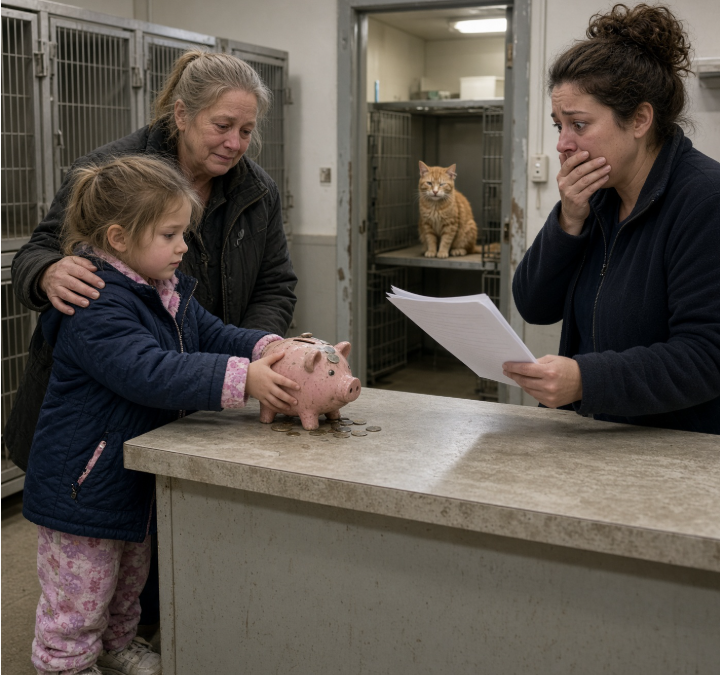
Back at the front desk, Lila placed both hands on the piggy bank as though she were presenting everything she owned to the world.
Clara opened the little rubber stopper.
Coins spilled onto the counter in a clear, chaotic sound.
Two-euro coins.
One-euro coins.
Fifty-cent coins.
Ten-cent coins.
Small copper coins.
Some coins so old Clara wondered how long Lila had kept them.
Lila watched them as someone might watch something that had taken a long time to grow.
Mireille whispered:
“She’s been saving for two years.”
Clara looked up.
“Two years?”
The grandmother nodded.
“Birthday money. Tooth fairy money. Coins found on the ground. Change people sometimes gave her. She never bought anything. Not candy. Not a doll. Not even the little box of glitter crayons she wanted last summer.”
Lila listened without taking her eyes off the coins.
Clara counted.
Once.
Then a second time.
47.38 euros.
The adoption fee was 65 euros.
Clara opened her mouth to say something, but Sandrine spoke first.
“It’s fine.”
Mireille looked up, surprised.
“But it’s short—”
“It’s fine,” Sandrine repeated.
Her voice was firm.
Not hard.
Firm in a way that did not allow shame to enter the room.
“The fee is covered.”
Mireille wiped her cheeks again.
“I can pay the difference back. Maybe not today, but—”
Sandrine placed one hand gently on the counter.
“Ma’am, your granddaughter just bought this cat with two years of patience. No one here is going to ask her for seventeen more euros.”
Lila did not understand the whole sentence.
But she understood Captain was leaving.
Not Unit 22.
Captain.
The name came from her before Clara even printed the papers.
“He can’t be called Unit,” she said. “That isn’t a name.”
“What do you want to call him?” Mireille asked.
Lila did not hesitate.
“Captain.”
“Why Captain?”
The little girl shrugged.
“Because he looks like he used to be in charge of something.”
Clara smiled through her tears.
“I think that’s true.”
The preparation took longer than Lila wanted.
Papers had to be signed.
FIV had to be explained.
His care had to be explained.
The staff had to explain that an old cat needed calm, special food, vet visits, and monitoring.
Sandrine did all of it gently, without minimizing anything.
Mireille listened seriously.
She did not have much money.
It showed in her worn coat, in her repaired shoes, in the careful way she folded the receipt as if every piece of paper had value. But she did not ask a single question to escape the responsibility.
She asked:
“Is he suffering?”
Sandrine answered:
“Not like he was before. His teeth were treated urgently, but he’ll need follow-up care. He eats. He moves around. He can have a beautiful life if someone accepts that it may be short and imperfect.”
Mireille looked at her granddaughter.
Lila sat on a chair, feet tucked beneath her, coat buttoned up to her chin, eyes fixed on the cat room door.
“We already have an imperfect life,” Mireille murmured. “That doesn’t scare us.”
Sandrine found nothing to say.
At 8:21, Unit 22 left his cage for the last time.
Clara opened the door gently.
The cat remained lying down one second longer.
Then he lifted his head.
His single eye rested on Lila.
The little girl came closer with an almost solemn focus.
“Can I?”
Clara replied:
“Gently. He’s old. You can talk to him first.”
Lila leaned in slightly.
“Hello, Captain. It’s me. I came.”
The old cat did not move immediately.
Then he stood.
His legs were stiff. His back formed a small hump beneath his orange fur. He walked slowly to the edge of the cage.
Clara wanted to help Lila hold him, but the little girl was already reaching out her arms.
“He’s too heavy for you,” Mireille said.
“No.”
He was.
Of course he was.
Even thin, Captain was too large for her six-year-old arms. His back legs hung beneath her elbows. His long body almost slipped against her coat. Clara positioned herself near them, ready to intervene.
But Captain did not struggle.
He rested his head on Lila’s shoulder.
His single eye stayed open.
He looked back toward the room he was leaving.
Toward the cages.
Toward the door he had watched for one hundred thirty-one days.
Not with fear.
Not with anger.
Sandrine, standing in the hallway, later described that look with a sentence that stayed in the shelter:
“It was the look of someone who had finally been answered.”
When Lila passed the desk, she stopped in front of the empty piggy bank.
“Can I keep it?”
Clara handed it to her.
“Of course.”
Lila took it in one hand, Captain in the other arm, as if she were carrying both what she had waited for and what she had given.
Outside, the rain had stopped.
Mireille offered to carry the cat to the car.
Lila refused again.
“I chose him.”
So she walked slowly across the gravel, barefoot in the cold, Captain against her chest, the empty piggy bank clutched in her hand.
Inside, Clara watched the door close.
Then she saw the blue list on Sandrine’s desk.
The first line.
Unit 22.
Sandrine picked up a pen.
She crossed out the name.
Not with an administrative stroke.
With a clear, almost trembling line.
Then she wrote beside it:
Adopted.
And, in parentheses:
Captain.
Mireille’s house was small.
An old house at the end of a quiet street, with a peeling white fence, a narrow porch, and rose bushes without flowers beneath the windows. It was not perfectly tidy. Nothing inside was new. The living room rug had worn edges. The kitchen table carried knife marks. The curtains did not match.
But it was warm.
And Captain seemed to understand that within the first hour.
Mireille had prepared a corner in the living room with an old folded blanket, a water bowl, and a shallow plate. She had placed a cushion near the radiator.
Captain inspected everything.
Slowly.
He smelled the walls, the chair legs, the corners of the rug. Lila followed him in silence, sometimes on all fours, sometimes standing, like an overly eager but surprisingly patient shadow.
“Let him breathe,” Mireille said sometimes.
Lila immediately stepped back.
“Does he breathe better if I’m far away?”
“He breathes better if he knows he can choose.”
Lila thought about that.
Then she sat in the middle of the living room, cross-legged, and waited.
Captain finished his tour of the room.
He passed the blanket.
The cushion.
The radiator.
Then he walked toward Lila.
He stopped beside her knee, slowly folded his legs, and lay down against her.
Lila did not dare move.
“Grandma,” she whispered.
Mireille looked from the kitchen.
“Yes?”
“He chose me too.”
Mireille put a hand over her mouth.
“Yes, sweetheart. I think he did.”
The first night, Mireille set Captain up in the living room.
She explained to Lila that they needed to let the old cat rest, that he had been through many changes, that he needed sleep.
Lila agreed.
She went upstairs to her room.
Mireille turned off the lights.
At 2:13 in the morning, Lila appeared in the doorway of her grandmother’s bedroom.
“Grandma.”
Mireille opened her eyes, her heart already worried.
“What is it?”
“He’s looking at me from the stairs.”
Mireille got up.
In the hallway, Captain sat at the bottom of the staircase.
Straight-backed.
Silent.
His single eye fixed upward.
Mireille went down two steps.
“Do you want to come up, old man?”
Captain did not move.
Lila came down in her pajamas.
“He doesn’t know he’s allowed.”
So the little girl sat on one step.
“Captain, you’re allowed.”
The cat slowly lifted one paw.
Then another.
He climbed with difficulty.
Step by step.
It took time.
Lila did not rush him.
Mireille stayed behind him, ready to help without frightening him.
When he reached the top, Captain stopped in the hallway, as if he did not understand that a world could continue after so many closed doors.
Lila opened hers.
“This is my room. You can sleep here.”
Captain entered.
He circled the bed.
Sniffed a basket of stuffed animals.
Carefully avoided a pile of books.
Then he sat beside the bed and looked at Lila.
The little girl climbed under her blanket.
Captain did not jump.
He could not.
So Lila climbed back down at once.
“Grandma, he can’t get up.”
Mireille, who already knew what was about to happen, sighed softly.
“Then we’ll help him.”
They lifted him together.
Mireille supported his back end.
Lila placed her hands under his chest.
They set him on the bed.
Captain stood on the blanket for a few seconds, as if testing the strength of a miracle.
Then he turned in a circle once.
Twice.
And lay down against Lila’s pillow.
The little girl placed her head a few inches from his.
“Good night, Captain.”
The old cat closed his eye.
That was the first night of all the others.
The next week, Captain saw the veterinarian.
Dr. Legrand was a calm man with white hair who spoke to animals before speaking to people. He examined Captain with careful gentleness.
He checked the empty eye socket.
The teeth.
The ears.
The heart.
The joints.
The weight.
The FIV record.
Lila stood beside the table, hands joined in front of her, as if attending an important ceremony.
“Is he going to die?” she suddenly asked.
Mireille closed her eyes.
The veterinarian did not seem surprised.
He was used to children.
They asked the real questions faster than adults did.
“One day, yes,” he answered.
Lila went pale.
He added gently:
“Like all cats. Like all dogs. Like all people. Captain is old. He had a hard life. We can’t give back the years he lost. But we can make the years he has left as good as possible.”
Lila looked at Captain.
The cat sat on the table, less impressed by the speech than by the jar of treats on the shelf.
“What does good mean?” she asked.
Dr. Legrand smiled.
“It means he will be warm. He will eat food that is good for him. We will treat what hurts him. He will sleep beside someone who loves him. He will not be left alone when he is afraid.”
Lila thought about that.
“Then he’s already having a good life.”
The veterinarian set down his stethoscope.
“Yes. I think he is.”
During his first month with Lila and Mireille, Captain gained almost two pounds.
It was not spectacular at first.
Only little things.
His fur seemed less dull.
His sides looked less hollow.
His legs trembled less when he crossed the kitchen.
He ate slowly because his remaining teeth still bothered him. Mireille softened his food with warm water, just as the veterinarian had advised. Lila called it his captain soup.
Every morning, Captain walked with Lila to the school bus.
At first, Mireille refused.
“It’s cold. He’s old. He isn’t going outside.”
But Captain had his own opinion.
On the third morning, when Lila put on her coat, he rose from his cushion.
When she put on her boots, he walked toward the door.
When she picked up her schoolbag, he meowed.
Not loudly.
But clearly.
Lila stopped.
“You want to come?”
Mireille sighed.
“He doesn’t understand the bus.”
Captain meowed again.
So they tried.
The porch was damp, the street quiet, the sky pale. Lila went down the steps. Captain followed her slowly, remained on the stone path, then sat beside her at the gate.
When the yellow bus appeared at the end of the street, Captain straightened.
He did not step back.
He watched Lila climb aboard.
The little girl turned from the first step of the bus.
“I’ll come back after school, Captain.”
The cat stayed there until the bus disappeared.
Mireille leaned toward him.
“She’ll come back, you know.”
Captain did not move.
“She always comes back.”
Eventually, he went inside.
But at 3:36, when the bus dropped Lila in front of the house, Captain was already sitting on the porch step.
From that day on, it became their ritual.
Every morning, he walked her out.
Every afternoon, he waited.
Rain or wind or cold.
Sometimes he waited behind the glass when the weather was too bad, but as soon as he heard the bus, he stepped down to the porch.
The neighbors began to notice him.
Mrs. Fournier, who lived across the street, said:
“That cat knows the time better than my alarm clock.”
The mailman, who at first found Captain unsettling with his one eye and torn ear, eventually spoke to him every morning.
“Morning, Captain. Still on duty?”
Captain did not answer.
He watched.
Always.
But now his gaze no longer waited for just anyone.
It waited for Lila.
At school, Lila did not talk much about Captain at first.
The other children had young cats, dogs, rabbits, goldfish. They talked about their animals as playmates.
Captain was not exactly a playmate.
He did not chase balls.
He did not like sudden movements.
He got tired quickly.
And when a boy in her class saw a picture of him in Lila’s notebook, he said:
“He looks scary.”
Lila immediately took the photo back.
“No.”
“He only has one eye.”
“So?”
“He looks like a pirate.”
Lila thought about that.
“Pirates have ships. Captain has a bed. That’s better.”
Madame Renaud, the teacher, heard the exchange from her desk.
She said nothing.
But that evening, while correcting notebooks, she thought for a long time about the little girl who had defended an old cat as if defending something precious and secret.
A few weeks later, Madame Renaud asked the class to draw their families.
Most children drew parents, brothers, sisters, houses, suns.
Lila drew her grandmother, herself, and Captain.
Captain was almost as big as the house.
He had one enormous eye, a torn ear, and a red collar Mireille had bought at the market.
Under the drawing, Lila wrote:
My family always watches to see if I come home.
Madame Renaud held the drawing longer than the others.
Then she hung it on the wall.
Captain’s story did not remain only inside Mireille’s house for long.
At the shelter, Clara thought of him every day.
Cage 22 was quickly occupied by other cats. First two black kittens, then a tabby female found near a barn, then a white male who bit hands but accepted warm blankets.
Yet every time Clara passed that cage, she still saw Unit 22 sitting at the front.
Watching the door.
One week after the adoption, Mireille called.
Clara answered with her heart beating too fast.
Calls after adoption could bring bad news.
“Is everything all right?” she asked.
Mireille laughed softly.
“I think so. He sleeps in her bed.”
“On the cushion?”
“No. In Lila’s bed.”
Clara closed her eyes with relief.
Mireille continued:
“He walks her to the bus. He waits for her in the afternoon. He eats better. He hasn’t tried to hide once.”
Clara did not speak right away.
“Clara?”
“Yes. I’m here.”
“I just wanted to tell you. She asked me to call so you would know he isn’t watching the shelter door anymore.”
Clara had to sit down.
That evening, she wrote on a small card the sentence Mireille had told her:
“He has been waiting longer than I have been saving. That isn’t fair.”
Sandrine read the card.
Then she taped it to the shelter’s donation box.
At first, no one really noticed.
Then a woman read it while waiting to fill out a form.
She put five euros into the box.
A man read it after dropping off a bag of kibble.
He came back the next day with two clean blankets.
A teenager took a photo of it and asked permission to share it on the shelter’s social media.
Sandrine hesitated.
Then she agreed, as long as no photo of Lila was posted.
The message became more visible than expected.
People began coming in and asking:
“Do you have other cats nobody wants?”
The first time someone asked that, Clara did not know what to say.
Then she led the couple to a ten-year-old black cat with diabetes, one no one had asked to see in three months.
The couple looked at him for a long time.
The cat lifted his head.
The woman cried.
He was adopted the following Saturday.
Then came a deaf white female cat.
Then an old tabby tom who was afraid of men.
Then two twelve-year-old brothers who needed to leave together.
Lila’s sentence did not save every animal.
No sentence can do that.
But it changed the way some people looked.
And sometimes, changing one look was enough to change an ending.
At Mireille’s house, Captain never seemed to understand that he had become a small local legend.
He did not care.
What he cared about was Lila.
Her voice.
Her footsteps.
Her schoolbag hitting the entryway floor too hard.
The way she told him about her whole day while forgetting half the words.
In the evenings, she lay on the bed, Captain against her pillow, and gave him a complete school report.
“Today Noémie said clouds look like cauliflower. I think they look like sheep that forgot their heads.”
Captain blinked his single eye.
“Maxime broke his ruler. Not on purpose. I think.”
Captain rested his head on his paws.
“Madame Renaud says we’re going to learn subtraction. I don’t like when numbers disappear.”
Captain sighed.
“You too?”
Sometimes Mireille listened from the hallway.
She heard her granddaughter speaking to the old cat the way someone speaks to a being who understands everything because he never interrupts.
Lila had not had an easy life either.
Her mother had left when she was four.
Not dead.
Not exactly missing.
Gone.
That word had become the simplest way to describe something that was not simple at all.
Sometimes she sent a card.
Sometimes nothing.
Her father had never really been there.
So Mireille raised Lila on a modest pension, food-bank help, donated sweaters, a great deal of fatigue, and an immense love that did not always fill the refrigerator but filled the house as much as it could.
Lila did not talk about it often.
She had learned early that adults became uncomfortable when a child asked questions no one knew how to answer.
Why doesn’t Mommy stay?
Why doesn’t Daddy call?
Why do the other children have two parents in front of the school?
Why do I have Grandma?
Mireille did her best.
But some childhood wounds need a witness who does not try to explain.
Captain became that witness.
He did not ask questions.
He did not say things would definitely get better.
He stayed.
Perhaps that was why Lila had recognized him.
In his single eye, she had not seen a damaged cat.
She had seen someone who knew how it felt to wait too long.
One January evening, two months after the adoption, snow fell for the first time.
Not much.
Just enough to cover the garden in a thin white layer.
Lila ran downstairs.
“Captain has to see!”
Mireille looked up from her sewing.
“It’s cold.”
“Just the porch.”
Mireille agreed.
Lila opened the door.
Captain slowly walked to the threshold.
Cold air entered the hallway.
The cat looked at the snow.
Then immediately backed away and returned to the radiator.
Lila burst out laughing.
“Okay. He saw it. He didn’t like it.”
It was one of the first truly light laughs Mireille had heard from her granddaughter in a long time.
Captain, offended by the noise or simply tired by winter, turned his back with dignity.
At the end of winter, Captain had a difficult period.
He ate less.
He slept more.
His single eye watered a little.
Mireille took him to the veterinarian with Lila. Dr. Legrand adjusted his treatment, recommended a joint supplement, checked his mouth, and spoke gently about age, fragility, and monitoring.
Lila listened to everything.
In the car on the way home, she asked:
“Grandma, if he dies soon, will I have made a mistake?”
Mireille felt her heart split.
“Why do you say that?”
“Because I’ll have given all my money for not much time.”
Mireille parked in front of the house but did not turn off the engine right away.
Captain slept in his carrier on the back seat.
“Lila, look at me.”
The little girl obeyed.
“Time isn’t the only thing that counts.”
“But what if there isn’t much of it?”
“Then it needs to be full.”
Lila frowned.
Mireille searched for the right words.
“If someone had given Captain one hundred thirty-one more days at the shelter, in a cage, watching a door, would that have been better than one month in your bed, with you, warm?”
Lila looked toward the carrier.
“No.”
“There. We don’t always choose how long love lasts. But we can choose how we give it.”
Lila stayed quiet for a long time.
Then she said:
“Then I’ll give him a lot in not much time.”
Mireille closed her eyes.
“Yes, sweetheart. That’s exactly it.”
Captain got better.
Not like a young cat.
Never like a young cat.
But his appetite returned.
He began waiting for the bus again.
He even stole a small piece of ham from the table one Sunday, which Mireille considered an excellent sign of health and Lila considered proof that he was secretly a professional thief.
Spring arrived.
Then summer.
Captain discovered sunlight on the porch.
He had his favorite spot: the second step, the one that caught the light between ten and noon. He stretched out there, body warming, torn ear twitching sometimes when an insect passed.
The neighbors got used to his presence.
The children on the street learned they had to approach him gently.
Mrs. Fournier sometimes brought him a piece of cooked chicken.
The mailman said hello every morning.
A little boy named Hugo, who was afraid of cats, began sitting six feet away from him after school. Captain did not move. Neither did Hugo. After three weeks, Hugo dared to say:
“Hi.”
Captain blinked.
Hugo ran home to announce that he had spoken to a pirate.
At first, Lila did not like other children taking interest in Captain.
Then she understood that Captain did not leave with them.
He could be looked at by others and still remain hers.
That was a lesson too.
In the following November, one year after the adoption, Mireille suggested visiting the shelter.
Lila hesitated.
“With Captain?”
“No, sweetheart. He doesn’t need to go back there.”
“Then why?”
“To give them news.”
Lila prepared a drawing.
She drew Captain sitting on the porch, herself with a schoolbag, and the school bus at the end of the street. Above it, she wrote:
Captain waits better than anyone.
Mireille bought a packet of cat treats.
They walked into the shelter on a Wednesday afternoon.
Clara was at the front desk.
When she recognized Lila, she brought both hands to her face.
“Oh my God.”
Lila grew shy.
“Hello.”
Clara came out from behind the counter and crouched in front of her.
“How is Captain?”
Lila handed her the drawing.
“He waits for the bus. He sleeps on my bed. He eats soft soup. He doesn’t like snow. He stole ham, but Grandma says that’s good.”
Clara laughed and cried at the same time.
Sandrine came from the hallway.
She looked at Lila with an expression the little girl did not yet understand.
It was gratitude.
Not only because Lila had saved Captain.
But because she had reminded the shelter of something fatigue had almost buried.
Behind every hard-to-place animal, there was not only a problem.
There might also be a wait.
And somewhere, sometimes, someone who knew how to recognize it.
Sandrine showed Lila the donation box.
The card was still there.
“He has been waiting longer than I have been saving. That isn’t fair.”
Lila read her own sentence as if it already belonged to someone else.
“I said that.”
“Yes,” Sandrine replied. “And many people have read it.”
“Did it help?”
Clara answered:
“Yes. More than you know.”
In the cat room, Lila walked past the cages.
She stopped in front of an old black cat.
He was thirteen.
One stiff leg.
An exhausted gaze.
“Is he waiting too?” she asked.
Clara followed her gaze.
“Yes.”
Lila was silent.
Then she asked:
“Is someone saving for him?”
Clara did not know what to say.
Sandrine answered softly:
“Maybe. We don’t know yet.”
Lila nodded as if accepting a mission entrusted to time.
Before leaving, she dropped into the donation box the two coins she had found in her grandmother’s car.
Then she looked at the empty piggy bank in her bag.
She had never filled it again.
Mireille had suggested it several times.
Lila always refused.
“It already did its job,” she said.
At eight years old, Lila had grown.
Her feet now touched the floor when she sat on certain chairs. She read better. She wrote straighter. She asked fewer questions about her mother, not because the wound had disappeared, but because she had learned to live around it.
Captain was sixteen.
His single eye was beginning to cloud.
His steps were slower.
He no longer climbed stairs alone.
He no longer jumped onto the bed at all.
Every evening, Lila lifted him with a care no adult had truly taught her. She supported his back end, as the vet had shown her, then placed him on the pillow beside hers.
He always sighed when he touched the blanket.
As if he found the service acceptable.
“You’re dramatic,” Lila told him.
Captain closed his eye.
In the morning, he still went down to the porch when he could.
Sometimes he stayed behind the glass door.
Lila would say:
“It’s okay. You can wait inside. I know you’re waiting.”
The bus came.
She left.
He watched.
He had become more fragile, but he had never stopped being visible.
He never hid under the bed.
Not once.
Even when visitors came.
Even when there was noise.
Even when a child shouted too loudly.
Captain simply sat somewhere he could see the room.
After one hundred thirty-one days of watching a door and being ignored, he seemed to have decided he would never disappear again.
One day, Madame Renaud asked the class to write a few lines about their hero.
Some children wrote about soccer players.
Others about their parents.
One little girl chose a singer.
One boy wrote about a firefighter.
Lila stayed bent over her paper for a long time.
Then she wrote four sentences.
My hero is my cat Captain.
He waited 131 days for someone to choose him.
Nobody did.
So I chose him.
Madame Renaud read the text after class.
She had to sit down.
Then she asked Lila if she could make a copy to display.
Lila thought about it.
“Will Captain know?”
“I don’t know.”
“Then yes. Maybe someone will tell him with their eyes.”
The text was displayed in the school hallway.
One mother read it.
Then another.
Then the principal.
Then someone at the shelter heard about it.
Sandrine asked Mireille if she could copy the four sentences onto a new card beside the first one.
Mireille asked Lila.
Lila agreed, but only if Captain’s name was written correctly, with a capital letter.
The new card was placed beside the donation box.
Under the first.
He has been waiting longer than I have been saving. That isn’t fair.
Then:
My hero is my cat Captain. He waited 131 days for someone to choose him. Nobody did. So I chose him.
People gave more often after reading the second card.
But more importantly, they more often asked to see the older animals.
One Sunday, a woman came in with her husband.
They had lost their cat a few months earlier.
They said they were not ready for a kitten.
Clara showed them a fifteen-year-old gray male cat with diabetes who slept a lot.
The man read the cards.
He stayed quiet.
Then he said:
“Can we meet him?”
Clara smiled.
“Of course.”
The gray cat went home with them a week later.
Another day, a teenager asked if he could become a volunteer. He had seen the phrase on the shelter’s social media. He said he had thought a lot about “the one nobody wants.”
He began coming on Wednesdays.
He cleaned cages.
He talked to the cats.
He was not very talkative with humans, but the animals seemed to like him.
Clara sometimes wondered whether Captain knew any of this.
Probably not.
But maybe some lives change the world without ever seeing it.
Captain lived in his little kingdom.
Lila’s bed.
The porch.
The radiator.
The bowl of soft soup.
The schoolbag dropping every day in the entryway.
Mireille’s voice.
Homework recited out loud.
Lila’s hands lifting him every night as if he were both fragile and royal.
At sixteen and a half, Captain began to decline more clearly.
He still ate, but less.
He slept more.
Some days, he no longer went down to the porch.
Dr. Legrand spoke softly about comfort.
Pain.
Quality of life.
Mireille listened with the closed expression of a woman who had already understood before entering the room.
Lila did not cry right away.
She asked a question.
“How will I know when he’s too tired?”
The veterinarian took time before answering.
“You know him better than many people. You’ll watch what he loves. If he no longer wants to eat, if he no longer wants to be touched, if he no longer looks for your bed, if there are no more moments when he seems happy, then we’ll talk. Not before.”
Lila nodded.
“And if he still wants my bed?”
The doctor smiled sadly.
“Then we give him your bed.”
That night, Lila slept badly.
Captain slept deeply against her pillow.
She watched him in the weak light of the night-light.
“You don’t have to wait all the time anymore,” she whispered.
Captain did not move.
“If you’re tired, you can sleep. I always come back too.”
The old cat opened his cloudy eye.
He placed one paw on Lila’s hand.
Then he let his head fall back down.
He did not leave that night.
Or the next week.
Or the next month.
He stayed.
As he had always known how to stay.
The third anniversary of his adoption arrived.
Mireille made a small cake for Lila, not for Captain, because Captain could not eat cake. For him, she prepared a special portion of warm food.
Lila placed the empty piggy bank in the center of the table.
“Why are you putting that there?” Mireille asked.
“Because it’s his day too.”
“His day?”
“The day it stopped being money.”
Mireille fell silent.
Lila continued:
“Before, it was coins. After, it was Captain.”
The sentence stayed in the kitchen long after it had been spoken.
Mireille wondered how many adults could have explained sacrifice so simply.
Later that evening, Lila took a photo of Captain on her pillow. His orange fur had grown paler around his muzzle. His torn ear rested to the side. His single eye looked at the camera with that old intensity that had never completely disappeared.
Lila showed the picture to Mireille.
“He still looks like he’s waiting.”
Mireille looked.
“Maybe.”
“For what?”
The grandmother passed a hand through the child’s hair.
“Maybe he’s just waiting for you to come to bed.”
Lila smiled.
“That’s easy.”
She went upstairs.
Captain was waiting.
One spring morning, Captain did not come to the door for the bus.
Lila was already ready, schoolbag on her back.
She looked toward the living room.
Captain was on his cushion near the radiator, awake but still.
Mireille said softly:
“He’s tired today.”
Lila set down her schoolbag.
She went and knelt beside him.
“I have to go to school.”
Captain blinked slowly.
“You can wait here. I’ll know.”
She kissed the top of his head.
Then she left.
All day, she thought about him.
At 3:36, the bus stopped in front of the house.
Lila climbed down quickly.
Captain was not on the porch.
Not behind the glass.
She opened the door with her heart tight.
He was in the entryway.
Lying on the rug, only a few steps from the door.
He had not had the strength to go outside.
But he had tried to be there.
Lila dropped her schoolbag and lay down beside him.
“I saw you,” she said.
Captain closed his eye.
That evening, Mireille called the veterinarian.
Not to make an immediate decision.
To talk.
To ask what they should watch for.
To be ready to love him properly until the end.
Lila heard part of the conversation from the stairs.
She did not come down.
She went to her room and got her empty piggy bank.
She set it beside Captain.
Then she sat next to him.
“It’s still empty,” she said. “But if I could, I would pay so you’d be less tired.”
Captain did not answer.
Cats do not promise anything.
They only offer their presence.
And sometimes, their presence is enough to say what no promise could ever keep.
A few weeks later, Captain had a very good day.
A gift day.
He ate his whole plate.
He went down three porch steps.
He stayed in the sun for almost an hour.
He lightly batted at Lila’s shoelace, a movement so weak and unexpected that Lila shouted:
“Grandma! He’s playing!”
Mireille rushed in, thinking something was wrong.
Then she saw Captain.
The old orange cat, one-eyed, torn-eared, paw raised against the pink shoelace.
Mireille burst out laughing.
Lila laughed too.
Captain, having completed his accomplishment, placed his head on his paws and ignored their emotion.
That evening, Lila wrote in her notebook:
Today Captain played.
Not much.
But enough for it to be an important day.
The next day was harder.
Then came another good day.
Then two slow days.
The end of Captain’s life did not follow a straight line. It moved the way he did: gently, with pauses, returns, moments of fatigue, and unexpected flashes of presence.
Lila learned not to measure love only by what it could still do.
Captain no longer climbed onto the bed.
So she lifted him.
Captain no longer always went to the bus.
So she said goodbye to him in the living room.
Captain no longer ate quickly.
So she waited.
Captain slept more.
So she spoke more softly.
One evening, while rain tapped gently against the windows, Lila asked:
“Grandma, does Captain know we saved him?”
Mireille set her knitting down on her lap.
“I don’t know if he thinks that way.”
“How does he think?”
“Maybe he doesn’t think: I was saved. Maybe he only thinks: I am warm. She is here. I can sleep.”
Lila looked at the sleeping cat.
“That might be better.”
“Yes.”
“Because saved means before it was very dangerous.”
Mireille nodded.
“And now?”
Lila answered herself:
“Now it’s soft.”
That word became their word.
Soft.
When Captain ate well, Lila said:
“It’s soft.”
When he slept against her:
“It’s soft.”
When he breathed calmly near the radiator:
“It’s soft.”
And when his days truly became shorter, Mireille understood that Lila was trying to remember not only the fear, but the softness.
Captain passed away one autumn morning.
Almost four years after his adoption.
He was over seventeen years old.
Lila was almost ten.
The night before, she had carried him to the bed as always. He had rested his head against her pillow. He had slept a long time.
In the morning, he was not suffering loudly.
He was not fighting.
He was simply too tired.
Dr. Legrand came to the house.
Because Mireille had asked.
Because Captain had spent enough of his life waiting behind doors.
He was not going to end his life on a cold table if there was another way.
Lila stayed with him.
Mireille had told her she could leave the room if she wanted.
Lila had answered:
“He waited for me. I can stay.”
She placed the empty piggy bank beside him.
The old cat lay on her pillow.
His single eye, cloudy now, stayed open until Lila put her hand in front of him.
“I’m here, Captain.”
He closed his eye.
The end was calm.
Not easy.
Never easy.
But calm.
Afterward, Lila cried in a way she had never cried before. With her whole body. As if four years of fear, love, responsibility, and tenderness were leaving her all at once.
Mireille held her.
The veterinarian remained silent.
In the room, the pink piggy bank was still empty.
And Captain, for the first time since leaving the shelter, was waiting for no one.
A few days later, Lila asked to go to the shelter.
Mireille hesitated.
“Are you sure?”
“Yes.”
“You don’t want to wait?”
Lila shook her head.
“I want to tell them.”
They went in on a Wednesday afternoon.
Clara was still at the front desk.
She understood before Lila spoke.
Some news enters a room before the words do.
Clara came out from behind the counter.
Lila held the empty piggy bank against her chest.
“Captain died,” she said.
Clara knelt.
“I’m so sorry, sweetheart.”
Lila nodded.
She did not cry right away.
“He died in my bed. Not in a cage.”
Clara brought a hand to her mouth.
Sandrine arrived.
Mireille explained softly.
The veterinarian at home.
The calm.
The pillow.
Lila staying with him.
Sandrine cried openly.
Not only for Captain.
For Unit 22.
For the old cat who had watched a door for one hundred thirty-one days.
For the fact that he had finally had almost four years of bed, porch, school bus, stolen ham, sunlight, and a little girl who chose him.
Lila set the piggy bank on the counter.
Clara looked at it.
“Do you want to donate it?”
“No.”
Lila ran her fingers over the worn pink plastic.
“I want it to stay here for a while. Empty.”
Sandrine asked softly:
“Why empty?”
Lila replied:
“Because it already gave what it had. But maybe if people see it empty, they’ll understand that you can give everything you can, even if it isn’t enough for everything.”
No one answered.
Because, once again, Lila had said something too simple to argue with.
Captain’s piggy bank remained on the donation box for a month.
Beside the two cards.
People put coins into it.
At first, Clara wanted to remove them and place them in the box.
But Lila, when she came back the following week, shook her head.
“No. Leave them inside.”
“Do you want to start saving again?”
Lila looked toward the cages.
An elderly cat slept at the back of one.
A black female cat watched the visitors.
A younger orange cat rubbed his head against the bars.
“Not for me,” she said.
Captain’s piggy bank became the fund for the invisible ones.
Lila chose the name.
The money helped pay adoption fees or medical care for animals who were old, sick, disabled, frightening, or simply ignored.
The animals people looked at and then forgot.
Every time an animal left because of the fund, Clara wrote its name in a notebook.
Not a public board.
Not a post.
A notebook.
Because Lila had asked:
“I want all of them to have a name somewhere.”
The first was Marius, the old black cat with the stiff leg.
Then Blanchette, the deaf white cat.
Then Oscar, who bit, but only because he was afraid.
Then two eleven-year-old tabby sisters.
Then an old one-eyed dog who had spent the winter in a kennel.
With each name, Clara thought of Captain.
Of Unit 22.
Of the barefoot child.
Years passed.
Lila grew older.
The pink piggy bank stayed at the shelter behind the counter, protected under a small clear cover that Clara’s husband made one Sunday.
On a simple plaque, Sandrine had written:
Captain’s Piggy Bank
For the Ones Still Waiting
Mireille’s house remained full of memories.
The cushion near the radiator.
The red collar in a little box.
The photo of Captain on the porch.
The family drawing where he was almost as large as the house.
For a long time, Lila did not want to adopt another animal.
No one forced her.
Mireille understood.
Some loves are not replaced.
They simply open a room inside us, and that room stays there, even when empty.
One day, maybe, another animal would enter.
Or maybe not.
That was not the question.
The question was what Captain had left behind.
And he had left a great deal.
He had left a little girl who knew choosing someone could change a life.
He had left a shelter that looked longer at the cages in the back.
He had left an empty piggy bank that became more useful than when it was full.
He had left sentences on cards.
He had left animals adopted by people who, before him, might never have thought to ask:
“Who has been waiting the longest?”
At twelve, Lila had to write an essay about an event that changed her life.
She did not write about Captain’s death.
She wrote about the morning she walked barefoot into the shelter.
Her essay began like this:
I thought I was going to save a cat.
But now I think he taught me how to see the people and animals everyone else walks past.
I named him Captain because he looked like he had once been in charge of something, but really, what he commanded was simply that someone look at him for real.
Madame Renaud, who now taught another class but had stayed in contact with Mireille, received a copy of the essay.
She cried again.
Some stories do not lose their strength as they grow older.
They become deeper.
Like the imprints an old cat leaves on a bed long after he no longer sleeps there.
Years after that Tuesday in November, cage 22 still existed at the shelter.
It had been repaired, repainted, and moved a few feet during renovations. Dozens of cats had passed through it.
But on the small ledge, Clara had quietly placed a tiny gold star.
No one really noticed it.
It was not for visitors.
It was for the staff.
To remember.
That an animal sitting in front of a door is not always waiting in vain.
That a difficult file is not an ending.
That an old orange cat, one-eyed, FIV positive, thin, nameless, familyless, and seemingly without a future, could become Captain.
That a six-year-old child, barefoot in a coat over her pajamas, could arrive thirteen minutes before eight and change a decision everyone believed had already been made.
And that some lives do not ask for much.
A bed.
A bowl.
A porch step.
A little girl coming home from the bus.
A name.
A gaze that someone finally answers.
Captain’s piggy bank continues to fill and empty.
That is what it does.
It receives.
It gives.
It becomes light again.
Then someone adds a coin.
Sometimes a child.
Sometimes an elderly person.
Sometimes someone who reads the cards and stays silent for a long time.
On the first card, the handwriting is beginning to fade a little.
But you can still read it:
“He has been waiting longer than I have been saving. That isn’t fair.”
On the second:
“My hero is my cat Captain. He waited 131 days for someone to choose him. Nobody did. So I chose him.”
And under the clear cover, the pink piggy bank waits.
Empty on some mornings.
Full on other days.
Always ready.
The way Captain had been.
Sitting, in a way, in front of a door.
Watching to see if someone would finally stop.


