A 5-Year-Old Offered Eight Bikers $24.40 to Beat Up His Cancer—Six Weeks Later, 400 Motorcycles Answered His Final Order
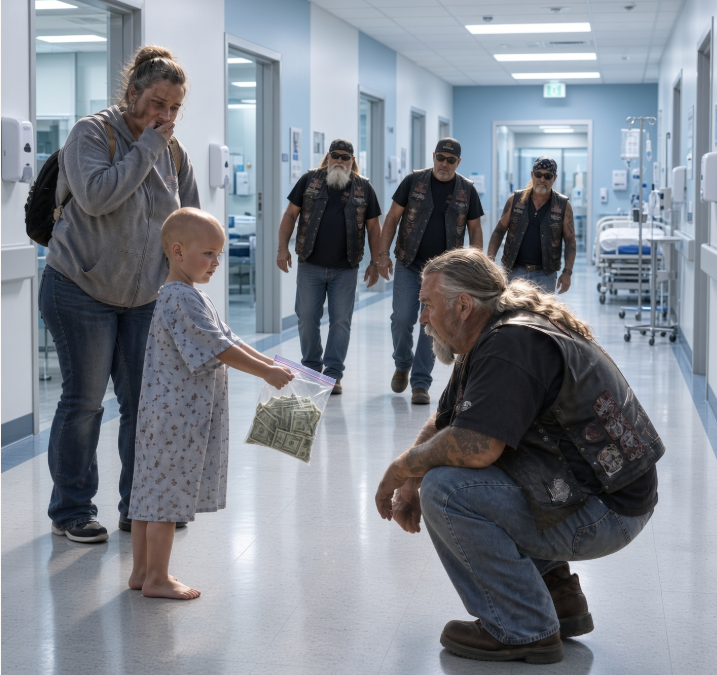
A 5-Year-Old Offered Eight Bikers $24.40 to Beat Up His Cancer—Six Weeks Later, 400 Motorcycles Answered His Final Order.
A five-year-old boy with leukemia walked barefoot into a hospital parking lot, handed me every dollar he had saved, and asked eight bikers to go upstairs with him and beat the monster the doctors could no longer stop.
His mother already knew he had only weeks left, but Tucker didn’t know he was dying—he only knew grown-ups had failed to defeat the thing inside him, and he had decided men in leather vests looked tough enough to finish the job.
Six weeks later, more than four hundred motorcycles surrounded the hospital while the smallest general I had ever served under gave us one final command: after he was gone, we were not allowed to stop fighting for the frightened kids he would leave behind.
I have carried a rifle in places where the ground shook under artillery.
I have watched men bleed through uniforms.
I have seen helicopters come in low over dust while everyone on the ground prayed they were carrying someone out instead of bringing somebody new in.
I thought I understood courage.
I was fifty-three years old before a five-year-old boy in a hospital gown taught me I had been using the word too casually.
My road name is Bear.
My mother did not name me that.
Nobody looks at a ten-pound newborn and says, “That’s a Bear.”
The name came years later because I was six-foot-four, weighed two hundred seventy pounds, had a beard that went gray before the rest of me did, and apparently possessed the personality of “an angry refrigerator.”
That description belonged to Hammer.
Hammer had known me thirty-one years.
He was allowed one insult a week.
He usually spent it by Tuesday.
There were eight of us that morning outside St. Jude’s Children’s Hospital in Cleveland.
We had ridden in from Indiana before sunrise to deliver a check from a charity run.
Nothing heroic.
Nothing unusual.
Our club had been doing pediatric hospital rides for years.
We raised money.
Delivered toys.
Paid for gas cards.
Bought meals for parents sleeping in hospital chairs.
That was the kind of thing nobody sees when they hear motorcycle club and picture trouble.
There was Hammer, who owned a roofing company and cried during dog-food commercials.
Diesel, an enormous former trucker whose beard entered rooms several seconds before the rest of him.
Pastor Pete, who really was a pastor and had spent twenty-seven years trying unsuccessfully to convince the rest of us to swear less.
Scrubs, a retired Army medic.
Reaper, who got his name in his twenties and regretted it by forty.
Big Country, six-foot-seven and somehow the quietest man I had ever met.
Tank, who looked like he could bench-press a refrigerator but fainted once during a flu shot.
And me.
Eight bikes.
Eight aging men.
Too much leather.
Too much gray hair.
PART2:
We were standing around arguing about breakfast when the hospital doors opened.
A little boy came through.
Not walked.
Marched.
That is important.
He was pulling his mother behind him by the hand.
She looked like she had spent the entire night crying and then had run out of energy for the sound.
Tears were coming down her face.
She made no attempt to wipe them.
The boy wore a hospital gown beneath a Spider-Man hoodie.
His head was completely bald.
One sock.
No shoes.
A white medical bracelet around one wrist.
PART3:
He was so thin the hoodie seemed to be hanging from a coat hanger.
But his jaw was set.
He knew where he was going.
Straight toward me.
I stopped talking.
So did everybody else.
The boy stood in front of my Harley.
Looked up.
Then up some more.
“You a real biker, mister?”
Hammer made a choking sound behind me.
I climbed off the motorcycle and crouched.
Even then, I was almost eye level with him only because he stood very straight.
The bracelet said:
TUCKER J. WHITFIELD.
“I sure am.”
He studied my vest.
The patches.
My beard.
My boots.
“You sure?”
I glanced at the seven men behind me.
“Fellas, are we real?”
Diesel spread his arms.
“Been fooling everybody for years.”
Tucker did not laugh.
This was serious business.
He looked back at me.
“You help people?”
That changed the air.
I nodded.
“When we can.”
His mother covered her mouth.
I saw her shoulders shake.
Tucker reached into the front pocket of his hoodie.
He pulled out a Ziploc bag.
Money inside.
Wrinkled dollar bills.
Coins.
Some quarters.
Dimes.
Nickels.
He held it toward me with both hands.
“I need to hire you.”
None of us moved.
I looked at his mother.
She shook her head almost imperceptibly.
Not no.
Something else.
Please.
I turned back.
“What’s the job?”
Tucker breathed in.
There was a wet rattle in his chest.
I heard it.
Scrubs heard it too.
His expression changed.
Tucker said:
“Something bad lives inside me.”
I felt every hair on my arms rise.
“The doctors keep putting needles in me.”
He pointed to the hospital.
“They give me medicine.”
“They put stuff in here.”
He touched his chest.
“And it makes me puke.”
His mother bent her head.
“But it won’t leave.”
Tucker held the money higher.
“I saw a video where bikers helped a kid.”
“So I told Mom we needed bikers.”
I looked at Hammer.
Hammer looked away.
Tucker continued:
“I got twenty-four dollars and forty cents.”
“I counted twice.”
“That’s everything.”
“I want you and your friends to come upstairs.”
He paused.
“And beat up my cancer.”
Pastor Pete dropped to one knee.
Not theatrically.
His legs simply seemed to stop working.
Diesel turned around.
Hammer stared at the sky.
Big Country pressed his lips together so hard they disappeared.
I had been shot at.
I had buried friends.
I had stood beside parents receiving folded flags.
Nothing prepared me for a five-year-old asking me to fight something I could not touch.
I looked at his mother.
She stepped closer.
Her fingers closed around my forearm.
“Please.”
Her voice barely existed.
“Just pretend.”
Tucker was looking at the motorcycles.
She lowered her voice.
“Take the money.”
“Tell him you’ll do it.”
Her hand shook against my arm.
“Last night his doctors told me six weeks.”
My stomach dropped.
“What?”
She nodded once.
“Maybe less.”
Tears continued silently.
“His name is Tucker James Whitfield.”
“He’s five years and four months old.”
“He’s had acute lymphoblastic leukemia since he was three.”
She spoke quickly, as if the facts had become a script she could recite without collapsing.
“Chemo worked for a while.”
“Then it came back.”
“Bone marrow transplant failed.”
“Clinical trial failed.”
“Last chemotherapy didn’t work.”
“They told me yesterday there’s nothing curative left.”
I looked at the boy.
He was counting the motorcycles.
“One, two, three…”
His mother whispered:
“They told me to take him home if I want.”
“He doesn’t want to go home.”
“He says the monster lives on the fourth floor because that’s where they fight it.”
Her voice broke.
“For two months he’s been asking me to find bikers.”
“Why bikers?”
She laughed once through tears.
“He saw some club escort a sick boy to school on a video.”
“After that he decided bikers can beat anybody.”
“He made me drive past truck stops.”
“Motorcycle shops.”
“A bar once.”
“I wouldn’t let him go inside.”
Despite everything, I almost smiled.
“He’s been looking for you.”
“For us?”
“Not you specifically.”
“People who looked…”
She glanced toward our bikes.
“…tough enough.”
Tucker turned back.
“Twenty-four dollars and forty cents.”
He shook the bag.
“You gonna take the job or not?”
I looked at him.
Then at his mother.
Then at the seven men behind me.
We did not need a meeting.
I crouched again.
“Tell me something, soldier.”
“What?”
“You sure that’s all twenty-four forty?”
“Yes.”
“Because that is serious money.”
“I know.”
“You could buy a lot of candy.”
“My stomach doesn’t like candy anymore.”
That sentence hurt in a different way.
“You sure you want to spend every cent?”
He nodded.
“On beating him up.”
“Him?”
“The cancer.”
“Right.”
I took the bag.
Held it carefully.
Like money mattered.
Like the contract mattered.
Like the universe might still respect paperwork if we behaved officially enough.
“All right.”
Tucker’s eyes widened.
“Yeah?”
“Yeah.”
I stood and turned toward the others.
“Gentlemen.”
Seven men straightened automatically.
“We have a contract.”
Hammer wiped his face with one hand.
“Copy.”
I looked at Tucker.
“One condition.”
His expression became suspicious.
“What?”
“You’re in charge.”
His mouth opened.
“Me?”
“Your cancer.”
“Your war.”
“We don’t know the enemy.”
“You do.”
“So you’re the commanding officer.”
Diesel said:
“Absolutely.”
Pastor Pete, still kneeling, nodded.
“Highest-ranking man here.”
Tucker looked at his mother.
“Mom.”
She cried harder.
“I’m a general.”
She nodded.
“You sure are, baby.”
I handed her the money bag discreetly.
Tucker caught me.
“No.”
He pointed.
“You keep it.”
I looked at him.
“It’s payment.”
I tucked the Ziploc into my vest.
“Yes, sir.”
Tucker smiled.
First time.
One front tooth missing.
That smile changed everything.
His arms went around my neck.
I nearly fell backward because I had not expected him to move.
I hugged him carefully.
He weighed almost nothing.
I had carried saddlebags heavier than that child.
His mother put both hands over her face.
Behind me, Diesel muttered something and walked twenty feet away to cry.
I lifted Tucker onto my hip.
“All right, General.”
“Where’s the enemy?”
He pointed at the hospital.
“Fourth floor.”
I turned to the boys.
“You heard the man.”
Eight bikers followed a five-year-old into St. Jude’s.
The front desk woman stared.
Tucker sat on my arm like a king entering a conquered city.
His mother hurried ahead.
“I’m sorry.”
she told the receptionist.
“I know this looks—”
The woman looked at Tucker.
Then at us.
Then at his mother’s face.
“Fourth floor?”
She nodded.
The receptionist pressed the elevator release.
“Go.”
Tucker pushed the button himself.
His finger shook.
He was smiling.
“Wait until you see my room.”
“What’s in it?”
Hammer asked.
“Pictures.”
“Of what?”
“The monster.”
Nobody spoke.
Tucker looked at us.
“So you know what he looks like.”
The elevator seemed to take an hour.
The doors opened onto pediatric oncology.
You never forget those floors.
Murals try very hard.
Dinosaurs.
Spaceships.
Rainbows.
Fish.
Cartoon clouds.
Everything painted bright because the reality is too heavy for plain walls.
A nurse carrying medications stopped mid-step.
Another looked out from the station.
Then another.
Eight bikers came down the hallway.
Boots.
Leather.
Chains.
And on my hip, a five-year-old giving directions.
“Left.”
We turned.
“Other left.”
Hammer muttered:
“We’re going to die under this leadership.”
Tucker heard him.
“I know where I’m going.”
“Yes, General.”
“Past the playroom.”
We passed.
“The blue door.”
Room 417.
Private.
Tucker’s room.
I stepped inside.
Then stopped.
Drawings covered the walls.
Not family pictures.
Not superheroes.
Monsters.
Dozens.
Some black blobs with sharp teeth.
Some red snakes.
One looked like a spider with needles instead of legs.
Another green thing spread across an entire sheet of paper.
Crayon pressed so hard it had torn through.
Tucker pointed.
“There.”
I stared.
“That’s him?”
“That’s one.”
“One?”
“He changes.”
Tucker slid down from my arms.
His mother steadied him.
“When he makes me sick, I draw what he looks like.”
Pastor Pete walked to one picture.
Put his palm against wall beside it.
“What’s this?”
Tucker explained.
“That was when he hurt my legs.”
Another.
“That was when he made me throw up blood.”
His mother turned away.
Another.
“That one was after the transplant.”
I could not speak.
Tucker looked at me.
“I made them so when you came you’d know who to beat up.”
You came.
Not if.
When.
This little boy had been waiting for us before he knew our names.
I swallowed.
“All right.”
I removed my vest.
Hung it on the back of a chair.
“We need a war room.”
Tucker’s face brightened.
“What’s that?”
“Command center.”
“Where soldiers study the enemy.”
He looked around.
“This can be the war room.”
“Exactly.”
I pointed at Hammer.
“Notes.”
Hammer grabbed Tucker’s coloring notebook.
“Diesel.”
“Yeah?”
“Enemy intelligence.”
“What’s that mean?”
Tucker asked.
Diesel answered:
“I figure out where the bad guy hides.”
Tucker nodded seriously.
“Mostly my blood.”
Diesel’s face twitched.
“Copy.”
“Pastor Pete.”
“Sir?”
“Spiritual operations.”
Tucker looked confused.
“Praying.”
Pastor Pete said.
“I’m very good at it.”
Tucker nodded.
“You do that.”
“Scrubs, medical liaison.”
Scrubs saluted.
“Reaper, transportation.”
“Big Country, supplies.”
“Tank, security.”
“And me?”
Tucker asked.
I looked at him.
“You’re General Tucker.”
He sat straighter.
“General Tucker.”
He tried the words.
“Do I get one of those biker names?”
“That is a biker name.”
“It is?”
“Best one I’ve heard.”
He looked at his mother.
“Mom.”
She stood in doorway.
“Yes?”
“I’m General Tucker.”
She tried to answer.
Nothing came.
She nodded.
Tucker climbed onto bed.
“All right.”
Then he pointed at me.
“What’s your name?”
“Bear.”
“Bear?”
“Long story.”
“You look like a bear.”
“Short story.”
He laughed.
There it was again.
His mother covered her mouth.
Later she told me she had not heard him laugh like that in three months.
We stayed four hours.
The nurses eventually brought chairs.
One doctor came in.
Stopped.
Looked at us.
Then at Tucker.
Tucker announced:
“These are my soldiers.”
The doctor, Dr. Evelyn Shah, looked at his mother.
She nodded.
Dr. Shah smiled.
“I’m glad reinforcements arrived.”
Tucker pointed at her.
“She’s been fighting him too.”
I stood.
“Doctor.”
She shook my hand.
“You better listen to your general.”
“Yes, ma’am.”
Tucker’s mother’s name was Sarah.
I learned that after Tucker finally fell asleep.
The boys went downstairs for coffee.
I stayed.
Sarah sat by window.
She looked thirty-five.
Could have been twenty-eight.
Could have been forty-five.
Grief destroys age.
Her husband had left before Tucker’s relapse.
Not because he did not love his son.
Because he could not handle watching him die.
That was Sarah’s explanation.
Her voice held no anger when she said it.
That worried me more.
“He calls sometimes.”
she said.
“Does Tucker know?”
“Some.”
“Is he coming?”
“I don’t know.”
She looked at sleeping boy.
“I stopped asking.”
I sat across.
“You got family?”
“My mother died.”
“My sister lives in Arizona.”
“She came after transplant.”
“She has kids.”
“Work.”
“Life.”
She rubbed her eyes.
“It’s mostly me.”
“Not anymore.”
The words came out before I thought.
Sarah looked at me.
I wished I could take them back because promises around dying children are dangerous.
Then Tucker shifted in bed.
One hand still clutching a crayon.
I said again:
“Not anymore.”
At six the next morning, all eight of us returned.
I had slept two hours.
Hammer none.
Diesel had slept in his truck.
Pastor Pete drove to Indiana and back because he claimed there was “equipment” we needed.
Tucker was awake.
Spider-Man shirt.
Hospital pajama pants.
Notebook.
“Late.”
he told us.
“It’s six-oh-two.”
I looked at clock.
“Court-martial me.”
“What’s that?”
“Never mind.”
His battle plans covered six pages.
Map of hospital.
Arrows.
Drawings of cancer monster.
Times he felt worst.
Noon.
After lunch.
Night.
One page showed eight bikers surrounding a black blob and hitting it with sticks.
Hammer examined it.
“Why am I the smallest?”
“That’s Diesel.”
Diesel objected.
“I do not have a square head.”
“You do.”
The room filled with laughter.
Pastor Pete brought a small wooden box.
Inside were military-style patches he had made from cloth scraps overnight.
GENERAL.
MEDIC.
INTEL.
CHAPLAIN.
SUPPLY.
TRANSPORT.
SECURITY.
Tucker looked at them.
“Where’s Bear’s?”
Pastor Pete held one up.
It said:
EXECUTIVE ASSISTANT TO GENERAL TUCKER.
Everyone laughed.
I threatened violence.
Tucker laughed hardest.
Later that afternoon, Diesel disappeared.
Returned with package.
Tiny leather vest.
He had driven to a leather shop before opening and convinced the owner to come in early.
Across the back:
GENERAL TUCKER.
Below:
ROAD CAPTAIN.
In the middle:
a small angel with motorcycle wings.
Tucker stared.
Did not touch.
“Is it real?”
Diesel knelt.
“As real as mine.”
“Really?”
“You earned it.”
Sarah helped him put it on.
The vest swallowed him.
Shoulders too wide.
Length almost to his knees.
He stood in front of mirror.
Turned.
Looked over shoulder.
For a moment, he did not look like a dying child.
He looked like a five-year-old playing dress-up and believing completely in the world he had invented.
That vest barely came off for six weeks.
Treatments.
Baths.
Scans.
Those were exceptions.
Otherwise:
Vest.
By day three, General Tucker had established a command structure.
Every morning:
Orders.
“Bear.”
“Yes, General?”
“Punch him in face.”
“Which side?”
“Both.”
“Copy.”
“Hammer.”
“Yes?”
“Hit him with a brick.”
“Legal department may have concerns.”
“Do it anyway.”
“Yes, sir.”
“Pastor Pete.”
“I’m here.”
“Do the praying.”
“Already started.”
Tucker loved reports.
We would leave for an hour.
Go drink terrible cafeteria coffee.
Return.
I would salute.
“General, enemy took a left hook at 0700.”
Tucker grinned.
Hammer:
“Hit him with brick.”
“Twice.”
Diesel:
“Tracked him through enemy territory.”
“Scared him bad.”
Pastor Pete:
“I put in a request upstairs.”
Tucker nodded.
“Good.”
It sounds ridiculous.
It was.
That was the point.
Cancer had turned his life into blood counts and nausea.
We gave him an enemy he could command.
We never told him the medicine was working when it wasn’t.
Never promised cure.
Sarah made that boundary clear.
We were careful.
“We’re fighting.”
Not:
“We’re winning.”
Until one night, I made a different choice.
Word spread.
Bikers talk.
Especially when something matters.
By week one, riders from Michigan, Pennsylvania, Kentucky, West Virginia, and farther had heard about General Tucker.
At first they called the hospital.
Then they came.
Two at a time.
Five.
Twelve.
Clubs that normally would not park beside each other walked into that children’s ward under temporary truce.
Different colors.
Different patches.
Different grudges.
Tucker outranked everybody.
A rider named Red Dog came from Pennsylvania.
Twelve hours on road.
Brought a child-sized commander helmet painted black with a silver star.
A women’s riding group in Texas mailed a flag.
GENERAL TUCKER’S ARMY.
Somebody from Tennessee sent challenge coins with his name.
Tucker handed them out like medals.
By week two, his notebook listed one hundred thirty-two soldiers.
Sarah said:
“He can’t remember his multiplication tables.”
“But he knows every biker’s road name.”
Correct.
A man called Axle forgot to report after an assignment.
Tucker remembered.
“Where’s Axle?”
Nobody knew.
He showed up next day.
Tucker crossed his arms.
“You were AWOL.”
Axle looked at me.
I whispered:
“Just apologize.”
“I’m sorry, General.”
“You gotta hit him twice today.”
“Yes, sir.”
The fundraising started without us asking.
One club set up a donation page.
Then another.
Within five days, forty-two thousand dollars had been raised for Sarah and Tucker.
Sarah refused it.
We ignored her.
The hospital social worker explained rent was eight weeks behind.
Sarah had stopped working months earlier.
Car repossession notice.
Medical travel debt.
Utilities.
We paid those first.
Then put remainder into trust.
Sarah found out and cornered me in hallway.
“You cannot do this.”
“Already did.”
“I didn’t ask.”
“Tucker did.”
“For cancer.”
“Logistics are part of war.”
She laughed despite herself.
Then cried.
“I don’t know how to accept this.”
Pastor Pete appeared.
“Try saying thank you.”
She glared.
“I hate all of you.”
“We get that often.”
Tucker was getting weaker.
That truth lived underneath every laugh.
Week three, he needed more oxygen.
Could no longer walk hallway without wheelchair.
His skin became translucent.
Pain medication increased.
But every morning, he put on vest.
Every morning, orders.
One afternoon he asked me:
“Bear?”
“Yes?”
“Were you a soldier?”
“A long time ago.”
“Did you fight bad guys?”
“Some.”
“Did you get scared?”
I looked at him.
“All the time.”
His face changed.
“You did?”
“Anybody who says they weren’t scared is either lying or wasn’t paying attention.”
He considered that.
“I’m scared at night.”
I sat beside him.
“Of pain?”
He shook his head.
“Of sleeping.”
I knew why before he said it.
“What if I don’t wake up?”
The room suddenly felt too small.
Sarah was downstairs showering in family room.
Just us.
I wanted to lie.
I had lied to soldiers.
To families.
To myself.
I said:
“You want truth?”
“Yes.”
“I don’t know what happens.”
He looked at blanket.
“That’s scary.”
“Yes.”
“You scared to die?”
I thought about it.
“Sometimes.”
“You’re old.”
“Thank you.”
He smiled faintly.
“Will you sit here until I sleep?”
“Yes.”
“Will you leave after?”
“Eventually.”
“Will you come back?”
“Yes.”
He studied me.
“Promise?”
There it was.
The word.
I said:
“If I’m breathing, General, I’m coming back.”
He accepted.
Closed eyes.
I sat until Sarah returned.
Then downstairs in bathroom, I cried with my face against paper towel dispenser.
Week four.
Things turned.
Tucker stopped eating.
Not dramatically.
One bite.
Then none.
Water through sponge.
His laughter came less.
Orders shortened.
“Hit him.”
“Yes, sir.”
“Pray.”
“Always.”
“Stay.”
That last one became common.
Stay.
So we did.
Rotating shifts.
Pastor Pete slept in chair.
Diesel on floor.
Hammer developed back pain and refused to admit it.
Big Country brought blankets.
Scrubs talked with nurses.
I stayed nights.
Sarah asked:
“Don’t you have a life?”
I said:
“Apparently not.”
She knew what I meant.
One night around three, Tucker woke.
Room dark except monitor glow.
I had my boots off.
Feet up.
He whispered:
“Bear?”
I was awake instantly.
“Right here.”
“Come close.”
I moved chair.
Put ear near his mouth.
“You guys really beat him up?”
My heart stopped.
His cheeks were hollow now.
Lips cracked.
His hand looked like bird bones beneath skin.
Vest still over pajamas.
I knew what he was really asking.
Did it work?
Did we win?
I lied.
“We got him good.”
Tucker smiled.
“I knew.”
He breathed shallow.
“I told Mom you could.”
I held his hand.
“General.”
“Yeah?”
“You did most of fighting.”
“No.”
“Yes.”
“You took medicine.”
Needles.
Surgeries.
“Stuff tougher men than me would complain about.”
He smiled.
“Did cancer cry?”
“Oh, absolutely.”
“Good.”
He drifted.
I did not cry.
Not there.
Soldier does not cry in front of his general.
At least that was what I told myself.
I walked down hall to bathroom.
Locked door.
Sat on tile.
Cried forty minutes.
A nurse found me after.
Did not say anything.
She sat outside the door.
That kindness almost made it worse.
Week five, Dr. Shah asked us into consultation room.
Sarah.
Me.
Pastor Pete.
She said:
“Tucker is asking to go outside.”
Sarah nodded.
“He keeps asking.”
Dr. Shah exhaled.
“His oxygen requirements are higher.”
“He is extremely fragile.”
“I would not normally recommend…”
I said:
“Yes.”
Sarah looked at me.
Dr. Shah continued:
“Bear.”
“Yes.”
“I haven’t finished.”
“It’s yes.”
Sarah started crying.
Dr. Shah looked at us.
Then nodded.
“One lap.”
That became something else.
Someone made calls.
I do not know who first.
By morning, parking lot was full.
Not dozens.
Hundreds.
More than four hundred motorcycles.
Sixteen states.
Rows curved around hospital.
Down access road.
Onto overflow lot.
No revving.
No showing off.
Just engines silent.
Riders wearing black armbands.
TUCKER.
Hospital staff filled windows.
Children from oncology pressed faces to glass.
Handmade signs:
GO GENERAL.
RIDE SAFE.
WE LOVE YOU TUCKER.
YOU GOT THIS.
We bundled him in three blankets.
Commander helmet.
Vest underneath.
Pastor Pete carried him.
Sarah walked beside with one hand on Tucker’s cheek.
When doors opened and he saw motorcycles, Tucker stopped breathing for half a second.
Then:
“Whoa.”
Every rider stood.
No cheering initially.
Just silence.
Tucker looked at me.
“These are mine?”
“All yours, General.”
“All of them?”
“Every last idiot.”
He laughed.
Weak.
Beautiful.
Pastor Pete placed him on seat in front of me.
Sarah climbed behind.
I wrapped one arm around Tucker.
The other on handlebar.
“Ready?”
He whispered:
“Ready, Bear.”
We moved.
Slow.
Walking speed.
One lap around hospital.
Four hundred engines idling low.
No thunder.
A heartbeat.
Tucker lifted one hand.
Then both.
I tightened arm around his waist.
He laughed.
Sarah laughed behind me while crying so hard I felt tears soak into back of my vest.
Riders saluted.
Some bowed heads.
Some openly sobbed.
At front doors, we stopped.
Tucker looked at crowd.
Someone gave signal.
Every engine revved once.
One rolling wave of thunder.
Tucker jammed fingers into ears.
His grin became enormous.
For one moment, there was no cancer.
No prognosis.
No six weeks.
Just a five-year-old general with an army.
That was his last ride.
Three days later, Wednesday, 4:47 in the morning, Tucker died.
There were six of us in room.
Sarah.
Me.
Pastor Pete.
Diesel.
Dr. Shah.
A nurse named Rachel who had cared for him nearly two years.
The night before, Tucker called final meeting.
He could barely speak.
We gathered.
He looked at me first.
“Bear.”
“Yes, General.”
“After I’m gone…”
Sarah turned away.
I wanted to stop him.
I didn’t.
“There’s other kids.”
“Yes.”
“They’re scared too.”
“Yes.”
“You gotta fight for them.”
My throat closed.
“You promise?”
“I promise.”
“Everybody.”
Hammer leaned against wall.
“Everybody what?”
“Keep being soldiers.”
Pastor Pete nodded.
“Yes, sir.”
“Tell my mom…”
Sarah turned back.
Tucker looked at her.
“She can be sad.”
She laughed through tears.
He frowned.
“But not forever.”
Sarah climbed into bed beside him.
“Oh, baby.”
“I had fun.”
That sentence broke every man in room.
I had fun.
His last six weeks.
Cancer.
Pain.
Hospice.
And that child wanted his mother to know he had fun.
Sarah kissed him.
“You made every day fun.”
Tucker whispered:
“Twenty-four forty was good money.”
I laughed and cried.
“Best contract I ever took.”
He looked at me.
“Did I overpay?”
“Massively.”
He smiled.
The next morning, his breathing slowed.
Pastor Pete prayed.
Diesel held right hand.
I held left.
Sarah bent over him.
“Mom loves you.”
Tucker whispered something.
We could not hear.
She kissed his forehead.
His chest rose.
Fell.
Long pause.
Rose again.
Then stopped.
Monitor changed.
No movie music.
No dramatic sound.
Just machines and breathing from adults trying not to break.
Rachel turned monitor off.
Sarah made a sound I hope never to hear again.
I pressed Tucker’s hand between both of mine.
Still warm.
His vest rested over his chest.
Angel with motorcycle wings.
I wanted to bargain with every God anyone had ever named.
Twenty-four forty.
Forty-two thousand.
Four hundred motorcycles.
Take all of it.
Give the kid ten minutes.
Nothing.
Pastor Pete closed Tucker’s eyes.
Sarah rested her face against his.
“I’m right here.”
She kept saying it.
“I’m right here.”
Eventually staff came.
Tucker remained in vest.
Sarah insisted.
We agreed.
When they carried him from room, hospital hallway was lined.
Doctors.
Nurses.
Housekeeping.
Respiratory therapists.
Security.
Parents.
Children who could leave rooms.
Everyone silent.
Hands over hearts.
Some saluting.
I had seen military honor lines.
This was different.
There are people who will tell you two thousand bikers followed Tucker’s hearse.
Maybe it was seventeen hundred.
Maybe twenty-one hundred.
I never counted.
It looked endless.
State police closed lanes.
Motorcycles stretched beyond what I could see.
At cemetery, Sarah stood beside a tiny casket.
That is an image no person should have.
Tiny caskets should not exist.
His helmet sat on top.
The little vest was not buried with him.
Sarah gave it to me.
“No.”
I stepped back.
“It’s his.”
She shook her head.
“He told me.”
“When?”
“Last week.”
“He said Bear needed it for next kid.”
I could not speak.
She placed the vest in my hands.
Twenty-four dollars and forty cents was still in my safe at home.
I had never spent it.
Not one coin.
The foundation started accidentally.
Someone had money left from fundraiser.
Someone else wanted to donate.
Then a company called.
Then a motorcycle dealership.
Then a parent.
We formed the Tucker James Whitfield Foundation.
Sarah fought name.
Said it sounded too big.
We told her General outranked her.
She lost.
First year, we paid travel expenses for eighteen families with children undergoing cancer treatment.
Second year, forty-three.
Gas cards.
Hotels.
Rent.
Funeral costs.
Meals.
Childcare.
Anything families needed while disease consumed normal life.
Research grants came later.
So did national chapters.
Riders joined from everywhere.
Not just bikers.
Nurses.
Teachers.
Veterans.
Parents.
People who had never touched motorcycle.
We called them Tucker’s Soldiers.
Every volunteer got a small patch.
Angel with motorcycle wings.
Eight years later, the foundation crossed four million dollars raised.
Six thousand registered volunteers.
Forty-three states.
Every October, near anniversary of last ride, motorcycles return to St. Jude’s.
Not always thousand.
Sometimes more.
Sometimes less.
One slow lap.
No unnecessary noise.
Children watch from windows.
We wave.
Then I go upstairs.
Fourth floor.
The murals changed.
The old blue door got repainted.
Room 417 is still a patient room.
Tucker’s drawings are gone.
Good.
That room belongs to whoever needs it now.
I carry his vest.
Not always on handlebars anymore.
Leather is fragile.
It stays protected.
But sometimes, before entering hospital, I unfold it.
GENERAL TUCKER.
ROAD CAPTAIN.
Angel.
I touch patch.
“Reporting for duty.”
Then I find a kid.
Not every kid wants biker.
Important lesson.
Some want quiet.
Some want games.
Some want nothing.
We listen.
One girl named Sophie wanted motorcycle helmet to decorate with stickers.
A boy called Evan asked whether Diesel really ate nails.
We told him only galvanized.
Pastor Pete objected to lying.
Evan laughed.
One fourteen-year-old wanted us gone.
We left.
Came back only after he requested.
Tucker taught us command also means listening.
Sarah comes every year.
For first two years after Tucker died, she looked like she was walking underwater.
People praised her strength.
She hated it.
I knew better than to call her strong.
Some days she could barely get out of bed.
She told me once:
“I’m angry at him.”
“At Tucker?”
She nodded.
Then covered her face.
“I’m angry at my dead five-year-old because he made me promise not to be sad forever.”
I sat beside her.
“That is rude.”
She laughed through tears.
“Right?”
“Absolutely.”
“He was bossy.”
“The worst.”
She punched my arm.
Grief changed shape.
It never left.
Sarah remarried eventually.
A quiet man named Daniel.
He had known Tucker because he worked in hospital’s physical therapy department.
Not replacement.
Not new ending.
Just life continuing.
They had a son.
Named James.
Not Tucker.
Sarah said:
“One Tucker was enough for the universe.”
James grew up knowing brother through photographs.
At age four, he came to annual ride wearing miniature vest.
I had to walk away.
Sarah found me behind trailer.
“You okay?”
“No.”
“Good.”
I laughed.
That had become our language too.
I am sixty-one now.
Thirty-seven years riding.
My knees complain.
Hearing worse.
Hands not as steady.
I have seen combat.
Wrecks.
Cancer.
Heart attacks.
Men I thought indestructible become names on patches.
If you ask me what toughness looks like, I do not picture soldiers anymore.
I see bare feet on cold October pavement.
Hospital bracelet.
Bald head.
Ziploc bag.
Twenty-four dollars.
Forty cents.
A boy asking:
“You a real biker, mister?”
I have thought about that question for eight years.
Was I?
I had motorcycle.
Vest.
Road name.
Scars.
Miles.
I thought those made me real.
Tucker had different definition.
Real meant:
Would you show up?
Would you take the job even when you could not win?
Would you sit beside him at three in morning?
Would you keep promise after he was no longer there to check?
That is what he hired us for.
Not to cure him.
We couldn’t.
Not to defeat death.
We didn’t.
He hired us to fight fear.
On that battlefield, maybe we did better.
Years after his death, Sarah told me something I had never known.
The morning Tucker found us, she had almost driven home.
She had parked hospital entrance because Tucker spotted motorcycles.
He became frantic.
“Those are them.”
Sarah said no.
She was tired.
Had heard prognosis night before.
She wanted to get him upstairs.
Tucker unbuckled.
Opened door.
She tried stopping him.
He pulled her.
That is what we saw.
She whispered:
“I thought you’d laugh.”
I stared.
“At him?”
“Not cruelly.”
“But I thought maybe you’d smile, take picture, humor him for two minutes.”
“I didn’t think you’d stay.”
Neither did I.
That is truth.
I thought one afternoon.
Maybe next day.
Then Sarah told me six weeks.
Something inside all of us made decision before discussion.
Six weeks is nothing.
Also enough to change life.
Tucker changed dozens.
Hundreds.
Thousands eventually.
But I am careful saying things like “everything happens for reason.”
I hate that sentence.
Tucker did not get cancer to create foundation.
He did not need to die so we could become better men.
His death was a loss.
Full stop.
Good things grew afterward because people refused to let loss be only thing left.
That is different.
If Tucker could have lived instead of any foundation existing, I would burn every check myself.
Sarah would too.
So would every rider.
Meaning does not justify suffering.
Sometimes meaning is just what survivors build because suffering already happened.
Pastor Pete taught me that.
He is seventy now.
Still praying.
Still pretending he does not swear when motorcycles break.
Hammer died two years ago.
Pancreatic cancer.
Before he died, his wife brought Tucker vest to hospice.
Hammer touched it.
“General still owes me for brick.”
We laughed.
Diesel lost his beard to chemo last year.
Lymphoma.
He took photograph bald and sent Sarah:
TELL TUCKER I’M COPYING HIS LOOK.
He is in remission.
Big Country had stroke.
Recovered enough to ride trike.
Tank became grandfather.
Reaper finally changed road name.
Calls himself Ray.
Nobody respects it.
Life kept moving.
But Tucker remained weirdly present.
Not ghost.
Standard.
Whenever club argues about money:
“What would General say?”
When somebody wants ego:
“General wouldn’t care.”
When event becomes more about motorcycles than children:
“Tucker didn’t hire us to show off.”
That keeps us straight.
The twenty-four dollars and forty cents still exist.
I put the bills and coins in shadow box.
Never used.
At foundation office, behind glass.
Label:
ORIGINAL CONTRACT — OCTOBER 2018
$24.40
No fancy quote.
Sarah insisted.
One afternoon, a corporate donor came through.
Pointed.
“That started four million dollars?”
I said:
“No.”
He looked confused.
“A five-year-old did.”
Money was only paperwork.
The real contract was promise.
Keep being soldiers.
There are other kids here.
They’re scared too.
I sometimes wonder if Tucker knew more than we thought.
Children near death say things adults turn mystical because we cannot bear ordinary explanation.
Maybe Tucker knew he was dying.
Maybe he simply understood people around him were afraid.
Maybe he knew Sarah would need purpose.
Maybe not.
We do not need to turn him into prophet.
He was five.
He loved Spider-Man.
Hated peas.
Cheated at Go Fish.
Thought “butt” was funniest word in English.
Once told Pastor Pete heaven probably had motorcycles because otherwise “what’s even the point?”
He was a child.
That makes courage more extraordinary, not less.
Sarah once showed me a video from week two.
I had never seen it.
Tucker wearing vest.
Me reporting imaginary battle.
He laughs.
Camera shakes because Sarah laughs too.
Then Tucker looks toward lens.
“Mom.”
“Yes, baby?”
“Don’t cry.”
“I’m not.”
“You are.”
She wipes face.
“I’m happy.”
Tucker says:
“You cry weird.”
Sarah laughs harder.
Then video ends.
I watched five times.
What struck me was not him.
It was Sarah.
For perhaps thirty seconds she looked like a mother filming her child playing.
Not a mother counting days.
That was what our ridiculous war accomplished.
We gave them pockets of ordinary.
Parents of sick children understand that value.
Hospital life steals ordinary.
Everything becomes important.
Every meal measured.
Every temperature.
Every lab.
Every scan.
Every bruise.
Every cough.
Nothing gets to be meaningless.
Tucker got to spend six weeks ordering grown men to punch imaginary monster.
Meaningless.
Wonderful.
Necessary.
We gave him nonsense.
Nonsense gave Sarah memories not entirely soaked in fear.
That matters.
Years later, one oncology nurse told me Tucker’s laughter changed floor.
Other children heard bikers.
Asked questions.
One boy named Mason was afraid of procedure.
Tucker sent Hammer to sit with him.
“Mission.”
Hammer did.
Mason held Hammer’s hand.
No one organized.
Tucker did.
He was commanding before we understood.
At funeral, Mason’s mother came.
Said:
“My son went into surgery pretending General Tucker had ordered him to be brave.”
Tucker died never knowing how many people already followed.
Maybe that is good.
He would have become unbearable.
At the annual ride two years ago, I met Mason again.
Eighteen.
Cancer-free.
He wore a Tucker’s Soldiers patch.
“Remember me?”
“No.”
He showed photo.
Tiny boy beside Hammer.
I cried.
He hugged me.
Said:
“I’m going into nursing.”
I told Sarah.
She sat down.
That is legacy.
Not four million.
Not motorcycles.
Not media stories.
A frightened child grows up and chooses to sit beside another frightened child.
That is how promise travels.
I have been asked whether we told Tucker truth.
Did he know doctors had stopped curative treatment?
Sarah did.
We never sat him down and said six weeks.
His medical team followed his cues.
He understood more than adults wanted.
Kids usually do.
When he asked direct questions, Sarah answered.
“Am I dying?”
He asked once.
Week four.
Sarah told me later.
She said:
“Yes, baby.”
He cried.
She cried.
Then he asked:
“Does dying hurt?”
She said doctors would make sure pain was controlled.
Then:
“Will you be there?”
“Yes.”
“Will Bear?”
“If you want.”
“Okay.”
Then he asked for popsicle.
Children can hold death and popsicles in same hour.
Adults think grief requires constant solemnity.
It doesn’t.
Some of my most painful memories of Tucker are also funniest.
He once made Tank wear fairy wings.
Called them tactical equipment.
He made Pastor Pete say prayer for “cancer to get diarrhea.”
Pastor Pete refused wording.
Tucker insisted.
They compromised on “suffer greatly.”
He called Hammer “Hamster” for entire day.
No explanation.
Sarah laughed until she coughed.
I treasure those more than speeches.
The day before he died, Tucker asked me:
“Bear?”
“Yeah?”
“Who gets my money if I die?”
I froze.
“What money?”
“My twenty-four forty.”
“Oh.”
I looked at Sarah.
She said nothing.
I answered:
“It’s still yours.”
“But I won’t need it.”
“You want it back?”
He thought.
“No.”
“What should we do?”
“Buy weapons.”
Sarah gasped.
“Tucker!”
He laughed weakly.
I asked:
“What kind?”
“Water guns.”
“For kids.”
“Cancer hates water guns.”
I said:
“Fact.”
Sarah rolled eyes.
The first Tucker Foundation event after funeral bought two hundred water blasters.
Hospital administration did not let us use them indoors.
Bureaucracy.
We took children to courtyard in summer.
Absolute chaos.
Doctors got soaked.
Pastor Pete targeted deliberately.
He called it baptism.
Tucker would have approved.
Every year, we still host water-gun fight.
That probably means more to me than formal gala.
Because Tucker never wanted gala.
He wanted cancer hit with brick.
The world calls these stories inspirational.
I understand.
But sometimes that word sands off pain.
Tucker’s mother lost her son.
No foundation fixes that.
Sarah still has mornings she cannot breathe when October light looks same.
She once told me she hates smell of hospital sanitizer because it brings his last week back instantly.
James, her younger son, asked why she sometimes cries on his birthday.
Because Tucker loved birthdays.
Grief does not become inspirational just because survivors become useful.
It remains grief.
What changed was Sarah no longer carried it alone.
Neither did we.
That was another lesson.
Strength is not carrying alone.
Tucker understood instinctively.
He had cancer.
Doctors could not stop it.
So he hired eight bikers.
Absurd.
Brilliant.
He made fear communal.
Once everybody carried a piece, he could laugh.
I sometimes wish adults were that wise.
We isolate when hurting.
Disappear.
Say “I’m fine.”
Tucker walked into parking lot with Ziploc bag and said:
I need help.
Most courageous sentence in English.
I need help.
I still struggle saying it.
General outranks me.
So I practice.
Foundation expanded to parents.
Emergency counseling.
Support groups.
Respite volunteers.
We tell them:
You do not have to be hero every day.
Some parents collapse when they hear that.
Because hospitals call them warriors too.
Everything becomes battle language.
Fight.
Beat cancer.
Stay strong.
Sometimes children die despite fighting as hard as anyone.
We became careful.
Tucker loved war game because he chose it.
We never tell another child dying means they lost.
Cancer is disease.
Not moral contest.
Tucker did not lose.
He lived every day he got.
Then disease took what medicine could not save.
That distinction matters to me.
Our pretend reports changed after his death.
When visiting kids, we ask what language they want.
One wants dragon.
One wants storm.
One wants alien.
One does not want metaphor.
Fine.
We follow their command.
Because Tucker taught us first rule:
General calls shots.
Sarah once asked if I regret lying that night.
“We got him good.”
I thought.
“No.”
“Me either.”
“Why?”
She looked at old video.
“He wasn’t asking medical question.”
Exactly.
He was asking whether his army had tried.
We had.
Every way we could.
We could not kill cancer.
We could kill loneliness.
Could punch fear in face for an hour.
Could stand beside mother.
Could fill parking lot.
Could raise money.
Could make boy laugh.
Sometimes those are battles available.
You fight available battle.
Eight years later, I still keep Tucker’s final notebook.
Sarah gave it to foundation archive.
Pages brittle.
Crayon.
Orders.
Names.
One page near end has list:
BEAR — STAY
HAMMER — BRICK
DIESEL — FIND HIM
PETE — PRAY
MOM — SLEEP
That one destroys me.
MOM — SLEEP.
Five years old.
Dying.
Still worried his mother was tired.
Sarah had not slept full night in weeks.
Tucker noticed.
We arranged shift.
She slept six hours in nearby family room.
When she woke, she found note:
MISSION COMPLETE.
She keeps it framed.
I know people embellish stories.
Numbers grow.
Emotions become cleaner.
Real life messier.
So here is messy truth.
Sometimes we were tired of hospital.
Sometimes I did not want to ride three hours.
Sometimes Sarah snapped at us.
Sometimes Tucker was mean because pain made him mean.
One afternoon he threw a cup at Diesel.
Called him stupid.
Diesel left room.
Cried.
Came back.
Tucker apologized later.
We did not turn dying child into saint.
We let him be child.
That is love too.
He had tantrums.
Refused medicine.
Bit nurse once.
Cheated at cards.
Demanded cartoons at two A.M.
Made Sarah miserable some days.
She would give anything to be miserable with him once more.
Complexity does not reduce love.
It makes it real.
A month before my sixty-first birthday, a reporter asked:
“What do you think Tucker saw in bikers?”
I answered jokingly:
“Bad judgment.”
But later I thought.
Maybe he saw size.
Noise.
Leather.
Machines.
To a sick child, we looked like people nothing could hurt.
That is heartbreaking because we are as breakable as anyone.
Tucker discovered quickly.
He made us cry.
He made us kneel.
He made us promise.
Maybe he saw not invincibility.
Maybe he needed adults willing to pretend strength until he could borrow some.
We did.
Then we borrowed his.
That exchange continues.
Children borrow courage from volunteers.
Volunteers borrow purpose from children.
Parents borrow rest from strangers.
Nobody saves anybody alone.
When Tucker’s last ride video appears online every October, people comment:
ANGELS.
HEROES.
THESE BIKERS SAVED HIM.
No.
He died.
We did not save him.
We accompanied him.
There is dignity in using correct word.
Accompanied.
Stayed.
Witnessed.
Loved.
Sometimes that is all humans can do when medicine runs out.
It is not small.
I wish more people understood.
One winter, I visited Sarah’s house.
James was six.
He found Tucker’s commander helmet in closet.
Put it on.
Too big.
Walked into kitchen.
“Mom, look.”
Sarah froze.
Color drained.
James smiled.
“I’m General.”
Silence.
I moved instinctively.
Sarah held hand up.
Wait.
She knelt.
Adjusted helmet.
“That belonged to your brother.”
James knew name.
“Tucker?”
“Yes.”
“Was he a general?”
Sarah smiled through tears.
“The bossiest one.”
“Can I wear it?”
“For five minutes.”
He marched around giving orders.
Sarah watched.
Pain.
Joy.
Both.
Later she told me:
“I almost took it off.”
“I thought I couldn’t handle it.”
“What changed?”
“He looked happy.”
That is grief after years.
Not getting over.
Learning when to let memory enter room.
The vest still does that to me.
I carry it on anniversary ride sometimes.
Not every day.
Leather cracking.
We preserve it now.
Replica travels.
Original stays.
Sarah agreed reluctantly.
“Tucker would say use the real one.”
I said:
“Tucker was five.”
“Bad archival judgment.”
She laughed.
We argue like family.
That happened too.
I became godfather to James.
Not legally at first.
Then practically.
Sarah’s husband Daniel tolerates me.
Says I teach boy bad habits.
Correct.
But no motorcycles until age determined by mother.
I learned boundaries.
General Tucker would approve.
Last year James asked:
“Why did Tucker hire you?”
I said:
“He thought bikers could beat cancer.”
James frowned.
“Could you?”
“No.”
He looked shocked.
“Then why’d he hire you?”
“Because he needed somebody to fight with him.”
“Did it help?”
“Yes.”
“Did he die?”
“Yes.”
“Then how did it help?”
Kids ask better questions.
I answered:
“He wasn’t alone while he was scared.”
James considered.
Then nodded.
“That’s good.”
Exactly.
That is good.
Not enough.
Never enough.
Still good.
I return often to first moment.
Parking lot.
October sun on Tucker’s bald head.
Bare feet cold on blacktop.
Bag in his hands.
I wonder what would have happened if we had laughed.
Not cruelly.
Maybe dismissively.
If I had said:
“Sorry, kid.”
If we had been in hurry.
If one of us said this is too sad.
We have fundraiser.
We have ride.
We have plans.
Tucker would have returned upstairs.
Sarah would have thanked us anyway.
Six weeks later he would have died.
We would never know.
Foundation would not exist.
Hundreds of families not helped through this particular network.
Mason maybe still becomes nurse.
Maybe not.
Life has countless alternate roads.
I do not say fate.
I say attention.
We were there.
A child asked.
We listened.
That is all beginning required.
So much goodness begins because somebody does not look away at wrong moment.
The money mattered because it made his request formal.
Twenty-four dollars forty cents.
He had saved from birthdays.
Coins from couch.
Dollar from grandmother.
Two dollars found near vending machine.
Sarah later told me she had offered to add money.
Tucker refused.
“It has to be mine.”
He wanted agency.
Cancer had taken almost every choice.
What to eat.
When to sleep.
Where to go.
Needles.
Medicine.
Doctors.
Adults.
His twenty-four forty was something he controlled.
He hired his own army.
That is why we treated it seriously.
The world had already taken too much power from him.
We were not taking that too.
Whenever foundation trains volunteers, I tell them:
Never pity a child in front of them.
Compassion, yes.
Pity places you above.
Tucker did not want poor baby.
He wanted General.
We followed rank.
The last time I saw him fully awake, he pointed at me.
“Bear.”
“Yes?”
“You listening?”
“Yes.”
“No crying.”
“Never.”
“You lie.”
“Sometimes.”
He smiled.
“Promise.”
“What?”
“Other kids.”
I knew.
“I promise.”
That promise has outlived him eight years.
Maybe it will outlive me.
We have transition plans.
Foundation board.
Young riders.
Nurses.
Parents.
No organization should depend on one old biker.
I made them put that in writing.
Sarah laughed:
“You finally learned succession planning.”
“I don’t know what that means.”
“It means you’re old.”
Fair.
When I can no longer ride, somebody else will lead annual lap.
When I die, vest stays with foundation.
Original Ziploc too.
Twenty-four forty.
I wrote instructions.
No auction.
No private collector.
No museum unless Sarah approves.
It belongs with kids.
Tucker paid for service.
Contract remains active.
Sometimes late at night, when joints hurt and world feels heavier, I look at photograph from last ride.
Tucker on motorcycle.
Both arms up.
Helmet too big.
Sarah behind him crying and laughing.
Me holding him.
Four hundred bikes.
I know photograph’s ending.
That makes joy inside it sharper, not weaker.
He had three days.
Three.
And he laughed.
What is a good life measured in?
Length?
I hope not.
Achievement?
He was five.
Money?
He had twenty-four dollars.
Then maybe connection.
Courage.
Moments of safety.
People who remember your orders years later.
Maybe.
I cannot solve death.
Tucker did not ask me to.
He asked me to fight.
So I fight what I can.
Bills.
Isolation.
Fear.
Empty hospital rooms.
Parents sleeping in cars.
Kids needing somebody at three A.M.
Research funding.
Blood drives.
Bone marrow registries.
Those are enemies with handles.
We grab.
If there is one thing I wish everyone understood about bikers—or nurses, veterans, parents, anyone—it is that toughness is not looking hard.
We looked hard that morning.
Leather.
Beards.
Tattooed arms.
Engines.
Tucker was soft-skinned, barefoot, sick.
He was toughest person there.
Toughness is knowing you are scared and walking toward what you need anyway.
He walked toward us.
Dragging his mother.
Holding everything he owned.
That image will follow me to grave.
His last funeral procession does not define him.
First march across parking lot does.
He saw eight strangers who looked capable.
He decided to trust.
“Are you real bikers?”
Yes, General.
We tried to become real enough for him.
The foundation office has a bell by entrance.
Not cancer bell.
Motorcycle bell.
Small brass.
Every time family receives assistance, volunteer rings once.
Ting.
Not celebration that child is sick.
Acknowledgment:
You are seen.
You are not alone.
Sometimes Sarah rings it.
Sometimes I do.
Sometimes siblings.
Last month a little girl named Avery came in.
Eight.
Brain tumor.
She saw shadow box.
“What’s money?”
I explained.
“A boy hired us.”
“To do what?”
“Fight cancer.”
“Did he win?”
I hesitated.
She looked at me.
I said:
“He died.”
She frowned.
“So he lost?”
“No.”
“How?”
I sat down.
“He changed what winning meant.”
She looked skeptical.
Kids hate adult nonsense.
I tried again.
“He was scared.”
“He made friends.”
“He had fun.”
“He helped other kids even after he was gone.”
“He didn’t get the ending we wanted.”
“But his life still mattered.”
Avery thought.
Then pointed at vest replica.
“Can I be general?”
I smiled.
“Absolutely.”
She gave me three missions.
One involved ice cream.
One involved making her brother stop stealing chargers.
One involved beating cancer.
We reported for duty.
That is how it continues.
Not because Tucker became myth.
Because children keep needing people.
There will always be another room.
Another parent crying silently.
Another kid with a question adults are afraid to answer.
Another chance to sit.
When people ask why I still ride at sixty-one, I give different answers.
Freedom.
Habit.
Brotherhood.
Wind.
Truth?
Somewhere in back of my mind, a five-year-old general might need transportation.
So bike stays fueled.
Phone stays on.
At hospital, staff know number.
Middle of night.
Snow.
Rain.
Doesn’t matter.
If a kid asks for biker, somebody goes.
Usually younger now.
Sometimes me.
We have one rule from Tucker.
No child pays.
The original contract covered everybody.
That was Pastor Pete’s idea.
Tucker would like it.
Twenty-four forty.
Unlimited service.
Best deal we ever made.
The day Tucker died, I thought contract ended.
I was wrong.
It began.
A child used all his savings to purchase something he never lived long enough to see completed.
Years of strangers showing up.
Families helped.
Research funded.
Children comforted.
Riders changed.
Mother carried.
Promise repeated.
That is a strange return on investment.
If numbers matter, best twenty-four dollars and forty cents in history to me.
But when I look at shadow box, I do not see money.
I see his hands.
Small.
Thin.
Holding bag toward me.
I hear:
“You a real biker, mister?”
And every year that question gets harder.
Being real is not vest.
Not Harley.
Not miles.
It is reporting for duty after person who gave order is gone.
So every October, before engines start, I stand in front of riders.
Some knew Tucker.
Most did not.
I tell story.
Not embellished.
Not cleaned.
A five-year-old.
Cancer.
Twenty-four forty.
Six weeks.
One last ride.
One final order.
Then I hold his vest.
Read words.
GENERAL TUCKER.
ROAD CAPTAIN.
I ask:
“What’s our mission?”
Hundreds answer:
“THE KIDS.”
Again:
“What’s our mission?”
“THE KIDS.”
Then engines start.
One by one.
We roll past St. Jude’s.
Children wave from windows.
Parents wave.
Nurses.
Doctors.
Sometimes Sarah stands outside with James.
Sometimes she cannot.
Both okay.
I ride first less often now.
But when I do, Tucker’s replica vest is strapped to handlebars.
At the first turn, I always glance down.
Angel.
Motorcycle wings.
For one second I can feel almost nothing but October.
Cold blacktop.
A boy on my hip lighter than a saddlebag.
His finger pointing toward hospital.
“He’s in there.”
And I remember what he asked us to do.
We could not beat the monster out of Tucker.
That is the painful truth.
But the monster did not get everything.
It did not get his laugh.
His road name.
His last ride.
His mother’s love.
His army.
His orders.
It did not get the years of work that came after.
It did not get to make his death the only thing his life meant.
Tucker kept those.
And he gave some to us.
So I ride.
I show up.
I answer phone.
I sit beside beds.
I listen to scared kids describe enemies nobody can see.
And when somebody asks whether I can help fight one, I give the answer a five-year-old bought from me eight years ago.
“Yes, General.”
Then I report for duty.


