A 4-Year-Old Cat Survived Nearly Two Years as Bait in an Illegal Dog-Fighting Ring—When a Vet Tech Finally Lifted Her Into Her Arms, Lace Did the Last Thing Anyone Expected.
PART3:
Then it came again.
Small.
Hoarse.
Almost gone.
He moved the first pallet.
Then the second.
Behind them was a rabbit cage.
Small.
Filthy.
Half covered by a blue tarp.
The wire was bent inward on one side. The tray underneath had overflowed long ago. The newspaper lining the bottom was soaked and flattened into gray pulp. Flies crawled along the edges. There was no food bowl. No water bowl. No blanket.
Inside was a cat.
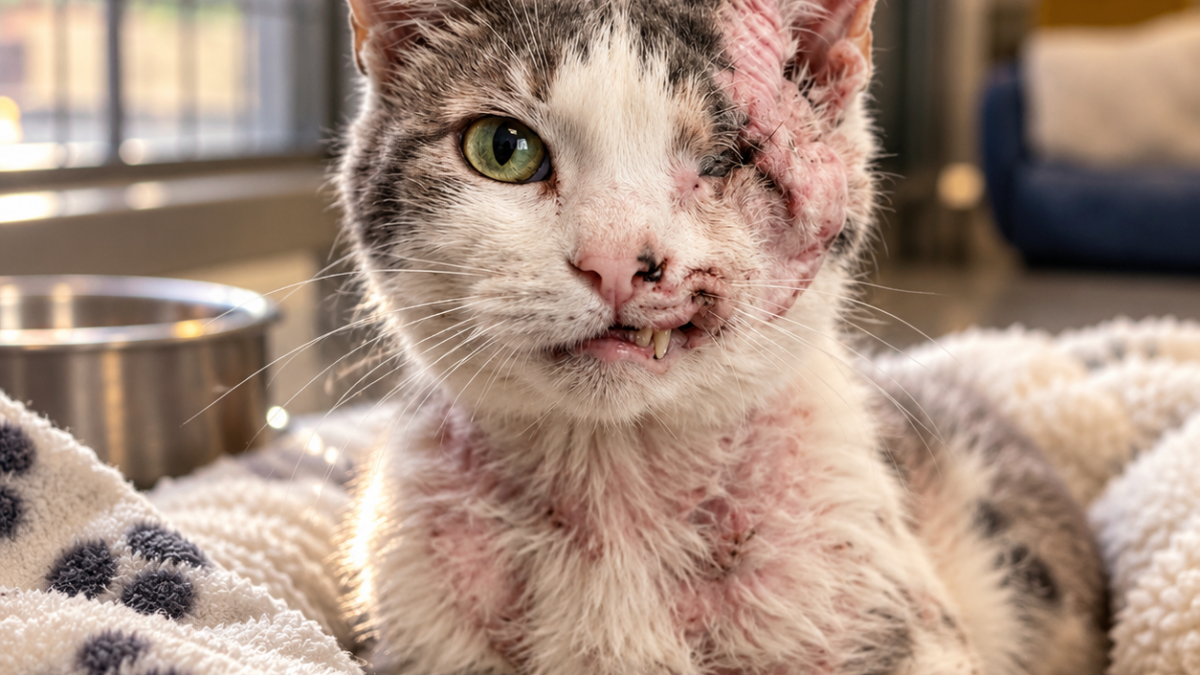
A little white and gray cat.
At first, nobody spoke.
Because the mind needs a second to understand what the eyes refuse.
She was curled into the far corner of the cage, so small she looked like something discarded. Her fur was stained. Her body trembled. Her face was turned partly away, and for one merciful second, the deputy could pretend she was only dirty.
Then she lifted her head.
That was when they saw what had been done to her.
One side of her face was still a cat’s face.
One green eye.
A few white whiskers.
A gray patch near her cheek.
The other side had been destroyed by old injuries and terrible healing. Her right eye was gone. The skin around it had closed into thick scar tissue. Part of her cheek was missing. Her upper lip was pulled out of shape, leaving a permanent glimpse of teeth that made her look fierce, though there was no fierceness in her at all.
Her ears were gone.
Not clipped.
Not clean.
Gone in the uneven way the veterinarian would later describe quietly, after stepping into the hallway because she needed a moment before finishing the report.
Her tail was gone too, leaving a short infected stump covered with scar tissue.
Her front paws were the worst.
Not because they looked the most shocking.
Because they told the clearest story.
Defense wounds.
Again and again, she had lifted those little paws against animals many times her size.
Again and again, her body had tried to say no.
Nobody had listened.
The deputy crouched in front of the cage.
“Hey, sweetheart,” he said.
His voice changed when he said it.
Everyone heard it.
The same man who had been giving commands all morning suddenly sounded like he was speaking to a sleeping child.
The cat blinked her one eye.
Then, impossibly, she tried to move toward him.
The cage door was rusted shut.
Animal control had to cut it open.
When they lifted her out, she weighed almost nothing.
One point nine kilograms.
Barely over four pounds.
A cat her size should have weighed nearly twice that.
She was wrapped in a towel and placed into a carrier. The dogs barked from the vans. Radios crackled. Officers spoke to each other. Evidence was marked. Photos were taken.
The cat did not fight.
She did not hiss.
She did not scratch.
She tucked her ruined face into the towel and made one tiny sound.
Not a growl.
Not a cry.
Something softer.
Something almost like relief.
Her first veterinary exam began less than an hour later.
I know because I was there.
My name is Hannah Mercer, and at the time I was a veterinary assistant at Briar County Animal Medical Center. We worked with animal control often enough that emergency cruelty cases did not surprise us anymore, though they still hurt. That morning, when the call came in, our lead veterinarian, Dr. Elaine Rhodes, stepped out of surgery prep and listened silently.
“How many?” she asked.
“Seventeen dogs,” animal control said. “And one cat.”
There was a pause.
“A cat?”
“Yes.”
Another pause.
“How bad?”
The officer did not answer immediately.
That told us enough.
By the time the transport van arrived, we had cleared the isolation room, laid out warmed towels, prepared fluids, pain medication, wound supplies, scales, gloves, and intake forms. The dogs came in first. They needed exams, photographs, sedation for some, emergency treatment for others.
Then came the carrier.
It was placed on the stainless steel table.
The room went quiet in a way I still remember.
Dr. Rhodes opened the carrier door slowly.
Inside, the cat lay folded in the towel.
“Hello, baby,” she whispered.
The cat lifted her head.
Nobody was ready.
You think you are ready because someone told you the case is bad. You think your professional face will hold because you have held it before. But there are injuries that do not just show pain. They show time. Long time. Repeated time. A life organized around suffering.
That was what her body showed.
Not one attack.
Not one accident.
A pattern.
Dr. Rhodes did not react loudly. She never did. She simply breathed in through her nose, gently slid both hands under the towel, and lifted the cat onto the exam pad.
The cat weighed 1.9 kilograms.
Her temperature was low.
She was dehydrated.
Her gums were pale.
Six teeth were missing or broken.
Her tail stump was infected.
Her ears had been torn away long before that day.
Her right eye was gone, the socket sealed beneath old scar tissue.
Her right cheek and lip had healed badly.
More than forty scars crossed her body.
Two ribs had been broken and had healed crooked.
Her front legs were marked with old defensive wounds.
There were repeated bite scars in the same places.
Over and over.
The medical report would later run four pages.
But reports make things tidy.
Bodies are not tidy.
Every line in that report represented something she had survived alone.
At some point during the exam, Dr. Rhodes placed two fingers under the cat’s chin to steady her head.
The cat leaned into the touch.
Just a little.
I saw it.
I thought I had imagined it.
Then I picked her up carefully so we could change the towel underneath her.
The second her body settled against my chest, she began to purr.
Not a faint purr.
Not a nervous vibration.
A real purr.
Deep.
Immediate.
Powerful.
Too big for a cat that small.
I froze.
Dr. Rhodes looked up from the chart.
The room stopped.
The cat pressed the intact side of her face against my scrub top and purred harder.
I felt it through my hands.
Through my chest.
Through every part of me that had been trying to stay professional.
“Oh,” I said.
That was all I managed.
Oh.
I had held frightened cats before.
I had held angry cats.
I had held cats too sick to respond.
I had held cats at the end of their lives, when purring sometimes comes as comfort, confusion, or pain.
But this was different.
This cat, who had every reason to fear hands, responded to being held as if she had been waiting two years for one gentle touch.
Dr. Rhodes turned away.
She pretended to check the medication drawer.
She did not need anything from it.
I knew because the drawer she opened held bandage scissors, not medication.
She just needed ten seconds where nobody saw her face.
The purring continued through the entire exam.
Through wound cleaning.
Through radiographs.
Through the ultrasound.
Through the tail stump cleaning.
Through bloodwork.
Through fluids.
Even when something hurt, she did not bite.
She did not lash out.
She only pressed her little body against whoever was holding her and purred like she believed we could still be good.
That was the part none of us knew what to do with.
Her injuries were terrible.
But her trust was devastating.
People think the worst thing to see in an abused animal is fear.
Sometimes it is not.
Sometimes the worst thing is hope that should have been destroyed and somehow was not.
By the end of that first day, we had stabilized her.
No infectious disease.
No obvious neurological damage.
No immediate organ failure.
Against all reason, her body was still functioning.
Broken, scarred, underweight, infected, exhausted—but functioning.
We placed her in a clean medical kennel with a soft bed.
Probably the first soft bed she had ever known.
She stepped onto it cautiously.
Her one eye widened.
She pressed one paw into the blanket.
Then another.
Then she began kneading.
Slowly.
Carefully.
Scarred paws opening and closing against fleece.
She turned around three times.
Lowered herself.
And fell asleep purring.
We stood outside the kennel watching her.
Nobody wanted to walk away first.
Dr. Rhodes finally said, “She needs a name.”
One of the technicians whispered, “Lace.”
We all looked at her.
She swallowed.
“Because her scars look like torn lace.”
Fragile.
Full of holes.
Still whole.
The name stayed.
Lace.
For the first week, Lace lived in our isolation ward.
Not because she was dangerous.
Because she was fragile.
Her body needed careful monitoring. She needed antibiotics, pain relief, nutritional support, wound care, and quiet. She ate small meals at first, then larger ones. Wet food mixed with warm water. High-calorie supplement. Tiny portions offered often, because starving bodies cannot be rushed back to health without risk.
Every time someone opened her kennel, she tried to come forward.
Not quickly.
She did not have much strength.
But she came.
One step.
Then another.
Then her head against a hand.
Then the purr.
Always the purr.
The first time I cleaned her face, I expected her to pull away. The scar tissue around her missing eye was sensitive. The edge of her damaged lip needed gentle care. I warmed the cloth, spoke softly, moved slowly.
She closed her eye.
Her one eye.
And purred.
“You don’t have to be this brave,” I whispered.
She kneaded the towel.
Maybe bravery had nothing to do with it.
Maybe Lace had simply decided that if kindness existed, she was going to walk toward it before it disappeared.
On the fourth day, one of the rescued dogs came into the clinic for recheck.
His name was Tank then, though the rescue later renamed him Milo. He was a broad-headed brown dog with scars across his shoulders and eyes that could not decide whether to trust the room. He passed the isolation door while being led to exam room two.
Lace saw him through the lower glass panel.
My whole body tightened.
I expected panic.
I expected hissing.
I expected her to retreat to the back of the kennel.
She did none of those things.
She stood.
Slowly.
Walked to the kennel door.
And chirped.
A tiny sound.
Curious.
Soft.
Tank froze.
The handler froze.
I froze.
Lace pressed her cheek against the kennel bars.
Tank lowered his head.
For one suspended second, a dog rescued from violence and a cat used as bait looked at each other through a clinic door.
Then Tank wagged his tail once.
Just once.
Lace purred.
I had to sit down afterward.
Not because it was cute.
Because I could not understand it.
I still cannot.
People ask about that sometimes when they hear Lace’s story.
How could she trust dogs?
How could she rub against them later?
How could she not hate them?
I do not have an answer.
I only know animals are not symbols. They are individuals. Trauma changes them, but it does not always change them in ways humans expect. Some become fearful. Some become defensive. Some become withdrawn. Some remain open in ways that feel almost impossible.
Lace did not seem to blame every dog for what humans had forced dogs to do.
That was more grace than most people manage.
After ten days, she was transferred to a specialized foster home.
Her foster mother was named Rebecca Lane.
Rebecca had taken cruelty cases for years. Not easy cases. Not pretty cases. The ones who needed medication schedules, quiet rooms, patience, and a person willing to celebrate tiny victories no one else would notice.
She had two calm senior dogs, three resident cats, and a spare room prepared before Lace arrived.
Soft bed.
Low litter box.
Water fountain.
Heating pad.
No sudden noises.
No expectations.
Rebecca came to the clinic with a carrier lined in fleece. When she saw Lace, her eyes filled, but she smiled anyway.
“Hello, beautiful girl,” she said.
Beautiful.
Not poor thing.
Not monster.
Not tragedy.
Beautiful.
Lace lifted her head.
Rebecca sat on the floor.
She did not reach immediately.
She waited.
That mattered.
Lace stepped out of the kennel on unsteady legs and walked straight into Rebecca’s lap.
No hesitation.
No fear.
She placed the intact side of her face against Rebecca’s palm and stayed there.
For twenty minutes.
The clinic moved around them.
Phones rang.
Doors opened.
Dogs barked.
People passed.
Rebecca sat on the floor with one hand curved around Lace’s small body, crying silently while Lace purred into her palm.
Finally, Rebecca whispered, “Okay. I understand. You’re coming home.”
The first morning in foster, Lace climbed into Rebecca’s lap during breakfast.
Rebecca had barely poured coffee. She sat at the kitchen table, trying not to crowd the new cat, when Lace walked out of the spare room, crossed the tile, and placed one paw on her slipper.
Rebecca froze.
Lace climbed slowly.
Not gracefully.
Her body was still weak. Her balance was different without a tail. Her ribs had healed wrong, and sometimes her movement carried a slight hitch.
But she climbed.
Into Rebecca’s lap.
Then she pressed the good side of her face into Rebecca’s palm.
And stayed there.
Twenty minutes.
The next morning, she did it again.
And the next.
And the next.
It became their ritual.
Coffee.
Sun through the kitchen window.
Lace in Rebecca’s lap.
One scarred body resting against one gentle hand.
Rebecca sent us updates constantly.
Day 1: She ate well and found the heated bed.
Day 2: She purred when I said her name.
Day 4: She met the dogs through the baby gate. No fear. I cried.
Day 6: She rubbed against Jasper’s nose.
Jasper was one of Rebecca’s senior dogs.
Large.
Gray-muzzled.
Gentle enough that Rebecca trusted him with kittens.
Still, when I saw the video, I held my breath.
Lace walked toward him slowly. Jasper lay on the floor, chin down, eyes soft. Lace stopped inches from his nose.
Then she leaned forward and rubbed the intact side of her face against him.
Jasper did not move.
He only closed his eyes.
Lace purred.
Rebecca’s voice shook behind the camera.
“I don’t know how she does this,” she whispered.
None of us did.
The world had given Lace every reason to become sharp.
Instead, she remained soft.
Not untouched.
Never untouched.
Her body remembered.
She startled at sudden metallic sounds. She disliked cages. She did not like being approached from her blind side. She sometimes woke from sleep and looked around quickly, as if checking whether the room had changed into the old place.
But she did not become cruel.
There is a difference between being damaged and becoming what damaged you.
Lace proved that every day.
Her recovery was not simple.
People like simple recovery stories.
Rescued.
Loved.
Healed.
But healing is not a straight road.
There were infections to manage.
Weight to gain.
Dental surgery to plan.
Scar tissue to monitor.
Pain that came and went with weather.
A tail stump that needed weeks of treatment.
A damaged mouth that made eating messy.
A missing eye that changed how she moved through space.
She bumped into furniture at first if something changed position. Rebecca learned to keep chairs tucked in, laundry baskets off the floor, doors either fully open or fully closed.
Lace learned too.
She mapped the house.
Sunroom.
Kitchen.
Hallway.
Rebecca’s bedroom.
The soft rug near the sofa.
Jasper’s bed, which she stole within three weeks.
The water bowl.
The window where birds came in the afternoon.
Her confidence grew in small increments.
The first time she jumped onto the couch, Rebecca sent a message in all capital letters.
SHE DID IT.
The first time she played, it was with a feather toy.
At first, she only watched it.
One eye tracking.
Body still.
Then one paw lifted.
Swatted.
Missed.
Swatted again.
Caught the feather.
Rebecca laughed.
Lace froze at the sound.
Then, when nothing bad happened, she swatted again.
That became another ritual.
Feather toy after dinner.
Lap during breakfast.
Sunroom naps.
Jasper’s stolen bed.
A life made of small safe repetitions.
The legal case continued in the background.
The dogfighting ring made local news. There were arrests. Charges. Court dates. Evidence hearings. Some of the dogs went to specialized rescues. Some needed long rehabilitation. A few could not be safely placed, which is one of the truths rescue people carry quietly because the public prefers miracles without shadows.
Lace was mentioned in the case file.
One cat recovered from rear structure.
Severe injuries consistent with prolonged use as bait animal.
I hated the phrase.
One cat.
As if she were a footnote.
As if her suffering existed only to support charges connected to the dogs.
But Lace was not a footnote.
She was a whole life.
A life that had been treated like disposable equipment.
A life that still purred.
Dr. Rhodes completed the full medical summary for the court.
Four pages.
No drama.
Just facts.
Missing pinnae bilaterally.
Tail partially amputated by trauma.
Healed rib fractures.
Multiple scars consistent with repeated bite wounds.
Right eye absent.
Chronic facial trauma.
Dental loss.
Evidence of prior pregnancy.
That last line broke Rebecca.
Evidence of prior pregnancy.
The veterinarian believed Lace had delivered at least one litter during captivity.
No kittens were found at the property.
No one wanted to imagine what had happened to them.
For several days after learning that, Rebecca said Lace carried a stuffed toy around the house. It was a small gray mouse with one felt ear missing. Lace would pick it up, move it from room to room, and place it near her bed.
Maybe it meant nothing.
Maybe it meant everything.
Animals do not explain their grief to us.
We only witness the shape of it.
Rebecca kept the mouse.
Lace still has it.
Months passed.
Her weight doubled.
Her coat grew softer.
The infection cleared.
Her remaining eye brightened.
She began greeting visitors at a distance, then closer, then directly if they sat quietly and let her decide.
Children were told the rules.
Do not reach fast.
Do not touch her blind side.
Let her come to you.
Most children listened better than adults.
One little girl from Rebecca’s neighborhood asked, “Why does she look like that?”
Rebecca answered carefully.
“Because someone hurt her, and then people helped her heal.”
The girl thought about that.
Then asked, “Can I say hi gently?”
That was the right question.
Lace approached.
Sniffed the child’s fingers.
Rubbed her cheek against them.
The little girl smiled with her whole face.
“She’s soft,” she whispered.
Yes.
After all that, Lace was still soft.
That became the sentence I could not stop thinking about.
After all that.
Still soft.
The rescue posted her update six months after the raid.
The photo showed Lace in Rebecca’s sunroom. Morning light across her back. One eye closed in contentment. No ears. No tail visible. Scarred face turned toward the camera. Beautiful in a way that made people stop scrolling.
The caption read:
Lace survived what no animal should ever endure. She is safe now. She purrs every morning in her foster mother’s lap. She trusts humans. She trusts dogs. She reminds us that survival is not only staying alive. Sometimes survival is keeping the part of you that can still receive love.
The post spread farther than anyone expected.
Messages came in from everywhere.
People cried.
People donated.
People asked to adopt her.
Rebecca read applications carefully.
Too carefully, some people thought.
But Lace was not a symbol to be claimed by whoever wrote the most emotional message. She was a cat with needs. She needed stability, patience, medical follow-up, quiet routines, and people who understood that love does not erase trauma.
Then something unexpected happened.
Rebecca realized she could not let her go.
It was not selfish.
Or maybe it was, but in the best way.
Foster failure, rescue people call it.
The phrase sounds like defeat.
It is sometimes victory.
Rebecca called the rescue director and said, “I think she’s home.”
The director laughed softly.
“We were waiting for you to admit it.”
The adoption paperwork was signed on a rainy Tuesday.
Lace slept through most of it on Jasper’s bed.
Officially, she became Lace Lane.
Rebecca celebrated by buying her a new blue blanket.
Lace ignored it for three days.
Then slept on the cardboard box it came in.
Because she was still a cat.
That mattered too.
She was not only her trauma.
She was also picky.
Stubborn.
Messy with wet food.
Terrible at judging jumps.
Obsessed with Rebecca’s slippers.
Suspicious of bananas.
Fond of warm laundry.
Determined to sit on paperwork.
She had survived horror, yes.
But she also knocked pens off the coffee table and looked offended when gravity worked.
Life returned to her not as one great healing moment, but as a thousand ordinary cat things.
That may be the kindest ending any abused animal can have.
To become ordinary again.
To be more than the worst thing that happened.
Today, Lace still climbs into Rebecca’s lap every morning during breakfast.
She places the intact side of her face against Rebecca’s palm.
She stays there for twenty minutes.
Sometimes longer.
Rebecca does not rush her.
The coffee gets cold.
The toast waits.
Emails remain unanswered.
The world can wait twenty minutes for a cat who waited two years for gentleness.
Her scars remain.
They always will.
Thin lines across her body.
A damaged lip.
A missing eye.
No ears to twitch toward morning birds.
No tail to curl around her paws.
The torn-lace pattern of a life that should have ended behind a barn and did not.
Visitors sometimes stare before they can stop themselves.
Rebecca does not scold them.
She only says, “She knows she looks different. Tell her she’s beautiful anyway.”
So they do.
And Lace, who has no reason to believe humans deserve another chance, often gives them one.
She walks forward.
She sniffs a hand.
She purrs.
That is what people find hardest to understand.
Not the survival.
Not the surgery.
Not even the trust.
The purr.
That powerful, immediate purr.
The sound that filled the exam room on her first day of safety.
The sound that made a veterinary assistant leave the room to cry.
The sound that still starts every morning in Rebecca’s kitchen.
I have thought about that purr for a long time.
A purr is not always happiness. Veterinarians know that. Cats purr when they are comfortable, yes, but also when they are hurt, frightened, giving birth, dying, trying to soothe themselves.
But Lace’s purr was not only self-soothing.
I felt it.
I was holding her.
That purr moved toward us.
It rose the moment gentle hands replaced cruel ones.
It was not forgetting.
Cats do not forget.
Bodies do not forget.
Her body remembered everything.
But maybe that purr was her answer.
Not forgiveness.
Not approval.
Not innocence.
An answer.
You hurt me.
But I am still here.
You made me a thing.
But I am still someone.
You taught me pain.
But I still recognize kindness.
That is not weakness.
That is strength beyond anything I know how to name.
Some animals survive by becoming untouchable.
Some survive by disappearing inside themselves.
Lace survived and still reached back.
No ears.
No tail.
One eye.
Half a face.
More than forty scars.
Broken ribs that healed wrong.
A body used by people who should have protected her.
And still, when warmth finally came, she did not turn away.
She purred.
She trusted.
She stepped toward open hands instead of running from them.
That does not mean she forgot.
It means pain did not get to own the whole story.
For two years, Lace lived in a place where she was not meant to survive.
Then one morning, someone opened a rabbit cage behind a barn and lifted her into the first gentle arms she may have ever known.
And the little cat with half a face filled the room with a purr so loud that everyone who heard it understood the same impossible truth.
They had taken so much from her.
But they had not taken her softness.
They had not taken her will.
They had not taken the part of her that could still feel love and answer it.
That is why Rebecca named her Lace.
Fragile.
Torn.
Full of holes.
But still whole.
And every morning, when she presses her scarred face into a waiting palm and begins to purr, she proves it all over again.


