A 24-Year-Old Woman in a Wheelchair Asked a Retired Navy SEAL, “Is This Seat Taken?”—Then His Combat K9 Suddenly Stepped Between Her and the Crowd.
A 24-Year-Old Woman in a Wheelchair Asked a Retired Navy SEAL, “Is This Seat Taken?”—Then His Combat K9 Suddenly Stepped Between Her and the Crowd.
I came to that train station because I wanted to disappear into the storm and be left alone.
Then a young woman in a wheelchair rolled up beside me and asked if the empty space was taken.
Before I could answer, my retired combat dog stood between her and the crowd, bared his teeth, and told me something my eyes had not seen yet: someone was hunting her.
My name is Garrett Hayes.
I am thirty-four years old, retired Navy SEAL, former special operations handler, and a man who has spent the last two years learning that surviving war and coming home from war are not the same thing.
That night in Seattle, I did not want conversation.
I did not want company.
I did not want anyone looking at me long enough to decide I had a story.
I only wanted to sit in a shadowed corner of King Street Station, wait out the winter storm, and board my southbound train when the rails finally cleared.
The storm had turned the station into a pressure cooker.
Freezing rain hammered the arched windows. Announcements crackled overhead and changed nothing. Every delayed train added more bodies to the terminal until the whole place smelled of wet wool, coffee, diesel, and frustration. Travelers camped along walls. Children cried into their mothers’ coats. Suitcases blocked pathways. People fought over outlets like they were life rafts.
I had chosen an alcove near the old east concourse because it gave me three things I still needed even in civilian life.
A wall behind me.
A clear line of sight.
And enough darkness to discourage strangers.
Titan lay across my boots.
Ninety pounds of German Shepherd muscle, black-and-tan coat, scar along one ear, and eyes that had seen places no dog should ever have to remember.
He had served three tours with me.
Explosive detection.
Suspect apprehension.
Room clearing.
Perimeter response.
Titan had found pressure plates under dust, wires beneath prayer rugs, and men hiding where men should not have been able to hide. He had saved my life twice in ways that ended up on paper and once in a way no report ever captured because the men writing the report were too busy bleeding to understand what had happened.
Now he was retired.
Technically, he was my service dog.
That was the language civilians understood.
What Titan actually was, was the last living piece of the war that had not turned against me.
In crowds, he behaved like a statue.
Toddlers could drop crackers beside his paws. Commuters could roll suitcases over his tail. Someone could spill coffee three feet from his muzzle, and unless I gave a command, Titan would not move.
Disciplined apathy.
That was what we called it in the teams.
A dog who sees everything and reacts to nothing unless reaction becomes necessary.
At 6:14 p.m., the statue broke.
I felt it before I saw it.
PART2:
The weight across my boots changed.
Titan’s head came up.
His ears pinned forward.
Not curious.
Not alert.
Targeted.
Every muscle along his back tightened beneath his coat. A low vibration built under my palm when I dropped my hand to his neck.
A growl.
Not loud.
Not for show.
The kind of sound he made in places where men hid behind walls with rifles and waited for us to make the first mistake.
My eyes moved before my thoughts did.
Exits.
Upper walkway.
Ticket kiosks.
Reflection in the glass.
Blind corner near the restrooms.
Maintenance door.
Families.
Luggage.
Security cameras.
Then she appeared.
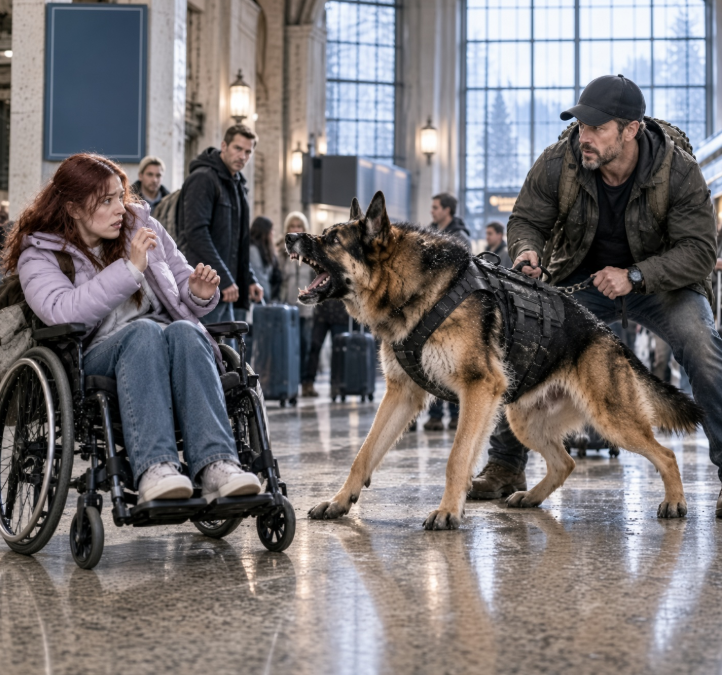
A young woman in a manual wheelchair was fighting her way through the crowd.
She was maybe twenty-four.
PART3:
Pale face. Chestnut hair damp from rain, strands stuck to her cheeks. Gray coat expensive once, now scuffed at the cuffs and stained along one sleeve. A medical brace secured her lower spine beneath the coat, visible for half a second when she twisted to avoid a suitcase. Her hands were tight on the push rims, knuckles white from exhaustion.
The crowd treated her the way crowds treat anyone who cannot move at their speed.
Badly.
People stepped in front of her chair.
A man with a rolling suitcase clipped her wheel and did not turn around.
A woman backed into her and snapped, “Watch it,” as if the chair had offended her.
The young woman apologized to people who should have apologized to her.
She had been moving too long. I could see it in her shoulders. The tremor in her arms. The way her breathing caught when she pushed over a crack in the old floor tile.
Every accessible seating area was full.
Then she saw the small space beside me.
Most people had avoided it.
Not because of a sign.
Because of me.
Because of Titan.
Because men like me carry an atmosphere even when we are trying not to. People feel it. They may not know why they take a wider path around us, but they do.
This young woman was too exhausted to care.
She rolled toward the alcove.
Her wheels squeaked softly on the wet floor.
“Excuse me,” she said.
Her voice trembled, partly from cold, partly from the kind of fatigue that makes pride difficult to maintain.
“Is this space taken? I just need to stop moving for a minute.”
I was already reaching for my duffel bag.
I meant to move it, nod once, and leave her alone.
That was all.
Then Titan stood.
No command.
No warning.
No hesitation.
My grip tightened on the leash, and a reprimand was halfway to my tongue when I realized he was not moving toward her.
He was moving around her.
Titan stepped between her wheelchair and the main concourse, placed his body squarely in the gap, and sat down like a barricade.
He did not look at the woman.
He faced the crowd.
His hackles rose in a hard ridge down his spine.
His upper lip lifted just enough to show teeth.
The growl deepened.
People nearby shifted away.
The woman shrank back in her chair, both hands coming up.
“I’m sorry,” she whispered. “I’ll leave. I didn’t mean to startle him.”
“Don’t move.”
My voice came out lower than I intended.
She froze.
“Is he going to bite me?”
“No.”
I was watching Titan’s eyes.
“He’s not looking at you.”
Her breathing hitched.
“He’s protecting you.”
That sentence changed the temperature in the alcove.
The woman stared at Titan.
Then at me.
“Protecting me from what?”
“I don’t know yet.”
But Titan did.
That was the part that mattered.
Titan was trained to protect me.
Not strangers.
Not random civilians in train stations.
Me.
For him to expand his perimeter around this woman without a command meant he had identified something I had not.
A scent.
A posture.
A chemical spike of fear.
A threat vector.
Something.
My eyes moved over her quickly.
Not in a way meant to be rude.
In a way meant to keep her alive.
Dilated pupils.
Right hand clutching a thick manila envelope against her chest.
Old fear beneath fresh panic.
No luggage except a small backpack hooked to the rear of her chair.
Cash traveler.
Not comfortable in crowds.
Back to the wall instinctively when possible.
Looking at reflections instead of faces.
This was not a woman on vacation.
This was a woman running.
“What’s your name?” I asked.
She swallowed.
“Harper.”
“Last name.”
“Lawson.”
“I’m Garrett. That’s Titan.”
Titan leaned backward without taking his eyes off the concourse, pressing his flank against her left knee. Not hard enough to push. Just enough contact to ground her.
He used to do that to me after nightmares.
Before I knew I was awake.
Before I knew which room I was in.
Before I remembered I was not still under a collapsed wall with dust in my mouth and a dead radio against my ribs.
Harper looked down at him, confused.
“Why is he doing that?”
“Helping you breathe.”
“I’m breathing.”
“Not well.”
She tried to argue.
Then inhaled sharply and realized I was right.
“Talk to me, Harper.”
Her eyes flicked toward the crowd.
“About what?”
“Why you paid cash for three cabs in a blizzard to get here.”
All the color left her face.
I had not guessed.
I had read what she gave me.
Three things made it clear. Her coat was too wet for a direct drop-off. Her chair tires had grit from more than one street surface. A taxi receipt stub was tucked halfway into her sleeve because she had forgotten to hide it after handing over cash.
Tradecraft.
Messy, desperate tradecraft.
But tradecraft all the same.
“How did you—”
“What’s in the envelope?”
She looked at Titan.
Then at me.
Eight months of not trusting anyone battled with the fact that a combat dog had just placed himself between her and the world.
Her voice dropped to a whisper.
“I was a forensic accountant.”
“Was?”
“For a logistics firm. Northwest freight contracts. Port movement. Warehousing. I found discrepancies.”
“How big?”
“Millions.”
“That’s not a discrepancy. That’s a system.”
She shut her eyes.
“I traced shell companies. False freight invoices. Laundered payments. Offshore transfers. It connected to a cartel distribution network moving through the Pacific Northwest.”
My hand tightened around the leash.
“I brought it to my supervisor,” she continued. “Three days later, I was crossing a street after work when a black SUV ran a red light and hit me.”
Her hand moved unconsciously to the brace at her spine.
“They called it a hit-and-run. Possible drunk driver. No suspect. No plate. No witnesses who wanted to remember anything.”
“But you knew.”
“I knew.”
She looked down at her legs.
“I survived. My spine didn’t. I spent months in a rehabilitation clinic under a different name. Tomorrow morning, I have a meeting in Portland with an assistant U.S. attorney.”
“The envelope.”
“Hard drive. Original ledgers. Backups. Names.”
That explained the fear.
That explained Titan.
A paralyzed whistleblower carrying cartel-linked financial evidence, stranded in a public transit hub during a storm with limited exits and too many civilians.
Tactical nightmare.
“You think they found you?”
“I didn’t think so.”
Her answer died when Titan’s growl changed.
It dropped half an octave.
He took one step forward.
His body became a drawn bow.
“Contact,” I whispered.
There are moments when a crowd shows you the threat by moving around it.
Everyone else in the terminal flowed, shifted, searched screens, argued, paced, carried bags.
One man did not.
Dark gray raincoat.
Average height.
Hands in pockets.
Standing near the digital departure board.
Not watching the trains.
Watching us.
His feet were placed too evenly. Weight distributed. Balanced. Not waiting. Ready.
“Gray raincoat,” I said without moving my head. “Twelve o’clock. Forty yards. Near the monitors.”
Harper leaned slightly around Titan’s shoulder.
Her breath broke.
“Oh, God.”
“You know him?”
“That’s Derek Mitchell.”
“The driver?”
“No.” Tears filled her eyes. “The private security contractor my firm hired after I reported the missing money. He took my initial statement.”
“Then he knows exactly what you look like.”
Derek Mitchell stared directly at me.
Then he pulled a phone from his pocket.
He did not look away while he lifted it to his ear.
“He’s not alone,” I said.
Harper’s hands clenched around the envelope.
Titan’s head snapped right.
Near the restrooms, a second man in a dark jacket began moving against the flow of passengers. Slow. Direct. Closing angle.
Two hostile vectors.
One principal.
No friendly security close enough to matter.
“Harper,” I said.
Her eyes were wide.
“Take the brakes off your chair.”
“What?”
“Brakes. Off.”
“We can’t outrun them.”
“We’re not running.”
I stood.
At full height, I could see over most of the crowd.
Derek slowed but did not stop.
The second man kept coming.
Titan rose beside me, teeth fully visible now, his growl vibrating through the floor.
“You’re going to hold onto my belt with one hand and that envelope with the other,” I said.
“I can’t—”
“You can.”
Her jaw shook.
Then she reached out and grabbed the back of my jacket.
“Titan,” I said. “Stand.”
The German Shepherd shifted forward.
I took the push handles of Harper’s chair.
Derek’s right hand disappeared deeper into his raincoat.
I barked one word.
“Clear.”
Titan exploded with a single concussive bark.
The sound tore through the station.
Every civilian within twenty feet reacted on instinct. People scrambled away, shouted, dragged luggage, grabbed children, spilled coffee. A clean path opened through chaos.
To untrained eyes, panic.
To me, cover.
“Move,” I said.
I drove Harper’s chair hard to the east.
Not toward the main exits. The glass doors were jammed with stranded passengers, and the icy pavement outside would give her no advantage.
Instead, I aimed for the roped-off section near the defunct concourse.
Maintenance corridor.
Personnel doors.
Concrete funnels.
Controlled angles.
Behind us, Harper gasped.
“They’re following.”
“I know.”
Derek was no longer pretending. He shoved through passengers, eyes locked on us, right hand still inside the coat.
The second man cut from the right.
Heavyset. Dark blue bomber jacket. Folded newspaper in one hand.
Too stiff.
Too careful.
I saw the dull metallic gleam under the paper.
Suppressed pistol.
“Contact right.”
The words came out of me like old muscle memory.
The heavyset man lifted his arm.
“Titan, fass.”
The command cracked through the air.
Titan launched.
He covered the distance in less than two seconds, a black-and-tan missile of muscle and teeth. The man had time to widen his eyes before Titan hit him in the chest.
The dog did not go for the throat.
He went for the weapon arm.
His jaws locked on the forearm and drove the muzzle off-line. The pistol clattered onto the stone floor. The man screamed and dropped hard, Titan using his full weight to pin him.
I did not stop.
I pushed Harper past, snatched the dropped weapon off the floor without breaking stride, and called Titan back.
He released instantly and fell in beside us.
We hit the heavy wooden double doors marked STATION PERSONNEL ONLY.
They slammed open into a dim corridor smelling of old dust, damp concrete, and ozone.
The noise of the station dropped behind us like a curtain.
Harper was breathing hard.
“We’re trapped. This only goes to the old freight elevators and loading dock.”
“I know.”
She stared up at me.
“I’m funneling them.”
“What?”
“Out there, they had three hundred sixty degrees. In here, they have one door.”
I pushed her behind a rusted industrial dumpster near the freight elevator doors, placing her in a protected corner where concrete covered her back and sides.
“Stay here. Keep the drive under your coat.”
She clutched the envelope tighter.
I crouched in front of Titan.
His eyes burned.
“Watch her.”
The word was softer than an attack command.
More serious.
Titan moved in front of Harper’s chair and planted himself there.
I stepped into the shadows behind a row of storage lockers, the captured pistol low and steady.
We waited.
Ten seconds.
Twenty.
Rain hammered the high barred windows.
Somewhere beyond the walls, an announcement echoed through the station, distorted and useless.
Then Derek Mitchell’s voice came down the corridor.
“You’re making a mistake, soldier.”
He had not stepped through the doors yet.
Smart.
Using acoustics.
Testing our position.
“I ran your plates in the lot,” Derek called. “Hayes. I know who you are. Discharged. Living off a pension in the woods. You don’t want this fight.”
I said nothing.
“We don’t care about you or the dog. Push the girl’s chair into the hallway with the envelope, and you can walk away.”
Harper’s breathing shook.
Titan nudged her knee once with his nose.
Not moving from his guard position.
Just enough to remind her she was not alone.
“She’s dead either way,” Derek called. “You think a U.S. attorney can protect her? The people I work for own cops, judges, politicians. They’ll kill her in federal custody if they have to.”
I adjusted my grip.
He was talking too much.
That meant he needed something.
The drive.
Harper alive or dead, maybe, but the drive first.
“Last chance, Hayes.”
The double doors creaked.
Then something silver rolled across the floor.
Canister.
Hissing.
“Gas,” I shouted. “Cover your face.”
Gray smoke poured into the corridor.
Harper yanked her scarf over her mouth and nose.
Titan sneezed once, shook his head, then held position.
Two figures breached through the smoke.
Derek and another contractor.
Both wearing tactical respirators.
Weapons up.
Flashlights cutting through the haze.
They expected choking civilians.
They expected panic.
They did not know what kind of dark I had learned to work in.
I held my breath, stepped from behind the lockers, and fired twice.
Controlled.
Low light.
Spatial memory.
The second contractor dropped with a shoulder hit and spun into the wall, weapon skittering away.
Derek moved fast.
Better than average.
He rolled under my line, came up behind a concrete pillar, and fired blind down the hallway.
The bullets chewed metal from the lockers. Sparks spat into the smoke. One ricochet snapped past Harper’s ear and shattered a glass fixture overhead.
She screamed.
I was pinned.
The smoke thickened.
My eyes burned.
My lungs wanted air.
Derek had the angle now. If I stepped out wrong, Harper died. If I waited too long, the gas would make the decision for me.
I looked at Harper.
Then at the dumpster.
Then at Titan.
“Harper,” I shouted. “Brakes off.”
“They are.”
“Push the dumpster.”
“What?”
“Use the chair. Push it now.”
She did not ask again.
Fear can freeze people.
It can also turn them into something stronger than they knew how to be.
Harper leaned forward, planted both hands on the rusted metal side of the dumpster, and pushed with everything she had left. Her wheelchair rolled back half an inch, then she locked her shoulders and drove forward again.
The dumpster groaned.
Then moved.
Metal screamed across concrete.
Derek’s flashlight snapped toward the sound.
So did his weapon.
That was the opening.
“Titan,” I roared. “Packen.”
The elite takedown command.
Titan flew.
Not ran.
Flew.
He used the side wall like a springboard, launched through the smoke over the moving dumpster, and hit Derek high.
The respirator came off first.
Then the weapon.
Titan’s jaws clamped around Derek’s wrist before he could fire. Momentum carried them both backward onto the concrete.
I was on him one second later.
I kicked the gun away, drove a knee into his shoulder, and slammed the butt of the captured pistol into the side of his head.
Derek went limp.
“Titan, out.”
Titan released instantly.
He stepped back, chest heaving, eyes still hard.
The corridor fell quiet except for the dying hiss of the canister and the distant rumble of an arriving train.
I crossed to the wall and smashed the red emergency ventilation button.
Industrial fans kicked on overhead.
The smoke began to pull away in slow, ugly ribbons.
Harper was still behind the dumpster.
Face streaked with soot and tears.
Scarf pressed to her mouth.
The manila envelope locked against her chest.
She had not dropped it.
Not once.
I crouched in front of her.
“You hit?”
She shook her head.
“Can you breathe?”
She nodded, then coughed hard.
I looked at the dumpster, now several feet from where it had been.
“You pushed the hell out of that thing.”
A laugh broke out of her.
Not because anything was funny.
Because she was alive.
Titan walked to her chair and sat beside her.
The monster from three seconds ago was gone. His ears softened. His mouth opened slightly. He looked up at her with patient, intelligent eyes.
Harper reached toward him with a trembling hand.
“May I?”
I nodded.
Titan leaned into her palm.
She stroked the thick fur between his ears.
“He saved my life.”
“We both did.”
Thirty minutes later, the loading dock flashed red and blue.
Seattle police.
Federal agents.
Paramedics.
Transit security trying to look useful.
Harper had managed to power on her phone and call the emergency number for the assistant U.S. attorney’s office. That call triggered a federal response faster than I expected, which told me Harper’s evidence had already been taken seriously by someone with weight.
An FBI special agent named Donovan secured the hard drive in an evidence bag.
She looked at the contractors being loaded under guard.
Then at Harper.
“Ms. Lawson, you have no idea what kind of hornet’s nest you just kicked open.”
Harper’s hands shook in her lap.
“I have some idea.”
Donovan’s expression softened slightly.
“We’re putting you on federal transport tonight. New route. New team. No public terminals.”
Harper nodded.
The adrenaline was leaving her now.
That is the dangerous part after violence.
People think the danger ends when the guns are gone.
Sometimes the body only begins paying the bill then.
I stepped away while the agents talked.
Titan sat at my side, calm again, eyes on Harper.
A local detective asked for my statement. I gave him the parts he needed. Not all of it. Not the parts that belonged to places the government had sealed years ago. Not the parts where smoke in a corridor became smoke in a cave halfway around the world. Not the part where Titan’s bark snapped me back to the present because for three seconds I had been twenty-seven again and certain we were not all getting out.
When the detective turned to speak with another officer, I picked up my duffel.
Harper saw me from across the dock.
“Garrett.”
I stopped.
She rolled toward me, blanket around her shoulders, envelope gone now, replaced by two federal agents who did not let anyone stand too close.
Snow blew in through the open loading doors.
“Where are you going?” she asked.
“Train’s canceled. I’ll find another way south.”
“They still need your statement.”
“They have enough.”
She looked down at Titan.
Then back at me.
“I don’t know how to thank you.”
“You already did.”
“I didn’t do anything.”
“You pushed the dumpster.”
Her mouth trembled.
“That was not exactly heroic.”
“It was exactly what needed doing.”
She absorbed that.
Maybe no one had said something like that to her since the accident. Maybe people had spoken to her as injured, fragile, inspiring, tragic, brave in ways that made them feel better. But sometimes survival is not a speech. Sometimes it is a woman in a wheelchair pushing a rusted dumpster through tear gas because nobody else can do it from where she is.
Harper looked at Titan.
“He knew.”
“Yes.”
“How?”
I followed her gaze to the dog.
Titan’s ears flicked toward her voice.
“He reads things people miss.”
“Fear?”
“Fear. Focus. Intent. Body chemistry. Patterns. The way a predator moves in a crowd.”
“And he chose to protect me.”
I looked at Titan.
Then at the empty space in the station where she had first rolled up beside me.
“You asked if the seat was taken,” I said. “Titan decided it belonged to you.”
For the first time since I met her, Harper smiled.
Small.
Exhausted.
Real.
“Will I see you again?”
I could have said no.
That would have been easier.
Clean exit.
No attachments.
No names exchanged beyond necessity.
That was how I had survived the first two years after leaving the teams.
Keep moving.
Stay useful.
Do not belong anywhere long enough for anyone to expect you to stay.
But Titan had shifted his weight beside me.
Toward Harper.
As if the answer had already been decided by something smarter than me.
I took an old field card from my wallet, one with my number written across the back in black marker. I handed it to her.
“If your federal protection team starts cutting corners, call me.”
She took it carefully.
“Is that a joke?”
“No.”
Agent Donovan, standing nearby, heard me.
Instead of taking offense, she said, “Fair.”
Harper looked at the card like it weighed more than paper.
“Thank you, Garrett.”
I tipped the brim of my cap.
“Keep fighting, Harper.”
Then Titan and I walked out into the Seattle snow.
Not because the story was over.
Because my part in that night was.
At least, that was what I told myself.
Two weeks later, the first arrests made national news.
A logistics executive.
Two shell company operators.
A port security supervisor.
A deputy prosecutor.
Three cartel intermediaries.
Then more.
Harper’s ledgers did what bullets and threats could not stop them from doing.
They spoke in numbers.
Numbers are stubborn witnesses when kept properly.
Harper testified behind closed doors first. Then before a grand jury. Eventually, months later, in open court.
I know because she called once before the first hearing.
Not to ask for help.
Just to hear Titan bark in the background.
He did.
Once.
Loud enough that she laughed.
That was the sound I remembered most.
Not the gunfire.
Not the gas.
Not Derek Mitchell’s threats echoing down concrete.
Harper laughing because a dog who had once turned himself into a wall between her and death was now barking at a squirrel outside my cabin like the fate of civilization depended on it.
A year later, I received a letter.
Real paper.
Handwritten.
Harper had moved into a new apartment with wide doorways, good locks, and a view of the river. She was working again, not for a private firm, but as a consultant helping federal investigators follow money through systems designed to hide it.
The last paragraph said:
I used to think the accident made me helpless. Then one night in Seattle, a stranger, a dog, and a dumpster proved I still had force in the world. Thank you for seeing that before I did.
I read that line twice.
Then I folded the letter and placed it in the drawer where I kept the few things I did not want to lose.
Titan lay by the door, watching me.
“You were right about her,” I said.
His tail thumped once.
Just once.
Like any professional, he did not need praise repeated.
People called Titan a hero after that night.
They were right.
But not completely.
Heroism is not always charging through smoke.
Sometimes it is noticing fear in a crowded room before anyone else cares enough to look.
Sometimes it is standing between a vulnerable person and a threat that has not yet shown its weapon.
Sometimes it is a young woman who has already lost the use of her legs refusing to let powerful men bury the truth.
Sometimes it is taking the only strength you have left and pushing a dumpster three feet through hell because three feet is enough.
I went to King Street Station because I wanted to be alone.
Harper came there because she had nowhere safe left to go.
Titan saw the truth before either of us said it out loud.
That empty space beside me was not taken.
It was waiting.
And when Harper Lawson rolled up and asked, “Is this seat taken?” my dog stood, faced the crowd, and answered for both of us.


