A 19-Year-Old Boy Was Told to Let His Dying Cat Go—Instead, He Made One Desperate Choice That Would Change Both of Their Lives Forever
PART3:
She explained.
I heard maybe half of it.
Disease.
Immune response.
Fluid.
Liver involvement.
Severe.
Treatment difficult.
I interrupted.
“Can you fix it?”
Dr. Cole stopped.
Not because I was rude.
Because she knew that was the only part I cared about.
“There is a treatment protocol being used in cases like his.”
“So yes.”
“Eli.”
“How much?”
She paused.
“The medication alone could run between five and six thousand dollars over the full course.”
My hand stopped on Chess’s head.
She continued.
“He would also need regular blood work, ultrasounds, fluids, nutritional support if he keeps refusing food, and monitoring. That could add another two or three thousand.”
I looked at Chess.
“So eight?”
“Possibly more.”
“Okay.”
Dr. Cole studied me.
I was nineteen.
My jeans had a patch at one knee.
My shoes had been repaired with glue.
I had arrived carrying the cat because I could not afford a taxi.
She knew what eight thousand dollars meant.
“There’s another issue.”
“What?”
“The treatment is eighty-four consecutive days.”
“That’s fine.”
“Daily.”
“I heard you.”
“And even if he responds, he needs a long observation period afterward.”
“How long?”
“About ten months.”
I nodded.
Dr. Cole did not.
“Eli, you need to understand something.”
I finally looked at her.
“This is not a guarantee.”
“I know.”
“No, I don’t think you do.”
Her voice was gentle.
That made me angry.
Not because she was wrong.
Because gentle voices had always appeared shortly before adults told me something had been decided for me.
“When a cat is this sick, treatment can still fail.”
“What are the chances?”
She hesitated.
“In his condition, I would prepare for the possibility that it may not work.”
“That’s not a number.”
“Maybe a sixty-five percent chance of meaningful response if everything goes well.”
I did the math.
“Then thirty-five percent it doesn’t.”
“Yes.”
“Which means sixty-five it might.”
“Eli.”
I looked back at Chess.
His eyes were half closed.
But they followed my face.
Always my face.
Dr. Cole waited.
Then she said the sentence.
“There is another option.”
I knew.
She did not have to explain.
Still, she did.
“Given his condition, it would be reasonable to consider letting him go peacefully before he becomes more uncomfortable.”
Chess blinked.
I remember that.
One slow blink.
Maybe meaningless.
Maybe not.
My hand pressed into the metal table.
“No.”
Dr. Cole went silent.
One word.
That was all I had.
No.
The same word I had used when I was seven years old and my mother tried to drag Chess out of my bedroom during one of her bad nights.
No.
The same word I used at eleven when a social worker told me pets were usually not included in emergency placement.
No.
The same word I used at fifteen when a group-home administrator explained that Chess could not come with me.
No.
People mistake quiet children for children without opinions.
I had opinions.
I simply learned young that speaking them usually made things worse.
But there was one subject on which silence had never been possible.
Chess.
He had been mine since I was seven.
Technically, my mother brought him home.
But from the first night, he belonged to me.
She found him behind a laundromat during a thunderstorm.
He was maybe eight weeks old.
Wet.
Sneezing.
Eyes crusted.
Too weak to run when she picked him up.
My mother later told me she had shoved him inside her coat because the laundromat owner threatened to call animal control if he stayed near the dumpsters.
She came home after nine that night.
I remember sitting on the floor in my room with my back against the door.
There was yelling downstairs.
There was often yelling downstairs.
My mother had a boyfriend then.
Rick.
Or Ray.
Something beginning with R.
He stayed three months.
Most of them stayed less than a year.
That night, my mother came upstairs.
She knocked once.
Then opened the door.
“You awake?”
I looked at her.
Her coat moved.
Something inside sneezed.
I sat up.
“What was that?”
Mom smiled.
For maybe the first time that week.
She unzipped the coat.
A tiny black-and-white face appeared.
I stared.
“What is that?”
“What does it look like?”
“A cat.”
“Congratulations. School is working.”
She placed him on my blanket.
The kitten took three uncertain steps.
Then collapsed beside my leg.
I did not touch him immediately.
I had learned not to get excited about things.
Things disappeared.
People changed their minds.
Rent went unpaid.
Cars got repossessed.
Boyfriends moved in.
Boyfriends moved out.
Furniture vanished.
Sometimes electricity did too.
So I looked at the kitten.
Then my mother.
“Whose is he?”
“Yours.”
I remember exactly what I said.
“For how long?”
My mother stopped smiling.
That question hurt her.
I knew it even then.
She sat beside me.
“For good.”
Children believe adults even after adults have repeatedly taught them not to.
I believed her.
The kitten crawled into my lap.
“Name him.”
I looked at his black-and-white fur.
He reminded me of the chessboard in the elementary school library.
“Chess.”
Mom laughed.
“Chess?”
“Yes.”
“That’s strange.”
I held him closer.
“He’s mine.”
“Yes.”
For once, my mother kept a promise.
Not because she stayed.
She didn’t.
Because Chess did.
At first he was sick.
Respiratory infection.
Eye infection.
Fleas.
My mother found a low-cost clinic.
I slept beside his cardboard box.
When he sneezed, I woke.
When he stopped eating, I cried so hard my mother finally sat on the floor with me until sunrise.
He recovered.
Then he became everything a frightened kid could want.
He slept beside my head.
Followed me to the bathroom.
Waited outside the shower.
Sat on my homework.
Bit my pencils.
If shouting started downstairs, Chess disappeared into my bedroom before I did.
We learned the same escape routes.
Closet.
Under bed.
Behind dresser.
At seven, I thought I was protecting him.
Years later, I understood he had been protecting me too.
He gave fear somewhere to go.
When I heard adults fighting, I did not have to think about whether someone would leave.
I thought:
Find Chess.
Close door.
Stay quiet.
If I could keep him safe, I had a job.
Jobs were easier than fear.
By the time I was eleven, my mother was worse.
I still do not know exactly what was wrong with her.
That is one of the blank spaces in my childhood.
People ask whether she used drugs.
Sometimes.
Alcohol?
Definitely.
Depression?
Probably.
Bad relationships?
Always.
But children do not receive diagnostic reports.
We receive consequences.
Late dinners.
Missed birthdays.
Locked doors.
Strangers sleeping on couches.
The phone being disconnected.
Adults saying, “Your mother loves you,” as though love and stability were interchangeable.
Then one day she disappeared.
No note.
No phone call.
No address.
I came home from school and noticed her closet was open.
Half her clothes gone.
The blue suitcase missing.
At first, I thought she had gone somewhere.
By nine that night, I knew.
Chess sat on the kitchen counter while I called my grandmother.
I did not cry.
That came much later.
Grandma Ruth arrived before midnight.
She was seventy-two.
Five feet two.
Gray hair.
Worked the overnight sanitation line at a food-packaging plant because retirement checks did not cover rent and medication.
She looked around the apartment.
“Where is your mother?”
“I don’t know.”
“How long?”
“I don’t know.”
She looked at me.
Then Chess.
Then me again.
“Pack.”
That was all.
The next morning, a social worker came.
Questions.
Forms.
Temporary guardianship.
School transfer.
My grandmother’s apartment was small.
One bedroom.
I slept on a pullout couch.
The social worker asked about Chess.
“Can somebody else keep the cat?”
I looked at her.
“No.”
“Eli, your grandmother’s lease—”
“The cat comes too.”
“We may need—”
“The cat comes too.”
Four words.
That was everything.
My grandmother looked at the social worker.
“The cat comes.”
Conversation over.
Chess came.
For four years, life became almost normal.
Grandma worked nights.
I made breakfast before school.
Chess slept beside me.
Grandma complained about cat hair while secretly feeding him chicken from her plate.
She called him “that ridiculous animal.”
Then bought him a red blanket for Christmas.
At fifteen, I learned stability can end inside five seconds.
Grandma had a stroke in the kitchen.
I found her.
She was standing near the sink.
Then she wasn’t.
One moment upright.
Next moment on the floor.
Her mouth moved strangely.
One arm did not work.
I called 911.
Chess hid beneath the table.
Grandma survived.
But she could no longer care for me.
That was when I entered foster care.
The first group home said no animals.
I said I would not go.
The county said I did not have a choice.
A neighbor named Mr. Fisher agreed to keep Chess temporarily.
I lasted four days.
Then I ran.
Six miles.
Mostly walking.
Some hitching a ride with a delivery driver who thought I was going to a friend’s house.
Mr. Fisher found me sitting on his kitchen floor at midnight.
Chess in my arms.
The police came.
Returned me.
I ran again ten days later.
Same destination.
Third time, my social worker sat across from me.
Her name was Teresa Alvarez.
She was tired.
Not cruel.
There is a difference.
“Eli.”
I stared at the floor.
“You cannot keep running.”
Silence.
“You’re fifteen.”
Silence.
“You could get hurt.”
Nothing.
“Why do you keep going back?”
I looked at her.
She already knew.
“For Chess?”
I nodded.
“He’s safe with Mr. Fisher.”
I finally spoke.
“He’s not with me.”
Teresa sighed.
“We do not have foster placements taking teenagers and cats.”
“Then leave me with Mr. Fisher.”
“He can’t foster.”
“Then I’m leaving again.”
“You can’t threaten—”
“I’m telling you.”
I meant it.
Teresa believed me.
Three weeks later, she found the Wilcox family.
Married couple.
No young children.
Two dogs.
One elderly cat.
They agreed to take both me and Chess.
I stayed two years.
They were good people.
That almost made it harder.
I kept waiting for the trick.
There wasn’t one.
Mrs. Wilcox packed lunch.
Mr. Wilcox showed me how to change brake pads.
Nobody shouted at night.
Nobody disappeared.
Chess adapted faster than I did.
When I graduated high school, I had a 3.4 GPA.
Nothing extraordinary.
But enough.
I wanted nursing.
I did not have a heroic reason.
No dead relative.
No inspirational hospital experience.
I had spent my life around people who needed help and adults who either noticed or didn’t.
I thought maybe I could become someone who noticed.
I was accepted into a public university about two hours away.
Small scholarship.
Financial aid.
Not enough for dorm housing.
So I found a rented room above a hardware store fifteen minutes from campus.
It allowed one pet.
Chess came.
Obviously.
I had $4,200 saved.
Some from my scholarship refund.
Some from summer work.
Some from a small account my grandmother opened before the stroke.
I treated that money like sacred ground.
Books.
Transportation.
Emergency expenses.
Someday, maybe a better apartment.
At nineteen, $4,200 looked like proof that my life might finally stay upright.
I bought secondhand furniture.
One mattress.
One desk.
One pan.
Two plates.
Chess claimed my pillow the first night.
I slept around him.
Seven weeks into my first semester, he stopped eating.
Then we reached Dr. Cole’s examination room.
Then:
No.
Dr. Cole waited after I refused euthanasia.
“Okay.”
That surprised me.
No argument.
She simply put her glasses back on.
“If you want to pursue treatment, we need to discuss how.”
“I have money.”
“How much?”
I hated the question.
“Forty-two hundred.”
She was quiet.
“Total?”
“Yes.”
“Eli, that may not cover even the medication.”
“I’ll work.”
“Treatment requires monitoring.”
“I’ll work.”
“You are in school.”
“I can take fewer classes.”
“You may need to consider—”
“No.”
Not angry.
Just final.
Dr. Cole leaned back.
“What exactly are you asking me to do?”
“Keep him alive.”
“I can’t promise that.”
“I didn’t ask you to promise.”
She looked at Chess.
Then me.
I swallowed.
“I’m asking you to try.”
That night, I returned to my apartment alone.
Chess stayed hospitalized.
It was the first night in twelve years that I slept in a room where he did not exist.
I lasted forty-three minutes.
Then I got up.
Sat on the floor.
Called financial aid.
Voicemail.
Called my foster mother.
No answer.
Called the gas station where I worked weekends.
Asked whether the manager had more hours.
He said mornings.
Five to noon.
I said yes.
Then I opened my laptop.
College withdrawal portal.
I stared at it until two in the morning.
If I withdrew, I would lose the scholarship.
Part of my aid would need to be repaid.
Housing assistance tied to enrollment would end.
My academic program would continue without me.
Everything I had worked toward since high school.
I thought about Chess in the clinic.
The sensible decision was obvious.
That is what people miss.
I knew.
I was not a child unable to understand death.
I understood money.
I understood probability.
I understood that a twelve-year-old cat might die even after I spent everything.
I understood that losing college over an animal sounded irrational.
I understood all of it.
Then I remembered being eleven.
My mother gone.
Chess beside me.
Fifteen.
Grandmother hospitalized.
Chess waiting.
Group home.
Running.
Foster placement.
Chess.
Every address.
Every bed.
Every version of me.
Chess.
I clicked withdraw.
The next morning, I went to the university office.
A woman named Mrs. Palmer explained consequences.
“You understand your scholarship will not automatically be reinstated if you return?”
“Yes.”
“You may owe a portion of your federal assistance.”
“Yes.”
“You’re currently passing all courses.”
“Yes.”
“Can I ask why?”
“My cat is sick.”
She thought she misheard.
“Your cat?”
“Yes.”
Her expression changed.
Not cruel.
Confused.
“Eli, have you spoken with student emergency services?”
“They can’t cover this.”
“Perhaps taking an incomplete—”
“I need to work full-time.”
“For veterinary treatment?”
“Yes.”
She folded her hands.
“Are you sure?”
No one had ever asked that question in a way that made me want to scream more.
Because I was not sure.
Of course I wasn’t.
I was terrified.
I signed anyway.
That afternoon, I withdrew all $4,200.
I went to Millhaven Veterinary Clinic.
Dr. Cole was examining a Labrador when I arrived.
I waited.
When she came out, I handed her the envelope.
“What’s this?”
“Money.”
She looked inside.
“Eli.”
“Start.”
“Where did you get this?”
“Mine.”
“You didn’t—”
“I left school.”
Dr. Cole froze.
“You what?”
“I left.”
“Why?”
“So I can work.”
She closed the envelope.
Then handed it back.
“No.”
I stared.
“What?”
“I’m not taking every dollar you have.”
“You said the treatment costs—”
“I know what I said.”
“So take it.”
“No.”
“Then Chess dies.”
“Eli.”
“Take it.”
My voice broke.
First time.
I hated that.
Dr. Cole watched me.
I pressed the envelope toward her again.
“He stayed.”
She frowned.
“What?”
“He stayed.”
My hands shook.
“Everybody leaves.”
I was crying now.
I could not stop.
“My mother left. Grandma got sick. Foster homes changed. School changes. Everything changes.”
Dr. Cole did not move.
“He didn’t.”
I wiped my face angrily.
“For twelve years.”
Silence.
“He stayed.”
I looked at her.
“So start the treatment.”
Dr. Cole took the envelope.
Not all the money.
The envelope.
Then she said:
“Give me an hour.”
That hour changed both our lives.
I learned later that Dr. Cole called the clinic owner.
A medication supplier.
Two colleagues.
An emergency assistance fund.
She moved charges.
Reduced some.
Eliminated others.
Did things that probably made bookkeeping more creative than accountants prefer.
When she called me into her office, she had an arrangement.
“I can start treatment at a reduced rate.”
“How reduced?”
“Enough that your forty-two hundred gets us started.”
“And after?”
“You pay what you can.”
“I’ll work.”
“I know.”
Then:
“Where are you living?”
I looked away.
“What?”
“Your apartment.”
“I’ll figure it out.”
“Did withdrawing affect the lease?”
“Yes.”
“How long?”
“End of month.”
Dr. Cole rubbed her forehead.
I prepared for another lecture.
Instead:
“We have a long-term care room.”
I stared.
“What?”
“There is floor space beside Chess’s enclosure.”
“What are you saying?”
“I’m saying I’m probably going to regret this.”
I waited.
“If you are willing to clean, do laundry, organize supplies, help the night technician, and follow every rule I give you…”
She paused.
“You can sleep here.”
I thought I misunderstood.
“In the clinic?”
“Yes.”
“For how long?”
“We start with treatment.”
“And after?”
“If he makes it to observation…”
Dr. Cole sighed.
“We figure it out.”
I stared.
“You’d let me live here?”
“No.”
She pointed.
“You’d sleep here.”
“Difference?”
“Large legal difference.”
For the first time in days, I almost laughed.
Dr. Cole continued:
“No patients handled without permission.”
“Okay.”
“No medications unless a technician gives them to you.”
“Okay.”
“No entering surgery.”
“Okay.”
“You clean what you’re asked to clean.”
“Yes.”
“You work your outside job.”
“Yes.”
“You sleep.”
“Yes.”
She gave me a look.
“Actually sleep.”
“Yes.”
“And if Chess worsens…”
I knew.
“You tell me.”
“Yes.”
I moved into the clinic that week.
Everything I owned fit in four boxes.
The Wilcoxes stored most of it.
Clothes came with me.
Books went into storage.
My mattress did not.
Dr. Cole offered me the old couch in the employee room.
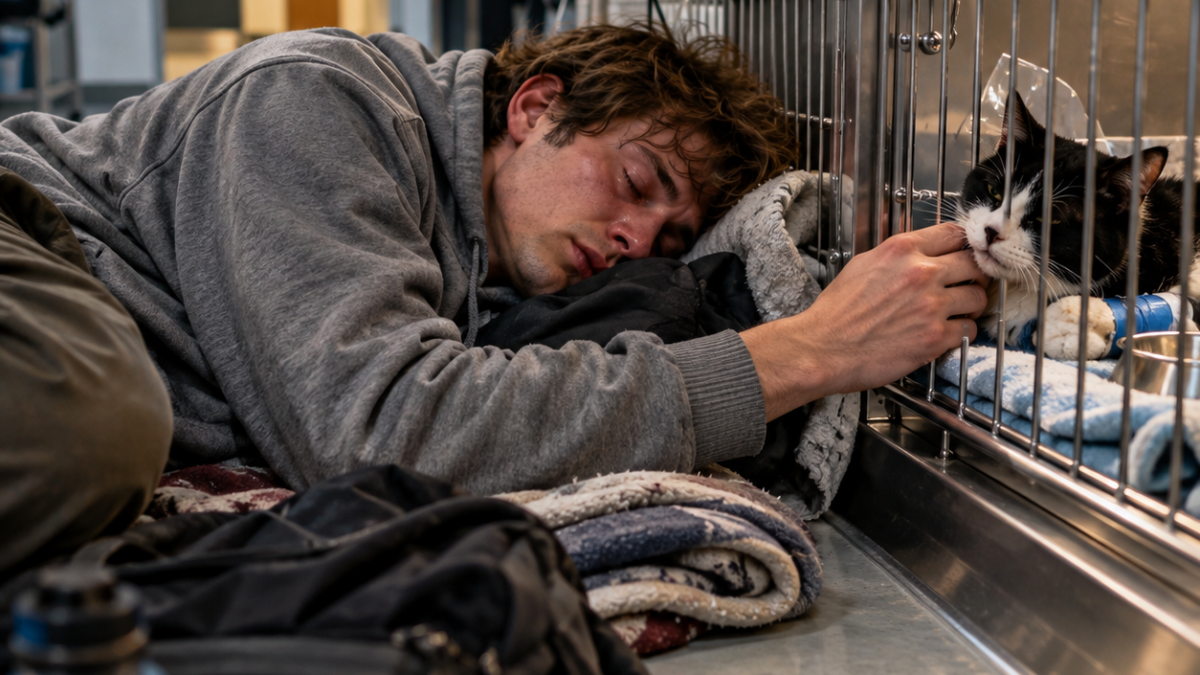
I chose the floor beside Chess.
People later turned that choice into something noble.
It wasn’t.
I was afraid.
Chess had spent twelve years sleeping near my face.
Now he was sick enough that I could not stand the idea of a wall between us.
So I folded two clinic blankets.
Placed them on the linoleum beside his enclosure.
Used my backpack as a pillow.
At night, I pushed my fingers through the bars.
Chess rested his cheek against them.
That was how we slept.
The first injection terrified me even though I was not giving it.
Chess cried when the medication entered.
A sound I had almost never heard from him.
I held his head.
“I’m sorry.”
He tried to move.
The technician steadied him.
I whispered:
“I know.”
Afterward, he would not look at me.
That nearly broke me.
Day two, same.
Day three.
Day four.
I worked at Millhaven Gas & Go from five in the morning until noon.
Four-thirty alarm.
Wash in clinic restroom.
Walk seven blocks.
Coffee I could not afford but the manager stopped charging me for.
Work register.
Stock coolers.
Mop.
Deal with people angry about lottery tickets.
At noon, back to clinic.
Clean cages.
Laundry.
Trash.
Sweep.
Hold animals when allowed.
Watch.
Learn.
At night, Chess.
Day seven, he ate three bites of chicken.
Dr. Cole said nothing at first.
Then walked out of the room and cried where she thought I could not see.
Day ten, he stood long enough to walk five steps.
Day twelve, he vomited everything.
I thought treatment had failed.
Dr. Cole adjusted support medications.
Fluids.
More blood work.
Day fifteen, Chess purred.
Barely audible.
I had my hand near his chest.
Felt it before hearing it.
I sat on the floor and cried.
A veterinary assistant named Kara passed the doorway.
She quietly closed the curtain.
Nobody mentioned it.
I started learning because watching was easier than waiting.
At first, simple things.
How to clean without terrifying a hospitalized animal.
Which disinfectants needed contact time.
Why towels were folded in particular ways.
How to tell dehydration from fear.
How gums could tell stories.
How respiratory effort mattered.
How much information lived in posture.
Dr. Cole taught me because I asked too many questions.
“What’s that number?”
“Packed cell volume.”
“What does it mean?”
“Right now? That Chess needs monitoring.”
“What number is bad?”
She explained.
Then:
“Why are you staring at the lab sheet?”
“Because if it changes, I want to know.”
“You’re not his doctor.”
“I know.”
She looked at me.
“Fine.”
She taught me how to read trends.
Not diagnose.
Observe.
His protein level.
Liver values.
Weight.
Fluid.
Temperature.
Respiratory rate.
I filled a notebook.
Day twenty-two:
Ate half meal.
Day twenty-three:
No vomiting.
Day twenty-four:
More alert.
Day twenty-five:
Slept on left side most night.
Day twenty-six:
Hissed at Kara.
I underlined that.
Good sign.
Chess was becoming rude again.
We celebrated.
The injections remained the hardest part.
Every day.
Same time.
Same routine.
At first, a technician administered them.
I held Chess.
He began associating the room with pain.
One afternoon, Dr. Cole handed me an orange.
“Inject it.”
I stared.
“It’s fruit.”
“I know.”
She handed me a syringe filled with saline.
“Practice.”
I laughed.
She did not.
“Angle matters.”
So I practiced on oranges.
Again.
Again.
Again.
Eventually, she let me practice preparing syringes.
Then handling subcutaneous fluids under supervision.
Then, after weeks, she looked at me.
“You want to administer Chess’s injection?”
My stomach dropped.
“Yes.”
“You’re sure?”
“No.”
“Good answer.”
I sat with Chess on my lap.
He had gained a little weight.
Not enough.
But some.
I cleaned the site.
Hands shaking.
Dr. Cole touched my wrist.
“Slow.”
I breathed.
Needle.
Angle.
Push.
Chess tensed.
I wanted to stop.
“Continue.”
I pushed.
Withdrew.
Pressed cotton.
Then held him against my chest for five minutes.
Exactly five.
After that, it became our ritual.
Injection.
Pressure.
Chest.
Five minutes.
I talked.
Not inspirational things.
Mostly nonsense.
“You’re expensive.”
Chess closed his eyes.
“You know that?”
Purr.
“I could’ve bought a car.”
Nothing.
“A bad car.”
Purr.
“You owe me.”
He pushed his head beneath my chin.
Day forty.
Day fifty.
Day sixty.
I never missed one.
Not once.
The gas station manager, Mr. Lewis, changed my schedule twice so I could make injection time.
Once, a snowstorm shut down the buses.
I walked nearly three miles after covering another employee’s shift.
Arrived eleven minutes before injection.
Kara looked at my soaked jeans.
“You know we could’ve done it.”
“I know.”
“Then why did you walk?”
“Because I do it.”
She did not ask again.
At day sixty-three, Chess stopped eating for a day.
My world collapsed instantly.
I had learned enough by then to know recovery was not a straight line.
Emotion did not care.
Dr. Cole found me sitting beside his cage after midnight.
“You need sleep.”
“I’m sleeping.”
“You’re sitting.”
“Same thing.”
“No.”
She checked Chess.
“He had a stressful day.”
“What if it’s back?”
“We test.”
“What if—”
“Eli.”
I looked at her.
“You cannot survive ten months by treating every bad hour like the ending.”
I said nothing.
She sat beside me.
On the floor.
Not doctor stool.
Floor.
“Do you know why medicine is hard?”
“Because everything costs too much?”
She smiled.
“One reason.”
Then:
“Because caring makes uncertainty unbearable.”
I looked at Chess.
“You learn enough to see what can go wrong.”
Her voice softened.
“But you still have to live in the part where you don’t know yet.”
I hated that.
Still do.
Chess ate breakfast.
Day eighty-four arrived on a Thursday.
I remember waking at 4:12 before the alarm.
Chess was already awake.
He sat upright in his enclosure.
His fur had grown glossy again.
Not fully.
But enough.
I opened the cage.
He climbed into my lap.
“Heard the news?”
Chess kneaded my thigh.
“Last injection.”
I kissed his head.
“Then we wait.”
That evening, I prepared the syringe.
My hands were steady.
Injection.
Press.
Chest.
Five minutes.
When the timer ended, I did not put him down.
Dr. Cole stood near the door.
“That’s eighty-four.”
I nodded.
“What now?”
“Blood work tomorrow.”
“Then?”
“More blood work.”
“Then?”
“Ultrasound.”
“And then?”
She smiled.
“You really hate not knowing.”
“Yes.”
“I noticed.”
The first blood panel looked better.
Second confirmed.
The ultrasound showed the abdominal fluid had resolved.
His liver values improved.
Protein normalized gradually.
Gums pink.
Weight rising.
Response.
Dr. Cole sat across from me.
“He responded.”
I heard the words.
Did not trust them.
“What does that mean?”
“It means the medication did what we hoped.”
“He’s cured?”
“No.”
My chest tightened.
“Eli, this is why observation matters.”
“How long?”
“You already know.”
“Ten months.”
“Yes.”
I looked around the clinic.
I had imagined day eighty-four as a finish line.
It was a doorway.
Dr. Cole said:
“You don’t have to stay on the floor.”
“Yes, I do.”
“No.”
“He stays.”
“He may not need hospitalization continuously.”
“Where do I take him?”
That ended the discussion.
I had no apartment.
No college housing.
No savings.
The clinic had become home by default.
So I stayed.
Month four.
Five.
Six.
Chess gradually became less patient-like and more cat-like.
He roamed supervised areas.
Sat on the reception counter even though Dr. Cole said he was not allowed.
Kara gave him treats.
Dr. Cole pretended not to see.
He developed a habit of sleeping in clean laundry baskets.
I started helping more.
A frightened beagle came in after being hit by a bicycle.
Would not let anyone near.
I sat on the floor.
Turned sideways.
Did nothing.
Ten minutes later, the dog crawled toward me.
Kara stared.
“How?”
“I don’t know.”
It kept happening.
Cats stopped hiding.
Dogs leaned against my legs.
An elderly pit bull recovering from surgery refused food until I sat beside her.
Dr. Cole noticed.
One afternoon, she handed me a clipboard.
“Hold this.”
I followed her into an exam.
Then another.
Eventually, I learned restraint techniques.
Not force.
Position.
Support.
How to hold a frightened animal without making fear worse.
How to watch ears.
Tail.
Eyes.
Jaw.
Breathing.
I understood scared animals.
Maybe because I had been one.
People say animals sense kindness.
I do not know.
I think they sense pressure.
Children do too.
If somebody enters a room needing you to behave a certain way, you feel it.
If somebody sits nearby and lets you decide whether to come closer, you feel that too.
I had spent my childhood hiding from people trying to control the room.
I was good at not becoming one of them.
Month seven.
My financial-aid repayment notice arrived.
I owed money.
Not impossible.
Impossible for me then.
I stared at the letter.
Dr. Cole saw.
“You okay?”
“Fine.”
“Bad liar.”
I handed it over.
She read.
“You regret leaving?”
I answered too quickly.
“No.”
She handed the letter back.
“Try again.”
I sat.
“I don’t regret choosing Chess.”
“That wasn’t my question.”
I stared at the floor.
“I miss school.”
There.
The thing I had refused to admit.
I missed anatomy lecture.
I missed library evenings.
I missed knowing what came next.
“I was good there.”
“I know.”
“How?”
“You’re good here.”
“That’s different.”
“Yes.”
I looked at Chess asleep beneath a chair.
“If he dies anyway…”
Dr. Cole waited.
“I lose both.”
She sat beside me.
“That’s possible.”
I hated her honesty.
“But going back in time wouldn’t make the decision easier.”
“No.”
“You chose with what you knew.”
“Yes.”
“And what mattered to you.”
I nodded.
“You are allowed to grieve the cost without calling the choice a mistake.”
I remembered that sentence.
Still do.
Month eight.
Grandma Ruth died.
Not from the stroke.
She had survived several years in assisted living.
Then pneumonia.
I received the call at the gas station.
I finished the transaction in front of me.
Receipt.
Change.
Bag.
Then walked into the storage room and sat on a crate.
Mr. Lewis found me.
“What happened?”
“My grandma.”
He understood from my face.
“Go.”
“I need the hours.”
“Go.”
I took the bus.
Two transfers.
Three hours.
Chess stayed at the clinic.
At the funeral, I stood beside the Wilcoxes.
Teresa Alvarez came.
My mother did not.
No one knew where she was.
At the cemetery, I thought about leaving Chess at fifteen.
How Grandma had looked at the social worker and said:
The cat comes.
She had protected that bond when nobody else understood why it mattered.
After the funeral, I went to the assisted living facility to collect her belongings.
One box.
Clothes.
Bible.
Family photos.
Inside the bedside drawer was a photograph of me at eight years old.
Chess in my arms.
On the back, Grandma had written:
My boys.
I sat on her empty bed and cried harder than I had at the funeral.
Then I returned to Millhaven.
Walked into the clinic after midnight.
Chess came running.
Not fast.
He was fourteen now.
But fast enough.
I dropped to the floor.
He climbed into my arms.
I held him.
“I lost her.”
Chess purred.
“I know.”
He stayed.
Of course he did.
Month nine.
Ten.
Eleven.
Every test made me sick before the results.
Good.
Good.
Good.
No recurrence.
Month twelve.
Dr. Cole began talking about my future.
I avoided her.
Month thirteen, she cornered me while I was cleaning kennels.
“What are you doing after Chess is cleared?”
“Working.”
“Where?”
“Gas station.”
“No.”
I looked at her.
“What?”
“No.”
“You don’t employ me.”
“Exactly.”
She handed me an application.
Millhaven Veterinary Clinic.
Veterinary Assistant.
Full-time.
I stared.
“What is this?”
“Paper.”
“I can see that.”
“Fill it out.”
“I’m not qualified.”
Dr. Cole laughed.
Actually laughed.
“Eli, you have spent more than a year in this building.”
“That doesn’t make me—”
“You know sanitation protocols.”
“Yes.”
“You know basic restraint.”
“Yes.”
“You know intake.”
“Some.”
“You recognize emergencies.”
“Sometimes.”
“You can prepare rooms.”
“Yes.”
“You can monitor hospitalized patients under supervision.”
“Yes.”
“You’ve learned more about lab values than assistants who have been here two years.”
“That’s because Chess—”
“And every animal in the building trusts you.”
I looked away.
“That’s not a qualification.”
“It should be.”
She placed the application against my chest.
“I can teach procedures.”
Her voice softened.
“I cannot teach presence.”
I frowned.
“What does that mean?”
“You walk into a room and scared animals stop believing they are alone.”
That hit somewhere I did not want touched.
I took the paper.
“I’ll think.”
“You’ll fill it out.”
“Bossy.”
“Yes.”
Month fourteen.
Final examination.
I barely slept.
Chess acted completely normal.
Ate breakfast.
Stole part of Kara’s sandwich.
Scratched the leg of a chair.
Dr. Cole called him a criminal.
Then:
Blood.
Ultrasound.
Physical exam.
Waiting.
Always waiting.
She finally asked me into Exam Room Two.
Same room where she had told me to consider euthanasia.
Same flickering light had been replaced.
Same anatomy poster.
Chess sat in my lap.
Dr. Cole sat opposite me.
She did not remove her glasses.
Good sign.
Maybe.
Her face gave me nothing.
“Eli.”
“Yes.”
“Do you remember what I told you fourteen months ago?”
“Unfortunately.”
“I told you we might fail.”
“Yes.”
“I told you the odds.”
“Yes.”
“I told you to consider letting him go.”
My arms tightened around Chess.
“Yes.”
Dr. Cole smiled.
“He’s in remission.”
I did not react.
Not because I did not care.
Because my brain refused the sentence.
“What?”
“Chess is in remission.”
I stared.
“Completely?”
“His current tests are clear.”
“Say it again.”
She laughed through tears.
“He’s in remission.”
I looked down.
Chess looked up.
I put both arms around him.
Pressed my face into his neck.
He complained because I squeezed too hard.
I laughed.
Then cried.
Then laughed again.
Dr. Cole turned away.
Kara was standing in the doorway crying openly.
I did not care.
I had spent fourteen months refusing to imagine that moment because imagining it felt like tempting something cruel.
Now it was real.
Chess alive.
Weight back.
Fur bright.
Eyes clear.
Fourteen years old.
Alive.
Dr. Cole waited.
Then:
“You can go home.”
I looked around.
Home?
The clinic was home.
She seemed to understand.
“You don’t owe us anything.”
“I owe a lot.”
“No.”
“I still have a balance.”
“No.”
“What?”
“Your account is closed.”
“How?”
“Because I closed it.”
“You can’t—”
“I can.”
“That’s not fair.”
Dr. Cole stared.
“For fourteen months, you cleaned this clinic.”
“I was staying here.”
“You did laundry.”
“That was the arrangement.”
“You worked nights unpaid.”
“I learned.”
“You helped patients.”
“I—”
“Eli.”
I stopped.
“We are even.”
She smiled.
“Actually, I suspect we owe you.”
I looked down at Chess.
“What am I supposed to do now?”
“First?”
“Yes.”
“Sleep in a bed.”
I laughed.
“And then?”
“Come to work Monday.”
I had not yet signed the application.
Apparently this detail did not matter to Dr. Cole.
The Wilcoxes helped me rent a tiny apartment above a bakery four blocks from the clinic.
One bedroom.
Old radiator.
Slanted floor.
The entire apartment smelled like bread every morning at four.
The first night, I placed a cat bed beside mine.
Chess ignored it.
Climbed onto my pillow.
Exactly where he had slept since I was seven.
I lay beside him.
For the first time in fourteen months, there were no cage doors.
No fluorescent hallway light.
No machines.
No dogs barking from recovery.
Just Chess breathing beside my ear.
I touched his back.
Counted breaths automatically.
Old habit.
Chess opened one eye.
“Sorry.”
He closed it.
I slept nine hours.
Monday, I started at Millhaven Veterinary Clinic.
My first official patient was a Chihuahua named Pebble who tried to bite me four times.
Dr. Cole said:
“Natural talent.”
I said:
“Thank you.”
She said:
“That was sarcasm.”
Months passed.
I kept the gas-station job for three mornings a week until my clinic hours increased enough.
Then I left.
Mr. Lewis shook my hand.
“You ever need work…”
“Thanks.”
He nodded toward my scrubs.
“You’re better there.”
I was.
That scared me too.
Because I had spent so long believing the choice I made for Chess destroyed my future.
I did lose a future.
That part is true.
My scholarship disappeared.
The nursing program continued without me.
I owed money I could not immediately repay.
Friends from school stopped texting after a while.
Their lives moved.
Mine did too.
But the clinic gave me another path.
I enrolled in evening coursework toward veterinary technician certification.
Slow.
One class at a time.
I paid what I could.
No scholarship miracle.
No wealthy stranger.
No viral fundraiser.
Just work.
Study.
Pay.
Repeat.
By twenty-two, I was still in the same clinic.
Chess was fifteen.
He slept more.
Jumped less.
Complained louder.
His abdomen still had a small patch where the fur never quite grew back evenly after repeated ultrasound shaving.
I had a callus near my right thumb from months of syringe preparation.
Kara once noticed.
“You still have that?”
“Apparently.”
She pointed toward Chess’s thin belly patch.
“Matching scars.”
“They’re not scars.”
“You know what I mean.”
I did.
The folded blanket remained at the clinic.
The one I slept on.
I had meant to take it when I left.
Dr. Cole said no.
At first I assumed she needed it.
Months later, I found it folded beside the long-term care area.
Same corner.
Same place.
“Why is that still here?”
Dr. Cole looked up from records.
“What?”
“The blanket.”
“Oh.”
“Why didn’t you move it?”
She returned to writing.
“Training tool.”
I stared.
“For what?”
“New employees.”
“What do you tell them?”
“Truth.”
I did not like the sound of that.
“Which truth?”
She looked at me.
“That some kid slept there for fourteen months because he refused to abandon his cat.”
I groaned.
“Don’t tell people that.”
“Why?”
“It sounds dramatic.”
“It was dramatic.”
“I was broke.”
“That too.”
“Dr. Cole.”
She smiled.
Then her expression softened.
“I tell them because people enter veterinary medicine thinking the job is mostly animals.”
I listened.
“It’s not.”
She pointed toward the waiting room.
“It’s people loving animals.”
She pointed toward the treatment area.
“People failing them.”
Toward the long-term ward.
“People trying.”
Then toward me.
“People staying.”
I looked away.
“Still dramatic.”
“Get back to work.”
One night, close to midnight, we had an emergency.
A young woman brought in a cat hit by a car.
She was maybe eighteen.
Crying so hard she could barely answer questions.
The cat survived the initial stabilization.
We could not promise more.
The girl sat on the waiting-room floor.
Not a chair.
Floor.
I recognized that.
I sat several feet away.
She looked at me.
“Is he going to die?”
“I don’t know.”
Wrong answer according to comfort.
Right answer according to truth.
She cried.
“What am I supposed to do?”
“Right now?”
She nodded.
“Stay.”
That was all.
The next morning, her cat was still alive.
Not safe.
Alive.
Sometimes that is enough for one day.
I began understanding what Dr. Cole meant by presence.
You cannot promise outcomes.
You can make sure someone does not face the uncertainty alone.
I had needed that at seven.
Eleven.
Fifteen.
Nineteen.
Chess gave it without language.
Maybe that was why I could finally give it to other people.
Then one afternoon, a client asked the question I had heard versions of for years.
He was a middle-aged man waiting while his retriever received stitches.
I had worked an emergency shift overnight.
During lunch, I fell asleep on the break-room couch.
He saw me when the door opened.
Later, while I was carrying supplies, he asked:
“You the kid who lived here?”
I stopped.
“Who told you?”
“Front desk.”
“Kara?”
“Maybe.”
Traitor.
He smiled.
“Heard you dropped out of college for your cat.”
“Yes.”
The smile faded.
“All that for a cat?”
I knew he did not mean harm.
That almost made it worse.
People ask questions according to the shape of their own lives.
In his life, a cat was probably a pet.
Loved.
But one relationship among many.
I set the supplies down.
“When I was seven, my mother brought Chess home.”
The man waited.
“When I was eleven, she left.”
His expression changed.
“When I was fifteen, my grandmother had a stroke and I lost my home.”
I continued.
“Foster care. Group home. New school. New family.”
He stopped smiling.
“Every time something disappeared…”
I swallowed.
“He was still there.”
The clinic became very quiet in my mind.
“Chess was the only thing in my childhood I never had to wonder about.”
The man looked toward the floor.
“So when the vet told me I should let him go…”
I shook my head.
“It wasn’t about whether I understood death.”
I did.
“I understood abandonment.”
That was different.
“For twelve years, he had been the one thing that stayed.”
My throat tightened.
“I wasn’t going to teach him at the end of his life that staying only counted when it was convenient.”
The man said nothing.
“I wasn’t going to choose tuition over him.”
I looked toward the treatment room where Chess, now basically the clinic’s unofficial supervisor, was sleeping on a clean towel.
“Not money.”
“Not a degree.”
“Nothing.”
The man whispered:
“Do you regret it?”
I thought.
“No.”
Then:
“I regret that it had to cost so much.”
That distinction matters.
People love turning sacrifice into something beautiful.
Sometimes sacrifice is ugly.
I lost things.
Real things.
I still wonder who I might have become if Chess never got sick.
Would I have finished nursing school?
Worked in an ICU?
Emergency department?
Maybe.
There are people from my freshman class who graduated.
One works pediatrics.
Another moved to Chicago.
I see pictures occasionally.
White coats.
Graduation gowns.
Vacations.
For a second, I feel the road I did not take.
That does not mean I chose wrong.
It means choices have shadows.
Every life contains people you might have been.
The goal is not to pretend they never existed.
It is to live honestly with the person you became.
Chess gave me that person.
Not because he owed me.
Cats do not think in debts.
He simply stayed alive long enough for me to discover I belonged somewhere I never planned to enter.
A veterinary clinic.
Years later, I learned more about my mother.
Teresa Alvarez contacted me.
She had received an inquiry through an old case file.
My mother was alive.
Living in New Mexico.
Had been sober for several years.
She wanted my address.
I stared at the message for a long time.
Chess slept beside my keyboard.
I did not respond immediately.
That old child inside me wanted two opposite things.
Find her.
Never let her find me.
Dr. Cole noticed I was distracted.
“What happened?”
I told her.
“What are you going to do?”
“I don’t know.”
“What do you want?”
“I don’t know.”
She nodded.
“Good.”
“How is that good?”
“Means you haven’t lied to yourself yet.”
Eventually, I wrote my mother.
Not forgiveness.
Not reunion.
A letter.
I said I was alive.
Working.
Studying.
Chess was alive.
That last sentence felt important.
She wrote back.
Three pages.
Apologies.
Explanations.
Recovery.
Shame.
She said she thought leaving me with Grandma was safer than staying.
Maybe.
I was not ready to decide.
Near the end, she wrote:
I still remember the kitten.
I think about the night I brought him home more than you would believe.
Did you keep him long?
I laughed.
Actually laughed.
Chess was sitting on my lap.
I wrote back:
He’s fifteen.
He never left.
My mother’s next letter arrived two weeks later.
One sentence made me cry.
I’m glad one of us knew how to stay.
I did not forgive everything.
Life is not that clean.
But we began speaking.
Slowly.
Phone call.
Then another.
She came to Millhaven when I was twenty-three.
Chess was sixteen.
She entered my apartment.
Stopped.
Chess sat on the couch.
Old.
Thin now.
White whiskers.
She covered her mouth.
“That’s him?”
“Yeah.”
She knelt.
“Chess.”
His ears turned.
He watched.
My mother held out one hand.
No reaching.
He approached.
Sniffed.
Then rubbed his head against her fingers.
Mom cried.
I looked away.
She whispered:
“I’m sorry.”
I did not know whether she meant to him or me.
Maybe both.
We had coffee.
No dramatic reconciliation.
No hug until the end.
Before leaving, Mom stood near the door.
“You became a good man.”
I hated that sentence.
Too easy.
She saw it.
“Sorry.”
I nodded.
Then she tried again.
“I’m grateful you survived me.”
That was harder.
More honest.
I hugged her.
Briefly.
Chess watched.
After she left, I sat beside him.
“You forgive everybody.”
Chess yawned.
“Terrible standards.”
He slept.
At seventeen, Chess developed kidney disease.
Manageable at first.
Fluids.
Diet.
Monitoring.
By then, I was certified.
I knew too much.
Numbers.
Patterns.
What decline looked like.
For the first time since nineteen, I faced the possibility that staying might eventually mean letting go.
That terrified me.
Dr. Cole understood.
One evening, after blood work worsened, I asked:
“How do I know?”
She knew the question.
“When the choice is for him instead of for you.”
I looked at her.
“That’s not helpful.”
“It won’t feel helpful.”
“He survived FIP.”
“Yes.”
“I can do fluids.”
“Yes.”
“Medication.”
“Yes.”
“Feed him.”
“Yes.”
“I can—”
“Eli.”
I stopped.
“Staying does not always mean keeping a body alive.”
I looked away.
I hated her again.
Temporarily.
Chess gave me another eight months.
Good ones.
Mostly.
Sunlight in the bakery apartment window.
Sleeping on my pillow.
Complaining about renal food.
Walking through the clinic like he owned it.
New employees knew him.
Clients knew him.
Children asked whether he was the famous cat.
I told them he was mostly famous for stealing chicken.
Then one March morning, he did not get up.
I knew.
Before touching him.
Before temperature.
Before labs.
I knew.
He looked at me.
Same eyes.
Older.
Tired.
Still following my face.
I wrapped him in the gray hoodie I had carried him to the clinic in years earlier.
I had kept it.
Too worn to wear.
Could never throw it away.
Dr. Cole examined him.
She removed her glasses.
History repeated.
But I was not nineteen anymore.
She did not tell me what to do.
She waited.
I sat beside Chess.
Put my forehead against his.
“You stayed.”
He purred.
Weakly.
“I know.”
My hands shook.
“I’m scared.”
Chess breathed.
I laughed through tears.
“You don’t care.”
Purr.
“You never cared whether I was ready.”
Dr. Cole waited outside.
I thought about the first diagnosis.
No.
I had been right then.
This time, the word changed.
Not yet.
I took him home one more night.
Chess slept on my pillow.
I did not.
I kept one hand against him.
At four in the morning, he woke.
Looked at me.
Then rested his face against my fingers.
Exactly the way he had through the cage bars when I slept on the clinic floor.
That was when I knew.
I did not need one more test.
No heroic treatment.
No bargain.
Morning came.
I carried him to the clinic.
Everyone knew.
Kara cried.
Receptionist cried.
Dr. Cole did not until later.
We went into Exam Room Two.
Of course.
The same room.
Twelve-year-old Chess almost died there.
Seventeen-year-old Chess would leave there.
I sat on the floor.
Not table.
Floor.
Chess in my lap.
Dr. Cole inserted the catheter.
Explained every step even though I knew them.
That mattered.
I held Chess against my chest.
Five minutes.
The old ritual.
He breathed.
I whispered:
“When I was seven, you stayed.”
His eyes half closed.
“When I was eleven, you stayed.”
My voice broke.
“Fifteen.”
I could barely speak.
“Nineteen.”
I kissed his head.
“Every time.”
Dr. Cole waited.
I looked at Chess.
“It’s my turn.”
I nodded.
The first medication relaxed him.
His body softened.
Purr stopped.
Not from death yet.
Sleep.
I held him.
Then Dr. Cole gave the final medication.
Chess exhaled.
And did not inhale again.
There was no thunder.
No sign.
No meaningful last movement.
His heart stopped beneath my hand.
I stayed on the floor.
For a long time.
Then Dr. Cole sat beside me.
The same floor.
Just like years earlier.
“I did it.”
She knew what I meant.
“I let him go.”
“Yes.”
“It feels like leaving.”
“No.”
I looked at her.
She was crying now.
“Eli.”
Her voice shook.
“You stayed all the way to the door.”
That sentence saved me.
Not immediately.
Nothing saves grief immediately.
But later.
You stayed all the way to the door.
Chess was cremated.
His ashes came home in a simple wooden box.
No inscription at first.
Months later, I added one.
CHESS
2009–2026
HE STAYED.
That was enough.
I could not sleep on my pillow for weeks.
Ridiculous.
I knew.
My head remembered there should be weight beside it.
Warmth.
Purring.
Sometimes I woke reaching.
Nothing.
The bakery smell came through the floor at four every morning.
Life continued with offensive normality.
I went to work.
Animals needed care.
People arrived frightened.
Some left relieved.
Some left grieving.
I understood both sides better now.
The folded blanket remained in long-term care.
One day, I moved it.
Not far.
I took it home.
Dr. Cole saw me carrying it.
“Finally?”
“Yeah.”
“What are you going to do with it?”
“I don’t know.”
She nodded.
At home, I washed it.
Folded it.
Placed it beneath Chess’s box.
Not because I wanted a shrine.
Because it told the whole story.
A cheap clinic blanket.
A cat’s ashes.
Everything between them.
I eventually completed advanced technician training.
Later, with Dr. Cole’s encouragement, I began taking prerequisite classes again.
Not nursing.
Veterinary medicine.
Slow.
Part-time.
I was older than many students.
Broke.
Again.
Still paying debt.
But different.
The first time I entered a college classroom after leaving at nineteen, I stood outside the door for almost a minute.
I thought of Mrs. Palmer warning me the scholarship would disappear.
She had been right.
I thought of the nineteen-year-old version of me signing withdrawal papers.
I wanted to tell him something.
Not that everything would work out.
I hate that phrase.
Sometimes things do not.
I wanted to tell him:
You are not throwing your future away.
You are choosing without knowing what the future will become.
Those are not the same thing.
I sat down.
Opened my notebook.
My right thumb still had that small callused ridge from filling syringes during Chess’s treatment.
I rubbed it once.
Then started writing.
Years after Chess died, people still occasionally recognize me from the clinic story.
Some versions grow exaggerated.
They say I slept inside a cage.
I didn’t.
They say I spent every cent I ever earned.
Not literally.
They say Chess miraculously survived an incurable disease.
Reality was messier.
Treatment.
Risk.
Work.
Luck.
Medicine.
People who helped.
They say I sacrificed my future.
That part bothers me most.
Because it assumes the future I originally planned was the only one that counted.
I lost that future.
I will never pretend otherwise.
But Chess did not leave me with nothing.
He left me with another one.
I learned medicine because I was terrified of losing him.
I learned patience because scared animals needed it.
I learned honesty because Dr. Cole refused to promise what she could not guarantee.
I learned uncertainty because every test forced me to live inside it.
I learned that care is not control.
I learned that staying is sometimes fighting.
Sometimes waiting.
Sometimes sleeping on a floor.
Sometimes giving eighty-four injections.
And sometimes, at the very end, staying means having enough courage to say:
You don’t have to stay for me anymore.
The clinic eventually renovated.
New floors.
New kennels.
Better long-term ward.
The corner where I slept disappeared beneath new cabinetry.
Before construction began, Dr. Cole called me in.
“What?”
She pointed toward the floor.
There, beneath where my blanket had been, were faint scratches.
Chess’s old enclosure had shifted over time.
Tiny marks in the flooring.
Probably meaningless.
Dr. Cole smiled.
“Want a piece?”
“You’re asking if I want clinic flooring?”
“Yes.”
“That’s weird.”
“You slept on it fourteen months.”
“Exactly why I don’t want it.”
She laughed.
The contractors removed it.
Life moved.
Dr. Cole retired when I was twenty-nine.
At her retirement dinner, people gave speeches.
Kara spoke.
Clinic owner.
Clients.
Then Dr. Cole looked at me.
“No.”
She smiled.
“Eli.”
“I’m not speaking.”
“Yes, you are.”
“I hate speeches.”
“I kept your cat alive.”
“That is emotional blackmail.”
“Yes.”
Everybody laughed.
I stood.
No preparation.
Looked at Dr. Cole.
“When I was nineteen, she told me my cat might die.”
The room became quiet.
“And I hated her for about thirty seconds.”
Dr. Cole smiled.
“Longer.”
“Yes.”
I continued.
“She never promised me Chess would live.”
“She gave me something better.”
I looked around.
“She told me the truth and stayed after telling it.”
My throat tightened.
“I think that’s what good medicine is.”
Dr. Cole looked down.
I continued:
“She let a broke kid sleep on her clinic floor.”
Some laughter.
“She taught me to inject an orange.”
More.
“She gave me a job when my entire résumé was basically gas station cashier and professional cat worrier.”
Dr. Cole wiped one eye.
“And when Chess finally died years later, she sat on the floor beside me because apparently chairs have never been part of our relationship.”
The room laughed through tears.
I looked at her.
“You gave me a future when I thought I’d spent mine.”
Dr. Cole shook her head.
“No.”
She spoke from her table.
“You built it.”
I smiled.
“Fine.”
Then:
“You gave me somewhere to build.”
That was true.
After retirement, she continued visiting.
Of course.
People like Dr. Cole do not actually retire.
They simply become more irritating without payroll restrictions.
Eventually, I became the senior technician at Millhaven.
Then clinic manager.
Years later, when ownership changed, I bought a small share.
I kept one policy that was never written officially.
If a frightened teenager arrived with an animal and no money, nobody dismissed them at the desk.
We talked first.
Not because every case could be saved.
Not because treatment should happen at any cost.
That is another false lesson people sometimes take from my story.
Money matters.
Quality of life matters.
Prognosis matters.
Sometimes euthanasia is kindness.
Chess’s story does not mean every person should bankrupt themselves to delay death.
It means people deserve honest information and room to make choices they can live with.
I had an option.
Narrow.
Expensive.
Uncertain.
I chose it.
Chess responded.
We were lucky.
That is part of the truth too.
I have held animals whose owners spent everything and still lost them.
I have sat beside people screaming:
“But I did everything.”
They did.
Everything is not always enough.
That does not make the love smaller.
One mother brought in a fifteen-year-old spaniel with advanced cancer.
She kept apologizing.
“I should have noticed sooner.”
I sat beside her.
“You noticed when you could.”
“No.”
“I failed him.”
The dog rested his head on her shoe.
I thought of Chess.
“You stayed.”
She looked at me.
“Sometimes that’s what we get to give.”
She cried.
I did too after she left.
People think working with animals makes death easier.
It doesn’t.
It makes death familiar.
Different.
You learn not to confuse familiar with painless.
At thirty-one, I received an envelope from my mother.
Inside was the photograph Grandma Ruth had kept.
Seven-year-old me.
Chess.
My boys.
Mom had visited Grandma’s old belongings through a relative and found a duplicate.
On the back, she wrote:
I gave you Chess thinking I was bringing home a sick kitten.
I didn’t know I was giving you the person who would raise you after I failed to.
I stared at that sentence a long time.
A cat did not raise me.
Not literally.
But he taught me continuity.
That relationships could survive bad days.
That sleeping beside someone was sometimes enough.
That affection did not have to be earned by being useful.
That returning could become a habit.
I framed the photo.
It sits in my office at the clinic.
New employees ask.
“That your childhood cat?”
“Yes.”
“The one from the story?”
I smile.
“What story?”
They usually realize I’m teasing.
Sometimes someone asks the question directly.
“Was it worth it?”
Fourteen months on the floor?
Yes.
Losing the scholarship?
Harder answer.
The money?
Yes.
The debt?
I hated it.
The fear?
No choice.
Would I do it again?
That question is unfair because I know the ending now.
Nineteen-year-old me did not.
He stood in an examination room with $4,200, no safety net, and a dying cat.
He chose without knowing.
That is why I respect him more now than I did while I was him.
He was not fearless.
He was terrified.
Courage is often badly described.
People think courage is feeling certain.
I think courage is understanding exactly how badly something might hurt and choosing according to your values anyway.
At nineteen, I knew Chess might die.
I knew I might lose school and the cat.
I knew people would think I was stupid.
Some did.
I chose.
Not because cats are more important than education.
Not because sacrifice is automatically noble.
Because in the context of my life, leaving Chess when he had a realistic chance of treatment would have broken something in me I did not know how to rebuild.
He had been my only constant.
I needed to be his.
That is the whole story.
People prefer bigger meanings.
Destiny.
Purpose.
Fate.
Maybe.
I do not know.
I know one concrete thing.
When I was seven, a sick kitten lay on my blanket.
I did not know whether he would survive.
I stayed beside him.
Twelve years later, I lay on a veterinary clinic floor beside that same cat.
He did not know whether he would survive.
I stayed.
And years later, when medicine could no longer save him, I held him while he died.
I stayed then too.
That word followed us from beginning to end.
Stay.
Not forever.
Nothing stays forever.
That is not what the word means to me anymore.
Staying means:
I am here while I can be.
I will not disappear just because this becomes difficult.
I will not measure your worth by convenience.
I will not make you face fear alone.
And when the moment comes that love requires letting go instead of holding tighter, I will still be here when you leave.
Chess taught me that.
Or maybe life with Chess gave me enough chances to finally understand it.
Sometimes I visit his little box before work.
Not every day.
I am not trapped in grief.
I have a life.
Friends.
Work.
My mother and I speak regularly now.
Not perfectly.
But honestly.
The Wilcoxes come for Christmas.
Teresa retired.
Kara still works at the clinic and still tells every new employee embarrassing stories about me.
Dr. Cole sends me photographs of birds from wherever she travels because retirement apparently turned her into an amateur photographer with no understanding of focus.
I am still studying.
Still learning.
Still paying something somewhere.
That may be adulthood.
But on difficult nights, when the clinic is quiet after an emergency and I am the last person walking through long-term care, I remember the floor.
A folded blanket.
Cold linoleum.
My hand through cage bars.
Chess’s face pressed against my fingers.
I used to think I stayed awake to keep him alive.
That was not true.
Medicine kept him alive.
Treatment.
Dr. Cole.
The staff.
His body responding.
Luck.
My presence did not cure him.
That distinction matters.
But sometimes being unable to save someone does not make staying meaningless.
I could not control the outcome.
I could control whether he faced it alone.
That was my job.
It remains my job now.
Not just with animals.
With people who walk into rooms carrying frightened animals against their chests.
With children whose first question is whether their dog is going to die.
With elderly men who apologize because they cannot afford everything.
With women who sit on waiting-room floors.
With families who need someone to tell them the truth without leaving immediately afterward.
Sometimes, when a new technician asks what veterinary medicine is really about, I take them to the long-term ward.
The floor is new now.
The original corner is gone.
But I tell them anyway.
“There used to be a blanket right there.”
They look.
“What for?”
“A kid slept there.”
“How long?”
“Fourteen months.”
“Why?”
I smile.
“His cat was sick.”
They usually wait for more.
I give it to them.
“The vet told him the cat might die.”
“He had four thousand two hundred dollars.”
“College.”
“Debt.”
“No plan.”
“He chose treatment.”
I tell them about eighty-four injections.
The gas station.
The cage.
The remission.
The job.
Not because I want them to romanticize it.
Because I want them to understand that every animal entering the clinic arrives attached to a human story we may not see.
A dirty carrier might belong to someone choosing between rent and medication.
A difficult client may be terrified.
A teenager may be holding the last stable thing in his life.
You do not have to agree with every choice.
But you should know there may be more happening than the bill in front of you.
Then, sometimes, somebody recognizes me.
“Wait.”
I hate that part.
“You were the kid?”
I sigh.
“Unfortunately.”
They laugh.
Then usually ask:
“What was the cat’s name?”
That question I never mind.
“Chess.”
Always Chess.
The first living thing that was entirely mine.
The animal I refused to leave behind.
The cat who cost me the future I thought I wanted and led me, paw by paw, into the life I never knew was waiting.
If I could go back to that examination room at nineteen, I would not tell myself Chess survives.
I would not remove the fear.
I would not promise the money works out.
I would not tell the boy he becomes a veterinary technician or returns to school.
Because that boy did not need guarantees.
He needed somebody to tell him he was allowed to make a hard choice without knowing the ending.
I would stand beside him.
That is all.
Maybe place one hand on his shoulder.
Let him look at Chess.
Let him remember every house.
Every goodbye.
Every night with that black-and-white cat pressed against his side.
Then I would wait.
And when Dr. Cole said it might be time to let Chess go, I already know what nineteen-year-old me would say.
“No.”
One word.
Not denial.
Not ignorance.
A decision.
Not yet.
We still have a road to try.
Fourteen months later, Chess walked out of that clinic in my arms.
Years later, I carried him back in for the final time.
Both moments were love.
That took me a long time to understand.
Fighting for someone can be love.
Letting someone rest can be love.
Sleeping on a floor can be love.
Leaving school can be love.
Returning to school can be love.
Forgiving a mother slowly can be love.
Keeping boundaries can be love.
There is no single shape.
But if you want to know what Chess and I were to each other, there is one sentence that has never changed.
He stayed for me.
I stayed for him.
Everything else came after.


