A 15-Year-Old Shelter Cat Was Adopted Only So He Wouldn’t Die Alone—Then Three Weeks Later, He Dragged Something From Under the Couch That Changed Everything.
PART3:
When the shelter worker opened the door, he did not come out.
He did not meow.
He did not rub against the bars.
He did not try to charm us.
He simply lifted his head from a faded towel, looked at us through those cloudy eyes, and blinked once.
Mark whispered, “He looks exhausted.”
That was the moment I knew we were taking him home.
Not because I expected a miracle.
Because I could not stand the thought of that being his last room.
A metal cage.
Fluorescent lights.
Doors slamming.
Strangers walking past, deciding whether he was worth the trouble.
We signed the papers.
The shelter worker tried to be cheerful.
“He’s very sweet,” she said. “Quiet. Doesn’t ask for much.”
I hated that sentence too.
Doesn’t ask for much.
Old animals ask for what every living thing asks for.
A safe place.
A warm place.
Someone to notice if they stop eating.
Someone to say their name like it matters.
On the drive home, Babo stayed inside the carrier without protest. That worried me. Cats usually complain about injustice. Milo once screamed for twenty minutes because we took him to the vet for a nail trim and then refused to speak to us for an entire evening.
Babo made no sound.
Mark kept glancing at the carrier.
“You okay back there, buddy?”
Nothing.
“I don’t think he likes buddy,” I said.
“What does he like?”
“I don’t know yet.”
Mark nodded.
“We’ll ask him.”
We set up the living room before we even brought him inside. Soft bed near the heat vent. Low litter box in the hallway. Shallow water bowl because his whiskers looked too tired for anything deep. A folded blanket beside the couch. A kitchen stool under the front window in case he ever wanted to look outside. Tiny cans of soft food in flavors that sounded better than some meals Mark and I made for ourselves.
“Senior chicken pâté,” Mark read from one label.
“Don’t mock his cuisine.”
“I’m not. I’m jealous.”
When we opened the carrier, Babo did not rush out.
He looked at the room.
Then at us.
Then he slowly stepped forward, his bad hips wobbling slightly, and walked directly to the heat vent.
He lowered himself onto the blanket like a man who had found a bench after walking too far.
Then he slept.
For the first week, that was all he did.
He slept beside the heat vent.
He slept under the coffee table.
He slept in the laundry basket after I accidentally left warm towels there, and after that I kept accidentally leaving warm towels there.
Sometimes I stood over him and watched his ribs rise and fall just to make sure he was still here.
At night, Mark would ask, “Did he eat?”
“A little.”
“Did he use the box?”
“Yes.”
“Did he drink?”
“A little.”
Then we would both go quiet because we knew what we were really asking.
How much time does he have?
We did not say it aloud.
Saying it aloud would make the answer start walking toward us.
Babo was polite in the way some very tired animals are polite. He accepted food if we placed it close enough. He allowed gentle touches on his head but did not seek them. He did not hide, exactly, but he did not join us either. He existed near us, not with us.
I told myself that was okay.
I told myself the goal was comfort, not affection.
I told myself love did not require him to perform gratitude.
Still, every time I walked past him and he did not lift his head, something inside me ached.
By the second week, something changed.
Not much.
Nothing dramatic.
But Babo started watching me.
If I moved from the kitchen to the living room, his cloudy eyes followed. If I left the room, he lifted his head. If Mark came home from work and dropped his keys into the bowl by the door, Babo opened one eye and listened.
He still did not trust the house completely.
I could see that.
He seemed to be waiting for the catch.
Maybe he had learned that homes could disappear.
That hands could stop reaching down.
That a warm blanket could become a car ride, and a car ride could become a cage.
One morning, I found him on the stool by the front window.
He had climbed up there by himself.
Outside, a fat brown squirrel was digging in my flower bed like it paid property taxes.
Babo stared at it.
His tail flicked once.
Tiny.
Almost nothing.
But I froze in the hallway.
Because for the first time since he came home, Babo looked interested.
Not comfortable.
Not happy exactly.
Interested.
A few days later, I heard scraping from the living room.
My whole body went cold.
I thought he had fallen.
I ran in and found Babo halfway under the couch, his back legs sticking out, his thin tail twitching with great seriousness.
“Babo?”
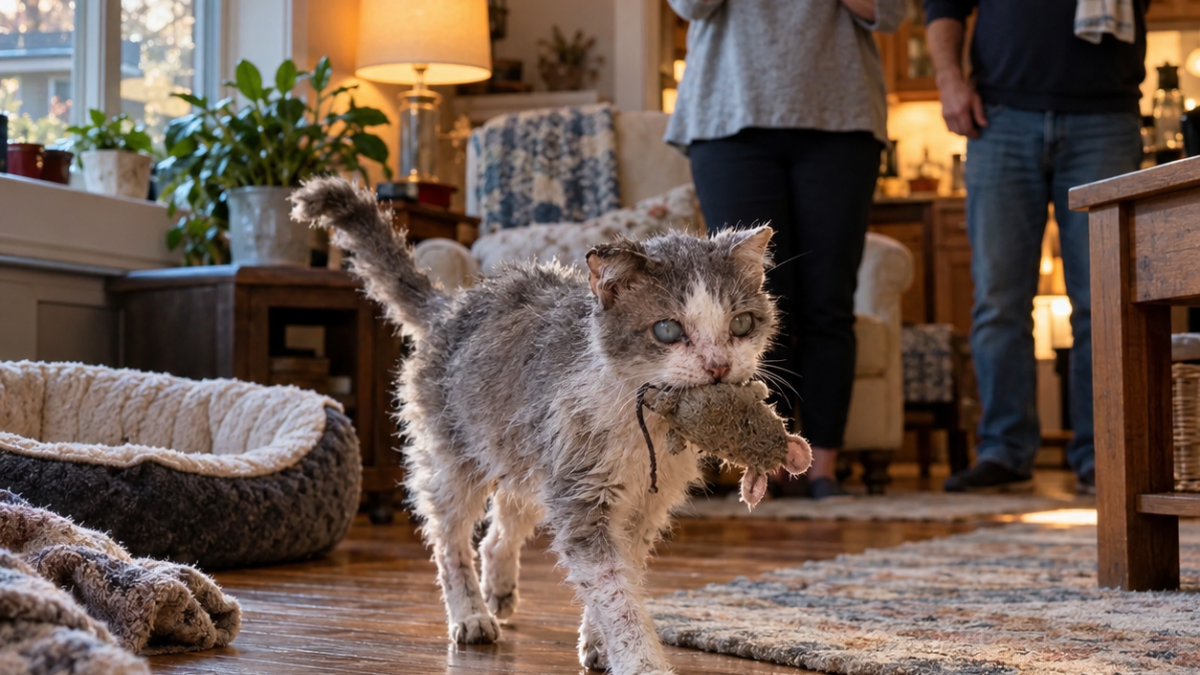
He backed out slowly, dragging something in his teeth.
A toy mouse.
I had not seen that thing in years. It must have belonged to Milo. The little cloth body was faded nearly colorless, one felt ear was missing, and the stuffing had gone flat. It looked like something that had survived both a war and a vacuum cleaner.
Babo dropped it in the center of the rug.
Then he looked at me like he had discovered buried treasure.
Mark came in from the kitchen with a dish towel over his shoulder.
“What’s he got?”
Before I could answer, Babo picked up the mouse again and trotted.
Trotted.
Not fast.
Not graceful.
His hips wobbled, and his paws slipped a little on the hardwood.
But there he went across the living room, head high, carrying that ruined toy as if he had fought a lion for it.
Mark covered his mouth.
I started crying before I knew I was crying.
Because the dying cat was gone.
In his place was an old cat who had remembered he was still a cat.
After that, Babo became someone else.
He still slept a lot. He was still fifteen. His body still had limits. Some mornings, he moved like the floor had personally offended him. Some evenings, he lowered himself onto his blanket with the sigh of a retired construction worker.
But every morning, he carried that toy mouse into the kitchen while I made coffee.
He announced breakfast with a raspy little meow that sounded like an old screen door.
He swatted Mark’s sock if dinner was late.
One afternoon, Mark left a small piece of chicken too close to the edge of his plate, and Babo reached up with one careful paw and pulled it down like a professional thief.
Mark stared at him.
Babo stared back.
Then Babo ate the chicken.
We laughed so hard we had to sit down.
That night, I found him asleep on our bed, hugging the toy mouse between his front paws. His chin rested on the cloth. His claws barely touched it, like he was afraid someone might take it away.
That was when I understood.
Babo had not just been old.
He had been lonely.
He had lost his people, his smells, his sunny spots, his routine, his whole little world. Then he had been placed somewhere loud and strange, where everyone was kind but no one was his.
No wonder he slept.
Maybe sleep was easier than hoping.
Maybe stillness looked like dying to people who did not understand a broken heart.
I posted his story online without thinking too much about it.
A few photos.
Babo in the window.
Babo with the mouse.
Babo glaring at Mark’s plate.
I wrote about hospice adoption and how wrong we had been to think we were only giving him an ending. I wrote that senior cats are not empty just because they are slow. I wrote that sometimes love does not comfort the final chapter. Sometimes it rewrites it.
I expected maybe a handful of friends to respond.
Instead, people shared it.
Then strangers shared it.
People wrote about old cats they had adopted, old dogs they still missed, senior animals who arrived shut down and then slowly remembered joy. The comments made me cry more than once.
Three days after Babo’s story began spreading, a message appeared in my inbox.
Eight words.
I think that is my mother’s cat.
I stared at the screen until it dimmed in my hand.
Babo was asleep on the blanket beside the heat vent, one paw draped over the ugly mouse like a tiny guard dog.
Mark stood at the sink rinsing two coffee mugs.
“What is it?” he asked.
I did not answer right away.
Because before I clicked the woman’s profile, before I read another word, before I saw the photo she sent, I already knew.
The past had found Babo.
And it was knocking.
The woman’s name was Lena.
She wrote in short lines, like she had typed them while holding her breath.
Her mother had owned a gray-and-white cat for years.
A small old cat with one folded ear.
A cat who slept in laundry baskets.
A cat who carried around a toy mouse with one missing ear.
His name had not been Babo.
His name had been Bobby.
That was close enough to make my hands shake.
Then came the photo.
It was old and slightly blurry. In it, Babo sat on the arm of a floral couch beside an elderly woman in a blue cardigan. He looked younger then. Fuller. His eyes clearer. But it was him.
That folded ear.
That crooked little mouth.
That serious expression, like the world had disappointed him but he was willing to hear one more argument.
Mark came over and stood behind me.
I handed him the phone.
He looked at the picture.
Then he looked at Babo.
“Oh,” he said.
That was all.
Just oh.
Because what else was there?
Lena sent another message before I could respond.
My mother has been asking for him.
Then another.
She thinks he died.
Then another.
I didn’t know where he went after the shelter. I only saw your post because someone shared it with me.
I put the phone face down on the table.
I felt angry.
Not loud angry.
Not the kind that throws things.
The quiet kind.
The kind that hurts because it has nowhere good to go.
This was the family who had surrendered him.
This was the family behind those cold words.
No longer active.
This was the family who had let an old cat sleep in a cage when all he wanted was a blanket and a window.
And now they were asking about him?
Now?
After he had finally stopped waiting for the catch?
Mark sat across from me.
“Don’t answer yet.”
“I have to.”
“No,” he said gently. “You don’t have to answer while you’re upset.”
I looked at Babo.
He was dreaming.
His whiskers twitched. One back foot gave a tiny kick. Maybe he was chasing squirrels in whatever place old cats go when their bodies are tired but their hearts still have some wildness left.
“I don’t want them taking him,” I said.
Mark’s face changed.
Not much.
Enough.
“Are they asking to take him?”
“I don’t know.”
“But you think they will.”
“I think people don’t send messages like that just to say hello.”
Mark leaned back and rubbed both hands over his face.
“We adopted him.”
“I know.”
“He’s ours.”
“I know.”
But the word ours felt different now.
It did not feel wrong.
But it felt heavier.
Because somewhere there was another woman who might once have said the same thing.
My Bobby.
My cat.
My little old man.
I did not answer Lena that night.
I tried.
I typed three different replies and deleted them all.
The first sounded too cold.
The second too soft.
The third sounded like I was asking forgiveness when I had not done anything wrong.
So I put the phone away.
That night, Babo climbed onto our bed by himself.
He did it in stages.
First the stool.
Then the old trunk at the foot of the bed.
Then the quilt.
It took almost five minutes.
Mark and I stayed perfectly still, pretending not to watch, because old cats have pride too.
When Babo finally reached the pillow, he stood there breathing through his nose.
Then he stepped onto Mark’s chest.
Mark whispered, “Sir, that is my lung.”
Babo ignored him.
He turned in three slow circles and settled between us, pressed against my ribs.
The toy mouse was still in his mouth.
I lay awake for a long time.
I could feel his small body rising and falling.
I thought about the elderly woman in the blue cardigan.
I thought about her asking for him.
I thought about her being told he was gone.
Then I thought about Babo in that shelter cage, too tired to hope.
And I did not know who I was angry at anymore.
The next morning, I messaged Lena back.
I kept it simple.
Yes. I think this is the same cat. He is safe with us. He is loved. Can you tell me what happened?
For almost an hour, there was no answer.
Then my phone lit up.
This time, Lena wrote a lot.
Her mother’s name was Ruth.
Ruth was eighty-one.
She had lived alone in a small house for years after her husband died. Babo—or Bobby—had been her husband’s cat first. Then he became hers. Then, somewhere along the way, he became the last living thing in that house that still remembered the old shape of her life.
Lena said Ruth had fallen in her kitchen in January.
Not badly, but badly enough.
After that, Lena and her brother moved her into a senior apartment called Willow Place.
No pets allowed, except small fish.
That sentence made me stop reading.
No pets allowed, except small fish.
As if a fish could sit beside an old woman at midnight.
As if a fish could sleep in the dip of her blanket.
As if a fish could remember the sound of her husband’s chair, the smell of his winter coat, the rhythm of the life she had lost one piece at a time.
Lena said they tried to find someone in the family to take Bobby.
Nobody could.
One cousin had dogs.
One nephew had allergies.
A neighbor agreed at first, then changed her mind after two nights because Bobby cried at the door.
Lena called rescues.
All full.
She posted in a local community group.
Nobody offered.
Finally, she brought him to the shelter.
She cried the whole way, Lena wrote.
I read that line twice.
Then a third time.
Because I had built a simple story in my mind.
Cruel family.
Unwanted old cat.
A goodbye that should never have happened.
But real life kept doing what real life does.
It refused to stay simple.
Lena said she did not tell Ruth the truth.
She told her mother Bobby was staying with a nice retired woman who had a sunroom.
She thought that would make it easier.
But Ruth kept asking.
Every morning.
Every evening.
Where is Bobby?
Did you feed Bobby?
Is Bobby sleeping on my sweater?
The questions slowed for a while.
Then Lena saw my post.
Now she was asking if they could see him.
Not have him.
Just see him.
At first.
That was the part that got me.
At first.
I sat with the phone in my lap.
Babo was in the kitchen yelling at the pantry because he believed the tiny cans lived there and should be released.
Mark came in with his work shirt untucked.
“What did she say?”
I handed him the phone.
He read it standing beside the table.
His jaw tightened.
Then softened.
Then tightened again.
“That’s awful,” he said.
“For who?”
He looked at me.
“For everyone.”
That was the problem.
It would have been easier if someone had been terrible.
It would have been easier if Lena had written something selfish or careless.
It would have been easier if she had said, We got tired of him.
But she had not.
She had written like a daughter who made a decision in the middle of too many impossible decisions.
And still, Babo had paid for it.
Mark set the phone down.
“What do you want to do?”
“I don’t want to move him.”
“I didn’t ask what you don’t want.”
I hated that.
Because he was right.
I looked toward the kitchen.
Babo had given up on the pantry and was now sitting in front of his bowl, staring at nothing with the exhausted patience of a man at a badly run restaurant.
“I want Ruth to know he’s alive,” I said.
Mark nodded.
“And?”
“I want her to see he’s okay.”
“And?”
I swallowed.
“And I don’t want him to go back.”
There.
I had said it.
It sounded selfish.
It also sounded true.
Mark sat across from me.
“Then we say they can visit.”
“Here?”
“Yes.”
“What if they ask to take him?”
“Then we say no.”
“You make it sound easy.”
“It won’t be easy,” he said. “But it can still be clear.”
That afternoon, I told Lena they could come on Sunday.
I wrote that Babo was fragile.
I wrote that we did not want to overwhelm him.
I wrote that we were not ready to discuss moving him.
I erased that last sentence three times.
Then I put it back.
Lena replied almost immediately.
Thank you. I understand.
Then, a minute later:
My mother may not understand.
That sentence followed me for the rest of the week.
On Monday, Babo stole a corner of Mark’s toast.
On Tuesday, he smacked the same houseplant four times for reasons known only to him.
On Wednesday, he climbed into a grocery bag and sat there like he had purchased the house.
On Thursday, he had a bad day.
He slept through breakfast. He did not bring the mouse. His back legs seemed stiff, and when he walked from the living room to the hallway, he stopped twice.
I sat on the floor beside him and touched his bony shoulder.
“Hey, old man. You okay?”
He blinked at me.
Then he leaned his head into my palm.
It was such a small thing.
But with Babo, small things had become holy.
That night, I almost canceled the visit.
Not because Babo was worse.
By bedtime, he had eaten a little and dragged the mouse halfway to the hallway.
I almost canceled because I was scared.
Scared he would recognize Ruth.
Scared he would not.
Scared he would want to go.
Scared he would hide.
Scared we would hurt him by opening a door that had taken him three weeks to stop staring at.
On Friday, Lena sent another photo.
Ruth sitting in a chair by a window, hands folded in her lap. She looked small. Not weak, exactly. Just reduced by age and loss, the way some people seem to shrink after the world takes too much.
On her lap was a gray sweater.
Lena wrote, She kept this because he used to sleep on it.
I showed the picture to Mark.
He was quiet for a long time.
Then he said, “We should let her bring it.”
“Do you think it will confuse him?”
“I think he already remembers more than we know.”
Sunday came too fast.
I cleaned the house like a woman expecting judgment.
I vacuumed under the couch.
I washed Babo’s bowls.
I folded his blanket neatly beside the heat vent, then unfolded it because he hated neat things and preferred a small mountain.
Mark watched me rearrange the same pillow three times.
“They’re not coming to inspect us.”
“I know.”
“They’re coming to see him.”
“I know.”
“You’re moving his mouse.”
I looked down.
I was holding the toy mouse.
The poor thing looked worse in daylight. Flat body. Missing ear. Thread hanging from one side. It had become Babo’s most precious possession and the ugliest thing in our house.
I placed it beside his blanket.
Babo walked over, picked it up, and dropped it two inches to the left.
Then he looked at me.
“Sorry,” I said. “Interior design is your department.”
At two o’clock, a car pulled into the driveway.
Babo was asleep.
Of course he was.
He had spent the morning yelling at a squirrel and then exhausted himself by sitting in a patch of sun.
Mark opened the door.
Lena stood on the porch first.
She was in her late forties, with tired eyes and a careful expression.
Beside her stood Ruth.
She wore the same blue cardigan from the old photo.
In her arms, she held the gray sweater.
For one second, nobody spoke.
Then Ruth looked past us into the house.
“Where is he?”
Not hello.
Not thank you.
Not what a nice house.
Where is he?
Her voice broke on the last word.
I stepped aside.
“He’s by the heat vent.”
Ruth moved slowly.
Lena stayed close to her elbow but did not touch her unless she had to.
That told me something.
It told me Ruth still liked to do things herself.
It told me Lena had learned when to help and when to let her mother have what dignity was left.
Babo was curled on his blanket, head tucked down, mouse beneath his chin.
Ruth stopped about six feet away.
Her hand went to her mouth.
“Oh,” she whispered.
Babo’s ear twitched.
Just once.
Ruth took one small step closer.
“Bobby?”
Babo did not move.
My heart sank.
Ruth took another step.
“Bobby, baby?”
Babo lifted his head.
Slowly.
So slowly.
As if the name had traveled through years, through shelter noise, through loneliness, through sleep, and finally reached the part of him that still knew it.
He stared at her.
Ruth began to cry.
Not loudly.
Tears simply slipped down her face while she held that sweater like it was the only thing keeping her upright.
Babo pushed himself to his feet.
His back legs wobbled.
Mark took one step forward, then stopped.
I held my breath.
Babo walked toward Ruth.
One careful step.
Then another.
Then another.
He stopped in front of her shoes.
Sniffed the hem of her pants.
Then looked up.
And made a sound I had never heard from him before.
Not his raspy breakfast meow.
Not his angry pantry yell.
Tiny.
High.
Almost young.
Ruth bent down with difficulty.
Lena moved to help, but Ruth shook her head.
“No. Let me.”
So Lena let her.
Ruth lowered herself into the armchair by the window, the one Mark had moved there that morning. Babo watched her the whole time. When she settled, she placed the gray sweater across her lap.
Babo sniffed the air.
Then he climbed.
Not gracefully.
Not easily.
But he climbed into Ruth’s lap like his body remembered a path his mind had not dared to hope for.
Ruth put both hands around him.
And Babo melted.
That is the only word for it.
He did not just sit.
He became liquid.
His head pressed beneath her chin. His folded ear flattened against her cardigan. His paws kneaded the sweater once, twice, then stopped, like even joy had to be done carefully now.
Ruth rocked him.
“Oh, Bobby,” she whispered. “Oh, my good boy. I’m sorry. I’m so sorry.”
I turned away.
Mark looked at the ceiling.
Lena cried into a tissue.
There was Babo, the cat we had saved, curled in the arms of the woman who had lost him.
For twenty minutes, nobody moved much.
Ruth spoke to him in soft little pieces.
She told him he looked skinny.
She told him his ear was still silly.
She told him she had kept his sweater.
She told him she had looked for him in the hallway every morning.
Babo closed his eyes.
He purred.
Not loud.
Not strong.
But there it was.
A rough little engine starting under a pile of years.
I should have felt happy.
Part of me did.
Another part of me felt like I had been punched.
Because I had loved him back to life.
But she had loved him first.
That is a hard thing to admit.
It does not make your love smaller.
But it does make the room more crowded.
After a while, Lena followed me into the kitchen.
Mark stayed near the living room, pretending to adjust the curtains while keeping watch over Babo like a nervous bodyguard.
Lena stood by the counter with both hands around a cup of tea.
“I don’t know how to thank you.”
“You don’t have to.”
“I do.”
I did not answer.
She looked toward the living room.
“I thought I was doing the least terrible thing.”
That sentence opened something in me.
Because that was exactly it.
Not the best thing.
Not the right thing.
The least terrible thing.
So many people live whole years making choices like that.
Not because they do not care.
Because every option hurts someone.
“My brother said I should have waited longer,” Lena said. “My aunt said I should have tried harder. The shelter woman was kind, but I could tell what she thought.”
“What did she think?”
“That I was abandoning him.”
Her voice cracked on the last word.
I wanted to say she was wrong.
I also wanted to say she was not.
Both truths stood there between us.
Finally, I said, “He was very shut down when we met him.”
Lena closed her eyes.
“I know.”
“He didn’t come out of the cage.”
“I know.”
“He slept for a week.”
“I know.”
I had not meant to be cruel.
But maybe part of me wanted her to feel it.
Not all of it.
Just enough.
Lena set the tea down.
“I’m sorry,” she said. “I know he suffered because of what I chose.”
I looked at her then.
Really looked.
She was tired in a way I recognized. Not the tired of one bad night. The tired of forms, appointments, phone calls, bills, guilt, and people telling you what they would have done from a safe distance.
“I don’t think you wanted him to suffer,” I said.
“No.”
“But he did.”
“Yes.”
That was the first honest conversation we had.
Not pretty.
Not comforting.
Honest.
From the living room, Ruth laughed.
Lena and I both turned.
Babo had lifted one paw and touched Ruth’s chin.
Ruth smiled down at him like the sun had come back into the room.
Then she said something that made my whole chest tighten.
“I knew you weren’t dead.”
Lena covered her mouth.
I gripped the edge of the counter.
Because there it was.
The lie.
The mercy lie.
The one Lena had told because she thought the truth would hurt too much.
But the lie had hurt too.
Maybe even more.
People do that, I think.
We hide hard truths from old people, from children, from ourselves. We call it kindness.
Sometimes it is.
Sometimes it is fear wearing kindness’s coat.
When it was time to leave, Ruth did not move.
Lena touched her shoulder.
“Mom.”
Ruth looked up.
“What?”
“We should let Bobby rest.”
Ruth’s arms tightened around him.
“He can rest with me.”
The room went still.
Mark looked at me.
I looked at Lena.
Lena’s face had gone pale.
“Mom,” she said softly.
“No,” Ruth said.
Not loud.
Not angry.
Just firm.
Like a woman who had lost enough and was not offering anything else to the world.
Babo slept in her lap.
Completely peaceful.
The worst possible argument for letting him stay with us.
Ruth looked at me.
“I want to take my cat home.”
There it was.
The sentence we had all been walking around.
My mouth went dry.
Lena said, “Mom, we talked about this.”
“No. You talked.” Ruth stroked Babo’s head. “I listened.”
Mark stepped closer to me. I could feel him before he spoke.
“He lives here now,” Mark said gently.
Ruth looked at him.
Her face changed.
Not with anger.
With confusion.
Then hurt.
“He lived with me for fourteen years.”
Nobody answered.
Because what could we say?
Three weeks is not fourteen years.
A new blanket is not an old house.
A toy mouse found under our couch was probably his toy mouse from before.
Even the name we used was borrowed wrong.
Babo.
Bobby.
A mistake that had become love.
Ruth looked back at me.
“Please.”
That word nearly broke me.
Not because she demanded.
Because she did not.
She asked.
One old woman asking another human being not to take the last piece of her old life.
My first instinct was to say yes.
Take him.
Take the bed too.
Take the bowls.
Take the little cans.
Take the stool by the window.
Take whatever he needs.
Then Babo shifted in her lap.
His back leg trembled as he changed position. He opened his cloudy eyes and looked around. For a second, he seemed unsure.
He looked at Ruth.
Then at me.
Then at Mark.
Then toward the kitchen, where his bowl was.
Then back at me.
That was when I remembered something important.
Babo did not understand guilt.
He did not understand history.
He did not understand who deserved what.
He only understood what his body could handle.
Safe or not safe.
Warm or not warm.
Known or unknown.
And he had already survived losing his world once.
I knelt in front of Ruth.
“I know you love him.”
Ruth’s chin trembled.
“I do.”
“I know he loves you.”
She held him tighter.
“But he is very old,” I said. “And moving him again may be too much.”
Ruth looked away.
I kept going, though every word felt like stepping on glass.
“He is eating here. Sleeping here. Playing here. He knows where the litter box is. He knows where the water is. He knows the house now.”
“He knows me,” she whispered.
“Yes,” I said. “He does.”
The room went quiet.
Then Ruth said, “So I lose him twice?”
I had no answer.
None.
Lena started crying again.
Mark looked wrecked.
And Babo, the cause of all this human suffering, began licking his paw.
Because cats do not care about timing.
Ruth stayed another half hour.
She did not argue again.
That was almost worse.
She just held him and stared down at him like she was trying to memorize what she had already memorized years ago.
When Lena finally helped her to the door, Ruth turned back.
Babo sat on the rug now.
The toy mouse was beside him.
“Bobby,” she said.
He looked at her.
She lifted one hand.
“Be good.”
He blinked.
Then she left.
The door closed.
I cried so hard I had to sit on the stairs.
Mark sat beside me.
Neither of us spoke for a while.
Then he whispered, “Did we do the right thing?”
I laughed once.
It sounded awful.
“I was hoping you knew.”
In the living room, Babo picked up the toy mouse and carried it to the front door.
He dropped it there.
Then he sat down and looked at the door.
That nearly killed me.
For two days, he was quiet.
He ate.
He used the box.
He slept.
But he did not bring the mouse to the kitchen. He did not yell at squirrels. He did not slap Mark’s sock.
He sat by the door more than usual.
Every time, I felt like the worst person alive.
On the second night, Mark found me standing in the hallway in the dark.
Babo was by the door again.
The mouse between his paws.
“You’re thinking about giving him back,” Mark said.
“I’m thinking about Ruth.”
“I know.”
“I’m thinking about him sitting there waiting.”
“I know.”
“I’m thinking maybe we kept him because we didn’t want to lose him.”
Mark was quiet.
Then he said, “Maybe.”
I turned to him.
That hurt.
He did not take it back.
“But I’m also thinking,” he said, “that loving something doesn’t always mean moving it to wherever our pain is loudest.”
I looked at Babo.
He was tired.
So tired.
“Ruth’s pain is real,” Mark said. “Lena’s guilt is real. Our love is real. But his body is real too.”
That sentence stayed with me.
His body is real too.
The next morning, I called the shelter.
The woman who answered remembered Babo immediately.
Of course she did.
Everyone remembered Babo once they knew him.
I told her what had happened.
She was quiet.
Then she sighed.
“I wondered if that might happen someday.”
“You knew about Ruth?”
“I knew there was an older owner,” she said. “I knew the daughter was upset.”
“Why did the paperwork say no longer active?”
Another sigh.
“That note came from the surrender form. We copy what we’re given, but sometimes the words are too small for the story.”
Sometimes the words are too small for the story.
I closed my eyes.
I asked what she thought we should do.
She did not tell me.
She said Babo’s adoption was final.
Legally, we were his family.
Then she paused and added, “But legally is not the same as emotionally.”
I almost laughed.
Not because it was funny.
Because that was exactly the problem.
She said moving senior cats can be hard on them. Some handle it. Some do not. Stress can look like sleeping, hiding, not eating, or seeming to give up.
Then she said, “You know him now. Watch him. He’ll tell you more than any of us can.”
So I watched.
For the rest of that week, I watched Babo the way I had watched him during the first week. His ribs. His bowl. His eyes. His sleeping places.
On Wednesday, he brought the mouse back to the kitchen.
Not all the way.
He dropped it near the doorway and gave one rusty meow.
I cried into my coffee.
Mark said, “We are not emotionally stable enough for this cat.”
Babo ignored us both and demanded breakfast.
On Thursday, Lena messaged.
My mother keeps asking when she can see him again. I told her we need to respect your space.
I read it twice.
Then I wrote back:
She can come Sunday.
And just like that, something changed.
Not fixed.
Changed.
Ruth came the next Sunday.
This time, she did not ask to take him.
She brought the gray sweater and a small paper bag.
Inside was a brush with a wooden handle.
“His old brush,” she said.
Babo sniffed it and immediately turned his head so she could brush his cheek.
That little traitor.
He had never let me brush him for more than four seconds.
For Ruth, he sat like royalty.
She brushed him slowly, careful over his bony back.
She told me he used to knock pens off her husband’s desk. She told Mark he hated rain. She told us he once stole an entire pork chop from a plate and dragged it under the table like a jungle animal.
Mark looked at Babo with new respect.
“Sir,” he said, “you have a criminal past.”
Babo purred.
That Sunday was easier.
Not easy.
Easier.
When Ruth left, Babo followed her to the door.
But he did not sit there all night.
He came back to the living room.
He ate dinner.
He slept on Mark’s knee.
The next Sunday, Ruth came again.
Then the next.
Then the next.
Some people in our circle thought it was beautiful.
Some thought we were making it harder.
My sister asked, “Isn’t it confusing for the cat?”
Mark’s brother said, “You should just give him back if she was his person.”
A neighbor said, “No, absolutely not. That cat finally has stability.”
Someone else said, “But imagine being old and losing your pet.”
And there it was.
The argument nobody could win.
Because every side had a heart in it.
That is what made it so hard.
Cruel arguments are easy to ignore.
Loving arguments stay with you.
Lena started staying for coffee after she brought Ruth.
At first, we talked only about Babo.
What he ate.
How he slept.
Whether he had yelled at squirrels.
Then we talked about Ruth.
Then caregiving.
Then guilt.
Lena told me she had not slept properly in months.
She said people praised her for taking care of her mother, then judged every decision she made.
Too much help.
Not enough help.
Wrong apartment.
Wrong doctor.
Wrong schedule.
Wrong tone.
Wrong everything.
“I thought surrendering Bobby was the worst thing I had ever done,” she said one afternoon. “Then I saw your post and realized it was worse than I let myself believe.”
I stirred my coffee.
“I was very angry when you first messaged.”
“I know.”
“I’m still angry sometimes.”
She nodded.
“I am too.”
That surprised me.
“At who?”
She looked toward the living room.
Ruth was brushing Babo, and Mark was sitting nearby pretending to read while clearly listening to every word.
“At the apartment rules,” Lena said. “At my brother. At myself. At the fact that love doesn’t make logistics disappear.”
That was a sentence a lot of people would understand.
Love does not make logistics disappear.
It does not make apartments bigger.
It does not make money stretch.
It does not make aging gentle.
It does not make every good choice possible.
But it does make the bad choices hurt.
Babo began expecting Sundays.
By ten in the morning, he sat near the front window.
Not by the door.
The window.
As if he were watching for Ruth’s car.
He still lived with us.
He still slept beside our heat vent.
He still stole from Mark.
He still brought me the mouse in the morning.
But on Sundays, part of him belonged to Ruth again.
Or maybe it always had.
Maybe love is not a pie.
Maybe giving one person a piece does not leave less for somebody else.
Maybe cats know that better than humans.
One Sunday in late spring, Ruth arrived looking more tired than usual.
She smiled when she saw Babo, but it took longer.
Lena helped her into the chair.
Babo climbed into her lap and pressed his head under her hand.
Ruth did not brush him right away.
She rested her palm on his back.
“I forgot his name this morning,” she said.
Nobody spoke.
She looked at me.
“I knew I loved him. But I forgot the name.”
Lena’s eyes filled.
Ruth stroked Babo once.
“Then I saw the sweater and remembered.”
Babo purred.
Ruth looked down at him.
“I don’t want to forget him while he’s still here.”
That sentence hit the room like a dropped plate.
Mark stood and walked into the kitchen.
Not because he was rude.
Because he was crying.
Lena knelt beside her mother’s chair.
“Mom.”
Ruth looked at her.
“I need you to promise me something.”
Lena took her hand.
“What?”
Ruth looked at Babo.
“When I forget, don’t tell me he’s dead.”
Lena broke.
Not dramatically.
She simply bent forward like something inside her had finally given out.
Ruth kept going.
“Tell me he is in the house with the window. Tell me he has his mouse. Tell me he is bossing those nice people around.”
I covered my mouth.
Ruth looked at me.
“Will you send pictures?”
“Yes,” I said immediately. “As many as you want.”
Ruth nodded.
“Good.”
Then she looked down at Babo.
“And don’t let her take you to any place with fish.”
We all laughed.
Even Lena.
Especially Lena.
It was the kind of laugh that comes when grief opens a window for one second and lets air in.
After that, Sundays became something we protected.
We did not schedule errands.
We did not invite people over.
We did not explain it too much.
Ruth came.
Babo sat with her.
Lena drank coffee.
Mark made terrible jokes.
I took pictures.
Sometimes Ruth remembered everything.
Sometimes she asked if Babo had eaten, then asked again two minutes later.
Sometimes she called him Bobby.
Sometimes Buddy.
Once she called him Harold, and Mark said, “Honestly, he does look like a Harold.”
Ruth laughed so hard Babo got offended and left her lap.
But he came back.
He always came back.
Summer arrived slowly.
Babo loved warm spots.
He followed them across the living room like a little old worshipper of light. His legs grew thinner. His cloudy eyes cloudier. He had more sleepy days.
But he was still himself.
He still yelled at squirrels.
He still stole chicken.
He still carried that mouse.
One morning, I woke to find the mouse on my pillow.
Babo sat beside it.
Staring.
I opened one eye.
“Is this a gift or a threat?”
He meowed.
Mark rolled over.
“It’s both,” he muttered.
That was our life now.
Small.
Quiet.
Ridiculous.
Full.
Then one Saturday evening, Lena called instead of texting.
I knew before I answered that something was wrong.
Her voice was thin.
“Mom is having a hard weekend.”
“What happened?”
“She packed a bag.”
“For where?”
“For your house.”
I closed my eyes.
Lena continued.
“She said she needed to go home to Bobby.”
The word home sat between us.
Not her apartment.
Not her old house.
Our house.
Because Babo was there.
Because maybe home is not always a place.
Sometimes it is the creature waiting in the sunny spot.
“I’m sorry,” Lena said. “I know that’s too much.”
I looked at Babo.
He was asleep beside the toy mouse, one paw resting on it.
“Do you want to bring her tomorrow morning?”
“I don’t want to impose.”
“You’re not.”
“She may be upset.”
“That’s okay.”
“She may ask again.”
I knew what she meant.
To take him.
To keep him.
To undo the one decision nobody could undo.
I looked at Mark.
He had heard enough to understand.
He nodded.
“Bring her,” I said.
Ruth arrived early.
Her cardigan was buttoned wrong. Her hair was not as neat as usual. She stepped into our house and looked around like she half knew it and half did not.
“Where is my Bobby?”
Babo was under the coffee table.
He had been waiting there, pretending he had not been waiting.
When he heard her voice, he came out.
Ruth sank into the chair and reached for him.
He climbed into her lap.
Then she cried.
Not the soft tears from the first visit.
This was deeper.
Scared.
Angry.
Lost.
“I want to go home,” she said.
Lena knelt beside her.
“I know, Mom.”
“No, you don’t. I want my house. I want my chair. I want my husband. I want my cat.”
No one said anything.
Sometimes pain names all the doors that have closed.
Ruth looked at me.
“Can I stay?”
My heart stopped.
Lena’s face went white.
Mark set his coffee down carefully.
It would have been easy to say no quickly.
Too easy.
Of course she could not stay. We were not family. We were not equipped. We were not prepared for that kind of responsibility.
But looking at Ruth with Babo pressed against her chest, I understood how cruel truth can feel even when it is necessary.
I sat on the ottoman in front of her.
“You can stay for lunch.”
Her eyes searched my face.
“And then?”
“Then Lena will take you back to your apartment.”
Ruth shook her head.
“I don’t like it there.”
“I know.”
“My cat isn’t there.”
“I know.”
“Then why do I have to go?”
There it was again.
The kind of question with no answer that does not sound like an excuse.
Lena whispered, “Mom, please.”
Ruth looked at her daughter.
For a moment, I saw the old mother.
The one who had raised children and paid bills and made soup and remembered birthdays.
She touched Lena’s cheek.
“You’re tired.”
Lena started crying.
“Yes.”
Ruth looked down at Babo.
“We are all tired.”
That day, Ruth stayed for four hours.
We ate soup at the kitchen table. Babo sat on the chair beside her because apparently he now required a place setting. Ruth fed him tiny pieces of chicken from her spoon, and nobody had the strength to stop her.
Before she left, she asked to see his bed.
I showed her the blanket by the heat vent.
The low litter box.
The shallow water bowl.
The stool under the window.
The pantry he yelled at.
Ruth nodded at each thing like she was inspecting a boarding school.
At the front door, she turned to me.
“You take good care of him.”
“We try.”
“No,” she said. “You do.”
Then she handed me the gray sweater.
I blinked.
“You should keep it here,” she said. “For him.”
Lena looked surprised.
So did I.
“Are you sure?”
Ruth looked at Babo.
He was sitting near Mark’s shoe, chewing the toy mouse’s remaining ear.
“Yes,” she said. “He lives here.”
The words were simple.
They were also huge.
Lena closed her eyes.
Mark looked away.
I held the sweater against my chest.
Ruth bent as much as she could and touched Babo’s head.
“I’ll visit,” she told him.
Babo blinked.
Then Ruth left.
This time, Babo did not sit at the door.
He watched through the window until the car pulled away.
Then he came to the blanket.
He sniffed the gray sweater.
He stepped onto it.
Turned twice.
Lay down.
And slept.
After that, the anger in me changed.
It did not disappear.
I still believed Babo should never have ended up in that cage.
I still believed old animals are too often treated like old furniture. Useful until they are not. Sweet until they are inconvenient. Loved until love requires rearranging a life.
But I understood something I had not wanted to understand.
Sometimes people fail animals while still loving them.
Sometimes people fail parents while still loving them.
Sometimes the problem is not a lack of love.
Sometimes love gets trapped inside rules, money, housing, exhaustion, and decisions nobody prepared you to make.
That does not erase the harm.
But it changes the shape of the blame.
And maybe that matters.
Ruth kept visiting.
Some Sundays were bright.
Some were hard.
Some days she knew exactly where she was.
Some days she asked Mark if he was her neighbor.
He always said, “Only if your neighbor is handsome.”
Ruth always laughed, even when she did not understand why.
Babo got slower.
By early fall, he no longer climbed onto the bed.
Mark built him a little ramp from scrap wood he found in the garage.
It was crooked.
Babo refused to use it for two days.
Then, on the third night, he walked up it like he had personally commissioned the work.
Mark whispered, “You’re welcome.”
Babo stepped on his stomach and went to sleep.
The toy mouse got worse.
I did not know that was possible.
The stuffing came out one side. The last felt ear disappeared. The cloth body looked like something rescued from a vacuum bag.
I bought a new mouse once.
Soft.
Cute.
Perfect.
Babo sniffed it, looked at me with deep disappointment, and walked away.
Mark picked up the new mouse.
“Rejected,” he said. “Too many ears.”
So the old mouse stayed.
Ruth loved that mouse.
She said Bobby had carried it around after her husband died. She said he used to drop it in her slippers. She said once, during a visit from a pastor from a small local chapel, Bobby placed the mouse directly into the man’s open briefcase and sat beside it like he had made a donation.
I wrote those stories down.
At first, I did it for Ruth.
Then I realized I was doing it for Babo.
Then I realized I was doing it for all of us.
Because memory is a strange thing.
We think it lives in the mind.
But sometimes it lives in a toy mouse.
A sweater.
A window stool.
A raspy meow from the kitchen.
A cat with three names who answered to all of them when he felt like it.
One Sunday, Ruth did not come.
Lena called and said her mother was too tired.
I put the phone down and went to Babo.
He was by the window.
Waiting.
I sat beside him.
“She can’t come today,” I said.
He stared outside.
I do not know how much he understood.
Maybe nothing.
Maybe everything.
So I took a picture of him with the gray sweater and the mouse.
I sent it to Lena.
A few minutes later, she sent one back.
Ruth was in bed, holding the phone close to her face.
Her eyes were on the picture.
The message underneath said:
She smiled.
That was enough.
The next week, Ruth came.
She looked smaller.
She held Babo for nearly an hour without saying much.
Before she left, she pressed her cheek against his head.
“Thank you for waiting for me,” she whispered.
I do not know if she meant that day.
Or all the days.
Babo licked her chin.
Then sneezed.
Because tenderness still has to share space with being a cat.
Winter came.
The heat vent became Babo’s kingdom again. His bad days came more often. We adjusted around him. Food bowl closer. Water bowl closer. Thicker blanket. Softer steps. Mark started warming Babo’s food for a few seconds because Babo had become a restaurant critic in his old age.
If it was too cold, he stared at Mark.
If it was too warm, he stared at Mark.
If it was perfect, he ate it and then stared at Mark anyway.
“You know,” Mark said one morning, “I used to be respected in this house.”
“No, you didn’t.”
“That’s fair.”
By then, Babo had been with us almost eight months.
Eight months we never expected.
Eight months of stolen chicken, Sunday visits, mouse deliveries, and old grief learning how to sit in the same room without biting.
One evening, I found Mark on the floor beside Babo’s blanket.
He held the toy mouse.
Babo slept with his chin on Mark’s wrist.
Mark looked up.
“I’m going to miss him.”
I sat beside him.
“I know.”
“I thought hospice adoption meant we’d be prepared.”
I leaned my head against his shoulder.
“I think it just means you know the storm is coming.”
Mark touched Babo’s folded ear.
“Doesn’t make the rain hurt less.”
No.
It did not.
But the storm did not come that night.
Or that week.
Babo kept going.
Slowly.
Stubbornly.
With great personal inconvenience to everyone’s nerves.
On Christmas morning, Ruth came with Lena.
We did not make it a big thing.
Just coffee.
Toast.
A small plate of scrambled eggs Babo absolutely believed belonged to him.
Ruth wore a red scarf.
She had a good day.
A very good day.
She remembered Babo’s name.
She remembered Mark’s bad jokes.
She remembered I took my coffee with too much cream.
She sat in the chair by the window, Babo in her lap, and told us about the first night her husband brought him home.
“He said he found him behind the feed store,” she said. “Tiny thing. Dirty. Mad as a hornet.”
Babo slept through this slander.
“He bit him twice,” Ruth said proudly.
Mark nodded.
“A strong beginning.”
Ruth smiled.
“My husband said, ‘That cat has no manners, Ruth.’ And I said, ‘Neither did you when I found you.’”
We all laughed.
Then Ruth looked down at Babo.
“He was never easy,” she said. “But he stayed.”
That line stayed with me.
He was never easy.
But he stayed.
Maybe that is what we ask from love more than anything.
Not perfection.
Not convenience.
Just stay.
Stay when the body gets old.
Stay when the house changes.
Stay when memory slips.
Stay when the toy mouse is ugly.
Stay when goodbye is coming.
A week later, Ruth could not come.
Then two weeks.
Then three.
Lena still sent messages.
Pictures of Ruth looking at Babo’s photos.
Updates.
Thank-yous.
Apologies she did not need to keep giving.
In return, I sent pictures of Babo sleeping on the sweater.
Babo glaring at warm food.
Babo halfway inside a paper bag.
Babo with the toy mouse in his mouth, looking like a retired pirate.
One afternoon, Lena wrote:
I think he gave her peace.
I looked at Babo.
He slept in a sun patch, one paw touching the mouse.
“No,” I whispered. “She gave him some too.”
The last time Ruth saw Babo, we brought him to the car.
We did not bring him inside the apartment.
That would have been too much for him.
Lena parked in our driveway, and Ruth sat in the passenger seat with a blanket over her lap.
Mark carried Babo out wrapped in the gray sweater.
Babo hated being carried by anyone for more than eight seconds, but that day he allowed it.
Maybe he knew.
Maybe I only need to believe he knew.
Mark placed him gently in Ruth’s lap.
Ruth’s hands shook as she touched his head.
For a moment, her face was blank.
Then something cleared.
“Bobby,” she said.
Babo looked up.
He made that tiny young sound again.
The one from the first visit.
Ruth smiled.
“There you are.”
They sat like that in the winter light.
An old woman.
An older cat.
Both held together by a sweater, a daughter’s guilt, a stranger’s house, and a love that had taken the long way around.
Before she left, Ruth looked at me.
“Thank you for not keeping him from me.”
I swallowed hard.
“Thank you for letting him stay.”
She nodded.
Then she said, “That was the right thing.”
I needed those words more than I knew.
Even after all those months, part of me still wondered.
Had we been selfish?
Had we been kind?
Had we protected him?
Had we taken something that was not ours?
Maybe the answer was yes to all of it.
Life is rude that way.
It does not always give one clean answer.
Sometimes it gives you a cat with a folded ear and asks you to do your best.
Ruth passed away in early spring.
Peacefully, Lena said.
I will not pretend it did not hurt.
It did.
Not like losing family.
Not exactly.
But like losing someone who had become woven into our Sundays.
Lena came over a week later.
She brought a small envelope.
Inside was the old photo.
Ruth on the floral couch, Babo beside her, younger and rounder and deeply unimpressed.
On the back, Ruth had written years earlier:
Bobby, guarding my chair.
Lena said, “Mom wanted you to have it.”
I held the photo for a long time.
Babo slept on the gray sweater.
Lena knelt beside him.
“Hey, Bobby,” she whispered.
He opened one cloudy eye.
She touched his head.
“Grandma loved you.”
He blinked.
Then he placed his paw on the toy mouse.
As if he already knew.
After Ruth was gone, I worried Babo would fade.
I thought maybe he had been holding on for her.
Maybe once she was gone, something in him would let go.
But Babo had one more lesson to teach us.
He kept living.
Not wildly.
Not forever.
But fully.
He enjoyed his warm food.
He yelled at the pantry.
He supervised Mark’s ramp repairs.
He sat in the window and judged birds.
He brought the mouse to my side of the bed every morning for two straight weeks, which felt less like a gift and more like assigned responsibility.
And slowly, I understood.
Love had not rewritten Babo’s final chapter by making it endless.
That was never the promise.
It rewrote it by making it his again.
Not a cage.
Not a form.
Not no longer active.
His blanket.
His window.
His ridiculous mouse.
His old person.
His new people.
His name, in all its versions, spoken with care.
Babo.
Bobby.
Old man.
Sir.
Tiny thief.
Sweet boy.
All of them true.
Months later, someone commented under the original story.
The family who surrendered him didn’t deserve updates.
I stared at that comment for a long time.
Once, I might have agreed.
Maybe part of me still understood why someone would feel that way.
But I deleted three angry replies before writing one simple sentence.
Sometimes the story is bigger than the paperwork.
That is what Babo taught me.
Old animals are not empty just because they are slow.
Surrender forms do not hold the whole truth.
A hard choice can still hurt an innocent creature.
Love is not proven by never making a mistake.
Sometimes it is proven by what you do after.
Lena could have disappeared.
She did not.
Ruth could have demanded.
In the end, she let him stay.
We could have closed the door.
We opened it carefully.
And Babo, because cats are wiser than people and also much more dramatic, accepted all of us on his own terms.
He never chose sides.
He chose warmth.
He chose the sweater.
He chose the mouse.
He chose whoever had chicken.
That sounds funny.
But I think there is something holy in it.
Animals do not care about our pride.
They do not care who was right in the comment section.
They care who shows up gently.
Who keeps the bowl filled.
Who learns where they hurt.
Who remembers that old does not mean done.
Babo lived with us for eleven months.
Eleven months after we brought him home for a peaceful ending.
Eleven months after we thought we were being brave for accepting goodbye.
That old cat made fools of us all the way to the end.
He made fools of the shelter note.
He made fools of our careful expectations.
He made fools of anyone who thought senior cats only need pity.
Because Babo did not want pity.
He wanted a window.
A warm vent.
A stolen piece of chicken.
A woman in a blue cardigan.
A man who warmed his food wrong at least twice a week.
A foolish couple who cried over a toy mouse that should have been thrown away years ago.
When his last day came, it was quiet.
I will not make it dramatic.
He had never liked drama unless he was causing it.
He spent the morning on Ruth’s sweater.
The toy mouse was beside him.
Mark sat on the floor.
I sat on the other side.
The house was warm.
The window was open just enough for him to smell spring.
A squirrel ran along the fence.
Babo lifted his head.
Not much.
Just enough.
His tail gave one tiny flick.
Still interested.
Still Babo.
I put my hand on his back.
Mark touched his folded ear.
“You did good, old man,” Mark whispered.
Babo blinked slowly.
Once at Mark.
Once at me.
Then he rested his chin on the mouse.
And that was enough.
Afterward, the house went quiet in the old terrible way.
The way it had after Milo.
The way I had been afraid of.
But this time, the quiet was not empty.
It was full of him.
Full of the pantry yelling.
Full of the sock attacks.
Full of Ruth’s laugh.
Full of Lena’s coffee cup on our table.
Full of Mark saying, “Sir, that is my lung.”
Full of every small thing that had become a reason to keep hoping.
We buried the toy mouse with him.
Some people would say we should have kept it.
I understand that.
But it was his.
It had always been his.
The gray sweater stayed with us.
The photo stayed on the mantel.
Babo and Ruth, both younger in their own ways, sitting together like they had known all along that love would find a crooked path back.
A month later, Lena came by.
She brought a small plant for the window.
No flowers.
Nothing fancy.
Just a sturdy green plant in a plain clay pot.
“For his squirrel-watching spot,” she said.
Mark placed it on the stool.
For three days, I could not look at it without crying.
On the fourth day, I saw a squirrel digging in the flower bed outside.
Without thinking, I said, “Babo, look.”
Then I remembered.
And I cried again.
Grief is like that.
It makes you feel foolish.
Then it makes you grateful you had something worth being foolish over.
I still get messages about Babo.
People tell me about old cats they almost did not adopt.
Old dogs sleeping on new couches.
Senior animals who arrived tired and then remembered joy.
Some people tell me they still cannot forgive Lena.
Some say they understand her too well.
Some say Ruth should have gotten him back.
Some say we were right to keep him stable.
I have stopped trying to win that argument.
Maybe the argument is part of why the story matters.
Because it asks something uncomfortable.
When love and stability want different things, which one should win?
When an old animal has two homes in its heart, who gets to decide where he belongs?
When someone fails, do they lose the right to come back with tenderness?
I do not have perfect answers.
I only have Babo.
And Babo’s answer was never a speech.
It was a paw on an ugly mouse.
A slow blink.
A raspy meow.
A tired body choosing, again and again, to trust the room he was in.
We thought we were giving him a place to die.
Then we thought we were giving him a place to live.
In the end, I think he gave us something bigger.
He gave Ruth goodbye without another lie.
He gave Lena forgiveness without pretending nothing happened.
He gave Mark and me a love that was not clean, easy, or ours alone.
And he gave every person who heard his story a question to carry home.
Not just whether senior animals deserve better.
Of course they do.
But whether we are willing to make room for complicated love.
The kind that does not fit on a shelter form.
The kind that shows up late but still shows up.
The kind that says, “I hurt you,” and then stays to help heal what it can.
The kind that knows a final chapter can still have visitors.
Still have laughter.
Still have squirrels.
Still have stolen chicken.
Still have a toy mouse with no ears left.
Babo was old when we met him.
He was tired.
He was wounded in that quiet way animals get when their world disappears and nobody can explain why.
But he was not finished.
Not with life.
Not with love.
Not with causing trouble.
And if his story did anything, I hope it made someone look twice at the old cat in the back of the cage.
The one not reaching.
Not meowing.
Not performing sweetness for strangers.
The one who looks like he has given up.
Maybe he has not.
Maybe he is only waiting to see if the world can be trusted again.
Maybe he has a toy mouse somewhere.
Maybe he has a name someone used to say with love.
Maybe he has one more chapter left.
And maybe, if someone is brave enough to open the cage, that chapter will not be just an ending.
Maybe it will be a home.


