A 14-Year-Old One-Eyed Cat Was Scheduled to Die at 8 A.M. After 131 Days in a Shelter—At 7:47, a Barefoot 6-Year-Old Walked In With Her Piggy Bank and Said, “I’m Here for the One Nobody Wants.”
PART3:
He had arrived in July inside a cracked blue carrier brought by two adult grandchildren who would not meet Marlene’s eyes. Their grandfather had gone into a nursing home after a fall, they explained. He had dementia. He had no idea what was happening. The cat had belonged to him. Nobody in the family could take it.
“He’s old,” the granddaughter said, as if that were an apology and a verdict.
“What’s his name?” Marlene asked.
The grandson looked at his sister.
She looked at the carrier.
“I don’t know,” she said. “Grandpa just called him buddy, I think.”
The cat inside the carrier had been silent.
Not hiding.
Not thrashing.
Just watching.
When Marlene opened the carrier, she saw the missing left eye first. The socket had healed long ago into a sunken scar. The right ear was torn almost in half from some injury nobody had treated properly. His orange coat had dulled to a dusty pumpkin color. His ribs showed beneath it. When he opened his mouth, she saw infected teeth and gums so painful she wondered how he had eaten at all.
Still, when she reached in, he pressed his forehead gently against her wrist.
Marlene had to turn away for a second.
The intake exam was ugly. Old infection. FIV positive. Dental disease. Arthritis in both hips. Underweight by nearly four pounds. His file filled with red flags. Not contagious in any ordinary way, not dangerous, not hopeless medically, but expensive, complicated, and old.
Old was the word that did the most damage.
Shelters could find homes for kittens with cloudy eyes. They could sometimes place three-legged dogs. They could raise money for puppies needing surgery. But a fourteen-year-old cat with one eye, torn ear, bad teeth, FIV, and no dramatic rescue story attached to his face was harder.
He was not cute enough to go viral.
Not tragic in a clean way.
Not young enough to promise years.
He was simply an old cat someone had loved once and could no longer keep.
Those were the animals who broke Marlene the deepest.
Because no one had meant to be cruel.
And still, cruelty had arrived.
The first time Unit 22 appeared on the euthanasia list, Marlene moved him off it.
She told herself he had only been there two weeks. He deserved more time.
The second time, she wrote “still social, eating well.”
The third time, she attached new photos.
The fourth time, she begged a rescue partner two counties away to consider him.
They said they were full.
The fifth time, she wrote a Facebook post about senior cats.
It got twelve likes.
The sixth time, she moved him into a cleaner cage closer to the public walkway.
The seventh time, she put a bright orange card on his kennel that read: Gentle Senior Boy. Loves Quiet Company.
Someone stole the card.
The eighth time, she asked the director to wait until after the weekend adoption fair.
Three kittens went home.
Two puppies went home.
One rabbit went home.
Unit 22 sat at the front of his cage and watched every family leave.
The ninth time, Marlene signed the delay herself and prayed nobody would ask.
Now there was no room left.
The shelter had taken in fourteen cats in two days. A hoarding case had filled the isolation area. The overflow crates lined the laundry room. Two mothers had delivered kittens overnight in carriers. The director had already called every rescue contact in their region.
No space.
No foster.
No transfer.
No miracle.
At 7:44, Marlene wiped her eyes with the heel of her hand and hated herself for doing it.
She heard footsteps behind her.
Luke Bennett, the shelter director, stood in the doorway. He was forty-two, broad-shouldered, tired-eyed, and kind in a way that had cost him. People who called him heartless had never watched him sit in his truck after euthanasia mornings with both hands on the steering wheel, unable to start the engine.
“Still hoping?” he asked quietly.
Marlene looked down at the clipboard.
“I know what the numbers are.”
“That wasn’t what I asked.”
She swallowed.
“He sits at the front of the cage, Luke. Every day. Like he knows someone’s coming.”
Luke closed his eyes.
“I know.”
“Nine times,” she said. “We gave him nine extensions.”
“And each one meant another animal waited somewhere else.”
“I know.”
His voice softened.
“I hate this too.”
The clock clicked.
7:45.
Fifteen minutes.
Dr. Alvarez arrived with her medical bag pressed under one arm. She was the shelter’s contract veterinarian, a small woman with silver-threaded black hair and a face that had learned to become still in hard rooms. She glanced at the clipboard and said nothing for a moment.
“Is it him?” she asked.
Marlene nodded.
Dr. Alvarez inhaled slowly.
“I was afraid of that.”
Luke looked down the hall toward the cat ward.
“We should bring him back,” he said, but he did not move.
None of them moved.
That was when the front door opened.
The shelter did not open to the public until nine.
Marlene heard the bell above the lobby door ring once, sharp and bright in the quiet building.
All three of them turned.
At first, Marlene assumed it was an animal control officer or a volunteer with a key. Then she heard a child’s voice.
Small.
Breathless.
Determined.
“Hello?”
Marlene set the clipboard down and walked quickly toward the lobby.
The girl standing near the front desk was so tiny she barely reached the counter.
She was barefoot.
Her feet were dusty and red from the cold pavement. She wore a purple winter coat zipped crookedly over pink pajamas printed with moons and stars. Her hair stuck up on one side like she had climbed out of bed and run through the morning without letting anyone brush it. In both hands, she carried an old pink ceramic piggy bank with silver tape around one ear.
Behind her stood an elderly woman in a gray cardigan, slippers, and a raincoat thrown over her shoulders. She was breathing hard, one hand pressed to her chest, eyes already wet.
Marlene stared.
The little girl lifted the piggy bank with both hands and set it on the counter. It landed with a heavy clink.
“I’m here for the one nobody wants,” she said.
No one spoke.
The sentence moved through the lobby and found every tired adult standing there.
Luke stepped out from the hallway.
Dr. Alvarez appeared behind him.
The grandmother covered her mouth.
Marlene walked around the counter and knelt slowly so she was eye level with the child.
“What’s your name, sweetheart?”
“Nora.”
“Nora what?”
“Nora Whitaker.”
Her voice shook, but she did not step back.
The grandmother wiped her cheek.
“I’m June Whitaker,” she said. “I’m her grandmother. I’m sorry. I know you aren’t open yet. I tried to get her shoes on. She wouldn’t wait.”
Nora looked offended.
“He was going to die at eight.”
Marlene felt something inside her chest tighten.
Luke’s eyes moved to the clock.
7:47.
Thirteen minutes.
“How did you know that?” Luke asked gently.
Nora looked at her grandmother.
June closed her eyes.
“I volunteer here sometimes,” June said quietly. “Blankets. Laundry. I was here yesterday. I saw the list on the desk.”
Marlene’s face went pale.
“June—”
“I know,” June whispered. “I know I shouldn’t have seen it.”
Nora placed both hands on the piggy bank.
“Grandma cried in the kitchen,” she said. “So I asked why. She said the orange cat had no more time.”
June’s voice broke.
“I tried to explain. I tried to tell her shelters are complicated, that sometimes people make impossible choices, that we could talk about it after breakfast.”
Nora turned toward Marlene.
“I didn’t want to talk after breakfast.”
Her bottom lip trembled, but she held herself straight.
“I wanted to choose him before he thought nobody came.”
Marlene had to look away.
Luke knelt beside her.
“Nora,” he said, “which cat are you talking about?”
Without hesitation, Nora pointed toward the hallway.
“The orange one with one eye. The one who watches the door.”
The building went quiet.
Even the dogs in the back seemed to pause between barks.
Dr. Alvarez pressed her fingers against her lips.
Marlene whispered, “Unit 22.”
Nora nodded.
“That’s not his name.”
“What is his name?”
Nora looked uncertain for the first time.
“I don’t know yet. He hasn’t told me.”
Luke stood slowly.
“Come with me.”
They walked into the cat ward together.
Marlene went first, then Nora, then June, then Luke, then Dr. Alvarez, though no one invited the veterinarian. She simply followed, as if whatever happened next needed a witness.
The cat room smelled like disinfectant, litter, damp towels, and canned food. The cages lined both walls. Kittens tumbled over each other in the upper banks. Two black cats watched from a shared kennel. A calico pawed at her water bowl. A gray mother cat curled protectively around five nursing babies.
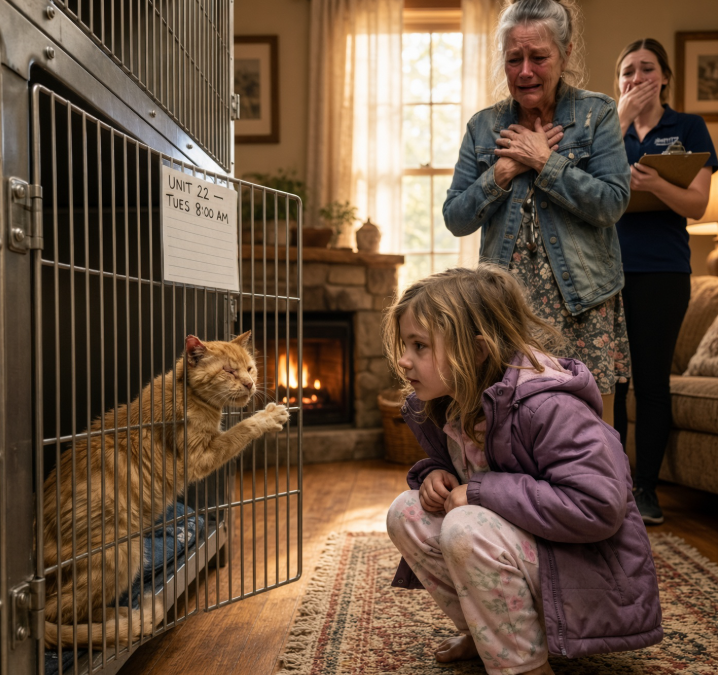
And at the last cage on the left sat Unit 22.
Front and center.
One yellow eye open.
Torn ear lifted.
Waiting.
Nora stopped so suddenly her grandmother nearly bumped into her.
“There,” she whispered.
Marlene opened her mouth to say something careful. Something adult. Something about introductions and medical needs and senior pets and responsibility.
But Nora had already moved closer.
She did not stick her fingers through the bars.
She did not squeal.
She did not press her face against the cage.
She crouched down on the cold floor, barefoot toes curling slightly against the tile, and looked at him.
The old orange cat looked back.
For a long moment, nobody spoke.
Then Unit 22 did something Marlene had never seen him do in 131 days.
Very slowly, as if lowering his tired bones took thought, he lay down.
He pressed his body against the cage door.
He rested his scarred face near the bars.
Then he closed his one eye.
Nora inhaled sharply.
Her eyes filled.
She looked up at her grandmother.
“You see?” she whispered. “He was just tired of waiting.”
June covered her mouth again.
Marlene turned away because tears had spilled before she could stop them.
Luke stared at the cat, and in all the years Marlene had worked with him, she had never seen his face look quite like that.
Defeated and relieved at the same time.
Dr. Alvarez knelt beside Nora.
“You know he’s old, sweetheart?”
Nora nodded.
“You know he has some medical problems?”
“He needs medicine?”
“Yes.”
“Grandma takes medicine too.”
June gave a broken laugh through her tears.
Dr. Alvarez smiled gently.
“He may not live for many more years.”
Nora kept her eyes on the cat.
“How many?”
“We don’t know.”
“How many days was he here?”
Marlene answered softly.
“One hundred thirty-one.”
Nora touched the piggy bank still held against her chest.
“Then he can have all my days until he’s done.”
Nobody in the room knew what to do with that.
Adults were always trying to measure love in practical units.
Money.
Time.
Space.
Plans.
Capacity.
Nora measured it in days.
If the cat had waited 131 of them, then maybe she could give him the ones that came after.
Luke cleared his throat.
“There are adoption fees.”
Nora held up the piggy bank.
“I know.”
June spoke quickly.
“I can pay whatever—”
“No,” Nora said.
Her voice was small, but firm.
“I saved it.”
June closed her eyes.
“Nora, honey—”
“I saved it for something important.”
Marlene stood.
“How much is in there?”
“Forty-seven dollars and thirty-eight cents.”
She said it exactly.
Proudly.
As if every penny had a history.
The adoption fee was sixty-five dollars.
Before June could reach into her purse, Marlene said, “That is enough.”
Luke looked at her.
Marlene looked back.
He understood.
“That is enough,” he repeated.
Nora looked suspicious.
“But the paper says sixty-five.”
“Today,” Luke said, “the shelter is accepting forty-seven dollars and thirty-eight cents.”
“Why?”
He glanced at Unit 22.
“Because sometimes adults need help recognizing the right price.”
Nora considered that.
Then she nodded.
“Okay.”
They moved back to the lobby to fill out paperwork.
Nora insisted on carrying the piggy bank herself. Luke found a towel and placed it on the counter so they could break it safely. June hesitated when she saw the little pink pig on the towel.
“Nora, sweetheart, we could save the piggy bank.”
Nora shook her head.
“It’s not for saving anymore.”
Marlene wrapped the piggy bank in the towel and tapped it gently with a small hammer from the maintenance drawer. The ceramic cracked with a sound that made June flinch.
Coins spilled across the counter.
Pennies.
Nickels.
Dimes.
Quarters.
A few folded dollar bills.
Two birthday cards folded around money from relatives.
A tooth-fairy envelope with glitter on it.
A Canadian quarter Nora insisted still counted because “it was shiny.”
Together, they counted.
Forty-seven dollars.
Thirty-eight cents.
Nora watched every coin.
June watched Nora.
Marlene watched both of them and thought about all the adults who had walked past that cage because the cat looked too broken to be chosen.
When the adoption application reached the medical disclosure section, June’s hand trembled.
“Marlene,” she said quietly, “I’m on a fixed income. I need to be honest. I can care for him, but I can’t afford thousands in emergency procedures.”
Dr. Alvarez stepped closer.
“I’ll do his first full exam at no charge.”
June looked up.
“No, I can’t ask—”
“You didn’t.”
Luke leaned against the counter.
“The shelter has a senior pet medical fund.”
Marlene looked at him sharply.
They did not, technically, have a senior pet medical fund.
They had a donation jar with sixty-two dollars in it and an unpaid invoice for kitten formula.
Luke continued without looking away.
“We do now.”
June’s chin trembled.
“I don’t want charity.”
Marlene said, “It’s not charity. It’s a community catching up to a six-year-old.”
Nora had stopped listening to the adults.
She was looking down the hall.
“Can I hold him now?”
Unit 22 left Briarwood County Animal Shelter at 8:26 a.m.
He was too big for Nora.
His back legs dangled awkwardly beneath her elbows. His torn ear brushed her cheek. His scarred face rested against her shoulder like he had been placed exactly where he had been trying to go for 131 days.
Before they reached the door, he lifted his head and looked back once.
Not at the cages.
Not at the forms.
Not at the euthanasia room.
At Marlene.
He gave one slow blink.
Later, when people asked what that moment felt like, Marlene could only say, “He looked like someone who had finally received an answer.”
Outside, the rain had turned to a fine mist.
June tried again to get Nora’s shoes on before they crossed the parking lot.
Nora refused.
“I forgot my shoes when I came for him,” she said. “He forgot his person. We both forgot something.”
That logic made no sense.
Nobody argued.
They wrapped the old cat in a fleece blanket and placed him carefully in June’s car. Nora sat beside the carrier, one hand pressed against the door.
“What are you going to name him?” June asked as she started the engine.
Nora looked at the cat.
He looked back through the carrier bars.
“He needs a brave name.”
June smiled faintly.
“He does?”
“He waited longer than anyone. That’s brave.”
“What about Rusty?”
Nora frowned.
“That’s a rusty name.”
“He is orange.”
“He is not rusty. He is important.”
June drove slowly out of the parking lot.
Nora watched the shelter disappear behind them.
After three blocks, she said, “Captain.”
June glanced in the mirror.
“What?”
“His name is Captain.”
The old cat pressed his one eye against the carrier door.
Nora smiled.
“He likes it.”
Captain spent his first afternoon in Nora’s bedroom beneath her desk.
Not hiding exactly.
Resting.
There is a difference.
June placed a soft blanket under the desk, a bowl of water nearby, and food recommended by Dr. Alvarez. Captain sniffed the food, licked some gravy, and looked at Nora as if asking whether this strange new room was permanent.
Nora lay flat on her stomach on the carpet.
“I’m Nora,” she whispered. “You’re Captain. Grandma is Grandma. The house is old, but not scary. The heater makes a knocking sound. That’s normal. The blue chair is mine, but you can use it. Don’t eat the purple crayons. They taste bad. I know because I tried one when I was four.”
Captain blinked.
“I don’t have a dad here,” she continued. “I mean I have one somewhere, but not here. Grandma says he is not ready to be responsible. I think that means he forgets birthdays.”
June stood outside the cracked door, one hand pressed to the wall.
She had not meant to listen.
But grief sometimes made sound travel differently.
Nora’s father, Kyle, had been twenty-three when Nora was born. He loved his daughter in the lazy way some men love things they assume will wait for them. He came and went. He promised Saturdays and missed them. He sent gifts late. He called when guilty and vanished when needed.
Nora’s mother, Emily, had worked double shifts at a diner until the accident.
A wet road.
A truck driver who looked down at his phone.
A funeral Nora was too young to understand.
June had taken her granddaughter home that week and never let her go.
Nora had been four.
She had stopped sleeping through the night for almost a year.
She stopped asking when her father was coming.
She stopped crying in front of adults.
Instead, she saved coins.
Every birthday coin.
Every tooth fairy quarter.
Every dime found under vending machines.
Every penny dropped near grocery store registers.
June thought Nora was saving for a dollhouse.
Nora never said.
Then, one Wednesday after school, June had taken laundry to the shelter. Nora had come along and waited near the front window. That was when she saw Unit 22.
He was sitting at the front of his cage.
Watching the door.
Nora had stood outside the glass for eleven minutes.
June remembered because she had folded an entire basket of towels and Nora had not moved once.
On the drive home, Nora asked, “Why does the orange cat wait by the door?”
June answered carefully.
“Maybe he’s hoping someone will come.”
“For him?”
“Yes.”
“Does someone know he’s there?”
“I hope so.”
For the next six days, Nora asked about him every morning.
Did he get adopted?
Did he eat?
Did he sleep?
Did he have a blanket?
Did people pet him?
Did he know he was old?
Did old animals feel embarrassed when people wanted babies instead?
June answered as best she could.
Then Monday evening, while helping with laundry at the shelter, June saw the list.
Unit 22.
8:00 a.m.
She had turned away too quickly, but not quickly enough. Marlene saw her face. June left without finishing the blankets. At home, she cried quietly over the kitchen sink, thinking Nora was asleep.
Nora was not asleep.
At 6:12 the next morning, June woke to the sound of ceramic scraping across wood.
Nora had dragged a kitchen chair to the top shelf of her closet and taken down the piggy bank.
“What are you doing?” June asked.
Nora turned with wild hair, bare feet, and furious eyes.
“We have to go.”
“Honey, it’s still dark.”
“He doesn’t have until light.”
June tried logic.
Nora ignored logic.
June tried breakfast.
Nora put on her coat over pajamas.
June tried shoes.
Nora ran to the car barefoot with the piggy bank clutched to her chest.
Now Captain slept beneath the desk, alive because a six-year-old had treated time like an emergency.
By evening, he came out.
Slowly.
Stiffly.
Nora was sitting on her bed with picture books spread around her. She had chosen five to read aloud, though she struggled with longer words. Her school had recently suggested testing for dyslexia. June had signed the forms with a stomach full of worry.
Captain walked stiffly across the rug and stopped beside the bed.
Nora looked down.
“You can’t jump?”
He looked at her.
She slid off the bed, lifted him carefully under his chest and hips the way Dr. Alvarez had shown her, and placed him beside her pillow.
Captain turned in a slow circle.
Then he lay down.
Against her side.
Nora did not move for nearly ten minutes.
June found them that way.
The old cat sleeping beside the child.
The child staring at the ceiling with one hand resting lightly on his back.
“Grandma?” Nora whispered.
“Yes, honey?”
“Can old hearts get full again?”
June leaned against the doorframe.
“Yes.”
“How do you know?”
“Because mine just did.”
The first week was not easy.
Captain had medicine twice a day. He hated the first dose and spat half of it onto Nora’s pajama sleeve. He moved like his bones were made of old hinges. He could not eat hard food, so June mashed special meals with warm water. His breath smelled terrible until Dr. Alvarez removed more infected teeth. His fur came out in dull clumps when brushed.
Nora loved him through all of it.
She made a chart with stickers.
Medicine.
Food.
Water.
Bathroom.
Brush.
Love.
June told her love did not need a box.
Nora said Captain might like knowing it was scheduled.
At school, Nora told everyone about him.
Most children listened politely.
One boy named Mason said, “Why didn’t you get a kitten?”
Nora looked at him like he had asked why she did not choose a different moon.
“Because kittens already get picked.”
“My dad says old cats die.”
“So do grandpas,” Nora said. “We still love them.”
The teacher, Mrs. Ellison, coughed into her hand to hide a laugh.
That afternoon, she called June.
“I think Nora has found her voice,” she said.
June looked into the living room, where Nora was lying on the floor reading haltingly to Captain.
“Yes,” June said. “I think Captain brought it with him.”
Briarwood County did not forget the story.
At first, only shelter staff talked about it.
Marlene wrote the quote on an index card and taped it near the donation jar:
He waited longer than I saved. That isn’t fair.
By noon, someone had dropped in twenty dollars.
By three, the jar held more than two hundred.
By the end of the week, it held nine hundred and seventeen dollars and a note from a retired mail carrier that read: For the ones who wait.
Luke created an actual senior pet medical fund because once a lie becomes necessary, the decent thing is to make it true.
They named it The Captain Fund.
Marlene objected at first.
“Nora might not want attention,” she said.
Luke looked through the window into the cat ward.
“This isn’t attention. This is infrastructure.”
“Infrastructure?”
“One child made us better. We should build something strong enough to hold the lesson.”
The Captain Fund paid for dental work on an eleven-year-old calico named Peaches. It paid for bloodwork on a blind black cat named Marvin. It paid for arthritis medication for a surrendered dog whose owner had died in hospice.
Old animals began getting bright blue cards on their cages.
Still Waiting. Still Worth It.
Adoptions did not explode overnight.
This was real life.
People still wanted kittens.
But some stopped longer.
Some asked questions.
Some reconsidered.
Marlene noticed people reading the cards, then looking back at the animals with more patience.
That mattered.
Three weeks after Captain’s adoption, a local reporter came to the shelter for a story about overcrowding. Luke spoke about capacity, funding, intake numbers, and spay-neuter programs. Marlene spoke about senior animals. The reporter noticed the index card by the donation jar.
“What does that mean?” she asked.
Marlene hesitated.
Then she told the story.
She did not use Nora’s last name. She did not give her address. She did not dramatize anything. She simply said a little girl had arrived barefoot thirteen minutes before a senior cat’s scheduled euthanasia and emptied her piggy bank because she believed waiting should count for something.
The story ran on Sunday.
By Monday morning, the shelter phone would not stop ringing.
Most calls were kind.
Some were not.
That was how the trouble started.
Because kindness brings attention.
Attention brings praise.
And praise brings people who believe they deserved it first.
The Briarwood Shelter Board had seven members. Most were ordinary people trying their best with too little money and too many opinions. But the board chair, Vivian Croft, was different.
Vivian owned a boutique pet supply store downtown called The Polished Paw. She wore pearl earrings, spoke in fundraising phrases, and had an instinct for appearing in photographs near other people’s compassion. She had joined the board three years earlier after organizing a charity gala where guests paid one hundred dollars per plate and left with gift bags containing gourmet dog biscuits.
Vivian liked animals.
She liked being known for liking animals even more.
When the article about Nora and Captain began spreading online, Vivian called Luke.
“Why wasn’t I informed before this went public?” she asked.
Luke rubbed his forehead.
“Because a child adopted a cat. It wasn’t a media plan.”
“It is now. This story has reach.”
“That isn’t why it matters.”
“Don’t be naive, Luke. Emotional stories drive donations.”
He looked across his office at a stack of unpaid invoices.
“I’m aware.”
“Then we need to manage it.”
“What does that mean?”
“It means we contact the family, get permission for a photo, create a campaign, brand the fund properly, and schedule a donor event.”
“She’s six.”
“Her grandmother can consent.”
“She adopted a cat, Vivian. She didn’t sign up to become the face of the shelter.”
Vivian paused.
“Do you want funding or not?”
Luke closed his eyes.
That was the cruelty of people like Vivian. They hid pressure inside reasonable needs.
The shelter did need funding.
The animals did need food, medicine, staff, repairs, crates, litter, towels, and space.
But Luke had seen Nora’s bare feet on the lobby floor. He had seen her cracked piggy bank. He had seen Unit 22 close his one eye against the cage door because a child had finally stopped in front of him.
Some things should not be packaged.
“We’ll ask carefully,” he said.
“Good,” Vivian replied. “And Luke?”
“Yes?”
“Make sure the story stays positive. No mention of euthanasia scheduling. People don’t donate when they feel guilty.”
Luke looked at the clipboard still locked in his file cabinet.
“Actually,” he said, “sometimes they do.”
Vivian did not laugh.
June said no.
When Luke came to her house two days later with Marlene beside him and embarrassment written all over his face, June made coffee, listened politely, then looked toward the living room where Nora was building a cardboard castle for Captain.
“No.”
Luke nodded.
“I understand.”
Marlene looked relieved.
June glanced at her.
“Do they need money?”
“Yes,” Marlene admitted.
“Then use the quote. Use the story without her name. Use Captain’s name if you want. But Nora has lost enough to be turned into a poster.”
Luke’s shoulders lowered, as if he had been carrying the answer before she gave it.
“That’s what I hoped you’d say.”
Marlene smiled.
“Captain looks good.”
The old cat was sitting inside the half-built cardboard castle with the grave dignity of a wounded king inspecting poor construction.
“He gained twelve ounces,” Nora announced from the floor.
“That’s wonderful.”
“He takes medicine like a criminal.”
Marlene laughed.
Nora narrowed her eyes.
“He waits until Grandma says good boy, then spits it on the rug.”
“He may be teaching you patience.”
“He is teaching me betrayal.”
June nearly spilled her coffee.
For a while, the story remained beautiful.
The Captain Fund grew quietly. Senior pets began moving out of the shelter more often. Nora visited once a month with June, always wearing shoes after Marlene made it a serious rule. Captain came sometimes in a soft carrier with a blanket, and shelter staff treated him like a retired general returning to inspect troops.
Then, in January, Vivian Croft held her gala.
She did not use Nora’s name.
She did something worse.
She used the story without permission and changed it.
The invitation appeared online beneath gold lettering.
The One-Eyed Cat Who Saved a Shelter.
It described “a brave local child inspired by our board’s compassionate senior pet initiative.” It implied the Captain Fund had existed before Nora arrived. It claimed the shelter had been “days away” from losing him, not thirteen minutes. It erased the euthanasia schedule entirely and replaced it with “uncertainty.”
At the bottom, in elegant script, it said:
Founded under the leadership of Vivian Croft and the Briarwood Shelter Board.
Marlene found it first.
She walked into Luke’s office without knocking and placed her phone on his desk.
He read the invitation.
His face hardened.
“She did not.”
“She did.”
Luke called Vivian.
She answered cheerfully.
“Isn’t it lovely?”
“You rewrote the story.”
“I made it donor-friendly.”
“You made it false.”
“I made it useful.”
“Nora founded that fund with forty-seven dollars and thirty-eight cents.”
Vivian sighed.
“Luke, we cannot center a fundraising campaign around a barefoot child and a death deadline. It sounds chaotic.”
“It was honest.”
“Honesty is not always strategic.”
He stood.
“Cancel it.”
“No.”
“Vivian.”
“The venue is booked. Sponsors are confirmed. We already have pledges.”
“You used that child.”
“I protected her privacy.”
“You stole her act of compassion and put your name on it.”
There was a silence.
When Vivian spoke again, her voice had cooled.
“Careful.”
Luke stared out the window at the shelter yard.
“Or what?”
“Or the board may start asking whether your management style is sustainable.”
There it was.
The threat beneath the pearls.
Luke ended the call.
He told himself to calm down.
Then he called June.
He owed her the truth.
June listened without interrupting. When he finished, she did not speak for several seconds.
“Send it to me,” she said.
“I’m sorry.”
“Send it.”
Nora saw the invitation because June left the phone on the kitchen table.
Children see more than adults think.
She read slowly, lips moving around the longer words.
Then she asked, “What does founded mean?”
June closed her eyes.
“It means started.”
Nora looked down at the screen.
“Mrs. Croft didn’t start Captain.”
“No.”
“She didn’t bring money.”
“No.”
“She didn’t come before eight.”
“No, baby.”
Nora’s face changed.
Not anger.
Hurt.
That was worse.
“She made him fancy,” Nora whispered.
June sat beside her.
“What do you mean?”
“She took the sad part out.”
June pulled her close.
“I know.”
“But the sad part is how you know he needed help.”
June had no answer because the child was right.
The gala went forward.
Vivian stood under warm lights in the ballroom of the Briarwood Country Club wearing a silver dress and a shelter-branded pin. Behind her, on a projector screen, was a professional illustration of an orange cat with one eye looking upward toward a golden door.
Not Captain.
A prettier version.
A version with clean fur, symmetrical scars, and no tiredness.
Tables were decorated with tiny blue cards that read Still Waiting. Still Worth It.
Marlene had designed those words after crying in the laundry room.
Vivian raised her champagne glass and spoke about compassion.
She spoke about leadership.
She spoke about building programs before crisis.
She spoke about how senior animals deserved dignity.
People applauded.
Luke stood near the back wall with his arms crossed, feeling sick.
Marlene had refused to attend.
Dr. Alvarez had declined too.
June did not go.
Nora stayed home with Captain and asked if grown-ups always told stories wrong when they wanted money.
June said no.
Then, after a long pause, she said, “But some do.”
At the gala, Vivian announced that The Polished Paw would sponsor “Captain’s Legacy Senior Pet Initiative.”
Luke’s head snapped up.
Captain’s Legacy.
She had used his name.
He walked out before the dessert course.
The next morning, a check for twenty-two thousand dollars arrived at the shelter.
Luke stared at it.
Marlene stared at it.
No one celebrated.
“That money could save lives,” she said quietly.
“Yes.”
“It came from a lie.”
“Yes.”
“What do we do?”
Luke picked up the check.
“We make sure the truth gets there first.”
That afternoon, he called June again.
“I need to ask you something difficult.”
June sat at her kitchen table while Nora colored beside Captain on the floor.
“What?”
“Vivian raised money using Captain’s name. She changed the story. I can refuse the donation, but that hurts the animals. I can accept it quietly, but that lets her own what Nora did.”
June looked at her granddaughter.
Nora had drawn Captain with a crown, an eye patch, and what appeared to be wings.
“What are you asking?”
“I want to create the Captain Fund publicly and correctly. Nora does not have to appear. Her name does not have to be used. But I want the record to say the fund began because a child brought forty-seven dollars and thirty-eight cents to save a senior cat thirteen minutes before his scheduled euthanasia.”
June’s voice was careful.
“And Vivian?”
“Vivian will hate it.”
“That wasn’t my question.”
Luke exhaled.
“I intend to recommend her removal as board chair.”
June was silent.
Then she said, “Nora should decide how much of her story belongs to others.”
“She’s six.”
“She was old enough to know Captain mattered when the rest of us were busy being practical.”
Luke accepted that.
June placed the phone on speaker and called Nora over.
Luke explained as gently as he could. He told her some adults had told Captain’s story in a way that left out important parts. He said the shelter wanted to tell it truthfully but did not want to make her uncomfortable.
Nora listened, one hand resting on Captain’s back.
“Will it help old cats?” she asked.
“Yes.”
“Will people know he was almost out of time?”
“Yes.”
“Will they know he waited 131 days?”
“Yes.”
“Will they know he was not ugly?”
Luke’s throat tightened.
“Yes.”
“Then you can tell it.”
June closed her eyes.
Nora added, “But don’t say I’m a hero.”
Luke smiled through the ache in his chest.
“What should we say?”
Nora looked at Captain.
“Say I was late but not too late.”
The public meeting happened six days later.
The shelter board gathered in the community room at the public library because too many people wanted to attend for the shelter office to hold them. Volunteers came in jeans and rescue sweatshirts. Donors came in coats. Reporters came with cameras. People who had adopted senior animals sat in the back holding printed photos.
Vivian arrived polished and angry.
She had prepared.
People like Vivian always prepared for conflict as if appearance could win before facts began.
She wore navy blue, pearls, and a soft expression designed to communicate disappointment rather than fear.
Luke spoke first.
He did not attack.
That was why it worked.
He simply told the story.
The real one.
A fourteen-year-old orange cat known as Unit 22 had lived at the shelter for 131 days. His euthanasia had been scheduled for 8:00 a.m. because the shelter was overcrowded and no adopter or rescue had come forward. At 7:47 a.m., a six-year-old child arrived barefoot with her grandmother and a piggy bank containing forty-seven dollars and thirty-eight cents. She said she had come for the one nobody wanted. She adopted him. She named him Captain.
The room was silent.
Luke continued.
“The Captain Fund did not begin as a board initiative. It did not begin at a gala. It began with a child who noticed an animal everyone else had learned to walk past.”
Vivian’s face stiffened.
Luke looked down at his notes.
“Last week, fundraising materials were distributed that inaccurately credited board leadership with creating this program and altered key facts about Captain’s adoption. Those materials used Captain’s name without permission from his family and without approval from shelter management.”
Vivian stood.
“I must respond.”
Luke looked at the board.
The vice chair nodded reluctantly.
Vivian walked to the front.
She smiled at the crowd.
“I appreciate Luke’s passion,” she said. “But this is precisely why professional oversight matters. Emotional staff members sometimes struggle to understand donor communication. I protected a minor child’s privacy, preserved the uplifting nature of the story, and raised significant funds for animals in need.”
A few people nodded.
Vivian saw them and gained confidence.
“Would everyone here prefer that money be returned because the wording was not perfect?”
Marlene stood from the second row.
“It was not wording.”
Vivian turned.
“Marlene, I know this has been emotional for you.”
Marlene walked forward slowly.
Her hands shook, but her voice did not.
“You took the saddest part out because it made donors uncomfortable. But that sad part is the shelter. That sad part is overcrowding. That sad part is the reason senior animals die quietly while people shop for kittens. Nora understood that better than you did.”
Vivian’s smile thinned.
“This is inappropriate.”
Dr. Alvarez stood.
“I examined Captain after adoption. The child did not save a mascot. She saved a real old cat with pain, infection, FIV, missing teeth, and arthritis. Turning him into a clean little logo is not compassion. It is marketing.”
A murmur moved through the room.
Then June stood.
Nora was not with her. June had left her at home with Captain and a neighbor because some rooms were too heavy for children.
June held the broken pink piggy bank in both hands. Marlene had repaired it with glue, but the cracks remained visible.
“I am Nora’s grandmother,” she said.
Every camera turned.
June hated that, but she kept standing.
“My granddaughter did not ask for a campaign. She did not ask for attention. She did not ask adults to clap for her. She saw a living creature running out of time and believed that was unfair.”
Her voice trembled, then steadied.
“She had saved those coins for two years. Birthday money. Tooth fairy money. Pennies from parking lots. She brought everything she had because she thought everything she had might be enough. It was not enough according to your fee schedule. It was enough according to the only standard that mattered.”
Vivian looked trapped between apology and defense.
June held up the piggy bank.
“This belonged to a child. Not to a board. Not to a sponsor. Not to a boutique pet store. Not to anyone who wanted their name beside her mercy.”
The room went utterly still.
June looked at Vivian.
“My granddaughter asked one thing. She said not to call her a hero. She said to tell people she was late but not too late.”
Someone in the back began crying.
June lowered the piggy bank.
“So tell it right.”
That was the moment Vivian lost the room.
Not because people hated her.
Because they saw her clearly.
There are humiliations people create for others, and there are humiliations that arrive when truth enters a room wearing no decoration.
Vivian had raised twenty-two thousand dollars with a borrowed story.
Nora had raised something larger with broken coins and bare feet.
The board voted that evening.
Vivian Croft was removed as chair by a vote of five to two.
The funds from the gala were accepted, but every public page was corrected. The program was renamed simply The Captain Fund. The first line on its website read:
Started with $47.38 and a child who was late, but not too late.
Vivian resigned from the board two weeks later. She wrote a public statement about “differences in vision.” Nobody believed it, but most people were too tired to argue.
The Polished Paw stopped using shelter partnerships in its advertising.
The shelter did not become perfect after that.
No place does.
Animals still arrived faster than homes appeared.
Staff still cried in supply closets.
Hard decisions still came.
But something changed.
Every morning, volunteers checked the senior cages first.
Every adoption event included older animals at the front.
Every euthanasia list required a second review for animals who were social, stable, and waiting.
The Captain Fund paid for dental surgeries, foster stipends, senior bloodwork, special diets, pain medication, and transfer fees.
More than that, it paid for time.
Sometimes time was the difference between a cage and a couch.
Sometimes it was not.
But after Captain, nobody at Briarwood could look at an old animal sitting quietly by the door and say waiting meant nothing.
Captain flourished in the Whitaker house.
Not in a dramatic, movie kind of way.
He did not become young.
His missing eye did not return.
His torn ear remained torn.
His arthritis still made rainy mornings difficult.
But his coat brightened. His ribs softened. His walk became less careful. His one eye, cloudy at the edges, grew calmer.
He developed habits.
At 6:30 every morning, he sat beside Nora’s cereal bowl and pretended not to want milk.
At 7:12, he followed her to the front door.
At 7:18, he walked with her and June to the bus stop at the corner, wearing a small orange harness because June refused to let him roam near traffic.
The first morning he did it, the bus driver opened the door and laughed.
“Well, who’s this gentleman?”
Nora lifted her chin.
“This is Captain. He was waiting 131 days.”
The bus driver nodded gravely.
“Then I’m glad he caught the bus.”
“He doesn’t ride.”
“Shame. Looks like he’d behave better than some fifth graders.”
Captain sat beside Nora’s feet until she climbed aboard.
Then he watched the bus pull away.
He did not move until it turned the corner.
Every afternoon, he waited on the porch before the bus returned.
June tried keeping him inside during cold weather.
Captain disagreed.
He expressed disagreement by sitting in front of the door and staring at it with the full moral force of a creature who had survived bureaucracy.
June bought him a heated porch bed.
Nora tucked an old blanket around him each morning.
“Captain has a job,” she told her teacher.
“What is his job?” Mrs. Ellison asked.
“He waits for me.”
Mrs. Ellison smiled.
“That sounds like love.”
Nora considered that.
“Love is a job sometimes.”
Captain became known in the neighborhood.
The mail carrier carried treats with June’s permission.
The old man next door built a little ramp so Captain could climb onto Nora’s bed without being lifted every night.
A teenager who had once teased Nora for walking a cat later built a wooden sign for the porch.
Captain’s Watch.
Nora painted it orange.
Her father, Kyle, came back into the story that spring.
He arrived on a Saturday in April with a wrapped gift, a new haircut, and the nervous smile of a man hoping charm could cross bridges he had burned by neglect.
Nora was in the backyard brushing Captain.
June saw Kyle first through the kitchen window and felt her body tighten.
He knocked twice.
She opened the door.
“Mom,” he said.
June had stopped correcting him. She was not his mother-in-law anymore. Emily was gone. But old names cling when people want old access.
“Kyle.”
“I was in town.”
That was how he always began.
As if his daughter were an errand he could fit between other things.
“I wanted to see Nora.”
June looked at the gift in his hand.
“You should have called.”
“I know. I just thought maybe surprises are nice.”
“For children with reliable parents, maybe.”
His smile faltered.
“Can I see her?”
June almost said no.
Then Nora appeared behind her.
“Dad?”
Kyle crouched with theatrical warmth.
“Hey, bug.”
Nora did not run to him.
That hurt June and satisfied her at the same time, which made her feel guilty.
Kyle held out the gift.
“I brought you something.”
Nora took it carefully.
Inside was a glittery craft kit meant for children younger than her.
“Thank you,” she said.
Polite.
Small.
Kyle looked past her into the yard.
“And this must be the famous cat.”
Captain had followed Nora to the doorway. He sat beside her bare ankle, one eye fixed on Kyle.
“He’s Captain,” Nora said.
Kyle forced a smile.
“Heard you caused quite a stir with him.”
Nora frowned.
“I adopted him.”
“That’s what I mean.”
Captain’s tail moved once.
Kyle stepped inside without being invited.
June stiffened.
“So,” he said, looking around, “where’s this hero piggy bank I keep hearing about?”
Nora’s face changed.
June noticed.
Kyle did not.
“I saw the article online,” he continued. “My kid’s famous, huh?”
“She is not famous,” June said.
“I’m just saying, it’s a good story.”
Nora picked up Captain.
He was heavy, but she managed.
Kyle watched.
“That cat looks rough.”
Nora held Captain tighter.
“He is old.”
“Yeah, I can see that.”
June’s voice sharpened.
“Kyle.”
He raised both hands.
“No offense. Just saying. Cats like that are a lot of work.”
Nora looked down at Captain’s torn ear.
“He waited.”
Kyle sighed, impatient in the way adults get when children force them into sincerity.
“Nora, I’m glad you helped him. Really. But you don’t have to make everything so serious.”
The room went cold.
June opened her mouth, but Nora spoke first.
“You missed my birthday.”
Kyle blinked.
“What?”
“You said you were coming. I waited by the window. Grandma made cupcakes. You didn’t come.”
“Nora—”
“You didn’t call until Monday.”
He looked embarrassed.
“I had things going on.”
“Captain had things going on too. He still waited.”
Kyle stared at his daughter.
For once, charm had nowhere to stand.
“I’m trying,” he said.
Nora nodded.
“Okay.”
The word was not forgiveness.
It was acknowledgment.
Kyle stayed twenty-three minutes.
After he left, Nora sat on the porch steps with Captain in her lap.
June sat beside her.
“You all right?”
Nora nodded.
Then shook her head.
Then nodded again.
“Captain doesn’t leave,” she said.
June put an arm around her.
“No. He doesn’t.”
“Even when he’s tired.”
“No.”
Nora leaned into her.
“That’s why I picked him.”
June kissed the top of her head.
“I know.”
But June did not fully know until later.
That summer, Mrs. Ellison asked Nora to write about her hero.
Most children wrote about firefighters, athletes, mothers, soldiers, superheroes, or older siblings.
Nora wrote six sentences.
My hero is my cat Captain. He waited 131 days for someone to choose him. Nobody did. So I did. He has one eye and one torn ear, but he sees me better than people with two eyes. Heroes do not always save you first. Sometimes they wait until you save them, and then they stay.
Mrs. Ellison read it three times at her desk after school.
Then she called June and asked permission to submit it to the district writing showcase.
June asked Nora.
Nora asked whether Captain could attend.
The answer, surprisingly, became yes.
By then, Captain had developed a following. The Captain Fund website included occasional updates, always approved by June. No photos of Nora’s face appeared. Usually, the updates showed Captain’s paws, Captain’s torn ear, Captain sleeping beside a book, Captain watching the bus from the porch.
The district showcase took place in a middle school auditorium. Nora wore a yellow dress and sneakers with glitter laces. June wore her good cardigan. Captain wore his orange harness and sat in a soft carrier with the door open, because closing the door made Nora sad.
Nora was nervous.
Her hands shook when she unfolded the paper.
Captain, sensing something only cats and old souls understand, climbed out of the carrier and pressed himself against her ankle.
The audience made a soft sound.
Nora read.
Slowly.
Carefully.
She stumbled on the word “heroes,” then corrected herself.
When she finished, there was a silence so deep it felt like the whole room had stopped breathing.
Then people stood.
Not all at once.
First Mrs. Ellison.
Then June.
Then others.
Nora looked frightened by the applause until Captain meowed loudly into the microphone stand.
The room laughed through tears.
Afterward, a woman approached June. Her name was Rebecca Hall. She was a producer for a regional morning show. She wanted Nora and Captain to appear.
June said no.
Rebecca tried gently.
“It could raise awareness.”
“No.”
“We would protect her.”
“No.”
“Nora’s story could help a lot of animals.”
June looked at the woman.
“It already has.”
Rebecca handed over a card anyway.
Nora watched the exchange.
In the car, she asked, “Why can’t I help on TV?”
June chose her words carefully.
“You can. But helping is not the same as being used.”
“How do you know the difference?”
June drove past a field washed gold by evening light.
“You ask who benefits if you get tired.”
Nora thought about that for a long time.
Then she said, “Captain would hate TV.”
“Yes,” June said. “Captain believes cameras steal souls and snacks.”
Nora laughed.
Captain lived past fifteen.
Then sixteen.
His one eye grew cloudy.
His back legs weakened.
He could no longer jump onto Nora’s bed, so she lifted him every night. When he became too heavy for her to lift safely, the old man next door made wooden steps with carpet glued to each one. Captain ignored them for three days, then decided they had always belonged to him.
His world grew smaller.
The porch.
The bed.
The sunny square near the kitchen table.
The bus stop on warmer mornings.
Nora grew taller.
She lost baby teeth.
She learned to read better, though slowly. She discovered graphic novels. She stopped wearing pajama pants to breakfast. She began correcting adults who said “rescue cat.”
“I didn’t rescue him,” she would say. “I adopted him.”
Adults usually smiled.
Nora did not.
She meant the difference.
Rescue made it sound like the story ended when Captain left the shelter.
Adoption meant the promise continued every day after.
The promise became harder in Captain’s seventeenth year.
He stopped eating well.
Dr. Alvarez found kidney disease.
June sat in the exam room with Nora beside her, Captain wrapped in a towel on the table.
Dr. Alvarez explained gently.
Medication could help.
Special food could help.
Fluids might help.
But Captain was old.
Very old.
Nora listened without crying.
That worried June more than tears would have.
When Dr. Alvarez stepped out to prepare medication, Nora leaned close to Captain.
“You don’t have to stay if you hurt too much,” she whispered.
June covered her mouth.
Captain opened his cloudy eye.
He pressed his forehead against Nora’s wrist.
He stayed.
For months, Nora and June cared for him with the devotion of nurses and the stubbornness of family. Fluids under the skin. Warm food. Medicine. Soft bedding. Porch time when weather allowed. Bedtime lifting. Gentle brushing. Quiet songs.
The Captain Fund, by then, had helped 217 senior animals.
Marlene kept count.
She also kept Captain’s first intake photo taped inside her locker. Not because she liked remembering how bad he looked, but because she needed to remember what waiting could become when someone finally stopped.
On a cold morning in February, Captain did not go to the porch.
Nora had already put on her coat for school.
She stood by the front door with her backpack on.
Captain remained on her bed.
His breathing was shallow.
June looked at him and knew.
Nora knew too.
Children who love old animals learn the language of endings before anyone wants them to.
“I’m not going to school,” Nora said.
June nodded.
“I’ll call.”
They spent the morning on Nora’s bed.
No drama.
No rushing.
Captain lay against her side the same way he had on the first night. June sat in the chair nearby, knitting nothing, the needles still in her lap.
At 10:18, Nora asked June to call Dr. Alvarez.
At 11:06, the veterinarian arrived at the house.
Marlene came with her.
Not as a shelter employee.
As someone who had been part of the waiting.
Captain was wrapped in the purple blanket Nora had used since she was little. His body was thin again, lighter than it should have been, but not the same as before. Before, he had been empty from neglect. Now he was light from age after being loved as fully as any creature could ask.
Nora held him.
Dr. Alvarez sat on the edge of the bed.
“You don’t have to decide this minute,” she said.
Nora stroked Captain’s head.
“He waited for me,” she whispered. “I can stay for him.”
No one in the room spoke.
Captain passed with Nora’s hands on his back, June’s hand on Nora’s shoulder, and Marlene standing by the door with tears running freely down her face.
His last breath was quiet.
That felt right.
After all the cages, barking, forms, lists, fundraisers, arguments, and public meetings, Captain left the world in a room where nobody was counting space.
Nora cried then.
Not loudly.
Not dramatically.
She bent over him and cried like something inside her had finally learned the shape of goodbye.
June held her.
Marlene cried too.
Dr. Alvarez wiped her eyes and said, “He had a good life with you.”
Nora lifted her face.
“No,” she said.
Everyone looked at her.
Her voice trembled.
“He had the rest of his life.”
That sentence went on the wall at Briarwood Shelter one month later.
Not with Nora’s name.
Not with her picture.
Just the words.
He had the rest of his life.
Underneath it hung a small framed photo of Captain’s orange paw resting on Nora’s sleeve.
The Captain Fund continued.
People donated in memory of old pets. Children brought coins. Seniors adopted seniors. Foster families opened spare bedrooms to cats who needed quiet. The shelter built a small room called Captain’s Corner, furnished with soft chairs, low beds, warm lamps, and cages that did not feel like cages.
Animals who might have been invisible were placed there.
Visitors had to slow down to enter.
That was the rule.
No rushing.
No tapping glass.
No asking first which animals were youngest.
In Captain’s Corner, every card began with the same line:
Still waiting. Still worth it.
Nora returned to the shelter six weeks after Captain died.
June worried it was too soon.
Nora said, “Waiting still happens when you are sad.”
Marlene met them in the lobby.
For a moment, none of them spoke.
Then Nora hugged her.
Marlene closed her eyes and held on carefully.
“Do you want to see the room?” she asked.
Nora nodded.
Captain’s Corner was warm and quiet. A twelve-year-old tortoiseshell slept in a round bed. A gray cat with diabetes watched from a low perch. An old black-and-white tom with half a tail sat at the front of his enclosure.
Watching the door.
Nora stopped.
June saw her face.
“Oh, honey,” she whispered.
Nora walked closer.
The black-and-white cat blinked.
Marlene said softly, “His name is Mr. Pickles.”
Nora looked at her.
“That is a terrible name.”
“He came with it.”
“Can names be fixed?”
“Sometimes.”
Nora crouched in front of the enclosure.
She did not put her fingers through.
She did not speak.
She simply looked.
The old cat looked back.
After a long moment, Nora said, “I’m not ready.”
Marlene nodded.
“That’s okay.”
Nora stood.
“But someone else might be.”
She reached into her coat pocket and pulled out three coins.
Two quarters and a dime.
Sixty cents.
She placed them in the donation box.
“For whoever is late,” she said.
Years moved on.
Nora became taller than June expected and quieter than most people understood. She volunteered at the shelter once a week when she turned twelve. Not in the cat rooms at first. Laundry. Dishes. Filing. Sweeping. Work that helped without asking her heart to open too quickly.
Eventually, she entered Captain’s Corner again.
The first senior cat she helped place was a blind calico named Maple, adopted by a retired librarian who had lost her husband and wanted “someone peaceful to share the morning with.”
Nora carried Maple to the adoption room and whispered, “Don’t worry. She smells like books.”
Marlene overheard and had to step outside.
By sixteen, Nora was training new volunteers.
She told them practical things.
Do not wake sleeping cats to entertain visitors.
Do not describe animals by what is missing first.
Do not call FIV cats hopeless.
Do not say “at least” to grieving people.
Do not assume quiet means unfriendly.
Do not assume ugly means unloved.
And never say nobody wants this one while the animal can hear you.
When asked why, Nora would say, “Because sometimes they are waiting for the exact wrong person to become the right one.”
June lived long enough to see Nora graduate high school.
At graduation, Nora wore a tiny orange cat pin on her gown. Inside her purse, she carried the repaired pink piggy bank, now empty and cracked and more precious than anything expensive.
After the ceremony, Kyle showed up.
Older.
Softer.
Still not fully reliable, but trying in ways that no longer demanded applause.
He hugged Nora awkwardly.
“I’m proud of you,” he said.
Nora looked at him for a long time.
“Thank you.”
“I know I missed a lot.”
“Yes.”
“I’m sorry.”
“I know.”
He swallowed.
“I wish I had been better.”
“So do I.”
The words hurt him.
They were supposed to.
Then Nora hugged him anyway.
Not because everything was repaired.
Because she had learned from Captain that waiting and forgiving were not the same thing.
You could stop waiting and still leave a door open.
Nora studied veterinary social work in college.
People laughed when she first explained it.
Then she explained that animals do not suffer alone. Their people suffer with them. Shelter workers suffer. Veterinarians suffer. Families surrender pets because of poverty, illness, housing, aging, addiction, grief, and impossible choices. Compassion needed structure, not just feeling.
She wrote her senior thesis on decision fatigue in overcrowded animal shelters.
The first page contained a dedication.
For Captain, who waited 131 days.
For my grandmother, who drove barefoot love through the rain.
For every animal at the front of the cage.
For every person who needs one more day to become brave.
Years later, Nora returned to Briarwood not as a child, not as a volunteer, but as the director of community placement and senior care.
Marlene was still there, older now, with silver in her braid and knees that complained in winter.
Luke had retired the previous year.
Dr. Alvarez came twice a week and pretended she was cutting back.
Captain’s Corner had expanded.
The fund had become one of the shelter’s most reliable programs.
On Nora’s first day, Marlene handed her a box.
Inside was Captain’s original intake card.
Unit 22.
Male neutered domestic shorthair.
Orange tabby.
Approximate age: fourteen.
Medical concerns listed in harsh black ink.
At the bottom, in Marlene’s handwriting, was the note that had followed him for 131 days.
Sits at front of cage. Watches door. Never backs away.
Nora touched the card with one finger.
She was twenty-four years old, but for a moment she was six again, barefoot in a shelter lobby, holding a piggy bank heavier than her arms could manage.
“You kept it,” she said.
Marlene smiled.
“Some records matter.”
That afternoon, a mother and teenage son came in looking for a kitten.
They left with a thirteen-year-old gray cat whose owner had entered hospice.
The next week, an older couple came in saying they could not handle a young pet.
They adopted two bonded senior cats whose cage card said they liked old movies and soft laps.
The month after that, a little boy brought in a jar of coins and asked whether any animals had been waiting “too long.”
Nora knelt in front of him.
“How long is too long?” she asked.
The boy thought hard.
“Long enough to feel sad.”
Nora looked toward Captain’s Corner.
“That’s a good answer.”
The pink piggy bank sat in Nora’s office.
Still cracked.
Still empty.
She never filled it again.
People asked why.
She would smile and say, “Because it already did its job.”
But that was not the full truth.
The full truth was that some empty things are not empty at all.
That piggy bank held the sound of forty-seven dollars and thirty-eight cents spilling across a shelter counter. It held June’s tears. It held Marlene’s trembling hands. It held Luke’s first honest fund. It held Vivian’s public correction. It held Captain’s first night under Nora’s desk. It held morning bus stops, porch watches, medicine charts, school essays, cardboard castles, kidney disease, goodbye, grief, and the hundreds of old animals who received time because one little girl decided unfairness was not a reason to look away.
Nora kept it on the shelf behind her desk.
Whenever a hard list arrived, whenever capacity tightened, whenever numbers began turning lives into categories, she would look at the piggy bank and remember the morning that changed everything.
A shelter is always full of doors.
Kennel doors.
Exam room doors.
Intake doors.
Adoption doors.
Doors people walk through when they are desperate.
Doors animals watch because hope, once learned, is hard to stop.
Captain watched the door for 131 days.
People misunderstood that.
They thought he was waiting for his old owner.
Maybe he was.
They thought he was waiting for food.
Maybe sometimes.
They thought he was waiting because old cats do not understand time.
Nora knew better.
Captain was waiting for the person who would see him as he was and still choose him.
Scarred.
Old.
Sick.
Imperfect.
Inconvenient.
Expensive.
Worth it.
At six years old, Nora walked into the shelter barefoot because love had made her faster than fear.
She did not have enough money.
She did not have a plan.
She did not have adult permission in any organized sense.
She had only a piggy bank, a grandmother willing to drive, and a sentence that still lived on the wall years later.
I came for the one nobody wants.
But the truth, Nora would understand much later, was not that nobody wanted Captain.
It was that too many people had looked too quickly.
They saw one eye.
They saw age.
They saw disease.
They saw cost.
They saw loss arriving sooner than comfort.
Nora saw waiting.
And because she saw waiting, she answered it.
Captain lived three years, four months, and eleven days after he left Briarwood.
Some people, when they heard that, said, “Only three years?”
Nora always corrected them.
Not sharply.
But clearly.
“Three years is a long time when you were scheduled to have thirteen minutes.”
That was the measure.
Not how long love lasts compared to what we wish.
How much life begins after someone refuses to let a number be the ending.
On the anniversary of Captain’s adoption, Briarwood held no gala.
Nora insisted.
No ballroom.
No champagne.
No polished speeches.
Instead, every November, the shelter opened early.
At 7:47 a.m., staff, volunteers, adopters, and children gathered in Captain’s Corner with mugs of bad coffee and paper cups of apple juice. They read the names of every senior animal adopted through the fund that year.
At 8:00 a.m., the time Captain had once been scheduled to die, they opened the doors to the public.
Not with sadness.
With purpose.
The first year Nora directed the ceremony, she stood beside Marlene and held Captain’s intake card.
Her voice shook only once.
“Captain was not saved because everything was easy,” she said. “He was saved because a child believed waiting should count. Our job is to make sure it still does.”
Outside, rain tapped softly against the windows.
Inside, an old orange cat was everywhere and nowhere.
In the cracked piggy bank.
In the blue cards on cages.
In the senior cat sleeping under a heat lamp.
In the volunteer folding towels.
In the family filling out adoption papers for a ten-year-old tabby.
In the little boy dropping coins into the donation box.
In the silence after hard decisions.
In the courage to tell the truth about them.
And in Nora, who still remembered what it felt like to be small, barefoot, and absolutely certain that arriving late was not the same as arriving too late.
By noon that day, three senior cats had pending adoptions.
One was nearly blind.
One needed daily medication.
One had been sitting at the front of his cage for seven weeks, watching the door.
When his adopter signed the paperwork, Nora walked back to her office and looked at the empty piggy bank.
For a moment, she imagined Captain there beside it.
One eye bright.
Torn ear lifted.
Waiting, but not sadly anymore.
She smiled.
Then she returned to the cat ward, because there was always another cage, another form, another family, another impossible decision waiting to be softened by the memory of what one child had done before breakfast.
A little girl once spent everything she had on an old cat the world had already counted out.
She did not buy a pet.
She bought him time.
And in return, Captain gave that time back to everyone.
He gave it to Nora, who learned that love is not measured by how long something stays perfect, but by how faithfully you show up when it is fragile.
He gave it to June, whose tired heart became full again watching her granddaughter choose mercy without being taught.
He gave it to Marlene, who had almost signed one more form and instead spent the rest of her career building doors where there had been deadlines.
He gave it to Luke, who learned that a program can begin with a cracked piggy bank.
He gave it to every senior animal who came after him.
And he gave it to the people who walked into Briarwood believing they wanted something young, easy, pretty, and new, only to stop in front of an old face at the front of a cage and realize love had been waiting there all along.
Captain was not the cat nobody wanted.
He was the cat nobody had been brave enough to choose yet.
Until 7:47 on a Tuesday morning in November.
Until bare feet crossed a cold shelter floor.
Until forty-seven dollars and thirty-eight cents landed on a counter.
Until a six-year-old girl looked at a world full of adult excuses and said, with all the certainty love requires:
“I came for the one nobody wants.”


