A 10-Year War Dog Refused Every Handler at His Own Retirement Ceremony—Then an Old Veteran Walked Past Without Giving a Single Command, and the K9 Followed Him.
PART3:
A handshake.
Maybe a child allowed to pet him after the ceremony if someone decided it would look good.
But Rook had other information.
“That one’s been out there a while,” Chester said eventually.
Not a question.
A measurement.
“Yeah,” Carlos said.
That was enough.
Chester moved around to the right side.
The dog had not changed posture in several minutes. That was what most of the crowd did not notice. They saw the handlers. They saw the official. They saw the ceremony organizers shifting from foot to foot, smiling nervously, checking watches, whispering into phones. They saw the visible problem.
Carlos watched the dog.
The set of the shoulders.
Weight distributed back-heavy.
Chest forward.
Muzzle low and slightly left of center.
Ears half back, not pinned.
Tail down but not tucked.
Hackles flat.
Breathing steady enough, though shallow at the top.
Not aggression.
Not fear in the simple sense.
Not defiance.
Something else entirely.
Carlos’s thumb moved to the adjacent notch in the walking stick.
Slightly deeper.
Rougher at the edge.
Older.
Chester noticed.
Carlos knew he noticed because Chester was the kind of man who noticed almost everything and had the good sense not to mention most of it.
The walking stick looked ordinary at first glance.
Dark wood.
Plain handle.
Rubbed smooth by use.
But along the shaft, where Carlos’s hand rested most often, there were notches carved into the wood. Not decorative. Not evenly spaced. Some deep. Some shallow. Some almost worn flat from years of his thumb returning to them in silence.
Chester had never asked about them.
That was one reason Carlos kept coming back.
Chester understood that men sometimes carried lists where no one else could read them.
Names, maybe.
Dates.
Places.
Dogs.
Ghosts.
Whatever they were, Carlos touched them when certain things happened.
A siren too close.
A child crying behind him.
A dog whining in a parking lot.
A young veteran talking too loudly at the coffee shop with his back to the door.
And now Rook, locked in the grass across the street, waiting for someone who was not coming.
“Dog won’t go for any of them,” Chester said.
“No.”
“You know why?”
Carlos breathed in.
Held half a second too long.
Let it out.
“Got an idea.”
Chester finished the right side, set the scissors down with a clean click, and untied the cape at Carlos’s collar.
Hair slid down the fabric and onto the floor.
Carlos did not move immediately.
His thumb found the oldest notch.
The one that had gone past rough and past worn and arrived somewhere that felt almost like skin.
His hand rested flat on the wood.
He looked at Rook.
And impossibly, across the street, through the window and across the park, the dog turned his dark face toward the barber shop.
Carlos stood.
He set the walking stick to the floor with the loose, unhurried grip of a man who carried it for reasons that had nothing to do with balance.
“Thanks, Chester.”
Chester picked up the cape and shook it once.
“You need me to hold the door?”
Carlos looked at him.
Not sharply.
Not softly either.
Chester nodded once.
“Right. Thought not.”
Outside, the air had the bite of a town not fully awake yet. Cold enough to see breath. Not cold enough to complain. Clouds pressed low over the courthouse, the memorial park, the barber shop, the coffee stand on the corner, the row of storefronts with their faded awnings and clean morning windows.
Carlos stepped down from the low concrete stoop and paused.
Coffee in his left hand.
Walking stick in his right.
He let the scene come to him.
That was how he had survived long enough to become old.
Not by rushing toward things.
Not by assuming the loudest piece of a scene was the most important.
He looked.
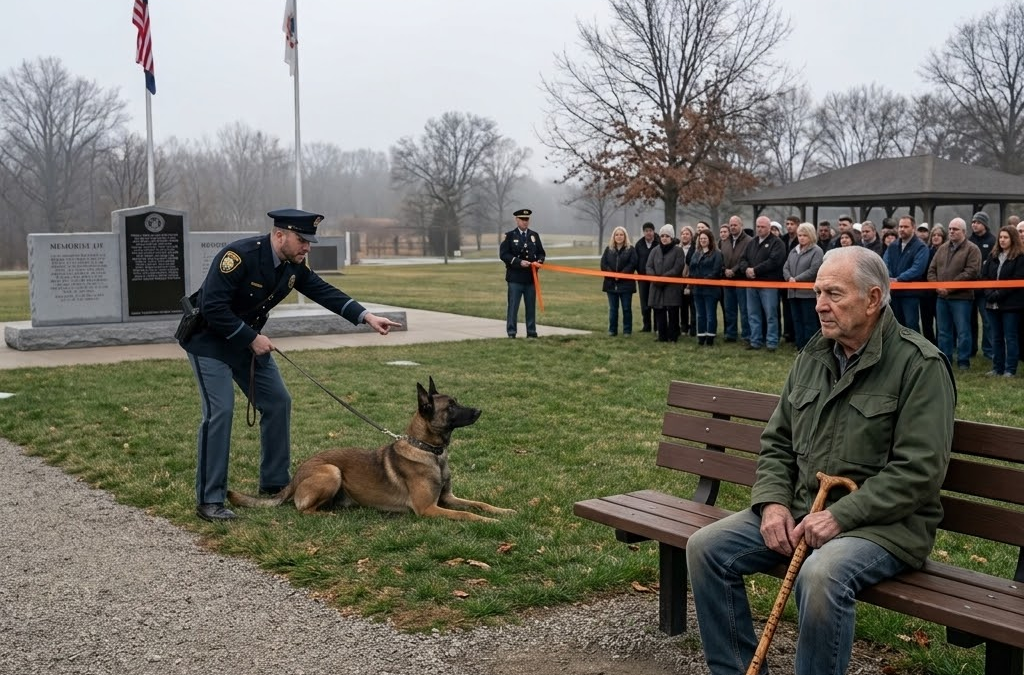
There were maybe forty people gathered in the park. Families. Town officials. Veterans in branch hats. A councilman in a jacket too new for the occasion. A local reporter standing beside a young cameraman who seemed relieved the ceremony had not started on time because it gave him something unexpected to film.
At the center of the event, near the granite slab, sat Rook.
Carlos could see him clearly now.
The dog was older than the banner suggested, or perhaps service had aged him faster. Five, maybe six years of serious work showed in the chest, the neck, the scar tissue around one ear, the steady way he did not waste movement. He was not green. Not uncertain. Not being stubborn in the way young dogs sometimes became stubborn because their bodies held more energy than sense.
His head was low, but not submissive.
His weight sat slightly back on his hindquarters, as if the patch of grass beneath him had become unreliable in a way only he could feel.
His ears remained half back.
That mattered.
Pinned ears would have meant one thing.
Forward ears another.
Half back meant conflict.
Orientation without commitment.
Recognition without release.
Pain with nowhere to go.
Carlos lifted the coffee to his mouth and held it there without drinking.
His eyes moved slowly.
The young handler crouched near Rook had the name STAPLES sewn over his chest pocket.
Spencer Staples.
Late twenties.
Too young to have learned how heavy some silences could get, but old enough to know this one mattered.
He held the lead loosely. That told Carlos something good about him. A lesser handler would have tightened the line by now, using pressure to create movement and calling it control.
Spencer was trying not to make things worse.
“Rook,” Spencer said.
Calm.
Level.
Firm.
Exactly what the training manual would ask of him.
Rook did not blink.
Spencer waited.
Then tried again.
Same tone.
Slightly closer.
Rook shifted his weight another inch backward.
The crowd murmured.
A child asked, “Why won’t he get up?”
A parent shushed him.
Carlos watched Spencer’s third attempt and felt something settle inside him.
Not urgency.
Clarity.
The dog was not refusing.
That was the part nobody was reading correctly.
Rook’s tail was not tucked. His hackles were down. He was not threatening, testing, resisting, or challenging the handler in any form Carlos recognized from eighteen years of working around dogs who told the truth faster than humans could interpret it.
The freeze was older than command structure.
Older than training.
Older than public ceremony, retirement paperwork, transition protocol, liability concerns, county forms, and whatever human plan had brought Rook to this lawn expecting obedience.
Rook was oriented.
Not toward Spencer.
Not toward the ceremony.
Not toward the crowd.
Toward a patch of air slightly left and behind him.
A direction corresponding to nothing visible.
No person.
No object.
No sound anyone else seemed to hear.
Nothing visible.
Carlos lowered the cup.
His thumb found the walking stick’s wood.
Pressed once into the old notch.
He had not brought a dog home in a long time.
He had learned not to name that particular kind of tired because naming it did not do anything useful. But he knew what grief-lock looked like. He had seen it in the field. In staging areas. In airports. In kennels. In the dark beside dogs who had lost their person and had no language for it except the body going quiet in a way no command could reach.
Rook was waiting for someone who was not coming.
“Sir, I need you to step back behind the tape line.”
The man who spoke had the county windbreaker and the binder.
His name badge read DWIGHT KAPLAN.
He was about forty-five with a haircut so precise it looked recently negotiated. He carried a binder under one arm and a lanyard badge that bounced against his chest with every purposeful step.
Carlos did not step back.
He shifted his weight slightly, walking stick easy in his right hand, and watched Kaplan finish directing two volunteers to string orange tape between a park bench and a temporary sign.
EVENT COORDINATION
DO NOT CROSS
Official.
Documented.
Contained.
Rook did not move.
Kaplan turned to Carlos.
“I understand you’re interested in what’s happening here, but this is a controlled animal interaction zone.”
Carlos looked at him.
Kaplan continued, voice carefully neutral.
“We have a situation with an unresponsive working animal, and county protocol requires certified handler contact only. There are liability considerations for your safety and the animal’s.”
He glanced at the walking stick.
“Back up, please. I’ll need you on the other side of the tape.”
Carlos said, “Not long.”
Kaplan frowned.
“What?”
“Just enough.”
“I’m going to ask you again to step behind the tape.”
“All right,” Carlos said.
He did not move.
Kaplan opened the binder.
Not aggressively.
More the way a man opens a binder when he wants the binder itself to lend weight to his spine.
“We’ve got the incident log started,” Kaplan said. “Certified handlers on site have made multiple documented approach attempts. Our next step is to contact the regional animal services supervisor and begin the assessment protocol for an unresponsive canine at a public event.”
Spencer Staples stood nearby, lead in hand.
Something moved across his face.
Not anger.
A helpless kind of dread.
Kaplan kept speaking.
“Depending on what that assessment shows, we may need to remove the dog from the public-facing area.”
Carlos’s attention left Kaplan before Kaplan finished.
Rook’s left ear had begun to rotate.
Slowly.
Like a dish tracking a signal.
Not toward Kaplan.
Not toward the crowd.
Toward Carlos.
Just the ear.
Barely.
But it was moving.
Kaplan said something about a waiver.
Certified personnel.
Civilian proximity.
Approved handler list.
Carlos did not hear the rest.
Vincent Crane, the supervising handler, stepped near Kaplan and said something low.
Kaplan paused.
Crane said something else.
Kaplan frowned the way men frown when they are doing math they dislike.
Carlos watched Rook’s ear.
It stopped rotating.
Settled toward him like a compass needle finding north.
No drama.
No announcement.
Only insistence.
Kaplan closed his binder.
Opened it again.
He seemed certain the right form existed for this.
Carlos almost envied that kind of faith.
The dog was waiting for someone who was not coming.
Carlos knew that feeling.
He had known it for a long time.
Chester came out of the barber shop behind him, apron still tied, comb in one hand. He stood at Carlos’s left shoulder and looked across the park.
Neither man spoke.
Kaplan unspooled more orange tape with the practiced efficiency of someone who believed that if the right boundary were placed in the right location, the world would behave.
“What we need,” Kaplan announced to no one in particular, which meant everyone within range, “is a controlled withdrawal. Get the animal back to transport. File the incident report. Reschedule the formal transfer ceremony pending behavioral review.”
Vincent Crane looked at him like he had just spoken a language no one in the park needed.
“The dog doesn’t need behavioral review.”
Kaplan clicked his pen.
“He needs to be out of public view until we can establish what’s triggering the non-compliance. That’s protocol. I don’t write it. I follow it.”
Crane’s face did not change much.
That was how Carlos knew he was angry.
Good handlers rarely wasted emotion outward when a dog was watching.
“He’s not non-compliant,” Crane said.
Kaplan gave him a look of practiced patience.
“Vincent—”
“He is shut down.”
“Which requires assessment.”
“It requires understanding.”
Kaplan exhaled through his nose.
“That is precisely what assessment is for.”
Carlos watched Rook.
The dog’s weight had shifted lower in the last few minutes, rear haunches dropping fractionally, not from fatigue. The opposite. He was settling deeper into the freeze, reinforcing it from inside. That was what dogs did when the thing they waited for did not come and the wait became the only fact left in the world.
Kaplan spoke into his radio now, requesting a secondary containment assessment, which seemed to mean another van and another set of forms.
Spencer stepped forward.
“Sir.”
Kaplan lowered the radio slightly.
“If we move him now, we may lose weeks of reintegration work.”
“The liability window on a public ceremony—”
“He’s not a liability.”
Kaplan paused.
He was not cruel.
That was the difficult part.
He was not stupid either.
In many rooms, Carlos suspected, Dwight Kaplan was useful. Responsible. Organized. Probably good with scheduling, budgets, permits, seating charts, weather contingencies, and parking overflow. But this was not a room.
This was a park.
And a dog had stopped moving.
And a crowd was watching a man with a binder fail to solve the kind of problem no binder had ever truly solved.
“I understand your concern,” Kaplan said, in the tone people use when they do not. “But without certified progress in the next few minutes, I’m going to have to—”
Carlos set his coffee cup on the park bench.
The cup made almost no sound.
He did not look at Kaplan.
He did not look at Chester.
His thumb moved once across the carved wood of the walking stick, slow, finding what it needed.
Then his hand went still.
Chester saw it.
He had never seen Carlos look urgent.
He had never seen him look unsettled.
What he saw now was something between the two.
A man standing at the edge of a decision the way one holds a door open against wind—not fully open, not closed, just enough to feel the pressure on the other side.
Rook moved.
Not fast.
Not excited.
Not startled.
One step.
Deliberate.
Weight shifting forward from the haunches.
Head turning in a slow arc that bypassed Spencer, bypassed Crane, bypassed the handlers, bypassed Kaplan, bypassed the entire knot of people who had been trying to solve him for nearly an hour.
His amber eyes locked on Carlos.
Thirty feet of grass lay between them.
Rook’s nose lifted.
Higher this time.
He breathed in.
Then he stood.
Nobody gave a command.
Nobody said his name.
Nobody moved.
Rook walked across the lawn with purpose in every stride.
Kaplan stopped mid-sentence.
His binder went slack in his hand.
Spencer’s mouth opened slightly, but nothing came out because good handlers know there are moments when command becomes interference.
Carlos did not move toward the dog.
Did not crouch.
Did not call.
Did not extend his hand.
Civilians always wanted to reach first, to offer fingers, to prove kindness by advancing. Carlos knew better.
He stood with his weight settled, walking stick loose in one hand, eyes soft but not evasive, body present without demand.
Rook closed the distance.
Fifteen feet.
Ten.
His tail, which had hung limp for nearly an hour, began a single slow arc.
Not a wag.
Not yet.
Something more careful.
Like a question forming inside the body before the mind could risk asking it.
Five feet.
The dog stopped.
Then Rook sat.
Not on command.
Not in response to a signal.
He sat in front of Carlos McBride, looked up at him, and the tension locked through his hindquarters began to leave like heat leaving iron.
Slow.
Even.
Gone.
The crowd did not cheer.
They did not murmur.
They did not reach for phones.
They went quiet in the specific way people go quiet when they witness something and do not yet have a word for it.
Vincent Crane watched from across the tape.
Compact man.
Gray at the temples.
Face shaped by thirty years of reading dogs and people until the two skills had grown together inside him.
He watched Rook sit.
Watched his breathing.
Then he looked at Carlos.
Something in Crane’s face changed.
Not surprise.
More like a door opening in a room he thought had been locked.
He took one step toward the tape, then stopped.
Just watching.
Measuring.
Kaplan found his voice first.
“That animal just approached a member of the public, which is exactly the liability scenario I’ve been trying to—”
Chester turned and looked at him.
Only looked.
Kaplan closed his mouth.
Carlos lifted the orange tape and walked under it.
Nobody stopped him.
That was the thing Chester noticed later.
Kaplan had words ready. They were visible behind his teeth, stacked like traffic at a red light. But when Carlos crossed into the controlled zone, not one person moved to intercept him.
Not Spencer.
Not Crane.
Not the other handlers.
Not Kaplan, whose voice seemed to fail him like a radio losing signal mid-broadcast.
Carlos walked toward Rook.
Not slow.
Not fast.
Unhurried.
The carved stick swung easy in his left hand.
His thumb rode the wood from notch to notch without looking.
His eyes stayed on the dog.
Rook watched him come.
No growl.
No retreat.
No forward lunge.
Only locked, patient attention.
The kind a dog gives something it is trying to decide about and is taking its time.
Carlos stopped six feet out.
He did not crouch.
Did not drop to a knee.
Did not reach.
He simply occupied the space in front of the dog like a wall occupies a room—present, unmoving, not asking to be believed.
Spencer stood two steps to the left, leash slack in his hand.
His expression carried relief and guilt in equal measure, the look of a man watching someone else do in thirty seconds what he had failed to do in an hour.
Carlos turned to him.
Without ceremony, he reached into his jacket pocket and pulled out a coin.
He pressed it into Spencer’s palm and closed the young man’s fingers over it with one brief, firm grip.
No explanation.
No performance.
Just a gesture that said, Keep this.
Chester saw the face of the coin before Carlos’s hand closed over Spencer’s.
His eyes sharpened.
“That’s a 39er marker,” Chester said.
Not loud.
Clear enough.
“A Third Special Forces Group K9 recon coin. Where did you get a 39er coin?”
Nobody answered him.
But Vincent Crane turned fully now.
He looked at the coin in Spencer’s hand.
Then at Carlos’s jacket.
Then at the walking stick.
Then at Carlos’s face.
And his expression changed slowly, involuntarily, like a half-remembered photograph coming into focus.
Crane walked toward them in measured steps.
He stopped in front of Carlos and stared for a moment at the old man in the faded dark green jacket, with the carved stick, the steady eyes, and the stillness of someone who had spent a lifetime not explaining himself.
Then Crane said the name.
“Carlos McBride.”
Not a question.
Not an announcement.
He said it like a man says a name he has seen carved in stone, printed in old training documents, spoken by older handlers when the room was almost empty and the real stories came out.
Carlos did not answer.
He did not need to.
The handlers nearest them exchanged glances.
Someone in the crowd whispered something.
Kaplan opened his binder.
He held a pen.
He wrote nothing.
Rook took another step toward Carlos.
Then stopped.
His muzzle hovered six inches from Carlos’s jacket sleeve. He breathed in, reading something no one else in the park could name and no certification in Kaplan’s binder could have predicted.
Kaplan began again.
Something about authorization.
Civilian contact.
Department of Defense property.
Transfer liability.
Public event exposure.
His voice grew louder, faster, more technical, the way bureaucratic voices do when they sense ground shifting beneath them and hope terminology might hold it in place.
Carlos did not look at him.
He lowered himself to one knee in the grass.
The motion cost him.
You could see it if you were watching correctly.
The small pause before his weight committed.
The care around the left knee.
The fraction of stiffness through the hip.
But once he was down, he was down.
Unhurried.
His jacket sleeve brushed the grass.
His free hand rested open on his thigh.
No tension in the fingers.
Rook watched him come down and did not move away.
That alone meant something.
Every handler there knew it.
Spencer went absolutely still.
Carlos slowly turned his forearm, inner sleeve upward, and brought it toward Rook’s muzzle line.
Not a command.
Not an offer exactly.
Presence.
Offered like an open door with no expectation of which way anyone should walk through it.
Kaplan said, “Uncertified personnel cannot—”
Vincent Crane said, “Stop talking.”
Quiet.
Once.
Kaplan stopped.
The sleeve met Rook’s muzzle.
Not pressed.
Not forced.
Rested there.
Carlos let his gaze drop slightly, taking pressure off the moment the way experienced handlers do, making himself smaller so the frightened thing had room to decide.
His thumb found the walking stick lying in the grass beside him.
Found a notch.
Rested.
Rook exhaled.
A long breath.
Slow.
Something released inside the animal’s chest that had nothing to do with obedience.
His ears tilted forward.
His weight shifted.
The architecture of grief changed shape.
That was what Carlos would have called it if anyone had asked and if he had been a man who liked explaining things.
The architecture of grief.
That locked-down posture that looks like defiance to people who want movement, but is only a living thing carrying something it cannot set down.
Rook stood.
Four legs under him.
Weight forward.
Head lowered to working height.
Not broken.
Not subdued.
Present.
He walked one slow circle around Carlos’s kneeling body, scenting the jacket, the sleeve, the old canvas smell, the faint trace of oil and barber soap, and something deeper that belonged to men who had slept under the same sky as dogs and war and never entirely returned from either.
Then Rook came to rest with his flank pressed against Carlos’s shoulder.
Stayed.
Spencer made a sound and swallowed it.
Kaplan stared at the open binder in his hands.
There was not a form for this.
Not a protocol.
Just an old man kneeling in park grass and a war dog that had refused everyone for an hour finally pressing its weight into a shoulder that knew exactly what it was holding.
Carlos rested one hand on Rook’s back.
Not stroking.
Not performing comfort.
Just contact.
Steady.
There.
A way of holding a line taut without pulling.
The handlers remained quiet.
The crowd remained quiet.
The ceremony, whatever it had been planned to be, had become something else entirely.
Spencer Staples was the one who moved first.
He approached slowly, the way young handlers learn to approach a scene they do not fully understand. He stopped a few feet back and crouched, lowering himself to the dog’s level because that habit lived in his knees now and would for the rest of his life.
“How did you know?” he asked softly.
Carlos did not answer right away.
Rook’s breathing had slowed.
Deepened.
The big ribs moved evenly now.
The kind of breath a dog takes when the world has finally decided to make sense again.
Spencer looked at Carlos’s hand on the dog’s back.
“He’s been like this for months,” Spencer said. “Not all the time. Not every day. But whenever transition work gets close to final, he checks out. He’ll train. He’ll work. He’ll respond. Then something shifts, and he just… leaves.”
Carlos’s hand stayed still.
“Who was his handler?”
Spencer looked down.
“Master Sergeant Ellis Vard.”
The name moved through some of the older handlers like a current.
Carlos noticed.
“Where is he?”
Spencer’s throat moved.
“Killed last year. Convoy hit outside the wire. Rook survived. Ellis didn’t.”
Rook’s ear twitched at the name.
Carlos felt it under his palm.
There it was.
The place where the whole scene had been pointing.
The banner.
The ceremony.
The public transition.
The expectation of a new handler.
The crowd.
The speech.
The exact shape of a farewell Rook had no language for.
Carlos looked at the dog.
“He thought this was a handoff.”
Spencer said nothing.
Carlos continued.
“He was waiting for Ellis to come take the lead.”
The young handler looked away.
“I didn’t think—”
“You thought like a handler,” Carlos said. “Not wrong. Just not enough.”
Spencer took that like a blow and a lesson at the same time.
Vincent Crane stepped closer but did not crowd them.
“He’s right,” Crane said quietly. “We built the event like a transfer. Public. Formal. Lead change. New vest. New handler position. Rook read the structure better than we did.”
Kaplan spoke from behind them, softer now.
“The structure?”
Crane glanced back.
“The dog has done ceremonies before. Memorial details. Transfer protocols. Ramp ceremonies. Retirements. He knows patterns.”
Kaplan looked at Rook.
For the first time, he looked less like an official staring at a problem and more like a person watching a creature grieve.
“He thought his handler was supposed to appear.”
Carlos said, “Dogs trust patterns until patterns betray them.”
No one spoke.
The wind moved the small ceremony flag.
Rook pressed slightly harder into Carlos’s shoulder.
Carlos could feel the tremor still buried deep in the dog’s body, though it was no longer ruling him.
Spencer looked at the coin in his hand.
“What is this?”
Carlos glanced once.
“A marker.”
“I know that. I mean—”
“You keep it until you don’t need it.”
Spencer turned it over.
The coin was worn at the edges, the raised insignia softened by years of handling. Third Special Forces Group. K9 Recon. A small number stamped near the bottom.
“Was it yours?”
Carlos’s thumb found the oldest notch in the walking stick.
“Yes.”
Chester stood at the tape line, comb still in his hand, barber apron moving slightly in the wind. He watched Carlos’s thumb on the stick and finally understood something he had always known without knowing.
Those notches were not decoration.
They were not habit.
They were names.
Spencer turned the coin again.
“Who was your dog?”
Carlos looked at Rook.
For a long time, it seemed he might not answer.
Then he said, “Mara.”
The name landed quietly.
No drama.
No explanation.
But Rook lifted his head slightly.
Dogs know when names carry weight.
Spencer waited.
Carlos kept his hand on Rook’s back.
“Mara was faster than my judgment and smarter than my ego,” he said. “That’s a rare combination.”
Crane’s eyes lowered.
He had heard the name. Maybe in training history. Maybe in stories older handlers told after midnight. Maybe attached to a report buried in a file no one read anymore except men who could not let certain things disappear.
Carlos continued.
“She found things before instruments did. Heard things before radios did. Saved men who never knew her name.”
The crowd did not move.
Even the children were quiet now.
Carlos’s voice stayed level.
Not flat.
Level, the way men speak when they have carried a story so long it no longer shakes in their hands.
“We were outside Kandahar. Bad ground. Bad map. Worse intel. We had a team pinned in a dry wash and a route out that looked clear because everyone wanted it to be clear.”
His thumb pressed the notch.
“Mara didn’t like it.”
Spencer looked at the walking stick.
Carlos noticed.
He did not explain the notch.
Not directly.
“She stopped. Sat. Wouldn’t move. Handler behind me said to pull her. Command wanted movement. We were exposed.”
He paused.
“Mara was right.”
The silence deepened.
“Pressure plate under dust. Secondary line hidden in brush. She caught what we didn’t.”
Spencer whispered, “She saved you.”
“She saved eleven of us that morning.”
Rook breathed under his hand.
Carlos looked at him.
“Three weeks later, I missed what she saw.”
The words did not ask for comfort.
No one offered any.
That was mercy.
Carlos continued.
“Different route. Night movement. Intermittent contact. She alerted once. I read it wrong. Thought she was keying on livestock outside a wall. Pushed the pace.”
He stopped long enough that Chester thought he would not finish.
Then Carlos said, “There was a boy in the doorway with a detonator he didn’t understand.”
Spencer’s eyes closed briefly.
“Mara got between him and the team.”
Carlos’s hand remained steady on Rook.
“She moved before I did.”
The wind lifted the flag and let it fall.
“She died in my arms before the medevac bird landed.”
No one breathed loudly.
Carlos looked down at Rook.
“After that, I could still give commands. Still write reports. Still train handlers. Still show up clean-shaven when command wanted me to brief something. But there was a part of me that sat down right there and waited for a dog who wasn’t coming back.”
Rook’s head turned.
He pressed his muzzle against Carlos’s sleeve.
Spencer looked at the dog and then at the old man.
“How did you keep going?”
Carlos did not look up.
Spencer’s voice roughened.
“After you lost yours in the field, how did you carry something like that and still be this?”
He gestured helplessly toward Carlos, Rook, the morning, the impossible shape of what had just happened.
“How do you stay the thing they trust?”
Carlos’s thumb moved across the oldest notch.
Once.
“He didn’t follow me,” Carlos said quietly.
Spencer waited.
Carlos looked at Rook.
“He followed what I still carry.”
The words sat there.
Simple.
Heavy.
“There’s a difference,” Carlos said. “Most days that difference is the only thing that makes sense.”
Spencer did not answer.
Carlos let the silence stretch.
Rook’s breathing stayed even.
Kaplan closed his binder slowly.
Not with defeat.
Not quite.
More like a man setting down a tool after realizing the job required hands.
The crowd behind the tape remained still.
The reporter had lowered her microphone.
The cameraman had stopped trying to frame the shot and was simply watching.
Carlos pressed his forehead briefly against Rook’s head.
Not sentimental.
Not performed.
An old field goodbye.
The kind given when no other language fits.
He stayed there one breath.
Then straightened.
Rook did not resist the movement.
Carlos stood slowly, both knees protesting.
The walking stick came up into his hand, thumb finding the wood without looking.
Spencer remained crouched.
His eyes had gone to the place young handlers’ eyes go when they have just been handed something they will carry for the rest of their careers and do not yet know its shape.
Carlos looked at him directly.
“You keep going,” he said, “because the next one needs you whole.”
That was it.
That was all of it.
Every notch on the stick.
Every name he did not say.
Every morning he had picked up the lead again and walked back into the work because the next dog did not know what had been lost, and so Carlos could not allow himself to know it all the way either.
Not while there was still one more dog to bring home.
Spencer nodded slowly.
Like a man accepting weight.
Rook rose beside Carlos.
No command.
No leash pressure.
He stood because the world had shifted into a shape he could understand again.
Crane moved toward Spencer.
“Take him,” he said softly.
Spencer swallowed.
Then looked at Rook.
Not as a dog to be transferred.
Not as a ceremony problem.
As a veteran.
As a creature with memory.
“Rook,” he said.
Not command tone.
Not ceremony voice.
Just a name.
Rook turned his head.
Spencer lowered one hand, palm inward, not offering pressure, only presence.
Rook looked once at Carlos.
Carlos gave nothing visible.
No nod.
No signal.
But Rook seemed to read what he needed.
He stepped toward Spencer.
One step.
Then another.
Spencer did not reach too fast.
Good.
He waited until Rook’s shoulder brushed his knee.
Then he placed one hand lightly against the dog’s vest.
Not grabbing.
Not claiming.
Just contact.
Crane closed his eyes for half a second.
Kaplan looked down at the orange tape.
Then at the crowd.
Then at the binder.
He cleared his throat.
“I think,” he said carefully, “we may need to adjust the ceremony sequence.”
Chester, from the tape line, said, “You think?”
Kaplan looked at him.
Then unexpectedly smiled, just a little.
“Yes,” he said. “I think.”
The ceremony did not proceed as planned.
No one read the full prepared speech.
The councilman tucked his pages into his jacket after the first paragraph and wisely stopped trying to sound important.
Vincent Crane spoke instead.
He kept it brief.
He told the crowd that military working dogs do not retire from memory just because a date appears on a form. He told them Rook had served with distinction. He told them service leaves marks no vest can cover and no ceremony should rush.
Then he invited Spencer forward.
Spencer walked with Rook beside him.
Not dragged.
Not pulled.
Not displayed.
Together.
Rook stayed close, shoulder aligned with Spencer’s leg, but once, halfway to the small stage, he looked back.
Carlos had already reached the sidewalk near the barber shop.
He did not turn around.
That was the thing Chester noticed first.
Every handler, every official, every person in the park watched Carlos walk away, and he never turned back once.
The carved stick moved with him at that unhurried, measured pace.
Thumb resting where it always rested.
On the oldest and smoothest notch.
Not leaning on it.
Just carrying it.
The way he carried everything.
The overcast sky had pressed down all morning, flat and gray and permanent-looking. But as Carlos reached the barber shop, the clouds opened for a moment. A single shaft of late light crossed the sidewalk four feet ahead of him, pale gold and exact.
The kind of light that exists only long enough to make you notice it.
Carlos stepped through where it had been.
Behind him, in the park, Rook stood beside Spencer while Crane removed the ceremonial lead and handed Spencer the working one.
There was no applause at first.
Then someone started.
Not loud.
Not the clapping people do when a speech ends.
This was slower.
Careful.
Respectful.
The sound grew, but Rook did not flinch.
Spencer kept one hand on his vest.
Crane looked toward the barber shop once.
Kaplan did too.
So did Chester.
Carlos did not.
The barber shop door opened.
Chester held it without a word.
Carlos paused at the threshold.
His thumb touched the oldest notch one last time.
Just the pad of it.
Just a second.
Then he went inside.
Chester followed him in and let the door close gently behind them.
The shop smelled of talc, coffee, old leather, and cut hair.
For a moment, neither man spoke.
Carlos returned to the chair, not because his haircut needed finishing, but because the chair was where he had been before the world interrupted him. He set the walking stick across his knees again.
Chester removed the cape from where he had left it and shook it out once.
“You want me to clean up the back?”
Carlos nodded.
Chester draped the cape over him.
Fastened it at the neck.
Picked up the scissors.
Outside, the ceremony resumed in altered form.
Inside, scissors began their soft rhythm again.
After several minutes, Chester said, “Mara.”
Carlos’s eyes met his in the mirror.
Chester’s expression held no curiosity now.
Only acknowledgment.
Carlos looked away first.
“Yeah.”
“She one of the notches?”
Carlos’s thumb rested on the smoothest groove.
“The first one I carved.”
Chester cut carefully around the back of his ear.
“How many?”
Carlos did not answer quickly.
Chester waited.
Carlos said, “Enough.”
That was all.
And Chester, being a good barber and a better man than he ever claimed, let that be enough.
Across the street, Rook completed the ceremony with Spencer.
Not perfectly.
No working dog ever gave humans perfection when truth would do.
But he stood.
He moved.
He accepted the lead.
He leaned once into Spencer’s leg while Crane spoke the final words.
And when the crowd finally dispersed, Rook turned his face toward the barber shop window.
For a moment, Carlos saw him through the glass.
Dark muzzle.
Amber eyes.
Green-and-gold vest.
A living thing carrying what he could not set down but no longer carrying it alone.
Carlos’s thumb pressed the notch.
Not counting.
Never counting.
Just touching.
Then Rook turned away with Spencer, and the two of them walked toward the transport van together.
Not cleanly.
Not magically healed.
That was not how grief worked.
But moving.
And sometimes moving was the miracle.
Later that afternoon, after the park emptied and the last folding chair was loaded into a county truck, Dwight Kaplan remained near the granite memorial with his binder closed under one arm.
Vincent Crane stood beside him.
Neither looked at the other.
For a while, they watched Spencer brush Rook beside the van in slow, deliberate strokes.
Kaplan finally said, “There should be something in the protocol for that.”
Crane watched the dog.
“There is.”
Kaplan turned.
Crane nodded toward the barber shop.
“Know when the protocol isn’t enough.”
Kaplan looked uncomfortable.
But not offended.
That, Crane decided, was progress.
Spencer kept the 39er coin in his pocket for six months.
He did not tell many people that.
He carried it during training sessions, public events, reintegration exercises, and the long afternoons when Rook seemed to drift toward the edge of himself again.
He never used Carlos’s name as a command.
Never tried to imitate the old man.
He understood enough not to cheapen the moment by copying its shape.
But sometimes, when Rook froze in a doorway or paused beside an empty passenger seat or turned toward a sound no one else heard, Spencer would stop asking the dog to move and instead make room for him to remember.
That was different.
And Rook noticed.
Slowly, the dog began returning faster.
Not because he forgot Ellis.
Because Spencer stopped asking him to.
One evening, months later, Spencer found Carlos’s barber shop by accident, or told himself it was by accident. He parked across the street and sat in his truck for ten minutes with the coin in his hand before stepping out.
Chester was sweeping hair from beneath the second chair when the bell over the door rang.
Spencer entered in civilian clothes, cap in hand.
“No haircut needed,” he said.
Chester looked at him, then at the coin in his hand.
“Figured.”
“Is he here?”
Chester leaned on the broom.
“Not today.”
Spencer nodded.
He looked around the small shop as if the room might contain instructions.
“He still come in?”
“Every three weeks. Same chair.”
Spencer swallowed.
“Can you give him this back?”
He held out the coin.
Chester did not take it.
“Do you still need it?”
Spencer looked down.
Thought longer than Chester expected.
Then closed his fingers around the coin again.
“Maybe a little longer.”
Chester nodded.
“Then you keep it a little longer.”
Spencer turned to leave.
At the door, he stopped.
“Rook’s doing better.”
Chester smiled faintly.
“Carlos will know.”
Spencer looked back.
“How?”
Chester resumed sweeping.
“He seems to know most things nobody tells him.”
Three weeks later, Carlos came for his haircut.
Chester told him Spencer had stopped by.
Carlos said nothing.
But his thumb moved along the walking stick and settled briefly on a notch that was not the oldest one.
Not Mara’s.
A newer one.
Chester noticed.
Had the good sense not to mention it.
Outside, late morning traffic passed.
The memorial park sat quiet.
The orange tape was gone.
The chairs were gone.
The banner had been removed.
Only the granite slab remained, and the flag, and the grass where Rook had refused to move until someone who understood grief walked close enough for him to follow what was still being carried.
Chester trimmed around Carlos’s left ear.
After a while, he said, “You ever think about telling people the whole story?”
Carlos looked at him in the mirror.
“No.”
“Any reason?”
Carlos’s eyes moved toward the park.
“Stories get smaller when people want to own them.”
Chester considered that.
Then said, “Some get bigger when they’re carried right.”
Carlos said nothing.
The scissors moved.
The morning held.
On Carlos’s knees, the walking stick lay steady.
The notches remained where they had always been.
Some rough.
Some smooth.
One almost like skin.
Each a name.
Each a weight.
Each proof that loss did not disappear just because a man learned how to stand under it.
Outside, a dog barked somewhere down the block.
Carlos’s eyes moved first.
Then his face.
A habit he had never turned off.
Never tried to.
And Chester, who had learned the shape of Carlos McBride’s silence better than most men learned another man’s speech, kept cutting.
Because sometimes that was all you could do for a man like Carlos.
Not ask too much.
Not look too directly at the wounds.
Not make ceremony out of survival.
Just hold the door.
Sharpen the scissors.
Let him sit facing the window.
And when the world outside called to something he still carried, step aside and let him answer.


