PART2:We Rescued a Dog So Weak We Couldn’t Even Bathe Her—Then Her First Days in Foster Care Broke My Heart
PART2
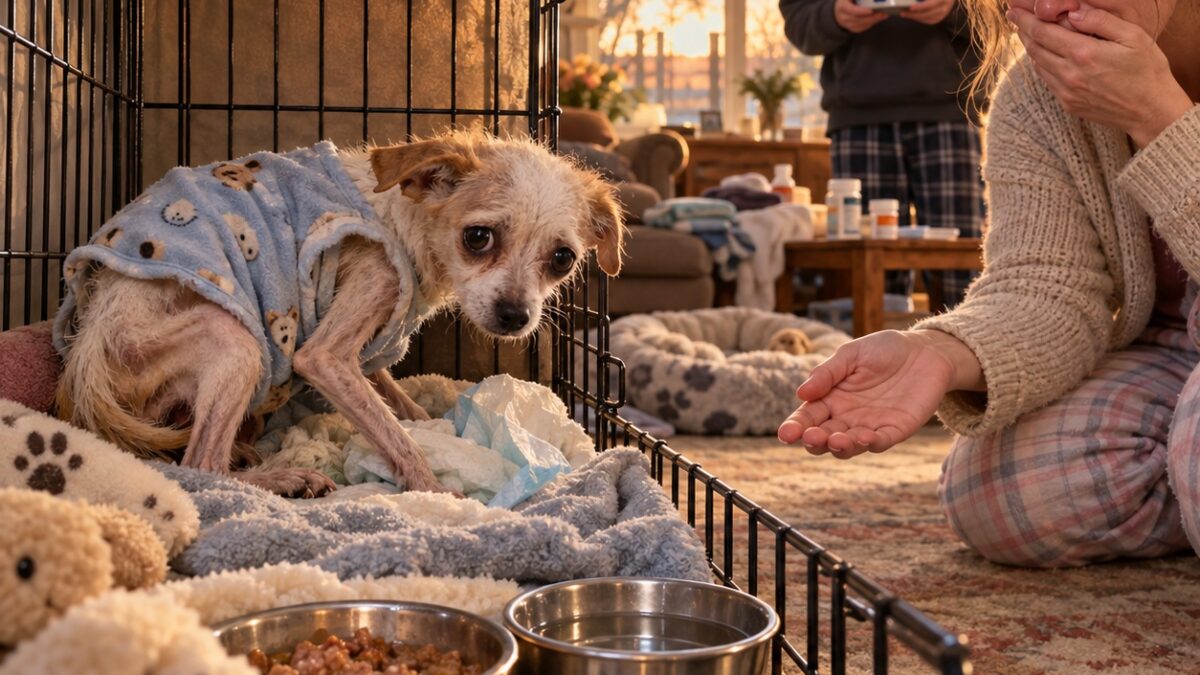
The first morning in foster care, Nola woke before the rest of the house.
Or maybe she had never really slept.
Sick dogs often drift in and out.
I found her standing uncertainly near the edge of the room.
She looked at me.
Then at the doorway.
Then back at me.
“Outside?”
She knew the word no more than she knew anything else about our routine.
I clipped a leash on her carefully and carried her down the step because her strength was still too unreliable.
Morning light had just started coming across the ranch.
The grass was wet.
A little fog hung low over the farther pasture.
Nola stood on the ground.
She froze.
I had expected her to sniff immediately.
Instead, she simply looked.
A dog who has lived a normal life treats grass like background.
Nola seemed to study it.
Then she took one step.
Another.
Her feet became damp.
She stopped again.
A bird called from somewhere behind us.
Nola’s ears lifted.
For the first time, I saw something in her face that had nothing to do with illness.
Curiosity.
Tiny.
Fragile.
But there.
She relieved herself eventually.
I praised her.
Nola looked confused by the attention.
Inside, I offered breakfast.
That was when she became most alive.
Her eyes locked onto the bowl before it reached the floor.
Her body shook.
Not fear.
Need.
I put the food down.
Nola ate with a desperation that made me immediately regret using a regular bowl.
She swallowed as though the food might disappear between bites.
“Slow down.”
My hand moved toward the dish.
Nola stiffened.
I stopped.
There are moments when a foster animal tells you an entire chapter of its history without language.
The tension in that tiny body said:
Do not take this.
I lowered my hand.
“Okay.”
She kept eating.
Afterward, she searched the floor.
Every corner near the bowl.
Licked crumbs that were not there.
Walked toward the kitchen.
Nose down.
I had fed her the amount the medical team told me to feed.
Her stomach and body needed careful rebuilding.
I could not simply fill a huge bowl until she stopped.
But explaining that to Nola was impossible.
Her body knew one truth.
Food exists now.
Eat it before it stops existing.
For the rest of the morning, she followed us.
Kitchen.
Living room.
Hallway.
If someone stood up, Nola stood too.
Slowly.
Painfully at times.
But she followed.
I began wondering whether she wanted company.
Then I noticed her nose.
Always checking.
A hand near the counter.
A child carrying a snack.
A plate.
A sound from the refrigerator.
Nola was following food possibilities.
Maybe us too.
But food first.
There was no shame in that.
Survival had taught her priorities.
My son sat at the table eating toast.
A crumb fell.
Before it reached the floor, Nola moved.
Fastest I had seen her.
She swallowed it.
My son looked at me.
“Can I give her some?”
“Not from your plate.”
“Why?”
“Because we need her stomach to adjust carefully.”
Nola stared at the toast.
Her whole body seemed organized around it.
My son turned his chair slightly so she would not have to watch.
That made me love him.
Later, sunlight spread through the living room window.
Nola found it.
She stepped into the warm patch.
Stopped.
Then slowly lowered herself.
Her pajamas made her look impossibly small.
She stretched out.
Closed her eyes.
For almost twenty minutes, she did nothing except absorb warmth.
I watched from the kitchen.
There is an image people have of rescue dogs arriving in foster homes and immediately understanding they are safe.
They sleep deeply.
They cuddle.
They seem grateful.
Sometimes.
Nola did not know what safe meant yet.
She knew warm.
She knew food.
She knew pain.
She knew fatigue.
Safety would have to become a pattern before it became a feeling.
So we built the pattern.
Breakfast comes.
Medication comes.
Nobody takes breakfast away.
Outside.
Inside.
Soft bed.
Lunch if scheduled.
More medication.
A child’s voice.
Sun.
Dinner.
Warm pajamas.
Sleep.
Then breakfast comes again.
The most important part was again.
For an animal shaped by deprivation, consistency is its own language.
You cannot say:
There will always be food.
You show it.
Monday.
Tuesday.
Wednesday.
Thursday.
Every bowl becomes evidence.
Every full stomach adds one sentence to the new story.
By the second day, Nola recognized the refrigerator opening.
By the third, the sound of her food container brought her into the kitchen.
She was still weak.
Still being monitored.
Still requiring repeated blood tests.
The medical side did not disappear simply because she had left the hospital.
We returned for bloodwork.
Nola trembled in the car.
I kept a hand near her.
At the clinic, she recognized the staff.
Tail.
Always the tail.
The veterinarian drew blood.
Nola looked offended now.
That was improvement.
On the first day she barely objected because she had no energy.
Now she turned her head.
Tried pulling one paw away.
The technician smiled.
“Getting feisty.”
“I’ll take it.”
We waited for results.
Numbers improved again.
Still not normal.
Nobody pretended.
But enough to breathe a little easier.
Her body was responding.
Fluids.
Medication.
Nutrition.
Rest.
Something was working.
Back home, Nola continued studying domestic life.
Day three, she discovered the couch.
Not exactly.
She watched one of our dogs jump up.
Then looked at the cushion.
Nola placed her front paws against it.
I watched.
She climbed.
Awkward.
Slow.
Eventually she stood on the couch.
Her face looked almost alarmed.
Soft surface.
Elevation.
Maybe both unfamiliar.
She remained there for about five seconds.
Then climbed right back down.
My son laughed.
“Nola, that’s where dogs are supposed to sleep.”
I said:
“According to who?”
“Every dog we’ve ever had.”
Nola looked at us.
Then went back to her blanket on the floor.
The couch would take time.
Toys were even stranger.
On the fourth day, my son rolled a small stuffed toy toward her.
Nola watched it stop.
Nothing.
He picked it up.
Squeaked it.
Nola flinched.
He immediately put it down.
“Sorry.”
She sniffed it later.
That was all.
Another rescue dog carried a ball past her.
Nola watched.
No chase.
No excitement.
No instinct visible to us that said:
This is for fun.
That was heartbreaking in a quiet way.
We think of play as automatic.
Puppies chase.
Dogs tug.
They toss objects.
But play needs security.
It requires energy beyond survival.
A starving body does not waste calories on a ball.
An animal constantly searching for food does not necessarily understand why another dog runs after something that cannot be eaten.
Nola looked at toys like objects without instructions.
So we stopped expecting anything.
They remained around.
Available.
No pressure.
Then came the kennel morning.
Day four.
Early.
I entered the room before breakfast.
Nola was inside her kennel.
She had had an accident.
That itself was not surprising.
House training was completely new.
I moved closer.
Then stopped.
Nola was eating her own waste.
For half a second, my mind refused the image.
“Nola.”
She looked at me.
Then lowered her head again.
I opened the kennel quickly but gently.
Not yelling.
Not punishing.
I guided her out.
Cleaned everything.
Fed her according to schedule.
Then sat on the floor after she finished.
Nola searched around the bowl.
Again.
Nothing left.
She looked at me.
That was when I cried.
Not because what she had done disgusted me.
Because our house was full of food.
Her measured meals were arriving on schedule.
She had been given medication.
Warmth.
Blankets.
Pajamas.
Soft voices.
And still, when she found something inside the kennel her past had taught her might contain even a trace of nourishment, she ate it.
Four days of safety had not overwritten starvation.
Why would it?
Her brain and body had survived something much longer than four days.
I understood the behavior for what it was.
Not disobedience.
Not something shameful.
A habit shaped by deprivation.
A survival strategy.
Maybe one she had needed.
Maybe the difference between an empty stomach and something.
I sat beside her.
“You’re getting breakfast.”
Nola stared at me.
“Every morning.”
Her ears lifted.
“You don’t have to do that anymore.”
Of course she did not understand.
Not yet.
So I stopped talking.
And kept feeding her.
That became another lesson.
Trauma does not disappear when circumstances change.
A dog can be safe and still behave like danger is coming.
A dog can be fed and still search desperately.
A dog can have a bed and still sleep on the floor.
Can have toys and not play.
Can be offered affection and remain uncertain.
The body arrives in foster care before the nervous system does.
We had rescued Nola geographically.
Emotionally, some part of her remained wherever hunger had taught her those habits.
Our job was not to drag that part forward.
It was to make the present predictable enough that eventually she would follow.
The first frightening new experience came from something ridiculous.
A hair dryer.
We were still not bathing her normally yet.
Her body remained fragile, though her bloodwork continued improving.
We were doing gentle cleaning.
One afternoon, after carefully wiping part of her coat, I used a hair dryer at a distance on a very low setting for another dog nearby.
The sound began.
Nola collapsed.
Not physically from illness.
Fear.
She dropped low.
Eyes wide.
Tried backing away.
I switched it off immediately.
Silence.
Nola remained frozen.
I sat several feet away.
Did not touch her.
“Okay.”
She stared at the dryer.
“Done.”
Minutes passed.
Eventually her body loosened.
That experience reminded us how little we knew.
Maybe she had never heard a dryer.
Maybe the noise resembled something frightening.
Maybe any loud mechanical sound would have triggered the same response.
The reason mattered less than the message.
Slow down.
New experiences were not automatically good experiences simply because they happened in a safe house.
We began introducing things carefully.
Vacuum.
Doors.
Television.
Kitchen appliances.
My son dropping toys.
The other dogs barking.
Each sound was information Nola had to process.
Sometimes she startled.
Sometimes not.
When she became afraid, someone stayed nearby.
Not trapping.
Not forcing.
Just presence.
The ranch helped.
Our property gave Nola space without overwhelming crowds.
The first trip farther from the house happened once the veterinarian was comfortable with her strength.
We drove out to where some of the other rescue dogs spent supervised time.
Nola stepped onto the ground.
Wind moved across the grass.
She lifted her nose.
A larger dog approached.
Nola froze.
The dog was calm.
Older.
Experienced around fosters.
He sniffed from a respectful distance.
Nola sniffed back.
Then he walked away.
No pressure.
That was perfect.
Another dog ran past.
Nola’s head followed.
A third rolled in the grass.
For several minutes, Nola simply watched dogs being dogs.
Eating had been her first lesson in security.
Maybe this was the first lesson in leisure.
These animals were not searching frantically.
They were running because they could.
Sniffing because the world smelled interesting.
Rolling because apparently grass felt good.
Nola took several steps farther.
Then another.
Her legs were still thin.
But the body was becoming more stable.
She sniffed one patch of grass.
Moved to another.
Then followed the older dog several feet.
I felt something loosen in my chest.
“Look at you.”
Nola turned toward my voice.
Tail.
Bigger wag now.
Not the faint hospital movement.
An actual wag.
My son ran toward us from farther away.
I called:
“Slow!”
He slowed immediately.
Nola’s ears perked when he spoke.
They always did.
“Hi, Nola.”
She moved toward him.
That relationship grew before any of us planned it.
My son did not treat her like a patient.
Children can be wonderful that way when taught gentleness.
Adults looked at Nola and saw anemia.
Infection.
Body condition.
Medication schedule.
My son saw a tiny dog wearing pajamas.
He talked to her.
Told her about school.
Asked whether she liked dinosaurs.
Explained video games she could not possibly understand.
Nola listened because she liked his voice.
Soon, when he entered a room, her ears rose.
Then her head.
Then eventually her whole body.
She followed him.
Partly because children drop food.
We should be honest.
But not entirely.
One evening he lay on the living-room floor doing homework.
Nola approached.
Sniffed the pencil.
Then settled beside his arm.
My son did not move.
He looked at me.
Eyes wide.
I whispered:
“Keep doing your homework.”
“Mom.”
“Homework.”
“But—”
“She chose you. Don’t make it weird.”
He grinned.
For twenty minutes, Nola slept beside him.
That night, she climbed onto the couch again.
This time she stayed.
Only at one edge.
Ready to jump down.
But she stayed.
We pretended not to notice.
Her coat was slowly changing too.
The stains did not disappear in one dramatic bath.
We continued gentle cleaning as her health allowed.
Soft wipes.
Warm cloths.
Small areas.
Eventually more thorough grooming became possible.
Each time, another patch of white emerged.
Real white.
Not yellow.
Not gray.
Not the color of old urine.
White fur.
The first time I saw a clean section on her shoulder, I ran my hand across it.
“Look at this.”
My husband glanced over.
“What?”
“She’s white.”
He laughed.
“We knew that.”
“No. Look.”
Under all that staining was this beautiful coat.
It felt symbolic enough that I tried not to make it symbolic.
Nola did not care what color she was.
But I did.
Every bit of white felt like seeing the dog underneath what had happened to her.
People sometimes say rescue washes away the past.
It doesn’t.
The past happened.
Nothing removes it.
But stains can come out of fur.
Weight can return.
Blood values can improve.
New memories can accumulate.
The past can stop being the only visible thing.
That is what happened to Nola.
Week one became week two.
Her medical rechecks continued.
Blood draw.
Wait.
Improvement.
Another appointment.
More improvement.
Still caution.
The veterinarian reminded us that recovering from severe anemia and infection takes time.
I did not need convincing.
I could see it.
Some mornings Nola had more energy.
Then she slept most of the afternoon.
A short walk could exhaust her.
Play remained limited.
But appetite?
Appetite was not a problem.
She had enough for five dogs.
At least in her opinion.
We followed the feeding plan.
Nola disagreed.
She developed a habit of inspecting the kitchen after everyone finished eating.
Chair by chair.
Floor beneath my son.
Trash area.
Near the refrigerator.
One morning I caught her staring at a crumb beneath the cabinet.
It was so small I could barely see it.
Nola had found it from several feet away.
“Your nose is ridiculous.”
She ate the crumb.
Then looked for more.
The waste-eating behavior did not vanish instantly either.
We managed the environment carefully.
Cleaned immediately.
Supervised.
Kept her feeding consistent.
No punishment.
We wanted the old survival strategy to become unnecessary through repetition.
Weeks later, I realized I could not remember the last time she had tried.
That is how some progress arrives.
No announcement.
One day you notice a problem has not happened for a while.
Food was still important.
Probably always would be.
But panic around food softened.
At the beginning, Nola ate as though someone might remove the bowl mid-bite.
Later, she began lifting her head between mouthfuls.
Looking around.
Then returning.
That simple pause meant something.
She believed the food would still be there when she looked back.
I nearly cried the first time.
People who have never cared for a starved animal might think that is ridiculous.
It wasn’t.
The pause was trust.
Trust in a bowl.
Trust in a house.
Trust in tomorrow.
Her pajamas eventually became unnecessary during the day.
She was gaining enough weight to regulate herself better.
I folded the first tiny pair and put them in a drawer.
My son saw.
“Is she done with those?”
“Mostly.”
“Can we keep them?”
I smiled.
“Yes.”
“Why?”
He looked at me as if the answer were obvious.
“Because those were her first pajamas.”
Fair.
Nola began spending more time outside.
Sun remained one of her favorite things.
She would find a warm patch near the ranch house.
Lower herself.
Close her eyes.
But now there was more body beneath her fur.
Her ribs were less severe.
The sharpness along her spine softened.
You could touch her without feeling as though one wrong movement might break something.
Her coat shone.
Her eyes changed.
That was perhaps the biggest difference.
When Nola first arrived, her eyes followed food and people with the intensity of someone monitoring resources.
Now they looked around simply because the world was interesting.
A bird.
A horse in the distance.
Leaves moving.
Another dog carrying a stick.
Curiosity was replacing vigilance.
The day Nola first played almost happened by accident.
One of the ranch dogs had a soft rope toy.
He dropped it near her.
Nola sniffed.
He picked it up.
Moved away.
Then returned.
Dropped it again.
Whether he was inviting her or simply being indecisive, I do not know.
Nola watched.
The other dog grabbed one end.
Nola suddenly put her mouth on the other.
I froze.
My son whispered:
“Mom.”
“I see.”
The other dog pulled gently.
Nola held.
Not strongly.
Two seconds.
Then released.
The rope dropped.
Nola looked almost surprised by herself.
The other dog picked it up again.
This time Nola followed.
That was it.
Not a full game.
No running in circles.
But she had interacted with a toy for no reason connected to food.
We celebrated after she walked away.
My son raised both arms silently.
I high-fived him.
Nola looked back at us as though we were unstable.
Fair.
The next play moment came sooner.
A soft toy.
She mouthed it.
Then carried it three steps.
Dropped it.
Later, she chased something another dog moved.
Day by day, play became a skill.
Imagine having to learn fun.
That thought broke my heart every time.
Then I realized we all learn fun.
Puppies learn it surrounded by littermates, mothers, humans, toys, safety.
If Nola had been denied those things, it made sense that play was not obvious.
She had spent her energy surviving.
Now survival no longer needed every calorie.
There was finally energy left to waste.
Play is beautiful waste.
Running when you do not need to run.
Chasing what you do not need to catch.
Digging a hole that accomplishes nothing.
Rolling in grass.
Nola was slowly becoming rich enough in safety to waste energy.
The first time she ran was not dramatic.
We were at the ranch.
Another dog moved quickly across the yard.
Nola followed at a trot.
Then something changed.
Her stride lengthened.
She accelerated.
For maybe six or seven seconds, Nola ran.
Her body looked awkward.
Thin legs working faster than I trusted.
I almost yelled for her to stop.
My fear reacted before my brain.
Then she slowed on her own.
Turned.
Tail up.
Tongue barely visible.
My son shouted:
“She ran!”
Nola’s ears perked.
She ran toward his voice.
Shorter distance.
But faster.
He crouched.
Nola stopped in front of him.
My son laughed.
I did too.
I had spent so many days measuring Nola’s life by blood tests that I had forgotten recovery could eventually become something you watched across grass.
That evening, she slept deeply.
A healthy tired.
Not the exhaustion of a dying body.
The fatigue of a dog who had used muscles for something joyful.
Those two kinds of tired look different once you know them.
One feels like disappearing.
The other feels like rest.
Our veterinary appointments became less frightening.
At the beginning, every blood draw felt like a verdict.
Later, it became confirmation.
Her numbers continued moving in the direction we needed.
The infection was responding.
Her anemia improved.
Not instantly.
Not magically.
But steadily enough that the medical team began using different language.
At first:
Fragile.
Critical.
Monitor closely.
Then:
Improving.
Stable.
Continue.
Then one day:
“Her body is doing really well.”
I stared at the veterinarian.
“Really?”
She smiled.
“Really.”
Nola wagged from the exam table.
The technician laughed.
“She knows.”
“She thinks you’re about to feed her.”
Probably true.
I picked her up.
She felt heavier.
That simple fact affected me.
The first time I carried Nola, she had felt terrifyingly light.
Now there was substance.
Muscle beginning.
Weight.
A warm living body instead of something fading in my arms.
Back at the ranch, the other rescue dogs became part of her education.
They taught things humans cannot.
Where to sniff.
How to greet.
When to run.
What noises matter.
Which noises do not.
Nola watched them before making decisions.
If they remained relaxed when a gate clanged, she relaxed sooner.
If they ran toward my husband arriving, she followed.
If they sprawled in the shade, Nola tried it.
Dogs teach safety by example.
One afternoon a storm rolled in.
Not severe.
Wind.
Thunder in the distance.
Several dogs barely reacted.
Nola heard the first rumble.
Her body stiffened.
She looked toward the house.
I expected her to panic.
Instead, she looked at the older dog lying near her.
He had not moved.
Nola remained standing.
Another thunderclap.
She came closer to me.
I put my hand near her shoulder.
Not holding.
Just there.
Nola leaned.
We went inside before the rain.
She did not hide.
I marked that as another victory.
The hair dryer took longer.
We did not need to use it on her for a while, so we worked around the sound gradually.
Far away.
Low volume.
Seconds.
Off.
Treat.
Different day.
Again.
Nola learned:
Noise.
Nothing bad.
Noise stops.
People stay calm.
Eventually the sound lost some power.
Not all.
That was okay.
A dog does not need to love hair dryers to have a good life.
Sometimes recovery means fear becomes manageable, not nonexistent.
That distinction helped me with my own expectations.
I wanted to erase everything.
Every stain.
Every fear.
Every food obsession.
Every strange survival behavior.
That desire came from love.
It was also unrealistic.
Nola did not need to become a dog with no history.
She needed a life large enough that history was no longer controlling every decision.
That was happening.
The couch became hers.
This was unfortunate.
At first she climbed up and immediately down.
Then she stayed for one minute.
Then five.
Then one afternoon I entered the living room and found Nola stretched across the middle cushion as though she had been paying the mortgage for years.
My son sat on the floor.
I pointed.
“What happened?”
He whispered:
“She stole my spot.”
“Move her.”
“No.”
“Why?”
“She chose it.”
Nola opened one eye.
I laughed.
“Fine.”
Soon she learned cushions.
Blankets.
Pillows.
The idea that soft things could belong to her.
She began choosing where to sleep.
That is another kind of agency healthy animals take for granted.
Kennel?
Bed?
Couch?
Sun?
Near the child?
Choice.
When Nola arrived, survival had narrowed life down to requirements.
Eat.
Stay warm.
Watch.
Now preferences appeared.
She liked the sunny side of the room.
Preferred one blanket.
Followed my son more than my husband.
Loved certain treats.
Disliked the dryer.
Liked ranch dogs.
Was suspicious of one squeaky toy.
Adored another.
Personality emerged where crisis had been.
That is the dog we had been trying to meet all along.
Then came the first real bath.
By then, Nola was stronger.
Her bloodwork better.
Body better able to regulate temperature and tolerate the stress.
I still asked the veterinarian first.
“Can we?”
“Yes.”
I felt absurdly nervous.
I prepared everything.
Warm room.
Warm water.
Towels.
No rushing.
My son wanted to help.
I let him stand nearby and talk to her.
Nola entered the water uncertainly.
She stiffened.
“Easy.”
My son began telling her a story about something that happened at school.
Nola’s ears moved toward his voice.
I wet her coat slowly.
Water changed color beneath her.
Old residue.
Stains we had been working around for weeks.
I used gentle shampoo.
No scrubbing aggressively.
Just enough.
The smell that had greeted me on her first day began disappearing.
I cried before we finished.
My son noticed.
“Mom?”
“I’m fine.”
“You’re crying.”
“I know.”
Nola looked at me.
Her face wet.
Tiny.
Much healthier now.
I rinsed her.
Then wrapped her immediately.
Warm towels.
No hair dryer.
Not that day.
We dried her by hand.
When the towel came away, her coat looked brighter than I had ever seen it.
White.
Actual white fur.
My son stared.
“She looks like a different dog.”
I looked at Nola.
“No.”
He waited.
“She looks like Nola.”
That was the difference.
The sick dog covered in urine had been Nola too.
I did not want to erase her.
But this was the first time the outside reflected some of what had changed inside.
After the bath, she ran around the living room.
Not full zoomies.
She still did not have that kind of stamina.
But enough.
Couch.
Floor.
Hallway.
Back.
My son laughed.
“What is she doing?”
“Apparently celebrating being clean.”
Nola stopped.
Shook.
Then climbed onto the couch.
Wet paws and all.
“Great.”
My son grinned.
“She chose it.”
I regretted teaching him that argument.
Weeks became months.
Nola’s life stopped being organized around appointments every few days.
Checks became more spaced.
Medication changed as the veterinary team directed.
Meals remained consistent.
Weight returned.
Muscles strengthened.
Her white coat stayed white.
The old urine smell disappeared completely.
The pajamas still existed in the drawer.
Sometimes my son pulled them out.
“She used to fit in these.”
“She still probably does.”
“No, she’s chunky now.”
Nola was not chunky.
But compared with the skeletal dog who arrived, she looked gloriously substantial.
He called her chunky with pride.
Food insecurity softened further.
She still appeared instantly when something edible opened.
That might simply be dog behavior now.
She no longer inhaled every meal with the same panic.
She could leave a crumb.
The first time I saw food remain in the bowl for several minutes, I checked whether she was sick.
That is how much her old desperation had become our normal.
She was fine.
She had simply eaten enough.
Enough.
What a word.
Nola had reached a place where enough existed.
Enough food.
Enough warmth.
Enough rest.
Enough safety.
Enough attention.
When you have cared for an animal shaped by scarcity, seeing them experience “enough” can feel more miraculous than abundance.
She did not need an overflowing bowl.
She needed to believe another bowl would come.
Eventually, she did.
The kennel stopped being a place where we discovered survival behavior.
It became a sleeping option.
Sometimes she entered voluntarily.
Curled into the bedding.
Relaxed.
No frantic searching.
No waste eating.
No panic.
A structure can hold completely different meanings depending on what happens inside it.
For Nola, the kennel gradually changed from a place of uncertainty to a predictable resting place.
At the ranch, she began running with the other dogs more confidently.
I stopped hovering so much.
That was difficult.
Once you have watched a dog nearly die, you can become overprotective long after they are fragile.
I saw danger everywhere.
Too much running.
Too much cold.
Too much excitement.
A jump from the couch.
My husband finally said:
“You know she’s allowed to be a dog.”
“I know.”
“You’re watching her like she’s glass.”
“She was.”
“She isn’t now.”
I looked toward Nola.
She was chasing another dog around a tree.
He was right.
My fear had not updated as quickly as Nola’s body.
I had to let recovery change my behavior too.
So I let her run.
She ran.
Not because she was proving anything.
Because it felt good.
Wind moved her clean fur.
Her legs stretched.
She followed the others.
Turned.
Came back.
Sometimes dirt covered the white we had worked so hard to reveal.
That made me laugh.
At first, dirt had represented neglect.
Now it represented play.
Same stained paws.
Different story.
One afternoon Nola found a patch of loose earth.
Sniffed.
Pawed once.
Again.
Then started digging.
My son yelled:
“Nola!”
She looked up.
White muzzle covered with brown soil.
I started laughing.
“What?”
He pointed.
“She’s dirty!”
“Good.”
He looked at me like I had lost my mind.
“We spent weeks getting her clean.”
“I know.”
Nola went back to digging.
That was the beauty of it.
The first dirt had happened to her.
This dirt was chosen.
She could become filthy now because we knew she would be cleaned.
She could waste energy because dinner would come.
She could run because rest would follow.
She could play because nobody needed her to spend every ounce of strength simply staying alive.
That is the transformation I remember most.
Not the blood test.
Not even the clean coat.
The first time Nola willingly made a mess.
Only safe dogs have the luxury of causing harmless trouble.
She became good at it.
Stealing socks.
Following my son when he had food.
Taking the couch.
Digging.
Joining the other dogs when they ran.
Investigating grocery bags as if employed by security.
The little dog who had arrived barely holding onto life developed opinions about everything.
Dinner late by two minutes?
Unacceptable.
Closed door between her and my son?
Suspicious.
Other dog occupying her preferred sunny patch?
Negotiation required.
Hair dryer?
Still terrible.
Perfect.
We did not need her to love everything.
We needed her to know she had choices.
Sometimes visitors asked about her history.
I noticed the way their faces changed.
Pity.
They would look at Nola differently after hearing.
I understood.
But eventually I stopped giving the whole story every time.
“She’s a rescue.”
That was enough.
Because I did not want Nola forced to remain the starving dog in everyone else’s mind after she had worked so hard to become simply herself.
Her suffering deserved acknowledgment.
It did not deserve ownership of her identity.
One morning, months after arrival, I woke to my son laughing outside.
I looked through the window.
Nola and two other dogs were running across the yard.
Sun barely above the horizon.
Grass wet.
Nola’s white coat bright against the green.
She chased one dog.
Then changed direction.
My son ran after them.
Nola heard his voice.
Her ears perked exactly the way they had on the first night.
Then she ran toward him.
He crouched.
Nola reached him.
He wrapped his arms around her briefly.
She licked his face.
He fell backward laughing.
I stood inside with one hand over my mouth.
There was the dog we had been waiting to meet.
Not a different Nola.
The same one, finally freed from the full-time work of survival.
That morning I opened the drawer containing her tiny pajamas.
I held them.
They looked impossibly small.
I remembered the first night.
Nola standing in the living room.
Bones under fabric.
No idea where to sleep.
No idea that breakfast was guaranteed.
No idea what a toy was.
I remembered the kennel.
The waste.
How hard I cried.
I remembered thinking:
How long does it take before a starving animal believes starvation is over?
There is no single answer.
For Nola, belief came in pieces.
One breakfast.
Then another.
Warm pajamas.
Sun.
My son’s voice.
Food arriving.
Medical numbers improving.
One safe dog.
Then several.
A couch.
A toy.
A bath.
Clean white fur.
Running.
Dirt.
Ordinary life.
Security was not one event.
It was repetition.
I folded the pajamas again.
Put them back.
My husband saw me.
“You’re keeping those forever, aren’t you?”
“Yes.”
“Thought so.”
People sometimes asked when Nola was “fully recovered.”
I never knew how to answer.
Medically, there were milestones.
Bloodwork.
Infection.
Weight.
Strength.
But emotionally?
Recovery is not a finish line.
Nola still watched food carefully.
Certain sounds still bothered her.
Maybe some habits would remain forever.
Who cared?
A good life does not require a perfectly erased past.
It requires a present strong enough to hold whatever remains.
Nola had that.
She had us.
The ranch.
The dogs.
Her sunny spot.
My son.
Food.
Choice.
She was no longer searching through waste because some primitive part of her believed it might be the last available nutrition.
She was searching the kitchen because she had become a shameless opportunist.
That distinction made me happy.
One evening, I was preparing dinner.
A piece of carrot fell.
Nola grabbed it.
Chewed.
Then looked disgusted.
Spat it out.
I stared.
“You used to eat anything.”
Nola sniffed the carrot.
Walked away.
I laughed so hard my husband came in.
“What?”
I pointed.
“She has standards.”
He looked at the carrot.
“Apparently.”
That tiny act felt enormous.
A starving dog does not reject food because she does not prefer the flavor.
A safe dog can.
Nola had become picky enough to insult a carrot.
Success.
Another time, my son left part of a sandwich on a low table.
I expected Nola to take it.
She approached.
Sniffed.
Looked toward him.
Then sat.
He came back.
Saw her.
“Did she eat it?”
“No.”
He looked amazed.
I handed him a small approved treat.
“Give her this.”
He did.
Nola took it.
Tail wagging.
Again, trust.
There had been a time when any available calorie had to be seized.
Now she could wait.
That was a bigger transformation than people understood.
Her relationship with touch changed too.
On the first days, we kept everything gentle because her body itself was fragile.
Later, Nola began asking.
Nudging a hand.
Leaning.
Rolling partly onto her side.
One evening, she put her head directly in my lap while I sat on the couch.
I ran my hand along her back.
No sharp bones.
No stained fur.
Warm.
Healthy.
I thought about the first wipes.
How gently we had cleaned her because a bath might overwhelm her.
Now Nola had spent the afternoon digging and would eventually need another bath because she had chosen to become disgusting.
I smiled.
“What?”
My son asked.
“Nothing.”
Nola sighed.
Closed her eyes.
I rested my hand on her.
The house was ordinary.
Television.
Dishes.
Someone walking upstairs.
Other dogs shifting.
No hospital equipment.
No test results.
No one waiting for a phone call.
I think that may be the best possible ending to a rescue story.
Boredom.
Ordinary noise.
A dog sleeping without anyone monitoring whether she will wake.
But Nola’s story had one more moment that I carry more vividly than almost anything else.
We were at the ranch on a cool morning.
By then, her body had recovered enough that I no longer counted every run.
The other dogs were scattered around.
My son had gone ahead.
Nola was near me.
Sun came through the trees.
She suddenly stopped.
There was a patch of light on the ground.
The same warm kind she had found in our living room on that first day.
Nola walked into it.
Lay down.
Closed her eyes.
I stood there.
The scene looked almost identical.
Except everything was different.
First time:
Pajamas.
Bones.
Weakness.
A body using sunlight because it had almost no warmth of its own.
Now:
Fuller body.
White coat.
Muscle.
Dirt on one paw.
A dog resting in the sun because she liked it.
Same behavior.
Different reason.
That is what recovery can look like.
Not everything changes.
The meaning changes.
I sat in the grass beside her.
Nola opened one eye.
Tail tapped once.
“Remember the first time?”
She did not.
Probably.
I did.
I remembered all of it.
The smell of urine.
The tail wag.
The blood tests.
The doctor telling me we could not bathe her.
The soft wipes.
The pajamas.
Her obsession with every crumb.
The kennel.
My heartbreak.
The hair dryer fear.
The first couch attempt.
The toy she did not understand.
The ranch.
The other dogs.
White fur emerging.
First run.
First harmless hole.
All of those moments existed inside the dog beside me.
Nola stretched.
Then stood.
Shook.
Ran toward my son.
No hesitation.
I watched her go.
There are dogs who arrive in rescue ready to begin again.
Nola had to learn what “again” meant.
Her body had been organized around scarcity.
Her mind around uncertainty.
We could not tell her:
That life is over.
We had to demonstrate it.
Again.
Again.
Again.
Until repetition became belief.
That is the part of fostering people rarely see.
It is not only saving a dog from one terrible moment.
It is waking up the next morning and proving the rescue still applies.
Breakfast.
Day two.
Breakfast.
Day three.
Breakfast.
The dog has an accident.
You clean it.
The dog eats something heartbreaking.
You do not punish.
The dog is afraid of a harmless sound.
You slow down.
The dog does not play.
You leave toys available.
The dog cannot handle a bath.
You use wipes.
The dog is cold.
You find tiny pajamas.
The dog follows you because food might fall.
You let her learn that someday she may follow because she likes you.
Small acts.
Boring acts.
That is how safety becomes real.
Months later, Nola no longer entered every room scanning for food first.
Sometimes she entered because we were there.
Sometimes she stayed in another room because she wanted to.
That independence made me happier than following ever had.
At the beginning, I felt touched when she stayed close.
Later I understood closeness can be anxiety too.
A secure dog can walk away.
Sleep elsewhere.
Choose.
Nola chose more and more.
Sometimes our bed.
Sometimes the couch.
Sometimes sunlight.
Sometimes beside my son.
Sometimes with the other dogs.
Her world grew.
I do not know every detail of Nola’s life before rescue.
I will not invent them.
The condition she arrived in told us enough.
Urine soaked into her coat.
Starvation.
Serious anemia.
Infection.
Exhaustion.
Survival behaviors around food.
Unfamiliarity with ordinary household life.
Those facts do not require a dramatic imagined villain.
Her body testified.
What mattered to me was not constructing every painful chapter behind us.
It was writing different chapters forward.
Nola helped.
She was a remarkably willing participant.
Even on the first day, that tail moved.
I think about that often.
People sometimes interpret tail wagging as proof a dog is happy.
It is more complicated than that.
A wag can reflect many kinds of arousal or social response.
But in Nola’s case, I did not need to label it happiness.
It was engagement.
Her body was dangerously depleted.
Yet she still noticed people.
Still responded.
Still participated.
Something remained oriented toward connection.
That gave us something to build on.
By the time Nola ran across the ranch with the other dogs, the little tail that had barely moved against a hospital blanket was high enough to see from across the yard.
I could recognize her by it.
White dog.
Tail up.
Running.
I remember thinking:
There you are.
Not because she had been absent before.
Because illness had occupied so much space that we could finally see more of her.
Nola loved running near the others.
Sometimes she was not the fastest.
Did not matter.
She chased.
Stopped to sniff.
Changed direction.
Got distracted.
Did ordinary dog things with no awareness that we considered them extraordinary.
That is what I wanted.
I did not want Nola spending her life as a symbol of starvation.
I wanted her forgetting meals long enough to chase another dog.
I wanted her turning down vegetables.
I wanted muddy paws.
I wanted couch hair.
I wanted toys in the hallway.
I wanted to complain about her behavior and mean it affectionately.
One night she stole a sock.
My sock.
Ran.
I followed.
“Nola.”
She sped up.
My son shouted:
“Go, Nola!”
“Do not encourage her!”
He was laughing.
Nola ran around the table.
White coat flashing.
Sock hanging from her mouth.
Eventually she dropped it.
I picked it up.
Covered in saliva.
I looked at her.
“Seriously?”
Tail wag.
I thought about the kennel morning.
Food desperation.
Waste.
Then the sock.
A completely useless stolen object.
I nearly hugged her.
She would have thought I was strange.
I settled for a treat after retrieving the sock appropriately.
My son said:
“You reward crime.”
“Rehabilitation.”
“Sure.”
Fostering changes your sense of what constitutes progress.
You cheer for normal misbehavior.
The more Nola recovered, the less dramatic our days became.
Veterinary visits became routine.
Then occasional.
I stopped waking and immediately checking whether she was breathing.
Stopped counting every rib.
Stopped watching every stool with forensic attention.
Stopped touching her ears to judge temperature without realizing it.
One by one, emergency habits fell away.
I did not notice until they were gone.
That was my recovery too.
Caretakers become shaped by crisis.
We develop our own vigilance.
Did she eat?
Is she warm?
Is her gum color okay?
Does she seem weaker?
Should I call the veterinarian?
You live in observation.
Then the animal improves.
But your mind can remain on emergency duty.
It takes time to stand down.
Nola helped by behaving more and more like a dog who did not need an emergency.
Hard to panic while she is digging up a flower bed.
Although my husband tried.
“Your dog.”
“She’s our foster.”
“Your foster.”
Nola continued digging.
I looked at the hole.
“That’s impressive.”
“Do not praise her.”
“I didn’t.”
“You sounded proud.”
I was.
The family began talking about Nola less as a patient.
More as Nola.
What did Nola destroy?
Where did Nola sleep?
Why is Nola under the table?
Who gave Nola that?
Why is Nola muddy?
That is integration.
An animal stops being a medical project and becomes part of the household narrative.
I still kept her early medical papers.
Bloodwork.
Medication schedule.
Weight records.
I could trace her recovery through numbers.
But none of the numbers captured the first time she rejected a carrot.
Or sat on the couch.
Or ran toward my son.
Medicine kept her alive.
Those ordinary moments told us what the life was becoming.
One afternoon, I sat with Dr. Parker—though the source does not name Nola’s veterinarian, so think of this simply as the veterinarian who had followed her case from the beginning.
She looked at Nola.
Much healthier.
Then at me.
“Remember when you wanted to bathe her?”
“I still think you were cruel.”
She laughed.
“You were going to put an anemic, hypothermia-prone, infected little skeleton into a bath because she smelled bad.”
“She smelled very bad.”
“I know.”
“I used wipes.”
“You complained the entire time.”
“Also true.”
She scratched Nola’s chin.
“You did fine.”
I looked at Nola.
“She did.”
The veterinarian nodded.
“They usually tell us when they’re ready.”
That was a phrase I had learned to respect.
Ready for food increases.
Ready for more movement.
Ready for a bath.
Ready for new experiences.
We like schedules.
Bodies do not care.
Nola recovered on Nola time.
The moment that convinced me starvation no longer controlled her happened quietly.
I was preparing food for all the dogs.
Bowls lined up.
Nola waited with them.
She watched.
Interested.
But not frantic.
I put another dog’s bowl down first.
Months earlier, that would have been almost unbearable for her.
Food within reach.
Not hers yet.
This time she waited.
Looked at me.
Her bowl came next.
She ate.
Normal speed.
Then walked away.
Did not inspect every other bowl.
Did not search the floor obsessively.
Just walked to the living room and climbed onto the couch.
I stood in the kitchen holding an empty scoop.
Tears came unexpectedly.
My husband entered.
“What happened?”
“Nothing.”
“Why are you crying?”
I pointed toward the couch.
“Nola.”
He looked.
She was asleep.
“What about her?”
“She left.”
He waited.
“The food.”
He understood after a second.
“Oh.”
Yes.
Oh.
You do not realize how beautiful indifference can be until you have watched hunger control an animal.
Nola was full.
Full enough to stop thinking about food.
That may have been the most peaceful thing I ever witnessed.
The ranch became her favorite place.
She knew the route.
Car rides stopped frightening her.
At first, every trip might have meant hospital.
Needles.
Unknown.
Later, the car also meant grass.
Dogs.
My son.
Freedom.
She began looking out the window.
Nose lifted.
White fur clean.
Sometimes I would glance in the mirror and see her standing carefully, watching the world move.
I thought about the first hospital ride.
A body barely holding on.
What a distance.
At the ranch, she developed friendships.
One older rescue dog tolerated her immediately.
Another younger dog invited play constantly.
Nola learned when to participate and when to walk away.
She ran in short bursts at first.
Then longer.
Her endurance grew.
The sun she once used simply to stay warm became something she lounged in after playing too hard.
Again, same sunlight.
Different life.
One evening, all the dogs came inside tired.
Nola drank water.
Ate dinner.
Climbed onto the couch.
Rolled onto her side.
Her white belly visible.
Eyes closed.
My son sat beside her.
He rested one hand lightly near her shoulder.
Nola did not wake.
I stood in the doorway.
There was no dramatic music.
No camera.
No one announcing a milestone.
But I knew I was looking at the conclusion to something.
The dog who could not tolerate a bath because her body was too weak now slept through the sounds of an ordinary family.
The dog who did not know how to play had spent the afternoon running with other rescues.
The dog who once ate her own waste because deprivation had taught her to search everywhere for calories now slept after leaving food crumbs behind.
The dog whose stained coat hid its natural color was white again.
Not perfectly.
There was dirt on one paw.
I loved the dirt.
I went to the laundry room.
Opened the drawer.
Took out those first tiny pajamas.
Held them beside her current body from a distance.
My son whispered:
“No way.”
“What?”
“She was that little?”
“Not little.”
I corrected him.
“Thin.”
He nodded.
There is an important difference.
Some small dogs are naturally tiny.
Nola had been diminished.
Starvation had taken body away.
Now she had reclaimed some of it.
My son touched the pajamas.
“Can she wear them?”
“Probably not comfortably.”
“Good.”
Exactly.
Good.
We folded them.
Put them back.
Not as a sad souvenir.
Evidence.
Not court evidence.
Evidence for us.
Proof that the dog sleeping on our couch had come farther than memory sometimes allowed us to appreciate.
I do not know exactly where Nola’s story went after every moment described here.
I do know what the source gives us.
She survived those first terrifying days.
Her bloodwork began improving.
She entered foster care.
She learned warmth.
Food.
Family.
The sound of a child’s voice.
She revealed behaviors shaped by terrible deprivation.
Her carers answered with patience rather than punishment.
She faced frightening new experiences slowly.
She met other rescued dogs at the ranch.
She explored.
Ran.
Relaxed.
And as the old stains were gently removed, her white coat came through.
Little by little, the dog beneath survival became visible.
That is where I think the honest ending belongs.
Not with an invented adoption we were never told about.
Not with a miraculous declaration that every fear vanished.
With Nola running.
Because running tells us enough.
Not merely that her legs worked.
That she had energy to spend.
A starving dog conserves.
A dying dog rests because the body has no choice.
A recovering dog eventually discovers excess.
Enough energy to chase.
Enough security to explore.
Enough food stored in the body to waste calories on joy.
Running was not just movement.
It was abundance.
The first time Nola ran toward the other rescue dogs instead of toward a dropped crumb, I knew we were meeting the version of her hunger had hidden.
She had preferences.
Curiosity.
Relationships.
Mischief.
Fear too.
Yes.
Recovery does not turn a dog into an inspirational machine.
She remained an animal shaped by experience.
But experience was changing.
Every safe day joined the old bad days.
At first, the past outnumbered us.
We could not know how many hungry nights.
How many hours in urine.
How long the infection had been growing.
How long her body had been losing blood strength and weight.
We only had days.
Day one.
Day two.
Day three.
Eventually weeks.
Then months.
New days accumulating.
That is how you compete with a painful past.
You do not erase it.
You outnumber it.
Breakfast.
Breakfast.
Breakfast.
Warmth.
Warmth.
Warmth.
Kind hands.
Kind hands.
Kind hands.
Nothing bad after the hair dryer.
A couch that remains available.
A toy that waits.
A child whose voice always means something gentle.
Other dogs who show her how to relax.
A ranch where running ends with dinner.
Eventually the nervous system has enough new evidence to reconsider the old rules.
Food might not disappear.
People might not hurt.
New sounds might stop.
Rest might be safe.
Waste is not food.
Couches are soft.
Toys are pointless and therefore wonderful.
That is healing.
Not forgetting.
Updating.
Nola updated.
So did we.
At the beginning I looked at her and thought:
How do we save this dog?
Later I thought:
How do we teach her?
Then:
How do we stop hovering and let her live?
Each question belonged to a different stage.
The final stage was the best.
Do less.
Watch her go.
One morning at the ranch, Nola ran farther than usual.
Across the yard.
Past the older rescue.
Toward my son.
He called her name.
She accelerated.
White coat catching sunlight.
No pajamas.
No trembling.
No smell of urine.
No IV.
No blood test.
Nothing in the scene told a stranger how close she had once been to disappearing.
That was okay.
I knew.
My son knew.
Nola did not need to.
She reached him.
Circled once.
Then ran off again because another dog had something interesting.
My son looked toward me.
“Mom!”
“I see her.”
“She’s fast!”
“Apparently.”
I remembered the first night.
The tiny pajamas.
“How is she supposed to stay warm?”
The first sunny spot.
The first hesitant couch climb.
The first toy she ignored.
The kennel.
The tears.
I put my hands into my pockets.
Watched Nola run.
People love to say rescue changes everything.
It can.
But usually not all at once.
Nola was changed by hundreds of small mercies.
A technician warming fluids.
A veterinarian reading bloodwork.
Someone choosing not to bathe her yet.
A soft wipe across stained fur.
A measured bowl.
Tiny pajamas.
My son speaking from across the room.
A hand nearby when the dryer scared her.
Another rescue dog walking away after a calm greeting.
A couch no one forced her onto.
Breakfast arriving after yesterday’s breakfast.
None of those moments make a dramatic headline.
Together, they are the reason she ran.
The dog who smelled of urine when she arrived eventually smelled like grass.
And sometimes dirt.
And once, after rolling in something at the ranch that I refuse to identify, something significantly worse than urine.
I complained the entire drive home.
My husband laughed.
“Remember when you wanted her clean?”
“This is different.”
“How?”
“She chose this smell.”
He laughed harder.
I had to laugh too.
That may be the perfect description of Nola’s transformation.
At first, everything ugly had happened to her.
Later, she was free enough to make her own messes.
Free enough to get dirty.
Free enough to dislike vegetables.
Free enough to steal socks.
Free enough to be frightened by some things and curious about others.
Free enough to lie in sunlight because she enjoyed warmth rather than desperately needing it.
Free enough to walk away from a full bowl.
Free enough to run for no reason.
One evening, she came in from the ranch with mud across that beautiful white coat.
My son looked horrified.
“Mom, she’s dirty again.”
I grabbed a towel.
Nola wagged.
This time, the veterinarian had no reason to tell me her body could not handle a bath.
We cleaned her.
Nola tolerated it.
She still disliked the dryer, so we skipped it.
Towels worked.
Afterward, she shook water across the bathroom.
My son yelled.
I laughed.
Nola ran into the hallway.
Wet paws everywhere.
I stood in the mess.
And thought about the first wipes.
How carefully I had cleaned one fragile leg.
How afraid I was of asking her body for too much.
Now she was asking us for more life than we could neatly contain.
That is the kind of problem rescue exists to create.
If I could speak to the version of myself who first saw Nola, I would not tell her:
She’ll be fine.
Because I did not know that then.
And nobody should pretend certainty in a medical crisis.
I would say:
Keep going carefully.
The bloodwork may move.
The infection may respond.
The body may begin rebuilding.
She may learn the couch.
She may learn toys.
She may do things that break your heart because hunger lives in memory longer than food lives in a bowl.
Do not punish her for surviving badly.
Show her another way.
Again.
Again.
Again.
One day you may realize she has not done the frightening thing in weeks.
One day she may leave food behind.
One day she may run.
And when she does, do not make her stop because you still remember how fragile she was.
Let her run.
That is the lesson Nola left me.
Compassion changes as healing changes.
At first compassion protects.
Then it teaches.
Eventually, compassion must trust.
We trusted Nola.
Not immediately.
I hovered far too long.
But eventually.
We let her be dirty.
Let her run.
Let her make ordinary mistakes.
And every ordinary mistake felt like evidence that illness was no longer writing every line.
I still see the first tail wag when I close my eyes.
That fragile body.
That terrible smell.
The anemia.
The infection.
The exhaustion.
Then the tail.
As if Nola had no idea that her condition should have made friendliness impossible.
Maybe she simply saw people and hoped.
I am careful with the word hope when talking about dogs.
I do not know what Nola thought.
But I know what that wag did to us.
It made us move closer.
Made us want to know her.
Then her bloodwork improved.
Then her body followed.
Eventually the little tail had enough strength to wag her entire back half.
The first time she greeted me that way at the ranch, I laughed.
“Careful.”
Nola did not care.
Her tail went faster.
That is my final picture.
Not the kennel.
Not the pajamas.
Not the stained fur.
Nola outside.
White coat with a little dirt on it.
Other rescued dogs nearby.
My son calling her.
Nola turning toward his voice.
Ears up.
Tail moving.
Then running.
Running not toward food.
Not away from fear.
Just toward someone she liked.
Because she could.
And because, finally, she had enough of everything that mattered to spend some of it on joy.







