PART2:Pet Shop Owner Tried to Give Me the “Worthless” Puppy for Free—He Had No Idea Why I Chose Him
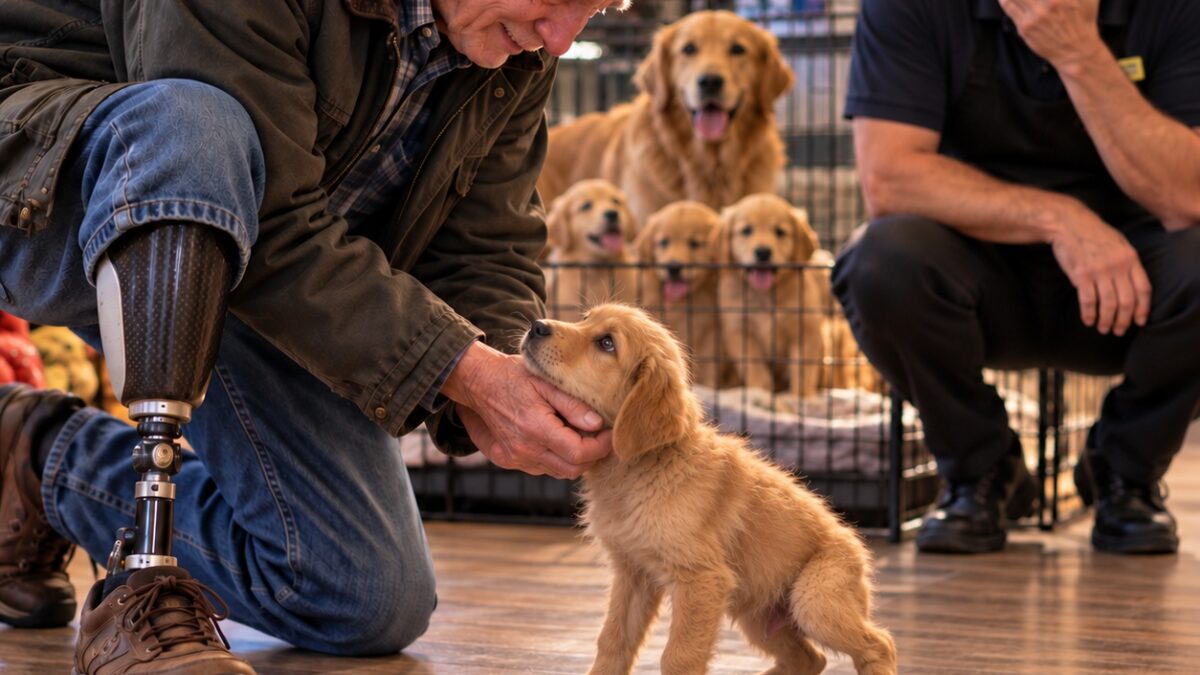
PART2
The owner’s expression changed.
Embarrassment first.
Then something like regret.
He looked at my prosthetic.
Then at the puppy.
Then back at me.
“I didn’t mean anything by it.”
“I know.”
And I did.
Mostly.
People use careless words when they are talking about things they think are practical.
Worth.
Useful.
Normal.
Good stock.
Bad hip.
No value.
Words become easy when you are not the one being measured by them.
I lowered my trouser cuff.
Then held out the $150.
“I’ll give you this today.”
The owner did not take it.
“You really don’t have to.”
“Yes.”
“Sir—”
“And I’ll pay you twenty-five a month until I reach whatever you would have charged for one of the others.”
His eyes widened.
“You don’t have to do that.”
“I heard you the first time.”
I nodded toward the puppies.
“If one of those healthy ones is worth four hundred, so is he.”
The owner looked uncomfortable.
Good.
Not because I wanted to humiliate him.
Because discomfort is sometimes the beginning of reconsideration.
He crossed his arms.
“I’m trying to be honest with you.”
“I appreciate that.”
“This dog’s going to need care.”
“I know.”
“You may need a veterinarian more often.”
“Probably.”
“He may have trouble getting up stairs.”
“So do I.”
“He may never run much.”
“Neither do I.”
“He’s not going to leap onto furniture the way other dogs do.”
“I have no objection to that.”
The owner sighed.
Then he said the thing he seemed to believe would finally convince me.
“Playing is going to be difficult for him.”
The little puppy had reached my shoe.
He sniffed the leather.
Then sat crookedly against it.
I bent down.
He looked up.
“Maybe he and I can invent our own version.”
The owner stared at us.
I held the money out again.
This time he took it.
“One-fifty today.”
“One-fifty.”
“Twenty-five a month?”
“Until we’re square.”
He shook his head.
“You’re stubborn.”
“I’ve been told.”
He smiled slightly.
“What are you going to call him?”
I had not thought that far.
The puppy tried climbing onto my shoe.
Failed.
Tried again.
I watched him.
“Buddy.”
The owner laughed.
“That simple?”
“I’m seventy-two. I’m not wasting time on complicated names.”
Buddy.
The puppy’s ears lifted slightly at the sound.
Probably coincidence.
I decided it wasn’t.
The paperwork took twenty minutes.
I filled it out slowly.
My handwriting had gotten worse since the arthritis.
Name.
Address.
Phone.
Emergency contact.
Veterinarian preference.
The owner brought food.
Instructions.
Medical notes from the examination.
I read everything.
Hip abnormality.
Mobility limitations expected.
Monitor weight.
Avoid unnecessary jumping.
Regular veterinary follow-up.
I folded the papers.
Put them inside my jacket.
Then the owner placed Buddy into my arms.
He weighed almost nothing.
Warm.
Soft.
That puppy smell.
Milk.
Fur.
Something sweet that disappears once dogs grow up.
Buddy tucked his head against my chest.
The owner said:
“He might be scared in the car.”
“He’ll manage.”
“You have somebody at home?”
“No.”
That made the man pause.
“No family nearby?”
“My daughter’s fifteen minutes away.”
“You sure this is a good idea?”
I looked down at the puppy.
He had already closed his eyes.
“Yes.”
We did not even make it through the pet shop door before Buddy fell asleep against me.
That was the beginning.
I walked slowly to the truck.
Cane in one hand.
Puppy against my chest.
Every few steps, I looked down.
Still sleeping.
Completely trusting.
That part frightened me more than I expected.
Trust from an animal is a responsibility.
They do not read contracts.
They do not understand whether you are financially prepared.
They do not know whether you are emotionally stable enough to keep promises.
They simply go home with you.
Buddy slept the entire drive.
I kept one hand against him at red lights.
The passenger seat felt strange.
Margaret used to sit there.
After she died, I stopped putting anything on it.
No grocery bags.
No mail.
No coat.
Grief creates ridiculous rules.
Rules nobody asked for.
Some part of me had decided that keeping the seat empty preserved something.
Now Buddy lay there inside a towel the pet shop owner had given me.
I kept looking over.
He slept.
One hind leg stretched awkwardly.
I touched his head.
“You don’t know what you’re getting into.”
Buddy sighed.
Neither did I.
When we reached my house, I carried him inside.
He woke at the threshold.
His nose started working immediately.
New smells.
Old carpet.
Coffee.
Wood polish.
The lavender cleaner Margaret had used for years and I still bought because changing brands felt disloyal.
I put Buddy on the floor.
He stood.
Looked around.
Tried one step.
Then another.
The hardwood challenged him.
His bad hip made traction difficult.
His back end slid.
He sat down abruptly.
I stared.
“Oh.”
He looked at me.
I looked at the hallway.
Hardwood everywhere.
“This house is going to need some work.”
Buddy wagged.
I found old rugs.
Bathroom mats.
A runner Margaret had stored in the linen closet because she hated the pattern.
I laid them across the worst slippery areas.
Instant pathways.
Buddy discovered the first runner and followed it.
Slow.
Awkward.
Determined.
I moved another rug ahead.
Then another.
Within an hour, my quiet, carefully kept old house looked like someone had designed a flooring system during an emergency.
I loved it.
That first night, Buddy cried.
Not loudly.
Small sounds from the crate I had borrowed from my daughter.
I had placed it near my bed.
The first cry came at 11:14.
Then 11:19.
11:25.
At 11:31, I gave up.
I sat on the floor.
My prosthetic was already off.
One leg.
One stump.
One old man in pajama pants.
Buddy pressed his face against the crate door.
“Listen.”
He whimpered.
“I know.”
Another whimper.
“I’m not putting you in bed.”
He stared at me.
“You’ll fall.”
His tail moved.
“That is manipulation.”
He whined.
By midnight, Buddy was sleeping against my chest.
In bed.
I had broken my first rule in less than six hours.
Margaret would have laughed.
That was the first time I thought of her and smiled instead of hurting.
Not completely.
The hurt was there.
But the smile arrived with it.
Buddy slept curled beneath my chin.
His little heartbeat fast.
Mine slower.
I lay awake.
The room did not feel empty.
I had forgotten what that felt like.
The next morning, Buddy woke at 5:07.
Not because he needed to go outside.
Because he wanted to bite my ear.
I opened my eyes.
“What are you doing?”
Puppy teeth.
“Ow.”
He wagged.
I lifted him carefully.
Carried him outside.
Cold morning.
Dew.
Buddy touched grass.
Froze.
Then sniffed.
He tried walking.
Grass provided more traction than hardwood.
He did better.
Not good.
Better.
Three steps.
Pause.
Four.
His crooked gait became more obvious when he moved farther.
He did not care.
There are things humans mourn on behalf of animals that animals themselves simply live with.
Buddy did not stand in my yard grieving that his hips were different from his siblings’.
He smelled a leaf.
Bit it.
Found another leaf.
Forgot the first.
That was his morning.
I envied him.
My own leg was a different story.
I lost it when I was forty-six.
Industrial accident.
I had been working maintenance at a manufacturing plant.
A piece of machinery failed.
The details stopped mattering after enough years.
What mattered was waking up and knowing part of me was gone.
People came to visit.
They told me I was lucky.
I hated that word.
Lucky.
Lucky the doctors saved me.
Lucky it wasn’t both legs.
Lucky the accident had not been worse.
All technically true.
None helpful.
Margaret was the only person who did not tell me I was lucky.
She sat beside the hospital bed.
Held my hand.
And said:
“This is going to be terrible for a while.”
I looked at her.
“What?”
“You heard me.”
“You’re supposed to tell me it’ll be okay.”
“It will.”
She squeezed my hand.
“Eventually.”
Then:
“But I’m not going to insult you by pretending this part isn’t awful.”
That was Margaret.
Honest enough to be kind properly.
Rehabilitation hurt.
Physically.
Emotionally.
Phantom pain.
Balance.
Learning the prosthetic.
Falling.
Hating everyone who tried to encourage me.
I remember the first physical therapist telling me:
“You’ll walk again.”
I answered:
“I was walking yesterday.”
He learned quickly not to use inspirational speeches on me.
Months passed.
I walked.
Then worked.
Then adapted.
People told me I was brave.
I was not.
I had bills.
A wife.
A daughter.
What else was I supposed to do?
You adjust because morning keeps arriving.
That was what I thought about while watching Buddy in the yard.
He had never had the other version of his body.
No before.
No comparison.
No memory of running normally.
This was simply how he moved.
Maybe that was a kind of mercy.
He walked toward me.
Tripped.
Rolled.
Got up.
Continued.
I laughed.
“You’re going to teach me something, aren’t you?”
Buddy attacked my shoelace.
The first veterinarian appointment came three days later.
Dr. Singh had been our family vet when Margaret was alive.
We had owned an old beagle named Roscoe years before.
After Roscoe died, Margaret said no more dogs because saying goodbye hurt too much.
I agreed.
Then she died first.
Life has a cruel sense of humor.
Dr. Singh looked up when I entered.
“Walter?”
“Still me.”
Then she saw Buddy.
“Oh, no.”
I smiled.
“What?”
“You bought a puppy?”
“I was unsupervised.”
“That explains it.”
She knelt.
Buddy went toward her immediately.
Crooked gait.
Tail fast.
Dr. Singh examined him carefully.
Hips.
Range of motion.
Pain response.
Spine.
Legs.
She reviewed the records.
Then sat on the floor with him.
“He’s definitely got a congenital hip problem.”
“I know.”
“How much did they charge you?”
“Same as the others.”
She looked at me.
“You knowingly paid full price?”
“Yes.”
“Why?”
I lifted my pant leg slightly.
She stared.
Then laughed.
“You two are ridiculous.”
“Medical opinion?”
“Professional diagnosis.”
She became serious.
“He may do better than you were told.”
I leaned forward.
“What do you mean?”
“Hard to predict exactly at this age.”
“So he might run?”
“I’m not promising that.”
“Jump?”
“Walter.”
“Just asking.”
“Keep him lean. Let him build strength safely. No unnecessary high jumps. Rugs at home?”
“Already destroyed the decor.”
“Good.”
“Pain?”
“Monitor. Right now he seems comfortable.”
Buddy tried chewing her stethoscope.
She pulled it away.
“Definitely comfortable.”
That appointment gave me something important.
Not false hope.
Permission not to define Buddy entirely by limitation.
The pet shop owner had described his future with negatives.
Won’t run.
Won’t jump.
Won’t play normally.
Dr. Singh described care.
Keep him lean.
Build strength.
Protect joints.
Monitor discomfort.
That difference changed me.
One person saw what Buddy might fail to do.
The other saw what we could help him do.
I chose the second way of looking.
At home, I started modifying things.
I built a short ramp for the back step.
Ugly.
Solid.
Buddy distrusted it for two days.
Then discovered treats appeared at the top.
Suddenly the ramp made sense.
I added more rugs.
Moved a low table he kept bumping into.
Put his bed beside my recliner.
Bought toys.
Too many toys.
My daughter, Claire, came over and stared at the living room.
“What happened?”
“Dog.”
“I can see that.”
Buddy limped toward her.
Claire crouched.
“Oh my God.”
Her voice softened.
“Dad.”
“What?”
“He’s tiny.”
“He’s a puppy.”
“He walks funny.”
“So do I.”
She looked at me.
I looked back.
Then she understood.
Her eyes filled.
“Dad.”
“Don’t.”
“I wasn’t going to say anything.”
“Yes, you were.”
She picked Buddy up.
He licked her chin.
Claire laughed.
Then cried anyway.
“You paid money for him?”
“Yes.”
“How much?”
“Four hundred.”
Her eyes widened.
“You don’t have four hundred puppy dollars.”
“I had one-fifty.”
“Dad.”
“Payment plan.”
She stared.
“You put a disabled puppy on layaway?”
“That makes him sound like a refrigerator.”
“You are unbelievable.”
Buddy fell asleep in her arms.
Claire’s anger disappeared.
She sat beside me.
For a while, we watched him.
Then she said quietly:
“Mom would’ve loved him.”
I swallowed.
“Yes.”
“She would’ve said no first.”
“Absolutely.”
“Then bought him a sweater.”
“Three sweaters.”
Claire smiled.
That night after she left, I sat in my recliner.
Buddy climbed against my foot.
Tried getting onto the chair.
Could not.
I bent down.
Lifted him.
He curled on my lap.
Television played.
I did not follow the program.
I watched him sleep.
That became our routine.
Every evening.
My lap.
Television.
Buddy sleeping.
Sometimes I stroked his ears.
Sometimes he snored.
I had spent three years sitting in that chair alone.
Now I had to check before moving because a puppy might be sprawled across me.
It was inconvenient.
Wonderful.
The first month was chaos.
Puppies are not therapy.
That is another thing people forget.
They are work.
Buddy peed in the hallway.
Chewed one of my slippers.
Then chewed the replacement.
Dragged toilet paper across the bathroom.
Discovered a roll of paper towels.
Tried eating a dead beetle.
Woke me before sunrise.
Cried when I left the room.
Stole my hearing-aid case once and carried it under the kitchen table.
I called him several names that were not Buddy.
He loved me anyway.
His hip affected things.
He tired sooner than most puppies.
He sometimes sat while playing instead of chasing.
The first time Claire brought her neighbor’s healthy puppy over, I saw the difference clearly.
That puppy exploded across the yard.
Full speed.
Turn.
Leap.
Buddy tried following.
For about fifteen seconds.
His body could not match.
He stopped.
Watched.
My chest hurt.
There it was.
The pet shop owner’s warning.
He’ll never run around the way the others do.
Buddy tried again.
His awkward gait became faster.
Then he stumbled.
The other puppy kept moving.
Buddy sat.
I walked toward him.
“Come here.”
He ignored me.
The other dog circled back.
Dropped the ball near Buddy.
Buddy grabbed it.
Then refused to surrender it.
The healthy dog pulled one end.
Buddy held the other.
They played tug for ten straight minutes.
Sitting down.
Buddy won twice.
I laughed.
Different game.
Same joy.
That became our life.
Adapt.
Not lesser.
Different.
Buddy could not leap onto my bed, so I built steps.
He struggled with steep stairs, so we used the ramp.
He did not chase as long, so we played games that required less distance.
Puzzle toys.
Tug.
Hide treats around the living room.
Short walks.
Sniffing.
Training.
Buddy loved finding things.
I would hide a treat beneath one of three cups.
He learned faster than I did.
Eventually I made the game harder.
Five cups.
Different rooms.
Buddy limped around searching.
Tail up.
Entirely serious.
Then collapsed on my lap afterward as though he had worked a twelve-hour shift.
One afternoon, a little boy in the neighborhood saw us walking.
He stared at Buddy.
“Why does your dog walk like that?”
His mother looked horrified.
“Ethan!”
“It’s all right.”
I stopped.
“His hips were made a little differently.”
The boy looked at my cane.
“Is that why you walk funny too?”
His mother nearly died.
I laughed.
“Yes.”
He considered.
“So you match.”
I looked down at Buddy.
“I suppose we do.”
The boy crouched.
Buddy approached.
Tail wagging.
“Does it hurt him?”
“Sometimes he gets tired.”
“Can he run?”
“A little.”
“Can you?”
“Absolutely not.”
The boy laughed.
His mother apologized three times.
I told her not to.
Children ask direct questions adults spend too much energy avoiding.
Buddy and I did match.
He had four legs, technically.
I had three if you counted metal.
We were both slower than we used to imagine others should be.
And neither of us needed pity.
That distinction became important.
People saw Buddy limp and immediately made a face.
The same face I had received for twenty-six years when strangers noticed the prosthetic.
Soft eyes.
Head tilt.
Poor thing.
It used to anger me.
Later I understood most people meant kindness.
They simply did not know how to separate compassion from sorrow.
One woman at the park said:
“Oh, that poor puppy.”
Buddy was at that exact moment trying to steal half a hot dog from my hand.
I said:
“He’s doing pretty well.”
“Such a shame.”
Buddy succeeded in taking the hot dog.
I stared at him.
“Yes. Tragic.”
He chewed proudly.
I stopped explaining after that.
Buddy did not need strangers to understand him.
He needed me to keep him healthy.
So we did.
Months passed.
He grew.
Not into a large dog.
Medium.
His chest broadened.
His ears finally looked proportional.
The hip issue remained.
The limp stayed.
Some days better.
Some worse.
Dr. Singh monitored him.
We managed activity.
Weight.
Joint support.
Everything we reasonably could.
Buddy surprised us.
He did run.
Not like his siblings probably did.
His back end moved with an odd rhythm.
One leg did more than the other.
But when something mattered enough—usually Claire arriving with treats—he ran.
The first time I saw him do it across the whole yard, I yelled:
“Slow down!”
He did not.
Claire came through the gate.
Buddy accelerated.
Almost fell.
Recovered.
Reached her.
She crouched.
He crashed into her lap.
Claire laughed.
I stood on the porch with my cane.
The pet shop owner’s sentence came back.
He’ll never run around.
Wrong.
He ran.
He simply ran like Buddy.
That was different from running like any other dog.
One evening, I drove back to the pet shop.
Buddy was nine months old.
I had continued mailing twenty-five dollars every month.
Old-fashioned.
Check.
Envelope.
The owner had called after the second payment.
“You really don’t have to keep doing this.”
“I said I would.”
“Walter.”
“I don’t like debt.”
By the ninth month, the remaining amount was small.
I decided to pay it in person.
Buddy came with me.
He wore a blue collar.
Walked through the pet shop door with his familiar limp.
The bell rang.
The owner looked up.
For a second, he did not recognize us.
Then:
“Is that him?”
“Buddy.”
He came around the counter.
Buddy approached.
No fear.
The owner crouched.
“Look at you.”
Buddy sniffed him.
Then leaned into his hand.
The man looked up.
“He looks good.”
“He is good.”
I handed over the final cash.
The owner stared at it.
“You actually paid every dollar.”
“I told you.”
He rubbed Buddy’s chest.
“I was wrong.”
I waited.
“He had value.”
I shook my head.
“No.”
His expression fell.
“He always had value.”
That was the part I needed him to understand.
Nothing Buddy accomplished made him worth the price.
Not running.
Not adapting.
Not becoming affectionate.
Not entertaining me.
He had value the day he struggled behind the litter.
Before anyone knew what kind of dog he would become.
Before he had proven anything.
The owner nodded slowly.
“You’re right.”
I did not need more.
Buddy walked around the shop.
Found a basket of toys.
Tried taking one.
I stopped him.
“We’re not stealing.”
The owner laughed.
“Let him have it.”
I looked at him.
“He pays full price.”
The man laughed harder.
“You really are stubborn.”
“I told you.”
Buddy chose a stuffed duck.
The owner refused my money.
I let him win that one.
On the drive home, Buddy sat in the passenger seat.
He had outgrown my lap for car rides.
The stuffed duck between his paws.
I looked over.
“You’re officially paid for.”
Buddy bit the duck.
It squeaked.
He startled.
Then attacked it.
I laughed so hard I had to pull over.
Margaret would have loved him.
That thought became less painful over time.
At first, Buddy reminded me how much she was missing.
Then he began reminding me how much she had given me.
Patience.
Humor.
The ability to build a life around imperfections without treating them as tragedies.
She had done that for me after the accident.
I had been angry.
Ashamed.
Difficult.
She never told me I was inspiring.
Thank God.
She told me to put my prosthetic on because we had groceries to buy.
She told me to stop feeling sorry for myself when I became unreasonable.
She rubbed my residual limb when phantom pain kept me awake.
She walked slower without announcing she was walking slower.
That last thing mattered most.
Margaret adapted to me without turning my disability into the center of our marriage.
That was exactly what I wanted for Buddy.
Protect the hip.
Provide support.
Then let the dog be a dog.
I did not want every day to be:
Poor Buddy.
Careful, Buddy.
You can’t, Buddy.
So I learned the difference between protecting him and limiting him because I was afraid.
Dr. Singh had to remind me.
“He can play.”
“I know.”
“You’re hovering.”
“He fell yesterday.”
“He’s a puppy.”
“He has bad hips.”
“He also has muscles that need to get stronger.”
“What if he hurts himself?”
“What if you keep him so protected he never learns his body?”
I hated that.
Because she was right.
My own rehabilitation had depended on falling.
Not dangerously.
But learning.
Balance requires mistakes.
Confidence requires testing.
So I loosened my grip.
Buddy explored.
He learned which furniture he could climb and which he could not.
Which steps were manageable.
How fast he could turn.
How to compensate.
One day he tried jumping onto the couch without his little ramp.
Failed.
I reached for him.
Then stopped.
Buddy backed up.
Tried again.
Front paws landed.
Back end did not.
He slid.
Looked offended.
Third attempt.
He figured out an angle.
Up.
He stood on the couch.
Tail high.
I stared.
“You could’ve used the ramp.”
Buddy walked in a circle.
Lay down.
I smiled.
“Show-off.”
Later, I wondered if my reaction to Buddy had less to do with his disability than I originally thought.
Maybe I chose him because I recognized something else.
The effort.
That little puppy had been behind.
His siblings moved easily.
He struggled.
But he was still following.
That image reached back twenty-six years into my own life.
The first weeks with a prosthetic.
Other patients walking faster.
A younger man climbing stairs while I still hated standing.
Physical therapist saying:
Again.
Me saying:
Go to hell.
Again.
The world moves at a pace that does not change simply because you need longer.
You learn either to hate everyone ahead of you or keep moving at your own speed.
Buddy seemed to have figured that out before eight weeks old.
Maybe I did not buy him because he needed someone like me.
Maybe I needed somebody who did not consider slow progress humiliating.
He taught me that without ever knowing.
The first anniversary of Margaret’s death after Buddy arrived was different.
Usually, I spent that day alone.
Claire offered to visit.
I told her not to.
I would sit with photographs.
Listen to music Margaret liked.
Make her terrible meatloaf recipe because I had never learned to cook it properly.
That year, Buddy ruined the schedule.
At 6:30 a.m., he woke me by dropping the stuffed duck onto my face.
I opened one eye.
“No.”
Squeak.
“Go away.”
Squeak.
“Buddy.”
Tail.
Squeak.
I laughed.
On the day I had planned to be miserable.
Laughed.
That did not feel like betrayal.
Not anymore.
I made coffee.
Fed Buddy.
We walked.
Slowly.
The morning was cool.
Leaves beginning to change.
I told him about Margaret.
Out loud.
The way she hated when I left cabinet doors open.
The way she sang off-key.
The time she tried cutting my hair during a snowstorm and I wore a hat for three weeks.
Buddy sniffed a mailbox.
I kept talking.
People had told me after Margaret died that grief needed expression.
I hated talking to people about it.
Talking to Buddy was easier.
Perhaps that was what my old dog Roscoe had done for us years earlier.
Animals make silence less empty.
They do not require you to resolve the story before speaking.
We reached a bench.
I sat.
Buddy leaned against my good leg.
I looked toward the sky.
“I miss her.”
Buddy looked up.
I touched his head.
“You would’ve liked her.”
His tail moved.
That afternoon, Claire came anyway.
She brought Margaret’s meatloaf recipe.
We cooked.
Buddy waited hopefully.
We ate.
Cried a little.
Laughed more.
It was the first anniversary that felt less like a funeral repeated and more like remembering a life.
Buddy slept on my lap that night.
Too big now.
He still tried.
His front half across my thighs.
Back legs sideways.
Television on.
I stroked his head.
“Comfortable?”
He sighed.
“I’m not.”
No movement.
“Glad we discussed it.”
My daughter began saying Buddy had saved me.
I objected every time.
“I was fine.”
“You were surviving on canned soup.”
“That is food.”
“You talked to the television.”
“It’s more intelligent than some people.”
“You had three shirts in rotation.”
“Efficient.”
She looked at Buddy.
“See what I deal with?”
Buddy wagged.
I knew what she meant.
My life had become larger.
Not because Buddy cured loneliness.
Loneliness does not work like an infection.
But he created obligations.
Breakfast.
Walk.
Vet.
Play.
Outside.
Inside.
Night.
Morning.
Routine is underrated medicine.
Especially after loss.
You can spend an entire day inside grief when nothing interrupts you.
A dog interrupts constantly.
Buddy did not care whether I was having a meaningful emotional moment.
If he needed outside, he needed outside.
If dinner was late, tragedy.
If the mailman arrived, national emergency.
His needs pulled me into the present.
That mattered.
He also changed how people interacted with me.
Before Buddy, neighbors asked:
“How are you holding up?”
I hated that question.
After Buddy:
“How’s the little guy?”
Much better.
I could answer.
“He stole my sock.”
“He’s doing well.”
“He needs another checkup.”
“He finally learned the ramp.”
People talked to me without making Margaret’s death the opening subject.
Buddy became a bridge back into ordinary conversation.
One day, the little boy Ethan returned.
He was riding a bicycle.
Buddy and I were in the yard.
Ethan stopped.
“He got bigger.”
“So did you.”
“Can he run now?”
“Some.”
Buddy demonstrated by chasing a leaf.
His gait awkward.
Ethan watched.
“He’s fast.”
“Fast enough.”
Then the boy looked at my leg.
“Can you run?”
“No.”
“Did you try?”
I laughed.
“Yes.”
“What happened?”
“I decided walking was underrated.”
He nodded seriously.
Then:
“Does Buddy know he’s disabled?”
I thought.
“No.”
“Do you?”
That question surprised me.
“Yes.”
“Why?”
Children.
I looked down at my prosthetic.
“Because I remember before.”
Ethan considered that.
“Buddy doesn’t have a before.”
“No.”
He smiled.
“So he just thinks he’s Buddy.”
I stared at him.
Then at the dog.
“Yes.”
Exactly.
Buddy just thought he was Buddy.
Perhaps we should all be so lucky.
As he grew older, we developed our own pace.
Morning walks were not long.
Half a mile.
Sometimes less.
We stopped often.
People assumed stops were for me.
Sometimes.
Other times Buddy.
Neither of us cared.
We sat on benches.
Watched birds.
I brought water.
He sniffed everything.
If another dog ran past at full speed, Buddy watched.
Sometimes followed.
Sometimes not.
His joy had stopped depending on comparison.
Mine too.
That was new.
For years after losing my leg, I noticed people walking quickly.
Stairs.
Running.
Jumping out of trucks.
Movements they did without thought.
The noticing faded eventually.
Buddy made it disappear further.
His body was simply his.
Mine was mine.
Function instead of appearance.
What can we do?
Do that.
What cannot we do?
Find another way.
That philosophy simplified a lot.
One winter, ice made the porch dangerous.
For both of us.
Claire insisted I stay inside until she salted everything.
Buddy disagreed.
He needed to relieve himself.
I put on the leash.
Claire stood in front of the door.
“No.”
“I’m seventy-three years old.”
“And?”
“You don’t tell me no.”
“I absolutely do.”
Buddy sat beside me.
I pointed at him.
“He agrees.”
“He eats tissues.”
“Still voting age in dog years.”
She took the leash.
“I’m taking him.”
Buddy went with her immediately.
Traitor.
Five minutes later, Claire came back laughing.
“He slipped.”
My heart jumped.
“Is he okay?”
“Fine. He looked offended.”
She handed me the leash.
“He’s definitely your dog.”
I tried looking angry.
Failed.
By Buddy’s second year, people no longer saw him as a sick puppy.
Just the dog with the funny walk.
His hip condition remained.
Dr. Singh continued monitoring.
Some days, anti-inflammatory support was needed under veterinary guidance.
We adjusted exercise.
Installed another ramp.
Kept his weight controlled despite Buddy’s belief that every meal was starvation.
He loved life.
That is the simplest description.
Loved car rides.
Loved Claire.
Loved Ethan.
Loved lying in warm patches of sun.
Loved television nights because they involved my lap and occasionally popcorn falling by accident.
He hated rain.
Despised nail trims.
Believed vacuum cleaners were demonic.
And he never once showed any sign that he considered his life diminished.
That came from people.
Not him.
I began noticing how often we decide value through ability.
Can it work?
Can it perform?
Can it look normal?
Can it do what others do?
The pet shop owner had made that calculation.
Healthy puppies:
$400 to $600.
Buddy:
Free.
No value.
He did not mean Buddy had no right to live.
I know that.
He meant market value.
Still, language matters.
When you use price as a shortcut for worth, something ugly can sneak in.
Buddy’s worth was not the vet bills I paid.
Not the price I insisted on paying.
Not the companionship he gave me.
Not the fact that he eventually ran better than expected.
Worth came before usefulness.
That lesson had taken me decades.
I wish I could say I always understood it.
After my accident, I questioned my own value.
I had worked with my hands and body my entire life.
Then suddenly I needed help showering.
Dressing.
Standing.
The man I thought I was had been built partly on independence.
Losing a leg felt like losing rank in my own life.
Margaret never allowed that thinking to stay unchallenged.
One night, months after the accident, I said:
“I’m useless.”
She was folding laundry.
She did not stop.
“No.”
“I can’t even carry a basket up the stairs.”
“You’re currently recovering from an amputation.”
“I can’t work.”
“Yet.”
“I can’t do anything.”
She put down the towel.
Walked over.
“Walter.”
“What?”
“Your paycheck was never why I loved you.”
I looked away.
“You don’t have to do this.”
“Do what?”
“Pretend.”
She became angry.
Good angry.
The kind I needed.
“You think I married a leg?”
I stared at her.
“What?”
“Because apparently I’m supposed to reevaluate the entire marriage now that one is missing.”
I almost laughed.
She pointed at me.
“Your body changed. Your value didn’t.”
Years later, inside that pet shop, when the owner said Buddy had no value, Margaret’s voice came back.
Your body changed.
Your value didn’t.
Buddy’s body had been different from the beginning.
Same principle.
Maybe that was why I became stubborn about paying.
Not because paying money determines worth.
It doesn’t.
But I needed the owner to understand I did not see Buddy as the free defective option.
I chose him.
And I wanted the transaction to reflect choice.
Buddy was never charity.
He was my dog.
Years passed.
The old puppy became an adult.
I became older too.
My cane became more necessary.
Then a walker on particularly bad days.
Buddy slowed a little.
Funny.
Eventually our speeds matched even better.
We took shorter walks.
Spent longer on the porch.
He still slept on my lap when he could fit enough of himself there.
At some point, “on my lap” became “head on my lap.”
A compromise.
Television evenings stayed.
That was the detail from the first weeks that never changed.
I would settle into the recliner.
Buddy appeared.
Head across my thighs.
Sometimes one paw.
I stroked his ears.
News.
Baseball.
Old westerns.
Whatever.
I talked to him the way Margaret used to complain I talked too much during movies.
Buddy never minded.
One night I told him:
“You know you cost me four hundred dollars.”
He opened one eye.
“Should’ve negotiated.”
Nothing.
“I could’ve gotten you free.”
Tail tap.
“But then you’d think you were special.”
Buddy closed his eye.
“You are special.”
I hated myself for saying it.
Too sentimental.
Margaret would have teased me for a week.
I looked at her photograph.
“Not a word.”
Buddy sighed.
The house had become noisy again in different ways.
Tags against water bowl.
Nails on runners.
Barking at delivery trucks.
Toy squeaks.
My own voice telling Buddy to stop doing something.
It was not the old life.
Nothing brings old lives back.
It was a new one.
That distinction saved me.
For a long time after Margaret died, I thought healing meant wanting my previous life less.
I did not want that.
I wanted her.
Buddy taught me healing could mean building something alongside grief rather than replacing it.
I still missed Margaret.
And I loved Buddy.
No conflict.
Two truths.
The day the pet shop owner called me several years later, I almost did not answer.
“Walter?”
“Yes.”
“This is David.”
Pause.
“Pet shop.”
I remembered.
“How are you?”
“Still old.”
He laughed.
“How’s Buddy?”
I looked toward the living room.
Buddy was asleep in a patch of sun.
“Still spoiled.”
“Good.”
There was hesitation.
Then:
“I wanted to tell you something.”
“All right.”
“We had another puppy born with a leg issue.”
My chest tightened.
“What happened?”
“A family came in last week.”
He paused.
“I didn’t offer him free.”
I smiled.
“What did you tell them?”
“That he might need extra care.”
“Good.”
“That he had some limitations.”
“Fair.”
“And that if they wanted him, they’d pay the same adoption price.”
I looked at Buddy.
“Did they take him?”
“They did.”
“Good.”
Another pause.
“I thought you’d like to know.”
“I do.”
He sounded emotional.
“You made me think differently.”
I swallowed.
“No.”
“What?”
“Buddy did.”
David laughed softly.
“Fair enough.”
After we hung up, I told Buddy.
“You changed business policy.”
He yawned.
“Very impressive.”
He rolled onto his other side.
Humility.
Buddy was good at it.
My grandson, Noah, grew up with him.
At first Noah was small enough that Buddy intimidated him despite the limp.
Then they became partners in crime.
Noah fed him beneath the table.
I pretended not to notice.
Buddy learned the sound of Noah’s mother’s car.
Ran to the door every visit.
As Noah became older, he started asking about my prosthetic.
About Buddy.
About why I chose him.
I told the story.
Not as a lesson.
Just history.
One day, Noah said:
“So you bought him because he was like you.”
“Sort of.”
“What if he had been normal?”
I thought.
“Then maybe someone else would’ve taken him.”
“Would you?”
“I don’t know.”
Noah frowned.
“That seems unfair.”
“What?”
“That you needed him to be hurt first.”
Children again.
He was right in a way.
“I didn’t need him hurt.”
“Then why him?”
I looked at Buddy.
Old enough now for gray near the muzzle.
Sleeping comfortably.
“Because I saw him trying.”
Noah waited.
“The others didn’t need me.”
“That one did?”
“Maybe.”
I smiled.
“Or maybe I needed to feel useful again.”
That was closer to the truth than I had ever said aloud.
I had spent three years after Margaret’s death being cared about.
Claire checking on me.
Neighbors.
Church people.
Doctors.
Everyone asking what I needed.
Buddy needed me.
There is healing in being needed when you have spent too long as the recipient of concern.
He needed rugs.
Ramps.
Food.
Appointments.
Walks.
Someone to lift him occasionally.
Someone who did not mistake limitation for tragedy.
I understood the assignment.
And in caring for him, I stopped thinking so constantly about what had been taken from me.
Loss of leg.
Loss of wife.
Loss of youth.
Buddy lived forward.
Dogs are good at that.
Eventually, age began affecting his good hip too.
Dr. Singh showed me X-rays.
Arthritis.
Expected.
Manageable.
We adjusted again.
Medication.
Shorter walks.
More rugs.
A better ramp.
I laughed when I realized I was modifying the house for both of us now.
Rails.
Ramps.
Non-slip surfaces.
Claire said:
“You two should apply for accessibility grants.”
“Mind your business.”
Buddy looked at her.
“Don’t encourage her.”
He wagged.
Old age had become another disability we shared.
No shame.
Adapt.
One morning, Buddy struggled to get up.
I watched him.
Did not help immediately.
He shifted.
Tried again.
Got halfway.
Stopped.
I moved close.
“Need a hand?”
He looked at me.
I slid one arm under him.
Lifted gently.
He stood.
For a second, we balanced each other.
My cane.
His weaker hips.
Two old creatures negotiating gravity.
I laughed.
“Pathetic.”
His tail moved.
“I’m talking about me.”
We walked to the kitchen.
Slow.
Together.
That moment became one of my favorites.
Not because it was triumphant.
Because there was no embarrassment.
Buddy needed help.
I gave it.
Tomorrow I might need help.
Claire would give it.
Bodies change.
Value doesn’t.
Margaret’s lesson.
Buddy’s lesson.
Same truth.
The final years were quieter.
Buddy slept more.
I did too.
We sat on the porch.
Watched people pass.
Ethan, the little boy, became a teenager.
Then a young man with a car.
He stopped one afternoon.
“Hey, Mr. Walter.”
“Ethan.”
He crouched beside Buddy.
“Man, he got old.”
“So did you.”
“So did you.”
“Get off my porch.”
He laughed.
Buddy licked his hand.
Ethan looked at him.
“You remember when I said you matched?”
“I do.”
“You still do.”
I looked down.
Prosthetic.
Cane.
Buddy’s careful stance.
“More than ever.”
Ethan sat on the step.
“What are you going to do when…”
He stopped.
Teenagers are brave until death enters the sentence.
“When he dies?”
Ethan nodded.
I looked at Buddy.
For years I had avoided that thought.
Then age made avoidance childish.
“I’ll be sad.”
“Yeah.”
“Probably a mess.”
Ethan smiled slightly.
“Then?”
I thought about Margaret.
About the empty house.
The pet shop.
Buddy sleeping against my chest before we reached the door.
“I’ll be grateful.”
“That’s it?”
“No.”
I scratched Buddy’s ear.
“But it’s enough for today.”
Buddy lived longer than some veterinarians expected with his hip condition.
Not because love cured him.
Love does not rebuild malformed joints.
Care helped.
Weight management.
Medical treatment.
Adaptation.
Luck.
Genetics beyond the problem he started with.
All of it.
He had good years.
That was what mattered.
When his later years came, I refused to measure them against healthy dogs.
Could he still enjoy food?
Yes.
My lap?
Yes.
Sun?
Yes.
Short walks?
For a long time.
Visitors?
Absolutely.
Noah?
Always.
Life remained life.
One evening, Buddy fell asleep with his head on my lap during a baseball game.
I looked down.
Gray muzzle.
Slow breathing.
The same ears that had once seemed too large.
I remembered the puppy struggling behind his littermates.
Step.
Pause.
Step.
The pet shop owner saying:
No value.
I ran my hand across Buddy’s head.
“What an idiot.”
Buddy opened one eye.
“Not you.”
He closed it.
“You were worth every dollar.”
Then I thought:
Wrong.
Money had never been the point.
Worth every morning.
Every destroyed slipper.
Every vet bill.
Every ramp.
Every lonely anniversary interrupted by a squeaky duck.
Every slow walk.
Every conversation.
Every nap.
You cannot price that.
The $400 had only been a statement.
I had paid because someone had confused disability with worthlessness.
But Buddy had spent years proving something I did not need him to prove.
A body can be limited and a life can still be enormous.
He never climbed fences.
Never jumped high.
Never ran like the other puppies.
He did not need to.
He filled an entire house.
How much more valuable could anything be?
When people hear this story, they sometimes focus on the moment I lifted my pant leg.
It makes a neat lesson.
Old man with prosthetic chooses disabled puppy.
I understand why people like it.
But the real story came afterward.
Disability was how we recognized each other.
It was not what made us love each other.
I loved Buddy because he snored.
Because he stole my chair if I stood too long.
Because he somehow knew when Claire was bringing food before her car entered the driveway.
Because he hated rain.
Because he trusted me.
Because he made the house sound occupied.
Because when grief sat beside me, Buddy climbed onto my lap and left less room for it.
That was love.
The prosthetic was only an introduction.
Years after I first walked into the shop, I found the original receipt in a drawer.
$150.
First payment.
I sat at the kitchen table holding it.
Buddy slept nearby.
Claire was visiting.
“What’s that?”
“His receipt.”
“You kept it?”
“Apparently.”
She read it.
“You really paid monthly.”
“I said I would.”
“You know the owner would’ve given him to you.”
“I know.”
Claire smiled.
“You were proving a point.”
“I hate that phrase.”
“You absolutely were.”
I folded the receipt.
“Maybe.”
“To him?”
I looked at Buddy.
“To myself too.”
Claire sat opposite me.
“What point?”
I took a while.
“That needing help doesn’t make you charity.”
Her eyes softened.
I hated when my daughter looked at me like that.
Too much like Margaret.
I continued before she could get emotional.
“When I lost the leg, I hated people doing things for me.”
“I remember.”
“No, you don’t. You were young.”
“I remember enough.”
“People meant well.”
I looked at the prosthetic.
“But I confused receiving help with losing value.”
Claire reached across the table.
I let her take my hand.
“Buddy never did.”
“No.”
“He accepts help like royalty.”
I laughed.
That was true.
Buddy never considered a ramp humiliating.
Never apologized for being lifted.
Never worried that medication made him less of a dog.
He simply used what helped.
Another lesson I had taken too long to learn.
There is dignity in accepting accommodation.
It is not defeat.
A ramp is not failure.
A prosthetic is not failure.
A slower pace is not failure.
Help is not proof you are worth less.
Buddy understood naturally what took me decades.
Eventually, I stopped hiding my prosthetic under long pants during summer.
That surprised everyone.
For years I had worn trousers even in heat.
Not because I was ashamed exactly.
Habit.
Avoiding stares.
Questions.
Then one summer, Noah said:
“Grandpa, you’re sweating.”
“I’m old.”
“You’re wearing pants.”
“So?”
“It’s ninety degrees.”
He pointed at Buddy.
“He doesn’t cover his leg.”
I stared at him.
“Buddy is naked.”
“Exactly.”
Terrible logic.
Effective.
I bought shorts.
First time I wore them to the park, people looked.
I noticed.
Then stopped caring.
Buddy limped beside me.
Two visible imperfect legs between us.
We looked like ourselves.
That felt good.
The last thing I want anyone to take from Buddy’s story is pity.
Not for him.
Not for me.
Pity shrinks people and animals down to what is missing.
Compassion is different.
Compassion sees difficulty and asks:
What would help?
The owner originally saw Buddy’s bad hip and concluded:
No value.
I saw it and thought:
Maybe I know how to make life easier.
Dr. Singh saw it and thought:
Weight, strength, protection, monitoring.
Different responses create different lives.
Buddy’s hip never stopped being real.
My leg never grew back.
Margaret never came home.
Happy endings are not endings where damage disappears.
They are lives where damage is no longer the only thing worth talking about.
Buddy gave me that kind of ending.
One autumn evening, long after he had become too big to fully sleep on my lap, I sat in the same recliner.
Television on.
Buddy climbed beside me as far as he could.
Head across my thighs.
I rested one hand on him.
Outside, leaves moved against the porch.
The house smelled like coffee.
His dinner bowl sat empty in the kitchen.
Ramps crossed the few places he needed them.
My cane leaned beside the chair.
Prosthetic secured beneath my trousers.
A photograph of Margaret sat on the shelf.
Nothing about the room was perfect.
Everything important was there.
I thought about the pet shop.
The five puppies.
Four tumbling forward.
One struggling behind.
If I could go back, I would choose him again before he ever reached my shoe.
I would pay the $150.
Then twenty-five.
Then twenty-five.
Every month.
Not because paying made him valuable.
Because choosing him without discount had made something inside me stand upright again.
I had walked into that store as an old widower killing time between a pharmacy and a truck.
I walked out carrying responsibility.
Warmth.
Noise.
Future vet bills.
Destroyed slippers.
A reason to come home.
Before we even crossed the threshold, Buddy fell asleep against my chest.
At the time, I thought:
He trusts me already.
Years later, I realized I had trusted him too.
I trusted this little imperfect animal with the quietest parts of my life.
The empty chair.
The passenger seat.
The evenings after Margaret.
The old shame I still carried about needing help.
Buddy handled all of it by being a dog.
No advice.
No speeches.
Just there.
That was enough.
Today, when Buddy settles against me during television, I still sometimes remember the owner warning me:
“He’ll never run around or leap over things the way those other puppies can.”
He was right about some of it.
Buddy never became the dog people imagine when they picture perfect athletic health.
He had limits.
Real ones.
But he ran when he wanted something badly enough.
Played in ways that worked for him.
Learned ramps.
Conquered the couch.
Stole food.
Loved children.
Filled my days.
And every night, he found the same place.
My lap.
Or as much of it as age and size allowed.
The pet shop owner had looked at Buddy and seen the things he could not do.
I spent the rest of Buddy’s life learning the opposite habit.
Look at what is still possible.
That changed how I looked at him.
Then how I looked at myself.
Maybe that is why I had to pay full price.
Maybe some part of me knew that if I took Buddy for free because his body was different, I would be accepting an idea I had spent half my life trying to reject.
That a damaged body makes a life cheaper.
No.
I knew better.
Margaret had taught me.
My own prosthetic had taught me.
Buddy finished the lesson.
He was never the puppy with no value.
He was simply the puppy nobody had yet learned how to value properly.
And perhaps I was an old man who needed reminding of the same thing.
So yes, I walked into a pet shop with $150.
I walked out carrying a dog I technically could not afford.
Paid the rest twenty-five dollars at a time.
Built ramps.
Bought rugs.
Spent far more on veterinary care than I ever admitted to Claire.
And if somebody offered me every dollar back in exchange for erasing those years?
I would laugh.
Then I would probably say something impolite.
Because Buddy was never a bargain.
He was never a charity case.
He was never a lesson wrapped in fur.
He was my dog.
My slow-walking, crooked-running, lap-stealing friend.
And I was his slow-walking, metal-legged old man.
We were not fast.
We did not need to be.
We got where we were going together.
And in the end, that was worth more than anything I had in my pocket the day we met.







