PART2:My Neighbor Died at 39—Then We Found His Missing Chihuahua Guarding the Last Thing That Still Smelled Like Him
PART2
The lake was more than a mile from Nathan’s house.
For a Chihuahua Rosie’s size, that distance meant something.
Especially if she had traveled it alone.
I kept thinking about the route while Ben drove.
Had she followed the path Nathan usually took?
Had she gone there the same evening he died?
Had she simply searched every place where she had learned to expect him?
We could not know.
We only knew somebody had seen a small dog there.
That was enough.
When we arrived, Ben parked quickly.
We started walking.
The lake was quiet.
Water moving gently.
A path along the edge.
Wooden benches positioned where people could sit and watch the surface.
I had seen Nathan out there before.
Sometimes Rosie beside him.
Sometimes walking just behind.
Then I saw something small on one of the benches.
Brown.
Still.
“Ben.”
He saw her too.
Rosie.
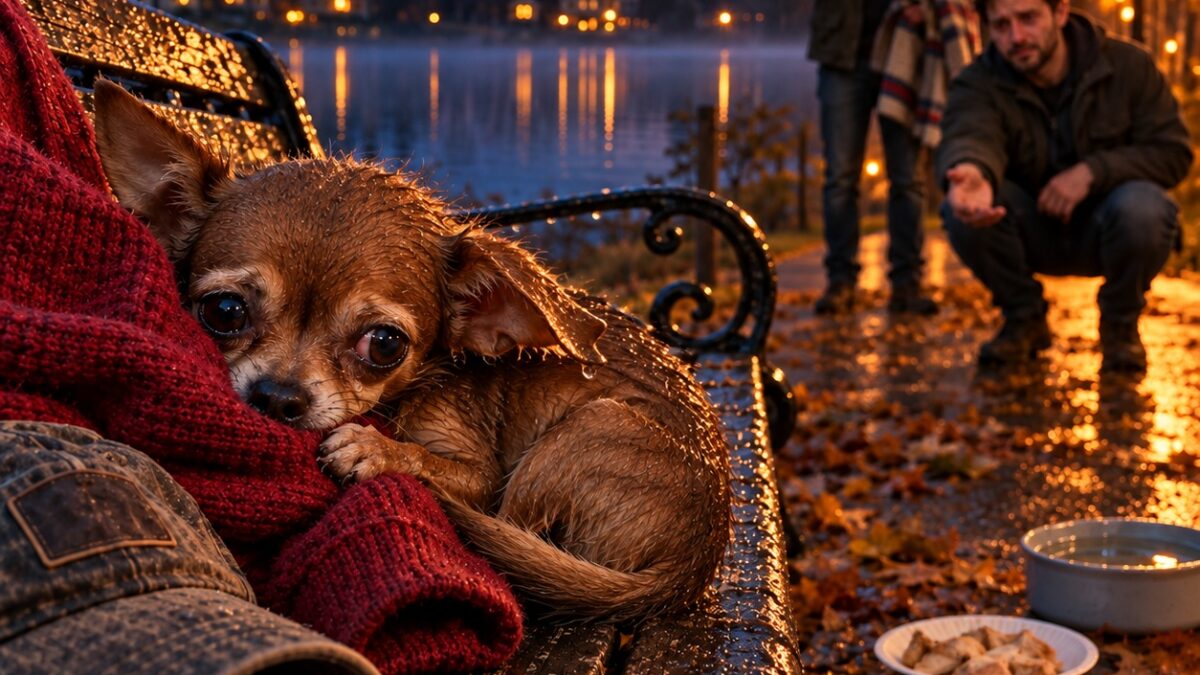
She was curled on a wooden bench overlooking the water.
For one second, relief hit me so hard that I almost ran straight toward her.
Then I noticed what she was pressed against.
An old red sweater.
It had been draped over the back of the bench, and one sleeve had fallen down onto the seat.
Rosie had tucked herself against that sleeve.
I knew the sweater.
Nathan wore it constantly.
Especially in the evenings.
I had seen him in it more times than I could count.
That old red sweater and Rosie had been part of the same picture in my mind.
Nathan walking.
Rosie behind.
Now Nathan was gone.
The sweater remained.
And Rosie had found it.
I do not know how it ended up on that bench.
The source of this story does not tell us.
Maybe Nathan had left it there previously.
Maybe it had been placed there somehow after his death.
I do not pretend to know.
What I know is what I saw.
Rosie had pressed her body against the sleeve.
As close as she could get.
I slowed immediately.
“Hey, sweetheart.”
Her head lifted.
For one second, she looked directly at me.
Then she looked past me.
Toward the path.
That movement hurt more than I expected.
She had found something that smelled familiar.
Something connected to Nathan.
And every time someone approached, she was watching.
Waiting.
I crouched near the bench.
Did not reach for her.
I had brought chicken.
Something small and tempting.
I held a piece out.
“Come on, Rosie.”
She sniffed the air.
Looked at the chicken.
Then stayed exactly where she was.
That told me how deeply she was anchored to that sweater.
A hungry little dog refusing food because leaving the sleeve felt more dangerous than staying.
Ben moved slowly toward her.
His hand came forward.
Rosie pressed even closer to the sweater.
Body against red fabric.
No growl.
No snap.
Just refusal.
I put the chicken down.
Then sat.
Ben sat too.
That was all.
For a while, neither of us spoke.
The lake moved below us.
Soft sound.
Water against the shore.
Wind.
Occasional footsteps on the path.
Each time somebody came near, Rosie’s ears rose.
Those huge ears.
Alert.
Hopeful.
She would look toward the sound.
Then the person would pass.
Her ears would lower again.
I watched it happen more than once.
And I knew I was looking at something I could never fully understand.
I did not know what Rosie knew about death.
I did not know whether she understood Nathan was never coming back.
Dogs do not explain grief to us.
We observe.
We guess.
We try not to turn their behavior into something more human than it is.
But I knew one thing.
Rosie was cold.
Tired.
Far from home.
And unwilling to leave something that smelled like the person she had followed everywhere.
That was enough.
I thought about Nathan’s evening walks.
Rosie a few feet behind him.
Maybe this bench was part of their routine.
Maybe he sat there.
Maybe she sat nearby.
Maybe the sweater carried the only version of home she could still locate.
Ben looked at me.
I looked at him.
No words needed.
We could not simply pull her away from the sweater as though it were trash.
So I reached slowly.
Not toward Rosie first.
Toward the red fabric.
I gathered it gently.
Rosie watched my hands.
I wrapped part of the sweater around her.
She stayed still.
Then I slid my hands underneath her small body.
This time she did not resist.
Maybe because the sweater moved with her.
Maybe because she was exhausted.
Maybe because something about the moment finally felt safe enough.
I lifted her.
She was tiny.
So much smaller in my arms than she looked on the bench.
The sweater stayed wrapped around her.
“It’s coming with us, sweetheart.”
I meant the sweater.
But in that moment I think I meant more.
Nothing connected to Nathan had to be taken away from her simply because we needed to get her home.
Rosie rested against the fabric.
I held her close.
Ben walked beside us.
The bench remained behind.
Empty.
I looked back once.
The lake.
The path.
The place where we had found her waiting.
I knew we were taking her somewhere safe.
Still, part of me felt like we were closing a door for her.
She had gone there expecting something.
Maybe Nathan.
Maybe routine.
Maybe only the familiar smell.
Whatever she had been waiting for was not going to happen.
I could not give her Nathan back.
That was the hardest truth.
Rescue has limits.
Sometimes you can save an animal from danger.
Sometimes you can feed.
Warm.
Treat.
Adopt.
But you cannot replace the person they loved.
The best you can do is stay long enough that life becomes safe again without pretending the old love did not exist.
I brought Rosie home.
The first thing she needed was water.
Then a warm meal.
Simple things.
Her body had been through enough.
I set everything down near her.
She drank.
Ate.
Not wildly.
Not as though food was the center of the world.
She kept checking the red sweater.
I created a small sleeping place beside my own bed.
Then folded the sweater into it.
Rosie walked over.
Sniffed.
Circled.
Then settled on top of it.
That became the beginning.
I made a decision that day.
Rosie would never have to search for a home again.
I did not know how long it would take for her to adjust.
Did not know whether she would spend days looking toward the door.
Did not know whether she would settle beside me or keep choosing the sweater.
Those things did not change the decision.
She was staying.
There are promises you make because they sound good.
Then there are promises you make because you cannot imagine doing anything else.
Keeping Rosie was the second kind.
Nathan had been my neighbor.
I could not help him anymore.
But I could take care of the little dog who had followed him through so much of his ordinary life.
That responsibility felt obvious.
The first nights were quiet.
Rosie slept with the sweater.
I kept it close to her.
I did not wash it.
That would have felt wrong.
The scent mattered.
At least, I believed it did based on the way she had found and guarded it.
So I left it exactly as it was.
Old.
Red.
Nathan’s.
Rosie’s.
Sometimes she woke and shifted deeper into the fabric.
I would lie there listening.
Tiny movement.
Then stillness again.
I wondered what she remembered.
Nathan’s footsteps?
His voice?
The sound of the door opening?
The walk to the lake?
The corner store?
The mailbox?
Again, I could not know.
I had to be careful not to invent memories for her simply because they made sense to me.
What I could see was enough.
She wanted the sweater.
She relaxed near it.
So it stayed.
During the day, Rosie began following me.
At first, only sometimes.
I would walk from one room to another and hear tiny feet behind me.
That sound stopped me the first few times.
Because I had watched her do the same thing with Nathan.
A few steps behind.
Always.
Now those steps belonged behind me.
I did not take that lightly.
There is something humbling about being chosen by an animal who has just lost the person she trusted most.
It does not mean the old bond has disappeared.
It means the animal is risking another one.
Rosie would follow me into the kitchen.
Wait.
Then into the living room.
Sometimes she would settle nearby.
Not always touching me.
Just close enough.
I gave her space.
She had spent her life with Nathan.
I was not going to demand that she immediately behave as though I had always been there.
Trust cannot be inherited like furniture.
It has to be built.
So we built it.
Meals.
Walks.
Quiet evenings.
Doors opening.
Doors closing.
Me returning.
Her bed beside mine.
The sweater.
Again.
Again.
The same predictable things.
People sometimes underestimate routine.
For a grieving animal, routine can become structure when the rest of life suddenly makes no sense.
Nathan had been the routine.
Now I had to create a new one without erasing him.
I started taking Rosie outside regularly.
At first, every walk made me nervous.
Would she try to head toward the lake?
Would she pull toward Nathan’s house?
Would she search?
She was so small that physically I could keep her safe.
Emotionally, I had no control over what places meant to her.
Sometimes we passed familiar streets.
Her ears would lift.
She would look.
Then continue.
I learned not to overreact to every glance.
Memory is not a setback.
Looking is not waiting forever.
Rosie could recognize something and still move forward.
I began learning that alongside her.
Nathan’s death had affected more people than Rosie.
Thirty-nine is young.
Too young.
When someone dies unexpectedly, the people around them are left with unfinished versions of ordinary plans.
Things they assumed could happen next week.
Next month.
Later.
Rosie’s version was simpler.
She had expected him to be where he always was.
Then he was not.
There is something brutally pure about an animal confronting absence.
No explanations.
No funeral rituals.
No understanding of medical events.
The person simply stops appearing.
That is why I could never be angry at her for waiting.
The lake bench made sense from her perspective.
Nathan went there.
The sweater smelled like him.
She stayed.
What else was she supposed to do?
Humans have language for grief.
Dogs have behavior.
Rosie’s behavior had been:
Find him.
Find something familiar.
Wait.
Mine became:
Bring her home.
Stay.
The red sweater became part of our house.
At first, I thought of it as temporary.
Something she needed while she adjusted.
Then weeks passed.
Rosie continued sleeping with it.
Months passed.
Still the same.
I stopped thinking about removing it.
Why would I?
It comforted her.
It belonged to her now as much as it had belonged to Nathan.
Sometimes she dragged part of it into a different position.
Sometimes buried her nose against it.
Sometimes slept on top of it.
That sweater became the one object that physically connected both lives.
The life with Nathan.
The life with me.
I respected that.
I never wanted Rosie to choose between remembering him and loving me.
That would have been unfair.
Love is not a competition with someone who died.
Rosie could carry Nathan forward and still build something new.
So could I.
Nathan had been my neighbor, not my brother or closest friend.
Still, after Rosie came home, I thought about him more than I had expected.
Every time she did something familiar, I remembered seeing the two of them together.
Rosie waiting while he checked the mail.
Rosie following toward the store.
Rosie moving behind him toward the lake.
She became a living piece of a person the neighborhood had lost.
But over time, she also became simply Rosie.
That distinction mattered.
I did not want to spend her entire life treating her like Nathan’s memorial.
She was alive.
She needed her own present.
She liked laps.
That became obvious quickly.
A Chihuahua can make a chair feel occupied no matter how small she is.
Every evening, Rosie began climbing onto me.
Sometimes she circled twice.
Sometimes settled immediately.
She seemed to know exactly how to position herself so getting up became inconvenient.
I let her.
I had made a promise.
Apparently that included surrendering most rights to my own lap.
She would relax.
Head down.
Eyes closing.
Sometimes the red sweater was nearby.
Sometimes in her bed waiting for nighttime.
That was how our evenings changed.
Nathan had once been the person she followed.
Now she watched me move.
If I stood, her ears lifted.
If I went toward the door, she paid attention.
If I returned, she settled again.
The first time I noticed how closely she monitored departures, I understood something.
Rosie had lost one person without any ability to control or understand it.
Of course leaving mattered.
So I became predictable.
If I went out, I came back.
If I left her with someone safe, I returned.
Again and again.
No dramatic training method.
Just evidence.
Departure does not always mean disappearance.
Animals learn that through repetition.
People do too.
Gradually, Rosie’s body language softened around my movements.
She still greeted me at the door.
Always.
That became one of my favorite parts of the day.
Her small body appearing.
Those enormous ears.
Excitement.
No matter how ordinary my arrival was, Rosie treated it like information worth celebrating.
I would look down and think about the lake.
The same dog who once watched footsteps hoping Nathan would return now knew who was coming through this door.
Me.
That realization carried responsibility.
I wanted every return to reinforce what I had promised.
You are home.
You are not searching anymore.
I am here.
One year became two.
The red sweater remained.
Its fabric aged.
Of course it did.
Rosie aged too.
Time was moving, even if the sweater had become something like a fixed point.
People who did not know the story sometimes asked why I kept such an old thing in a dog bed.
I told them.
Then they stopped asking why.
Some objects stop being objects after enough meaning accumulates.
That sweater had been clothing.
Then scent.
Then comfort.
Then memory.
Eventually family history.
I could not imagine throwing it away.
Neither could Rosie.
Years passed.
Rosie’s face began showing white.
At first, only slightly.
A few lighter hairs around the muzzle.
Then more.
Her movements slowed.
The Chihuahua who had traveled more than a mile to the lake became an older dog who took more time getting comfortable.
She still followed me.
Not always as quickly.
That made no difference.
Those little steps were still there.
I would hear them behind me and smile.
Sometimes I thought about Nathan.
He never got to see Rosie become old.
That sadness stayed.
Thirty-nine.
Rosie outlived the man she had expected to grow old beside.
But she did grow old beside someone.
That meant something to me.
Ten years.
That is where the story reaches now.
Ten years after the day Ben and I found her beside the lake.
Rosie’s face is whiter.
Her steps slower.
Those oversized ears still look too big for her.
Some things do not change.
She still greets me at the door.
Still claims my lap in the evening.
Still sleeps with the red sweater.
Ten years.
That fabric has been part of her nights for a decade.
Nathan’s old sweater outlasting so much.
Sometimes I tuck it around her.
Not because she cannot arrange it herself.
Because caring for an old dog becomes filled with little rituals.
You notice comfort.
Temperature.
Position.
You adjust things.
Rosie watches.
Sometimes, when I lean down to tuck the sweater around her, she licks my hand.
One quick touch.
Then settles.
I scratch behind her ears.
The same ears that rose every time footsteps approached the lake path.
That image never leaves me.
I say the same thing before bed.
“Good night, Rosie.”
A little pause.
“See you in the morning.”
That final sentence matters more than it sounds.
See you in the morning.
Not goodbye.
Not disappearance.
Not uncertainty.
A promise about return.
Small.
Ordinary.
Kept again and again for ten years.
Maybe that is what home eventually became for Rosie.
Not one place.
Not the house she shared with Nathan.
Not my house by itself.
Home became continuity.
A person there in the evening.
A person there in the morning.
The sweater.
A lap.
Food.
Water.
A familiar voice.
No searching.
I think often about the day Nathan died.
The first thing I asked:
Who’s looking after Rosie?
At the time, the question felt practical.
A dog needed care.
Someone had to feed her.
Find her.
Make sure she was safe.
I did not understand that answering that question would reshape ten years of my own life.
That is how responsibility often arrives.
Small question.
Who is looking after her?
Then suddenly the answer is:
You are.
Not for one night.
Not until the shelter opens.
Not until someone else takes over.
You.
That was one of the best responsibilities I ever accepted.
There were people who might have adopted Rosie if I had asked.
I am sure of it.
She was tiny.
Sweet.
The kind of dog many people would have wanted.
But after the lake, the decision felt made.
She had already lost enough continuity.
Nathan gone.
House empty.
A search more than a mile away.
Cold bench.
Red sweater.
I did not want the next chapter to be another transfer.
Another unfamiliar door.
Another person.
I had been there when she finally allowed herself to leave the bench.
I had carried her wrapped in Nathan’s sweater.
It felt wrong to carry her toward temporary safety and then hand her away.
So I did not.
She stayed.
Ten years later, I am grateful every day that she did.
Rosie did not “replace” anything in my life.
I dislike that idea.
Animals are not replacement parts for people.
Neither are people replacement parts for each other.
Nathan remained Nathan.
His relationship with Rosie remained part of her story.
I became something different.
The next safe person.
The person after loss.
There is dignity in that role.
You do not need to erase who came before.
You simply need to be trustworthy enough for what comes next.
Rosie taught me that.
Grief and new attachment can occupy the same small body.
She could sleep with Nathan’s sweater and climb into my lap.
No contradiction.
She could remember through scent and still greet me as home.
Humans sometimes make loyalty too complicated.
We act as though loving again dishonors what was lost.
Rosie seemed to understand something simpler.
The sweater stays.
So does Daniel.
Both can be true.
That became beautiful to me.
When she was younger, I occasionally wondered whether keeping the sweater prevented her from “moving on.”
I stopped thinking that way.
Rosie was moving on every day.
Eating.
Walking.
Sleeping.
Following.
Greeting.
Living.
She did not need to discard a source of comfort to prove recovery.
People do that too.
Photographs.
Clothing.
Wedding rings.
Letters.
Why should a dog be expected to grieve more cleanly than we do?
The sweater did not keep Rosie trapped at the lake.
It let her take something familiar with her when she left.
That made sense.
Sometimes you move forward by carrying one piece of the past.
That is what she did.
The bench itself became less important over the years.
I did not take Rosie back there repeatedly for sentimental reasons.
There was no need.
The place had served its part in the story.
Nathan had walked there.
Rosie had gone there searching.
We found her.
Then we left.
Home should pull stronger than memorials.
Eventually it did.
Rosie’s world became my house.
My door.
My lap.
Her bed.
The sweater traveled with her.
That was enough.
Ben still remembers the rescue day as clearly as I do.
Sometimes we talk about it.
Especially the waiting.
How Rosie would not take the chicken.
How she pressed into the red sleeve when he reached toward her.
How different everything became once we stopped trying to convince her to leave.
We sat.
That was the important part.
We gave her time.
People often think helping means action.
Grab the dog.
Take her home.
Problem solved.
Sometimes helping means becoming still enough for fear to settle.
We could not make Rosie understand our intentions through explanation.
We could show patience.
No grabbing.
No pulling.
Sit.
Wait.
Then move the one thing she refused to abandon with her.
That was the solution.
Not Rosie or sweater.
Rosie and sweater.
I think that is why she let me lift her.
Nothing important was being taken.
The familiar smell moved too.
That lesson stayed with me.
When someone is grieving, do not always demand that they leave everything behind before they can accept help.
Sometimes help can carry something with them.
A memory.
An object.
A ritual.
A sweater.
Whatever lets the transition feel less like another loss.
Rosie needed one thing from the old world to enter the new one.
We let her have it.
Ten years later, I am glad we did.
The sweater is worn now.
Of course it is.
Fabric is not immortal.
Neither are dogs.
That thought has become harder as Rosie has aged.
Her slower steps remind me.
Her white face reminds me.
Ten years is a gift.
It is also evidence that time moves.
I know there will come a day when “See you in the morning” cannot be a promise forever.
I do not like thinking about that.
But Rosie taught me not to waste the present by sitting beside a future loss.
Nathan did not get ten more years with her.
I did.
That makes every ordinary evening valuable.
So I scratch behind her ears.
Tuck the sweater.
Let her take my lap.
Stay an extra moment.
That is enough.
Rosie does not need me grieving tomorrow while she is here today.
She needs me here.
That is one thing dogs consistently teach humans better than we teach ourselves.
Presence.
Now.
There is another thing I think about.
Rosie traveled more than a mile to the lake.
For a Chihuahua, that is determination.
Whatever guided her—routine, scent, memory, familiarity—she went somewhere connected to Nathan.
I imagine all the places she might have checked first.
The corner store.
The street.
The path.
Again, I do not know.
I refuse to turn guesses into facts.
But I know where we found her.
The lake.
Bench.
Sweater.
That image is enough.
Sometimes the truth already contains all the symbolism a story needs.
A little dog beside water.
A dead man’s red sweater.
Ears lifting at footsteps.
No invention could improve it.
That is why I remember the scene exactly.
Not because it was dramatic in a loud way.
It was quiet.
Almost painfully quiet.
The water moved.
People passed.
Rosie waited.
Grief often looks like that.
Not screaming.
Waiting.
I think Nathan would have been grateful we found her.
I cannot prove that, obviously.
But I knew how he treated Rosie.
He took her everywhere.
A dog does not become someone’s shadow by accident.
They had a life built around each other.
If he could have asked one thing of a neighbor after his death, I believe taking care of Rosie would have mattered.
Maybe that is why my first question came so quickly.
Who’s looking after her?
Because somewhere in my mind, Nathan and Rosie were still a unit.
If Nathan was gone, somebody had to hold the other half.
I did.
Not perfectly.
Just consistently.
Consistency became our whole relationship.
Door.
Return.
Food.
Walk.
Lap.
Night.
Morning.
Repeat.
Ten years of simple proof.
You are still here.
I am still here.
That kind of love is less dramatic than rescue day.
Stronger, maybe.
Rescue is one moment.
Home is thousands.
Thousands of mornings.
Thousands of meals.
Thousands of times opening the door.
Thousands of small decisions to stay.
Rosie’s first life with Nathan was made of those too.
I inherited the responsibility of continuing them in a new form.
I did not know that when I drove to the lake.
I thought we were searching for a missing dog.
We were.
But I was also walking toward ten years I could not imagine yet.
That is one reason I do not dismiss small acts.
Ben and I could have waited for someone else.
Called the shelter and assumed professionals would eventually locate her.
Instead, someone mentioned the lake and we went.
Simple.
We found her.
Simple.
Sat beside her.
Simple.
Wrapped the sweater.
Simple.
Sometimes the rest of a life depends on simple things done at the right time.
Rosie never became some dramatic rescue celebrity.
That was not the point.
She became my dog.
That is better.
The goal of rescue should not be permanent tragedy.
It should be normal life.
Rosie achieved that.
People meeting her now see an old Chihuahua.
White face.
Slow steps.
Big ears.
Lap dog.
They may not know about the lake.
Good.
She is allowed to be old without constantly being defined as grieving.
The sweater knows the whole story.
I do too.
That is enough.
When Rosie settles at night, I sometimes run my hand over the red fabric.
It is strange to think Nathan once wore it.
Human body inside it.
Rosie following behind.
Then, after his death, the sweater became something else entirely.
A substitute scent.
A bridge.
A bed.
A comfort object.
Objects acquire meaning through use.
This one acquired a decade.
Sometimes I wonder what Nathan would say about that.
Probably something simple.
“Of course she kept it.”
Maybe.
He knew his dog.
I only knew her from across the street then.
Now I know the way she turns three times before settling.
The way she still insists on greeting me.
The way her ears remain expressive even as age slows everything else.
The way she fits herself into my lap like she has legal ownership.
The way she licks my hand when I tuck her in.
Those details belong to my version of Rosie.
That is another beautiful thing.
One animal can be fully loved by two people in different chapters.
Nathan knew a younger Rosie.
I know the older one.
He knew her quick steps behind him.
I know the slower steps behind me.
He gave her the red sweater without knowing he was giving it.
I preserve it because she chose it.
No competition.
Shared stewardship across time.
I wish we had gotten to discuss her.
I wish Nathan could have said:
She likes this.
She hates that.
Do not forget this.
You will know she needs that.
Death did not allow the handoff.
So Rosie taught me herself.
That took longer.
Maybe it also made the bond deeper.
Every habit discovered directly.
Every preference.
Every trust milestone.
I learned her rather than inheriting instructions.
That was our relationship beginning.
The first lesson:
Do not take the sweater.
The second:
Sit.
Wait.
The rest came naturally.
If I had to explain Rosie’s story in one sentence, I would not say:
A dog waited at a lake for her dead owner.
That is the heartbreaking part.
But the whole story is larger.
I would say:
A little dog lost the person who had been her whole world, carried the memory of him into another home, and discovered that loving someone new did not require leaving the old love behind.
That is what I witnessed.
Ten years of it.
I think humans need that message too.
We are afraid that grief asks loyalty.
That moving forward means betrayal.
Rosie kept sleeping with Nathan’s sweater while greeting me at the door.
There.
Problem solved.
Love expands.
It does not need permission.
I never asked her to forget.
She never asked me to become Nathan.
We met as ourselves.
That was enough.
Tonight, Rosie will probably do what she always does.
Claim my lap before bedtime.
Move reluctantly when I need to stand.
Walk toward her bed.
Maybe pause for me to arrange the sweater.
I will tuck it around her.
She will lick my hand.
I will scratch behind those ridiculous ears.
Then:
“Good night, Rosie.”
And the sentence that matters:
“See you in the morning.”
I have said it hundreds, maybe thousands of times.
Still not tired of it.
Because once, Rosie lived through a day when the person she expected did not come back.
Now every night ends with a promise of return.
And every morning, as long as I am able, I keep it.







