PART2:I Found Fern Dying in a Dumpster—The Next Morning, I Made Her a Promise I Didn’t Know She’d Live Long Enough to Hear
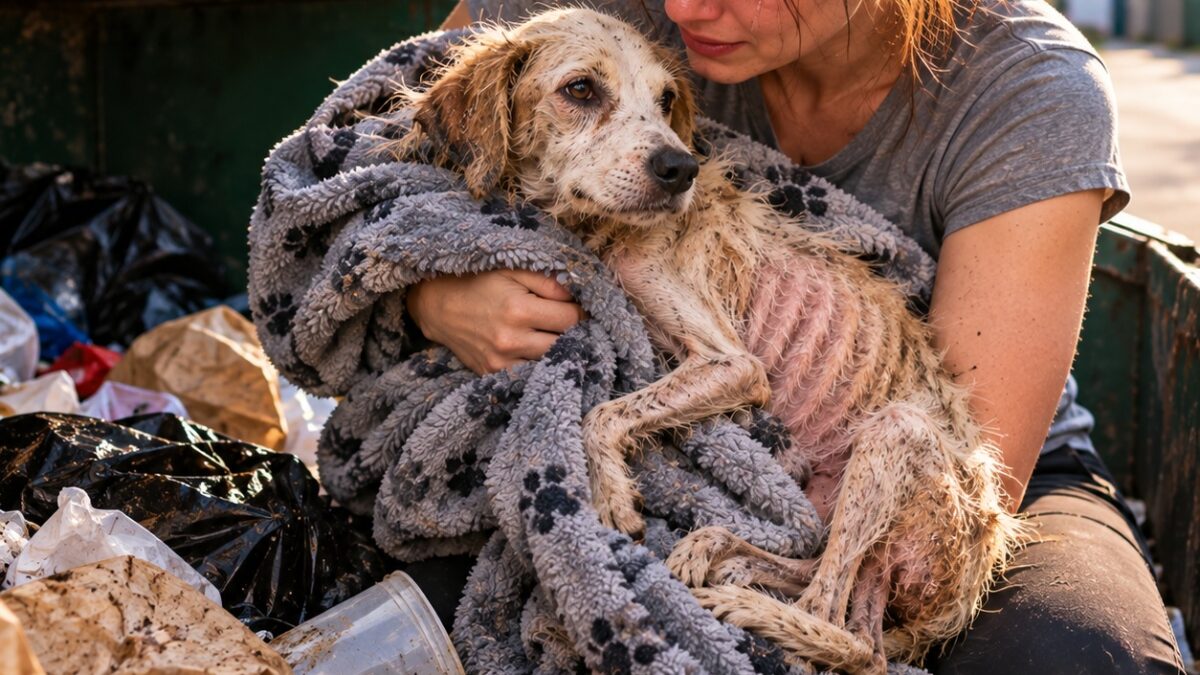
PART2
Waiting beside a critically ill animal is one of the most helpless things I have ever experienced.
You can be surrounded by professionals.
Machines.
Medication.
Blankets.
People who know exactly what they are doing.
And still feel useless.
Because eventually, after all the support is given, the body has to answer.
Fern’s body had spent so long losing.
Losing weight.
Losing strength.
Losing heat.
Losing the ability to stand.
We were asking it to reverse direction.
No one could promise that it would.
The veterinary team worked to stabilize her.
Her temperature had to come up.
Shock had to be addressed.
She had to tolerate fluids and whatever care her condition required.
Even water was not something we could treat casually.
Fern was so weak that a few tiny drops mattered.
I watched her mouth.
Watched every swallow.
Things that would be invisible in a healthy dog became milestones.
She took a little.
Good.
She kept it down.
Good.
Her eyes stayed open a little longer.
Good.
The blankets held warmth around her.
Good.
None of those things meant she was safe.
They meant she was still here.
That first evening, I stayed as long as I could.
Leaving felt impossible.
Every part of me wanted to sit beside her all night.
But eventually I had to go home.
I remember standing near her hospital bed before I left.
Fern looked impossibly small under the blankets.
Her body almost disappeared into them.
I told her I would come back.
I knew how meaningless that promise might be.
She might not understand the words.
And there was a possibility I would return to a bed without a living dog in it.
That thought followed me home.
I could not stop seeing the dumpster.
Then the hospital bed.
Dumpster.
Bed.
Trash.
Blankets.
Heat outside.
Dangerous cold inside Fern’s body.
The images kept replacing each other.
I lay down.
I did not sleep.
Every few minutes I checked the time.
Midnight.
1:18.
2:43.
4:05.
Morning seemed impossibly far away.
I kept thinking:
Is she still alive right now?
Is she sleeping?
Is she worse?
Are they working on her?
Did her body decide it had had enough?
You cannot bargain with a dog’s physiology from another room.
I tried anyway.
Just make it to morning.
That was all I asked.
Not recovery.
Not walking.
Not home.
Morning.
Give us morning.
When daylight finally came, I returned as soon as I could.
I walked into the hospital afraid to look at anyone’s face.
I think I knew that if the news was bad, I would see it before someone spoke.
Then I saw Fern.
Still there.
Alive.
She looked fragile.
Nothing about her suddenly looked healthy.
But her chest moved.
Her eyes opened.
I felt something in me release.
Not completely.
Fear remained.
But morning had arrived, and Fern had arrived with it.
I pulled a chair beside her.
I sat down.
And that was when I made the promise.
I told her that if she became strong enough to leave the hospital, she was coming home with me.
No more garbage.
No more wondering where she belonged.
No more ending up somewhere no living thing should be left.
“You make it out of here, and you’re coming with me.”
Her eyes were tired.
I do not know whether she understood anything.
The promise was partly for me.
I needed Fern’s future to have somewhere to go.
Until then, everything had been about preventing death.
That morning, I allowed myself to imagine life.
A door.
A house.
A bed.
Sunlight through a window.
Water available whenever she wanted it.
Food given carefully and consistently.
A name called because someone expected her to respond.
Home.
There was a life waiting for Fern now.
The only thing standing between her and that life was whether her body could survive long enough to reach it.
The changes came slowly.
So slowly that sometimes I wondered whether I was imagining them.
Fern started moving her legs.
Not standing.
Not walking.
Movement.
Her paws shifted.
A leg stretched slightly.
Tiny things.
But after seeing her unable to lift her head, movement felt enormous.
I became obsessed with watching for those signs.
A paw.
An ear.
Her eyes tracking someone.
Anything showing us she was becoming more connected to her own body.
Then came the little barks.
The first one was so faint I almost did not recognize it.
A tiny sound.
Not impressive.
Not loud.
Not the bark of a healthy dog demanding dinner or warning a squirrel to leave the yard.
Fern barely had enough energy to make it.
But she made it.
I laughed and cried at the same time.
“You have something to say now?”
Another tiny sound.
The dog who arrived unable to lift her head had found enough strength to use her voice.
That changed the room.
The medical situation was still serious.
She was still desperately weak.
Nobody relaxed simply because she barked.
But personality had entered the crisis.
Until then, Fern had mostly been a patient.
A body people were trying to stabilize.
Now there was suddenly a little dog inside the medical emergency.
A dog with a voice.
A dog who could respond.
A dog who seemed increasingly interested in what was happening around her.
That difference mattered.
When an animal is critically ill, illness takes over everything.
You stop seeing who the animal might be.
You see temperature.
Hydration.
Shock.
Weight.
Whether she can swallow.
Whether her body is tolerating treatment.
Gradually, Fern began taking up more space than those questions.
Not physically.
She was still tiny.
But as herself.
During her treatment, she needed a plasma transfusion.
That was another moment that reminded me how serious everything remained.
Improvement did not mean easy.
Fern’s body still required significant medical support.
People sat beside her.
Held her paw.
Talked softly.
I watched hands around her and thought about where those paws had been before.
Inside a dumpster.
Now somebody was holding one carefully as if it were something precious.
That contrast stayed with me.
She had been treated as disposable.
Now every heartbeat mattered.
Every test mattered.
Every little change mattered.
Every paw mattered.
That is what rescue can do before an animal is even recovered.
It changes the value surrounding the life.
Fern had always had value.
Humans had simply failed to behave as though she did.
Now people were behaving differently.
The hospital team kept working.
I kept visiting.
And Fern kept answering.
Not dramatically.
Not consistently.
Recovery rarely moves like that.
One day can feel better.
The next can feel frightening again.
When you care about the outcome, every small setback feels enormous.
You begin building emotional meaning around things that would not matter to anyone else.
She seems more tired today.
Why?
She moved less.
Is that bad?
She barked yesterday.
Why not today?
You have to discipline yourself not to turn every hour into a verdict.
Fern needed time.
Her body had been starving for far longer than I had known her.
It could not undo that damage according to my emotional schedule.
So I learned to watch without demanding.
That may have been the hardest part.
I wanted progress because progress would mean she was safer.
But wanting progress can become pressure if you are not careful.
Fern did not owe me improvement because I had promised her a home.
She did not have to stand to deserve that promise.
If she left the hospital with limitations, the promise remained.
If recovery was slower than I wanted, the promise remained.
Home was not a reward for getting well enough.
It was waiting because Fern existed.
That distinction helped me.
It let me stop treating every therapy milestone like an exam.
Fern was not passing or failing.
She was recovering at whatever pace her body allowed.
When she was strong enough, the veterinary team began carrying her outside.
Not walking her.
Carrying her.
That first trip into the open air became another moment I will never forget.
Think about the first place I saw her outdoors.
A dumpster.
Sweltering heat.
Trash.
Her body nearly gone.
Now people carried her carefully into the sunshine.
Not abandoned in it.
Held.
Protected.
The breeze moved over her fur.
She lifted her head more than she had before.
There was something almost painful about how simple the moment was.
A dog feeling air.
Sun.
Nothing extraordinary.
Yet when almost everything has been taken from a life, ordinary experiences become enormous.
Fern had survived long enough to feel a breeze again.
That mattered.
We stayed only as long as was appropriate.
No need to turn the moment into something more than her body could handle.
Then she went back inside.
Rest.
More care.
More waiting.
Those outdoor moments became something I looked forward to.
Not because they proved recovery.
Because they reminded me what recovery was for.
Not to produce better numbers on a chart.
Not to create an inspiring story.
To give Fern access to life.
Breeze.
Sunshine.
A home someday.
Maybe a soft place to sleep.
The right to be a dog rather than a medical emergency.
That was the goal.
Then came the ICU moment that changed everything.
Fern tried to get up.
No one had staged it.
No one held a treat across the room demanding she perform.
She simply tried.
At first, I thought she was shifting position.
Then I realized what she was doing.
Her front legs moved underneath her.
Her body lifted.
The back end followed awkwardly.
Her legs shook immediately.
The muscles had almost nothing to give.
She wobbled.
Every person watching seemed to stop breathing.
“Easy.”
Someone stayed close.
Ready to catch her.
Fern trembled.
For a second, I thought she would collapse.
Maybe she would.
That would have been okay.
Trying was enough.
Then somehow, impossibly, she held herself up.
Standing.
Fern was standing.
The dog I had lifted from a dumpster because she could not raise her own head was carrying her body on her legs.
Not steadily.
Not beautifully.
But she was up.
I covered my mouth.
I think I was afraid making noise would somehow break the moment.
Fern looked uncertain.
Her legs shook harder.
Then one paw moved.
Forward.
A step.
Tiny.
Unsteady.
Then another.
I started crying before I realized it.
There are moments when the body reacts before your mind has found words.
That was one.
Step.
Fern.
Step.
Everything in me went back to the first day.
The trash.
The stillness.
Her eyes opening.
My hands lifting her.
The vet team warming a dangerously cold body.
The question of euthanasia.
The first night when I did not know whether morning would come.
My promise beside the bed.
And now this dog was moving in front of us under her own strength.
Another step.
It did not matter that she wobbled.
The wobble was beautiful.
A wobbling dog is still upright.
A trembling leg is still carrying weight.
Fern had nothing to prove.
Yet every unstable movement felt like a declaration.
I am still here.
I can move.
I am trying.
Those few steps meant everything.
Not because they guaranteed a perfect recovery.
They did not.
Because they showed how far Fern had already come.
Her body had stopped moving only toward collapse.
Now it could move forward.
Literally.
That changed hope.
Before standing, hope had been abstract.
Numbers improving.
More response.
Tiny barks.
Leg movement.
All meaningful.
But when Fern took those steps, the future became visible.
You could imagine her walking through a doorway.
You could imagine her crossing a room.
You could imagine her reaching a bed on her own.
You could imagine home.
I had promised that home before I knew whether she would ever stand.
Now I could see her moving toward it.
From that point, Fern continued growing stronger.
Again, not in one giant leap.
Her body had endured starvation and shock severe enough to nearly kill her.
Strength had to return gradually.
Standing once did not mean standing all day.
Walking a few steps did not mean walking normally immediately.
But the direction had changed.
Each day, she had more life available to use.
You could see it.
There is a look critically ill animals have when their energy is being rationed for survival.
Everything is reduced.
Movement.
Attention.
Reaction.
Then, if recovery comes, the world begins to re-enter them.
Fern started noticing more.
Responding more.
Moving more.
Her little barks no longer seemed impossible.
They belonged to her now.
Her body began feeling less like something we were protecting from collapse and more like something Fern was beginning to use again.
I stopped entering the ICU expecting catastrophe.
That shift took time.
Fear had become habit.
Even when Fern looked better, part of me remained prepared for bad news.
Trauma is not only something the animal carries.
People who witness it can become conditioned too.
The first time I walked toward Fern’s bed and realized I was smiling before I reached her, I noticed.
There had been a time when every step toward that room felt like approaching a verdict.
Now I was going to see my dog.
I had already started thinking of her that way.
My dog.
Not officially home yet.
Still under medical care.
But in my mind, the promise had changed possession.
It was no longer:
If she makes it, maybe I can do this.
It was:
When she is ready, I am taking her home.
That certainty felt good.
Maybe Fern felt something changing too.
Again, I refuse to pretend I knew her exact thoughts.
I know what I saw.
More response.
More engagement.
A dog who had been almost absent from her own body becoming present.
It is tempting to describe rescue as bringing an animal “back.”
But where was Fern going back to?
The source gives no safe previous home.
No happy family.
No normal life we can restore.
So maybe recovery was not a return.
Maybe it was the first time Fern had access to the kind of life we consider ordinary.
Warmth.
Care.
Someone waiting.
A future tied to a home instead of garbage.
That made the promise feel even more important.
I was not trying to restore a known past.
I was offering something new.
The day the veterinary team told me Fern was finally ready to leave the ICU, I had imagined it so many times that the actual words almost did not register.
Ready to leave.
Fern.
Ready.
I stared at them.
“Really?”
I must have asked that more than once.
Not because I doubted them.
Because some part of my mind was still stuck on the dumpster.
The distance between those two images felt too large for one dog to cross.
But she had crossed it.
Slowly.
Warm blankets.
Stabilization.
Care.
Tiny water.
Plasma.
Hands holding her paw.
Sunshine carried in arms.
Leg movement.
Barks.
Standing.
Steps.
Strength.
All of those moments formed a bridge.
Fern had crossed it.
I went to get her.
This time, I was not arriving to sit beside a dog whose future might end overnight.
I was arriving to keep my promise.
Home was waiting.
I remember looking at Fern before we left and feeling something complicated.
Joy, obviously.
Relief.
But also anger at how close the world had come to never seeing this version of her.
Someone had allowed her to become so starved that she ended up inside a dumpster unable to lift her head.
Had I arrived later, maybe there would have been no open eyes to notice.
No tiny movement.
No ICU.
No promise.
No steps.
That possibility makes every healthy moment afterward feel enormous.
Fern did not know any of that.
She simply knew people were moving around her.
Then I lifted her again.
The first time I carried Fern, I was taking her away from garbage.
I did not know whether she would survive the ride.
The second time I carried her away from a major threshold, I was taking her out of the ICU.
Toward home.
Same dog.
Completely different meaning.
The first carry was emergency.
The second was arrival.
I held her carefully.
Looked down at her.
“You did it.”
Maybe that sounds like too much credit to a dog whose survival depended heavily on veterinary care.
But survival is cooperative.
Medicine can support a body.
The body still has to respond.
Fern did.
Again and again.
The hospital team gave her chance after chance.
She used them.
Now the promise I made beside her bed was becoming real.
She was leaving.
With me.
There is something almost sacred about bringing a rescue animal through a front door for the first time after seeing where she came from.
The source ends with me taking Fern home, so I will not invent what happened in the weeks or months afterward.
I will not create a scene where she sleeps in a particular bed.
I will not claim she meets other animals.
I will not invent toys, favorite foods, habits, or a forever transformation the source does not provide.
The truth already gives us enough.
Fern went home.
That sentence contains everything I needed from the ending.
Not back to the dumpster.
Not to an unknown foster placement.
Not somewhere temporary while I decided what to do.
Home.
With the person who found her.
With the person who sat beside her hospital bed and promised.
The promise had conditions only because Fern’s body had to become medically strong enough to leave.
My commitment did not.
I had decided.
She had somewhere to go.
That changes what recovery feels like.
A hospital can keep a dog alive.
Home gives the survival somewhere to belong.
I thought about the first night again.
The hours.
The clock.
My fear that Fern might die before I returned.
At the time, I could not imagine leaving the hospital with her.
The future was too large.
I was asking only for sunrise.
Then sunrise came.
And after sunrise, another day.
And another.
The little barks.
The legs moving.
The plasma transfusion.
Sunshine.
Standing.
Steps.
ICU discharge.
A future becomes less impossible when built one small day at a time.
That may be Fern’s whole story.
She did not leap from dying to safe.
She moved through tiny thresholds.
Eyes open.
Water.
Warmth.
Morning.
Movement.
Voice.
Treatment.
Outside.
Standing.
Step.
Step.
Home.
When people hear rescue stories, they often focus on the dramatic contrast.
Dumpster to home.
Dying to walking.
Those contrasts are powerful.
But if you skip the middle, you miss where the real work lived.
The middle was waiting.
The middle was uncertainty.
The middle was people holding a paw when no one knew what tomorrow looked like.
The middle was caring for Fern before she could repay anyone with progress.
That is what gave the ending integrity.
No one knew whether the story would become inspiring.
They helped anyway.
That matters.
If we only help when we know the ending will be good, we are not choosing the animal.
We are choosing the story.
Fern had no guaranteed story.
She looked like she might die.
She might have.
The veterinary team took that possibility seriously.
So did I.
There were moments when letting her go seemed like it might become the compassionate choice.
The reason the decision to continue mattered is because we did not make it blindly.
We watched Fern.
Her response.
Her medical condition.
Her ability to tolerate care.
The chance remained.
So we took it.
And Fern kept meeting us there.
I still think about the moral weight of that first decision.
It would be easy, after seeing the outcome, to say:
Of course we had to keep going.
Look how well she did.
That is hindsight.
At the time, there was no walking Fern available to prove us right.
There was only the dog in shock.
The dangerously low temperature.
The starvation.
The inability to stand.
We had to decide based on the dog who existed then.
Not the dog we hoped to have later.
That is why quality of life matters so much in rescue.
Hope has to remain honest.
Fern gave us reasons to continue.
The medical team believed stabilization was possible enough to try.
We tried.
Then her body began answering.
That is the story.
Not “never give up” as a blind rule.
Give a fair chance when a fair chance exists.
Then listen.
Fern’s first clear answer was survival through the first night.
Then movement.
Then sound.
Then standing.
Then walking.
Each answer allowed the next question.
Can she make it until morning?
Yes.
Can she respond?
Yes.
Can she become stronger?
Yes.
Can she stand?
Yes.
Can she step?
Yes.
Can she leave?
Eventually, yes.
Then my answer:
Can she come home?
Absolutely.
I do not know what Fern remembers.
We should be careful about assigning human narratives to dogs.
I do not know whether a dumpster became a memory she revisited.
I do not know whether she understood abandonment.
What I know is what her body experienced.
Heat around her.
Dangerously low internal temperature.
Hunger.
Weakness.
Then warmth.
Touch.
Treatment.
Sun.
Support.
Movement.
The body keeps its own kind of history even when we cannot translate it.
The most important thing is that her present changed.
A dog once lying among discarded things was being carried somewhere because one person had decided she would never be treated like something disposable again.
That reversal is enough.
I have wondered many times what would have happened if I had not looked carefully.
Fern did not bark to get my attention.
Did not stand.
Did not move toward me.
Her rescue began because I noticed her eyes.
Open.
That tiny detail.
If I had looked only at the body and assumed death, I might have walked away.
That thought still frightens me.
It also taught me something.
Sometimes the difference between “too late” and “still time” is a second look.
Check.
Get closer.
Look for breath.
Look at the eyes.
Do not make the final assumption from a distance.
Fern was still there.
The world had almost lost her because she was too weak to announce it.
That first day, her life could not advocate for itself loudly.
Someone else had to notice.
Later, she found her bark.
I loved that progression.
From silent to vocal.
From motionless to walking.
From discarded to chosen.
Fern kept gaining ways to participate in her own life.
At first, we did everything.
Lift.
Warm.
Offer water.
Treat.
Carry outside.
Then she moved a paw.
She barked.
She tried to stand.
She stepped.
That shift from being entirely cared for to becoming physically active again was emotionally overwhelming.
You want an animal to regain agency.
Not simply survive because humans maintain every function around her.
You want to see choices return.
Fern’s steps were the first visible piece of that.
Step toward what?
It almost did not matter.
The point was that she could.
Mobility opens a world.
Even one unstable step says:
I can change where I am.
For a dog found trapped inside a body that could not move itself out of a dumpster, that mattered more than I can explain.
I remember seeing her legs shake and thinking:
Please do not hurt yourself.
At the same time:
Please keep going if you can.
That is the tension of rehabilitation.
Protect.
But allow effort.
Catch.
But do not remove every chance to try.
Fern tried.
Those steps became one of the defining moments of her story.
But I think the first promise mattered just as much.
Not because words have magic.
They do not.
Fern did not recover because I said she could come home.
She recovered because of veterinary care, support, time, and her body’s response.
The promise mattered because it changed my role.
I was no longer only the person who found her.
I had become the person waiting for her future.
There is power in waiting for someone.
Fern had been discarded as though no one would notice whether she lived.
Now someone was planning around her survival.
Space existed for her in a home she had never seen.
That is what choosing an animal means before adoption paperwork or routine can happen.
You reorganize the future to include her.
I had done that before Fern was strong enough to stand.
Everything after that felt like watching her move toward a place already reserved.
When she left the ICU, I did not feel like I had won something.
I felt like Fern had finally reached the next part.
Not the ending.
The next part.
That matters.
Home is not the end of healing.
The source does not tell us what followed, so I will not pretend it does.
Fern may still have needed time.
Strength.
Adjustment.
Whatever her veterinary team recommended.
Recovery does not stop because a hospital door closes.
But going home changes the emotional landscape.
Hospital care is necessary.
Home says:
You belong to a future larger than treatment.
You are not only a patient.
You live here now.
That is why the final image I keep is not the first time Fern stood.
It is me taking her home.
The standing proved her body was coming back.
Home proved her life had somewhere to go.
I think about the dumpster and the front door as two opposite symbols.
One represented disposal.
The other belonging.
The dumpster said:
No one wants this.
The door said:
Come in.
The dumpster was where somebody expected Fern’s story to disappear.
The door was where I intended the rest of it to begin.
Everything in between existed because people refused to accept the first message as the final one.
Warm blankets contradicted the garbage.
A hand holding her paw contradicted abandonment.
Plasma contradicted neglect.
Sunshine carried in someone’s arms contradicted being left alone in heat.
Standing contradicted helplessness.
Home contradicted every part of being discarded.
That is why her story stays with me.
The rescue was not simply medical.
It was a sequence of opposites.
Cold body.
Warm blankets.
Silence.
Bark.
Unable to move.
Steps.
Trash.
Home.
Every part of Fern’s recovery answered something that had been taken from her.
Not perfectly.
Not immediately.
But enough.
I will probably always remember the first moment I wondered whether euthanasia might be kinder.
That memory used to make me feel guilty.
Now it does not.
Compassion sometimes asks difficult questions.
Loving an animal does not mean demanding survival at any cost.
It means considering the animal’s suffering honestly.
What changed the decision was not fear of grief.
It was the fact that Fern still had a reasonable enough chance and began showing signs that she was responding.
We chose the chance.
She used it.
That is a beautiful outcome.
It would have been unfair to turn that outcome into proof that the hard question should never be asked.
It should.
Because Fern’s welfare mattered more than my desire for an uplifting ending.
The reason the ending feels so good is that it became good for her.
Not merely for us.
Standing gave her more ability.
Walking gave her more freedom.
Leaving the ICU reduced the intensity of medical crisis.
Going home gave her continuity.
Those are meaningful improvements to Fern’s life.
That is why I celebrated.
Not because I wanted to say:
Look what I saved.
I did not save Fern alone.
No one did.
The team saved her medically.
The blankets mattered.
Treatment mattered.
The transfusion mattered.
Monitoring mattered.
Fern’s response mattered.
Care was collective.
My promise was only one piece.
But it was my piece.
I could not perform the medical work.
I could give Fern a home if she reached it.
So that is what I did.
There is humility in rescue when you do it right.
Know what you can provide.
Let professionals do what they know.
Do not turn the animal into a trophy.
Do not make every milestone about yourself.
The dog is the one living the consequences.
Fern taught me that quickly.
Every decision had to answer:
Is this helping her?
Not:
Does this make me feel like a good person?
Those are very different questions.
Sometimes helping meant staying close.
Sometimes it meant leaving so the medical team could work.
Sometimes it meant accepting slow progress.
Sometimes it meant being scared and not letting Fern carry my fear.
Eventually, it meant taking her home.
I look back at the hospital photographs in my mind.
Fern under blankets.
Paw in a hand.
Her little body almost disappearing beside the equipment around her.
Then I remember her upright.
Legs trembling.
Step.
Another.
I will never stop being amazed by that contrast.
But I also do not want the first Fern to become only a tragic “before” picture.
She was already worthy then.
That is important.
People sometimes celebrate transformed rescue dogs as though they became valuable by getting healthy.
No.
Fern was valuable in the dumpster.
She was valuable when she could not stand.
She was valuable before the bark.
Before plasma.
Before the first step.
If she had remained disabled, she would still have been Fern.
Walking was a victory because it gave her freedom.
It was not proof that saving her had been justified.
Her life justified care before anyone knew the result.
I wish more people understood that.
We often ask what an animal can become.
Healthy?
Adoptable?
Easy?
Beautiful?
Friendly?
Those are human questions.
Sometimes the first responsibility is simpler.
Is she suffering?
Can we help?
Does a fair chance exist?
Fern had a fair chance.
Tiny at first.
But real.
That was enough.
The first night, I asked only for morning.
Eventually, I got to ask for much more.
That still feels like a gift.
Morning.
Then another.
Then a bark.
Then sunshine.
Then standing.
Then walking.
Then home.
The progression became almost like a list I repeated whenever fear returned.
Look how far she has already come.
The dog who could not lift her head moved her legs.
The dog who could barely take water barked.
The dog whose body was shutting down stood.
Sometimes remembering progress is the only way to survive uncertainty.
Fern was teaching us to look backward only long enough to see distance.
Then forward again.
When she finally walked out of the ICU phase of her life, I felt the promise beside her hospital bed return in full.
I had said there was a life waiting.
Now there was.
Me.
A home.
Whatever ordinary days would follow.
Ordinary is what I wanted most.
Not constant milestones.
Not endless medical drama.
I wanted Fern to eventually have days nobody would find inspiring enough to tell strangers about.
A day where nothing happened.
A day where she rested.
A day where she ate.
A day where no one wondered if she would survive.
Those are the best days after crisis.
Boring means the emergency is gone.
I cannot tell you, from the source, whether Fern reached every version of that ordinary life.
But I know where the story leaves her.
Alive.
Stronger.
Out of the ICU.
Going home.
That is enough to satisfy me.
Because the story began with no future at all.
The dumpster was a place for endings.
Fern turned it into a beginning.
Not alone.
Never alone again.
When I carried her toward home, I thought about the words I had said beside her bed.
If you get strong enough to leave, I will take you home.
Promises are easy when they cost nothing.
This one had already cost fear.
Time.
Emotional attachment.
The possibility of heartbreak.
I would have made it again.
Because Fern deserved to know, even if only through actions, that someone’s commitment to her did not depend on convenience.
She had already experienced the opposite.
Somebody had allowed her to end up inside garbage.
I wanted the next chapter built on something completely different.
Reliability.
She survives?
I am there.
She needs time?
I wait.
She stands?
I celebrate.
She wobbles?
I stay close.
She walks?
I cry.
She is cleared to leave?
I show up.
That is love before the sentimental parts.
Show up.
Again.
Fern’s hospital team showed up too.
Every shift.
Every treatment.
Every assessment.
I think about the people who held her paw.
It is such a small image.
You cannot medically cure a dog by holding her paw.
But medicine and comfort do not compete.
A body can receive both.
Fern needed plasma.
She also needed gentleness.
The two belong together.
There are forms of suffering medicine addresses.
There are forms of fear a quiet presence helps.
Rescue works best when both matter.
Fern’s tiny barks may be my favorite sign of that emotional shift.
Sound means effort.
It also means participation.
The dog found silent had something to say.
Maybe complaint.
Maybe attention.
Maybe nothing more than reflex.
I do not need to interpret it perfectly.
I loved hearing it.
The first bark meant the room contained enough Fern for a voice.
That was progress.
Later, the standing gave her another kind of voice.
Physical.
No words.
Just trembling legs saying:
I can carry myself for this second.
Then another second.
Then a step.
I have replayed that moment so many times I worry I have worn it smooth in memory.
But one detail never changes.
Nobody looked at her as though the wobbling was failure.
We were overwhelmed because she was trying at all.
That is something animals deserve from us.
Celebrate direction, not perfection.
Fern did not need perfect steps.
She needed safe attempts.
The people around her understood that.
That is why her first movements became confidence instead of pressure.
I do not know exactly how Fern felt going home.
Excited?
Tired?
Confused?
Dogs do not narrate transitions for us.
Maybe she simply knew she was with the same person whose voice had become familiar.
That was enough.
For me, the drive felt completely different from the rush to the hospital.
The first time, every minute had been an emergency.
I wanted traffic lights to change.
Wanted roads to shorten.
Wanted the car to become faster than physics allowed.
Going home, urgency had changed into protection.
Take the turn gently.
Keep Fern comfortable.
Get there.
No panic.
I could breathe.
That difference alone told me how far we had come.
A drive that began as:
Please do not die.
Became:
We are going home.
Few sentences in my life will ever feel farther apart.
I carried Fern through a doorway knowing I had no idea what every future day would look like.
That is normal.
Nobody does.
But uncertainty had changed too.
Hospital uncertainty was:
Will she survive?
Home uncertainty was:
Who will she become now that survival is no longer the only question?
That is the best kind of unanswered question.
I wanted to learn her.
Preferences.
Personality.
What made her comfortable.
What made her curious.
The source ends before those details.
They belong to whatever came next.
And I respect that boundary.
Sometimes a story does not need to tell us everything to give us a complete emotional ending.
Fern did not have to become perfect.
She only had to reach the place promised to her.
She did.
Home.
That is where I leave her too.
Not in the dumpster.
Not under the blankets.
Not wobbling in the ICU.
Moving forward.
With me.
Toward a life she almost never got to see.
If I close my eyes, I can still see the first image.
Garbage.
Heat.
A motionless dog.
Then her eyes.
That is the hinge.
Everything changes at the eyes.
They were open.
She was alive.
That was all the permission rescue needed.
Not a guarantee.
A fact.
Alive.
And because she was alive, we acted.
Because we acted, she reached morning.
Because she reached morning, we gave her another day.
Because enough days accumulated, her legs moved.
Her voice returned.
Her body responded.
She stood.
She stepped.
She left.
The future was built from that chain.
No single moment owns the miracle.
Even the first steps depend on everything before them.
That is why I try to remember the whole story instead of only the dramatic parts.
The warm blankets matter.
The people holding her paw matter.
The sleepless night matters.
The plasma transfusion matters.
The little barks matter.
Being carried into sunshine matters.
The promise matters.
The steps matter.
Home matters.
Each piece carries another.
That is recovery.
If anyone had shown me Fern on the day I found her and said:
This dog will stand.
She will walk.
You will take her home.
I do not know whether I would have believed them.
Hope felt almost disrespectful at first because the situation was so severe.
Then hope changed from imagination to evidence.
That is the kind of hope I trust.
Not denial.
Evidence.
Eyes open.
Still alive.
Morning.
Still alive.
Paws moving.
Still fighting.
Bark.
Still present.
Stand.
Still stronger.
Step.
Moving.
Home.
That was Fern’s answer.
I remember wondering whether letting her go would be kinder than asking her to endure.
I am glad we asked the question.
I am grateful the answer became:
Not yet.
Not today.
Give her the chance.
Because somewhere inside the body I found among trash was a dog capable of standing.
No one could see her yet.
Not even me.
But she was there.
Not a hidden “better” version that made the sick Fern less worthy.
The same Fern.
The one whose eyes opened.
The one who accepted tiny drops of water.
The one under warm blankets.
The one whose paw someone held.
The one who eventually placed that paw on the floor and moved forward.
Same dog.
That continuity is what makes the story beautiful.
We did not replace a broken Fern with a healthy Fern.
We stayed long enough for Fern herself to become stronger.
And in the end, when the hospital said she was ready, I got to do the thing I had promised beside her bed on the morning after I thought I might lose her.
I picked her up.
I held her close.
And this time, I was not carrying her away from a place where someone had thrown her out.
I was carrying her toward the place where someone had chosen to keep her.
Home.







