PART2:I Fell Paralyzed in the Snow on New Year’s Eve—My Golden Retriever Stayed on Top of Me for 20 Hours Until Someone Finally Heard Her
PART2
There is something cruel about being able to see safety when you cannot reach it.
If I had fallen somewhere deep in the woods, maybe my mind would have understood the situation differently.
Remote.
Isolated.
Miles from shelter.
But I was home.
That was the part I could not get past.
The door was close.
The warmth was close.
The telephone was close.
Dry clothes were close.
Everything I needed existed only a few yards away.
My body had turned those few yards into another world.
I tried moving.
Tried finding some part of myself that would respond differently.
The neck injury had changed everything in a single second.
I could not simply roll over, crawl, drag myself back inside, or push up and stand.
What had been the most ordinary task of my evening had become a life-threatening accident.
Kelsey did not leave.
That is the detail people tend to focus on now, and they should.
But lying there, I did not experience it as the beginning of some heroic story.
She was simply there.
Warm fur.
Breathing.
Weight against me.
Then barking.
Her body became one of the few things I could still feel as immediate and dependable.
Cold came from everywhere else.
Twenty-four degrees does not sound as frightening when you are dressed for winter and moving.
When you are lying still on frozen ground without a coat, it becomes something completely different.
The cold does not need drama.
It simply keeps taking.
Heat.
Energy.
Clarity.
Time.
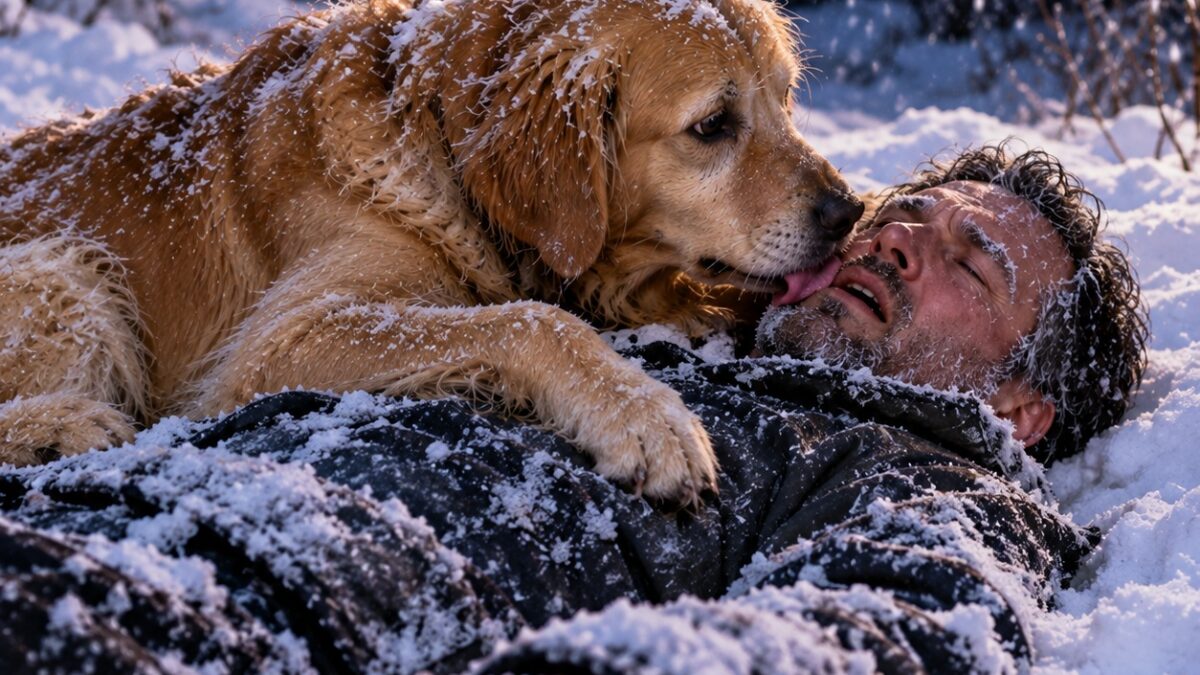
Kelsey lay over me as much as she could.
She kept close.
Her warmth mattered.
The fact that she remained beside me mattered just as much.
Every so often, she licked my face.
My hands.
I was conscious.
I knew enough to understand that staying awake mattered.
The cold was dangerous.
The injury was dangerous.
Being alone outside for hours was dangerous.
Kelsey kept interacting with me.
Touch.
Warmth.
Sound.
She would bark toward the darkness.
Then stay with me.
She never ran off searching somewhere else.
She never decided there was nothing more she could do.
Later, I said it as simply as I knew how.
She kept barking for help but never left my side.
That was Kelsey.
Calling outward.
Staying with me.
Both.
Hours passed.
Night in northern Michigan in winter feels different when you cannot move.
The darkness seems permanent.
There are no normal markers of time.
No walking to a clock.
No changing television programs.
No getting another drink.
No turning lights off.
You remain in one place while the cold deepens and your body becomes less reliable.
I called for help until calling became harder.
My throat suffered from the effort.
I had screamed again and again with everything I could produce.
No answer.
At some point, my voice faded.
By morning, it was gone.
That frightened me.
Until then, as helpless as I was physically, I had still possessed one tool.
My voice.
I could call.
Maybe someone would hear.
Maybe a neighbor would happen to step outside.
Maybe sound would travel just far enough.
Then even that was taken away.
I tried.
Nothing useful came.
Kelsey still had her voice.
She used it.
Morning arrived.
New Year’s Day.
2017 had begun.
People talk about New Year’s mornings as fresh starts.
Resolutions.
Possibility.
I was still in the same snow where I had fallen the previous year.
That is literally what happened.
I stepped outside in 2016.
I was still lying there in 2017.
The calendar changed.
My situation did not.
Kelsey continued barking.
It is difficult to explain how important that became emotionally.
When your own voice is gone, hearing another living creature continue calling on your behalf means something beyond the sound itself.
She was doing what I could no longer do.
I did not have to wonder whether she had become tired of trying.
She had not.
Her barking continued.
Then she would come close again.
Lie across me.
Lick me.
Stay.
The hours after sunrise were not some sudden rescue.
That is important.
Morning did not bring a neighbor.
Daylight did not solve anything.
The sun rising did not mean someone could suddenly see me.
I remained outside.
Hour after hour.
Cold.
Injured.
Unable to get up.
At some point, the concept of time became almost meaningless.
You stop thinking in neat hours.
You think in endurance.
Still here.
Still conscious.
Kelsey still here.
Still cold.
Still no one coming.
The body protects itself in ways you do not consciously control.
Hypothermia was developing.
Severe hypothermia, I would later learn.
At the time, I did not need a diagnosis to know the cold had become part of the emergency.
My thoughts were affected.
My strength was affected.
Everything was being reduced.
Kelsey kept pressing her body against mine.
Later, the doctors would credit her with helping keep me alive.
There is no way I can know exactly what my body temperature would have become without her.
I only know she stayed warm against me through a freezing night and much of the following day.
And when doctors evaluated me afterward, despite roughly twenty hours outside, I had no frostbite.
Not one place.
That still amazes me.
I had gone outdoors in long johns, a shirt, and slippers.
No winter coat.
No heavy boots.
No gloves.
No plan to survive an entire night.
The dog was the only piece of insulation I had not planned for.
Kelsey had chosen herself.
As the day went on, exhaustion became overwhelming.
I had already spent the night injured and exposed.
Now daylight hours kept accumulating.
The human body has limits no amount of determination can negotiate with forever.
Around nineteen hours after the fall, I lost consciousness.
That is another frightening part of the story for me.
As long as I was awake, I was at least present inside the fight.
I could hear Kelsey.
Understand, however imperfectly, where I was.
Once I became unconscious, none of that remained under my control.
I could no longer encourage her.
Could not listen for vehicles.
Could not measure whether the cold felt worse.
Could not call, even silently.
From that moment, whatever happened next depended completely on somebody else discovering us.
Kelsey stayed.
I know that because she was there when help finally arrived.
She did not leave after I stopped responding.
Think about that.
For hours, she had received some reaction from me.
Voice.
Movement of my face.
Awareness.
Then I became unconscious.
To her, whatever connection she had been receiving suddenly changed.
She still stayed.
She continued calling.
A dog does not need medical training to understand when a person is terribly wrong.
Kelsey knew enough.
And she refused to walk away.
Late that afternoon, a neighbor came toward my house.
It was around 6:30 p.m. on New Year’s Day.
He had come to borrow eggs.
The randomness of that detail still feels impossible to me.
Not a search party.
Not someone who knew I was missing.
Not police already looking.
A neighbor needing eggs.
An ordinary reason.
A routine visit.
Except before he could simply arrive, Kelsey was making noise.
Not an ordinary bark anymore.
A piercing howl.
Something that carried.
Something different enough to draw attention.
That sound reached him.
Kelsey had been barking for help for hours.
By then, her call was doing the work my voice could no longer do.
My neighbor found me.
Finally.
After nearly twenty hours.
Help came.
From that moment, the situation changed from survival in place to emergency medicine.
I was rushed to McLaren Northern Michigan hospital in Petoskey.
I do not remember those transitions the way a fully conscious person would.
By then my body had been through too much.
The cold.
The neck injury.
The hours.
The loss of consciousness.
But eventually the full medical picture became clear.
Severe hypothermia.
Two herniated discs in my neck.
Pressure on my spinal cord.
Paralysis.
Those words explain what my body had been telling me in the snow.
The reason I could not simply get up.
The reason fifteen feet became impossible.
Something had happened in my neck severe enough that the spinal cord was being compressed.
That pressure was causing the paralysis.
A neurosurgeon, Dr. Chaim Colen, took over the part of the fight Kelsey could not.
If Kelsey’s job had been to get me to a doctor alive, Dr. Colen’s job was to deal with the damage inside my neck once I arrived.
He operated.
The goal was to relieve the pressure on my spinal cord and stabilize my spine.
Surgery is another kind of helplessness.
You place your body in someone else’s hands because there is nothing else to do.
But compared with the snow, I was finally where I needed to be.
Warm.
Surrounded by medical care.
The injury understood.
A plan.
The uncertainty was still enormous.
Surviving outside did not guarantee movement.
The spinal cord had been under pressure.
Paralysis had already happened.
No one could make a casual promise about exactly how much function would return.
I had survived one crisis.
Now another question began.
What would my body do after surgery?
Then movement started returning.
That sentence can sound simple when you say it quickly.
It was not simple to live.
Movement.
Something I had taken for granted before stepping outside for firewood.
A body normally obeys hundreds of commands without asking you to celebrate.
Move hand.
Shift leg.
Stand.
Reach.
Walk.
Then one injury can make the smallest response feel enormous.
After surgery, when signs of movement began coming back, I understood ordinary movement differently.
Dr. Colen had relieved the pressure.
My spine had been stabilized.
Now rehabilitation lay ahead.
Intensive rehabilitation.
Survival did not mean I could simply walk out and resume life exactly where the commercial break had interrupted it.
Recovery would require work.
Time.
Patience.
But work is different from hopelessness.
Rehabilitation meant there was something to work with.
Possibility.
I had spent nearly twenty hours outside not knowing whether anyone would even find me.
Now I had doctors talking about recovery.
That was already a different world.
And then Kelsey came to visit me.
I had seen her last in the snow.
Or, more accurately, my last conscious experiences outside included her.
Her warmth.
Her barking.
Her licking my face and hands.
Her body beside mine.
Then hospital.
Surgery.
Brace.
Medical equipment.
When she came near me again, she did what Kelsey did.
She came to me.
I was wearing a neck brace.
She licked my face above it.
The dog who had spent the freezing night trying to keep me awake was beside me again after surgery.
There is no way to describe that moment without sounding sentimental.
So I will not try to hide from it.
I was emotional.
How could I not be?
I knew by then what the doctors thought about what she had done.
She had helped keep me warm.
She had continued calling for help after I could no longer call.
She had stayed after I lost consciousness.
She had howled loudly enough for the neighbor to notice.
Without Kelsey, there was a very real possibility that the story ended outside my house.
Not because the hospital could not help.
Because I might never have reached the hospital in time.
I called Kelsey and Dr. Colen my two heroes.
I meant it.
They did different jobs.
You cannot compare them as though heroism is a competition.
Dr. Colen had the training to operate on my neck.
He relieved the pressure threatening my spinal cord.
He stabilized my spine.
That gave me the opportunity to regain movement and begin rehabilitation.
Kelsey had no medical training.
She had instinct.
Loyalty.
A warm body.
A voice.
She used everything she had.
One helped restore my ability to move.
The other made sure I was alive long enough to receive that help.
Those are my two heroes.
People sometimes hear Kelsey’s story and describe her as extraordinary.
She was.
But what interests me now is how ordinary the beginning was.
A man needs firewood.
A dog is home.
Commercial break.
Fifteen feet.
That is all.
No dangerous expedition.
No blizzard adventure.
No deliberate risk.
Life can split open in places we consider safe.
That realization stayed with me.
My own yard nearly became the place I died.
Safety had been visible the entire time.
That door only steps away.
I think about it more than I would like.
If I had fallen a little differently, what would have happened?
If Kelsey had been inside and unable to reach me?
If the neighbor had not needed eggs?
If he had come an hour later?
There is no useful way to answer those questions.
They lead into versions of the story that did not happen.
The version that happened includes Kelsey.
That is enough.
She heard me.
Came out.
Stayed.
I can tell you what she did.
She lay across my body.
She licked my face and hands.
She barked.
She kept barking when I no longer could.
She stayed when I became unconscious.
She howled.
Someone heard.
Sometimes a life is saved through a chain of actions so basic each individual one seems almost too simple.
Stay warm.
Stay awake.
Make noise.
Do not leave.
Kelsey could do those things.
So she did.
Again and again.
For nearly twenty hours.
That repetition matters.
It is easy to imagine a dog barking for several minutes.
Maybe half an hour.
Then wandering.
Getting hungry.
Going inside.
Following another smell.
Kelsey remained in the emergency with me.
Night into morning.
Morning into afternoon.
Afternoon toward evening.
A dog has no concept of a twenty-hour rescue narrative.
She had the moment.
I am here.
Bob is here.
Bob is not getting up.
Stay.
That may be the purest kind of loyalty.
Not understanding the whole problem.
Only understanding you do not leave the person inside it.
The temperature was about twenty-four degrees.
People later asked how I avoided frostbite.
There are probably multiple factors in any case like mine, and doctors can explain cold injury better than I can.
But Kelsey’s warmth was repeatedly credited.
She covered me.
Pressed against me.
I had a living blanket whose only goal seemed to be staying close.
I think about her fur differently after that.
A golden retriever’s coat is something you brush.
Something that leaves hair on furniture.
That night it was insulation.
Her entire body became equipment in a rescue she had never trained for.
She did not know she was preventing heat loss.
She only knew closeness.
That was enough.
The licking mattered too.
People describe her licking my face and hands to keep me alert.
Again, Kelsey did not understand hypothermia protocols.
She understood interaction.
Stay responsive.
Pay attention to me.
Wake up.
Maybe that was all.
Yet that simple behavior helped during a night when losing consciousness too early could have been disastrous.
The barking became more important as the hours passed.
At first, it accompanied my own yelling.
Later, it replaced it.
My voice was gone by morning.
Imagine realizing your dog has become your only alarm system.
I could not call 911.
Could not reach a phone.
Could not crawl.
Could not get to the door.
Could not shout effectively anymore.
Kelsey was the emergency signal.
Every bark was another attempt.
Every howl another possibility that someone might finally notice.
Dogs bark all the time.
At delivery trucks.
Squirrels.
Neighbors.
Sometimes nothing visible.
People learn to ignore it.
Kelsey somehow kept making enough sound that eventually one particular howl reached the right person at the right moment.
My neighbor was close enough to investigate.
That was the break we needed.
I have thought a lot about how rescue often depends on ordinary human curiosity.
You hear something strange.
You check.
Maybe it is nothing.
Maybe it is a dog barking at a deer.
Or maybe a man has been lying paralyzed in freezing weather for almost a day.
That neighbor came to borrow eggs.
The errand seems almost absurd beside the outcome.
But life is like that.
Enormous events arrive inside ordinary reasons.
A commercial break sent me outside.
Eggs brought someone close enough to hear Kelsey.
Two mundane things marking opposite ends of twenty hours.
One sent me into danger.
The other helped bring help.
At McLaren Northern Michigan hospital, the details became clinical.
Severe hypothermia.
Herniated discs.
Spinal-cord pressure.
Paralysis.
Those words are cleaner than the experience.
Medicine has to name problems precisely.
That is how people treat them.
For me, each diagnosis connected back to something physical.
Hypothermia meant the cold I had felt taking over.
Disc injury meant the fall.
Spinal-cord pressure meant the body that refused to get up.
Paralysis meant the impossible distance between me and my front door.
Dr. Colen looked at images and saw what could be treated.
That ability still amazes me.
I had spent the night inside the consequences without knowing the anatomy.
He could identify the mechanism.
Then operate.
One of my heroes was a dog operating entirely on instinct.
The other was a neurosurgeon operating with years of specialized training.
Both were exactly what I needed.
That contrast makes the story almost unbelievable.
Kelsey got me through the wilderness that existed in my own yard.
Dr. Colen dealt with the injury inside my spine.
Neither could have replaced the other.
Suppose the neighbor had found me immediately but there were no surgeon capable of relieving the pressure.
Different story.
Suppose the best neurosurgeon in the world was waiting at the hospital, but I died of exposure before anyone knew I was outside.
Different story.
Survival needed the chain intact.
Kelsey.
Neighbor.
Emergency response.
Hospital.
Dr. Colen.
Surgery.
Rehabilitation.
People often want one hero.
Real life usually gives you a sequence.
Kelsey became the most emotionally powerful part because she chose to stay without being told.
No dispatcher.
No training.
No reward.
No understanding that newspapers might someday tell people what she had done.
Dogs do not perform loyalty for reputation.
She stayed because she was Kelsey.
That humbles me.
The hours I spent conscious outside gave me plenty of time to experience fear.
But after the fact, another emotion became stronger.
Gratitude.
That takes time.
Immediately after an emergency, your mind is overwhelmed.
Pain.
Medical decisions.
Surgery.
Can I move?
What happens next?
Only later do you start reconstructing what other people—or in this case, another animal—did around you.
Kelsey could have left.
She did not.
She could have gone back inside if a door allowed.
Could have wandered.
Could have tired of barking.
Could have stopped interacting when I stopped responding.
She did none of those things.
The phrase “never left my side” can sound cliché.
In my story, it was literal.
She never left my side.
That is why she was there at the end.
Still calling.
Still waiting.
I wonder what those hours were like for her.
We cannot know.
I refuse to invent some detailed inner monologue for a dog.
But behavior tells us enough.
Something was wrong with her person.
She remained close.
She vocalized.
She maintained contact.
When I became unresponsive, she continued.
That is all the evidence of loyalty I need.
The reunion after surgery gave me one of the first moments where the entire experience seemed to form a complete circle.
Her face near mine.
Tongue against my skin above the brace.
Same behavior.
Different environment.
Outside, the licking had been part of survival.
Inside, it became affection again.
That change affected me.
The emergency had not changed who Kelsey was.
She was still the dog who wanted close contact with me.
Her ordinary affection had become lifesaving only because circumstances demanded it.
Now circumstances were changing back.
Maybe that is what I wanted most.
Ordinary Kelsey.
Not permanent rescuer.
Dog.
Companion.
Family.
She had done enough.
I still had rehabilitation ahead.
Intensive rehabilitation.
Surgery opens a door.
You still have to walk—or work—through recovery afterward.
Movement returning did not mean everything returned instantly.
The spinal cord had been compressed.
My neck stabilized.
My body needed rehabilitation.
The future required effort.
But effort felt like a privilege after helplessness.
In the snow, I could not make my body obey.
In rehabilitation, I could participate.
Try.
Repeat.
Improve.
That distinction is enormous.
Before rescue, the goal was simply:
Do not die.
After surgery:
Recover what you can.
Those are very different lives.
Kelsey had helped move me from one into the other.
I sometimes imagine the commercial break.
If there were a way to speak to myself standing beside the television before going outside, what would I say?
Put on a coat?
Probably.
Wear boots?
Yes.
Carry a phone?
Definitely.
But hindsight is cheap.
People step outside their homes underdressed all the time because they plan to be out for seconds.
You do not build every daily action around the worst event imaginable.
The useful lesson for me was not to spend life blaming that version of myself.
It was to recognize how quickly circumstances change and how dependent we sometimes are on others.
I had lived independently.
Walk fifteen feet.
Carry firewood.
Simple.
Then one fall reduced my world to the body lying on the ground and the dog beside it.
Independence can disappear in a second.
That experience changes pride.
It should.
I survived because I needed help.
First from an animal.
Then from a neighbor.
Then emergency workers.
Then physicians.
Then rehabilitation professionals.
There is no shame in that.
Kelsey certainly did not think less of me because I could not stand.
She adjusted.
That may be another lesson dogs give better than people.
They respond to what is needed.
No lecture.
No embarrassment.
You are down?
I lie with you.
You cannot call?
I bark.
You stop responding?
I stay.
Simple.
The human world sometimes complicates care with questions about deserving, independence, inconvenience.
Kelsey skipped all of that.
Her loyalty was practical.
Warmth.
Noise.
Presence.
I have wondered whether she sensed the cold affecting me.
Dogs notice changes in people we miss.
Smell.
Breathing.
Movement.
Maybe she noticed.
Maybe she simply wanted contact.
Again, exact motivation is less important than outcome.
Her body helped conserve warmth.
Her licking encouraged alertness.
Her barking sought help.
Her howl contributed to discovery.
Facts are powerful enough.
We do not need to turn her into something supernatural.
Kelsey was a dog.
That is what makes it so remarkable.
A five-year-old golden retriever used ordinary dog behaviors extraordinarily well in an emergency.
Lie close.
Lick.
Bark.
Stay.
Nothing she did required human language.
Everything mattered.
The “no frostbite” detail still surprises people.
It surprises me too.
Severe hypothermia but no frostbite after that exposure.
Again, I do not claim Kelsey was the only biological reason.
Medicine is rarely that simple.
But the doctor credited her role in keeping me alive.
That is enough.
I know what her warmth felt like.
I know she covered me.
I know what I wore.
I know how long I was out there.
I know the result.
I left that night in slippers.
I reached the hospital alive.
Kelsey belongs in the explanation.
At some point after the story became known, people began calling her heroic.
I agreed, but I also knew hero was not a role she thought she was filling.
When she visited, she did not carry herself like she had accomplished something famous.
She wanted me.
That was all.
She licked my face.
Dogs are wonderfully resistant to human ceremony.
You can call them heroes.
They still want the person.
Food.
A familiar hand.
Maybe a ball.
That helped me.
My life had become medical very quickly.
Doctors.
Spinal cord.
Surgery.
Brace.
Movement.
Rehabilitation.
Kelsey arrived and made the room personal again.
I was Bob.
She was Kelsey.
Same relationship.
Medical crisis did not erase it.
That kind of continuity matters after trauma.
Everything else can feel unfamiliar.
Your body unfamiliar.
Hospital room unfamiliar.
Future uncertain.
Then the dog you know walks in.
Suddenly something is exactly what it always was.
Love.
That was grounding.
I called Dr. Colen a hero because he worked on the problem nobody else could see with bare eyes.
The herniated discs.
Pressure.
Spinal cord.
Technical skill.
Precision.
Kelsey worked on the problem everyone could understand.
A man was freezing alone.
Stay with him.
Two kinds of expertise.
One learned over years.
One instinctive.
I owe both.
If I had to reduce those twenty hours to one image, I do not think it would be the fall.
It would be Kelsey lying across me.
Darkness.
Snow.
Golden fur.
Her body between mine and the cold.
The simplicity of it.
One living thing using itself to protect another.
No equipment.
No planning.
Nothing but presence.
And then sound.
Her bark traveling where I could not.
That is how she became my voice after mine disappeared.
By morning, I had yelled until I could no longer produce what I needed.
Kelsey did not know that my throat had given out in the technical sense.
She knew nobody had come.
So she kept making noise.
There is persistence in dogs that humans sometimes underestimate.
They can repeat a behavior far beyond the point we would become self-conscious or discouraged.
Kelsey did not think:
I have barked all night and nobody came, so clearly this is useless.
She barked again.
And later, the howl mattered.
Persistence eventually reached someone.
That detail has stayed with me because people often stop when help does not come immediately.
You call once.
Knock once.
Try once.
Kelsey had no concept of wasted effort.
Her person needed help.
Make sound.
Repeat.
If I could thank her in language she understood, maybe gratitude would be simple too.
Stay close.
Good girl.
Touch.
Love.
She does not need my explanation of spinal injury.
She knows we are together.
That is enough.
People reading this know the end.
That changes how the middle feels.
You know the neighbor arrives.
You know I reach the hospital.
You know surgery succeeds in relieving the pressure.
You know movement begins returning.
When I lived the middle, I knew none of that.
That is important.
Heroic stories become neat after survival.
Inside them, they are uncertainty.
Night.
Cold.
No answer.
Voice gone.
Daylight but no rescue.
Hours.
Loss of consciousness.
Kelsey did not know the ending either.
She stayed inside uncertainty.
That makes her loyalty more meaningful.
She did not stay because she knew someone was coming at 6:30.
She stayed because leaving me was not an option to her.
I think about that whenever people use the word devotion.
Devotion is easy when the outcome is guaranteed.
The deeper form continues when nothing changes for hours.
Kelsey’s devotion had duration.
Nearly twenty hours.
Cold.
Fatigue.
Repeated failure to get attention.
Still there.
One of the great ironies is that the neighbor came for eggs.
Eggs.
It makes people smile because the scale is so mismatched.
Someone nearly dying.
A dog performing an all-night rescue.
And the human entrance into the story is:
Could I borrow eggs?
But that ordinary errand was exactly enough.
If the neighbor had no reason to approach the house, perhaps the howl would not have been heard.
Life often turns on things too small to look significant beforehand.
A commercial.
A log.
A slip.
A dog.
Eggs.
Then a neurosurgeon.
No storyteller could make that sequence look less random.
Reality did not care.
Afterward, rehabilitation became my next long stretch of repetition.
Kelsey had done hers.
Bark.
Stay.
Lick.
Warm.
Now I had mine.
Whatever the rehabilitation team asked.
Try.
Repeat.
Regain.
I had an example.
Kelsey had spent hours doing the same lifesaving things without visible evidence anyone was coming.
Rehabilitation asks a similar patience.
Progress is not always immediate.
Movement can return gradually.
You do the work because small changes accumulate.
I had no excuse to complain too much with Kelsey’s example sitting in my mind.
Of course I still had hard moments.
A dog’s heroism does not remove the frustration of recovery.
But it gave the frustration context.
I was alive to be frustrated.
Alive to work.
Alive to wonder how much movement would return.
Those are privileges compared with the alternative.
Severe hypothermia could have ended differently.
Spinal-cord compression could have ended differently.
The neighbor could have arrived too late.
He did not.
I am grateful for timing I did not control.
That experience made gratitude less abstract.
People say they are grateful for another day.
After New Year’s Eve 2016, I understood the phrase literally.
Another day was what Kelsey helped me get.
Then Dr. Colen helped me make that day more functional.
Rehabilitation helped build the days after.
I do not need some grand moral beyond that.
Life is physical.
Warmth matters.
Movement matters.
A voice matters.
Someone hearing matters.
Care matters.
The story makes those basics impossible to ignore.
Kelsey is a golden retriever.
Goldens are known for closeness with people.
But breed stereotypes do not explain twenty hours.
Kelsey’s individual relationship with me does.
She knew her person.
She stayed.
That is why I prefer talking about what she did rather than turning her into a generic symbol of dogs being loyal.
Dogs are individuals.
Kelsey made individual decisions inside that night.
Remain close.
Bark.
Lick.
Howl.
Those behaviors became my lifeline.
Maybe another dog would have behaved differently.
Kelsey behaved exactly as I needed.
That makes gratitude personal.
My dog.
My hero.
The hospital visit after surgery reinforced that.
She did not greet “a patient.”
She greeted me.
Brace or no brace.
Hospital or home.
Her nose knew.
Her eyes knew.
She licked above the brace.
For me, that moment said the emergency had not broken the relationship.
If anything, it revealed what had always been inside it.
I had cared for Kelsey for years.
Fed her.
Sheltered her.
Loved her.
Then for one night and day, those roles reversed in a way I could never have predicted.
She cared for me.
That reversal changes how you think about companion animals.
They are not only recipients of human care.
Relationships can become reciprocal in moments we never plan for.
Kelsey could not operate on my spine.
I could not stay warm alone.
Each life has capacities.
That night, hers covered one of mine.
Later, Dr. Colen covered another.
Maybe heroism is simply using what you have when someone else desperately needs it.
Kelsey had warmth.
Voice.
Presence.
She gave all three.
Dr. Colen had surgical skill.
He gave that.
My neighbor had ears, proximity, and the willingness to investigate a howl.
He gave those.
None alone was the whole rescue.
Together, enough.
The phrase “two heroes” refers to Kelsey and my surgeon, but I also understand how many people become part of any survival story.
Emergency responders.
Hospital staff.
Rehabilitation team.
The neighbor.
People whose names may not end up in headlines.
Kelsey remains the emotional center because she bridged the impossible gap.
From fall to discovery.
That was the period no professional knew I needed help.
She was my only rescuer before rescue officially began.
That distinction is extraordinary.
Hospitals cannot treat a patient they never receive.
Emergency services cannot respond to an incident nobody reports.
Kelsey created the report with her voice.
Not in words.
In persistence.
She transformed private danger into a signal someone could detect.
That is what saved the chain from breaking.
Sometimes I imagine what the scene looked like from outside.
A golden retriever barking hour after hour.
Someone hearing it in the distance might initially think:
Dog being noisy.
The neighbor who arrived heard something different enough to pay attention.
A piercing howl.
Urgency carries its own sound.
Kelsey found it.
There is something almost unbearable about knowing she may have been escalating because I had become unconscious.
Again, I cannot know exactly why.
But the timing matters.
She continued when I no longer could.
That is the essence of what she did.
She took over the functions I lost.
Warmth when I could not move to shelter.
Alerting when I could not reach anyone.
Voice when mine disappeared.
Presence when I lost consciousness.
That is why I survived the waiting period.
Then medical people took over what she could not do.
Perfect handoff, though nobody planned it.
As my movement began returning, I thought about my hands.
Kelsey had licked them outside.
Trying to keep me responsive.
Later, when I could move again, even small movement carried that memory.
Hands.
Arms.
Legs.
Ordinary parts of the body stop being ordinary after paralysis.
You become aware of function as a gift.
Neurosurgery relieved the pressure creating the paralysis.
Rehabilitation would determine how much function I could recover and how well.
I had work ahead.
The story does not end with me instantly fully recovered.
That is important.
Survival stories are often compressed.
Fall.
Dog saves man.
Surgery.
Happy ending.
Real bodies require longer timelines.
I began regaining movement after surgery.
Intensive rehabilitation still lay ahead.
That is where the source leaves the medical arc.
It is enough.
The point is not that Kelsey magically erased a spinal injury.
She kept me alive long enough for medicine to intervene.
Dr. Colen did what a surgeon could do.
My body began responding.
Then rehabilitation continued.
Each part respected reality.
That makes the story stronger than any exaggerated version.
I do not need to say Kelsey “cured” me.
She did something equally important.
She prevented the cold and isolation from ending the story before treatment became possible.
The fact that I had no frostbite became one of the clearest physical signs of her role.
Again, severe hypothermia is serious enough.
But considering the clothing, temperature, duration, and immobility, the absence of frostbite was remarkable.
Kelsey’s warmth belongs in that discussion because the treating doctor credited her.
That is not sentimental speculation.
It is the medical interpretation of a dog’s physical presence.
She was literally useful warmth.
I smile sometimes when I think about all the dog hair people complain about.
Golden retriever fur everywhere.
Furniture.
Clothes.
Car.
People vacuum constantly.
That night, I would not have traded a single strand.
Her coat was part of what stood between me and the cold.
Perspective changes fast.
After something like this, ordinary annoyances become evidence of life.
Dog hair?
Kelsey is here.
Barking?
Good. I know what that voice can do.
Wanting to be close?
Come closer.
The traits that might mildly inconvenience you on a normal day can become the traits that save you on an abnormal one.
Kelsey’s attachment to me was not a behavior to correct that night.
It was rescue.
There is another thing I learned.
Dogs do not measure usefulness the way humans do.
If we cannot solve a problem completely, we sometimes feel helpless.
Kelsey could not move me.
Could not open the door and drag me inside.
Could not phone 911.
Could not understand spinal anatomy.
If she had judged herself by what she could not do, she would have left.
Instead, she did what she could.
Warm.
Lick.
Bark.
Stay.
Enough.
That is worth remembering beyond dogs.
When someone is in crisis, you may not be able to fix the whole situation.
Maybe your role is simply not leaving.
Maybe making the call.
Maybe bringing warmth.
Maybe continuing to ask for help.
Small capacities become large when they match the need.
Kelsey matched mine.
I have replayed the 10:30 decision too many times.
Commercial.
Log.
Door.
Slippers.
People ask whether I became more cautious afterward.
Of course an event like that changes how you think.
But the deepest change was not fear of stepping outside.
It was awareness that ordinary safety can be fragile.
And that relationships matter in practical ways we do not see until tested.
Kelsey had been my companion before New Year’s Eve.
Afterward, “companion” felt almost too small.
She was still my dog.
I did not want to burden her identity with permanent hero status.
But I could never forget that when my body failed, she treated my survival as her responsibility.
That knowledge changes love.
Not into debt.
Dogs do not keep debt ledgers.
Into gratitude.
I owed her good days.
Walks.
Care.
Affection.
The ordinary things she deserved before.
Now I understood them as gifts in both directions.
I wonder sometimes what she thought when she saw me in the hospital.
Dogs notice medical equipment.
Smells.
Movement.
My neck brace certainly changed how I looked.
Yet she did not hesitate to reconnect.
Lick on the face.
Above the brace.
Same Kelsey.
I like that.
Humans can become uncertain around injury.
What do I say?
Where do I touch?
Will this be awkward?
Dogs simplify.
There you are.
I know you.
Affection.
That moment cut through all the machinery.
For a second, I was not the man with two herniated discs.
Not the hypothermia patient.
Not the paralysis case.
I was Kelsey’s person.
That identity felt good.
Dr. Colen’s work gave me the physical possibility of returning to more of myself.
Kelsey reminded me that some part of myself had never disappeared.
The relationship.
Still intact.
That is why I called them both heroes.
One worked from the inside of my body.
One from the outside.
Both protected pieces of me I could not protect alone.
If someone asked which moment frightened me most, I am not sure I could answer.
The fall?
The first attempt to move and realizing I could not?
My voice disappearing?
Losing consciousness?
Each carried a different kind of fear.
But the most surreal may have been the front door.
Always close.
That image remains.
Safety visible but inaccessible.
It taught me that physical ability is something we assume until we cannot.
Fifteen feet can be a universe.
A hand can be useless if the spinal cord cannot send the right signal.
A voice can vanish after hours of screaming.
A house can be warm while you freeze outside it.
What bridges that universe?
Sometimes a golden retriever.
That sounds like a movie line.
It was my life.
Kelsey turned those fifteen feet from a death sentence into a waiting period.
She could not shorten the distance.
She could keep me alive within it.
That distinction matters.
Eventually help moved me.
But survival had to happen first.
The neighbor who came for eggs gave Kelsey’s efforts an endpoint.
Until then she was working with no proof anyone would respond.
Once the neighbor arrived, the signal had succeeded.
That must have changed everything, though I was unconscious.
For people reconstructing the scene later, it was clear.
Kelsey’s howl drew attention.
My neighbor found me.
Emergency care followed.
Sometimes the most satisfying part of a rescue is the moment someone finally understands what the dog has been saying all along.
Kelsey had been saying:
Something is wrong.
Come here.
Hours.
Then someone finally listened.
That thought makes me pay more attention to animals.
Not every bark is an emergency.
Of course not.
But behavior changes matter.
Persistence matters.
A dog communicating unusually deserves curiosity.
The neighbor’s curiosity saved time.
In emergencies, time is life.
I received the time Kelsey bought.
Then Dr. Colen used it.
That is a beautiful handoff when I think about it.
She could not know him.
He could not know what she had done while it was happening.
Yet their work met inside my survival.
Kelsey got Bob to the operating room alive.
Dr. Colen gave Bob a chance to move again.
That is how I summarize it.
Two heroes.
One covered in golden fur.
One carrying surgical expertise.
My rehabilitation became another chapter, but the New Year’s Eve story remained the moment everything turned.
People may think I remember every hour.
Trauma does not work that neatly.
Some moments are sharp.
Others blur.
Cold.
Darkness.
Kelsey.
Calling.
No answer.
Morning.
No voice.
More time.
Then less awareness.
What I remember with certainty is her constancy.
That is why when details blur, the center does not.
Kelsey stayed.
If you remove everything else, keep that.
She stayed.
She stayed while I could speak.
She stayed when I could not.
She stayed when I was conscious.
She stayed after I was not.
She stayed until another human arrived.
Then she later came back to my side in the hospital.
The story begins and ends the same way.
Kelsey beside me.
Only the setting changed.
Snow.
Hospital.
Warmth.
Brace.
The relationship stayed.
That symmetry means something to me.
The first time she lay against me, she was helping preserve my life.
The hospital visit told me that life still contained what I loved.
That was part of recovery too.
People often focus on motor function after spinal injury.
Understandably.
Can you move?
Can you walk?
What returns?
But recovery is psychological too.
Can you imagine going home?
Can you imagine ordinary routines?
Can you see yourself as more than an accident?
Kelsey helped with that without trying.
Her presence belonged to home.
Seeing her brought a piece of home into the hospital.
The dog who had turned my yard into a place of survival now made the hospital feel connected to the life waiting outside.
I needed that.
Rehabilitation is easier to endure when something waits on the other side.
Kelsey did.
That was another kind of promise.
Not spoken.
She had already shown it.
I stay.
Dogs are good at turning verbs into relationships.
Stay is one.
Return is another.
Love, maybe, is repetition.
Kelsey repeated herself for twenty hours.
Stay.
Bark.
Lick.
Warm.
Then repeated the relationship after surgery.
Here I am.
I began thinking about New Year’s differently afterward.
People mark the transition at midnight.
Countdown.
Noise.
Kisses.
Fireworks.
Resolutions.
My New Year crossed over quietly while I was lying in snow.
No countdown.
Maybe distant sounds I do not clearly remember.
For me, the meaningful transition happened hours later when help arrived.
That was my new year.
Being found.
Then later, surgery.
Movement.
Rehabilitation.
The dates matter less than the sequence.
December 31:
I could walk outside.
Then I could not move.
January 1:
I was still outside.
Then I was found.
Life can transform faster than calendars can explain.
That creates humility about planning.
You still plan.
You should.
But you appreciate what is here.
Football.
Fire.
Dog.
Home.
The ordinary scene before the fall became precious in hindsight.
So did the possibility of returning to ordinary scenes afterward.
Maybe that is what recovery is ultimately for.
Not constant awareness of survival.
Returning to life enough that you can forget for a while.
Watch a game.
Sit near a fire.
Have Kelsey nearby.
Ordinary.
I do not want every day to feel like a heroic rescue.
Kelsey did not either.
Heroism should be temporary.
Home should be normal.
But the memory remains useful.
When I look at her, I know what loyalty looked like at twenty-four degrees after midnight.
I know the sound of her commitment.
Bark.
Bark.
Bark.
I know the weight of her warmth.
That knowledge does not disappear because the crisis ended.
It deepens every ordinary moment afterward.
People sometimes say dogs would do anything for us.
That is a broad statement.
I can only speak for mine.
Kelsey did everything she could.
That is more precise.
Everything available to a five-year-old golden retriever in that situation.
Body heat.
Licking.
Vocalizing.
Presence.
She used all of it for as long as necessary.
What more could anyone ask?
She did not perform CPR.
Did not open a phone.
Did not pull me indoors.
Those things were outside her capacity.
Heroism is not possessing impossible abilities.
It is exhausting the useful ones you have.
Kelsey did.
That is why the story inspires people.
Not because she became human.
Because she remained fully a dog and that was enough to save a human life.
I love that.
Her dogness mattered.
Warm coat.
Sensitivity to me.
Persistence.
Voice.
Attachment.
All ordinary characteristics.
Extraordinary result.
Dr. Colen remained my other hero for the opposite reason.
What he did was not ordinary to me at all.
Neurosurgery.
Understanding images.
Relieving spinal-cord pressure.
Stabilizing the spine.
Specialized expertise built through training I could never replicate in an emergency.
We need both kinds of help in life.
Instinctive care.
Expert care.
Kelsey gave the first until I reached the second.
The result was movement returning.
That sequence deserves respect without exaggeration.
I survived.
I began regaining movement.
Intensive rehabilitation remained ahead.
That is the medically honest ending to the immediate crisis.
And Kelsey returned to my side.
That is the emotional ending.
I do not need more.
The future after a spinal injury is complicated enough without inventing a perfect finish.
What mattered then was possibility.
Before the neighbor arrived, possibility was shrinking.
At the hospital after surgery, possibility was expanding.
That is the reversal.
Kelsey held the line long enough for that reversal to happen.
If I had to speak directly to her about it—and if she could understand all the words—I would tell her this:
You did not need to know what was wrong with my neck.
You did not need to know the temperature.
You did not need to understand hypothermia.
You did not need to know my voice was disappearing.
You did not need to know I had lost consciousness.
You only needed to know I was yours.
And you did.
That was enough.
She stayed because I was hers.
Maybe that is the simplest explanation.
Humans use terms.
Owner.
Pet.
Dog.
Companion.
Kelsey reduced it to belonging.
My person is down.
Stay.
I think about that when I hear people describe pets as “just animals.”
The word just becomes difficult after an animal has protected your life for nearly twenty hours.
Kelsey was an animal.
A dog.
Exactly.
That is the amazing part.
Her capacities came from being what she was.
Not from becoming something else.
I did not need her to be a person that night.
I needed my golden retriever.
And she was perfect at being Kelsey.
Warm.
Loyal.
Loud.
Stubborn enough not to leave.
She kept me alive long enough for somebody with different capacities to take over.
Maybe every rescue is a relay.
Kelsey carried the first section farther than anyone could reasonably expect.
My neighbor took the next step by finding me and summoning help.
Emergency personnel transported me.
Hospital staff stabilized me.
Dr. Colen operated.
Rehabilitation continued the work.
A chain.
If one link fails, outcome changes.
Kelsey was the first link after my body failed.
That makes her unforgettable.
Years could pass and I would still know exactly what mattered.
Not the television score.
Not which team was playing.
Not what commercial sent me outside.
Kelsey.
Some memories are stripped down by crisis until only essentials remain.
I remember the cold.
I remember helplessness.
I remember her.
That is enough.
The story gets retold because it has the shape people recognize as extraordinary.
Dog saves owner.
But inside that shape is something quieter.
Dependence.
We need one another.
Humans like to imagine ourselves as the caregivers in our relationships with animals.
Feed.
Shelter.
Protect.
Then one night, the direction reverses.
That should make us more respectful.
Animals are not accessories to human lives.
Relationships have depth we may not understand until circumstance reveals it.
Kelsey revealed ours.
When she licked my face above the neck brace, she was not thinking about what she had earned.
No medal.
No recognition.
No praise.
She wanted contact.
That purity is almost embarrassing compared with human ideas of reward.
She saved me, then acted like the real prize was simply being allowed beside me again.
Maybe that is another reason the moment hit me so hard.
I survived because she refused to leave.
She was happy because I was still there.
Nothing more complicated.
I called her my hero.
She would probably have preferred a good scratch behind the ears.
That is Kelsey.
If I could change one thing about the night, obviously I would avoid the fall.
I would stay inside.
Put on proper clothes.
Carry a phone.
Any of it.
But since I cannot change it, I try to honor what came from it without pretending the suffering was necessary.
Kelsey’s heroism did not require my injury to become meaningful.
She had always been loyal.
The accident simply exposed the scale.
Dr. Colen’s skill existed before I needed it.
The emergency revealed it to me personally.
Sometimes crises do not create good qualities.
They reveal them.
Kelsey did not become devoted at 10:30 p.m.
She already was.
I just learned what that devotion could do.
That realization made me pay more attention to the ordinary years before and after.
A dog following you into another room can feel mundane.
Maybe it is also practice in staying close.
A dog barking when you disappear outside can be annoying.
Maybe it is also evidence that your location matters to her.
A dog insisting on physical contact may shed hair on everything.
Maybe one day that body heat matters more than clean furniture.
You cannot live expecting catastrophe.
But you can appreciate the relationship before catastrophe tests it.
I wish everyone could learn that without falling in the snow.
The final image people often want is Kelsey beside me after surgery.
That is where I would leave the story too.
Not because rehabilitation was finished.
It was not.
Not because every uncertainty disappeared.
It did not.
Because the essential relationship had completed its circle.
I was alive.
Surgery was done.
Movement was beginning to return.
Kelsey was there.
She reached toward my face.
The neck brace separated part of us physically.
She found the skin above it.
Licked me.
Same dog.
Same person.
Different year.
Different room.
Different future.
I thought about the snow.
The darkness.
Her body across mine.
Her bark.
My lost voice.
The hours after I could no longer help myself.
Then I looked at her.
And there was no way I could call her anything less than what she was.
My hero.
One of two.
Dr. Chaim Colen had given me a chance to move again.
Kelsey had given me the chance to reach him alive.
One hero used his hands inside an operating room.
The other used everything she had in the snow.
And for nearly twenty freezing hours, when I could not move, could not reach my door, eventually could not speak, and finally could not even stay conscious, my five-year-old golden retriever kept doing the one thing that mattered most.
She stayed.







